The ultimate jaws on a longhorned beetle!

Some 23 years ago, I departed on my first ex-U.S. insect collecting trip. I was still a youngster—barely into my 30s—but had by then a well developed interest in woodboring beetles of the families Buprestidae and Cerambycidae. I had spent the previous eight years since graduate school collecting these beetles throughout Missouri, work that led to the publication of my faunal treatments of the two families for the state (MacRae 1991, 1994), and even begun collecting insects outside of Missouri in other states such as Texas, Arizona and Florida. Although I was still cutting my teeth as a collector, I yearned for the tropical experience, and in December 1989 to January 1990 I got the chance to spend three weeks in one of the most tropical localities I could imagine—Ecuador! I’ve collected in many countries since then, but that first tropical collecting trip remains one of my most cherished experiences.

Criodion rhinoceros Bates 1870 | Sucumbios Province, Ecuador (New Country Record)

Of course, being as young and green as I was, I didn’t really know what any of the insects I was collecting were beyond family level (if that!), and the numbers were so overwhelming compared to anything I had experienced previously that all I could do was collect as much as I could using the techniques I had figured out to that point, process them all when I got back, and then hold them for the future when I would either study them myself or make them available to other specialists. In the years since, Buprestidae have become the primary focus of my studies, relegating any non-Nearctic Cerambycidae in my collection to the sidelines. Since I don’t now and probably will never do serious work on Neotropical Cerambycidae, I’ve begun sending them to specialists who do work on them for identification or to be utilized as desired in their research. Much of the Cerambycidae were sent to Frank Hovore, an expert of Ecuadorian Cerambycidae who kindly identified them for me before tragically passing away while on a collecting trip to that very country. Some of the larger specimens were not sent, however, because I had used them to create an “Oh wow!” drawer (see photo on My Collection page). After Frank’s passing, I decided to try identifying the longhorned beetles in that drawer, most of which I was able to identify using Larry Bezark’s incredible website, A Photographic Catalogue of the Cerambycidae of the [New] World. There was one, however, that I was not able identify, despite the fact that it seemed to be the most easily identifiable of all due to remarkable horn-like processes arising from the top of the mandibles. I scanned repeatedly through the photos of species in all genera that looked even remotely similar. Criodion seemed most likely, but none of the species photographed sported such unique mandibular armature.

Males sport remarkable horn-like processes arising from the mandibles.

Stumped, I emailed the top photo to Brazilian coleopterist and cerambycid specialist Antonio Santos-Silva (Universidade de São Paulo) and asked for his opinion. He replied that it seemed to be a species of Criodion, noting that the only species of Criodion with this kind of mandible is C. rhinoceros—known only from the Brazilian state of Pará, and a species completely lacking in their collection. I sent him the other photos in this post to give him a better view of the mandibles, and Antonio replied back that both he and colleague Ubirajara Martins agree with the initial ID. My failure to match the specimen with this species in the photographic catalogue was understandable, as this was one of the few species for which no photographs were available. That situation has since been corrected, and the site now features photographs of both male and female specimens—the latter exhibiting quite chunky but not nearly as grossly developed mandibles as the former.

Another view of the male's remarkable mandibular armature

A lateral view of the head resembles that of a rhinoceros!

Bates’ (1870) original description, based only on the male, notes that the spines arise from the upper edge of the mandibles near the middle and incline towards each other, crossing at the apices and giving the head of the beetle, viewed in profile, the curious resemblance to that of a rhinoceros. Certainly no other species in the genus bears such extraordinary modifications of the mandibles, and if there are others in the family, I am not aware of them and they must be very few in number. One can only speculate on the function of such a modification, but since they are present only on the males a sexual or mating-related function could be considered likely. If any reader has information or thoughts about extreme mandibular modifications such as this and their possible functional significance please let me know.

Males sport remarkable horn-like processes arising from the base of the mandibles

And of course, the BitB face shot!

The collection of this species in Ecuador adds another species to that countrys’ already rich cerambycid fauna (Antonio confirmed that it is a new record for Ecuador). I’ve picked up a smattering of other Cerambycidae from South America over the past ten years, so I’m going to send them all to Antonio for ID and allow him to keep whatever is interesting for his research or the University’s collection. I will include this remarkable species in the package as a gift—considering its status as the only known voucher for the species in Ecuador, I think his institution’s collection will be a more appropriate repository for it than my “Oh wow!” drawer.

REFERENCE:

Bates, H. W. 1870. Contributions to an insect fauna of the Amazon Valley (Coleoptera, Cerambycidae). Transactions of the Entomological Society of London 1870:243–335, 391–444.

MacRae, T. C. 1991. The Buprestidae (Coleoptera) of Missouri.  Insecta Mundi 5(2):101–126.

MacRae, T. C. 1994. Annotated checklist of the longhorned beetles (Coleoptera: Cerambycidae and Disteniidae) known to occur in Missouri. Insecta Mundi 7(4) (1993):223–252.

Copyright © Ted C. MacRae 2013

Let’s make a deal!

buprestid

Image source unknown

I recently conducted a complete reorganization of the jewel beetles (superfamily Buprestoidea) in my collection (TCMC). The primary purpose of this was to bring the nomenclature and arrangement of the collection into agreement with the recently published World Catalogue of Buprestoidea (Bellamy 2008) and accurately document the taxa represented in the collection and their numbers. In the short term this will be helpful not only in visualizing what is represented but also what is missing (particularly in North America), while longer term it lays the groundwork for the eventual donation of my collection to a public institution.

In an active, working collection, no inventory is ever fully up-to-date. In my case, the inventory includes only completely curated material that has been incorporated into the main cabinets. I still have several years worth of material in various states of curation—i.e., unmounted, mounted but unlabeled, or labeled but unidentified. That said, the main collection now contains more than 23,000 specimens of Buprestoidea representing 1,500+ species worldwide. Of the species represented, 37% are Nearctic (U.S./Canada), 22% Palearctic (Europe, North Africa, temperate Asia), 19% Neotropical (Latin America), 10% Afrotropical (Subsaharan Africa), 7% Indomalayan (tropical Asia) and 6% Australian (Australia/New Zealand). The collection also contains 492 paratype specimens representing 77 species. The inventory has been converted to  PDF and uploaded for access by the link below. It lists all of the species represented, with nomenclature updated and taxa arranged according to Bellamy (2008) and number of specimens  indicated for each. Also indicated are higher taxa not yet represented in the collection (shown in gray rather than black text) so that the collection holdings can be placed in context of a complete higher classification for the superfamily.

 Click to see full inventory of TCMC Buprestoidea

Of course, as a North American, the Nearctic fauna is the primary focus of my taxonomic and biological studies. As a result, I am keen to have the Nearctic fauna represented as completely as possible in my collection. Currently I have 75% (595) of the 790 species and non-nominate subspecies currently recognized in North America. Obviously, by now I’ve picked most of the low-hanging fruit, and the last 25% will be much more difficult to get. Many of these are truly rare species that I may never find (some are known only by the holotype), while others are more common but occur in areas that I have limited opportunity to visit. These species are also indicated in the above inventory (again, in gray text) but are also listed below for easy reference. If you have any of the species on this list, please let me know and also what you might like to receive in exchange for them. I have not only many species of Buprestidae from around the world to offer, but also beetles in other families such as longhorned beetles (Cerambycidae), tiger beetles (Cicindelinae), scarabs (Scarabaeoidea), and even non-beetles such as treehoppers (Membracidae) and cicadas (Cicadoidea). Let’s make a deal!

REFERENCE:

Bellamy, C. L. 2008. World Catalogue and Bibliography of the Jewel Beetles (Coleoptera: Buprestoidea),  Volumes 1–5. Pensoft Series Faunistica, 3125 pp.

Copyright © Ted C. MacRae 2013


T.C.MacRae Collection Desiderata

Family SCHIZOPODIDAE LeConte 1859
Subfamily SCHIZOPODINAE LeConte 1859
Tribe SCHIZOPODINI LeConte 1859

Genus Schizopus LeConte 1858
sallei ssp. sallei Horn 1885
sallei ssp. nigricans Nelson 1991
Genus Dystaxia LeConte 1866
elegans Fall 1905

Family BUPRESTIDAE Leach 1815
Subfamily POLYCESTINAE Lacordaire 1857
Acmaeoderioid lineage sensu Volkovitsh 2001
Tribe HAPLOSTETHINI LeConte 1861

Genus Mastogenius Solier 1849
arizonicus Bellamy 2002
puncticollis Schaeffer 1919

Tribe ACMAEODERINI Kerremans 1893
Subtribe ACMAEODEROIDINA Cobos 1955

Genus Acmaeoderoides Van Dyke 1942
cazieri Nelson 1968
depressus Nelson 1968

Subtribe ACMAEODERINA Kerremans 1893

Genus Acmaeodera Eschscholtz 1829
— Subgenus Acmaeodera (s. str.)
audreyae Westcott & Barr 2007
bryanti Van Dyke 1953
comata LeConte 1858
consors Horn 1878
cubaecola Jaquelin du Val 1857
discalis Cazier 1940
dolorosa ssp. liberta Fall 1922
fattigi Knull 1953
flavosticta Horn 1878
horni Fall 1899
inyoensis Cazier 1940
laticollis Kerremans 1902
morbosa Fall 1899
pubiventris ssp. panocheae Westcott 2001
recticolloides Westcott 1971
starrae Knull 1966
subbalteata LeConte 1863
thoracata Knull 1974
tildenorum Nelson & Westcott 1995
wheeleri Van Dyke 1919

Genus Acmaeoderopsis Barr 1974
prosopis Davidson 2006
rockefelleri (Cazier 1951)
varipilis (Van Dyke 1934)

Genus Anambodera Barr 1974
nebulosa (Horn 1894)
santarosae (Knull 1960)

Polyctesioid lineage sensu Volkovitsh 2001
Chrysophana generic group [tribal level] sensu Volkovitsh 2001

Genus Beerellus Nelson 1982
taxodii Nelson 1982

Polycestioid lineage sensu Volkovitsh 2001
Tribe POLYCESTINI Lacordaire 1857

Genus Polycesta Dejean 1833
— Subgenus Polycesta (s. str.)
angulosa Jacquelin du Val 1857
— Subgenus Polycesta (Arizonica) Cobos 1981
arizonica ssp. acidota Cazier 1951
— Subgenus Polycesta (Tularensia) Nelson 1997
crypta Barr 1949

Tribe TYNDARINI Cobos 1955
Subtribe TYNDARINA Cobos 1955

Genus Paratyndaris Fisher 1919
— Subgenus Paratyndaris (s. str.)
anomalis Knull 1937
crandalli Knull 1941
grassmani Parker 1947
quadrinotata Knull 1938

Subfamily CHRYSOCHROINAE Laporte 1835
Chrysochroid lineage sensu Bellamy 2003
Nanularia generic group [tribal level] sensu Volkovitsh 2001

Genus Nanularia Casey 1909
cupreofusca Casey 1909
pygmaea (Knull 1941)

Tribe CHRYSOCHROINI Laporte 1835
Subtribe CHALCOPHORINA Lacordaire 1857
Texania generic group sensu Volkovitsh 2001

Genus Texania Casey 1909
langeri (Chevrolat 1853)

Tribe POECILONOTINI Jakobson 1913
Subtribe POECILONOTINA Jakobson 1913

Genus Poecilonota Eschscholtz 1829
ferrea (Melsheimer 1845)
montana Chamberlin 1922
viridicyanea Nelson1997

Dicercioid lineage sensu Bellamy 2003
Tribe DICERCINI Gistel 1848
Subtribe HIPPOMELANINA Holynski 1993

Genus Hippomelas Laporte & Gory 1837
martini Nelson 1996
parkeri Nelson 1996

Genus Gyascutus LeConte 1858
— Subgenus Gyascutus (s. str.)
jeanae (Nelson 1988)
pacificus (Chamberlin 1938)

Genus Barrellus Nelson & Bellamy 1996
femoratus (Knull 1941)

Subtribe DICERCINA Gistel 1848
Dicerca generic group sensu Volkovitsh 2001

Genus Dicerca Eschscholtz 1829
dumolini (Laporte & Gory 1837)
hornii nelsoni Beer 1974
lugubris LeConte 1860
mutica LeConte 1860
sexualis Crotch 1873
spreta (Gory 1841)
tuberculata (Laporte & Gory 1837)

Subfamily BUPRESTINAE Leach 1815
Buprestioid lineage sensu Volkovitsh 2001
Buprestinioid branch sensu Volkovitsh 2001
Tribe BUPRESTINI Leach 1815
Subtribe TRACHYKELINA Holynski 1988

Genus Trachykele Marseul 1865
fattigi Knull 1954
opulenta Fall 1906

Subtribe BUPRESTINA Leach 1815

Genus Buprestis Linnaeus 1758
— Subgenus Buprestis (Cypriacis) Casey 1909
intricata Casey 1909
prospera Casey 1909
— Subgenus Buprestis (Knulliobuprestis) Kurosawa 1988
fremontiae Burke 1924
— Subgenus Buprestis (Stereosa) Casey 1909
apricans Herbst 1801
decora Fabricius 1775

Anthaxioid lineage sensu Volkovitsh 2001
Anthaxiinioid branch sensu Volkovitsh 2001
Tribe ANTHAXIINI Gory et Laporte 1839

Genus Anthaxia Eschscholtz 1829
— Subgenus Anthaxia (Haplanthaxia) Reitter 1911
carya Wellso & Jackman 2006
caseyi ssp. sublaevis Van Dyke 1916
— Subgenus Anthaxia (Melanthaxia) Rikhter 1944
barri Bílý 1995
californica Obenberger 1914
cupriola Barr 1971
emarginata Barr 1971
embrikstrandella Obenberger 1936
exasperans Cobos 1958
furnissi Barr 1971
helferiana Bílý 1995
hurdi Cobos 1958
nanula Casey 1884
neofunerula Obenberger 1942
nevadensis Obenberger 1928
oregonensis Obenberger 1942
porella Barr 1971
sculpturata Barr 1971
serripennis Obenberger 1936
strigata LeConte 1859
subprasina Cobos 1959
tarsalis Barr 1971
wallowae Obenberger 1942

Tribe XENORHIPIDINI Cobos 1986
Subtribe XENORHIPIDINA Cobos 1986

Genus Hesperorhipis Fall 1930
hyperbola ssp. californica Knull 1947
jacumbae Knull 1954
mirabilis ssp. mirabilis Knull 1947

Chrysobothrioid lineage sensu Volkovitsh 2001
Melanophilinioid branch sensu Volkovitsh 2001
Tribe MELANOPHILINI Bedel 1921
Subtribe MELANOPHILINA Bedel 1921

Genus Phaenops Dejean 1833
carolina (Manee 1913)
caseyi (Obenberger 1944)
obenbergeri (Knull 1952)
vandykei Obenberger 1944

Chrysobothrinioid branch sensu Volkovitsh 2001
Tribe ACTENODINI Gistel 1848

Genus Actenodes Dejean 1833
arizonicus Knull 1927
mimicus Knull 1964

Tribe CHRYSOBOTHRINI Gory et Laporte 1838

Genus Chrysobothris Eschscholtz 1829
— Subgenus Chrysobothris (s. str.)
aeneola LeConte 1860
bacchari Van Dyke 1923
bicolor Horn 1894
bisinuata Chamberlin 1938
bispinosa Schaeffer 1909
boharti Van Dyke 1934
breviloboides Barr 1969
caurina Horn 1886
chamberliniana Fisher 1948
costifrons ssp. costifrons Waterhouse 1887
culbersoniana Knull 1943
cupressicona Barr & Westcott 1976
deserta Horn 1886
dolata Horn 1886
fragariae Fisher 1930
grindeliae Van Dyke 1937
helferi Fisher 1942
hidalgoensis Knull 1951
horningi Barr 1969
hubbardi Fisher 1942
idahoensis Barr 1969
kelloggi Knull 1937
knulli Nelson 1975
nelsoni Westcott & Alten 2006
oregona Chamberlin 1934
orono Frost 1920
paragrindeliae Knull 1943
potentillae Barr 1969
pseudacutipennis Obenberger 1940
pubilineata Vogt 1949
purpurata Bland 1864
roguensis Beer 1967
schaefferi Obenberger 1934
schistomorion Westcott & Davidson 2001
scitula Gory 1841
sexfasciata ssp. sexfasciata Schaeffer 1919
sloicola Manley & Wellso 1976
smaragdula Fall 1976
socialis ssp. apache Westcott & Barr 2007
speculifer Horn 1886
subopaca Schaeffer 1904
vivida Knull 1952
westcotti Barr 1969
wickhami Fisher 1942

Genus Knowltonia Fisher 1935
alleni (Cazier 1938)
atrifasciata (LeConte 1878)

Subfamily AGRILINAE Laporte 1835
Tribe AGRILINI Laporte 1835
Subtribe AGRILINA Laporte 1835

Genus Agrilus Curtis 1825
— Subgenus Agrilus (s. str.)
hazardi Knull 1966
— Subgenus Agrilus (Engyaulus) Waterhouse 1889
inhabilis ssp. cuprinus Nelson 1996
utahensis Westcott 1996
— Subgenus Agrilus (Quercagrilus) Alexeev 1998
derasofasciatus Boisduval & Lacordaire 1835
— Subgenus Agrilus (Uragrilus) Semenov-Tian-Shanskij 1935
granulatus ssp. mojavei Knull 1952
sayi Saunders 1871
— Subgenus undefined
amelanchieri Knull 1944
arizonus Knull 1934
audax Horn 1891
aurilaterus Waterhouse 1889
bespencus Barr 2008
burkei Fisher 1917
catalinae Knull 1940
cercidii Knull 1937
cochisei Knull 1948
criddlei Frost 1920
davisi Knull 1941
delicatulus Waterhouse 1889
dozieri Fisher 1918
exiguellus Fisher 1928
floridanus Crotch 1873
funestus Gory 1841
geronimoi Knull 1950
gillespiensis Knull 1947
hazardi Knull 1966
horni Kerremans 1900
jacobinus Horn 1891
langei Obenberger 1935
latifrons Waterhouse 1889
montosae Barr 2008
neabditus Knull 1935
nevadensis Horn 1891
nigricans Gory 1841
obscurilineatus Vogt 1949
olivaceoniger Fisher 1928
ometauhtli Fisher 1938
palmerleei Knull 1944
parabductus Knull 1954
pilosicollis Fisher 1928
pseudocoryli Fisher 1928
pubifrons Fisher 1928
restrictus Waterhouse 1889
shoemakeri Knull 1938
sierrae Van Dyke 1923
snowi Fall 1905
torquatus LeConte 1860
waltersi Nelson 1985
wenzeli Knull 1934

Tribe TRACHYINI Laporte 1835
Subtribe BRACHYINA Cobos 1979

Genus Taphrocerus Solier 1833
floridanus Obenberger 1934

Subtribe PACHYSCHELINA Böving et Craighead 1931

Genus Pachyschelus Solier 1833
fisheri Vogt 1949
schwartzi Kerremans 1892
vogti Hespenheide 2003

Best of BitB 2012

Welcome to the 5th Annual “Best of BitB”, where I pick my favorite photographs from the past year. 2012 was one of the most intensive travel years I’ve ever had—I spent 8 weeks in Argentina from February through April, made separate trips to Puerto Rico and Arkansas in May (bracketing a personal week in California), traveled almost weekly to Illinois and Tennessee from June to September (interrupted by a personal week in Florida in July), toured the southeastern U.S. (Arkansas, Louisiana, Mississippi and Georgia—great food!) in early September, chased tiger beetles in Oklahoma, Texas and Arkansas in late September, went back to Argentina for a week in October, and capped off the travel year by attending the Entomological Society of America Annual Meetings in Knoxville, Tennessee (for the first time in more than 10 years!)—whew! While many would cringe at such a travel load, I am among the lucky few who actually get paid for doing something that is also my hobby—entomology! This gives me ample opportunity to further hone my photography skills (nine of the 13 photos I’ve selected below were actually taken while I was on business travel), resulting in two key accomplishments this year—my first ever photography talk at the ESA’s insect photography symposium and my first commercial sales (look for the BitB commercial site to go online in 2013).

Enough blather! Here are my favorite BitB photographs from 2012. Click the link in the text below the photo to see the original post. I would greatly appreciate knowing if you have a favorite (and why)—your feedback will be enormously helpful to me as I continue to learn and develop as a photographer.  For those interested, here are my previous year picks for 2008, 2009, 2010 and 2011. And, as always, thank you for your readership!


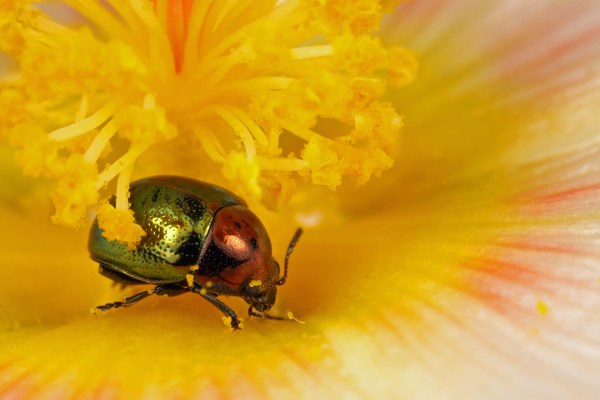
Spintherophyta (?) sp. in flower of Abutilon pauciflorum | Buenos Aires, Argentina

From  (posted 2 Feb). One of my 2012 learnings was that sometimes a photograph that is not so close is more effective than one that is as close as possible. In one of my earlier attempts at “not-so-close” macrophotgraphy, the soft colors of the flower compliment the brash shininess of the tiny leaf beetle that has been feeding on its pollen. Pink lines lead the eye directly to the subject and create a pleasing composition, and pollen grains stuck to the beetle—a distraction in some situations—add to the miniature natural history story of the photo.


Apiomerus flavipennis with stink bug prey and kleptoparasitic flies | Chaco Province, Argentina

From  (posted 11 Mar). I selected this photo solely for the complex natural history story drama it shows—stink bug (Piezodorus guildenii) feeding on soybean becomes prey of an assassin bug (Apiomerus flavipennis), with volatiles from the chemicals it emitted in a vain attempt to defend itself serving as cues to kleptoparasitic flies (families Milichiidae and Chloropidae) that benefit from the assassin bug’s labors.


Planthopper nymph | Buenos Aires Province, Argentina

From  (posted 26 Mar). Another learning that I began putting into practice in 2012 was the use of low perspective for compositional impact. The cryptic coloration of this planthopper nymph (family Fulgoridae) made it almost invisible on the branch on which it was sitting when viewed from a normal “top-down” human perspective. Getting “down under” it, however, brought the nymph to life and emphasized its unusual form.


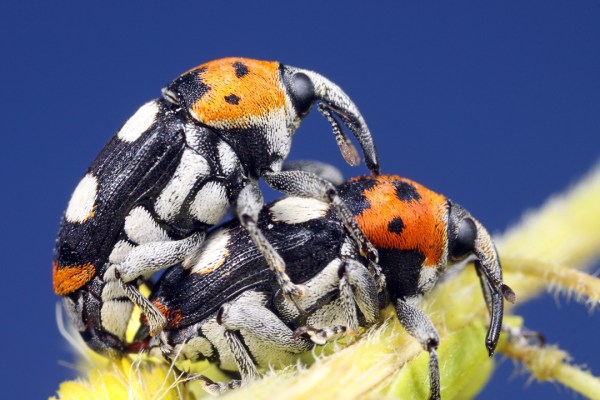
Megabaris quadriguttatus | Corrientes Province, Argentina

From  (posted 12 Apr). I spent much of 2012 working on the “blue sky background” technique, with these weevils from northern Argentina representing one of my better attempts. Macrophotography of insects with a blue sky background involves setting exposure, ISO, and aperture to achieve two separate exposures—full flash illumination of the subject for maximum depth-of-field, and ambient light from the sky to create a clean, uncluttered, natural-looking background. In this shot I managed to achieve an almost ideal shade of blue to compliment the wild black, white and red colors of the beetles. (My one criticism of the photo is having clipped one of the beetle’s feet.)


Bombylius sp. cf. mexicanus | Scott Co., Missouri

From  (posted 16 May). This photo is unusual if nothing else. Focus, lighting, depth-of-field, and composition are all better than can be hoped for in a single shot, but the subject—perfectly alive—is in a most unusual position. Read the original post to find out how this happened.


Perisphaerus sp. (a pill roach) | Vietnam (captive individual)

From  (posted 27 May). White-box photography is an excellent technique for clean, uncluttered photographs of insects, but it also isolates them from their natural surroundings and limits their natural history appeal. The best white-box photos are those that highlight a key feature or behavior of the subject—in this case a pill roach’s comically conglobulating defensive posture.


Micronaspis floridana (Florida intertidal firefly) larva | Pinellas Co., Florida

From  (posted 31 July). Here is another photo whose back story played a big part in its selection. This firefly larva not only represents a rare Florida-endemic species but was also first seen by my then 12-year old nephew, who willingly accompanied me through a dark, spooky salt marsh in the middle of a humid Florida night to see what he could learn. The lesson here for budding natural historians (and old-timers like me) cannot be overstated!


Arctosa littoralis (beach wolf spider) | Lewis Co., Missouri

From  (posted 23 Aug—prelude to  posted 28 Aug). Those who follow this blog know of my obsession with close-up portraits, and while tiger beetles are the subjects I most commonly photograph in this manner, I am always on the lookout for good subjects in other taxa. This wolf spider “face” almost looks human, with “two” eyes, two “nostrils” and a shiny upper lip above huge (albeit hairy) buck teeth! It’s enough fill-the-frame spidery goodness to melt (or explode) the heart of even the most ardent arachnophobe!


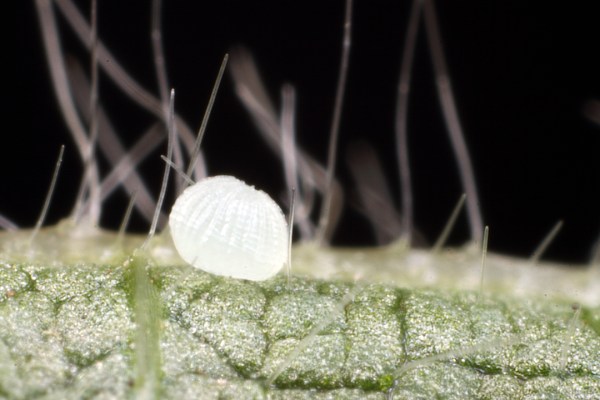
Anticarsia gemmatalis (velvetbean caterpillar) egg on soybean leaf

From Life at 8X—Guide to lepidopteran eggs on soybean (posted 3 Sep). “Life at 8X” was a new series I introduced this year, featuring insects photographed at magnifications testing the upper limit of my equipment and photographic skills. Diffraction is the chief difficulty with magnifications as high as this and is the primary flaw in the above photograph. Nevertheless, such view of a moth egg on the underside of a soybean leaf provides a spectacular view of the otherwise unseen micro-world that lives right beneath our noses.


Megacyllene decora (amorpha borer) on snakeroot flowers | Mississippi Co., Missouri

From  (posted 12 Sep). This second example of “blue sky background” was taken later in the year and was considerably more difficult to capture than the first because of the larger size of the subject and resulting need for a longer focal length macro lens. Getting a well-lit, focused, and composed image with a desirable shade of blue in the background depended not only on finding the proper camera settings, but also secure body and camera bracing techniques for this completely hand-held shot.


Cicindelidia politula politula (Limestone Tiger Beetle) | Montague Co., Texas

From  (posted 28 Sep). I will go ahead and say it—this is my favorite photograph of 2012. As discussed under the first entry, panning back from the subject can allow for some very interesting compositions. This photo combines charismatic pose by a wary subject with panning back and low perspective to create an image that scores high in both natural history and aesthetic appeal.


Calosoma sayi (black caterpillar hunter) | New Madrid Co., Missouri

From Black is beautiful! (posted 7 Nov). Of course, close-as-possible can also be used to create striking photos, especially if the subject exhibits features that are best seen up close. Anything with jaws fits the bill in my book, and highlighting the mandibular sculpturing of this caterpillar hunter (a type of ground beetle) required precise angling of the flash heads for maximum effect.


Cicindela repanda (Bronze Tiger Beetle) | St. Louis Co., Missouri

From  (12 Nov). This final selection is not a rare species, but it is as close as I have come to what I consider the “perfect” tiger beetle macrophotograph—a close, low angle, lateral profile of an adult in full-stilt posture (a thermoregulatory behavior), well lit, perfectly focused, and with a dynamic but pleasingly blurred background. It’s a perfect storm of a photo that took the better part of two hours to achieve—rarely do all of these elements come together in a hand-held photograph of an unconfined tiger beetle in its native habitat.


Well, there you have it. I hope you’ve enjoyed my selections, and again please do let me know if you have a personal favorite. See you in 2013!

Copyright © Ted C. MacRae 2012

More Eocene insects

Most of the Green River Formation (GRF) insect fossils that I have on loan clearly represent either beetles (order Coleoptera) or flies (order Diptera). I’ve already shown a few of the latter (fungus gnat, midge), as well as some that don’t belong to either order (ant, cricket?). Here are a few more that seem identifiable to order, but family-level identification is less certain. Thoughts from the readership would be most welcome.


IMG_1923_enh_1080x720IMG_1826_enh_1080x720
This fossil shows an aggregation of insects that I believe represent some kind of beetle. Based on shape and size (16.7 mm length) I’m guessing perhaps either a diving beetle (family Dytiscidae) or whirligig beetle (family Gyrinidae). These are both aquatic families, although only the former is among the beetle families recorded from the GRF by Wilson (1978).


IMG_1927_enh_1080x720 IMG_1836_enh_1080x720
There are two insect fossils on this specimen, but the closeup is the one near the center of the rock. It is tiny (3.5 mm in length), and at first I thought it might be a fly (order Diptera). However, dipterist Chris Borkent thinks it might be a small hymenopteran (bee?) because it has what looks to be long multi-segmented antennae. The only bee family recorded for the GRF by Wilson (1978) is Anthophoridae (now included within Apidae), of which this fossil clearly is not a representative. There are six other hymenopteran families recorded in that work, of which Tenthredinidae is the only one that seems plausible. Of course, it could represent a family not recorded by Wilson (1978). Collected along Hwy 139 in Douglas Pass (Garfield Co., Colorado).

Here is a closeup of the other fossil (far right in photo above). This looks to me like a brachyceran fly, and I’ve sent a high resolution version of the image to Chris Borkent to see what he thinks.


IMG_1934_enh_1080x720 IMG_1850_enh_1080x720
The label accompanying this fossil indicates “Mosquito (?),” but to my eye this looks like a true bug (order Hemiptera). It is small—only 5.9 mm in length—and has the gestalt of a plant but (family Miridae) or seed bug (family Lygaeidae). GRF fossils representing the latter but not the former were recorded by Wilson (1978). Also collected along Hwy 139 in Douglas Pass (Garfield Co., Colorado).


REFERENCES:

Wilson, M. V. H. 1978. Paleogene insect faunas of western North America. Quaestiones Entomologicae 14(1):13–34.

Copyright © Ted C. MacRae 2012

Virtual Mantle 2012

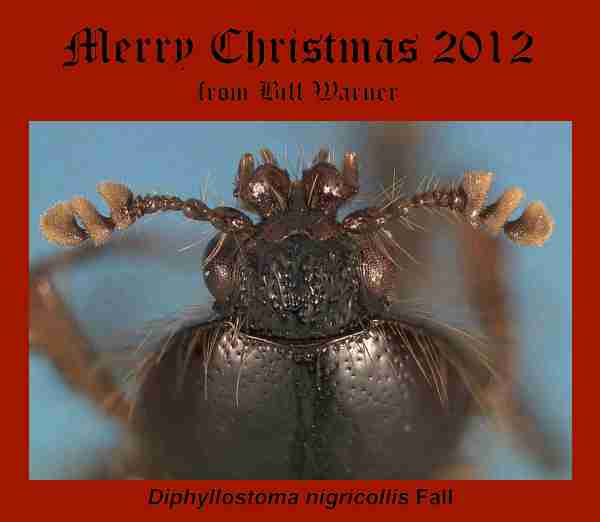
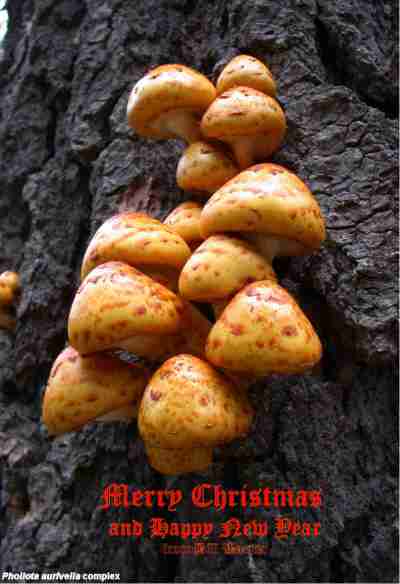
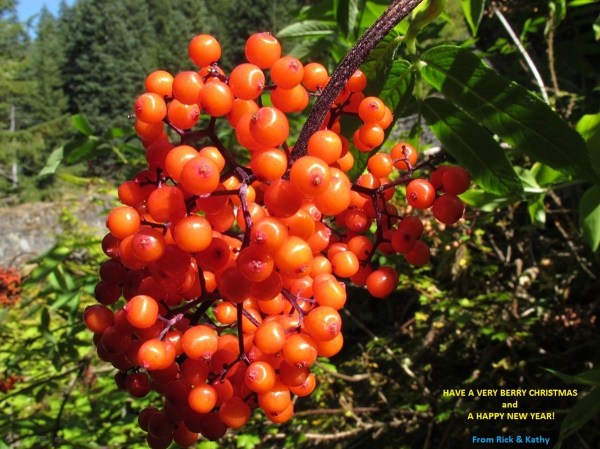
In recent years a truly delightful custom has developed among taxonomic entomologists—Photoshopped e-Christmas cards featuring their favorite insects! This should not be a surprising development—connectivity among scientists from around the world is at an all-time high, as is their access to digital cameras and imaging software. And, of course, what better subject for such cards could one ask for than insects (especially beetles, I might add)? It’s hard to resist anthropomorphizing them, with their buggy eyes and comical expressions, but their outright beauty makes them perfect also as pure ornaments. I did my first one last year (Santa Jaws), and for this year’s version I created Buprestis saintnicholasii. Following are the e-Christmas cards on my virtual mantle this year, received from beetle taxonomists as far and wide as Arizona, California, Oregon, Bulgaria, Germany and Romania!

I really enjoy getting these—if I’m not already on your e-Christmas card mailing list please consider adding me in 2013!

Xmas-2012_Bellamy

Chuck & Rose Bellamy – Sacramento, California

Xmas-2012_Kalashian

Mark Kalashian – Yerevan, Armenia

Xmas-2012_Mühle

Hans Mühle – Munich, Germany

Xmas-2012_Ruicanescu

Adrian Ruicanescu – Cluj-Napoca, Romania

Xmas-2012_Warner

Bill Warner – Phoenix, Arizona

Xmas-2012_Warner2

Bill Warner – Phoenix, Arizona

Xmas-2012_Westcott

Rick & Kathy Westcott – Salem, Oregon

Xmas-2012_Gashtarov

Victor Gashtarov – Sofia, Bulgaria

Copyright © Ted C. MacRae 2012

The 2nd-oldest Known Myrmicine Ant

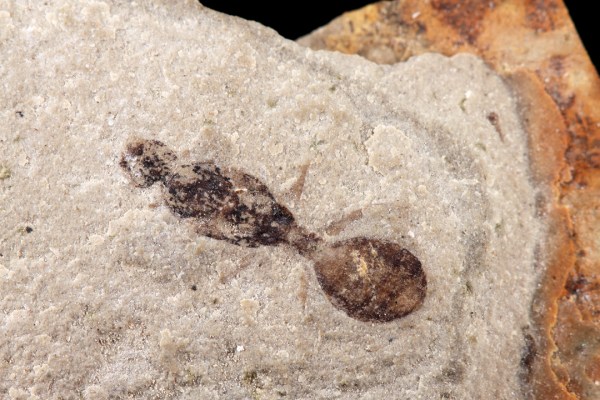
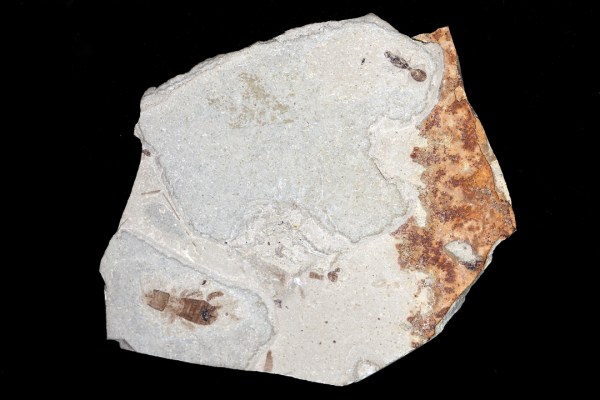
Among the 20 or so insects represented in the Green River Formation (GRF) fossils that I currently have on loan, this rather obvious ant (family Formicidae) is the only one that is firmly assignable to the order Hymenoptera (wasps, bees and ants). This is not surprising, as hymenopterans are not well represented among GRF insect fossils. In fact, of the 300+ insect species that have been described from GRF deposits (Wilson 1978), more than two-thirds belong to just three orders—Diptera (flies), Coleoptera (beetles) and Hemiptera (true bugs). Hymenoptera, on the other hand, comprise only 4% of GRF fossils (Dlussky & Rasnitsyn 2002). I presume these numbers are more a result of taphonomic (fossil formation) bias than a true reflection of insect diversity in western North America during the Middle Eocene (47–52 mya).

cf. Myrmecites rotundiceps | fossil impression from the Green River Formation (45 mya, middle Eocene)

cf. Myrmecites rotundiceps (length = 6.7 mm).

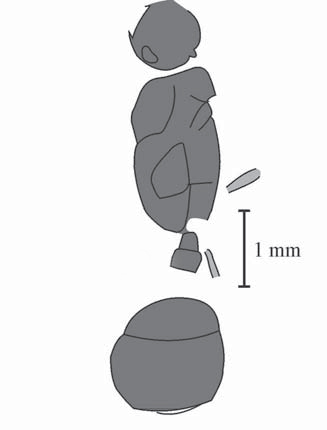
Ants in particular have been poorly represented by GRF deposits. Only four named species were known until Dlussky & Rasnitsyn (2002) reviewed available GRF fossils and increased the number to 18 (15 described as new, one older name placed in synonymy). Diagnoses, line drawings, and keys to all covered subfamilies, genera and species provide one of the best treatments to GRF insect fossils that I’ve come across. According to that work, the fossil in these photos seems comparable to the description and illustration given for Myrmecites rotundiceps, a unique fossil with the general appearance of ants in the subfamily Myrmicinae but differing from all known Eocene and New World fossil ants by its very short, two-segmented waist. The only difference I noted was size—6.7 mm length for my fossil versus 5.5 mm for the holotype (see figure below). Of course, I’m more comfortable identifying extant Coleoptera than extinct Formicidae, so I contacted senior author Gennady M. Dlussky to see if he agreed with my opinion. He graciously sent the following reply:

I agree that specimen on your photo is very similar to Myrmecites rotundiceps. It is larger (holotype is 5.5 mm long), but it may be normal variability. I cannot see another differences.

Myrmecites rotundiceps, holotype (Gennady & Rasnitsyn 2002)

Myrmecites rotundiceps Gennady & Rasnitsyn 2002, holotype (reproduced from Gennady & Rasnitysyn 2002)

If correctly assigned, M. rotundiceps is the second oldest known member of the subfamily Myrmicinae—the oldest being Eocenidris crassa from Middle Eocene Arkansas amber (45 mya). In fact, the only older ant fossil of any kind in North America is Formicium barryi (Carpenter) from Early Eocene deposits in Tennessee (wing only). [Edit: this is actually the only older Paleocene ant fossil—there are some Cretaceous-aged fossils such as Sphecomyrma freyi (thanks James Trager).] Since myrmicine fossils of comparable age are lacking from other parts of the world, this might suggest a North American origin for the subfamily; however, it could also be an artifact of incomplete knowledge of ants from older deposits in other parts of the world. Myrmicine ants make their first Eurasian appearance in Late Eocene Baltic amber deposits (40 mya) and become more numerous in North America during the early Oligocene (Florissant shales of Colorado, 33 mya). (Dlussky & Rasnitsyn (2002) consider the Middle–Late Eocene ant fauna to represent the beginnings of the modern ant fauna, with extant genera becoming numerous and extinct genera waning but still differing by the preponderance of species in the subfamily Dolichoderinae over Formicinae and Myrmicinae.

IMG_1919_enh_1080x720

USA: Colorado, Rio Blanco Co., Parachute Creek Member.

The photo above shows the entire fossil-bearing rock (also bearing the putative orthopteran posted earlier).

My thanks to Gennady Dlussky and James Trager for offering their opinions on the possible identity of this fossil.

REFERENCES:

Dlussky, G. M. & A. P. Rasnitsyn. 2002. Ants (Hymenoptera: Formicidae) of Formation Green River and some other Middle Eocene deposits of North America. Russian Entomological Journal 11(4):411–436.

Wilson, M. V. H. 1978. Paleogene insect faunas of western North America. Quaestiones Entomologicae 14(1):13–34.

Copyright © Ted C. MacRae 2012

T.G.I.Flyday: Tachinomyia sp.

You would think that somebody with enough patience to photograph tiger beetles would be equally patient with “calyptrate” flies, but for me such is not the case. It’s not that I don’t find them interesting (although, really, what insect group can match the diversity, polytopism, ecological extremism and behavioral charisma of tiger beetles?), but their flighty, frenetic behavior and difficult taxonomy are just a bit too much for me. After all, why invest the time it would take to get a good photograph of something that, in the end will probably be unidentifiable.

IMG_9659_enh_1080x720

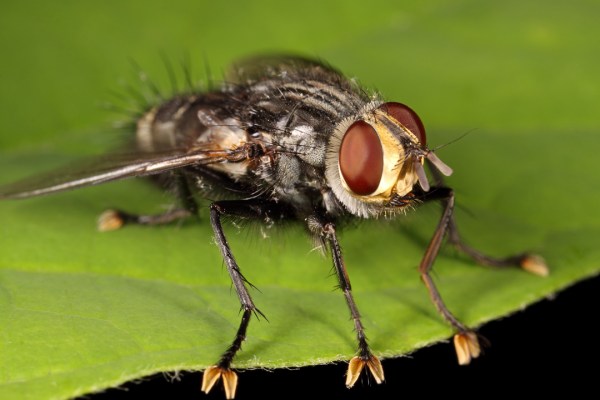
Tachinid fly (prob. Tachinomyia sp.) | Wayne Co., Missouri

Last April as I was hiking a woodland trail in Sam A. Baker State Park in southeastern Missouri’s Ozark Highlands, I saw this decent-sized fly bumbling across the trail. I knelt to look at it more closely, and though it tried to flee, it seemed too weak and uncoordinated to take flight. It was in beautiful condition—a perfect specimen, and I surmised that it represented a newly emerged adult that had not yet hardened sufficiently to withstand the rigors of flight. I was fascinated by its distinctive, orange tarsal pads and the white “beard” around its head, and the ability to coax the fly onto a leaf and hold the leave in whatever position I desired was all the enticement I needed to spend a little time with it. Out of the several shots that I took, these two are my favorites.

IMG_9683_enh_1080x720

You got it—the BitB face shot!

Of course, just being able to photograph the fly was only half the battle—there still remained the matter of its identification. It seemed “tachinidish” to me at the time, but a little digging revealed that there are species of Sarcophagidae look very similar to tachinids, the difference being the presence or absence of a visible postscutellum. My photos don’t show this character, and I quickly became overwhelmed when I tried scanning through BugGuide photos for these two families. Nevertheless, I’m a persistent sort, and after winnowing out the numerous unlikely choices I finally settled on not only family Tachinidae, but possibly Tachinomyia sp. (tribe Exoristini). I was tempted to go out on a limb and post the ID here unvetted, but I chickened out and and sent the photos to fly guy Norman Woodley at the Systematic Entomology Lab in Washington, DC. Norm supported my identification and wrote back:

I think it is probably Tachinomyia.  It would be better to have a wing view as well as the hind end to be absolutely positive, but I’m reasonably sure that’s what it is.  It’s a male.  Some species are active in the spring, so that fits with your data as well.

Copyright © Ted C. MacRae 2012