It seems that North American entomologists have returned en masse from their various tropical winter travels – Alex and Brigette have returned from their respective trips to Ecuador, Troy has come back from Costa Rica, and I am now back home after my recent business trip to São Paulo, Brazil. I’m anxious to see the photos and read the tales that the others will no doubt be posting in the coming weeks regarding their visits to cloud forests, research stations, and nature preserves. My insect hunting activities were limited to municipal parks and hotel grounds, but I still have a decent variety of insect encounters to share (along with many pleasant memories of churrasco, cerveja, e novos amigos).

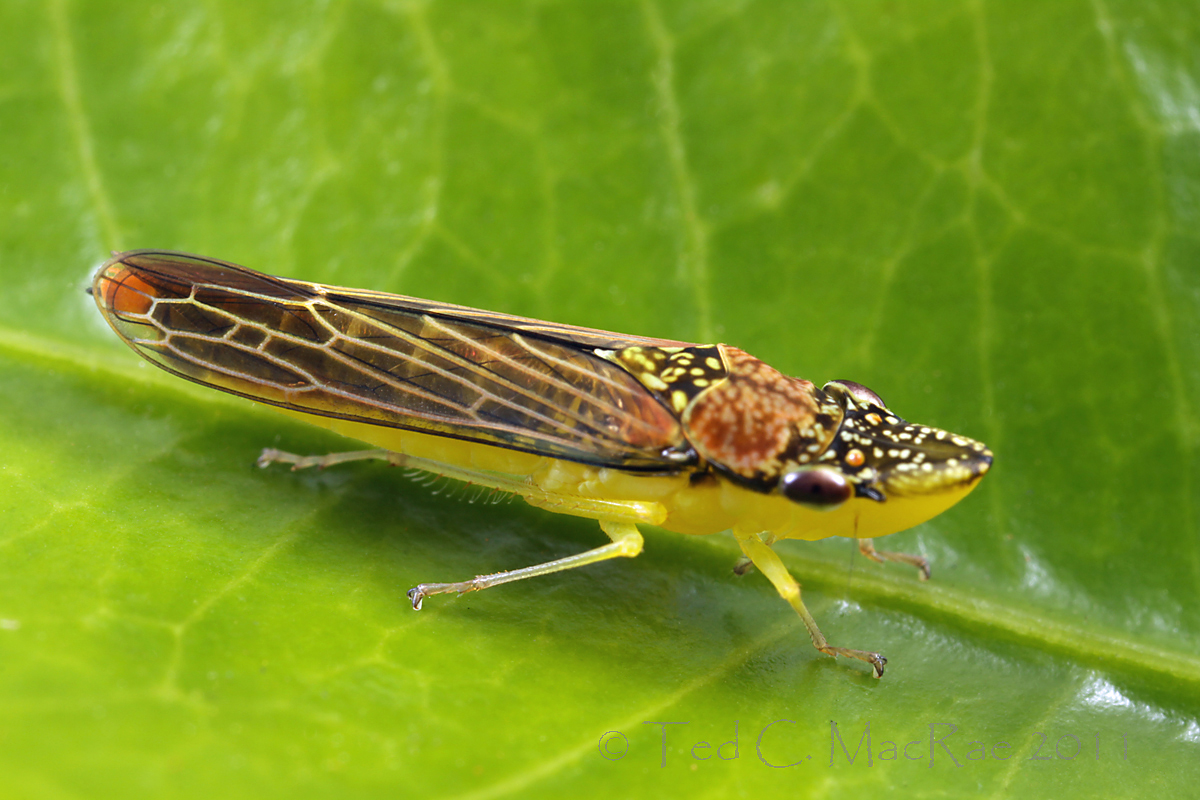
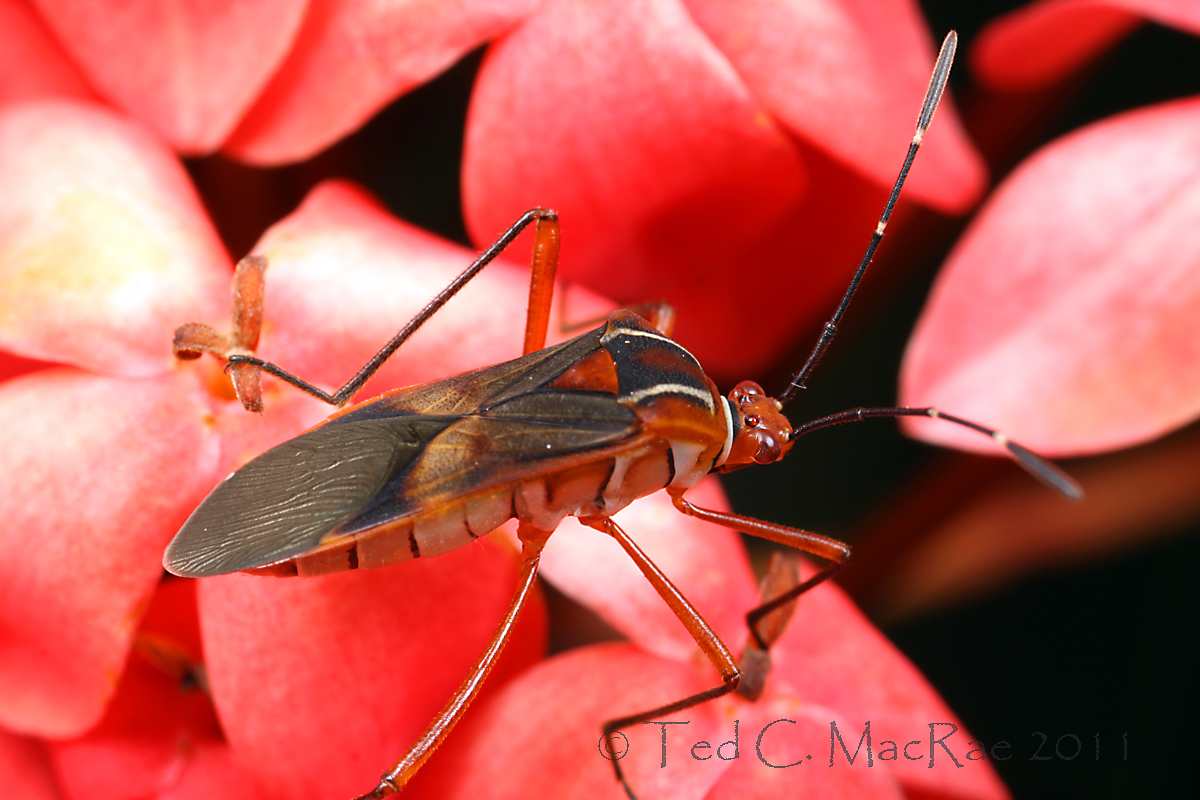
Acrogonia citrina
Thanks to Ani, I think we now agree that the pink-flowered shrub on the grounds of my hotel in Campinas that attracted such a nice diversity of insects belongs to the genus Ixora (family Rubiaceae). Included in this post are a few leafhoppers (order Hemiptera, family Cicadellidae) in a group known as ‘sharpshooters’ (subfamily Cicadellinae) that I found also attracted to this shrub. Leafhoppers are, of course, a hugely diverse family, but because of the generally small size and cryptic coloration of most North American species, it is a group that often goes unnoticed. In the tropics, however, it’s a different story, with not only a number of larger forms but also a multitude of brightly colored species.

Acrogonia citrina at 5X life size
The diversity of species present in a place like southern Brazil might seem to preclude any possibility of identification without consulting a specialist, but the individual in these first two photos looks very much like Acrogonia citrina. This species has become a major pest of citrus in São Paulo state during the past two decades, its importance driven not so much by direct damage, but rather by vectoring a bacterial disease of citrus called Citrus Variegated Chlorosis (Xylella fastidiosa) – or CVC (Lopes 2007). Of the 12 sharpshooter species identified as vectors of CVC, A. citrina is among the most important due to its abundance in citrus groves (an important agricultural crop in São Paulo state) and high degree of polyphagy. The disease affects mainly fruit quality, reducing their size and making them unsuitable to be sold fresh, and by decreasing yield when processed for juice.

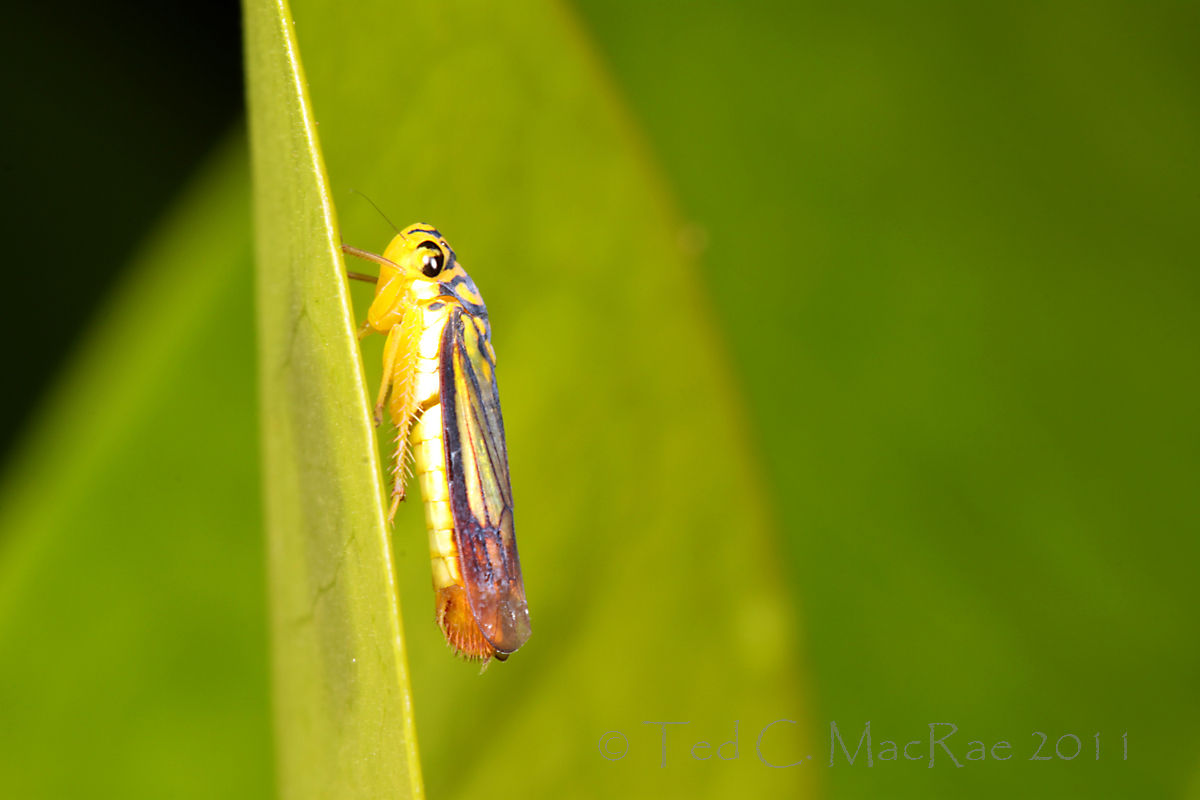
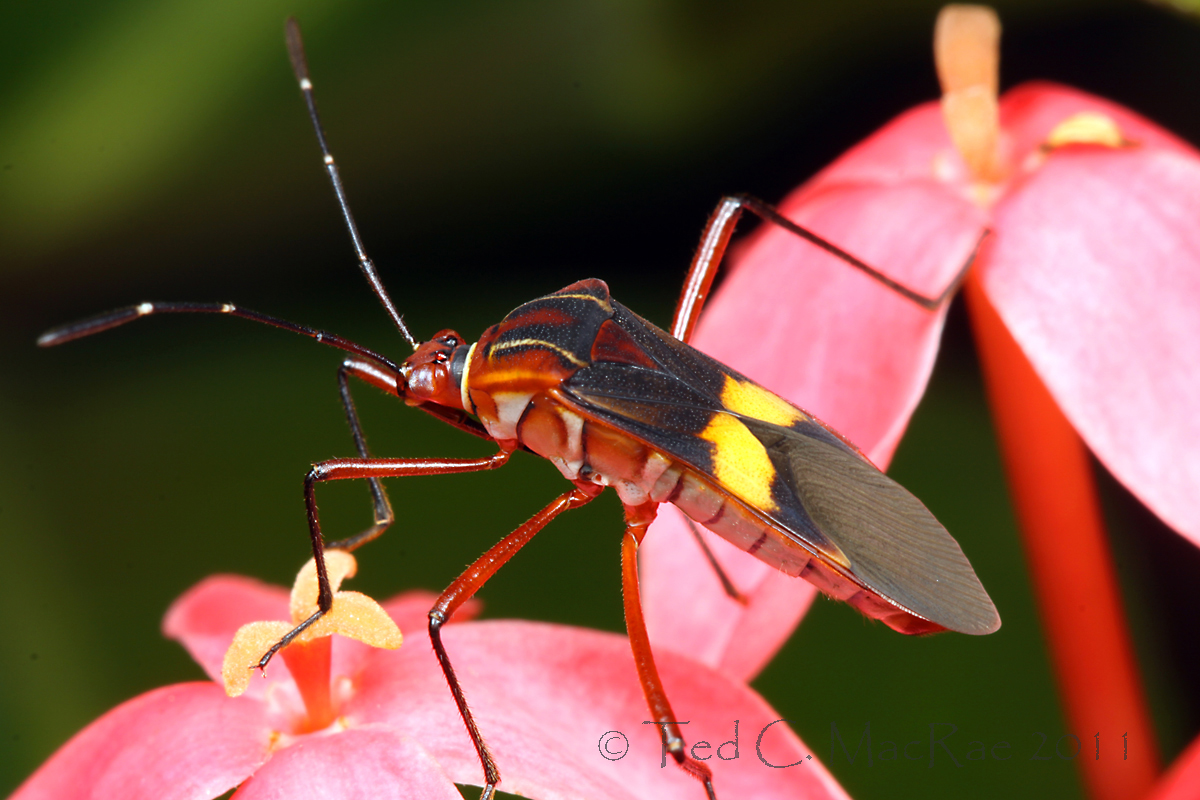
Dilobopterus costalimai
Dilobopterus costalimai is another important vector of CVC, again primarily as a result of its abundance on citrus in São Paulo state and polyphagous nature.¹ At this point, CVC has not been found outside of South America; however, California and Florida citrus growers are understandably nervous about the potential for its eventual occurrence in the U.S. due to the presence here of leafhopper species that are confirmed vectors of the disease and the ease with which the disease can be transported in infected nursery stock. There is no cure for CVC, and chemical control of vectors is both costly and difficult, leaving nursery certification, protection of nursery stock from infection, pruning of symptomatic parts of trees to remove inoculum sources, and other such labor intensive methods as the only options for managing CVC (Chung and Brlansky 2009).
¹ I originally attempted to photograph this individual because it appeared to have been parasitized by what I suspect is a dryinid (order Hymenoptera, family Dryinidae). Unfortunately the parasitoid is on the right side of the abdomen of this individual and can’t really be seen in this view, and I didn’t get any other shots besides this one.
REFERENCE:
Chung, K.-R. and R. H. Brlansky. 2009. Citrus Diseases Exotic to Florida: Citrus Variegated Chlorosis (CVC). University of Florida, Institute of Food and Agricultural Sciences Fact Sheet PP-223, 4 pp.
Lopes, J. S. 2007. Vector ecology and implications on epidemiology of citrus variegated chlorosis. Proceedings of the 2007 Pierce’s Disease Research Symposium, California Department of Food and Agriculture.
Copyright © Ted C. MacRae 2011