Meet Enus’ Meal

Phymatodes amoenus (Coleoptera: Cerambycidae) | Stoddard Co., Missouri

Phymatodes amoenus (Coleoptera: Cerambycidae) | Stoddard Co., Missouri

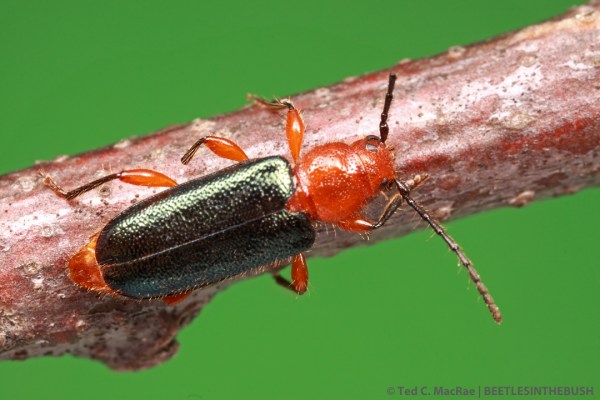
When Enus (Enoclerus ichneumoneus) was beaten from a dead grape vine in southeastern Missouri, he wasn’t alone. Along with him was this longhorned beetle representing Phymatodes amoenus (family Cerambycidae). Even though P. amoenus and E. ichneumoneus are both woodboring beetles, their association together on this dead grape vine was not purely coincidental. Phymatodes amoenus is associated exclusively with the genus Vitis (family Vitaceae), its larvae developing within the dead vines. Enoclerus ichneumoneus also bores through dead wood in the larval stage but is much less discriminating about the plant species. This is because E. ichneumoneus and most other checkered beetles (family Cleridae) don’t actually eat the wood within which they are tunneling, but rather prey upon the other woodboring beetle larvae that they encounter in the wood. The adult checkered beetles are thus attracted to dead wood not as a food source itself, but rather the woodboring larvae that will provide food for their offspring.

Phymatodes amoenus

Half an antenna and the left mesotarsus were the price to pay for rooming with Enus!

When I collected these two individuals, I put them together in a vial as I continued beating the vine to look for other individuals. None were found, but I had forgotten that adult checkered beetles also are predaceous. Needless to say, Enus found the cerambycid beetle to be easy pickings while they were confined together and managed to eat half of the cerambycid’s left antenna and left mesotarsus before I realized my oversight and rescued the poor thing.

Copyright © Ted C. MacRae 2013

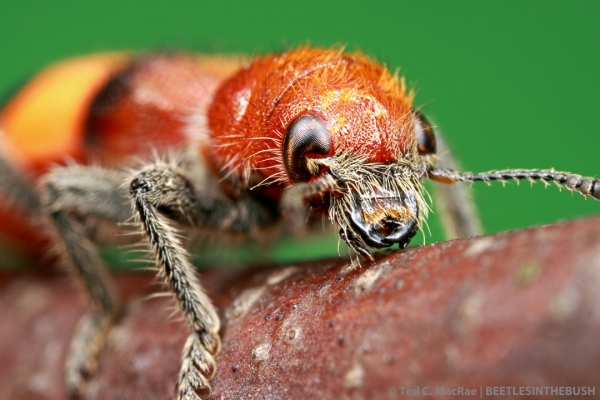
Meet Enus

It may be quiet here at Beetles in the Bush for the next week or so while Ted is off in the far corners of Oklahoma looking for beetles to photograph and add to his collection. In the meantime, meet Enus (full name Enoclerus ichneumoneus), a checkered beetle who was beaten from a dead grapevine (Vitis sp.) in southeastern Missouri and who has promised Ted he will keep a close eye on things while Ted is away.

Enoclerus ichneumoneus | Stoddard Co., Missouri

Enoclerus ichneumoneus | Stoddard Co., Missouri

Beetles in Oklahoma had better watch out!

© Ted C. MacRae 2013

North America’s itsiest bitsiest longhorned beetle

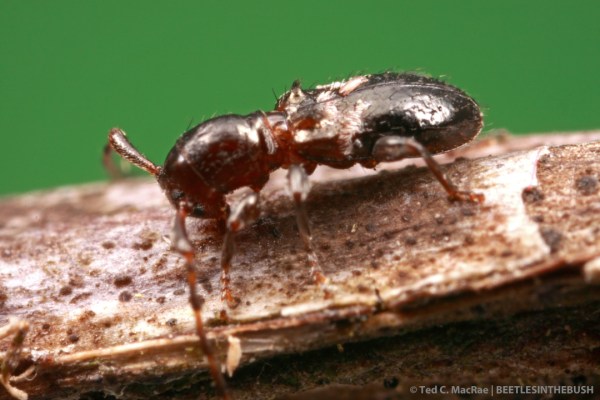
Longhorned beetles (family Cerambycidae) are generally regarded as medium to large-sized beetles, but that doesn’t mean the family is without its pip-squeeks! There are a number of species, primarily in the tribes Tillomorphini, Anaglyptini, and Clytini (all in the subfamily Cerambycinae) that are remarkably effective mimics of ants. Some of these, especially members of the genus Euderces, are quite small, but none are smaller than the absolutely diminutive Cyrtinus pygmaeus. Measuring only 2–3 millimeters in length, the adult beetles can be found on dead twigs and branches among equally small ants such as Lasius americanus.

Cyrtinus pygmaeus | Stoddard Co., Missouri

Cyrtinus pygmaeus | Stoddard Co., Missouri

The species is said to be widespread across eastern North America, having been recorded on a number of hardwood trees (Lingafelter 2007). I have no reason to doubt this, having reared a number of individuals from dead branches of river birch (Betula nigra), chinquapin oak (Quercus muhlenbergii), willow oak (Q. phellos) and black oak (Q. velutina) (MacRae & Rice 2007), but in the wild I have only encountered the species three times—each time as a single specimen that I noticed crawling on my arm after a bout of beating a variety of dead branches. The most recent occasion was two weekends ago during a visit to the Mississippi Lowlands of southeastern Missouri. I had done a bit of beating in a forest dominated by black oak, blackjack oak (Q. marilandica), and southern red oak (Q. falcata) and not found much when I felt a “tickle” on my right forearm. I looked down and was just about to flick the “ant” off my arm when something about the way it moved gave me pause. I stopped and looked closer, then recognizing what it was, instinctively called out “Oh cool, Cryrtinus pygmaeus!” My field partners for the day had never seen the species, so I let them look before I placed it in a vial. I was sure they would ogle at the incredibly tiny longhorned beetle, but their subdued “Hmm”s makes me think they were less impressed with the find than I was.

Cyrtinus pygmaeus

Like other ant-mimicking genera, the elytra of this species bear two prominent humps near their bases.

If the species is so common, why have I not seen them more commonly or on the beating sheet proper as soon as I beat them from their host plant? The answer, I believe, is that they are such effective mimics of the tiniest of ants that I simply overlook them! The series of specimens retrieved from my rearing cans could not be missed, as I combed through the contents every week during the beetle emergence period to make sure I found anything—longhorned beetle or otherwise—that emerged from the wood inside. In the field, however, my search image is queued for more “normal-sized” beetles and especially movement. Most other ant-mimicking longhorned beetles, even though they look very much like ants, still run like longhorned beetles—swiftly, almost frenetically, looking for the earliest opportunity to spread their elytra and take wing. Cyrtinus pygmaeus, on the other hand, is slow and clumsy, not a runner at all (slower even than the ants they mimic). If the three individuals I’ve encountered in the wild to date hadn’t happened to fall on my arm rather than the beating sheet and gotten stuck in my hair and perspiration I may never have noticed them.

Cyrtinus pygmaeus

Bands of white pubescence on the bases of the elytra give the illusion of a narrow-waisted ant.

I considered putting the beetle on a branch for photographs as soon as I found it, but since I had already pulled it off my arm I had already lost the chance to take true field photographs. Instead, I placed the beetle live in a vial and photographed it the next day at home. All of the photos were taken hand-held with an MP-E 65 mm macro lens at the upper end of its magnification capabilities. The green background is simply a colored file folder placed about four inches behind the beetle as I photographed it.

p.s. can you tell me what unusual feature this particular individual exhibits?

REFERENCES:

Lingafelter, S. W. 2007. Illustrated Key to the Longhorned Woodboring Beetles of the Eastern United States. Coleopterists Society Miscellaneous Publications, Special Publication No. 3, 206 pp.

MacRae, T. C. and M. E. Rice. 2007. Distributional and biological observations on North American Cerambycidae (Coleoptera). The Coleopterists Bulletin 61(2): 227–263.

Copyright © Ted C. MacRae 2013

Field photographs of insects can be deceiving

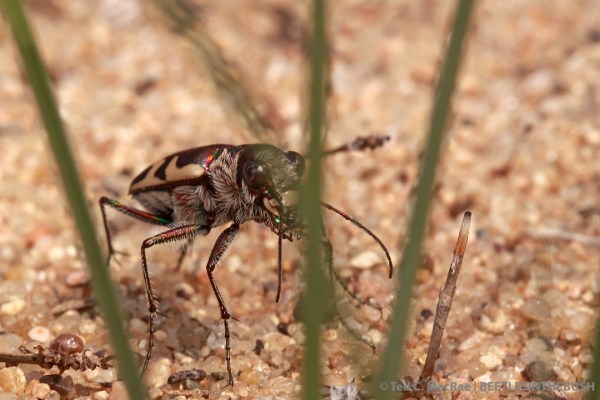
My previous post featured several photos of Cicindela formosa generosa (Eastern Big Sand Tiger Beetle). This gorgeous beetle is said to occur in open, dry sand habitats throughout the Great Plains and more sporadically across the north-central and northeastern U.S. Like most other existing photos of this species, they show adults on barren sand with not so much as a sprig of vegetation to be seen. As a result, one might presume that adult beetles prefer the most open and barren areas of the habitats in which they occur.

"You don't see me, but I see  you!"

“You don’t see me, but I see you!”

Consider the above photo—taken the same day as those in the previous post but annoyingly cluttered with vegetation that partially obstructs the view of the beetle. This was actually the first photograph that I took that day, and while the foliage may be considered an aesthetic distraction, it nevertheless provides valuable information about the natural history of the beetle. My impression from the past few years of observation is that adult beetles actually spend more time foraging in the sparsely vegetated areas surrounding these more open areas. I presume they are more likely to encounter prey in areas where some vegetation exists, and also the vegetation provides opportunities for shade, which the adults actively seek out during the hottest parts of the day. Most collectors and photographers do not notice beetles foraging amongst the vegetation, but instead see them only after their approach has caused the beetle to flee out into the more open areas—where they are then collected/photographed.

© Ted C. MacRae 2013

Big, Bold and Beautiful—Redux

Cicindela formosa generosa | Scott Co., Missouri

Cicindela formosa generosa (Eastern Big Sand Tiger Beetle) | Scott Co., Missouri

Strange as it may seem to residents of the western U.S. or coastal areas in the east, one of my favorite sights in Missouri is dry sand! It’s a true rarity in our limestone/dolomite dominated state, a result of nearly continuously exposed land for the past several hundred million years. Only along the state’s bigger rivers, where relatively recent alluvial events have yet to be completely eroded by the passage of time, can significant sand deposits be found. It is in these habitats that one of my favorite of Missouri’s tiger beetles, Cicindela formosa generosa (Eastern Big Sand Tiger Beetle), can be found. In much of the state, tiny slivers of sand dry enough to support populations of these beetles occur sporadically along the Missouri and Mississippi Rivers and their larger tributaries. More extensive deposits, however, are found in several wide, low ridges of sand in the southeastern lowlands of the state—relatively recent alluvial deposits from the last glacial maximum. Sadly, in a region originally blanketed by tupelo/gum/cypress swamp, such relatively dry areas were the first to fall to the plow, and subsequent drainage of the surrounding swamps further promoted a near complete  conversion of the entire region to agriculture.

She's got legs up to her neck!

She’s got legs up to her neck!

Still, tiny remnants of original habitat remain—generally parcels of land that were either too dry and sandy or persistently undrainable. Such parcels now form the basis of Missouri’s system of preserves in southeast Missouri. As tiny as they are and representing only a few percent of their original extent, these parcels now serve a critical role in preserving some of Missouri’s most endangered natural communities. Among these is Sand Prairie Conservation Area in Scott Co., featured several times now on this blog (). The sand here is extraordinarily dry, due not only to its depth but also the low organic content—factors that made the land unfarmable and, ultimately, allowed it to escape the conversion that befell the surrounding areas and eventually become a preserve. I have visited Sand Prairie many times in recent years, and although I now know its plants and animals well, there are some that I never tire of seeing—plants like clasping milkweed (Asclepias amplexicaulis), one of my favorite of Missouri’s milkweeds, and animals like C. formosa generosa!

Bold white markings and a chunky body make this one of Missouri's most distinctive tiger beetles.

Bold white markings and a chunky body make this one of Missouri’s most distinctive tiger beetles.

Last weekend I visited Sand Prairie once again, and I was happy to see C. formosa generosa as plentiful as I have ever seen it. I have photographed this species on several occasions, most recently two years ago at a site very near my house. Those last photographs are probably as good as I can ever expect (and in fact one of them even made this year’s ESA calendar), so barring some unusual color form or interesting natural history observation I have little reason to continue taking photographs of it. Nevertheless, I’m trying out a new diffuser, which was all the excuse I needed to try my hand again with this big, beautiful species. I was once again reminded of why of I love this tiger beetle so much—their bulk, their bulging eyes, their long, looping escape flights that end with a comical bounce and tumble, only to end up on their feet and facing their pursuer. These beetles are loaded with personality and behavioral charisma. It was an unseasonably warm and humid day, so my opportunities to photograph them were limited. I hope these few that I present here impart some of that personality.

Individuals from Missouri often show a hint of the red coloration that characterizes populations further west.

Missouri individuals often show a hint of the red coloration that characterizes populations further west.

Copyright © Ted C. MacRae 2013

Oversized, double-concave diffuser for MT-24EX twin flash

IMG_2865_enh_1080X720

Megaloxantha bicolor palawanica, photographed with oversized, double-concave diffuser

This jewel beetle is, of course, Megaloxantha bicolor palawanica me beetle on several occasions while testing out different diffuser designs for my Canon MT-24EX twin flash unit. In the most recent one, I had tried combining SoftBoxes with my oversized concave diffuser and was pleased enough with the result that I thought I might try it in the field. Well, let’s just say the extensions for the flash heads and SoftBoxes attached to them was far too clumsy for field use, and I abandoned the idea after just a couple of hours. Back to the drawing board.

Despite the problems with using the SoftBoxes in the field, I still wasn’t ready to give up on the idea of double diffusion, and I had also learned that extending my oversized diffuser out over the subject (leaving it “open”) produced better lighting than curling it back (as I had been doing). Curling the diffuser back only served to turn it into a convex diffuser, which results in more specular highlighting because the center of the diffuser is closer to the subject than the edges. A concave diffuser provides more even lighting because all parts of the diffuser are roughly the same distance from the subject. Just about that time, I saw a DIY diffuser design by Piotr Nascrecki that, in principle, resembled Alex Wild‘s tent diffuser. It was, however, much larger—like mine, and thus amenable for use with a 100mm macro lens (the macro lens I use most commonly). This resemblance to Alex’s diffuser did make me notice one missing feature—double diffusion layers. That’s when I thought, why not do the same with an oversized diffuser rather than fussing with separate diffusers attached to the flash heads? I had some Bogen Imaging filter sheets on hand (#129 Heavy Frost), so I picked up some 1-mm steel wire at the hardware store, found a Bic pen in the drawer that I could cut in half, and built the diffuser as shown in Piotr’s post. I then secured a second filter sheet above the first sheet by taping the two together along their sides, being sure to ‘bow’ the upper sheet above the bottom sheet to achieve the double diffusion effect. Here is the result (please excuse the iPhone shots):

Oversized double diffuser for Canon MT-24EX twin flash.

Canon 50D with MT-24EX twin flash and oversized, double-concave diffuser.

IMG_0939_enh_1080X720

Better view of the double diffusion layers and Piotr’s “Bic pen” attachment system.

I have big hopes that this will finally be the diffuser I’ve been looking for. For as quick a test shot as the jewel beetle photo above was, the lighting is great and the colors are vibrant—both achieved with typical post-processing. My only complaint is the slightly greater “hot spot” intensity in the lower parts of the highlights in the eyes. This is due to the flash heads sitting near the base of the diffuser, and (as Piotr recommends) a second set of Kaiser shoes will allow me to move the flash heads not only more towards the center of the diffuser but also further above it to help spread out the light throw and even out the highlights. I’ll need to play around positioning the flashes to figure out the best positions depending on the size and distance of the subject—sitting up higher as they are puts them more on “top” than in “front” of the subject, so they will need to be directed downward more than I am used to doing. Even more important, however, is field usability, and I really think this diffuser will prove to be convenient and easy to use in the field—no more gawky arms attached to the camera, the diffuser attaching quickly and easily and, just as importantly, coming off easily and storing flat in the backpack, and large enough to do the job while not so oversized that it gets in the way. Piotr says this diffuser also works well with the 65mm macro lens, so I will certainly be testing that out as well.

Copyright © Ted C. MacRae 2013

Giving me the weevil eye!

The order Coleoptera (beetles) is, of course, the largest single group of animals on earth, and by most accounts the Curculionidae (weevils) and their close relatives are the largest family-level group within the order. At 60,000 species and counting, weevils account for approximately one out of every 20 described life forms, and as a result their diversity of forms, colors and life histories are as staggering as their numbers. Among the small slice of the group that I have seen, Megabaris quadriguttatus is without question the most colorful, but species in the related genus Eurhinus (both genera belong to the curculionid subfamily Bardinae, which I point out here for reasons discussed below) must rank as among the shiniest of all weevils. Twenty-three species, all colored brilliant metallic green, blue, purple or red, are known from this exclusively Neotropical genus (Vaurie 1982), one of which has also recently established in southern Florida (Ulmer et al. 2007). The individual featured in this post was seen April 2012 in northern Argentina near La Escondida (Chaco Province) and compares well with Eurhinus adonis (ID courtesy Charles O’Brien, Green Valley, AZ). Vaurie (1982) records that species from southern Brazil, Bolivia, Paraguay and Argentina (although only from Missiones Province in the latter) and says that nothing is known of its biology.

Giving me the weevil eye!

Eurhinus cf. adonis on Solidago chilensis | Chaco Province, Argentina

This is certainly among the most challenging insects that I’ve ever photographed. Overblown specular highlights are a constant challenge in flash macrophotography of bright, shiny, metallic beetles, and yellow flowers are prone to blown highlights as well. Add on top of that my desire for a blue sky rather than the typical black background and the usual difficulties of hand-held, field photography of an actively moving subject, and you’ve got a quadruple challenge. Adequate diffusion of the flash is critical, and although the diffusers I was using at the time weren’t perfect, they were enough in combination with intentional underexposure of the photograph to further minimize the chance of blown highlights (underexposed photographs can be relatively easily “fixed” during post-processing, as all of the information is still there, while overexposed photographs can rarely be fixed because the information is gone). Bumping up the ISO (in this case 400) also helps—higher sensitivity to light by the sensor not only allows light from the sky to register and create a blue background, but also further reduces flash duration and the risk of blown highlights. No amount of camera settings, however, can address the final challenge—getting the subject well composed and in focus within the frame. For that, the three “P”s (patience, practice, and persistence) are the only advice I can offer.
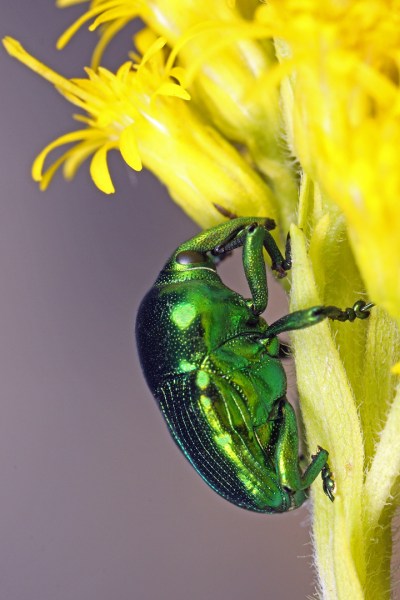
Eurhinus cf. adonis on Solidago chilensis flowers | Chaco Province, Argentina.

What’s in a name? That which we call a Eurhinus by any other name would be as shiny!

This genus of weevils was involved in one of the more interesting nomenclatural problems that I’ve encountered. The genus was originally given the name Eurhin by Illiger in 1807, but Schönherr in 1824 changed it to Eurhinus—believing (incorrectly) that Eurhin was not a properly formed name. Unfortunately, the name Eurhinus had already been used by Kirby in 1819 for a different genus of weevils in the subfamily Apioninae. The rules of zoological nomenclature, of course, prohibit the same name being used for two different genera, and several attempts were made during the following years to provide a replacement name for Schönherr’s Eurhinus. None gained acceptance, however, and eventually Schönherr in 1833—still considering justified his correction of Eurhin to Eurhinus—proposed the name Eurhynchus for Kirby’s Eurhinus. Remarkably, the name Eurhynchus also had been used previously (for a genus of birds). Nevertheless, the change gained acceptance, and both of Schönherr’s names remained in use for the next century and a half—Eurhinus in the subfamily Baridinae and Eurhynchus in the subfamily Apioninae, with both credited to Schönherr. Strict application of the rules of nomenclature would require that the name Eurhinus be transferred back to the apionine genus and credited to Kirby and the name Eurhin resurrected for the baridine genus and credited to Illiger. However, as pointed out by Zimmerman & Thompson (1983) this would not only destroy more than a century’s worth of nomenclatural stability but also complicate the formation of family-group names such as tribes—since the two original names each have the same root (Eurhin-), tribal names based on them would be identical (Eurhinini). To resolve these issues, a formal application was submitted to the International Commission of Zoological Nomenclature (ICZN) to preserve  Schönherr’s long accepted usage of Eurhinus and Eurhynchus. To do this, the ICZN would not only have to declare Schönherr’s correction of Eurhin to Eurhinus justified, but also suppress the original use of the name Eurhynchus (as a genus of birds) in order to allow Schönherr’s subsequent use for the apionine genus to stand. Fortunately, suppressing the first use of Eurhynchus had no impact on stability, since an older name was already in use for the genus of birds and the younger name had not been used since its original description. The authors of the application also noted the support of several contemporary weevil specialists (including Charles O’Brien) and that Patricia Vaurie, in her revision of the genus one year earlier (Vaurie 1982), had used the original name Eurhin with reluctance on the then-correct advice of her contemporaries. It was a classic case of priority versus stability, and while the ICZN typically is rather conservative in favoring priority, they were clearly swayed in this case by the interests of stability and impact on formation of family-group names.

REFERENCES:

Ulmer, B. J., R. E. Duncan, J. Prena & J. E. Peña. 2007. A weevil, Eurhinus magnificus Gyllenhal (Insecta: Coleoptera: Curculionidae). University of Florida, IFAS Publication #EENY-417/IN751, 6 pp.

Vaurie, P. 1982. Revision of Neotropical Eurhin (Coleoptera, Curculionidae, Baridinae). American Museum Novitates 2753:1–44.

Zimmerman, E.C. & R. T. Thompson. 1983. On family group names based upon Eurhin, Eurhinus and Eurhynchus (Coleoptera). Bulletin of Zoological Nomenclature 40:45–52.

Copyright © Ted C. MacRae 2013

Group mimicry in Cerambycidae… and more

During last year’s extended visit to Argentina, I had the chance to spend the early part of April in the northern province of Chaco. Though much of this hot, arid plain has been converted to agriculture, remnants of thorn forest remain along fence rows and in small patches of Chaco Forest. Despite the decidedly tropical latitude of the region, however, the profuse bloom of Chilean goldenrod, Solidago chilensis, along these fence rows during the Argentine autumn is reminiscent of crisp fall days here in the eastern U.S., and like the goldenrod here the ubiquitous stands of yellow blossoms stretching across the Chaco Plain are equally attractive to a multitude of insects. Among those insects are the Cerambycidae, or longhorned beetles, and while the eastern U.S. cerambycid fauna of goldenrod boasts only a few (albeit spectacular) species in the genus Megacyllene, the Argentine cerambycid fauna that I found on these flowers included at least three species in various genera belonging to two different tribes.

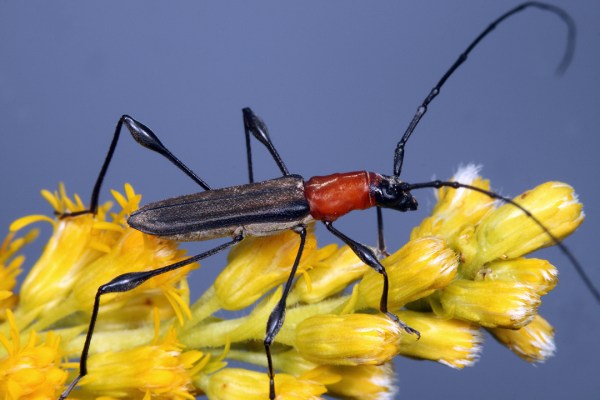
Rhopalophora collaris (Germar 1824) | Chaco Province, Argentina

Rhopalophora collaris (Germar 1824) | Chaco Province, Argentina

Two of the species I saw are shown here, and their similarity of appearance is no coincidence, as both belong to the tribe Rhopalophorini (coming from the Greek words rhopalon = club and phero = to bear, in reference to the distinctly clavate, or club-shaped, legs exhibited by nearly all members of the tribe). In fact, a great many species in this tribe exhibit the same general facies—slender in form and black in coloration with the head and/or pronotum red to some degree. Since all of these species are diurnal (active during the day) and frequently found on flowers, one can assume that the members of this tribe represent an example of what Linsley (1959) called ‘group mimicry.’ In this simple form of Batesian mimicry (harmless mimic with protected model), a group of related species within a genus or even a tribe have a general but nonspecific resemblance to those of some other group of insects—in this case presumably small, flower-visiting wasps. Although the tribe is largely Neotropical, the nominate genus Rhopalophora does extend northward with one eastern U.S. representative, R. longipes. Among the numerous species occurring in South America, the individuals I saw in Argentina can be placed as R. collaris due to the relative lengths of their antennal segments and uniquely shaped pronotum (Napp 2009).

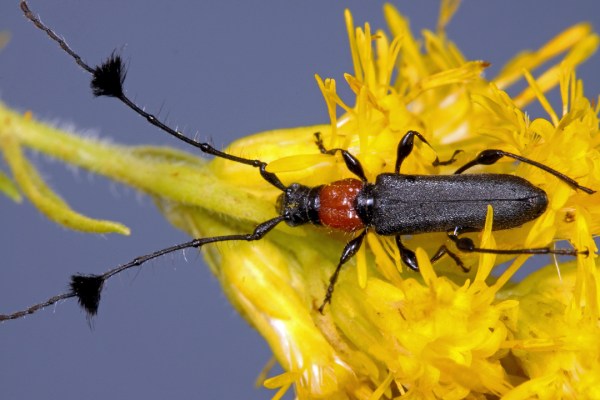
Cosmisoma brullei (Mulsant 1863) | Chaco Province, Argentina

Cosmisoma brullei (Mulsant 1863) | Chaco Province, Argentina

The second species could easily be mistaken for another species of Rhopalophora were it not for the distinct tufts of hair surrounding the middle of the antennae. These tufts immediately identify the beetle as a member of the large, strictly Neotropical genus Cosmisoma (derived from the Greek words kosmos = ornament and soma = body, a direct reference to the tufts adorning the antennae of all members of this genus). Three species of the largely Brazilian genus are known from Argentina, with the black and red coloration of this individual easily identifying it as C. brullei (Bezark 2o13). In the years since this genus was described, additional related genera have been described that bear remarkably similar tufts of hair not on the antennae, but on the elongated hind legs. The great, 19th century naturalist Henry Walter Bates “tried in vain to discover the use of these curious brush-like decorations” (Bates 1863), and nearly a century later Linsley (1959) conceded that their function still remained unknown. Antennal tufts are actually quite common in Cerambycidae, especially in Australia, and while experimental evidence continues (to my knowledge) to be completely lacking, Belt (2004) records observing “Coremia hirtipes” (a synonym of C. plumipes) flourishing its leg tufts in the air (presumably in a manner similar to waving of antennae) and, thus, giving the impression of two black flies hovering above the branch on which the beetle was sitting. This seems also to suggest a function in defense, with the tufts perhaps serving as a distraction to potential predators in much the same way that many butterflies have bright spots near the tail to draw the predator’s attention away from the head.

REFERENCES:

Bates, H. W. 1863. The Naturalist on the River Amazons. Murray, London, 2 vols.

Belt, T. 2004. The Naturalist in Nicaragua. Project Guttenberg eBook.

Bezark, L. G. 2009. A Photographic Catalogue of the Cerambycidae of the World. Available at http://plant.cdfa.ca.gov/byciddb/

Linsley, E. G. 1959. Ecology of Cerambycidae. Annual Review of Entomology 4:99–138.

Napp, D. S. 2009. Revisão das espécies sul-americanas de Rhopalophora (Coleoptera: Cerambycidae). Zoologia (Curitiba) 26(2):343–356.

Copyright © Ted C. MacRae 2013