Book Announcement: Field Guide to the Jewel Beetles (Coleoptera: Buprestidae) of Northeastern North America

It’s not often that I anticipate the release of a book as much as I have with the soon-to-be-released Field Guide to the Jewel Beetles (Coleoptera: Buprestidae) of Northeastern North America. Fortunately, the wait is now almost over—Morgan Jackson, author of Biodiversity in Focus and co-author of the book, has just announced its planned released in early 2013. Even better, he has provided a sneak peak at its contents that is as smartly designed as the book itself.

Obviously, as a serious student of the family Buprestidae, this book would make it into my bookshelf no matter what, and I plan to do a more detailed review of the book once I have a copy permanently in my hands. However, I can tell you that I am already very impressed with the design of the book and the quality of the product. I was fortunate to meet up with Morgan at last month’s Entomological Society of America meetings in Knoxville, Tennessee, and Morgan kindly allowed me to leaf through the carefully guarded copy he had with him (it was difficult handing it back to him). The Prezi preview for the book covers some of the more important features that will set this book apart from other field guides, but worthy of special mention are: 1) the minimum/maximum size silhouette figure in the upper left-hand corner of each species treatment—a tremendously useful feature, 2) inclusion of the both the author and date of the original description of the species (to keep us more taxonomically inclined happy), 3) super high quality dorsal and lateral habitus photographs and of additional key features to aid in identification, 4) geographical range maps coded to show both presumed and recorded ranges, and 5) keys to all treated species, richly augmented with high quality photographs.

There is another reason I am so excited about this book, and that is the authors chose my photograph of Buprestis rufipes (red-legged buprestis), one of North America’s most striking jewel beetle species, to grace the cover of the book. I also provided specimens of a number of uncommonly encountered species which were used for the photographs in their respective species treatments.

Quite remarkably, this book will be available at NO COST—including free shipping anywhere! As a consequence, the book will not be available from commercial book and literature sources. You can request your copy by emailing your mailing address to Morgan at morgandjackson@gmail.com. I don’t know how many copies of the book are being printed, but I have a feeling that supplies will not last long, and in the coming years one will have to beg/borrow/steal from a kindly old colleague to get a copy (you can have my copy when you pry it from my cold, dead fingers!).

Copyright © Ted C. MacRae 2012

One Bad Beetle

Almost every tiger beetle trip that I take has a mix of gimmes and stretch goals. That’s alright—it’s impossible to find everything every time out, and if I eschewed the common and was happy only when I found something truly rare, then I would probably find myself rather unsatisfied most of the time. For the stretch goals, however, “success” can mean many things—obviously the best case scenario is to find it in good enough numbers to allow responsible collection of an adequate series and photograph enough individuals in situ to ensure that at least a few shots will have the focus, lighting, and composition that I want. Success can also be something less than that—maybe I find only a few and don’t get a very good series, or I have trouble getting field shots and am not happy with the shots I got…or worse I don’t even get field shots! The least successful version of “success” is when I end up with just one single beetle, and the only photographs I get are very ordinary-looking shots of that one beetle in confinement. Like what happened with Cicindela decemnotata (Badlands Tiger Beetle).

IMG_3717_1080x720

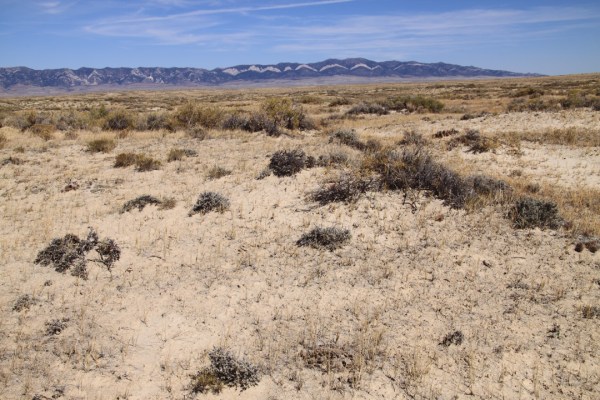
Soda Lake, Wyoming—we searched theses areas of alkaline exposures but never found beetles…

Chris Brown and I knew this species would be a stretch goal when we added “Soda Lake, Wyoming” to the itinerary of our 7th Annual Fall Tiger Beetle Trip™ (location “H” on this map). Cicindela decemnotata is the westernmost representative (Rocky Mountains from the northwestern Great Plains and northern Great Basin north to Yukon) of a group of species that seem to be closely related and resemble each other in their green coloration varying degrees of red on the head, pronotum and elytra and their variably developed white elytral markings (Pearson et al. 2006). Cicindela limbalis, C. splendida and C. denverensis occur as a partially allopatric species complex further east in the Great Plains, while C. sexguttata, C. patruela and C. denikei occupy more forested regions even further to the east. On this trip we were focusing on Great Plains tiger beetles and the dune specialists of the Yampa River Valley of northwestern Colorado. Our drive from northwestern Nebraska to the Yampa Valley would skirt the eastern edge of C. decemnotata‘s distribution, so we decided to stop by Soda Lake where Matt Brust had seen the species in previous years.
IMG_3721_1080x720

…until we started searching these small ridges of exposed sandy soil.

It took most of the morning to reach the spot, so by the time we arrived we were anxious to get out and start searching the sage brush habitat. For me it was an unfamiliar landscape—at that time my northwesternmost push for tiger beetles yet, and like many western habitats it seemed vast and unending. We were optimistic, however, because it just “looked” like good tiger beetle habitat, with ribbons of alkaline flats weaving through open brush. Of course, as time passes and one starts to recognize that they are again searching ground already covered with no sign of beetles, optimism begins to wane and searches become more deliberate. We were there for almost an hour before I heard Chris call out. He had abandoned the alkaline flats—obvious habitat it would seem—and started looking upon some slightly sandier low ridges a little further to the south. I hustled to where he was standing, and we both looked at the beetle, calmly sitting on the sand, as we deliberated our next move. Should we try to photograph it? It seemed not at all skittish—but what if we failed, it got away, and then we never saw another one? We played it safe, netted it (easily), and placed it in a vial for transfer to a container of native soil should further efforts at finding and photographing the species fail. It was perhaps another 45 minutes before we saw another beetle—I don’t know if it was just a less cooperative individual or the heat of the day had kicked in, but as soon as I started my approach it was gone. We saw another not long after, but same story. Finally we saw one last beetle that seemed to tolerate my approach to the point that I even began looking for it in the view finder—at which point it promptly zipped away. This small prospect of success only served to prolong our vain searching before we eventually we accepted defeat and tried to be happy with the single individual that we had caught and the photographs that we would take of it in its artificial home.

Cicindela decemnotata

Cicindela decemnotata (Badlands Tiger Beetle) | Soda Lake, Wyoming

Part of me really doesn’t like showing photographs of confined tiger beetles—not for any philosophical reasons, but because I just don’t like the way they look. Rarely do they exhibit the elegant stilting and other thermoregulatory behaviors that place them in much more pleasing postures when photographed in situ. Rather, they often have a “hunkered down” look that says “I’m not happy and I don’t want to be here, so I’m not going to smile for the camera!” Since these photos were taken, I have learned a few tricks to deal with confined beetles and achieve more aesthetically pleasing photographs—these include the use of much larger arenas, allowing the beetles more time to accommodate to their environs, and elevating the substrate relative to the camera (maybe a subject for a future post). In the end, however, they are still confined and can’t be passed off as anything but that.

The bold white markings, media band sharply angled and not reaching the edge of the elytra, and ''greasy'' appearance distinguish this species.

The bold white markings, media band sharply angled and not reaching the edge of the elytra, and ”greasy” appearance distinguish this species.

As an aside, tiger beetle pros Barry Knisley, Ryan Woodcock and Mike Kippenhan have recently published the results of an impressive study of this species in which a combination of morphological and molecular evidence support the recognition of four subspecific entities—three described as new (Knisley et al. 2012). The molecular analyses not only support the subspecific distinctions postulated from morphology but also suggest that populations have undergone rapid phylogenetic radiation in the recent geological past. Much of the area occupied by C. decemnotata was covered by an ice shield during the most recent glaciations and, thus, has opened up for colonization only during the past 10,000 years (Pearson and Vogler 2001). The molecular analyses showed a relatively low amount of genetic divergence within C. decemnotata populations, which combined with marked morphological differences suggests recent and rapid radiation—most likely in the wake of glacial recession. A similar situation has been observed with members of the Cicindela maritima species-group, which occupy much the same range as C. decemnotata and, presumably, have experienced similar selection pressures in the recent geological past.

REFERENCES:

Knisley, C. B., M. R. Woodcock & M. G. Kippenhan. 2012. A morphological and mtDNA analysis of the badlands tiger beetle, Cicindela (s. str.) decemnotata Say, 1817 (Coleoptera: Carabidae: Cicindelinae) with the description of three new subspecies. Insecta Mundi 0214:1–49.

Pearson, D. L., C. B. Knisley & C. J. Kazilek. 2006. A Field Guide to the Tiger Beetles of the United States and Canada. Oxford University Press, New York, 227 pp.

Pearson, D. L. and A. P. Vogler.  2001. Tiger Beetles: The Evolution, Ecology, and Diversity of the Cicindelids.  Cornell University Press, Ithaca, New York, 333 pp.

Copyright © Ted C. MacRae  2012

Where siblings mingle: Ellipsoptera marginata vs. E. hamata

When Erwin & Pearson (2008) formally broke up the great genus Cicindela by elevating most of its former subgenera to full genus rank, it caused a bit of consternation amongst some North American cicindelophiles. The argument went something like, “Now we have all these new genus names to learn, and we’ll have to relabel and reorganize everything in our collections, and how do we know the names won’t change again, and we can’t even tell them apart in the field anyway, and blah blah…” Pardon me, but since when did taxonomy become more about slotting species into fixed, easy-to-learn categories and less about best reflecting dynamic knowledge of complex evolutionary relationships? In the case of Cicindela and its former subgenera, however, even these arguments don’t hold up to close scrutiny—tiger beetle enthusiasts in North America should have already been quite familiar with the former subgenera due to their inclusion in the widely accepted Pearson et al. (2006) field guide, many of which actually do present a unique suite of morphological/ecological characters that facilitate their recognition in the field, and I personally find that nomenclatural recognition of individual lineages helps my attempts to learn and understand them much more than dumping them into a large, all-encompassing genus based on superficial resemblance. As for insisting that names don’t change, well that has never been a tenet of taxonomy. Stable, yes, but fixed and immutable, no.

Ellipsoptera marginata male | Pinellas Co., Florida

Enough waxing philosophic. One of the more distinctive of the former subgenera is Ellipsoptera. Morphologically the genus is defined by details of male genitalia, but the 11 North American species are generally recognizable in the field by their relatively “bug-eyed” look and long legs (Pearson et al. 2006) and, as a group, seem ecologically tied to extreme habitats with sandy and/or saline substrates that are nearly or completely devoid of vegetation. Coastal marshes and mudflats, saline flats, sandy river banks, and deep sand ridges representing ancient coastlines are some of the habitats where species in this genus are most commonly encountered. Most of the species exhibit a fairly uniform facies but differ in the details of maculation and dorsal coloration, but two species that stand apart from the rest are E. marginata (Margined Tiger Beetle) and E. hamata (Coastal Tiger Beetle) due to the highly diffuse middle band of their elytra. These are both eastern coastal species and presumably represent sibling species that have diverged based on geographical range partitioning—E. marginata along the Atlantic Coast and E. hamata along the Gulf Coast. In the field, the two species are almost identical in appearance but nonetheless easily identifiable based on geographical occurrence. There is, however, a small stretch of coastline—the lower Gulf Coast of Florida—where the ranges of the two species overlap and geography alone isn’t sufficient for species determination.

Ellipsoptera hamata lacerata male | Dixie Co., Florida

Fortunately, despite their strong resemblance to each other, field identifications in areas where these species co-occur are still possible due to the presence of small but distinct sexual characters present in one species but absent in the other. Close examination is necessary to see the characters (or their absence), so it is best to net a few individuals and examine them in the hand or, as I have done here, look at them through the viewfinder of a camera. The photos in this post include the male and the female of both species, each showing the presence or absence of the distinguishing character.

Ellipsoptera marginata female | Dixie Co., Florida

In most tiger beetles, male individuals are distinguished by a number of secondary sex characters, but easiest to see in the field are the brush-like pads on the underside of the front tarsi (“feet”). Males of E. marginata and E. hamata are further distinguished from each other by the presence (E. marginata) or absence (E. hamata) of a distinct tooth on the underside of the right mandible. Photo 1 above shows a male E. marginata from Pinellas Co., Florida, and the tooth is easily seen in that relatively distant view. Photo 2 above shows a male E. hamata lacerata (Gulf Coast Tiger Beetle)—the Floridian subspecies, and while a small bump can be seen on the underside of the right mandible, it is not nearly as well developed into a distinct tooth as in E. marginata.

Ellipsoptera hamata lacerata female | Dixie Co., Florida

Female tiger beetles, on the other hand, lack the brush-like tarsal pads present in the males and are further distinguished by the “mesopleural coupling sulcus”—an area just behind the side of the pronotum that receives the male mandible during mating and is thus devoid of setae (compare the females in Photos 3 and 4 with the males in Photos 1 and 2). Neither E. marginata nor E. hamata females possess the mandibular tooth found in E. marginata males, but they can be distinguished from each other by their elytral apices. In E. marginata females (Photo 3), the elytra are curiously “bent” at the tips, forming a distinct indentation at the apex of the elytra where they meet, while female E. hamata (Photo 4) lack this indentation.

Are there other tiger beetle sibling species groups for which you would like to see comparative posts such as this one?

p.s. I completely neglected to mark yesterday’s 5th anniversary of Beetles in the Bush! I don’t know how I missed a milestone as big as five years—hopefully my ability to provide interesting content is faring better than my middle-aged memory!

REFERENCES:

Erwin, T. L. and D. L. Pearson. 2008. A Treatise on the Western Hemisphere Caraboidea (Coleoptera). Their classification, distributions, and ways of life. Volume II (Carabidae-Nebriiformes 2-Cicindelitae). Pensoft Series Faunistica 84. Pensoft Publishers, Sofia, 400 pp.

Pearson, D. L., C. B. Knisley and C. J. Kazilek. 2006. A Field Guide to the Tiger Beetles of the United States and Canada. Oxford University Press, New York, 227 pp.

Copyright © Ted C. MacRae 2012

Persistence Pays

For the past three years I’ve crisscrossed the country in search of some of North America’s rarest tiger beetles, each time hoping to get that “perfect” photograph of an unconfined beetle exhibiting natural behavior in its native habitat. I’ve managed to get photos of most, though there are a few that I wish I could do over, but the only one that I think really comes close to the ideal I have in my mind is this one of Cicindela formosa generosa, featured in the ESA 2013 World of Insects Calendar (and, ironically, taken only about 5 miles from my home).

A consequence of all this attention to uncommon species is that I’ve somewhat neglected getting good photographs of some of our most common tiger beetles. One of these is Cicindela repanda (Bronze Tiger Beetle), which can be found near almost any body of water throughout the bulk of eastern North America. This summer I resolved to correct that situation, but I found this to be more difficult than anticipated. The first time I tried to photograph the species was when I encountered them in late July on a wide, open beach along the Mississippi River on a hot, summer day. I found the beetles almost completely unapproachable due to the extreme heat and lack of any cover that could be used to my advantage. I had better luck in mid-August when I attracted some individuals to an ultraviolet light that I had setup one night at a spot further north along the river. Those photos were acceptable technically but lacking otherwise, primarily because the beetles didn’t assume any of the charismatic poses associated with the thermoregulatory behaviors exhibited by active beetles in the middle of a hot summer day. Finally, at the end of August, I encountered the species yet again on a small patch of sandy/muddy river bank along the Mississippi River just south of St. Louis. It was another hot day—quite hot actually—but with the help of some features of terrain I was finally able to get that photo of the species that I’ve been wanting.

Cicindela repanda (Bronze Tiger Beetle) | St. Louis Co., Missouri

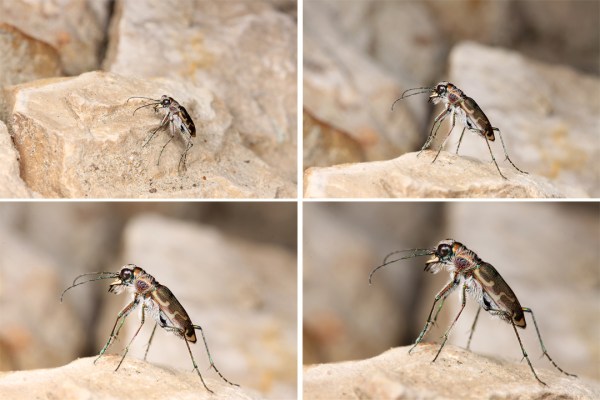
I like this photo for a number of reasons. The beetle is nicely profiled while paused “tall” on its front legs (a common posture on hot days as they try to lift themselves up off the hot soil surface), the angle is low, and the subject and foreground are well focused in front of a nicely blurred backdrop of rocks. It is these rocks that actually helped me get this photo. I had chased several individuals down on the open sand for some time, but since the day was as hot as my first attempt and I wasn’t having any better luck. Every now and then one of the beetles that I was “working” would fly up into this rockier area, and I noticed that I was able to get closer to these beetles because I was able to stay lower as I made my approach. I began preferentially working beetles towards the rocks and finally got one that settled down and started showing normal searching behaviors despite the fact that I was already in fairly close range. At that point, it became a matter of waiting for the beetle to “lower his guard” while I assumed a shooting position, and as soon as it began acting normal I slowly closed in and began taking shots.

Getting close is a process, as these successive shots demonstrate.

This collage shows the four shots immediately preceding the final photo and how each shot brought me a little closer to the beetle (and that final composition that I wanted). The beetle was still in search mode as it crawled up the side of one rock and I began taking photos, but upon reaching the top it paused and lifted itself up high on its front legs. I knew I would have 5, 10, maybe 15 seconds at the most to capture this pose before it began moving again, so I closed in slowly but assertively and fired a shot every couple of seconds until I got the one that I wanted. At that moment, the beetle flew away, and although I tried for another 20 minutes or so I was unable to get another beetle back up on the rocks for more shots. How fleeting success can be!

Copyright © Ted C. MacRae 2012

Black is beautiful!

As much love as I give to tiger beetles, I tend to be just as indifferent to the non-cicindeline ground beetles. Why this is I don’t know; ground beetles sensu lato are super diverse taxonomically, morphologically, and ecologically, and the colors of some rival even the gaudiest of beetles. Still, whenever I see a Harpalus pensylvanicus or Bembidion affine crawling on the ground, my brain just yawns and I look elsewhere. I suspect my tiger beetle inclinations have more to do with their extreme habitat specificity and attendant behavioral adaptations, in which areas the other ground beetles are clearly somewhat lacking. There are also those tiger beetles jaws!

Calosoma sayi (black caterpillar hunter) | New Madrid Co., Missouri

Well, there is one group of carabids that does excite me almost (almost!) as much as tiger beetles, and that is the nominate subfamily Carabinae with genera such as Calosoma, Callisthenes, Scaphinotus, and Cychrus—the so-called “caterpillar hunters” and “snail hunters.” These are the giants of the family, with most species measuring at least 15 mm in length and many measuring up to 25 mm in length or more. And then there are those jaws! Perhaps my feelings for this group are no coincidence, given the close relationship between these beetles and tiger beetles (in fact, most molecular data suggest that tiger beetles are firmly nested within the Carabinae).

Baby got jaw!

I came across several individuals representing Calosoma sayi (black caterpillar hunter), including the two individuals shown in the above photographs, back in late August under street lamps in the southeastern Missouri city of Portageville. Though it lacks the metallic colors possessed by many other species in the group, it does have those delightful, sculptured jaws. While I don’t normally like to photograph beetles on pavement, that’s where the beetles were and I’ve had poor luck in trying to move active beetles to an alternative substrate and then get them to settle down and resume natural-looking positions. In this case, it turned out not to be necessary to move the beetles, as the color and texture of the pavement provides a very nice background for these all black beetles. Also, did I mention those jaws?!

Copyright © Ted C. MacRae 2012

Life at 8X—hibiscus flea beetle

Chaetocnema quadricollis on Hibiscus lasiocarpus | St. Louis Co., Missouri (photo @ 2X)

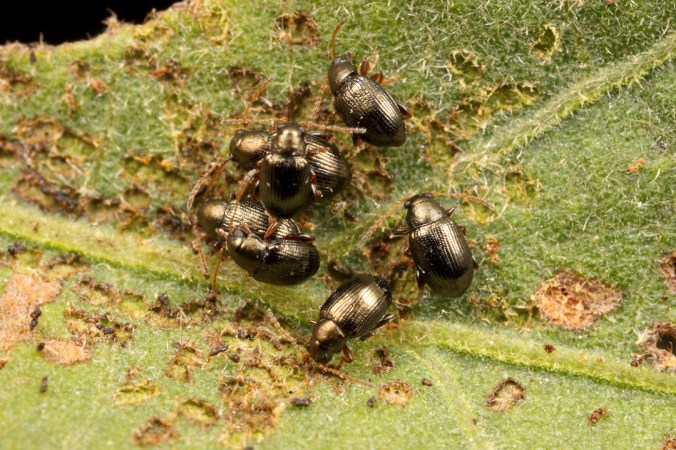
In mid-August I visited Route 66 State Park along the Meramec River in east-central Missouri to check stands of rosemallow (Hibiscus lasiocarpus) that I had previously noticed growing in the park for the presence of the stunning jewel beetle, Agrilus concinnus. Once considered amongst the rarest members of the genus in North America, this species has in recent years been collected at several localities—always in association with Hibiscus spp. (MacRae 2004). I was disappointed to find the rosemallow stands sparse and stunted—a result of this year’s drought—and there were no A. concinnus to be found. Whether this was a result of the drought or the location or the lateness of the season, I do not know. However, as often happens when I don’t find what I’m looking for, I start seeing things that I’m not looking for. In this case, what I noticed were these incredibly tiny leaf beetles feeding on the foliage of the rosemallow plants.

Adults feed gregariously on the upper leaf surfaces, leaving characteristic feeding damage (photo @ 3X)

I’ve collected a fair number of leaf beetles over the years, thus I recognized these immediately as belonging to the subfamily Alticinae (flea beetles) due to the way they jumped when I disturbed them. However, I have also done a fair bit of collecting of insects on rosemallow and never seen (or at least noticed) this species of flea beetle. The beetles were feeding gregariously on mostly the upper surface of the leaves, and their feeding resulted in a rather distinctive damage that caused the more severely affected leaves to shrivel and turn brown. Based on gestalt, I was guessing Crepidodera or Chaetocnema, two genera that contain some of the state’s smallest species of flea beetles.

An adult pauses long enough for a photo while feeding on sap at the broken end of a leaf petiole (photo @ 8X)

Based on host plant and this photo on BugGuide, I thought these might represent Chaetocnema quadricollis. However, that species isn’t among the nine species of the genus recorded from Missouri by Riley & Enns (1979, 1982). Nevertheless, Ed Riley himself, and Shawn Clark as well, each confirmed this as the likely identity of the beetles based primarily on its associated host plant, and in fact Riley did record the species from Missouri at numerous localities under the name C. decipiens (later synonymyzed under C. quadricollis by White (1996) in his revision of the genus in North America). Schwarz (1878) described the species from Florida (noting that it has “exactly the same aspect of a small Crepidodera“), and apparently its association with and occasional pest status on rosemallow has long been established (Weiss & Dickerson 1919 recommended Bordeaux or arsenate of lead for its control).

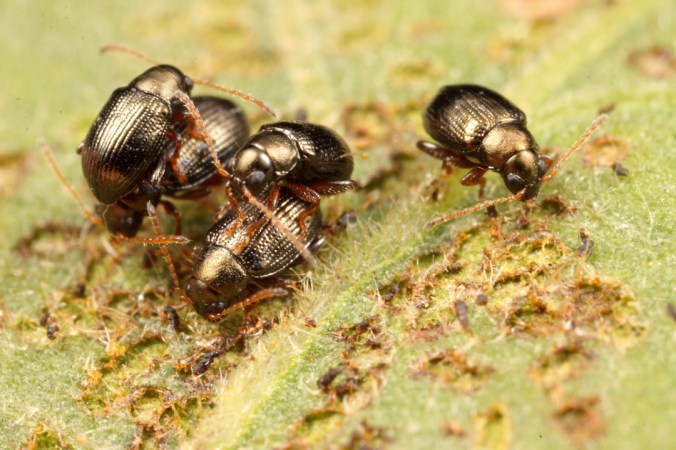
Although coupled, these beetles are not actively mating (is this mate guarding?) (photo @ 8X)

These are probably the smallest beetles that I have photographed so far. In the photo of the mating pair above, the male measures just over 1 mm in length, while the female measures about 1.6 mm in length (the sensor of my camera measures 21 mm wide, so an 8X photo yields a field of view measuring 2.625 mm wide). All of the above photos were taken hand-held in the field with a Canon MP-E 65mm macro lens (1/250 sec, ISO-160, f/14, full flash). The last two photos were taken with the lens mounted on 68 mm of extension tube and fully extended to achieve 8X magnification. While the photos contain good depth-of-field (DOF), they are soft due to the extreme amount of diffraction that occurs at such a small aperture and high magnification. If I were to do it over, I would reduce the aperture to f/10 or even lower and sacrifice some DOF for better sharpness.

REFERENCES:

MacRae, T. C. 2004. Beetle bits: Hunting the elusive “hibiscus jewel beetle”. Nature Notes, Journal of the Webster Groves Nature Study Society 76(5):4–5.

Riley, E. G. & W. R. Enns. 1979. An annotated checklist of Missouri leaf beetles (Coleoptera: Chrysomelidae). Transactions, Missouri Academy of Science 13:53–83.

Riley, E. G. & W. R. Enns. 1982. Supplement to an annotated checklist of Missouri leaf beetles (Coleoptera: Chrysomelidae): new state records and host plant associations. Entomological News 93(1):32–36.

Schwarz, E. A. 1878. The Coleoptera of Florida. Proceedings of the American Philosophical Society 17(101):353–469.

Weiss, H. B. & E. L. Dickerson. 1919. Insects of the swamp rose-mallow, Hibiscus moscheutos L. in New Jersey. Journal of the New York Entomological Society 27(1):39–68.

White R.E. 1996. A revision of the genus Chaetocnema of America north of Mexico (Coleoptera: Chrysomelidae). Contributions of the American Entomological Institute 29(1): 1–158.

Copyright © Ted C. MacRae 2012

Beetle Collecting 101: How to pin a beetle

It has been a long time since I initiated my Beetle Collecting 101 series (more than two years!), and to date the first issue—Beetle Collecting 101: Dress for Success—remains the one and only lesson that I’ve posted. I really had intended to follow that up with nittier-grittier posts on the actual mechanics of collecting beetles and processing the specimens for long-term preservation, but I didn’t and don’t know why other than to say, well… life happens. It’s never too late to fix something, however, so as a long overdue follow up I thought I would give a short video lesson on how to pin a beetle—specifically a cerambycid (longhorned) beetle. Featured in this short (4:31) video is the lovely Megacyllene decora (amorpha borer), which I found back in early September at a site in Missouri’s southeastern lowlands. Click the image to be directed to the video.

Copyright © Ted C. MacRae 2012

The hardest EASIEST ID Challenge in like ever!

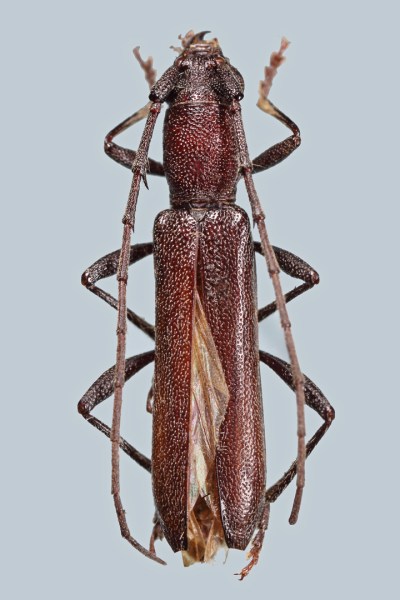
This is not only the hardest ID Challenge I have ever posted, it is probably the hardest one anyone has EVER posted. I’m not going to ask for order or family because they’re so easy. I will ask for the genus, because maybe only a few of you will get that right, but the genus alone won’t be enough. I want the species! Don’t even think about searching the internet for a matching photo—it doesn’t exist! You’re going to have to utilize other resources to figure this one out.

Because of the difficulty of this challenge, all the normal rules are out the window—no points, no sessions, no moderated comments, no nothing. This is winner take all—first person to correctly guess the species gets loot! I’ll even provide all the collection data in the caption. Good luck!

Update 10/29/12 10:12 pm: Well, I goofed and didn’t think about somebody Googling the label data, which Ben Coulter did to quickly arrive at the correct answer. Stupid Google!

At any rate, and with great anticlimactic fanfare, say hello to Aneflomorpha cribellata, described by Bates more than a century ago (1892) and known only from that single type specimen until the collection of this one in southern Mexico in 2005 (MacRae et al. 2012). This is the first photograph of the species and will be added to Larry Bezark’s A Photographic Catalogue of the CERAMBYCIDAE of the World.

Reference:
MacRae, T. C., L. G. Bezark & I. Swift. 2012. Notes on distribution and host plants of Cerambycidae (Coleoptera) from southern México.  The Pan-Pacific Entomologist 88(2):173–184.


MEXICO: Oaxaca, 4.8 km E La Ventosa, Hwy 190, 16°33’27″N, 94°54’27″W, elev. 76′, 28.vii.2005, beaten from unidentified dead branches, coll. T. C. MacRae.

Copyright © Ted C. MacRae 2012