Milkweeds of the genus Asclepias are among my favorite plants, although I’m not fully sure why that is the case. Sure, their blooms are conspicuous and colorful, but so are those of many other plants. Perhaps one reason is their status as hosts for milkweed beetles (genus Tetraopes, family Cerambycidae). Four species of these beetles occur in Missouri, including the rare T. texanus. Another reason might be their diversity—in Missouri alone there are 16 different species, ranging from the ubiquitous common milkweed (A. syriaca) to the federally endangered Mead’s milkweed (A. meadii). The latter is one of six milkweed species occurring in Missouri that I have not yet seen, so I suppose I should withhold judgement until I’ve succeeding in finding all 16 species. Nevertheless, I would have to say that clasping milkweed (A. amplexicaulis) has to be my favorite of Missouri’s milkweeds.
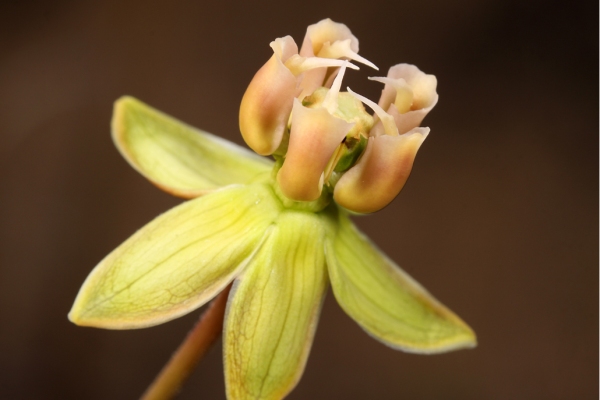
Clasping milkweed (Asclepias amplexicaulis) | Sand Prairie Conservation Area, Scott Co., Missouri
Clasping milkweed (also known as sand milkweed—not to be confused with A. arenaria occurring further west in the Great Plains) is said to occur sporadically throughout Missouri in prairies, glades, rocky open woods, roadsides, and railroads. However, I have seen this species only a few times—all in dry sand habitats in the southeastern Mississippi Alluvial Plain (or, the “bootheel” as we say here in Missouruh). Until a few years ago the only time I had ever seen this plant was many years in an eroded sandy opening on Crowley’s Ridge (an elevated ridge of alluvium and loess deposited during the last glacial maximum). Those plants were not in flower, but their was no mistaking their identity due to their erect stems and broad, cordate-clasping, tomentulose leaves with wavy margins. I would see this plant again a few years ago during my first visit to Sand Prairie Conservation Area, and although I would see it again on many subsequent visits, at no time did I succeed in seeing the blooms.
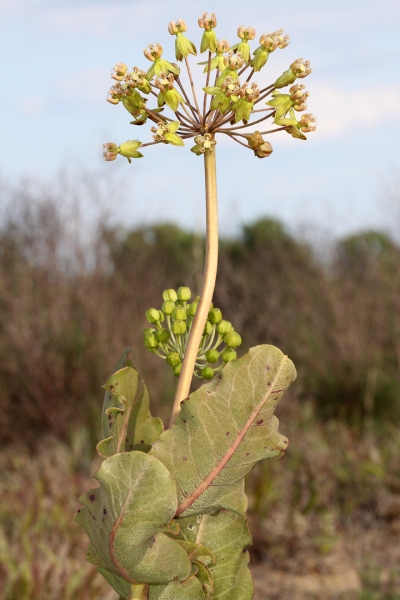
Broad, clasping, tomentulose leaves with wavy margins.
Finally, last year, I returned to Sand Prairie during late April (a weather-delayed installment of my Annual-Birthday-First-Bug-Collecting-Trip-of-the-Year). I had actually gone there to photograph Missouri’s unique intergrade population of the Festive Tiger Beetle (Cicindela scutellaris), but the weather was cool and the beetles apparently had decided to remain in their burrows. A bad day of collecting, however, is still better than a good day of just about anything else—perhaps because there are almost always consolation prizes, and my consolation prize on this day was my first sight of clasping milkweed plants in full bloom.
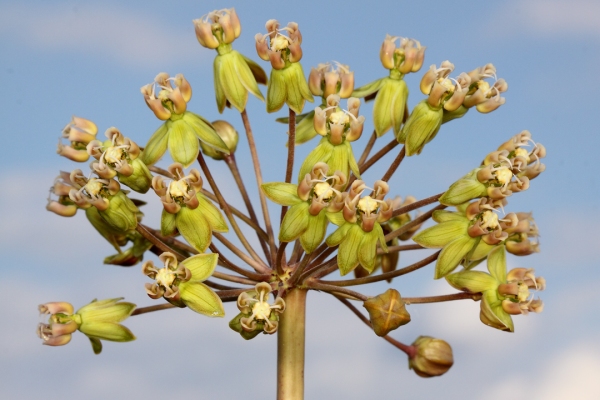
A single inflorescence atops each stem.
I may not be exactly sure why I like milkweeds so much, but I think I now know why I like clasping milkweed above all others. The softly colored green and pink blossoms are exquisite, to be sure, but more importantly the species is firmly linked in my mind to one of my favorite Missouri habitats. I imagine that clasping milkweed might be an attractive, if somewhat gangly, addition to a native wildflower garden. However, I’m not sure I would enjoy cultivated plants in my garden as much as I do seeing wild plants in one of Missouri’s rarest and most endangered natural communities.
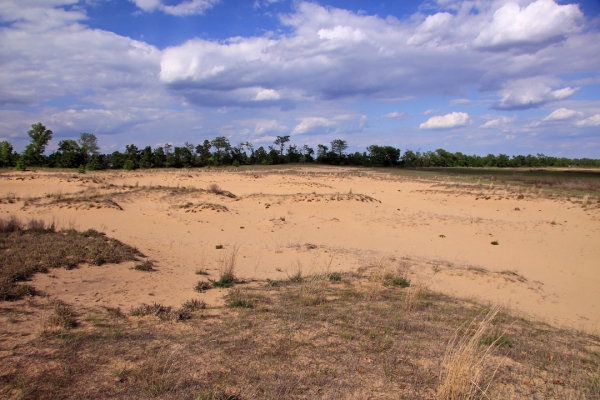
Sand Prairie Conservation Area, Scott Co., Missouri
Copyright © Ted C. MacRae 2013