Hand-held caddisflies

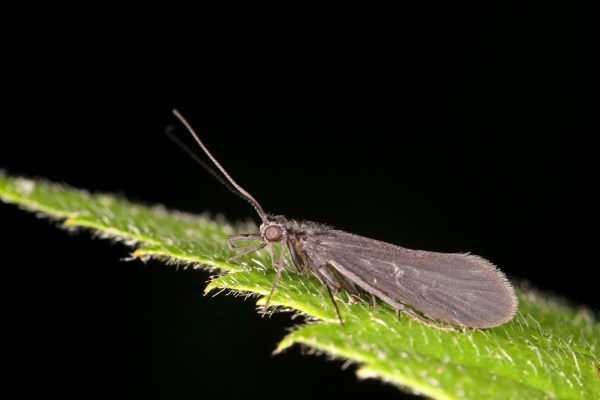
Chimarra sp. (Trichoptera: Philopotamidae) | Sam A. Baker State Park, Missouri

I recently found a folder in my files with a number of photos taken way back in April during a visit to Sam A. Baker State Park in the Ozark Highlands of southeastern Missouri. I never got around to posting them at the time, but there are some interesting photo series in the folder. One includes these photographs of an adult caddisfly (order Trichoptera). I remember seeing these insects in fair numbers resting on the foliage of shrubs alongside Big Creek and thinking they were some kind of archaic family of moths. Admittedly, it wasn’t until I got the photos up on the computer and saw the lack of any coiled proboscis for mouthparts, prominent maxillary and labial palps, and hairy rather than scaled wings that I realized what these were. My mistake is understandable—trichopterans are quite closely related to the order Lepidoptera, the two groups together forming an “ironclad” monophyletic clade (Wheeler et al. 2001).

The distinct palps, lack of proboscis and ”hairy” wings identify this insect as a caddisfly rather than a moth.

It was the beginning of this past season that I began practicing “hand-held” technique for insect macrophotography in earnest. I don’t use a tripod, so shooting insects resting on foliage requires that I brace my body to minimize movement. This is fairly easy if I can sit or crouch but very difficult if I have to stand. Moreover, even if I can manage to eliminate body movement, the plant on which the insect is resting often moves because of wind. What is really needed is a way to “lock” the relative positions of the camera and subject—movement is fine as long as both camera and subject are moving together. That’s where hand-holding the subject comes in… well, handy! I’ve learned to carry a small folding scissors in my waist pack when I am in the field, and by very gently grasping the petiole of the leaf on which the insect is perched with my left-hand thumb and forefinger and snipping the petiole with the scissors, I can detach the leaf without disturbing the insect and then hold it in any position and against any background that I desire. To take the photograph, I hold the camera in my right and and rest the lens on my left wrist or the base of my left thumb and then fine tune the position of the insect on the leaf while composing through the viewfinder. In this manner I not only lock the subject-lens distance but also precisely control the composition and background. This works best with the MP-E 65mm lens—its working distance of only 4″ at 1X and even less at higher magnifications is perfectly suited for this technique. I do also use this technique with my 100mm lens, but it is more difficult to do because of the longer working distance of the lens and resulting need to rest the camera further back on the left forearm. At any rate, these photos represent some of my earliest efforts using what I call the “left wrist” technique.
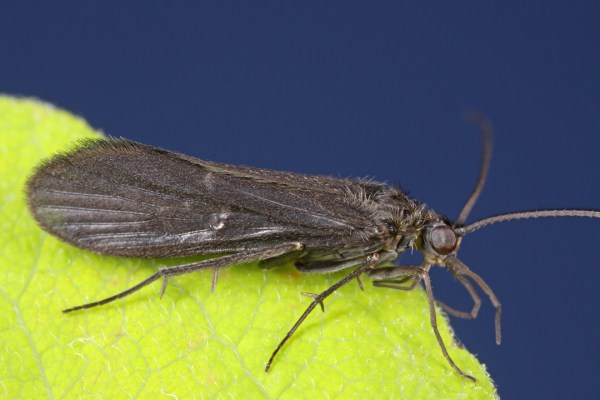
Among caddisflies, the blackish body and wings are characteristic for this genus.

I thank Dr. Robert Sites, University of Missouri-Columbia, for identifying the individual in these photos to the genus Chimarra in the family Philopotamidae (he also noted that male genitalic characters would be needed for species determination). Ferro and Sites (2007) listed three species of caddisflies in this genus from Sam A. Baker State Park (C. feria, C. obscura, and and unidentified Chimarra sp.).

REFERENCE:

Ferro, M. L. & R. W. Sites. 2007. The Ephemeroptera, Plecoptera, and Trichoptera of Missouri State Parks, with Notes on Biomonitoring, Mesohabitat Associations, and Distribution. Journal of the Kansas Entomological Society 80(2):105–129.

Wheeler, W.C, M. Whiting, Q.D. Wheeler & J.M. Carpenter. 2001. The phylogeny of extant hexapod orders. Cladistics 17: 113-169.

Copyright © Ted C. MacRae 2012
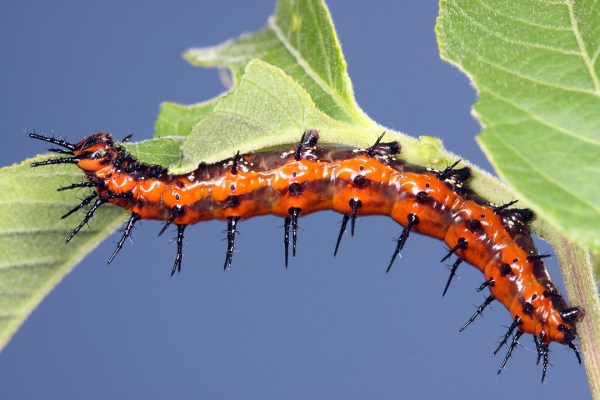
Gulf Fritillary in southern Missouri

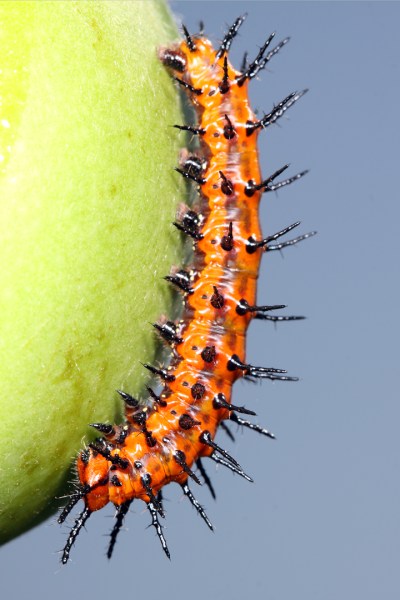
Gulf Fritillary (Agraulis vanillae) | Mississippi Co., Missouri

I’m not sure, but I think this might be the first time I’ve photographed a butterfly caterpillar. Not a bad subject to start with, as few butterflies have caterpillars that are more colorful than the Gulf Fritillary, Agraulis vanillae. A common resident in the southern states and further south, this member of the nymphalid subfamily Heliconiinae is less commonly encountered in Missouri—in fact, I had never seen (or at least noticed) these caterpillars before encountering a few feeding hungrily on the foliage of maypop (Passiflora incarnata) growing in a city park in Missouri’s southeastern lowlands. While the stunning colors of these caterpillars are a delight to human eyes, their function, as in most butterfly caterpillars, is to advertise the unpalatability of their toxin-laced bodies. In the case of this species, the toxins include cyanogenic glycosides that the larvae sequester from the tissues of their host plants (ironically these compounds are supposed to serve the same protective function for the plant that produces them, but butterflies have become master specialists at evolving mechanisms to sidestep toxic impacts).

According to my friends Richard & Joan Heitzman, long-time students of Missouri Lepidoptera, this species is a sporadic migrant that occasionally forms summer colonies in Missouri, especially in the western half of the state, until the first hard freeze destroys the colony (Heitzman & Heitzman 1987).

REFERENCE:

Heitzman, J. R. & J. E. Heitzman. 1987. Butterflies and Moths of Missouri. Missouri Department of Conservation, Jefferson City, 385 pp.

Copyright © Ted C. MacRae 2012
Life at 8X—hibiscus flea beetle

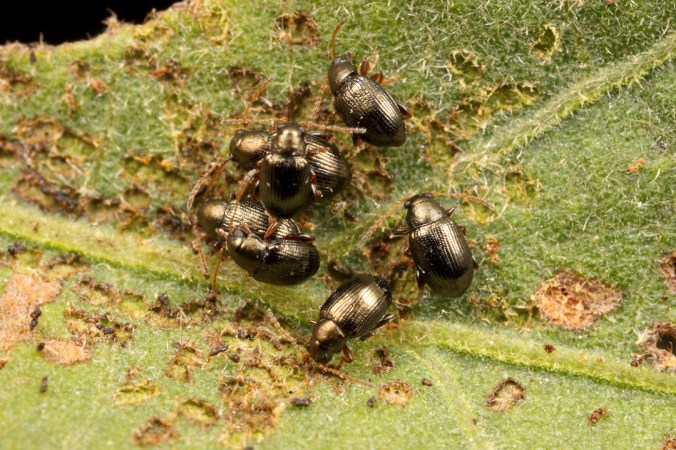
Chaetocnema quadricollis on Hibiscus lasiocarpus | St. Louis Co., Missouri (photo @ 2X)

In mid-August I visited Route 66 State Park along the Meramec River in east-central Missouri to check stands of rosemallow (Hibiscus lasiocarpus) that I had previously noticed growing in the park for the presence of the stunning jewel beetle, Agrilus concinnus. Once considered amongst the rarest members of the genus in North America, this species has in recent years been collected at several localities—always in association with Hibiscus spp. (MacRae 2004). I was disappointed to find the rosemallow stands sparse and stunted—a result of this year’s drought—and there were no A. concinnus to be found. Whether this was a result of the drought or the location or the lateness of the season, I do not know. However, as often happens when I don’t find what I’m looking for, I start seeing things that I’m not looking for. In this case, what I noticed were these incredibly tiny leaf beetles feeding on the foliage of the rosemallow plants.

Adults feed gregariously on the upper leaf surfaces, leaving characteristic feeding damage (photo @ 3X)

I’ve collected a fair number of leaf beetles over the years, thus I recognized these immediately as belonging to the subfamily Alticinae (flea beetles) due to the way they jumped when I disturbed them. However, I have also done a fair bit of collecting of insects on rosemallow and never seen (or at least noticed) this species of flea beetle. The beetles were feeding gregariously on mostly the upper surface of the leaves, and their feeding resulted in a rather distinctive damage that caused the more severely affected leaves to shrivel and turn brown. Based on gestalt, I was guessing Crepidodera or Chaetocnema, two genera that contain some of the state’s smallest species of flea beetles.

An adult pauses long enough for a photo while feeding on sap at the broken end of a leaf petiole (photo @ 8X)

Based on host plant and this photo on BugGuide, I thought these might represent Chaetocnema quadricollis. However, that species isn’t among the nine species of the genus recorded from Missouri by Riley & Enns (1979, 1982). Nevertheless, Ed Riley himself, and Shawn Clark as well, each confirmed this as the likely identity of the beetles based primarily on its associated host plant, and in fact Riley did record the species from Missouri at numerous localities under the name C. decipiens (later synonymyzed under C. quadricollis by White (1996) in his revision of the genus in North America). Schwarz (1878) described the species from Florida (noting that it has “exactly the same aspect of a small Crepidodera“), and apparently its association with and occasional pest status on rosemallow has long been established (Weiss & Dickerson 1919 recommended Bordeaux or arsenate of lead for its control).

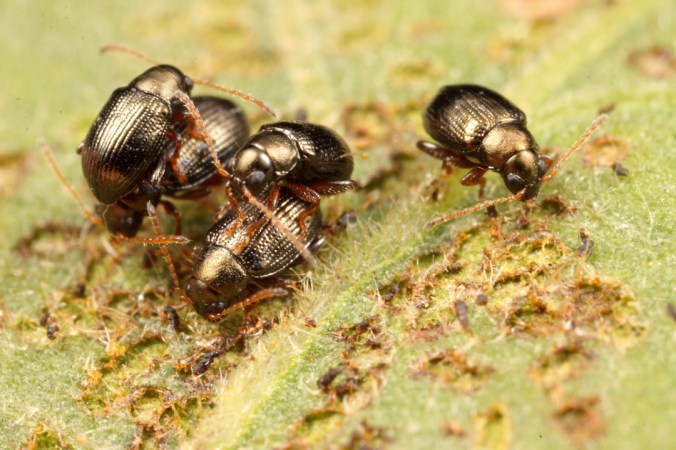
Although coupled, these beetles are not actively mating (is this mate guarding?) (photo @ 8X)

These are probably the smallest beetles that I have photographed so far. In the photo of the mating pair above, the male measures just over 1 mm in length, while the female measures about 1.6 mm in length (the sensor of my camera measures 21 mm wide, so an 8X photo yields a field of view measuring 2.625 mm wide). All of the above photos were taken hand-held in the field with a Canon MP-E 65mm macro lens (1/250 sec, ISO-160, f/14, full flash). The last two photos were taken with the lens mounted on 68 mm of extension tube and fully extended to achieve 8X magnification. While the photos contain good depth-of-field (DOF), they are soft due to the extreme amount of diffraction that occurs at such a small aperture and high magnification. If I were to do it over, I would reduce the aperture to f/10 or even lower and sacrifice some DOF for better sharpness.

REFERENCES:

MacRae, T. C. 2004. Beetle bits: Hunting the elusive “hibiscus jewel beetle”. Nature Notes, Journal of the Webster Groves Nature Study Society 76(5):4–5.

Riley, E. G. & W. R. Enns. 1979. An annotated checklist of Missouri leaf beetles (Coleoptera: Chrysomelidae). Transactions, Missouri Academy of Science 13:53–83.

Riley, E. G. & W. R. Enns. 1982. Supplement to an annotated checklist of Missouri leaf beetles (Coleoptera: Chrysomelidae): new state records and host plant associations. Entomological News 93(1):32–36.

Schwarz, E. A. 1878. The Coleoptera of Florida. Proceedings of the American Philosophical Society 17(101):353–469.

Weiss, H. B. & E. L. Dickerson. 1919. Insects of the swamp rose-mallow, Hibiscus moscheutos L. in New Jersey. Journal of the New York Entomological Society 27(1):39–68.

White R.E. 1996. A revision of the genus Chaetocnema of America north of Mexico (Coleoptera: Chrysomelidae). Contributions of the American Entomological Institute 29(1): 1–158.

Copyright © Ted C. MacRae 2012

Beetle Collecting 101: How to pin a beetle

It has been a long time since I initiated my Beetle Collecting 101 series (more than two years!), and to date the first issue—Beetle Collecting 101: Dress for Success—remains the one and only lesson that I’ve posted. I really had intended to follow that up with nittier-grittier posts on the actual mechanics of collecting beetles and processing the specimens for long-term preservation, but I didn’t and don’t know why other than to say, well… life happens. It’s never too late to fix something, however, so as a long overdue follow up I thought I would give a short video lesson on how to pin a beetle—specifically a cerambycid (longhorned) beetle. Featured in this short (4:31) video is the lovely Megacyllene decora (amorpha borer), which I found back in early September at a site in Missouri’s southeastern lowlands. Click the image to be directed to the video.

Copyright © Ted C. MacRae 2012

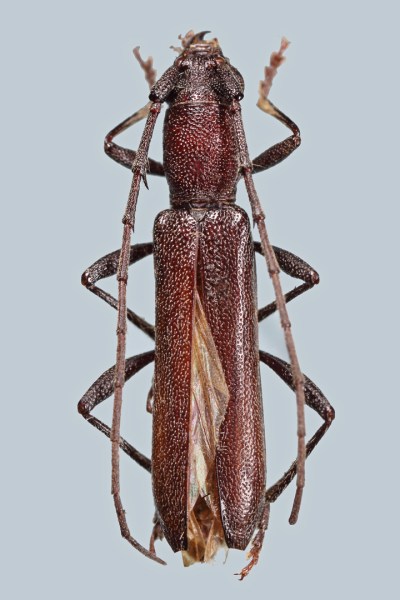
The hardest EASIEST ID Challenge in like ever!

This is not only the hardest ID Challenge I have ever posted, it is probably the hardest one anyone has EVER posted. I’m not going to ask for order or family because they’re so easy. I will ask for the genus, because maybe only a few of you will get that right, but the genus alone won’t be enough. I want the species! Don’t even think about searching the internet for a matching photo—it doesn’t exist! You’re going to have to utilize other resources to figure this one out.

Because of the difficulty of this challenge, all the normal rules are out the window—no points, no sessions, no moderated comments, no nothing. This is winner take all—first person to correctly guess the species gets loot! I’ll even provide all the collection data in the caption. Good luck!

Update 10/29/12 10:12 pm: Well, I goofed and didn’t think about somebody Googling the label data, which Ben Coulter did to quickly arrive at the correct answer. Stupid Google!

At any rate, and with great anticlimactic fanfare, say hello to Aneflomorpha cribellata, described by Bates more than a century ago (1892) and known only from that single type specimen until the collection of this one in southern Mexico in 2005 (MacRae et al. 2012). This is the first photograph of the species and will be added to Larry Bezark’s A Photographic Catalogue of the CERAMBYCIDAE of the World.

Reference:
MacRae, T. C., L. G. Bezark & I. Swift. 2012. Notes on distribution and host plants of Cerambycidae (Coleoptera) from southern México.  The Pan-Pacific Entomologist 88(2):173–184.


MEXICO: Oaxaca, 4.8 km E La Ventosa, Hwy 190, 16°33’27″N, 94°54’27″W, elev. 76′, 28.vii.2005, beaten from unidentified dead branches, coll. T. C. MacRae.

Copyright © Ted C. MacRae 2012

Why are this beetle’s elytra outstretched?

Toposcopus wrightii on dead branch Juniperus virginiana | Major Co., Oklahoma

I’ve puzzled over the beetle in the above photo since I first saw it back in September on Day 2 of this year’s Annual Fall Tiger Beetle Trip. I encountered it on a dead branch of eastern red-cedar (Juniperus virginiana) on top of the main mesa at Gloss Mountain State Park in northwestern Oklahoma. At about 8 mm in length, it immediately struck me as possibly something in the family Ripiphoridae (wedge-shaped beetles). Still, the full-length elytra covering the abdomen made me doubt that identification, so I collected the specimen to get a better look at it when I returned home. Later that same day, while scanning the base of another mesa across the highway from the park at night, I came upon another individual that seemed to represent the same species—this time on a dead branch of fragrant sumac (Rhus aromatica). That individual is seen in the photo below, and two things are immediately apparent: 1) the beetle is a female in the act of oviposition, and 2) it is holding its elytra outstretched in a most curious way.

Another female oviposits on a dead branch of Rhus aromatica.

A quick browse through BugGuide’s ripiphorid images quickly showed a likely match with the genus Toposcopus, and consulting the original description of both the genus and its only included species—T. wrightii (LeConte 1868) showed agreement with the key diagnostic character (eyes divided into two lobes connected by a slender line of smooth, non-faceted corneous membrane). These two females differ from the male by their much less flabellate antennae (presumably the male uses these organs to detect female-emitted pheromones). LeConte described this species from New Mexico, and Rivnay (1929) also saw specimens from Texas and Arizona when he reviewed the North and Central American species of the family. Although the species is listed on Don Arnold’s Checklist of the Coleoptera of Oklahoma, the listing seems to be based only on the presence of specimens in the Oklahoma State University insect collection, while published records of its occurrence in the state are, as far as I can tell, still lacking. This species, thus, seems to be, along with Acmaeodera macra and Chrysobothris octocola (both family Buprestidae), an example of a typically southwestern U.S. species whose distribution extends northeast into the Red Hills Region of northwestern Oklahoma. Considering that Cylindera celeripes (Swift Tiger Beetle) and Amblycheila cylindriformis (Great Plains Giant Tiger Beetle) also have only recently been discovered in this area, it would seem that this part of the state is still undersampled and has the potential to yield additional interesting southwestern U.S. species.

Why is this female holding her elytra outstretched while ovipositing?

Regarding the outstretched elytra, I’ve not seen this type of behavior before with a beetle in the act of oviposition. While several groups of insects in other orders may hold their forewings outstretched as part of threat displays, I’ve not seen a beetle hold its elytra outstretched for any reason at all other than flight and don’t recall seeing such behavior mentioned in the literature either. Thus, I’m at a loss to explain why the beetle is doing this. If you have any ideas I would love to hear them.

One thing that I enjoy immensely about 19th Century taxonomic literature is the rich, often effusive prose that frequently accompanies the descriptive portions of the text. (I also lament that such colorful writings are nearly universally frowned upon my modern editors. Perhaps as taxonomy advances more fully into electronic-only publishing the concerns about space will dissipate and taxonomic authors will no longer be constrained to such sterile, uniform, precisely formatted writings.) The naming of this species provides an especially colorful example of the embellishments permitted to 19th Century authors:

I desire in the name of this beautiful and interesting addition to our fauna, to commemorate the ability of Gen. W. W. Wright, the Chief Engineer and Commander of the Survey in which the species in the present memoir were collected. His attention to the comfort and safety of the party while traveling through a hostile Indian country will not soon be forgotten by any of his companions; while the skill with which the more difficult portions of the route were examined, and the labors of his assistants directed to the most easy methods of surmounting the difficulties, will commend itself to every admirer of correct engineering.

John L. LeConte is widely regarded as the father of North American coleopterology. I don’t think there is anybody from the 19th Century, save perhaps Charles Darwin, that I would have more liked to meet.

REFERENCES: 

LeConte, J. L. 1868. New Coleoptera collected on the survey for the extension of the Union Pacific Railway, E. D. from Kansas to Fort Craig, New Mexico. Transactions of the American Entomological Society 2:49–59.

Rivnay, E. 1929. Revision of the Rhipiphoridae of North and Central America (Coleoptera). Memoirs of the American Entomological Society 6:1–67, 3 plates.

Copyright © Ted C. MacRae 2012

PPE Call For Submissions

Over the past two years, we have made great progress in working through a backlog of manuscripts as we bring the journal closer to our eventual goal of on-schedule publishing. I thank the authors who contributed manuscripts, the Editorial Board for their efforts to work through this backlog, and especially the many reviewers who contributed their time and expertise to ensure that the manuscripts met our high standards of quality research.

With the backlog of manuscripts cleared and existing manuscripts moving quickly through the review process, we are in need of new submissions to maintain the momentum we have established as we finish out volume 88 and look forward to the publication of volume 89. The Pan-Pacific Entomologist is an international journal publishing manuscripts on taxonomy and biosystematics of insects and other closely related arthropods. Manuscripts from all world areas are welcome, with those from regions around the Pacific Rim especially desired.

For those of you conducting taxonomic or biosystematic research on insects and their relatives, I hope you’ll consider The Pan-Pacific Entomologist as an outlet for the publication of your research. Among the many journal choices that are available to you, we offer 60% reduced page charges for all members of The Pacific Coast Entomological Society, an additional 50% reduction of the first 5 pages for members that meet other qualifications, and a complete waiver of normal page charges for authors who follow our “pre-reviewed” process (up to 20 pages per volume). The Pan-Pacific Entomologist has long been and continues to be one of the lowest cost print journals for entomology with an international scope.

If you have a manuscript that you would like to consider publishing in The Pan-Pacific Entomologist, please don’t hesitate to contact me (Ted C. MacRae, Managing Editor) on this page or by direct message. I look forward to hearing from you!

Copyright © Ted C. MacRae 2012

Have you googled yourself lately?

I recently came upon a post titled, What will I find if I google you?, written last year by Scientopia blogger gerty-z at Balanced Instability. Although written from the perspective of a new, tenure-track academician giving advice to students with similar aspirations, the main point of the post is relevant to probably any profession: “SEARCH COMMITTEES WILL GOOGLE YOU.” That this is true for industry as well as academia is a fact—over the course of my now three-decades-long career, the past 22 in industry, I have been involved in many a search committee, and particularly over the past 3–4 years a Google search has become a standard part of my resume screening process as I try to whittle down the 10 or so resumes that have survived my initial screening to those 3 to 5 candidates that I will recommend for an interview.

For me, the post had it’s intended effect, as I started wondering what, really, I would find if I googled myself. Of course, I’ve done this in the past, primarily in the early days of my online and social media presence and more out of trivial curiosity than as part of an effort to critically assess what impression the results might give to a prospective employer. Not that I am actively looking for another job—I love what I do, have a reasonable amount of autonomy, and am fairly compensated. Nevertheless, one never knows what opportunity or circumstance might arise and the timing of such, and a favorable online reputation is much easier to maintain than to create or repair on short notice. In my case, that presence is extensive—I’ve blogged regularly for almost five years now and participated to greater or lesser degree in most of the other social media outlets frequented by entomologists—BugGuide, Facebook, Google+, Twitter, Flickr, etc.—for much of that same period. This blog alone contains nearly 650 posts and averages somewhere between 500 to 1,000 words per post—that’s in the neighborhood of one-half million words tagged with my very searchable name. Add to that my 3,601 comments here, innumerable comments and mentions on other blogs (including 1,158 on BugGuide alone), and perhaps somewhat sillier musings over on FB and Twitter—well, whatever reputation I’ve accumulated by now I’m probably stuck with, good or bad!

I didn’t think I would find any problems, but gerty-z’s post did convince me that I should at least take the exercise. What if I did suddenly find myself on a candidate short list for that dream curatorship at the U.S. National Museum (right!)? Would Terry Erwin, Steve Lingafelter, and the other members of their search committee be impressed or concerned by what they found when they googled my name? I probably represent the best case scenario for a prospective employer wanting to search my online presence—my first and last names are both fairly uncommon, and add to that the fact that I always sign with my middle initial. Enclose all that in quotes and one has a very specific search term with little likelihood that the results will be diluted by other people. What did I find? 40,800 results! (I made sure to turn off “Personal” results so that I would see the same search results that somebody else googling my name would see). Nevertheless, the results were largely what I expected. The top 4 and 7 of the top 15 results (see below) linked directly to Beetles in the Bush or one of its posts, and all but one of the remaining top 15 results linked to my various online profiles—all but one of which are either professionally oriented or highlight my entomological expertise. That’s a good thing—I’m happy for anyone to see my list of publications, research interests, professional capabilities, etc. The one exception is Facebook, and that is the only social medium I use that might possibly contain content that someone, somewhere, might find objectionable (I generally stick to entomology and photos from travel or my family while avoiding contentious subjects, but sometimes my touch of irreverence sneaks through). Still, it’s not like one will find photos of drunken excess or poor choices on my FB page, so I think my relative FB risk is small. I doubt many prospective employers would look much past the top 15 results, especially with such a consistent picture of who I am (at least who I project myself to be) having already been painted by that point, but those who do choose to look further will find several dozen subsequent results largely linking to blogs on which I have left a comment or been mentioned by name (the latter usually referring back to Beetles in the Bush or thanking me for an insect identification). I also conducted the search on “Images”, and the result was largely the same—page after page of images from Beetles in the Bush or from other blogs on which I had left a comment or been mentioned by name.

gerty-z suggests that Google searches by potential employers have either neutral or negative impacts on their decisions but rarely have a positive impact since anything “awesome” about you that can be found online should also be in your application. I’m not sure I agree with this latter point. Awesome can include more than simply a long list of publications or multiple summaries of degrees earned and experience gained—things that are easy to include in a resume. Awesome can also include a well-practiced commitment to high quality writing, or consistent involvement in outreach activities, or demonstrated taxonomic expertise far beyond that implied by a list of publications, or even a solid foundation of knowledge in subjects beyond one’s immediate area of expertise but that nevertheless enhance perspective. These are concepts that are much more difficult to capture or highlight in a resume but that might tip the balance in a candidate’s favor if all other considerations are equal. The point is, don’t look at your online presence only as something to manage to prevent failure, but rather as a potential tool to help build a positive reputation and enhance the information provided in your application.

Top 15 results from search on “Ted C. MacRae”

  1. Beetles In The Bush
  2. About the Author « Beetles In The Bush
  3. A visit to the Dallas Arboretum « Beetles In The Bush
  4. Ted C. MacRae (tcmacrae) on Twitter
  5. Ted C. MacRae – The Coleopterists Society – An International …
  6. Ted C. MacRae – BugGuide
  7. Ted C Macrae | ResearchGate
  8. Ted MacRae | Facebook
  9. Ted C. MacRae – Gravatar Profile
  10. Ted C. MacRae – Wikispecies
  11. Program Announcment: 2012 ESA Annual Meeting « Beetles In The …
  12. MacRae, T. C. 2000. – Beetles In The Bush

Copyright © Ted C. MacRae 2012