Answer to Super Crop Challenge #1

Seemingly correct answers came quickly to yesterday’s inaugural Super Crop Challenge, which featured a curious structure atop a harvestman (class Arachnida, order Opiliones) that I encountered while hiking the lower North Fork Section of the Ozark Trail in extreme southern Missouri. “Seemingly” I say, because even though some points were earned, others remained left on the table – the organism was rightly recognized as a harvestman, and the structure in the photo does indeed contain the ocelli (or eyes).  However, nobody actually named the structure itself (see update below) – the ocularium (ocular or optical tubercle would also have been accepted).  Hey, I’m pedantic and proud!

As near as I can tell, this individual belongs to the genus Leiobunum (family Sclerosomatidae).  Species in this genus are notoriously difficult to identify; however, the super long legs, dark dorsal stripe, pointed abdomen, and very long palps with “knees” that extend dorsally to a level well above the ocularium suggest a male L. vittatum or one of its close relatives (Schulz 2010). Leiobunum vittatum is a common inhabitant of wooded habitats across the eastern U.S.

I took this shot with an MP-E 65mm macro lens at about 2.5X. The short working distance of the lens at this level of magnification makes it difficult to photograph these longer-legged species in lateral profile due to their habit of “waving” their especially elongate 2nd pair of legs in the air as pseudo-antennae – one touch of any part of the camera sends them scampering. I chased this guy back and forth across a downed tree trunk for some time before I finally got lucky when it encountered some prey (note the long structure extending down from the mouth area – I believe it is the antenna of a tiny, nymphal blattodean) and became distracted just long enough for me to close in and fire off a couple of close shots. He was actually closer to the underside of the log, so when I took this photo I was leaning far over the log with the camera almost upside-down!

Okay – Art earns points for being the first to identify it as a harvestman, while Geek snaps rare duplicate ID points for using the order’s scientific name (no complaining – scientific names will always get points on this blog).  Art, Aniruddha, and Geek also get half-points for mentioning (in order of correctness) eye, ocelli (technically more correct, but wrong plurality), and ocellus (yes, only one is visible – did I mention my pedantic tendencies?).  However, I’m going to declare arachnologist and Opiliones specialist Chris as the winner of this round for his impressive display of generic-level identification based on the meagerest of evidence!

Update 11/22, 11:00 a.m. – actually, Chris did name this structure in an email sent to my office address while the comments box was unchecked and, thus, earns a clean sweep of this challenge.

Photo Details: Canon 50D w/ MP-E 65mm 1-5X macro lens (ISO 100, 1/250 sec, f/13), Canon MT-24EX flash w/ Sto-Fen + GFPuffer diffusers. Typical post-processing (levels, minor cropping, unsharp mask).

REFERENCE:

Schulz, J. W. 2010. The Harvestmen of Maryland (accessed 20 November 2010).

Copyright © Ted C. MacRae 2010

Super Crop Challenge #1

ID quizzes and challenges seem to have become an increasingly popular subject for natural history blogs. I’ve done a few of my own, but my straight up ID challenges are starting to seem a little unimaginative compared to the DNA sequence, crypsis, mimicry, taxonomy fail, and other challenges being offered up by bug blogdom’s more creative types. To step it up a notch, I offer the first Super Crop Challenge. Small structures that we take for granted within a larger context often take on alien qualities when viewed in isolation. Can you identify this structure and the organism that possesses it?


Copyright © Ted C. MacRae 2010

Desmocerus palliatus – elderberry borer

Desmocerus palliatus (elderberry borer), Squaw Creek Natl. Wildlife Refuge, Missouri.

Last June I made two trips to the Loess Hills in northwestern Missouri to survey additional sites for Cylindera celeripes (swift tiger beetle), which my colleague Chris Brown and I had discovered in some of the area’s few remaining loess hilltop prairie remnants the previous year. One of these potential new sites was  Squaw Creek National Wildlife Refuge, where a few tiny slivers of hilltop prairie can still be found on the fingers of loess bluffs that border the refuge’s several thousand acres of restored wetlands that famously host large concentrations of snow geese and bald eagles during the fall and spring migrations.  On the first visit, I had arranged to meet with Corey Kudrna, Refuge Operations Specialist, who was kind enough to take several hours out of his day to personally guide me to each of the site’s loess hilltop prairie remnants. 

As we crossed the highway right-of-way at the base of the bluffs on our way to the one of the remnants, we passed through a large patch of common elderberry, Sambucus nigra ssp. canadensis.  Anytime I see patches of this plant, especially in June, I immediately think of Desmocerus palliatus (elderberry borer) – a spectacularly colored longhorned beetle (family Cerambycidae) that breeds exclusively in the living stems and roots of this plant.  It is not a particularly rare species, but for some reason I have not had much success in finding this species.  In my close to three decades of collecting beetles, I had encountered perhaps a half dozen individuals – never more than two at the same time.  Still, when I get the chance to look at elderberry I look for this beetle, and when I did so this time I was delighted to see one within a few moments of entering the patch.  I was ecstatic when I saw another one almost immediately after the first, and I was stunned when I realized that they were all around me!  Good fortune continued on my subsequent visit two weeks later, when I was able to spend a little more time trying to get a good field photograph.  Wind was a problem, the beetles were easily alarmed, and their tendency to rest in the upper reaches of the plant made it difficult to brace myself and the camera while shooting, making this a rather difficult subject to get a good photograph of.  The photo shown here is literally the last of around two dozen that I took and is the only one that I really like.

Many cerambycid beetles are mimics of other more noxious species, mostly ants and wasps.  However, elderberry borers appear to be the exception in that they are themselves noxious.  The cobalt blue and bright orange coloration of the adults screams aposematic (warning) coloration, and it is reasonable to assume that they accumulate in their bodies for defensive purposes the cyanogenic glucosides produced by elderberry plants (Huxel 2000).  Even their movements are those of a chemically protected model – lumbering and clumsy, without the alert evasiveness usually seen with other flower longhorn species.  Presumably this species participates in a Müllerian mimicry complex involving netwinged beetles (family Lycidae, particularly species in the genus Calopteron) and perhaps Pyromorpha dimidiata (orange-patched smoky moth, family Zygaenidae) as well, and it may serve as a Batesian model for the equally colorful but completely innocuous Lycomorpha pholus (black-and-yellow lichen moth, family Arctiidae).

Photo Details: Canon 50D w/ 100mm macro lens (ISO 100, 1/250 sec, f/10), Canon MT-24EX flash w/ Sto-Fen diffusers.

REFERENCE:

Huxel, G. R.  2000.  The effect of the Argentine ant on the threatened valley elderberry longhorn beetle.  Biological Invasions 2:81–85.

Copyright © Ted C. MacRae 2010

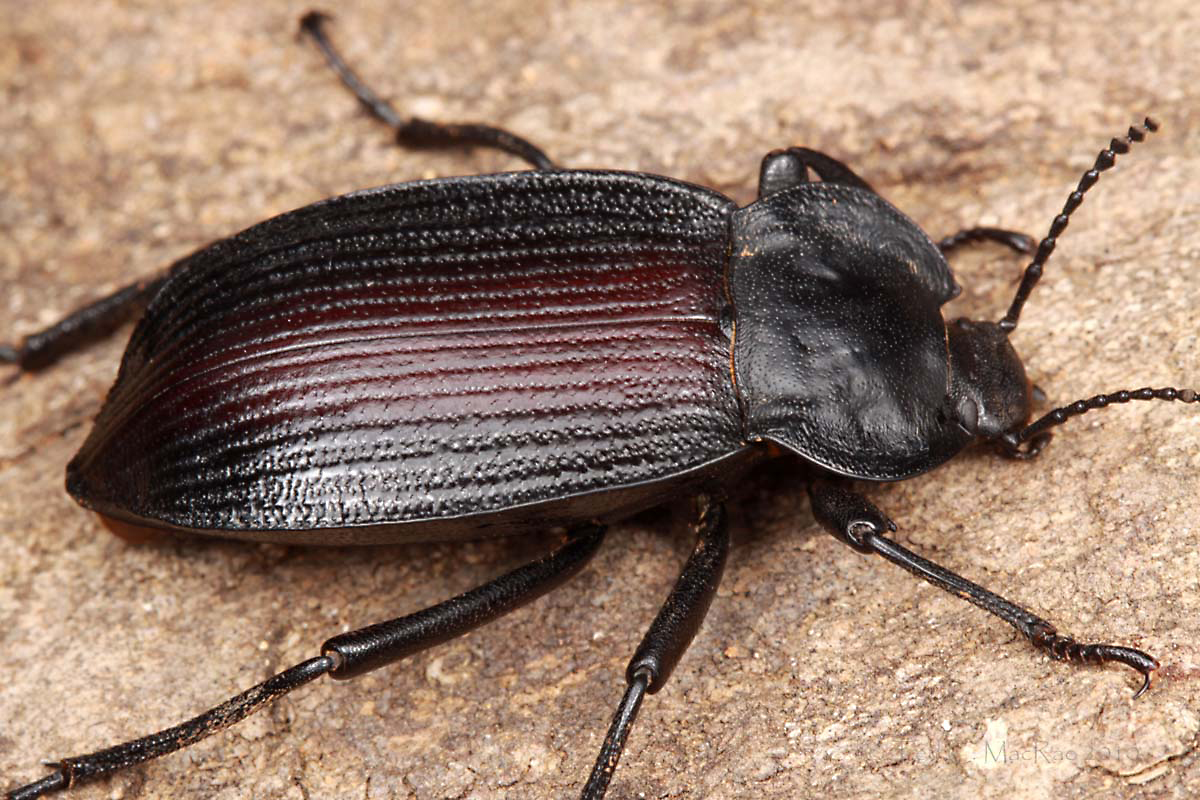
The “best” Eleodes suturalis

Eleodes suturalis - "sutured" clown beetle

Testing with my new diffuser setup¹ continues. I’ve kept this “sutured” clown beetle (Eleodes suturalis) alive since last July as a terrarium-mate with my Great Plains giant tiger beetles (Amblycheila cylindriformis). The first photos I took of it in the terrarium with the old diffusers (Sto-Fen + Puffers) can only be described as “ho-hum.” The next series (with the beetle cleaned up a bit) was taken in a white box with indirect flash and represented a nice improvement over the first shots. Here, the beetle is back in the terrarium on a piece of bark using direct flash and the new diffuser. I think it has the best of both worlds – nicely diffused lighting on a natural substrate (without the need for a white box). Yes, the focus is a bit off in the head area – the beetle was really not very cooperative during the shoot, and I was just interested in seeing how the lighting would look without spending too much time trying to capture the “perfect” shot.

¹ Photos of the diffuser and instructions on how to make it are coming, I promise! I’ve made a few improvements over the prototype by eliminating the tape to hold things together and am just working on the attachment to the MT-24EX flash bracket.

I really hope this diffuser works out for me in the field!

Photo Details: Canon 50D w/ 100mm macro lens (ISO 100, 1/250 sec, f/16), direct Canon MT-24EX flash w/ oversized concave diffuser. Typical post-processing (levels, minor cropping, unsharp mask).

Copyright © Ted C. MacRae 2010
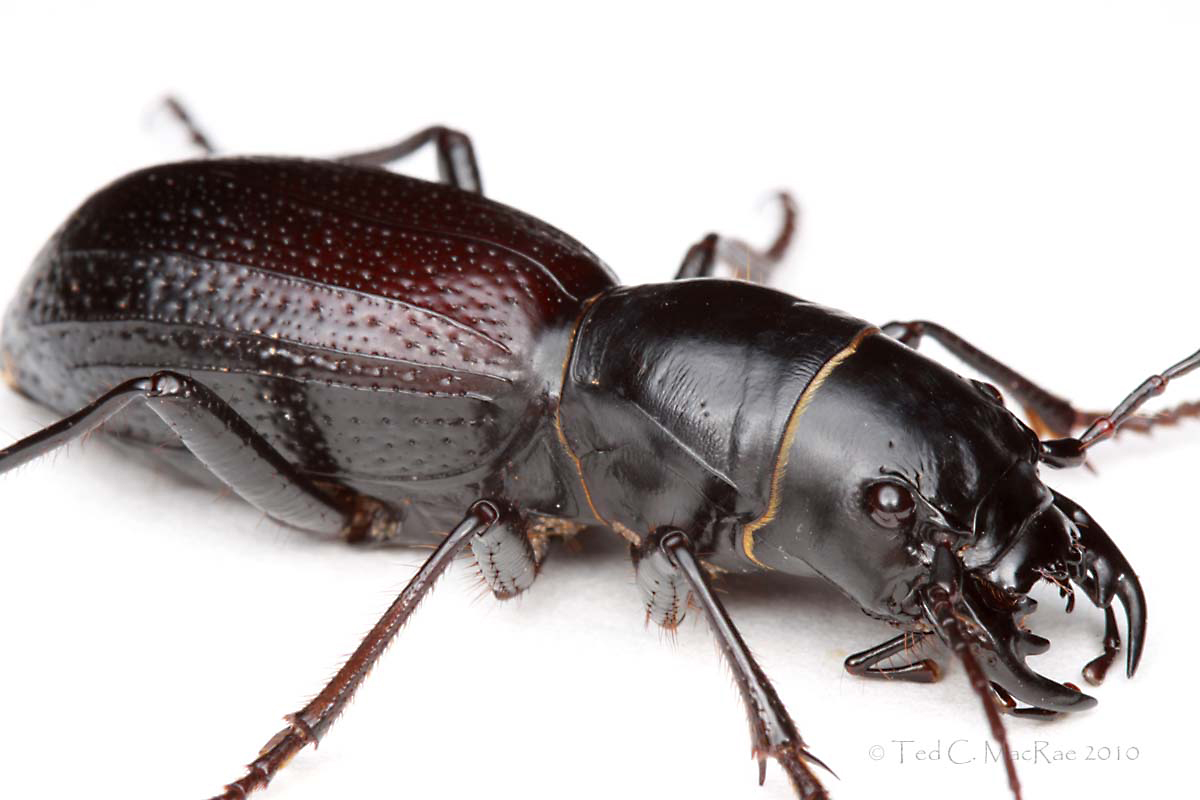
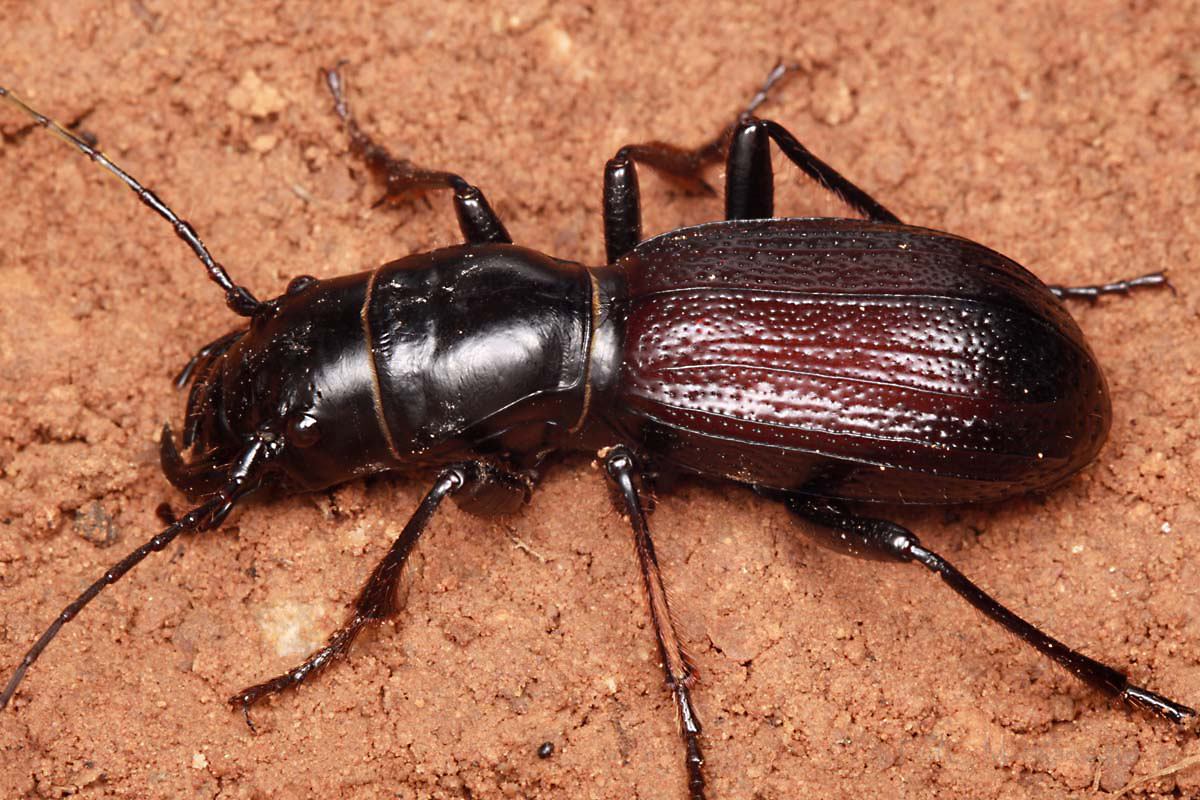
Cicindela pulchra on white

Two more photographs taken with my new diffuser, this time the spectacular Cicindela pulchra (beautiful tiger beetle). Which one do you like better?

Photo Details: Canon 50D w/ 100mm macro lens (ISO 100, 1/250 sec, f/16), Canon MT-24EX flash w/ oversized concave diffuser. Standard post-processing (levels, unsharp mask).

Copyright © Ted C. MacRae 2010

Amblycheila cylindriformis on white

It’s been four months now since I went to the Glass Mountains of northwestern Oklahoma on a hunch to look for Amblycheila cylindriformis (Great Plains giant tiger beetle).  The five adults that I brought back from that night are still alive in a terrarium of native soil, but to this point they have refused to lay eggs.  Despite feeding them regularly with fat Maduca larvae, there is obviously still something they need that I am not providing.  I’ve suspected that perhaps the terrarium that I have them in is too small, and I’ve also noted in the literature that larval burrows are often found clustered near the entrance of mammal burrows.  With this in mind, I combined the native soil from three separate terraria into one larger, deeper terrarium, packed the soil lightly, and used a spoon to create an artificial mammal burrow entrance.  Not long after placing the adults in their new home they began digging at the back of the burrow, eventually creating two separate tunnels leading in opposite directions (and fortunately against the container walls so that I can see inside the tunnels).  I was optimistic at first that finally I had given them what they wanted, but since digging the burrows they’ve just sat in them.  Perhaps they “know” that winter is coming and are just looking to hole up for now, so I suppose I’ll go ahead and place the terrarium in the 10°C incubator with the rest of my larval and adult rearing containers and wait until next spring to see what happens.

In the meantime, I thought I would share these recent photographs of one of them.  I had been wanting to take photographs of this species in a white box, which I have used with a few other species to generate some rather striking photographs (e.g., Gromphadorina portentosa, Buprestis rufipes, Scolopendron heros, Eleodes suturalis). The photographs in this post might look like they were taken in a white box, however, they were not.  I’ve been spending a lot of time lately trying to come up with a diffuser setup that is convenient for field photographs of wild insects in their native habitats.  Kurt’s do-it-yourself concave diffuser and Alex’s tracing paper diffuser work great with the Canon MT-24EX Macro Twin Lite Flash and the Canon MP-E 65mm f/2.8 1-5X Macro Lens, but as I mentioned in a previous post they do not work so well with the Canon EF 100mm f/2.8 Macro USM Lens and its longer working distance… or so I thought!  I’ve come up with a modified version of the concave diffuser that seems to be what I am looking for – it is easy to use, adds virtually no weight to the camera, is completely portable for field use, can be used with both the 65mm and 100mm macro lenses, and – best of all – costs virtually nothing.  The photographs in this post were taken with the first prototype, and now that the basic design and general dimensions seem to work I’ll try to make a more durable version. It’s simply a larger version of the concave diffuser – I found some very thick polypropylene foam that is sturdy enough to hold its shape but flexible enough to curl back and over the top of the flash heads, where the corners are held in place by Velcro. Essentially it forms a large “soft box” type diffuser in front of both flash heads. I cut the bottom inch off of a a 500-mL polypropylene beaker, then cut that in half and cut out all but a quarter inch of the bottom to form a sturdy but transluscent frame to hold the polypropylene foam against the flash head bracket on the front of the lens. Right now the foam is held in place by tape, but hot glue should do a better job, and the diffuser bracket is attached to the flash head bracket with Velcro. The whole rig comes off in a flash and lays mostly flat in the camera bag.

If this diffuser proves successful, it will eliminate the need for the different flash head extender brackets that I was considering.  I really didn’t want to go that route because even the cheapest models are rather costly, and all of them add bulk to the camera and create problems for those who need to switch lenses frequently (such as I do).  Of course, the real test is – does it achieve the desired result?  I’m quite happy with these initial photographs – the lighting is quite even due to the large “apparent” size of the light source, and the annoying double specular highlights that are the hallmark of the MT-24EX are much less apparent (though still slightly discernible).  The closest shots are at 1:1, while those of the entire beetle are between 1:1.5 and 1:2.  They are among the largest beetle species that I have photographed, so the range of magnifications used here pretty much covers the entire range that I typically use with this lens.  Wildflowers often require smaller mags and longer working distances, so it remains to be seen whether this diffuser/lens combination will be useful for them as well. 

All of the photographs in this post were taken with the 100mm macro lens (ISO100, 1/250 sec, F16) and direct MT-24EX macro twin flash using this new diffuser.  The beetle was placed on white filter paper and covered with a clear glass bowl until it settled against the side of it.  Once the beetle was quiet, I gently lifted the bowl and used micro-forceps to gently tug its legs into more appealing positions – surprisingly this did not cause it to become alarmed and try to flee (as long as I didn’t accidentally brush against one of its antennae!).  For the last photograph, I placed the beetle back in its terrarium and used the same techniques to get the beetle in a good position. 

Copyright © Ted C. MacRae 2010

Forgotten Foto Friday: Centruroides vittatus

I got this idea from Doug Taron over at Gossamer Tapestry, who credits Steve Borichevsky at Shooting my Universe for an occasional feature called Forgotten Photo Friday (hopefully my use of the alternative spelling “Foto” won’t be considered too presumptuous).  Perfect timing, as I recently ran across these photos of Centruroides vittatus (striped bark scorpion) that I took last fall after finding him secreted under a rock in a dolomite glade at White River Balds Natural Area in extreme southwest Missouri.  One other photo from the series did make it onto the blog last year – an extreme closeup of his seemingly “smiling” face (see A face only a mother could love), and while these photos are less extreme, I think they still deserve to be shared nevertheless.


One thing that strikes me about this individual is how marvelously well-matched is his coloration with that of the surrounding rocks – a perfect example of the cryptic coloration that characterizes most members of the family (Buthidae) to which this species belongs.

Photo Details: Canon 50D w/ 100mm macro lens (ISO 100, 1/250 sec, f/13-16), Canon MT-24EX flash (1/4 ratio) w/ Sto-Fen. Typical post-processing (levels, minor cropping, unsharp mask).

Copyright © Ted C. MacRae 2010
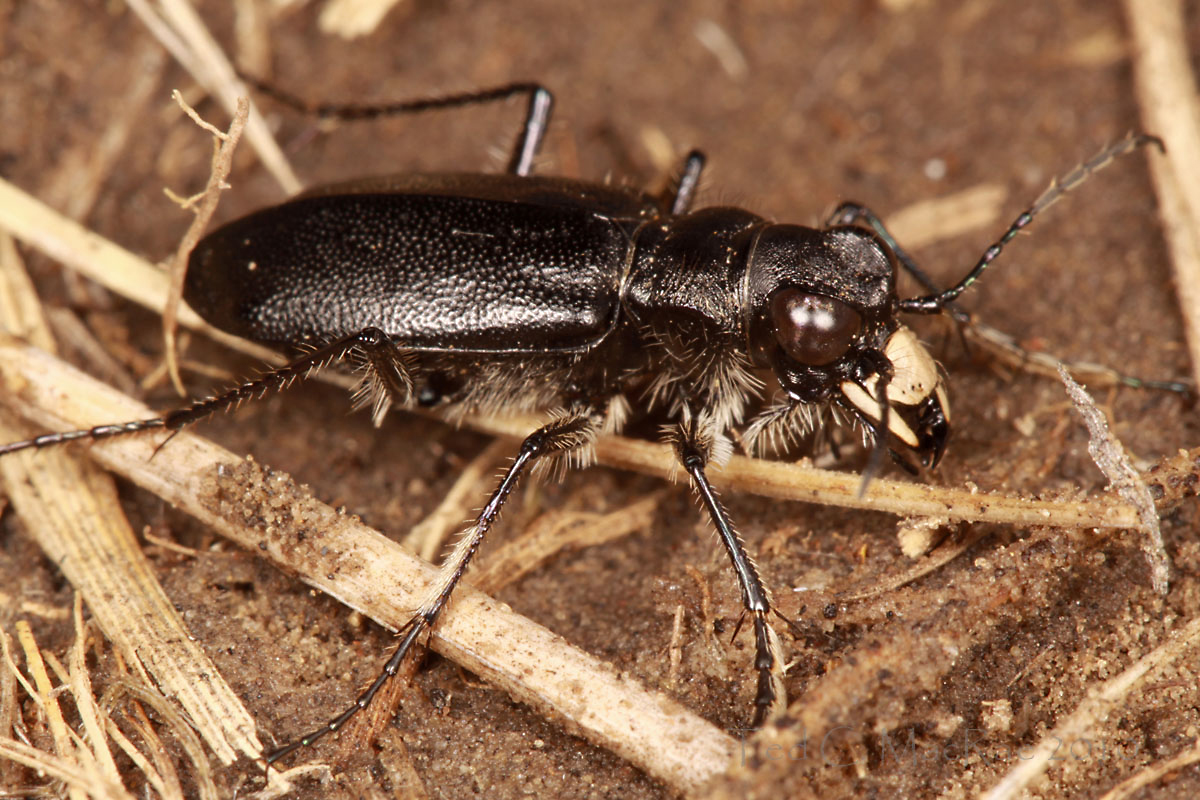
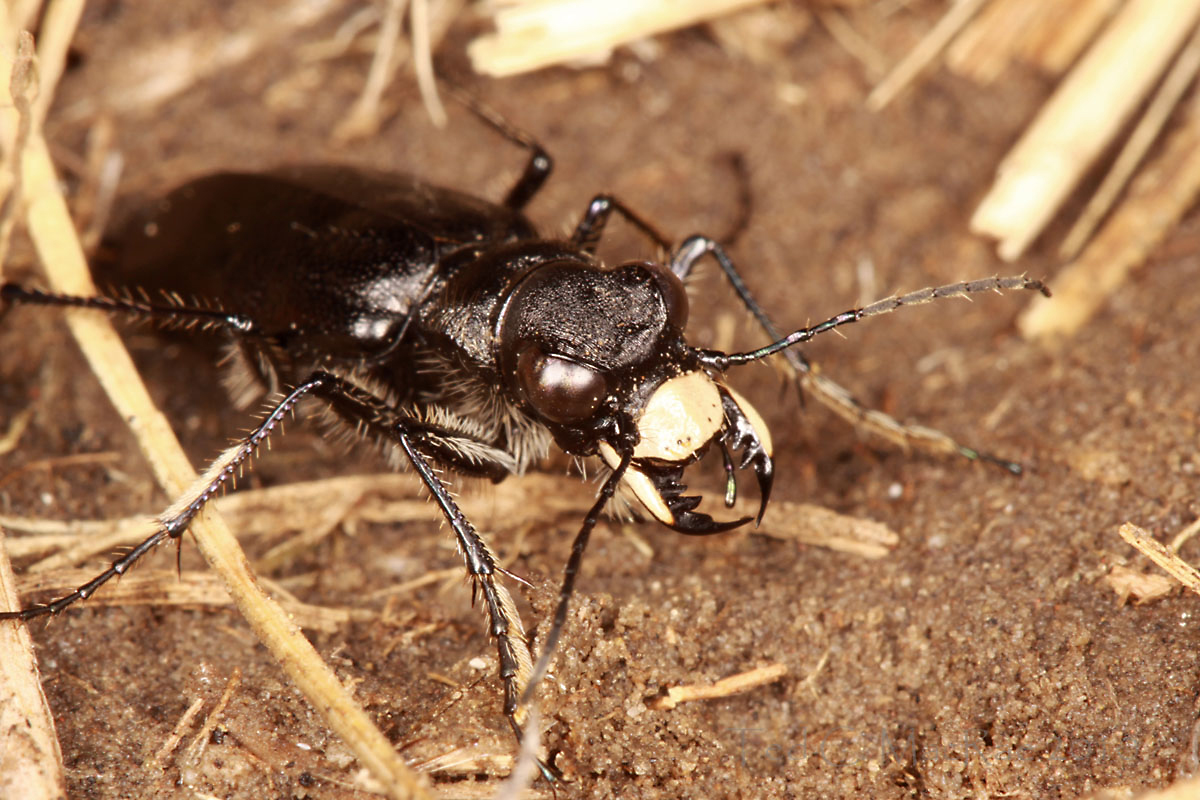
Cicindela nebraskana – Prairie Long-lipped Tiger Beetle

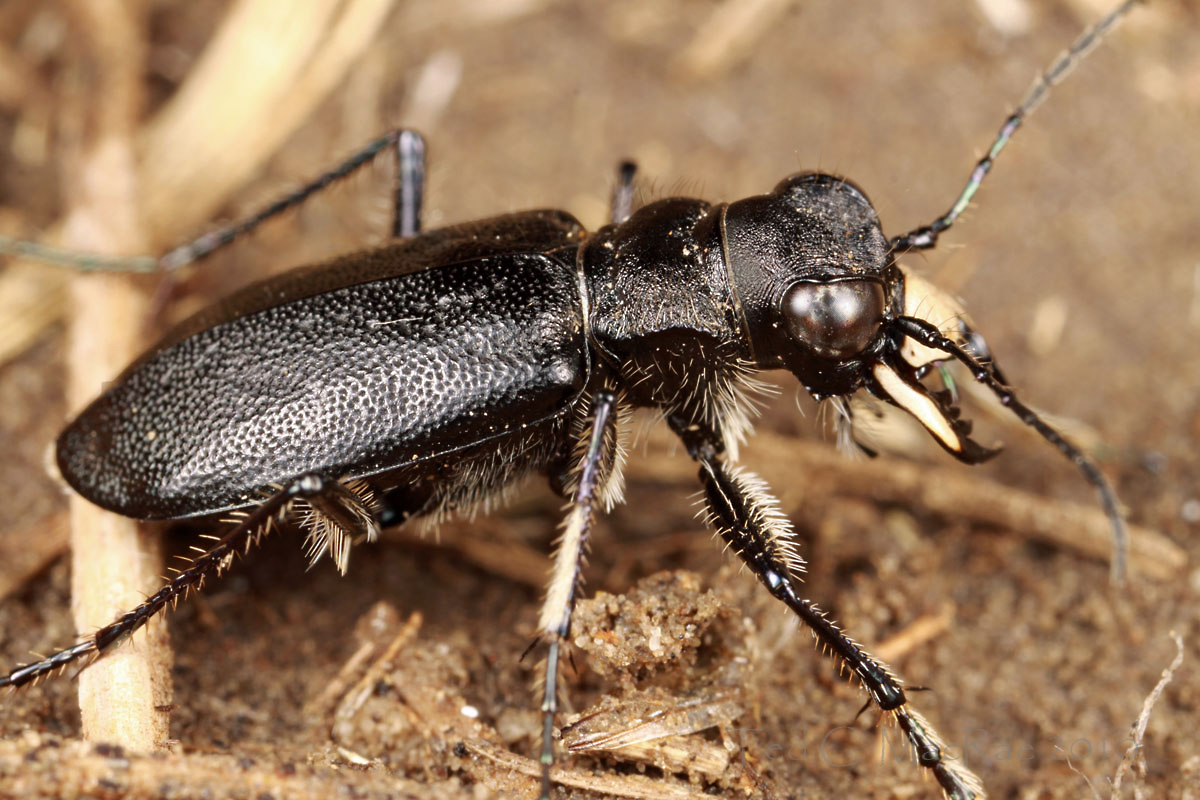
Cicindela nebraskana - the prairie long-lipped tiger beetle

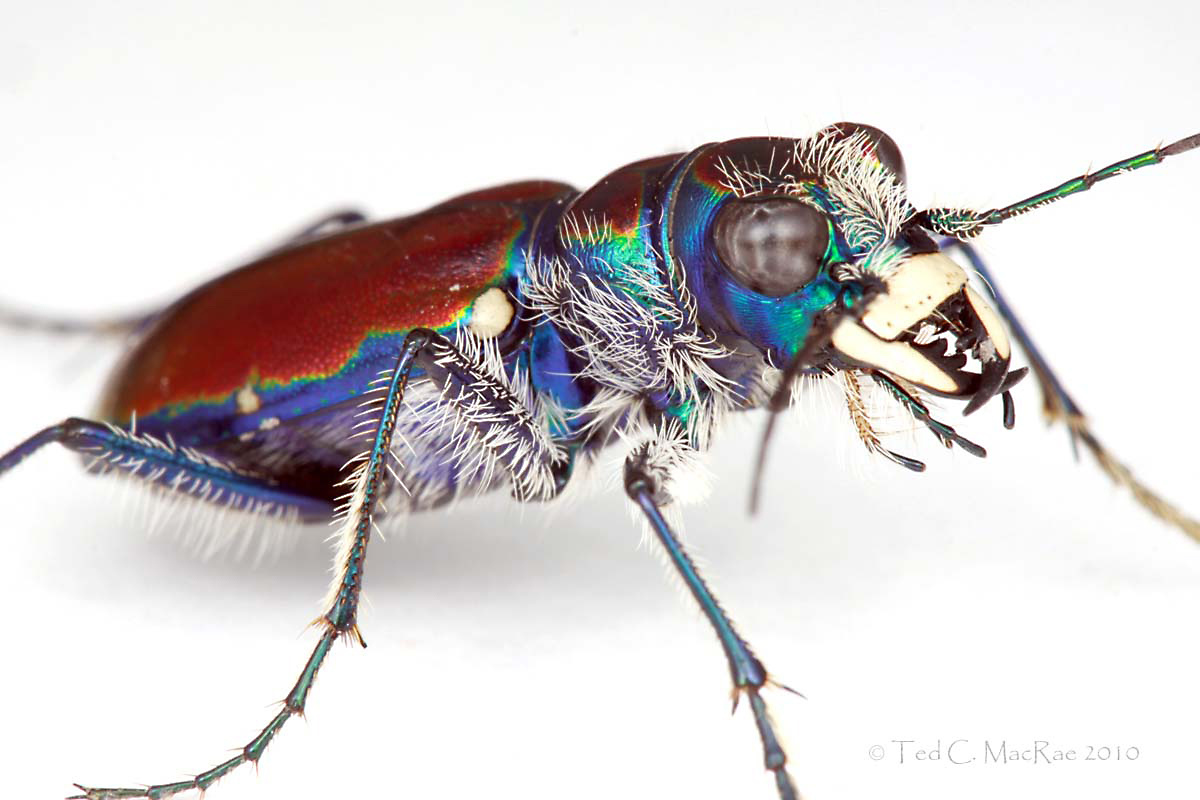
We were only halfway through Day #1 of five days in the field and had already achieved Goal #1 of the trip.  Despite that, it took a few hours before Chris and I were ready to tear ourselves away from our first stop in Fall River Co., South Dakota, where we were treated to the sight of glittering, wine-red adults of Cicindela pulchra bejeweling the charcoal-colored shale slopes.  However, the list of species that we wanted to see over the next several days was long, and eventually our pulchra-fever abated (barely) enough to head south to the Pine Ridge in Sioux Co., Nebraska to look for A-list Species #2 – Cicindela nebraskana.  Sioux Co., Nebraska is the type locality for this species (thus the name), but in reality it is a more western species whose distribution just barely sneaks into the northwestern corner of Nebraska (Pearson et al. 2006, Spomer et al. 2008).  I first saw this species at this very site two years ago, seeing only a handful of individuals and managing one harshly-sunlit, point-and-shoot image of one of them.  To my knowledge, this remains the only known field photograph of this species.

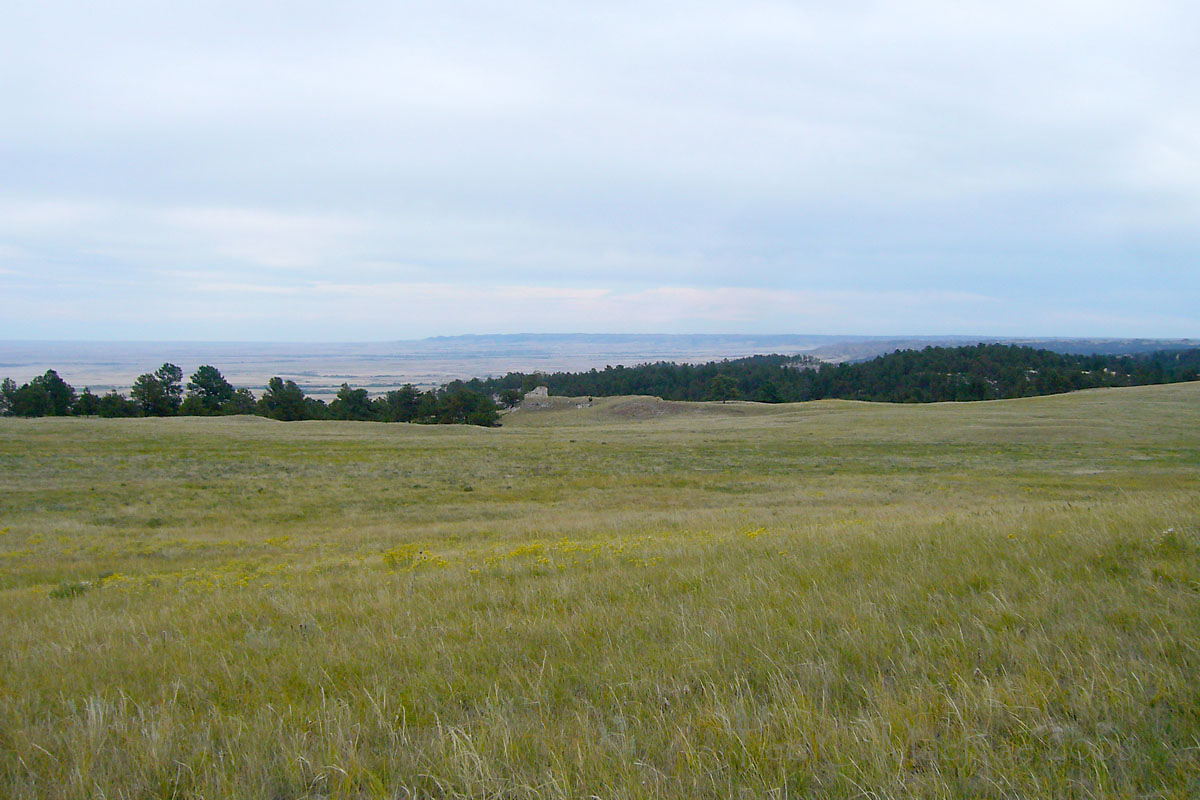
Shortgrass prairie atop the Pine Ridge, Sioux Co., Nebraska (photo taken September 2008).

This time, with a Canon 50D camera and 100mm macro lens in my backpack, I was much better equipped for vastly improved field photographs, but in contrast to the numerous individuals of C. pulchra that we saw earlier in the day, only a single C. nebraskana would turn up after intensive searching by Chris, Matt Brust, and myself in the vast shortgrass prairie sitting at the type locality atop the Pine Ridge.  I didn’t find it – Matt did – and the general rule with rare tigers is to capture the first individual rather than try to photograph it.  If no others are seen, photographing it later in a terrarium of native soil is better than trying to photograph it in the field and risk letting it escape.  Matt gave it to Chris, and at the end of the day when we realized we were not going to see another one, we prepared a terrarium of native soil, taking care to keep the surface as intact as possible so that an accurate replication of the field situation could be created when we photographed it later.

Tiger beetles "hunker down" when fatigued.

Although I prefer actual field photographs, the nice thing about photographing tiger beetles in confinement is… well, they don’t run away!  That’s not to say it is easy.  While they do settle down if left undisturbed for a while, once you start messing with them they quickly become agitated and start running in circles around the terrarium perimeter.  Much finger prodding is necessary to get them away from the edge and into a good spot for photographs, and rarely do they stay put for long.  When they finally do settle down, they tend to “hunker down” in a most unflattering pose (as above) – lacking the appearance of alertness that gives the true field photos their life.

A ferocious pose is struck after judicious prodding of the face and touching of the antennae.

I’m a persistent (syn. stubborn) sort, however, and I’ve learned that I can wear them down and poke and prod them out of their hunker.  Just a light poke at the face will often make them back up and lift their front slightly – poke again and they often open their jaws half-cocked – a light touch on the tip of one antennae and they’ll turn slightly.  With practice and patience, hunkered down beetles can be coaxed into some remarkably aggressive-looking poses.  I like the last of these photos in particular because the oblique, jaws half-cocked pose shows off two nice features of this species – the quite long labrum (upper lip) compared to most other tiger beetle species, and the bright white labrum and mandibles of the males of this species (in females they are partially or completely dark).  The long labrum and jaws give this species a very long-faced appearance that distinguishes it immediately from the black morphs of Cicindela purpurea audubonii that occur with much greater frequency in the same habitats as C. nebraskana.

Photo Details:
1: Canon 50D w/ MP-E 65mm 1-5X macro lens (ISO 100, 1/250 sec, f/13), Canon MT-24EX flash w/ Sto-Fen + GFPuffer diffusers.
2: Panasonic DMC-FX3 (ISO 100, 1/400 sec, f/5.6), natural light.
3-4: Canon 50D w/ 100mm macro lens (ISO 100, 1/250 sec, f/16), Canon MT-24EX flash w/ Sto-Fen + GFPuffer diffusers.
All photos: Typical post-processing (levels, minor cropping, unsharp mask).

REFERENCES:

Pearson, D. L., C. B. Knisley and C. J. Kazilek. 2006. A Field Guide to the Tiger Beetles of the United States and Canada. Oxford University Press, New York, 227 pp.

Spomer, S. M., M. L. Brust, D. C. Backlund and S. Weins.  2008. Tiger Beetles of South Dakota & Nebraska.University of Nebraska, Department of Entomology, Lincoln, 60 pp.

Copyright © Ted C. MacRae 2010