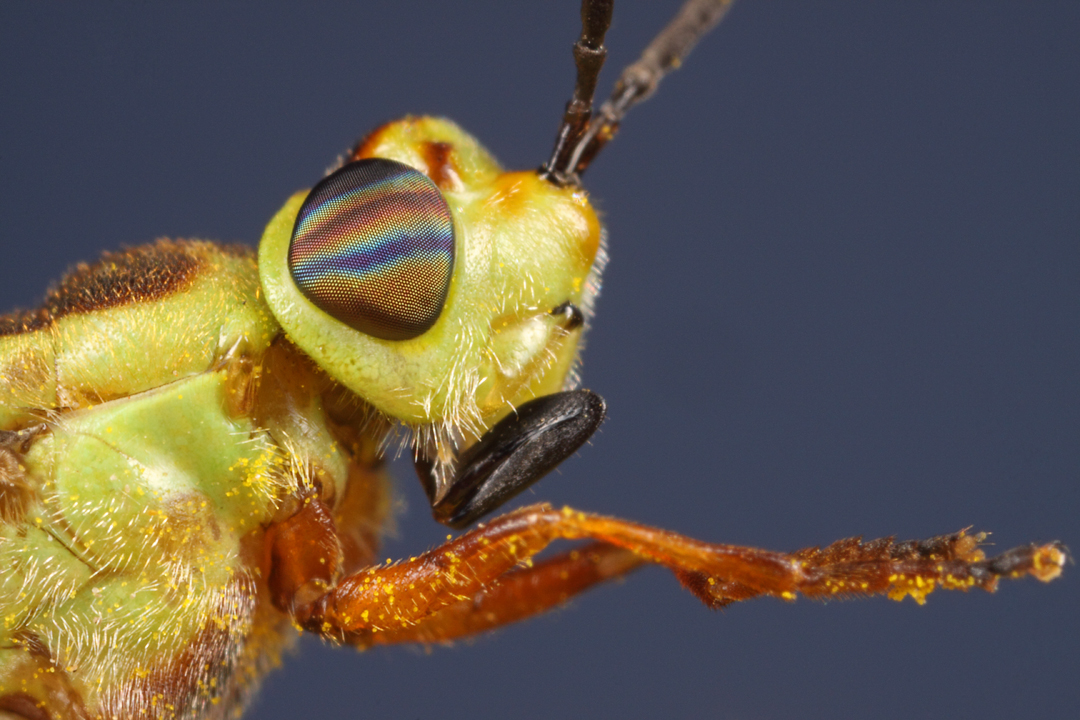
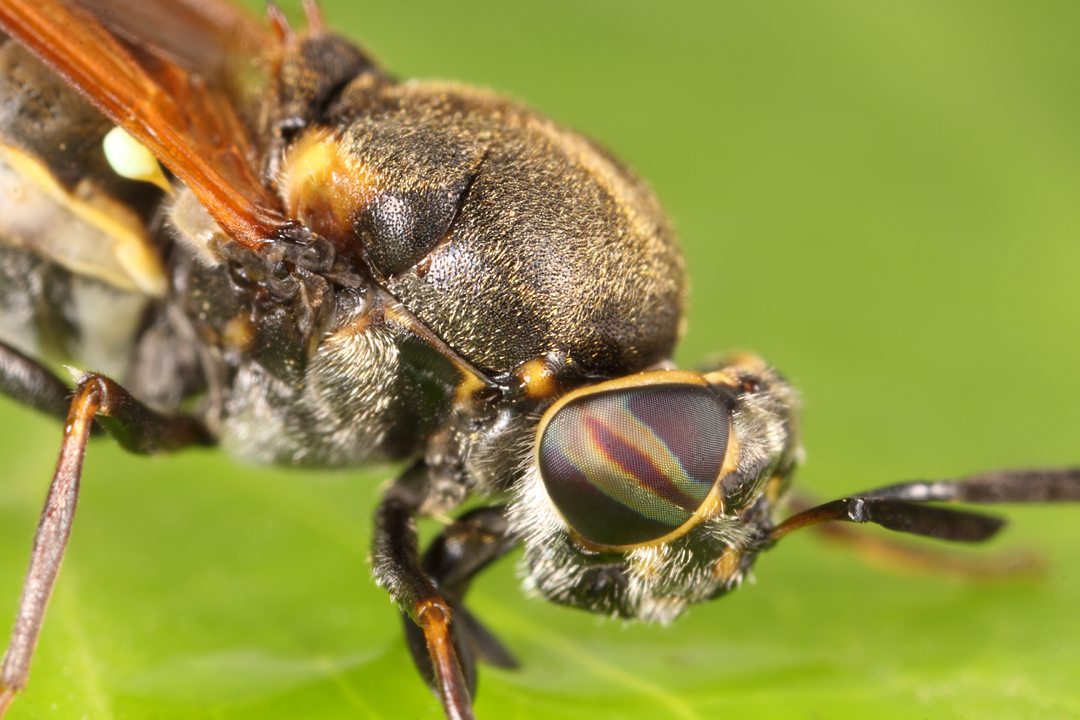
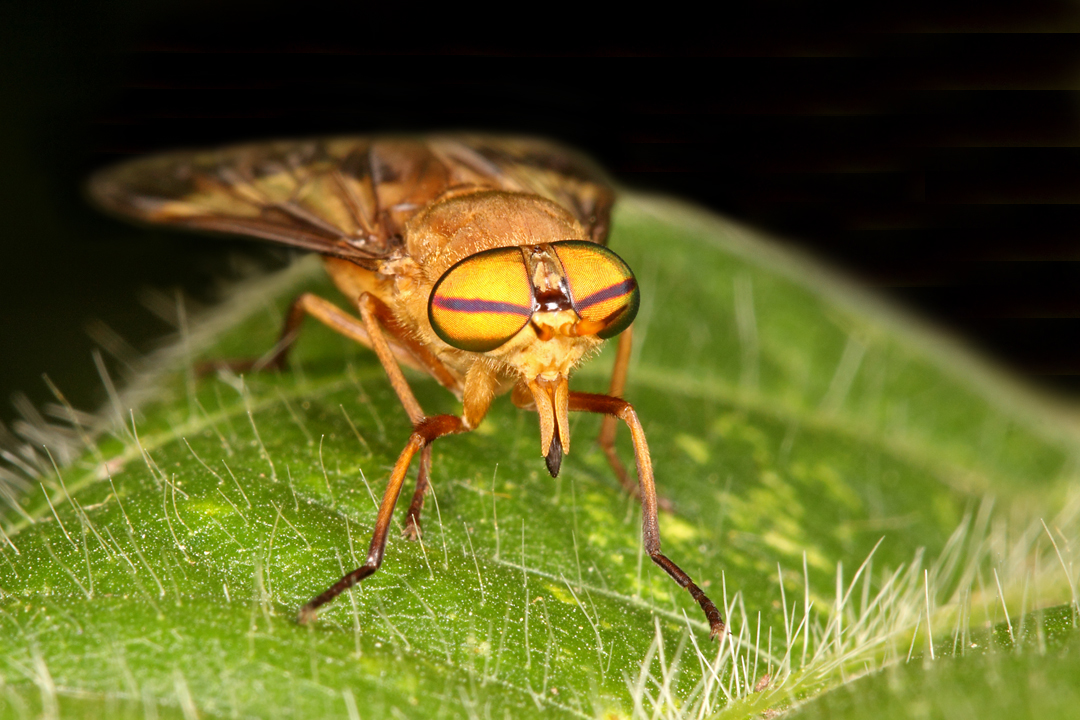
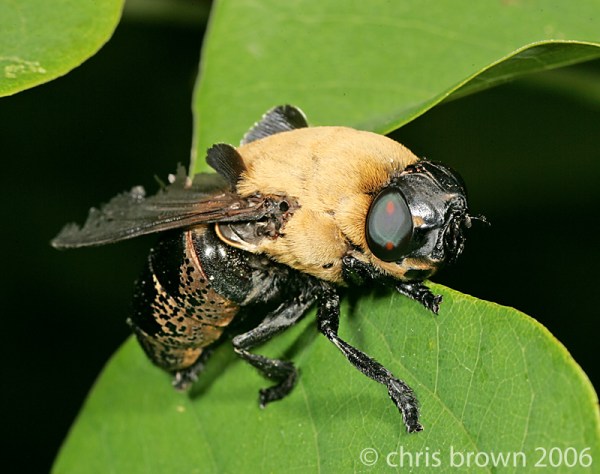
More fly got eye!

Here is another fly photographed during my recent visit to Argentina. I had little doubt when I saw it that it, too, was a member of the family Stratiomyidae; however, unlike the previous species this one was a far more cooperative subject for photographs. I have learned to carry a small utility tool in my pocket that contains an even smaller scissors—these have proven to be quite handy for gently snipping flowers or plant parts on which insects are perched without disturbing them. Holding these detached plant parts in front of the camera has several advantages, including the ability to photograph the subject while standing (or sitting) in a stable, comfortable position, providing more flexibility in choosing the background, and allowing me to “rest” some part of my hand or arm against some part of the camera or flash heads to “fix” the subject-to-lens distance. The fly remained quite calm through all these machinations, allowing me to focus on getting the composition, exposure, background, focus, and other technical aspects of the photos to my liking. Easier said than done of course, but a cooperative subject at least makes it more possible.

Psellidotus? sp. | Corrientes Prov., Argentina

I thought this fly looked an awful lot like our North American species of Odontomyia, so I sent the photos to stratiomyid expert Norman Woodley (Systematic Entomology Laboratory, Smithsonian Institution) for his opinion. Norm wrote back:

The stratiomyid fly…is in the subfamily Stratiomyinae, tribe Stratiomyini, which includes Odontomyia. I think that your fly is in the genus Psellidotus. Psellidotus is similar to another genus, Hedriodiscus…these two are easily separable in the Nearctic Region but the distinction becomes fuzzy in the Neotropics, especially in South America. We don’t have the species you photographed in the USNM collection. The majority of species in Psellidotus and Hedriodiscus in the Neotropics are very poorly known outside of their original descriptions.

Once again… fly got eye!

As before, this stratiomyid also exhibits stunningly patterned eyes, and like nearly all of the examples that I have seen the horizontal nature of the banding suggests an ability to see horizontally polarized light in similar fashion to many species of tabanids (Horváth et al. 2008). Again there seems to be a link between the ability to see horizontally polarized light and insects with aquatic lifestyles, as such visual capabilities have been demonstrated for a variety of other aquatic insects. While the biologies of most Neotropical stratiomyid species remain unknown, larvae of the subfamily Stratiomyinae are (like tabanid larvae) known to be aquatic (Brown 2009). Stratiomyine adults that exhibit these horizontal banding patterns may, like tabanids, also be able to see horizontally polarized light, which would be useful for finding mates and suitable sites for laying eggs.

REFERENCE:

Brown, V. B. 2009. Manual of Central American Diptera, Volume 1. NRC Research Press, 714 pp.

Horváth, G., J. Majer, L. Horváth, I. Szivák & G. Kriska. 2008. Ventral polarization vision in tabanids: horseflies and deerflies (Diptera: Tabanidae) are attracted to horizontally polarized light. Naturwissenschaften 95:1093–1100.

Copyright © Ted C. MacRae 2012

Fly got eye!

While walking the grounds of my company’s experiment station in Fontezuela, Argentina, I encountered a massive European elm (Ulmus laevis)—its trunk enveloped by an unidentified woody vine with large, ball-clusters of small, green flowers. Despite their inconspicuous appearance, the flowers were highly attractive to insects, primarily honey bees and smallish, black and yellow vespid wasps. One of the wasps caught my attention—it was not quite as narrow as the others, and it flew a little differently. Closer inspection, of course, revealed that it was not a wasp after all, but rather a fly. I wasn’t sure what it was, but it was extremely flighty and wouldn’t allow me to get close enough even to attempt looking at it through the viewfinder—much less going for a composed shot. Now, if it were a tiger beetle I’d probably spend the next 2 hours “working” it to get that in situ shot. But, hey, it’s just a fly (with apologies to my dipterist friends)! I trapped it in a vial and collected some flowers and foliage from the vine with hopes of giving it a day or so to settle down enough to allow a few photographs in a more controlled environment.

Hoplitimyia sp. poss. mutabilis | Buenos Aires Province, Argentina

That proved more difficult than expected, and a few photographs was all I could get. Even after a day in the vial it was extremely flighty, and every time I released it onto the flowers in the white box I had setup it immediately tried to take flight. I decided it must at least be hungry, so I whipped up some sugar solution and painted a small amount onto one of the leaves, then placed the open end of the vial over the leaf to let the fly find the sugar. That worked—briefly! The fly paused just long enough to allow me to fire off a half-dozen shots or so while it drank and preened before once again attempting to take flight. No amount of coaxing back to the sugar could interest the fly—she’d had enough, and so had I. I thought the fly had a soldier fly-ish look to it (family Stratiomyidae), and this was confirmed by dipterist Martin Hauser who wrote:

It is a female Hoplitimyia, maybe mutabilis…but the species are a mess. There are at least two species in the US, and more in South America. They have aquatic larvae…

Fly got eye!

Among flies, tabanids and syrphids seem to get all the attention from insect photographers because of their contrastingly colored eyes, but this fly had every bit as much eye as those better known families! Considering how broadly across the order Diptera that one finds these stunningly patterned eyes—72 species out of 23 families according to Lunau & Knüttel (1995), an obvious question is what is their purpose. Considering that the patterns and coloration are often sexually dimorphic, it’s tempting to think it has something to do with mate selection, especially with their large size and resulting prominence. However, Horváth et al. (2008) presented evidence that the ventral eye surface of many tabanids are stimulated by horizontally polarized light. Such capabilities are common in aquatic insects, suggesting some function in locating water for finding hosts, mates and suitable sites for laying eggs. This still doesn’t explain why the patterns are often sexual dimorphic, although one can imagine that males and females experience different selective pressures for specific visual cues that could have an effect on the resulting color pattern. Comments from any dipterists that happen by this blog and have greater insight into this question would be greatly appreciated.

REFERENCE:

Horváth, G., J. Majer, L. Horváth, I. Szivák & G. Kriska. 2008. Ventral polarization vision in tabanids: horseflies and deerflies (Diptera: Tabanidae) are attracted to horizontally polarized light. Naturwissenschaften 95:1093–1100, DOI 10.1007/s00114-008-0425-5.

Lunau, K. & H. Knüttel. 1995. Vision through colored eyes. Naturwissenschaften 82(9):432-434, DOI: 10.1007/BF01133678.

Copyright © Ted C. MacRae 2012

Lord of the flies!

I happened upon a rather interesting scene last week in a soybean field in northern Argentina (Chaco Province). This assassin bug (family Reduviidae) had captured and was feeding on an adult stink bug of the species Piezodorus guildinii—an important pest of soybean in Argentina and Brazil (where it is known by the common names “chinche de la alfalfa” and “chinche verde pequeño”, respectively). Assassin bug predation is always interesting enough itself, but what made this scene especially fascinating was the large congregation of flies surrounding and even crawling upon the predator and its prey. I had not witnessed something like this before, but it seemed clear to me that the flies were engaging in kleptoparasitism—i.e, stealing food. I’ve gotten into the habit of keeping a full set of extension tubes mounted on the camera with my 100mm macro lens—this not only provides the most useful (for me) range of magnification but also serves as a convenient and easy-to-use field microscope. Through the viewfinder I could see that there were at least two markedly different types of flies involved—more abundant, small, brown flies that I presumed (incorrectly, as it turns out) to be some type of drosophilid (vinegar fly), and a few larger, black flies that were completely unfamiliar to me. The flies were apparently feeding on fluids from the stink bug prey but also crawled all over the assassin bug as it fed. The assassin bug seem unencumbered in its feeding by the presence of the flies, but periodically it would slowly wipe its forelegs over its head to dislodge flies that had settled onto it. Just as quickly as they flew away, however, they crawled back.

The assassin bug, on the other hand, I recognized as very likely a species of Apiomerus—a large, exclusively New World genus known in North America as “bee killers” for their habit of sitting on flowers and ambushing visiting bees for prey. The prey selection behaviors of these insects, however, are more generalist than the name implies, as can be seen by these photographs. To verify my generic ID and possibly obtain a species ID, I sent some of these photos to Dimitri Forero at the Heteropteran Systematics Lab at University of California-Riverside. Dimitri is revising portions of Apiomerus (e.g., Berniker et al. 2011) and working on a general phylogenetic hypotheses for the genus. In the past he has been quite helpful in fielding questions from me about these bugs, and within a few hours Dimitri replied to inform me that the assassin bug was, indeed, a member of the genus Apiomerus, likely representing the common, widespread species A. lanipes (ranging from Panama to Argentina), based on its coloration, locality, and relative size. Update 12 March, 3:07 pm—After seeing the last photo in this post (which I did not send to him initially), Dimitri wrote to say the ventral abdominal pattern was not characteristic of A. lanipes. He asked about its size, to which I replied that it was about the same length but maybe a little less robust than A. crassipes (eastern North America). He later added, “I now think that this is A. flavipennis Herrich-Schaeffer, 1848. It is very similar to A. lanipes, but a lot smaller (lanipes is really robust), and with the abdomen with black and white patches, whereas in lanipes the abdomen is always black. I checked some series of specimens that I have here and, I am pretty sure now of the ID. I have material from Argentina as well. In some specimens that coloration of the corium varies, but the original description says it is yellow with a “hairy” pronotum, which fits very nicely your photos.” Apiomerus flavipennis is known from Argentina and Southern Brazil only.

Quite unexpectedly, Dimitri also noted that at least some of the flies could belong to the family Milichiidae. He first became aware of these flies after seeing a photograph of Apiomerus showing something similar and suggested Milichiidae online as a possible source for more information. This remarkably informative  website by milichiid expert Irina Blake, who dubs species in the family as “freeloader flies”, is a model for how websites dealing with obscure insect taxa should be organized and populated (and features on the home page a great photo of ant-mugging flies taken by our favorite myrmecophile). At any rate, I forwarded my photos to Irina and within minutes received her response that the bigger black flies most probably represent the cosmopolitan Milichiella lacteipennis and the smaller flies a species of the family Chloropidae (of “dog pecker gnat” fame) in the subfamily Oscinellinae, noting that she has seen similar (or the same?) chloropids in other photos as well engaging in kleptoparasitism.

Not long after receiving the first reply from Dimitri, I got another message from him with a link to a very interesting paper by Eisner and colleagues (1991), who recorded freeloader flies in Florida preferentially attracted to stink bugs and leaf-footed bugs (family Coreidae) being preyed upon by the orb-weaving spider Nephila clavipes. Olfactory stimuli were already suspected to be involved in attraction of milichiids and also chloropids (Sivinski 1985); however, Eisner et al. (1991) experimentally demonstrated that milichiid attraction was tied to specific components of defensive sprays in several pentatomid and coreid species (including P. guildenii, the prey species in this series of photographs). The defensive sprays of the bugs were generally ineffective at preventing predation by the spiders (and apparently this is the case for A. lanipes and other reduviids as well), thus serving as a signal to milichiids and chloropids not only of the presence of a food source but perhaps also assisting search for mates in a density dependent fashion (Sivinsky 1985). Milichiid attraction to hymenopteran prey, richly endowed with integumental glands themselves, has also been documented; the Eisner study raises the question whether these types of prey are also detected from chemical cues.

REFERENCES:

Berniker, L., S. Szerlip, D. Forero and C. Weirauch. 2011. Revision of the crassipes and pictipes species groups of Apiomerus Hahn (Hemiptera: Reduviidae: Harpactorinae). Zootaxa 2949:1–113.

Eisner, T., M. Eisner & M. Deyrup. 1991. Chemical attraction of kleptoparasitic flies to heteropteran insects caught by orb-weaving spiders. Proceedings of the National Academy of Sciences of the United States of America 88:8194–8197.

Sivinski, J. 1985. Mating by kleptoparasitic flies (Diptera: Chloropidae) on a spider host. Florida Entomologist 68(1):216–222.

Copyright © Ted C. MacRae 2012

Crazy Eyes 2

Buenos Aires Province, Argentina | March 2012

While the eyes of this female horse fly (family Tabanidae) aren’t quite as striking as those of Tabanus lineolus (the wonderfully dimorphic males and females of which were made famous by Thomas Shahan and Ralph Holzehthal), they still managed to catch my eye as I was scouting for more pedestrian types of insect in a soybean field in central Argentina this past week. We know this is a female due to the separated eyes (males have larger eyes that meet at the middle of the head—supposedly the better to see females with); and by the obvious, blade-like mouthparts, which the females use to slice mammal skin so they can lap the blood that their eggs need for development prior to being laid while males forego specialized mouthparts and concentrate on using their huge eyes to look for females.

Female horse flies have well-separated eyes and distinct, blade-like mouthparts.


I suspect this individual had recently emerged from the soil (where many horse flies pupate) and was still hardening off, as she was very calm sitting on the leaf and allowed me to steady the leaf with one hand as I snapped a few photos with the other. I would have loved to have switched out the 100mm lens I was using and put on my 65mm 1-5X lens to really zoom in on those striking eyes. Unfortunately, I don’t think my field companions shared or understood my fascination with this little insect. If anybody has a clue about the identity of this species please let me know.

Copyright © Ted C. MacRae 2012

Of Bots and Warbles

As an undergraduate at Truman State University during the mid-90’s I was part of a small mammal research group led by Dr. Scott Ellis.  My focus was on flying squirrels, but others in the group studied mice.  There were always opportunities to help my colleagues trap mice, and that is where I first encountered bot flies (Oestridae: Cuterebra spp.).  It was common for the live trapped mice to be infected with bot fly larvae, or bots, developing just under the skin of the host.  You might expect a fly parasite of a mouse to be relatively small but that is not the case with bot flies.  The bots cause a grotesquely large growth (or warble), and Cramer and Cameron (2006) report that a single bot can weigh as much as 5% of the host body weight.  That’s like a 150 lb guy having a 7.5 lb growth!  One unfortunate mouse that comes to mind had a warble on its head which caused its eye to bulge out.  I hate to make light of that poor mouse’s condition, but I distinctly recall that the bulging eye made it look as if it was continually surprised.  That said, Cuterebra fontinella infections are not thought to have a negative impact on white-footed mice, and in fact some studies have found that infected mice actually live longer than their non-infected neighbors (Cramer and Cameron 2006).  This relatively benign relationship between host and parasite is also the case in general with other species of Cuterebra, which is attributed to the long evolutionary history shared between the parasite and a single or very few closely related hosts (Catts 1982).  Negative impact or not, I was glad that I didn’t have to worry about bot flies infecting me, at least while I was in temperate Missouri.  Of course I had heard plenty of stories of humans being parasitized in the tropics by the human-attacking Dermatobia hominis, and they didn’t sound like very pleasant experiences.  My favorite story involved the person that had a bot in their ear that just about drove them crazy because they could hear the bot any time it changed positions.  Actually the Slansky article discusses the more negative interaction between D. hominis and its host, and this has been attributed to the less specialized relationship between the parasite and any one host because D. hominis has a broad range of hosts. 

Dermatobia hominis actually employ another insect to deliver its eggs to the host!  They lay eggs on mosquitoes or other blood-feeding Diptera for subsequent transfer to the host.  This makes a lot of sense from my point of view as a potential host—the adults are huge (bumble bee size), and I sure would be wary of one approaching me.  But mosquitoes, now there’s an idea—they are very adept at finding their hosts and are inconspicuous enough that they just might be able to get in close enough to allow the body heat of the host to stimulate the hatching and deposition of a bot.

There are other species of Cuterebra, and each is host specific to some degree.  Cuterebra abdominalis (Fig. 1) and Cuterebra buccata are both specific to lagomorphs (rabbits).  No doubt male tree squirrels and chipmunks get a little nervous every time they hear the species name of their bot fly—“emasculator”.  The species name originated from the observation that the warbles were often located near the genitalia of the squirrels, which prompted the idea, given the impressive size of the warble, that there must be an impact on the reproductive ability of the afflicted squirrels.  Luckily for the squirrels, research has demonstrated that the species name is a misnomer (Catts 1982).

Figure 1. Cuterebra abdominalis, a rabbit bot fly

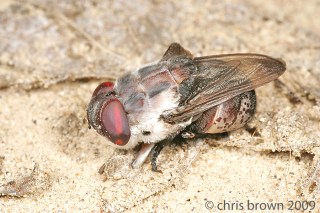
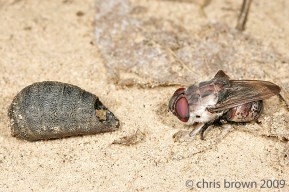
I knew nothing of the adult Cuterebra at the time I saw the parasitized mice, but that changed when Ted MacRae netted an adult rabbit bot fly, Cuterebra buccata, while we were looking for tiger beetles in northeastern Missouri.  In May of 2006, my wife Jess and I came across an adult C. abdominalis on the edge of a glade at Shaw Nature Reserve near St. Louis, and it is this photo that I discuss more below (Fig. 1).  The only other encounter was from southeastern Missouri in April of 2009 when Ted again found a rabbit bot fly, and this individual had only recently emerged from its puparium (Figs. 2 and 3– See Ted MacRae’s previous post from 2009 on this exact same fly).  All told, that’s only three encounters with adult bot flies from countless hours spent in the field, so my experience is that adult bot flies are rarely encountered.

Figure 2. Newly emerged rabbit bot fly, Cuterebra buccata

Figure 3. Newly emerged C. buccata with shed puparium


The image in Figure 1 represents well the type of photographic opportunity that I look for because it readily leads into various side stories.  Here are some examples: 

1) Amazing natural history—you just can’t make this stuff up.  The Catts review article cited discusses numerous other aspects of bot fly natural history in addition to the discussion above.  For example:

  1. Cuterebra spp. are thought to oviposit in the host habitat where the eggs await close passage of a host.  As with the D. hominis, the body heat of the host stimulates the eggs to hatch. The first instar larvae enter the host through an existing orifice or wound and then travel through the host to find a suitable subcutaneous location to create a warble.  Here, the larva molts to the second instar and continues to draw nourishment from the host.  Cuterebra larvae feed on fluids of the host as opposed to feeding on actual tissue, which would be more damaging to the host.
  2. The larvae spend roughly one month in the host.  Upon completion of the third instar, the larva exits the host, digs into the soil, and pupates.  Bot flies overwinter as pupae.
  3. Adults do not feed and are relatively short-lived.  Their attention is focused on the serious business of reproduction. 

2) Mimicry.  As you can see from the image, C. abdominalis very much resembles a bumble bee.  This image is great for presentations because it captures the attention of grade school kids.  I include this image at the end of a series of slides containing images of bees and wasps alongside the flies that mimic them.  Kids become very engaged and have a lot of fun trying to guess which images represent the models and which represent the mimics.  By the end of the series the kids have become pretty savvy about picking out the imposters but I present this image last and C. abdominalis is so bizarre that it always stumps the audience.  The kids become even more captivated by the discussion of how bot flies make a living.

3) Insect photography technique.  It’s thrilling to find new insects, but the experience can quickly turn disappointing if the insect flies off never to be seen again just as you begin to approach it for a photograph. That would have been the case with my encounter with C. abdominalis if I didn’t have a companion with me in the field.  I was lucky to have my wife, Jess, with me on this hike.  She kept an eye on the fly as I moved in for pictures.  Once or twice it flew at my approach, and Jess was able to keep track of it so I could try again.  Ted and I have also acted as spotters for one another, and this has made the difference between getting the pic or not.

4) Great location.  We encountered C. abdominalis on the edge of the scenic glade that slopes away from the Trail House at Shaw Nature Reserve in Franklin County, Missouri.  It’s always fun to revisit certain places and get to know them and the photographic opportunities they provide.  The Nature Reserve is one such place for me.  It offers countless opportunities for insect photography close to St. Louis due to a wide variety of habitats including prairie, glade, forest, wetland, and riparian areas. 

REFERENCES:

Catts E. 1982. Biology of New World bot flies: Cuterebridae. Annual Review of Entomology 27:313–338.

Cramer J. and G. Cameron. 2006. Effects of bot fly (Cuterebra fontinella) parasitism on a population of white-footed mice (Peromyscus leucopus). Journal of Mammalogy 86:1103–1111.

Slansky, F. 2007. Insect/mammal associations: Effects of cuterebrid bot fly parasites on their hosts. Annual Review of Entomology 52:17–36.

Copyright © Christopher R. Brown 2012

Best of BitB 2011

Welcome to the 4th Annual BitB Top 10, where I get to pick my 10 (more or less) favorite photographs of the year. As an insect macrophotographer I still feel like a relative newcomer, although with three seasons under my belt fewer and fewer people seem to be buying it anymore. Granted I’ve learned a lot during that time, but the learning curve is still looking rather steep. I don’t mind—that’s the fun part! With that said, I present a baker’s dozen of my favorite photographs featured here during 2011. I hope they reflect the learnings I’ve had the past year and maybe show some progress over previous years (2009, 2008 and 2010).

One more thing—I’m including a special bonus for the first time in this year’s edition. Each of the photos shown below is linked to a 1680×1120 version that may be freely downloaded for use as wallpaper, printing in calendars, or any other use (as long as it’s personal and non-profit). It’s my way of saying thanks for your readership and support.


From  (posted 8 Jan). I’ve done limited photography with prepared rather than live specimens. However, the recreated aggressive-defensive posture of this greater arid-land katydid (Neobarrettia spinosa)—or “red-eyed devil”—was too striking to pass up. A clean background allows every spine and tooth to be seen with terrifying clarity.


From  (posted 6 Feb). I had never seen a cactus fly until I encountered this Nerius sp. I’m especially fond of the bizzarely-shaped head and un-fly-like spines on the front legs.


From  (posted 17 Feb). This photo of a fungus weevil, Phaenithon semigriseus, is one of the first where I nailed the focus right on the eye at such a magnitude of closeup (~3X) and also got the composition I was looking for. I didn’t notice at the time, but the beetle seems to be “smiling.”


From  (posted 28 Mar). One of the field techniques I’ve been practicing this year is actually holding the plant with the subject in one hand, resting the camera on my wrist and controlling it with the other hand, and manipulating the position of the plant to achieve a desired composition. It’s a difficult technique to master, but the results are worth it. The jumping spider, Euophrys sutrix, represents one of my earliest successful attempts with this technique.


From  (posted 30 Mar). This South American tree fruit weevil looks like it is sitting quite calmly on a branch. In reality, it never stopped crawling while I attempted to photograph it. Crawling subjects are not only difficult to focus on but also almost always have a “bum” leg. I achieved this photo by tracking the beetle through the lens and firing shots as soon as the center focus point flashed, playing a numbers game to ensure that I got at least one with all the legs nicely positioned. I’d have been even happier with this photo if I had not clipped the antennal tip.


From  (posted 4 May). Face shots of predatory insects are hard to resist, and in this one of the fiery searcher beetle, Calosoma scrutator, the angle of the subject to the lighting was perfect for showing off every ridge and tooth in its impressive mandibles.


From  (posted 10 May). I’ve taken plenty of lateral profile shots of tiger beetles, but I like this slightly panned out one especially because of the sense of scale and landscape created by the inclusion of the plantlets and the view over the small rise.


From  (posted 18 May). I found these Edessa meditabunda stink bug eggs on the underside of a soybean leaf in Argentina almost ready to hatch. The developing eye spots in each egg gives the photo a “cute” factor rarely seen in such super close-ups.


From  (posted 15 July). Some of my favorite insect photos are not only those that show the bug in all its glory, but also tell a story about its natural history. This nymphal lichen grasshopper, Trimerotropis saxatilis, is almost invisible when sitting on the lichens that cover the sandstone exposures in its preferred glade habitat. 


From  (posted 23 Aug). I know this is the second beetle face shot I’ve included in the final selections, but it was while photographing this rare Florida metallic tiger beetle, Tetracha floridana, in the middle of the night that I discovered the use of extension tubes to improve the quality of flash lighting (decreased lens to subject distance results in greater apparent light size). This is perhaps one of the best illuminated direct flash photographs that I’ve taken, and I also like the symmetry of the composition.


From  (posted 17 Sep). The three-cornered alfalfa hopper (Spissistilus festinus) is a common pest of alfalfa and soybean in the U.S. However, despite its abundance, I’ve never noticed the bizarre zig-zag pattern of the eyes until I took this photo. Even though both the insect and the background are green, there is sufficient value contrast to create a pleasing composition. Bumping up the ISO and a lower FEC setting prevented overblowing the light greens—easy to do with full flash macrophotography.


From  (posted 4 Oct). This longhorned beetle had settled in for the night on its Ericamera nauseosa host plant, allowing me to use higher ISO and lower shutter speed settings with a hand-held camera to achieve this very pleasing blue sky background, while retaining the sharpness of detail of the subject that comes from full-flash illumination. The blue sky background provides a more pleasing contrast with the colors of this particular beetle and flowers than the black background that is more typically seen with full-flash macrophotography.


From  (19 Dec). An uncommon underside view of these purple tree fungus (Trichaptum biforme) caps and use of flash illumination allows the colors to literally glow against the bright green lichens also growing on the tree. Keeping aperture at a moderate setting allows blurring of the caps further back, adding three-dimensionality to the photo and preventing it from looking ‘flat.’


Well, there you have it, and I hope you’ve enjoyed my selections. Please do tell me if you have a favorite among theses (and if there were other photos posted during 2011 that you think deserved making the final selections).

Copyright © Ted C. MacRae 2011

Hover fly on mallow flower

I’ve mentioned before my reluctance to take random “bug on a flower” photos, but the colors of this hover fly (family Syrphidae) and the mallow flower (Malvaceae, possibly Abutilon pauciflorum) on which it was sitting were enough to capture my interest—a rare offering from this blog to dipterophiles. Even though I’m a beetle man, I’ve had reasonably good success identifying the varied insects across several orders and families that I’ve photographed at the Reserve. This one, however, has me a little stumped. I searched the syrphid gallery at Diptera.com but didn’t find a good match, the most similar being the Old World species Episyrphus balteatus. My best guess is something in the tribe Syrphini. Morgan? Keith? Phoridae?

Photographed last month at  in Buenos Aires.

Copyright © Ted C. MacRae 2011

Bee Fly Parasitism of Tetracha virginica

I expected to gain a better understanding of insect photography principles and techniques at last weekend’s BugShot insect photography workshop at Shaw Nature Reserve in Gray Summit, Missouri.  I even expected that I would walk away from the event with some new friends.  The one thing I did not expect was the discovery of an apparently unreported host/parasitoid relationship amongst my beloved tiger beetles.  Nevertheless, that’s exactly what happened in a patch of barren soil just outside of the Dana Brown Education Center where the event was being held.

Tetracha virginica 3rd instar larva | Shaw Nature Reserve, Franklin Co., Missouri

I had spied the small cluster of tiger beetle burrows the previous day as we left on our first group hike.  The burrows were unmistakably those of Tetracha virginica (Virginia metallic tiger beetle) due to their size (no other tiger beetle in east-central Missouri approaches the size of this species), and in fact some of the larvae were seen sitting at the tops of their burrows.  Tetracha larvae are easily distinguished from other genera of North American tiger beetles (in addition to their size) by their distinctive white-margined pronotum.  I had to catch back up with the group but came back later in the day and took a few photographs of one of the larvae sitting in its burrow.  Some of the other BugShot attendees were there and wanted to take photographs, but the larvae dropped on their less-practiced approach.  No problem, I just “fished” a larva out of its burrow and let them take their photographs.  When they finished, I began taking my own photographs, but I only got off one shot before the larva suddenly made a bee-line for its burrow and dropped in before I could block its escape.  Oh well, I do already have photographs of the larva of this species from other locations.
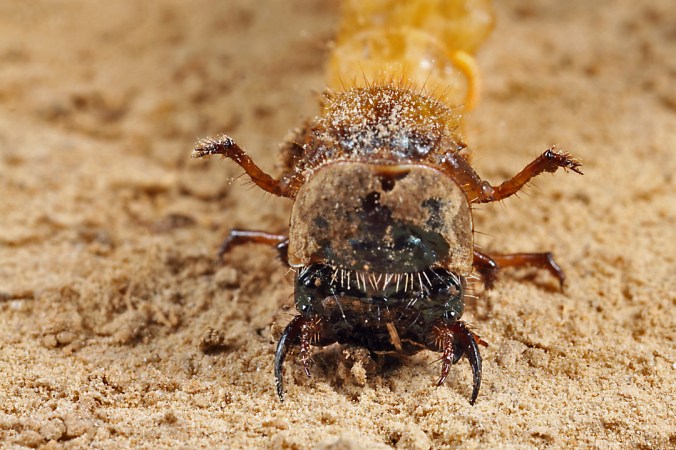
Tetracha virginica 3rd instar larva | Shaw Nature Reserve, Franklin Co., Missouri

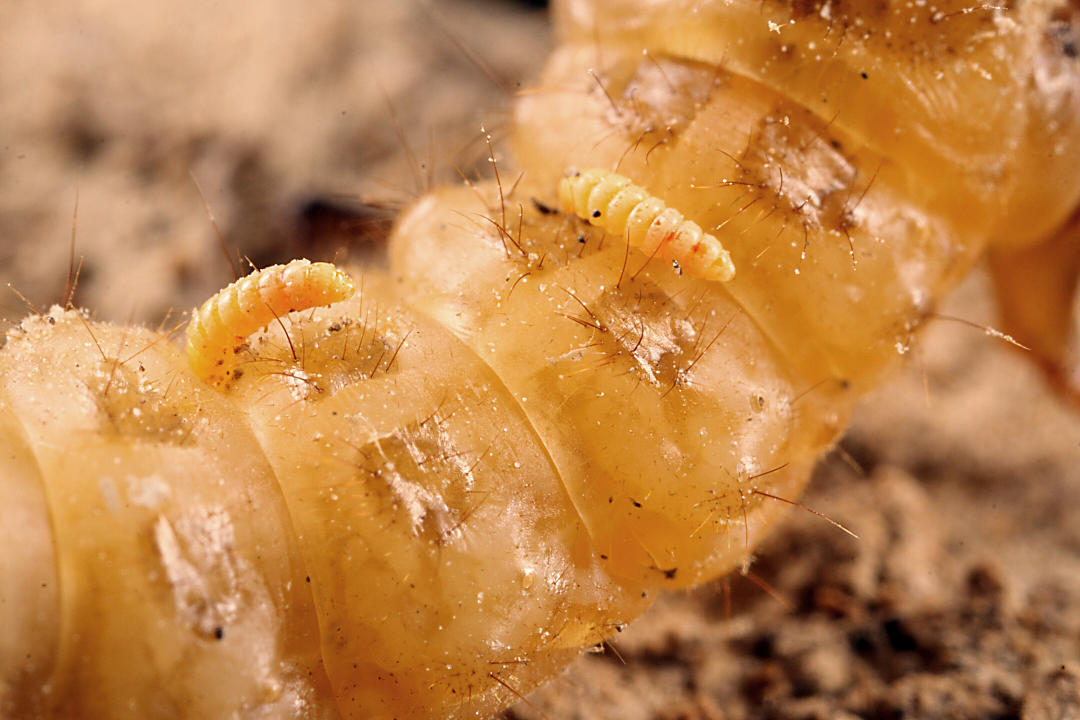
The next day I passed by the burrows again with Crystal and Lee.  I really wanted them to see the larvae, but they were not active.  No problem, I grabbed a long grass stem, chewed on one end, and inserted it to a depth of about 35 cm before it hit bottom.  A little jiggling to get the larva to bite, then a quick jerk back and out came the larva.  I never tire of seeing someone witness this for the first time—the way they jump back half-startled when they see the otherworldly larva flying through the air and landing on the grass.  I grabbed the larva and placed it on the barren clay to let them take photographs.  Crystal went first, and as she looked at the larva through her viewfinder she exclaimed, “there are wormy-things [the technical term, of course] on him.”  Lee and I looked, and sure enough there were two small “wormy-things” attached to the back of the tiger beetle.  I immediately recognized them as bee fly larvae (family Bombyliidae)—specifically Anthrax analis, the only bee fly known to parasitize tiger beetle larvae in the United States.  I was quite excited by this discovery, as I have never seen these before despite fishing untold numbers of tiger beetle larvae from their burrows over the past decade or so.  We all went camera crazy and took our turns photographing larvae and host, after which I popped it into a vial to keep for an attempt at rearing out the bee flies.

Anthrax analis larvae attached to abdomen of Tetracha virginica larva

It now seems that our find represents more than just a personal discovery, as bee flies—to my knowledge—have not yet been reported parasitizing any species of the genus Tetracha.  Of the 70 Anthrax spp. for which hosts have been recorded (Yeates and Greathead 1997), only three are known to parasitize tiger beetles.  Shelford (1913) gave the first account of A. analis (as Spogostylum anale) parasitzing Cicindela scutellaris lecontei, noting that the adult females lay their eggs by flying backward and downward while thrusting the abdomen forward until it touches the sand near the host burrow entrance.  Hamilton (1925) found Cicindelidia obsoleta parasitized by this species, and Bram and Knisley (1982) expanded its known host spectrum to include C. hirticollis, C. tranquebarica, Cicindelidia punctulata, and Ellipsoptera marginata.  Photographs of larvae (presumably of this species) parasitizing undetermined tiger beetle larvae can be seen in Pearson and Vogler (2001) and in this photo by Chris Wirth.  Anthrax gideon has been recorded parasitizing Pseudoxycheila tarsalis in Costa Rica (Palmer 1982) and Oxycheila trisis in Brazil (Arndt and Costa 2001), while a third undetermined Anthrax sp. has been reared from larvae of Pentacomia ventralis, also in Brazil (Arndt and Costa 2001).  Oxycheila and Pseudoxycheila are related to Tetracha at the tribal/subtribal level (depending on which classification you follow), so the finding of A. analis utilizing Tetracha is not unexpected.

Closer view of anteriormost Anthrax analis larva

The beetle larva and its unwelcome tagalongs is now in a container of native soil and has accepted the starter burrow that I made for it. Hopefully at least one of the bee fly larvae will complete its development and emerge as an adult to allow confirmation of its identity.  If this host association does turn out to be unreported, we will follow up with at least a short journal communication.  To that end, any literature citations you are aware of regarding bee fly parasitism of tiger beetles that is not listed below would be most welcome.

Congratulations to Ben Coulter, who wins yet another BitB Challenge with 14 points (this guy is a machine!), and Mr. Phidippus came close with 13 points.  Ben and Phiddy were the only participants that figured out the parasites were bee flies of the genus Anthrax, and Phiddy was the only participant to guess the correct genus for the host.  Ben’s win gives him a now commanding lead with 49 points in the current BitB Challenge Session #4 as we enter the home stretch.  Mr. Phidippus and Roy are still in striking distance with 39 and 28 points, respectively.  Is anybody capable of keeping him from his third title?  We shall see.

REFERENCES:

Arndt, E. and C. Costa.  2001.  Parasitism of Neotropical tiger beetles (Coleoptera: Carabidae: Cicindelinae) by Anthrax (Diptera: Bombyliidae).  Studies on Neotropical Fauna and Environment 36(1):63–66.

Bram, A. L. and C. B. Knisley.  1982.  Studies on the bee fly Anthrax analis (Bombyliidae), parasitic on tiger beetle larvae (Cicindelidae).  Virginia Journal of Science 33:90.

Hamilton, C. C. 1925. Studies on the morphology, taxonomy, and ecology of the larvae of Holarctic tiger beetles (family Cicindelidae).  Proceedings of the U.S. National Museum 65 (Art. 17):1–87.

Palmer, M. K.  1982.  Biology and behavior of two species of Anthrax (Diptera: Bombyliidae), parasitoids of the larvae of tiger beetles (Coleoptera: Cicindelidae).  Annals of the Entomological Society of America 75(1):61–70.

Pearson, D. L. and A. P. Vogler.  2001. Tiger Beetles: The Evolution, Ecology, and Diversity of the Cicindelids.  Cornell University Press, Ithaca, New York, 333 pp.

Shelford, V. E.  1913.  The life history of a bee-fly (Spogostylum anale Say) parasite of the larva of a tiger beetle (Cicindela scutellaris Say var. lecontei Hald.).  Annals of the Entomological Society of America 6(2):213–225.

Yeates, D. K. and D. J. Greathead.  1997. The evolutionary pattern of host use in the Bombyliidae (Diptera): a diverse family of parasitoid flies.  Biological Journal of the  Linnaean Society 60:149—185.

Copyright © Ted C. MacRae 2011