Rejoicing the end of summer

Russet browns of big bluestem (Andropogon gerardii) and Indian grass (Sorgastrum nutans) blend with still-green foliage in early autumn at White River Balds Natural Area in southwestern Missouri.

Last week I awoke to refreshingly cool temperatures for the first time in a long time – a brutal heat wave that had gripped the Midwest for some time had finally (if only briefly) passed. Missouri typically experiences substantial heat and humidity during the height of summer, a result of warm, moisture-laden air sweeping up from the Gulf of Mexico and over our mid-continental position.  The first cool snap in mid-August, however, usually marks the beginning of the end of protracted heat. High temps may return (and usually do), but they are intermittent and the writing is on the wall – summer’s end is near, and fall is on its way! For most of my life, the coming of fall has always been something to which I looked forward eagerly – it really is my favorite time of year.  I don’t just love fall, I adooore it!!!  As a result, I sometimes forget that not everyone shares my feelings, so when I mentioned to a colleague last week how excited I was that fall was on the way, I was a little surprised by her less-than-pleased reaction. Kids I can understand –  fall means a return to school and the end of fun and sun and no responsibilities.  However, for most adults, fall does not entail as dramatic a paradigm shift – we get up and go to work everyday regardless of the season. Indeed, to my colleague, fall was not dreaded so much for what it is but what it portends – winter! I convinced myself that if she was as interested in natural history as I, surely she would appreciate fall as a time of transition in the natural world.  This logic proved faulty, however, when just a few days later one of my favorite entomologist/natural historian bloggers voiced a similar lamentation.

Xeric calcareous prairie (''cedar glade'') in southwestern Missouri - habitat for Cicindela obsoleta vulturina.

That the charms of fall are not immediately apparent to everyone is beyond me.  Who in middle America doesn’t rejoice the end of long, sweltering days as they cede to the cool days of fall?  Who dreads the crisp, clean, autumn air and its pungent, earthy aromas?  Who doesn’t marvel as they watch the landscape morph from summer’s monotonous shades of green – its forests becoming a riot of red, orange, and yellow, its grasslands a shifting mosaic of tawny, amber, and gold, and in all places shadows cast long and sharp by a cool yellow sun riding low in a deep blue sky?  For the natural historian, fall offers even more than just these sensory gifts – it’s not the end of the season, but rather part of a repeating continuum that includes birth, growth, senescence and quiescence.  Plants that have not yet flowered begin to do so in earnest, while those that have shift energy reserves into developing seeds.  The spring wildflowers may be long gone, but only now do the delicate blooms of Great Plains Ladies’-tresses orchids rise up on their tiny spires.  Grasses also, anonymous during the summer, now reach their zenith – some with seed heads as exquisite as any summer flower.  Insects and other animals step up activity, hastily harvesting fall’s bounty to provision nests or fatten their stores in preparation for the long, winter months ahead.

Gypsum Hills in south-central Kansas. Habitat for Cicindela pulchra.

For myself, it is tiger beetles that are fall’s main attraction.  Yes, tiger beetles are out during spring and summer as well, but there is something special about the fall tiger beetle fauna.  Glittering green, wine red, and vivid white, a number of tiger beetles make a brief appearance in the fall after having spent the summer as larvae, hidden in the ground while feeding on hapless insects that chanced too close to their burrows, until late summer rains triggered pupation and transformation to adulthood.  As the rest of the nature prepares for sleep, these gorgeous beetles take their first, tentative steps into the autumn world for a brief session of feeding and play before winter chases them back underground for the winter.  Every fall for the past several years now, I have looked forward to the annual fall tiger beetle trip to see some of the different species and the unique landscapes which harbor them.  From the “cedar glades” of Missouri’s Ozark Highlands and Gypsum Hills of south-central Kansas, to the Sandhills of central Nebraska and Black Hills of South Dakota, I’ve acquired an even greater passion for a season that I already loved.  I’ll never forget the first time I saw Cicindela pulchra (beautiful tiger beetle) flashing iridescently across the barren red clay.  I still remember the excitement of seeing my first C. obsoleta vulturina launching itself powerfully from amongst the clumps of big bluestem. I recall my amazement at my first encounter with C. limbata (sandy tiger beetle) as it danced across deep sand blows, undaunted by scouring 30 mph winds.  No doubt I have many equally vivid memories awaiting me in the future, as I intend to keep the annual fall tiger beetle trip a long-standing tradition.  For this year, I’m hoping that C. pulchra and a few other species will reward a late-September drive to the Nebraska and South Dakota Badlands.  Whether they do is almost irrelevant – I love fall, and the chance to see new localities during my favorite time of year will be reward enough.

Copyright © Ted C. MacRae 2010

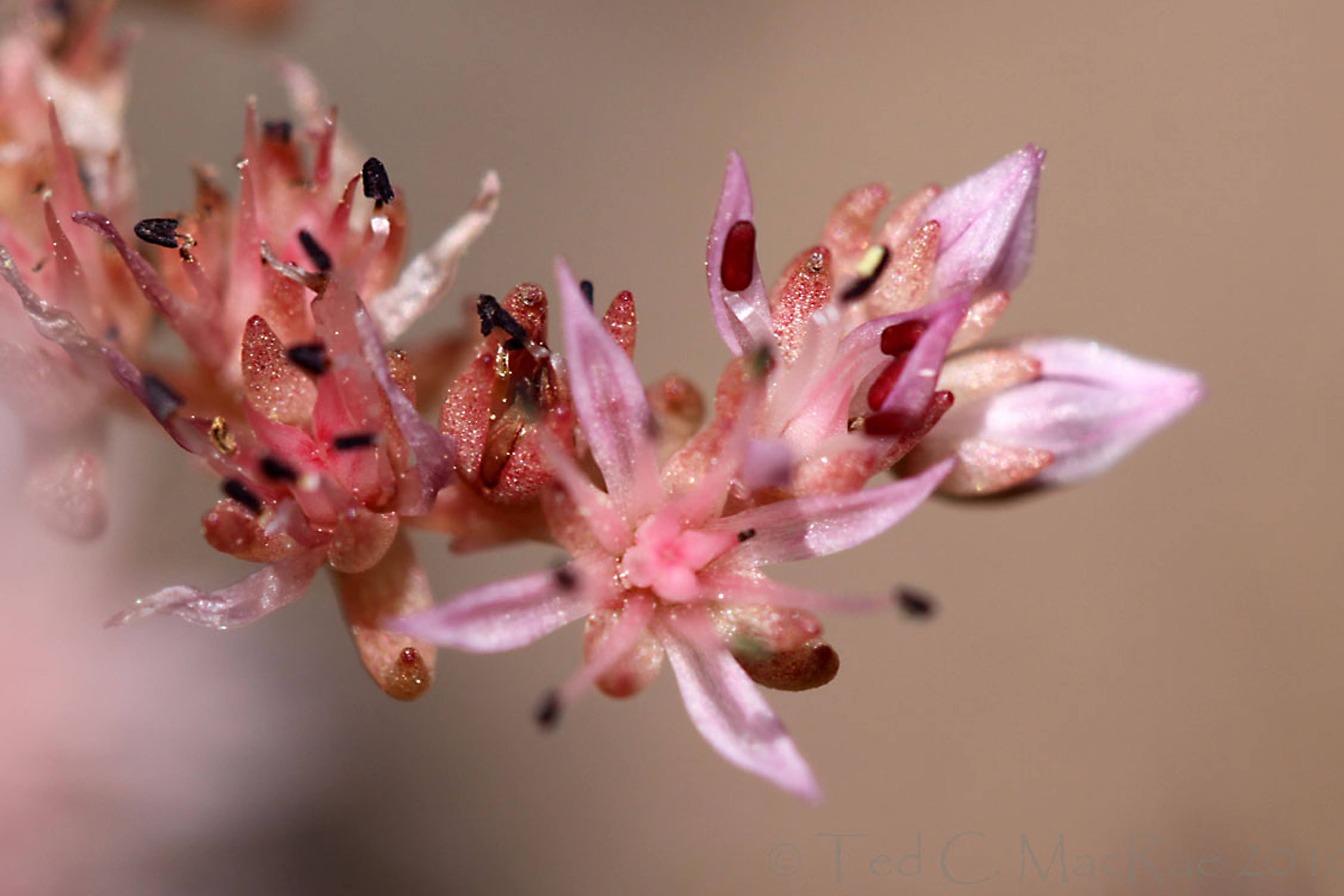
Friday Flower – Sedum pulchellum

I’m particularly enamored with glades, and after nearly 30 years of exploring Missouri’s Ozark Highlands, there aren’t many glades of any significance that I haven’t visited at some time or another.  However, during my mostly unproductive Memorial Day weekend collecting trip, I had a chance to visit Bona Glade Natural Area in Dade County for the first time.  Located in southwestern Missouri where the Ozark woodlands of the Springfield Plateau begin transitioning to the grasslands of the Great Plains, this small (20 acres) sandstone glade is noted as a station for the federally threatened and state endangered Geocarpon minimum.  I did not see this diminutive plant (sometimes called tinytim) during my visit, but I did see another pretty little succulent – Sedum pulchellum.  Also called widowscross, this plant belongs to the Crassulaceae – the same family as the familiar jade houseplant.

Although not nearly as rare as Geocarpon, widowscross is nevertheless somewhat restricted in Missouri, occurring primarily in the southwestern quarter of the state.  Throughout much of its range it is primarily associated with calcareous limestone glades, ledges, and outcrops (Baskin and Baskin 1977), but in Missouri it grows also on acidic chert and sandstone glades (Yatskievych 2006) – as is the case at Bone Glade.  I’ve not encountered this plant before, thus when I spotted this little stand with its profusion of brilliant pink blossoms, it immediately caught my attention.  A winter annual, this species prefers full sun and well drained, disturbed soils and apparently produces seeds quite prolifically when grown under the right conditions.  These features, along with its petite attractiveness, would seem to make it an ideal native alternative for succulent gardens.

Another, much less common sedum also occurs at Bona Glade, Sedum nuttallianum (Nuttall’s sedum).  This species is similar to S. pulchellum but can be distinguished by its smaller leaves and yellow blossoms.  It’s range is similar to that of Geocarpon, growing almost exclusively on chert and sandstone glades from southwestern Missouri and southeastern Kansas south to Louisiana and Texas.  I did not see this plant either – in fact, after finding this small stand of S. pulchellum I searched the entire glade rather thoroughly and did not see any other plants of that species either.

Photo Details: Canon 50D (ISO 100-200, 1/400-500 sec, f/5.6), Canon 100mm macro lens, ambient light. Post-processing: minor cropping, levels, unsharp mask.

REFERENCES:

Baskin, J. M. and C. M. Baskin. 1977. Germination ecology of Sedum pulchellum Michx. (Crassulaceae). American Journal of Botany 64(10):1242-1247.

Yatskievych, G. 2006. Steyermark’s Flora of Missouri, Volume 2. The Missouri Botanical Garden Press, St. Louis, 1181 pp.

Copyright © Ted C. MacRae 2010

Add to FacebookAdd to DiggAdd to Del.icio.usAdd to StumbleuponAdd to RedditAdd to BlinklistAdd to TwitterAdd to TechnoratiAdd to Yahoo BuzzAdd to Newsvine

Email to a friend

Are we loving our prairies/glades/woodlands to death?

I had such high hopes for last weekend’s collecting trip – late May is boom time for insects across Missouri, we have had good moisture this spring, and I would be visiting some high-quality natural communities that I had not visited for a long time.  My stated goals (the jewel beetles, Agrilus impexus and A. frosti) were long shots – I knew that and would have been fine coming home without those species (which I did) had the the collecting been otherwise productive (which it was not).  Still, I’ve been doing this for a long time now, and I’ve learned to draw on my accumulated experience when things don’t go as planned to give myself the best shot at turning a bad collecting trip into a decent one when things don’t go as planned.  The itinerary with which I start is rarely the one that I actually follow, and this past weekend was a good example of such.

My first stop was Ha Ha Tonka State Park, one of Missouri’s premier parks, boasting high-quality chert, dolomite, and sandstone savanna interspersed with dolomite glades.  It is on these glades and savannas that I hoped to find Agrilus impexus, or failing that at least collect a nice diversity of other jewel beetles on the oaks and hickories of the savannas and surrounding woodlands.  However, it was with some reservation that I even came here after being told by my colleague at the Department of Natural Resources just 2 days before my trip that 75% of the park’s grasslands and woodlands had been burned within the past two years.  For an insect collector, this is never good news – in all my years of collecting insects, my experience in relatively recently-burned habitats has been consistent: collecting sucks!  I decided, however, to visit Ha Ha Tonka anyway because of the quality of the natural communities it contains, thinking perhaps I might be able to find pockets of unburned habitat supporting good insect populations.  This was not to be. I beat oak after oak in the savannas and woodlands – nothing!  I swept little bluestem and Indian grass in the glades – nothing!  The foliage was lush and green and the savanna and glade landscapes highly diverse – given the time of season the place should have been teeming with insect life, yet it almost seemed sterile. Were it not for a few Chrysobothris quadriimpressa jewel beetle adults that I found attracted to a recently wind-thrown black oak tree, I would not have seen any insects here at all.  It appeared my fears about park-wide depression of insect populations had been realized.  However, not one to waste a visit I decided to explore some of Ha Ha Tonka’s fascinating geological features.  Ha Ha Tonka contains one of Missouri’s best examples of karst geology, with complex structures formed from the collapse of a major cave system.  The Devil’s Promenade is one of the more spectacular examples of such, its horseshoe-shaped cliff representing the former interior walls of a now-collapsed cave.  As dusk approached, the day’s poor insect collecting caused me to abandon my plans to stay here and blacklight for nocturnal beetles.  Instead, I decided to break from the itinerary, drive further west and explore Lichen Glade Natural Area in the morning before heading to the Penn-Sylvania Prairie BioBlitz later that afternoon.
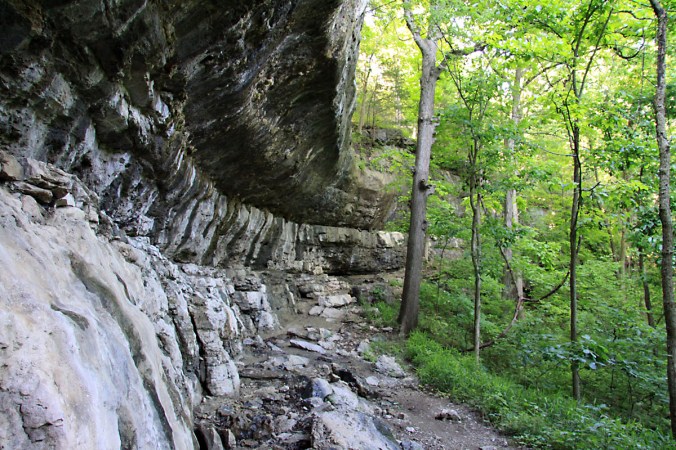
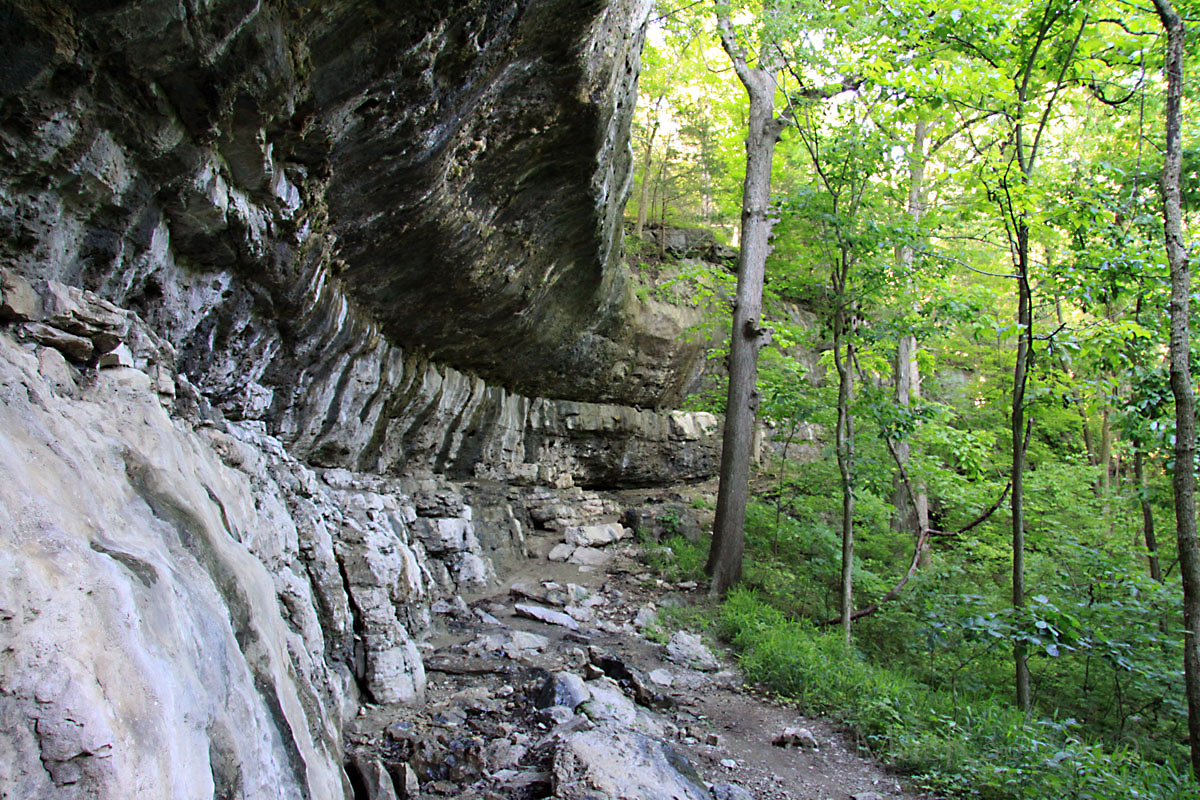
Devils Promenade, Ha Ha Tonka State Park

Lichen Glade Natural Area is a small area owned by The Nature Conservancy that boasts a high-quality sandstone glade surrounded by post oak/black jack oak forest.  My first visit to the area more than 20 years ago was during May, and it was one of the most productive collecting trips I’ve had with a number of Agrilus spp. (including A. frosti) beaten from post oak (Quercus stellata) along the woodland edge.  I didn’t visit again until fall of 2002, when Chris Brown, Rich Thoma and I found claybank tiger beetles (Cicindela limbalis) sunning on the exposed sandstone outcrops, and I made one more visit the following May to beat more insects off of post oak.  The Lichen Glade that I returned to this past weekend was a very different place from when I last visited – the surrounding woodlands had been extensively opened (I would guess within the past few years based on the size of the post oak resprouts), and fire had been used throughout the area.  Anticipation turned to frustration when no amount of beating of the woodland vegetation and sweeping of the glade vegetation turned up beetles in any appreciable numbers (or any insects for that matter) and two hours worth of effort yielded not a single buprestid beetle!
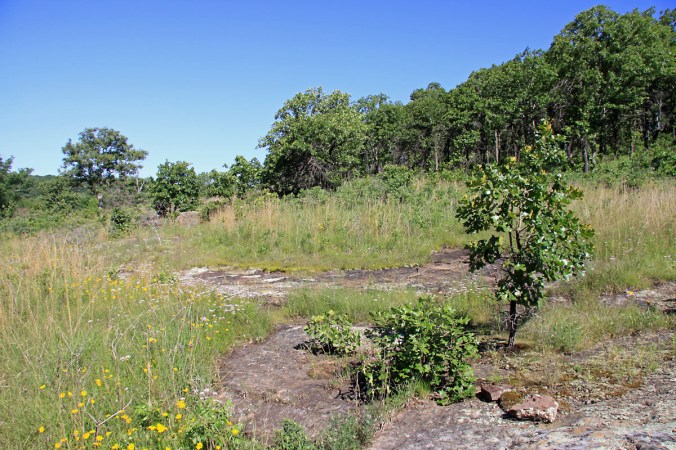
Sandstone glade community, Lichen Glade Natural Area

With resignation, I headed on over to Penn-Sylvania Prairie, where during the introduction to the BioBlitz I learned that nearly half of the 160-acre prairie was burned last December and all of it had been burned within the past few years.  I knew what I was going to find – nothing!  Okay, I shouldn’t say nothing, as there actually were some beetles present.  However, the numbers and diversity were low, with all of the species encountered representing common, widespread species.  Moreover, it was not just beetles – all of the invertebrate group leaders (which included experts on snails, ants, butterflies, and bees) reported low overall abundance and diversity in their groups of interest.  Only the vascular plants – the metric by which the value of prescribed burning is always assessed – showed high diversity, with 300 species of mostly native prairie plants recorded for the site.  It was a fun event, with probably ~75 attendees and a delicious pot luck dinner that evening; however, it would have been more enjoyable had there actually been a nice diversity of insects present to document for the preserve.

My comments may make it seem that I am against the use of prescribed burning.  This is not true – I understand the critical role that fire as a management technique plays in restoring and maintaining examples of Missouri’s historically fire-mediated landscape. Without fire and other processes to mimic natural disturbance factors, most of Missouri’s historical grasslands and woodlands suffer relentless encroachment by woody vegetation. However, the modern landscape is very different from the historical landscape, where fires of unpredictable scale, intensity, and frequency operated within a vastly larger scale to create a shifting mosaic of natural communities in various stages of ecological succession. Such processes cannot be recreated on today’s severely fragmented landscape, where the precious few remaining tracts of native habitat are relatively to extremely small and more often than not separated from each other by vast expanses of homogeneous and “inhospitable” habitat (e.g., agricultural, urbanized, or severely degraded lands).  It is in that context that I have great concerns about how aggressively fire has been used in recent years on our state’s natural areas and the impact this is having on insect populations – specialist and generalist alike.  Fire proponents will point to published studies that show little to no effect by the use of fire for managing small, isolated remnants on specialist insects (see review in Henderson 2010).  However, there are an equal number of studies that suggest such concerns are well-founded (see review in Panzer 2002). A consistent limitation in all of the studies that have been conducted is the lack of very large and long un-burned remnants.  Prescribed burning has been adopted so rapidly and pervasively that there just aren’t any significant un-burned remnants left to properly include as controls in such studies.  As a result, the insect fauna present at a given site at the start of such a study is already skewed towards those species that successfully recolonized the area post-burn.  At a minimum, the data to this point are inconclusive, and certainly the potential for impacts has not been given the consideration it warrants in designing fire-management plans for our own state’s prairies and glades. Furthermore, as rapidly and aggressively as fire has been adopted on our few, small, widely disjuct remnants, the opportunity for proper investigation of those potential effects may be gone.  A particularly egregious example of the lack of consideration being given to prairie invertebrates in designing fire management plans is shown in these photos of Iowa’s Sylvan Runkel State Preserve before and after a late May burn and the impact of that burn on a resident population of Nevada buck moths (Hemileuca nevadensis).

Here in Missouri, as in Iowa, it’s a problem of scale – the landscape is too fragmented and remnants too disjunct to manage based strictly on floristic response.   Populations of generalist insect species will recover, and even specialist species may be able to overcome such management practices if they are widely distributed and sufficiently mobile. But what about conservative species with low vagility, such as the swift tiger beetle (Cylindera celeripes) and our disjunct population of the frosted dromo tiger beetle (Dromochorus pruinina), flightless species restricted in Missouri to the few tiny remnants of loess hilltop prairie in northwestern Missouri and a single 2.5-mile stretch of roadside habitat in west-central Missouri?  Until directly relevant data, gathered here in Missouri, are forthcoming to suggest otherwise, I believe the most judicious use of fire possible should be practiced in restoring and maintaining our grasslands and woodlands.  In-season burns may have been a part of the historical landscape, but their use today has great potential to result in local extirpations and should be used only after the most careful consideration.  Leaving un-burned refugia within remnant habitats to accelerate recovery would also be prudent – yet many land managers disregard this practice because of its logistical difficulties. This is especially true in small parcels, yet it is precisely these remnants that have the most to gain from their use (or lose from not doing so!).  In the historical landscape, every burn was a patch burn – no matter what its size, there were always adjacent or proximal unburned habitat from which recolonization could occur.  Elk and bison, too, were integral components of the presettlement prairie landscape – their roamings caused intermittent, localized disturbances that were likely not only crucial to the tiger beetles that I study but may also have contributed to vegetational diversity through patch succession.  Techniques that mimic these natural disturbance factors include mowing, haying, and managed grazing.  They can be utilized to mimic those disturbances as well as delay woody encroachment, and their use in land management should be considered for their ecological value rather than deprioritized because of their relatively greater complexity and cost to implement. Mechanical removal and selective use of herbicides offer additional tools for addressing woody encroachment while minimizing potential impacts to insect populations. An effective management program that considers all of the flora and fauna of a remnant may not be possible unless all of these management tools are utilized, or at least properly considered. As my good friend James Trager said in a recent email (quoting Andrew Williams), habitat restoration “cannot rest on any single management practice, nor practicing it too extensively.”

REFERENCES:

Henderson, R. A.  2010. Influence of Patch Size, Isolation, and Fire History on Hopper (Homoptera: Auchenorrhyncha) Communities of Eight Wisconsin Prairie Remnants.  Wisconsin Department of Natural Resources, Research Report 189, 22 pp.

Panzer, R. 2002. Compatibility of prescribed burning with the conservation of insects in small, isolated prairie reserves. Conservation Biology, 16(5):1296-1307.

Copyright © Ted C. MacRae 2010

Add to FacebookAdd to DiggAdd to Del.icio.usAdd to StumbleuponAdd to RedditAdd to BlinklistAdd to TwitterAdd to TechnoratiAdd to Yahoo BuzzAdd to Newsvine

Email to a friend

Long Weekend Bug Collecting Trip!

On Saturday, I’ll be joining a number of other Missouri biologists as a Group Leader for a BioBlitz at Penn-Sylvania Prairie (“C” on the map above).  Penn-Sylvania Prairie is a 160-acre tract of native tallgrass prairie in southwestern Missouri owned by the Missouri Prairie Foundation. I’ll be leading the “Beetles” group (of course), and as far as I can tell there has been little to no work done to survey beetles in this prairie.  Late May is an awesome time to look for beetles in southwestern Missouri, and with the forecast calling for sunny skies with highs in the mid-80’s, what better opportunity to add an extra day to an already long holiday weekend and do a…

Long Weekend Bug Collecting Trip!

The BioBlitz is not until Saturday afternoon, so I’ve padded the itinerary with a few nearby southwestern Missouri spots that I’ve wanted to visit for some time now.  The first stop will be Ha Ha Tonka State Park (“B”) and its mosaic of dolomite glades and post oak savanna.  My interest in this area stems from two jewel beetle specimens collected there by a student at the University of Missouri, who gave them to me for identification.  These two specimens caused a stir when I first saw them, as I could not definitely ID them – they resembled Agrilus impexus, a common inhabitant of the desert southwest and Mexico, but they were much larger and, of course, were found in Missouri.  These specimens played a key role in clearing up a case of taxonomic confusion on the identity of Agrilus impexus when I sent them to U.S. Agrilus-guru Henry Hespenheide.  Through comparison with type specimens, he determined that these were among a smattering of specimens collected across the Great Plains that represent the true A. impexus, while the common southwestern U.S. species to which the name had long been applied was actually an undescribed species.  He described the latter as Agrilus paraimpexus (Hespenheide 2007), and the true A. impexus remains rare and little known.  Obviously, my two specimens are the only ones known from Missouri, and indeed only one other specimen of this species has been collected in the past 60 years!  I know that makes finding it a long shot, but the student who collected them told me he swept them from woody vegetation along the edge of a glade at Ha Ha Tonka Savanna Natural Area.  I suspect they may be associated with honey locust (Gleditsia triacanthos), thus, I will have my beating sheet and will be beating lots of honey locust on Friday – wish me luck!

On Sunday, I’ll work my way slightly northeast to some of the sandstone glades that are found in St. Clair Co. where the Osage Plains to the west transition into the Ozark Highlands to the east.  The two most interesting of these are Lichen Glade Natural Area (“D”) and Dave Rock Natural Area (“E”).  Here, sandstone glades and bluffs are surrounded by dry and dry mesic sandstone woodlands dominated by post oak (Quercus stellata) and blackjack oak (Quercus marilandica).  Many years ago, I beat a single specimen of Agrilus frosti off of post oak at Lichen Glade.  I have not collected the species since, and I know of only one other Missouri specimen collected by state agriculture personnel in a malaise trap in central Missouri.  I also hope to photograph the lichen grasshopper (Trimerotropis saxatilis), which I have seen commonly at both of these sites.  This Great Plains species is at its eastern limit of distribution in Missouri, occurring exclusively on sandstone and igneous glades where its cryptic coloration makes it nearly invisible against the acidic, lichen-covered rocks that dominate these habitats.

Otherwise, I have no specific goals for the trip, but as late May is prime time in this area for jewel beetles, I’ll be doing lots of general beating on the oaks and hickories that many species in this family favor as hosts for larval development.

REFERENCE:

Hespenheide, H. A.  2007. The identity of Agrilus impexus Horn, a new species, and taxonomic notes and records for other Agrilus Curtis species (Coleoptera: Buprestidae).  Zootaxa 1617:57–66.

Add to FacebookAdd to DiggAdd to Del.icio.usAdd to StumbleuponAdd to RedditAdd to BlinklistAdd to TwitterAdd to TechnoratiAdd to Yahoo BuzzAdd to Newsvine

Email to a friend

Taum Sauk Mountain – Missouri’s High Point

Although spring is now well underway in the middlin’ latitudes of Missouri, it was only a few short weeks ago that winter was still with us.  For my last winter hike of the season, I returned to perhaps my favorite stretch of my favorite trail in all of Missouri – the Mina Sauk portion of the Taum Sauk Trail on Taum Sauk Mountain.  Located in the rugged St. Francois Mountains (the “epicenter” of the Ozark Highlands), Taum Sauk Mountain is Missouri’s highest peak.  I say “peak” with a bit of reservation – at 1,772 feet it hardly compares with the high peaks of the Rocky Mountains or even the much mellower Appalachians (and certainly not with those of my beloved Sierra Nevada).  Nevertheless, unlike the remainder of the Ozark Highlands, the St. Francois Mountains are true mountains initially formed through a series of volcanic events occurring well over a billion years ago.  They, and the rest of the Ozark Highlands, have been shaped to their current form by repeated cycles of uplift and subsequent erosion.  

During their Precambrian prime, the St. Francois Mountains reached heights of 15,000 feet (the “ancient” Appalachians, in the meantime, were still just a twinkle in Mother Earth’s eye).  Rain and wind and the vastness of time have reduced them to nubs, leaving only the most ancient of volcanic rocks as testament to their former glory.  Although most of what is now the Ozark Highlands was inundated repeatedly later in the Palaeozoic (laying down the sediments that were then uplifted and “carved” to their current shape), the highest peaks of the St. Francois Mountains may be among the few areas in the United States never to have been completely submerged under those ancient seas.  Standing atop Taum Sauk Mountain, it is tempting to visualize today’s craggy terrain as a fossil of that ancient landscape – the peaks representing the former islands of rhyolite, their slopes barren and lifeless in stark contrast with the exploding diversity of bizarre life forms appearing in the tropical waters that surrounded them.

The sterile, volcanic rocks of the St. Francois Mountains support an abundance of open, rocky glades – especially on their peaks and southern and western slopes – that are home to a number of plants and animals more typically found in the tallgrass prairies further west.  Indian grass (Sorghastrum nutans) and little bluestem (Schizachyrium scoparium) thrive in clumps between the large, pink boulders that are strewn across the landscape and which provide shelter and sunning spots for animals ranging from the charismatic eastern collared lizard (Crotaphytus collaris) to the smaller but no less beautiful splendid tiger beetle (Cicindela splendida).  The surrounding forest is historically an open woodland with a rich, herbaceous understory and widely-spaced, drought-tolerant trees such as shagbark hickory (Carya ovata), post oak (Quercus stellata), and blackjack oak (Quercus marilandica).  These woodlands and glades are a fire-mediated landscape dependent upon periodic burns to maintain their vegetative character.

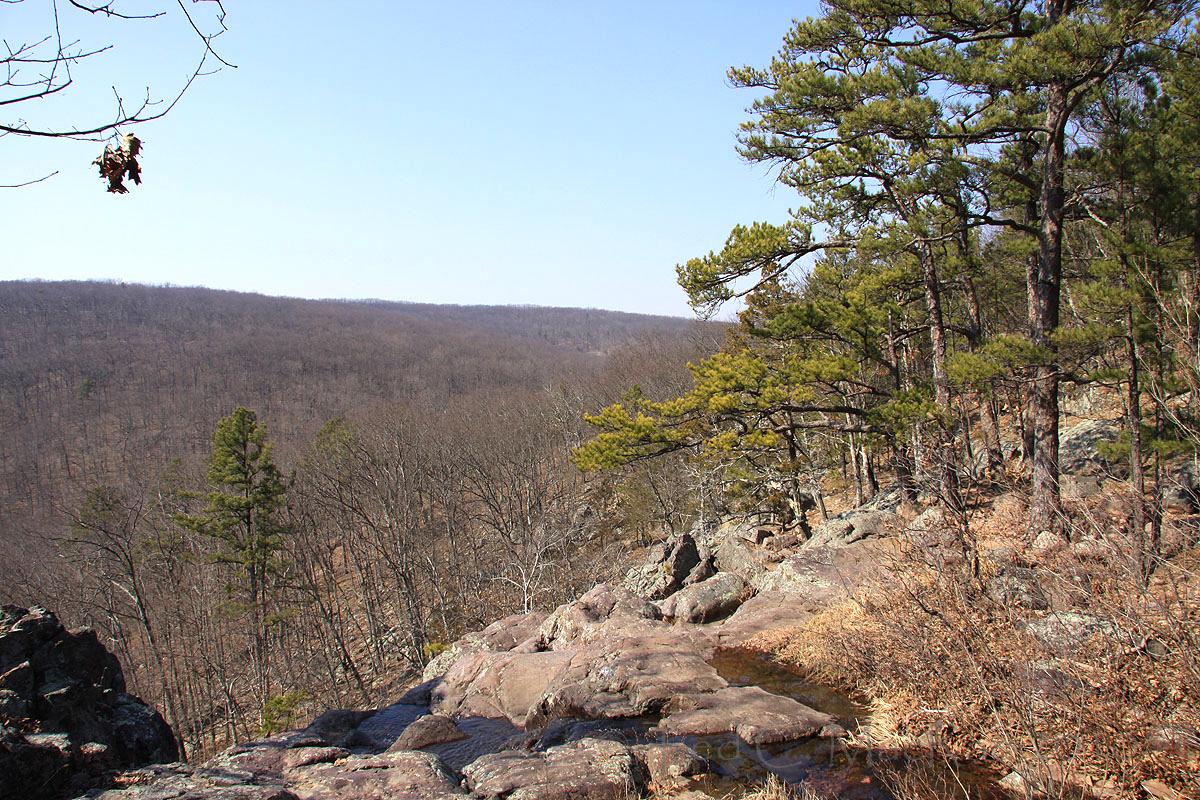
A trail begins at “High Point”, marking the summit of Taum Sauk Mountain and the highest point in Missouri.  A granite slab next to the summit rock documents the elevation at 1,772.68 feet MSL (Mean Sea Level).  The Mina Sauk Falls Trail, a rugged three-mile loop that joins the Taum Sauk Section of the Ozark Trail, leads to the tallest wet-weather waterfall in Missouri, Mina Sauk Falls.  During periods of high water flow, water gushes over the edge and drops 132 feet over a series of rocky ledges.  Water was flowing lightly during my late winter visit; nevertheless, looking out from above the falls (see photo above) offers one of the most spectacular vistas available in Missouri.  A rather difficult hike down the side of the mountain to the bottom of the falls is also well worth the effort, although clear views of the entire falls are difficult to find in the dense, moist forest below (it was here that I photographed the spectacular Ozark Witch Hazel).

A second unique geological feature lies about a mile farther down the Ozark Trail – Devil’s Toll Gate.  The rocks stand 30 feet high on either side of this eight-foot-wide, 50-foot-long fissure.  The gap probably began as a vertical fracture in the rock that has been enlarged by subsequent weathering. Over time the fissure will continue to widen, as the rocks on either side lose height.

Returning to High Point at the end of the hike, I noticed that the summit was a little higher than when I started my hike – whether this was through additional uplift of the underlying mountain or a depositional event I cannot say.  Nevertheless, I estimated Missouri’s new highest elevation to be approximately 1,773.01 feet MSL!

Copyright © Ted C. MacRae 2010

Add to FacebookAdd to DiggAdd to Del.icio.usAdd to StumbleuponAdd to RedditAdd to BlinklistAdd to TwitterAdd to TechnoratiAdd to Yahoo BuzzAdd to Newsvine

Email to a friend

The Inexorable March of Spring!

Granted, the progress of spring seems to advance in halting baby steps with occasional falls onto its muddy bottom, rather than as a determined forward march, but spring is welcome, no matter how it arrives. When little green tips start poking up and there’s a bit of that “spring smell” in the air, I simply must get out and catch up on the status of Nature — the old-fashioned way (she doesn’t have a Facebook account). Over the last week, I’ve gone forth in search of signs that everything else living is about as tired of winter as I am, and wants to get this spring show on the road! There is already so much happening, I can’t recount it all here — A partial list of unphotographed notables: owls breeding; hawks nesting; woodcocks doing their silly, repetitive and almost invisible (because it’s nearly dark) courtship displays; wood ducks on forest ponds; year-round resident songbirds reestablishing territories; spring peepers, chorus frogs, wood frogs and southern leopard frogs singing, especially in the fishless ponds; winter crane flies and midges swarming in sun flecks in the woods; wild filberts, silver and red maples flowering, etc…

Formica pallidefulva sniffs the spring air


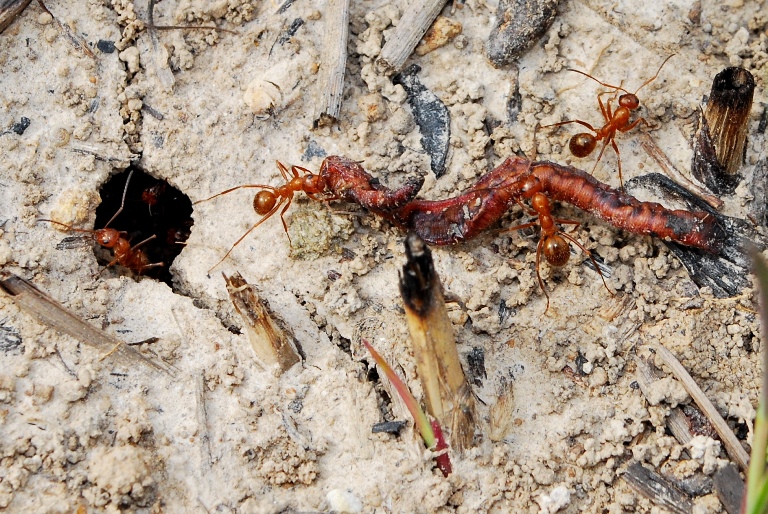
Of course, I look for the first ants out at this time of year, though with the exception of 10 March, when the temperature exceeded 70F, they haven’t been notably active. However, that afternoon I encountered, among others, a worker of Formica pallidefulva poking its head out cautiously to sniff the spring air. This is one of my favorite local ants — largish (5-6mm), abundant, active in daylight even when it’s hot, usually shiny bronzy red to red-brown, usually with a darker gaster (the apparent abdomen of ants) around here, but ranging from a beautiful reddish gold (in the deep South) to almost pure black-coffee brown (New England and southern Canada) across its wide geographic occurrence (Rocky Mountain foothills of Wyoming to New Mexico, all the way east to Québec and Florida). It has the added charm of being the host species to a wide range of social-parasitic and dulotic (“slave-making”) ants both in its own and in another closely related genus, with which it lives in temporary or permanent mixed colonies (as with the Polyergus illustrated in my last post). The image below of these ants bringing home a charred earthworm was taken almost one year ago, as one of Shaw Nature Reserve’s prairie areas was beginning to resprout after a prescribed burn a few weeks earlier. Ants will take their food raw or cooked!

Formica pallidefulva with charred earthworm


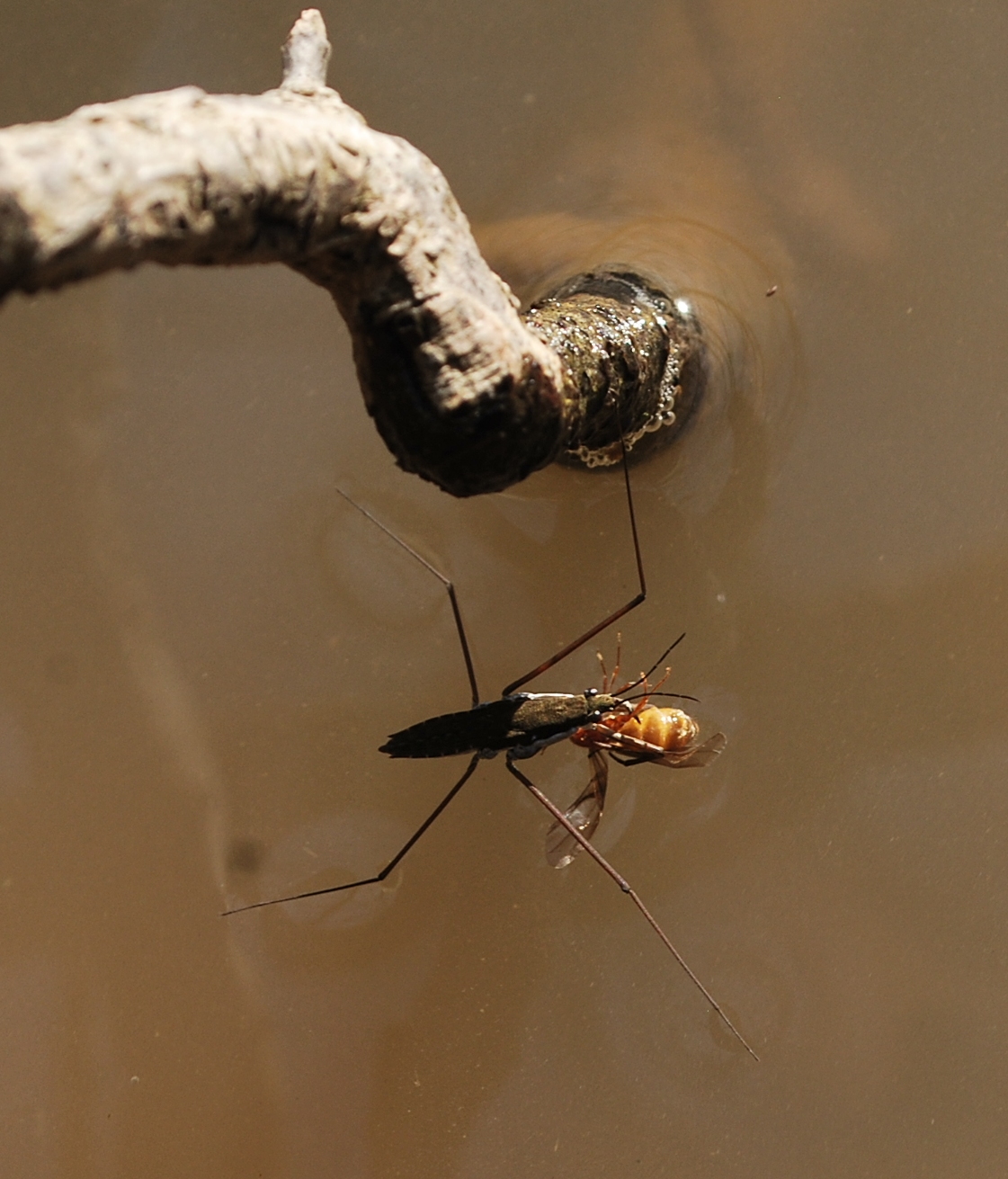
Prenolepis imparis alate in the clutches of a gerrid

Another ant I mentioned last time I was with you, Prenolepis imparis, has the distinction of being the only ant in our fauna that has mating flights while there is still a good chance of frost in the forecast for the next few weeks. In this picture of a mating pair at  BugGuide, note the size difference that inspires their name “imparis”, Latin for disparate. Any time after mid-February when it is sunny and not too windy, and the temperature rises above 65F, the winged males and females reared the preceeding fall, fly out to partake of a grand insectan orgy. Typically, they have big flights on the first couple of appropriately warm days, then some smaller ones (i.e., fewer individuals participating) over the next few weeks. The flying males look like gnats, bobbing up and down in drifting swarms, a few feet off the ground over a shrub, near a woodland edge or in a sunny opening. (One of my co-workers got into the midst of a group of such swarms once when we were conducting a prescribed burn in a wooded area, and I recall her commenting she “felt like Pigpen with all the little bugs flying around”!) The much larger, golden-brown females lift slowly off the ground, fly ploddingly (or is it seductively?) through the male swarms, are there mobbed by the tiny fellows, and then glide away and slightly downward, mating in flight with the winner of the males’ tussling. Rather clumsy fliers, the females do not always land in a good spot, as occurred to this hapless one that ended up as a feast for a water strider. Those that survive break off their wings, dig a burrow, seal themselves in, and raise a small brood of workers on food produced in their own bodies (like say, milk in mammals or “cropmilk” in doves and some other birds.)

But lest you to think I only have eyes for ants, I feel indeed fortunate to have encountered a tarantula this week, of the same species as Ted recently posted and I didn’t even have to go to Oklahoma for it. This bedraggled individual was at the mouth of its completely flooded burrow in what is most often a very dry habitat — a dolomite glade. Stunned and muddy at the time, my guess is this creature, belonging to a resilient and ancient lineage, will dry off, clean up, and saunter away as soon as she warms up.

Aphonopelma hentzi in flooded burrow


And speaking of emerging from flooded burrows, how about this handsome fellow, a male three-toed box turtle, his sex revealed by his bright orange and red markings, coming up for a breather? In truth, it was perhaps only just warm enough to make him need air, but not really enough so for him to be up and about, so he just sat there, nearly immobile, looking pretty, notwithstanding mud and leaves glued onto his shell.

Male box turtle emerges


Copyright © James C. Trager 2010

Add to FacebookAdd to DiggAdd to Del.icio.usAdd to StumbleuponAdd to RedditAdd to BlinklistAdd to TwitterAdd to TechnoratiAdd to Yahoo BuzzAdd to Newsvine

Email to a friend

Great Plains Ladies’-tresses

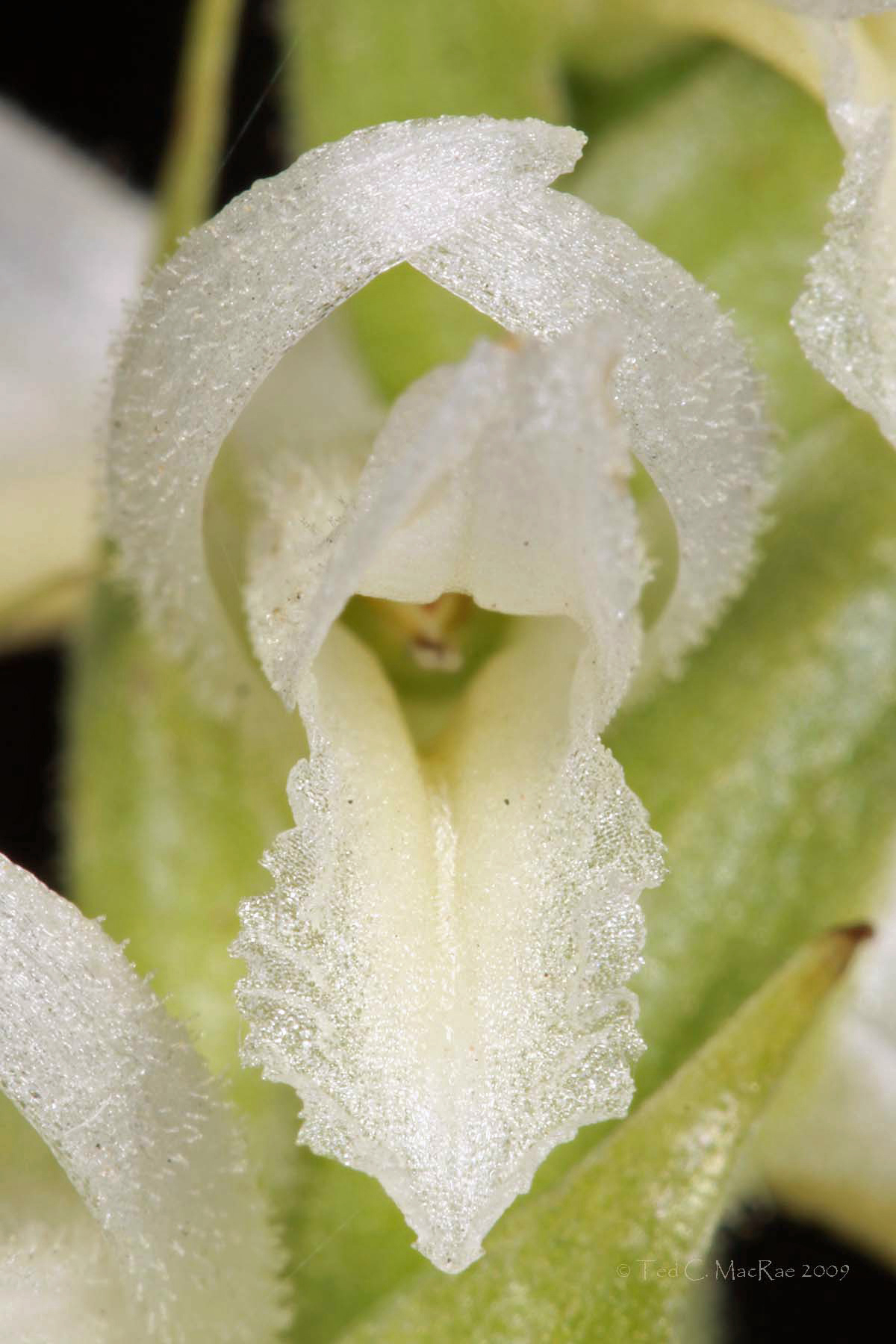
First things first—everyone who participated in the quiz in the previous post correctly identified the orchid flower in the photo as belonging to the genus Spiranthes, and a few were on the right track with their species suggestion of S. cernua.  However, Scott Namestnik from Indiana and Doug Taron from Illinois, were the only ones who recognized it to be a close relative of that species, the recently-described S. magnicamporum.  Nice job!  The plants in these photographs were found during early October in the dry dolomite glades of White River Balds Natural Area in southwestern Missouri (part of Ruth and Paul Henning Conservation Area).  The creamy white inflorescences stood in stark contrast to the russet big bluestem (Andropogon gerardii) and rusty gold Indian grass (Sorghastrum nutans) stems that dominated the rocky landscape.

Spiranthes¹ is one of the more complex genera of North American orchids, seven of which are known to occur in Missouri (Summers 1985).  Spiranthes magnicamporum² is closely related to S. cernua and was only recently (1975) described as a distinct species.  Conclusive separation of the two species requires microscopic examination of the seeds (those of S. magnicamporum are monoembryonic, whereas a large percentage of the seeds of S. cernua are polyembryonic) (Luer 1975).  In the field, however, S. magnicamporum can generally be distinguished from S. cernua by its spreading rather than appressed lateral sepals and absence of basal leaves at the time of flowering³.  It is likely that many previous records of S. cernua in Missouri actually refer to this species, as both occur throughout much of southern Missouri and sporadically in northern Missouri (refer to the USDA Plants Database Missouri county level distributions for S. cernua and S. magnicamporum).  However, they are ecologically isolated in that S. cernua prefers wet lowlands with acidic soils, while S. magnicamporum is typically found in drier uplands with calcareous soils.  Both species are late-season bloomers, but S. magnicamporum blooms even later (mid-September into November) than S. cernua (mid-August to mid-October) and has more fragrant flowers.

¹ From the Greek speira—σπειρα,—”coil,” and anthos—ανθος,—”flower,” referring to the coiled or spiraled spike of flowers common in the genus.

² From the Latin magnus, “large,” and campus, “plain,” meaning “of the Great Plains” in reference to the primary geographic area where this species is found.

³ My identification of these plants as Spiranthes magnicamporum was confirmed by Dr. George Yatskievych, author of Steyermark’s Flora of Missouri.

Orchids as a whole exhibit highly specialized pollination biology, and species of Spiranthes are no exception, with the spiral arrangement of their flowers evidently an adaptation to pollination by long-tongued bees (e.g. bumblebees, Bombus spp., and megachilid bees) (van der Cingel 2001).  Flowers are protandrous, i.e., they are functionally male when they first open and become functionally female as they age, and open sequentially from the base, resulting in female flowers on the lower inflorescence and male flowers on the upper inflorescence.  Thus, bee pollinators tend to act as pollen donors when visiting lower flowers and pollen recipients when visiting upper flowers.  Pollinia from male flowers are attached to the bee’s proboscis as it tries to access nectar secreted into the base of the floral tube.  When visiting a plant, bees start at the bottom of the inflorescence and spiral up to the top before flying to the next plant.  The reasons for this behavior, called acropetal movement, are not fully understood but could be related to the tendency for nectar rewards to be greater in the lower flowers.  Whatever the explanation, the result is to promote outcrossing between neigboring plants.

While specific insect pollinators have been documented for a number of Spiranthes spp., apparently the only account of pollination in S. magnicamporum is documented by Jeffrey R. Hapeman, author of the website Orchids of Wisconsin:

I have seen a bumblebee (Bombus nevadensis ssp. americorum) pollinating Spiranthes magnicamporum in a prairie in southeastern Wisconsin. After visiting a number of inflorescences, the bee began to vigorously scratch at the pollinia on its proboscis, trying to remove them. The bee became so involved in trying to remove the pollinia that it fell to the ground, where it was easily captured. The specimen was determined by Steve Krauth, and is deposited in the Insect Research Collection at the University of Wisconsin-Madison. Apart from this observation, there are no published accounts of pollination of S. magnicamporum.

Photo details:
All photos: Canon 100mm macro lens on Canon EOS 50D (manual mode), ISO 100, MT-24EX flash w/ Sto-Fen diffusers.
Photo 1: 1/160 sec, f/14, flash 1/2 power.
Photo 2: 1/250 sec, f/16, flash 1/4 power.
Photo 3: 1/250 sec, f/20, flash 1/4 power.
Photo 4: w/ 36 mm extension tube, 1/250 sec, f/16, flash 1/8 power.

REFERENCES:

Luer, C. A.  1975.  The Native Orchids of the United States and Canada Excluding Florida.  The New York Botanical Garden, 361 pp. + 96 color plates.

Summers, B.  1981.  Missouri Orchids.  Missouri Department of Conservation, Natural History Series No. 1, 92 pp.

van der Cingel, N. A.  2001.  An atlas of orchid pollination: America, Africa, Asia and Australia. A. A. Balkema, Rotterdam, Netherlands, 296 pp.

Copyright © Ted C. MacRae 2009

Add to FacebookAdd to DiggAdd to Del.icio.usAdd to StumbleuponAdd to RedditAdd to BlinklistAdd to TwitterAdd to TechnoratiAdd to Yahoo BuzzAdd to Newsvine

Email to a friend

Friday Flower: Yes, it’s an orchid…

Photo details: Canon 100mm macro lens on Canon EOS 50D (manual mode), 36 mm extension, ISO 100, 1/250 sec, f/16, MT-24EX flash @ 1/8 power w/ Sto-Fen diffusers.

…but what kind? Identifying the genus should be relatively easy, but I suspect a species identification will be more of a challenge.  I’ll provide a little information and even a couple of literature sources that might be useful for achieving a specific determination.
  • Date of photograph: October 5, 2009.
  • Location: White River Balds Natural Area, Taney County, Missouri.
  • Habitat: Dolomitic limestone glade.

Answer and more photos will be posted shortly, so give it your best shot. Think big!

REFERENCES:

Luer, C. A.  1975.  The Native Orchids of the United States and Canada Excluding Florida.  The New York Botanical Garden, 361 pp. + 96 color plates.

Summers, B.  1981.  Missouri Orchids.  Missouri Department of Conservation, Natural History Series No. 1, 92 pp.

Copyright © Ted C. MacRae 2009

Add to FacebookAdd to NewsvineAdd to DiggAdd to Del.icio.usAdd to StumbleuponAdd to RedditAdd to BlinklistAdd to TwitterAdd to TechnoratiAdd to Furl