The “Dagger Butt Weevil”

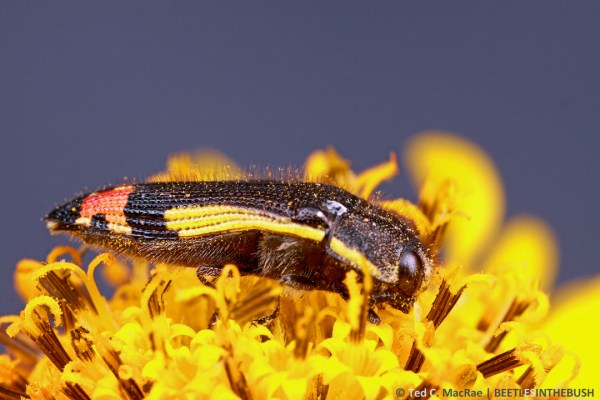
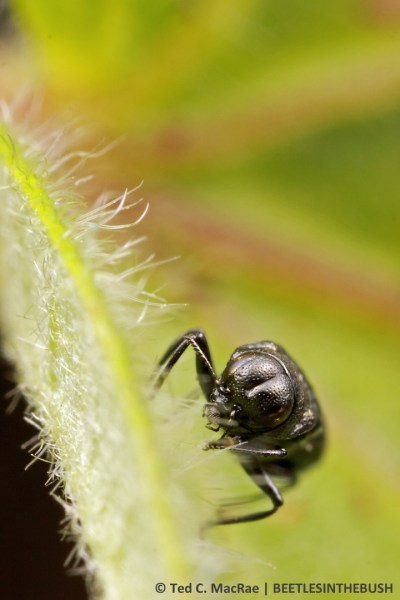
In April 2012 I spent some time in northern Argentina collecting insects, and while collecting was not that great (late in the season after a protracted drought) I saw enough of interest to make it a worthwhile effort. Among the insects that I saw were two species of weevil (family Curculionidae)—one being Eurhinus c.f. adonis () and the other this one, also kindly identified by Charles O’Brien as Erodiscus obidensis (Monte 1944). Both of them were found on flowers of Solidago chilensis growing along the roadside near La Escondida in Chaco Province; however, the two weevils are almost complete opposites in terms of coloration and body form—E. adonis brilliant metallic green and robust chunky, and E. obidensis chestnut-colored and elongate slender.
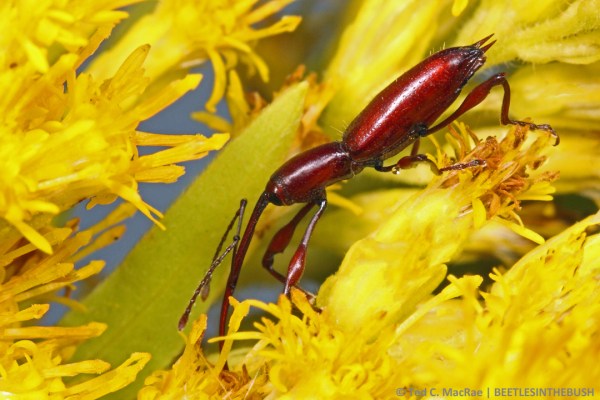
Erodiscus obidensis (Monte) | Chaco Province, Argentina | Apr 2012

Erodiscus obidensis (Monte) | Chaco Province, Argentina | Apr 2012

An obvious feature of E. obidensis are its two stout spines located at the apices of the elytra. I presume that these serve a defensive purpose to protect them against potential avian or reptilian predators. However, if elytral spines are all that is needed for such then why are these structures not found widely across the order Coleoptera—certainly the potential is there, as many beetles exhibit very small spines at the elytral apices. With enough selection pressure one can easily imagine that larger spines would be selected for. Either the spines also/instead serve some other purpose, or development of spines is more energetically expensive than I am imagining.

What purpose those daggers?

What purpose those daggers?

Compared to most of the insects that I have featured on this blog, I wasn’t able to find much information on this species. It was originally described as Atenistes attenuatus var. obidensis from Óbidos in the Brazilian state of Pará (Monte 1944) and is listed as such in the Blackwelder (1947) catalogue. However, my weevil literature is sparse compared to the other beetle groups with which I am more familiar, and I found nothing else in searches on the web as well. It apparently is already known from Argentina, as it is listed at the website Curculionidae de Argentina (but without any photos). As far as I could tell, these are the first photos of the species to be posted to the web, at least with the associated name. Since so little seems to be known about this weevil, I take it upon myself to give it a common name, and I can’t think of a more amusing and fun-to-say name than the “dagger butt weevil” in reference to its distinctive apical spines.

REFERENCES:

Blackwelder, R. E. 1947. Checklist of the coleopterous insects of Mexico, Central America, the West Indies, and South America. Part 5. Bulletin of the U. S. National Museum 185:765–925 [pdf].

Monte, O. 1944. Sobre coleópteros Otidocephalinae. Revista Entomologia, Rio de Janeiro 15(3):318–320 [abstract].

Copyright © Ted C. MacRae 2013
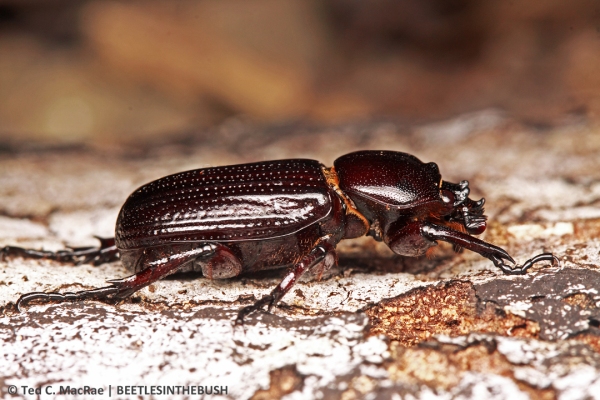
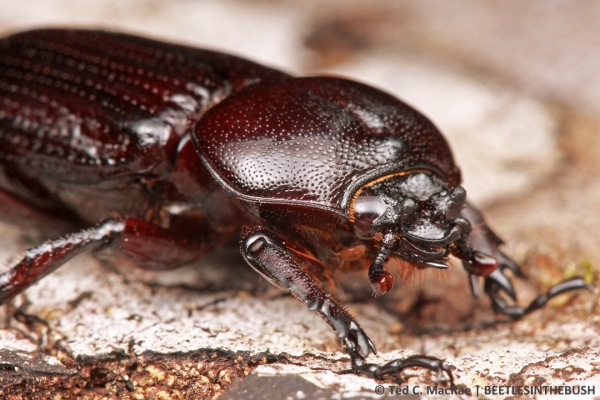
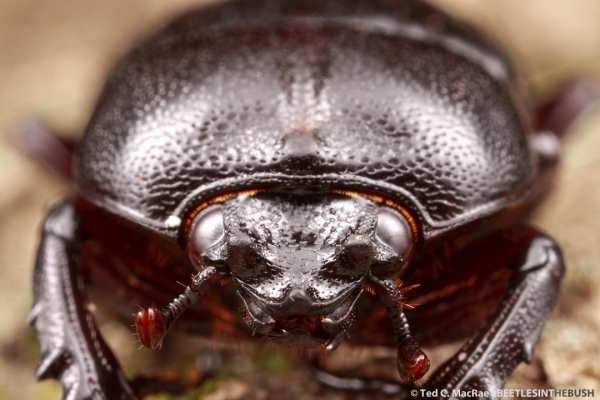
Sunday scarab: Phileurus valgus

Phileurus valgus (Linnaeus) | Otter Slough Conservation Area, Stoddard Co., Missouri

Phileurus valgus (Linnaeus) | Otter Slough Conservation Area, Stoddard Co., Missouri

Few beetles enjoy more popularity than the scarabs (family Scarabaeidae)¹, and within that group certainly the members of the subfamily Dynastinae are the most popular of all due to their often enormous size and presence of highly developed horns on the head and pronotum. The largest beetles in the U.S. (at least, by weight)—the Hercules beetles, genus Dynastes—belong to this subfamily, and in the tropical regions of the New World members of the genus Megasoma (literally meaning “giant body”) are among the heaviest-bodied beetles in the world (ironically, the title spot goes to members of the genus Goliathus in the subfamily Cetoniinae). Of course, almost without exception in the insect world exceptions apply, and not all dynastine scarabs are large, heavy-bodied beetles. In fact, members of the genus Cyclocephala are often mistaken for May beetles (subfamily Melolonthinae), while members of the genus represented by the species featured in this post—Phileurus—are sometimes mistaken for smallish “bess beetles” (Odontotaenius disjunctus) in the family Passalidae due to their flattened and parallel-sided body.

¹ Except maybe tiger beetles, jewel beetles, and longhorned beetles (wink!).

This species resembles and is sometimes mistaken for the common "bess bug."

This species resembles and is sometimes mistaken for the common “bess bug.”

Phileurus is a primarily Neotropical genus, with only two species ranging north into the United States and one, P. valgus, occurring broadly in the eastern United States. Despite its broad distribution, P. valgus seems to be more common in the southern part of the country and has been recorded under bark of decaying wood and attracted to lights. Saylor (1948) notes that Richter reared a specimen from a larvae collected in a cavity of a dead basswood (Tilia sp.) tree, and adults have also been reared from larvae collected in a blackjack oak (Quercus marilandica) snag (Taber & Fleenor 2005). The individual featured here was one of several that I found under the lower trunk bark of a large, standing, dead pin oak (Q. palustris) tree growing in a wet, bottomland forest in the Mississippi Alluvial Plain of extreme southeastern Missouri. I have seen this species from time to time over the years—never abundantly—but these are the first that I have seen in a situation other than being attracted to lights. The bark was quite loose and covered wood that was soft and well-decayed, and three adults were found embedded within a granular frass-filled gallery directly beneath the bark. One can presume that larvae could also have been found within the wood had I done a little digging.

The head of this species is adorned with three small cephalic tubercles.

The head of this species is adorned with three small cephalic and one pronotal tubercles.

Taber & Fleenor (2005) also note that adults of this species possess structures known to be used by other beetles for sound production, but they did not say whether they have heard this beetle making sounds. I have never heard sounds from these beetles when handling them, either. This contrasts with true bess beetles, which stridulate to make a “kissing” sound when handled.

REFERENCES:

Saylor, L. W. 1948. Synoptic revision of the United States scarab beetles of the subfamily Dynastinae, No. 4: Tribes Oryctini (part), Dynastini, and Phileurini. Journal of the Washington Academy of Sciences 38(5):176–183.

Taber, S. W. & S. B. Fleenor. 2005. Invertebrates of Central Texas Wetlands. Texas Tech University Press, Lubbock, 322 pp. [preview].

Copyright © Ted C. MacRae 2013
Fire ant winged reproductives: male and female

While in Austin at the Entomological Society of America meetings, I had the chance to tour The University of Texas at Austin’s Brackenridge Field Laboratory.  Located on 82 acres of land bordering the Colorado River, the station supports studies in biodiversity, ecosystem change and natural history. A major focus of research at the station involves efforts to establish biological control agents for control of imported fire ant (Solenopsis invicta) using entomopathogens and parasitoids (e.g. phorid flies in the genus Pseudacteon). This research relies on maintaining cultures of fire ants to support rearing of the phorid fly. While time was limited and I did not have much opportunity to photograph either the ant or the fly, I did manage to quickly sneak in a shot or two of some winged reproductives that were removed from the teaming formicid mass in a rearing tray and placed on a table top for all to see (and when I say “a shot or two” I mean it. I had the chance only for one shot of the female and two of the male as they crawled crazily about and the tour leader quickly tried to move us on). I’m sure Alex Wild has all stages/forms of this species covered in spades, but the sexually dimorphic winged reproductives were new for me, and perhaps some readers of this blog as well.

Solenopsis invicta winged reproductives: male (top), female (bottom).

Solenopsis invicta winged reproductives: male (top), female (bottom).

Copyright © Ted C. MacRae 2013

ESA Insect Macrophotography Workshop

Today is the last day of the Entomological Society of America (ESA) Annual Meeting in Austin, Texas, and it has been an action packed week for me. Annual meetings such as this serve several purposes. In addition to seeing talks on a variety of subjects—in my case covering subjects ranging from insect resistance management to scientific outreach to beetle systematics—they also offer the chance to establish new connections with other entomologists that share common interests and reinforce existing ones. Of course, a major part of my interest in entomology revolves around insect macrophotography, and in recent years ESA has begun to cater to the entomological photographer contingent within the society. Last year’s meetings featured a macrophotography symposium titled, “Entomologists Beyond Borders” (for which I was one of the invited speakers), and this year featured an Insect Macrophotography Workshop led by Austin-based entomologist/photographer Ian Wright. Having done this for a few years now I figured a lot of the workshop might be review for me, but I still have much to learn and am willing to accept new ideas from any source. Besides, the workshop involved a field trip to a local habitat to try out our insect photography skills, and for a field junkie like me time in the field at an otherwise all-indoor event spanning close to a week is always welcome. The location of the meetings in Austin this year made this possible, as even in mid-November there still remain insects out and about that can be photographed if the weather cooperates (and it did).

This will be a somewhat different post than what I usually post here. Rather than featuring photos of a certain species and using them as a backdrop for a more detailed look at their taxonomy or natural history, I’m just going to post all the photos that I ended up keeping from the field trip portion of the workshop with just a comment or two about each. We went to the city’s nearby waste-water treatment facility, the grounds of which are wild and woolly enough to provide habitat for insects, and spent about an hour and a half seeing what we could find. For myself, it was a chance to photograph some insects I’ve not normally tried to photograph (i.e., dragonflies, ambush bugs) and get more practice on my blue sky technique. I did appreciate the chance to spend some time talking to Ian during while we traveled to the site and back, and I also ended up helping other participants with their camera equipment questions and technique suggestions. With that, here are the photos I took—I’ll be curious to see what readers think of this post format versus my more typical style.

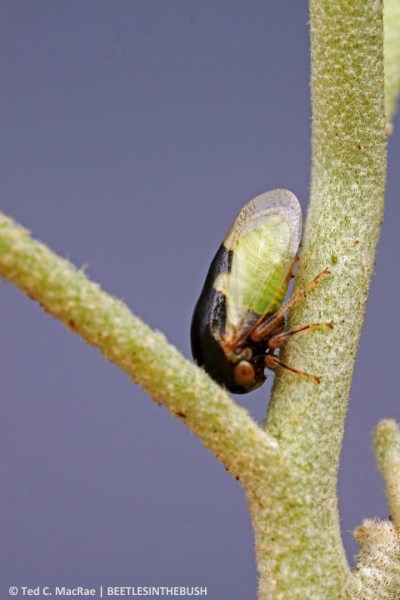
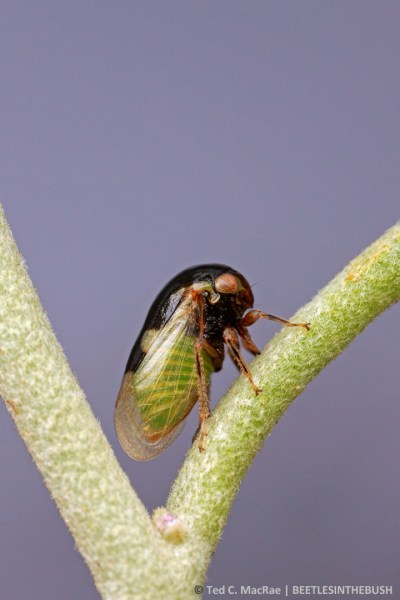
Micrutalis calva

Micrutalis calva (Hemiptera: Membracidae) on silverleaf nightshade (Solanum elaeagnifolium).

Micrutalis calva

This species of treehopper is restricted to herbaceous plant hosts.

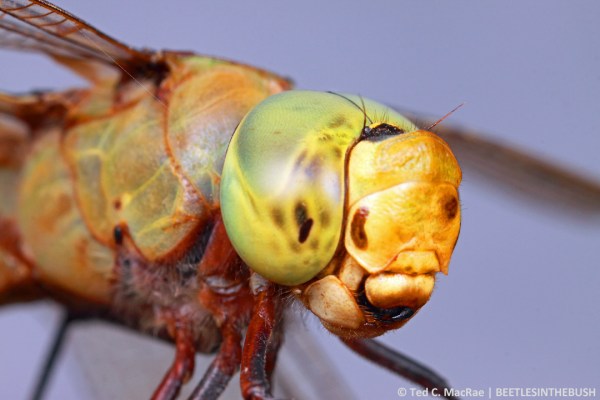
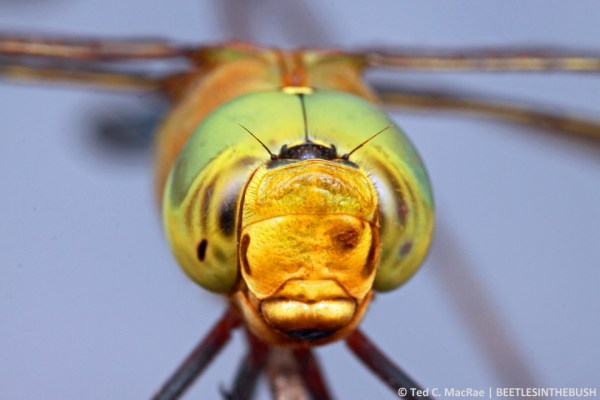
Anax junius

Anax junius (Odonata: Aeshnidae), one of the darner species of dragonfly.

Anax junius

This adult was perched on a dead twig tip and seemed to be “asleep.”

Anax junius

I clipped the perch and held it up for these “in-your-face” shots – it then awoke with a start and flew off.

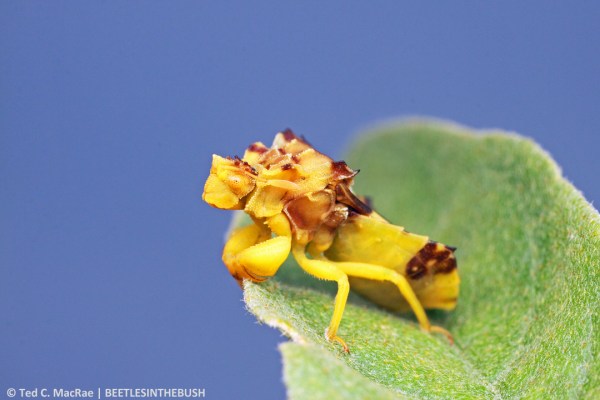
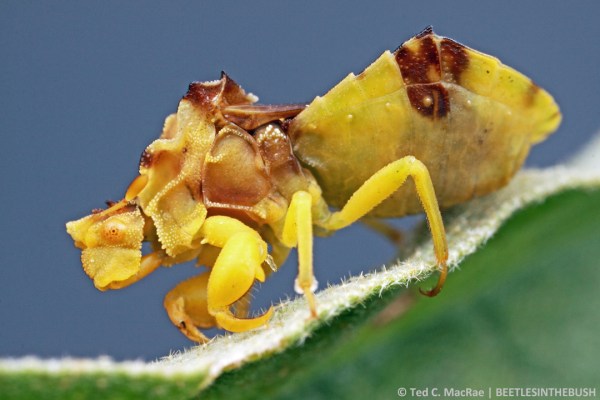
Phymata sp.

Phymata sp. (Hemiptera: Reduviidae), one of the so-called “jagged ambush bugs.”

Phymata sp.

Formerly a separate family, ambush bugs are now combined with assassin bugs (family Reduviidae).

Acmaeodera flavomarginata

Acmaeodera flavomarginata (Coleoptera: Buprestidae).

Acmaeodera flavomarginata

This is one of a few species of jewel beetle in the southcentral US that are active during the fall.

Mecaphesa sp.

Mecaphesa sp. (Araneae: Thomisidae), one of the crab spiders

Mecaphesa sp.

Cryptic coloration allows the spider to lurk unseen by potential insect prey visiting the flower.

Gratiana pallidula

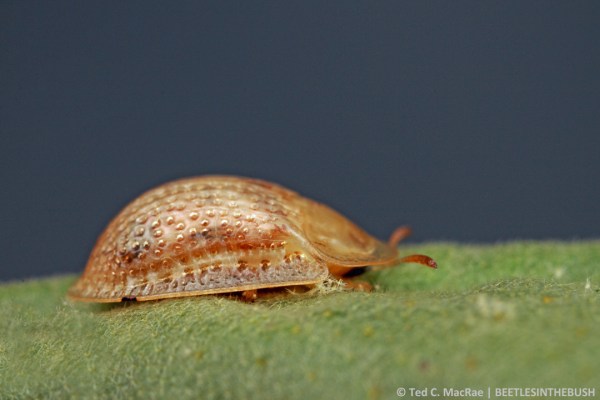
Gratiana pallidula (Coleoptera: Chrysomelidae) on silverleaf nightshade (Solanum eleagnifolium).

Gratiana pallidula

A type of tortoise beetle, adults “clamp” down against the leaf as a defense against predators.

Copyright © Ted C. MacRae 2013
The Darwin Beetle

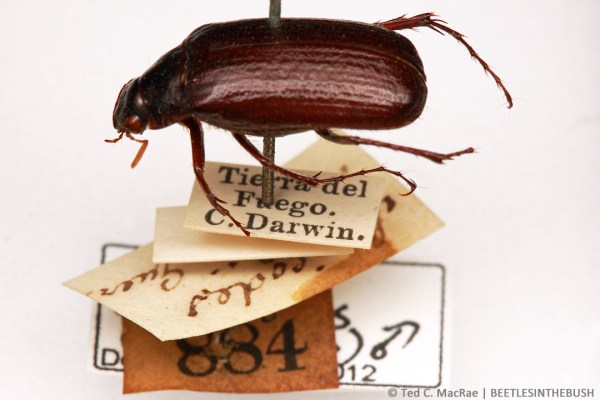
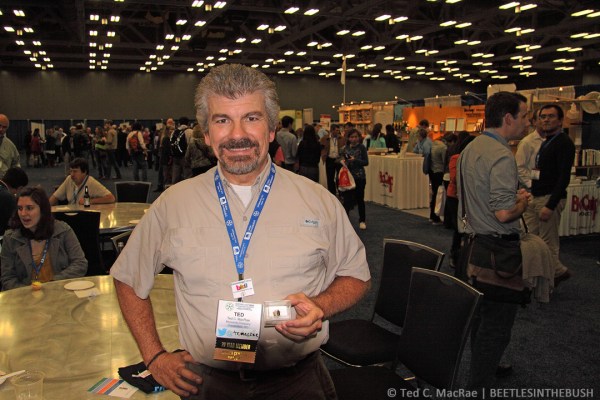
Like most modern biologists, Charles Darwin ranks high on my short list of intellectual/entomological heroes. Actually, with all due respect to others on the list—Carl Linnaeus, Alfred Russell Wallace, John Lawrence LeConte, and others, Darwin sits at #1. His theory of evolution, offered more than 150 years ago to a powerfully skeptical world, continues to provide the basic framework for modern biology (as Theodosius Dobzhansky said in his 1973 paper in American Biology Teacher, “Nothing in biology makes sense except in the light of evolution”). Thus, when Max Barclay recently posted on Facebook a photograph of a beetle collected by Charles Darwin himself, it reminded me that I have yet to visit Down House in Kent (the home of Charles Darwin) or to see anything personally touched by the man whose legacy I revere more than any other. Little did I know that Max did not post the photo from The Natural History Museum in London, but from Austin, Texas where he and I were each arriving for the annual meetings of the Entomological Society of America. When I commented on his post how I would love to see a beetle collected by Darwin someday, Max replied that he had the specimen with him and that he would bring it to the meetings for me to see (and I quote, “Most fun it has had since it flew to 22-year-old Charles Darwin’s gas lamp in Tierra Del Fuego in December 1832”). Can you imagine my anticipation?! True to his word, Max found me at the opening reception, came up from behind me, and placed  the plastic, see-through box housing the specimen on the table in front of me. I recognized it instantly, but still seeing “C. Darwin” on the label almost felt like I’d just met the man himself. I asked Max if it was okay to open the box, to which he agreed, and I even dared to grab the pin head and re-position the specimen for photographs. Call me crazy, but it was as spiritual an experience as I’ve had since, well… “Mrs. Ples” stood before me!

At any rate, here is the “Darwin Beetle,” followed by proof that I really got to hold it!

Sericoides glacialis (Fabricius), collected at Tierro del Fuego in 1832 by Charles Darwin.

Scarab beetle collected at Tierro del Fuego in 1832 by Charles Darwin. Identified as Sericoides glacialis (Fabricius) by Andrew B. T. Smith in 2012 after standing for many years as ‘Sericodes Reichii Guer.’

Holding the ''Darwin Beetle''

Holding the ”Darwin Beetle”

Copyright © Ted C. MacRae 2013
Midget male meloid mates with mega mama

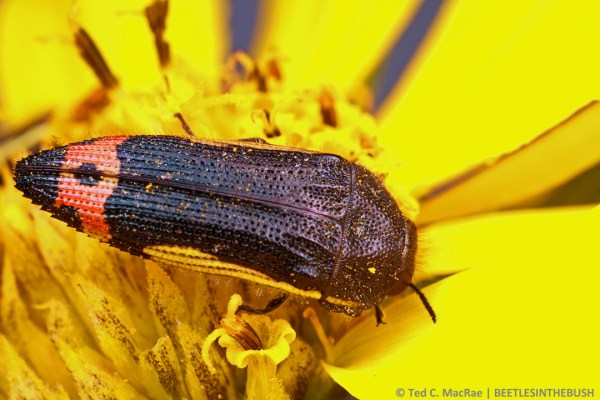
Pyrota bilineata on flowers of Chrysothamnus viscidflorus | San Juan Co., Utah

Pyrota bilineata on flowers of Chrysothamnus viscidflorus | San Juan Co., Utah

While looking for longhorned beetles in the genus Crossidius on flowers of yellow rabbitbrush (Chrysothamnus viscidiflorus) in southern Utah, I encountered one particular plant with numerous blister beetles (family Meloidae) on its blossoms. The orange color, two black pronotal spots, and distinctive black and white longitudinal elytral stripes leave no doubt as to its identity—Pyrota bilineata, but for good measure I sent a photo to my field mate for the trip, Jeff Huether, who confirmed its identity. I had seen singletons of this species at a few previous localities during the trip, so I was intrigued by the large numbers of individuals congregated on this single plant. As I looked at them, I saw one individual that appeared to have something stuck to the tip of its abdomen. I peered closer to get a better look and, to my surprise, discovered that it was actually a male in the act of mating. The male was tiny, only one-third the size of the female, representing about as extreme a size difference in mating insects as I’ve ever seen.

Pyrota bilineata on flowers of Chrysothamnus viscidflorus | San Juan Co., Utah

A tiny male mates with the ginormous female.

Many species of blister beetles exhibit tremendous size variability, and a unique aspect of some species’ mating behavior is the cantharidin-packed spermatophore produced by males and transferred to females during mating. (Cantharidin is a toxic defensive compound that serves as a very effective deterrent to predation.) The spermatophores are energetically “expensive” to produce and are transferred to females during relatively short-lived mating aggregations. Mating in some species may take up to 24–48 hours, thus reducing the opportunities for multiple matings, and as a result males of long-mated species end up investing rather heavily in a limited number of females compared to males that mate more often. These features lead to size assortative mating (Alcock & Hanley 1987), with males showing a preference for larger females (that are presumably more fecund) and females preferring larger males to maximize the amount of cantharidin that they receive or to ensure receipt of a spermatophore large enough to fertilize their full complement of eggs. Medium-sized individuals, likewise, would choose the largest of the remaining individuals, leaving the smallest individuals to mate among themselves. Alcock & Hanley (1987) also note, however, that not all species of blister beetles exhibit size assortative mating, even though they form large mating aggregations and individuals vary greatly in size. I have not seen any reference to size assortative mating in Pyrota bilineata; however, this example seems to suggest that the behavior is not practiced by this species. This could be due to shorter mating times (leading to more opportunities for mating) or a range of variation in body size that is not sufficient to consistently favor the behavior.

REFERENCE:

Alcock, J. & N. F. Hadley. 1987. Assortative Mating by Size: A Comparison of Two Meloid Beetles (Coleoptera: Meloidae). Journal of the Kansas Entomological Society 60(1):41–50 [preview].

Copyright © Ted C. MacRae 2013
One-shot Wednesday: The “other” hibiscus jewel beetle

Paragrilus tenuis | Stoddard Co., Missouri

Paragrilus tenuis (LeConte) | Stoddard Co., Missouri

This past summer I visited Otter Slough Conservation Area in southeast Missouri in an effort to find and photograph the stunningly beautiful Agrilus concinnus Horn, or “hibiscus jewel beetle” (MacRae 2004). I was not successful in that quest, but I did manage to snap a single photo of another jewel beetle also associated exclusively with hibiscus, Paragrilus tenuis (LeConte). This species belongs to a much smaller genus of mostly Neotropical jewel beetles that resemble the related and much more speciose genus Agrilus but differ significantly by their antennae being received in grooves along the sides of the pronotum and, for the most part, their association as larvae with stems of living, herbaceous plants rather than dead branches and twigs of deciduous trees. Only four species of Paragrilus occur in the U.S. (Hespenheide 2002), and of these only Ptenuis is known to occur in the eastern U.S. where it has been reported breeding in Hibiscus moscheutos (including ssp. lasiocarpos). I have also collected adults on H. laevis (MacRae 2006), but to my knowledge it has not yet been reared from that plant.

These tiny little beetles (~ 5 mm in length) are normally seen resting on the terminal leaves of their host plants, but they are extremely wary and quick to take flight. As a result, photographing them in situ with a short macro lens in the heat of the day is rather challenging, especially when they are not numerous. I only saw perhaps half a dozen individuals during the visit, and the photo shown here represents the only shot that I even managed to fire off. While I would have liked to have gotten a dorsal view of the beetle, this single shot is nevertheless well-focused and a rather interesting composition.

REFERENCES:

Hespenheide, H. A. 2002. A review of North and Central American Paragrilus Saunders, 1871 (Coleoptera: Buprestidae: Agrilinae). Zootaxa 43:1–28 [pdf].

MacRae, T. C. 2004. Beetle bits: Hunting the elusive “hibiscus jewel beetle”. Nature Notes, Journal of the Webster Groves Nature Study Society 76(5):4–5 [pdf].

MacRae, T. C. 2006. Distributional and biological notes on North American Buprestidae (Coleoptera), with comments on variation in Anthaxia (Haplanthaxiaviridicornis (Say) and A. (H.) viridfrons Gory. The Pan-Pacific Entomologist 82(2):166–199 [pdf].

Copyright © Ted C. MacRae 2013
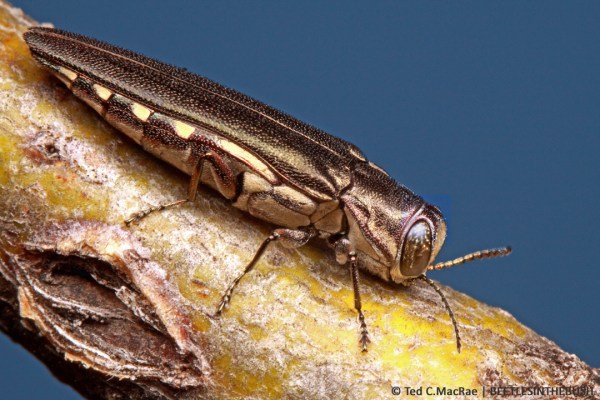
Honey Locust Borer

Agrilus difficilis | Beaver Dunes State Park, Beaver Co., Oklahoma

Agrilus difficilis | Beaver Dunes State Park, Beaver Co., Oklahoma

Conditions for collecting didn’t look very promising when I awoke on Day 4 of my early June trip to northwestern Oklahoma. After collecting at Alabaster Caverns State Park the previous day, I had traveled a few hours further west during the evening with plans to collect at Beaver Dunes State Park the following morning. However, heavy rain during the night and lingering sprinkles during the morning had me thinking it might be a lost day. By noon, however, the rain had completely abated, and though the sky still hung low and gray I decided I had nothing to lose by at least trying. I knew quickly that I’d made the right decision, as within minutes of arriving at the park I began seeing jewel beetles (family Buprestidae) landing on my beating sheet. Hackberry (Celtis sp.) was abundant along the roadways and supporting great numbers of individuals in the genera Chrysobothris and Agrilus.

This species is associated almost exclusively with honey locust (Gleditsia triacanthos).

This species is associated almost exclusively with honey locust (Gleditsia triacanthos).

By the time I reached the back end of the campground, I’d collected rather large series of the hackberry associates when I noticed a dying honey locust (Gleditsia triacanthos) tree in one of the campsites. Honey locust (and fabaceous trees, in general) is favored by several species of jewel beetles—at least a dozen species have been recorded in the literature reared from its branches, and another dozen species have been collected on it as adults. As a result, when jewel beetles are active it’s always a good bet that some will be found on honey locust when present, especially if the trees are stressed or dying. I walked up to the tree—a fairly large one—and scanned the lower branches overhead to see if I could notice any activity. I did not, but I nevertheless placed my beating sheet underneath one of the branches, gave the branch a quick “whack” with the handle of my net, and lowered the beating sheet to have a look. To my surprise, I saw at least 50 adults of the jewel beetle species, Agrilus difficilis, sitting on the beating sheet. Because of the cloudy conditions and cool, moist air, the beetles were not very active and did not immediately zip off the beating sheet as they would have had the day been sunnier and warmer, so I was able to rather easily collect a decent series of the beetles without any trouble. I had never seen the beetles so numerous, however, so I continued to beat a few more branches—each yielding just as many adults as the previous. I was astonished by the fact that the beetles were so abundant on the branch, yet I had not seen them even when I specifically looked for the presence of jewel beetles in the branches prior to beating them. Taking another look at the branches, I was able to visually detect just a few individuals, and those only with great difficulty, until I pulled the branch down and was able to look at it up close.

Relatively large size, coppery-purple color without spots on the elytra, and the presence of lateral white patches distinguish this species.

Large size, coppery color, no spots on elytra, and presence of lateral white patches distinguish this species.

Honey locust became a rather popular landscape ornamental tree in the eastern U.S. after the development of thornless cultivars, and while at first the tree seemed to be relatively free of insect pests, A, difficilis has proven to be one of several insects that have adapted to these landscape plants and occasionally cause economic damage. Trees in urban landscapes are often planted in suboptimal sites and suffer from stress to a much greater degree than their native counterparts, and the beetles take advantage of the lowered defensive capabilities of these stressed trees to gain entry. Larvae mine beneath the bark and damage the cambium layer, interfering with movement of water and nutrients. Trees in later stages of attack usually exhibit branch dieback and D-shaped holes in the trunk and main branches where adults have emerged from the tree. In severe cases infestation by this species can result in death of the tree. As mentioned above, there are twelve other species of jewel beetles that have been reared from the wood of honey locust. All of these have been reared only from dead wood rather than living trees, but adults of these species might, nevertheless, be encountered on living trees. They include three species (A. egeniformisA. fallax, and A. pseudofallax) that might be confused with A. difficilis; however, the latter is easily distinguished from these and other congeners by its relatively large size, coppery color with purple luster, absence of any spots or pubescent lines on the elytra, and distinctive patches of white pubescence along the sides. As with most wood boring beetles, chemical control of the adults or larvae is usually not feasible once an infestation has already begun—the best method to avoid infestations in landscape trees is proper site selection and optimal care to prevent stress that reduces the ability of the tree to fend off attack.

Copyright © Ted C. MacRae 2013