2019 Arizona/New Mexico/California Insect Collecting Trip iReport

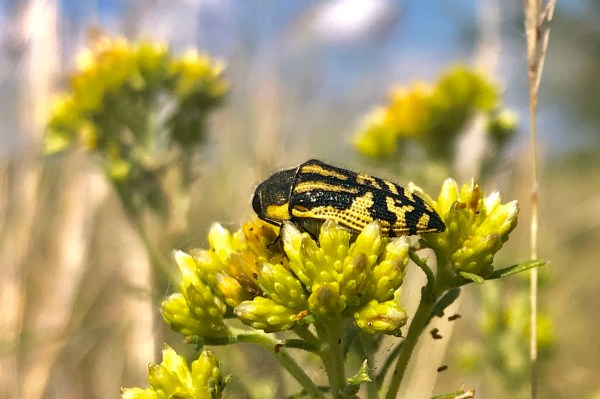
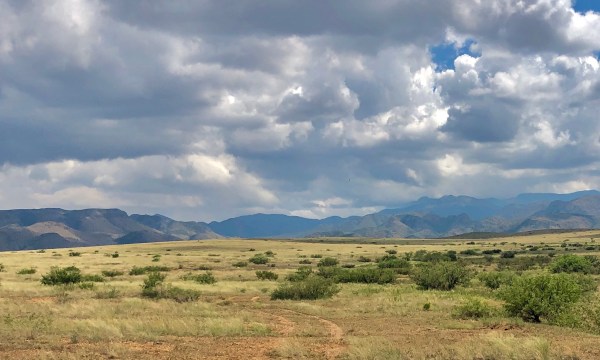
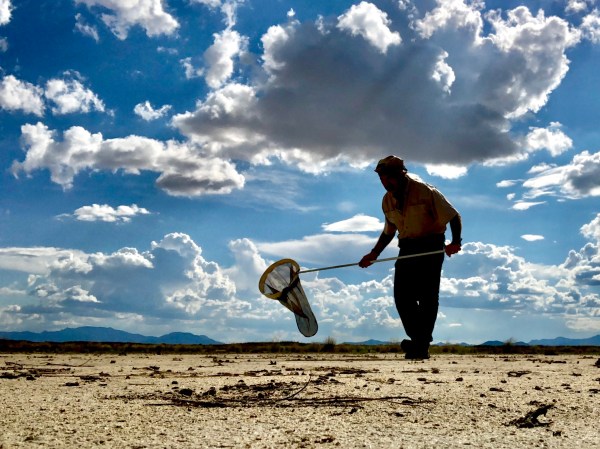
This is the eighth “Collecting Trip iReport”; this one covering a one-week trip to southern Arizona, New Mexico, and California from September 7–14, 2019 with meloid/cerambycid-enthusiast Jeff Huether. Jeff has been a frequent collecting trip partner during recent years, this being our sixth joint outing since 2012. Our initial objective on this trip was to collect cerambycid beetles of the genus Crossidius occurring across southern Arizona/California—part of a larger effort to sample as many of the named subspecific taxa as possible from multiple locations (including type locations when possible) for future molecular studies. We had good success, though we did not collect every taxon that we were after (we were a tad early in soCal). Also, the fact that we had Crossidius as our primary goal did not mean that we would not concurrently be on the lookout for buprestids (me), meloids (Jeff), or other cerambycids (both of us)—and in that regard we were also successful.

As with all previous “iReports” in this series, this report is illustrated exclusively with iPhone photographs (thus the term “iReport”), with previous versions including the following:
2013 Oklahoma
2013 Great Basin
2014 Great Plains
2015 Texas
2018 New Mexico/Texas
2018 Arizona
2019 Arkansas/Oklahoma


Day 1 – Dripping Springs Mountains, Arizona
First stop of the trip, and we’re heading east to Safford. As soon as we got east of Superior up into the mountains we saw a place where Heterotheca subaxillaris was in bloom abundantly along the roadsides and pulled over. There were four species of Acmaeodera on the flowers, and I also found a fifth species on the flower of a small white aster. Nice first stop for the trip!

Dripping Spring Mountains.
Acmaeodera gibbula on flower of Heterotheca subaxillaris.
Acmaeodera rubronotata on flower of Heterotheca subaxillaris.
Acmaeodera alicia on flower of Heterotheca subaxillaris.

3.6 mi NW Bylas on US-70, Arizona
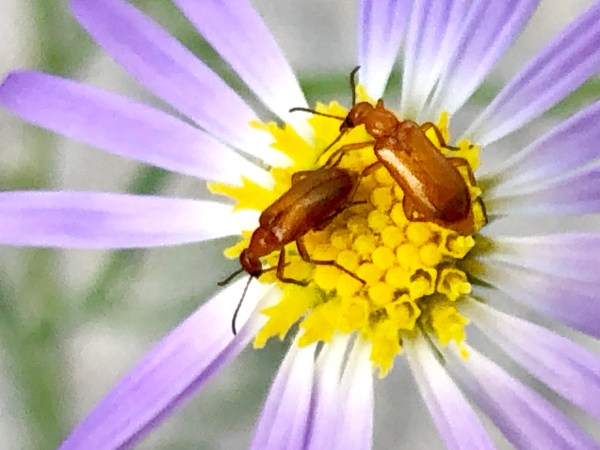
Continuing our way to Safford, Jeff saw some patches of sunflower and wanted to look for Epicauta phoenix. I found the first two (but not in sunflower), and then Jeff found two more. As we were walking back to the car I noticed a Crossidius suturalis sitting on Isocoma tenuisecta that was not quite in bloom, and then another nearby on the same plant. We searched the area again, but the only plants were those few right around the car.

I’ve never seen an orange jumping spider (family Salticidae) before!

5.7 mi NE Safford, Arizona
After getting a hotel in Safford, we had time to come back to a spot where Jeff had collected Epicauta phoenix back in July. We found quite a few (see photo) on plants nearby the original collection spot. Looking around more I found an Acmaeodera convicta perched on the tip of a shrub—first time I’ve collected this species! There were several species of tenebrionids crawling on the ground, perhaps prompted to activity by cooling temps as rain whipped up in the distance. I kept one eye on the skies and the other on the plants and eventually found two more A. convicta perched together on the same type of shrub just as rain began pelting my back. We made a quick dash back to the car and called an end to Day 1 in Arizona.

Epicauta phoenix (order Coleoptera, family Meloidae).

Day 2 – 1.9 mi S Artesia, Arizona
We started seeing Isocoma tenuisecta just coming into bloom as we headed south of town so stopped to see if we could find any Crossidius. I looked at a lot of plants before finding a single C. suturalis sitting on one of the non-blooming plants and in the meantime found one Trichodes peninsularis and a fair number of Zonitis dunniana on the flowers. Looking around on other plants, I found one large Chrysobothris sp. (not C. octocola, but longer and narrower) on the branch of a living Acacia constricta [Edit: this is C. knulli—a new one for me!] and one Acmaeodera disjuncta, several more Z. dunniana and T. peninsularis on flowers of Hymenothrix wislizeni. Finally, I did some sweeping of the bunch grasses in the area and got a nice series of what I presume to be Agrilus rubrovittatus—first time I’ve collected that species!

Crossidius suturalis on pre-blooming Isocoma tenuisecta.
Trichodes peninsularis on Isocoma tenuisecta.
Zonitis dunniana on flowers of Isocoma tenuisecta.

17.7 mi S Artesia, Arizona
Another stop with both Isocoma tenuisecta and also Gutierrezia microcephala coming into bloom. We immediately began finding Crossidius pulchellus on the latter and eventually collected a good series of them and also Trichodes peninsularis off the plants When I returned to the first plant we had checked (in fullest flower), a Lampetis webbii landed on it right in front of me! I eventually found C. suturalis on Isocoma tenuisecta, as well as Trichodes sp. and a few C. pulchellus. There was a tall-stemmed malvaceous shrub off which I got a male/female pair of Tylosis maculata, and sweeping produced a couple more Agrilus rubronotata, a few more T. peninsularis, and one Acmaeodera scalaris. I saw a couple of Acmaeodera disjuncta on Baileya multiradiata flowers but missed them both!

Stagmomantis limbata (bordered mantis) on Gutierrezia microcephala.
Lampetis webbii on Gutierrezia microcephala.

1.1 mi N Rodeo, New Mexico
We slipped just inside the New Mexico border to visit the area around the type locality of Crossidius hurdi. We found a spot where there were good stands of Isocoma tenuisecta along the roadsides and checked them out. Like the other spots today they were just starting to come into bloom, and rain had just moved through the area. We found perhaps 20 Crossidius individuals total, and honestly they were so variable that I don’t know whether they represent C. suturalis, C. hurdi, or both! [Edit: they are all C. suturalis] I also collected one Sphaenothecus bivittatus and several individuals each of three species of clerids on the flowers of these plants. A male Oncideres rhodosticta was found on the twig of Prosopis glandulosa, and I also found a cool meloid that I’ve never seen before—Megetra punctata!

A particularly well-marked female Crossidius suturalis on flowers of Isocoma tenuisecta.
The coloration of Megetra punctata screams “Don’t eat me or you’ll be sorry!”
Oncideres rhodosticta on Prosopis glandulosa (mesquite).
Mule deerly departed.
Fence row to the Chiricahua Mountains.

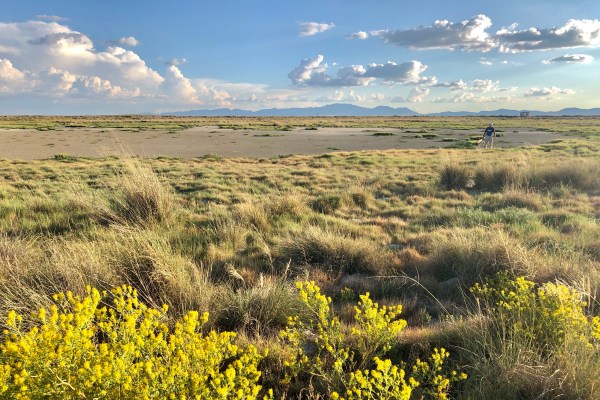
Willcox Playa, Arizona
We plan to visit Willcox Playa tomorrow (my inaugural visit!), but we had some time at the end of the day and decided to come take a look. There were some stands of Isocoma tenuisecta at the north end of the playa, and I found just a couple of Crossidius individuals on them, presumably C. suturalis, but it looks like they are bedding down for the evening. Also got a couple of Enoclerus sp. on the flowers.

North end of Willcox Playa.

Day 3 – 8.4 mi SE Willcox, Arizona
On our way towards the Chiricahua Mountains to see if we can find any Crossidius host plant stands. We found patches of Isocoma tenuisecta and Gutierrezia microcephala along Hwy 186 southeast of town—the former was just coming into bloom, but there were plenty of Acmaeodera (scalaris, disjuncta, and amplicollis) on the flowers, including on the unopened heads. We found perhaps a dozen Crossidius suturalis on them as well, and Jeff found one small female that looks like C, hurdi [Edit: it is C. suturalis]. I looked at a lot of Gutierrezia before finding a single C. pulchellus sitting on one of the plants. The same diversity of Acmaeodera as well as a few A. gibbula and T. peninsularis was also found on flowers of Hymenothrix wislizeni, and I took a series of about 10 specimens of what I looks like A. parkeri on flowers of what appears to be Stephanomeria pauciflora. There were also some tiny membracine treehoppers on a thorny shrub (maybe Condalia?) being tended by ants—both adults and young, and I collected a few of the adults.

Acmaeodera amplicollis on flowers of Isocoma tenuisecta.
Acmaeodera disjuncta on flowers of Isocoma tenuisecta.
Acmaeodera scalaris on flowers of Hymenothrix wislizeni.

Jct AZ-186 & AZ-181, Arizona
After passing over a small range towards the Chiricahuas we didn’t see any Isocoma tenuisecta until we got to Hwy 181. There were some Baccharis sarothroides at the junction also, so we stopped and looked around. The Isocoma was just barely coming into bloom, but I found two Crossidius on them—one male C. suturalis and one small female that may be C. hurdi [Edit: nope, it is C. sururalis]. Heterotheca subaxillaris was in bloom abundantly, but there were no Acmaeodera on them and the area in general looked quite dry. I did find two A. decipiens on Sphaeralcea sp., and in the way back to the car I spotted a huge Lampetis webbii hanging on Ericameria nauseosa (which we’re not even close to blooming)—surely an incidental record.

Chiricahua Mountains in the distance.

4.1 mi SE Willcox, Arizona
We came back towards town where things seemed to be further along and found stands of Isocoma tenuisecta in full bloom at the junction of Blue Sky Rd (a classic Arizona collecting locality). Crossidius suturalis were out in numbers on the flowers! Every now and then I got one that seemed too heavily maculated, making me think it could be C hurdi, but in the end I decided that all represented C. suturalis.

Crossidius suturalis mating pair on flowers of Isocoma tenuisecta. Note the difference in antennal length between the male (top) and female.

Willcox Playa, Arizona
We went to the Playa to see if there were any tiger beetles to be had. I hiked to the edge of the Playa, and within a few minutes I saw a Cicindela pimeriana—just the second one I’ve encountered (the first was last night at gas station lights)! With that promise of more, I hiked the entire playa edge and never saw another one! I only saw one other tiger beetle—Cylindera lemniscata—seems I’m a bit late in the season for the Willcox Playa tiger beetles. Nevertheless, it’s a cool place and was fun to see. I’ll definitely be back during the summer, not just for here but for nearby Blue Sky Rd. Arriving back at the car, I did find one Moneilema sp. (I think M. appressum) on cholla. There were Crossidius suturalis abundant on the Isocoma tenuisecta, which, like the last spot, was in full bloom, but I’d gotten my fill of them at the previous spot and didn’t collect any.

Stalking tiger beetles.
Jumping spider out in the playa.
Eking out a living.
Cow tracks.
These Gnathium sp. were the tiniest blister beetles I’ve ever seen.

Willcox, Arizona (epilogue)
Collecting the insects from the field is only the beginning. Each night they must be processed for storage until they can be mounted once back in the lab.

Processing the day’s catch.

Day 4 – Santa Rita Mountains, Box Canyon, Arizona
We passed through Box Canyon on our way to Madera Canyon, so we decided to stop near the dry falls where last year I’d collected such a nice diversity of Acmaeodera spp. on flowers of Allionia incarnata. There was evidence of recent rain, and we found the patch nicely in bloom with four species (scalaris, decipiens, cazieri, and parkeri) on the flowers. Nearby in the wash before it crossed the road was a yellow composite (Xanthisma gracile), from which I collected the first three as well as gibbula, rubronotata, and disjuncta. Euphoria verticalis scarabs we’re flying plentifully around the flowers also—first time I’ve seen the species.

Allionia incarnata (trailing four o’clock) blooming the canyon slope.

Flats below Madera Canyon, Arizona
There are records of Deltaspis tumacacorii from Madera Canton at Proctor Rd collected on Croton, so we stopped by on our way south to give it a try. This seems to be a rather hard-to-find bug, so I didn’t have high expectations, and that’s a good thing because I didn’t see the beetle nor anything that even remotely resembled Croton. I ended up checking out the desert broom (Baccharis sarothroides) in the area on which I’d collected Stenaspis verticalis arizonensis and Tragidion spp. (also without high expectations). There were some interesting congregations of Euphoria leucographa feeding at sap flows on the stems and a few Stenaspis solitaria but otherwise litttle of note. I did find one Hippomelas planicauda hanger-on on a low fabaceous shrub (not Mimosa biuncifera), and inspecting the Gutierrezia microcephala plants revealed nothing but a single Acmaeodera rubronotata.

Stenaspis solitaria on Baccharis sarothroides (desert broom).
Peucetia viridans (green lynx spider) feeding on Acanthocephala thomasi twice its size!
Euphoria leucographa and a Polistes paper wasp feeding at a sap flow on Baccharis sarothroides (desert broom).
Euphoria leucographa on Baccharis sarothroides (desert broom).
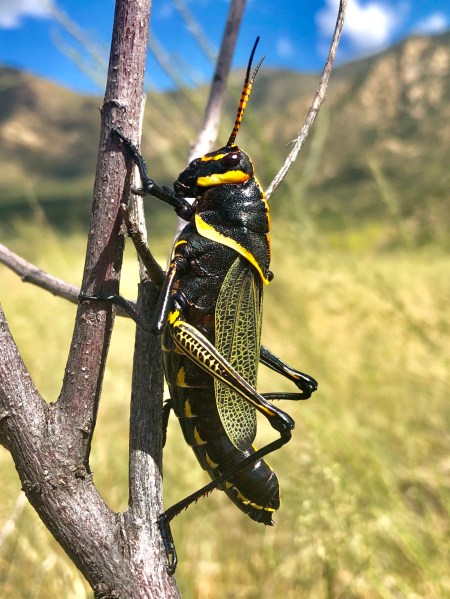
Taenipoda eques (lubber grasshopper). The striking coloration is a warning to potential predators that it is chemically protected.

Madera Canyon Rd, Arizona
We stopped real quick down the road on the way out of Madera Canyon because we saw stands of Isocoma tenuisecta, although they were still just shy of blooming. We looked at quite a few and found a single Crossidius suturalis—probably we are a tad early, and the area looks like it could use a good rain to pop things out and bring the Isocoma into bloom. We also saw low plants that could be the Croton that Deltaspis tumacacorii has been found on [Edit: I do not believe these are the plants, as they are too low]. Would be good to revisit this spot after a good rain!

The author with Ferocactus wislizenii (fishhook barrel cactus)—also called “compass barrel” due to its habit of leaning to the south.

Tumacacori Mountains, Walker Canyon, Arizona
Our second shot at Deltaspis tumacacorii, which has also been taken in Walker Canyon. We found thick stands of knee-high flowers that we immediately took to be the Croton—just as described by our contact—on which the beetles have been taken. However, we quickly began doubting that ID and decided the plant must be some type of composite. That would make more sense from a host plant standpoint, as all known host plants for Crossidius spp. are composites (subsequently determined to be Pseudognaphalium leucocephalum, family Asteraceae). We looked at the dense stands for quite some time but didn’t see any beetles (or much of anything else) before deciding that we were probably too early—had the beetles already emerged we would have at least found some stragglers. I did take a few Acmaeodera on the flowers (scalaris and rubronotata), as well as a large cantharid (Chauliognathus profundus). I also took single A. amplicollis and A. rubronotata individuals off of a large helianthoid composite (Viguiera cordifolia) and one A. rubronotata on a small yellow composite (Xanthisma gracile). There were a multitude of darkling beetles crawling in the ground—in one spot I saw five individuals of several species all within a one-square foot area. We’ll have one more shot at D. tumacacorii tomorrow at Kitt Peak.

Pseudognaphalium leucocephalum (white rabbit-tobacco) blooms profusely in the dry wash.
Cantharid vs. cantharid! Chauliognathus profundus (right) feeds on a C. lewisi that it has captured.

Day 5 – Pan Tak, Arizona (road to Kitt Peak)
Today’s destination is Kitt Peak to look for Deltaspis tumacacorii and Acmaeodera resplendens, but at the entrance we saw some Isocoma tenuisecta just coming into bloom and decided to check it out. We found a half-dozen Crossidius suturalis but had to really work for them. Alliona incarnata was also nicely in bloom, but I got only one Acmaeodera parkeri? and one A. alicia off of the flowers. There was some Gutierrezia microcephala present, also not quite in bloom, off of which Jeff got a pair of C. suturalis and gave me one. Kinda dry but lots of flowers—wish there would have been more beetles coming to them.

Moneilema sp. on Cylindropuntia imbricata.

Kitt Peak National Observatory, Arizona
Our last chance to find Deltaspis tumacacorii, and I also got a tip that Acmaeodera resplendens has also been taken up here. We immediately found several species of Acmaeodera (amabilis, amplicollis, decipiens, and rubronotata) abundantly on several composite flowers—Heliomeris longifolia, Heterotheca fulcrata, Hymenothrix wrightii, Solidago velutina, and Gutierrezia microcephala, and I found a single A. solitaria on a pink malvaceous flower, but no A. resplendens. We also searched thoroughly for any Croton-like plant for D. tumacacorii but found nothing. The Kitt Peak records of that species are older than the Walker Canyon, Peña Blanca, and Madera Canyon records, and most of the records seem to be in August rather than September, so I suspect we are a bit late for both the species and its host plant. My plan at this point is to return sometime during the middle of August and enlist the help of the source of one of the recent records to accompany me.

View north from Kitt Peak National Observatory.
Multiple species of Acmaeodera visiting flower of Heliomeris longifolia.
Acmaeodera amabilis on flower of Heliomeris longifolia.

Road to Kitt Peak, Arizona
We had noticed Gutierrezia microcephala and some other yellow composites in bloom about halfway up the mountain on our way to Kitt Peak and decided then to stop and take a look around on the way down. I took “down” the mountain, Jeff took “up.” I hadn’t walked very far when I saw what I at first thought was the cantharid Chauliognathus profundus (which I had seen yesterday at Walker Canyon preying on another cantharid) on G. microcephala flowers, but something about it gave me pause—it was too cylindrical and robust. I leaned closer to get a better look and realized it was a cerambycid—one that I did not recognize, a beautiful orange color with black elytral apices and pronotal spots! I quickly grabbed it with my right hand, immediately saw another elsewhere on the bush and grabbed it with my left hand, and as I stood there trying to fumble a vial out of my pack to put them in I saw a third individual taking flight from the bush and spiraling into the air and out of reach! I shouted out to Jeff, who came down to where I was, and showed him what I’d found, and together we decided that it must be Mannophorus forreri—a very uncommonly encountered species and more than adequate consolation for not finding Deltaspis tumacacorii earlier in the day. We spent the next hour searching up and down the roadsides, and I ended up with two more individuals from Gutierrezia flowers and two from Heterotheca fulcrata. Jeff found an additional individual on flowers of Thelesperma sp. I also picked up a few black and white Enoclerus sp., one on flowers of G. microcephala and a mating pair on flowers of Acacia berlandieri. We have a long drive to California in front of us now, and it sure is good going into the drive with such a great find under our belts.

Lower slopes of the road to Kitt Peak Observatory.
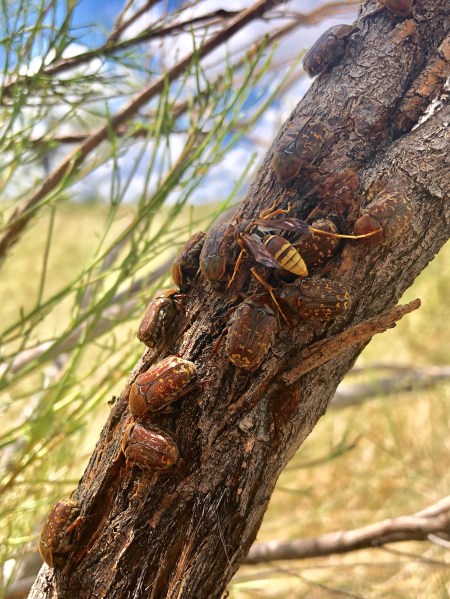
Thasus neocalifornicus (giant mesquite bugs) congregate on their host plant (Prosopis glandulosa).

Day 6 – Cajon Pass, California
Finally made it into California! Once we turned off the interstate, we made a quick stop to look at the roadside habitat where we spotted a good stand of Isocoma sp. in full bloom. We looked at quite a few plants but didn’t find any beetles on them. There were also good numbers of Ericameria nauseosa plants as well (host for Crossidius coralinus), but they weren’t quite yet in bloom yet and the only thing I found on them was a mating pair of Agrilus walsinghami. Moved on quickly to the next spot!

Lancaster, California
We met up with Ron Alten and traveled to a classic “Crossidius” collecting site (up to four species have been taken there). We’d stopped at a couple of places on the way there but not found anything—either the host plants were not yet blooming or no beetles were found, so we had the feeling that we might be a week or two early. We had to drive into the habitat a ways before we started seeing host plants—in this case Ericameria nauseosa—but eventually we found a nice large area with the plants in full bloom. It didn’t take long before we found Crossidius coralinus (populations in this area are assigned to subspecies ascendens) on the blossoms. We worked the area for a couple of hours in the heat (97°F) and got a sufficient series for study with some individuals in ethanol for DNA analysis. Males exhibit quite a bit of variability in the degree of development of the elytral markings (thin to moderately expanded sutural marking), while females were quite consistently fully expanded. Males also outnumbered females by 3:1, and all of the individuals I collected were perfect and not damaged—both suggesting that the species is just beginning to emerge. Perhaps that is why we did not find individuals of the other species (mojavensis, suturalis, and testaceus). What I did find, however, was a small trachyderine cerambycid that none of us recognized! It was on the flowers of E. nauseosa—just like C. coralinus—and at first I thought it might be a small, aberrant C. coralinus, but the elytra are completely blue-black and the size was significantly smaller than the smallest C. coralinus male that we saw. I scanned BugGuide and didn’t find anything that matched, so this will have to remain a mystery for now. [Edit: I later determined this to be a heavily marked C. discoideus blandus. In the field I couldn’t see the orange laterals on the elytra.]

Crossidius coralinus ascendens (male) on flowers of Ericameria nauseosa.
Crossidius coralinus ascendens (female) on flowers of Ericameria nauseosa.
Crossidius coralinus ascendens (mating pair) on flowers of Ericameria nauseosa.

Day 7 – Santa Catalina Mountains, Mt. Lemmon, Arizona
We decided we were just a bit to early for things in California and decided to come back to Arizona where we’d been having better success. I wanted to take another shot at Acmaeodera resplendens and had been told that Oracle Ridge Trail was a good locality for them, though maybe a bit late. We began seeing them soon after getting out of the car—unmistakable by their brilliant metallic green to copper color. They were not numerous, so I had to work for them and walked the trail about 2 miles out collecting them off a variety of flowers. The majority were on Bahia dissecta, and I also found occasional individuals of them and other species of Acmaeodera (amabilis, amplicollis, decipiens, and rubronotata) on flowers of Heliomeris longifolia, Heterotheca fulcrata, Hymenothrix wrightii, Ageratina herbarea, Achillea millefolium, sweeping, Cirsium sp., and prob. Viguiera dentata. One other beetle I found was a Megacyllene sp. sitting on a plant under a stand of Robinia neomexicana [Edit: this is M. snowi snowi—another new one for my collection!].

View from Oracle Ridge Trail @ 1 mile north of the trailhead.
Acmaeodera resplendens on flower of Heliomeris longifolia.

Scenic Overlook, Santa Catalina Mountains, Arizona
A quick stop on the way back down the mountain at a spot where we’d seen Gutierrezia microcephala and Heterotheca subaxillaris blooming along the sides of the road. There wasn’t much going on—a couple of Acmaeodera amplicollis and one A. rubronotata on the flowers of H. subaxillaris, one Enoclerus sp. on Solidago velutina, one A. solitaria on Baccharis sarothroides, and another swept from grasses. I did see Peucetia viridans (green lynx spider) feeding on a very bristly tachinid fly.

A clearwing moth (family Sesiidae).
Peucetia viridans (green lynx spider) feeding on a hairy tachinid fly.

Day 8 – Santa Rita Mountains, Montosa Canyon, Arizona (halfway up)
We decided to visit Montosa Canyon to take another shot at Deltaspis tumacacorii and also see if maybe we could find more Acmaeodera resplendens. We didn’t see many flowers along the way up the canyon until about the halfway point. When we did start seeing them we made a quick stop to see what might be on them. I collected some of the more common Acmaeodera (rubronotata, decipiens, and amplicollis) off a few different yellow composite flowers, but we quickly decided to take a look at the higher elevations.

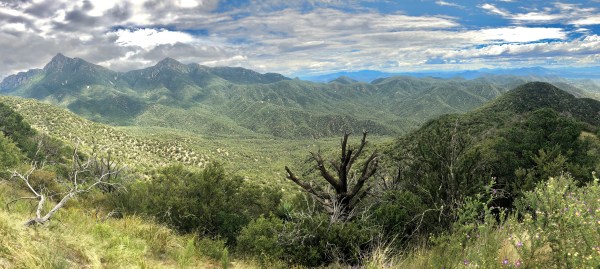
Panoramic view from halfway up the canyon.
Apyrrothrix araxes (dull firetip skipper) on flowers of Baccharis salicifolia.
The larvae of these large skippers feed on oaks.

Santa Rita Mountains, Montosa Canyon, Arizona (entrance to Whipple Observatory)
The road was gated past the km-13 point—Jeff took the roadsides, and I took a ridgetop trail off to the south for a little over a mile. The panoramic views were spectacular, and at the southern terminus I stood at the edge amidst gale-force winds admiring the landscape! Acmaeodera were diverse and abundant, though not quite as abundant as yesterday on Mt. Lemmon or a few days ago on Kitt Peak. However, I did get another nice series of A. resplendens, along with decipiens, rubronotata, amplicollis, and amabilis. Host flowers were collected for most of these: Hymenothrix wrightii, Erigeron neomexicanus, Linum neomexicanum, Heliomeris multiflora, Verbesina enselioides, Heliopsis parvifolia, Heterotheca subaxillaris, and Machaeranthera tanacetifolia. I also collected a small series of A. decipiens perching on grass stems and a very cool-looking wasp—black with a bright orange thorax and whitish abdominal apex [edit: I believe this is the scoliid Psorthaspis portiae].

Vista from the southern terminus of the ridgetop trail off Mt. Hopkins Rd at km 13.
Acmaeodera decipiens on flower of Machaeranthera tanacetifolia.
A curious assemblage of bees on this Heliomeris longifolia flower. They were not active, just sitting. [Edit: these are Dufourea sp. (short-faced bees, family Halictidae)].

Santa Rita Mountains, lower Montosa Canyon, Arizona
We stopped at a spot near the bottom of the canyon on the way out to see what was going on at the lower elevations. The answer—not much! There were a variety of woody shrubs and other plants in bloom, but the area seemed rather “wilty”. I think this area has a lot of potential, we just didn’t hit it at the right time. I did take an impressively huge tarantula hawk, just because.

Fouquieria splendens (ocotillo) resembles cacti but is not a true cactus. Distantly related to persimmons, blueberries and acacias, it is now placed in its own family (Fouquieriaceae).
Apiomerus flaviventris (yellow-bellied bee assassin) with prey.
The prey is a soldier beetle (likely Chauliognathus lewisi).
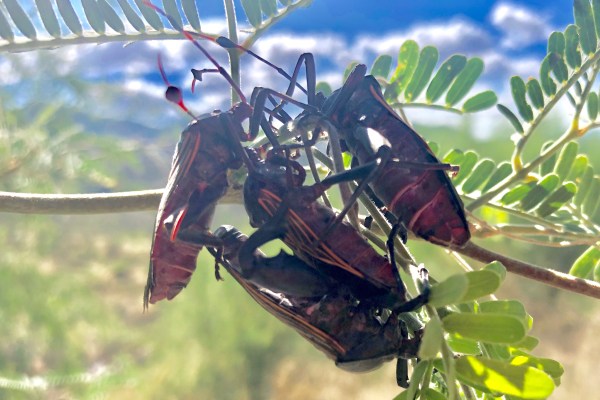
Robber flies not only mate tail-to-tail, they fly coupled in the position also. This tandem of giant robber flies (possibly Promachus nigrialbus), flew by me and landed in the bushes. The male (right) tried to take flight again and pulled the female’s hind legs off her perch. She stood firm, however, forcing the male to grab a nearby branch with just his from and middle legs and leave his hind legs dangling also. Note that the female is also feeding on a honey bee—so much natural history going on here!

Flats below Montosa Canyon, Arizona
I was a bit disappointed at not finding any beetles at what seemed would be the last collecting stop of the trip. But on our way out we saw a patch of Isocoma tenuisecta in bloom in the lowlands some distance west of the entrance to the canyon—just what we were looking for! Jeff and I each quickly found Crossidius suturalis individuals on flowers of the plants and continued searching up and down along the roadway. We didn’t find any more for awhile but when I got back to the area where I started I spotted another one sitting on a plant on the other side of the barbed-wire fence. I extended my net handle to the max, maneuvered it in position, took an assertive swipe, and got it. Just as I was putting it into the bottle, I saw another one take flight from a plant right beside me. I hadn’t closed the bottle yet but didn’t want the other one to get away, so I capped my thumb over the opening, awkwardly wielded my net into position one-handed, chased after it and took a swing and got it, too! (More often than not these situations end up with me losing both specimens!). There was also a good amount of Hymenothrix wislizeni along the roadside, off the flowers of which I collected several Acmaeodera gibbula, A. disjuncta, and A. rubronotata. This is probably the last collecting locality of the trip, so I’m happy to end up having success with this subspecies of Crossidius (C. suturalis intermedius), which we havn’t found in large numbers on this trip. Just after leaving the site, we saw a bobcat on the side of the road—my first one! Unusual to see one in the middle of the day—it was a small one, must’ve been quite hungry!

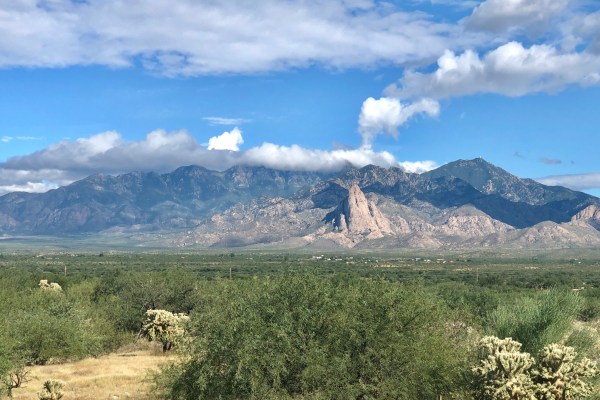
Santa Rita Mountains from the highway.

Phoenix, Arizona (epilogue)
Bill Warner was kind enough to host Jeff and I for our last night in Arizona prior to returning home tomorrow. What an amazing collection he has built, and his use of flight-intercept traps in recent years has turned up even more amazing beetles. I was happy to also meet Andrew Johnston and Evan Waite, who joined us for dinner.

Bill Warner, an icon among Arizona beetle collectors, sits amidst newly collected I material waiting to be processed.
Sunset in Phoenix!

©️ Ted C. MacRae 2019

2019 Arkansas/Oklahoma Insect Collecting Trip iReport

Alternative title: Rich and Ted’s Excellent Adventure

This is the seventh “Collecting Trip iReport”; this one covering a 5-day trip to Arkansas and Oklahoma from June 7–11, 2019 with my friend and local collecting buddy Richard Thoma. As with all previous “iReports” in this series, this one too is illustrated exclusively with iPhone photographs.

Previous iReports include the following
2013 Oklahoma
2013 Great Basin
2014 Great Plains
2015 Texas
2018 New Mexico/Texas
2018 Arizona

Image may contain: 2 people, including Ted MacRae, people smiling, people standing, beard, tree and outdoor
…and so it begins!

Day 1 – Ozark National Forest, vic. Calico Rock, Arkansas
It’s been many years since I’ve visited these sandstone glades overlooking the White River near Calico Rock. Conditions were partly sunny when we arrived, but water on the ground suggested rain earlier in the day. We had only a short time to start exploring before the wind started blowing up and the smell of rain filled the air. I did manage to beat one Amniscus sexguttata from a branch of living Pinus echinata and collect a couple of Strigoderma sp. from Coreopsis lanceolata flowers before steady rain forced us to retreat.

Image may contain: cloud, sky, mountain, outdoor, nature and water
White River near Calico Rock, Arkansas—before the rain.
Image may contain: mountain, sky, outdoor and nature
White River near Calico Rock, Arkansas—rain’s a comin’!

Day 2 – Ouachita National Forest, Winding Stair Campground & Ouachita Trail, Oklahoma
We walked the trail from the campground S about 2½ miles and back. I started off with Acmaeodera tubulus on Krigia sp. flowers, eventually finding a lot of them on this plant at higher elevations along with a single Acmaeodera ornata, and I beat a few Agrilus cepahlicus off of Cornus drummondii. This had me thinking it would be a good buprestid day, but it wasn’t, the only other species collected being some Chrysobothris cribraria off of small dead Pinus echinata saplings and Pachyschelus laevigatus on Desmodium sp. Also beat a few miscellaneous insects off of Cercis canadensis and Vaccineum arborea and swept some from grasses and other herbaceous plants. Back at the campground I collected Chrysobothris dentipes on the sunny trunks of large, live Pinus echinata trees.

Emerald Vista, along the Talihema Scenic Drive.
Acmaeodera tubulus on flower of Rosa carolina.
Canthon sp.
Apheloria virginiensis reducta (ID by Derek Hennen).
The biggest cairn I’ve ever seen.

Ouachita National Forest, Talimena Scenic Dr at Big Cedar Vista, Oklahoma
There were lots of native wildflowers like Coreopsis tinctoria and Ratibida columnifera in bloom, so we stopped to check them out. There were lots of butterflies, however, I found only a single Typocerus zebra on Coreopsis lanceolata.

View south from Talimena Scenic Drive at Big Cedar Vista.
Coreopsis tinctoria (plains coreopsis).
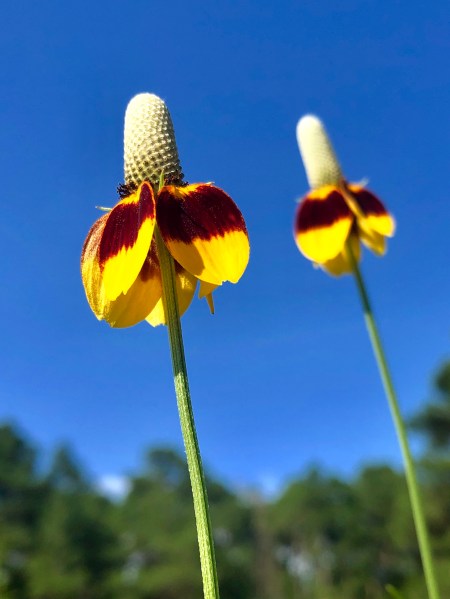
Ratibida columnifera (upright prairie coneflower).

Ouachita National Forest, Winding Stair Campground, Oklahoma
We returned to the campground in the evening to do some blacklighting. I had high hopes, but only five cerambycids came to the lights, all represented by a single individual: Monochamus carolinensis, Acanthocinus obsoletus, Amniscus sexguttatus, Eutrichillus biguttatus, and Leptostylus tranversus (the first four are pine-associates). I also picked up a few other miscellaneous insects.

Rich processes the day’s catch as the blacklight hums in the background.

Day 3 – Medicine Park Primitive Campground, Oklahoma
There wasn’t much insect activity going on in eastern Oklahoma, so we drove out west to the Wichita Mountains for hopefully better luck. We found a small park with a primitive campground in the city of Medicine Park—my first thought was to beat the post oaks dotting the campground, but when I went into the native prairie between the campground and the creek I never came out! Right away I found what must be Acmaeodera ornatoides on flowers of Opuntia sp., then I found more on flowers of Gallardia pulchella along with Acmaeodera mixta. The latter were also on flowers of Thelesperma filifolium along with Acmaeodera neglecta—took a nice series of each, and I also got a few of the latter on flowers of Coreopsis grandiflora. Strangalia sexnotata were on flowers of C. tinctoria and Torilis arvensis, and then on the latter plant I saw a male Strangalia virilis—a Texas/Oklahoma specialty that I’ve never collected before! I spent the next hour looking for these guys and ended up with 3 males and 2 females along with a few Trichiotinus texanus—another Texas/Oklahoma specialty—and a single Agrilaxia sp. nr. flavimana (could be A. texana). One single Typocerus octonotatus was on flowers of Achillea millefolium. I think we may come back here tomorrow—I’d like to look for more S. virilis and beat the post oaks (the reason we stopped here to begin with).

A cacophony of native wildflowers!
An orgy of Euphoria kernii (Kern’s flower scarab) in Opuntia sp. flower. Multiple color forms exist for this species.
At first I thought this was a type of hover fly (family Syrphidae), but eventually I determined it to be Esenbeckia incisuralis, a horse fly (family Tabanidae)—incredible emerald green eyes!
Papilio polyxenes asterius (black swallowtail) caterpillar.
Echinocereus reichenbachii baileyi (lace hedgehog cactus).

Lake Lawtonka nr. Ma Ballou Point, Oklahoma
We stumbled into this area while looking for stands of Sapindus drummondii (soapberry)—found a small stand along the road, but it was too inaccessible. The same diversity of blooms were present as at the previous spot, so I picked a few longhorns off flowers of Coreopsis grandiflora and Gaillardia pulchella. Super windy, so we didn’t stay long.

View across Lake Lawtonka from Ma Ballou Point.
Neochlamisus sp. (case-bearing leaf beetle) larvae inside their “casas de caca” on Monarda fistulosa (bee balm).
I believe this is Harrisina coracina, a leaf skeletonizer in the family Zygaenidae. Both BugGuide and the Moth Photographers Group show records only from Texas.

Day 4 – Wichita Mountains National Wildlife Refuge, Oklahoma
Before starting the day’s collecting, we wanted to go into the Wichita Mountains National Wildlife Refuge to have a look around. On the way into the refuge we some American bison near the road and had to stop, take photos, and simply admire these massive, majestic beasts. We then went to the Cedar Plantation, where I had visited before back in 2012 and photographed black individuals of Cicindelidia obsoleta vulturina (prairie tiger beetle). No tiger beetles were out now (they come out in the fall), but I’d hoped to maybe see Cylindera celeripes (swift tiger beetle) along the 2-tracks in the area. No such luck—nevertheless, we saw a myriad of interesting insects, including several more Esenbeckia incisuralis (green-eyed horse flies) and a beautiful Trichodes bibalteatus (checkered beetle), the latter of which I photographed on flowers of Ratibida columnifera and Achillea millefolium with the big camera. Afterwards we visited the “prairie dog town” and got marvelous views and photographs of black-tailed prairie dogs.

Native American wildlife on a native American landscape.
American bison (Bison bison bison).
Wichita Mountains from Cedar Plantation.
Acmaeodera mixta on flower of Rudbeckia hirta (black-eyed Susan).
Typocerus octonotatus on inflorescence of Achillea millefolium (yarrow).
Strangalia sexnotatus on flower of Ratibida pinnata (gray coneflower)
Trichodes bibalteatus on flower of Rudbeckia hirta (black-eyed Susan).
Trichodes bibalteatus on flower of Ratibida pinnata (gray coneflower)
The author walks a bison trail through the Cedar Plantation.
Black-tailed prairie dog at its burrow entrance.
“Watch you lookin’ at, Willis?!”
Black-tailed prairie dog (Cynomys ludovicianus).

Medicine Park, Jack Laughter Park, Oklahoma
We’d noticed this spot yesterday because of the old post oaks and wealth of wildflowers blooming up the mountainside. There wasn’t much going on today, however—just a few Acmaeodera mixta on flowers of Gaillardia pulchella. I did find an Anthaxia (Haplanthaxia) sp. on my arm! Otherwise I spent some time photographing the landscape and some geometrid larvae on flowers of Gaillardia pulchella.

Opuntia sp. (prickly-pear cactus) amidst rocky exposures.
Small Oncoptus fasciatus (large milkweed bugs) nymphs colonize seed pods of Asclepias asperula (antelope-horns).

Medicine Park Primitive Campground, Oklahoma
We returned to this spot since we had so much luck yesterday. I was hoping to collect more Acmaeodera ornatoides and Strangalia virilis, but there was much less going on today than yesterday—basically didn’t see anything for the first hour and a half. I didn’t give up, however, and kept checking the area where we saw most of the S. virilis yesterday, and eventually I saw another male in the same area as yesterday on the same stand of Torilis arvensis. I found two more males in the same area over the next hour, so three males on the day was a good reward for the time spent looking for them. I also collected Trichodes apivorus and Trichiotinus texanus on flowers of Allium sp. Interestingly, beating the post oaks—the reason why I originally wanted to stop here—produced nothing. So, not very many specimens on the day, but happy with those I did get.

Thelesperma filifolium (stiff greenthread).
Coreopsis grandiflora (large-flowered tickseed).
Gaillardia pulchella (firewheel).
Coreopsis tinctoria (plains coreopsis).
Torilis arvensis (erect hedge parsley), introduced.
Opuntia sp. (prickly-pear cactus).
Allium sp. (wild onion).

Medicine Park, Jack Laughter Park, Oklahoma
I was pretty much done for the day after spending all morning at the refuge and most of the afternoon at the previous spot, but Rich wanted to take another look at Jack Laughter Park because he’d found some interesting grasshoppers there. As with earlier in the day there were few beetles of interest to me, but I did collect a couple of Trichiotinus texanus on flowers of Cirsium undulatum. I checked out some large post oaks with large dead branches thinking that might be what Strangalia virilis was breeding in but never saw any, and eventually I turned my attention to photographing a few interesting native plants that I found along the way.

Krameria lanceolata (trailing krameria).
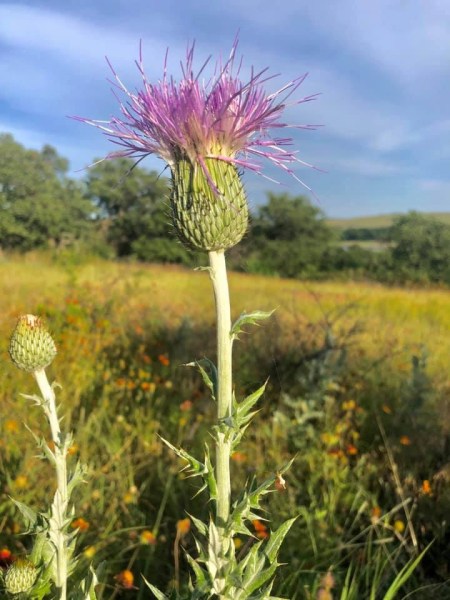
Cirsium undulatum (wavyleaf thistle or gray thistle) inflorescence.

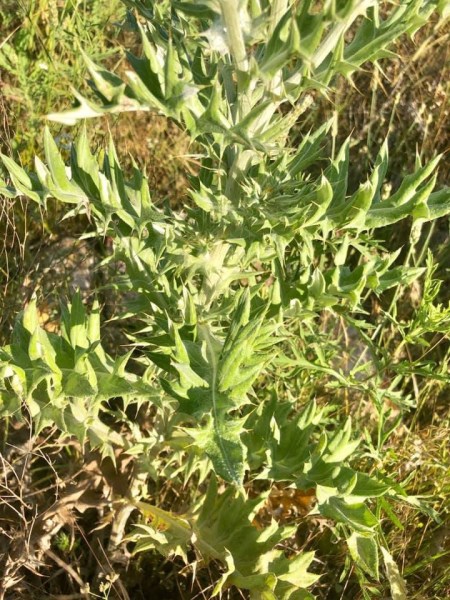
Cirsium undulatum (wavyleaf thistle or gray thistle) can be distinguished by its wavy leaves that are gray-green on both upper and lower surfaces.

Day 5 – Epilogue
We were tempted to do one last little bit of collecting on the way back to St. Louis, but since had pretty good luck during the last couple of days and the drive alone would take more than nine hours we decided to leave well enough alone and get home at a reasonable hour. A walk with Beauregard when I got home to stretch the post-drive legs was the perfect way to end the mini-vacation.


©️ Ted C. MacRae 2019

Orchid Valley Natural Area

This month’s destination for the WGNSS Natural History Photography Group was Orchid Valley Natural Area in Hawn State Park. This natural area is south of the main park and not normally open to the public, but we were granted permission to enter by the park administration. Our targets were several species of orchids and other rare plants that are known to occur in the area—showy orchis (Galearis spectabilis) being the one I hoped most to see.

Our group for the day (front to back): me, Lynne, David, Casey, Avery, James, Bill, and Rich (Chris behind tree at back).

There are no trails here—not even a place to park, as we squeezed our cars against the side of the road at a spot that appeared to provide good access. A bit of GPS-guided bushwhacking brought us to increasingly rough and sloping ground that ended up at the edge of a cliff overlooking one of the sandstone box canyons that this area is know for—down below was where we wanted to go. Wild azaleas lined the upper canyon edges with their stunning pink blossoms. We followed the canyon edge and found a way down, then circled back into the canyon to find a stunning waterfall, its sandstone walls dripping with mosses and ferns. We spent quite a bit of time here photographing the waterfall and surrounding area before eventually resuming the search for the orchids that we came to see.

Bill surveys a waterfall at the center of a sandstone box canyon.

The waterfall fell about 25 feet onto the sandstone rocks below, its splash creating perfect conditions for luxurious growth of mosses and ferns.

Mosses sending up their “stems” (actually setae), each holding up a capsule filled with spores.

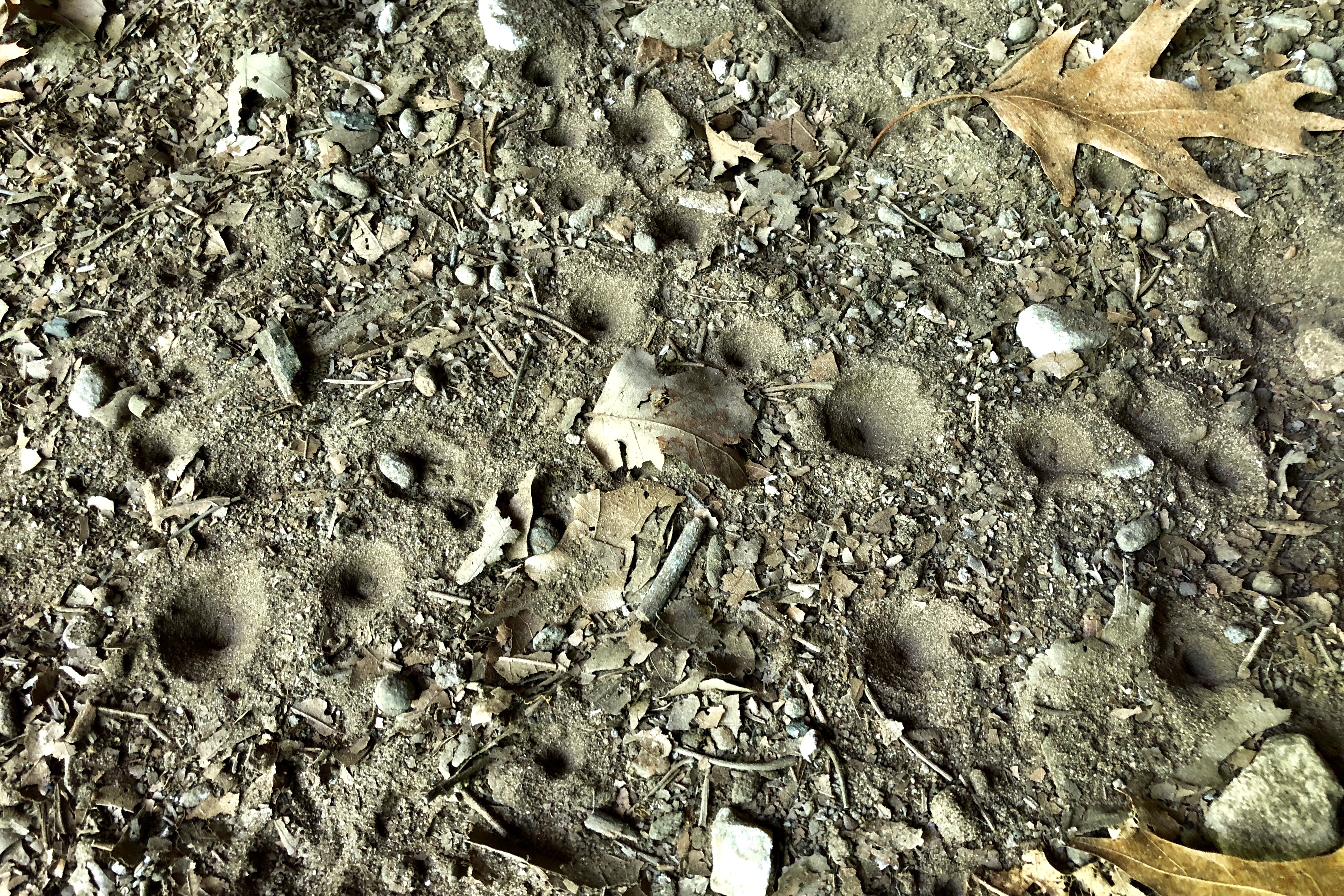
Sadly, the orchids were not yet in bloom—not even close, another victim of the cold, late spring we’ve been experiencing. Casey, our group leader, did find some very small showy orchis leaves, and we saw some nice clumps of another native orchid, rattlesnake plantain (Goodyera pubescens), an evergreen orchid that blooms during late summer. We hiked up another drainage that led to another box canyon—lacking a waterfall but equally impressive, nonetheless—but found no orchids in bloom there, either. We did, however, see cinnamon ferns sending up their spike-like fertile fronds and aggregations of antlion larvae (a.k.a. “doodlebugs”) in the soil beneath the sandstone ledges.

Leaves of rattlesnake plantain (Goodyera pubescens).

Moss growth is luxuriant in the wet sandstone exposures inside the box canyons.

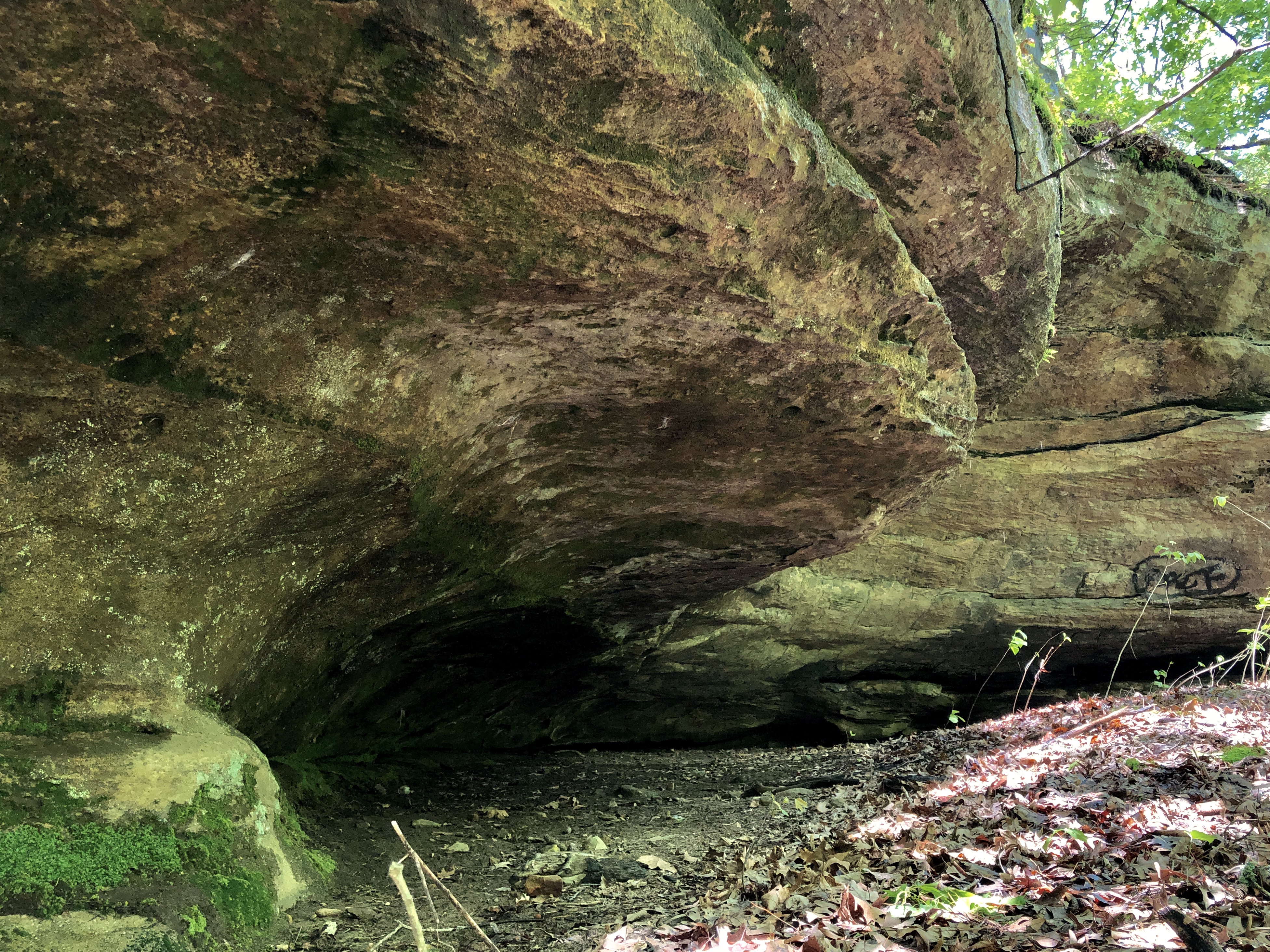
Sandstone ledge above a box canyon.

Pits of antlions, or “doodlebugs”, clustered in the soil beneath a sandstone ledge. Ants and other insects that fall into the pits are quickly dispatched by the sickle-shaped mandibles of the bug lying buried at the bottom of the pit.

You might think failure to find what we were looking for would result in a disappointing field trip—far from it! Time in the field with like-minded friends in a beautiful spot is always a pleasure, and when it comes to searching for rare plants (or insects, or whatever), failure is the norm—making success, when it does come, that much sweeter. There will be other chances to see showy orchis (perhaps in a couple of weeks).

© Ted C. MacRae 2019

North America’s most “extreme” jewel beetle

When Chuck Bellamy passed away two years ago, he left behind a remarkable legacy of study on the family Buprestidae (jewel beetles) that includes not only his insect collection—surely one of the best in the world in terms of representation of genera and species in the family—but also his extensive library of primary literature. Both of these assets, built over a period of decades, are now housed in the California State Collection of Arthropods at the CDFA Plant Pest Diagnostics Laboratory in Sacramento, California. Chuck, however, was not just a jewel beetle collector and taxonomist—he was also a skilled photographer, focusing (pun intended) largely, though not exclusively, on his beloved jewel beetles. Digital cameras were still far in the future when Chuck began photographing these beetles, and as a result the bulk of his photographic legacy exists in the form of 35mm slides. I was the fortunate recipient of his slide collection, numbering in the thousands, and have been slowly scanning his slides into digital format with the goal to eventually make them available to the larger community of buprestid workers. Some of his best photos were published in a memorial issue of The Coleopterists Bulletin (2014, volume 68, number 1), and I featured a few additional photos in this post shortly before the publication of that issue. There remain slides, however, of many additional species, a large number of which surely represent the only field photographs of live adults. As I convert his slides to digital format, I hope to share some of the more interesting here.

For the first of these featured species, I can think of no better one than Lepismadora algodones. This tiny little jewel beetle is the only representative of the genus, which was not even known until 1986 when it was discovered by Mimi & Rob Velten in the Algodones Sand Hills of southeastern California. The species and genus were described the following year (Velten & Bellamy 1987), making Lepismadora the most recently discovered new genus of jewel beetle in the U.S. The recentness of its discovery is remarkable, since southern California in general and the Algodones Sand Dunes in particular were thought to have been relatively well collected at the time of the beetle’s discovery. Also remarkable is the distant relationship of this monotypic genus to any other North American species; its closest known relative being the genus Eudiadora—known only from Argentina (Bellamy 1991).

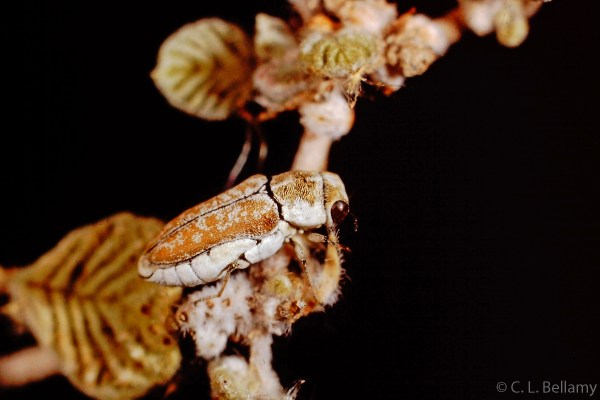
Lepismadora algodones

Lepismadora algodones Velten, in Velten & Bellamy, 1987 (Coleoptera: Buprestidae)

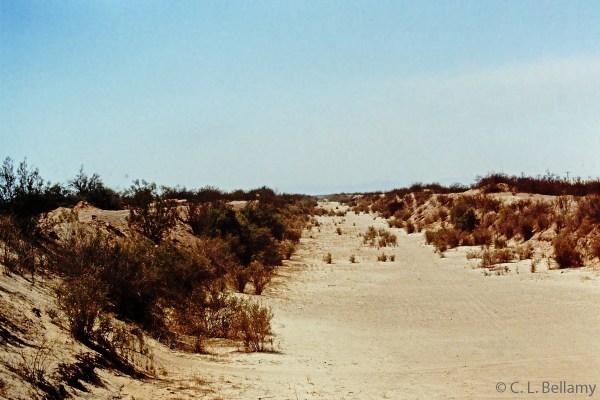
Even more remarkable, however, are its highly localized distribution and extreme habitat. The entire type series (one male holotype and 159 paratypes) and all individuals collected since its description have been found only in a single old canal on the west side of the Algodones dunes. Summer temperatures in the dunes routinely reach in excess of 110°F and are even higher in the depressed canal where the beetles are found. Astoundingly, the adults are active only during the hottest hours of the day (ca. 10 a.m. to 2 p.m.), during which time they can be found on the flowers and foliage of fanleaf crinklematTiquilia plicata (Boraginaceae). The reason for the beetle’s highly restricted distribution is a mystery, as the plant on which the beetles are found is rather widespread across the southwestern U.S. and northwestern Mexico. A final mystery is the still unknown larval host plant—it could be T. plicata, but it could just as likely be something completely different.

Algodones Dunes

Old canal on the west side of Algodones Sand Hills, type locality of Lepismadora algodones.

I moved to California a few years after the species was described and, of course, soon set out to find it for myself. I had driven to southern California from my home in Sacramento to meet the late Gayle Nelson (another important mentor of mine), who told me where to find the beetle and what the host plant looked like but also warned me about the extreme heat I would encounter. His advice was to hike the canal until I had half a bottle of water, then turn around and hike back. Mindful of his advice, I arrived at the dunes the next day around mid-morning, filled my water bottle and hydrated myself as much as I could, and climbed down into the canal. The heat was overpowering—more so down in the canal and far beyond anything I had ever experienced to that point, and after quickly recognizing the host plants I began tapping their tiny, prostrate branches over my beating sheet and looking for the beetles. I went as far as I could down the canal, perhaps 200 yards, before I had to turn around, but I had not yet seen any beetles and was starting to lose hope. I continued to tap host plants on the way back, though by then not really expecting to see anything. About halfway back I saw something laying on the ground a short distance ahead. As I approached I saw it was a small plastic vial with a white cap, and when I picked it up I saw inside a dried out T. plicata twig and a dead adult beetle—unmistakably L. algodones! While excited to have found the species, it was at the same time a bit unsatisfying for the specimen to be one that somebody else had collected before me and then lost (for all I know, it could have been Chuck Bellamy, considering that the beetle was apparently intended to be kept alive, possibly for photography!). I slipped the vial into my pocket, started tapping branches again, and found three additional adults in the immediate vicinity of where I had found the vial (and doing much to soothe my dissatisfaction with the first specimen). Those would be the only specimens that I would find that day, though I would succeed in finding another individual on a subsequent visit two years later.

REFERENCES:

Bellamy, C. L. 1991. A revision of the genus Eudiadora Obenberger (Coleoptera: Buprestidae). Proceedings of the Entomological Society of Washington 93(2):409-419 [Biodiversity Heritage Library].

Velten, R. K. & C. L. Bellamy. 1987. A new genus and species of Coroebini Bedel from southern California with a discussion of its relationships in the tribe (Coleoptera, Buprestidae). The Coleopterists Bulletin 41(1):185–192 [pdf].

© Ted C. MacRae 2015

Summer Insect Collecting iRecap

At the beginning of the season I was planning to spend the first week of June collecting insects in southeastern New Mexico. Family issues intervened, however, and left me with a week of vacation time and no plans on how to use it. I’ve never been one to not use vacation time, so I quickly came up with a backup plan—a Friday here and a Monday there to create several 3–4 day weekends. Long weekends may not allow travel to far off and exotic places, but they do allow me to travel a bit further than I would for a regular weekend. I also took advantage of my frequent travel for work to stop off at favorite collecting sites for an evening of blacklighting (much more fun than sitting in a hotel room) or a half-day in the field before getting back home. I always have my big camera with me for serious insect photography when the opportunity arises, but I also take frequent iPhone snapshots to document the “flavor” of my time in the field. In previous years, I’ve collected snapshots from my extended trips into “iReports”, which were later followed by posts featuring subjects that I spent “quality camera time” with (see 2013 western Oklahoma, 2013 Great Basin, and 2014 Great Plains). I’ve decided to do the same thing now, only instead of a single trip this report covers an entire summer. I realize few people have the patience for long-reads; nevertheless, enough readers have told me that they like my trip reports and all of their gory details to make this a worthwhile exercise. If you’re not among them, scan the photos—all of which were taken with a stock iPhone 5S and processed using Photoshop Elements version 11—and you’re done!


Searching for the Ghost Tiger Beetle
Central/Northwest Missouri (12–14 June 2015)

In mid-June my good friend, colleague, and fellow cicindelophile Chris Brown and I followed the Missouri River Valley across the state and and up along its northwestern border to visit previously known and potentially new sites for Ellipsoptera lepida—the Ghost Tiger Beetle. We first saw this lovely white species back in 2000 while visiting some of the large sand deposits laid down in central and east-central Missouri by the 1993 flood. In the years since these sites have become increasingly encroached by forests of eastern cottonwood (Populus deltoides), making them less and less suitable for the beetle (it also remains one of only two tiger beetles known to occur in Missouri that I have not yet photographed). In the meantime several new sand deposits have been laid down in northwestern Missouri by flooding in 2011, so the question has come up whether the beetle has yet occupied these new sites. We started out at a couple of potentially new sites in east-central Missouri (and did not find the beetle), then went to one of two known sites in central Missouri. We did not find the beetle there either, but we did find this eastern hognose snake  (Heterodon platirhinos).

Eastern hognose snake (Heterodon platirhinos)

Eastern hognose snake (Heterodon platirhinos) | vic. Eagle Rock Conservation Area, Boone Co.

Hognose snakes are well known for their vaired repertoire of defensive behaviors—from flattening of the head and hissing to rolling over and playing dead (a behavior called thanatosis)—the latter behavior often accompanied by bleeding from the mouth and even defecating onto itself. This one, however, was content to simply flatten its head and hiss, its tongue constantly flickering.

Eastern hognose snake (Heterodon platirhinos)

The flattened head is an attempt by the snake to make itself appear larger and more imposing.

Standing its ground as tenaciously as it did, I took advantage of the opportunity to close in tight and take a burst series of photos, which I used to create this animated gif of the snake’s constantly flickering tongue.

Eastern Hognose Snake (Heterodon platirhinos)

After an evening of driving to northwest Missouri and a stay in one of our favorite local hotels (eh hem…), we awoke to find the scene below at our first destination.
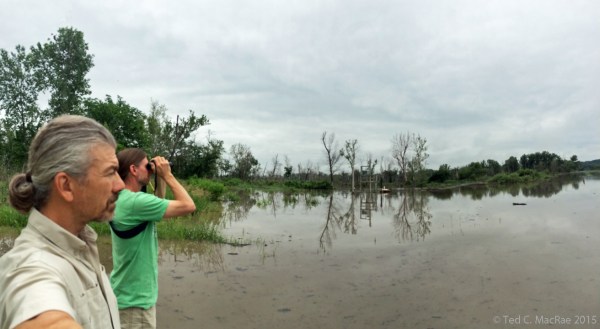
Ted MacRae & Chris Brown look out over a flooded wildlife refuge

Ted MacRae & Chris Brown look out over a flooded Thurnau Conservation Area, Holt Co.

No tiger beetles there! What to do now. One thing I love about modern times is the ability to pull out the smart phone and scan satellite images of the nearby landscape. Doing this we were able to locate a large sand deposit just to the south and navigate local, often unmarked roads to eventually wind up at a spot where we could access the area on foot. But before we did this we needed gas, and the only gas station for miles was a Sinclair station with a bona fide, original green dinosaur—one of the most potent and iconic corporate symbols ever! I remember these from my childhood, but this is the first one I’ve seen in years.

Authentic Sinclair dinosaur

An authentic Sinclair dinosaur guards the only gas station for miles.

Rain the night before had made the roads muddy, and it was only with some difficulty that we finally located a way to access the sand deposits we had seen on the satellite images. Even then we needed to hike a half-mile to access the sand plain, but once we got there this is what we saw:

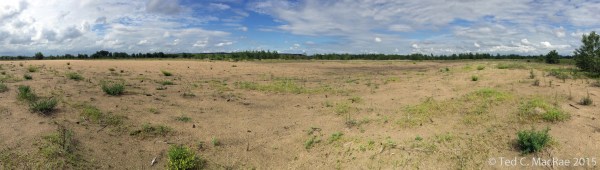
Sand plain deposited 2009

Sand plain deposited 2011 along Missouri River, Thurnau Conservation Area, Holt Co.

At first we were optimistic—the habitat looked perfect for not only E. lepida but also the more commonly seen Cicindela formosa generosa (Eastern Big Sand Tiger Beetle) and, at least in this area, C. scutellaris lecontei (LeConte’s Tiger Beetle). We saw no adults however, as we searched the plain, and we wondered if the cool, cloudy conditions that lingered from the previous evening’s storms were suppressing adult activity. After awhile, however, we noted that we hadn’t even found evidence of larval burrows, and that is when we began to think that maybe four years wasn’t long enough for populations to establish in such a vast expanse of new habitat. Eventually Chris did find a single E. lepida adult—a nice record but certainly not evidence of a healthy population.

Sand plain deposited 2009

Seemingly perfect habitat, but void of active adults or evidence of larval burrows.

The next sand plain we visited was a little further north at Corning Conservation Area, also in Holt Co. and also laid down by the 2011 flood. Once again we saw no active tiger beetles in the area, and by this point we were convinced that the species were not just inactive but had not yet even colonized the plains. It should be noted that large sand expanses such as these actually are not exactly a natural process, but rather the result of river channeling and the use of levees to protect adjacent farmland. Before such existed, the river existed as an intricate system of braided channels that rarely experienced catastrophic flooding. Nowadays, with the river confined to a single, narrow channel, the river valley doesn’t experience a normal ebb and flow of water. Only when water levels reach such extreme levels in the narrow channel that they breach a levee does the adjacent valley flood, with the area immediately downstream from the levee breach receiving huge amounts of sand and mud scoured from the breach zone. Tiger beetle species adapted to ephemeral sand plain habitats along big rivers probably
Sand plain deposited 2009

Another sand plain deposited in 2011 at Corning Conservation Area, Holt. Co.

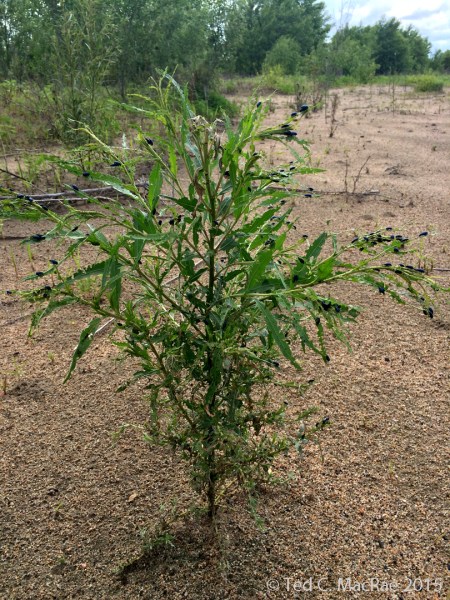
Cottonwoods and willows were already colonizing the edge of the plain, and the latter were heavily infested by large blue leaf beetles. As far as I know the only species of Altica in Missouri associated with willow is A. subplicata, although admittedly it is a large, diverse genus and there could be other willow-associates within the state that I am unaware of. The beetles seemed especially fond of the smaller plants (1–3′ in height), while taller plants were relatively untouched.
Altica bimarginata (willow flea beetle)

Altica subplicata? (willow flea beetle) | Holt Co., Missouri

Altica bimarginata (willow flea beetle)

Beetles congregated heavily on smaller willow plants.

Altica bimarginata (willow flea beetle)

Despite the heavy adult feeding we could find no larvae on the foliage.

Few other insects were seen. I did see a large, standing, dead cottonwood (Populus deltoides) and checked it out hoping hoping to find a Buprestis confluenta adult or two on its naked trunk (a species I found for the first time last year and still have yet to find in Missouri, although it is known from the state). No such luck, but I did collect a couple of large mordellids off of the tree. Let me say also that there were some interesting other plants in the area…

Wild hemp (Cannabis sativa)

Wild hemp (Cannabis sativa)

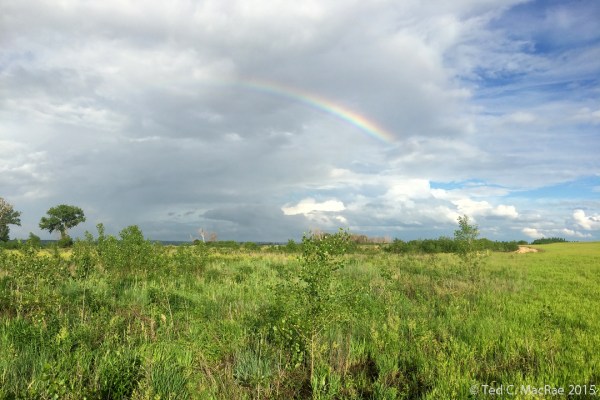
After satisfying ourselves that Corning also was not yet colonized by the tiger beetles, we drove further north into Atchison Co., the northwesternmost county in the state, to check out one more sand plain deposited by the 2011 flood at Nishnabotna Conservation Area. The sand plain at this area was much smaller than the two previous plains we had visited, and it was also far less accessible, requiring a bushwhacking hike through thick vegetation that was quite rank in some areas. Nevertheless, we soldiered on, motivated by the hope that maybe the third time would be a charm and we would find the beetles that we were searching for. The hike was not all bad—eagles were abundant in the area, and in one distant tree we could see a female perched near her nest with two large nestlings sitting in it. The passing storm system and sinking sun combined to create a rainbow that arched gracefully over the tree with the nest, resulting in one of the more memorable visions from the trip.
Rainbow over eagle's nest

Rainbow over eagle’s nest (tree is located at left one-third of photo).

By the time we got close enough to get a better photograph of the nest the female had departed, but the two nestlings could still be seen sitting in the nest. Sadly, the rather great effort we made to hike to the sand plain was not rewarded with any tiger beetles, and in fact the sand plain was little more than a narrow, already highly vegetated ridge that will probably be completely encroached before the tiger beetles ever find it.

Eagles in nest

Eagles in nest

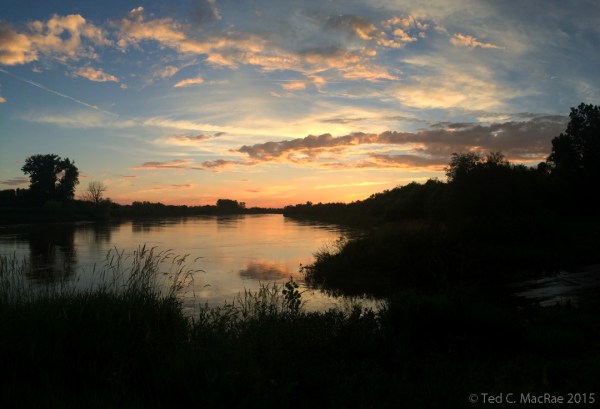
Ellipsoptera lepida was not the only tiger beetle we were hoping to see on the trip. The Sandy Stream Tiger Beetle, E. macra, has also been recorded from this part of the state, and being members of the genus Ellipsoptera both species can be attracted to lights at night. In one last effort to see either of these species, we went to Watson Access on the Nishnabotna River, near its confluence with the Missouri River. Thunder clouds retreating to the east were illuminated by the low hanging sun to the west, creating spectacular views in both directions. Unfortunately, the insect collecting at the blacklights after sunset was not near as interesting as the sky views that preceded it.

Sunset lit thunderclouds

Sunset lit thunderclouds to the east…
Sunset on the Nishnabotna River

… and a bright colored sunset to the west on the Nishnabotna River, Atchison Co.

The next day we had to start making our way back to St. Louis. But while we were in the area we decided to check on the status of one of Missouri’s rarest tiger beetlesParvindela celeripes (formerly Cylindera celeripes)—the Swift Tiger Beetle. Not known to occur in Missouri until 2010, this tiny, flightless species is apparently restricted in the state to just three small remnants of loess hilltop prairie in Atchison and Holt Counties. We were close to one of these—Brickyard Hill Conservation Area (where Chris and I first discovered the beetles) so stopped by to see if adults were active and how abundant they were. To our great surprise, we found adults active almost immediately upon entering the site, and even more pleasantly surprising the adults were found not just in the two small areas of the remnant where we had seen them before but also in the altered pasture (planted with brome for forage) on the hillside below the remnant (foreground in photo below). This was significant in our minds, as it was the very first time we have observed this beetle in substantially altered habitat. The beetle was observed in relatively good numbers as well, bolstering our hopes that the beetles were capabale of persisting in these small areas and possibly utilized altered pastureland adjacent to the remnants.

Loess hilltop prairie

Brickyard Hill Conservation Area, loess hilltop prairie habitat for Parvindela celeripes

As we made our way back towards St. Louis, there was one more site created by the 1993 flood where we observed E. lepida in the early 2000s that we wanted to check out and see how the beetle was doing. In the years since we first came to Overton Bottoms, much of its perimeter has converted to cottonwood forest; however, a large central plain with open sand exposures and bunch grasses persists—presumably providing acceptable habitat for the species. Chris had seen a few beetles here in a brief visit last summer, but this time we saw no beetles despite a rather thorough search of the central plain. It seemed untenable to think that the beetles were no longer present, and we eventually decided (hoped) that the season was still too young (E. lepida is a summer species, and the season, to this point, had been rather cool and wet). The photos below show what the central plain looks like—both from the human (first photo) and the beetle (second photo) perspective. I resolved to return later in the month to see if our hunch was correct.

Sand plain (people view)

Big Muddy NFWR, Overton Bottoms, south unit, sand plain habitat for Ellipsoptera lepida

Sand plain (tiger beetle view)

A tiger beetle’s eye view of its sand plain habitat

It doesn’t happen often, but every now and then I get caught by rain while out in the field, and this time we got caught by a rather ominous thunderstorm. The rain didn’t really become too heavy until shortly before we reached the car, but the lightning was a constant concern that made bushwhacking back more than a mile through thick brush one of the more unnerving experiences that I’ve had to date.


Trying for Prionus—part 1
South-central Kansas (26–29 June 2015)

Last summer Jeff Huether and I traveled to several locations in eastern Colorado and New Mexico and western Oklahoma to find several Great Plains species of longhorned beetles in the genus Prionus using recently developed lures impregnated with prionic acid—a principal sex pheromone component for the genus. These lures are extraordinarily attractive to males of all species in the genus, and on that trip we managed to attract P. integerP. fissicornis, and P. heroicus and progress further in our eventual goal to collect all of the species in the genus for an eventual molecular phylogenetic analysis. One species that remains uncollected by pheromones (or any other method) is P. simplex, known only from the type specimen labeled simply “Ks.” A number of Prionus species in the Great Plains are associated with sand dune habitats, so we had the idea that maybe P. simplex could be found at the dunes near Medora—a popular historical collecting site, especially with the help of prionic acid lures. Perhaps a long shot, but there’s only one way to find out, so we contacted scarab specialist Mary Liz Jameson at Wichita State University, who graciously hosted Jeff, his son Mark Huether, and I for a day in the field at Sand Hills State Park. We didn’t expect Prionus to be active until dusk, during which time we planned to place lure-baited pitfall traps and also setup blacklights as another method for attracting the adult males (females don’t fly). Until then, we occupied ourselves with some day collecting—always interesting in dune habitats because of the unique sand-adapted flora and the often unusual insects associated with them.
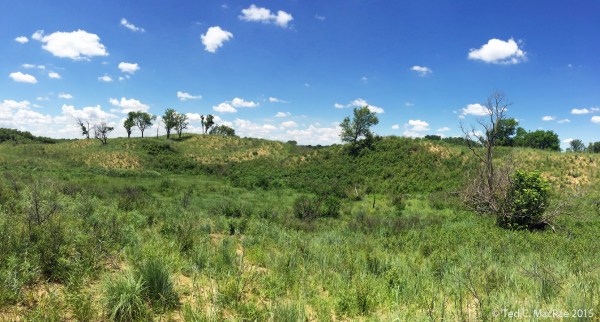
"Medora" Dunes

Sand Hills State Park (“Medora Dunes”), Kansas

Milkweeds (genus Asclepias) are a favorite of mine, and I was stunned to see a yellow-flowered form of butterfly milkweed (A. tuberosus). Eventually I would see plants with flowers ranging from yellow to light orange to the more familiar dark orange that I know from southern Missouri. I checked the plants whenever I saw them for the presence of milkweed beetles, longhorned beetles in the genus Tetraopes (in Missouri the diminutive T. quinquemaculatus is most often associated with this plant), but saw none.

Asclepias tuberosus "yellow form"

Asclepias tuberosus “yellow form”

In the drier areas of the dunes, however, we began to see another milkweed that I recognized as sand milkweed (A. arenicola). I mentioned to Jeff and Mary Liz that a much rarer species of milkweed beetle, T. pilosus, was associated with this plant and to be on the lookout for it (I had found a single adult on this plant at a dune in western Oklahoma a few years back). Both the beetle and the plant are restricted to the Quaternary sandhills of the midwestern U.S., and within minutes of me telling them to be on the alert we found the first adult! During the course of the afternoon we found the species to be quite common in the area, always in association with A. arenicola, and I was happy to finally have a nice series of these beetles for my collection.

Tetraopes pilosus

Two Sandhills specialties—Tetraopes pilosus on Asclepias arenaria

Milkweed beetles weren’t the only insects associated with sand milkweed in the area—on several plants we saw Monarch butterfly larvae, some nearing completion of the larval stage as the one shown in the photo below. Monarchs have been in the news quite a bit lately as their overwintering populations show declines in recent years for reasons that are not fully understood but may be related to recent droughts diminishing availability of nectaring plants for migrating adults and reduction of available food plants as agricultural lands in the U.S. become increasingly efficient.
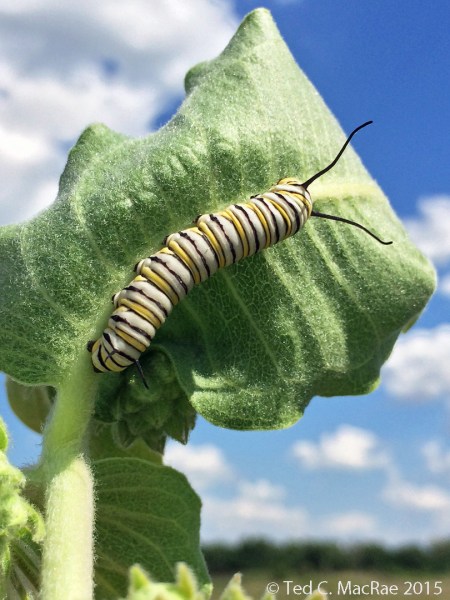
Danaus plexippus larva

Monarch butterfly (Danaus plexippus) larva on Asclepias arenaria

We found some other interesting insects such as the spectacular Plectrodera scalator, cottonwood borer, and the southern Great Plains specialty scarab, Strigoderma knausi, both of which I took the time to photograph with the big camera—separate posts on those species will appear in the future. Sadly, no Prionus came to either our lures or our lights that evening, but some interesting other insects were seen during the day and even at the lights despite unseasonably cool temperatures and a bright moon. I’ll post photographs of these insects, taken with the “big” camera, in the coming weeks. In the meantime, my thanks to Mary Liz for hosting us—I look forward to our next chance to spend some time in the field together.

Ted MacRae, Mark Huether, Jeff Huether, Mary Liz Jameson

Ted MacRae shows Mark Huether, Jeff Huether, and Mary Liz Jameson how to take a panoramic selfie.

The following day, Adam James Hefel—at the time a graduate student at Wichita State University—and I traveled northwest of Wichita to Quivira National Wildlife Refuge. Adam has recently become interested in tiger beetles and had observed several interesting species on the margins of the salt marshes at Quivira. Several of these species were on my “still to photograph” list (and one even on my “still to see” list), so I was happy to have access to some local knowledge to help me

Salt marsh

Quivira NWR – salt marsh habitat for halophilic tiger beetles

The saline flats of the central U.S. are hyperdiverse for tiger beetles. Adam has seen six species in the saling flats of Quivira, including the saline specialists Cicindela fulgida, C. wllistoni, Ellipsoptera nevadica knausi, Eunota togata, and E. circumpicta johnsonii (formerly Habroscelimorpha) (both red and green forms) and the ubiquitous Cicindelidia punctulata. We managed to find all of these except C. willistoni, which is a spring/fall species—unusual for a saline specialist, but the extreme heat of the day made them exceedingly difficult to approach (and virtually impossible to photograph).

Salt marsh

Tiger beetles are found most often in alkaline flats with sparse vegetation

Salt marsh

The wide open central flats are devoid of not only vegetation but tiger beetles (and life in general!).

Ever fascinated by the diversity of milkweeds to be found in the central U.S., an unfamiliar Asclepias growing in the higher, drier areas around a salt marsh caught my attention. Of course, I checked them for milkweed beetles and quickly found a number of Tetraopes tetraophthalmus individuals. John Oliver kindly identified the milkweed from my photos as Asclepias speciosa (showy milkweed), which does not occur in Missouri (hence the reason I was not familiar with it) but that gets common in the Great Plains and foothills of the Rocky Mountain.

Asclepias speciosa

Asclepias speciosa, or showy milkweed.

Asclepias speciosa

The specific epithet “specioosa” refers to the large, showy flowers.

Tiger beetles were not the only wildlife encountered on the saline flats. Killdeer and western snowy plover adults were abundant in the area, and we found this next with eggs along the lightly vegetated edge of a saline flat around Big Salt Marsh. Cheryl Miller suggested they are probably plover eggs, since killdeer don’t usually scrape out a cup or put debris around the eggs, while snowy plovers are known to nest on or near salt flats and frequently surround their eggs with twigs, small bones or other debris.
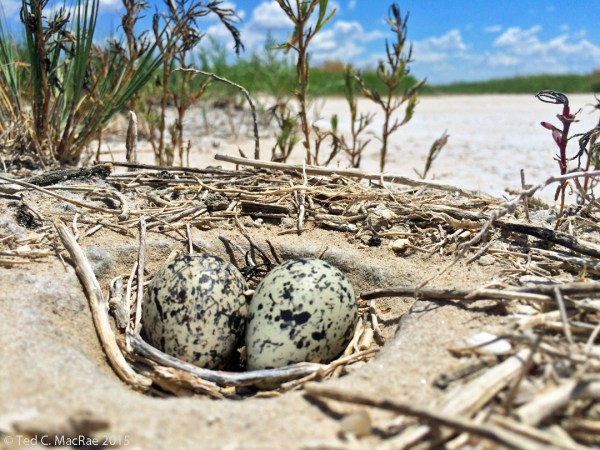
Western snowy plover (Charadrius nivosus) eggs

Western snowy plover (Charadrius nivosus) nest with eggs at the edge of an open flat

During the drive into the refuge, I noted several stands of large cottonwood (Populus deltoides), many of which were half- or completely dead. To some, these trees may be just ugly, half-dead trees. For me, however, they offer an opportunity to look for the gorgeous and rarely encountered Buprestis confluens, a species which I found for the first time just last year (not too far from hear in north-central Oklahoma). After getting our fill of tiger beetles, we drove to a parking lot surrounded by some of these trees, and even before I got out of the car I could see an adult B. confluens sitting on the trunk of a large, dead tree at the edge of the parking lot! I quickly secured the specimen, then spotted the half-dead tree in the photo below and walked towards it to look for more. I did not see any adults sitting on the trunk, but what I did see was truly incredible—two adults just beginning to emerge from the trunk! Waiting for one of the adults to emerge naturally (we “helped” the other one along) and photographing the sequence would occupy the next hour, but what an experience (and, of course, photos to come in a separate post).

Populus deltoides surrounded by hemp

This large, half-dead Populus deltoides “screams” Buprestis confluenta!

Wild hemp (Cannabis sativa)

Wild hemp (Cannabis sativa) fills the are with a pungent aroma.

After a break from the heat and something to eat in the nearest town (20 miles away), I returned to the cottonwoods, broke out the hatchet, and began chopping. Cottonwood is an amazingly soft wood compared to hardwoods such as oak and hickory, but dead cottonwood is still tough, and only after much effort did I manage to chop out two pupae (one of which later successfully emerged as an adult) and two unemerged adults, resulting in a nice, if still rather small, series of a species that until last year was not represented in my collection and until this time by only a single specimen.

Chopping Buprestis confluenta unemerged adults/pupae

Chopping Buprestis confluenta unemerged adults/pupae

Buprestis confluenta pupa

Exposed Buprestis confluenta pupa in its pupal chamber.

With the setting sun illuminating distant thunderclouds, I returned to the salt marshes to setup blacklights for the evening in hopes of attracting some of the tiger beetles that we had seen earlier in the day—not in attempt to collect more specimens, but rather to take advantage of their attraction to the lights and reduced skittishness in the cool, night air in an attempt to photograph them (I already had live specimens for studio photographs if necessary, but I prefer actual field photographs whenever possible). Eunota togata was not attracted to the lights, but both E. nevadica knausi and E. circumpicta johnsonii came to the lights in numbers (both red and green forms of the latter), and I succeeded in getting some real nice photographs as a result.
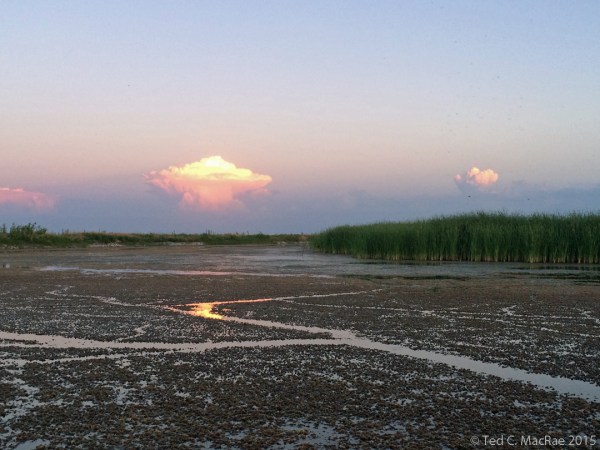
Thundercloud illuminated by setting sun

Thundercloud illuminated by setting sun

On the way back home, and again with the sun dropping close to the horizon, I stopped by Overton Bottoms again to look for Ellipsoptera lepida. Chris and I hadn’t see it here two weeks ago, and I was thinking (hoping) that it might have still a bit early in the season. This time I found them, and although they were not numerous and were apparently confined to the southernmost exposures of the central sand plain, they were still plentiful enough to allow me to get the field shots that I’ve wanted of this species for so long (and providing fodder for yet another future post). This species never seems to be encountered in great numbers, and although I have seen them on a number of occasions it always amazes me just how difficult they are to see!

Sand plain

Another pass through Overton Bottoms looking for Ellipsoptera lepida, this time with success!


Tryin’ for Prionus—part 2
South-central Kansas (11–12 July 2015)

Although our long-shot effort for Prionus simplex at the dunes near Medora, Kansas didn’t pan out, another species we hoped to see was P. debilis—a rather uncommonly collected species that occurs in the tallgrass prairies of the eastern Great Plains and, to our knowledge, had not yet been demonstrated to be attracted to prionic acid. I’d only seen this species once myself, some 30 years ago when I collected four males at lights near the southwestern edge of Missouri. As it happens, longtime cerambycid collector Dan Heffern grew up in P. debilis-land near Yates Center—not too far from where we were just a few weeks ago. When I mentioned my search for the species, he told me how commonly he used to see it around his home—especially around the 4th of July—and put me in contact with a friend who still lives in the area and has several tallgrass prairie remnants on his land. I made arrangements to visit the following weekend, and with prionic acid impregnated lures in the cooler and blacklights and sheets in the cargo area I set off. As I passed south through eastern Kansas I began to see nice tallgrass prairie remnants about 20 miles from my destination, so I took a chance and set a trap as a backup in case things didn’t pan out near Yates Center.

Trap baited with prionic acid lure

Trap baited with prionic acid lure

Things did pan out, however, although for a long time it did not appear they would. Dan’s friend kept me company while I placed a couple of traps and setup the blacklights, and for a couple of hours after sunset no beetles were seen (although we did enjoy good beer and better conversation). Just when I was ready to throw in the towel I saw a male crawling on the ground near one of the lights, and over the course of the next hour I found nearly a dozen males crawling on the ground in the general area around the lights but never actually at the lights. Interestingly, no males were actually seen in flight, nor were any attracted to the trap placed near one of the lights; however, after I took down the lights and checked the other trap there were five males in it. This likely represents the first demonstration of attraction to prionic acid by males P. debilis. I brought a couple of live males home for photography, taking this iPhone shot of a sleeping beetle in the meantime.
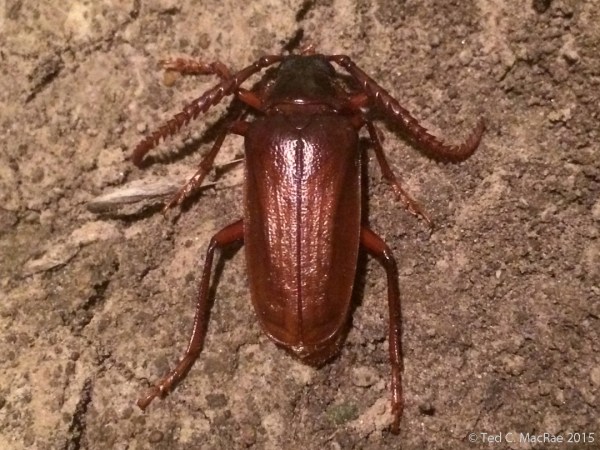
Prionus debilis "sleeping"

Prionus debilis “sleeping”in its cage after being taken near an ultraviolet light

One the way back home the next morning, success already “in the bag”, I stopped to check the trap I had placed the previous day. Filled with anticipation as I approached the trap, I was elated to find 21 males in the trap!

Prionus debilis

Prionus debilis in prionic acid lure-baited trap

The male antennae of this and other Prionus species show numerous adaptations that are all designed to maximize the ability to detect sex pheromones emitted into the air by females. They are both hyper-segmented and flabellate, providing maximum surface area for poriferous areas filled with chemical receptors. Larval habits for this species remain unknown, but Lingafelter (2007) states “Larvae may feed in living roots of primarily Quercus and Castanea, but also Vitis, Pyrus, and Zea mays.” I am not sure of the source of this information and don’t really believe it, either, as I think it much more likely that they feed on roots of bunch grasses such as bluestems (Andropogon spp.) and other grass species common in the tallgrass prairies.

Prionus debilis

Prionus debilis “looking” out over its tallgrass prairie habitat

Before reaching St. Louis, I decided to stop off at the last two known sites for Missouri’s endangered (possibly extirpated), disjunct, all-blue population of Eunota circumpicta johnsonii (Johnson’s Tiger Beetle). This didn’t go well—I first tried Blue Lick Conservation Area in Cooper County, where Chris Brown and I made the last known sighting of this beetle in the state 12 years ago at a salt spring about 500 yards further down the road in the photo below. I’m unsure what adaptations adults and larvae may have for surviving prolonged flooding, but it certainly cannot be helpful for the beetle. I then visited nearby Boone’s Lick State Historic Site in Howard County, and while the site was not flooded the two small areas where salt springs were located during our survey were even more heavily encroached by vegetation than before. Not only were no beetles seen, there did not even seem to be the slightest possibility that beetles could occur there. I keep hoping that the beetle will, someday, be seen again, but in reality I think I am just having trouble accepting the fact that I may have actually witnessed the extirpation of this incredibly beautiful and unusual population of beetles.
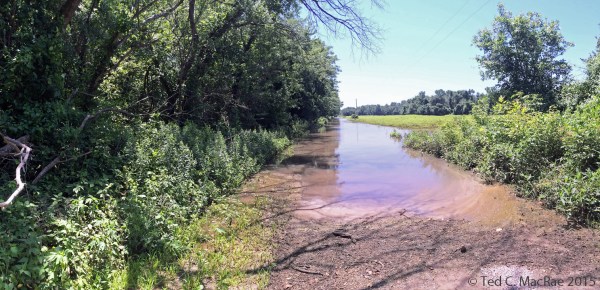
Flooded road leading to saline lick tiger beetle habitat

Flooded road leading to last known Missouri site for Eunota circumpicta johnsonii


Chillin’ after work
Sand Prairie – Scrub Oak Preserve, central Illinois (15 July 2015)

By the time mid-July rolls along, temperatures are not the only thing heating up. My travel for work also reaches a fever pitch as I begin traveling to research plots in Illinois and Tennessee every  two weeks. It takes three days to make the +1,000-mile round trip, which means that I have two nights and an occasional afternoon stop to collect insects—much more fun than checking into hotel right after work, eating dinner at Applebee’s, and spending the evening switching back and forth between FOX and MSNBC to see who can make the most outrageous statement because IFC just isn’t offered. One of my favorite spots along this route to set up a blacklight is Sand Prairie – Scrub Oak Preserve in Mason County, Illinois. Nothing too spectacular showed up at the lights there this season, but as they say a bad day (or night) of bug collecting is better than a good day of just about anything else.
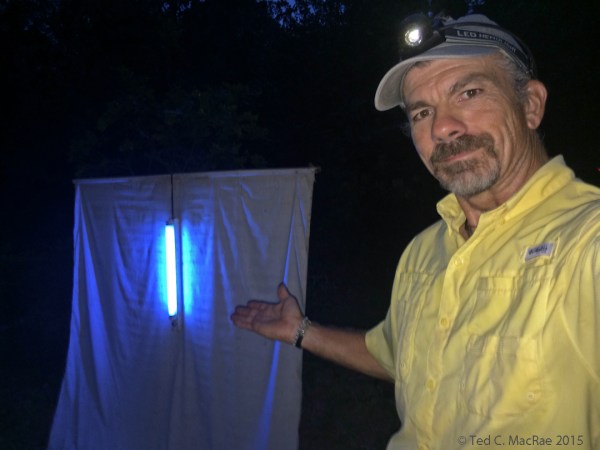
Ted MacRae at the blacklight

Calling all insects—the blacklight awaits you!

On this particular night a number of hawk moths (family Sphingidae) came to the lights, among the prettier of which included this Paonias excaecata (blinded sphinx) (kindly identified by Robert Velten).

Blinded Sphinx, Paonias excaecata

Paonias excaecata (blinded sphinx) | Sand Prairie – Scrub Oak Preserve, Mason Co., Illinois


More chillin’ after work
Pinewoods Lake, southeast Missouri (28 July 2015)

Another species of Prionus that I hadn’t seen for many years was P. pocularis, a species found in the pineywoods across the southeastern U.S. and, thus, reaching its northwestern distributional limits in the shortleaf pine (Pinus echinata) forests of the Ozark Highlands in southern Missouri. Like P. debilis, I had only seen this species once before—two males at a blacklight at Pinewoods Lake National Forest Recreation Area in Carter County many years ago. Unlike P. debilis, however, these were seen later in summer, as were a few other specimens known from the state. That being the case, I decided to try the prionic acid lures at Pinewoods Lake while traveling back up from Tennessee. I arrived at the lake shortly before sunset and, after getting the traps put out and the lights setup, had the chance to look out over the lake and its surrounding forests where I had collected so many insects back in the 1980s as a young, eager, budding coleopterist.

Pinewoods Lake at dusk

Pinewoods Lake at dusk

Quite some time passed and no Prionus beetles were seen at the light or in the trap (but several other longhorned beetles did occur). Recalling my experience with P. debilis in Kansas a few weeks earlier, I remained hopeful, and eventually my optimism was rewarded when I found this single male floating in the trap’s ethanol preservative. Curiously, it would be the only male seen that night, although several individuals of the related and much more common P. imbricornis were attracted to the prionic acid lures.

Prionus pocularis

Prionus pocularis in prionic acid lure-baited trap | Pinewoods Lake, Carter Co., Missouri

Several other insects did come to the blacklights, among the more photogenic being this underwing moth (genus Catacola, family Noctuidae) identified by Mathew L. Brust as Catocala neogama.

Catocala neogama

Catocala neogama at ultraviolet light | Pinewoods Lake, Carter Co., Missouri

Even more photogenic than underwings are royal moths (family Saturniidae), including this imperial moth, Eacles imperialis.

Eacles imperialis (imperial moth)

Eacles imperialis (imperial moth) at ultraviolet light | Pinewoods Lake, Carter Co., Missouri

Among the longhorned beetles I mentioned that did come to the lights was this Orthosoma brunneum (brown prionid). This species is closely related to prionid beetles (both are in the subfamily Prioninae). However, it is not a member of the genus Prionus, and, thus, is not attracted to prionic acid. It is perhaps no coincidence that males of this species do not exhibit the hypersegmentation and flabellate modifications of their antennae possessed by males in the genus Prionus, though they may still rely on sex pheromones for locating females.

Orthosoma brunneum

Orthosoma brunneum at ultraviolet light | Pinewoods Lake, Carter Co., Missouri

Even spiders were coming to the blacklights, perhaps attracted not by the light itself but by the ready availability of potential prey.
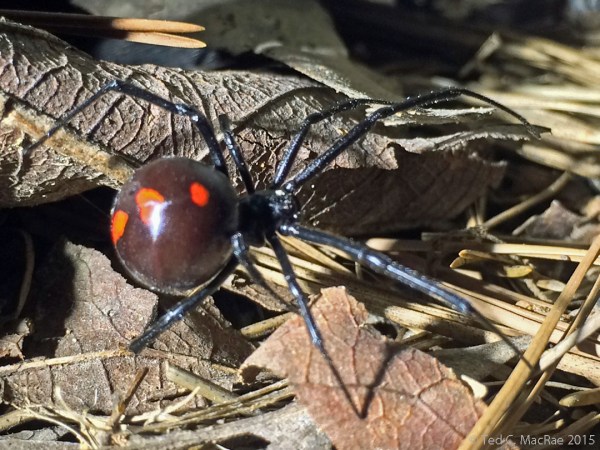
Black widow spider (Latrodectus mactans) female

Latrodectus mactans (black widow) at ultraviolet light | Pinewoods Lake, Carter Co., Missouri


Cicadamania!
White River Hills region, southwest Missouri (1–2 August 2015)

Although I had succeeded in finding Prionus pocularis earlier in the week at Pinewoods Lake, I wasn’t satisfied with having found just a single individual. I had nothing on the calendar the following weekend, so I decided to make a run down to one of my favorite areas in all of Missouri—the White River Hills of extreme southwest Missouri. The only other record of the species in Missouri is from that area, with its abundance of shortleaf pine forests (the species breeds in decadent pines), and I though how nice it would be to find more individuals in a part of the state that I love so much. The plan was to drive down, set a prionic acid trap or two once I got into the pine forests of the area, and then find a good spot to setup some blacklights with one more prionic acid trap that I could monitor. The plan was executed perfectly, and I ended up setting up the lights on a ridge just south of Roaring River State Park; however, the beetles never came. Nevertheless, like I said earlier a bad day/night of bug collecting is still better than just about anything else, and there was plenty at and near the lights to keep the night interesting. Once was this tiny walkingstick nymph that I found hanging out at the tip of a blade of grass. I was intrigued by the rather peculiar position adopted by the resting animal, with its forelegs and antennae extended straight out in front of the body with their tips resting on the grass blade.
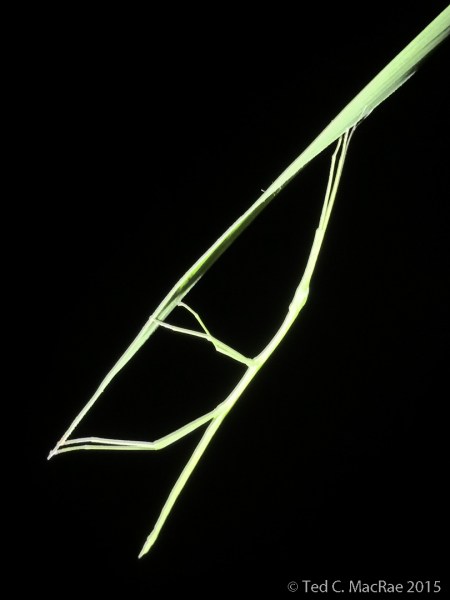
Undet. juvenile walkingstick

Undetermined walkingstick nymph | Mark Twain N.F., Barry Co., Missouri

One thing I love about blacklighting for insects is the sounds of the night—katydids fill the black night with raspy calls while Whip-Poor-Wills and their country cousins the Poor-Will’s-Widows hoot and cluck in the distance.

Undet. adult katydid?

Undetermined katydid | Mark Twain N.F., Barry Co., Missouri

As I was photographing the walkingstick, I felt something crawling on my neck. After many years of doing this, I’ve learned not to freak out and slap wildly at something crawling on my neck, because 1) more often than not it is something interesting and 2) even if it isn’t particularly interesting it’s almost never capable of biting or stinging. Still, I don’t want to just grab it unseen or pin it against my neck—instead I kind of “scoop” it away with my fingers and toss it onto the ground beside me in one swift, assertive movement. This night’s mystery neck crawler was about as interesting as they get—Dynastes tityus (eastern Hercules beetle), the largest beetle in eastern North America. This one is a female by virtue of its lack of any horns on the head and pronotum.
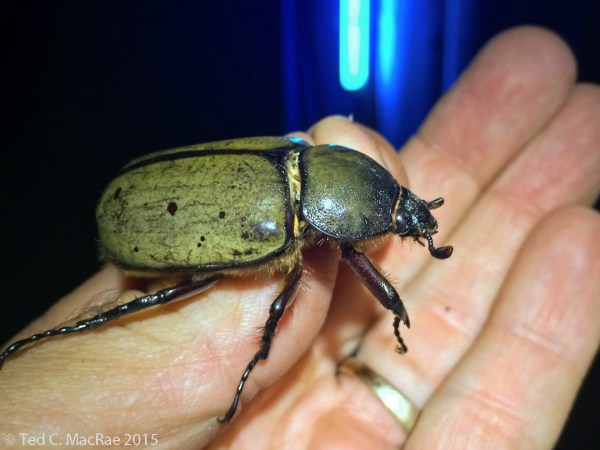
Dynastes tityus female

Female Dynastes tityus (eastern Hercules beetle) | Mark Twain N.F., Barry Co., Missouri

After pulling the lights down for the night, I drove to Mincy Conservation Area, one of the many dolomite glades in the area in the next county over and one that I had not visited for some time. There are no hotels in the area, and my bones are a little too old to be sleeping on the ground, so I just pulled into the campground, took off my shoes, changed into PJs, and laid the driver’s seat all the way back for a surprisingly comfortable night’s sleep. My frugalness would have its reward, although I did not know it until I awoke early the next morning to a hauntingly beautiful fog. I’d never seen the glades in such manner—so serene. I knew the rising sun would quickly burn off the fog and and the moment would be lost if I didn’t act quickly, so I grabbed both big camera and iPhone and, put on some shoes (didn’t bother with changing out of my PJs), and walked the glade taking as many photos as I could. While the quality of the iPhone snaps doesn’t compare with those taken with the big camera, they nevertheless convey the quiet beauty of the glade.
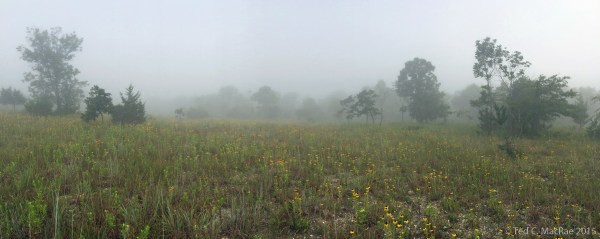
Morning fog over the dolomite glade

Morning fog over the dolomite glade | Mincy Conservation Area, Taney Co., Missouri

Missouri coneflower (Rudbeckia missouriensis) is a characteristic plant of limestone and dolomite glades in the Ozark Highlands of southern Missouri.

Morning fog over the dolomite glade

Missouri coneflower (Rudbeckia missouriensis) | Mincy Conservation Area, Taney Co., Missouri

Morning dew makes spider webs abundantly conspicuous.

Morning fog on a spider web

Morning fog on a spider web | Mincy Conservation Area, Taney Co., Missouri

Eventually the rising sun began to burn through the cool, damp fog, portending another day of searing heat in the xeric glade landscape.

Morning fog over the dolomite glade

The rising sun begins to burn off the fog | Mincy Conservation Area, Taney Co., Missouri

Heading back to my car as temperatures began to rise quickly, I was struck by the cacophony of cicadas that were already getting into high gear with their droning buzz calls. As I passed underneath one particular tree I noticed the song was coming from a branch very near my head. I like cicadas, but I was there to look for the spectacular Plinthocoelium suaveolens (bumelia borer), a glade species associated with gum bumelia (Sideroxylon lanuginosum). Had it been the song of a “normal” cicada like Neotibicen lyricen (lyric cicada) or N. pruinosus (scissor grinder cicada) I would have paid it no mind. It was, instead, unfamiliar and distinctive, and when I searched the branches above me I recognized the beautiful insect responsible for the call as Neotibicen superbus (superb cicada), a southwest Missouri specialty—sumptuous lime-green above and bright white pruinose beneath. I had not seen this spectacular species since the mid 1980s (most of my visits to the area have been in the spring or the fall rather than high summer), so I spent the next couple of hours attempting to photograph an individual in situ with the big camera. This is much, much easier said than done—the bulging eyes of cicadas give them exceptional vision, and they are very skittish and quick to take flight. I knew I had the iPhone photo shown below if all else failed, and for some time every individual I tried to approach ended up fluttering off with a screech before I could even compose a shot, much less press the shutter. Persistence paid off, however, and I eventually succeeded in locating, approaching, and photographing an unusually calm female resting at chest height on the trunk of a persimmon tree. Along the way I checked the gum bumelia trees hoping to spot one of the beautiful longhorned beetles associated with that tree, but none were seen.
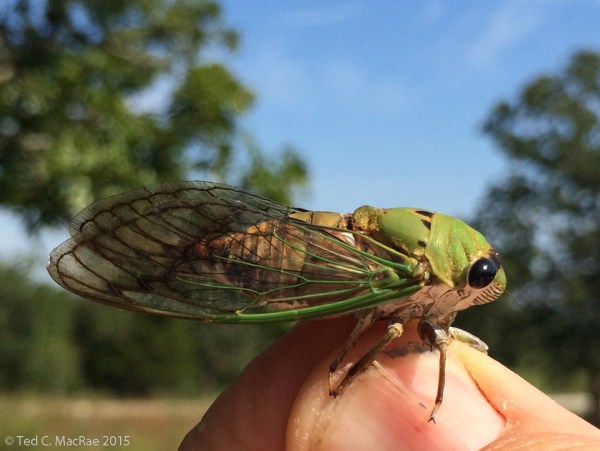
Neotibicen superbus

Neotibicen superbus

It was already high noon by the time I finished up at the Mincy glades, so I began to retrace my steps to check the prionic acid traps that I had set out the day before. Along the way I stopped by Chute Ridge Glade Natural Area in Roaring River State Park, another place where I have seen bumelia borers, so I stopped to try my luck there before continuing on to pick up the traps. Again, none were seen, but in addition to numerous individuals of N. superbus I found another species of cicada, still undetermined by more robust and nearly blackish and with a throatier call that sounding a bit like a machine gun (or table saw hitting a nail!). Despite the lack of bumelia borers, I enjoyed my time on the glade immensely and eventually had to call it quits if I was to get to all of my traps before nightfall.

IMG_6373_enh_1230x720


Still more chillin’ after work
Pinewoods Lake, southeast Missouri (11 August 2015)

Two attempts at Prionus pocularis in the past two weeks had netted me but a single specimen—this species was becoming my summer nemesis. So when I found myself back in Tennessee for field trial work and the timing still right I decided to spend the evening at Pinewoods Lake once again before heading back to St. Louis and see if the third time would be a charm. I found a new restaurant in the tiny nearby town of Ellsinore, and the dinner special that evening was fried catfish—hoo boy! My belly was in a good place after that, filling me with optimism that I would have success tonight. I got to the lake at dusk, quick setup the blacklights and put the prionic acid traps in place, and waited for the bugs to come in.
Pinewoods Lake at dusk

Pinewoods Lake at dusk, again!

The evening’s first visitor to the lights was a parandrine cerambycid—Neandra brunnea. Believe it or not, this was the first time I have ever seen the species alive (once before finding a dead specimen in a Japanese beetle trap waaaay back in the mid-1980s!)—a pretty nice find. In fact, Pinewoods Lake produced a number of good finds during those days back in the 1980s when I was collecting here regularly—longhorned beetles such as Acanthocinus nodosus, Enaphalodes hispicornis, and the aforementioned Prionus pocularis, male Lucanus elaphus stage beetles, the jewel beetle Dicerca pugionata on ninebark in the draws, and the seldom seen tiger beetle Apterodela unipunctata (formerly Cylindera unipunctata), just to name a few.

Neandra brunnea

Neandra brunnea | Mark Twain N.F., Pinewods Lake, Carter Co., Missouri

Seeing N. brunnea and the prospects of collecting P. pocularis weren’t the only things putting me in a good mood…

Blacklighting w/ beer

Blacklighting is better with beer!

My optimism, unfortunately, would eventually prove to be unfounded, as not only did P. pocularis never show up—either at the blacklights or the prionic acid traps, no other beetles showed up as well, longhorned or otherwise. When that happens, I have no choice but to start paying attention to other insects that show up at the lights. It was slim pickings on this night for some reason, making this already striking moth identified by Alex Harman as Panthea furcilla  (tufted white pine caterpillar or eastern panthea) in the family Noctuidae stand out even more so. 
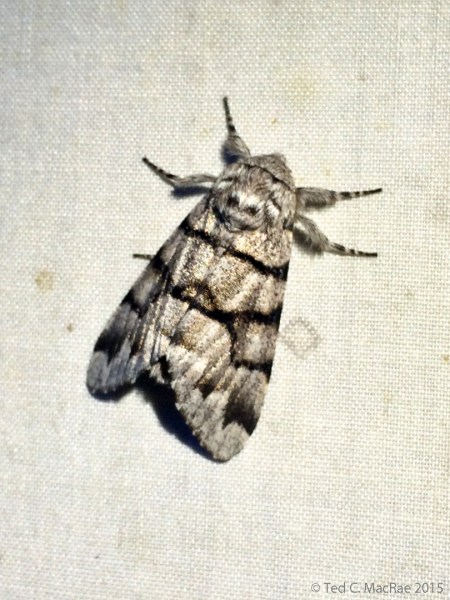
Panthea furcilla

Panthea furcilla | Mark Twain N.F., Pinewoods Lake, Carter Co., Missouri

While walking between the blacklights and the prionic acid traps, something suspended between two trees caught my eye. I recognized it quickly as some type of orb weaver spider (family Araneidae), but I couldn’t exactly figure out exactly what was going on until I took a closer look and saw that there were actually two spiders! I’d never seen orb weaver courtship before, so I excitedly took a few quick shots with the iPhone and then hurried back to the car to get the big camera.

Neoscona sp. courtship

Be very, very careful boy!

Sadly, the male had already departed by the time I got back, so the quick iPhone photos I took are the only record I have of that encounter. Still, I got some good photos of just the female with the big camera, along with the quicker, dirtier iPhone shots—one of which is shown below. According to Eric Eaton these are likely a species in the genus Neoscona.
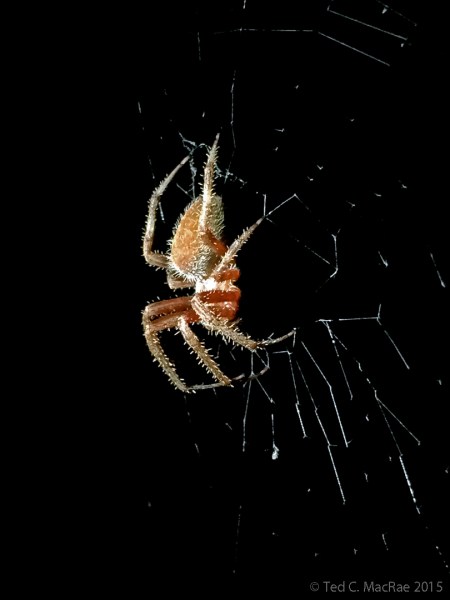
Neoscona sp.

Neoscona sp. | Mark Twain N.F., Pinewoods Lake, Carter Co., Missouri


Checking out a fen
Coonville Creek Natural Area, southeast Missouri (3 September 2015)

On yet another trip back to St. Louis from Tennessee, I made a spur-of-the-moment decision to visit Coonville Creek Natural Area in St. Francois State Park, an area I hadn’t seen in nearly 30 years and the outstanding feature being the calcareous wet meadow, or “fen”, that dominates the upper reaches of the creek drainage. Fen soils are constantly saturated, a result of groundwater from surrounding hills percolating through porous dolomite bedrock before hitting a resistant layer (in this case, sandstone) and seeping out onto the lower slopes. Constantly saturated soils and occasional fires (at least historically) have kept the fen open and treeless, with the cool groundwater allowing “glacial relicts” (i.e., plants common when glaciers covered the area) to persist. 

Calcareous wet meadow

Calcareous wet meadow | Coonville Creek, St. Francois State Park, St. Francois Co., Missouri

I saw a few Cicindela splendida (Splendid Tiger Beetles) on the rocky, clay 2-track leading to the area—a sure sign that fall was just around the corner, a female cicada on herbaceous vegetation in the fen (small, I think it’s not a species of Neotibicen), and a huge, fecund black and yellow garden spider (Argiope aurantia)—I love seeing the latter at this time of year when they have grown to their largest and the females are full of eggs. In reality, however, this visit turned into more of a botanical than an insect collecting experience. Insect activity in general was low, and my attention drifted instead to the diversity of wildflowers that were present on the fen—most new to me. False dragonhead (Physostegia virginiana), great blue lobelia (Lobelia siphilitica), and Spiranthes lacera (slender ladies’-tresses orchid)—its tiny white blossoms spiraling up the leafless spike were the most interesting, resulting in lots of time spent looking at them through the big camera.

Argiope aurantia

Argiope aurantia | Coonville Creek, St. Francois Co., Missouri


The always exciting amorpha borer
Otter Slough Conservation Area, southeast Missouri (23 September 2015)

As the dog-days of summer gave way to bright, blue skies and crisp, fall air, a distinctive insect fauna takes advantage of the explosion of goldenrod that blooms across a landscape morphing from shades of green to orange, yellow, and tawny. Many of these insects are widespread and super-abundant—soldier beetles, tachinid flies, bumble and honey bees, and scoliid, tiphiid, and vespid wasps are among the most conspicuous. Megacyllene robiniae, longhorned beetles commonly called locust borers  are also common on goldenrod during fall, but much less common is a closely related species that breeds in false indigo bush (Amorpha fruticosa)—Megacyllene decora, or the amorpha borer. I’ve seen this species several times, yet uncommonly enough that I still target it when I get the chance. One such place is Otter Slough Conservation Area—yet another interesting place along the way between Tennessee and St. Louis. On one of my final trips back this way I stopped by to see if these spectacular beetles would be out. My attention was first caught by egrets congregating in a mud flat exposed by recent dry weather. However, they were not what I was looking for.
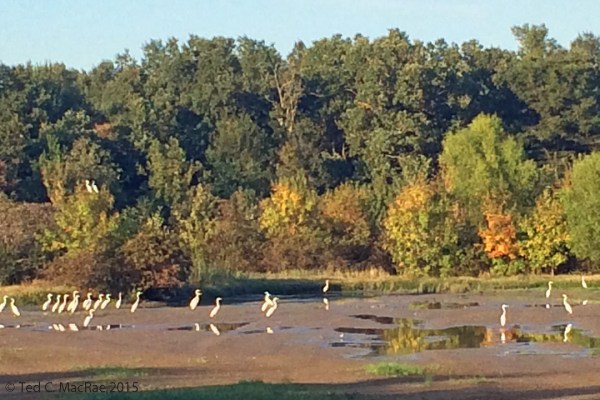
Egrets congregating on mud flats

Egrets congregating on mud flats | Otter Slough, Stoddard Co., Missouri

There is no shortage of interesting insects to look at as I begin scanning the goldenrod flowers growing along the roadsides and around the edges of the shallow pools managed for fishing and shore birds. A fat, female Stagmomantis carolina (Carolina mantis) sat on one of the first inflorescences that I checked, but she also was not what I was looking for.

Undet. mantid

Stagmomantis carolina | Otter Slough, Stoddard Co., Missouri

After a bit of searching, I found what I was looking for! Over the course of the next two hours (all the time I had left before sundown) I would a total of three adults on goldenrod flowers at three disparate locations within the area—again not very many, making those that I did see a real treat.

Megacyllene decora

Megacyllene decora on goldenrod | Otter Slough, Stoddard Co., Missouri

As dusk fell over the area, insects began bedding down for the night. I was lucky to find the last amorpha borer in the dwindling light as it bedded down next to a bumblebee—perhaps the likely model for the beetle apparent mimetic coloration.
Megacyllene decora

Megacyllene decora and a bumble bee bed down together | Otter Slough, Stoddard Co., Missouri

The sun sinking over the horizon behind the wetlands put an end to the collecting, not only for the day but for the season, at least here in Missouri and surrounding states. It would not be the final day of collecting for me, however, as I managed to scrape together some free time amidst my hectic travel schedule and spend a week in eastern Texas for the Annual Fall Tiger Beetle Hunt. I’ll save that trip for another report and close this one out here, but be on the lookout for higher quality photos over the coming months of the really interesting insects that I encountered over this past season. Let me also say that if you’re still reading at this point, you have my deepest admiration for having the persistence to wade through all 8,376 of the words contained within this post!

Dusk over Plover Pond

Sunset over Plover Pond | Otter Slough, Stoddard Co., Missouri

© Ted C. MacRae 2015

Spring beetles on Coreopsis flowers

Abby Lee, Ryan Fairbanks, Stephen Penn atop a rhyolite glades

The WGNSS Entomology Group takes in the view of rhyolite glades from atop Hughes Mountain.

Each spring the Entomology Group of the Webster Groves Nature Study Society takes a field trip to one of the many natural areas outside of the St. Louis area. This year the destination was Hughes Mountain Natural Area, about 75 miles SSW of St. Louis in Washington Co. I especially looked forward to going there this spring, as my last visit to the area was close to 20 years ago. Despite the long absence, I vividly recalled the spectacular vistas from atop the mountain of rhyolite and the diversity of unique plants and insects in the igneous glades that flanked its slopes. When we arrived, we found the glades ablaze with spring wildflowers in full bloom, the most prominent of which was lance-leaved coreopsis (Coreopsis lanceolata). As one of the so-called “yellow composites”, coreopsis is a favored source of pollen and nectar for a variety of insects, including beetles and especially the jewel beetles that I find so interesting.

Acmaeodera neglecta

Acmaeodera neglecta Fall, 1899

Species in the genus Acmaeodera are incredibly diverse in the southwestern U.S. (nearly half of the ~150 species/subspecies known from the U.S. occur in Arizona), where they are usually encountered on a variety of flowers. It is my opinion that the adult beetles mimic small bees, especially in flight by virtue of their fused elytra that do not separate during flight as in most other beetles and thus results in a profile resembling that of a small sweat bee (family Halictidae). The diversity of Acmaeodera drops off considerably in the eastern U.S., with only three species occurring broadly in the area. Missouri is a bit luckier than most eastern states, as two additional species found primarily in the south-central U.S. also occur here (MacRae 1991). One of these is Acmaeodera neglecta Fall, 1899. This tiny species (adults measure only 4–6 mm in length) is very similar to the much more common and widespread A. tubulus (Fabricius, 1801) (see photos here), and in fact its resemblance to that species is so great that it remained unreported from Missouri until Nelson (1987) recognized it among material that I had collected and sent to him during my early collecting days. Acmaeodera neglecta can be distinguished from A. tubulus by the elytra with slightly larger punctures and duller surface and the spots usually longitudinally coalesced into an irregular “C”-shaped marking on each side. I find this species most often in glade habitats.

Acmaeodera ornata

Acmaeodera ornata (Fabricius, 1775)

Acmaeodera ornata (Fabricius, 1775) is more widespread than A. neglecta (although not nearly so commonly encountered as A. tubulus). This handsome species is distinctly larger than A. tubulus and A. neglecta, usually around 8-11 mm in length, and has a broader, more flattened appearance with a distinct triangular depression on the pronotum. The elytra have a bluish cast rather than the bronzy sheen of A. tubulus and A. neglecta, and the spots on the elytra are smaller, more numerous, and more of a creamy rather than yellow color. No other species in the eastern U.S. can be confused with it, although there is a very similar species (A. ornatoides Barr, 1972) that occurs in Oklahoma and Texas. I have encountered this species numerous times on a variety of flowers in Missouri but have never managed to rear it, and in fact larval hosts remain unknown with the exception of one very old (and unreliable) report of the species breeding in hickory (Carya) and black-locust (Robinia).

Valgus canaliculatus

Valgus canaliculatus (Olivier, 1789)

As a general rule, beetles in the family Scarabaeidae don’t visit flowers—species in the subfamily Cetoniinae being a significant exception. This tiny representative of the subfamily, Valgus canaliculatus (Olivier, 1789), is no larger than the Acmaeodera neglecta adult above by length, although the body is broader and strongly flattened. This species is a representative of the tribe Valgini, one of only two tribes in the family that possess dorsal and ventral scale-like setae (the unrelated tribe Hopliini, or monkey beetles, being the other) (Jameson & Swoboda 2005). It has been suggested that the setae might play a role in crysis or adaptive coloration, and even more interesting is the association of most New World species with termites. Eggs are laid in termite galleries and the larvae feed on the wood within the galleries, but it remains unclear whether the termophily is obligatory or the beetles are simply taking advantage of the stable environment and accessible food source offered by termite colonies. Like other species in the subfamily, the adults are fond of flowers; however, only male valgines visit flowers, using specially modified, brush-like mouthparts to lap up nectar. As far as has been determined, the males do not feed on pollen.

Valgus canaliculatus

Note the flattened, scale-like setae covering both the dorsal and ventral surfaces as well as the legs.

REFERENCES:

Fall, H. C.  1899. Synonpsis of the species of Acmaeodera of America, north of Mexico. Journal of the New York Entomological Society 7(1):1–37 [pdf].

Jameson, M. L. & K. A. Swoboda. 2005. Synopsis of scarab beetle tribe Valgini (Coleoptera: Scarabaeidae: Cetoniinae) in the New World. Annals of the Entomological Society of America 98(5):658–672 [pdf].

MacRae, T. C. 1991. The Buprestidae (Coleoptera) of Missouri. Insecta Mundi5(2):101–126 [pdf].

Nelson, G. H. 1987. Additional notes on the biology and distribution of Buprestidae (Coleoptera) in North America, II.   The Coleopterists Bulletin 41(1):57–65 [pdf].

© Ted C. MacRae 2015

How to catch “bucket loads” of Prionus fissicornis!

Fresh off our unexpected success at finding Prionus integer in the shortgrass prairie of southeastern Colorado, field mate Jeff Huether and I made our way down into northeastern New Mexico to see if the prionic acid lures we used to attract that species would bring us success with other species of Prionus. Several species in this genus are known to occur in the Great Plains, and we had records of three from the area around Gladstone (Union Co.). Based on our experience from the previous day, we stopped at several sites that had sandy/loam soil and searched exposures along the roadsides for burrows that bore any resemblance to those that we had found associated with P. integer. Frustratingly, we saw no such burrows or evidence of the presence of Prionus beetles in any of the spots that we searched.

Eventually, with day’s end drawing near, we decided to play a hunch and set traps at two sites with soil exposures that seemed most similar to those seen the day before. As Jeff set the last pair of traps in place, I occupied myself photographing a dusty hognose snake (Heterodon nasicus gloydi). While photographing the animal, I happened to look down to my side, and what did I see but a male Prionus crawling through the vegetation! I recognized the species immediately as P. fissicornis—represented in my cabinet by a single specimen. This species is distinguished by the highly segmented antennae (up to 30 segments or more) that place it in the monotypic subgenus Prionus (Antennalia). I called out to Jeff, and for the next half an hour or so we scoured the surrounding area; however, our searches were in vain as we failed to find another individual.

Prionus fissicornis male

Prionus (Antennalia) fissicornis male | 24 June 2014, Union Co., New Mexico

We cast an eye towards the north and watched late afternoon thunderstorms roll across the expansive landscape. Rain is normally a downer on an insect collecting trip. However, considering the numbers of P. integer that came to the traps after rain the previous day, we actually found ourselves hoping that the skies would open up. Whether they would and if this would lead to success with P. fissicornis (or other Prionus species), however, would have to wait until the next morning when we returned to check the traps.

Thunderstorms over shortgrass prairie.

Thunderstorms over shortgrass prairie.

Around 10 a.m. the next morning our reward was revealed—traps brimming with P. fissicornis males! Each trap contained more than a dozen individuals, and males were still actively crawling around in the vicinity of the traps as well.

Prionic acid-bated traps w/ Prionus fissicornis males

Prionic acid-bated traps filled w/ Prionus fissicornis males.

Prionic acid-bated traps w/ Prionus fissicornis males

Each trap contained more than a dozen males.

We spent about an hour at the site determining the extent of their occurrence, and like P. integer the previous day the males were found almost exclusively in a small area adjacent to (and upwind from) the traps. As we searched, we also found a few females, one of which seemed to be in the act of ovipositing into the soil at the base of a plant. I carefully excavated the hole into which the ovipositor had been inserted once the female withdrew it, but I was unsuccessful in finding an egg. Perhaps she was only probing to search for a suitable oviposition site and did not find this one to her liking.

Prionus fissicornis female

Prionus (Antennalia) fissicornis female | 24 June 2014, Union Co., New Mexico

There are some interesting similarities and differences with this species compared to our experience with P. integer the previous day. Males of both were highly attracted to the prionic acid lures that we used and were effectively trapped in cans over which the lures were suspended. It is also interesting that both species were found in rather large numbers directly after a rain event, and it seems logical to presume that rain might trigger adult emergence—as is the case with many insects that inhabit dry habitats with seasonal rains. However, we did not find P. fissicornis adults associated with burrows as with P. integer, making me even more intrigued with the burrowing behavior in the latter and its possible function. Also, it is interesting that we found P. fissicornis adults most active during the morning hours and P. integer most active during early evening, but since we did not visit both localities at both times of day it is not possible to say for sure that the two species differ in their adult daily activity.

© Ted C. MacRae 2014

My first experience with Prionus lure

Our quick stop in Hardtner, Kansas to see “Beetle Bill” Smith at the beginning of our Great Plains Collecting Trip had already produced one unexpected success—the long-sought-after Buprestis confluenta. However, our trip didn’t really begin in earnest until noon the next day when field mate Jeff Huether and I stopped in the middle of a vast, dry grassland north of Las Animas in southeastern Colorado. Even at this point we hadn’t gotten to the first of our planned localities a little further south where we were hoping to find longhorned beetles in the genus Prionus, the main objective of the trip, using recently developed pheromone lures. Jeff had, however, collected an interesting blister beetle at this spot on an earlier trip and wanted to take another look since we were in the area. I looked out across the desolate landscape and wondered what on Earth I could find here that would be even remotely interesting to me.

Shortgrass prairie, 10.5 mi N of Las Animas, Colorado.
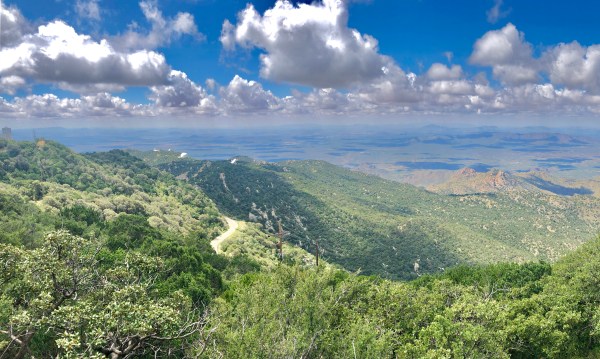
Shortgrass prairie, 10.5 mi N of Las Animas, Colorado.

I was convinced there was no point for me to look around, but I wanted to let Jeff have some time to look for his blister beetle, so I milled around the vicinity of the car to look for any flowers that might be in bloom and hoped to maybe see a tiger beetle or two. As is often the case, plants were a little lusher and more diverse along the roadsides due to rain shedding by the road, so I decided to walk down the roadside and see what I might find. I hadn’t gone too far when I saw a big, brown beetle crawling along the edge of the road. My first thought while approaching it was ground beetle, but I quickly decided it was not that. Only when I crouched down and looked at the beetle, crawling with some urgency but making no attempt to fly, did I realize that it was a female Prionus (later identified as P. integer LeConte, 1851 in the subgenus Homaesthesis). I had, in fact, only once before ever seen a female Prionus, that being the ginormous species P. heroicus in southeastern Arizona almost 30 years ago. Incredible! We hadn’t even gotten to the first spot where we planned to look for Prionus, and I’d already found one. And a female, no less!

Prionus integer female

Prionus (Homaesthesis) integer LeConte, 1851 (female).

Jeff was out of ear-shot, so I resumed my walk along the roadside to look for more. Not long afterwards I found a male carcass laying on the ground, and then shortly afterwards I found another one. One of the carcasses was in pretty good condition still, giving me optimism that I would find a live one as well. Frustratingly, however, I saw nothing more during the next hour as I continued slowly down the road to a distance of nearly one mile from the car and then along the other side all the way back. During the time that I was searching, I noticed strange burrows in the ground. They were only along the roadsides and were especially numerous in the area where I had found the female and two male carcasses. The diggings looked fresh, so I tried excavating a few. They were no more than two inches deep, and I found nothing in any of the dozen or so burrows that I excavated. Nevertheless, I was convinced that the burrows were somehow associated with the Prionus beetles that I had found (even though I had never heard of burrows associated with adult Prionus beetles, nor have I been able to find anything in the literature since)—the size of the burrow matched that of the beetles perfectly, and the presence of fresh diggings meant something had made them recently. If the Prionus beetles didn’t make them, then what did?

Prionus integer burrow

Prionus integer adult burrow.

All the time as I was searching, I wondered if Jeff knew about the beetles occurring here. However, when we finally met up again near the car and I showed him what I had found, I could see by the surprised look on his face that this was not the case. I also showed him the burrows that I’d found, and we both agreed they had to be connected to the beetles. I decided to try using a shovel instead of my knife to excavate more burrows, thinking that maybe I wasn’t excavating deep enough, so we got the shovel out of the truck, walked to the area where I had seen the live female, sunk the shovel deep into the ground next to one of the burrows, and pried up a chuck of the soil containing the burrow in its entirety. As we broke apart the soil there it was—another female!

Prionus integer female

A female Prionus integer dug from her burrow (shovel in lower right).

We excavated more burrows in the vicinity, preferentially choosing those with the freshest-looking diggings, and while most were empty we did find several more females. We were beginning to think that only the females created the burrows, but eventually a male was dug from its burrow as well. By now it was clear that we needed to make the first schedule change of the trip (before even reaching the first planned locality!) and decided to set out lure-baited traps and check them later in the evening before resuming our plans the next day. We expected the beetles to become active during dusk, so we went into town to eat dinner and check out a nearby locality before returning to the site. While we were gone heavy rains moved through  the area, and we weren’t sure if or how this would affect beetle activity and their possible attraction to the traps. However, as we approached the site (slipping and sliding on the muddy 2-track), we could actually see beetles crawling on the road from afar. What we found when we got out of the car was nothing short of mind-blowing—beetles were everywhere, crawling on the road, crawling through the grass, and overflowing in the flooded traps! The vast majority, as expected, were males—distinguishable by their smaller size and distinctly flabellate antennae—but we also found a fair number of the much more rarely collected females—most of them either mating or digging burrows.

Prionus integer mating pair

A male Prionus integer attempts to mate with a female.

It was tempting to focus on just collecting individuals, as we had clearly encountered an ephemeral emergence event. However, it was soon apparent that the number of individuals milling around and flying into the area was far greater than what we could possibly put in our bottles. As I gradually realized this, my focus shifted from collecting to observing—especially the females involved in mating and digging burrows. Most of the females that I saw digging burrows had their abdomens protruding from the burrow as they used their front legs to dig soil from the burrow, but eventually I noticed a burrow that had a female sitting completely within the burrow with her head just below and facing towards the burrow opening.

Prionus integer female

A Prionus integer female sits in her burrow.

I crouched down and watched the female closely (through the camera lens) and noticed a regular, almost rhythmic movement by the beetle as she sat in the burrow. I imagined perhaps the female was in the act of oviposition, although I now think it unlikely that this is the case (it doesn’t make sense for a female to make the energetic expenditure to dig a burrow large enough to contain the adult body when a simple probe of the ovipositor into the soil surface would accomplish the same thing. It also occurred to me that the female was emitting pheromone to attract males, but this begs the same question: why call for mates while enclosed within a burrow when doing so from the surface would be just as (and possibly more) effective. At any rate, the chance to observe mating and other behaviors made the encounter far more informative than if our focused had remained strictly on collecting the abundance that we had encountered.

Prionus integer female

Prionus integer female moving rhythmically in her burrow, but why?

Barr & Penrose (1969) give the only biological notes I am aware of for this species, noting that the larvae have been associated with the roots of sagebrush (Artemisia tridentata) and yellow rabbitbrush (Chrysothamnus viscidiflorus) and on two occasions finding larvae damaging newly planted beans or cutting underground stems of potato plants in southern Idaho. In both cases the fields had been recently cleared for cultivation, suggesting opportunistic feeding by larvae that were already present in the soil and feeding on native hosts when the land was cleared. At any rate, the site where we found the species was completely devoid of any rangeland shrubs, suggesting that herbaceous plants also may serve as suitable hosts for the species. We did observe small bunch grasses that were abundant in the area where both the beetles and their burrows were most numerous—in fact (although perhaps coincidentally), the burrows seemed most often to have been dug at the base of these grasses (see 3rd and 6th photos).

The sinking sun in the west and receding storm clouds in the east created conditions ripe for rainbows—a fitting exclamation point to our first (and completely unexpected) Prionus success of the trip. As the cloak of dusk descended, we packed up our gear and headed into town full of optimism about what other Prionus experiences lay ahead in the coming days.

Rainbow over shortgrass prairie

A rainbow hangs over the shortgrass prairie.

REFERENCE:

Barr, W. F. & R. L. Penrose. 1969. Notes on the distribution and bionomics of some Idaho Cerambycidae (Coleoptera). Great Basin Naturalist 29:88–95 [Biodiversity Heritage Library].

© Ted C. MacRae 2014