Persistence Pays

For the past three years I’ve crisscrossed the country in search of some of North America’s rarest tiger beetles, each time hoping to get that “perfect” photograph of an unconfined beetle exhibiting natural behavior in its native habitat. I’ve managed to get photos of most, though there are a few that I wish I could do over, but the only one that I think really comes close to the ideal I have in my mind is this one of Cicindela formosa generosa, featured in the ESA 2013 World of Insects Calendar (and, ironically, taken only about 5 miles from my home).

A consequence of all this attention to uncommon species is that I’ve somewhat neglected getting good photographs of some of our most common tiger beetles. One of these is Cicindela repanda (Bronze Tiger Beetle), which can be found near almost any body of water throughout the bulk of eastern North America. This summer I resolved to correct that situation, but I found this to be more difficult than anticipated. The first time I tried to photograph the species was when I encountered them in late July on a wide, open beach along the Mississippi River on a hot, summer day. I found the beetles almost completely unapproachable due to the extreme heat and lack of any cover that could be used to my advantage. I had better luck in mid-August when I attracted some individuals to an ultraviolet light that I had setup one night at a spot further north along the river. Those photos were acceptable technically but lacking otherwise, primarily because the beetles didn’t assume any of the charismatic poses associated with the thermoregulatory behaviors exhibited by active beetles in the middle of a hot summer day. Finally, at the end of August, I encountered the species yet again on a small patch of sandy/muddy river bank along the Mississippi River just south of St. Louis. It was another hot day—quite hot actually—but with the help of some features of terrain I was finally able to get that photo of the species that I’ve been wanting.

Cicindela repanda (Bronze Tiger Beetle) | St. Louis Co., Missouri

I like this photo for a number of reasons. The beetle is nicely profiled while paused “tall” on its front legs (a common posture on hot days as they try to lift themselves up off the hot soil surface), the angle is low, and the subject and foreground are well focused in front of a nicely blurred backdrop of rocks. It is these rocks that actually helped me get this photo. I had chased several individuals down on the open sand for some time, but since the day was as hot as my first attempt and I wasn’t having any better luck. Every now and then one of the beetles that I was “working” would fly up into this rockier area, and I noticed that I was able to get closer to these beetles because I was able to stay lower as I made my approach. I began preferentially working beetles towards the rocks and finally got one that settled down and started showing normal searching behaviors despite the fact that I was already in fairly close range. At that point, it became a matter of waiting for the beetle to “lower his guard” while I assumed a shooting position, and as soon as it began acting normal I slowly closed in and began taking shots.
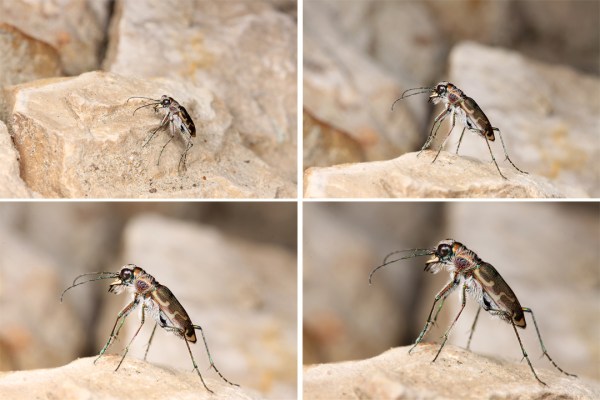
Getting close is a process, as these successive shots demonstrate.

This collage shows the four shots immediately preceding the final photo and how each shot brought me a little closer to the beetle (and that final composition that I wanted). The beetle was still in search mode as it crawled up the side of one rock and I began taking photos, but upon reaching the top it paused and lifted itself up high on its front legs. I knew I would have 5, 10, maybe 15 seconds at the most to capture this pose before it began moving again, so I closed in slowly but assertively and fired a shot every couple of seconds until I got the one that I wanted. At that moment, the beetle flew away, and although I tried for another 20 minutes or so I was unable to get another beetle back up on the rocks for more shots. How fleeting success can be!

Copyright © Ted C. MacRae 2012
Hand-held caddisflies

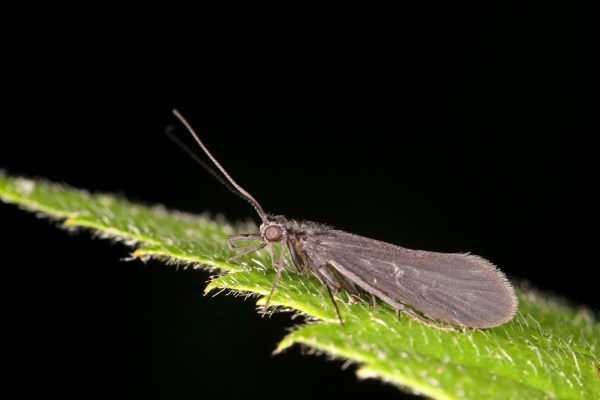
Chimarra sp. (Trichoptera: Philopotamidae) | Sam A. Baker State Park, Missouri

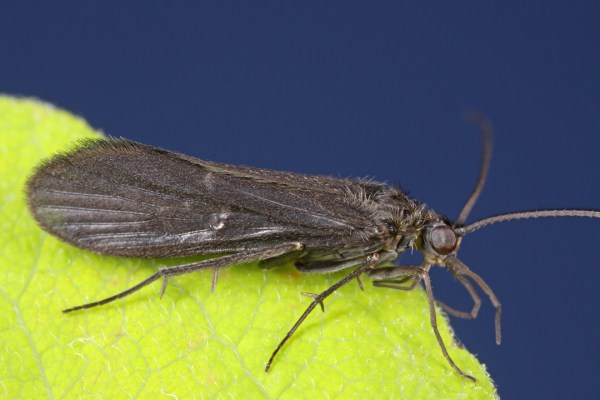
I recently found a folder in my files with a number of photos taken way back in April during a visit to Sam A. Baker State Park in the Ozark Highlands of southeastern Missouri. I never got around to posting them at the time, but there are some interesting photo series in the folder. One includes these photographs of an adult caddisfly (order Trichoptera). I remember seeing these insects in fair numbers resting on the foliage of shrubs alongside Big Creek and thinking they were some kind of archaic family of moths. Admittedly, it wasn’t until I got the photos up on the computer and saw the lack of any coiled proboscis for mouthparts, prominent maxillary and labial palps, and hairy rather than scaled wings that I realized what these were. My mistake is understandable—trichopterans are quite closely related to the order Lepidoptera, the two groups together forming an “ironclad” monophyletic clade (Wheeler et al. 2001).

The distinct palps, lack of proboscis and ”hairy” wings identify this insect as a caddisfly rather than a moth.

It was the beginning of this past season that I began practicing “hand-held” technique for insect macrophotography in earnest. I don’t use a tripod, so shooting insects resting on foliage requires that I brace my body to minimize movement. This is fairly easy if I can sit or crouch but very difficult if I have to stand. Moreover, even if I can manage to eliminate body movement, the plant on which the insect is resting often moves because of wind. What is really needed is a way to “lock” the relative positions of the camera and subject—movement is fine as long as both camera and subject are moving together. That’s where hand-holding the subject comes in… well, handy! I’ve learned to carry a small folding scissors in my waist pack when I am in the field, and by very gently grasping the petiole of the leaf on which the insect is perched with my left-hand thumb and forefinger and snipping the petiole with the scissors, I can detach the leaf without disturbing the insect and then hold it in any position and against any background that I desire. To take the photograph, I hold the camera in my right and and rest the lens on my left wrist or the base of my left thumb and then fine tune the position of the insect on the leaf while composing through the viewfinder. In this manner I not only lock the subject-lens distance but also precisely control the composition and background. This works best with the MP-E 65mm lens—its working distance of only 4″ at 1X and even less at higher magnifications is perfectly suited for this technique. I do also use this technique with my 100mm lens, but it is more difficult to do because of the longer working distance of the lens and resulting need to rest the camera further back on the left forearm. At any rate, these photos represent some of my earliest efforts using what I call the “left wrist” technique.

Among caddisflies, the blackish body and wings are characteristic for this genus.

I thank Dr. Robert Sites, University of Missouri-Columbia, for identifying the individual in these photos to the genus Chimarra in the family Philopotamidae (he also noted that male genitalic characters would be needed for species determination). Ferro and Sites (2007) listed three species of caddisflies in this genus from Sam A. Baker State Park (C. feria, C. obscura, and and unidentified Chimarra sp.).

REFERENCE:

Ferro, M. L. & R. W. Sites. 2007. The Ephemeroptera, Plecoptera, and Trichoptera of Missouri State Parks, with Notes on Biomonitoring, Mesohabitat Associations, and Distribution. Journal of the Kansas Entomological Society 80(2):105–129.

Wheeler, W.C, M. Whiting, Q.D. Wheeler & J.M. Carpenter. 2001. The phylogeny of extant hexapod orders. Cladistics 17: 113-169.

Copyright © Ted C. MacRae 2012

Black is beautiful!

As much love as I give to tiger beetles, I tend to be just as indifferent to the non-cicindeline ground beetles. Why this is I don’t know; ground beetles sensu lato are super diverse taxonomically, morphologically, and ecologically, and the colors of some rival even the gaudiest of beetles. Still, whenever I see a Harpalus pensylvanicus or Bembidion affine crawling on the ground, my brain just yawns and I look elsewhere. I suspect my tiger beetle inclinations have more to do with their extreme habitat specificity and attendant behavioral adaptations, in which areas the other ground beetles are clearly somewhat lacking. There are also those tiger beetles jaws!

Calosoma sayi (black caterpillar hunter) | New Madrid Co., Missouri

Well, there is one group of carabids that does excite me almost (almost!) as much as tiger beetles, and that is the nominate subfamily Carabinae with genera such as Calosoma, Callisthenes, Scaphinotus, and Cychrus—the so-called “caterpillar hunters” and “snail hunters.” These are the giants of the family, with most species measuring at least 15 mm in length and many measuring up to 25 mm in length or more. And then there are those jaws! Perhaps my feelings for this group are no coincidence, given the close relationship between these beetles and tiger beetles (in fact, most molecular data suggest that tiger beetles are firmly nested within the Carabinae).

Baby got jaw!

I came across several individuals representing Calosoma sayi (black caterpillar hunter), including the two individuals shown in the above photographs, back in late August under street lamps in the southeastern Missouri city of Portageville. Though it lacks the metallic colors possessed by many other species in the group, it does have those delightful, sculptured jaws. While I don’t normally like to photograph beetles on pavement, that’s where the beetles were and I’ve had poor luck in trying to move active beetles to an alternative substrate and then get them to settle down and resume natural-looking positions. In this case, it turned out not to be necessary to move the beetles, as the color and texture of the pavement provides a very nice background for these all black beetles. Also, did I mention those jaws?!

Copyright © Ted C. MacRae 2012
Gulf Fritillary in southern Missouri

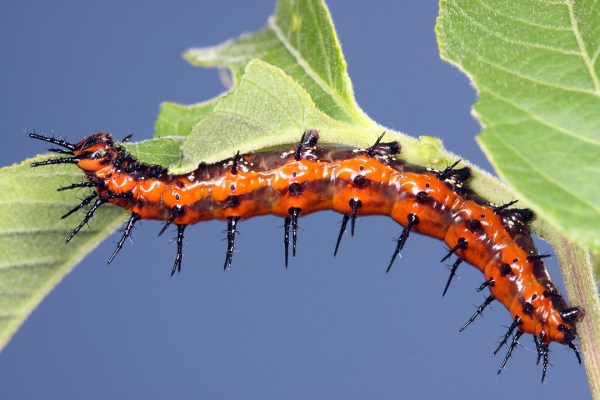
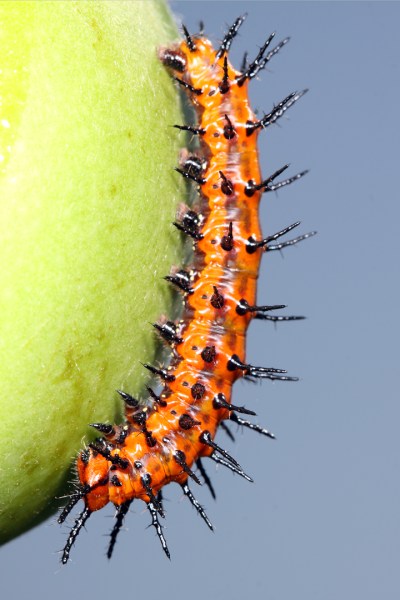
Gulf Fritillary (Agraulis vanillae) | Mississippi Co., Missouri

I’m not sure, but I think this might be the first time I’ve photographed a butterfly caterpillar. Not a bad subject to start with, as few butterflies have caterpillars that are more colorful than the Gulf Fritillary, Agraulis vanillae. A common resident in the southern states and further south, this member of the nymphalid subfamily Heliconiinae is less commonly encountered in Missouri—in fact, I had never seen (or at least noticed) these caterpillars before encountering a few feeding hungrily on the foliage of maypop (Passiflora incarnata) growing in a city park in Missouri’s southeastern lowlands. While the stunning colors of these caterpillars are a delight to human eyes, their function, as in most butterfly caterpillars, is to advertise the unpalatability of their toxin-laced bodies. In the case of this species, the toxins include cyanogenic glycosides that the larvae sequester from the tissues of their host plants (ironically these compounds are supposed to serve the same protective function for the plant that produces them, but butterflies have become master specialists at evolving mechanisms to sidestep toxic impacts).

According to my friends Richard & Joan Heitzman, long-time students of Missouri Lepidoptera, this species is a sporadic migrant that occasionally forms summer colonies in Missouri, especially in the western half of the state, until the first hard freeze destroys the colony (Heitzman & Heitzman 1987).

REFERENCE:

Heitzman, J. R. & J. E. Heitzman. 1987. Butterflies and Moths of Missouri. Missouri Department of Conservation, Jefferson City, 385 pp.

Copyright © Ted C. MacRae 2012
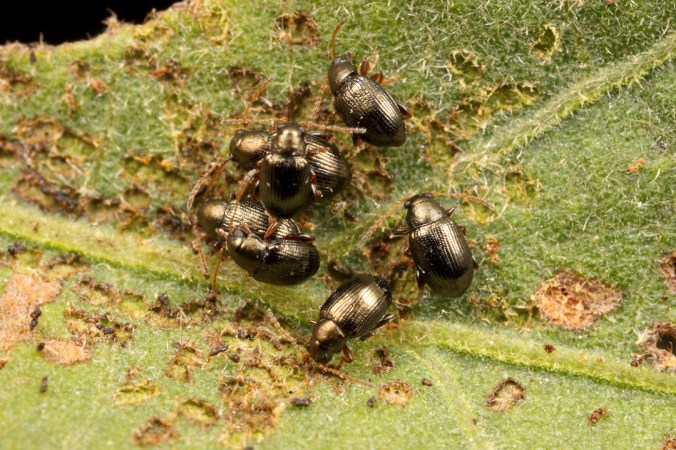
Life at 8X—hibiscus flea beetle

Chaetocnema quadricollis on Hibiscus lasiocarpus | St. Louis Co., Missouri (photo @ 2X)

In mid-August I visited Route 66 State Park along the Meramec River in east-central Missouri to check stands of rosemallow (Hibiscus lasiocarpus) that I had previously noticed growing in the park for the presence of the stunning jewel beetle, Agrilus concinnus. Once considered amongst the rarest members of the genus in North America, this species has in recent years been collected at several localities—always in association with Hibiscus spp. (MacRae 2004). I was disappointed to find the rosemallow stands sparse and stunted—a result of this year’s drought—and there were no A. concinnus to be found. Whether this was a result of the drought or the location or the lateness of the season, I do not know. However, as often happens when I don’t find what I’m looking for, I start seeing things that I’m not looking for. In this case, what I noticed were these incredibly tiny leaf beetles feeding on the foliage of the rosemallow plants.

Adults feed gregariously on the upper leaf surfaces, leaving characteristic feeding damage (photo @ 3X)

I’ve collected a fair number of leaf beetles over the years, thus I recognized these immediately as belonging to the subfamily Alticinae (flea beetles) due to the way they jumped when I disturbed them. However, I have also done a fair bit of collecting of insects on rosemallow and never seen (or at least noticed) this species of flea beetle. The beetles were feeding gregariously on mostly the upper surface of the leaves, and their feeding resulted in a rather distinctive damage that caused the more severely affected leaves to shrivel and turn brown. Based on gestalt, I was guessing Crepidodera or Chaetocnema, two genera that contain some of the state’s smallest species of flea beetles.

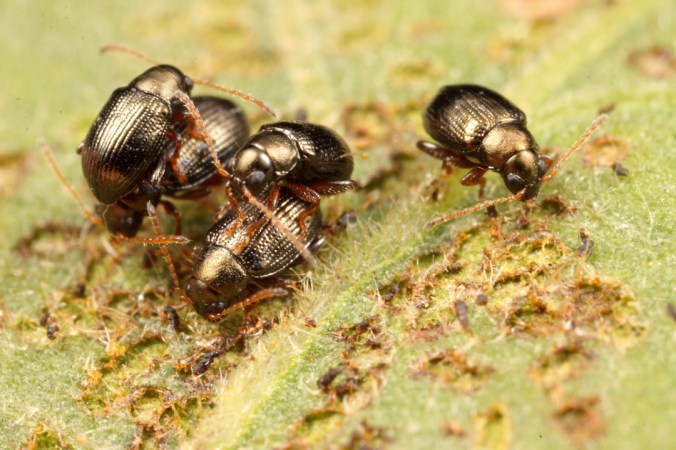
An adult pauses long enough for a photo while feeding on sap at the broken end of a leaf petiole (photo @ 8X)

Based on host plant and this photo on BugGuide, I thought these might represent Chaetocnema quadricollis. However, that species isn’t among the nine species of the genus recorded from Missouri by Riley & Enns (1979, 1982). Nevertheless, Ed Riley himself, and Shawn Clark as well, each confirmed this as the likely identity of the beetles based primarily on its associated host plant, and in fact Riley did record the species from Missouri at numerous localities under the name C. decipiens (later synonymyzed under C. quadricollis by White (1996) in his revision of the genus in North America). Schwarz (1878) described the species from Florida (noting that it has “exactly the same aspect of a small Crepidodera“), and apparently its association with and occasional pest status on rosemallow has long been established (Weiss & Dickerson 1919 recommended Bordeaux or arsenate of lead for its control).

Although coupled, these beetles are not actively mating (is this mate guarding?) (photo @ 8X)

These are probably the smallest beetles that I have photographed so far. In the photo of the mating pair above, the male measures just over 1 mm in length, while the female measures about 1.6 mm in length (the sensor of my camera measures 21 mm wide, so an 8X photo yields a field of view measuring 2.625 mm wide). All of the above photos were taken hand-held in the field with a Canon MP-E 65mm macro lens (1/250 sec, ISO-160, f/14, full flash). The last two photos were taken with the lens mounted on 68 mm of extension tube and fully extended to achieve 8X magnification. While the photos contain good depth-of-field (DOF), they are soft due to the extreme amount of diffraction that occurs at such a small aperture and high magnification. If I were to do it over, I would reduce the aperture to f/10 or even lower and sacrifice some DOF for better sharpness.

REFERENCES:

MacRae, T. C. 2004. Beetle bits: Hunting the elusive “hibiscus jewel beetle”. Nature Notes, Journal of the Webster Groves Nature Study Society 76(5):4–5.

Riley, E. G. & W. R. Enns. 1979. An annotated checklist of Missouri leaf beetles (Coleoptera: Chrysomelidae). Transactions, Missouri Academy of Science 13:53–83.

Riley, E. G. & W. R. Enns. 1982. Supplement to an annotated checklist of Missouri leaf beetles (Coleoptera: Chrysomelidae): new state records and host plant associations. Entomological News 93(1):32–36.

Schwarz, E. A. 1878. The Coleoptera of Florida. Proceedings of the American Philosophical Society 17(101):353–469.

Weiss, H. B. & E. L. Dickerson. 1919. Insects of the swamp rose-mallow, Hibiscus moscheutos L. in New Jersey. Journal of the New York Entomological Society 27(1):39–68.

White R.E. 1996. A revision of the genus Chaetocnema of America north of Mexico (Coleoptera: Chrysomelidae). Contributions of the American Entomological Institute 29(1): 1–158.

Copyright © Ted C. MacRae 2012

Beetle Collecting 101: How to pin a beetle

It has been a long time since I initiated my Beetle Collecting 101 series (more than two years!), and to date the first issue—Beetle Collecting 101: Dress for Success—remains the one and only lesson that I’ve posted. I really had intended to follow that up with nittier-grittier posts on the actual mechanics of collecting beetles and processing the specimens for long-term preservation, but I didn’t and don’t know why other than to say, well… life happens. It’s never too late to fix something, however, so as a long overdue follow up I thought I would give a short video lesson on how to pin a beetle—specifically a cerambycid (longhorned) beetle. Featured in this short (4:31) video is the lovely Megacyllene decora (amorpha borer), which I found back in early September at a site in Missouri’s southeastern lowlands. Click the image to be directed to the video.

Copyright © Ted C. MacRae 2012

Frustrating Emerald

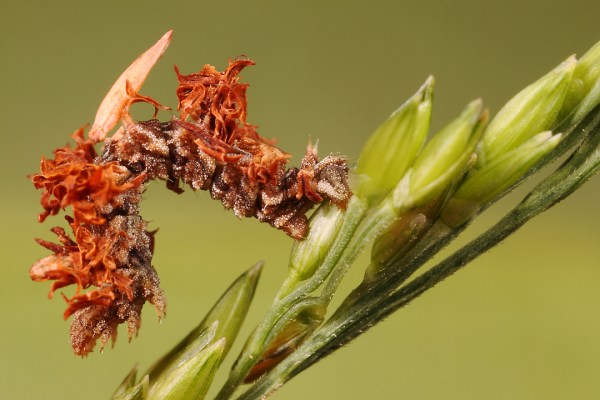
After years in the field looking for insects, one develops an eye not only for recognizing insects but also recognizing when something doesn’t look quite right. That happened to me early this past September at a spot along the Mississippi River in southeast Missouri where I had stopped during late afternoon to look for diurnal species of tiger beetles and then man a blacklight in the evening for nocturnal ones. It was still daylight as I walked along the edge of rank growth bordering the upper banks when a small, reddish “cluster” on a seed head in a stand of tall grasses caught my eye. I didn’t know what it was when I saw it, but I knew it was something ‘out of place.’ My first, cursory thought was that somehow the spent anthers of the now-seeding grass had gotten caught in a tangle, but I must have still had doubts because I looked closer anyway. Just then the “cluster” moved, and I then recognized what I was dealing with—an Emerald moth (Synchlora sp.) caterpillar. Caterpillars in this genus are remarkable for their habit of adorning their bodies with bits of the plants upon which they feed. I am, however, a beetle man and thus admit to being completely unaware of their existence until last summer when Alex Wild featured one of these as a Monday Night Mystery. I wondered then, “Why haven’t I seen one of these before?”, and now I know why—because they are extremely well camouflaged!

Synchlora sp. | Mississippi Co., Missouri

Realizing what I had, all efforts to look for tiger beetles were suspended (I hadn’t seen anything after ~30 minutes of looking anyway), and I broke out the 65mm lens to get the most of this small but remarkable looking insect. I took more than 50 shots, trying different backgrounds, angling the grass stem in different positions, and hoping with each shot that I had captured the larva in full profile, completely in focus, and in the midst of that magical loop. I was sure I had that “perfect” shot when I got home and anxiously fired up the computer to get a better look at the photos. My optimism began to drop, however, as I scanned through each successive photo and continued to not encounter that one photo that would cause me to say “Yes!” Exposure? Check. Composition? Check. Lighting? Check. Focus? Er… crap! The problem was pervasive throughout the entire set, and in the end, I have only this one photo that comes anywhere close to what I had envisioned while I was taking the photos. It’s a shame, because I love everything else about this photo. The cause of the problem is the very thing that makes the larva so remarkable—its adornments. The spent anthers project off the larva in all directions, adding considerable dimensionality to the subject and surpassing the depth-of-field capabilities of my lens. If the subject was in focus the forward projecting anthers were not, and if the anthers were in focus the subject was not. If I had realized in the field what was going on, I would have not gotten in so tight and cropped as appropriate during post-processing. Live and learn!

Although 12 species of Synchlora are found in North America, only one—Synchlora aerata (Wavy-lined Emerald)—is widespread in the eastern U.S. However, a number of other species are found in the southeastern U.S., and for all intents and purposes the Mississippi Lowlands of southeastern Missouri  are the south (culturally as well as biogeographically!). As a result, a generic ID is the best that can be done for this larva.

Copyright © Ted C. MacRae 2012

Wasp Wednesday—Not!

In early September, the agricultural landscape in the central U.S. awakens from its monotonous cloak of summer green and turns ablaze with a hundred shades of yellow, gold, and tawny. The “fall composites” as they are commonly called, a dazzling diversity of mostly yellow-flowered herbaceous plants in the family Asteraceae, are one of the chief contributors to this explosion of color, and among them none contribute more than goldenrod (Solidago sp.). Occupying nearly every fence row, drainage ditch, and fallow field, the bright yellow fronds of tiny flowers are not only pleasing to the eyes of humans, but a smorgasbord of pollen for all manner of flower-feeding insects. Bees, flies, wasps, beetles, and moths all flock to the bounty in numbers rarely seen during the dog days of summer. Spiders, ambush bugs, mantids, and other predators take up residence amongst the flowers as well—not to feed on the flowers, but rather the abundance of flower-feeding insects upon which they will prey. It is rare to find a goldenrod plant without at least a few insects upon it.

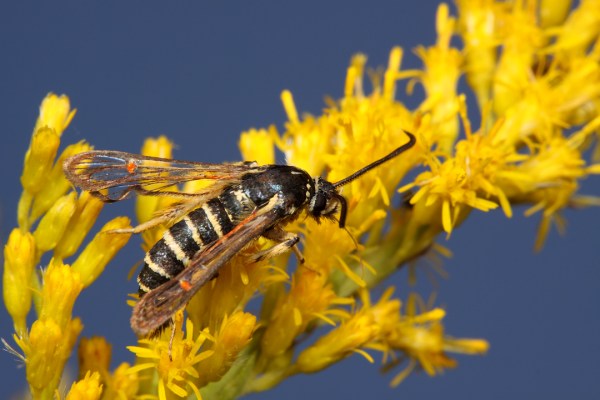
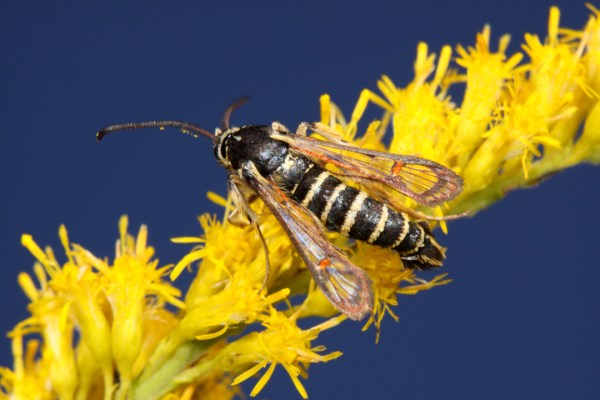
Synanthedon decipiens (oak gall borer) on Solidago sp. | Mississippi Co., Missouri

My favorite goldenrod insects are, of course, the longhorned beetles of the genus Megacyllene, and at least here in Missouri there are none finer than Megacyllene decora (see A classic fall ‘bycid). However, I keep an eye out for other insects as well, and when I first saw this “wasp” sitting on a flower head I had to do a bit of a double take—”something” just didn’t seem quite right about it. A little lean forward was all that was needed to confirm that this was indeed no wasp, but rather a clearwing moth (order Lepidoptera, family Sesiidae)¹. To my mind, of the many insects that try to mimic wasps, none do so more effectively than members of this family. From the elongate body to the yellow abdominal banding and narrow transparent wings, everything about this moth says “wasp”—well, almost everything or I wouldn’t have done a double take to begin with.

¹ I hope Eric Eaton, author of Bug Eric and its Wasp Wednesday series, will forgive my use of his title for this post.

Apparently a male, these moths use pheromones to locate females for mating.

I actually did a fair bit of work with this group in my early years with the Department of Agriculture. Females of most (all?) species emit species-specific pheromone blends that males can detect at incredibly low volumes (only a few molecules are needed to elicit a response by the male antenna). Components of these pheromones have been synthesized, and since a number of species have economic importance in landscape and nursery settings (larvae of most species are borers of woody or perennial plants), these synthetic pheromone blends are commonly employed in traps for survey and detection (e.g., Snow et al. 1985). I conducted surveys for several years during the mid 1980’s in east-central Missouri using these traps and, thus, developed a good eye for distinguishing these moths in flight from the wasps that they so effectively mimic. In fact, I used to keep a pheromone tag on my waist bag, which resulted in male moths frequently flying up to me and “searching” for the female. I never tired of seeing the faces of nursery growers—first showing concern as they were convinced I was under attack by a wasp, and then shock as I calmly reached out and grabbed the “wasp” in mid-flight with my bare hand! (And to be perfectly honest, it took me a while before I could bring myself to start grabbing them out of the air!) I even had one nursery grower continue insisting it was a wasp and could sting even after I had caught it (“Naw, them things sting—I seen ’em!)

The moth in these photos seems to best match Synanthdedon decipiens, widely distributed east of the Rockies and inhabiting the woody galls of cynipid wasps on oaks. In Georgia adults of this species exhibit a bimodal pattern of seasonal occurrence suggestive of two generations per year (Snow et al. 1985), so this September-occurring male might represent a second Missouri generation as well.

REFERENCES:

Snow, J. W., T. D. Eichlin & J. H. Tumlinson. 1985. Seasonal captures of clearwing moths (Sesiidae) in traps baited with various formulations of 3,13-0ctadecadienyl acetate and alcohol. Journal of Agricultural Research 2(1):73–84.

Copyright © Ted C. MacRae 2012