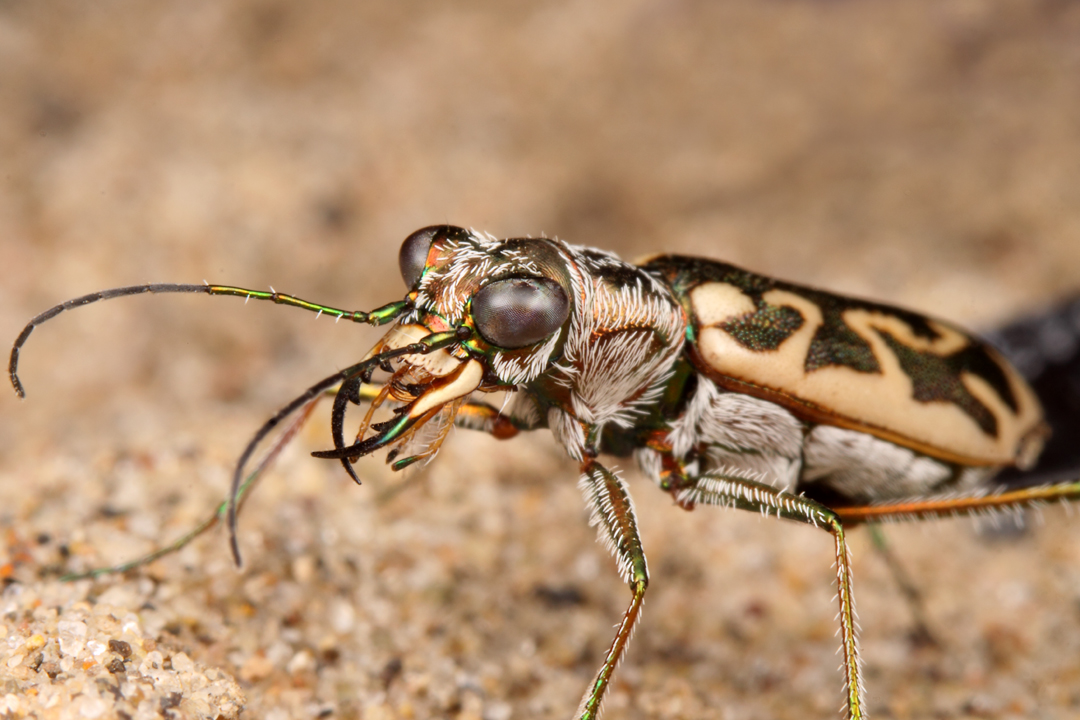
9th Annual Fall Tiger Beetle Trip: Day 1

Once again, I have embarked upon my Annual Fall Tiger Beetle Trip, this being the ninth consecutive year that I have done such a trip. Unlike previous editions, however, the quarry on Day 1 (Sept. 15) was not a tiger beetle but a longhorned beetle. Ataxia hubbardi is not uncommon in the eastern and central U.S. and breeds in the living tissues of a variety of herbaceous plants, but especially certain species of Helianthus, Ambrosia, and Silphium in the family Asteraceae. I was hoping to see a distinctive population of this beetle that is associated with prairie dock (Silphium terebinthinaceum) in the dolomite glades just south of St. Louis. This population is interesting because individuals are smaller, darker, and narrower in form than is typical for the species, and I would like very much to get some photographs of the adults, which seem most abundant in the fall, on the tall flower stalks of their host plant.

Victoria Glades Natural Area | Jefferson Co., Missouri

I first discovered the population many years ago—back in the 1980s when I visited one particular glade, Victoria Glades Natural Area, almost weekly over a period of several years. I left Missouri for a few years in the early 1990s but returned in 1995, and during my absence fire was implemented in Victoria Glades and other glades in the area as a management practice for controlling invasion by woody plants (primarily eastern red-cedar, Juniperus virginiana). While the use of fire has certainly done much to restore the glades and improve its floral diversity, it seems more than coincidental that insect abundance and diversity on the glades is only a fraction of what I observed during my pre-burn collecting in the 1980s. There are a number of beetle species that I found at the glade historically that I have not seen now for more than 20 years; one of which is this distinctive population of A. hubbardi.
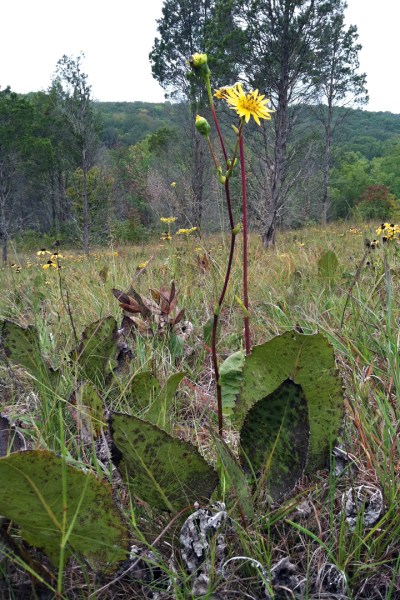
Prairie dock (Silphium terebinthinaceum) – host for Ataxia hubbardi

The prairie dock plants were at the height of bloom, but the flower stems seemed shorter and the normally large, spatulate basal leaves of the plants generally smaller than typical—perhaps a result of this summer’s severe drought. How such conditions affect the beetles is unknown. The day was also rather cool due to unbroken cloud cover and light drizzle, with temperatures in the low 70s during my visit. I spent the better part of two hours inspecting the stems of every prairie dock plant that I encountered and did not see a single beetle, so it has now been 23 years—almost a quarter century—since I’ve seen this once fairly common species at the glade. Can I prove that fire management has extirpated the beetle? No—populations might have been knocked down by the drought, or maybe the adults hide on cool, cloudy, drizzly days. Still, the pattern is too consistent to ignore, and I become increasingly worried that a special feature of these glades has now been lost.
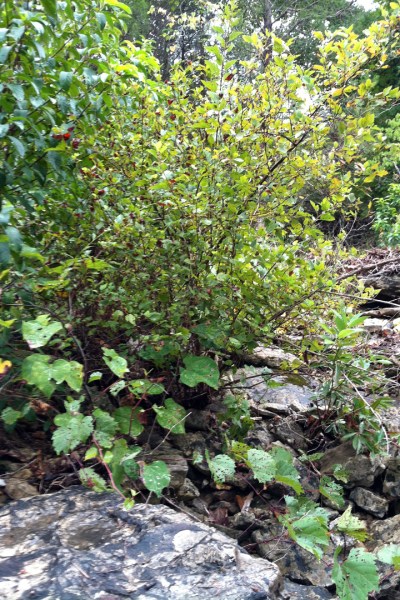
Ninebark (Physocarpus opulifolius intermedius) – host for Dicerca pugionata

On the other hand, another quite rare beetle that I encountered abundantly at Victoria Glades in the past seems to have rebounded from its long absence—the jewel beetle Dicerca pugionata. This beautiful beetle is associated with the scraggly clumps of ninebark (Physocarpus opulifolius intermedius) that hang on in the moist toe slopes of the glades. I wrote about this species earlier this year after re-discovering it in the glades; however, I couldn’t resist taking a few more photographs of this stunningly gorgeous species. This species also makes its appearance in the fall as well as spring, and in the two hours I spent searching I counted 13 beetles—more than I’ve ever seen on any one day. Interestingly, most of these were associated with a stand of plants in an area at the south end of the glade that I had never searched before and that appears not to have been subjected to fire management (cedar removal has been effected instead with a chain saw). Only a few of the beetles were found in the much more abundant plants growing in the area of the glade I am more familiar with and that has obviously been subjected to repeated burning. It’s not proof, but I’m just saying…

Dicerca pugionata on ninebark branch.

Adult beetles are colored almost precisely the same as the bark of their host plant.

More even lighting in this face shot compared to my previous attempts.

The cool temperatures and light drizzle were not conducive to much other insect activity, but while crossing the small, shallow creek that separates the south end of the glade from the main glade, the biggest male tarantula (Aphonopelma hentzi) that I have ever seen caught my attention as it crossed the creek. Situated only 30 miles south of St. Louis, Victoria Glades must represent the northeastern limit of distribution for the species, and although I once saw a tarantula crossing the road very near to this location, this is the first tarantula that I have actually seen in the glades that lie so close to St. Louis. Males are famous for their fall wanderings, presumably in search of the females that tend to stay within their burrows. This male was missing part of one of its hind legs but otherwise appeared quite healthy and robust. I hope he succeeds in finding a mate and sires many offspring and is not discovered by any of the poachers who regularly scour the glades and steal its more unusual inhabitants—the glades have already lost enough of their unique residents…

Can you find the tarantula crossing the creek? (Hint: 0.60X, 0.37Y)
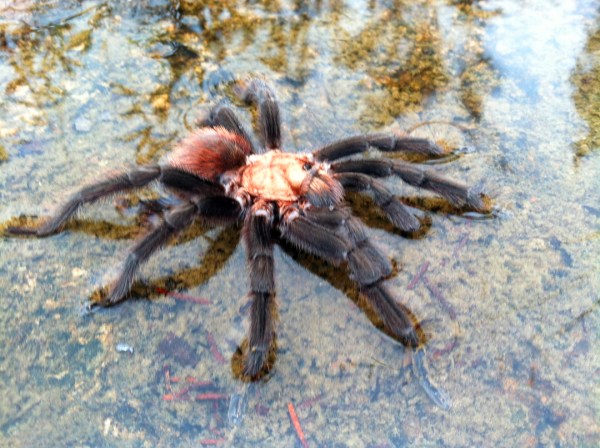
Male Aphonopelma hentzi | Jefferson Co., Missouri

Copyright © Ted C. MacRae 2012

A classic fall ‘bycid

In eastern North America, autumn is the beginning of the end for most insect groups. Preparations for winter are either complete or well underway—eggs have been laid, nests have been provisioned, and larvae (hopefully) have eaten well enough to endure the long, cold months that lie ahead. But for a few insects, fall is just a beginning. Triggered by cooler temperatures, shortened daylength, and invigorating rains, adults of these insects burst forth under crisp, blue skies to feed amongst a plethora of fall flowers or prey upon other late season insects before the advancing cold, finally, forces a close to the season. As a beetle man, my favorite fall insects must be the “fall tigers” (i.e., tiger beetles) that come out in force and zip across barren sand dunes or bask on exposed rocks of dolomite glades. My fall insect collecting focuses almost exclusively on these insects, since my other favorite groups (jewel beetles and longhorned beetles) are, for the most part, restricted in their adult activity to the spring and summer months and long gone by the time fall rolls around. There are, however, a few longhorned beetles that buck the normal spring/summer rule for the family, namely species in the genus Megacyllene. The most commonly encountered of these is Megacyllene robiniae (locust borer), and anyone who has examined goldenrod (genus Solidago) and its profuse blooms during the fall has likely encountered this familiar beetle with its narrow, alternating, zig-zag bands of black and yellow.¹ I have seen this species many times and in many places; however, I still always enjoy seeing it anew in the field each fall—perhaps as some sort of confirmation that the fall season truly has arrived.

¹ If you see a “locust borer” in the spring, it is actually the closely related Megacyllene caryae (hickory borer), while further west in the Great Plains during fall you might find Megacyllene comanchei.

Megacyllene decora (amorpha borer) | Mississippi Co., Missouri

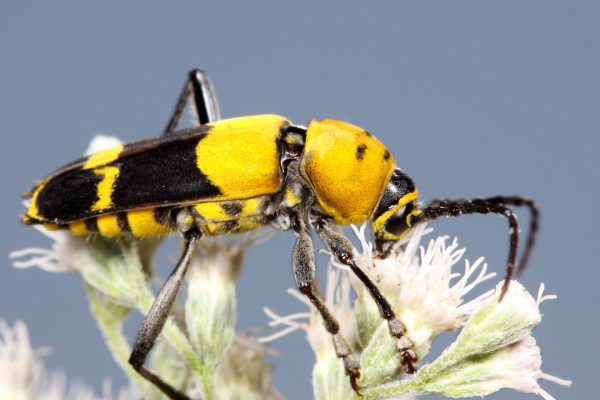
Another species in the genus that is far less commonly encountered, however, is Megacyllene decora (amorpha borer). I have encountered this stunningly beautiful species in only a handful of locations in Missouri (MacRae 1994)—all where stands of its larval host plant, Amorpha fruticosa (false indigo), grow in association with goldenrod and snakeroot (genus Eupatorium). These sites are primarily in the big river valleys of the state (Missouri and Mississippi Rivers), although I have found at least one site in the prairies of west central Missouri. Earlier this summer while traveling through the southeastern lowlands of Missouri, I noticed a stand of native Hibiscus growing within a wet ditch along the edge of a small city park and stopped by to look for the even rarer Hibiscus-associated jewel beetle, Agrilus concinnus (MacRae & Nelson 2003, MacRae 2006). While I did not find that species, I did notice fairly good numbers of A. fruticosa plants along the edge of the ditch as well and young goldenrod plants that had not yet reached flowering stage. At that moment I knew I had a good potential site to look for M. decora and made a mental note to stop at the site again later in the season when goldenrod began to bloom.

The species is distinguished from related species in the eastern U.S. by its wide black and yellow bands.

Last week I returned to the site to find not only goldenrod in its earliest stages of bloom, but an even greater number of Eupatorium serotinum plants already in bloom. I wanted to photograph the beetle, of course, but what I was really hoping for was to find and photograph the beetle on the stems of its Amorpha host plant (I have only seen this once before—all other sightings of the beetle have been on flowers of goldenrod and snakeroot). I approached each Amorpha clump cautiously and searched the stems carefully, also keeping an eye on the goldenrod and snakeroot blooms as I moved from one clump to the next. After searching a number of clumps, I finally found the adult shown in these photos. Fortunately, I knew from previous experience in collecting these beetles that they are not a particularly wary species (few aposematically- or mimetically-colored beetle are), so I was able to get a number of good photographs before I (stupidly) bumped the beetle with the diffuser over my flash heads and disturbed it.

”Blue sky” settings: ISO160–200, 1/200 sec, f/14–16, camera pointed near (not at) the sun.

It would be another half hour before I would find a second beetle, and in total on the day I saw only three (all on Eupatorium). This and the very early stage of the goldenrod blooms suggests to me that the beetles were just beginning to emerge—over the next few weeks I am sure they will become more numerous at the site, so I may yet have an opportunity to photograph one on its larval host plant when I pass by the area in a couple of weeks.

Normal ”normal” full-flash settings: ISO100, 1/250 sec, f/16.

REFERENCES:

MacRae, T. C. 1994. Annotated checklist of the longhorned beetles (Coleoptera: Cerambycidae and Disteniidae) known to occur in Missouri. Insecta Mundi 7(4) (1993):223–252.

MacRae, T. C. 2006. Distributional and biological notes on North American Buprestidae (Coleoptera), with comments on variation in Anthaxia (Haplanthaxia) viridicornis (Say) and A. (H.) viridfrons Gory. The Pan-Pacific Entomologist 82(2):166–199.

MacRae, T. C., and G. H. Nelson. 2003. Distributional and biological notes on Buprestidae (Coleoptera) in North and Central America and the West Indies, with validation of one species. The Coleopterists Bulletin 57(1):57–70.

Copyright © Ted C. MacRae 2012
The very dirty tiger

Ellipsoptera cuprascens (Coppery Tiger Beetle) | Mississippi Co., Missouri

In my post Very wary tigers!, I lamented my inability to photograph one of our state’s less commonly encountered tiger beetles, Ellipsoptera cuprascens (Coppery Tiger Beetle), on an open Mississippi River beach under a blazing sun. There are solutions to such problems, however, one of which is the use of blacklights to attract the beetles at night when cooler temperatures and readily available prey make the beetles much more approachable. Of course, this only works for those certain species that are attracted to blacklights, of which fortunately E. cuprascens is one, and not long afterwards I was able to photograph individuals of this species that came to a blacklight placed further south along the Mississippi River in New Madrid Co., Missouri. The photos were adequate, but none were what I would consider a true winner, so when I found the species again while blacklighting at another Mississippi River beach in southeast Missouri I continued with my attempts to photograph them.

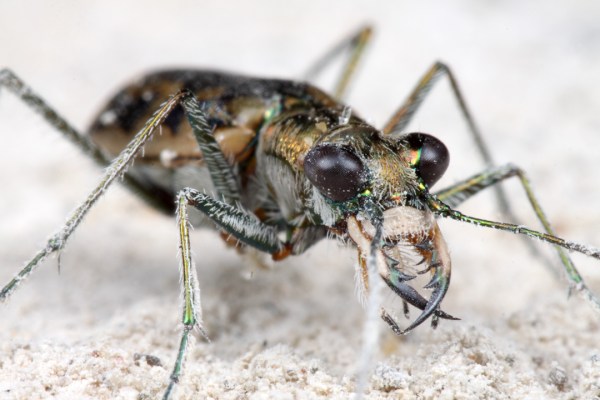
Heavy lime coating the antennae must feel to this fellow like like breathing in concrete does to us!

The species was much less abundant this time, and none of the few individuals that showed up at the light actually spent any time on the ground where I could take reasonably natural looking photographs. This time I decided to look for them along the beach away from the light and succeeded in finding a few. As is typical, the first several that I tried to photograph were too wary to approach, but I’ve learned to keep trying until I find that one (slightly) more cooperative individual. As I crossed over the concrete boat ramp I saw one that seemed not at all flighty. I’ve seen the ubiquitous Cicindela repanda commonly on concrete boat ramps, so I checked carefully to be sure it wasn’t that species, and after confirming its E. cuprascens identity I began the slow, cautious approach that ended with me flat on my belly and the camera lens inches from the beetle. Nighttime photography is tricky because… uhm… it’s dark, and I don’t find my flash unit’s focusing lamps all that helpful (they tend to time out right before I’ve composed the shot to my satisfaction). Instead, I place my headlamp on the ground and position it so that it continuously illuminates the subject so I can concentrate on getting multiple shots without having to constantly divert my attention to the focusing lamp button. The concrete was hard, and my elbows were mad at me for a time afterwards, but the beetle was generously cooperative and took on some very nice poses during the session, leaving me with the impression that I’d gotten that “perfect” shot as I walked back to the blacklight.

The obligatory face-shot—especially stark in its white lime surroundings!

Sadly, these photos are far from perfect. Their composition is good, as is their focus and lighting and the natural-looking poses that I captured. But the beetle is absolutely filthy! I didn’t realize it at the time, but apparently its wanderings across the decaying lower reaches of the concrete boat ramp resulted in a thick coating of lime on just about every part of its body. Now, few tiger beetles that I photograph are perfectly clean and spotless, and although a few grains of sand around the mouth or on the legs are tolerable, I am not above cloning out debris that detracts from the beauty of the beetle—especially when it is on the eyes or its shiny, glabrous dorsal surface. This beetle, however, is simply beyond repair. I’m by no means a Photoshop expert, but I’m not sure even the most fluent PS whiz could fix this beetle. So, my quest for the “perfect” E. cuprascens photo will continue…

Copyright © Ted C. MacRae 2012
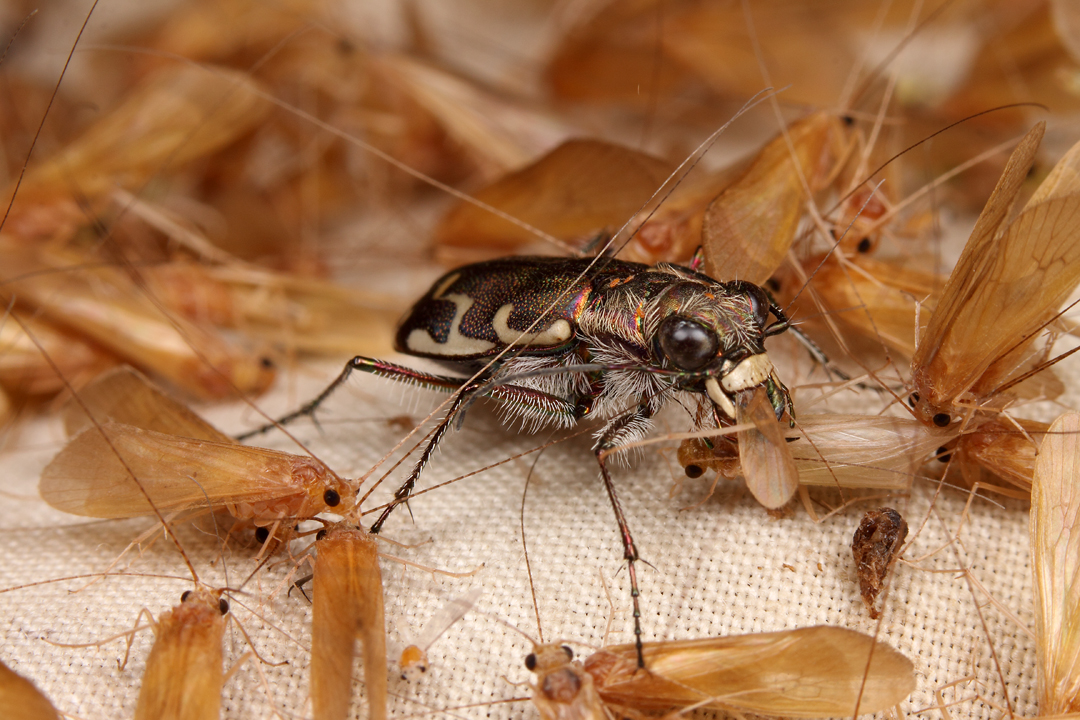
Unexpected visitors

Cicindela repanda (Bronzed Tiger Beetle) | Lewis Co., Missouri

In late July I began blacklighting on a weekly basis at different locations along the Mississippi River in an effort to gain more detailed information on the distribution of certain tiger beetles along that great watercourse. While attraction of tiger beetles to ultraviolet lights is well documented, it seems to me to be an underutilized method for collecting tiger beetles and recording distributions. Perhaps this is because only certain species are attracted to lights—principally members of the genera Ellipsoptera and Habroscelimorpha [and even one species, Habroscelimorpha striga (Elusive Tiger Beetle), that is seen almost exclusively at blacklights], while others, including the more commonly encountered and speciose genus Cicindela, are rarely attracted to lights. As a result, when I setup a blacklight on a sandy beach along the Mississippi River in La Grange in far northeastern Missouri, I expected to see Ellipsoptera cuprascens (Coppery Tiger Beetle), which I had seen there during the day many years ago, and hoped to see Ellipsoptera macra (Sandy Stream Tiger Beetle), which I have so far seen only in northwestern Missouri. I did not see either of these species, but what I did see was even more unexpected—Cicindela repanda (Bronzed Tiger Beetle).

Feasting on the bounty!

It is ironic that I should be so excited to see this species—it is only the most common species of tiger beetle in Missouri (and probably across much of eastern North America), where chokingly thick populations develop each summer along every waterway in the state. As a species, it is remarkable infidel when it comes to habitat selection, proximity to water appearing to be its only real requirement. I have seen them on virtually every type of stream/river/pondbank regardless of soil type—sand, mud, or any mixture of the two—and note them to be common even on concrete boat ramps (although I have yet to find larval burrows in the latter habitat!). Yet, I have never seen them at a blacklight! Perhaps it was just a matter of time, as until this year I myself hadn’t done much blacklighting for tiger beetles. Populations of this species build as the summer progresses, and it could be that once numbers reach their peak in mid- to late August, a few will find their way to a light that happens to be placed in their midst while the majority of individuals bed down in their overnight burrows.

A macerated bolus is all that remains of the caddisfly meal.

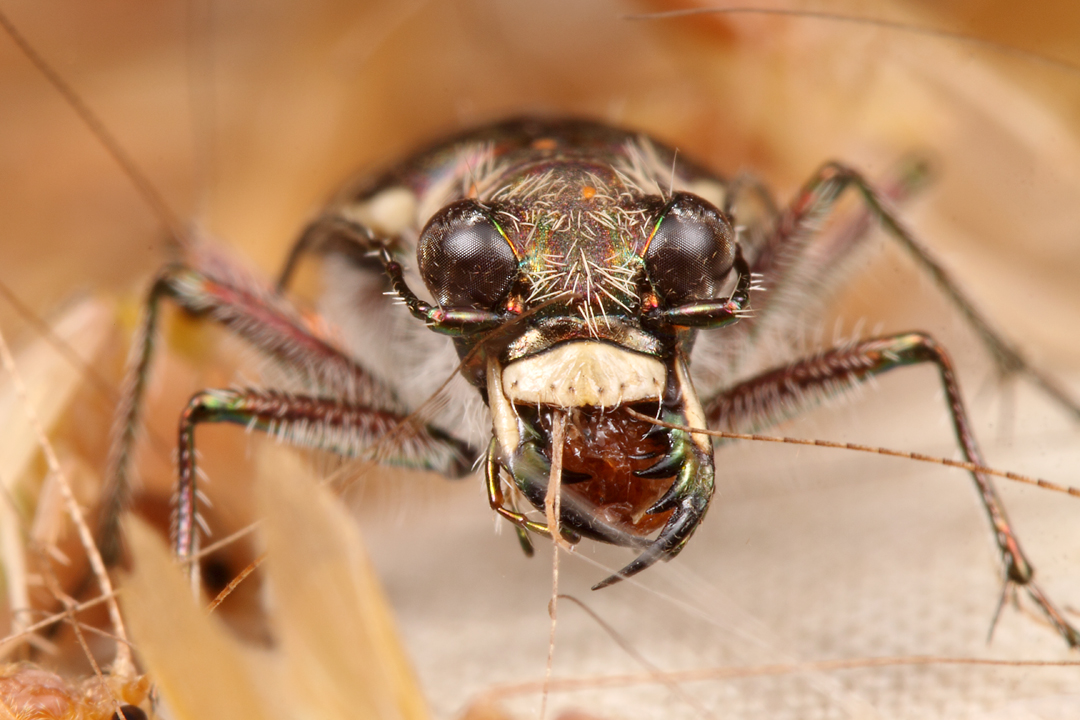
It’s easy to see what might attract them to the light other than the light itself—prey! At every location along the Mississippi River that I’ve blacklighted this summer, choking throngs of caddisflies inundate the sheet within the first half-hour after sunset. Piling up in layers beneath the stupefying light, the caddisflies are a limitless bounty of easy pickings for the tiger beetles, who greedily grab the hapless trichopterans in their toothy, sickle-shaped mandibles and then use their maxillae and digestive juices to macerate them to a juicy pulp that can be sucked dry. I have watched tiger beetle adults feeding on many occasions, but I never noticed until examining these photographs that the feeding beetles hold their antennae back and out of the way against their head and pronotum. Contrast the antennal position of the feeding beetles in the above photographs with the forward position of the antennae in the non-feeding beetles in the remaining photographs. Perhaps this is an adaptation to prevent the antennae from being grabbed and damaged by struggling prey.

A male in more natural-looking surroundings.

Recall also my recent lamentations about lacking good photographs of this species, due initially to lack of effort and later to a rare failure when I did try to photograph them. A half dozen individuals made their way to the light this night, and I was able to coax a few of them off the sheet and onto the surrounding sand for a few photographs in more realistic and natural surroundings. I still don’t consider these to be the photographs that I want for this species, as they do not show any of the thermoregulatory behaviors exhibited during the day such as stilting, sun-facing, or shade-seeking that make for such marvelously iconic tiger beetle poses. For that, I will need to give them another shot on a hot day while summoning every ounce of tiger beetle stalking skill that I can possibly muster. Still, these last two photos (and a few others not shown) are several steps above the single, frustratingly distant lateral profile shot that I had for this species before this night.

All jaws, eyes, legs, and hair!

Copyright © Ted C. MacRae 2012

Ghosts in the night

This summer I’ve spent quite a few nights hanging out along the Mississippi River—lamp on my head, vials in my pocket, and an ultraviolet (UV) light setup on the sandy banks. UV light collecting for insects (also called “blacklighting”) is a popular method among us beetlers, but for a number of reasons it’s been a while since I’ve done a lot of heavy blacklighting myself. That all changed this year when I decided I needed to get a better handle on the Missouri distribution of two species of tiger beetles, Ellipsoptera cuprascens and E. macra, found only in sandy habitats along the shores of the state’s two big rivers—the Missouri and Mississippi—and, fortuitously, attracted to blacklights at night. Blacklighting alongside these big rivers is a relatively new experience for me, as my previous experiences have been mostly in forests—either here in the Midwest or out in the desert southwest. Along the big rivers, as soon as the sun dips below the horizon hordes of hungry mosquitos descend upon me and choking swarms of caddisflies quickly envelop the blacklight. Liberal application of Deet keeps the mosquitoes at bay, but checking the sheet behind the blacklight to see if anything of interest has landed requires a bit of a mad dash and a quick retreat, all the while holding my breath and clamping the shirt cuff around my neck to prevent the swarming bugs from flying into spaces where I don’t want them.

Arctosa littoralis (beach wolf spider) | Lewis Co., Missouri

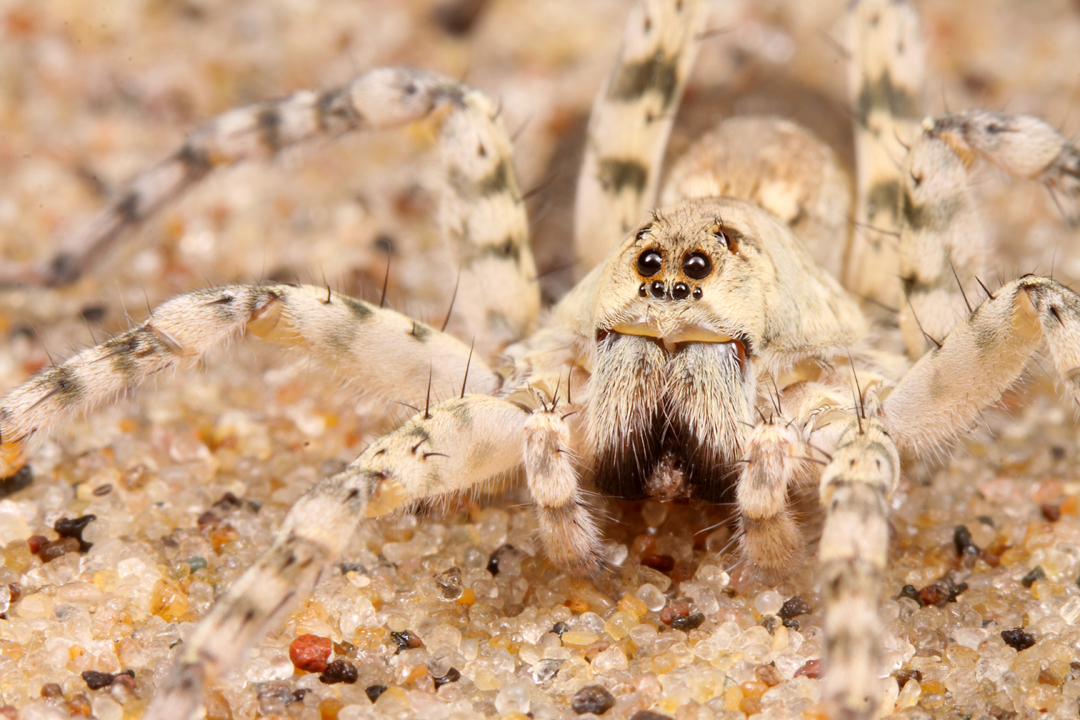
Wandering away from the blacklight and exploring along the beach in the black of night is also a relatively new experience. While I’ve done a fair bit of night collecting away from the light, again this has tended to be in forests and woodlands with a beating sheet in hand looking for jewel beetles, which still hang out on the same host plants they can be found on during the day but are far less inclined to zip away as soon as they hit the sheet like they do when the sun is high overhead. I haven’t spent much time shining a lamp on the sand of a big river beach, so I wasn’t quite sure what to expect (other than hopefully a tiger beetle!). As I walked along the beach, I occasionally saw blue-green glowing dots on the sand—I recognized these fairly quickly as the eyes of spiders reflecting the light from my headlamp. However, at first when looked closer at the spot where I thought a spider should be sitting I didn’t see anything. It took a few tries before finally I saw ghost-like movement on the sand, and when I moved cautiously and got down close to the sand I finally saw a magnificent, white wolf spider sitting motionless—perfectly colored to blend into the sand on which it was sitting.

The mottled, white coloration is conspicuous on wet sand…

I quickly hurried back to the car and got my camera, set it up with a 100mm macro lens and extension tubes (hoping I could get real close), and went back to the spot where I’d seen the spider to see if I could find it again. I didn’t, but not too much searching was required before I found another one. Unfortunately, I didn’t succeed in photographing that one either. It was apparent to me that I was going to have to use the same ultra-cautious and slow movements that I use with tiger beetles if I was going to succeed in photographing one or more of these spiders. I quickly figured out that they were easier to see if I looked right along the water’s edge, as in that situation the white coloration of the spider actually stood out against the darkened, wet sand. (Of course, photographing them on the wet sand was a tad dirtier for me, but I’m not afraid to get filthy dirty when it comes to photographing arthropods.) I also figured out that I could more easily find the spiders on the wet sand and then follow them up to the drier sand for photos that better showed just how marvelously cryptic their coloration was.

…but provides perfect camouflage on the dry sand further away from the water’s edge.

Those of you familiar with my work know that I love frontal portraits, but I found this to be almost impossible during my first attempts. It was hard enough approaching the spider from the front without it bolting before I could get set behind the camera, but in the few cases where I did actually manage this then it would bolt as soon as I made any microadjustment in the position of the camera to compose the shot. It occurred to me that the spider was sensing vibration from moving the camera on the ground (ground-resting the camera is a technique that I use commonly to get the lowest possible angle on my subjects)—makes sense, as spiders are intensely tuned into vibrations for  prey capture. Once I began keeping my hand flat under the camera as sort of a makeshift “beanbag” I was able to make the final adjustments necessary to get shots like the one shown below and in ID Challenge #20.

Active primarily at night, the spider’s eyes glow blue-green when hit by light.

According to Dondale & Redner (1983) this should be Arctosa littoralis—widespread in littoral habitats across North America but, at least at the time of their revision, not recorded from Missouri [in fact, it seems no species of Arctosa was known from Missouri until A. virgo was recorded from oak-hickory forests in the southern part of the state by Bultman (1992)]. I’ll leave it to the spiderphiles to determine if this actually represents a new state record or (more likely) if I just haven’t dug deep enough into the literature.

Congratulations to 3-time champ Ben Coulter, who swooped in from his hiding place with 30 pts to win ID Challenge #20—the final challenge of BitB Challenge Session #6. It wasn’t enough, however, to disturb the overall standings, and Brady Richards maintained his overall lead with 28 pts to win Session #6. Sam Heads was just one point away from the win in this challenge, but his 29 pts were enough to earn a tie for 2nd place in the overall standings with Mr. Phidippus, who finished a respectable 4th place in this challenge. Nobody else came close to these three gentlemen in the overalls, so they deserve their accolades and loot (please contact me for details on the available choices). In case you haven’t been following along, here is a summary of the BitB Challenge champions to this point, listed by session:

  1. Ben Coulter
  2. Ben Coulter
  3. Max Barclay
  4. Ben Coulter
  5. Mr. Phidippus
  6. Brady Richards

REFERENCES:

Bultman, T. L. 1992. Abundance and association of cursorial spiders from calcareous fens in southern Missouri. Journal of Arachnology 20:165–172.

Dondale, C. D. & J. H. Redner. 1983. Revision of the wolf spiders of the genus Arctosa C . L. Koch in North and Central America (Araneae: Lycosidae). Journal of Arachnology 11:1–30.

Copyright © Ted C. MacRae 2012

ID Challenge #20

Has it really been seven weeks since the last ID Challenge? BitB Challenge session #6 overall leaders Brady Richards (66 pts), Mr. Phidippus (58 pts), and Sam Heads (54 pts) must think I’m trying to duck the final standings so I don’t have to doll out any loot. Let’s finish this session with a straight up ID Challenge—3 pts for order (der!), 4 pts for family, 5 pts for genus, and (to separate the imagos from the neonates) 6 pts for species. Bonus question worth 5 pts—what is the best way to search for this species? That’s a whopping total of 23 pts up for grabs in this one challenge (not including any discretionary bonus pts that might be awarded), so not only are the leaders not safe from each other, but from any number of other participants lurking just below them in the standings.  Please read the full rules if you are not already familiar with them—good luck!

Copyright © Ted C. MacRae 2012

Shooting 8X hand-held in the field

Just to prove it can be done, here is an uncropped photograph of the seed weevil Althaeus hibisci (or the closely related A. folkertsi) (order Coleoptera, family Chrysomelidae, subfamily Bruchinae). Adults of these species measure only 1.5–2.5 mm in length (Kingsolver 2004), yet this individual almost completely fills the frame:

Althaeus hibisci/folkertsi on Hibiscus moscheutos lasiocarpus | Route 66 State Park, St. Louis Co., Missouri

I achieved 8X magnification by stacking 68 mm of extension tubes under my Canon MP-E 65mm 1–5X macro lens and extending the bellows of the lens out to its maximum. Shooting 8X is not for the timid—the small subject to lens distance complicates lighting (full flash required), and even finding the subject in the viewfinder can be next to impossible. However, doing it hand-held in the field requires more than just courage and patience—good bracing techniques to minimize movement by and between the camera and the subject are essential. Here is how I do it:

  • I sit down, prop my knees up, and rest the camera in the crotch between my knees (the camera quickly becomes very heavy since it’s being held by only one hand—see next bullet) while positioning it near my face. If possible, I lean back against something as well to provide even more stability, although this is often not possible depending on field conditions.
  • I hold the leaf or flower supporting the subject in my left hand. Subjects this small are rarely going anywhere (or if they are skittish then I use the same slow, deliberate techniques that I use with larger skittish insects), so it is possible to hold the leaf or flower and position the subject right in front of the lens. Hand holding the subject’s support also affords the ability to micro-adjust the position and angle of the subject for optimum composition or to adjust for movement by the subject (easier than trying to track it by moving the lens). In this case of the photo featured here, I detached the leaf with the beetle from the plant (use small scissors to snip the leaf petiole, as this avoids the “jolt” that happens if you try to pick the leaf and which usually results in the subject fleeing). In other cases, I leave the leaf attached and carefully “pull” it towards me to hold it steady.
  • I look through the viewfinder and brace my left wrist (yes, the same hand that is holding the subject) on the underside of the lens, then slowly move the subject towards the lens with my fingers until I see movement and can micro-adjust for proper focus. Bracing your wrist against the lens is key—it is nearly impossible to hold the subject steady in front of the lens without bracing your wrist against it. In effect, this “fixes” the subject to the lens. Also, before I begin looking for the subject through the viewfinder I study its position on the leaf and look for “landmarks” that I can recognize when looking through the viewfinder to minimize the time needed to find the subject (the more time you spend looking for the subject, the greater the chance it will move or flee). Again, the subject to lens distance is very small, but with practice you’ll get a feel for precisely how far from the lens you need to place the subject.
  • I hold my breath and micro-adjust the subject position to nail the focus (usually on the eye) and then fire a shot. If it takes too long to get the focus I exhale and try again, as body shake will only get worse once it starts. Important: After taking the first shot, do not move the hand holding the subject as you look at the image preview and/or histogram—the first shot rarely has the settings precisely where you need them, and keeping the subject in place prevents a lot of re-searching after making the needed setting adjustments with the right hand.

Other than lighting, nailing the focus is the most difficult aspect of shooting hand-held at such high magnifications. The more relaxed and stable you can keep the rest of your body, the less hand movement you’ll experience while holding the subject and the greater chance you have of hitting the focus. Again, a fully extended MP-E lens on 68 mm of extension tubes becomes very heavy very quickly when held in one hand (even when resting on your knees), so expect your forearm muscles to give out quickly until you have a chance to strengthen them through practice.

I use these same techniques to some degree at lower magnifications as well—certainly for anything above 2X. I’m interested in doing a lot more 8X photography, however, because there is a whole world of tiny insects that are not being photographed due to their very small size. These insects are no less fascinating and beautiful than their larger, more oft photographed brethren.

Finally, you might be asking why I don’t just carry a tripod or collect subjects and bring them back to the studio for more controlled conditions. There are many photographers who advocate the use of tripods, but I’m not one of them. I am first and foremost an entomologist, and when I’m in the field I’m generally already carrying at least a net and other equipment for collecting insects. There are opportunity costs involved if I also try to lug a heavy tripod with me. What’s that? I could leave it in the car and then go get it when I need it? Honestly, I would pass on a lot of shots if I had to go back to the car to get something for it. The same goes for studio photography—there are many shots I would simply pass on if getting them meant that I needed to collect subjects, keep them in good condition for the duration of the trip (which might be days or more), and then setup in a studio. Moreover, there are many shots—specifically regarding behavior—that would be impossible with collected subjects. But really, it has mostly to do with what I want to be and portray as an insect photographer, and that is somebody who has the ability to photograph unconfined subjects exhibiting natural behaviors in their native habitats. Having the ability to shoot 8X hand-held in the field if I want to gives me more options and makes me a better photographer.

Do you have any special bracing or stabilizing techniques that you use for high-mag hand-held macrophotography? If so I’d love to hear about them.

REFERENCE:

Kingsolver, J. M. 2004. Handbook of the Bruchidae of the United States and Canada. U.S. Department of Agriculture, Technical Bulletin 1912, 2 volumes, 536 pp.
 
Copyright © Ted C. MacRae 2012

Very cozy tigers!

In my post Very wary tigers!, I spoke of the frustrations of trying to photograph tiger beetles when conditions of temperature and terrain conspire to make them too wary to approach. This is a common feature of tiger beetle photography in general, but the problem seems to reach its zenith with the “wet sand beach” species—most species inhabiting these habitats tend to be “summer species” active during the hottest part of the season, and their habitats tend to be virtually devoid of any vegetative cover that can be used to the photographer’s advantage. A blazing sun on hot, open sand is not conducive to photographing anything! Still I try, and on that particular day I did manage a few relatively distant photographs of two species, Cicindela repanda (Bronzed Tiger Beetle) and C. hirticollis shelfordi (Shelford’s Hairy-necked Tiger Beetle) but none at all of a third species that was present on the beach, Ellipsoptera cuprascens (Coppery Tiger Beetle).

Ellipsoptera cuprascens (Coppery Tiger Beetle) | New Madrid Co., Missouri

Well, there is always more than one way to skin a cat (or a tiger), and as can be seen in these photographs I took a different approach to that latter species that allowed me to obtain several quite decent photographs of both males and females. Not long after that frustrating day at Cape Rock Park, I found myself again in southeastern Missouri with an opportunity to do some night collecting. It may not be widely known, but certain species of tiger beetles are also active at night and can actually be attracted to ultraviolet (UV) lights. This is particularly true of species in the genus Ellipsoptera, which as a group seem to depend almost exclusively on coastal and fluviatile sand habitats. I have used UV lights in the past to attract nocturnally active species of tiger beetles for photography (see Return to Nowhere), and since I had seen E. cuprascens a few years ago at Steward Towhead in New Madrid County I thought this might be a good spot to try again for photographs of that species.

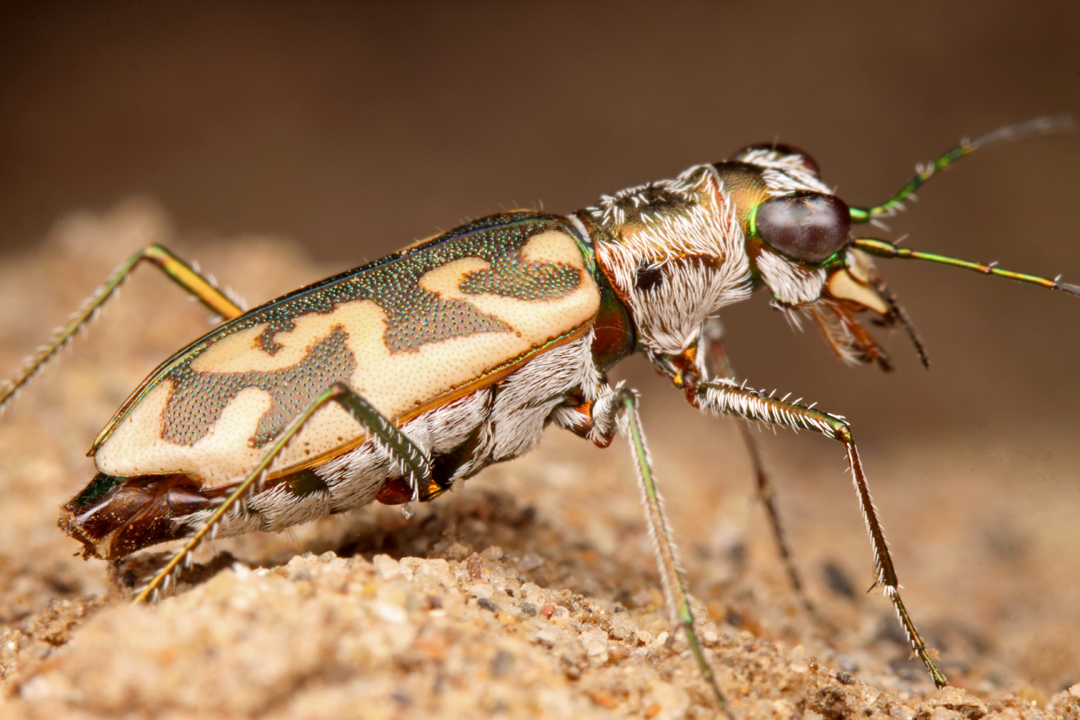
The relatively coarsely and densely punctate elytra distinguish E. cuprascens from E. macra.

“Might be a good spot” turns out to be quite the understatement, as I have never seen E. cuprascens in such numbers as I did that night! Seeing the species common at the sheet guarantees that individuals will also be found milling around on the ground in the immediate vicinity of the sheet, and unlike during the heat of the day when their bodies shift to thermal overdrive, adults at night are much easier to approach due to the cooler temperatures and the distraction of abundant, easily captured prey sitting transfixed in their UV light-induced stupor. Of course, night photography brings its own set of challenges, primarily (for me) the need to use the camera flash head lamps for focusing—I often find myself repeatedly aborting a shot because the lamps turned off automatically before I had a chance to find the subject and compose the shot to my satisfaction. Still, this is a minor inconvenience compared to the exasperation of subjects blasting across the hot sand when your approach comes within 12 feet!

Males mandibles are modified for grasping the female pronotum during mating.

Ellipsoptera cuprascens is very closely related to E. macra (Sandy Stream Tiger Beetle—see The last tiger beetle), which it resembles greatly and whose ranges overlap here in Missouri (although the latter is far less commonly encountered than the former). The photos in this post show the relatively coarser and denser punctures on the elytra that distinguish E. cuprascens from E. macra, as well as their somewhat shinier surface and distinctly more coppery color. The rounded elytral apices of the female (middle photo) also serve to distinguish the species from E. macra, in which species the elytra of the females come to a point at the suture (Pearson et al. 2006). Note also the sexual dimorphism in the labrum and mandibles of the female (first photo) and male (last photo), with the mandibles relatively longer and slightly curved and the labrum shorter in the latter. Presumably this is related to the use of the mandibles by the males in grasping the female pronotum during mating—the longer, curved mandibles are shaped to precisely fit the contour of the female’s pronotum, while the shorter labrum allows the mandibles to gain better purchase farther down on the side of the female’s pronotum (Pearson and Vogler 2001).

REFERENCE:

Pearson, D. L., C. B. Knisley and C. J. Kazilek. 2006. A Field Guide to the Tiger Beetles of the United States and Canada. Oxford University Press, New York, 227 pp.

Pearson, D. L. and A. P. Vogler.  2001. Tiger Beetles: The Evolution, Ecology, and Diversity of the Cicindelids.  Cornell University Press, Ithaca, New York, 333 pp.

Copyright © Ted C. MacRae 2012