Calm waters, frenzied beetles

North Fork River - Ozark Co., Missouri

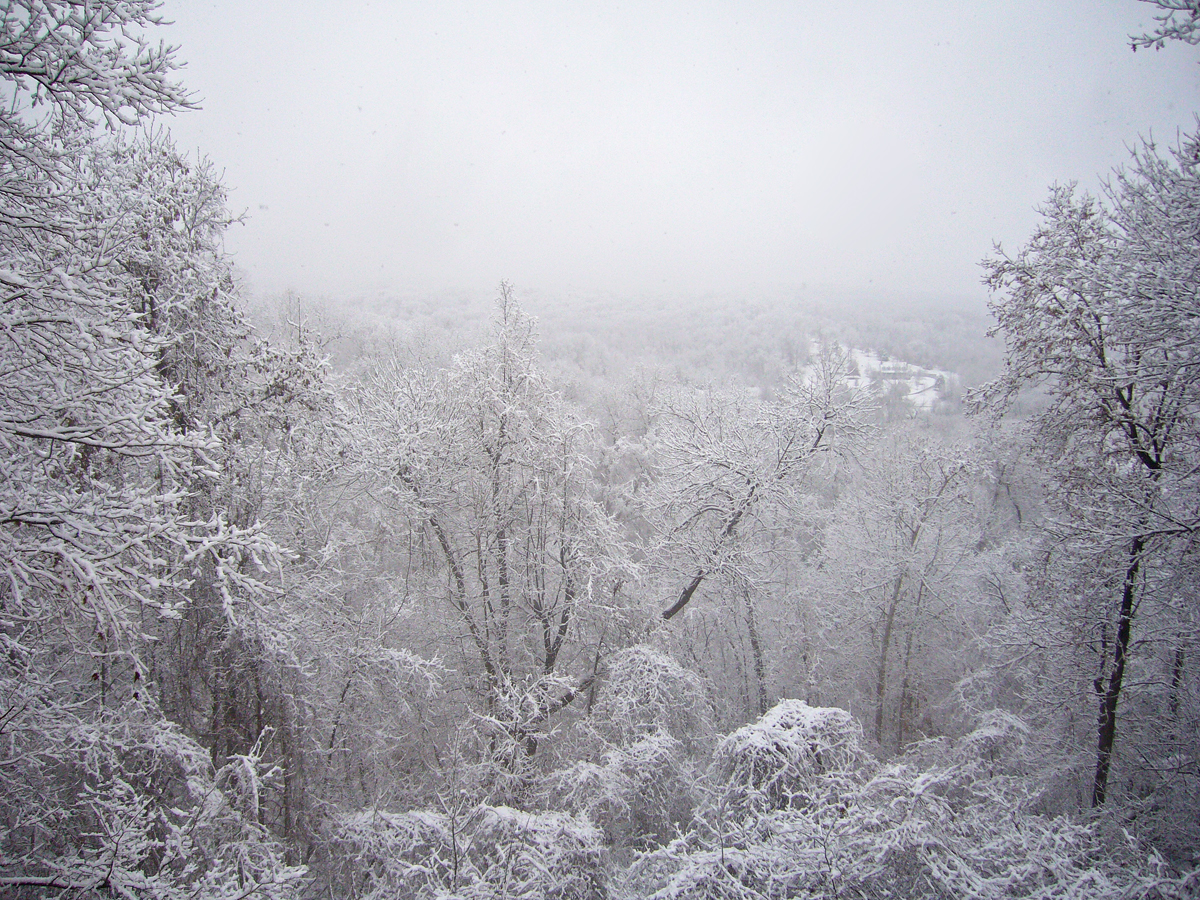
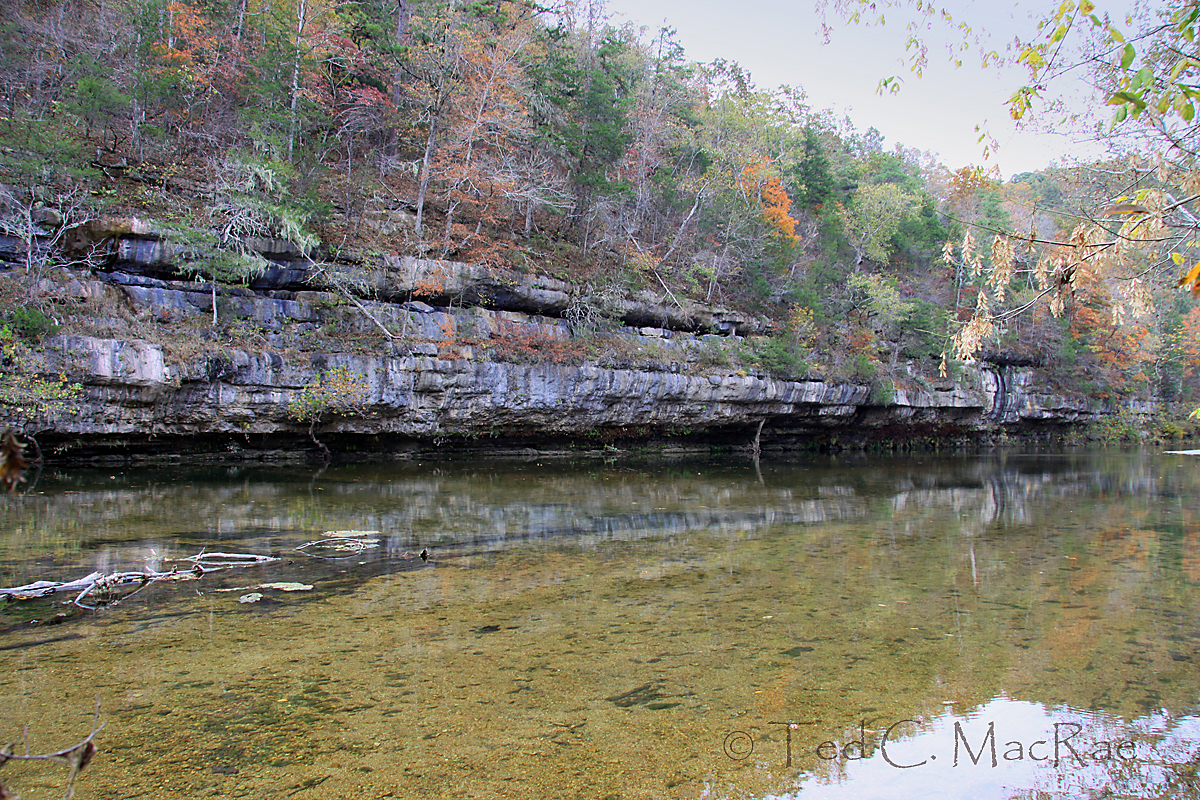
The North Fork River in south-central Missouri, like most Ozark rivers and streams, flows clear and cold over gravelled bottoms. Sustained year-round by the numerous seeps and springs that result from the region’s unique Karst geology, it meanders through a mix of forest and woodland alongside massive bluffs of half-a-billion-year-old dolomite. While small rapids can be found where gravel bars approach the bluffs, for the most part the shallow waters course lazily and idyllically south toward the White River in northern Arkansas.

Dineutus sp. (poss. discolor, per Brady Richards)

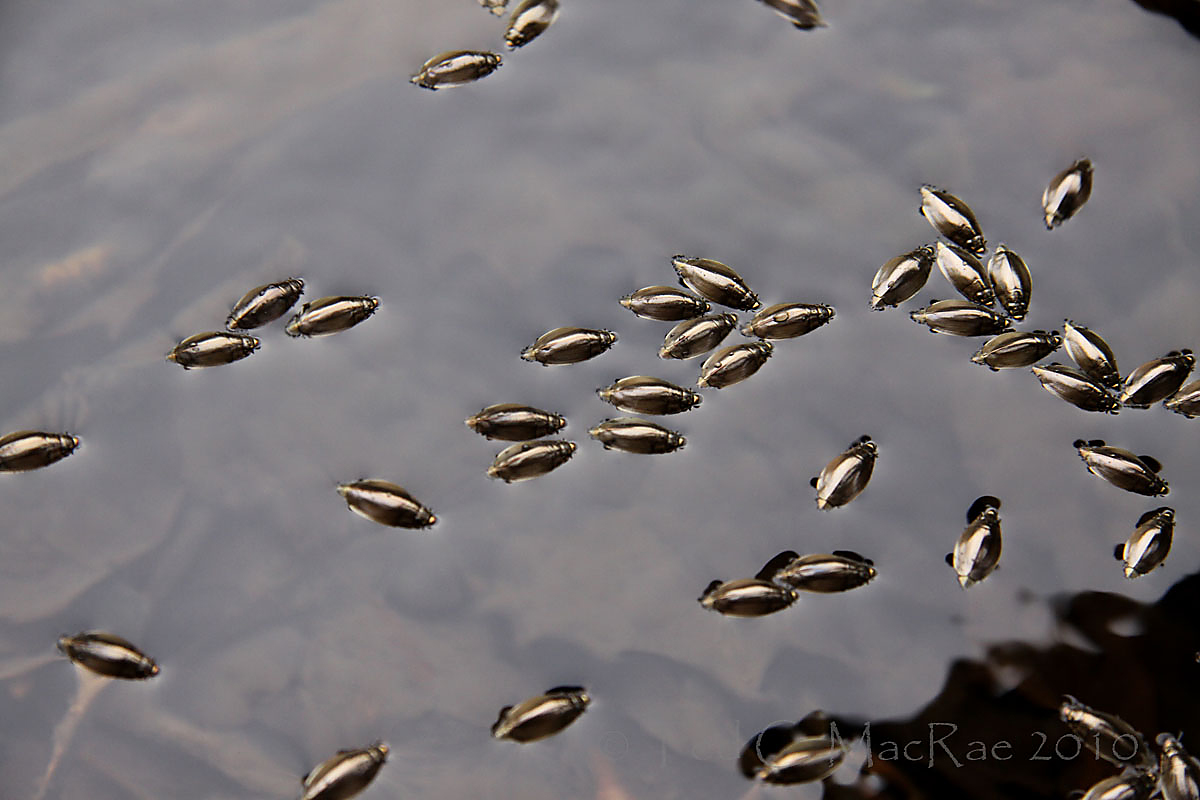
Lazy waters are the domain of whirligig beetles (family Gyrinidae).  We encountered this ‘raft’ of beetles in a sheltered pool near the shore of the North Fork River while hiking the Ozark Trail last October.  These frenzied little beetles live almost exclusively on the surface of the water, where they feed on organisms or scavenge debris in their famously and erratically conspicuous aggregations.  Such behavior might make them seem vulnerable to predation, but in actuality the reverse is true.  Beetles in rafts benefit from the increased number of eyes that can better scan the environment for potential threats than can individual beetles (Vulinec and Miller 1989), and the larger the raft the more efficiently this occurs.  There is also evidence that the appearance of the rafts themselves is a signal to warn potential predators (primarily fish) of the noxious chemicals produced in the beetles’ paired pygidial glands (Ivarsson et al. 1996), despite the decidedly non-aposematic coloration of the beetles themselves.

Photo Details: Canon 50D w/ 17-85mm zoom lens, natural light. Photo 1 – 17mm, ISO 100, 1/25 sec, f/5.6; photo 2 – 85mm, ISO 500, 1/160 sec, f/5.6. Typical post-processing (levels, minor cropping, unsharp mask).

REFERENCES:

Ivarsson, P., B.-I. Henrikson and J. A. E. Stenson.  1996.  Volatile substances in the pygidial secretion of gyrinid beetles (Coleoptera: Gyrinidae).  Chemoecology 7(4):191–193.

Vulinec, K. and M. C. Miller. 1989. Aggregation and Predator Avoidance in Whirligig Beetles (Coleoptera: Gyrinidae). Journal of the New York Entomological Society 97(4):438–447.

Copyright © Ted C. MacRae 2011

North America’s largest stag beetle


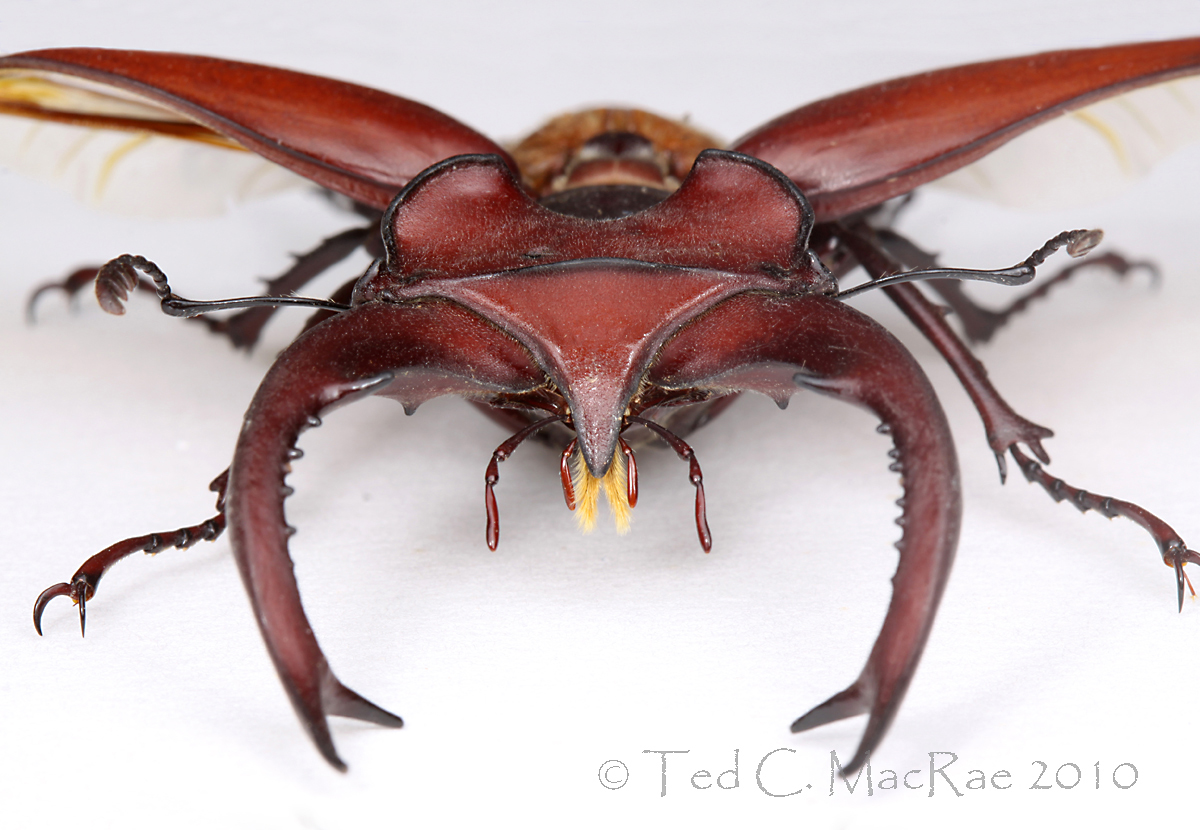
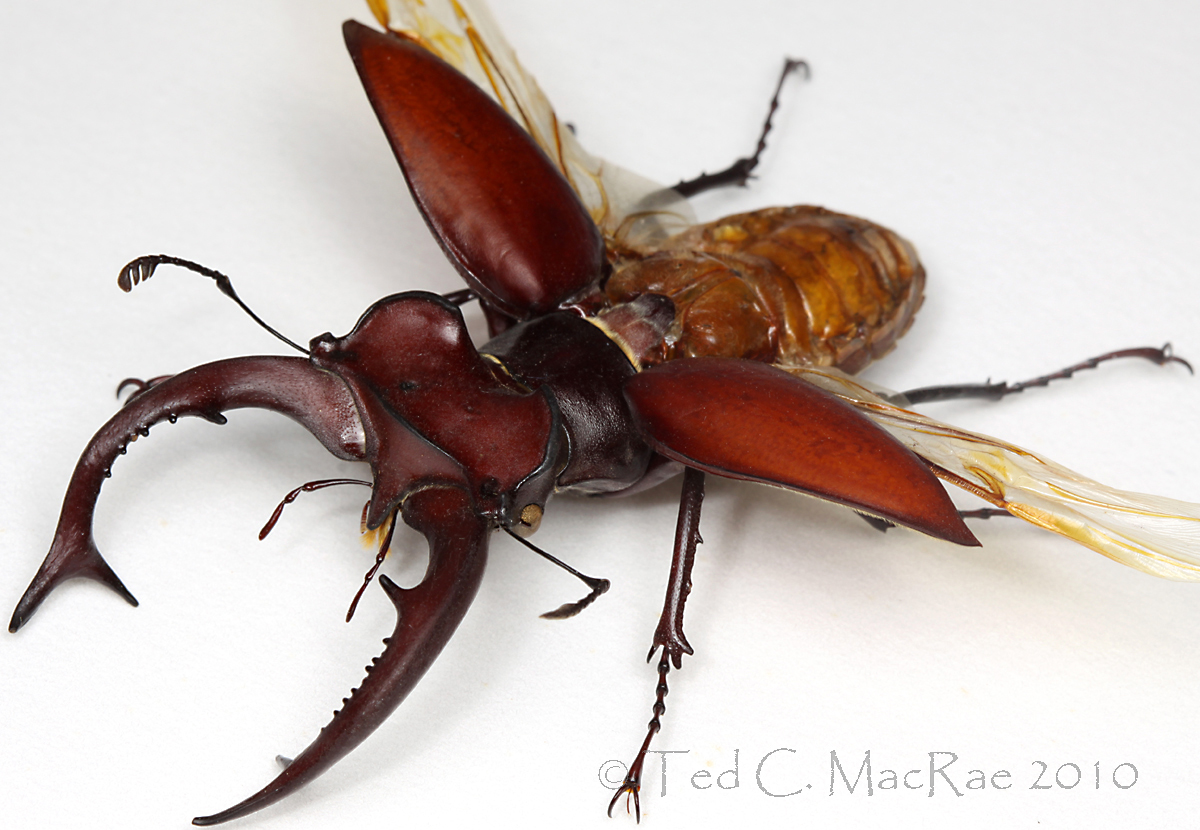
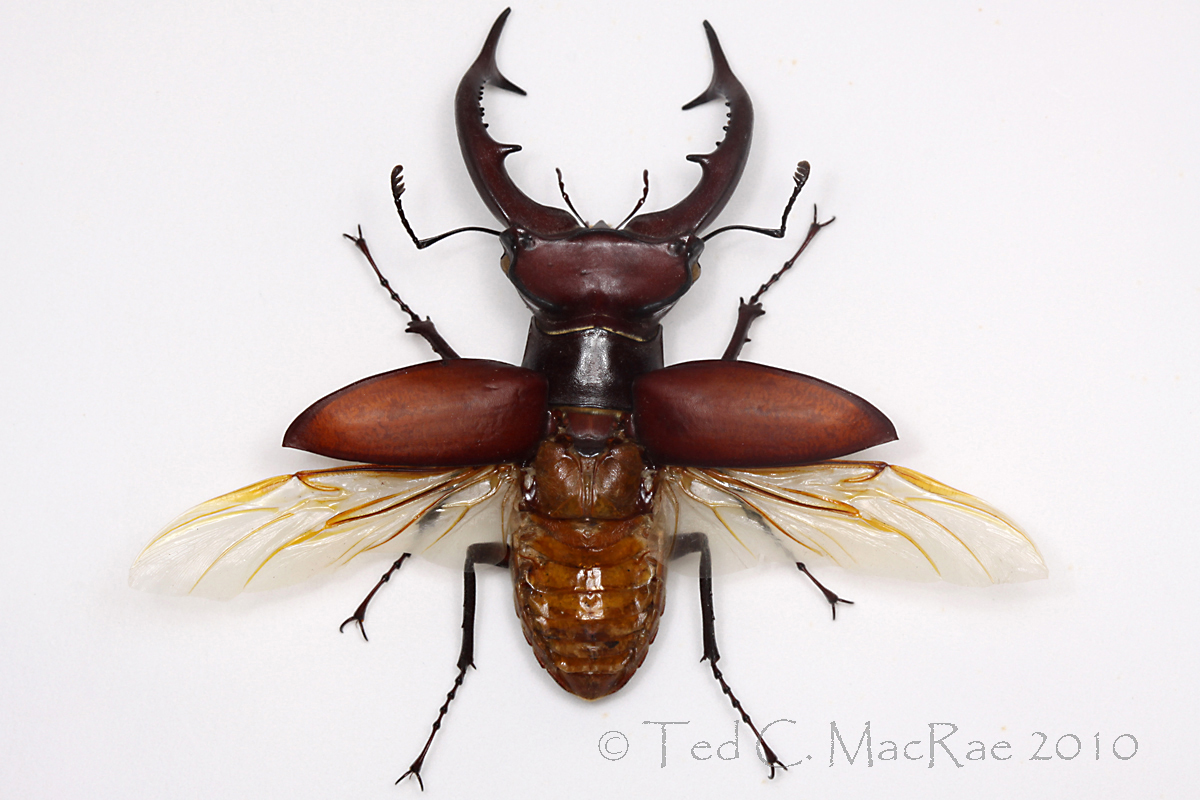
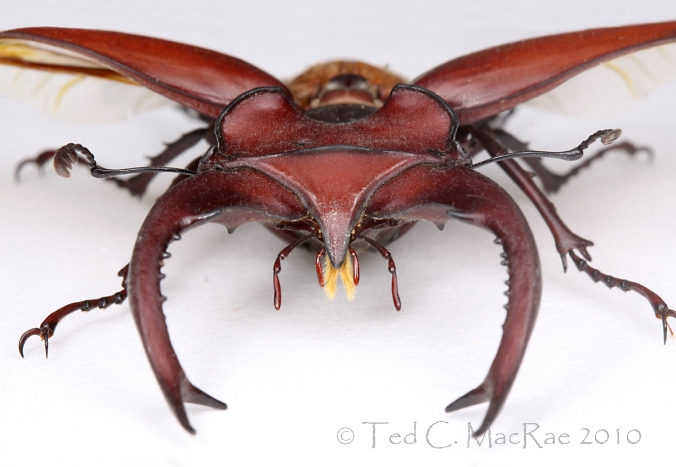
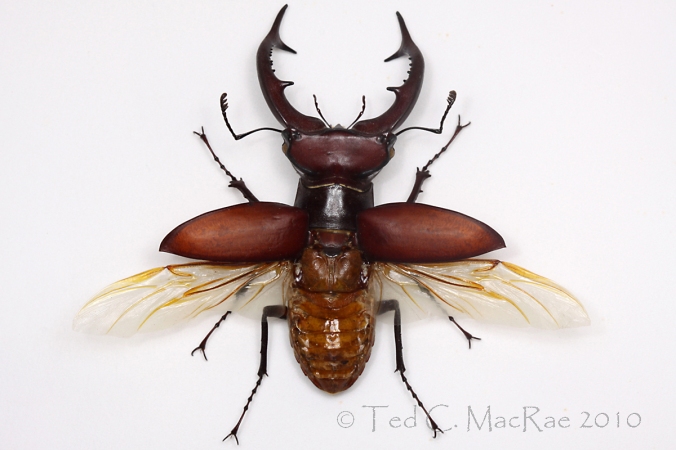
Here is the full-sized photo that provided the image for yesterday’s Super Crop Challenge #3.  The insect in the photo is, of course, a fine example of a male Lucanus elaphus – the giant stag beetle (family Lucanidae).  This striking insect is easily among North America’s most distinctive and recognizable species by virtue of the enormously super-sized mandibles sported by the males.  Its fearsome appearance belies the true nature of this harmless beetle, which spends its days feeding on sap that flows from wounds on the trunks and roots of trees.  Males use their massive mandibles in combat with other males, not for “biting,” but rather as tools to pry and lift their adversaries before dropping them to the ground.  Some marvelous photos of this behavior in a related European species can be seen at Stag Beetles Lucanus cervus Mating Behaviour.
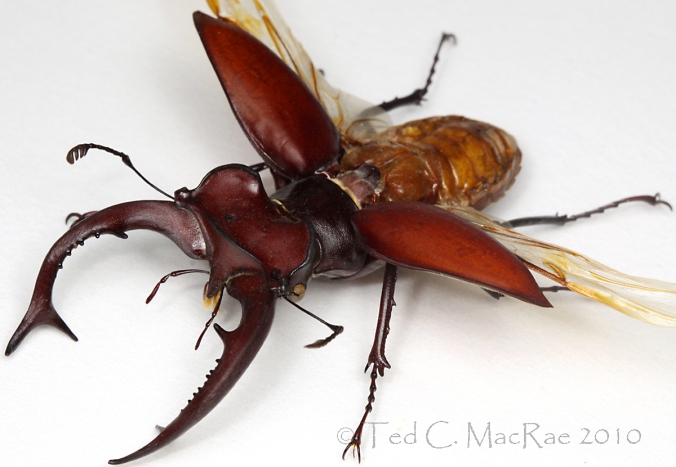
I collected this specimen many years ago at an ultraviolet light (“blacklight”) that I had setup in the pine/oak forests at Pinewoods Lake, Carter Co., in the southeastern Ozarks – one of my favorite 1980’s beetle collecting spots.  This was in my early days of studying beetles, during which time I was actively collecting material as part of my statewide surveys for the families Buprestidae (MacRae 1991) and Cerambycidae (MacRae 1994).  Lucanus elaphus is not a commonly encountered species, especially in the western reaches of its distribution here in Missouri, and I’ll never forget my rabid excitement when I encountered this fine major male at my blacklight sheet.  For many years afterward it remained the only individual that I had ever encountered, until a few years ago when I came across a group of two males and one female feeding on a sap flow in a wet bottomland forest along the Mississippi River in the lowlands of southeastern Missouri.  I encountered another male the following year at a nearby location “rafting” on debris in floodwaters from the nearby river, and two weeks later at that same site I picked up several males and females in a fermenting bait trap.¹  Like most “uncommon” species with broad distribution across the eastern U.S., I suspect that its apparent rarity is an artifact due to habits that make it infrequently encountered rather than being truely scarce.

¹ I have used fermenting bait traps to collect a wide variety of beetles, but especially longhorned beetles.  My recipe is based on that described by Champlain and Knull (1932) – bring 12 oz. dark molasses and 12 oz. beer up to 1 gal. with water, mix well and add a packet of dry baker’s yeast to get the fermentation started.  Hang a 1/2-gallon milk jug with big holes cut in the sides in a tree along the edge of a woods and add ~1 quart of fresh liquid.  It generally takes 2-3 days for the liquid to really start fermenting and become attractive, and it will remain so for about another week or so.  Check traps every 2-3 days by pouring the liquid through a kitchen strainer into another container – reuse or replace as necesssary. Place the collected specimens in vials of water to wash off the molasses residues, and either pin immediately afterward or transfer to 70% ethanol for longer term storage.  Some of the more desireable species I’ve collected in this manner, besides L. elaphus, are Plinthocoelium suaveolens, Purpuricenus axillaris, P. humeralis, P. paraxillaris, Stenocorus cylindricollis, S. shaumii, Sarosesthes fulminans, Stenelytrana emarginata [= Leptura emarginata], and S. gigas [= Leptura gigas].

Congratulations to Ben Coulter and Janet Creamer, both of whom correctly identified the species and most of the mouthparts.  Each earned 14 pts and, thus, tied for the win, while JasonC. earned 5 pts. to take the final podium spot.  The pointed structure is the labrum (its shape distinguishing it from other North American species of the genus), and it is flanked on each side by the fuzzy yellow galeae (derived from the maxillae) and the labial palps.  Nobody correctly named the galeae, which seem to be greatly elongated and hairy in stag beetles as a function of their sap feeding behavior.  A portion of the left maxillary palpus can also be seen in the corner of the photograph, but nobody scored those points either.  Brady Richards just missed the podium, but his witty reference to Gene Shalit (if not immediately picked up on by me) earns him an honorable mention.

With points being formally awarded now beginning with the previous competition (ID Challenge #1), I’ll start keeping an overall leaders board, and with wins in both competitions Ben takes a commanding lead in the overalls with 23 pts, followed by Janet Creamer at 14 pts and TGIQ at 8 pts.  I guess I should start thinking of some sort of tangible prize for winners periodically – suggestions welcome.  Stay tuned for another issue of Super Crop Challenge or ID Challenge in the near future.

REFERENCES:

Champlain, A. B. and J. N. Knull.  1932. Fermenting bait traps for trapping Elateridae and Cerambycidae (Coleop.).  Entomological News 43(10):253–257.

MacRae, T. C. 1991. The Buprestidae (Coleoptera) of Missouri.  Insecta Mundi 5(2):101–126.

MacRae, T. C. 1994. Annotated checklist of the longhorned beetles (Coleoptera: Cerambycidae and Disteniidae) known to occur in Missouri. Insecta Mundi 7(4) (1993):223–252.

Copyright © Ted C. MacRae 2010
The 12 Years of Christmas

This post first appeared on Beetles in the Bush on Christmas Day 2008. Two years have passed, but the sentiment remains stronger than ever. I reprint it here as BitB‘s single evergreen post. Merry Christmas!

p1020457_2

Merry Christmas - from our backyard to yours!

They came from completely different backgrounds. She had grown up in a middle class family, her father an educated professional, her mother a professional homemaker – “Ward and June”, as their now-grown children jokingly call them. He grew up on welfare, the family breaking up while he was still in elementary school. She was a popular student – cheerleader, debate team, gymnastics. He was the introverted science nerd, invisible to the popular, living quietly with his books. Religion was an important part of her life, growing up Catholic and remaining devoted to the church. He grew up Catholic but knew even as a child that religion would not provide the answers he was looking for, eventually finding a private spirituality in the Creation itself.

Despite these separate paths they found each other and fell in love, and despite their different lives they both wanted the same thing – a family. Such a simple desire, however, would prove to be difficult to achieve. When fertility drugs didn’t work, they turned to adoption. The first match failed. So did the second. They understood completely how the birth mothers could change their minds, but that didn’t ease their pain or calm their fears. Ultimately, they looked to Russia, a new democracy with old attitudes about orphans. In the fall of their 6th year of marriage, they learned that little Anastasia was waiting for them. They traveled to Russia before Christmas and became a family after New Years. In between, they visited little Anastasia every day – one hour at a time – and experienced the joy of being a parent, a feeling they had feared would ever elude them. On Christmas Day, they could not see little Anastasia, but in a small, gray apartment on the outskirts of Moscow, they celebrated her coming with their gracious host family. Ten days later, their family was born, and twelve months later they celebrated their first Christmas together at home.

Christmas meant little to me for much of my life. Yes, it was a time to relax and enjoy the company of family and friends, and the presents were nice. But my own approach to spirituality has little in common with traditional reflections of the season. Tonight, as I watched 12-year old Mollie Anastasia laughing with her cousins, hugging her nanny and papa, and teasing her uncle and his partner, I thought back to those cold, snowy days in Russia when my heart became warm for the first time. I recalled our second trip to Russia six years later, when she and little Madison Irina each met their sister for the first time. On this Christmas Day, as I have done for 12 years now, I thought about how lucky we are to have these two beautiful little girls that are unquestionably our own. Christmas means a lot to me now, and that is a gift that not even five golden rings could beat.

Copyright © Ted C. MacRae 2010
ESA in absentia

Click on image to see larger version.

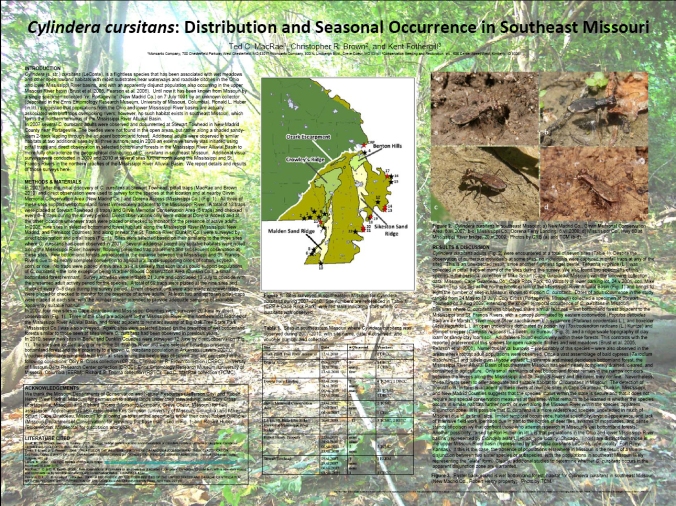
The Entomological Society of America (ESA) held its 58th Annual Meeting earlier this week in San Diego, California. For those of you who were unable to attend, I’ve included a link to a poster that I and coauthors Chris Brown and Kent Fothergill presented, titled Cylindera cursitans: Distribution and Seasonal Occurrence in Southeast Missouri. Okay, I can already see the puzzled faces, as many of you know I was unable to attend myself. In fact, none of the poster authors were in attendance – if Kelly Tindall, Kent’s entomologist-wife, hadn’t attended the meetings the poster would have never seen the light of day.

Despite lead authorship on the poster, I had a minimal role in its preparation.  Kent did much of the dirty work – clipping text and figures from a manuscript on the subject that we recently submitted to the journal CICINDELA, while Chris and I sat back and gave thumbs up and thumbs down opinions on each iteration of Kent’s hard work.  My heartiest congratulations to Kent for producing such a nice piece of work, to both Kent and Chris for putting up with my obsessive nitpicking over every trifling detail as we readied the manuscript for submission, and to Kelly for lugging a poster halfway across the country in the middle of winter when it didn’t even have her name on it.

REFERENCE:

MacRae, T. C., C. R. Brown, and K. Fothergill.  2010. Cylindera cursitans: Distribution and Seasonal Occurrence in Southeast Missouri. Annual Meeting of the Entomological Society of America, San Diego, California, December 12-15, 2010.

Copyright © Ted C. MacRae 2010

Eye of the Turtle

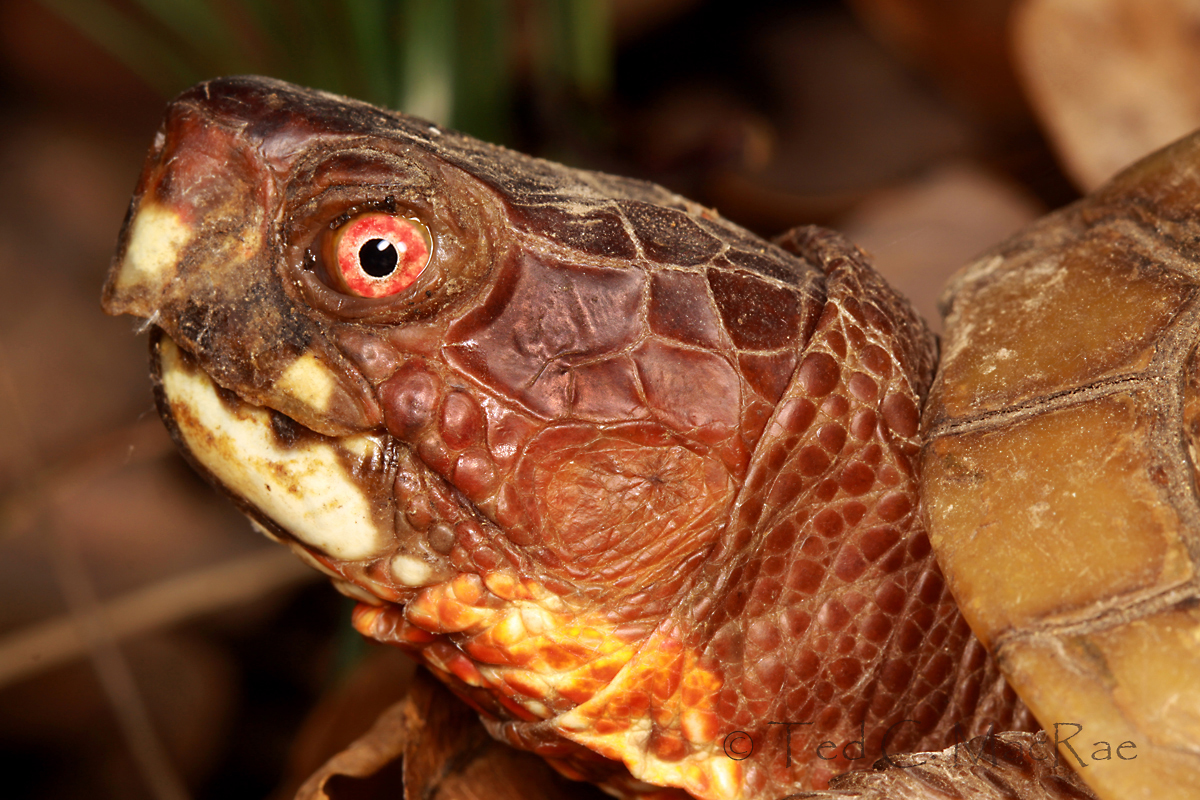
Adult male three-toed box turtle (Terrapene carolina triunguis).

Is there anything more lovable than the humble turtle?  As old as the dinosaurs, they stumbled onto a body plan that works and promptly dropped out of the evolutionary arms race.  Slow, plodding, and seemingly oblivious, they steadfastly cling to their quite, unhurried lives.  As the rest of the earth’s diversity of life races on, turtles go about their business much as they have done for more than 200 million years now.  They are survivors.

My friend Rich and I encountered this three-toed box turtle (Terrapene carolina triunguis) during our hike of the lower North Fork Section of the Ozark Trail in extreme southern Missouri.  Three-toed box turtles are one of four U.S. subspecies of the eastern box turtle, occupying the area west of the Mississippi River from Missouri and Kansas south to Texas and distinguished by their largely unpatterned shell and – yes, three toes on the hind legs rather than four.  I walked right by this guy the first time without noticing him, and only when I turned around to go back and look at something else did I see him sitting there – neck fully extended.  Box turtles exhibit considerable variability in color and patterns on the head and neck, and this particular individual is one of the more conspicuously colored that I’ve seen.

And the eye – as red an eye as I’ve ever seen!  Almost surely a male, as females may have some red in the eye but rarely to such a spectacular degree.  Also likely full-grown based on his rather large size, though probably not too advanced in age yet since the growth rings were still easily visible (in older turtles the growth rings gradually wear smooth).  I estimated it at about 12 years based on ring counts – still a far cry from the 30-50 years that are not uncommonly documented.  He kept a watchful eye on me as I studied him, and I wondered about what his future held.  As an adult, he has settled into a small home range from which he rarely ventures – likely visible to me in its entirety from where I stood.  For the next several decades, he will amble across this single hillside on an endless quest for earthworms, strawberries, and mushrooms.  Save for a possible run-in or two with a destined-to-be-frustrated coyote, fox, or racoon, it will be a largely uneventful life.  He is a survivor.

Copyright © Ted C. MacRae 2010

Answer to Super Crop Challenge #2

I was hoping that Super Crop Challenge #2 would prove a little more difficult than the first one, but first responder Troy Bartlett quickly sniffed out the correct answer – the top part of the abdomen of the marmorated orb weaver, Araneus marmoreus.  As the first correct responder he earns bonus points.  Dennis also came up with the same answer after temporarily being led astray, and Colton got it right as well (once he realized the challenge was here and not over on FaceBook).  I might be justified if I deducted points for misspellings in the genus and common names (if there is any field unforgiving of spelling errors, it’s taxonomy); however, I’m watching a Christmas movie with my family and am feeling the holiday spirit.  That spirit extends to Dave as well, who earns pity points for refusing to believe that I would offer consecutive spider challenges (actually the first Super Crop Challenge was an opilionid, but the ID challenge before that was another spider, making this the third straight arachnid challenge I’ve posted – it wasn’t by design).

The crop I used for this challenge was taken from the above photo – not the best of the series, but it had the most symmetrical view of the dorsal abdominal pattern that some think looks like a face.  This is just one of many color variations exhibited by this most variable of North American spiders – see this BugGuide page for a pictorial summary of the extraordinary amount of variation found in this species.

My friend Rich and I encountered this individual – a female – in an upland oak/hickory forest while hiking the lower North Fork Section of the Ozark Trail in extreme southern Missouri.  These spiders normally hide in a retreat during the day (usually a curled leaf) and spin a new web at night – I’m not sure why she was out during the day, as it didn’t appear she was recycling the web, tattered and torn and probably still remaining from the previous evening.  When I first approached, I accidentally brushed against one of the support lines, which sent her scampering up into her retreat.  I figured “tapping” on the leaf might cause her to drop back out – Rich was skeptical, but after a few taps, the spider not only dropped out but obligingly went right back down to the center of the web and stayed in place long enough for me to get a few shots of the ventral surface.  (I couldn’t suppress a smug chuckle as Rich muttered in exasperated disbelief!)  Moving around to the other side disturbed the spider again, and she once again took refuge in her retreat.  This time, rather than fight it, I carefully uncurled the leaf that formed her retreat, working gingerly to avoid disturbing her, and took a series of photos of her attractive dorsal surface as she sat in the retreat.

Photo Details: Canon 50D w/ 100mm macro lens (ISO 100, 1/200 sec, f/16), Canon MT-24EX flash w/ Sto-Fen + GFPuffer diffusers. Typical post-processing (levels, minor cropping, unsharp mask, etc.).

Copyright © Ted C. MacRae 2010

Answer to Super Crop Challenge #1

Seemingly correct answers came quickly to yesterday’s inaugural Super Crop Challenge, which featured a curious structure atop a harvestman (class Arachnida, order Opiliones) that I encountered while hiking the lower North Fork Section of the Ozark Trail in extreme southern Missouri. “Seemingly” I say, because even though some points were earned, others remained left on the table – the organism was rightly recognized as a harvestman, and the structure in the photo does indeed contain the ocelli (or eyes).  However, nobody actually named the structure itself (see update below) – the ocularium (ocular or optical tubercle would also have been accepted).  Hey, I’m pedantic and proud!

As near as I can tell, this individual belongs to the genus Leiobunum (family Sclerosomatidae).  Species in this genus are notoriously difficult to identify; however, the super long legs, dark dorsal stripe, pointed abdomen, and very long palps with “knees” that extend dorsally to a level well above the ocularium suggest a male L. vittatum or one of its close relatives (Schulz 2010). Leiobunum vittatum is a common inhabitant of wooded habitats across the eastern U.S.

I took this shot with an MP-E 65mm macro lens at about 2.5X. The short working distance of the lens at this level of magnification makes it difficult to photograph these longer-legged species in lateral profile due to their habit of “waving” their especially elongate 2nd pair of legs in the air as pseudo-antennae – one touch of any part of the camera sends them scampering. I chased this guy back and forth across a downed tree trunk for some time before I finally got lucky when it encountered some prey (note the long structure extending down from the mouth area – I believe it is the antenna of a tiny, nymphal blattodean) and became distracted just long enough for me to close in and fire off a couple of close shots. He was actually closer to the underside of the log, so when I took this photo I was leaning far over the log with the camera almost upside-down!

Okay – Art earns points for being the first to identify it as a harvestman, while Geek snaps rare duplicate ID points for using the order’s scientific name (no complaining – scientific names will always get points on this blog).  Art, Aniruddha, and Geek also get half-points for mentioning (in order of correctness) eye, ocelli (technically more correct, but wrong plurality), and ocellus (yes, only one is visible – did I mention my pedantic tendencies?).  However, I’m going to declare arachnologist and Opiliones specialist Chris as the winner of this round for his impressive display of generic-level identification based on the meagerest of evidence!

Update 11/22, 11:00 a.m. – actually, Chris did name this structure in an email sent to my office address while the comments box was unchecked and, thus, earns a clean sweep of this challenge.

Photo Details: Canon 50D w/ MP-E 65mm 1-5X macro lens (ISO 100, 1/250 sec, f/13), Canon MT-24EX flash w/ Sto-Fen + GFPuffer diffusers. Typical post-processing (levels, minor cropping, unsharp mask).

REFERENCE:

Schulz, J. W. 2010. The Harvestmen of Maryland (accessed 20 November 2010).

Copyright © Ted C. MacRae 2010

Super Crop Challenge #1

ID quizzes and challenges seem to have become an increasingly popular subject for natural history blogs. I’ve done a few of my own, but my straight up ID challenges are starting to seem a little unimaginative compared to the DNA sequence, crypsis, mimicry, taxonomy fail, and other challenges being offered up by bug blogdom’s more creative types. To step it up a notch, I offer the first Super Crop Challenge. Small structures that we take for granted within a larger context often take on alien qualities when viewed in isolation. Can you identify this structure and the organism that possesses it?


Copyright © Ted C. MacRae 2010