Clubmoss along the Ozark Trail

It has been a long, hard winter – one of the toughest I can remember during my years here in Missouri in terms of amount and frequency of precipitation and persistent cold temperatures. Tough winters, however, are no deterrent to my favorite wintertime activity – hiking. I’ve mentioned several times the goal of my friend Rich and I to hike all 350 miles of the Ozark Trail.  We’re at ~250 miles now (more than 2/3 done), thanks to the two 10-mile stretches of the Wappapello Section that we did on the days after Thanksgiving and New Year’s. 

Hiking these trails is an opportunity to imagine the Ozark Highlands in their wild, pre-settlement state – expansive hardwood forests covering miles and miles of rugged up-and-down terrain.  Of course, try as I might to pretend otherwise, the Ozarks have changed, and evidence of man’s pervasive presence are everywhere.  Some are overt, such as this mass grave of domestic cattle, dumped by their former owner for others to worry about when disease prevented them from realizing their economic potential.  Others are much more subtle, but to the discriminating naturalist they are everywhere – even in the most pristine-looking of areas.  A cedar-choked glade here, it’s rich, tawny, native warm-season grasses pushed the margins and interspaces; a monotonous, stunted black oak forest there, sprigs of herbaceous plants giving a hint of the diverse understory just waiting for a fire to bring back the more open woodland it needs to thrive.  Settlement has brought with it not only direct impacts to the land, but also changes in its ecology and vegetational character.  Once a fire-mediated landscape with shifting mosaics of bald ridges, grassy woodlands, and riparian forests, a century of logging, grazing, and fire suppression have turned much of the Ozark Highlands into homogenous stands of oak with depauperate mid- and understories.

While loss of diversity has been the overwhelming trend in response to settlement, additions to the state’s flora are also being seen.  The Wappapello Section is the southeasternmost of all the Ozark Trail sections, lying almost entirely in Wayne County, and as we traversed the rugged terrain north to Sam A. Baker State Park, we encountered this most unusual of plants – a clubmoss.  Since they are vascular plants, clubmosses are not really moss (which are non-vascular).  Clubmosses are not flowering plants either, nor do they even produce seeds, reproducing instead by spores – just like ferns, horsetails, and other ‘primitive’ (sorry, Alex!) vascular plants.  Practicing botanists include them in a group known as “fern allies”, meaning that they are not ferns (ferns have multiple branching veins in their delicate fronds, while clubmosses have a single vein in their small, scale-like leaves), but they are somewhat like them.

This particular clubmoss belongs to the genus Lycopodium, or ground cedars – the name obviously derived from the resemblance of their foliage to various gymnospermous plants known as cedars (though completely unrelated) but growing very low to the ground. There are three species of Lycopodium in Missouri (Yatskievych 1999), all confined to the Ozark Highlands and all considered species of conservation concern due to their rarity in the state (Missouri Natural Heritage Program 2010).  Two of these species are highly restricted (designated S1 for “critically imperiled”), boreal species occurring only on moist sandstone bluffs in Ste. Genevieve County as Pleistocene relicts – holdovers from a time when glaciers advanced to within about 50 miles to the north and cool, wet conditions prevailed throughout the rest of the state.  The third species, shown here, is Lycopodium digitatum.  Although more widespread in the cool forests of the northeastern U.S. and Canada, it is apparently expanding its range and was first found in Missouri in 1993.  While still considered uncommon (and accordingly designated S2, or “imperiled”), its range has since expanded to a core of several southeastern Missouri Ozark counties that include Carter, Iron, Madison, Reynolds, and Wayne Counties (Doolen and Doolen 2008).  We found this colony at the base of a moist wooded slope amongst an invading stand of Juniperus virginiana (ironically, called “cedars” by local residents).

“Running ground cedar” has been used as a common name for L. digitatum, most likely due to its habit of spreading by rhizomes – or “runners” – along the soil surface.  From a distance, the spore-producing strobili stood out in bright yellow contrast to the dark glossy green foliage that carpeted the ground – itself in stark contrast with the surrounding brown leaf litter.  It is these club-like strobili from which the common name “clubmoss” is derived, and from a distance of 20 m away I knew instantly that this was something unusual and worthy of investigation.  Despite the gray November skies and cool temperatures, the strobili were actively shedding spores – clouds of yellow dust swirling briefly with each knock of the finger before dissapating into the air.

Hundreds of millions of years ago, the Carboniferous earth was covered with vast forests of giant clubmosses – extinct relatives of this species that soared to heights of one hundred feet. These giants eventually gave way to new kinds of plants – first the seed-bearing conifers, and later the flowering angiosperms. The giant clubmosses are gone, but their descendents have survived the vastness of time, represented today by these humble, diminutive forms – extant members of an ancient group hiding in the nooks and crannies of the modern flora. I don’t know whether the recent appearance of L. digitatum in the Ozark Highlands is a result of the anthropogenic changes brought upon the area in recent years, but given its ancient, relictual qualities, it is one change in the flora of Missouri that I do not mind.

REFERENCES:

Doolen, W. and C. Doolen.  2008.  Clubmoss wonders in southeast Missouri.  Perennis, Newsletter of the S.E. Missouri Native Plant Society 1(4):1–2.

Missouri Natural Heritage Program.  2010.  Missouri Species and Communities of Conservation Concern Checklist.  Missouri Department of Conservation, Jefferson City, Missouri, 53 pp.

Yatskievych, G. 1999. Steyermark’s Flora of Missouri, Volume 1. Missouri Department of Conservation, Jefferson City, 991 pp.

Copyright © Ted C. MacRae 2010

Add to FacebookAdd to DiggAdd to Del.icio.usAdd to StumbleuponAdd to RedditAdd to BlinklistAdd to TwitterAdd to TechnoratiAdd to Yahoo BuzzAdd to Newsvine

Email to a friend

Monday Ménage – Brachyleptura rubrica

Photo details: Canon 100mm macro lens on Canon EOS 50D, ISO 100, 1/250 sec, f/18, MT-24EX flash w/ Sto-Fen diffusers.

This mating pair of longhorned beetles represents Brachyleptura rubrica, one of several so-called “flower longhorns” (including the rare Typocerus deceptus) that I saw on flowers of Hydrangea arborescens last June at Trail of Tears State Park in southeastern Missouri.  Flower longhorns collectively represent the subfamily Lepturinae, which among the Cerambycidae are distinguished by their posteriorly tapering elytra and generally narrow pronotum that give them a rather broad-shouldered look.  Their conical coxae (basal segment of the leg) and eyes that usually do not surround the base of the antennae distinguish them from the subfamily Cerambycinae, and the prognathous (forward slanting) face distinguishes them from the Lamiinae (flat-faced longhorns).  Additionally, a great majority of Lepturinae are diurnal (active during the day) and visit flowers as adults, whereas most other Cerambycidae (with notable exceptions) are nocturnal and seldom active during the day (most often being encountered by their attraction to lights).  The subfamily is named for its type genus, Leptura — derived from the Greek word λεπτός (leptos), or narrow, which I presume to be a reference to their relatively more slender appearance compared to other Cerambycidae.  Species in the genus Brachyleptura are distinguished from other Lepturinae by their often abbreviated elytra (“brachy” derived from the Greek word βραχύς, or short), although this is only scarcely the case in B. rubrica.  I’m confident most of you can determine the derivation of the species name.

Although fairly widespread across the eastern U.S., I can remember being really excited the first time I saw this species back in the mid-1980s when I was beginning my faunal study of the Cerambycidae of Missouri (MacRae 1994).  It is by no means rare, but at the same time it is not so routinely encountered as other common flower longhorns in the state such as Strangalia famelica solitaria, S. luteicornis, S. sexnotata, Typocerus octonotatus, and T. velutinus.  Unlike those more commonly seen species, B. rubrica shows a distinct preference for plants with white, compound, flat-topped floral structures.  No plant in Missouri meets this description better than Hydrangea arborecens, and it is on flowers of this plant that I have most often seen the species.  Other flowers on which I have collected it include Ceanothus americanus, Cornus drummondiiDaucus carota, and Parthenium integrifolium — all white, compound, and (except Ceanothus) flat-topped.  Larvae have been recorded breeding in a variety of hardwood species such as beech, birch, elm, hickory, and maple; however, I have only reared this species once — a single individual that emerged from a rather punky dead branch of Carpinus caroliniana (blue beech, musclewood, hornbean) (MacRae and Rice 2007).  I suspect that the condition of the wood (slightly decayed rather than freshly dead) is more important than the actual tree species (although perhaps it is confined to hardwoods and does not utilize conifers).

There is a related species in Missouri, Brachyleptura vagans, which resembles B. rubrica in form and by its white-annulated antennae, but it is distinguished by the elytra being wholly black except for small (usually) red patches behind the humeri (shoulders).  I haven’t encountered this species quite as commonly in Missouri, mostly in shortleaf pine (Pinus echinata) forests of the Ozark Highlands.  I’ve collected it on most of the same flowers as B. rubrica, but rather than H. arborescens it seems to be most fond of C. americanus.

REFERENCES:

MacRae, T. C. 1994. Annotated checklist of the longhorned beetles (Coleoptera: Cerambycidae and Disteniidae) known to occur in Missouri. Insecta Mundi 7(4) (1993):223–252.

MacRae, T. C. and M. E. Rice. 2007. Distributional and biological observations on North American Cerambycidae (Coleoptera). The Coleopterists Bulletin 61(2):227–263.

Copyright © Ted C. MacRae 2010

Add to FacebookAdd to DiggAdd to Del.icio.usAdd to StumbleuponAdd to RedditAdd to BlinklistAdd to TwitterAdd to TechnoratiAdd to Yahoo BuzzAdd to Newsvine

Email to a friend

Hawn State Park – Winter Hiking at its Finest

Two weekends ago we received another wave in what has been an unusually frequent series of snow events. I’m sure my northern (and Patagonian) friends are not impressed, but at our middlin’ latitudes snow falls rather infrequently and rarely sticks around for long when it does. This winter has been different, with snowfall almost every week, it seems like, and temperatures that have remained cold enough to keep it around for awhile. While this latest snowfall measured only a modest 1-2 inches here in the St. Louis area, a 7-inch blanket (as measured by my hiking stick) fell in the Ozark Highlands just south of here. Coming as it did at the start of the weekend, I welcomed the opportunity to go for a hike — among my favorite wintertime activities — in a landscape that is rarely seen covered in deep, newly-fallen snow. My daughter Madison loves hiking as much as I do (even in deep snow), so the two of us headed off to perhaps my favorite of Missouri’s public areas, Hawn State Park.  I have long adored Hawn for its premier hiking, facinating geology, and unusual flora, and everytime I visit Hawn I find something new to love about it.  

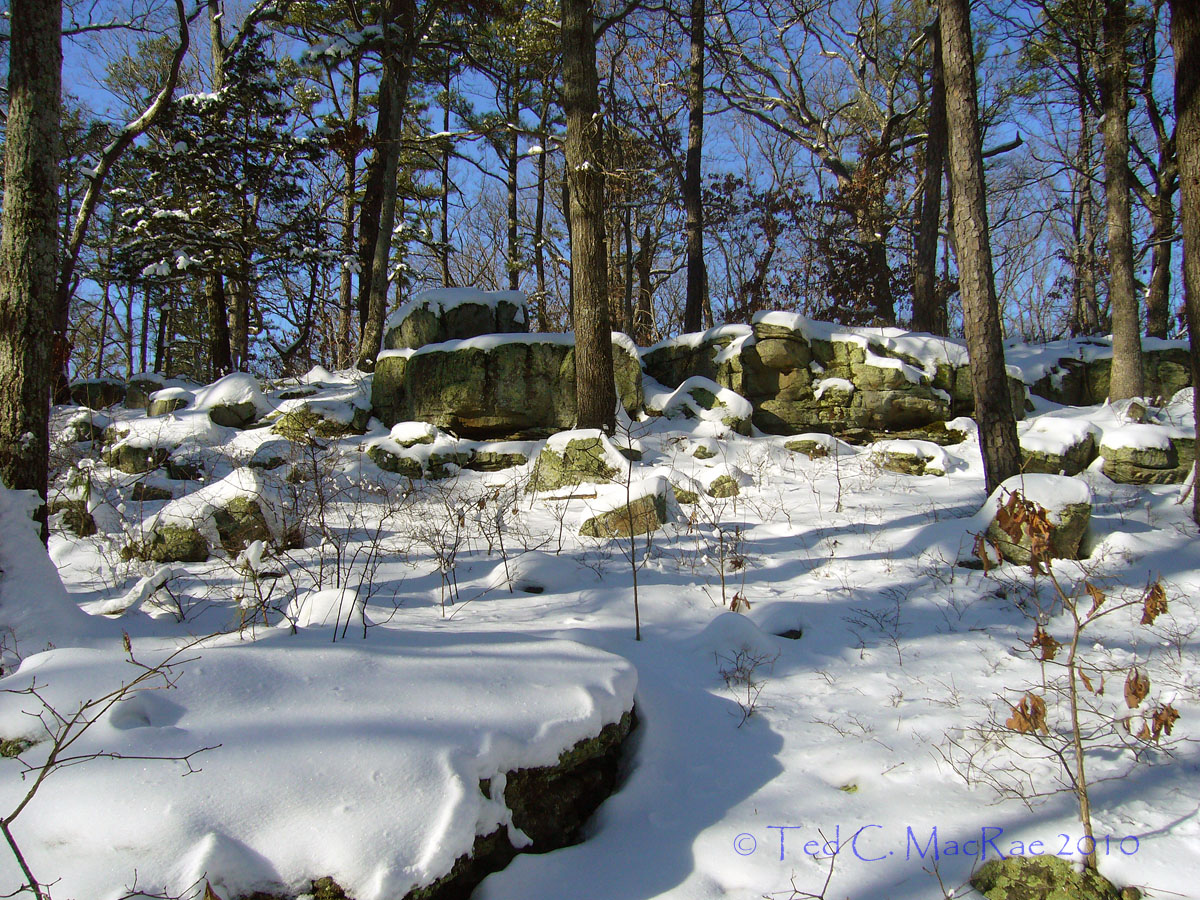
Lamotte sandstone outcrops on the White Oaks Trail


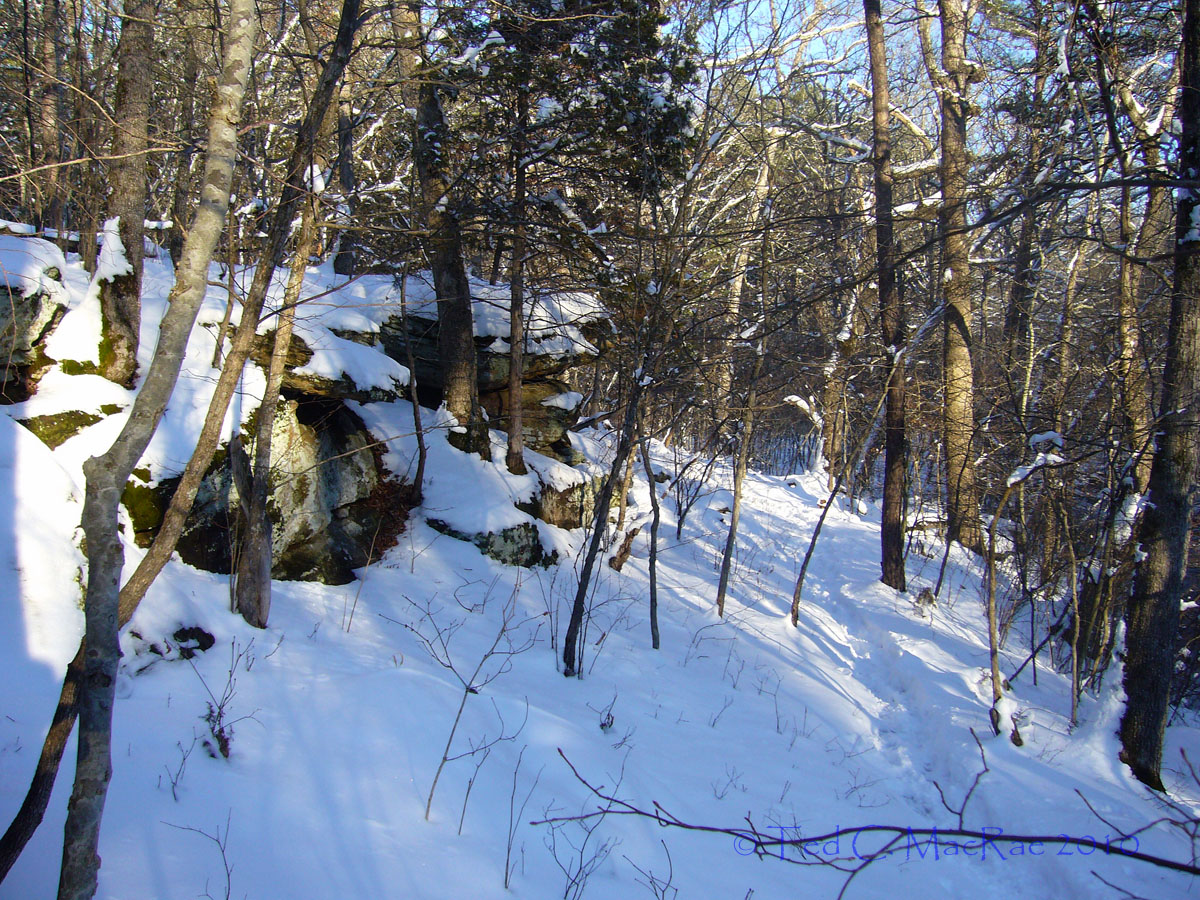
Such was the case on this visit, when Madison and I decided to explore the White Oaks Trail, a newer trail that I had not yet hiked.  I was a little concered whether we would even be able to get to the park, as the road leading into it had only been partially plowed (and we had already seen one car off the road, causing me to reach down and switch on the 4-wheel drive).  Most of the park was snowed in, but we were able to reach the uppermost parking area, leaving our snow-covered trail-finding abilities as the last obstacle to overcome.  After studying the trail map and looking at different route options, I asked Madison if she wanted to hike 2 miles, 4 miles, or 6 miles.  She immediately blurted out “6 miles!”, so off we went.  I was disappointed to see that we were not the first persons to have the idea, as we entered the trail only to find two sets of footprints (one human, one canid) leading off in front of us.  It did, however, make following the trail easier, and in fact I’ve had enough experience finding trails through the Ozark Highlands that I never felt like I needed the footprints in front of us to point the direction.  

Madison next to the root wad of an 83-yr old wind-thrown oak tree.


The White Oaks Trail followed nicely up-and-down terrain through mature white oak (Querucs alba) (appropriately) upland forest dissected by small riparian valleys before settling into relatively mild terrain through monotonous black oak forest.  Just when I thought the trail wouldn’t match the splendor of Hawn’s Whispering Pines and Pickle Creek Trails, it wrapped around to the south at the far end and passed by a beautiful hoo-doo complex of Lamotte sandstone outcroppingss supporting majestic, widely-spaced, mature shortleaf pines (Pinus echinata).  The rock outcrops provided a perfect spot to break for lunch while looking out on the deep, snow-covered valley in front of us.  

More Lamotte sandstone exposures along Pickle Creek, Whispering Pines Trail.


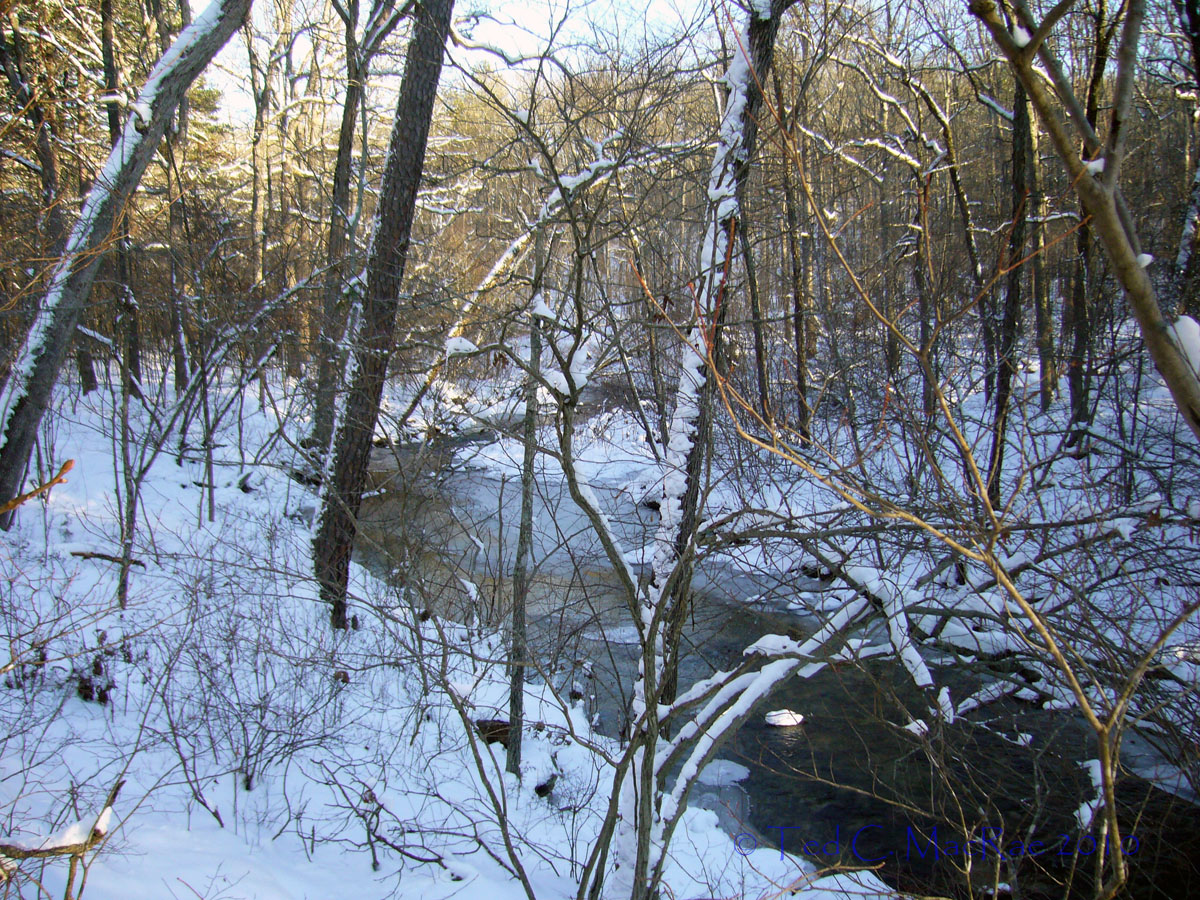
After counting a cut, wind-thrown black oak (Quercus velutinus) and determining a lifespan of 83 years, we took a connector trail down to the Whispering Pines Trail where it ran alonside the incomparably beautiful Pickle Creek.  Our hope was to hike down to the igneous shut-ins, where hard, pink rhyolites channeled the creek’s clear, spring-fed waters through narrow chutes and miniature gorges.  Upstream from the shut-ins, Pickle Creek runs lazily through the softer Lamotte sandstones that overlay those ancient rhyolites, combining with the snow cover to create a scene as peaceful and serene as any I’ve ever witnessed.

Pickle Creek meanders lazily through Whispering Pines Wild Area.

  
Just above the shut-ins, Pickle Creek bends to the west, carving deeply into the soft sandstone.  The porous nature of the rock allows moisture to trickle through and between the strata from the hillside above, creating seep zones that weaken underlying layers and lead to their collapse.  The abundant moisture this winter and continuous cycles of daytime thawing and nighttime freezes have resulted in extraordinary ice formations along the bluff face and underneath the overhanging layers, the likes of which are rarely seen in our normally more open winters.  Compare the scene in the first photo below with that in the second, taken at almost exactly the same spot one year ago in February 2009.  

Icicle formations along Pickle Creek, Whispering Pines Trail.


Same place as above in February 2009.


Ice rarely forms over the small ponds and lakes that dot the Ozark Highlands, much less its creeks and other moving waters.   The scene below of Pickle Creek as it exits the sandstone gorge is a testament to the slowness of its movements and the unusually consistent cold temperatures experienced during the past several weeks.  Only a short distance downstream, however, these lazy waters reach the bottommost layers of the erodable sandstones and encounter the hard rhyolites below.  These half-a-billion year old layers of igneous rock are much more resistant to the wearing action of water, which rushes noisily through narrowly-carved chutes before fanning out in broad sheets over smooth, steep slopes below.  

Pickle Creek along Whispering Pines Trail.


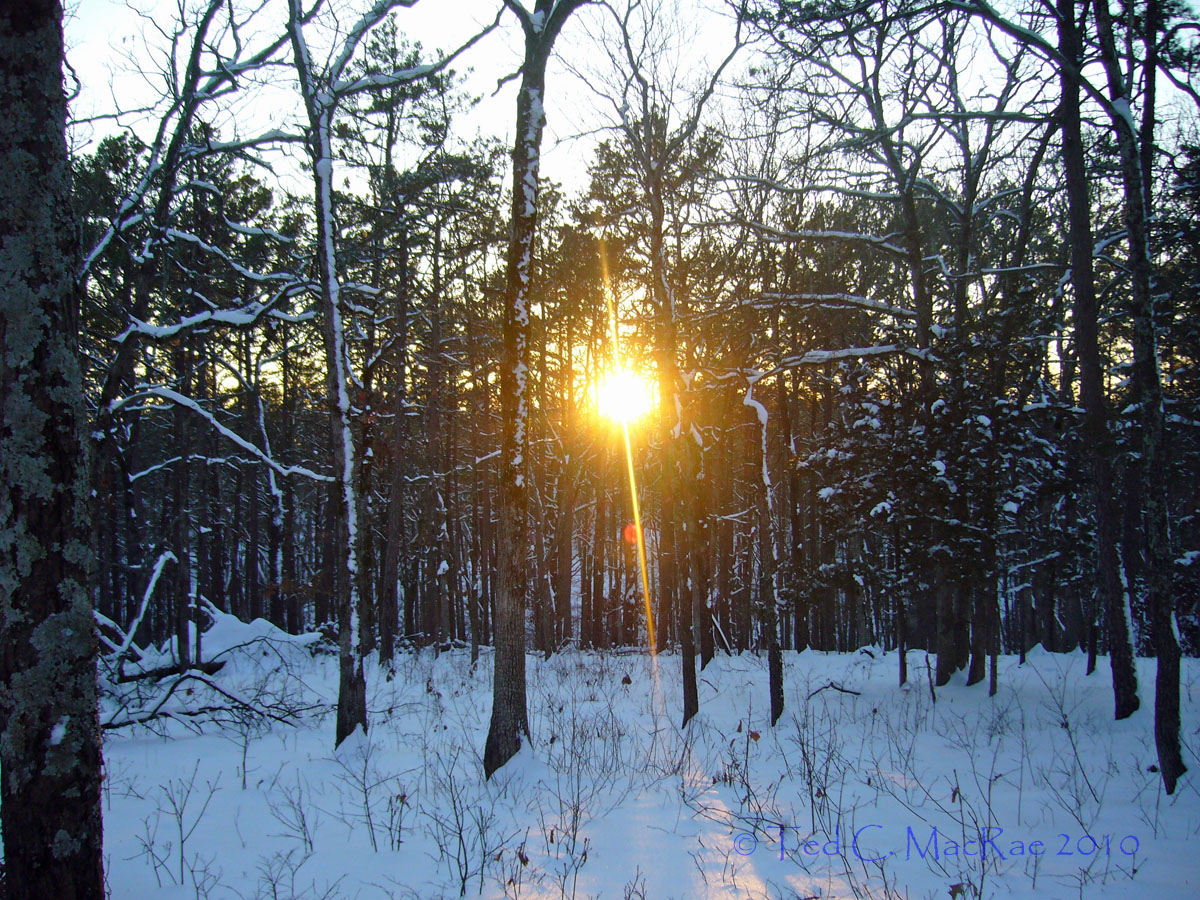
Sadly, there would not be time to visit the shut-ins.  The short February day conspired with our snow-slowed pace to leave us with a too-low-sun by the time we reached the fork in the trail that led to the shut-ins, a mile in one direction, and our car, a mile in the other.  Although we (both) had thought to carry flashlights (just in case), the last thing I really wanted to do was find myself stumbling over snow-covered trails through the dark with my 10-yr old daughter. Even had we survived the nighttime winter woods, I might not have survived the inevitable maternal reaction to such an escapade.

Arriving back at White Oaks Trailhead with a few minutes to spare.


Copyright © Ted C. MacRae 2010  

Add to FacebookAdd to DiggAdd to Del.icio.usAdd to StumbleuponAdd to RedditAdd to BlinklistAdd to TwitterAdd to TechnoratiAdd to Yahoo BuzzAdd to Newsvine  

Email to a friend

Ants invade Beetles in the Bush!

For months now, your Beetles in the Bush host, Ted, has been nudging me to blog, in the end resorting to offering me a guest blogger gig at BitB. Given this golden opportunity, I’ve decided to utilize my web-logging debut to introduce my favorite insects, the fabulous Formicidae. First, a disclaimer: I have not mastered ant photography, and so will rely on the undisputed king of ant photographers, Alex Wild, through links to his numerous, unexcelled images.

Since about age 5, I can remember being interested in virtually anything living, but especially in small, active creatures. From the beginning, I have had a particular attraction to ants. With some notable exceptions, and aside from the pulchritudinous feature of their svelte waists, ants aren’t what most folks would call pretty, but they are — How else to say it? — just plain “cool”!

First, who are they and where do they come from? Ants constitute a single family, Formicidae, within the insect order Hymenoptera, so their relatives are wasps, bees, sawflies, horntails, gall wasps, and a vast array of small parasitic wasps that are mostly unappreciated except by specialists who study them. Within Hymenoptera, the ants are considered to belong to the superfamily Vespoidea, along with hornets, paper wasps, potter wasps and other solitary relatives.  The evidence at present indicates the first animals we would call ant had diverged from their common ancestry with these other stinging wasps some time in the Cretaceous, 130 million years ago, more or less.  Ants are classified in a varying number of subfamilies, currently at about 20. Fossils in amber up to 100 million years old represent early members of several modern subfamilies, and a few extinct groups. Most of us in the Northern Hemisphere Temperate Zone are familiar only with the big two subfamilies, Formicinae (carpenter ants, weaver ants, honey ants, etc.) and Myrmicinae (fire ants, harvester ants, leaf-cutter ants, etc.). In much of North America, folks may also be familiar with an abundant member of another subfamily, Dolichoderinae, namely odorous house ants, which frequent our gardens, kitchen counters, wall spaces, and even electrical outlets, especially in spring.

Ants are a conspicuous and often dominant presence in the World of the Little (or, what Piotr Nascrecki, in one of my favorite books, calls the “Smaller Majority” ). It is difficult for any observant person to sit still, outdoors in good weather, and not begin to see ants doing what ants do. They scurry about singly, in pairs or threesomes or foursomes, or in long lines, or columns. Our notice may be further piqued by their habit of transporting sundry bits of biomass or mineromass (pebbles, etc.).  Often this is just taking out the inedible food waste, or sawdust or soil excavated while expanding or remodeling their nests.  Less visibly, because more diffusely in space, ants carry a variety of items from foraging to their nests to provide nutrition for their colonies, or to add mass or create functional structure to their nests (to create better drainage, to provide incubation space for developing brood, and in some desert ants, to capture dew). In one of the most spectacular examples of ants transporting things, the so-called “slave-making” ants carry home the mature brood of a related species, these young ants later maturing in the brood-robbers’ nest to become its work force!

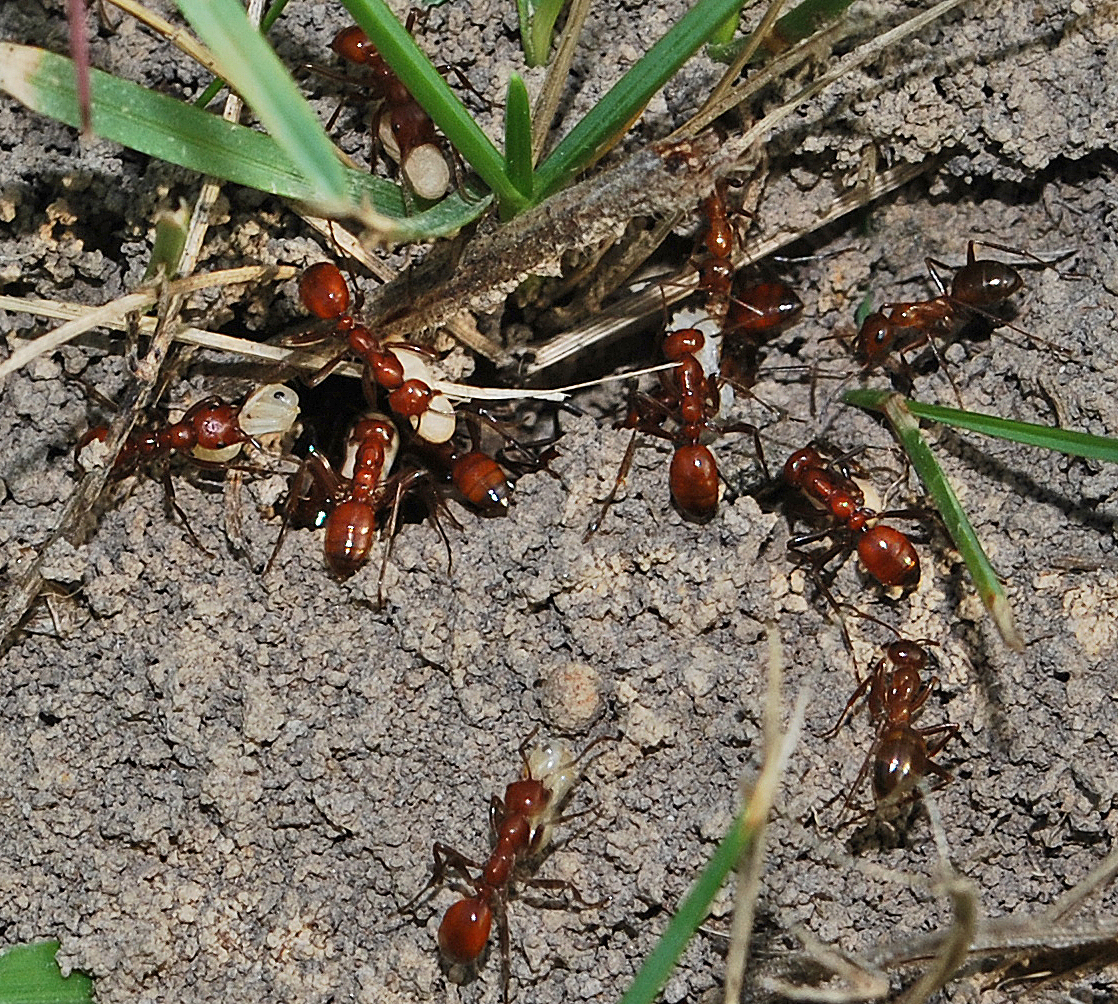
Shiny red workers of Polyergus lucidus return with pupae pillaged from a nest of Formica incerta several meters away. Two brown and differently proportioned workers of the latter that matured from raids earlier in the life of this Polyergus colony may be seen at the right of the photo.

Perhaps, not so widely known is that most of what most ants carry home is not some large, heavy particle in their mandibles, but rather is liquid carried in an expansible section of their esophagus called the crop. Because of the fine diameter of their gullets, adult ants cannot eat anything other than the most minute solid particles (e.g., pollen grains, loose cells from their prey).  Solid items may be cut up to feed to the legless, pale larvae, or the larvae may even be placed directly upon the killed prey to bite into it and feed on their own, using their flexible “necks”.  Adult ants get pre-digested food in return, in the form of glandular secretions loosely termed saliva, but which may be either a glandular secretion from the larva itself or simplify pre-liquefied flesh of prey lapped up from the larva’s messy eating.  In some lineages, known as Dracula ants, adults actually “bleed” the larvae through rapidly healing wounds made at particular locations on the larval exoskeleton.

Okay, I need to get back to my regular work, so let’s bring this home (to winter in the United States). Many of us are now in the dead of winter, or so it would seem. But, on sunny days, sap is beginning to flow upward in maple and other trees, and one ant species may actually be seen, creeping slowly through the woods, in search of dead arthropods and earthworms, or perhaps some sweet sap oozing from a sapsucker wound in a tree. This is Prenolepis imparis, sometimes called “winter honeypot ant”. This is a partial misnomer. While foragers may indeed fill their crops to over-full with sweet sap or honeydew, the very bloated “honeypots” in the deep nests of this ant are in fact, fat pots, having converted their food to whitish body fat. This is later converted to a glandular secretion that serves as food for developing larvae.  These ants are likely to be seen anywhere near where oaks of just about any species grow, and the where the soil is moist but well-drained. Look for these shiny little dark brown ants during your walks in the woods, on the sunny days that are sure to increase in number and warmth in the coming months.

Copyright © James C. Trager 2010

Add to FacebookAdd to DiggAdd to Del.icio.usAdd to StumbleuponAdd to RedditAdd to BlinklistAdd to TwitterAdd to TechnoratiAdd to Yahoo BuzzAdd to Newsvine

Email to a friend

BitB’s Newest Contributor

Those of you who have followed this blog for any length of time have likely noticed fairly regular participation in the comments sections by one James C. Trager.  Occasionally irreverent and always articulate, his informed quips are among those that I have enjoyed the most.  One can surmise from James’ comments that he knows a thing or two about entomology himself, but to say this would be an understatement!  Like me, James is a passionate entomologist whose scientific interests take him deep into many related fields of natural history study.  Unlike me, James is a formally trained insect taxonomist, specializing in ants (family Formicidae).  He has conducted numerous biogeographical and systematic studies on this group, much of it in the southeastern U.S. (list of publications), and is the current project leader for the Missouri Ants and Illinois Ants pages at AntWeb.org (whose ambitious goal is to provide information and high quality color images for each of the ~10,000 known ant species).  James’ deep knowledge of this single taxon, however, does not limit his interest in other insects — singing insects in particular are among his favorites. It is, thus, with great pleasure that I introduce James as the newest BitB contributor.

In fact, James and I have known each other for many years, as we are both based in the St. Louis area.  James is a restoration ecologist at Shaw Nature Reserve, a 2,500-acre ecological preserve located in the Ozark foothills (and just 15 miles from my house).  Originally established by the Missouri Botanical Garden for managed plant collections, its recent focus has shifted to environmental education and ecological research, and James has played a key role in their many ongoing wetland, woodland, prairie and glade (xeric limestone prairie) restoration efforts.  This experience combines with his entomological expertise and extensive travel within the U.S. and abroad (e.g., Ecuador) to give him a breadth of knowledge and perspective achieved by few, and I think you will find his writings most enjoyable.  Look for his first post to appear in the next day or so.

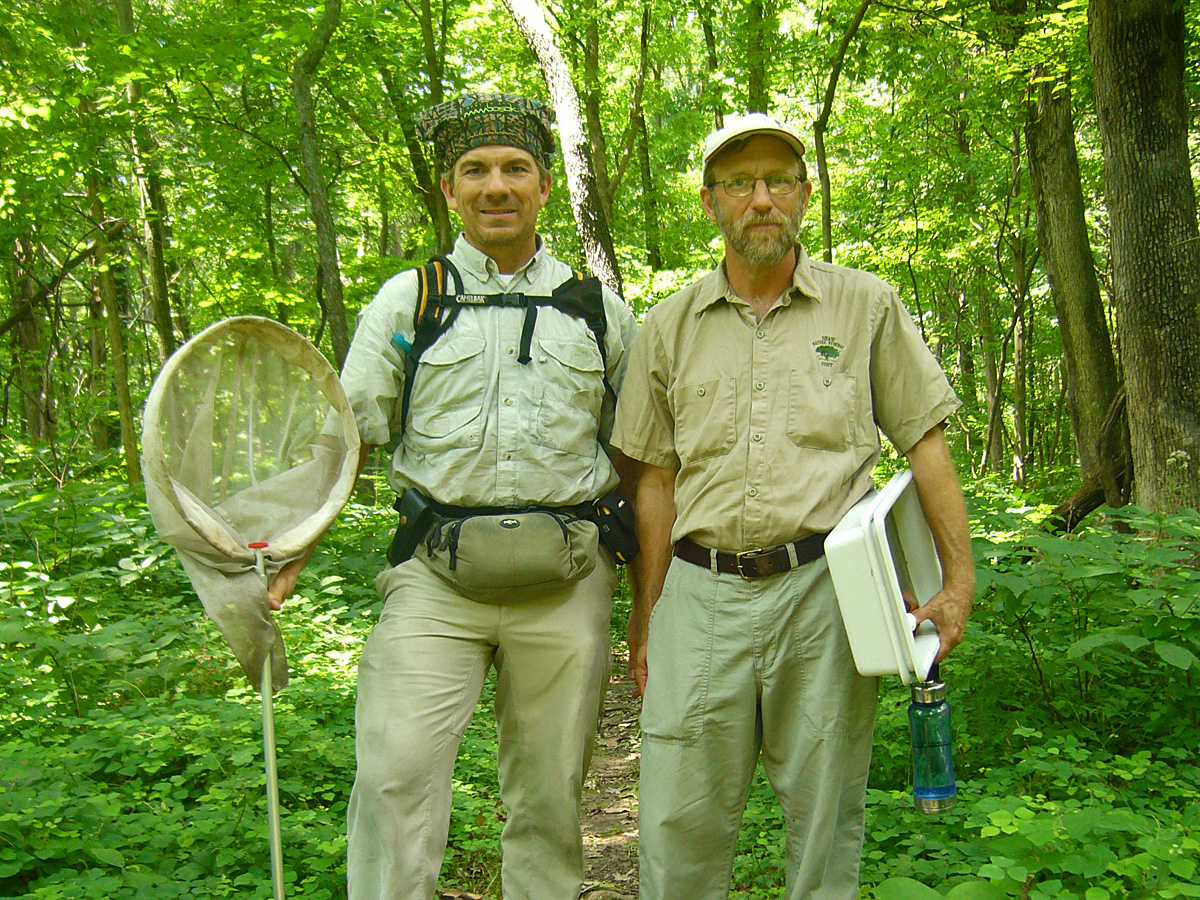
Ted & James in restored woodland at Shaw Nature Reserve. Photo by Madison MacRae.

Copyright © Ted C. MacRae 2010

Add to FacebookAdd to DiggAdd to Del.icio.usAdd to StumbleuponAdd to RedditAdd to BlinklistAdd to TwitterAdd to TechnoratiAdd to Yahoo BuzzAdd to Newsvine

Email to a friend

A matter of diffusion

In my Best of 2009 post, I mentioned four skills that, to me, seemed to be crucial for becoming a successful insect macrophotographer: 1) composition, 2) understanding lighting, 3) knowing how to use a flash, and 4) knowledge of the subject.  Of these, I’m most comfortable with the last – three decades of insect study have given me the chance to observe a tremendous diversity of insects in a variety of situations and habitats.  Many species are located only through understanding of their haunts and habits, and the ability to capture them relies upon successful approach techniques.  Collecting insects has been excellent preparation for photographing them.  I’m also reasonably satisfied with my compositional skills – at least in this early stage of my development as a photographer.  I don’t expect to win any photo competitions (yet), especially since my intent as a photographer is at least as much for scientific documentation as it is for artistic expression, but I’m satisfied that I’m on the right track and developing the eye I’ll need to make good progress.

What I’m not satisfied with yet are the middle two – understanding lighting and knowing how to use a flash.  Let’s face it, I was starting from square one here.  My only prior experience with insect photography were middlin’ attempts in the mid-1980’s using an Olympus OM-10 body, a Zuiko 50mm lens (maximum magnification 1:2), and natural light only.  I quickly lost interest (too distracting for the collecting), picking it back up only for my 1999 trip to South Africa.  Fast forward to May 2009 and my acquisition of a bona fide insect macrophotography setup, complete with Canon’s 100mm f/2.4 and 65mm 1-5X macro lenses and their MT-24EX macro twin flash.  Talk about giving a Ferrari to someone who had just received their learner’s permit!  I like a good challenge, however, and spent the rest of 2009 with camera in hand on several memorable field trips – shooting lots of frames, deleting many on the spot and more when I saw them on the computer, and occasionally stumbling onto a pretty good one.

While I still have much to learn, one thing I did realize is that lighting remains a challenge even with a decent setup such as mine.  The MT-24Ex flash unit, in particular, while seemingly the flash of choice among Canon-using amateur insect macrophotographers, produces a very harsh light.  The capabilities and shortcomings of this flash unit have been reviewed in great detail by several insect macrophotographers much more knowledgeable than I (e.g., Alex Wild, Dalantech, Kurt, etc.), so I simply refer you to their websites if you’re interested rather than try to summarize here.  However, the one thing they all emphasize with this flash unit is the need for diffusers.  Diffusing light is easy; a simple sheet of tracing paper will do.  However, diffusing light in a manner that is equally effective with both the 65mm and 100mm lenses (with their shorter and longer working distances, respectively) and also convenient for field-use is hard.  For most of the 2009 season, I tried using Sto-Fen Omni-Bounce Diffusers, and while they were marginally better than no diffusers at all, the results were still not satisfying.  More recently, I’ve been experimenting with the Gary Fong Puffers, which Dalantech has modified for use with the MT-24EX.  I hadn’t yet committed to constructing the diffusers as described and conducting controlled comparisons between the Puffers and Sto-Fens, but my initial tinkering with the Puffers has me impressed.  Below are two photos of Cicindela splendida (the aptly-named Splendid Tiger Beetle) – the first (which some of you may remember from this post) was taken in the field using the Sto-Fen diffusers and the 65mm lens (1X)…

…while the second was taken recently of this same beetle (in captivity on native soil) using the Puffers attached to the Sto-Fens and the 100mm lens (at slightly less than 1X).

Both photos have been cleaned up a bit with post-processing; however, neither has been altered dramatically.  While not a true one-to-one comparison due to different venues (field versus captivity) and lenses (65mm versus 100mm), the second photo is clearly superior to the first, with softer lighting resulting in richer colors and far fewer specular highlights on the insect body.   I had to bump the lighting up considerably for the second photo, since the Puffer combined with the Sto-Fens cut the light levels quite a bit, yet still the photo lacks any of the harshness and washed appearance of the first photo.  The use of the 100mm lens in the second photo also should have presented a greater challenge for the lighting due to the increased working distance (~8 inches, compared to only 2-3 inches for the 65mm lens).  I’m really quite pleased with the results of this initial experiment – enough to the point that I’ve ordered the necessary materials and am ready to dive into construction of my own set of “Dalantech-Puffers.”

Copyright © Ted C. MacRae 2010

Add to FacebookAdd to DiggAdd to Del.icio.usAdd to StumbleuponAdd to RedditAdd to BlinklistAdd to TwitterAdd to TechnoratiAdd to Yahoo BuzzAdd to Newsvine

Email to a friend

Friday Flower: Crystallofolia (“Frost Flowers”)

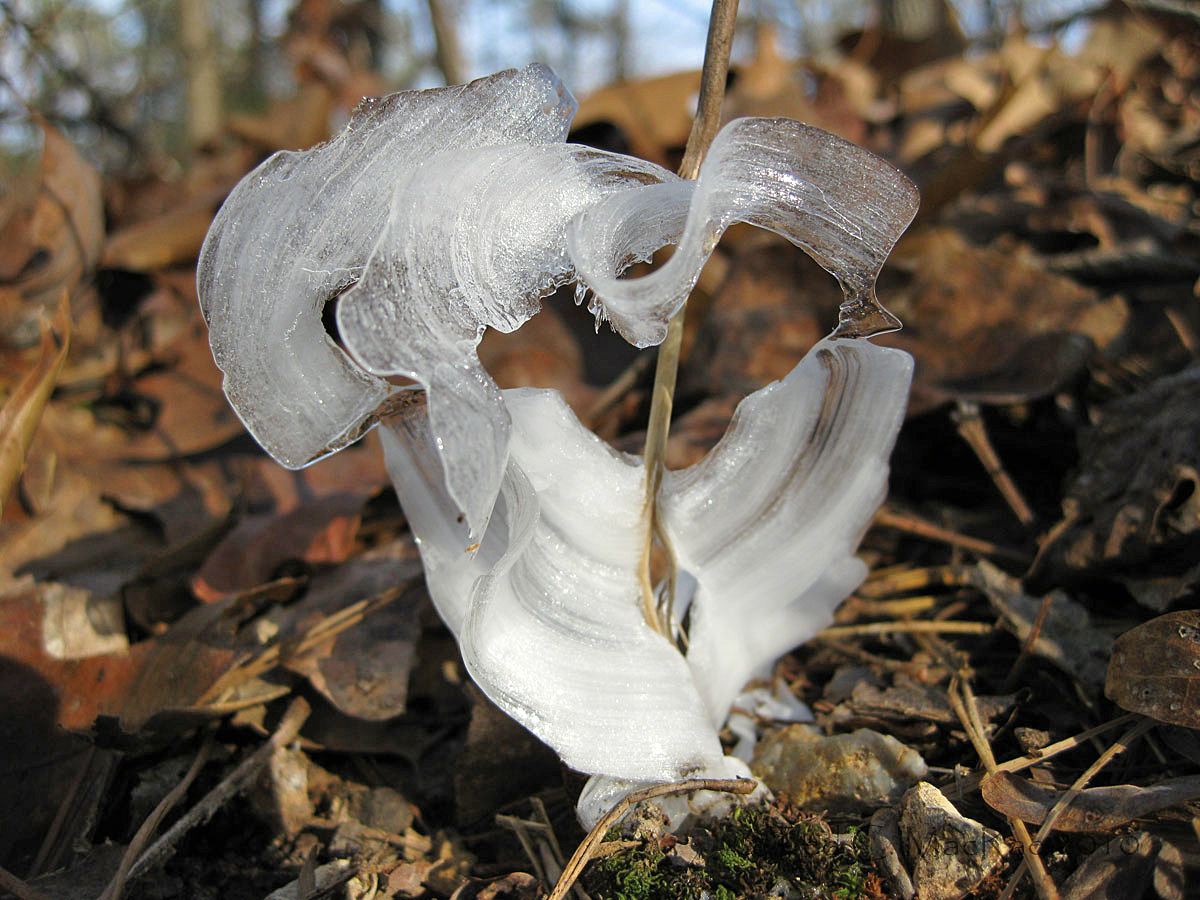
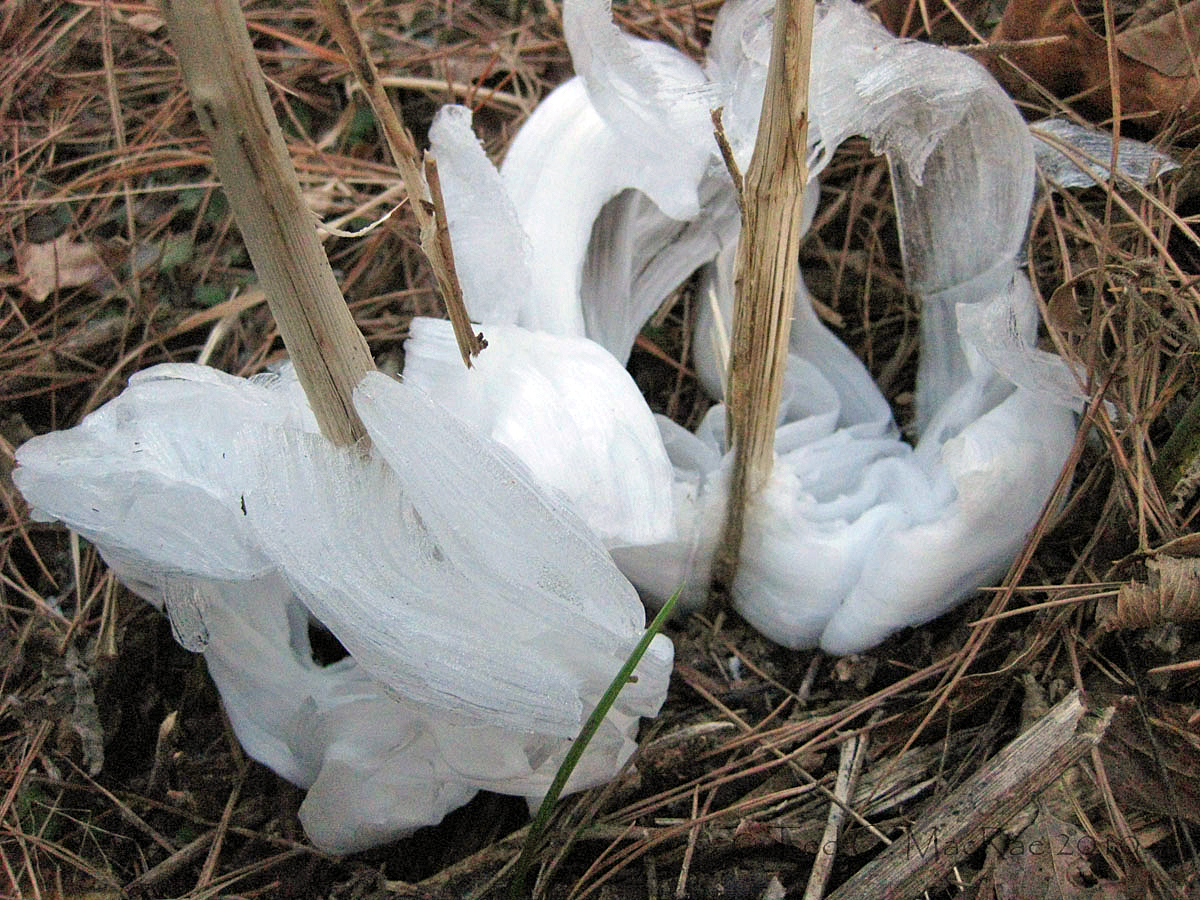
Crystallofolia (frost flowers) on dittany (Cunila origanoides).

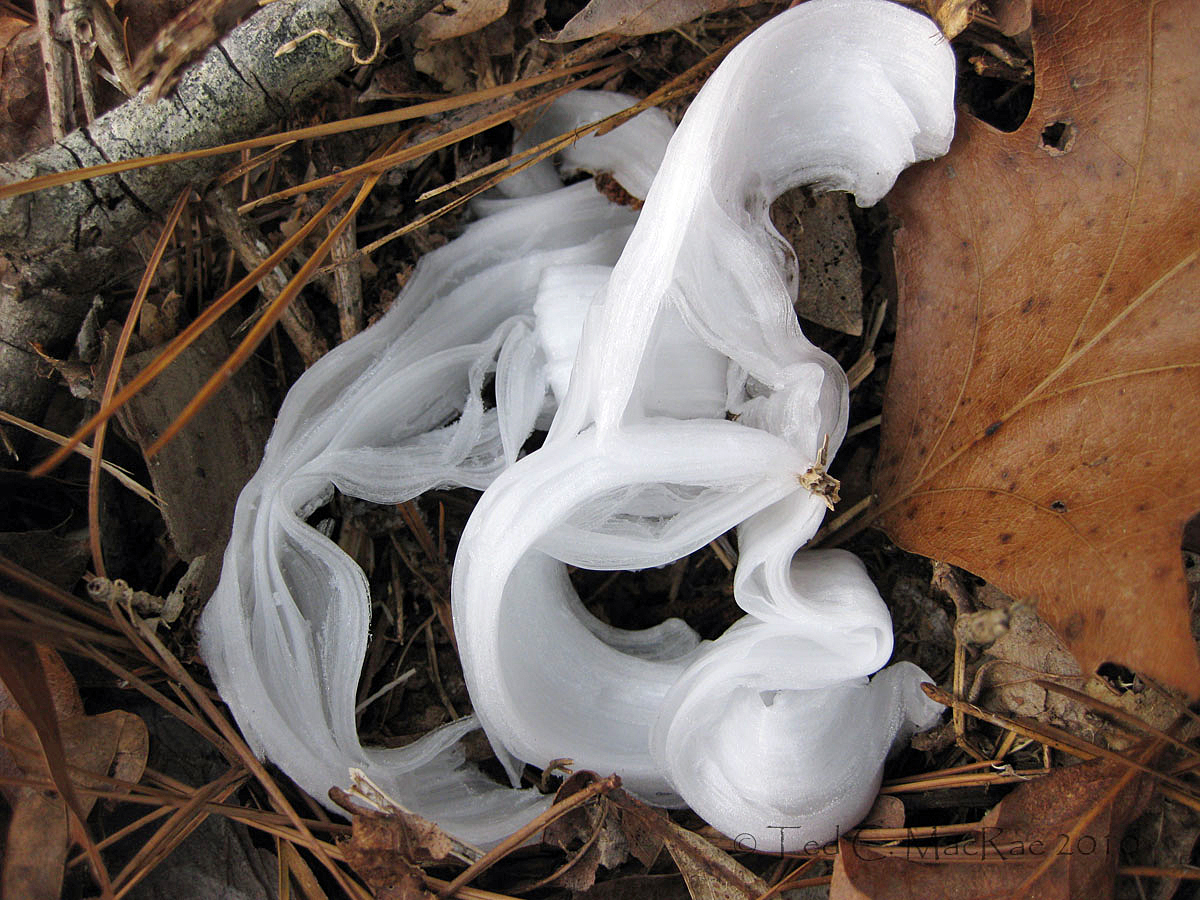
While hiking the middle stretch of the Ozark Trail’s Wappapello Section, my friend Rich and I witnessed a bounty of crystallofolia, or “frost flowers”.  These fragile, yet exquisite formations are, of course, not flowers at all, nor are they true frost (which forms directly from water vapor without first condensing), but rather are thin layers of ice that form as water is drawn from cracks in plant stems and freezes upon contact with cold air.  As the water continues to be drawn from the plant by capillary action, newly forming ice pushes older ice further out, creating delicate, folded, curling ribbons of ice that resemble many-layered flower petals.  Air trapped within the ice upon freezing imparts a frothy white appearance.

Frost flowers are not an uncommon phenomenon, and I have seen them on more than a few occasions during my frequent off-season hikes.  However, never before had either Rich or I seen the numbers that we saw during our hike on this, the second day of the New Year.  Frost flowers are normally encountered during the first hard freezes of fall when the ground is not yet frozen.  Water in the stems of certain plants expands as a result of the freezing air temperatures, causing vertical cracks to form along the length of the stem through which the ice ribbons are extruded. The formations are rather ephemeral, usually melting or sublimating away by late morning in fall’s typically mild daytime temperatures.  As fall progresses to winter, water stores in the plant stems become depleted after several freezes or locked up when the ground itself freezes, and as a result frost flowers are rarely seen later than December in Missouri. However, it has been a wet and mild fall and early winter, and after an extended period of moisture during December, Missouri was finally gripped by a severe cold spell with lows in the single digits and daytime highs remaining down in the teens and 20s.  The saturated, yet unfrozen ground provided a good source of moisture for plant stems to draw upon, and continuous subfreezing air temperatures allowed frost flowers to persist throughout the days and attain remarkable size. The photo above was taken in late afternoon as a sinking sun shone brightly on the west-facing slope where this formation was seen, persisting in all its fragile glory.

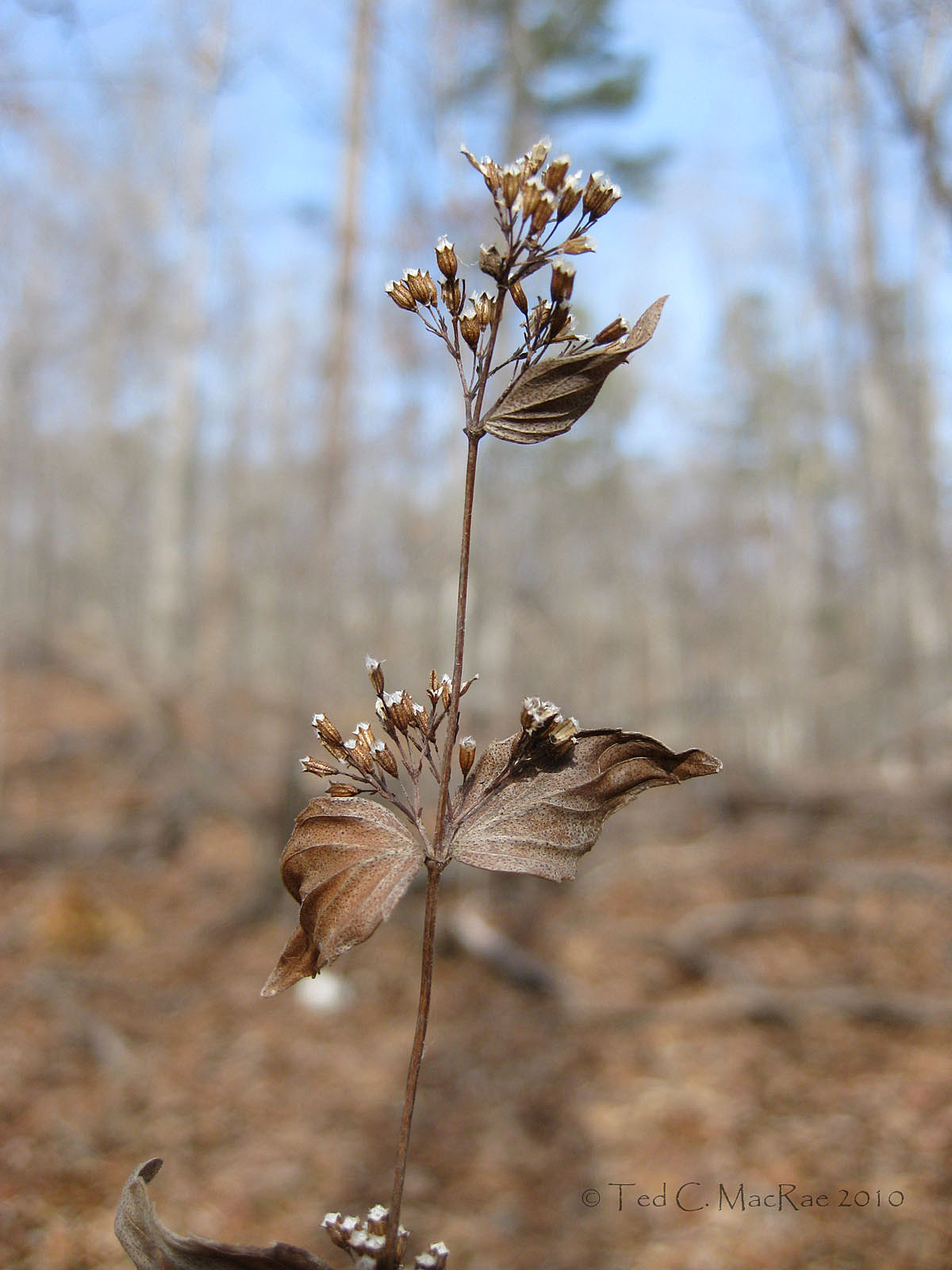
In Missouri, frost flowers are primarily associated with dittany (Cunila origanoides), species of Verbesina (V. virginica, white crownbeard; and V. alternifolia, yellow ironweed), and camphor weed (Pluchea camphorata).  Frost flowers are rarely seen on any other plant in Missouri, and I don’t know what it is about these plants and not others that make them suitable for frost flower formation.  Dittany is a daintly little member of the Lamiaceae, and as such has square stems – perhaps the angles on the stem are prone to splitting.  However, there are many other lamiaceous plants and non-lamiaceous square-stemmed plant species in Missouri that do not form frost flowers.  Likewise, Verbesina and Pluchea belong to the Asteraceae and do not have square stems.  They are, however, larger, more robust plants with thick, pithy stems that may be capable of holding a large amount of water and mature late in the season after most other plants have already dried up, perhaps allowing them to retain sufficient moisture in the stem late enough in the season to allow frost flower formation when conditions are right.  The majority of the frost flowers we saw were on dittany – dainty, delicate, fragile formations 2-3 inches across. However, at the end of the hike, as we were exploring the area around the parking lot, we found a stand of Verbesina (I suspect V. alternifolia), with which some of the most enormous and robust frost flowers that I have ever seen were associated.  Following are additional views of some of the more impressive formations we saw and the plants they were associated with.

Frost flowers on dittany - shaded, protected areas produced the largest formations.

Partial thawing during ribbon formation causes exquisite twists and turns.

Like snowflakes, each frost flower is one-of-a-kind.

Dittany (Cunila origanoides) dried stem, leaves, and fruits.

Verbesina sp. frost flowers were enormous - this one was approx. 5 inches wide.

Dried fruits of Verbesina sp. (poss. alternifolia).

Copyright © Ted C. MacRae 2009

Add to FacebookAdd to DiggAdd to Del.icio.usAdd to StumbleuponAdd to RedditAdd to BlinklistAdd to TwitterAdd to TechnoratiAdd to Yahoo BuzzAdd to Newsvine

Email to a friend

Mass Grave

My friend Rich and I have begun hiking the Wappapello Section of the Ozark Trail this winter in our quest to eventually hike all 350 miles of the Ozark Trail in Missouri (to this point we had completed ~230 miles).  The Wappapello Section is the southeasternmost of all the sections, lying almost entirely in Wayne County and traversing rugged terrain in the Mark Twain National Forest along the west side of Wappapello Lake as it courses north to Sam A. Baker State Park.  The U.S. Corps of Army Engineers built and manages Wappapello Lake primarily for flood control in the rich farmlands the lie just downstream in the Mississippi Alluvial Plain in extreme southeastern Missouri.  Because of this, stretches of the Ozark Trail are subject to frequent inundation.

Such was the case the day after Thanksgiving, when Rich and I tackled the northernmost 10-mile stretch of this section. Because of the flooding, we had to bushwhack to higher ground for a significant portion of the hike. This sounds easier than it was—elevational relief in this rugged southeastern portion of the Ozark Highlands is as much as 500 ft, with steep grades and thick leaf litter atop loose, cherty soils. We did our best to stay oriented using a basic contour map and the experience we’ve gained over the years in judging terrain.

Sometimes, diversions from the trail lead to unexpected discoveries. On an earlier hike, we had gotten lost trying to find our starting point (not a designated trailhead)—we drove through hill and dale and ended up on a losing 2-track that was quite obviously not where we wanted to be. While turning the vehicle around in the tight space between the trees, we noticed something white peeking out from under a black plastic tarp, and upon investigation discovered the clean and nearly complete skeleton of a horse (or mule? These are the Ozarks, afterall). A shattered left occiput and lead projectile protruding through the right maxilla of the skull told the story of this sad beast’s demise. Despite its gruesome origins, I simply cannot resist clean, whole skulls of any kind, so I placed it in the vehicle before we resumed our search for the trail. It now rests permanently in my “museum” and has been named Horace (sitting next to an even cleaner skull of a feral hog that I found a few years earlier—named Boris. Get it? Horace the horse and Boris the boar?).

On this day, as we blazed our own trail on higher ground roughly parallel to the actual trail, we happened upon the gruesome scene shown in these two photographs. Natural historians that we are, we began conducting our own “crime scene” reconstruction—first determining the identity of the remains, then hypothesizing the reason for their placement there based on what we could observe about them. As far as we could tell, the remains of at least three individuals were present, each in a different state of decay from the others and with no apparent evidence of trauma. Rich and I are pretty sure we know what these are, and we have our own ideas about how they got here and why, but I’d be interested in hearing what others think (click photos to embiggen).

This scene made me a little nervous—not because skeletons give me the creeps, but because the Ozark Highlands have a reputation for harboring what many people insultingly refer to as “hillbillies.” The stereotype that this term engenders—i.e., a barefoot man with a long beard and ragged clothes, banjo in one hand and shotgun in the other—may be an extreme and unfair caricaturization. Nevertheless, the presence of this mass grave, with apparently no effort to conceal it, made at least the shotgun part of that image seem a little too real for comfort.

Copyright © Ted C. MacRae 2010

Add to FacebookAdd to DiggAdd to Del.icio.usAdd to StumbleuponAdd to RedditAdd to BlinklistAdd to TwitterAdd to TechnoratiAdd to Yahoo BuzzAdd to Newsvine

Email to a friend