Ellipsoptera lepida – ghost tiger beetle

In the early 2000s, Chris Brown and I were beginning our general survey of Missouri tiger beetles. Our goal was to characterize the occurrence and distribution of all species within the state. At the time, 22 species were known to occur in Missouri, and our work would uncover the presence of two more—one being a vagrant occurrence of the widespread Cicindelidia trifasciata ascendens (ascendent tiger beetle) (Brown & MacRae 2005); the other being the rare Cylindera celeripes (swift tiger beetle) (MacRae & Brown 2011). Of the species already known from the state, however, some were known from only a few records and hadn’t been seen in the field by either Chris or myself. One such species was Ellipsoptera lepida (ghost tiger beetle), an almost pure white species known to occur in deep, dry sand habitats over most of central North America (Pearson et al. 2015). At that time, I had still seen only the more common species in Missouri, and the combination of its name and unusual, mostly-white color put this species high on my “must see” list.

Ellipsoptera lepida (ghost tiger beetle)

My first experience would come quickly. In June 2001, Chris and I visited a recent addition to Weldon Spring Conservation Area on the north side of the Missouri River in St. Charles Co. called Darst Bottoms. The area at one time was productive farmland, but the “Great Floods” of 1993 and 1995 left deep deposits of sand over the area. While no longer suitable for agriculture, the process of succession allowed valuable wildlife habitat to develop, and the area was purchased and added to the Conservation Area. By the time of our visit in 2001, early succession had resulted in young forests of mostly eastern cottonwood (Populus deltoides) surrounding a vast central plain of white sand. Chris and I didn’t know what to expect on that first visit, both of us being in the early stages of our survey of Missouri tiger beetles, but we figured we would find something interesting.

Ellipsoptera lepida (ghost tiger beetle)

I still remember the moment I first saw E. lepida and realized what it was. We had already found Cicindela formosa generosa (eastern big sand tiger beetle)—the first time I had seen that species in Missouri outside the southeastern lowlands (we would eventually find it at many sites along the Missouri and Mississippi Rivers and a few smaller interior rivers)—and were searching for additional specimens. We were in a small opening adjacent to the larger central plain when I thought I saw something move near my feet. I stopped to look down but didn’t see anything, so I began walking again while scanning the ground ahead of me. Again, I thought I saw movement nearby and stopped to look, this time pausing a little longer and doing so a little more carefully. That’s when I saw it, and even though I had seen only photographs of the species and museum specimens I recognized it instantly for what it was and yelled out “lepida!” Chris came over to see for himself, and we marveled at the effectiveness of their camouflage—they seemingly were able to disappear right before our eyes even though we were looking right at them.

Sand plain habitat for Ellipsoptera lepida (ghost tiger beetle).

Over the next few years, Chris and I found the species at several sites along or not too distant from the Missouri and Mississippi Rivers—always on sand deposits deep enough to become dry. We never found them in great numbers, sometimes just single individuals while other sand residents were abundant, and not at all sites where we did find more reliable species such as C. f. generosa and C. tranquebarica (oblique-lined tiger beetle). Pearson et al. (2015) mention that despite the broad distribution of this species across central North America that its actual occurrence is rather spotty and localized and that it has disappeared from many sites where it was previously known to occur. This was our experience in Missouri as well, as many of the museum records we had gleaned for the species no longer appeared to support populations of the beetle. This is likely due, at least in part, to the ephemeral nature of the habitats on which the species depends, at least those along the big rivers that are vulnerable to revegetation and succession back to bottomland forest.

Ellipsoptera lepida (ghost tiger beetle)

Of course, all of this occurred long before I took up insect macrophotography in 2009, and while I had managed to photograph most of the tiger beetle species in Missouri in the years that followed, E. lepida was one that I continued to lack. In the summer of 2015 I decided to rectify that situation and, when the time was right, returned to Darst Bottoms in hopes of finding and photographing this species. Imagine my surprise when I hiked into the area and, instead of young cottonwood stands surrounding a vast, barren sand plain, I found mature cottonwood forests surrounding a thickly vegetated sand prairie with only isolated patches of barren sand. Needless to say, with such little suitable habitat for the beetles they were neither abundant nor even common. In fact, the only evidence I found that told me they were still there at all was coyote scat containing unmistakable remains of the adult beetles. Skunked on my first effort, I decided to try another spot where we had seen good populations of the beetle—Overton Bottoms Conservation Area along the Missouri River in Cooper and Monteau Counties in central Missouri, now Overton Bottoms South Unit and part of the Big Muddy National Wildlife Area. Like Darst Bottoms, this area had experienced revegetation and succession in the decade+ since my previous visit; however, unlike the former there still remained a vast central plain that, while vegetated, was sparsely vegetated enough to continue providing suitable habitat for the beetle. It took some work, but I eventually found the beetles localized in one part of the sand plain (see photograph #3), and there were enough of them out at the time of my visit that I succeeded in getting the series of photographs shown in this post.

Ellipsoptera lepida (ghost tiger beetle)

I have fond memories of all 24 tiger beetle species in Missouri—each one presenting a unique collection of experiences that will fuel my love affair with the group for years to come. With E. lepida, the jubilance and excitement of that first, unexpected encounter remains near the top of the list for me.

REFERENCES:

Brown, C. R. & T. C. MacRae. 2005. Occurrence of Cicindela (Cicindelidia) trifasciata ascendens (Coleoptera: Cicindelidae) in Missouri. Cicindela 37(1–2):17–19 [pdf].

MacRae, T. C. & C. R. Brown. 2011. Historical and contemporary occurrence of Cylindera (s. str.) celeripes (LeConte) (Coleoptera: Carabidae: Cicindelinae) and implications for its conservation. The Coleopterists Bulletin 65(3):230–241 [pdf].

Pearson, D. L., C. B. Knisley, D. P. Duran & C. J. Kazilek. 2015. A Field Guide to the Tiger Beetles of the United States and Canada. 2nd Edition. Oxford University Press, New York, 264 pp. [Oxford description].

© Ted C. MacRae 2017

Cicindela scutellaris flavoviridis (chartreuse tiger beetle)

In previous posts I have discussed some Texas subspecies of Cicindela scutellaris (festive tiger beetle) and C. formosa (big sand tiger beetle)—two widespread and geographically variable species that occur broadly across eastern North America and that segregate into several distinctive and geographically restricted subspecies (Pearson et al. 2006). With the former species, I actually found two of its Texas subspecies, the second being C. s. flavoviridis (dubbed the “chartreuse tiger beetle” by Erwin & Pearson, 2008). This subspecies occurs in a narrow band from north-central Texas south to central Texas and apparently does not intergrade with rugata (which I featured previously) to the east (Pearson et al. 2006) and minimally with subspecies lecontei to the north (Vaurie 1950).

Cicindela scutellaris flavoviridis

Cicindela scutellaris flavoviridis

This beautiful subspecies usually lacks maculations, at most possessing two tiny ivory white spots along the outer edge of the elytra, and the shining metallic upper body surface is the most stunning shade of greenish-yellow, or chartreuse, color that I have ever seen. It shares with C. s. rugata a more wrinkled pronotum and smoother head than other C. scutellaris subspecies, but the latter is distinguished by its darker blue to blue-green dorsal coloration. Vaurie (1950) regarded C. s. flavoviridis to be intermediate between rugata and scutellaris but more closely related to the latter due to their shared yellow/coppery reflections on the elytra. Cicindela s. flavoviridis can also be confused with immaculate forms of C. sexguttata (six-spotted tiger beetle), but the latter is less robust with a more tapered posterior, and both sexes of C. sexguttata have a whitish labrum—in all C. scutellaris subspecies only males have a white labrum and females have a dark/black labrum.

Cicindela scutellaris flavoviridis

Cicindela scutellaris flavoviridis

Like all of the other C. scutellaris subspecies, this one occurs in deep, dry sand habitats such as dunes, blowouts, and road cuts. I found this population along a tributary of the Red River known as Cobb Hollow” in Montegue Co., Texas in early October 2015, where they occurred in small numbers on deep sand bars alongside the small creek. I actually made two visits to this site one week apart—failing the first time in my efforts to obtain good, in situ field photographs but succeeding on the second visit.

Cicindela scutellaris flavoviridis

Cicindela scutellaris flavoviridis

I am quite satisfied with these photos, especially the first one above that gives a good lateral view of an adult striking an interesting pose on sloped sand, although I would have liked to have gotten at least one with some foliage in the photo to add a bit of perspective. Nevertheless, having now succeed in photographing the four “western” subspecies of C. scutellaris (rugata and flavoviridis in Texas, nominate scutellaris in the Great Plains, and yampae in northwestern Colorado), I am now motivated to get good photographs of the three “eastern” subspecies: lecontei proper (there are populations in northern Missouri), rugifrons along the North Atlantic coast, and unicolor in the southeastern U.S. (although I have photographed an interesting lecontei × unicolor intergrade population in southern Missouri).

REFERENCES:

Erwin, T. L. & D. L. Pearson. 2008. A Treatise on the Western Hemisphere Caraboidea (Coleoptera). Their classification, distributions, and ways of life. Volume II (Carabidae-Nebriiformes 2-Cicindelitae). Pensoft Series Faunistica 84. Pensoft Publishers, Sofia, 400 pp [Amazon descriptionbook review].

Pearson, D. L., C. B. Knisley & C. J. Kazilek. 2006. A Field Guide to the Tiger Beetles of the United States and Canada. Oxford University Press, New York, 227 pp. [Oxford description].

Vaurie, P. 1950. Four new subspecies of the genus Cicindela (Coleoptera, Cicindelidae). American Museum Novitates 1458:1–6 [AMNH Digital Library pdf].

© Ted C. MacRae 2017

Cicindela scutellaris rugata (the “wrinkled tiger beetle”)

During last year’s Fall Tiger Beetle Collecting Trip, I visited several rural cemeteries in northeastern Texas. No, this was not a diversion from my beetle collecting—cemeteries in rural areas can be great places to look for tiger beetles because they tend to be lightly managed parcels of land of low agricultural value, thus retaining to some degree the character of the original landscape. In this case, the cemeteries I visited were located in the northern part of Texas’ Post Oak Savannah, a transitional ecoregion with uplands characterized by deep sandy soils supporting native bunchgrasses and scattered post oaks. It is the open, sandy areas in this region where distinctive subspecific populations of two more broadly distributed tiger beetles can be found—Cicindela scutellaris rugata and Cicindela formosa pigmentosignata. One location where I looked for them was an old cemetery in Henderson County. Within minutes of stepping out of the car, I found the first subspecies—unmistakable by its solid shiny blue coloration.

Cicindela scutellaris rugata

Cicindela scutellaris rugata Vaurie, 1950—Henderson Co., Texas

Cicindela scutellaris rugata, dubbed the “wrinkled tiger beetle” by Erwin & Pearson (2008), is one of seven recognized subspecies of this widely distributed species that shows greater geographical variation than any other species of tiger beetle in North America (Pearson et al. 2006). Across its range the species is found in deep, dry sand habitats that are fully exposed to the sun and lack any standing water. Except in the far southeastern U.S., this species is often found in association with C. formosa (although in Missouri I have noted that C. scutellaris occurs slightly earlier in the spring and slightly later in the fall—perhaps at least in part to avoid direct competition with and possibly even predation by that larger species).

Cicindela scutellaris rugata

The “wrinkled tiger beetle” exhibits solid blue to blue-green coloration with no maculations.

This subspecies is similar in appearance to C. s. unicolor, distributed across the southeastern U.S. and separated from C. s. rugata by the Mississippi River floodplain—both are shiny blue to blue-green in coloration and exhibit no maculations on the elytra. However, C. s. rugata has a more wrinkled pronotum (hence, the subspecific epithet) and smoother head, while C. s. unicolor has a smoother pronotum and more wrinkled head. Another subspecies, C. s. flavoviridis, shares this surface sculpturing but differs in having the elytra colored lighter yellow-green—in this sense C. s. rugata can be considered intermediate between C. s. unicolor to the east and C. s. flavoviridis to the west (Vaurie 1950). Cicindela s. rugata can also be confused with immaculate forms of C. sexguttata (six-spotted tiger beetle), but the latter is less robust with a more tapered posterior, and both sexes of C. sexguttata have a whitish labrum (in all subspecies of C. scutellaris only males have a white labrum, while females have a dark to black labrum).

Cicindela scutellaris rugata

The more wrinkled pronotum and smoother head distinguishes C. s. rugata from C. s. unicolor.

As I have noted for other C. scutellaris subspecies that I have encountered (nominate as well as C. s. leconteiC. s. yampae, and Missouri’s intergrade population of C. s. unicolorC. s. lecontei), adults were fairly abundant during the late morning hours but largely disappeared during the afternoon, probably having dug into their burrows to escape the midday heat (although I did not search for the burrows and dig them out as I have done for the other mentioned subspecies). I did see a very few individuals at another sandy cemetery in neighboring Van Zandt Co. that I visited later in the afternoon (and at both locations I found the stunning C. formosa pigmentosignata—that will be the subject of another post).

REFERENCES:

Erwin, T. L. & D. L. Pearson. 2008. A Treatise on the Western Hemisphere Caraboidea (Coleoptera). Their classification, distributions, and ways of life. Volume II (Carabidae-Nebriiformes 2-Cicindelitae). Pensoft Series Faunistica 84. Pensoft Publishers, Sofia, 400 pp [Amazon descriptionbook review].

Pearson, D. L., C. B. Knisley & C. J. Kazilek. 2006. A Field Guide to the Tiger Beetles of the United States and Canada. Oxford University Press, New York, 227 pp. [Oxford description].

Vaurie, P. 1950. Four new subspecies of the genus Cicindela (Coleoptera, Cicindelidae). American Museum Novitates 1458:1–6 [AMNH Digital Library pdf].

© Ted C. MacRae 2016

The “black bringer of light”

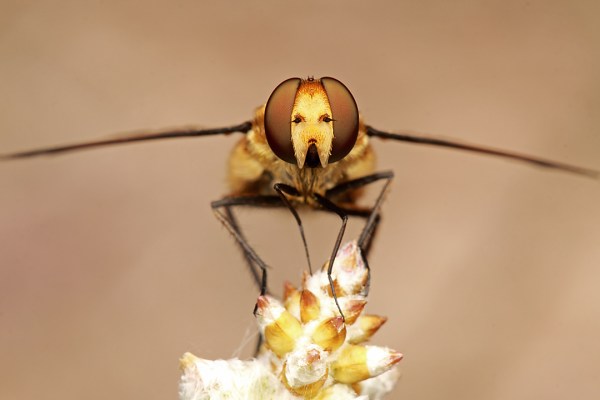
During last year’s Fall Tiger Beetle Collecting Trip, I spent a day visiting cemeteries in the Post Oak Savannah region of northeastern Texas to look for tiger beetles associated with open sand in and around the cemeteries. It had been a good day, and I thought I would try to squeeze in one more visit to a locality I had visited earlier in the day. By the time I arrived at Sand Flat Cemetery in Henderson Co., however, it was almost 6 p.m.—the sun was still up, but the shadows were long and no tiger beetles were found. Not all insects, however, are so quick to turn in as tiger beetles, so I lingered for awhile and eventually found an area where several large bee flies (family Bombyliidae) were seen flying and briefly perching on the ground or the tips of plains snakecotton (Froelichia floridana). Since this was the last stop of the day and there were no tiger beetles to demand my attention, I spent a fair bit of time trying to photograph these very skittish flies and ended up with photos of two different individuals that I was happy with.

Poecilanthrax lucifer

Poecilanthrax lucifer (Fabricius, 1775)—Sand Flat Cemetery, Henderson Co., Texas

Alex Harman was the first to suggest they might represent the species Poecilanthrax lucifer based on a quick iPhone photo that I posted on Facebook, a hunch that was eventually confirmed by Bishop Museum dipterist Neil Evenhuis based on these photos sent to him by e-mail. Poecilanthrax  is a strictly North American (sensu lato) genus that, at the time of its last revision by Painter & Hall (1960), contained 35 species. Although distributed from Canada south through Central America, the greatest abundance of species and individuals is found in the Great Basin region, and, so far as is known, the larvae develop as parasites inside caterpillars of various cutworms and armyworms (family Noctuidae).

Poecilanthrax lucifer

Adults were found perching on the flowers of plains snakecotton (Froelichia floridana)

Poecilanthrax lucifer is one of the more widely distributed species in the genus, occurring predominantly in the West Indies and southern Gulf States but also ranging south into Central America and north into Arkansas and southern Illinois. It is distinguished from other species in the genus by its conspicuous black and yellow tomentose (densely covered with short matted woolly hairs) crossbands on the abdomen and the bases of the larger veins yellow or tan and contrasting with the remainder of the wing color pattern.

Poecilanthrax lucifer

Black and yellow tomentose abdominal bands and yellow/tan larger wing veins distinguish this species.

Like other species in the genus, P. lucifer is known to parasitize noctuid caterpillars, having been reared from fall armyworm (Spodoptera frugiperda) and exhibiting parasitism rates of up to 25%. This species is unique in the genus, however, in that it has also been reported as a hyperparasite (parasite of a parasite) of Myzine haemorrhoidalis (family Tiphiidae), a primary parasite of white grubs (genus Phyllophaga) in Puerto Rico. The life histories of many species in the genus remain unknown, however, so perhaps other species in the genus will eventually be found to act as hyperparasites as well. All species of Poecilanthrax appear to be univoltine (one generation per year) in natural habitats; however, P. lucifer and a few others that frequent agricultural areas have been found to become facultatively bivoltine or multivoltine due to the extended seasonal availability of pest caterpillars that often occur in these situations.

Poecilanthrax lucifer

“Satanic deadly disease” or “black bringer of light”?

The scientific name of Poecilanthrax lucifer is perhaps one of the more ominous sounding names I’ve encountered. “Anthrax” is, of course, commonly associated with the often deadly infectious bacterial disease caused by Bacillus anthracis, while “lucifer” is none other than Satan himself! However, I suspect that the name of the genus refers not to the disease, but rather its original Greek meaning of “charcoal” in reference to the often black color of the adult flies. Likewise, the original Latin meaning of the word “Lucifer” is “morning star” or “Venus” when used as a noun and “light-bringing” when used as an adjective—only after a series of corruptions through repeated transcriptions and translations of the Bible did it become a name synonymous with the Devil. Thus, a name that could be interpreted as “Satanic deadly disease” might actually mean the “black bringer of light”.

REFERENCE:

Painter, R. H. & J. C. Hall. 1960. A monograph of the genus Poecilanthrax (Diptera: Bombyliidae). Kansas State University of Agriculture and Applied Science, Agricultural Experiment Station, Technical Bulletin 106, 132 pp. [HathiTrust pdf].

© Ted C. MacRae 2016

Fun with eucraniines! My hi

During my February/March 2015 visit to Argentina, I had the opportunity to travel to west-central provinces of San Juan and San Luis with Federico Ocampo for a weekend of insect collecting. Up to that point most of my collecting in Argentina had been limited to the northeastern provinces (Chaco, Corrientes, and Misiones), so I was excited for the chance to explore a radically different biome. West-central Argentina represents a transition zone from the flat, wet, treeless plains of the Humid Pampas in east-central Argentina (Buenos Aires, Santa Fe, and Córdoba Provinces) to the massive Andes Mountains running along the western edge of South America. This area is home to the Monte, a desert biome characterized by volcanic sediments, piedmont plains, large mountain blocks and dry salt lakes. Conditions in the Monte are generally more hospitable than in the neighboring Atacama and Patagonian Deserts lying north and south of the Monte, respectively. As a result, the flora and fauna in the Monte is relatively rich and characterized by a diversity of shrubs, grasses, and cacti.

Dunas de Encón

Encón Dunes, San Luis Province, Argentina

Of the several sites we visited in the area, the most remarkable was “Las Dunas de Encón” (the Encón Sand Dunes) in San Luis Province. Belonging to a larger system covering some 250,000 hectares—the largest in South America (and, thus, sometimes called the “Argentinian Sahara”)—the dunes are thought to have formed some 100–200K years ago as a result of dry conditions brought on by Quaternary glaciations. I find sand dune systems endlessly fascinating due to their unique and often endemic plants and animals and have visited many systems in North America (Bruneau, Coral PinkGlamisGreat, Medora, St. Anthony, and others), but this was the first sand dune system I’ve had the opportunity to see outside of the U.S. Federico, a scarab specialist, shares that fascination and has, in fact, described a number of species in the scarabaeine tribe Eucraniini—endemic to South America—that utilize these very sand dunes (Ocampo 2005, 2007, 2010). He was hoping one or more of them might be out and about; I was hoping to see anything, really.

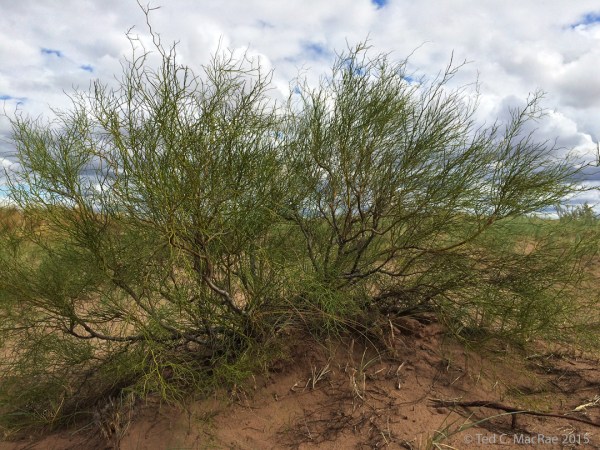
Host for Lampetis spp.

Bulnesia retama – adult host plant for Lampetis baeri and L. corinthia.

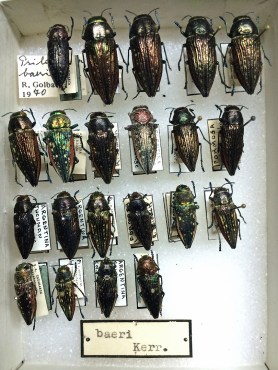
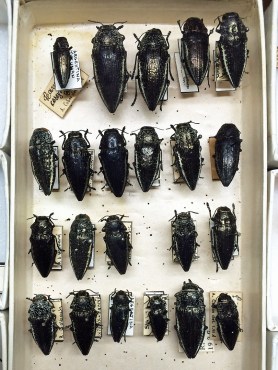
One of the first plants that caught my attention was a woody, fabaceous shrub that looked very much like what I would have previously called Cercidium, now Parkinsonia, and which after a bit of digging I conclude is likely Parkinsonia praecox. [Edit 12/15/25: This plant has been identified from a photograph posted to iNaturalist as Bulnesia retama—ID #330427306.] Woody, fabaceous shrubs in desert habitats are a sure bet to host jewel beetles, so I began paying special attention to each shrub as I wandered by. It wasn’t long before I saw a large, brilliant metallic green jewel beetle sitting on an outer branch of one of the shrubs—it was one of the most beautiful jewel beetles I have ever seen out in the field with my own eyes! I managed to catch it, and over the next few hours I collected not only several more of this species but also several individuals of an even larger, more somber-colored species. I was able to identify them as Lampetis baeri (Kerremans, 1910) and L. corinthia (Fairmaire, 1864), respectively, when I compared them to material in the collections at Fundacion Miguel Lillo, Instituto de Entomologia, Tucuman, Argentina [IFML]) during my visit there the following week (see photos below).

Lampetis baeri (Kerremans, 1910)

Lampetis baeri (Kerremans, 1910) [IFML]


Lampetis corinthia (Fairmaire, 1864)

Lampetis corinthia (Fairmaire, 1864) [IFML]

As a jewel beetle enthusiast, you would think that was the highlight of my day. In fact, the fun had only started. For a time after our arrival, Federico pointed out burrows likely made by eucraniine adults, but we didn’t see any evidence of activity at first. It wasn’t long, however, before we found the first adult—a fine Eucranium beleni Ocampo, 2010, the largest of the three species occurring at this site (about the size of our North American Deltochilum). One of the more obvious features of eucraniines is their enormously enlarged forelegs and pronotum to hold the musculature required to carry—that’s right, carry!—provisions to the larval burrow (in contrast with the more commonly seen habit among members of the subfamily of using the hind legs to push provisions to the burrow). This unusual morphology gives these beetles not only an amusing, shuffling gait but also a rather comical method for turning themselves upright (as seen in this video narrated by Federico). There are other dung beetles that pull, rather than push, larval provisions (e.g., Sisyphus spp., which stand on highly elongate hind legs and walk backwards while pulling the dungball), but eucraniines seem to be the only ones that actually lift provisions off the ground to carry them. In the case of E. beleni, this involves carrying pieces of dung with the forelegs held out in front of the head while walking forward on the middle and hind legs (Ocampo 2010). I didn’t get to see that behavior with E. beleni, but I did see it with one of another of the eucraniines we found that day (see below). In the E. beleni photo below, note the brushy middle and hind tarsi—an adaptation for walking on loose sand.

Eucranium belenae

Eucranium belenae Ocampo, 2010 walks on its middle/hind legs while holding its forelegs aloft.

Eucranium belenae burrow

Eucranium belenae burrow plugged with a piece of dung.

The second species in the group that we encountered was Anomiopsoides cavifrons (Burmeister, 1861). This species is much smaller than E. beleni (about the size of a large Onthophagus), and unlike E. beleni—and, in fact, most other dung beetles—the larvae of A. cavifrons develop on plant matter rather than dung. Both males and females provision the larval burrows with pieces of plant debris that they pick up with their front legs and carry back to the burrow while walking on their other four legs. This rather amusing video shows a male bringing a piece of debris back to his burrow, then exiting to find and retrieve another piece of debris to bring back to the burrow. The molar region of their mandibles is heavily sclerotized for masticating the plant fibers in preparation for the larvae. There are a couple of other species in the tribe that opportunistically include plant matter in their diet, but A. cavifons seems to be the only one known to utilize dry plant matter in desert habitats almost exclusively (Ocampo 2005). Anomiopsoides cavifrons was far more abundant in the dunes than E. beleni, and by early to mid-afternoon they were encountered with such regularity that I stopped even looking at them.

Anomiopsoides cavifrons male at burrow

Anomiopsoides cavifrons (Burmeister, 1861) male at burrow entrance.

We also were fortunate to see a few individuals of the third species known from these dunes, Anomiopsoides fedemariai Ocampo, 2007. This species is intermediate in size between the extremes represented by E. beleni and A. cavifrons and utilizes pellets of the plains viscacha (Lagostomus maximus), a species of rodent in the family Chinchillidae, for food (Ocampo 2007).

REFERENCE:

Ocampo, F. C. 2005. Revision of the southern South American endemic genus Anomiopsoides Blackwelder, 1944 (Coleoptera: Scarabaeidae: Scarabaeinae: Eucraniini) and description of its food relocation behavior. Journal of Natural History 39(27):2537–2557 [pdf via DigitalCommons].

Ocampo, F. C. 2007. The Argentinean dung beetle genus Anomiopsoides (Scarabaeidae: Scarabaeinae: Eucraniini): description of a new species, and new synonymies for A. heteroclytaRevista Sociedad Entomología Argentina 66(3–4):159–168 [pdf via SciELO Argentina].

Ocampo, F. C. 2010. A revision of the Argentinean endemic genus Eucranium Brullé (Coleoptera: Scarabaeidae: Scarabaeinae) with description of one new species and new synonymies. Journal of Insect Science 10:205, available online: insectscience.org/10.205 [pdf via DigitalCommons].

© Ted C. MacRae 2016

North America’s most recognizable longhorned beetle

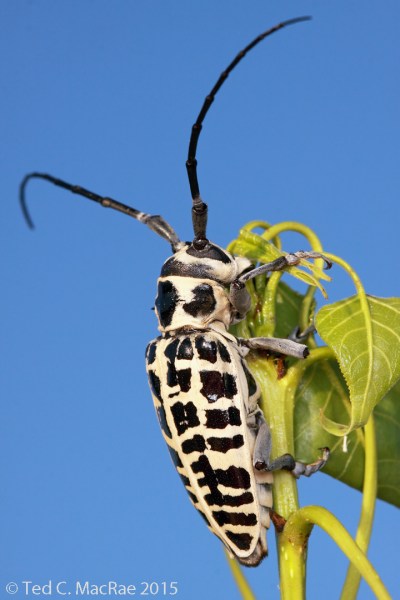
One of the more impressive insects that we found during our visit to Sand Hills State Park in south-central Kansas last June was Plectrodera scalator, the cottonwood borer. Large and robust (in fact, the only larger species in the family are the prionid root borers and their kin), their striking checkered pattern of white pubescence on a glossy black body makes them perhaps the most recognizable of all North American longhorned beetles (Linsley & Chemsak 1984). The very robust body of this individual, along with the relatively shorter antennae (only about as long as the body) identify it as a female—males are generally smaller and less robust with the body slightly tapering and the antennae distinctly longer than the body.

Plectrodera scalator

Plectrodera scalator (Fabricius, 1792) | Sand Hills State Park, Kansas

The white coloration on the body of these beetles is not a cuticular pigment (which is rather rare in beetles and is most often associated with species found in white sand habitats, e.g., certain tiger beetles), but instead a result of dense mats of microscopic white setae. The patterns formed by these mats are apparently as unique to each individual as fingerprints are to humans (Yanega 1996), making these beetles at once immediately recognizable as a species yet distinctive as individuals.

Plectrodera scalator

Adults of this species are found most often on cottonwood.

These are said to be common beetles in their range across the eastern two-thirds of the country, especially so in the Great Plains where their favored host, cottonwood (Populus deltoides), is especially abundant. Despite this, I have encountered this species only a handful of times in more than 3o years of searching. I know they’re out there, even in my home state of Missouri where I recorded 154 specimens collected in the state and deposited in various collections (MacRae 1994). It was not until around 2000 that I even saw my first ones (on a cottonwood tree in a homeowner’s yard just across the Mississippi River in Illinois), and in fact this one was actually found by Mary Liz Jameson, who had accompanied us to the field that day. It makes me wonder if their coloration, so strikingly conspicuous when isolated against a clean, blue sky background, might actually afford some type of cryptic protection against the normal backdrop of foliage and branches on which they are normally found—a phenomenon that I call “conspicuous crypsis” and which I have noted for other longhorned beetles (e.g., Acanthocinus nodosus). Perhaps, with this species at least, I have not yet set my search image to notice them.

Plectrodera scalator

Large, robust size and a distinctive checkered pattern of black and white makes these beetles among the most recognizable longhorned beetles in North America.

REFERENCES:

Linsley, E. G. and J. A. Chemsak. 1984. The Cerambycidae of North America, Part VII, No. 1: Taxonomy and classification of the subfamily Lamiinae, tribes Parmenini through Acanthoderini. University of California Publications in Entomology 102:xi + 1–258. [preview]

MacRae, T. C. 1994. Annotated checklist of the longhorned beetles (Coleoptera: Cerambycidae and Disteniidae) known to occur in Missouri. Insecta Mundi 7(4) (1993):223–252. [pdf]

Yanega, D. 1996. Field Guide to Northeastern Longhorned Beetles (Coleoptera: Cerambycidae). Illinois Natural History Survey Manual 6, x + 174 pp. [preview]

Beetle Collecting 101: Fermenting bait traps for collecting longhorned beetles

One of the most useful collecting techniques for those interested in longhorned beetles (families Cerambycidae and Disteniidae) is fermenting bait traps. I was first clued into the use of such traps soon after I began collecting these beetles in the early 1980s and encountered a series of rather old publications by A. B. Champlain and S. W. Frost detailing their usefulness and the diversity of species found to be attracted to them. Champlain & Kirk (1926) listed 15 species of Cerambycidae attracted to bait pans containing a mixture of molasses and water. This list was expanded to 37 species by Champlain & Knull (1932), who noted that a mixture of one part molasses to ten parts water in a gallon-pail seemed to give the best results. Frost & Dietrich (1929) listed 20 species captured with a mixture of one part molasses to 20 parts water. Twelve of the species they mentioned were not listed by Champlain & Knull (1932), and the list of Frost (1937) included two additional previously unrecorded species.

I made extensive use of fermenting bait traps during my 1980s survey of longhorned beetles in Missouri (MacRae 1994) using a mixture of one part molasses, one part beer, nine parts tap water, and a sprinkling of dry active yeast to start fermentation. This recipe was based on that of Champlain & Knull (1932) (although I must confess that I do not remember where I got the idea to add beer and yeast). During that study, I collected 13 species of longhorned beetles using this method and found in other collections specimens of three additional species also collected with fermenting baits. Of the species I collected, the most significant was a large, attractive Purpuricenus that closely resembled P. axillaris (which was also collected in the traps) but clearly was not that species. These eventually proved to be undescribed after I was able to examine type material in the Museum of Comparative Zoology at Harvard University, leading to a review of the genus in North America and the description of the new species as P. paraxillaris (MacRae 2000). Since then I’ve employed fermenting bait traps to collect Cerambycidae in other parts of the country (MacRae & Rice 2007), and I now have records of 72 species of U.S. Cerambycidae documented as being attracted  to fermenting baits.

Molasses-beer fermenting bait trap

Molasses-beer fermenting bait trap.

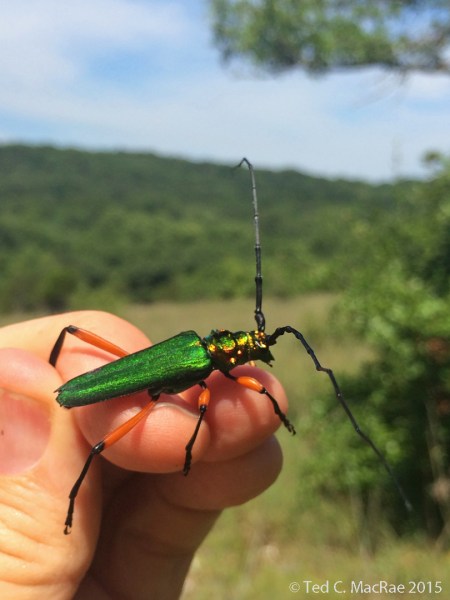
My interest in this technique was renewed some years ago when I finally succeeded in collecting the spectacular Plinthocoelium suaveolens in fermenting bait traps placed on glades in extreme southwestern Missouri. During my Missouri survey, I had done the bulk of my bait trapping along the edges of glades just south of St. Louis in Jefferson County, and while I had a record of this species in those glades I had never collected it there myself. Finally, last year I observed one of the host trees (gum bumelia, Sideroxylon lanuginosum) on these glades with the characteristic P. suaveolens larval frass pile at the base of the trunk, prompting a renewed effort this past season to collect the species there using fermenting bait traps. In early June I placed a series of traps at Valley View Glades Natural Area (~4 miles NW of Hillsboro) and Victoria Glades Natural Area (~2.5 miles S of Hillsboro). At both locations four traps were placed along the upwind interface between dry, post oak woodland and dolomite glades. Traps were spaced about 50–100 yards apart and hung to ensure exposure to sunlight but minimize the chance they would be discovered by vandals. Each trap consisted of a 2-L plastic bucket with a small hole drilled near the rim on each side and a length of wire attached to allow hanging from a nail in the side of a tree. Two baits were used: 1) molasses/beer, and 2) red wine. The molasses/beer recipe was based on Guarnieri (2009)—more concentrated that what I have used previously, and was prepared by combining a 12-oz (355 mL) jar of dark molasses with an approximately equal volume of tap water in a 1-L plastic bottle, agitating thoroughly, and bringing to one liter volume with tap water. At the trap site, about 500 mL of diluted molasses was added to the trap, followed by a 12-oz can/bottle of beer and one-half of a 7-g packet of dry, active yeast. Red wine bait was a cheap jug variety, undiluted, with about 500 mL added to the trap. Molasses/beer and red wine were alternated in the traps at each location and replaced every two weeks or if excessively diluted by rain or evaporated during hot, dry conditions. Traps were checked weekly from early June to mid-September by pouring the trap contents through a kitchen strainer over an empty bucket and transferring beetles with forceps to empty vials. Once back at the vehicle, tap water was added to each vial and the vial agitated to rinse the specimens and remove bait residue. The water was decanted and the beetles blot-dried with paper towels before transfer to clean vials containing tissue and ethyl acetate to halt decay and maintain the beetles in a relaxed state for pinning.

Cerambycidae from fermenting bait trap

A charismatic trio of Cerambycidae from fermenting bait traps at Victoria Glades: Purpuricenus paraxillaris (left), Plinthocoelium suaveolens (center), and Stenelytrana emarginata (right).

A note about my preferred trap design. I have always used open-top buckets (previously 1-G metal, now 2-L plastic), but “window jugs” (i.e., ½-G milk or juice jugs with holes, or “windows”, cut in the sides) are also commonly used. I have not directly compared buckets with window jugs; however, I favor buckets because I believe beetles attracted to window jugs are more likely to “perch” on the trap itself rather than fall directly into the bait. I also believe that beetles, once trapped, are more likely to escape from window jugs because the window edges provide “grab” sites for beetles before they succumb. The risk of escape can be reduced if the bait surface lies well below the bottom edge of the windows, but this then limits the quantity of bait that can be used. In my experience, 500–750 mL is the minimum volume of bait that is needed to last the duration of the two-week fermentation cycle without evaporating to the point that it is not deep enough to quickly submerge beetles falling into it. Some may be concerned that open-top buckets are prone to dilution by rain, but in my experience this happens infrequently and I have not noticed diluted bait to be any less effective at attracting beetles. Rain shields, on the other hand, only serve to provide a potential perch for beetles attracted to the trap.

Plinthocoelium suaveolens

Plinthocoelium suaveolens captured in flight near its host tree, gum bumelia (Sideroxylon lanuginosum), at Victoria Glades.

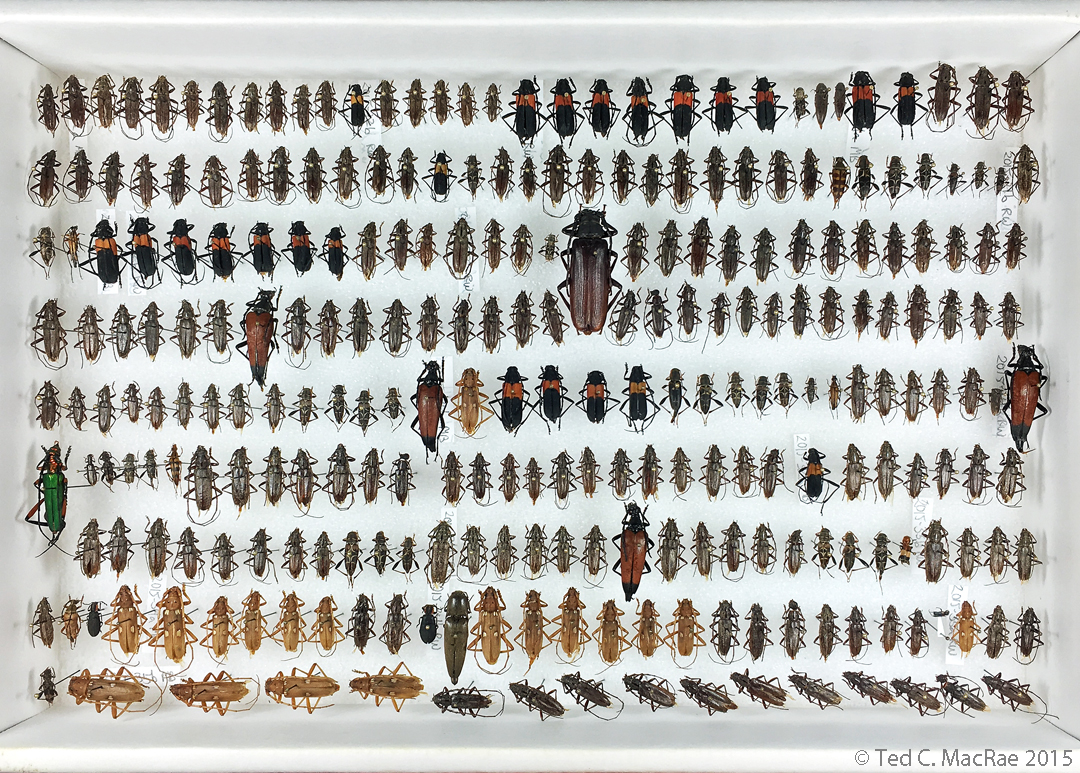
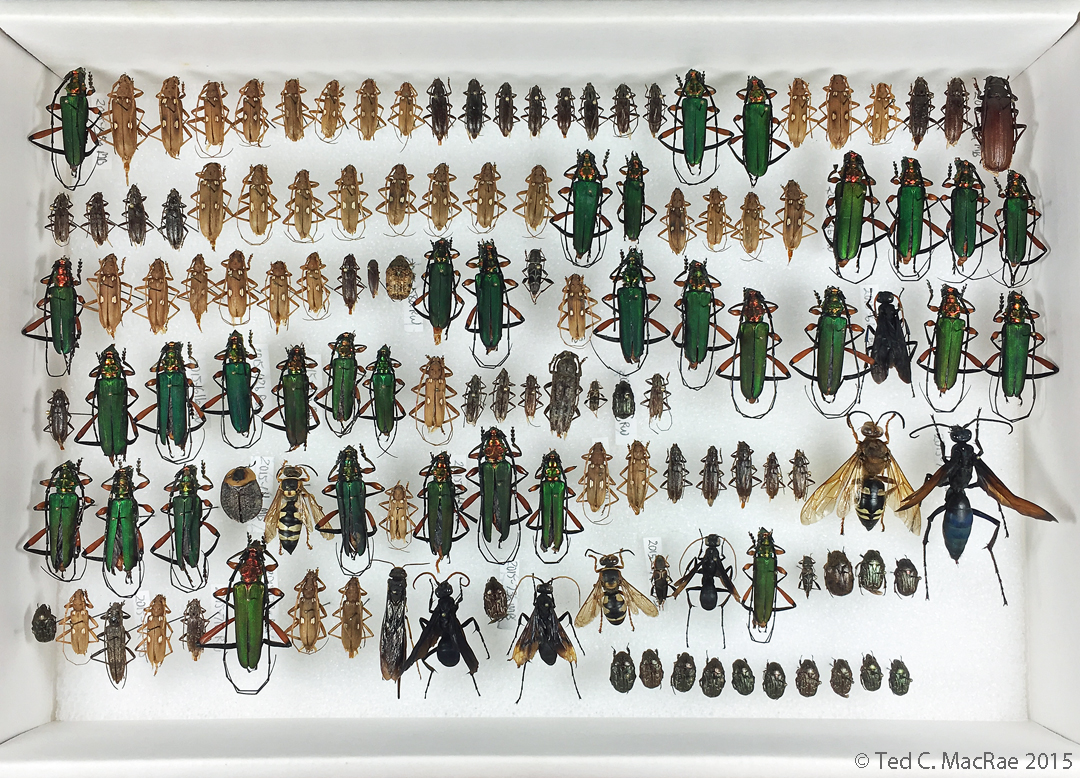
A total of 558 longhorned beetles representing 16 species were collected from the traps over the course of the season (see list below). Of these, 339 specimens representing 14 species were attracted to molasses/beer, while 219 specimens representing 14 species were attracted to red wine. Ten species were represented by more than two specimens and were attracted to both bait types, the most desirable being Plinthocoelium suaveolens (41 specimens), Purpuricenus axillaris (20 specimens), P. paraxillaris (3 specimens), and Stenelytrana emarginata (6 specimens). The number of P. suaveolens collected is remarkable, considering that it was not collected during my previous trapping effort spanning several years in the 1980s. It may be significant that 1) the molasses/beer recipe used in this study was considerably more concentrated than that used in the 1980s, and 2) nearly twice as many specimens were collected in red wine (not used in the 1980s) compared to molasses/beer. I routinely examined the gum bumelia trees during my weekly visits in an attempt to find adults on their host, especially during flowering, but encountered only a single adult in flight near one of the trees—a curious result given the diurnal habits and large, conspicuous appearance of the adults. All other species collected in numbers were more attracted to molasses/beer, with the significant exception of Purpuricenus paraxillaris. Seven species taken this season were not detected with fermenting bait traps in the 1980s, bringing to 23 the number of species collected by this method in Missouri. One species, Strangalia sexnotata, is documented from fermenting bait for the first time in this study.

2015 fermenting bait trap catch

2015 fermenting bait trap catch, box 1 of 3 (click to enlarge).

2015 fermenting bait trap catch, box 2 of 3 (click to enlarge).

2015 fermenting bait trap catch, box 2 of 3 (click to enlarge).

2015 fermenting bait trap catch

2015 fermenting bait trap catch, box 3 of 3 (click to enlarge).

Longhorned beetle species and numbers taken in fermenting bait traps in 2015—most to least abundant (MB = molasses/beer, RW = red wine):

  1. Elaphidion mucronatum – 254 (MB = 176, RW = 78)
  2. Eburia quadrigeminata – 145 (MB = 73, RW = 54)
  3. Plinthocoelium suaveolens – 41 (MB = 14, RW = 27)
  4. Neoclytus scutellaris* – 32 (MB = 26, RW = 6)
  5. Parelaphidion aspersum – 26 (MB = 18, RW = 8)
  6. Purpuricenus paraxillaris – 20 (MB = 6, RW = 14)
  7. Orthosoma brunneum – 13 (MB = 8, RW = 5)
  8. Neoclytus mucronatus* – 8 (MB = 6, RW = 2)
  9. Stenelytrana emarginata* – 6 (MB = 5, RW = 1)
  10. Purpuricenus axillaris – 3 (MB = 2, RW = 1)
  11. Enaphalodes atomarius – 2 (MB = 1, RW = 1)
  12. Strangalia famelica solitaria* – 2 (MB = 2, RW = 0)
  13. Typocerus velutinus* – 2 (MB = 1, RW = 1)
  14. Xylotrechus colonus* – 2 (MB = 0, RW = 2)
  15. Elytrimitatrix undatus – 1 (MB = 1, RW = 0)
  16. Strangalia sexnotata** – 1 (MB = 0, RW = 1)

* Not previously reported at fermenting baits in Missouri.
** Not previously reported from fermenting baits anywhere.

With regards to other insects, no attempt was made to quantify their occurrence or diversity, but a few interesting specimens were collected. Elateridae (click beetles) and other beetles were notable by their absence, in contrast to the great diversity recorded from by Champlain & Knull (1932). Flower scarabs were the exception, with two Euphoria inda and a moderate series of E. sepulchralis taken only in red wine traps. The most common non-beetle insects encountered were moths, flies, and stinging wasps, for which molasses/beer seemed to be much more attractive than red wine. The majority of the wasps were Vespidae, but a few large Crabronidae (one Sphecius speciosus and two Stizus brevipennis, I think) and at least two species of Pompiliidae were collected (see box 3 image above).

The diversity of longhorned beetles collected this season was undoubtedly influenced by habitat selection for trap placement (interface between dry, post-oak woodland and dolomite glade). Different habitats would likely yield different species, although prior experience seems to suggest that traps placed in open woodlands are more productive than those placed in dense forests. Recently thinned forests may have good potential due to an abundance of dead wood from thinning operations and trees stressed by sudden exposure to sunlight. Plans are currently underway to place traps (both molasses/beer and red wine) in a variety of wooded habitats during the 2016 season.

REFERENCES:

Champlain, A.B. & H. B. Kirk. 1926. Bait pan insects. Entomological News 37:288–291 [Biodiversity Heritage Library].

Champlain, A. B. & J. N. Knull.  1932. Fermenting bait traps for trapping Elateridae and Cerambycidae (Coleop.).  Entomological News 43(10):253–257.

Frost, S. W. 1937. New records from bait traps. (Dipt., Coleop., Corrodentia). Entomological News 48:201–202 [Biodiversity Heritage Library].

Frost, S. W. & H. Dietrich. 1929. Coleoptera taken from bait-traps. Annals of the Entomological Society of America 22(3):427–436 [abstract].

Guarnieri, F. G. 2009. A survey of longhorned beetles (Coleoptera: Cerambycidae) from Paw Paw, Morgan County, West Virginia. The Maryland Entomologist, 5(1):11–22 [pdf].

MacRae, T. C. 1994. Annotated checklist of the longhorned beetles (Coleoptera: Cerambycidae and Disteniidae) known to occur in Missouri. Insecta Mundi 7(4) (1993):223–252 [pdf].

MacRae, T. C. 2000. Review of the genus Purpuricenus Dejean (Coleoptera: Cerambycidae) in North America. The Pan-Pacific Entomologist 76:137–169 [pdf].

MacRae, T. C. & M. E. Rice. 2007. Distributional and biological observations on North American Cerambycidae (Coleoptera). The Coleopterists Bulletin 61(2):227–263 [pdf].

© Ted C. MacRae 2015

North America’s most “extreme” jewel beetle

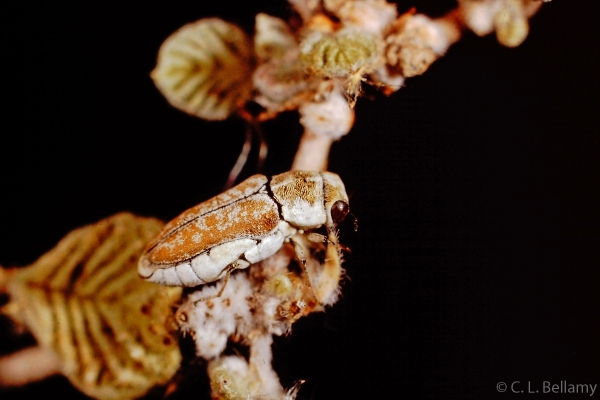
When Chuck Bellamy passed away two years ago, he left behind a remarkable legacy of study on the family Buprestidae (jewel beetles) that includes not only his insect collection—surely one of the best in the world in terms of representation of genera and species in the family—but also his extensive library of primary literature. Both of these assets, built over a period of decades, are now housed in the California State Collection of Arthropods at the CDFA Plant Pest Diagnostics Laboratory in Sacramento, California. Chuck, however, was not just a jewel beetle collector and taxonomist—he was also a skilled photographer, focusing (pun intended) largely, though not exclusively, on his beloved jewel beetles. Digital cameras were still far in the future when Chuck began photographing these beetles, and as a result the bulk of his photographic legacy exists in the form of 35mm slides. I was the fortunate recipient of his slide collection, numbering in the thousands, and have been slowly scanning his slides into digital format with the goal to eventually make them available to the larger community of buprestid workers. Some of his best photos were published in a memorial issue of The Coleopterists Bulletin (2014, volume 68, number 1), and I featured a few additional photos in this post shortly before the publication of that issue. There remain slides, however, of many additional species, a large number of which surely represent the only field photographs of live adults. As I convert his slides to digital format, I hope to share some of the more interesting here.

For the first of these featured species, I can think of no better one than Lepismadora algodones. This tiny little jewel beetle is the only representative of the genus, which was not even known until 1986 when it was discovered by Mimi & Rob Velten in the Algodones Sand Hills of southeastern California. The species and genus were described the following year (Velten & Bellamy 1987), making Lepismadora the most recently discovered new genus of jewel beetle in the U.S. The recentness of its discovery is remarkable, since southern California in general and the Algodones Sand Dunes in particular were thought to have been relatively well collected at the time of the beetle’s discovery. Also remarkable is the distant relationship of this monotypic genus to any other North American species; its closest known relative being the genus Eudiadora—known only from Argentina (Bellamy 1991).

Lepismadora algodones

Lepismadora algodones Velten, in Velten & Bellamy, 1987 (Coleoptera: Buprestidae)

Even more remarkable, however, are its highly localized distribution and extreme habitat. The entire type series (one male holotype and 159 paratypes) and all individuals collected since its description have been found only in a single old canal on the west side of the Algodones dunes. Summer temperatures in the dunes routinely reach in excess of 110°F and are even higher in the depressed canal where the beetles are found. Astoundingly, the adults are active only during the hottest hours of the day (ca. 10 a.m. to 2 p.m.), during which time they can be found on the flowers and foliage of fanleaf crinklematTiquilia plicata (Boraginaceae). The reason for the beetle’s highly restricted distribution is a mystery, as the plant on which the beetles are found is rather widespread across the southwestern U.S. and northwestern Mexico. A final mystery is the still unknown larval host plant—it could be T. plicata, but it could just as likely be something completely different.

Algodones Dunes

Old canal on the west side of Algodones Sand Hills, type locality of Lepismadora algodones.

I moved to California a few years after the species was described and, of course, soon set out to find it for myself. I had driven to southern California from my home in Sacramento to meet the late Gayle Nelson (another important mentor of mine), who told me where to find the beetle and what the host plant looked like but also warned me about the extreme heat I would encounter. His advice was to hike the canal until I had half a bottle of water, then turn around and hike back. Mindful of his advice, I arrived at the dunes the next day around mid-morning, filled my water bottle and hydrated myself as much as I could, and climbed down into the canal. The heat was overpowering—more so down in the canal and far beyond anything I had ever experienced to that point, and after quickly recognizing the host plants I began tapping their tiny, prostrate branches over my beating sheet and looking for the beetles. I went as far as I could down the canal, perhaps 200 yards, before I had to turn around, but I had not yet seen any beetles and was starting to lose hope. I continued to tap host plants on the way back, though by then not really expecting to see anything. About halfway back I saw something laying on the ground a short distance ahead. As I approached I saw it was a small plastic vial with a white cap, and when I picked it up I saw inside a dried out T. plicata twig and a dead adult beetle—unmistakably L. algodones! While excited to have found the species, it was at the same time a bit unsatisfying for the specimen to be one that somebody else had collected before me and then lost (for all I know, it could have been Chuck Bellamy, considering that the beetle was apparently intended to be kept alive, possibly for photography!). I slipped the vial into my pocket, started tapping branches again, and found three additional adults in the immediate vicinity of where I had found the vial (and doing much to soothe my dissatisfaction with the first specimen). Those would be the only specimens that I would find that day, though I would succeed in finding another individual on a subsequent visit two years later.

REFERENCES:

Bellamy, C. L. 1991. A revision of the genus Eudiadora Obenberger (Coleoptera: Buprestidae). Proceedings of the Entomological Society of Washington 93(2):409-419 [Biodiversity Heritage Library].

Velten, R. K. & C. L. Bellamy. 1987. A new genus and species of Coroebini Bedel from southern California with a discussion of its relationships in the tribe (Coleoptera, Buprestidae). The Coleopterists Bulletin 41(1):185–192 [pdf].

© Ted C. MacRae 2015