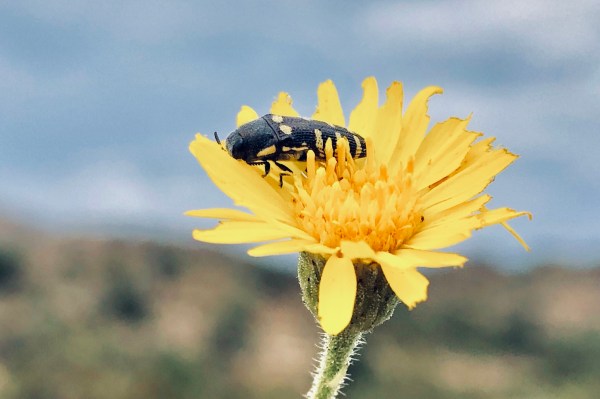
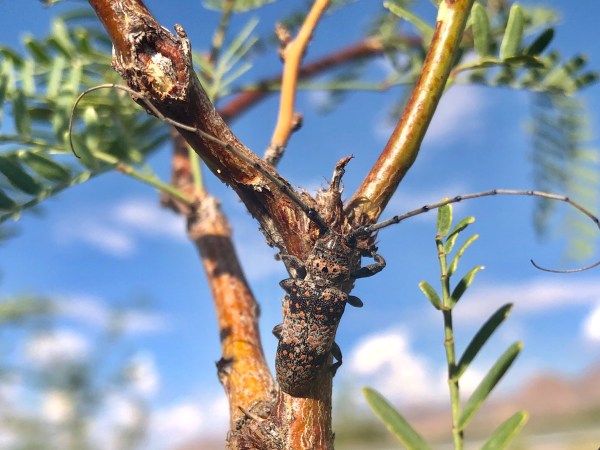
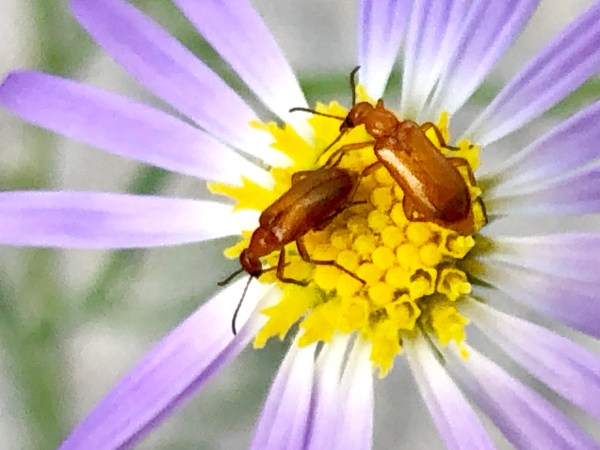
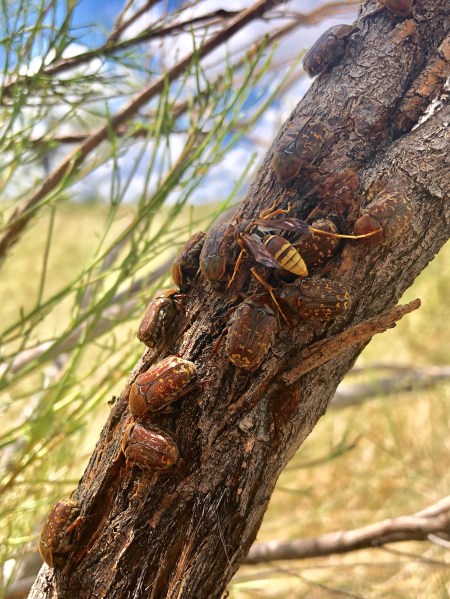
2019 Arizona/New Mexico/California Insect Collecting Trip iReport

This is the eighth “Collecting Trip iReport”; this one covering a one-week trip to southern Arizona, New Mexico, and California from September 7–14, 2019 with meloid/cerambycid-enthusiast Jeff Huether. Jeff has been a frequent collecting trip partner during recent years, this being our sixth joint outing since 2012. Our initial objective on this trip was to collect cerambycid beetles of the genus Crossidius occurring across southern Arizona/California—part of a larger effort to sample as many of the named subspecific taxa as possible from multiple locations (including type locations when possible) for future molecular studies. We had good success, though we did not collect every taxon that we were after (we were a tad early in soCal). Also, the fact that we had Crossidius as our primary goal did not mean that we would not concurrently be on the lookout for buprestids (me), meloids (Jeff), or other cerambycids (both of us)—and in that regard we were also successful.

As with all previous “iReports” in this series, this report is illustrated exclusively with iPhone photographs (thus the term “iReport”), with previous versions including the following:
2013 Oklahoma
2013 Great Basin
2014 Great Plains
2015 Texas
2018 New Mexico/Texas
2018 Arizona
2019 Arkansas/Oklahoma


Day 1 – Dripping Springs Mountains, Arizona
First stop of the trip, and we’re heading east to Safford. As soon as we got east of Superior up into the mountains we saw a place where Heterotheca subaxillaris was in bloom abundantly along the roadsides and pulled over. There were four species of Acmaeodera on the flowers, and I also found a fifth species on the flower of a small white aster. Nice first stop for the trip!

Dripping Spring Mountains.
Acmaeodera gibbula on flower of Heterotheca subaxillaris.
Acmaeodera rubronotata on flower of Heterotheca subaxillaris.
Acmaeodera alicia on flower of Heterotheca subaxillaris.

3.6 mi NW Bylas on US-70, Arizona
Continuing our way to Safford, Jeff saw some patches of sunflower and wanted to look for Epicauta phoenix. I found the first two (but not in sunflower), and then Jeff found two more. As we were walking back to the car I noticed a Crossidius suturalis sitting on Isocoma tenuisecta that was not quite in bloom, and then another nearby on the same plant. We searched the area again, but the only plants were those few right around the car.

I’ve never seen an orange jumping spider (family Salticidae) before!

5.7 mi NE Safford, Arizona
After getting a hotel in Safford, we had time to come back to a spot where Jeff had collected Epicauta phoenix back in July. We found quite a few (see photo) on plants nearby the original collection spot. Looking around more I found an Acmaeodera convicta perched on the tip of a shrub—first time I’ve collected this species! There were several species of tenebrionids crawling on the ground, perhaps prompted to activity by cooling temps as rain whipped up in the distance. I kept one eye on the skies and the other on the plants and eventually found two more A. convicta perched together on the same type of shrub just as rain began pelting my back. We made a quick dash back to the car and called an end to Day 1 in Arizona.

Epicauta phoenix (order Coleoptera, family Meloidae).

Day 2 – 1.9 mi S Artesia, Arizona
We started seeing Isocoma tenuisecta just coming into bloom as we headed south of town so stopped to see if we could find any Crossidius. I looked at a lot of plants before finding a single C. suturalis sitting on one of the non-blooming plants and in the meantime found one Trichodes peninsularis and a fair number of Zonitis dunniana on the flowers. Looking around on other plants, I found one large Chrysobothris sp. (not C. octocola, but longer and narrower) on the branch of a living Acacia constricta [Edit: this is C. knulli—a new one for me!] and one Acmaeodera disjuncta, several more Z. dunniana and T. peninsularis on flowers of Hymenothrix wislizeni. Finally, I did some sweeping of the bunch grasses in the area and got a nice series of what I presume to be Agrilus rubrovittatus—first time I’ve collected that species!

Crossidius suturalis on pre-blooming Isocoma tenuisecta.
Trichodes peninsularis on Isocoma tenuisecta.
Zonitis dunniana on flowers of Isocoma tenuisecta.

17.7 mi S Artesia, Arizona
Another stop with both Isocoma tenuisecta and also Gutierrezia microcephala coming into bloom. We immediately began finding Crossidius pulchellus on the latter and eventually collected a good series of them and also Trichodes peninsularis off the plants When I returned to the first plant we had checked (in fullest flower), a Lampetis webbii landed on it right in front of me! I eventually found C. suturalis on Isocoma tenuisecta, as well as Trichodes sp. and a few C. pulchellus. There was a tall-stemmed malvaceous shrub off which I got a male/female pair of Tylosis maculata, and sweeping produced a couple more Agrilus rubronotata, a few more T. peninsularis, and one Acmaeodera scalaris. I saw a couple of Acmaeodera disjuncta on Baileya multiradiata flowers but missed them both!
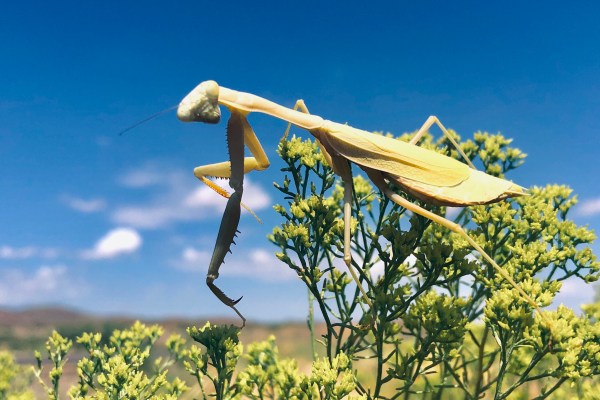
Stagmomantis limbata (bordered mantis) on Gutierrezia microcephala.
Lampetis webbii on Gutierrezia microcephala.

1.1 mi N Rodeo, New Mexico
We slipped just inside the New Mexico border to visit the area around the type locality of Crossidius hurdi. We found a spot where there were good stands of Isocoma tenuisecta along the roadsides and checked them out. Like the other spots today they were just starting to come into bloom, and rain had just moved through the area. We found perhaps 20 Crossidius individuals total, and honestly they were so variable that I don’t know whether they represent C. suturalis, C. hurdi, or both! [Edit: they are all C. suturalis] I also collected one Sphaenothecus bivittatus and several individuals each of three species of clerids on the flowers of these plants. A male Oncideres rhodosticta was found on the twig of Prosopis glandulosa, and I also found a cool meloid that I’ve never seen before—Megetra punctata!

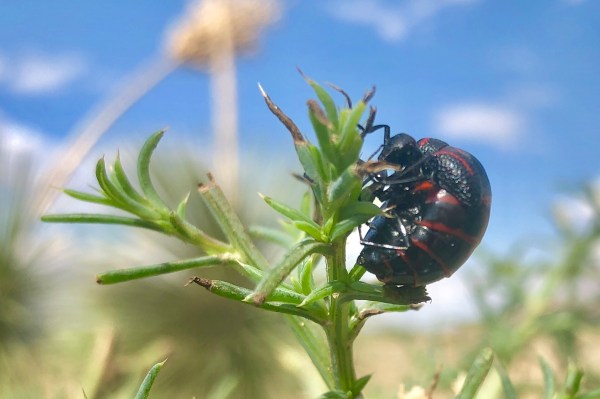
A particularly well-marked female Crossidius suturalis on flowers of Isocoma tenuisecta.
The coloration of Megetra punctata screams “Don’t eat me or you’ll be sorry!”
Oncideres rhodosticta on Prosopis glandulosa (mesquite).
Mule deerly departed.
Fence row to the Chiricahua Mountains.

Willcox Playa, Arizona
We plan to visit Willcox Playa tomorrow (my inaugural visit!), but we had some time at the end of the day and decided to come take a look. There were some stands of Isocoma tenuisecta at the north end of the playa, and I found just a couple of Crossidius individuals on them, presumably C. suturalis, but it looks like they are bedding down for the evening. Also got a couple of Enoclerus sp. on the flowers.
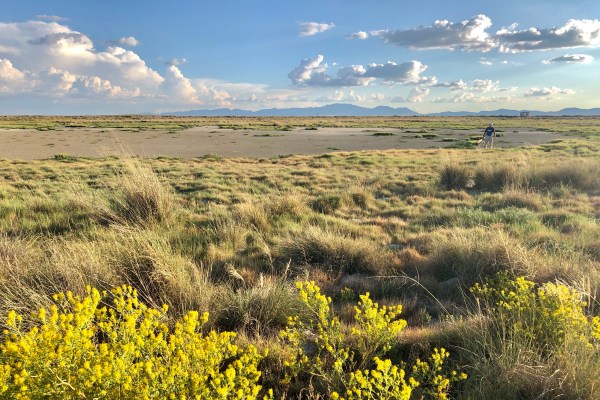
North end of Willcox Playa.

Day 3 – 8.4 mi SE Willcox, Arizona
On our way towards the Chiricahua Mountains to see if we can find any Crossidius host plant stands. We found patches of Isocoma tenuisecta and Gutierrezia microcephala along Hwy 186 southeast of town—the former was just coming into bloom, but there were plenty of Acmaeodera (scalaris, disjuncta, and amplicollis) on the flowers, including on the unopened heads. We found perhaps a dozen Crossidius suturalis on them as well, and Jeff found one small female that looks like C, hurdi [Edit: it is C. suturalis]. I looked at a lot of Gutierrezia before finding a single C. pulchellus sitting on one of the plants. The same diversity of Acmaeodera as well as a few A. gibbula and T. peninsularis was also found on flowers of Hymenothrix wislizeni, and I took a series of about 10 specimens of what I looks like A. parkeri on flowers of what appears to be Stephanomeria pauciflora. There were also some tiny membracine treehoppers on a thorny shrub (maybe Condalia?) being tended by ants—both adults and young, and I collected a few of the adults.
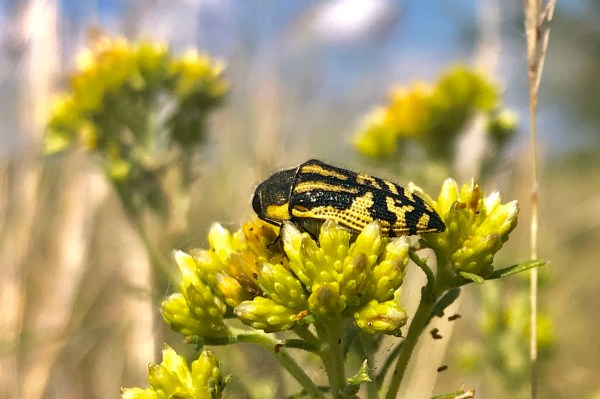
Acmaeodera amplicollis on flowers of Isocoma tenuisecta.
Acmaeodera disjuncta on flowers of Isocoma tenuisecta.
Acmaeodera scalaris on flowers of Hymenothrix wislizeni.

Jct AZ-186 & AZ-181, Arizona
After passing over a small range towards the Chiricahuas we didn’t see any Isocoma tenuisecta until we got to Hwy 181. There were some Baccharis sarothroides at the junction also, so we stopped and looked around. The Isocoma was just barely coming into bloom, but I found two Crossidius on them—one male C. suturalis and one small female that may be C. hurdi [Edit: nope, it is C. sururalis]. Heterotheca subaxillaris was in bloom abundantly, but there were no Acmaeodera on them and the area in general looked quite dry. I did find two A. decipiens on Sphaeralcea sp., and in the way back to the car I spotted a huge Lampetis webbii hanging on Ericameria nauseosa (which we’re not even close to blooming)—surely an incidental record.
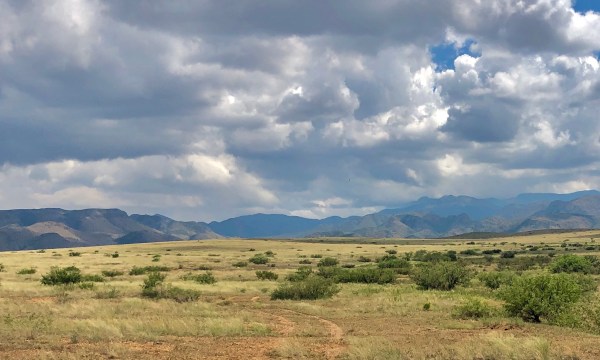
Chiricahua Mountains in the distance.

4.1 mi SE Willcox, Arizona
We came back towards town where things seemed to be further along and found stands of Isocoma tenuisecta in full bloom at the junction of Blue Sky Rd (a classic Arizona collecting locality). Crossidius suturalis were out in numbers on the flowers! Every now and then I got one that seemed too heavily maculated, making me think it could be C hurdi, but in the end I decided that all represented C. suturalis.

Crossidius suturalis mating pair on flowers of Isocoma tenuisecta. Note the difference in antennal length between the male (top) and female.

Willcox Playa, Arizona
We went to the Playa to see if there were any tiger beetles to be had. I hiked to the edge of the Playa, and within a few minutes I saw a Cicindela pimeriana—just the second one I’ve encountered (the first was last night at gas station lights)! With that promise of more, I hiked the entire playa edge and never saw another one! I only saw one other tiger beetle—Cylindera lemniscata—seems I’m a bit late in the season for the Willcox Playa tiger beetles. Nevertheless, it’s a cool place and was fun to see. I’ll definitely be back during the summer, not just for here but for nearby Blue Sky Rd. Arriving back at the car, I did find one Moneilema sp. (I think M. appressum) on cholla. There were Crossidius suturalis abundant on the Isocoma tenuisecta, which, like the last spot, was in full bloom, but I’d gotten my fill of them at the previous spot and didn’t collect any.
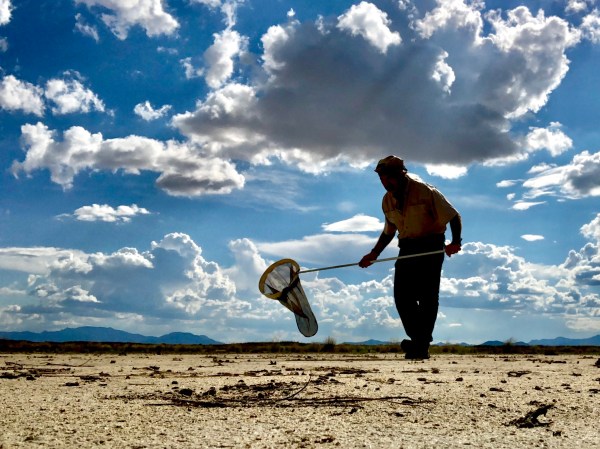
Stalking tiger beetles.
Jumping spider out in the playa.
Eking out a living.
Cow tracks.
These Gnathium sp. were the tiniest blister beetles I’ve ever seen.

Willcox, Arizona (epilogue)
Collecting the insects from the field is only the beginning. Each night they must be processed for storage until they can be mounted once back in the lab.

Processing the day’s catch.

Day 4 – Santa Rita Mountains, Box Canyon, Arizona
We passed through Box Canyon on our way to Madera Canyon, so we decided to stop near the dry falls where last year I’d collected such a nice diversity of Acmaeodera spp. on flowers of Allionia incarnata. There was evidence of recent rain, and we found the patch nicely in bloom with four species (scalaris, decipiens, cazieri, and parkeri) on the flowers. Nearby in the wash before it crossed the road was a yellow composite (Xanthisma gracile), from which I collected the first three as well as gibbula, rubronotata, and disjuncta. Euphoria verticalis scarabs we’re flying plentifully around the flowers also—first time I’ve seen the species.

Allionia incarnata (trailing four o’clock) blooming the canyon slope.

Flats below Madera Canyon, Arizona
There are records of Deltaspis tumacacorii from Madera Canton at Proctor Rd collected on Croton, so we stopped by on our way south to give it a try. This seems to be a rather hard-to-find bug, so I didn’t have high expectations, and that’s a good thing because I didn’t see the beetle nor anything that even remotely resembled Croton. I ended up checking out the desert broom (Baccharis sarothroides) in the area on which I’d collected Stenaspis verticalis arizonensis and Tragidion spp. (also without high expectations). There were some interesting congregations of Euphoria leucographa feeding at sap flows on the stems and a few Stenaspis solitaria but otherwise litttle of note. I did find one Hippomelas planicauda hanger-on on a low fabaceous shrub (not Mimosa biuncifera), and inspecting the Gutierrezia microcephala plants revealed nothing but a single Acmaeodera rubronotata.

Stenaspis solitaria on Baccharis sarothroides (desert broom).
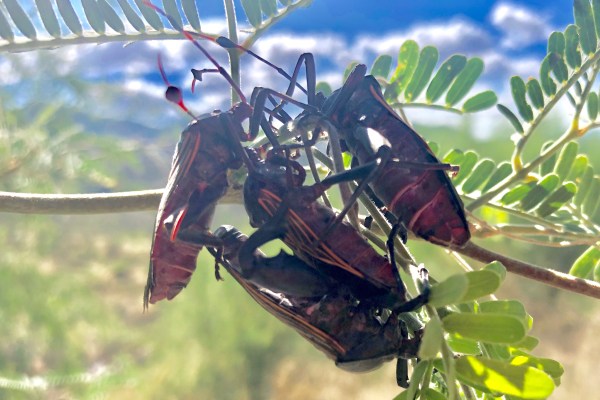
Peucetia viridans (green lynx spider) feeding on Acanthocephala thomasi twice its size!
Euphoria leucographa and a Polistes paper wasp feeding at a sap flow on Baccharis sarothroides (desert broom).
Euphoria leucographa on Baccharis sarothroides (desert broom).
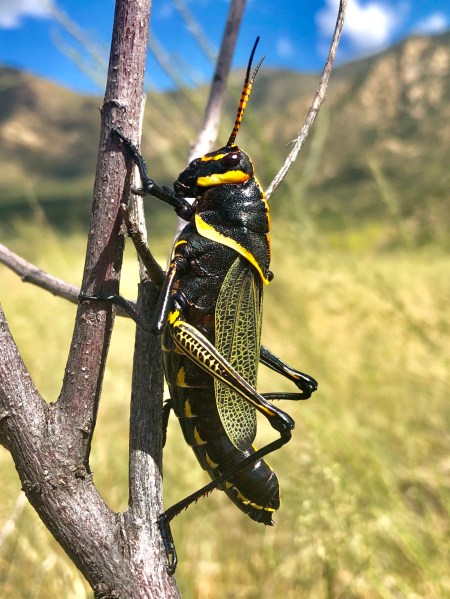
Taenipoda eques (lubber grasshopper). The striking coloration is a warning to potential predators that it is chemically protected.

Madera Canyon Rd, Arizona
We stopped real quick down the road on the way out of Madera Canyon because we saw stands of Isocoma tenuisecta, although they were still just shy of blooming. We looked at quite a few and found a single Crossidius suturalis—probably we are a tad early, and the area looks like it could use a good rain to pop things out and bring the Isocoma into bloom. We also saw low plants that could be the Croton that Deltaspis tumacacorii has been found on [Edit: I do not believe these are the plants, as they are too low]. Would be good to revisit this spot after a good rain!

The author with Ferocactus wislizenii (fishhook barrel cactus)—also called “compass barrel” due to its habit of leaning to the south.

Tumacacori Mountains, Walker Canyon, Arizona
Our second shot at Deltaspis tumacacorii, which has also been taken in Walker Canyon. We found thick stands of knee-high flowers that we immediately took to be the Croton—just as described by our contact—on which the beetles have been taken. However, we quickly began doubting that ID and decided the plant must be some type of composite. That would make more sense from a host plant standpoint, as all known host plants for Crossidius spp. are composites (subsequently determined to be Pseudognaphalium leucocephalum, family Asteraceae). We looked at the dense stands for quite some time but didn’t see any beetles (or much of anything else) before deciding that we were probably too early—had the beetles already emerged we would have at least found some stragglers. I did take a few Acmaeodera on the flowers (scalaris and rubronotata), as well as a large cantharid (Chauliognathus profundus). I also took single A. amplicollis and A. rubronotata individuals off of a large helianthoid composite (Viguiera cordifolia) and one A. rubronotata on a small yellow composite (Xanthisma gracile). There were a multitude of darkling beetles crawling in the ground—in one spot I saw five individuals of several species all within a one-square foot area. We’ll have one more shot at D. tumacacorii tomorrow at Kitt Peak.

Pseudognaphalium leucocephalum (white rabbit-tobacco) blooms profusely in the dry wash.
Cantharid vs. cantharid! Chauliognathus profundus (right) feeds on a C. lewisi that it has captured.

Day 5 – Pan Tak, Arizona (road to Kitt Peak)
Today’s destination is Kitt Peak to look for Deltaspis tumacacorii and Acmaeodera resplendens, but at the entrance we saw some Isocoma tenuisecta just coming into bloom and decided to check it out. We found a half-dozen Crossidius suturalis but had to really work for them. Alliona incarnata was also nicely in bloom, but I got only one Acmaeodera parkeri? and one A. alicia off of the flowers. There was some Gutierrezia microcephala present, also not quite in bloom, off of which Jeff got a pair of C. suturalis and gave me one. Kinda dry but lots of flowers—wish there would have been more beetles coming to them.

Moneilema sp. on Cylindropuntia imbricata.

Kitt Peak National Observatory, Arizona
Our last chance to find Deltaspis tumacacorii, and I also got a tip that Acmaeodera resplendens has also been taken up here. We immediately found several species of Acmaeodera (amabilis, amplicollis, decipiens, and rubronotata) abundantly on several composite flowers—Heliomeris longifolia, Heterotheca fulcrata, Hymenothrix wrightii, Solidago velutina, and Gutierrezia microcephala, and I found a single A. solitaria on a pink malvaceous flower, but no A. resplendens. We also searched thoroughly for any Croton-like plant for D. tumacacorii but found nothing. The Kitt Peak records of that species are older than the Walker Canyon, Peña Blanca, and Madera Canyon records, and most of the records seem to be in August rather than September, so I suspect we are a bit late for both the species and its host plant. My plan at this point is to return sometime during the middle of August and enlist the help of the source of one of the recent records to accompany me.
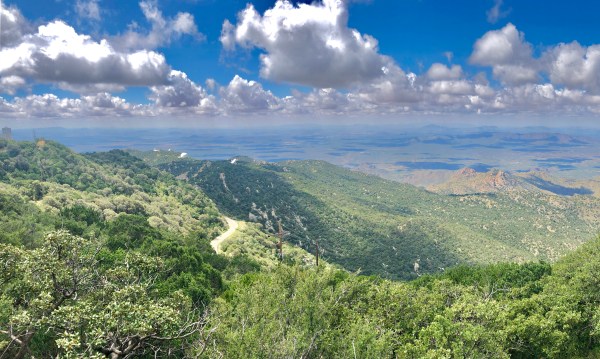
View north from Kitt Peak National Observatory.
Multiple species of Acmaeodera visiting flower of Heliomeris longifolia.
Acmaeodera amabilis on flower of Heliomeris longifolia.

Road to Kitt Peak, Arizona
We had noticed Gutierrezia microcephala and some other yellow composites in bloom about halfway up the mountain on our way to Kitt Peak and decided then to stop and take a look around on the way down. I took “down” the mountain, Jeff took “up.” I hadn’t walked very far when I saw what I at first thought was the cantharid Chauliognathus profundus (which I had seen yesterday at Walker Canyon preying on another cantharid) on G. microcephala flowers, but something about it gave me pause—it was too cylindrical and robust. I leaned closer to get a better look and realized it was a cerambycid—one that I did not recognize, a beautiful orange color with black elytral apices and pronotal spots! I quickly grabbed it with my right hand, immediately saw another elsewhere on the bush and grabbed it with my left hand, and as I stood there trying to fumble a vial out of my pack to put them in I saw a third individual taking flight from the bush and spiraling into the air and out of reach! I shouted out to Jeff, who came down to where I was, and showed him what I’d found, and together we decided that it must be Mannophorus forreri—a very uncommonly encountered species and more than adequate consolation for not finding Deltaspis tumacacorii earlier in the day. We spent the next hour searching up and down the roadsides, and I ended up with two more individuals from Gutierrezia flowers and two from Heterotheca fulcrata. Jeff found an additional individual on flowers of Thelesperma sp. I also picked up a few black and white Enoclerus sp., one on flowers of G. microcephala and a mating pair on flowers of Acacia berlandieri. We have a long drive to California in front of us now, and it sure is good going into the drive with such a great find under our belts.

Lower slopes of the road to Kitt Peak Observatory.
Thasus neocalifornicus (giant mesquite bugs) congregate on their host plant (Prosopis glandulosa).

Day 6 – Cajon Pass, California
Finally made it into California! Once we turned off the interstate, we made a quick stop to look at the roadside habitat where we spotted a good stand of Isocoma sp. in full bloom. We looked at quite a few plants but didn’t find any beetles on them. There were also good numbers of Ericameria nauseosa plants as well (host for Crossidius coralinus), but they weren’t quite yet in bloom yet and the only thing I found on them was a mating pair of Agrilus walsinghami. Moved on quickly to the next spot!

Lancaster, California
We met up with Ron Alten and traveled to a classic “Crossidius” collecting site (up to four species have been taken there). We’d stopped at a couple of places on the way there but not found anything—either the host plants were not yet blooming or no beetles were found, so we had the feeling that we might be a week or two early. We had to drive into the habitat a ways before we started seeing host plants—in this case Ericameria nauseosa—but eventually we found a nice large area with the plants in full bloom. It didn’t take long before we found Crossidius coralinus (populations in this area are assigned to subspecies ascendens) on the blossoms. We worked the area for a couple of hours in the heat (97°F) and got a sufficient series for study with some individuals in ethanol for DNA analysis. Males exhibit quite a bit of variability in the degree of development of the elytral markings (thin to moderately expanded sutural marking), while females were quite consistently fully expanded. Males also outnumbered females by 3:1, and all of the individuals I collected were perfect and not damaged—both suggesting that the species is just beginning to emerge. Perhaps that is why we did not find individuals of the other species (mojavensis, suturalis, and testaceus). What I did find, however, was a small trachyderine cerambycid that none of us recognized! It was on the flowers of E. nauseosa—just like C. coralinus—and at first I thought it might be a small, aberrant C. coralinus, but the elytra are completely blue-black and the size was significantly smaller than the smallest C. coralinus male that we saw. I scanned BugGuide and didn’t find anything that matched, so this will have to remain a mystery for now. [Edit: I later determined this to be a heavily marked C. discoideus blandus. In the field I couldn’t see the orange laterals on the elytra.]

Crossidius coralinus ascendens (male) on flowers of Ericameria nauseosa.
Crossidius coralinus ascendens (female) on flowers of Ericameria nauseosa.
Crossidius coralinus ascendens (mating pair) on flowers of Ericameria nauseosa.

Day 7 – Santa Catalina Mountains, Mt. Lemmon, Arizona
We decided we were just a bit to early for things in California and decided to come back to Arizona where we’d been having better success. I wanted to take another shot at Acmaeodera resplendens and had been told that Oracle Ridge Trail was a good locality for them, though maybe a bit late. We began seeing them soon after getting out of the car—unmistakable by their brilliant metallic green to copper color. They were not numerous, so I had to work for them and walked the trail about 2 miles out collecting them off a variety of flowers. The majority were on Bahia dissecta, and I also found occasional individuals of them and other species of Acmaeodera (amabilis, amplicollis, decipiens, and rubronotata) on flowers of Heliomeris longifolia, Heterotheca fulcrata, Hymenothrix wrightii, Ageratina herbarea, Achillea millefolium, sweeping, Cirsium sp., and prob. Viguiera dentata. One other beetle I found was a Megacyllene sp. sitting on a plant under a stand of Robinia neomexicana [Edit: this is M. snowi snowi—another new one for my collection!].

View from Oracle Ridge Trail @ 1 mile north of the trailhead.
Acmaeodera resplendens on flower of Heliomeris longifolia.

Scenic Overlook, Santa Catalina Mountains, Arizona
A quick stop on the way back down the mountain at a spot where we’d seen Gutierrezia microcephala and Heterotheca subaxillaris blooming along the sides of the road. There wasn’t much going on—a couple of Acmaeodera amplicollis and one A. rubronotata on the flowers of H. subaxillaris, one Enoclerus sp. on Solidago velutina, one A. solitaria on Baccharis sarothroides, and another swept from grasses. I did see Peucetia viridans (green lynx spider) feeding on a very bristly tachinid fly.

A clearwing moth (family Sesiidae).
Peucetia viridans (green lynx spider) feeding on a hairy tachinid fly.

Day 8 – Santa Rita Mountains, Montosa Canyon, Arizona (halfway up)
We decided to visit Montosa Canyon to take another shot at Deltaspis tumacacorii and also see if maybe we could find more Acmaeodera resplendens. We didn’t see many flowers along the way up the canyon until about the halfway point. When we did start seeing them we made a quick stop to see what might be on them. I collected some of the more common Acmaeodera (rubronotata, decipiens, and amplicollis) off a few different yellow composite flowers, but we quickly decided to take a look at the higher elevations.

Panoramic view from halfway up the canyon.
Apyrrothrix araxes (dull firetip skipper) on flowers of Baccharis salicifolia.
The larvae of these large skippers feed on oaks.

Santa Rita Mountains, Montosa Canyon, Arizona (entrance to Whipple Observatory)
The road was gated past the km-13 point—Jeff took the roadsides, and I took a ridgetop trail off to the south for a little over a mile. The panoramic views were spectacular, and at the southern terminus I stood at the edge amidst gale-force winds admiring the landscape! Acmaeodera were diverse and abundant, though not quite as abundant as yesterday on Mt. Lemmon or a few days ago on Kitt Peak. However, I did get another nice series of A. resplendens, along with decipiens, rubronotata, amplicollis, and amabilis. Host flowers were collected for most of these: Hymenothrix wrightii, Erigeron neomexicanus, Linum neomexicanum, Heliomeris multiflora, Verbesina enselioides, Heliopsis parvifolia, Heterotheca subaxillaris, and Machaeranthera tanacetifolia. I also collected a small series of A. decipiens perching on grass stems and a very cool-looking wasp—black with a bright orange thorax and whitish abdominal apex [edit: I believe this is the scoliid Psorthaspis portiae].
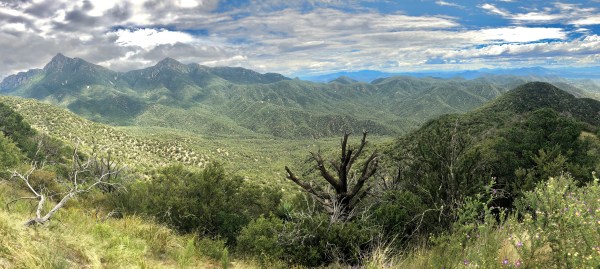
Vista from the southern terminus of the ridgetop trail off Mt. Hopkins Rd at km 13.
Acmaeodera decipiens on flower of Machaeranthera tanacetifolia.
A curious assemblage of bees on this Heliomeris longifolia flower. They were not active, just sitting. [Edit: these are Dufourea sp. (short-faced bees, family Halictidae)].

Santa Rita Mountains, lower Montosa Canyon, Arizona
We stopped at a spot near the bottom of the canyon on the way out to see what was going on at the lower elevations. The answer—not much! There were a variety of woody shrubs and other plants in bloom, but the area seemed rather “wilty”. I think this area has a lot of potential, we just didn’t hit it at the right time. I did take an impressively huge tarantula hawk, just because.

Fouquieria splendens (ocotillo) resembles cacti but is not a true cactus. Distantly related to persimmons, blueberries and acacias, it is now placed in its own family (Fouquieriaceae).
Apiomerus flaviventris (yellow-bellied bee assassin) with prey.
The prey is a soldier beetle (likely Chauliognathus lewisi).
Robber flies not only mate tail-to-tail, they fly coupled in the position also. This tandem of giant robber flies (possibly Promachus nigrialbus), flew by me and landed in the bushes. The male (right) tried to take flight again and pulled the female’s hind legs off her perch. She stood firm, however, forcing the male to grab a nearby branch with just his from and middle legs and leave his hind legs dangling also. Note that the female is also feeding on a honey bee—so much natural history going on here!

Flats below Montosa Canyon, Arizona
I was a bit disappointed at not finding any beetles at what seemed would be the last collecting stop of the trip. But on our way out we saw a patch of Isocoma tenuisecta in bloom in the lowlands some distance west of the entrance to the canyon—just what we were looking for! Jeff and I each quickly found Crossidius suturalis individuals on flowers of the plants and continued searching up and down along the roadway. We didn’t find any more for awhile but when I got back to the area where I started I spotted another one sitting on a plant on the other side of the barbed-wire fence. I extended my net handle to the max, maneuvered it in position, took an assertive swipe, and got it. Just as I was putting it into the bottle, I saw another one take flight from a plant right beside me. I hadn’t closed the bottle yet but didn’t want the other one to get away, so I capped my thumb over the opening, awkwardly wielded my net into position one-handed, chased after it and took a swing and got it, too! (More often than not these situations end up with me losing both specimens!). There was also a good amount of Hymenothrix wislizeni along the roadside, off the flowers of which I collected several Acmaeodera gibbula, A. disjuncta, and A. rubronotata. This is probably the last collecting locality of the trip, so I’m happy to end up having success with this subspecies of Crossidius (C. suturalis intermedius), which we havn’t found in large numbers on this trip. Just after leaving the site, we saw a bobcat on the side of the road—my first one! Unusual to see one in the middle of the day—it was a small one, must’ve been quite hungry!
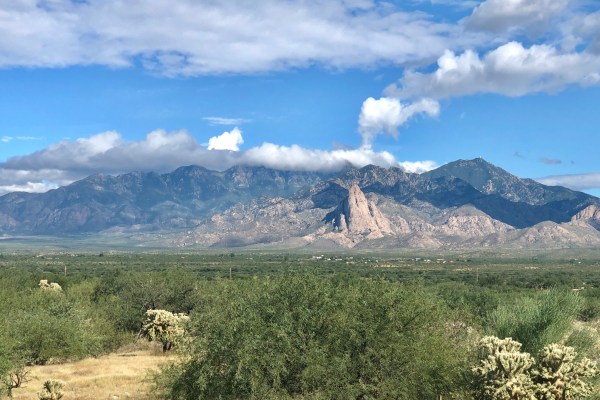
Santa Rita Mountains from the highway.

Phoenix, Arizona (epilogue)
Bill Warner was kind enough to host Jeff and I for our last night in Arizona prior to returning home tomorrow. What an amazing collection he has built, and his use of flight-intercept traps in recent years has turned up even more amazing beetles. I was happy to also meet Andrew Johnston and Evan Waite, who joined us for dinner.

Bill Warner, an icon among Arizona beetle collectors, sits amidst newly collected I material waiting to be processed.
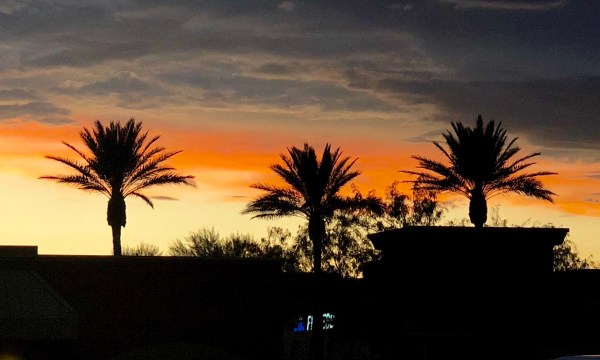
Sunset in Phoenix!

©️ Ted C. MacRae 2019

2019 Arkansas/Oklahoma Insect Collecting Trip iReport

Alternative title: Rich and Ted’s Excellent Adventure

This is the seventh “Collecting Trip iReport”; this one covering a 5-day trip to Arkansas and Oklahoma from June 7–11, 2019 with my friend and local collecting buddy Richard Thoma. As with all previous “iReports” in this series, this one too is illustrated exclusively with iPhone photographs.

Previous iReports include the following
2013 Oklahoma
2013 Great Basin
2014 Great Plains
2015 Texas
2018 New Mexico/Texas
2018 Arizona

Image may contain: 2 people, including Ted MacRae, people smiling, people standing, beard, tree and outdoor
…and so it begins!

Day 1 – Ozark National Forest, vic. Calico Rock, Arkansas
It’s been many years since I’ve visited these sandstone glades overlooking the White River near Calico Rock. Conditions were partly sunny when we arrived, but water on the ground suggested rain earlier in the day. We had only a short time to start exploring before the wind started blowing up and the smell of rain filled the air. I did manage to beat one Amniscus sexguttata from a branch of living Pinus echinata and collect a couple of Strigoderma sp. from Coreopsis lanceolata flowers before steady rain forced us to retreat.

Image may contain: cloud, sky, mountain, outdoor, nature and water
White River near Calico Rock, Arkansas—before the rain.
Image may contain: mountain, sky, outdoor and nature
White River near Calico Rock, Arkansas—rain’s a comin’!

Day 2 – Ouachita National Forest, Winding Stair Campground & Ouachita Trail, Oklahoma
We walked the trail from the campground S about 2½ miles and back. I started off with Acmaeodera tubulus on Krigia sp. flowers, eventually finding a lot of them on this plant at higher elevations along with a single Acmaeodera ornata, and I beat a few Agrilus cepahlicus off of Cornus drummondii. This had me thinking it would be a good buprestid day, but it wasn’t, the only other species collected being some Chrysobothris cribraria off of small dead Pinus echinata saplings and Pachyschelus laevigatus on Desmodium sp. Also beat a few miscellaneous insects off of Cercis canadensis and Vaccineum arborea and swept some from grasses and other herbaceous plants. Back at the campground I collected Chrysobothris dentipes on the sunny trunks of large, live Pinus echinata trees.

Emerald Vista, along the Talihema Scenic Drive.
Acmaeodera tubulus on flower of Rosa carolina.
Canthon sp.
Apheloria virginiensis reducta (ID by Derek Hennen).
The biggest cairn I’ve ever seen.

Ouachita National Forest, Talimena Scenic Dr at Big Cedar Vista, Oklahoma
There were lots of native wildflowers like Coreopsis tinctoria and Ratibida columnifera in bloom, so we stopped to check them out. There were lots of butterflies, however, I found only a single Typocerus zebra on Coreopsis lanceolata.

View south from Talimena Scenic Drive at Big Cedar Vista.
Coreopsis tinctoria (plains coreopsis).
Ratibida columnifera (upright prairie coneflower).

Ouachita National Forest, Winding Stair Campground, Oklahoma
We returned to the campground in the evening to do some blacklighting. I had high hopes, but only five cerambycids came to the lights, all represented by a single individual: Monochamus carolinensis, Acanthocinus obsoletus, Amniscus sexguttatus, Eutrichillus biguttatus, and Leptostylus tranversus (the first four are pine-associates). I also picked up a few other miscellaneous insects.

Rich processes the day’s catch as the blacklight hums in the background.

Day 3 – Medicine Park Primitive Campground, Oklahoma
There wasn’t much insect activity going on in eastern Oklahoma, so we drove out west to the Wichita Mountains for hopefully better luck. We found a small park with a primitive campground in the city of Medicine Park—my first thought was to beat the post oaks dotting the campground, but when I went into the native prairie between the campground and the creek I never came out! Right away I found what must be Acmaeodera ornatoides on flowers of Opuntia sp., then I found more on flowers of Gallardia pulchella along with Acmaeodera mixta. The latter were also on flowers of Thelesperma filifolium along with Acmaeodera neglecta—took a nice series of each, and I also got a few of the latter on flowers of Coreopsis grandiflora. Strangalia sexnotata were on flowers of C. tinctoria and Torilis arvensis, and then on the latter plant I saw a male Strangalia virilis—a Texas/Oklahoma specialty that I’ve never collected before! I spent the next hour looking for these guys and ended up with 3 males and 2 females along with a few Trichiotinus texanus—another Texas/Oklahoma specialty—and a single Agrilaxia sp. nr. flavimana (could be A. texana). One single Typocerus octonotatus was on flowers of Achillea millefolium. I think we may come back here tomorrow—I’d like to look for more S. virilis and beat the post oaks (the reason we stopped here to begin with).

A cacophony of native wildflowers!
An orgy of Euphoria kernii (Kern’s flower scarab) in Opuntia sp. flower. Multiple color forms exist for this species.
At first I thought this was a type of hover fly (family Syrphidae), but eventually I determined it to be Esenbeckia incisuralis, a horse fly (family Tabanidae)—incredible emerald green eyes!
Papilio polyxenes asterius (black swallowtail) caterpillar.
Echinocereus reichenbachii baileyi (lace hedgehog cactus).

Lake Lawtonka nr. Ma Ballou Point, Oklahoma
We stumbled into this area while looking for stands of Sapindus drummondii (soapberry)—found a small stand along the road, but it was too inaccessible. The same diversity of blooms were present as at the previous spot, so I picked a few longhorns off flowers of Coreopsis grandiflora and Gaillardia pulchella. Super windy, so we didn’t stay long.

View across Lake Lawtonka from Ma Ballou Point.
Neochlamisus sp. (case-bearing leaf beetle) larvae inside their “casas de caca” on Monarda fistulosa (bee balm).
I believe this is Harrisina coracina, a leaf skeletonizer in the family Zygaenidae. Both BugGuide and the Moth Photographers Group show records only from Texas.

Day 4 – Wichita Mountains National Wildlife Refuge, Oklahoma
Before starting the day’s collecting, we wanted to go into the Wichita Mountains National Wildlife Refuge to have a look around. On the way into the refuge we some American bison near the road and had to stop, take photos, and simply admire these massive, majestic beasts. We then went to the Cedar Plantation, where I had visited before back in 2012 and photographed black individuals of Cicindelidia obsoleta vulturina (prairie tiger beetle). No tiger beetles were out now (they come out in the fall), but I’d hoped to maybe see Cylindera celeripes (swift tiger beetle) along the 2-tracks in the area. No such luck—nevertheless, we saw a myriad of interesting insects, including several more Esenbeckia incisuralis (green-eyed horse flies) and a beautiful Trichodes bibalteatus (checkered beetle), the latter of which I photographed on flowers of Ratibida columnifera and Achillea millefolium with the big camera. Afterwards we visited the “prairie dog town” and got marvelous views and photographs of black-tailed prairie dogs.

Native American wildlife on a native American landscape.
American bison (Bison bison bison).
Wichita Mountains from Cedar Plantation.
Acmaeodera mixta on flower of Rudbeckia hirta (black-eyed Susan).
Typocerus octonotatus on inflorescence of Achillea millefolium (yarrow).
Strangalia sexnotatus on flower of Ratibida pinnata (gray coneflower)
Trichodes bibalteatus on flower of Rudbeckia hirta (black-eyed Susan).
Trichodes bibalteatus on flower of Ratibida pinnata (gray coneflower)
The author walks a bison trail through the Cedar Plantation.
Black-tailed prairie dog at its burrow entrance.
“Watch you lookin’ at, Willis?!”
Black-tailed prairie dog (Cynomys ludovicianus).

Medicine Park, Jack Laughter Park, Oklahoma
We’d noticed this spot yesterday because of the old post oaks and wealth of wildflowers blooming up the mountainside. There wasn’t much going on today, however—just a few Acmaeodera mixta on flowers of Gaillardia pulchella. I did find an Anthaxia (Haplanthaxia) sp. on my arm! Otherwise I spent some time photographing the landscape and some geometrid larvae on flowers of Gaillardia pulchella.

Opuntia sp. (prickly-pear cactus) amidst rocky exposures.
Small Oncoptus fasciatus (large milkweed bugs) nymphs colonize seed pods of Asclepias asperula (antelope-horns).

Medicine Park Primitive Campground, Oklahoma
We returned to this spot since we had so much luck yesterday. I was hoping to collect more Acmaeodera ornatoides and Strangalia virilis, but there was much less going on today than yesterday—basically didn’t see anything for the first hour and a half. I didn’t give up, however, and kept checking the area where we saw most of the S. virilis yesterday, and eventually I saw another male in the same area as yesterday on the same stand of Torilis arvensis. I found two more males in the same area over the next hour, so three males on the day was a good reward for the time spent looking for them. I also collected Trichodes apivorus and Trichiotinus texanus on flowers of Allium sp. Interestingly, beating the post oaks—the reason why I originally wanted to stop here—produced nothing. So, not very many specimens on the day, but happy with those I did get.

Thelesperma filifolium (stiff greenthread).
Coreopsis grandiflora (large-flowered tickseed).
Gaillardia pulchella (firewheel).
Coreopsis tinctoria (plains coreopsis).
Torilis arvensis (erect hedge parsley), introduced.
Opuntia sp. (prickly-pear cactus).
Allium sp. (wild onion).

Medicine Park, Jack Laughter Park, Oklahoma
I was pretty much done for the day after spending all morning at the refuge and most of the afternoon at the previous spot, but Rich wanted to take another look at Jack Laughter Park because he’d found some interesting grasshoppers there. As with earlier in the day there were few beetles of interest to me, but I did collect a couple of Trichiotinus texanus on flowers of Cirsium undulatum. I checked out some large post oaks with large dead branches thinking that might be what Strangalia virilis was breeding in but never saw any, and eventually I turned my attention to photographing a few interesting native plants that I found along the way.

Krameria lanceolata (trailing krameria).
Cirsium undulatum (wavyleaf thistle or gray thistle) inflorescence.

Cirsium undulatum (wavyleaf thistle or gray thistle) can be distinguished by its wavy leaves that are gray-green on both upper and lower surfaces.

Day 5 – Epilogue
We were tempted to do one last little bit of collecting on the way back to St. Louis, but since had pretty good luck during the last couple of days and the drive alone would take more than nine hours we decided to leave well enough alone and get home at a reasonable hour. A walk with Beauregard when I got home to stretch the post-drive legs was the perfect way to end the mini-vacation.


©️ Ted C. MacRae 2019

Orchid Valley Natural Area

This month’s destination for the WGNSS Natural History Photography Group was Orchid Valley Natural Area in Hawn State Park. This natural area is south of the main park and not normally open to the public, but we were granted permission to enter by the park administration. Our targets were several species of orchids and other rare plants that are known to occur in the area—showy orchis (Galearis spectabilis) being the one I hoped most to see.

Our group for the day (front to back): me, Lynne, David, Casey, Avery, James, Bill, and Rich (Chris behind tree at back).

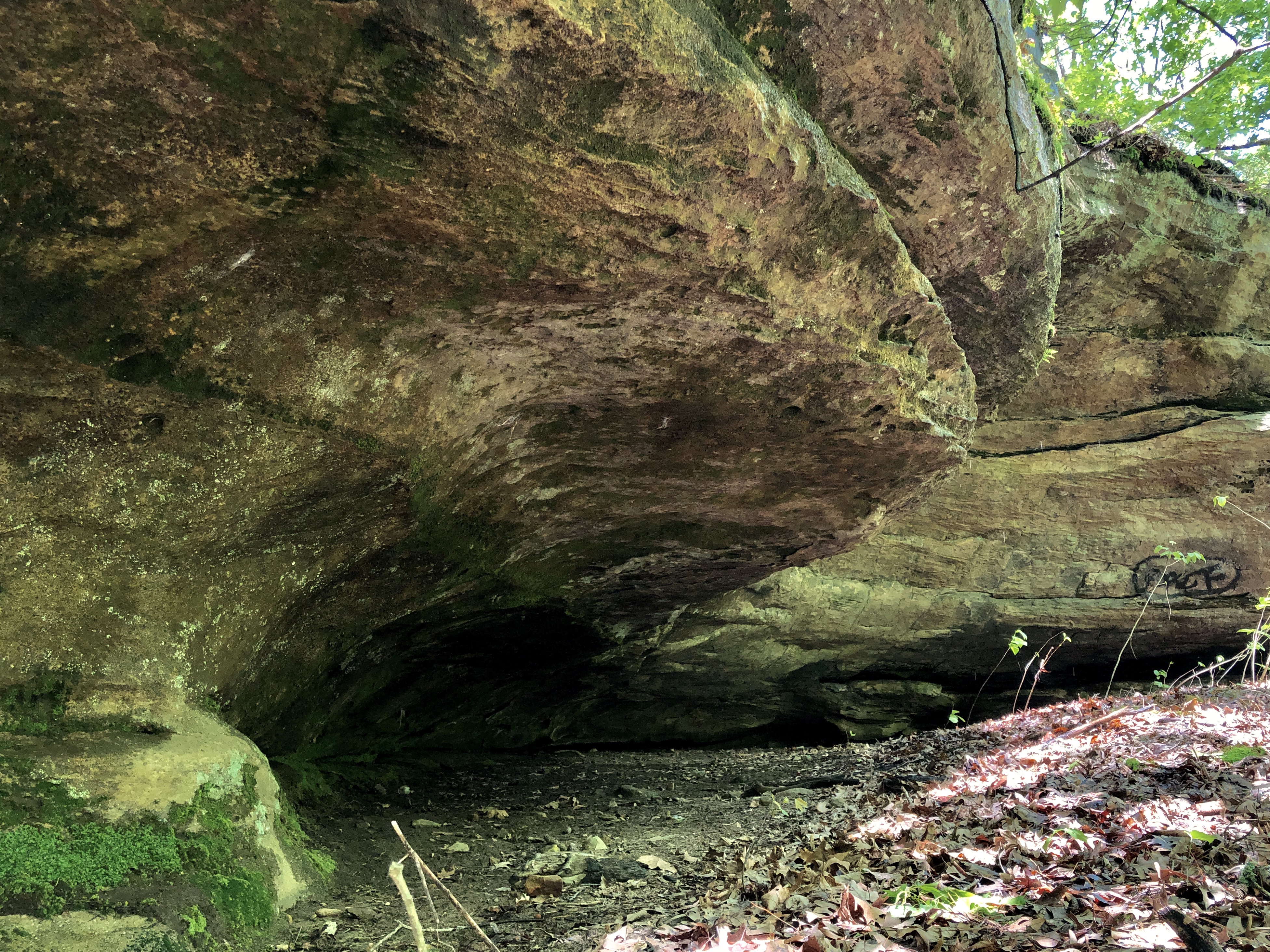
There are no trails here—not even a place to park, as we squeezed our cars against the side of the road at a spot that appeared to provide good access. A bit of GPS-guided bushwhacking brought us to increasingly rough and sloping ground that ended up at the edge of a cliff overlooking one of the sandstone box canyons that this area is know for—down below was where we wanted to go. Wild azaleas lined the upper canyon edges with their stunning pink blossoms. We followed the canyon edge and found a way down, then circled back into the canyon to find a stunning waterfall, its sandstone walls dripping with mosses and ferns. We spent quite a bit of time here photographing the waterfall and surrounding area before eventually resuming the search for the orchids that we came to see.

Bill surveys a waterfall at the center of a sandstone box canyon.

The waterfall fell about 25 feet onto the sandstone rocks below, its splash creating perfect conditions for luxurious growth of mosses and ferns.

Mosses sending up their “stems” (actually setae), each holding up a capsule filled with spores.

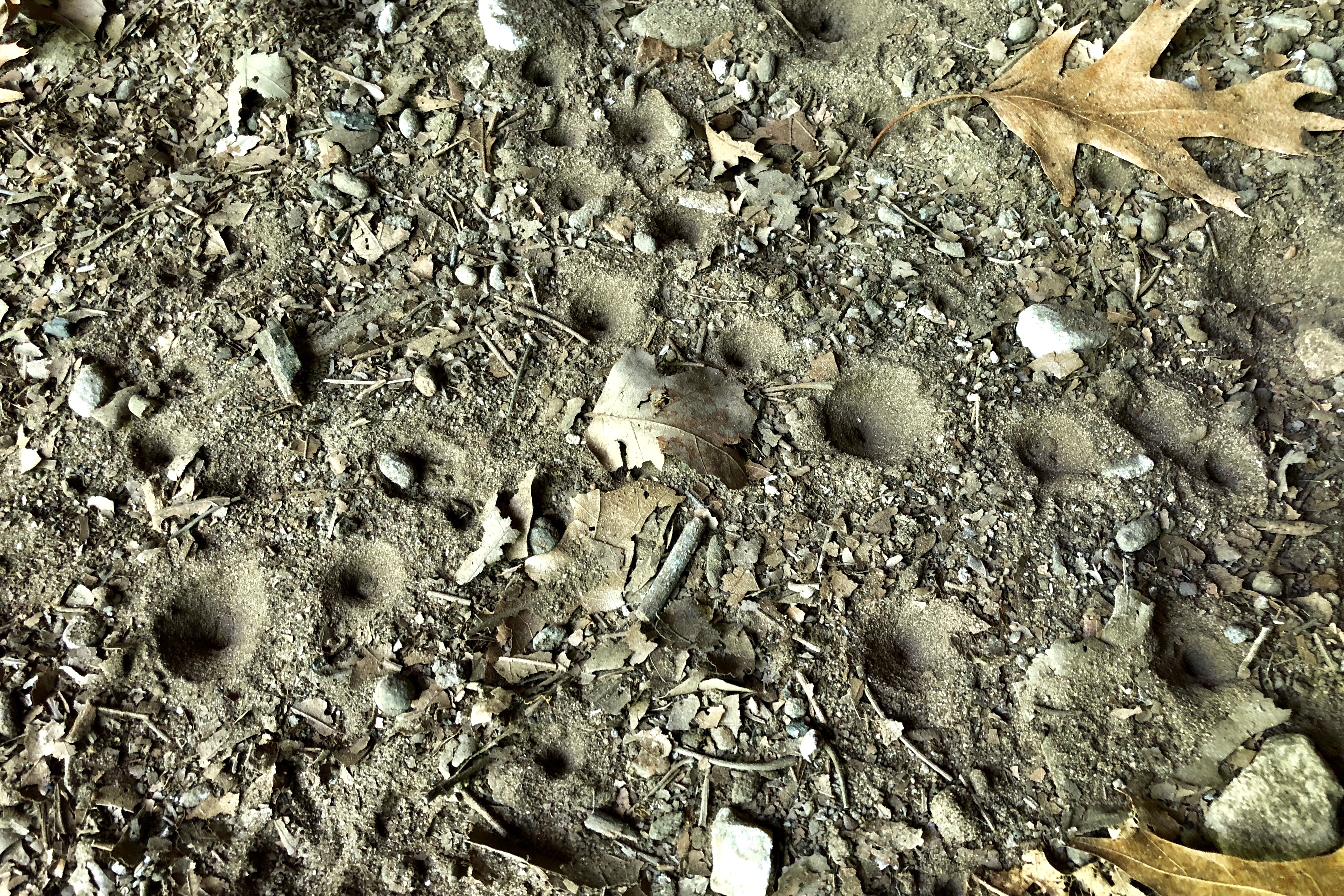
Sadly, the orchids were not yet in bloom—not even close, another victim of the cold, late spring we’ve been experiencing. Casey, our group leader, did find some very small showy orchis leaves, and we saw some nice clumps of another native orchid, rattlesnake plantain (Goodyera pubescens), an evergreen orchid that blooms during late summer. We hiked up another drainage that led to another box canyon—lacking a waterfall but equally impressive, nonetheless—but found no orchids in bloom there, either. We did, however, see cinnamon ferns sending up their spike-like fertile fronds and aggregations of antlion larvae (a.k.a. “doodlebugs”) in the soil beneath the sandstone ledges.

Leaves of rattlesnake plantain (Goodyera pubescens).

Moss growth is luxuriant in the wet sandstone exposures inside the box canyons.

Sandstone ledge above a box canyon.

Pits of antlions, or “doodlebugs”, clustered in the soil beneath a sandstone ledge. Ants and other insects that fall into the pits are quickly dispatched by the sickle-shaped mandibles of the bug lying buried at the bottom of the pit.

You might think failure to find what we were looking for would result in a disappointing field trip—far from it! Time in the field with like-minded friends in a beautiful spot is always a pleasure, and when it comes to searching for rare plants (or insects, or whatever), failure is the norm—making success, when it does come, that much sweeter. There will be other chances to see showy orchis (perhaps in a couple of weeks).

© Ted C. MacRae 2019

“62nd” Annual “Season-Opener-Birthday-Bug-Collecting-Trip”

This past Tuesday was my birthday, and as I have done for my entire adult life I took the day off and went on my traditional “Season-Opener-Bug-Collecting-Trip”. In the past I’ve usually just had one friend go with me, but today I had three—Rich, Chris, and Bill!

We started off by heading south about 3½ hours to Tingler Prairie Natural Area in Howell Co.. I wanted to come here because: 1) it was a place I’d never visited before, and 2) there is a population here of the endemic Ozark trillium (Trillium viridescens) that I thought might be in bloom. Rain in the forecast and a patch of the real thing on the way down had us a little worried, but the day turned out spectacular with temps climbing to 80°F and skies partly to mostly sunny.

IMG_6208 (Edited).JPG

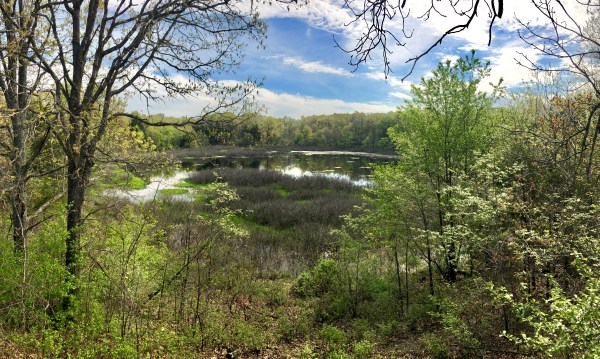
Tingler Lake – the centerpiece of Tingler Prairie Natural Area.

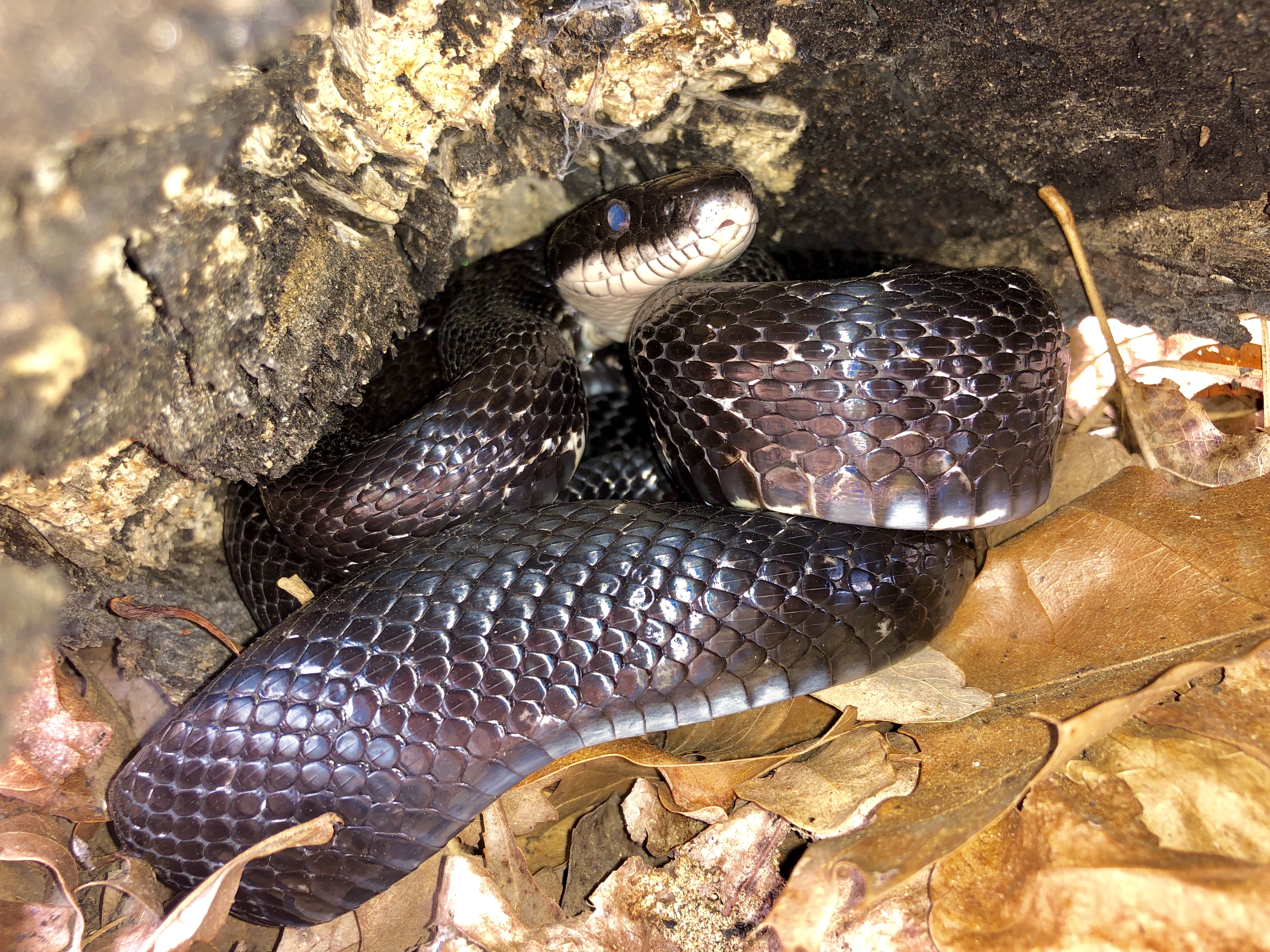
We never did find the trillium—even calling another friend (Casey), who had seen them here before to find out exactly where he saw them. Turns out we hit the right spot, but apparently we were too early, especially given how late spring has been moving along this year. Nevertheless, we still found much to capture our interest, including a yellow-bellied racer (Coluber constrictor flaviventris)—too quick for photos—and a black rat snake (Pantherophis obsoletus) that coiled up nicely under the end of a fallen log and tolerated my prodding and “cleaning” of the scene around him to get some good photos (albeit, only with the iPhone).

IMG_6219 (Edited)

Black rat snake (Pantherophis obsoletus).

IMG_6220 (Edited)

The “cloudy” eye is actually an artifact of the flash lighting reflected by the retina.

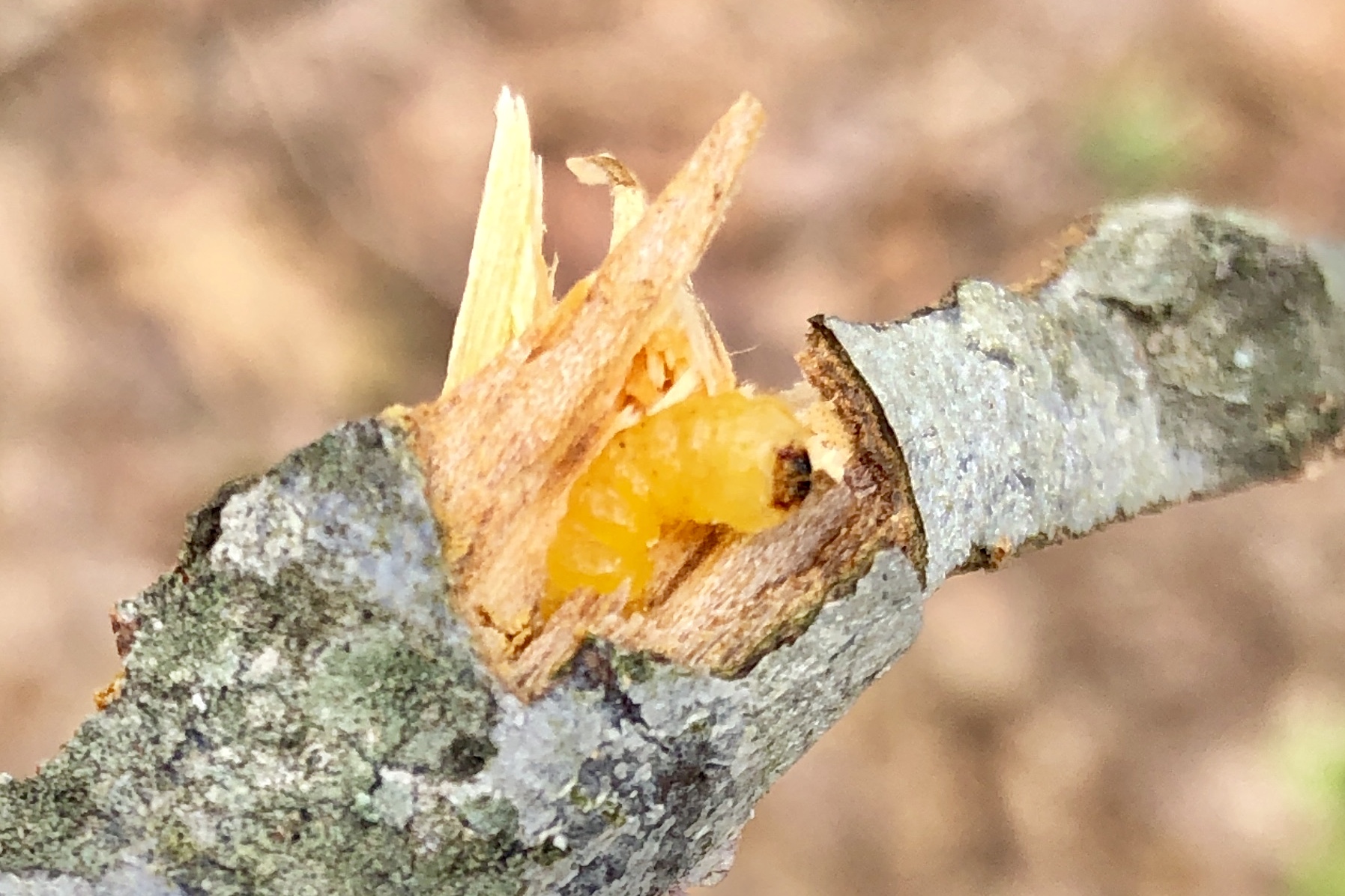
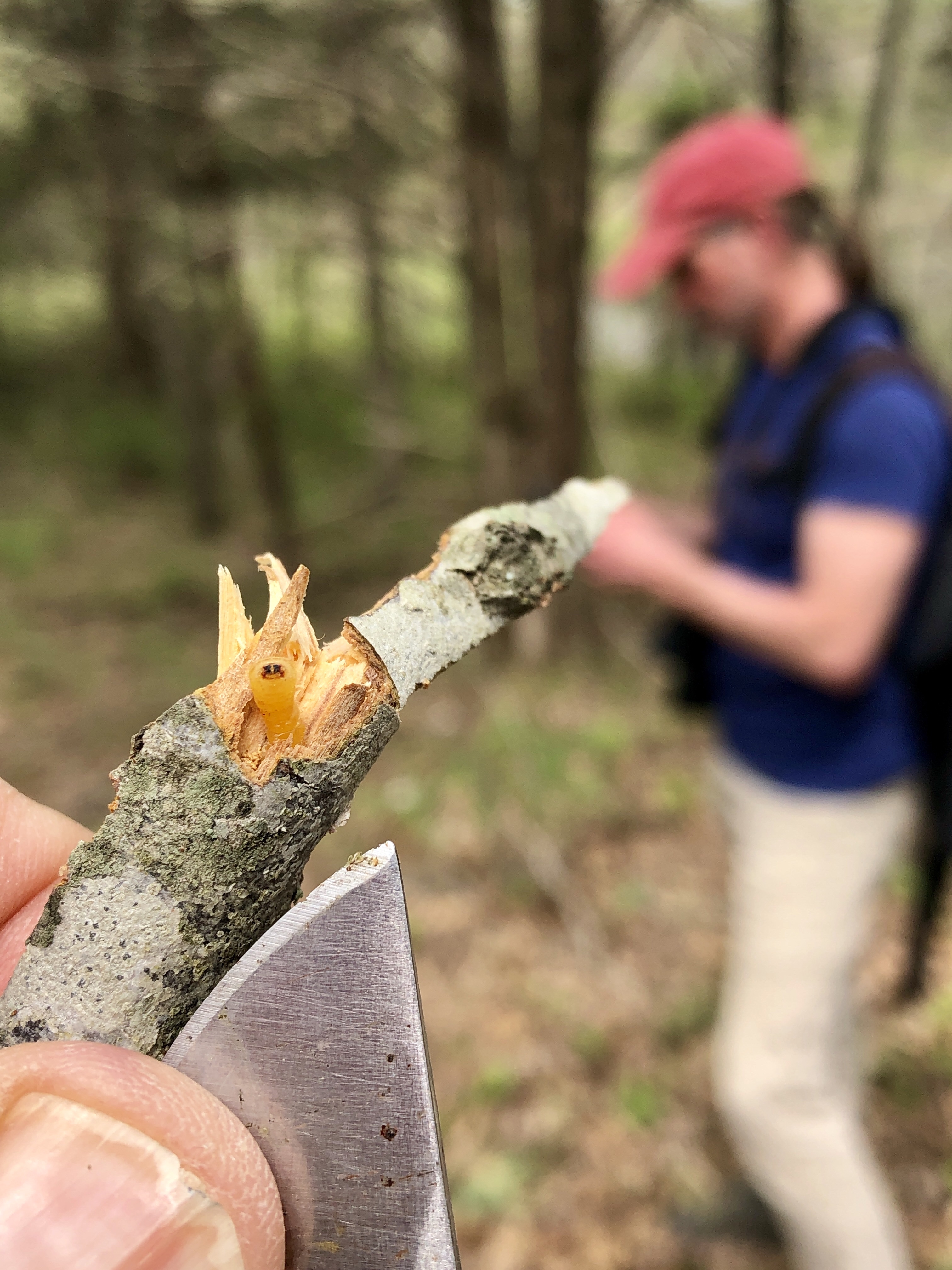
Unfortunately, insect activity was very light. We saw no tiger beetles and only the earliest spring forms of most other insects. I took about 10 specimens each of the early-spring jewel beetles Acmaeodera tubulus and Pachyschelus purpureus, which I found on flowers and foliage (respectively) of wild geranium, Geranium maculatum. It was the first time that I’d found the latter as abundant as this, so the series of specimens will be a welcome addition to my cabinet. I also took a couple of A. tubulus on a flower of violet wood sorrel, Oxalis violacea and showed the others the characteristic end of an oak twig pruned by a twig pruner (Anelaphus parallelus) larvae (and revealed the culprit for them to see). Despite the paucity of insects, it was a beautiful and high-quality spot, and I look forward to collecting here again sometime when the season is more advanced.

IMG_6227 (Edited)

Several adult Acmaeodera tubulus feeding on petals of wild geranium (Geranium maculatum) flowers.

IMG_6221 (Edited)

Twig pruner, Anelaphus parallelus, larva cut from its gallery near the base of a pruned oak twig.

img_6222

Revealing the culprit while Chris takes notes on some of the birds he’s been hearing.

img_6237

Redspotted purple butterfly, Limnetis arthemis astyanax (family Nymphalidae), caterpillar on black cherry (Prunus serotina), one of its favorite host plants. The caterpillar mimics bird droppings for protection.

img_6226

Fire pink, Silene virginica (family Caryophyllaceae) thrives on a dry, cherty hillside.

img_6233

Mayapple, Podophyllum peltatum (family Berberidaceae) prefers the rich, more mesic hillsides (this is where we expected Trillium viridescens to occur).

After finishing up at Tingler Prairie, we drove east an hour and bushwhacked over rough Forest Service 2-track to Bald Hill Glade Natural Area in Ripley Co. It had been close to 10 years since my previous visit, but I remembered the roads well. We had to park, however, about a mile from the entrance to the glade due to fallen trees across the final stretch 2-track. The landscape had changed considerably since my last visit—gone was the dense, close forest lining the 2-track, and in its place stood open woodland brought to this condition by active management that included the use of prescribed burning apparently as recently as the past season.

img_6238

Dwarf iris (Iris cristata).

img_6240

These diminutive plants are distinguished from other members of the genus by their short stature and sepals with midline beards.

img_6241

Bald Knob Glade Natural Area.

After hoofing through the forest we reached the glade and found a beautiful—if somewhat sterile—scene before us. The recent burn included not only the woodland but also the glade itself, and no unburned refugia could be found anywhere. Floristically, this is beneficial for the glade, which needs periodic fire to prevent woody encroachment, but in my experience such burns also result in severely depressed insect populations for years afterwards. It takes time for the insects to find and recolonize the glade, and in this case the lack of unburned refugia will only increase the amount of time that will be needed for the insect populations to recover.

Nevertheless, we enjoyed our hike through the area, watched and listened to the calls and songs of a number of cool birds, including summer tanagers, indigo buntings, blue-gray gnatcatchers, and—a first for me—the splendidly yellow prairie warbler. We also took photographs of the glade and some of its plants (with the big camera), and on the way back to the car we found several of the Polistes wasp-mimicking light flies, Pyrgota undata (family Pyrgotidae). Interestingly, all were mating pairs, and the ones we observed closely (as we photographed them with the big camera) were engaged in a most curious “French kissing” behavior. I can’t wait to read up more on this when I prepare to post the photos of this behavior.

img_6246

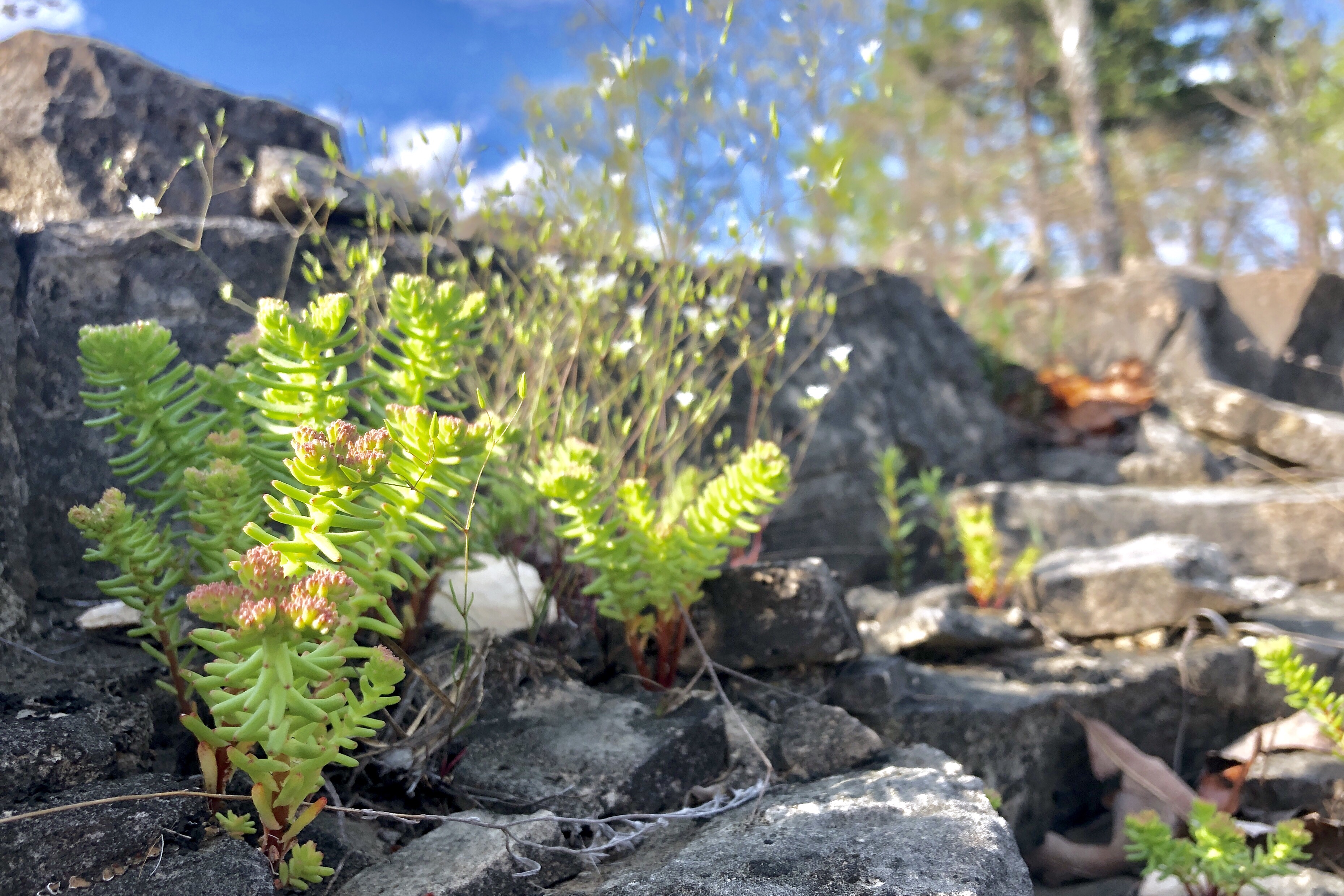
Widow’s cross (Sedum pulchellum).

55963458_10158503157048677_1504766440970911744_n (1)

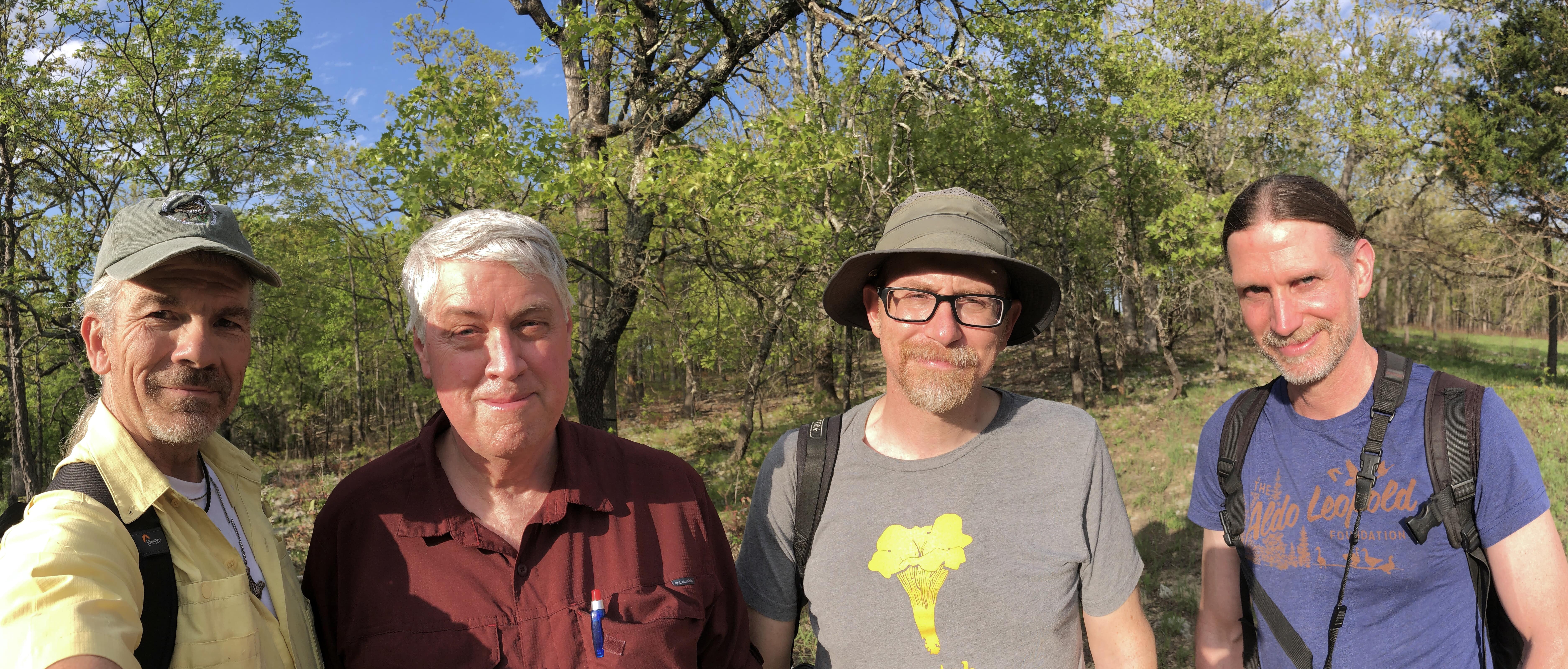
Me, Rich, Bill, and Chris.

Eventually, impending dusk signaled a close to the day, and after driving east another 1½ hours to have pizza dinner in Poplar Bluff we made the long drive back to St. Louis (arriving at my home at 12:30 a.m.!).

NOTE: All photos in this post were taken and processed with an iPhone X. The “real” photos taken with our “real” cameras will be shared as they become available.

© Ted C. MacRae 2019

When hardcore botany meets hardcore nature photography—nature geekery at its finest!

Last Saturday, the Webster Groves Nature Study Society (WGNSS) Nature Photography Group was joined by several members of the WGNSS Botany Group and Missouri Native Plant Society to look for one of Missouri’s rarest plants—Geocarpon minimum, a.k.a. tinytim or earth-fruit (family Caryophyllaceae). This diminutive, federally-threatened and state-endangered plant grows only on sandstone glades, primarily in west-central Missouri with a few populations known also from Arkansas, Louisiana, and Texas. The window for finding this plant is short—it’s entire life cycle lasts only about 4 weeks, with an even shorter window for finding it in flower.

Our first stop to look for them was Bona (pronounced “Bonnie”) Glade Natural Area. I’d been here before, but it was about 10 years ago and at the wrong time to look for this plant (but I did find widowscross, Sedum pulchellum, in bloom). Some of the group had seen it here before and were able to coach us on the microhabitat where we would likely find them, and it didn’t take long before we did. Soon after finding the first plants, we found them in bloom as well—their almost microscopic flowers being the perfect subject for my macro lenses!

Remnant sandstone glade at Bona Glade Natural Area, Dade Co., Missouri.

Geocarpon minimum (tinytim or earth-fruit). Note the tiny open flowers just below center. (This is an iPhone photo—I have much better photos with my “big” camera.)

Claytonia virginica (spring beauty) (family Montiaceae).

After getting plenty of shots of the plant and flowers, we moved to an adjacent plot of land across the highway, where we not only found more tinytim plants but also Corydalis aurea, commonly called golden corydalis (pronounced koor-ID-uh-lyss), in the family Papaveraceae—something I’d never seen before.

Sedum pulchellum (widowscross) (family Crassulaceae).

Corydalis aurea (golden corydalis).

Next the group moved on to Corry Branch Glade. It was originally our intent to look for more of the plant at this site, but immediately upon entering the glade we noticed a stunning display of Selenia aurea, or golden selenia. This small, striking species in the mustard family is restricted to just a handful of counties in the west-central part of the state, again primarily glade habitats. It was a surprising and pleasant find that occupied the groups’ attentions for some time before we finally decided to break for lunch (it was well into the afternoon!). While I was there, I not only photographed the plant but started having some success with my new 15-mm wide-angle macro lens, with which I had been experimenting all day (to that point without much success).

Selenia aurea (golden selenia) (family Brassicaceae).

Members of WGNSS & MoNPS go hunting for rare plants! Front to back: Ted MacRae (me), John Oliver, Casey & Anh Do Galvan, Steve Turner, Bill Duncan, David Seidensticker, Deb Tyler, Adam Rembert, and James Faupel.

After “lunch” (which was closer to dinner!), a few of us (Bill, David, and I) wanted to go back to Bona Glade to take another crack at photographing tinytim with our wide-angle macro lens. I especially was not satisfied with what I had gotten earlier, that being my first serious attempt at using the lens in the field. Having a better idea now of how to use the lens and what our compositional goals were, we scoured the area looking for just the right plants in just the right situations. I can honestly say I finally got a feel for how to use the lens, the trickiest part of it being how to balance use of flash on the subject with the amount of ambient light from the background (I’m not a stranger to this concept at all, frequently having combined flash with “blue sky” in much of the macrophotography I’ve done up to this point). We photographed several plants on different substrates looking for the right combination of plant, substrate, and background, and we all walked away pretty optimistic that we’d gotten the photos that we wanted.

Bill Duncan photographing tinytim with his wide-angle macro lens.

Amelanchier arborea (serviceberry) (family Rosaceae).

My thanks to Casey and Ando Galvan for letting me ride down there with them, to David Seidensticker and Bill Duncan for letting me ride back with them, and for everyone in the group who so generously shared their great, collective knowledge of botany, photography, and natural history. What a fun day!

NOTE: The photos in this post were taken with an iPhone X. The “real” photos, taken with our “real” cameras, will be shared as they become available.

© Ted C. MacRae 2019

2019 WGNSS Nature Photo Contest

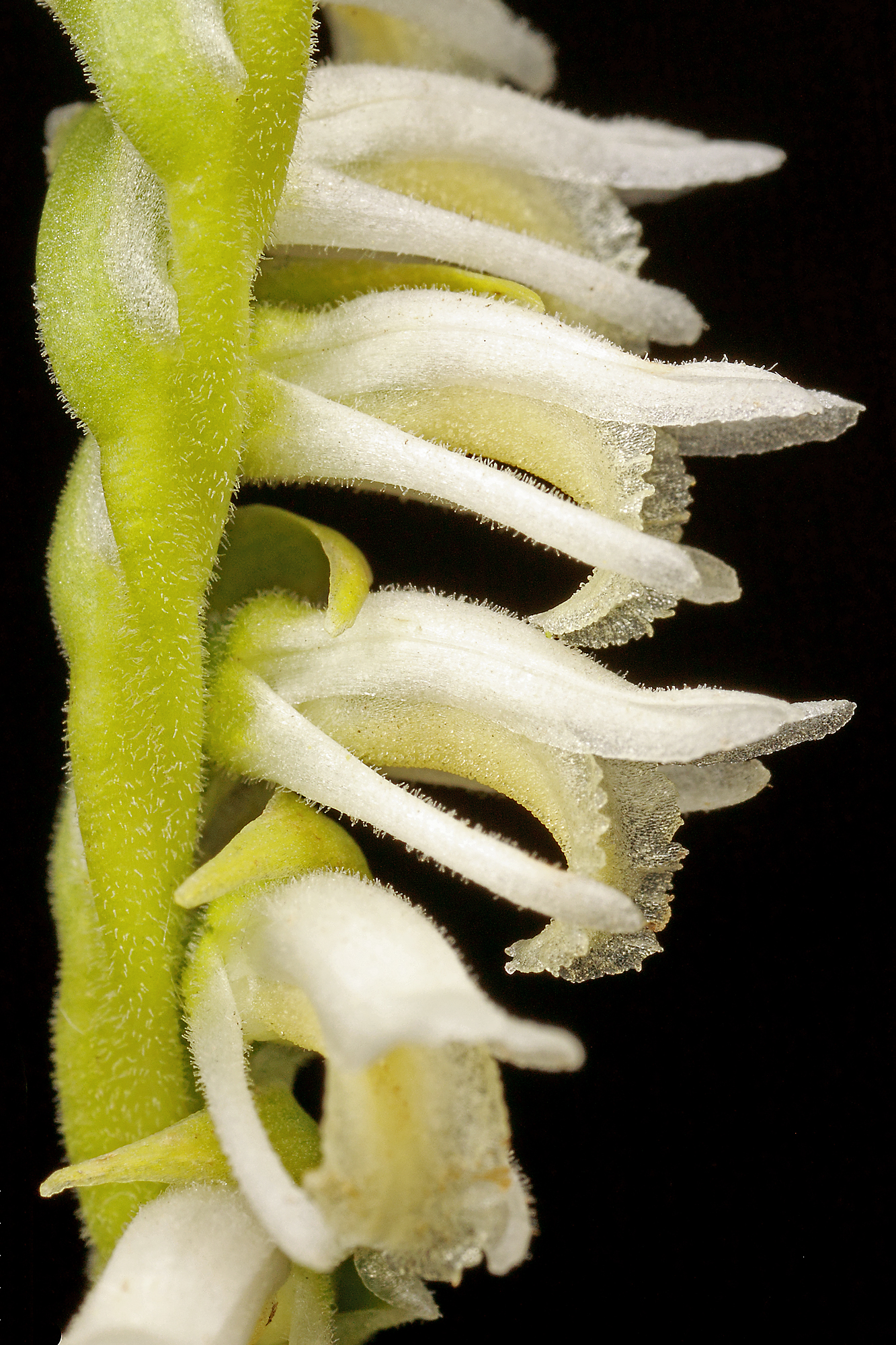
Last night the Webster Groves Nature Study Society (WGNSS) held their 2019 Nature Photo Contest, and I was fortunate to have a 1st place winner in the ‘Plants and Fungi’ category! This photograph of grassleaved lady’s tresses orchid (Spiranthes vernalis) flowers was taken at Taberville Prairie Natural Area in St. Clair Co., Missouri. Like other species of lady’s tresses orchids, their tubular flowers are arranged in a spiral along the inflorescence and cross-pollinated primarily by long-tongued bees (e.g. bumblebees, Bombus spp., and megachilid bees) (van der Cingel 2001).

Spiranthes vernalis (spring lady's tresses)

Grassleaved lady’s tresses orchid (Spiranthes vernalis), Taberville Prairie Natural Area, St. Clair Co., Missouri.

Spiranthes is one of the more complex genera of North American orchids, with seven species known to occur in Missouri (Summers 1985), and like almost all orchids, their pollination biology is fascinating! The flowers are “protandrous”, i.e., they are functionally male when they first open and become functionally female as they age. Since they open sequentially from the base of the inflorescence as it grows, this results in female flowers on the lower portion of the inflorescence and male flowers on the upper portion.  Thus, bee pollinators tend to act as pollen donors when visiting lower flowers and pollen recipients when visiting upper flowers.  Male pollinia are attached to the bee’s proboscis as it tries to access the nectar secreted into the base of the floral tube and then come in contact with the female stigma in the next flower that the bee visits.  Bees generally start at the bottom of an inflorescence when visiting a plant and then spiral up to the top before flying to the next plant.  Such “acropetal movement” is likely a result of the tendency for nectar rewards to be greater in the lower flowers, and it ultimately promotes cross-fertilization between neighboring plants.

This was the 4th edition of the contest, which has been held every other year since the inaugural edition in 2013. I’ve earned 2nd and 3rd place honors in the plants category each time before; however, this was my first win in that category. In addition to plants, I also had entries in the ‘Invertebrates’ (restricted to photos taken in Missouri or one of its contiguous states) and ‘Travel’ (open to photos taken anywhere in the world) categories, with one photo each making it to the final round of judging. You’ve seen them both before—Neotibicen superbus (below left—photographed at Mincy Conservation Area, Taney Co., Missouri) and Agrilus walsinghami (below right—photographed at Davis Creek Park, Washoe Co., Nevada). In the end, however, they both got beat out by the competition, so I only had the one winning photograph this time. Nevertheless, it was a 1st place winner, so I am very satisfied.

The WGNSS Nature Photo Contest has quickly become one of the organization’s marquee events, with the number of entries, caliber of competition, and attendance all exceeding the previous three editions. My thanks to the judges who volunteered their time, the attendees who supported the event, and especially to Bill Duncan, Chair of WGNSS’s Nature Photography Group (and an expert nature photographer in his own right), who worked hard to make this event the success that it was (and took home some well-deserved wins of his own). I look forward to the next competition in 2021!

REFERENCES:

Summers, B.  1981.  Missouri Orchids.  Missouri Department of Conservation, Natural History Series No. 1, 92 pp.

van der Cingel, N. A.  2001.  An Atlas of Orchid Pollination: America, Africa, Asia and Australia. A. A. Balkema, Rotterdam, Netherlands, 296 pp.

© Ted C. MacRae 2019

T.G.I.Flyday—Black horse fly (Tabanus atratus)

In my previous post, I talked about a day trip to a sand scrub remnant in the Lake Wales Ridge of central Florida to find and photograph the endemic Highlands tiger beetle (Cicindelidia highlandensis). Ironically, the dry sand scrub/pine woodland habitats along this ridge are dotted with small lakes and ponds, allowing a rich aquatic flora and fauna to co-exist alongside the xeric specialists. Field mate Chris Brown and I had found and just finished photographing the tiger beetles when we encountered this rather largish lake—bright, white sand surrounding crisp, clear water reflecting white, puffy clouds in a deep, blue sky. ‘Twas a spectacular sight, indeed!

Sand scrub lake

Sand scrub remnant, Lake Wales Ridge, central Florida

As we stood looking at the scenery, I noticed something black on the stem of one of the sedges growing along the water’s edge. Something big and black! As I moved closer I could tell quickly that it was a large horse fly, but it was not simply perched and resting on the sedge—there was something else going on. Moving closer, ever so cautiously so as not to disturb the fly, I eventually realized that it was a female in the act of oviposition. How cool—I’d never witnessed this before with any species of horse fly, so to see it with such a large species was a real treat. I recognized it instantly as Tabanus atratus—commonly called the black horse fly and recognizable as such by its large size, all-black coloration, and distinctively hooked antennae (see 3rd photo below).

Tabanus atratus ovipositing

A Tabanus atratus female oviposits on a stem overhanging the water.

Before we get to the eggs, let’s dispel some misinformation that seems to persist regarding the size of this species (as it does with almost any large insect). Black horse flies are undeniably large, and in fact they are one of the largest horse flies in North America. The more credible sources (e.g., Pechuman et al. 1983, Long 2001) cite body length as ranging from 20–25 mm (up to a full inch in length). Incredibly, the species does not take the honors as North America’s largest horse fly, which goes instead to Tabanus americanus and it’s upper limit of 30 mm (in fact, T. americanus may be the world’s largest horse fly)! There are, however, on-line sources and a few popular field guides (as cited in BugGuide) that state a maximum length of 28 mm for T. atratus. How credible this figure is I cannot say, but I guarantee that the size indications of 30, 40, and even a whopping 50 mm in length found routinely among photos of this species on BugGuide were not derived from careful measurement and almost certainly instead reflect the astonished reactions that such an abnormally large insect can generate! In fact, there are precious few insects in North America that reach lengths as grand as 50 mm (i.e., two full inches)!

Tabanus atratus ovipositing

Lateral view of oviposition.

We approached carefully, again so as not to disturb the female in the middle of her act, and we watched and photographed as she laid the individual eggs one by one, using the tip of her abdomen to carefully arrange them neatly against each other in stacked layers. From a photographic perspective, balancing flash exposure of the all-black adult with the bright-white egg mass presented a real challenge. Added to that was an additional exposure challenge (my desire for a blue-sky background), making it a truly difficult-to-photograph subject. Long (2001) states that T. atratus egg masses can contain anywhere from one hundred to a thousand eggs each, always near water’s edge or somewhere quite close to water. Females are capable of laying three or four of these egg masses, which apparently gradually turn dark as the eggs develop and approach hatch.

Tabanus atratus egg mass

Freshly laid Tabanus atratus egg mass.

Despite this being the first time I’ve ever witnessed oviposition by this species, it seems to be encountered regularly. There are several photos of ovipositing females among the many photos of this species that have been posted to BugGuide. Moreover, descriptions of the egg mass of T. atatus appeared very early in the literature, first by Hart (1895) and then in photographs by Schwardt (1936). The latter author also states “T. atatus deposits its eggs in masses which are so constant in structural plan as to make specific determination of the egg mass readily possible” (as quoted in Bailey 1948). Thus, even if this female had already finished and left her egg mass, it still could have been identified to species.

REFERENCES:

Bailey, N. S. 1948. Notes on Tabanus atratus subsp. nantuckensis Hine (Diptera). Psyche 55(3):131–138 [pdf].

Hart, C. A. 1895. On the entomology of the Illinois River and adjacent water. Illinois State Laboratory of Natural History Bulletin 4:149–273 [eBook].

Jones, C. M. & D. W. Anthony. 1964. The Tabanidae (Diptera) of Florida. U.S. Department of Agriculture, Agricultural Research Service, Technical Bulletin No. 1295, 85 pp. [pdf].

Long, W. 2001. Tabanus atratus (on-line), Animal Diversity Web. Accessed 20 March 2019 at https://animaldiversity.org/accounts/Tabanus_atratus/

Pechuman, L. L., D. W. Webb & H. J. Teskey. 1983. The Diptera, or true flies, of Illinois 1. Tabanidae. Illinois Natural History Survey Bulletin 33(1):1–121 [pdf].

Schwardt, H. I. 1936. Horseflies of Arkansas. Arkansas Agricultural Experiment Station Bulletin 332:14–15, 27–32.

© Ted C. MacRae 2019


Revisiting the Highlands tiger beetle (Cicindelidia highlandensis)

In September 2016, I had the opportunity to attend the Annual Meeting of the Entomological Society of America in Orlando, Florida, which was being held in conjunction with the International Congress of Entomology. My first thought when I made plans to attend these meetings was that this would be a chance for me to get another look at the Highlands tiger beetle (Cicindelidia highlandensis). One of Florida’s rarest endemic tiger beetles, this species is restricted entirely to remnant sand scrub and pine woodland habitats along the Lake Wales Ridge of Polk and Highlands Counties in central Florida (Choate 2003). I was thrilled to have found adults (in good numbers) on my first attempt back in 2009, and I was also thrilled to have successfully managed to photograph the beetle at that time. However, in the years since, I have become increasingly dissatisfied with those photographs—taken during what was my very first year of insect macrophotography. I’ve learned a lot since then about lighting, diffusion, and composition, but perhaps the biggest annoyance of those photographs is the fact that in every one the antennae and/or legs are “clipped”—a result of my being so enamored with my newfound macrophotographic capabilities that I nearly completely ignored other aspects of photographic composition.

Chris Brown photographing Cicindelidia highlandensis

Chris Brown photographs a Highlands tiger beetle.

Chris Brown—long-time field accomplice and himself a tiger beetle aficionado and insect macrophotographer—was also at the meetings, and since he had never seen the Highlands tiger beetle before we made plans to slip away one day and visit the spot where I had seen them back in 2009. I knew our chances of finding them were slim—it was very late in the season (late September), and the species is a so-called “summer species” with peak of adult activity in July and August. We figured, however, that even if we didn’t find adults we would still enjoy the day in the field, and for some time after arriving at the site that’s all it was. Finally, in an open sandy area near a small lake we saw the first adult. I let Chris take his shots, as this was his first opportunity (see photo above), while I continued to search for additional adults. Eventually I found one and began the long process of “whispering” to it to coax it into allowing me the photographs I desired.

Cicindelidia highlandensis

Highlands tiger beetle (Cicindelidia highlandensis).

As you can see in the photograph above, my compositional preferences have changed since I took those first photographs back in 2009. In contrast to the “as close as possible” style that I initially adopted, I now prefer to back off from the beetle enough to include elements of the habitat in which it occurs. While this compositional style may show less detail on the beetle itself, I believe it adds perspective and results in a more interesting and aesthetically pleasing photograph. I also now like to get down as low as I can, often placing the camera directly on the ground rather than always shooting from “elbow-height”, for a more unique perspective of the beetle, and my use of better flash diffusion results in more even lighting and minimizes the distracting specular highlights that are often the hallmark of flash macrophotography.

Cicindelidia highlandensis

This individual demonstrates the thermoregulatory “stilting” behavior of the adults.

Sadly, my flash unit failed soon after I began photographing the beetle, which is a real shame because the beetle began demonstrating the characteristic “stilting” behavior that the adults use for thermoregulation in their hot environment. The photograph above is the only one that I could “rescue” through some rather heavy-handed post-processing to make up for the failure of the flash unit to fire (it is fortunate that I have shifted to routinely using a combination of ambient light and fill-flash rather than flash only, or I would have had not even this photograph to rescue!). I suppose this means I’ll just have to revisit this species once again (now that I have not one but two new flash units!), which isn’t all bad because I would also love to see and photograph once again the moustached tiger beetle (Ellipsoptera hirtilabris), another Florida endemic (or near so) that I saw here also during my first visit but not during this one.

The Highlands tiger beetle belongs to a group of species called the abdominalis species-group, with all four of the included species (C. abdominalis, C. floridana, C. highlandensis, C. scabrosa) occurring in Florida (three of which are endemic or near-endemic to Florida). For those interested, I have seen and photographed all four of the species and presented a “mini-review” with photographs and links to posts with more detailed information about each species, along with a key to the species to allow for their identification.

REFERENCES:

Choate, P. M., Jr. 2003. A Field Guide and Identification Manual for Florida and Eastern U.S. Tiger Beetles.  University Press of Florida, Gainesville, 224 pp.

© Ted C. MacRae 2019