March has been incredibly warm in the St. Louis area, particularly during the second half in which temperatures exceeded 80°F on seven of 12 days and 90°F twice! As one would expect, such unusually warm conditions played havoc with the first wave of early spring bloomers, particularly the conspicuously flowering understory trees that normally follow a predictable sequence of bloom beginning with Lindera benzoin (spicebush—family Lauraceae) in early to mid-March, Prunus mexicana/americana (Mexican/American plum—family Rosaceae) and Amelanchier arborea (common serviceberry—family Rosaceae) in mid- to late March, Sassafras albidum (sassafras —family Lauraceae) and Cercis canadensis (eastern redbud—family Fabaceae) in late March to early April, and — the zenith of native blooming understory trees — Cornus florida (flowering dogwood—family Cornaceae) in early to mid-April. Instead of a tightly choreographed sequence of mass blooms, we instead witnessed haphazard displays beginning earlier than normal and progressing sporadically throughout late March, with many trees knocked out of bloom by quite cold temperatures during several nights.
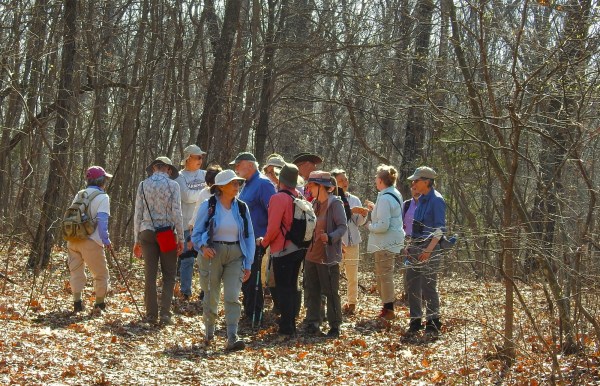
Nevertheless, it was not the disappointing displays of any of the above species that the group came to Little Lost Creek to see, but instead a much less commonly encountered understory tree with even less conspicuous blossoms—Dirca palustris (eastern leatherwood). One of only two Missouri representatives of the Family Thymelaeaceae, commonly called “stringbarks,” this species is found in scattered locations across the Missouri Ozarks and has been found reliably blooming in early April along Little Lost Creek.
WGNSS Botany Group at Little Lost Creek. Photo by Kathy Bildner.
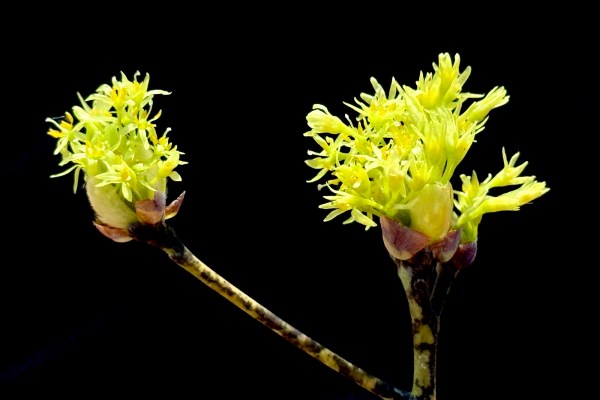
To get to the low, moist areas where D. palustris grows, however, we needed to hike the two-track across the old fields and rather disturbed adjacent forests where some of the more typical spring-flowering trees were seen. Sassafras was perhaps the least impacted by the crazy spring temperature, with most trees reliably in bloom.
Sassafras albidum (sassafras). Photo by Ted MacRae.
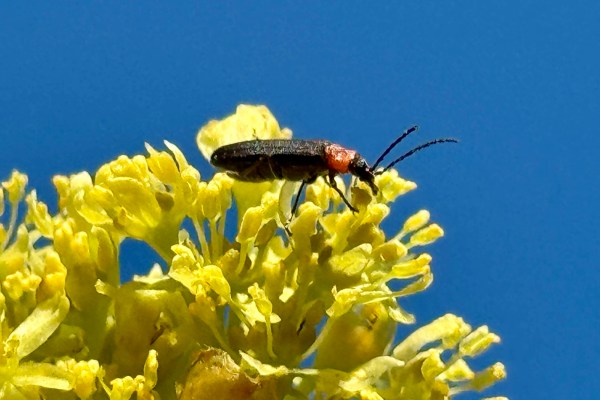
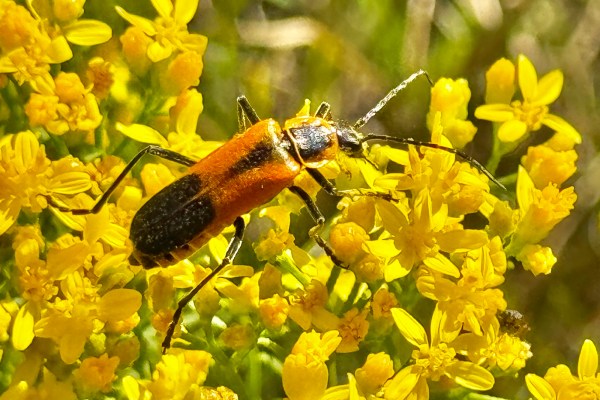
Ever the entomologist, I couldn’t help examining some of the flowers more closely in search of insects, eventually finding the aptly-named Ischnomera ruficollis (red-necked false blister beetle—family Oedemeridae), a frequent visitor to a variety of flowers.
Photo 3. Ischnomera ruficollis (red-necked false blister beetle) on flowers of Sassafras albidum (sassafras). Photo by Ted MacRae.
The patch of American plum along the two-track that I have seen blooming profusely in years past and had hope to photograph was, disappointingly, well past bloom. However, a fine specimen that I take to be Mexican plum was found blooming profusely along a fence line nearer to the beginning of the two-track. Mexican and American plums can be difficult to distinguish, but the former usually grows as anindividual tree while the latter tends to form clonal thickets with multiple stems arising from a single parental plant.
Prunus mexicana (Mexican plum). Photo by Ted MacRae.
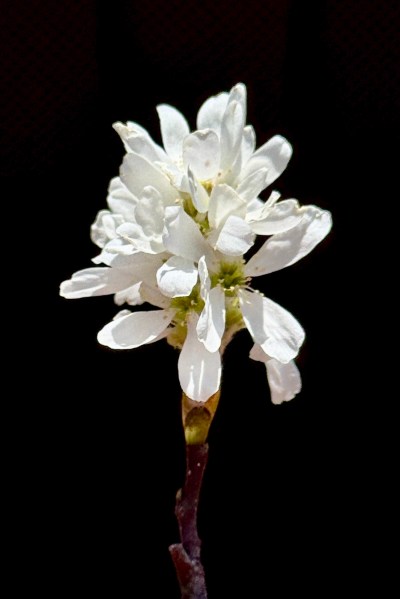
Serviceberry also should have been in bloom across the upland understory but was limited instead to just a few scattered trees still bearing flowers. One fine specimen, however, was found near the patch of American plum that was covered in near-perfect blossoms that simply begged to be photographed.
Amelanchier arborea (common serviceberry). Photo by Ted MacRae.
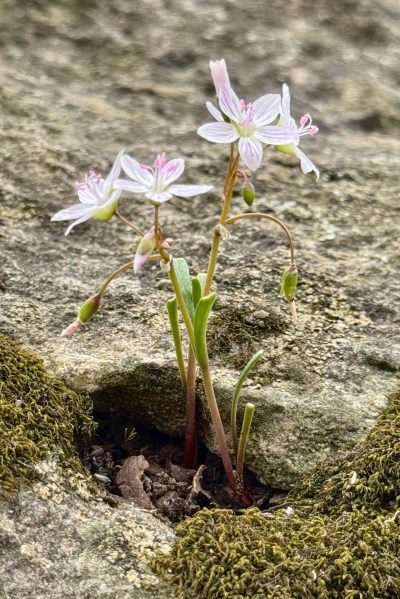
Veering into upland forests to approach the descent down into the valley, we saw some of the usual spring ephemerals and other plants that, despite not generally considered ephemerals, were nonetheless blooming quite early. Like the early-flowering trees, the spring ephemerals were impacted by the unusually warm March temperatures, with many of the species blooming far earlier than normal and now already fading despite the still-within-March date. Claytonia virginica (spring beauty—family Montiaceae, formerly Portulacaceae) is perhaps the best known ephemeral and, despite its commonness, is always a treat to see popping up in the woodlands after a long winter. The corolla color of this species is quite variable, with some being nearly white with barely perceptible venation, ranging to specimens with highly pronounced, vivid, pink venation.
Claytonia virginica (spring beauty). Photo by Ted MacRae.
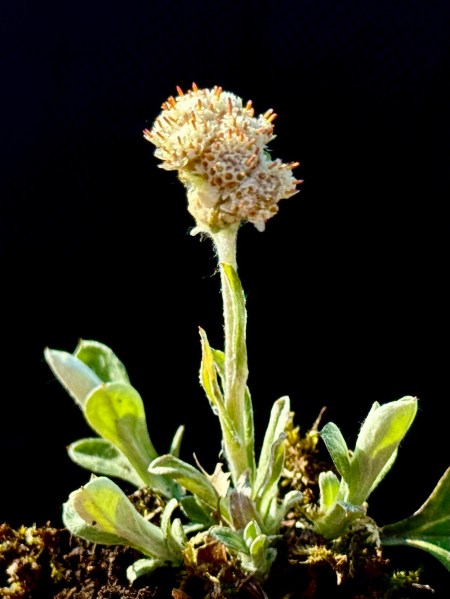
Antennaria parlinii (Parlin’s pussytoes—family Asteraceae), normally an April/May bloomer, also was in flower in the relatively dry, rocky forests before the descent into the valley. Missouri populations of this species were previously known as A. plantaginifolia, means “leaves of Plantain” and indeed the basal leaves do look like those of the genus Plantago—a character that distinguishes them from the single-veined leaves of Missouri’s only other species in the genus, A. neglecta (field pussytoes).
Antennaria parlinii (Parlin’s pussytoes). Photo by Ted MacRae.
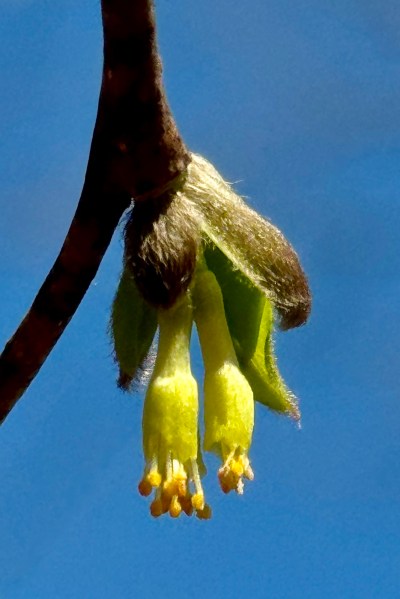
The descent into the valley is rather steep and precarious, especially for those of us who are “getting long in tooth” and needed to pick our way slowly down the rocky trail. The effort, however, was worth it as even before reaching the valley we began seeing leatherwood trees in bloom in the increasingly moist woodlands approaching the valley. The plants were, if anything, slightly past peak bloom, but not to the point that it made it difficult to find fresh examples of the instantly-recognizable flowers in clusters of 2–4 accompanying newly emerging leaves. More unusual than conspicuous with its small pendulous flowers surrounded by rusty woolly bracts, the species is distinguished from its even rarer congener, D. decipiens (upland leatherwood) by the small but discernible stalks and moist rather than upland habitat.
Dirca palustris (eastern leatherwood). Photo by Ted MacRae.
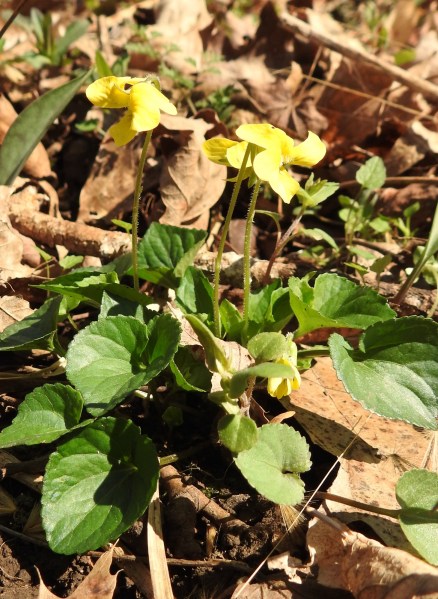
Several other botanical treasures awaited the group in the moist forests along Little Lost Creek besides leatherwood. One of these was very early blooming examples of Viola eriocarpa (smooth yellow violet—family Violaceae). This denizen of moist forests is often considered a smooth-leaved variety of V. pubescens (yellow violet) or even a synonym, and indeed the degree of “pubescentness” can be variable, making it sometimes difficult to distinguish a given plant.
Viola eriocarpa (smooth yellow violet). Photo by Kathy Bildner.
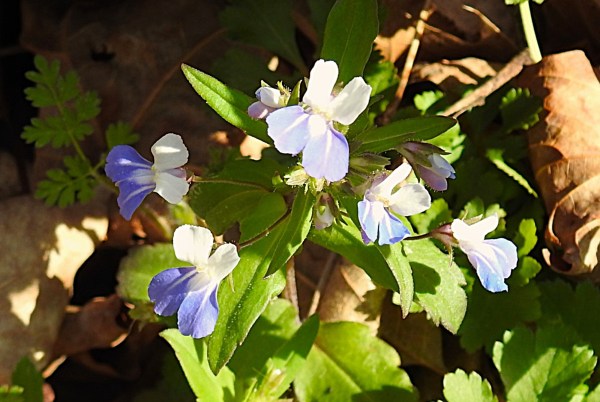
Another deep, moist, rich woods resident the group saw was the always-charming-to-see Collinsia verna (spring blue-eyed Mary—family Plantaginaceae). Unusually, this bona fide spring ephemeral is one of the few Missouri wildflowers that is truly “blue.” Equally unusual, its distribution is mainly in the Upper Midwest but in Missouri is apparently concentrated across the middle latitudes of the state.
Collinsia verna (spring blue-eyed Mary). Photo by Kathy Bildner.
[Warning: entomological geekery ahead!]
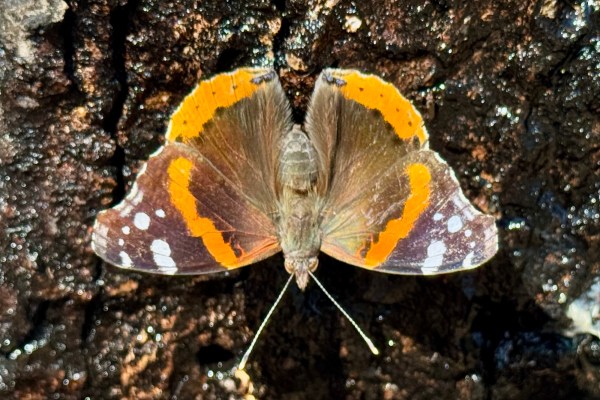
I, myself, missed these botanical finds due to my discovery immediately upon reaching the valley of a large oak tree with a dark, wet stain of flowing sap on its trunk that was hosting a variety of insects (remember; it is still March here—not normally a time to observe insects). Numerous muscoid flies, expectedly, congregated at the flow and lapped up the sap, as did a couple of brightly colored Vanessa atalanta (red admiral butterfly—family Nymphalidae). These fast-flying butterflies overwinter as adults and, thus, were ready to take advantage of the sudden warming spell. They also could have been difficult to photograph had their sweet tooth not enticed them to pose nicely on the dark, sap-saturated bark.
Vanessa atalanta (red admiral butterfly). Photo by Ted MacRae.
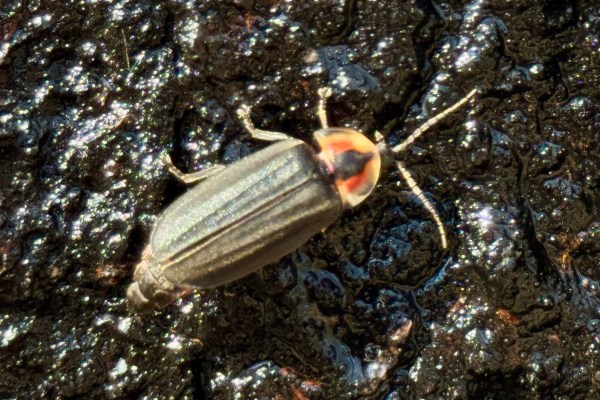
A closer look at the many insects congregating on the flow revealed the presence of two fireflies that proved to be Ellychnia corrusca (known as Photinus corruscus in some sources, e.g. iNaturalist) (winter firefly—family Lampyridae). Honestly, I didn’t recall ever having seen fireflies feeding on a sap flow, or for that matter any that were active in March—muggy summer nights are what I picture when I think of fireflies! The common name of this species, however, alludes to the fact that it can often be seen during warm days in winter, especially on tree trunks. Moreover, not only do adults become active in late winter, they mate at that time as well. The fact that these individuals were seen feeding on a sap flow is also unsurprising given that the species has been reported as a pest of sap buckets in the spring. There was one more surprise, however—as I was photographing the beetles, I noticed their all-dark abdomens, suggested they lack light-producing organs. This is surprisingly common among several groups of fireflies which have given up a crepuscular (i.e. active during dusk and/or dawn), luminescent lifestyle in favor of a diurnal (i.e., day active), non-luminescent existence. (We know that non- luminescent firefly species evolved from luminescent species—i.e., they used to be able to produce light and then lost the ability—rather than representing a lineage that evolved before other fireflies gained luminescent capabilities because their larvae do still posses light-producing organs.) Why did they do this? One possibility is the appearance of “femme fatale fireflies”—i.e., females of the genus Photuris that can that mimic the flash patterns of females in the genus Photinus to attract and eat Photinus males!
Ellychnia corrusca (winter firefly). Photo by Ted MacRae.
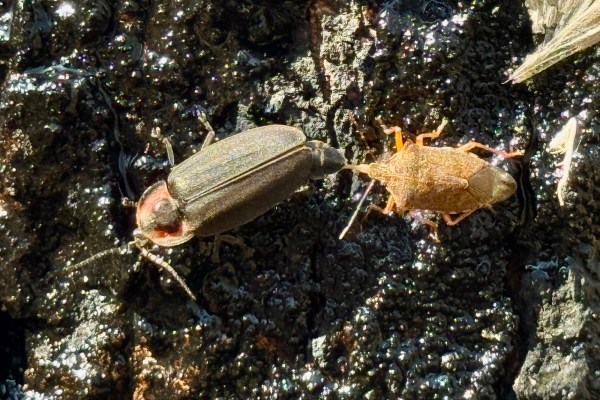
Non-luminescence as an antipredation strategy may be a good solution for femme fatales, but leading a diurnal existence still does not eliminate the risk of predation by other insects! One of the fireflies we saw on the sap flow had been attacked by a stink bug (family Pentatomidae) that came to the sap flow not for the sugary substance, but to prey on the other insects that it had attracted. For those of you who are asking “Aren’t stink bugs plant feeders?”, the answer is… mostly! While the majority of species use their piercing/sucking mouthparts to feed on developing seeds and fruits, there is one group of stinkbugs (the subfamily Asopinae) that has adapted its style of feeding to sucking the juices out of other insects rather than plants. This particular stinkbug was identified as Podisus maculiventris (spined soldier bug), and no amount of struggling by the firefly could release it from the stink bug, whose mouthparts had firmly impaled the firefly. Despite being predators, asopine stink bugs still lack chewing mouthparts and can only ingest liquid substances. This might be fine for sucking a juicy seed, but it falls short when trying to ingest another insect… unless it can digest the insect before it consumes it! This is called pre- or extra-oral digestion, whereby the stink bug injects its digestive enzyme-laden saliva into the prey and allows the enzymes to slowly liquify its innards. Once digested, the stink bug can then suck up thenutritious slurry, leaving only the shriveled external carcass of its hapless prey. Another such stink bug was seen elsewhere in the forest, this one preying on a fat, juicy caterpillar.
Podisus maculiventris (spined soldier bug) preying on Ellychnia corrusca (winter firefly). Photo by Ted MacRae.
For lunch, a smaller than usual crowd enjoyed authentic comida mexicana at Casa Tequila Cantina in nearby Warrenton.
Participants: Brenda Adams, Gisela Baner, Prem Barton, Renee Benage, Kathy Bildner, Tina Cheung, Wayne Clark, Sally Fabbri, June Jeffries, Shari Langer, Michael Laschober, Ted MacRae, Len Meier, Burt Noll, John Oliver, David Steinmeyer, Kathy Thiele, Elaine Wolshock, Matthew Wolshock, Richard Wolshock, and Laura Yates.
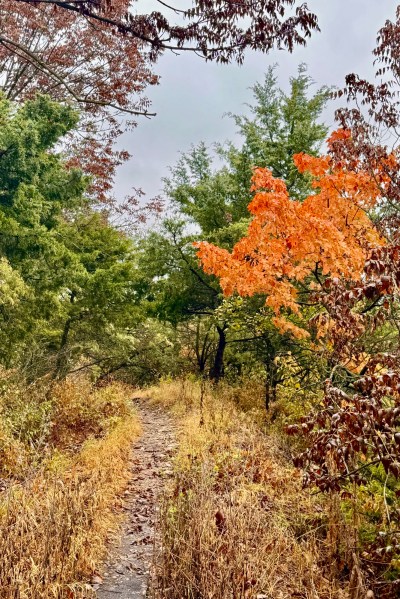
After several weeks of traveling to the outer reaches of the St. Louis area, the WGNSS Botany Group pinned their hopes on seeing good fall colors closer to home at Rockwoods Reservation in Wildwood. Despite its proximity to St. Louis, Rockwoods offers visitors a taste of the Ozarks with its mix of dry, rocky ridges, cool, moist ravines, and forested slopes featuring a variety of woodland types depending on substrate and exposure. Several trails are on offer, but the group chose the Rock Quarry Trail as the most likely to provide a diversity of plants and color.
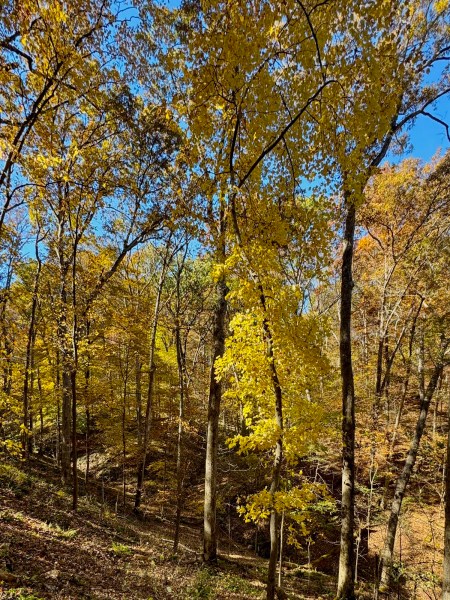
Hard maples ablaze!
A large (seemingly misplaced) Taxodium distichum (bald cypress) tree right at the trail entrance captured our attention, and numerous globular cones, still green at this point in the season could be seen within its crown. Bald cypress trees are often attacked by a small fly called the cypress twig gall midge (Taxodiomyia cupressiananassa—family Cecidomyiidae) which produces globular galls on the twigs that can be mistaken for immature cones, but despite thorough searching none were found.
As we started up the rocky trail, John noticed several freshly fallen leaves on the ground under a large(ish) tree and picked one up for the day’s first “pop quiz.” Morus (mulberry) or Tilia (linden or basswood), two unrelated trees that bear similar-looking leaves, were the early guesses, but which? The shape of the leaf base—usually symmetrical in the former and asymmetrical in the latter—can be useful but is not consistent. A better way is to break the leaf petiole to check the color of the sap that exudes—milky in the former and clear in the latter. In this case, it was milky, identifying the tree as Morus rubra (red mulberry).
Our late summer and early fall this year was unusually dry with almost no rain from the beginning of August until near the end of October. This year’s fall floral display has suffered as a result, with many of the plants we are seeing in flower now looking rather pitiful compared to if they had grown under more favorable conditions. The recent rains may not have been enough to “save” the season, but the landscape has “perked up” a bit in their wake. By early November, Solidago (goldenrods) and Symphyotrichum (true asters) make up the bulk of the anticipated plants in flower, and we were fortunate to see blooms of several species in these two genera. These included not only some species that we have seen in the past weeks, such as Solidago ulmifolia (elm-leaved goldenrod), Symphyotrichum anomalum (many-rayed aster), Symphyotrichum patens (spreading aster), and Symphyotrichum lateriflorum (calico aster), but also a few that we have not.
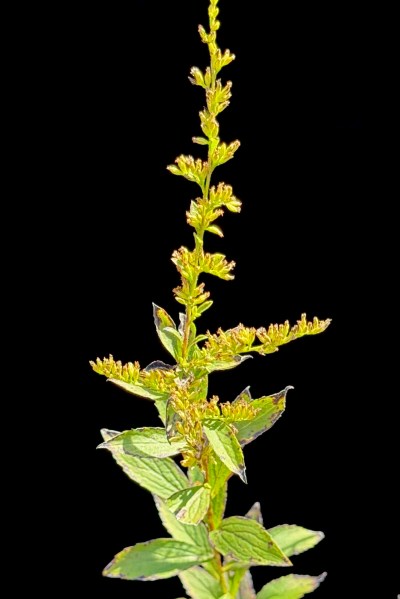
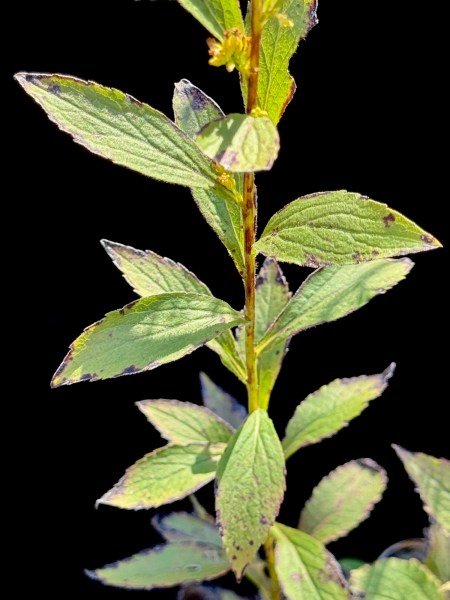
The bulk of these were located in or near a small “glade” on a southwest-facing not far from the trail entrance. The patch of xeric habitat is not a true glade, but rather a scar of past quarrying activity on the southwest-facing limestone slope that has resulted in a glade-like habitat. It was here that a few patches of Solidago rugosa (rough-leaved or wrinkle-leaved goldenrod) were found. This species is similar to S. ulmifolia but usually has multiple stems and sessile leaves with the margins not as coarsely toothed and the veins more deeply impressed, giving the leaf a rugose appearance (on which the species name is based).
Solidago rugosa (wrinkleleaf or rough-stemmed goldenrod—family Asteraceae) inflorescence.
Solidago rugosa (wrinkleleaf or rough-stemmed goldenrod—family Asteraceae) leaves.
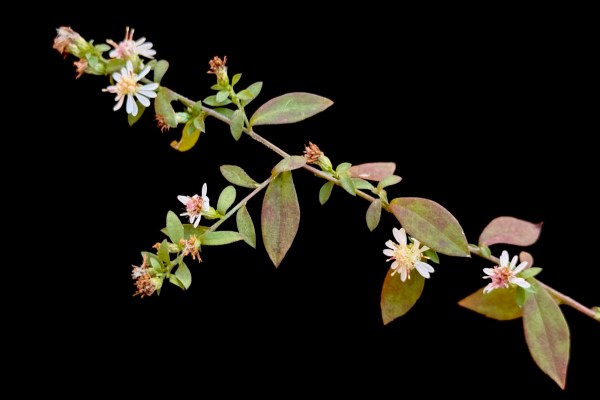
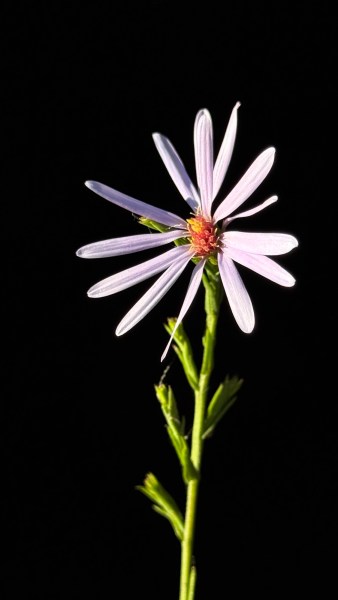
We have seen Symphyotrichum oblongifolium (aromatic aster) in true glades the past few weeks (at Victoria Glades and Fults Hill Prairie), and we saw it blooming in this “pseudo glade” as well. Amongst the several plants of this species, however, was a single blue-flowered aster that did not exhibit the same profusely branched and many-leaved growth. This turned out to be the slightly more conservative (CC = 7) Symphyotrichum laeve (smooth blue aster), identifiable by its smooth, completely hairless, narrowly elongate leaves that clasp the stem at the base.
Symphyotrichum laeve (smooth blue aster—family Asteraceae) flower.
Symphyotrichum laeve (smooth blue aster—family Asteraceae) stem and leaves.
Just beyond the glade and reentering the dry woodland, a single white-flowered aster was seen and determined to represent Symphyotrichum urophyllum (arrowleaf aster) based on its leaves—heart-shaped at the base and gradually becoming more arrowhead-shaped and sessile to nearly sessile further up the stem—and dense, cylindrical cluster of white flowers at the top of the plant.
Symphyotrichum urophyllum (arrowleaf aster—family Asteraceae) stem and leaf.
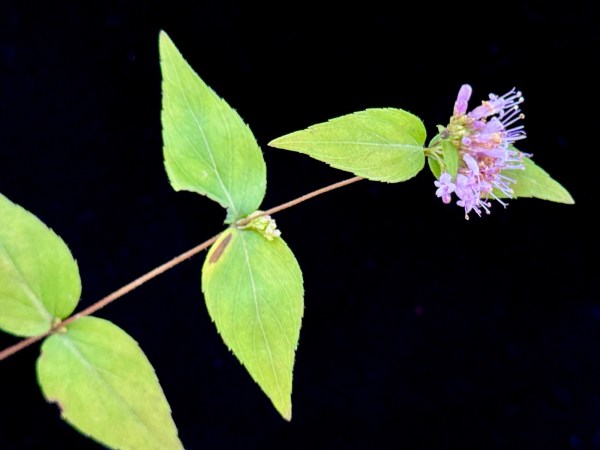
Moving further along the trail, the substrate transitioned from limestone to chert, which was accompanied by the appearance of more acid-loving lichens, mosses, and plants such as Vaccineum pallidum (lowbush blueberry) and Cunila origanoides (American dittany), a few plants of the latter still exhibiting blooms in good shape. The finely divided leaves of Viola pedata (bird’s foot violet), a characteristic occupant of upland forest openings having dry, cherty soils, were common along the steep trailside bank in this area.
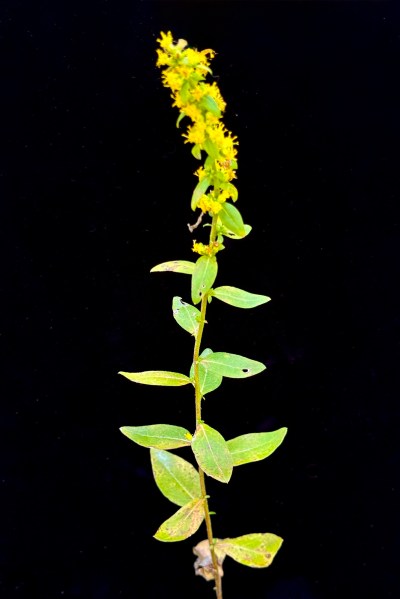
Further up the trail along the ridgetop, we saw a single plant representing yet another acidophile and first sighting for the season—Solidago hispida (hairy goldenrod). This species can be recognized by its single stem, erect, narrow cluster of yellow flowers at the top of the plant, distinctly hairy leaves and stems (especially at the base), and larger basal leaves. It typically inhabits dry, open, and rocky woodlands, especially those with acidic substrates.
Solidago hispida (hairy goldenrod—family Asteraceae) upper stem leaves and inflorescence.
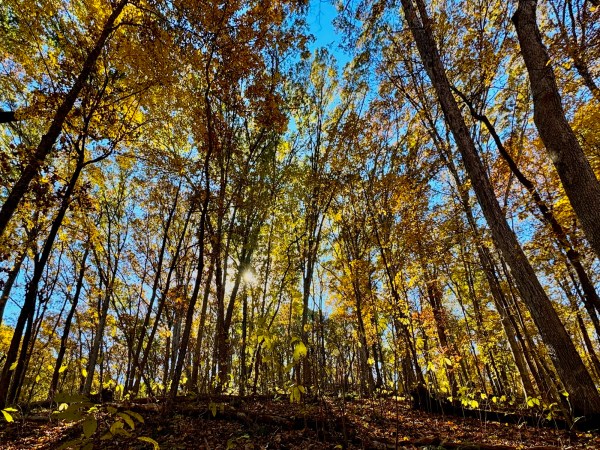
A long gentle descent off the ridge top took the group gradually down into a deep ravine with a tall, dense canopy that contrasted distinctly with the dry, rocky, more open forests seen to that point. Muted browns and yellows of oaks and hickories gave way to vibrant golds, oranges, and reds of hard maples. Polystichum acrostichoides (Christmas fern) was abundant on the north-facing slopes, the darkened tips of their fertile fronds conspicuous against the much more green rest of the plant, and two other fern species were noticed as well: Adiantum pedatum (northern maidenhair fern), a deciduous species with its fronds just starting to senesce, and Asplenium rhizophyllum (walking fern), an evergreen species that spreads vegetatively (“walks”) by rooting to form new plantlets whenever the tips of its long, undivided leaves touch moist substrate. Lindera benzoin (spicebush) was also abundant in the more mesic habitat now being traversed, their just-formed flower buds now sufficiently developed to distinguish male (larger buds) from female (smaller flower buds) plants at a glance.
Backlit leaves of Asimina triloba (pawpaw) under a canopy of blazing yellow Acer saccharum (sugar maple).
The trail ends up the road a ways from its start, requiring a short roadside walk to return to the parking lot. Despite the presence of asphalt, the group remained on the lookout for plants of interest in the now riparian forest corridor paralleling the road. A fourth goldenrod—Solidago altissima (tall goldenrod)—was seen (its identity confirmed by rubbing its leaves with the fingers to feel its roughness), but the biggest attention getter was a spectacularly large Ilex decidua (deciduous holly or possumhaw) bearing a profusion of bright orange-red berries.
After visiting Salt Lick Point Land & Water Preserve a few weeks ago, the WGNSS Botany Group continued its exploration of the Mississippi River bluffs in southern Illinois by visiting Fults Hill Prairie, a 532-acre preserve 13 miles south of Salt Lick Point. In addition to upland forests and glades, Fults Hill Prairie features the largest complex of high-quality loess hill prairie still existing in the state. This diversity of habitats correlates with a rich diversity of plants, which at this time of year is exemplified by the classic fall genera Solidago (goldenrods) and Symphyotrichum (true asters). While late October is a bit past peak bloom and the persistent precipitation that only began a few days earlier after an extraordinarily dry previous three months further dampened expectations, a decent-sized group of intrepid explorers nevertheless defied the forecast, steep wooden stairway, and slippery final ascent (along with the subsequent descent) to explore the area’s diversity and admire its bluff-top views.
View of the Mississippi River valley from Fults Hill Prairie Nature Preserve.
Some of the same goldenrods and asters that the group saw a few weeks ago at Salt Lick Point were again seen during the initial ascent. Among the more conservative of these were Solidago buckleyi (Buckley’s goldenrod), Solidago drummondii (cliff goldenrod), and Symphyotrichum anomalum (many-rayed aster). Less conservative (i.e., more commonly encountered) counterparts also were seen such as Solidago ulmifolia (elm-leaved goldenrod) and Symphyotrichum patens (spreading aster). In all cases, the plants exhibited precious few pitiful flowers due to the combination of late season and the drought-compromised display, but this didn’t prevent the group from practicing their identification skills based on non-floral characters.
Ascending the steep rocky slopes, the canopy was dominated by Quercus muhlenbergii (chinquapin oak)—an indicator of the thin, rocky soils underfoot. As the group continued to ascend, Quercus alba (white oak) also began to appear and eventually replaced Q. muhlenbergii as the dominant oak, signaling the presence of deeper deposits of the wind-blown loess soils that characterize the hilltops. Further up, on the south- and west-facing slopes at the top, such soils are unable to hold sufficient moisture to support the growth of trees. As a result, despite the presence of deep soils, the forest gives way to the first of two large hilltop prairie remnants featured in the preserve. A lone, Quercus stellata (post oak) stood sentry atop the prairie, adding to the diversity of oaks seen and framing a gorgeous view from the prairie across the valley below.
A lone Quercus stellata (post oak—family Fagaceae) stands sentry atop a loess hill prairie.
Entering the woodlands along a remnant 2-track belying the past presence of a farm, the group encountered a third species of blue-flowered aster whose cordate, scabrous leaves, pubescent stems, and distinctly winged leaf petioles identified it as Symphyotrichum drummondii (Drummond’s aster). This and another more commonly encountered aster, Symphyotrichum lateriflorum (calico aster), were found scattered along the sides of the 2-track until the group began its descent down into the second large loess prairie remnant.
Symphyotrichum drummondii (Drummond’s aster—family Asteraceae) leaf and petiole.
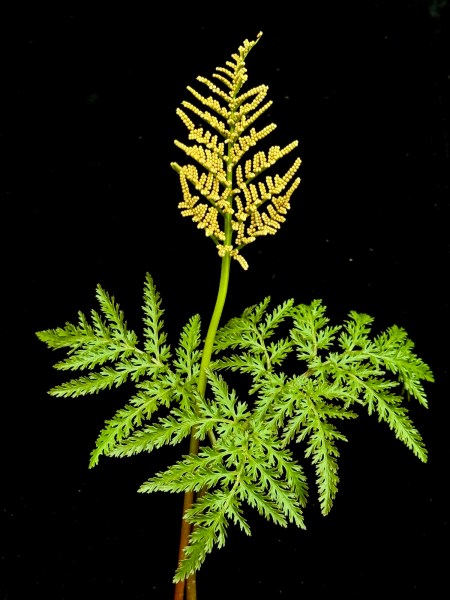
Also along the 2-track, but only in one small area, the group observed Sceptridium dissectum (cut-leaf grape fern, formerly Botrychium dissectum) in “flower” with mature fertile fronds. The finely divided leaves identified the plants as var. dissectum, which is a bit less common than var. obliquum.
Sceptridium dissectum var. dissectum (cutleaf grapefern—family Ophioglossaceae).
The diversity of oaks seen increased as the group traversed the forests along the 2-track, with Quercus velutina (black oak) becoming co-dominant with Q. alba. Numerous freshly-fallen twigs littered the 2-track due to the recent rains, and the shapes of some of the leaves seemed to suggest they might be from the more southerly Quercus falcata (southern red oak); however, careful examination of their lobes along with newly-formed buds and fully-developed acorns confirmed them, nevertheless, to be Q. velutina.
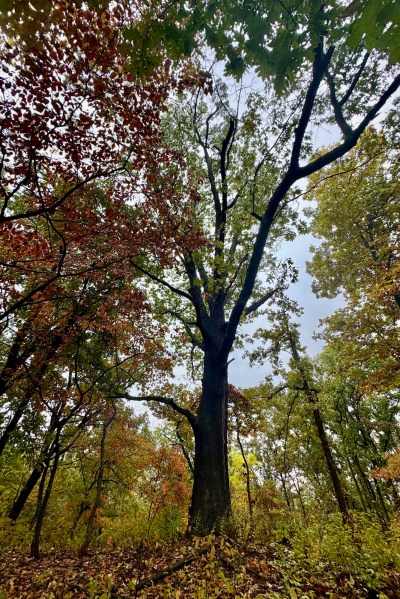
Still, the diversity observed oaks increased to five species when we began encountering Quercus shumardii (Shumard’s oak), including one particularly grand old tree whose spreading main branches and broadly-formed crown whispered stories about the more open conditions that must have occurred around it during its youth.
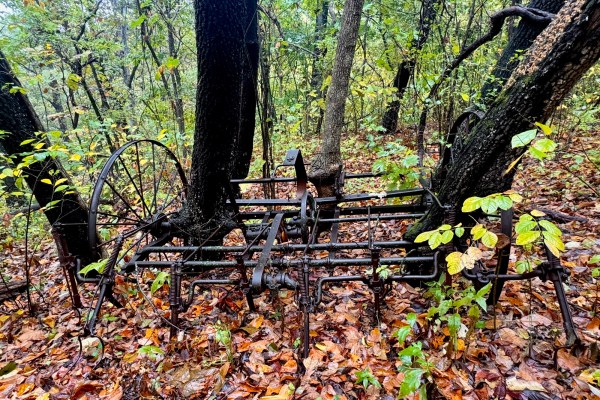
Nearby, a rusty farm implement, actively being engulfed by trees that sprouted after the last time it saw any movement, further attested to the area’s long-forgotten days as a farm.
Old farm implement taken over by trees.
The diversity of goldenrods seen also continued to tick upwards along the 2-track as we encountered what was either Solidago atltissima (tall goldenrod) or Solidago canadensis (Canadian goldenrod). These two species are difficult to distinguish, especially when the foliage is wet since leaf pubescence is a key distinguishing characteristic, but the upland habitat initially suggested the latter since S. altissima prefers more mesic habitats. A number of other more mesic-preferring plant species were also noticed in the area, however, perhaps a result of the underlying deep loess soils, so a final determination was not made. It was upon the final approach towards and down onto the second main loess prairie remnant, however, that the diversity of goldenrods and asters really began to skyrocket. Near the edge of the prairie but still in the forest, we saw Symphyotrichum oolentangiense (pronounced oh-OH-len-tang-ee-IN-say) (azure aster)—easily identifiable by its blue flowers and long, narrow, arrowhead-shaped lower leaves that are rough and sandpapery to the touch. At the prairie edge Symphyotrichum turbinellum (prairie aster), identifiable by its many-branched growth habit, elliptic leaves with tapered bases, and long vase-shaped involucres, began to appear. Symphyotrichum sericea (silky aster) further padded the diversity totals, a small patch of plants with their distinctive silvery leaves occupying the farthest (and possibly driest) extent of the loess prairie ridge before it began dropping precipitously towards the towering limestone blufftop.
Kathy, Michael, and John examine plants in a loess hill prairie.
The most dazzling addition to the diversity, however, was Solidago rigidiuscula (stiff-leaved showy goldenrod). Until recently considered to be a variety of Solidago speciosa (showy goldenrod), the large showy inflorescences of this species are every bit as attractive as the latter, but the plants feature narrower leaves, and while the flowers had largely faded by this late date, the lower foliage turning brilliant red provided stunning contrast with the still-green upper leaves and more muted colors of the surrounding vegetation.
The group then began its long, slow, careful descent off the prairie and through the lower woodlands back to the parking lot. Separating the two, however, is a limestone glade that features a slightly different flora of prairie-associated species than the hilltop prairie due to its thin, rocky versus deep loess soils, and it was in these glades where the group saw the day’s ninth and final species of aster—Symphyotrichum oblongifolium (aromatic aster), distinctive by its branched growth with numerous small leaves amongst normal-sized leaves (and if there is still any doubt, a quick crush-and-smell of the latter reveals its highly aromatic nature). A sixth and final goldenrod also was seen on the rocky slopes just below the glade—Solidago radula (rough goldenrod), its short, clump-like stature and densely numerous, heavily scabrous, serrate leaves confirming its identity.
As the lone entomologist in the group, I had been keeping my eye out for any insect activity—particularly Oncideres cingulata (twig girdler), a longhorned beetle (family Cerambycidae) that appears only during fall and “girdles” twigs of hickory and certain other trees before laying eggs in them. Numerous such twigs were seen, and I picked up several in hopes of finding females still upon them—unfortunately, to no avail. In fact, but a single insect was seen all day, and even it was not until I had returned to the parking lot—a nymph of the distinctively green Zelus luridus (pale green assassin bug).
Zelus luridus (pale green assassin bug—family Reduviidae) nymph.
L-R: Ted “BugMan” MacRae, Pete Kozich, David Seidensticker, “Ozark Bill” Duncan, Lisa Meihls, Chris Brown.
The Webster Groves Nature Study Society (WGNSS) Entomology Group began its final outing of the 2025 field season when eight participants (Chris Brown, Nathalie de Rocquigny, “Ozark Bill” Duncan, Jack Hambene, Pete Kozich, Ted “BugMan” MacRae, Lisa Meihls, and David Seidensticker) met up in the parking lot at Hughes Mountain Natural Area. Tucked into the southeastern corner of Washington Co., this gem of a natural area features 1.5 billion year old Precambrian outcrops that are among the oldest continuously exposed rocks in North America. Once molten as a result of volcanic activity associated with the St. Francois Mountains, the now hardened and weather-resistant rhyolite that formed after it cooled lies still exposed at the summit and surrounding areas. To the geologist, the polygonal columnar pattern of cracking at the summit—resulting in a unique formation called the “Devil’s Honeycomb”—might be the area’s most interesting feature. To the botanist, the xeric grasslands that formed on the surrounding exposures—i .e., “igneous glades”—might instead take this honor. To the entomologist, however, the unique fauna of insects associated with this interesting natural community earns top billing.
Rhyolite glade at Hughes Mountain Natural Area.
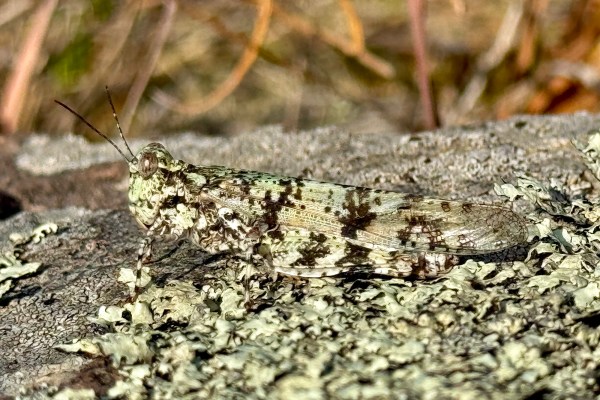
On two previous visits, the group has been fortunate to see one of Missouri’s rarest and most beautiful longhorned beetles—Tragidion coquus. Velvety black with vivid orange elytra, this charismatic species is usually seen during fall, and we hoped to be fortunate enough to see it again. Two species of fall tiger beetles—Cicindela limbalis (claybank tiger beetle) and Cicindela splendida (splendid tiger beetle), both colored iridescent green and brick red—were additional possibilities. A clear consensus quickly became apparent, however, when most participants voiced a desire to see Trimerotropis saxatilis—the famously and colorfully cryptic lichen grasshopper! It didn’t take long to see the first ones as soon as we began reaching the swathes of exposed rhyolite with their coverings of green and black lichens. Sitting motionless on the lichen-encrusted rocks, the grasshoppers were almost impossible to see, so perfectly colored and patterned was their camouflage.
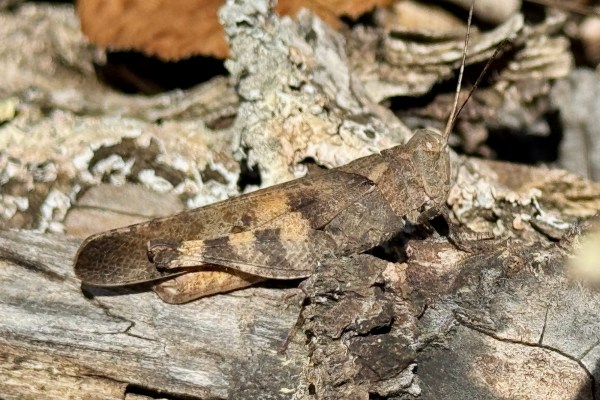
The abundance of lichen grasshoppers on the glades was somewhat expected, but what was not was the diversity of other grasshoppers also present at the margins of the glades and in the surrounding dry woodlands. Four such species were documented, including Hippiscus ocelete (wrinkled grasshopper), Melanoplus ponderosus (ponderous spur-throat grasshopper), Melanoplus rusticus (obovate-winged grasshopper), and Spharagemon bolli (Boll’s grasshopper)—all possessing their own forms of cryptic coloration that made relocating them after they jumped difficult.
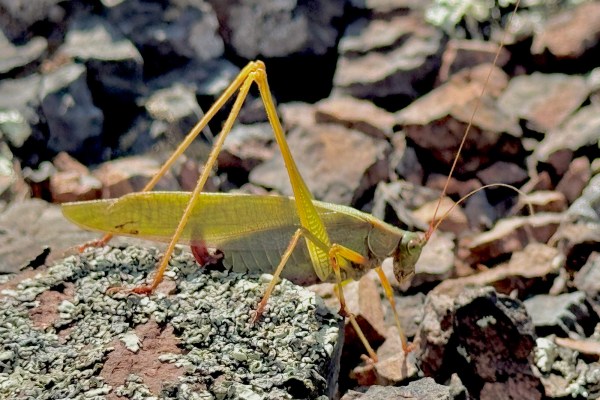
Two non-grasshopper orthopterans as well were found—several Scudderia furcata (fork-tailed bush katydid), ranging from green to tan to almost pinkish(!), were seen in the glades and woodlands, and an unusually cooperative Ceuthophilus sp. cave cricket (family Rhaphidophoridae) was also seen.
Scudderia furcata (fork-tailed bush katydid—family Tettigoniidae).
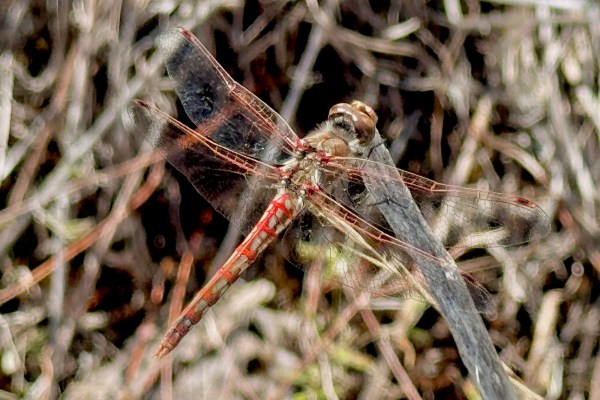
The group fanned out across the glades as they worked their way up towards the summit. Of special interest were flowers that might host pollinating insects (and possibly even T. coquus). Few flowers would be found, however—a consequence of abnormally dry conditions since late July, and we found ourselves looking for other targets. Ted managed to photograph a beautiful red-marked variegated meadowhawk dragonfly (Sympetrum corruptum), while David “captured” (through the viewfinder) a male black swallowtail butterfly (Papilio polyxenes).
Eventually the group reached the summit, where the “Devil’s Honeycomb” and a spectacular vista awaited us. An unexpected feature at the summit was white splotches on the tops of many of the projecting columns of rock, which the group surmised to indicate use of the summit as a roosting site by turkey vultures.
“Devil’s Honeycomb” at summit of Hughes Mountain.
The group lingered to take in the crisp air, blue skies, and spectacular view created by 1200’ of elevation before turning back to begin the descent back down the mountain.
Buford Mountain (2nd highest point in Missouri) in the distance.
Descending the mountain, however, did not mean an end of things to see. Even before getting off the summit, Lisa noticed Chelinidea vittiger (cactus leaffooted bug) on pads of Opuntia cespitosa (eastern prickly pear). This species feeds and develops almost exclusively on the pads, fruits, and young growth of prickly pear cacti (Opuntia spp.), thus, its range coincides with the distribution of these cacti.
Further down the mountain, another “variegated” species was seen—this time a variegated fritillary (Euptoieta claudia) butterfly. This well-worn individual was only the third butterfly species seen on the day, the aforementioned black swallowtail and a particularly fresh common buckeye (Junonia coenia) being the other two. This one was probably making its way south to overwinter in the southern U.S., where the species is a year-round resident.
Along the way, the lichen grasshoppers continued to attract our attention due to their abundance and striking diversity of coloration. We were treated to a particularly obvious example of this when we encountered a mating pair with the much smaller male exhibiting shades of brown instead of the greens exhibited by the much larger female.
It had been a leisurely descent off the main glade, and once clearing the woodland to emerge into the last glade fragments before the final descent, Chris and Ted were further delayed by a trio of observations in rapid succession. A large, impressively marked Neoscona crucifera (spotted orbweaver) spider hunkered down on a twig first caught Chris’ attention. Photographing it turned into an adventure when an effort to manipulate the twig on which it was resting ended up alarming the spider and causing it to drop down to the ground. They returned the spider to the twig using other twigs and leaves, but invariably it dropped again. Eventually, they learned they could “reel” the spider back up to the twig by its silk line if they acted quickly enough, and with repeated efforts both succeeded in getting photographs of the spider back up on the twig.
While this was going on, the unmistakable droning buzz of Milesia virginiensis (yellowjacket hover fly or Virginia flower fly) caught their attention. The resemblance of the adults of this species to wasps is remarkable, and they are often seen hovering in midair, making erratic shifting movements, and then suddenly flying away. This particular fly, however, cooperated by landing on a rock (briefly) and allowing a few photographs before it abruptly departed.
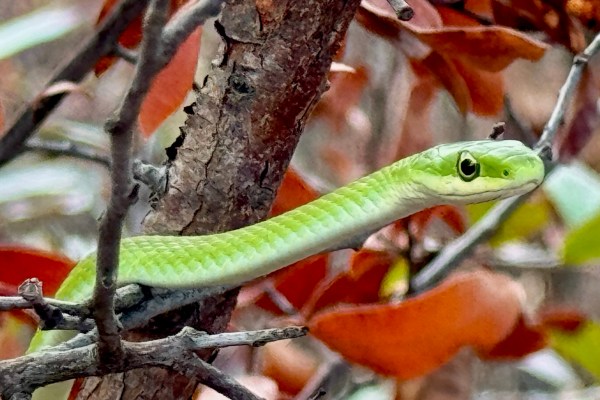
Spider and fly photographs in hand, Ted and Chris resumed their descent but took only a few steps before another sighting demanded photographs—a rough green tree snake (Opheodrys aestivus) peering quizzically from amongst the rust-red leaves of a stunted blackjack oak. The snake cooperated at first, allowing a few closeup photographs before making a run for it. Fortunately, this is a very docile species that rarely (if ever) bites when handled, so Chris and Ted were able to corral it for additional photos before returning it back to the tree from whence it came.
Opheodrys aestivus (rough green snake—family Colubridae).
At last, they were able to complete the descent and join the rest of the group in the parking lot, but not before making one last interesting find—the bizarrely beautiful caterpillar of Isa textula (crown slug moth). Like many members of the family Limacodidae (slug moths), the pale green, flattened caterpillars bear stinging spines/-in this case on lobes that radiate out from around the edge of the body. The caterpillar was found on the ground (it is probably mature and was looking for a protected place to spin a cocoon in which to spend the winter) and coaxed onto a leaf to bring it to the parking lot so everyone could have a chance to photograph it (it looked particularly stunning when set on a bright red sumac leaf).
6 Oct 2025—Fall continues to advance in the St. Louis area, and despite very dry conditions during the past two months the fall bloomers continue to make their appearance. One of the area’s most reliable and interesting places to see fall blooms is Victoria Glades south of Hillsboro, where orchids, gentians, and asters anchor a unique suite of fall-blooming plants that are rarely seen elsewhere in our mostly forested environs.
The group chose the Nature Conservancy portion of the complex to explore, as it was in the mesic forest along the riparian corridor below the glade on this side that the first of two orchids—the charmingly diminutive and seldom-seen Spiranthes ovalis (lesser ladies’ tresses)—was expected to be seen in bloom. Despite having recently taken GPS coordinates for the plants, it took several minutes of the group scouring the area around the coordinates before the tiny plants were finally found. Its delicate blooms, fall flowering season, small size, presence of basal and cauline leaves at anthesis, and preference for mesic habitats all serve to identify this species. Missouri’s populations are considered var. erostella, which lack certain essential flowering organs and are, thus, self-pollinated (cleistogamous).
Spiranthes ovalis var. erostellata (lesser ladies’ tresses—family Orchidaceae).
Clambering up and out of the creek bed and onto the open glade, the group found, again with some difficulty, the second orchid we were looking for—Spiranthes magnicamporum (Great Plains ladies’ tresses). Unlike S. ovalis, however, this species is much more commonly seen on dolomitic glades throughout the state, and there have been fall seasons at Victoria Glades featuring spectacular displays of it. Sadly, it does not appear that this will be one of those falls, almost surely because of the near absence of rain in recent months. The first two plants were found under and next to a cut eastern red-cedar, whose cadaver perhaps provided just enough protection to prevent a complete drying of the soil underneath and allowed the two plants to proceed to flowering. Of the nine species of Spiranthes presently known to occur in Missouri, S. magnicamporum is among the showiest due to its robust, often doubly helical inflorescences and relatively large flowers with spreading and arching lateral sepals. It is also among the most fragrant, with a sweetish fragrance of coumarin, which some people liken to vanilla.
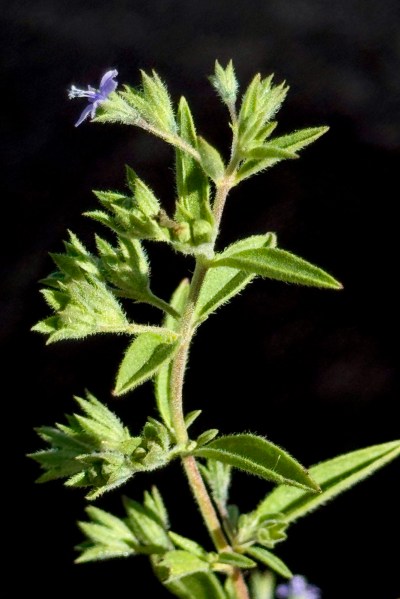
I’ve been visiting Victoria Glades for more than 40 years, yet I continue to see things I haven’t previously notified. This time it was Trichostema coeruleum (pennyroyal bluecurls), a member of the mint family (Lamiaceae). [Note: Trichostema coeruleum was known until recently as Trichostema brachiatum—now a synonym of Trichostema dichotomum.] Unlike Trichostema dichotomum (bluecurls), which prefers glades and other dry habitats with acidic substrates (e.g., sandstone), T. coeruleum prefers such habitats with calcareous substrates (e.g., dolomite). A third species of the genus, Trichostema setaceum (narrow-leaf bluecurls), also occurs in Missouri but is restricted to sand prairies in extreme southeastern Missouri.
Dolomite glades are also the preferred habitat for many species of plants in the family Orobanchaceae, a bizarre family of mostly hemiparasitic plants that derive at least some of their nutrition not from the sun, but by tapping into the roots of nearby plants. Castilleja coccinea (scarlet paintbrush) is perhaps the best known of these, in most years joining the cacophony of wildflowers that form colorful displays across Victoria Glades during spring and early summer. There are, however, several less conspicuous but equally beautiful wildflowers in the family that are restricted in the area almost exclusively to the dolomite glades of Jefferson Co. One of these is Agalinis skinneriana (Skinner’s or pale gerardia/false foxglove), which the group found sporadically still in bloom across the open glade. There are several species of Agalinis in Missouri, some of which are quite common. However, A. skinneriana can usually be recognized by the characteristic habitat and generally upward-facing flowers with spreading to reflexed upper corolla lobes. The plants are also relatively slender and fewer-branched than the more common A. tenuifolia (common gerardia/false foxglove) and A. gattingeri (rough-stemmed gerardia/false foxglove).
Agalinis skinneriana (Skinner’s or pale gerardia/false foxglove—family Orobanchaceae).
Another plant in the family Orobanchaceae that the group saw was Buchnera americana (American bluehearts), represented by a single plant still bearing two worn blossoms. Normally blooming from June through September, plants in full bloom have no look-alikes and are not likely to be confused with anything else. Despite this, the vervain-like fruit-bearing structure of this late straggler fooled the group into at first thinking it was a species of Verbena until its true identity was realized.
Buchnera americana (American bluehearts—family Orobanchaceae).
No group of plants more iconically represents fall than goldenrods (genus Solidago) and true asters (genus Symphyotrichum), and no place allows as many uncommonly seen species to be seen together as the dolomite glades. Three species of goldenrods were seen during the day—the super common Solidago nemoralis (old field goldenrod), the less common but more showy Solidago rigida (stiff goldenrod), and the highly restricted Solidago gattingeri (Gattinger’s goldenrod) (we were not able to locate a fourth species—Solidago radula [rough goldenrod], which we have observed during previous visits on the MDC portion of Victoria Glades). It was the true asters, however, that truly tested our plant identification abilities. Relatively easier are the purple asters, of which we found three species. The first and most abundant was Symphyotrichum oblongifolium (aromatic aster), recognized by its recurved phyllaries and branched habit with narrow, linear leaves that become more numerous and smaller in the upper plant. If one is still in doubt as to its identity, however, one needs only to crush the leaves between the fingers and enjoy its distinct aroma.
Along the intermittent creek and near the interface with the dry post oak woodland on the north of the glade, we encountered a second species—Symphyotrichum oolentangiense (azure aster). Identification of this species came only near the end of the outing, as a key identifying characteristic of this species—the presence of distinctly petiolate cordate basal leaves that are rough to the touch—was not seen on any of the plants examined before then. At that point, we suspected Symphyotrichum turbinellum (prairie aster) due to the vase-shaped involucres. While that species has been found at Victoria Glades, it is usually a much more highly branched plant associated with more wooded habitats (despite the common name). Finally, we found a plant with such leaves present, albeit dried up, and then another with the leaves present and still fresh to confirm the identification.
Symphyotrichum oolentangiense (sky blue aster—family Asteraceae).
In a small area at the northernmost point of the glade, we found Symphyotrichum sericeum (silky aster). This species is immediately recognizable from afar by the silvery cast to the foliage—this, combined with its highly preferred habitat of glades or dry prairies are usually enough to identify the species, although it is said that the flowers are often more purple and less bluish than other “purple asters.”
As we walked the margins of the glade, the group kept their collective eyes out for Gentiana puberulenta (downy gentian), a striking and rarely seen fall flowering species that has been found on several occasions at Victoria Glades. The species has been seen at Victoria Glades on a few occasions in past years, and the locations of these sightings were scoured thoroughly but without success. Unexpectedly, near the end of the outing, a single plant in flower was located—its perfectly fresh blossom initially hidden from view underneath fallen leaves. One of three members of the genus Gentiana in Missouri, this species is easily differentiated by having the corolla spread open at maturity. Missouriplants.com notes “The rich, deep blue color of the corollas is a striking and uncommon hue among our flora.” A strikingly beautiful final find of the day indeed, and a perfect note on which to gather for lunch at historic Russell House in nearby Hillsboro.
For me, no botany outing is strictly about plants (just as no entomology outing is strictly about insects), so there were a few interesting insect observations on the day. On our way to look for Spiranthes ovalis (lesser ladies’ tresses), June noticed a caterpillar on the Ulmus rubra (slippery elm) that we decided must represent Halysidotus tessellaris banded tussock moth).
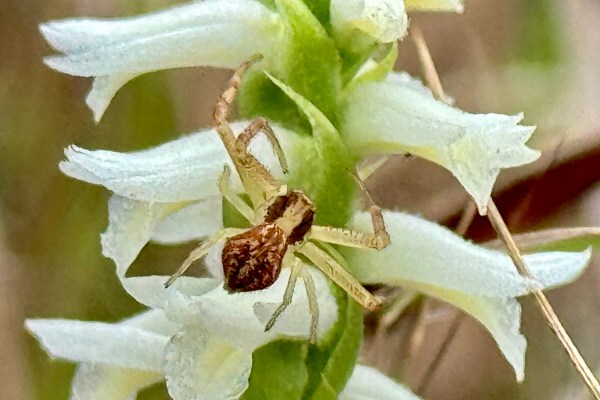
Later, after lunch with the group, I returned with the goal of more closely inspecting Physocarpus intermedius (Midwest ninebark) along the glade toeslopes and intermittent creek to see if Dicerca pugionata was out. It has been many years since I’ve seen this species in the fall (but it has also been many years since I’ve really tried to look for it during the fall). I started first with the plants along the moist toeslopes along the west side of the glade, checking several of the now very scraggly-looking plants without success. Along the way, I encountered an especially beautiful Spiranthes magnicamporum, so I paused to take photos. While doing so, I noticed a cryptically-colored crab spider on its blossoms—Mecaphesa asperata (northern crab spider)—the first time I’ve ever seen a spider hunting on the flowers of an orchid.
Mecaphesa asperata (northern crab spider—family Thomisidae) on flowers of Spiranthes magnicamporum (Great Plains ladies’ tresses).
Towards the end of the toeslopes, finally, two D. pugionata plopped onto my sheet. The plant they were on was near the far end of the toeslopes, and if I hadn’t seen any beetles by the time I reached the far end I would have given up the search. Finding them, however, motivated me to hike over to and continue looking along the intermittent creek, where I saw three more beetles in three different spots, the last one—satisfyingly—on the very last plant I checked before the creek disappears into denser woodland.
Dicerca pugionata (ninebark borer—family Buprestidae) beaten from living Physocarpus intermedius (Midwest ninebark).
Mission accomplished, I enjoyed one more leisurely stroll across the glade before calling it another (successful) day in the field.
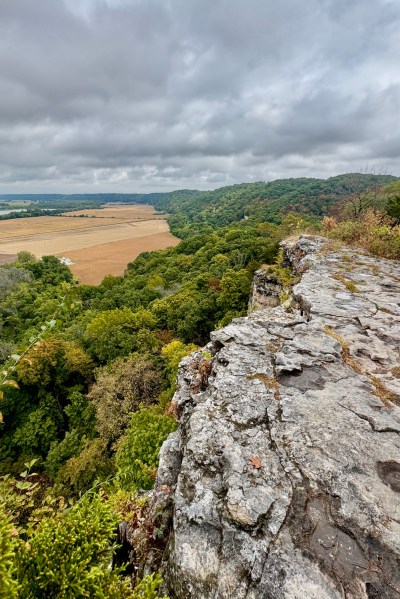
After missing the last three weeks, I was happy to rejoin the WGNSS botanists on their regular weekly outing this past Monday. This week’s destination—Salt Lick Point Land & Water Reserve in western Monroe Co., Illinois—features a mosaic of loess hill prairie and limestone glades amidst dry to dry-mesic upland forest atop limestone bluffs towering up to 400 feet above the Mississippi River valley below.
View from the Newman Trail at Salt Lick Point.
It has been an exceptionally dry August and September, so much that fall blooming plants are noticeably delayed and sparse in their blooms. Nevertheless, welcome rains just in the past few days have breathed some “fall life” into the woods and brought with them the pungent, earthy aromas that one expects to accompany a landscaping morphing from the dull greens of summer to the vibrant ambers, tawnies, and golds of fall.
View from the Salt Lick Trail at Salt Lick Point.
The group first explored the upland and blufftop habitats along the challenging terrain of the Salt Lick and Newman Trails, then returned through flat lowlands along the bluff bottoms via the Johnson Trail. Although still just beginning to bloom, a diverse palette of “fall asters” gave us an opportunity to reacquaint ourselves with the characters that distinguish these often “easy-to-identify-to-genus but difficult-to-identify-to-species” plants. The bulk of these fell into one of two groups—the true asters (genus Symphyotrichum) and the goldenrods (genus Solidago).
Salt Lick Trail at Salt Lick Point.
Symphyotrichum patens (late purple aster) was the first true aster that we noticed, a rather common species distinguished by its purple (of course) flowers with loose but not recurved phyllaries and leaves broadly clasping the stem. It wasn’t long before we had a chance to test our knowledge when we encountered the similar appearing Symphyotrichum anomalum (manyray aster), also with purple flowers but distinguished from S. patens by its distinctly recurved phyllaries and petiolate rather than clasping leaves. Eventually, we would encounter a third species of the genus—Symphyotrichum lateriflorum (calico aster), distinguished by its numerous small white flowers at the tips of numerous lateral branches rather than the terminus of the stem.
View from the Newman Trail at Salt Lick Point.
Goldenrods, on the other hand, were not only more diverse but also comprised some quite conservative species. The first of these was Solidago drummondii (Drummond’s goldenrod). This near-endemic species is restricted to eastern Missouri and adjacent parts of Illinois and Arkansas and grows almost exclusively on limestone or dolomite bluffs. However, we found it growing on limestone boulders placed at the trailhead next to the parking lot. Its wide, toothed leaves on short petioles (along with habitat) make this species easy to identify. Another quite conservative goldenrod was found as we entered the dry to dry-mesic forest further up the trail—Solidago buckleyi (Buckley’s goldenrod). Restricted to the Ozarks and adjacent areas, it is a showy species with relatively large flowers and spready phyllaries. In this and other respects, it greatly resembles the much more common Soldago petiolaris (downy goldenrod); however, it differs from that species by its narrower leaves that lack distinct teeth. A third species was seen as we approached one of the larger loess hilltop prairie remnants—Solidago altissima (tall goldenrod). Unlike the previous two species, this is one of the commonest and weediest species of goldenrod in the region. Relatively tall and with pyramidal inflorescences, this species often aggressively monopolizes roadsides and fallow fields. It greatly resembles another fairly common species—Solidago gigantea (late goldenrod), which we would later see during the return hike along the edge of the river valley. Leaf texture, however, differs between these two species—S. altissima has leaves with rough surfaces (caused by stiff, unidirectionally recurved hairs that cause the leaf to move only one direction when rubbed between the thumb and forefinger), while S. gigantea has smooth leaves (that move in any direction when rubbed).
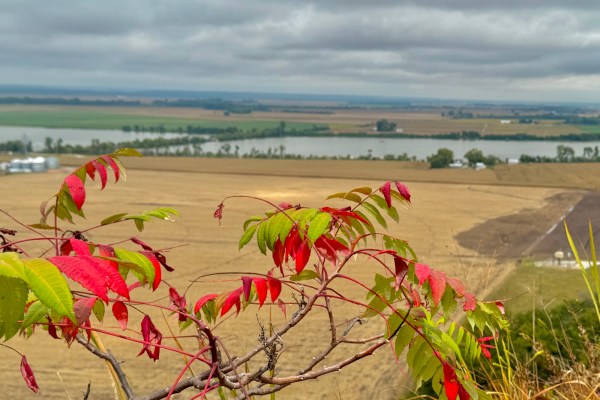
The group not only spent its time with its eyes down, but also out—across the vast Mississippi River valley spread out below the several lookout points dotting the trails. Tawny fields of near-ready-to-harvest corn provided a beautiful backdrop against the resplendent red sumacs and brilliant orange maples lining the blufftops.
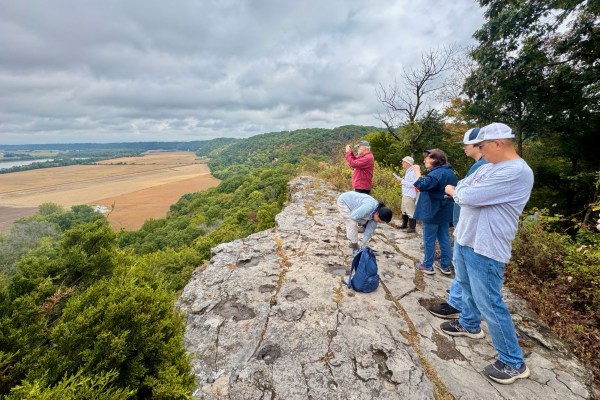
Members of the WGNSS Botany Group admire the view from the Newman Trail at Salt Lick Point.
View from the Newman Trail at Salt Lick Point.
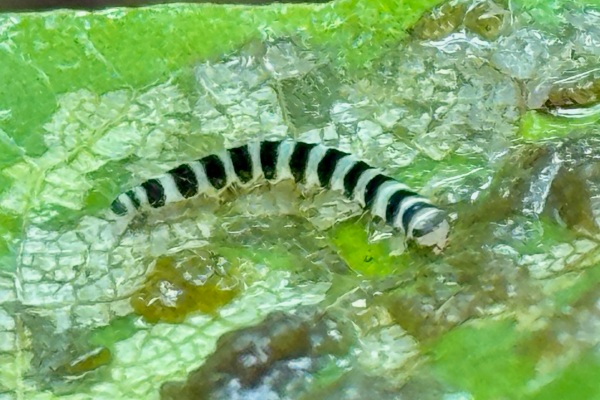
As the group’s lone entomologist/botanist (“entomotanist”?), I also kept an eye out for insects and was richly rewarded. A tiny “thorn” on the stem of S. buckleyi proved to be Enchenopa latipes (wide-footed treehopper), and unfolding the “folded” leaves of Cercis canadensis (eastern redbud) revealed the culprits—zebra-striped caterpillars of Fascista cercerisella (redbud leaffolder moth).
Enchenopa latipes (wide-footed treehopper—family Membracidae) on stem of Solidago buckleyi (Buckley’s goldenrod).
Fascista cercerisella (redbud leaffolder—family Gelechiidae) on Cercis canadensis (eastern redbud).
A spectacular earth boring beetle, Geotrupes splendidus, was seen lumbering clumsily along the trail in its endless quest for mammal dung to bury and lay an egg upon, while Bombus impatiens (common eastern bumble bee) worked the flowers of Eupatorium altissimum (tall boneset) and Eupatorium serotinum (late boneset).
Geotrupes splendidus (splendid earth-boring beetle—family Geotrupidae) on trail through dry-mesic loess woodland.
Bombus impatiens (common eastern bumblebee—family Apidae) on flower of Eupatorium altissimum (tall boneset).
A nearly mature Euchaetes egle (milkweed tussock moth) consumed the dwindling foliage of Cynanchum laeve (climbing milkweed), and Piezogaster calcarator (leaf-footed bugs) congregated on the inflorescences of Verbesina alternifolia (yellow ironweed).
Piezogaster calcarator (leaf-footed bug—family Coreidae) on flower of Verbesina alternifolia (yellow ironweed).
Nowhere, however, was insect activity more abundant than on the goldenrods, particularly the abundant stands of S. altissima in the uplands and S. gigantea below. Overwhelming numbers of Chauliognathus pennsylvanicus (goldenrod soldier beetles) and Lycomorpha pholus (black and yellow lichen moths) were accompanied by a cacophony of bees, wasps, and flies—a situation tailor made for Phymata sp. (jagged ambush bugs) to lay in wait while Epargyreus clarus (silver-spotted skipper) flew erratically overhead.
Phymata sp. (jagged ambush bug—family Reduviidae) mating pair on flower of Solidago altissima (tall goldenrod).
Epargyreus clarus (silver-spotted skipper—family Hesperiidae) perched on Solidago altissima (tall goldenrod).
Even in the deeply shaded mesic forest, Cyllopsis gemma (eastern gemmed satyrs) flitted deftly through the undergrowth.
Cyllopsis gemma (eastern gemmed satyr—family Nymphalidae) in mesic riparian forest.
The most unusual find, however, was a bizarre, green, jewel of a caterpillar found crawling on the forest floor—Isa textula (crowned slug moth or skiff moth), fringed with lacy projections that make it look more like a sea slug than an insect!
Isa textula (crowned slug moth, skiff moth—family Limacodidae) in leaf litter of mesic riparian forest.
Of course, a Monday WGNSS Botany Group outing isn’t truly consummated until it has enjoyed lunch at a local establishment—the choice this time being Tequila Mexican Restaurant in nearby Waterloo (best fish tacos I’ve ever had!).
This—the 18th “Collecting Trip iReport”—covers the second of two insect collecting trips to the southwestern U.S. this season—this first one occurring from June 4–13, during which I placed “bottle traps” and “jug traps” at several locations, and this one from September 3–14 to retrieve the traps and take advantage of any late-season collecting opportunities. I was fortunate on this trip to have longtime collecting buddy and melittologist Mike Arduser joining me, during which we visited the same 15 localities that I visited on my precious trip back in June (one in northwestern Oklahoma, six in northern Arizona, six in southern Utah, and two in southern Nevada) plus two additional localities (one each in northwestern Oklahoma and northeastern New Mexico).
I’m on my way out west with fellow collector Mike—today being only a travel day but with a quick stop in Texas Co., Oklahoma to retrieve bottle traps set back in June and then a night of camping at Black Mesa State Park before continuing the drive west tomorrow. After 7 hours, we needed to stretch our legs and stopped at Salt Plain National Wildlife Refuge’s Sandpiper Trail—a spot we both have visited several times and know well. Recent rains had the alkaline flats filled with more water than I’ve seen during any previous visit, …
Salt Plain National Wildlife Refuge, Alfalfa Co., Oklahoma.
… and only a few Ellipsoptera nevadica knausi (Knaus’ tiger beetle) and Eunota circumpicta johnsoni (Johnson’s tiger beetle) were seen on the drier margins of the alkaline flats. Several Epicauta conferta (red-cornered blister beetle) were seen lumbering across the path, and a Diogmites angustipennis (prairie robber fly) posed nicely on the trail for pictures as well.
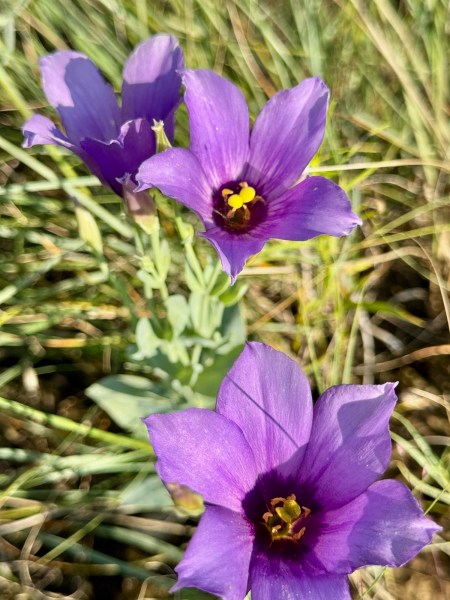
Showy Eustoma russellianum (prairie gentian)—a plant I’ve never seen before—were blooming spectacularly and prolifically in the vegetated areas bordering the alkaline flats.
It was a quick but interesting stop that rejuvenated the legs before we continued our journey westward.
The first “real” stop of the trip was ~5 miles north of Goodwell in Texas Co., Oklahoma where I placed three white bottle traps in early June hoping to capture the very rare Acmaeodera robigo, which had been photographed here on flowers of Melampodium leucanthemum (blackfoot daisy) and the photos posted on BugGuide. I was never able to contact the photographer, but since bottle traps are so effective at sampling species of Acmaeodera I reasoned placing three traps here (one at the precise spot and two more several hundred yards to the north and to the south) would give me the best chance of collecting it. It had already been dark for an hour before we reached the spot, but despite the darkness and late hour I had no trouble finding each of three traps. I was happy to see all three traps still in place, undisturbed, and filled to the brim with insects. I tried to pick out the larger insects (mostly crickets and grasshoppers) and stir through the remaining contents of each trap a bit to see if I could detect any Acmaeodera, but the majority of insects appeared to be small blister beetles, followed by bees. The darkness made further sorting impossible, so I bagged the contents of each trap and saved for later sorting. [Edit: later sorting found only a couple of Acmaeodera mixta? in just one of the traps and no A. robigo.]
We arrived at our first overnight spot—Black Mesa State Park—quite late (~11:30 pm) and quickly setup camp before retiring for the evening. In the middle of the night I got up, came out of the tent, and was greeted by an incredible amazing starscape that is normally only seen during winter. Taurus was already high in the sky, and Orion was well above the horizon with a brightly shining Jupiter not too far to its left.
Night sky at Black Mesa State Park. Orion has risen, with Taurus above and Jupiter just rising in the lower left.
Day 2
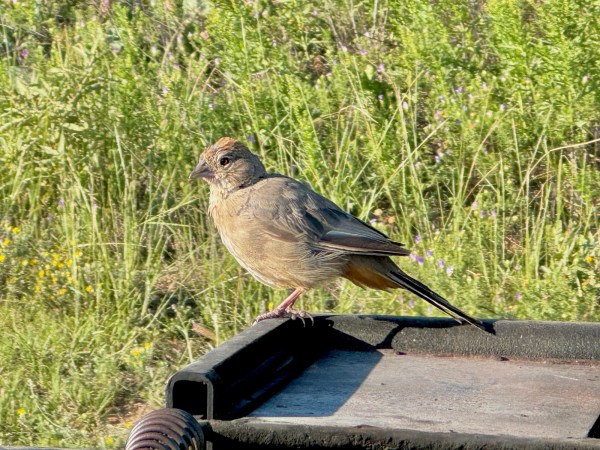
In the morning, a canyon towhee (Melozone fusca) kept us company as we prepared breakfast and then broke camp for another mostly travel day
Canyon towhee (Melozone fusca).
Our destination this evening is Devils Canyon Campground near Monticello, Utah, to which we will travel by way of northeastern New Mexico and then southwestern Colorado.
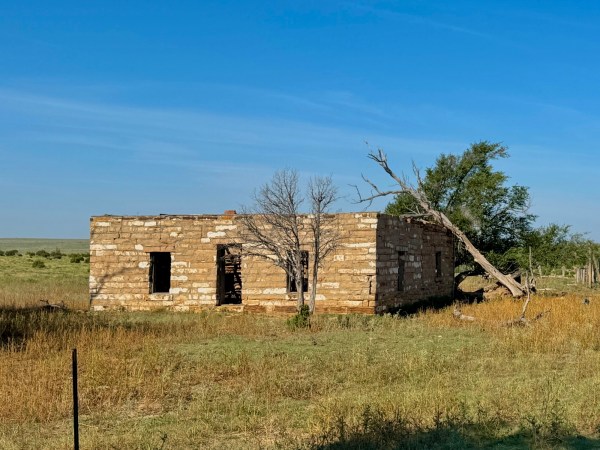
Abandoned homestead outside of Clayton, New Mexico.
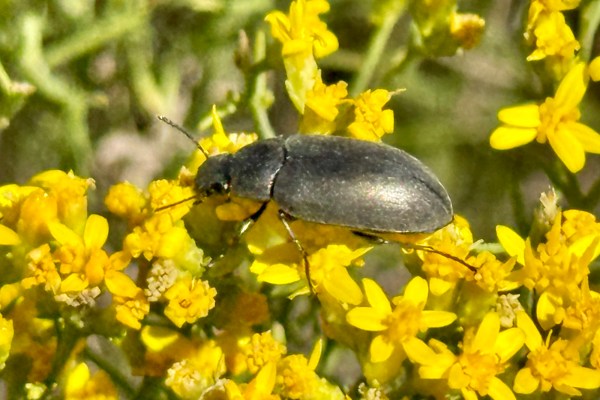
Shortly after crossing into Colorado we made a pit stop for ice and I began searching the pavement around the gas station looking for beetles that may have come into the previous night’s lights. I didn’t find any cerambycids but I did find a small tenebrionid beetle that didn’t look like familiar to me.
Crossing the Sangre de Cristo and then the San Juan ranges were as spectacular a mountain crossings as any that Colorado has to offer, and a coffee stop in Pagosa Springs (at Faire Society Cafe and Patisserie) provided not only good coffee and pastries to fuel me for the rest of the drive to Devils Canyon Campground near Monticello, Utah, but interesting and creatively framed art work to treat the eyes while waiting for our orders.
“Art wall” in Faire Society Cafe and Patisserie, Pagosa Springs, Colorado.
“Butterflies”—Faire Society Cafe and Patisserie, Pagosa Springs, Colorado.
“Gentleman Frog”—Faire Society Cafe and Patisserie, Pagosa Springs, Colorado.
“Cow”—Faire Society Cafe and Patisserie, Pagosa Springs, Colorado.
Weather during the drive had been good all day, but on the final approach to Devils Canyon Campground the skies began looking worryingly threatening. The last time I came here (early June) I had intended to camp here but got rained out and took a motel in town. I did not want a repeat of that, so we kept our fingers crossed and made the final drive to the campground. Although still threatening, it was not actually raining when we arrived (unlike last time), so we took our chances and set up camp. No sooner than that did the rain start! Fortunately, the tent was already up, so it just meant that instead of cooking dinner at the site, we would instead go to town and have dinner (Dave’s BBQ). When we got back to camp, the rain had stopped (although we could tell that it had rained hard), so I decided to walk the roads looking for night-active beetles. I knew this was probably a fruitless exercise—by then the post-rain temps at this 7000’ site were already down to the mid-50s, but it would give me a chance to stretch my legs after two straight days of driving, and I could also take that opportunity to retrieve the bottle and jug traps that I had set back in June. The bottle trap was disappointing, especially after seeing the ones I’d set near Goodwell, Oklahoma filled to the brim with insects—just a handful of bees (for Mike) and no beetles of any kind. This was surprising given the many Acmaeodera I have collected in alpine habitats just like this (Ponderosa pine and Gambel oak). The SRW-baited jug trap, on the other hand, was nicely (if not overwhelmingly) productive (Tragosoma sp., Enaphalodes sp., small elaphidiines, small acanthocine with very long antennae, Xestoleptura?)—enough to make it worth the effort. I was also pleased to see that the jug trap was in still place and intact with the catch in good shape despite three months in the field. The bait bottle was still about half full of red wine, but since the propylene glycol had dried the trap was no longer trapping insects. As I’d expected, no night-active insects were seen in the way to the traps or on the way back.
Day 3
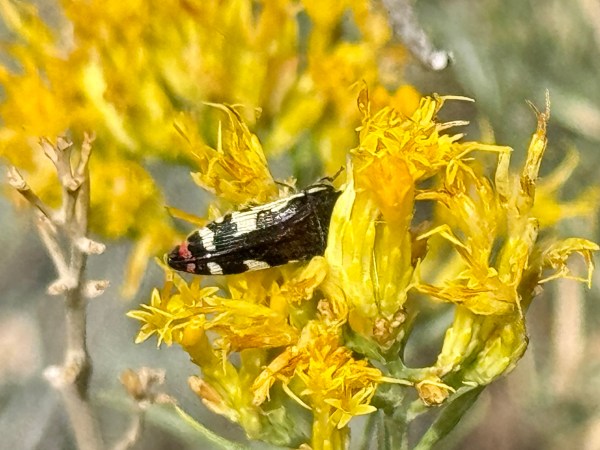
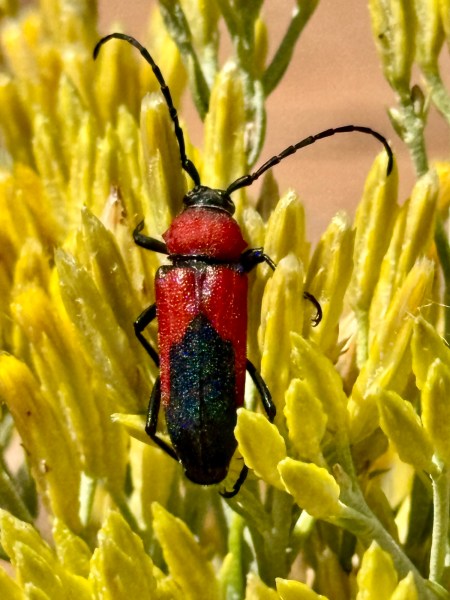
It was a chilly morning, and though it had not rained since our arrival last night the skies remained overcast. The day’s plan was to continue west to the Ponderosa Grove Campground in southwestern Utah (north of Kanab), but with only five hours of driving required to get there we would have time to make a few stops along the way. Before leaving I started checking the Ericameria nauseosa (rubber rabbitbrush), several of which had begun blooming in the campground, and found a few Crossidius coralinus and Acmaeodera amabilis on the flowers. I was tempted to suggest staying put—at least for a short time—and exploring the area a little more fully, but my real objectives were further west and I elected to stick with the plan.
Crossidius coralinus (family Cerambycidae) on flowers of Ericameria nauseosa (rubber rabbitbrush).
Acmaeodera amabilis (family Buprestidae) on flowers of Ericameria nauseosa (rubber rabbitbrush).
One of the stops I’d made along this way last June was 4 miles east of Bluff in San Juan Co., Utah, where the famous Mont Cazier had collected what would later be described as Agrilus utahensis. I did not find it in June (nor did I fully expect to, since the record was from late July), and I was equally skeptical about my chances this time given how much later it was in the season. On the way here, we got caught behind an oversized load on the highway that was so big it required three highway patrol chaperone vehicles to clear the road ahead. Going at about half the speed limit, I worried we might have to follow it the entire way to our turnoff, which would nearly double our travel time to the first spot. Fortunately, the caravan pulled over at one point to let the long train of trsffic that had accumulated behind it pass, and we were on our way (the convoy would later pass us at the very spot where we had stopped to collect).
Oversized convoy!
The location was disappointing dry and crispy, although Gutierrezia sarothroides (broom snakeweed) was coming into bloom. Sweeping it eventually produced about a dozen Crossidius pulchellus and two other beetles (a clytrine leaf beetle and a weevil), and Mike collected a handsome series and diversity of bees off of flowering Eriogonum sp. (buckwheat).
Crossidius pulchellus (family Cerambycidae) on flowers of Gutierrezia sarothrae (broom snakeweed).
Our drive afterwards through southeastern Utah and northeastern Arizona took us through some of the most amazing scenery that the American West has to offer—red sand/siltstones sculpted through the eons by wind and rain have created a landscape that can only be described as “planetary.”
Monument Valley, southeastern Utah.
Eventually, the dramatic landscape gave way to a more monotonous series of desert plateaus periodically interrupted by dramatic descents and canyons as we got deeper into north-central Arizona. Though pleasing to the eye, there were few signs of greenery of flowers to tempt the passing entomologist except occasional stands of Ericameria nauseosa (rubber rabbitbrush) beginning to bloom in higher elevation spots. We kept our nose to the grindstone, hoping to see better things once we passed through Page and crossed back into south-central Utah, but the landscape became even crispier, with a stop about 20 miles northwest of Page to look for Nanularia brunnea on Eriogonum inflatum (which I had found two years ago in late June) being a total bust. We expected/hoped that the higher elevations around Ponderosa Grove Campground (~6000’) would provide better collecting and continued there without haste. Our expectations/hopes proved well-founded, as blooming rabbitbrush was seen with greater frequency as we traveled north of Kanab and even more so along Hancock Rd approaching the campground. We took a few moments to scout out a good campsite and setup camp before spending the rest of the available daylight hours exploring. For me the rabbitbrush was most tempting, and scouting plants in the campground and the vicinity east produced small but nice series of Crossidius coralinus and Typocerus balteatus. As I was doing so, a sinking sun and virga to the east produced an impressive rainbow that became irresistible for photography—not only as a subject itself but as a backdrop for the beetles I was finding.
Rainbow at Ponderosa Grove Campground.
Crossidius coralinus (family Cerambycidae) on flowers of Ericameria nauseosa (rubber rabbitbrush).
Typocerus balteatus (family Cerambycidae) on flowers of Ericameria nauseosa (rubber rabbitbrush).
After some downtime back at camp (and grilled sirloin steaks for dinner), I did my customary nighttime patrol to check for night-active insects. This campground was especially productive when I did this back in June and found several Zopherus utahensis and other tenebrionids on the trunks of the massive Ponderosa pines that are the namesake of this campground.
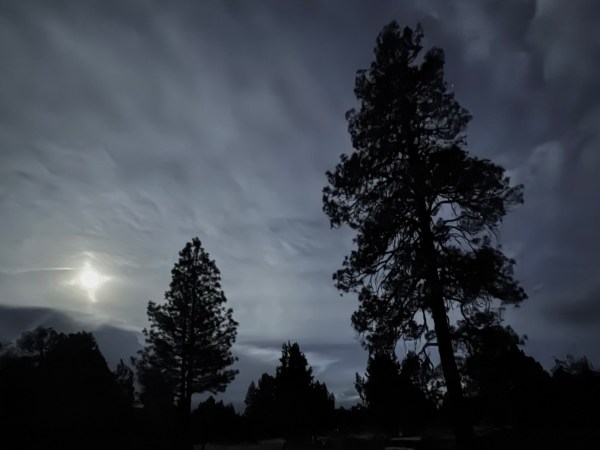
A near-full moon rises over our campsite at Ponderosa Grove Campground.
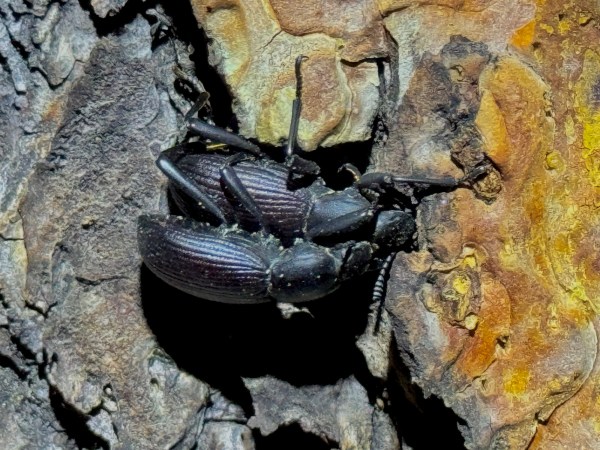
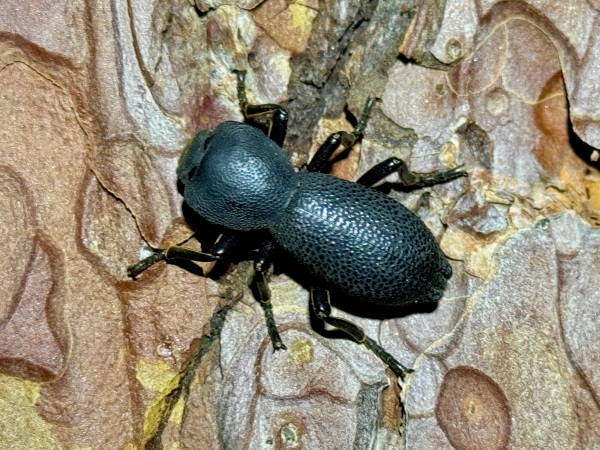
This time was no different—while I found only a single Z. utahensis, I did also find a few specimens of Coelocnemis sulcata, including a mating pair, on the trunks of the trees …
Coelocnemis sulcata (family Tenebrionidae) mating pair on trunk of Pinus ponderosa (Ponderosa pine) at night.
… and a single Embaphion sp. on the ground at the base of another. There are several massively-trunked Juniperus osteosperma (Utah juniper) in the campground as well, on which another C. sulcata was found. Despite this success and the relatively early hour, I was exhausted and called it quits for the night and retire. We will spend the entirety of the day here tomorrow, so I’ll have another chance to check the tree trunks again tomorrow night.
Day 4
After a relaxing morning at the campsite (during which time I caught up on my field notes while enjoying double-pour-through coffee), I walked over to the sand dune-adjacent woodlands to retrieve the traps that I’d set there back in June and brought them back to the campsite for sorting. I was happy to see Ericameria nauseosa (rubber rabbitbrush) and many other plants in bloom and looked forward to checking them more closely after servicing the trap catches.
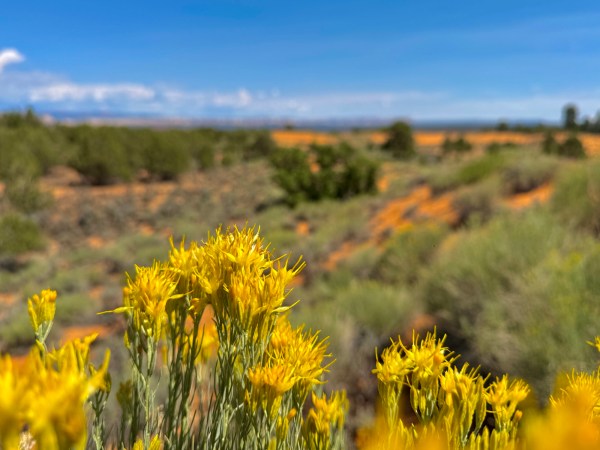
Ericameria nauseosa (rubber rabbitbrush) blooming in sand dune habitat at Moquith Mountain Wilderness Study Area.
The yellow bottle trap had ~15-20 beetles, including several Acmaeodera spp., a lepturine cerambycid, and a tiny Dichelonyx-like scarab (a relief after getting skunked with the bottle trap I’d set in Devils Canyon). There were also a fair number of bees in the trap, which I gave to Mike. The SRW-baited jug trap also did well, containing Tragosoma sp., Enaphalodes sp., several Psyrassa sp., and another colorful little lepturine along with several Euphoria inda, several small clerids, a mantispid, and numerous small beetles I take to be oedemerids. After processing the trap catch, I went back over to the woodlands and dunes, spending more than three hours collecting off the flowers of E. nauseosa and other flowers.
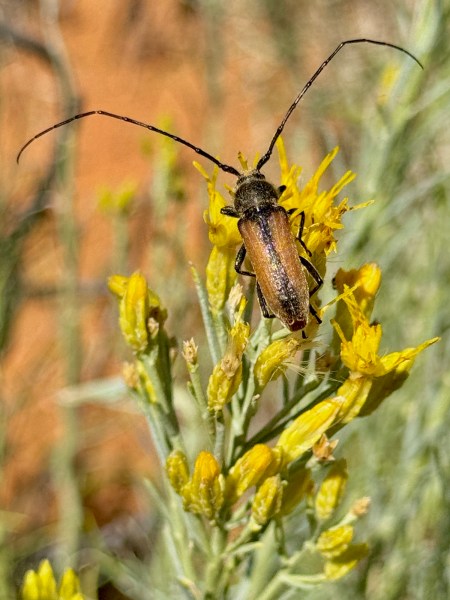
Typocerus balteatus was found not uncommonly on the flowers in most of the areas that I covered, while Crossidius coralinus and C. suturalis were found a bit more sparingly.
Crossidius coralinus (family Cerambycidae) on flowers of Ericameria nauseosa (rubber rabbitbrush).
Crossidius suturalis (family Cerambycidae) on flowers of Ericameria nauseosa (rubber rabbitbrush).
I also found Acmaeodera rubronotata on the flowers of Grindelia squarrosa (curlycup gumweed), Dieteria canescens (hoary tansyaster), and E. nauseosa, but they were limited to the woodlands and not seen in the dunes.
Acmaeodera rubronotata (family Buprestidae) on flowers of Dieteria canescens (hoary tansyaster).
I also found several individuals of an interesting little weevil on the rabbitbrush flowers, its gray/black longitudinally striped body making a good subject for photography (for which I also brought back a live A. rubronotata and a mating pair of ambush bugs), and spent a bit of time photographing some of the other blooming plants in the area.
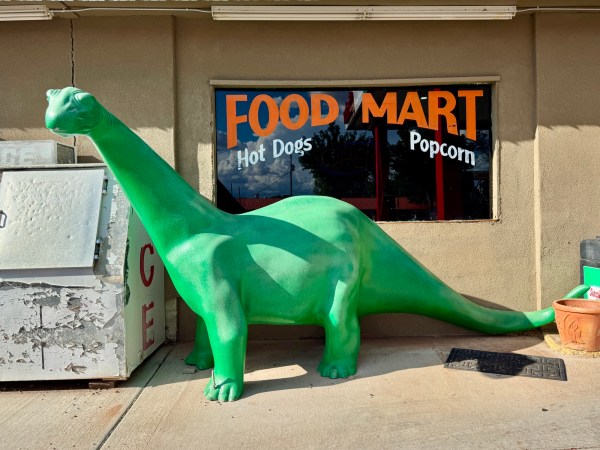
By the time I feel like I’d gotten a good enough look at the area, nearly four hours had gone by and I was famished. Sardines and Triscuits did the trick, after which we did a quick ice run into town and back—the highlights being an authentic Sinclair dinosaur (he’s smiling!) and an real (though non-functioning) pay phone.
The famous “Sinclair dinosaur.”
He’s smiling!
An authentic (though non-functional) pay phone.
Returning to the campground, I walked with Mike back into the dunes to retrieve his bowl traps. I had hoped that some of them would pick up Acmaeodera (as is often the case with bowl traps and why I have started utilizing them on my own collecting trips), but the only species that would be out in this area at this time of season would be A. rubronotata, which I had already collected earlier in the day (there were none).
Mike services a “bowl trap.”
After a period relaxing (with a cold beer and burgers hot off the grill), I began my customary night walk. I have yet to find a cerambycid on tree trunks at night here, but still I enjoy night walks here as much as anywhere due to the consistent presence of ironclad beetles and other tenebrionoids on the trunks of the massive Ponderosa pine trees that give the campground its name.
Another near-full moon rises over the campsite.
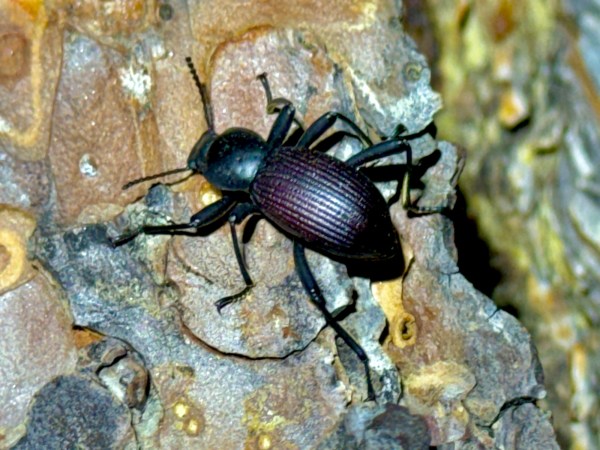
Tonight would be no different—I found Zopherus uteanus on just the second tree that I examined (right in our campsite), and I would also find two species of tenebrionids in the vicinity on the trunks of ponderosas (Coelocnemis sulcata and Eleodes obscura sulcipennis) and a third species (ID unknown) on the ground at the base of one of them.
Zopherus uteanus (family Zopheridae) on trunk of Pinus ponderosa (Ponderosa pine) at night.
Coelocnemus sulcata (family Tenebrionidae) on trunk of Pinus ponderosa (Ponderosa pine) at night.
Eleodes obscura sulcipennis (family Tenebrionidae) on trunk of Pinus ponderosa (Ponderosa pine) at night.
At that point, I decided to go outside of the loop towards a couple of large P. ponderosa at the entrance, and on the way I found another E. obscura sulcipennis on the trunk of a massively old Juniperus osteosperma (Utah juniper). There was nothing on the P. ponderosa trees that I had targeted, but nearby was another large one, and high up on the trunk (as far as my fully extended net could reach) was another Z. uteanus, and several C. sulcata—including a mating pair—were found on the ground at its base.
At that point I decided to limit my tenebrionoid collecting to only Zopherus unless I saw species that I hadn’t seen before, so I passed by some additional tenebrionids of the same species as the previous on a large P. ponderosa in the RV loop, then saw a large, multi-branched Pinus edulis (Colorado pinyon pine) that I thought might be interesting to check. I did not find any beetles on it, but I did locate at eye level—with considerable difficulty!—a male Oecanthus californicus (western tree cricket). I was not only able to take a photograph of it with its wings fanned but also record an audio track up close (posted on iNaturalist).
Oecanthus californicus (western tree cricket—family Oecanthidae) male singing on trunk of Pinus edulis (Colorado pinyon pine) at night (song).
Returning to the tent loop, I checked all of the large P. ponderosa trees and junipers that had—during the past visit and last night—been so productive, but the only beetles I found was a very small tenebrionid that, fortunately, was yet another species I had not previously seen here (ID unknown). After two hours of searching tree trunks, I called an end to the night, which also meant a close to the collecting at this spot—tomorrow we will drive to Kyle Canyon in southern Nevada!
Day 5
Our exit from Ponderosa Grove took us through more of the spectacular canyonland that southern Utah is famous for and past the incredible Coral Pink Sand Dunes State Park (so spectacular it is that I think it could—despite its small size—be a national park). A dramatic descent down into the Virgin River valley and the town of Hurricane was only the first such descent—the second one being even more dramatic as I-15 dropped off the edge of the Colorado Plateau along the Virgin River Gorge. The remainder of the drive to Kyle Canyon northwest of Las Vegas was mindnumbing in its contrast—an endless stretch of interstate highway through a vast expanse of low, hot, featureless desert punctuated at regular intervals by palm tree dotted oases, each with a gaudy, glittering casino at its center. Driving up Kyle Canyon Rd put an end to this, however, as each thousand foot gain in elevation brought with it an increasingly interesting landscape. At about 4500’ elevation, I had set a couple of bottle traps—one yellow, one blue—hoping to catch the recently described Acmaeodera raschkoi (whose namesake—Mike Raschko—I had happened to meet at Ponderosa Grove Campground last June a few days before I set the traps!). Mike R. had also placed a bottle trap (white) at the site and was kind enough to reset it for me so I would have three colors sampling the area. Both of my traps were still in place, intact, and filled with numerous Acmaeodera that I take to be A. quadrivittata (along with many bees for Mike A.) and the yellow also containing a larger species that I didn’t immediately recognize (not unusual since I have never collected this area). Unfortunately, I did not see any specimens that appeared to be A. raschkoi, and even more unfortunately the white bottle trap had been pulled from the ground (although I was able to recover a few A. quadrivittata that were still inside the trap). Not much else was going on at the site—only a few things in sparse bloom but no beetles visiting the flowers, nor was there any rabbitbrush around on which to look for Crossidius.
We got a scare when we arrived at the campground and saw a sign at the entrance saying “Campground Full.” This was bad—if this campground was full, then surely the much more heavily used one down below was also full, and I didn’t look forward to spending the rest of the afternoon scrambling for a campsite somewhere in the Spring Mountains. We drove through the campground anyway, and, in fact, there were many campsites available! Looks like somebody forgot to do their job!
“Campground Full” sign at a not-full Hilltop Campground above Kyle Canyon, Nevada.
Crisis averted, we selected a nice spot overlooking the desert below and set up camp. Cool evening temps come early at this high elevation (~8300’), so with the remaining afternoon hours I retrieved and sorted my SRW-baited jug trap, finding several Tragosoma sp. but, curiously, not a single other longhorned beetle (or any beetle for that matter). Searching around the area afterwards, I extracted a dead Dicerca tenebrosa partial carcass in its emergence hole in a stump of Pinus monophylla (single-leaf pinyon pine), then went back down to the area I had collected last time, focusing especially on the two large half-dead Juniperus osteosperma (Utah juniper) trees on which I had seen damage from the rarely collected Semanotus juniperi (on one of which I collected three adults later that night). There was nothing on the first (the one on which I found the beetles), but at the second one I saw a large wind-thrown branch that I had not noticed last time. It exhibited S. juniperi damage and emergence holes on the lower part, and chopping into it I quickly recovered a dead but intact carcass of yet another S. juniperi adult. Further chopping turned up nothing, and I was about to walk away when I thought maybe I should cut into the upper part of the branch as well to look for evidence smaller woodboring species. Doing so, I quickly encountered a Chrysobothris sp. larva, and with that I decided to bring the entire upper part of the branch back for rearing. There wasn’t much else going on—few plants were in flower and nothing was seen on the trunks of trees or various pieces of downed wood that were laying about, so I went back to camp.
Alpine pinyon/juniper woodland at Hilltop Campground above Kyle Canyon, Nevada.
An elevation of 8300’ affords spectacular views into the desert below.
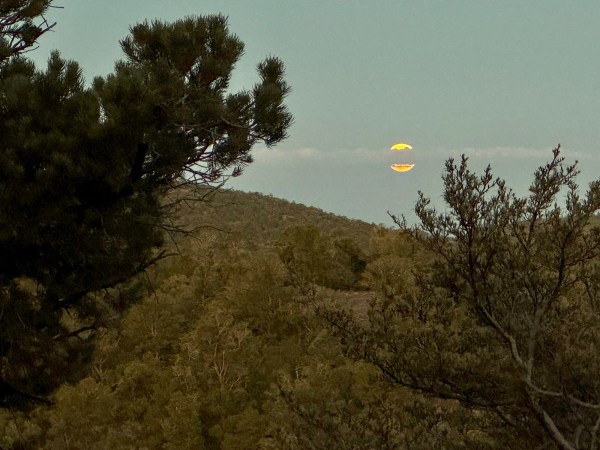
Later in the evening, we watched a spectacular moonrise, then enjoyed “surf ‘n’ turf” (grilled sirloin steak and salmon) before I started up my customary night walk to check tree trunks for night-active beetles.
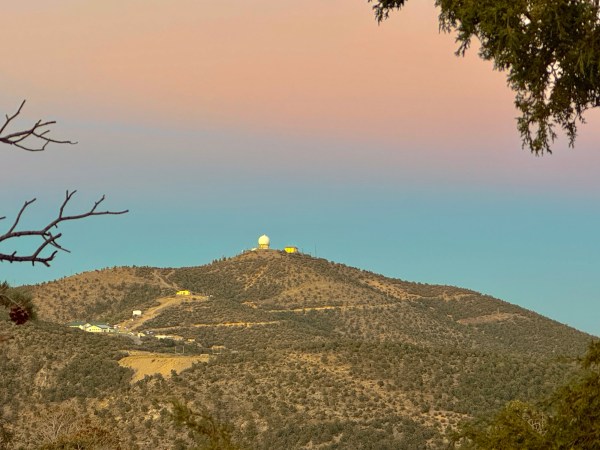
Angel Peak Radar Station at sunset.
“Corn Moon” rising.
Peeking through the trees.
Last time here when I did this, I found not only S. juniperi but also a few Zopherus uteanus, so I was hopeful for my chance tonight despite the lateness of the season. It started out well—on the first P. monophylla tree that I checked (right at our campsite), I found Oeme costata and a weevil.
Oeme costata (family Cerambycidae) on trunk of P. monophylla (single-leaf pinyon pine) at night.
Those would be the last live beetles I would see (other than an occasional tenebrionid beetle, none of which I collected). However, I would still find success—back at the J. osteosperma on which I had found three S. juniperi back in June, I found three more. They were not alive, however, but dead carcasses at the base of the tree—two nearly completely intact and the other partially so.
Western deer mouse (Peromyscus sonoriensis) at night.
Day 6
We had planned to visit few localities at middle and lower elevations but stopped to check out the profusely-blooming Ericameria nauseosa (rubber rabbitbrush) right outside the campground entrance for bees and beetles. Curiously, hardly anything was seen on the flowers despite the by then late-morning hour, sunny skies, and temps above 70°F. It seemed odd to me that there were no Crossidius beetles on the blooms, and the thought occurred to me that maybe the occurrence of E. nauseosa in the area itself could be a relatively recent phenomenon since it is only seen—albeit profusely—along the roads and highways in the area but nowhere further within the native habitats. With nothing going on, we pushed down to the lowest elevation point that caught our eye on the way in yesterday—the Step Ladder Trailhead at ~6700’.
Again, E. nauseosa was blooming profusely around the parking lot, but a quick perusal made it clear the situation would be similar here as well. Mike, on the other hand, was having good success collecting bees off of E. nauseosa and especially Gutierrezia sarothrae (broom snakeweed), so I was content to stay and refocus by searching for infested wood. I noticed a lot of Quercus gambelii (Gambel oak) and quickly found one with a dead but still attached, fully-barked branch. I broke the branch off the tree, and there in the broken butt of the branch was a large chrysobothroid larvae! This quickly prompted a decision to collect the infested branch and put it up for rearing. A second larvae was found in a small dead (but still fully-barked) tree nearby, which was added to the bundle. While this was going on, Mike found what seemed to be Agrilus blandus? in his net while sweeping bees from the flowers of G. sarothrae. I recall collecting this species in southern California in flowers of Eriogonum (wild buckwheat), so finding it on other flowers—particularly if Eriogonum is in the area (but not seen because it was not blooming) did not seem out of the question. My much more thorough sweeping of the plants around the area where he found it, however, produced no additional specimens. I was also interrupted in my sweeping attempts by a couple of curious bystanders—one a woman from Ukraine who wondered what the plant was that I was sweeping (I told her “broom snakeweed”) and what it was good for (“brooms” I wryly replied and then quickly clarified its role in the ecosystem), and then offered me a beetle collecting tip by telling me about large beetles they call “bombers” and that bite people sitting in spas in Southern California (I presume these are diving beetles in the family Dytiscidae); and the other a young man who was pleased to hear I was from St. Louis because he used to live there when he was married to his ex-wife. This all happened while I was in the middle of my sweeps, so I held the net bag firmly to keep insects from escaping my net until I could resume my sweeping. Eventually, I gave up the ghost and resumed my search for dead, infested wood, eventually finding a Cercocarpus ledifolius (curl-leaf mountain mahogany) tree with one recently-dead and one older dead branch, the former buprestid-infested (verified by cutting into the wood and finding young buprestid larvae) and which I collected for rearing.
View of Fletcher Peak from Step Ladder Trailhead.
After lunch back at the campground and some time spent processing specimens (as well as enjoying the antics of our resident golden-mantled ground squirrel [Callospermophilus lateralis certus]), …
Mount Charleston golden-mantled ground squirrel (Callospermophilus lateralis certus).
… I wanted to check out the nearby Deer Creek Picnic Area where I’d seen a lot of iNaturalist observations (suggesting it might be an interesting place). At first all I saw was the massive parking lot below an equally massive road-cut slope—the only thing that looked like a trail was a steep drop down to the creek below. I checked it out, only to find it dead-ending at the creek and clambered back up.
A massive Ponderosa pine looms above.
Then I saw a gravel trail behind the guardrail on the opposite side of the highway and found it leading to a paved path up the creek. Much of the trail was covered with a deep layer of gravel from flooding (and indeed some of the picnic tables were also nearly completely buried). I hiked the trail as it ascended alongside the creek under massive ponderosa pines until it dead-ended at a gravel road and turned around. The only plants in flower was Ericameria nauseosa (rubber rabbitbrush), and it was only near the highway, and while I saw no insects that I wished to collect, I did see a large Adejeania vexatrix (orange bristle fly) that frustrated my attempts to photograph it until I finally “pre-set” the focus, exposure, and zoom and quickly fired off a few shots at the distance I’d set it for as soon as the fly landed. The virtual lack of insect activity here confirmed what we’ve been seeing in the area as a whole, so I’ll be anxious to leave tomorrow and head for (hopefully) greener pastures at Leeds Canyon back in southwest Utah.
Adejeania vexatrix (orange bristle fly—family Tachinidae) on flowers of Ericameria nauseosa (rubber rabbitbrush).
Day 7
The drive from Kyle Canyon to Leeds Canyon was essentially a straight shot on I-15—normally a recipe for extreme boredom; however, coming back up through the Virgin River Gorge was a different, even more awe inspiring experience than the descent two days earlier. Ascending such a steep narrow canyon has the breathtakingly tall canyon bluffs looming high overhead, dwarfing the traffic, even the largest semi tractor trailers, snaking up below, whereas descending into a seemingly bottomless chasm feels a little more “dangerous.” We arrived at Leeds Canyon relatively early thanks to the “only” 3-hours drive. The area looked very dry, but a variety of blooming plants kept us optimistic as we made our way up the canyon road towards Oak Grove Campground at the top.
Leeds Canyon in southwestern Utah.
Sadly, optimism turned to dismay in an instant when we encountered a “Road Closed” sign about halfway up—a result of the ongoing fire risk that has bplagued the area this season. We checked to see if the campground on the other side of the mountain range was available, only to learn that it was closed due to fire damage. At that point, our decision was made for us—we would need to continue another two hours to the Kaibab Plateau where I had my last sets of traps to retrieve and where we could camp at Jacob Lake. While we were here, however, we took the opportunity to stop at a spot along Leeds Creek and see what we could find.
Oak Grove Rd crosses Leeds Creek in the lower part of Leeds Canyon.
Several different plants were in bloom, on which I’d hoped to find either Acmaeodera or longhorned beetles, the first that I looked at being Dieteria canescens (hoary tansyaster), but I only saw small dasytines (a few of which I collected). Nothing was seen on Solidago velutinus (velvety goldenrod) or Sphaeralcea grossulariifolia (gooseberry leaf globemallow) flowers, but then Mike came up with a Crossidius discoideus on flowers of Gutierrezia sarothrae (broom snakeweed).
Crossidius discoideus (family Cerambycidae) on flowers of Gutierrezia sarothrae (broom snakeweed).
Careful searching of the plants in the surrounding area atop a small hill turned up an additional half-dozen individuals, but none were seen on any of the plants further up or down along the road. By this time, we’d spent about an hour and decided to finish the additional 2-hours drive needed to get to Jacob Lake.
Megaphorus sp. (family Asilidae).
Historic home in nearby Harrisburg, Utah.
Some of the western U.S.’s worst fires this season occurred on Arizona’s Kaibab Plateau. The Dragon Bravo Fire destroyed over 100 structures on the Grand Canyon’s North Rim—including the historic Grand Canyon Lodge and the North Rim Visitor Center, while the White Sage Fire simultaneously burned significant areas of Kaibab National Forest north and east of Jacob Lake. It was the latter that, unfortunately, swept across both of the sites where I had placed traps a month earlier in June, so I was not optimistic about the likelihood that they had survived. Fortunately, the fires did not reach the immediate vicinity of Jacob Lake, so the campground was unaffected and—unusual in my experience—nearly devoid of people. After setting up camp, I went back north into the burn zone to see if my traps 1) had survived and 2) could be retrieved. The area around the site was almost completely destroyed, with charred black skeletons of trees dotting blackened soils devoid of any vegetation.
Aftermath of the White Sage Fire in the Kaibab National Forest.
I had low expectations for the traps at this site even before the fires, as the area had already burned several years early and was in the early stages of recovery (I had decided to place traps here anyway because I wanted to see what the woodboring beetle fauna in a recovering area might look like).
Blackened trunks punctuate a stark landscape.
I continued walking the 2-track toward the trap location surveying the damage, came around a bend, and saw it—a lone, still-green pinyon pine with my jug trap hanging from a branch and a bottle trap, its yellow funnel only slightly heat deformed, still planted in the soil beneath the tree!
A lone green tree amongst the destruction—with my traps in the tree and below it both intact!
At first I was elated, but then I saw the jug trap reservoir was dry and almost completely empty save for a few dried beetle carcasses—the trap had survived the fires, but the associated winds had blown the trap and dumped the contents (none of which could be detected on the ground beneath). The bottle trap, on the other had, looked to be full of insects with plenty of liquid still in the reservoir, so I was hopeful that I would retrieve some good specimens from it. This proved to be the case (sort of!) as I pulled a few Anthaxia sp., a meloid, and lots of bees (for Mike) from the trap. The dried carcasses in the SRW-baited jug trap turned out to be an elaphidiine & several silphids.
After leaving the first trap site and driving towards the second (a few miles east of Jacob Lake), I saw little to no fire impacts as I continued east of Jacob Lake. However, as I got closer to the site I began to see impacts—first along the ridge above, then down the slope and engulfing the area where I had placed my traps. Fortunately, the fire did not seem to have been as severe in the immediate area, so I remained hopeful.
Intact jug trap in burned woodland east of Jacob Lake, Arizona.
The bottle trap was found first and was in much the same condition as the bottle trap at the previous location—it’s blue funnel slightly heat-deformed, but the reservoir was filled with liquid and insects. Later sorting yielded an Acmaeodera diffusa?, a Melanophila sp., a couple of Anthaxia sp., a clerid, and lots of bees (for Mike). The Melanophila sp. was especially welcome—known collectively as “fire beetles” for their attraction to active fires, its presence in the trap may have been been a direct result of the fire. The SRW-baited jug trap was quickly found next, and much to my relief the trap was not only intact and undamaged but also filled with insects (in fact, the propylene glycol had not even completely dried). Later sorting would yield only a single longhorned beetle (plus a silphid and a Euphoria inda), but that longhorned beetle would prove to be the catch of the trip—Calloides nobilis mormonus! I have reared a single individual of the nominate subspecies from fire-damaged oak collected in Missouri, so I suspect the presence of this beetle is also a direct result of the fires that swept through the area—a satisfying irony.
Calloides nobilis mormonus (family Cerambycidae) attracted to sweet red wine-baited jug trap.
Back at camp and after another “surf & turf” dinner of sirloin steak and salmon, I did my customary nighttime walk to look for night-active beetles on the ground and in tree trunks. I had good luck with this here back in June, finding a Zopherus uteanus and several other beetles, but tonight’s catch consisted of just a single Temnochila sp. (family Trogosittidae) and a single weevil (superfamily Curculionoidea) crawling on the large trunks of Pinus ponderosa.
Unidentified weevil (superfamily Curculionoidea) on trunk of Pinus ponderosa (Ponderosa pine) at night.
Day 8
I’d seen a fair amount of Ericameria nauseosa (rubber rabbitbrush) in bloom at the second site the previous day when I retrieved my traps but didn’t see any insects (or, at least, beetles or bees) on them. I figured this was due to the early evening hour, so we decided to come back during the day to try again. The E. nauseosa flowers were still, puzzlingly, devoid of insects (save for honey bees and enormous numbers of a large, black, bristly tachinine fly—possibly Archytas metallicus or Juriniopsis adusta).
Tachinine fly (possibly Archytas metallicus or Juriniopsis adusta—family Tachindae) on flowers of Ericameria nauseosa (rubber rabbitbrush).
Like at Kyle Canyon, the absence of Crossidius spp. on E. nauseosa flowers was surprising, as I have seen them on this plant at almost every other location I have ever checked. You can’t make things appear no matter how hard you look, however, so we continued into some openings farther up the slop and encountered a few other plants in bloom. One was Dieteria canescens (hoary tansyaster), on the flowers of which I found a few small beetles of an unknown family. Nearby I saw several dead main branches in a clump of Quercus gambelli (Gambel oak)—cutting into them revealed a very small woodboring beetle larvae, so I collected several of the stems for rearing. Coming back down the slope I found a single cryptocephaline on the flower of Eriogonum racemosa (redroot buckwheat) and a single Acmaeidera rubronotata on flowers of Gutierrezia sarothrae (broom snakeweed)—the latter on which Mike had also found a single Crossidius discoideus. (This seems to be the first record of any species of Crossidius from the Kaibab Plateau! Maybe the other species are here as well but are not quite out yet at this relatively early date in fall.)
Crossidius discoideus (family Cerambycidae) collected on flowers of Gutierrezia sarothrae (broom snakeweed).
We were getting ready to leave when I spotted a large, fallen Pinus ponderosa (Ponderosa pine) with the twigs brown but still attached (indicating it might be the right “amount” of dead to host woodboring beetles. Damage by such could be seen on the smaller branches, and cutting into them confirmed the presence of larvae and led to a second wood-cutting/bundling session to bring the beetle-infested twigs and branches back for rearing.
Chasing more floriferous pastures, we went back up to higher elevations and stopped at a spot close to the campground where we 1) saw a great diversity of plants in bloom and 2) could safely pull off the highway. A huge diversity of blooming plants were seen (from which Mike collected ~20 species of bees), but the only beetles of interest that I saw and collected were numerous small black/red cryptocephalines on the flowers of Eriogonum racemosum (redroot buckwheat). After Mike was satisfied he’d sufficiently sampled the diversity of bees at the site, we looked for another place to collect.
We drove south towards DeMotte Campground on Hwy 67, but much of the landscape was complete devastation due to the fires and no access was allowed beyond Kaibab Lodge. It was depressing to see the immense scale of destruction and loss of natural resources, but as one forest worker that Mike talked to put it, “It’s just trees, and he didn’t have to call anybody’s family [i.e., there was no loss of life].” We then drove back down past my second trap location where we had collected earlier in the day to see if we could find better stands of Gutierrezia sarothrae (broom snakeweed) on which to look for more Crossidius discoideus (still represented in the area by the single individual Mike had collected earlier). We drove through even more complete and utter destruction but eventually found undamaged areas at about 6600’ elevation. Not only was there G. sarothrae in bloom, but also Chrysothamnus visicidiorus (green rabbitbrush) and Ericameria nauseosa (rubber rabbitbrush)—all three species serving as hosts for various Crossidius and providing a perfect scenario for comparing and contrasting the sometimes-tricky-to-identify plants! The promise of Crossidius, however, would not be realized, and after an hour of searching—finding only a lone weevil on the flowers of E. nauseosa—did I finally admit defeat and concede that Crossidius from this after would have to come some other time.
Inflorescences of Gutierrezia sarothrae (left), Chrysothamnus viscidiflorus (middle), and Ericameria nauseosa (right). Note the distinct ray florets of G. sarothrae and blue-green leaves of E. nauseosa.
I hadn’t planned to do my customary nighttime walk this evening—my motivation waning after the less than meager success of the previous night, continuing relative absence of beetle life I’d seen during the day, and temps now dropping towards the 50s. A cute but shy Uinta chipmunk in our campsite captured my photographic interest as we relaxed, and the setting sun turned the clouds a stunning pink!
An Uinta chipmunk (Neotamias umbrinus) climbs a Ponderosa pine to stay as far from my camera as possible!
However, as night fell the siren song of the nighttime walk began singing its tune and I was unable to resist.
The setting sun turns the clouds an exceptional pink.
It turned out to be a more successful night than I’d expected—I found a small species of tenebrionid [Edit 10/1/25: Eleodes pimelioides. Edit 10/1/25: Eleodes pimelioides or brunnipes.] on the rocks surrounding the campsite, and there turned out to be dozens of the little buggers crawling though the pine duff in the campground.
Eleodes pimelioides/brunnipes (family Tenebrionidae) in alpine coniferous forest at night.
Nothing else was seen, however, and since tomorrow would be a long travel day I called it an early night.
Day 9
On a mostly travel day, we tried to take a big bite out of the many miles that still separate us from St. Louis, where we planned to be in three days time. We got another look at the devastation east of Jacob Lake before reaching the dramatic drop off the Kaibab Plateau and down into the Vermilion Cliffs National Monument—their massive red bluffs accompanying us all the way to Mojave Canyon. Just south of there as the highway climbed up and out of the valley, we made a quick stop to remove excess clothing (having gone from high elevation to low), and alongside the road I spotted a Crossidius pulchellus on the flowers of Gutierrezia sarothrae (broom snakeweed). This is the furthest southwest I have collected this species, and I was tempted to continue looking to see if I could find the other G. sarothrae associate—C. discoideus—as well. We still had a long drive ahead of us, however (destination Mills Rim Campground in northeastern New Mexico), so I resisted temptation and we continued the drive.
The Vermilion Cliffs, stunning as they were, still weren’t the highlight of the drive. That honor would come from the moonscape formations along Hwy 89 as it followed the Echo Cliffs and then turned east onto Hwy 160 towards Tuba City. We then passed through a series of stunning plateaus and drops on Hwy 264 as it passed through the Navajo and Hopi Reservations. One abandoned house as we dropped down off the Ganado Mesa was especially picture-worthy.
Abandoned home on the Ganado Plateau near Kykotsmovi Village, Arizona.
Eventually we crossed the state line at Picture Rocks into New Mexico, and, suddenly, the landscape seemed more “tame” and less hostile. I don’t normally like interstates, and the stretch of I-40 to Albuquerque did nothing to change my opinion of them, but I must admit that I-25 north towards Santa Fe was among the most picturesque I have ever seen. Eventually, we left the mountains and found ourselves once again on the western edge of the Great Plains—its vast featureless expanse a true contrast to the landscape we had witnessed throughout most of the day. This apparent homogeneity, however, is misleading—tucked away in places unknown to most are some remarkable natural areas, and Mills Rim is one such place. We arrived after dark, so the explorations of its hidden charms would have to wait until the next day, but after getting camp set up I did a short nighttime walk to see what was out and about.
Night sky at Mills Rim Campground, Harding Co., northeastern New Mexico.
Only one beetle, Stenomorpha sp. (family Tenebrionidae) ambling across the ground, was seen.
Many plants in bloom were also seen however, so I went to bed optimistic about my prospects for finding beetles the next day.
Day 10
Mosquitoes were bad during the previous night, and they were bad again the following morning, prompting liberal use of repellent to a much greater degree than I am used to. At the same time, the presence of mosquitoes indicates abundant moisture in an area, and it was with that optimism that I set about searching for jewel beetles, longhorned beetles, tiger beetles, and whatever other insects could catch my eye in this hidden jewel of a place. Surrounded by treeless grasslands (and preserved as the Kiowa National Grasslands), Mills Rim Campground sits at the edge of Mills Canyon—a chasm in the landscape at the edge of a plateau bordering the foothills of the Rocky Mountains. Firmly embedded in the Great Plains, the juniper/pine/oak woodland at the edge of and down in the canyon features plants and animals at their easternmost extent—residents of the Rocky Mountains that have found an isolated home in the middle of the grasslands. Pinus edulis (Colorado pinyon pine), Pinus ponderosa (Ponderosa pine), Juniperus monosperma (one-seed juniper), Juniperus scopulorum (Rocky Mountain juniper), Quercus grisea (gray oak), and Quercus × undulata (wavy leaf oak) all make their homes here, hosting innumerable insect species that are normally more at home in the Rocky Mountains.
View into Mills Canyon from Mills Rim Campground.
I’ve collected here several times and recorded many different western species of beetles, but the height of the season seems to be in June and July. Mid-September, in contrast, seems to be near the tail end of the season, the numbers and diversity of beetles and other insects dropping from their highs earlier in the season. The flowers of Gutierrezia sarothrae, however, were hosting lots of insects. In addition to Crossidius pulchellus, Chauliognathus basalis, Bothrotes canalicularis, and Collops sp., Mike found numerous bee species, mostly females, collecting pollen from the flowers.
Crossidius pulchellus (family Cerambycidae) on flowers of Gutierrezia sarothrae (broom snakeweed).
Chauliognathus basalis (family Cantharidae) on flowers of Gutierrezia sarothrae (broom snakeweed).
Bothrotes canalicularis (family Tenebrionidae) on flowers of Gutierrezia sarothrae (broom snakeweed).
A couple of species of robber flies—Ospricerus sp. and Efferia sp.—were also taken in flight, presumably patrolling the flowers of G. sarothrae for bee prey.
Ospricerus sp. (family Asilidae) patrolling flowers of Gutierrezia sarothrae (broom snakeweed) for bee prey.
Nysius sp. (false chinch bugs—family Lygaeidae) on flower of Erigeron divergens (spreading fleabane).
Mirabilis linearis (narrowleaf four o’clock—family Nyctaginaceae).
After a rest and rehydration break, I followed the road down Mills Canyon as it approaches the Canadian River to see if I could find Ericameria nauseosa—should I be able to, it would surely be at or near the easternmost limit of occurrence for the species in this part of New Mexico.
Mills Canyon above the Canadian River.
A bit further down Mills Canyon Road.
About half a mile down the road I began seeing Acmaeodera rubronotata on the flowers of G. sarothrae, and I eventually secured a series of about a half dozen specimens. This is a nice record, as I found a single specimen a couple of years ago at Black Mesa in northwestern Oklahoma—a new state record and northeastern range extension, and this record helps bridge the gap between that record and the species’ more normal range of distribution across New Mexico and Arizona. Finally, nearly a mile into the canyon, I found one large blooming E. nauseosa and a smaller pre-bloom plant, but there were no Crossidius beetles on them, nor were any additional plants were seen a hundred yards or so further down the road, so I turned around.
Ericameria nauseosa (rubber rabbitbrush—family Asteraceae) along Mills Canyon Road.
On the way back out of the canyon, I collected a Calopteron sp. (family Lycidae) on senescing Melilotus alba (white clover) and photographed a female Stagmomantis limbata (Arizona mantis—family Mantidae).
Stagmomantis limbata (Arizona mantis—family Mantidae) on flowers of Gutierrezia sarothrae (broom snakeweed).
Back at camp, a couple of scarabaeoid beetles flew to the light of the lamp while we were relaxing with refreshments in hand and waiting for the coals to be ready. This suggested that maybe conditions were favorable for setting up the ultraviolet lights to attract other insects.
A final night of relaxing at camp with refreshments in hand.
After finishing dinner, we did exactly that and saw a few interesting insects show up, but shortly after setting up the lights the wind began to kick up, the temps began to drop, and increasingly frequent gusts making further lighting impossible!
Stagmomantis limbata (Arizona mantis—family Mantidae) male attracted to ultraviolet lights.
Schistocerca nitens (gray bird grasshopper—family Acrididae) attracted to ultraviolet lights.
Ophion sp. (short-tailed ichneumon wasp—family Ichneumoidae) attracted to ultraviolet lights.
Day 11
It was a rather sleepless final night in the tent—winds whipped as we turned in for the night, and shortly afterwards we awoke to rain splattering our faces through the fly-less tent roof. We quick got up and put on the rain fly, then listened to light but steady rain for most of the rest of the night. By the time we got up it had mostly stopped, but cool conditions with low-hanging, fast-moving clouds caused us to quickly break camp and save coffee and breakfast for Mocks Coffee Shop in Clayton, New Mexico near the Oklahoma state line (let me tell you how difficult it was for me to drive two hours first thing in the morning without coffee!). We had wanted to make our final collecting stop at a a lot near Kenton in the Black Mesa area of extreme northwestern Oklahoma, but the forecast for the area showed only slightly warmer temperatures and very gusty winds. This would make collecting there pointless, so we instead traveled four more hours east to get in front of the cold front at another of our favorite collecting spots, Gloss Mountain State Park in Major Co.
Gloss Mountain State Park features gypsum-capped mesas atop Permian red siltstones.
I was hoping to see an attractive late-season jewel beetle—Acmaeodera macra, which I had collected here and at nearby Alabaster Caverns State Park in previous years during late September. Temps were good (well over 80°F) when we arrived but the hour was already late (near 4:00 p.m.), so we had limited time for collecting before insects would start bedding down for the evening (usually around 5:00 to 6:00 p.m. at this point in the season). Megatibicen dorsata (bush cicada) and Neotibicen aurífera (prairie cicada) males were still singing abundantly, filling the air with their distinctive songs (video of M. dorsata male singing here).
Megatibicen dorsata (bush cicada—family Cicadidae) male singing on my hand after being taken from the stem of Helianthus annuus (annual sunflower).
Helianthus annuus (annual sunflower) and Grindelia ciliata (wax goldenweed) were blooming prolifically, off the flowers of which Mike collected a fair diversity of bees. I’d hoped to find beetles on the flowers as well, but they were limited almost exclusively to Chauliognathus limbicollis.
Chauliognathus limbicollis (family Cantharidae) on flower of Grindelia ciliata (wax goldenweed).
I did collect a male/female pair of Tetraopes femoratus (red-femured milkweed borer) on the seed pod of Asclepias engelmanniana (Engelmann’s milkweed) and photographed the striking and beautiful caterpillar of Schinia gaurae (clouded crimson moth) on the stem of Oenethera glaucifolia (false gaura).
Tetraopes femoratus (red-femured milkweed borer—family Cerambycidae) on seed pod of Asclepias engelmanniana (Engelmann’s milkweed).
Schinia gaurae (clouded crimson moth—family Noctuidae) on the stem of Oenethera glaucifolia (false gaura).
After that, I went up on top of the main mesa where I expected A. macra to occur. Heterotheca stenophylla (stiffleaf false goldenaster), on the flowers of which I collected A. macra in previous years, was blooming abundantly, but intense searching their flowers produced no beetles. I also noticed that Gutierrezia sarothrae (broom snakeweed), abundant in the area as well, was in only the earliest stages of bloom, suggesting to me that it might still be a bit too early for the jewel beetles to be out. By the time the 6:00 hour arrived, insect activity was noticeably diminished, and we wrapped up this, our final, collecting stop of the trip.
No camping is available at Gloss Mountain State Park, so we knocked out another hour and a half of travel by driving to Ponca City in north-central Oklahoma and taking a hotel there. For the first time since we left, we enjoyed dinner at a restaurant (fried catfish for me!), a hot shower, and a real bed!
Day 12
The following morning, we were surprised to learn that the only coffee shops in town were Starbuck’s and drive-throughs. This just wasn’t going to cut it for us on our final travel day, so we drove 15 minutes north to the small town of Newkirk and enjoyed great coffee, breakfast sandwiches, and scones at “Savvy Cactus” (Newkirk Mercantile Boutique & Espresso Bar). (The coffee was good enough that I bought a bag of their coffee!)
“Savvy Cactus” Newkirk Mercantile Boutique & Espresso Bar in Newkirk, Oklahoma.
The rest of the drive back to St. Louis was spent reflecting on the many experiences we’d just had and synthesizing the new knowledge while enjoying the landscape as it skirted the southern edge of the Flint Hills of Kansas and traversed the familiar hills and dales of our beloved Missouri Ozarks—the end of a 3,931-mile trip!
Fr. James Sullivan (left) and Ted MacRae (right) stand under a banyan tree in Key Largo, Florida, 9 May 1986 (photographer unknown).
In Spring 1986, the Rev. James Sullivan (Fr. Sullivan to those who knew him) and I made a two-week trip to Florida with the objective to explore as much of the state as we could—from the Panhandle to the Keys! My goal, of course, was to collect beetles2, especially woodboring beetles in the families Buprestidae and Cerambycidae (it was only my third trip outside of Missouri for such purpose), while Fr. Sullivan’s was to identify and document as many plant species as possible. This apparent dichotomy in interests was not as clean as it may seem—as an entomologist interested in host plant relationships, the chance to spend time in the field with as accomplished a botanist as Fr. Sullivan was too good to pass up, and Fr. Sullivan’s passion for studying insect associates of the plants he studied greatly aligned our interests. My memories of that trip have faced in the nearly 40 years since, jogged only by the specimens I collected now residing in my cabinet and two trays of 35 mm slides taken with an Olympus OM10 SLR film camera. Fortunately, Fr. Sullivan was more diligent than I in journaling his observations during that trip, a copy of which he gave to me. This report is an attempt to summarize our observations using these materials. In his journal, Fr. Sullivan made the following disclaimer: “Plant determinations in these notes must be regarded as tentative: We have not had the use of a complete flora for any portion of the State of Florida. We have been as precise as possible with the use of several less complete sources. ★This star symbol indicates plant determinations that were later confirmed by the use of the Flora of Tropical Florida or by other adequate keys.”
[Note: names for most of the plants included in this report were confirmed by Fr. Sullivan, the primary exceptions being those indicated with question marks (?). As a result, I have omitted use of the star symbol in this report. Also note that plant taxonomy has likely changed immensely during the past 39 years. Scientific names, common names, and plant families given are those we used at the time, and only in a few cases have they been harmonized with current nomenclature (my notes in [square brackets]). An asterisk (*) denotes plants and insects that were also photographed.]
We left St. Louis on the morning of April 28 with the goal of spending the night in Montgomery, Alabama. The next morning, true to form, Fr. Sullivan got up early to explore the area around the hotel before continuing the drive south. He noted two plants: Cirsium horridulum and Sapium sebiferum (Euphorbiaceae), the latter a fast-growing deciduous tree known as Chinese tallow and native to eastern Asia. All parts of the tree emit a milky white sap when damaged, which is toxic and can cause gastrointestinal upset if ingested. As we continued south, we noted the first Spanish moss (Tilandsia usneoides) draping the trees along Hwy 281. The growth was very well-developed, leading Fr. Sullivan to speculate that it also probably occurred north of Montgomery along I-65 but that we missed it due to our nighttime arrival.
Later in the day we arrived at our first destination, Torreya State Park in the Florida Panhandle, home of the extremely rare Florida nutmeg (Torreya taxifolia*) tree that grows only on the bluffs along the Apalachicola River. We explored the heavily forested hills and ravines of the area and found examples of this plant alongside the road near the entrance to the campground. However, we documented a diverse list of other plants including Acer barbatum [= A. saccharum ssp. floridanum] (Florida maple), Actaea pachypoda, Amorpha fruticosa, Aralia spinosa, Ascyrum sp., Callicarpa americana, Calycanthus floridus, Calycarpon lyoni, Cnidoscolus stimulosus*, Conopholis americana, Conradina canescens*(Lamiaceae), Croomia pauciflora* (Stemonaceae), Decumaria barbara, Dirca palustris, Erigeron strigosus, Erythrina herbacea*, Euonymus americanus*, Lonicera sempervirens*, Halesia sp., Hydrangea quercifolia*, Ilex opaca, Itea virginica*, Lygodium japonicum, Mitchella repens, Myrica serifera, Onoclea sensibilis*, Opuntia humifusa*, Rhaphidophyllum hystrix (needle palm), Ruellia carolinensis*, Sebastiana fruticosa* (Sebastianbush, Euphorbiaceae), Spiranthes praecox*, Viburnum sp., and Wahlenbergia marginata. Insect collecting consisted primarily of an assortment of longhorned beetles attracted to ultraviolet (UV) lights at night.
After two nights at Torreya State Park, we traveled further down the peninsula along the central spine to Highlands Hammock State Park, one of the oldest state parks in Florida protecting 9,000 acres of old-growth cypress swamp and oak hammock. We first explored the Wild Orange Grove Trail (noting wild orange trees as well as our first alligator!) but moved to other areas of the park over the next two days. We noted the occurrence of three species of palms here: Rhaphidophyllum hystrix (needle palm), which lacks the leaf midrib of and has fewer leaf divisions than Sabal palmetto (cabbage palm), the most common palm and distinguished by a strong leaf midrib, and Serenoa repens (saw palmetto) with its saw-toothed petiole edges. We repeatedly saw the tortoise beetle Hemisphaerota cyanea on the leaves of S. palmetto. A nice variety of longhorned beetles was also collected here, including the Florida endemic Typocerus flavocinctus and several lamiines at UV lights at night. A blister beetle (family Meloidae) similar to our Nemognatha nemorensis was common on the flowers of Aster reticulatus* and Pterocaulon pycnostachyum* (both Asteraceae), and on flowers of Cirsium horridulum we saw the leaf-footed bug Acanthocephala terminalis* (Coreidae). Other plants that Fr. Sullivan noted include Abrus precatorius*, Ardisia crenulata* (crenate berry bush, Myrsinaceae), Asimina pygmaea* (?), Bacopa sp.*, Bidens pilosa*, Callicarpa americana*, Cuthbertia graminea (?), Emilia sonchilfolius, Eriocaulon sp.*, Erythrina herbacea, Hypericum sp.*, Ilex cassine, Ilex glabra, Lachnocaulon anceps, Lygodesmia aphylla*, Lyonia lucida*, Mikania scandens, Oxalis violacea* (?), Persea borbonia, Polygala lutea*, Schrankia microphylla*, Tephrosia chrysophylla, Urena lobata, Utricularia sp.*, and Xyris sp.* Fr. Sullivan also noted in his journal a list of a dozen “rare” birds such (e.g., cardinal, catbird, crow, etc.!).
Our next destination was outside the northwestern limits of Everglades National Park at Collier-Seminole State Park, which lies partly within the great mangrove swamp of South Florida (one of the largest mangrove swamps in the world) and covering one of three original stands of royal palm (Roystonea elata [= Roystonea regia]) in Florida (the park was previously called Royal Palm Hammock). We primarily explored the Royal Palm Hammock Nature Trail and along the water’s edge around the boat basin, where Rhizophora mangle* (red mangrove) lined the edges of the salt marsh. Two species of Solanum were observed, primarily S. erianthum (potato tree) but also S. donianum*, and we noted the pleasant fragrance of a Eugenia sp. that escaped identification. Bursera simaruba (“tourist tree”), with its distinctive peeling bark, was also common here. We noted Baccharis halimifolia heavily infested with the leaf beetle Trirhabda bacharidus*, saw Heliconius charitonius butterflies on the wing, and observed a cluster of young seed bug nymphs* (Lygaeidae), likely one of the milkweed-associated species, on a vining species of milkweed. Deer flies (family Tabanidae) were a real problem for both of us, and we had to use head nets (Fr. Sullivan even resorted to wearing his London Fog jacket!). Other plants documented included Acrostichum sp., Alternanthera sp. poss. philoxeroides (Amaranthaceae), Batis maritima, Bidens pilosa var. radiata, Blechum brownei, Borrichia frutescens*(sea daisy), Commelina diffusa, Dicliptera assurgens*, Dicromena sp.* (white-bracted sedge, Cyperaceae), Eugenia sp.*, Ipomoea alba (moon flower), Ipomoea sagittata*, Passiflora pallens, Pithecellobium unguis-cati (cat claw), Pluchia odorata (camphor weed), Polygala grandiflora var. angustifolia, Psychotria undata*, Solidago sp.*, Triodanus sp., Urena lobata*, and Zanthoxylum fagara (lime prickly ash). Similar to previous localities, a diversity of longhorned beetles were attracted to UV lights at night.
After two days at Collier-Seminole, we drove east along the Tamiami Trail, noting the magnificent stands of bald cypress (Taxodium distichum) in the Big Cypress Swamp Preserve and seeing the first water hyacinths (Eichhornia crassipes) in bloom. We also saw Australian pines (several species in the genus Casuarina)—angiosperms rather than gymnosperms. Its needles are much longer than true pine (genus Pinus), and the trees appeared very dark green as seen from a distance. Eventually we landed at John Pennekamp Coral Reef State Park on Key Largo. Most people visit this park to dive and explore the spectacular living reefs of the Florida Keys; however, we had more terrestrial objectives. We began by exploring the coral limestone woodland along the Wild Tamarind Trail, where Metopium toxiferum*was common along the woodland border (and we took care not to touch!). A large ichneumonid wasp* (Ichneumonidae) was seen perched in the understory, and we noted the impressively oversized female of the spider Nephilia clavipes* being courted by an equally strikingly diminutive male. Lysiloma latisiliqua* was abundant in the woodland, as was Bursera simaruba* its bark red and peeling like a sunburned tourist! Coccoloba uvifera was also abundantly fruiting, and other plants seen include Alternanthera sp., Conocarpus erecta var. sericea, Schinus terebinthifolius*, and an unidentified composite (either Eupatorium villosum or Garberia sp.). Along the Mangrove Trail we saw (of course) not only red mangrove Rhizophora mangle*) but also black mangrove (Avicennia germinans*, Avicenniaceae) and white mangrove (Languncularia racemosa, Combretaceae). These three plants are placed in three unrelated families, yet all show a high degree of fidelity to mangrove ecosystems. At a Persea americana* orchard in the adjunct Shaw Property, we saw Hamelia patens* in bloom and Lysiloma latisiliqua growing around the orchard’s edge. Other plants seen in the area include Abutilon sp., Batis sp.*, Eupatorium villosum* (?), Gaillardia pulchella*, Heliotropium angiospermum, Heliotropium curassavicum, Hibiscus tiliaceus, Melanthera sp., and Rivina humilis*.
Our plan the following day was to continue down the length of the Keys, making stops at a few selected places along the way before spending the night in Key West. At our first stop on LowerMatecumbe Key, we noted Avicennia germinans, Eustoma exaltatum*, and Polygala baldwini (as well as a Great Blue Heron) and then continued southwestward to Long Key State Recreation Area [now Long Key State Park]. Most people visit Long Key for its beaches and fishing, but we came to the preserve to explore the endangered coastal dune ecosystem that it protects. Few insects were seen, but a number of interesting, mostly highly salt-tolerant, plant species were seen. These include Abutilon sp., Argemone mexicana*, Cassasia clusiifolia*, Chrysobalanus icaco, Ipomoea pes-caprae, Lantana involucrate, Manilkara bahamensis* (wild dilly, Sapotaceae), Scaevola plumieri* (inkberry, Goodeniaceae), Solanum diphyllum, and Suriana maritima* (bay cedar). We finished the day at Key Deer Preserve on Big Pine Key, a sanctuary for the smallest subspecies of white-tailed deer in North America. We did not see any deer, but we did see some interesting plants. Byrsonima cuneata* (Malphigiaceae) was common here, as was Croton linearis. Along the Nature Trail we saw the orchid Bletia purpurea* (pale pink) and also recorded Aletris sp., Chrysophyllum oliviforme (Sapotaceae), Dichromena sp., Ernodia littoralis*, Metopium toxiferum, Pithecellobium sp., Polygala verticillate (?), and “thatch palms” (plus a hissing alligator!).
The next two days were spent at Everglades National Park, where we began our visit by exploring the Long Pine Key Nature Trail, where Cladium jamaicensis* (sawgrass) and Taxodium distichum* dominated the landscape. We noted that it was easy to pass one’s fingers over the sawgrass blade edge in one direction, but not so easy in the other! It was here that I found what I considered a real prize—my first ever bumelia borer (Plinthocoelium suavelons)! I also collected the very colorful Trichodes apivorus on the flowers of Sabal palmetto. Fr. Sullivan had even more success with the plants—so much, in fact, that we were only able to explore the east end of the trail. Several plants belonging to largely tropical plant familys were seen, including Dodonaea viscosa (varnish leaf, Sapindaceae), Tatrazygia bicolor* (Melastomataceae), and Dipholis salicifolia (willow bustic, Sapotaceae). Polygala balduinii (or a similar species) and an unidentified Buchnera sp. were common. The recorded list of other plant species seen was diverse: Asclepias lanceolata*, Baccharis sp., Byrsonima cuneata, Calopogon sp.* [likely C. tuberosus var. simpsonii], Croton linearis, Dichromena sp., Heliotropium polyphyllum var, polyphyllum (H. leavenworthii ) (Boraginaceae), Jacquemontia jamaicensis, Lobelia glandulosa*, Melanthera angustifolia (Asteraceae), Myrica cerifera, Myrsine guianensis, Passiflora sp.*, Persea bordonia, Piriqueta caroliniana, Psychotria nervosa, Rhus sp., Sabatia sp. poss. brevifolia*, and Stillingia sylvatica ssp. tenuis (Euphorbiaceae). We returned again to Long Pine Key Nature Trail the following day to explore the west end near Pine Glades Lake, finding many of the same plants recorded the previous day but also Ageratum littorale (?), Bletia purpurea, Justicia ovata var. lanceolata*, Lippia stoechadifolia, and Morinda royoc. From there we moved on to the P.K. Nature Trail, where Cynanchum blodgettii was seen twining over much of the vegetation—including other plants of its own species!. Fr. Sullivan spent a good deal of time studying a plant found growing at the edge of Pine Glades Lake, which he presumed to be a species of Lippia that exhibited pleated leaves with matching teeth (leading him to call it “corduroy lippia” or “pleated lippia”). Eventually he settled (and later confirmed) the species as Lippia stoechadifolia, a Neotropical species limited in the U.S. to south Florida and the Keys. Other plants observed included Angadenia berterii, Urechites lutea, and (my favorite) Zamia floridana* [likely Z. integrifolia var. silvicola].
Back at Key Largo near Tarpon Bay (below our motel), Fr. Sullivan continued exploring the plants, especially the mangroves. He noted that Avicennia has “dewdrops” but that the other mangroves do not. This relates to the processes used by the plant to eliminate excess salt, which in Avicennia involves salt water “perspiration” that dries in the heat of the day (indeed, the residue of salt flecks is useful in distinguishing Avicennia from the other mangroves) but in Rhizophora is done by accumulating salt in the oldest leaves before they turn yellow and drop. He also noted that Avicennia and Rhizophora can be distinguished by color; Avicennia, which normally grow a little farther from the water, are closer to gray-green, while Rhizophora are closer to yellow-green. Tridax procumbens was a common roadside weed around the motel—its flowers and fluffy seedheads rise on long scapes, as if leafless, but are actually attached to the sprawling, hairy stems, which bear many deeply cleft leaves with opposite arrangement. He also noted Morinda royoc growing not only in the woods but also hedgerows. It is like Psychotria [both species are in the Rubiaceae], but without the large, nervy leaves. The fruits aggregate to look like large, yellowish mulberries. Hamelia patens grows right along the highway here, and several large Solanum shrubs with stellate trichomes on the leaves and white flowers were seen that may be a complex of species including S. donianum, S. verbascifolium, S. erianthum, or yet another species.
On May 10, the field visits were over, and it would take two days of driving to return to St. Louis. Even beginning the drive home, however, did not stop Fr. Sullivan from botanizing. During a stop at the drawbridge on Hwy 1 between Key Largo and the mainland, Fr. Sullivan collected Stachytarpheta jamaicensis, its flower tubes emerging from upward pointing, elongate triangular bracts, and its leaves being coarsely dentate. Also, from the highway in northern Florida, we saw what appeared to be the frequent occurrence of blooming Asimina. These were low plants with white flowers and leaves present. Spending several days in south Florida also gave Fr. Sullivan a chance to contemplate the different hammock habitats that we had visited, and he noted the following: “A hammock is basically a hardwood forest. A hammock in Florida has a significance parallel to that of a glade in Missouri: it is a relief from the ordinary situation. In the Everglades hammocks take the form of “hillocks”: The forest seems to build itself above the level of the sawgrass wetlands. In Highlands County, on the other hand, the hammocks occupy depressions in the topography. It is natural for the pinelands to burn with some degree of regularity, but the wet depressions are protected from most fires. Fire actually helps Pinus to have a competitive edge (since the needles make good tinder and the resin burns so hot, the pines contribute to their own survival situation), but in the wet depressions the broadleaf hardwoods are able to take over. The State Parks often feature the hammocks. As we go farther south, the hardwood species become more tropical. We have seen a lot of Bursera simaruba, a hammock feature, but have yet to see Ceratiola ericoides, which is more a representative of the norm for this state. Visiting Mahogany Hammock in the Everglades we learn that it is protected from sawgrass fires by a natural moat surrounding it. The moat results as limestone strata are eaten away by the hardwood-produced acids.”
1 Deceased April 15, 2025.
2 Permits for collecting beetles were obtained from the Florida Department of Agriculture and the National Park Service.