🪲 A day in the St. Francois Mountains with the WGNSS Nature Photography Group

Lying in the heart of the St. Francois Mountains, Johnson Mountain—like many of the other remnant peaks that form the core of this ancient volcanic system—features igneous glades on the rhyolite exposures at its summit and on its southwestern-facing slopes. While it has not been given any special wilderness designation within the Mark Twain National Forest, the U.S. Forest Service has restricted access in recent years due to increasing damage by ATVs and implemented management practices such as controlled burns to help restore these fragile glades to their presettlement extent and character. Thanks to WGNSS member Casey Galvan, who was able to gain access to these glades with the help of MDC Biologist Josh Wibbenmeyer, who ferried several members of the WGNSS Nature Photography Group up to the summit to explore its glades.

The burn a few years ago at the summit was “controlled” in name only—what had been open woodland extending down the southwest-facing slope was now oak/sumac scrub with numerous oak and pine cadavers standing starkly above the brush with tiny fragments of glade habitat on and around the larger rock exposures. It will take repeated burns and herbicide treatments to further reduce woody encroachment and allow expansion of grasses and forbs beyond their tiny toeholds.

Of course, as an entomologist—and one with special interest in beetles associated with woody plants at that, the cadavers dotting the landscape, many with the bark of their trunks loose and peeling, was an instant attention-getter. Navigating through the scrub on rocky ground was tricky, but I made it to one of the trees (Quercus stellata, post oak), peeled back a chunk of bark and saw two powderpost beetles (family Bostrichidae) belonging to the genus Lichenophanes. While there is a very common species in this genus in Missouri (Lichenophanes bicornis)—usually encountered at lights, these did not strike me as that species due to their smaller size and darker coloration, and photographing one of them at 2–2.5× revealed its true identity as the much less commonly encountered L. armiger. This species further differs from L. bicornis by its less distinctly raised elytral costae and tufts of setae raised and hair-like rather than flattened and scale-like. I have only encountered this species a few times, all at lights, so finding and photographing it in a more natural setting was a nice opportunity. While I photographed the individual, I also noticed a tiny red mite actively crawling about the surface of the beetle (seen at the base of the elytra in the photo below). This was likely not a parasitic mite, but rather a phonetic one—i.e., using the beetle only as a means of transport for its own dispersal.


Lichenophanes armiger under loose trunk bark on trunk of dead Quercus stellata (post oak).

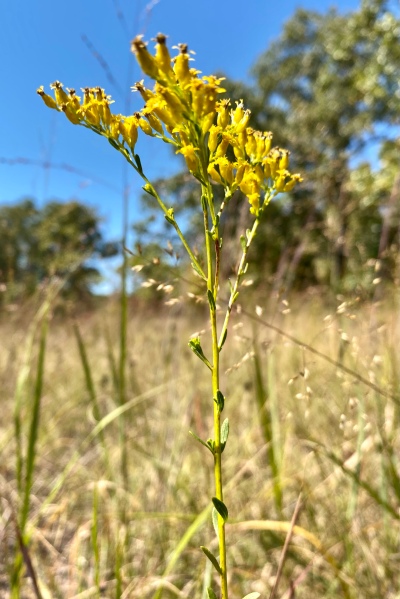
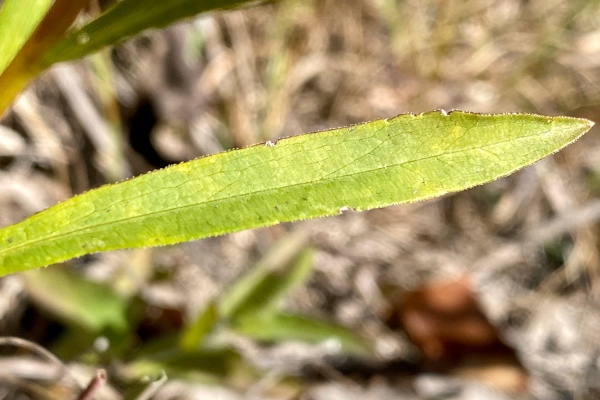
With one success already in hand, I immediately looked for other cadavers with bark to peel in search of beetles or other insects of interest. The second tree I approached seemed to just such, as I noticed a very tiny flat bug (family Aradidae) on the underside of the bark. However, as I positioned the lens over the subject, something about it didn’t look quite right, and zooming in closer revealed the bug, itself, to be a cadaver—partials remnants of a once-living individual that spent its last moments hunkered down under the loose bark. As often is the case when success come quickly, no amount of bark peeling over the next hour or so revealed beetles or other insects of any kind. With each fruitless effort, my attention increasingly wandered toward the foliage of other plants, and I eventually noticed a few patches of Solidago ulmifolia (elm-leaf goldenrod) beginning to bloom. Goldenrods are famously attractive to insects of many types, and the appearance of goldenrod in the landscape is a sure sign that summer has arrived in earnest. Most of the plants were in earlier stages of flowering, and insects observed visiting them were mostly the dreadfully pedestrian European honey bee (Apis mellifera). At one point, I noticed a few plants on which the flowers had not only peaked but were in early fruit development. While early-stage frutescences rarely attract pollinators, I noticed something on them anyway, and a closer look revealed them to be Missouri’s smallest representative of the family Coreidae (leaf-footed bugs), Merocoris distinctus. I don’t encounter this species very often—usually picking up an odd individual or two while sweeping herbaceous vegetation in high-quality prairies, so seeing half a dozen individuals congregating on a few plants was an unusual occurrence for me. Merocoris distinctus and its congeners in other areas are distinctive in their small size but chunky form and with the hind tibiae not expanded and flattened (thus, defying the family’s common name). Instead, their femora are robust and armed with small spines that once can imagine must serve some anti-predatory function. Their presence of fading flowers with developing fruits is logical, however, as members of this family are widely known to feed on the developing seeds and fruits of a variety of plants. Once again, I had the chance to photograph a seldom seen insect species engaging in natural behavior, and the presence of multiple individuals meant that I could continue my attempts with the skittish and flighty adults until, ultimately, I succeeded.


Merocoris distinctus on flower of Solidago ulmifolia (elm-leaf goldenrod).

After a couple of hours, we went back down the mountain a short distance to explore another glade that we’d seen on the way up. The core remnant was larger than what we’d seen up top due to the larger expanse of exposed rhyolite, and we immediately noticed one of the classic icons of igneous glades in Missouri—Trimerotropis saxitilis (lichen grasshopper). I’ve seen these beautiful grasshoppers—gorgeously cloaked in mottled green and black to match the lichen-encrusted rocks on which they sit—on numerous occasions, but I am nevertheless always tempted to photograph them whenever I see them and was preparing to do just that when Josh called out one of the only things that could surpass it in priority—tiger beetle! I knew it most likely was Cicindelidia rufiventris (red-bellied tiger beetle), and carefully approaching revealed this to be the case due to its dark dorsal surface but absence of a sutural row of spots on each elytron and slightly more gracile form that distinguish this species from its much more commonly encountered congener C. punctulata (punctured tiger beetle). This is another species that seems to prefer not only igneous glades but also the limestone/dolomite glades that dot the Ozark Highlands in the southern two-thirds of Missouri. I have photographed it on several occasions but nevertheless snapped a few shots while it gave a classic warm-day demonstration of thermoregulatory behaviors called “stilting” (standing tall on its front legs to raise its body above the thin layer of superheated air immediately above the rock) and “sun-facing” (facing directly toward the sun to minimize the amount of body area exposed to its direct rays).


Cicindelidia rufiventris (red-bellied tiger beetle) “stilting” and “sun-facing” on rhyolite exposure.

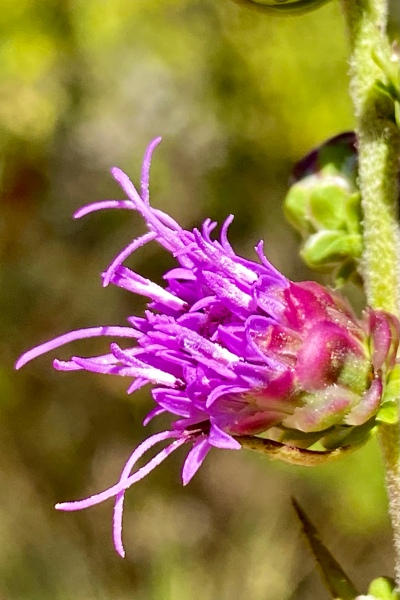
A 2-track leading from the glade led to what we hoped would be a renovated glade that was even more extensive, but despite the recent burns the area was still thickly choked with oak/sumac scrub that proved a challenge even to navigate, much less provide open space for glade-restricted plants and their insect associates. It was well past noon, so we regrouped to discuss our next move and decided to go in to town for lunch and then explore nearby Taum Sauk State Park. Casey had in the past mentioned a water pan where several interesting plants could be found, while I knew of a location where Platanthera ciliaris (yellow fringed orchid—the flowers of which are actually a beautiful shade of orange) should be getting close to flowering and that we could check their progress for planned photographs in the coming weeks. Striking stands of Liatris pycnostachya (prairie blazing star) greeted us at the parking lot and portended the even more dazzling displays that would see in many places throughout the park.

Liatris pycnostachya (prairie blazing star).

Our first foray was to the water pan near the high point, and even before reaching it the bright purple of the dense stand of L. pycnostachya colonizing it could be seen glowing through the forest understory. Despite having seen this plant in many places, primarily in prairies and along roadsides, I have never witnessed such a striking mass display of the flowers in peak bloom!

Liatris pycnostachya (prairie blazing star) in water pan atop igneous bedrock in dry oak/hickory forest.

Numerous butterflies flitted amongst the tall purple inflorescences gracefully swaying in the gentle beeezes, the largest and most conspicuous being Speyeria cybele (great spangled fritillary), Papilio troilus (spicebush swallowtail), and a strikingly fresh Papilio glaucus (tiger swallowtail) who danced tantalizingly close around the flowers as if inviting photographs.

Papilio glaucus (tiger swallowtail)

Liatris pycnostachya was not the only purple(ish)-flowered plant colonizing the water pan—Rhexia virginica (winged-stemmed meadow beauty), a denizen of moist acidic habitats, colonized the wetter areas of the water pan, its bright yellow, banana-shaped anthers contrasting nicely with its vivid purple-pink petals.

Rhexia virginica (winged-stemmed meadow beauty).

We then headed out in search of the stand of orchids (which I photographed in magnificent peak bloom last year in early August). Though more common in the southeastern U.S., in Missouri it is extremely rare, and finding the site entailed considerable off-trail bushwhacking to reach the site. At this time of year, before the plants have begun to bloom, we expected finding them would be quite difficult, but to our surprise we found numerous plants with inflorescences well developed and exhibiting tight buds. Some plants even were even beginning to develop color in the buds, and we found a single plant with two open flowers—surely among the earliest first-flower dates for the species in Missouri. Seeing this, we expect peak bloom in the next two to three weeks, and we plan to return to more fully photograph them in all their glory at that time.

Platanthera ciliaris (yellow fringed orchid).

We were able to enjoy slightly easier hiking back in the trail for a short time, during which we saw a robber fly (family Asilidae) posing nicely (and cooperatively) on a rock where David was able to photograph it. I tried to do the same, but it suddenly flew to a nearby stem where, fortunately, it settled back down and allowed me to get close enough for a few photos. The photographs enabled me to not only identify it as a female Efferia aestuans (northern hammertail) but also the reason for its relative cooperativeness—it had captured and was feeding on a much tinier fly!

Efferia aestuans (northern hammertail).

Our off trail adventures resumed quickly, however, when we decided to look for the endangered Asclepias meadii (Mead’s milkweed) in the open woodlands where it has been seen in the past. Hiking through the rough, igneous glades to get to the woodlands was itself difficult, and then searching the dense herbaceous layer of the woodlands for plants no longer in flower even more so. Ultimately, we were not successful in finding the plants, but our efforts were not unrewarded—dense stands of Phemeranthus calycinus (fame flower) with their charming hot-pink flowers daintily dotted the rhyolite exposures, and we saw several Cecropterus lyciades (hoary edge) skippers (family Hesperiidae) visiting the flowers of L. pycnostachya. This very uncommon butterfly resembles the much more commonly encountered Epargyreus clarus (silver-spotted skipper), but it is smaller and has a diffuse frosty spot reaching the edge of the hindwing. The vistas afforded from the glades at Taum Sauk are also among the best that I have seen in Missouri, especially when blazingstar is in full bloom.

Cecropterus lyciades (hoary edge) skippers on flowers of Liatris pycnostachya (prairie blazingstar).

By this time it was late afternoon, and we bushwhacked our way back to the trail. We had a difficult choice to make—turning right meant only about a mile of hiking back to the car; turning left meant having a chance to see the head of Mina Sauk Falls but perhaps closer to two even more difficult miles of hiking back to the car. We chose left! I can’t say it wasn’t worth it, because the chance to take the boots off and soak my legs in the cool water behind the shade of a large boulder was pure enjoyment, but two miles of rough hiking up the steep ascent felt like a Herculean effort—only the promise of water (and ice cream in town!) allowed me to keep the legs moving. Such times may be difficult in the moment but as memories become cherished. I’m already having fond memories of that final ascent!

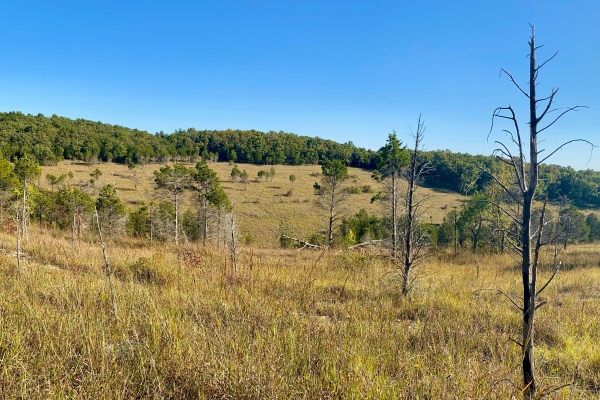
St. Francois Mountains vista from igneous glades near Mina Sauk Falls.

©️ Ted C. MacRae 2026

🌿 Botanizing w/ the WGNSS Botany Group at Victoria Glades Preserve

6 Oct 2025—Fall continues to advance in the St. Louis area, and despite very dry conditions during the past two months the fall bloomers continue to make their appearance. One of the area’s most reliable and interesting places to see fall blooms is Victoria Glades south of Hillsboro, where orchids, gentians, and asters anchor a unique suite of fall-blooming plants that are rarely seen elsewhere in our mostly forested environs.
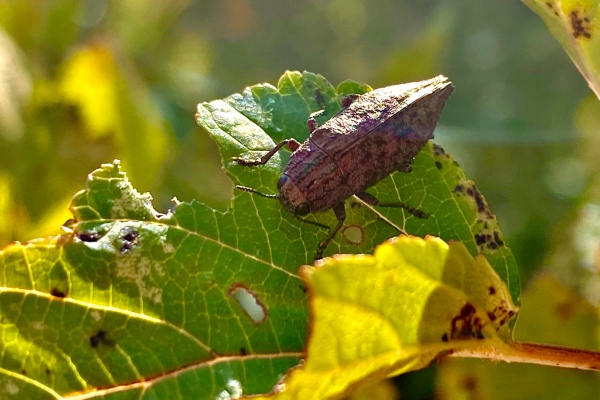
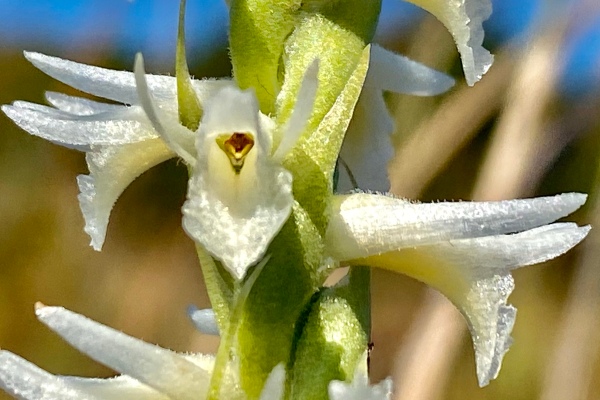
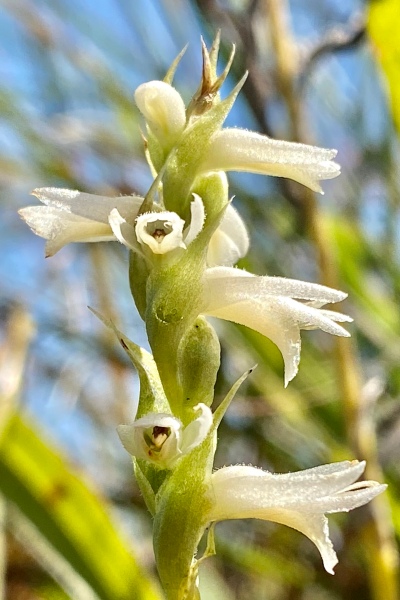
The group chose the Nature Conservancy portion of the complex to explore, as it was in the mesic forest along the riparian corridor below the glade on this side that the first of two orchids—the charmingly diminutive and seldom-seen Spiranthes ovalis (lesser ladies’ tresses)—was expected to be seen in bloom. Despite having recently taken GPS coordinates for the plants, it took several minutes of the group scouring the area around the coordinates before the tiny plants were finally found. Its delicate blooms, fall flowering season, small size, presence of basal and cauline leaves at anthesis, and preference for mesic habitats all serve to identify this species. Missouri’s populations are considered var. erostella, which lack certain essential flowering organs and are, thus, self-pollinated (cleistogamous).

Spiranthes ovalis var. erostellata (lesser ladies’ tresses—family Orchidaceae).

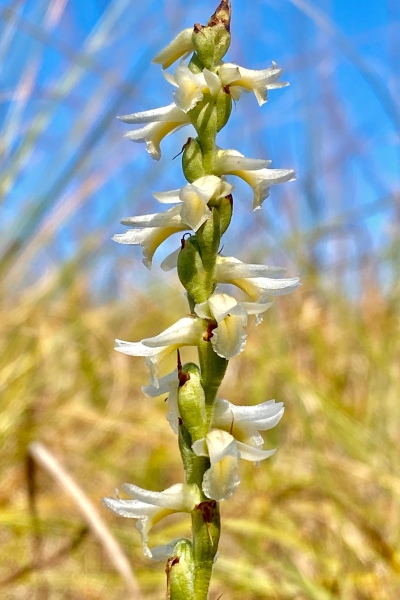
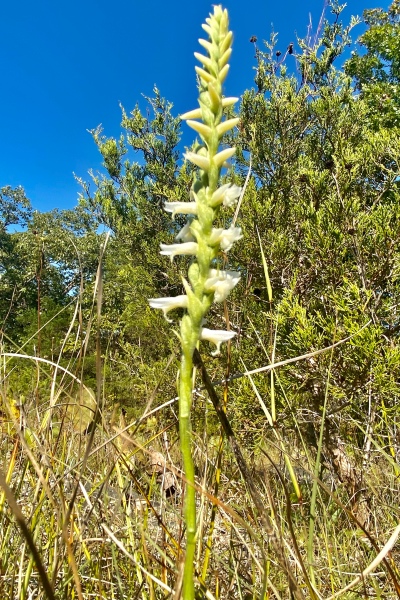
Clambering up and out of the creek bed and onto the open glade, the group found, again with some difficulty, the second orchid we were looking for—Spiranthes magnicamporum (Great Plains ladies’ tresses). Unlike S. ovalis, however, this species is much more commonly seen on dolomitic glades throughout the state, and there have been fall seasons at Victoria Glades featuring spectacular displays of it. Sadly, it does not appear that this will be one of those falls, almost surely because of the near absence of rain in recent months. The first two plants were found under and next to a cut eastern red-cedar, whose cadaver perhaps provided just enough protection to prevent a complete drying of the soil underneath and allowed the two plants to proceed to flowering. Of the nine species of Spiranthes presently known to occur in Missouri, S. magnicamporum is among the showiest due to its robust, often doubly helical inflorescences and relatively large flowers with spreading and arching lateral sepals. It is also among the most fragrant, with a sweetish fragrance of coumarin, which some people liken to vanilla.

Spiranthes magnicamporum (Great Plains ladies’ tresses—family Orchidaceae).

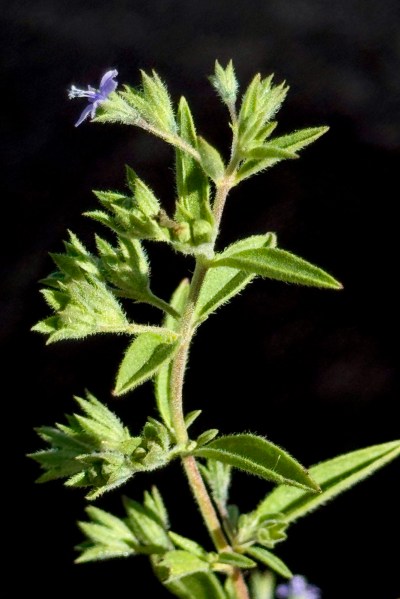
I’ve been visiting Victoria Glades for more than 40 years, yet I continue to see things I haven’t previously notified. This time it was Trichostema coeruleum (pennyroyal bluecurls), a member of the mint family (Lamiaceae). [Note: Trichostema coeruleum was known until recently as Trichostema brachiatum—now a synonym of Trichostema dichotomum.] Unlike Trichostema dichotomum (bluecurls), which prefers glades and other dry habitats with acidic substrates (e.g., sandstone), T. coeruleum prefers such habitats with calcareous substrates (e.g., dolomite). A third species of the genus, Trichostema setaceum (narrow-leaf bluecurls), also occurs in Missouri but is restricted to sand prairies in extreme southeastern Missouri.

Trichostema coeruleum (pennyroyal bluecurls—family Lamiaceae).

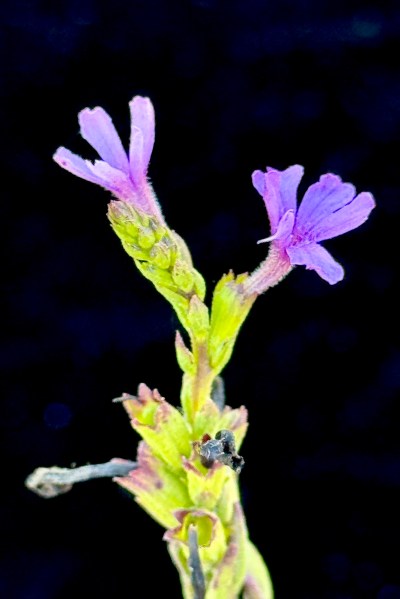
Dolomite glades are also the preferred habitat for many species of plants in the family Orobanchaceae, a bizarre family of mostly hemiparasitic plants that derive at least some of their nutrition not from the sun, but by tapping into the roots of nearby plants. Castilleja coccinea (scarlet paintbrush) is perhaps the best known of these, in most years joining the cacophony of wildflowers that form colorful displays across Victoria Glades during spring and early summer. There are, however, several less conspicuous but equally beautiful wildflowers in the family that are restricted in the area almost exclusively to the dolomite glades of Jefferson Co. One of these is Agalinis skinneriana (Skinner’s or pale gerardia/false foxglove), which the group found sporadically still in bloom across the open glade. There are several species of Agalinis in Missouri, some of which are quite common. However, A. skinneriana can usually be recognized by the characteristic habitat and generally upward-facing flowers with spreading to reflexed upper corolla lobes. The plants are also relatively slender and fewer-branched than the more common A. tenuifolia (common gerardia/false foxglove) and A. gattingeri (rough-stemmed gerardia/false foxglove).

Agalinis skinneriana (Skinner’s or pale gerardia/false foxglove—family Orobanchaceae).

Another plant in the family Orobanchaceae that the group saw was Buchnera americana (American bluehearts), represented by a single plant still bearing two worn blossoms. Normally blooming from June through September, plants in full bloom have no look-alikes and are not likely to be confused with anything else. Despite this, the vervain-like fruit-bearing structure of this late straggler fooled the group into at first thinking it was a species of Verbena until its true identity was realized.

Buchnera americana (American bluehearts—family Orobanchaceae).

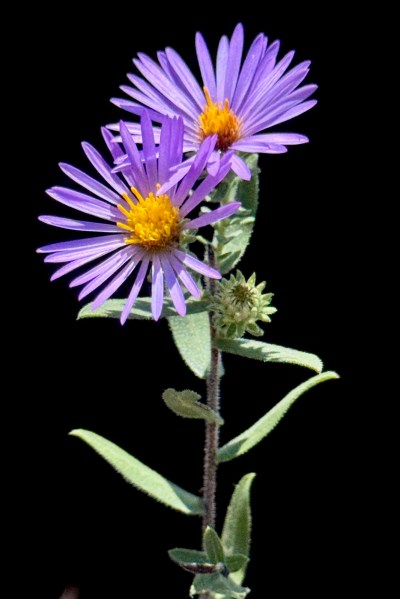
No group of plants more iconically represents fall than goldenrods (genus Solidago) and true asters (genus Symphyotrichum), and no place allows as many uncommonly seen species to be seen together as the dolomite glades. Three species of goldenrods were seen during the day—the super common Solidago nemoralis (old field goldenrod), the less common but more showy Solidago rigida (stiff goldenrod), and the highly restricted Solidago gattingeri (Gattinger’s goldenrod) (we were not able to locate a fourth species—Solidago radula [rough goldenrod], which we have observed during previous visits on the MDC portion of Victoria Glades). It was the true asters, however, that truly tested our plant identification abilities. Relatively easier are the purple asters, of which we found three species. The first and most abundant was Symphyotrichum oblongifolium (aromatic aster), recognized by its recurved phyllaries and branched habit with narrow, linear leaves that become more numerous and smaller in the upper plant. If one is still in doubt as to its identity, however, one needs only to crush the leaves between the fingers and enjoy its distinct aroma.

Symphyotrichum oblongifolium (aromatic aster—family Asteraceae).

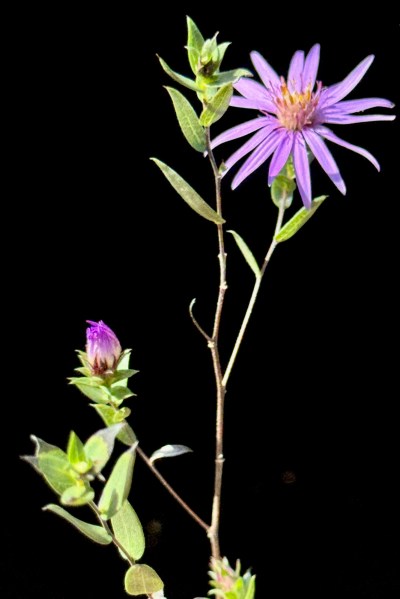
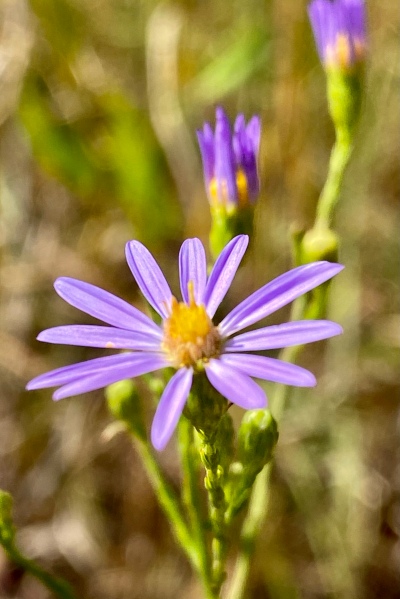
Along the intermittent creek and near the interface with the dry post oak woodland on the north of the glade, we encountered a second species—Symphyotrichum oolentangiense (azure aster). Identification of this species came only near the end of the outing, as a key identifying characteristic of this species—the presence of distinctly petiolate cordate basal leaves that are rough to the touch—was not seen on any of the plants examined before then. At that point, we suspected Symphyotrichum turbinellum (prairie aster) due to the vase-shaped involucres. While that species has been found at Victoria Glades, it is usually a much more highly branched plant associated with more wooded habitats (despite the common name). Finally, we found a plant with such leaves present, albeit dried up, and then another with the leaves present and still fresh to confirm the identification.

Symphyotrichum oolentangiense (sky blue aster—family Asteraceae).

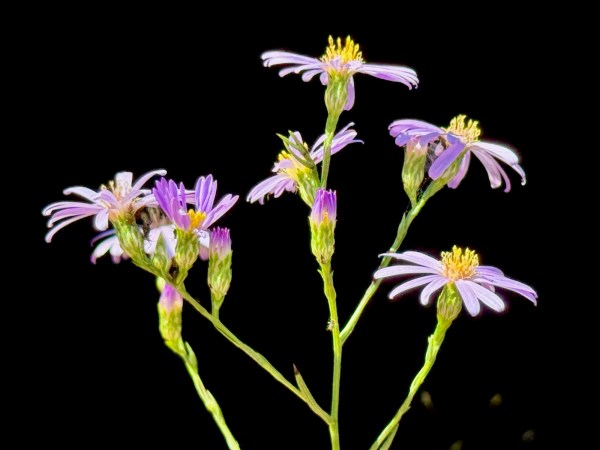
In a small area at the northernmost point of the glade, we found Symphyotrichum sericeum (silky aster). This species is immediately recognizable from afar by the silvery cast to the foliage—this, combined with its highly preferred habitat of glades or dry prairies are usually enough to identify the species, although it is said that the flowers are often more purple and less bluish than other “purple asters.”

Symphyotrichum sericeum (silky aster—family Asteraceae).

As we walked the margins of the glade, the group kept their collective eyes out for Gentiana puberulenta (downy gentian), a striking and rarely seen fall flowering species that has been found on several occasions at Victoria Glades. The species has been seen at Victoria Glades on a few occasions in past years, and the locations of these sightings were scoured thoroughly but without success. Unexpectedly, near the end of the outing, a single plant in flower was located—its perfectly fresh blossom initially hidden from view underneath fallen leaves. One of three members of the genus Gentiana in Missouri, this species is easily differentiated by having the corolla spread open at maturity. Missouriplants.com notes “The rich, deep blue color of the corollas is a striking and uncommon hue among our flora.” A strikingly beautiful final find of the day indeed, and a perfect note on which to gather for lunch at historic Russell House in nearby Hillsboro.

Gentiana puberulenta (downy gentian—Gentianaceae).

For me, no botany outing is strictly about plants (just as no entomology outing is strictly about insects), so there were a few interesting insect observations on the day. On our way to look for Spiranthes ovalis (lesser ladies’ tresses), June noticed a caterpillar on the Ulmus rubra (slippery elm) that we decided must represent Halysidotus tessellaris banded tussock moth).

Halysidota tessellaris (banded tussock moth—family Erebidae) on Ulmus rubra (slippery elm).

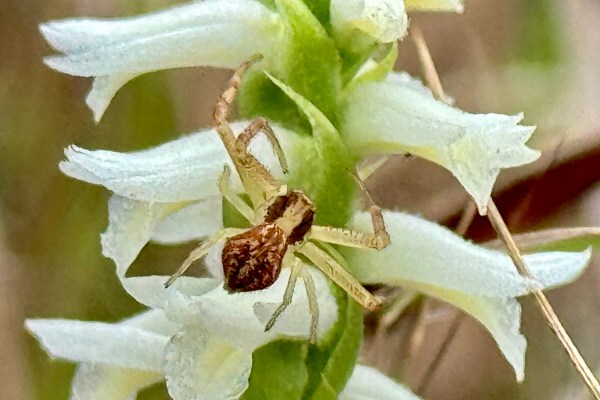
Later, after lunch with the group, I returned with the goal of more closely inspecting Physocarpus intermedius (Midwest ninebark) along the glade toeslopes and intermittent creek to see if Dicerca pugionata was out. It has been many years since I’ve seen this species in the fall (but it has also been many years since I’ve really tried to look for it during the fall). I started first with the plants along the moist toeslopes along the west side of the glade, checking several of the now very scraggly-looking plants without success. Along the way, I encountered an especially beautiful Spiranthes magnicamporum, so I paused to take photos. While doing so, I noticed a cryptically-colored crab spider on its blossoms—Mecaphesa asperata (northern crab spider)—the first time I’ve ever seen a spider hunting on the flowers of an orchid.

Mecaphesa asperata (northern crab spider—family Thomisidae) on flowers of Spiranthes magnicamporum (Great Plains ladies’ tresses).

Towards the end of the toeslopes, finally, two D. pugionata plopped onto my sheet. The plant they were on was near the far end of the toeslopes, and if I hadn’t seen any beetles by the time I reached the far end I would have given up the search. Finding them, however, motivated me to hike over to and continue looking along the intermittent creek, where I saw three more beetles in three different spots, the last one—satisfyingly—on the very last plant I checked before the creek disappears into denser woodland.

Dicerca pugionata (ninebark borer—family Buprestidae) beaten from living Physocarpus intermedius (Midwest ninebark).

Mission accomplished, I enjoyed one more leisurely stroll across the glade before calling it another (successful) day in the field.

©️ Ted C. MacRae 2025

Crane flies are insects…

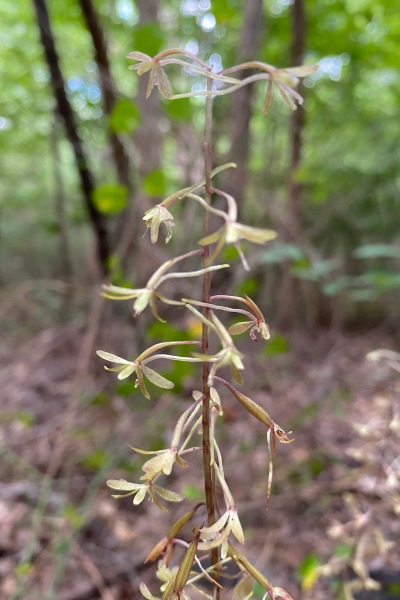
Tipularia discolor (cranefly orchid).

…but craneflies are plants—specifically, orchids, or Tipularia discolor (cranefly orchid).* This past August, the Webster Groves Nature Study Society (WGNSS) Botany Group traveled to the Mississippi Lowlands of southeastern Missouri to look for two species of native orchids, this being one of them. They were not easy to find—even with a location tip, it took a group effort to find them. But persistence paid off, and we found a patch with about 20 individual plants, most in full bloom and a few slightly past.

*One little known “rule” about common names is that the adjective and object (in this case, “crane” being the adjective” and “fly” being the “object”) are separated when the object is true and combined when the object is false or used together as an adjective for another object. Thus, flies in the family Tipulidae are called “crane flies,” because they truly are flies, while orchids of the genus Tipularia are called “cranefly” orchids because they are truly not flies and together form an adjective. Butterfly, dragonfly, and ladybug are examples of straight false objects (thus, for which the common names are compound words), while honey bee, house fly, and assassin bug are further examples of true objects (thus, for which the common names are not compound words).

Tipularia discolor (cranefly orchid).

Everybody who has ever seen this orchid talks about how hard they are to see (despite their relatively tall stature), yet nothing prepares you for just how remarkably difficult they are to see until you encounter them yourself for the first time! I believe this is because of the environment they are in—a dimly-lit forest with dappled light—combined with the lack of contrasting colors on the plants themselves.

Tipularia discolor (cranefly orchid).

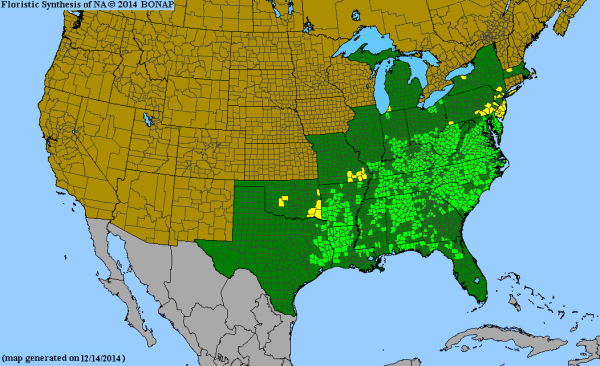
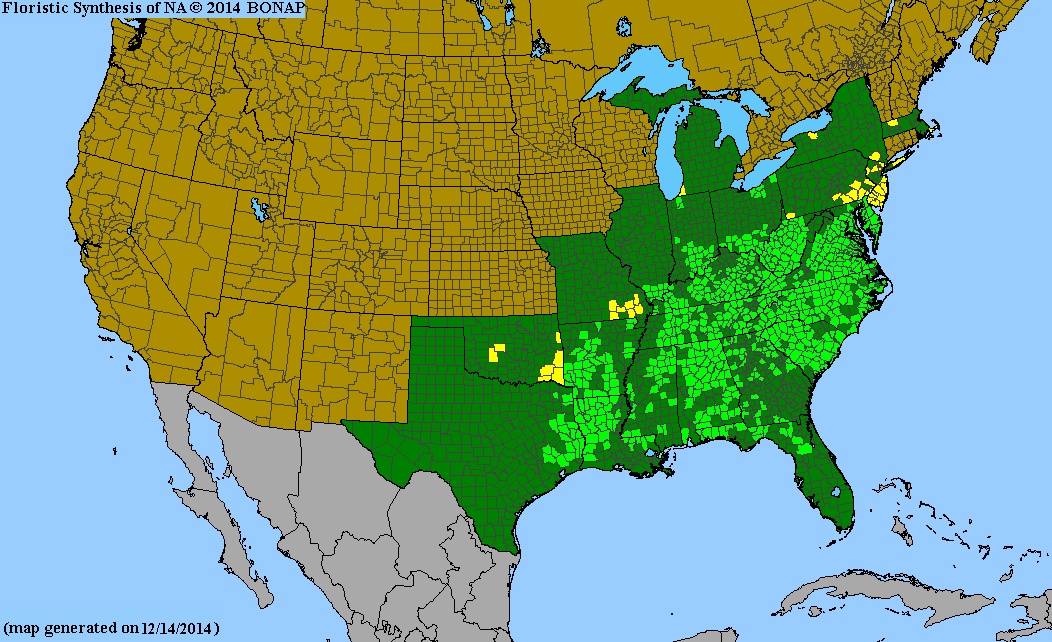
This species was not reported from Missouri until 1983, relatively recent, and while for a time it remained known in state only from the southeastern lowlands, it has more recently been reported from several counties across southern Missouri as far northwest as Hickory County. Considering how difficult the plants can be to see, it is tempting to think that this is simply a case of underreporting, but to the contrary the same phenomenon has been observed in Illinois and other states at the edge of its range, leading most botanists to conclude that the species is actually expanding its range. Of course, why this is occurring is anybody’s guess, but it is somewhat satisfying to see at least one native orchid doing well while many others are in decline.

Known distribution of Tipularia discolor (cranefly orchid). Source: BONAP (2014).

I was extremely fortunate in that I did not end up with a bad case of poison ivy as a result of photographing these plants!

Photo by Kathy Bildner.

©️ Ted C. MacRae 2021

Botanizing (again!) at Victoria Glades Conservation Area

By pure coincidence, the WGNSS Botany Group decided to visit Victoria Glades for today’s weekly field trip—just one day after I’d made my own solo visit, so for me a bonus visit! You might think that would result in me seeing the same things that I’d already seen, but unlike yesterday’s solo outing, I had the benefit of multiple pairs of eyes and solid botanical expertise accompanying me and directing my attention to several new-to-me plants.

A clump of sunflowers (Helianthus sp.) caught our attention even before we left the parking lot. Our initial impression was Jerusalem artichoke (H. tuberosus), but it lacked the alternate uppermost leaves usually found in that species. Nevertheless, when we ran it through the key and came to a choice between this species or woodland sunflower (H. hirsutus), we decided that it must be H. tuberosus. As we walked by another clump of the plants, we noticed the first insect of the day—a still-bedded-down helmeted squash bug (Euthochtha galeator), a type of leaffooted bug (family Coreidae)—on one of the older flower heads.

Helmeted squash bug (Euthochtha galeator).

On the glade proper (MDC “west” side), the group was just as excited to immediately see the Great Plains ladies’-tresses orchids (Spiranthes magnicamporum) in bloom as I was yesterday, and I couldn’t resist the urge to take just a few more photos of two of impressively flowering specimens. We also noted the now brilliant red flowering dogwoods (Cornus florida) that anchored the small woody hammocks dotting the glade and were surprised to find a total of eight “tree” species taking refuge in the hammocks, the others being Carolina buckthorn (Rhamnus caroliniana), deciduous holly (Ilex decidua), eastern red-cedar (Juniperus virginiana), dwarf hackberry (Celtis tenuifolia), sugar maple (Acer saccharum), gum bumelia (Sideroxylon lanuginosum), and persimmon (Diospyros virginiana).

Great Plains ladies’-tresses orchid (Spiranthes magnicamporum).

We made our way to the interface between the glade proper and a large dry post oak woodland hammock, where prairie gentian (Gentiana puberulenta) was found last year. As we walked, we got into a discussion about the pronunciation of the species name for Solidago gattingeri (Gattinger’s goldenrod). While “guh-TIN-jur-eye” may follow general guidelines for pronouncing latinized names, these guidelines do not apply to patronyms—i.e., scientific names derived from the name of a person, and for which the pronunciation of the person’s name is conserved in its latinized form. Since S. gattingeri was named after the German-born botanist Augustin Gattinger (pronounced “GAH-ting-er”) (1825–1903), the latinized form, which has an “i” added to the end of the name, and is thus pronounced “GAH-ting-er-eye.

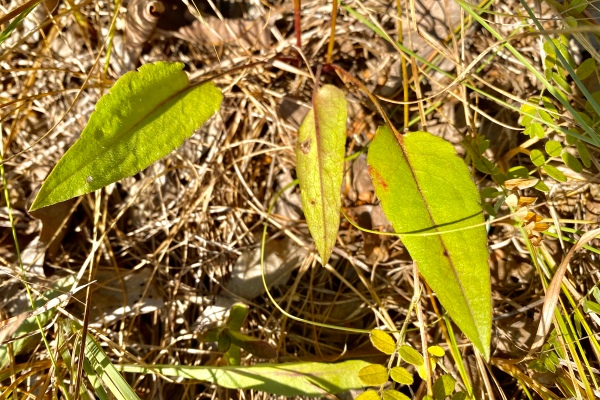
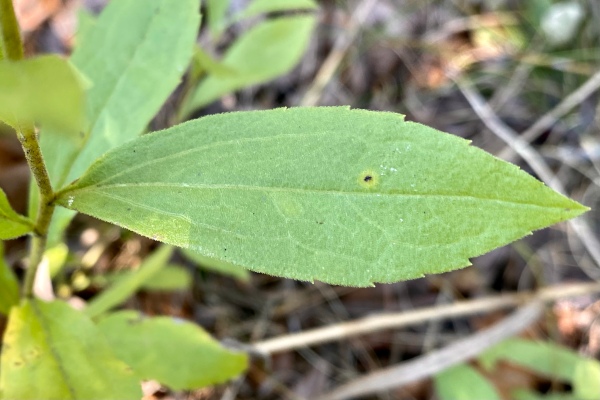
Reaching the interface and searching for the gentian would prove fruitless, but it was not without its consolations. The first of these was one of the blue asters, which we eventually determined to be azure aster (Symphyotrichum oolentangiense)—distinguished by its rough leaves with the basal ones arrowhead-shaped. This species sparked a further conversation about how to pronounce the double-o at the beginning of the name. In latinized nomenclature, all vowels must be pronounced (except the diphthongs ae and oe, both of which are pronounced “ee”). The specific epithet derives from the Olentangy River in Ohio, but the person who named the species misspelled it, adding an extra “o” at the beginning. Unfortunately, the rules of nomenclature demand that original spellings, even those considered misspellings, be conserved (unless certain special conditions are met), thus, the specific epithet must begin with a double-o, and both of them must be pronounced. Further, since it is derived from a place name, the pronunciation of “Olentangy” also must be preserved. As a result, the species name is pronounced “oh-OH-len-TAN-jee-in-see.”

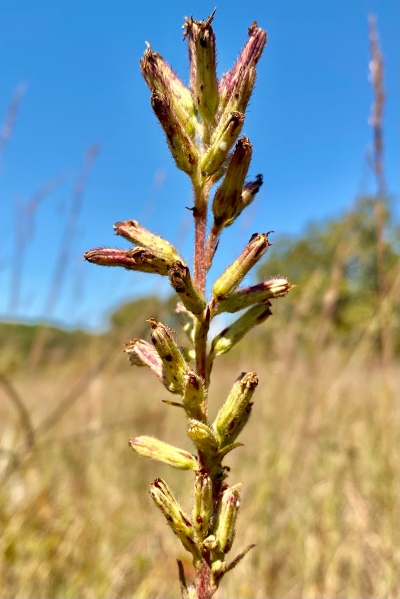
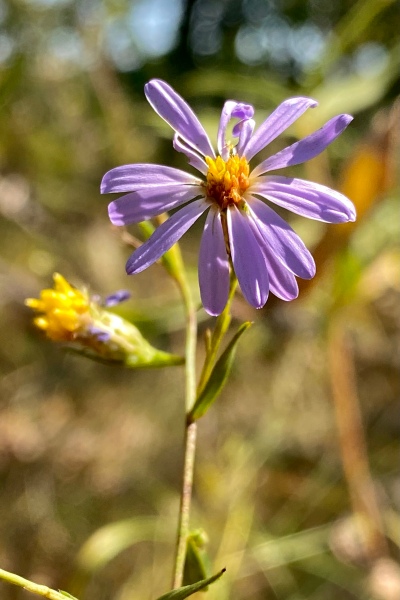
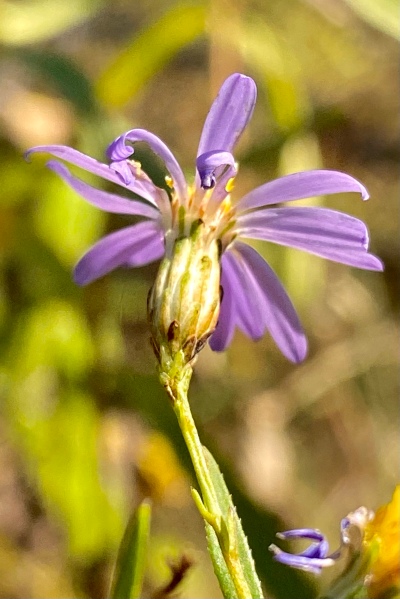
Azure aster (Symphyotrichum oolentangiense) inflorescences.
Azure aster (Symphyotrichum oolentangiense) inflorescence.
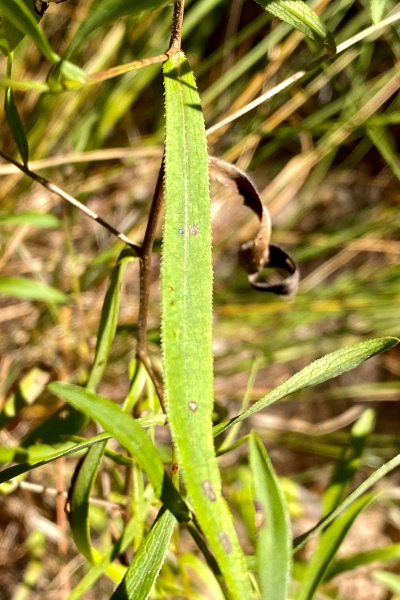
Azure aster (Symphyotrichum oolentangiense) basal leaves.

As we continued searching the glade-woodland interface, we encountered a healthy little patch of rough goldenrod (Solidago radula). Only a few of the plants bore inflorescences in good condition, but the plants were nevertheless recognizable by their small size and numerous rigid, scabrous, serrate leaves. We were pleasantly surprised to find this fairly conservative species (CC = 6), and everybody agreed that the species name is pronounced “RAD-yew-luh.”

Rough goldenrod (Solidago radula) inflorescence.
Rough goldenrod (Solidago radula) leaf.
Rough goldenrod (Solidago radula) stem/leaves.

When we reached the area where we were certain we should find prairie gentian, we instead found silky aster (Symphyotrichum sericeum)—their silvery leaves glistening in the sun and branchy stems mostly devoid of lower leaves making them visible and recognizable even from afar. This highly conservative species (CC = 9) is restricted to only a handful of states in the upper Midwest.

Silky aster (Symphyotrichum sericeum) inflorescence.
Silky aster (Symphyotrichum sericeum) upper leaves.
Silky aster (Symphyotrichum sericeum).

Once satisfied that we’d done our due diligence in our search for prairie gentian, we headed towards the top of the knoll where stiff sunflower (Helianthus pauciflorus) and rough white lettuce (Nabalus asper) have been observed in recent years. The sunflowers were found easily, though all in the apparently expanding patch were past bloom, but it took careful searching and reference to a GPS reading to find what amounted to just two, post-bloom white lettuce individuals. This latter species has a distribution centered roughly across Missouri and Iowa and is fairly conservative (CC = 7).

Rough white lettuce (Nabalus asper) post-bloom inflorescences.

As we headed back towards the parking lot, we passed through a peninsula of dry post oak woodland, giving us the opportunity to see yet another blue aster, this one being prairie aster (Symphyotrichum turbinellum). This is another fairly conservative species (CC = 6) whose distribution centers over Missouri and extends to only a few surrounding states. The elliptic leaves, branched habit, and “vase-shaped” involucre were all clues to its identity.

Prairie aster (Symphyotrichum turbinellum) inflorescence.
Prairie aster (Symphyotrichum turbinellum) involucre.
Prairie aster (Symphyotrichum turbinellum) leaf.

By then, only John and Kathy remained and were ready to call it a day, but I had a hankering to visit the TNC “east” side to check the ninebarks (Physocarpus olulifolius intermedius) that grow along the toeslopes at the interface between the glade proper and the riparian woodland below to look for Dicerca pugionata—a spectacular jewel beetle (family Buprestidae) that breeds in the plant’s woody branches. This beetle is rarely encountered throughout most of its range across the eastern U.S. but seems to be common at this location—perhaps due to the general unthriftiness of the plants growing along the toeslopes, a drier than preferred situation that may compromise their ability to fend off colonization by the beetle. The beetles can be reliably found in spring and fall by examining the stems and leaves. As I searched for the beetles, I encountered “blue aster #4” on the day—aromatic aster (Symphyotrichum oblongifolium). In the case of this species, the reflexed phyllaries, branched habit, and oblanceolate sessile leaves absent at the base were the first clues to its identity. Crushing one of the leaves and smelling its fragrance left no further doubt.

Aromatic aster (Symphyotrichum oblongifolium) inflorescences.
Aromatic aster (Symphyotrichum oblongifolium) involucres.
Aromatic aster (Symphyotrichum oblongifolium) inflorescences/upper stem.
Aromatic aster (Symphyotrichum oblongifolium) leaf.

Continuing my search for the beetles, I noticed a garden spider (Argiope sp.) in its web. Something about it did not look right for the species we normally see in Missouri—the black-and-yellow garden spider (A. aurantia), and I eventually determined it to be instead a subadult male banded garden spider (A. trifasciata). The webs of this species tend to be more hidden than those of A. aurantia, and the preferred habitat is said to be drier, which may explain why this species tends not to be seen very often compared to its more commonly encountered cousin.

Banded garden spider (Argiope trifasciata).

Eventually, I found two D. pugionata individuals perched on the outer twigs and leaves of ninebark—just as I expected, and I took comfort knowing that this rarely encountered species continues to thrive in this unique location.

Dicerca pugionata on leaf of ninebark (Physocarpus opulifolius intermedius).

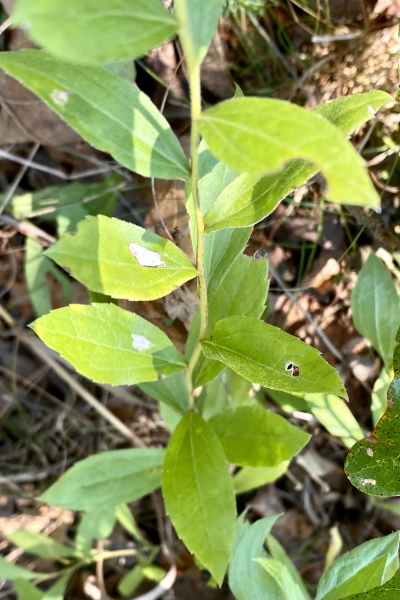
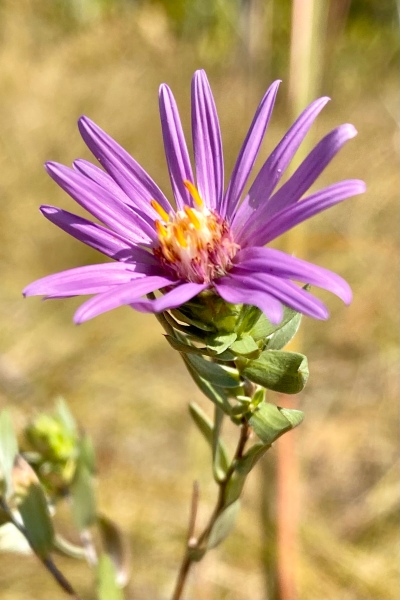
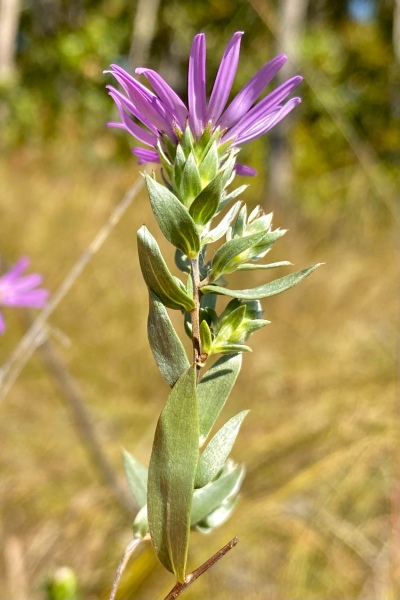
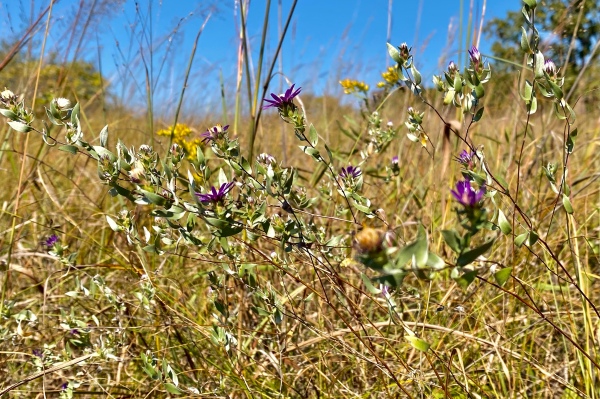
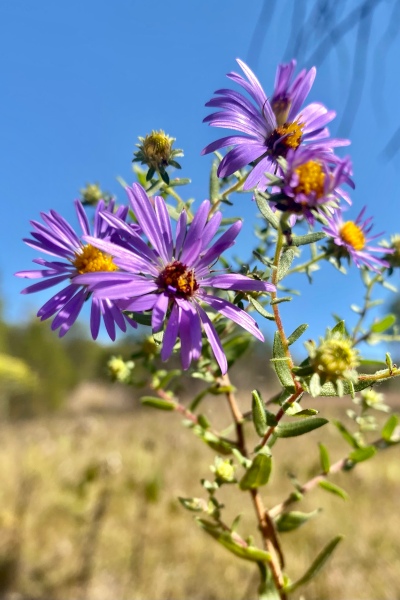
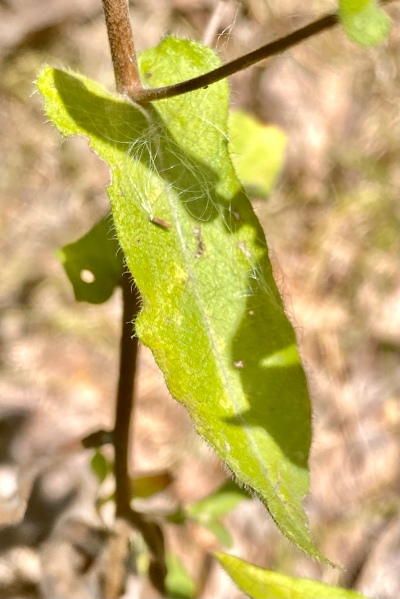
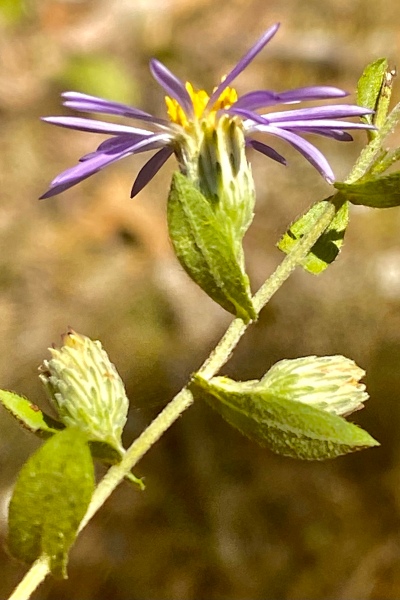
Remarkably, I would encounter one more “blue aster,” finding spreading aster (Symphyotrichum patens) as I searched around and through the dry post oak woodland at the top of the slope in hopes that I might still find prairie gentian. This species, found in Missouri only south of the Missouri River, is easy to identify (even by entomologists) by virtue of its purple ray flowers with yellow disks and strongly clasping stem leaves with distinctive rounded basal auricles.

Spreading aster (Symphyotrichum patens) inflorescences.
Spreading aster (Symphyotrichum patens) leaf.
Spreading aster (Symphyotrichum patens) involucres.

Five “blue asters” on the day, however, was enough to make this entomologist’s head spin, and with five hours in the field on a spectacular fall day, I finally headed back to the parking lot to close out the day.

©️ Ted C. MacRae 2021

Orchids blooming at Victoria Glades Conservation Area

Victoria Glades Conservation Area.

The late summer explosion of yellow composites has subsided greatly over the past week—Missouri conflower (Rudbeckia missouriensis) and rosinweed (Silphium integrifolium), and ashy sunflower (Helianthus mollis) have all gone to seed, and only sporadic still-blooming individuals of prairie dock (Silphium terebinthinaceum) and goldenrods—including old field goldenrod (Solidago nemoralis), stiff goldenrod (S. rigida), and Gattinger’s goldenrod (S. gattingeri)—can be found. Gattinger’s goldenrod, in particular, deserved extra attention, as this species has only a few known population centers and comes as close to a true Missouri endemic as any plant species in the state. It can be distinguished by its basally disposed, glaucus leaves which become very small on the upper stem and its pyramidal inflorescences radiating out from the stem in all directions.

Solidago gattingeri (Gattinger’s goldenrod).

The decline of the fall composites does not mean, however, that the glades are now without color, as vibrant purples still dot the glade perimeter in the form of Liatris asperas (rough blazingstar).

Liatris asperas (rough blazingstar).

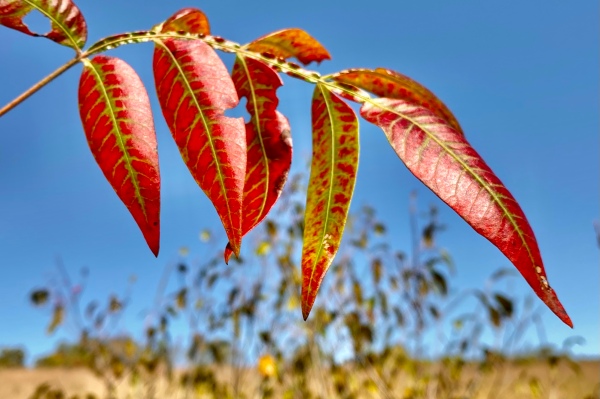
Sumacs, as well—both shining (Rhus copallinum) and fragrant (R. aromatica), and flowering dogwood (Cornus florida) have already begun turning rusty to bright red.

Shining shining (Rhus copallinum).

Nor does it mean that nothing new is coming into flower—Great Plains ladies’-tresses orchid (Spiranthes magnicamporum) are blooming for the first time this week, and I saw numerous individuals still developing their inflorescences to suggest a fantastic October display is around the corner.

Great Plains ladies’-tresses orchid (Spiranthes magnicamporum).

©️ Ted C. MacRae 2021

Orchid Valley Natural Area

This month’s destination for the WGNSS Natural History Photography Group was Orchid Valley Natural Area in Hawn State Park. This natural area is south of the main park and not normally open to the public, but we were granted permission to enter by the park administration. Our targets were several species of orchids and other rare plants that are known to occur in the area—showy orchis (Galearis spectabilis) being the one I hoped most to see.

Our group for the day (front to back): me, Lynne, David, Casey, Avery, James, Bill, and Rich (Chris behind tree at back).

There are no trails here—not even a place to park, as we squeezed our cars against the side of the road at a spot that appeared to provide good access. A bit of GPS-guided bushwhacking brought us to increasingly rough and sloping ground that ended up at the edge of a cliff overlooking one of the sandstone box canyons that this area is know for—down below was where we wanted to go. Wild azaleas lined the upper canyon edges with their stunning pink blossoms. We followed the canyon edge and found a way down, then circled back into the canyon to find a stunning waterfall, its sandstone walls dripping with mosses and ferns. We spent quite a bit of time here photographing the waterfall and surrounding area before eventually resuming the search for the orchids that we came to see.

Bill surveys a waterfall at the center of a sandstone box canyon.

The waterfall fell about 25 feet onto the sandstone rocks below, its splash creating perfect conditions for luxurious growth of mosses and ferns.

Mosses sending up their “stems” (actually setae), each holding up a capsule filled with spores.

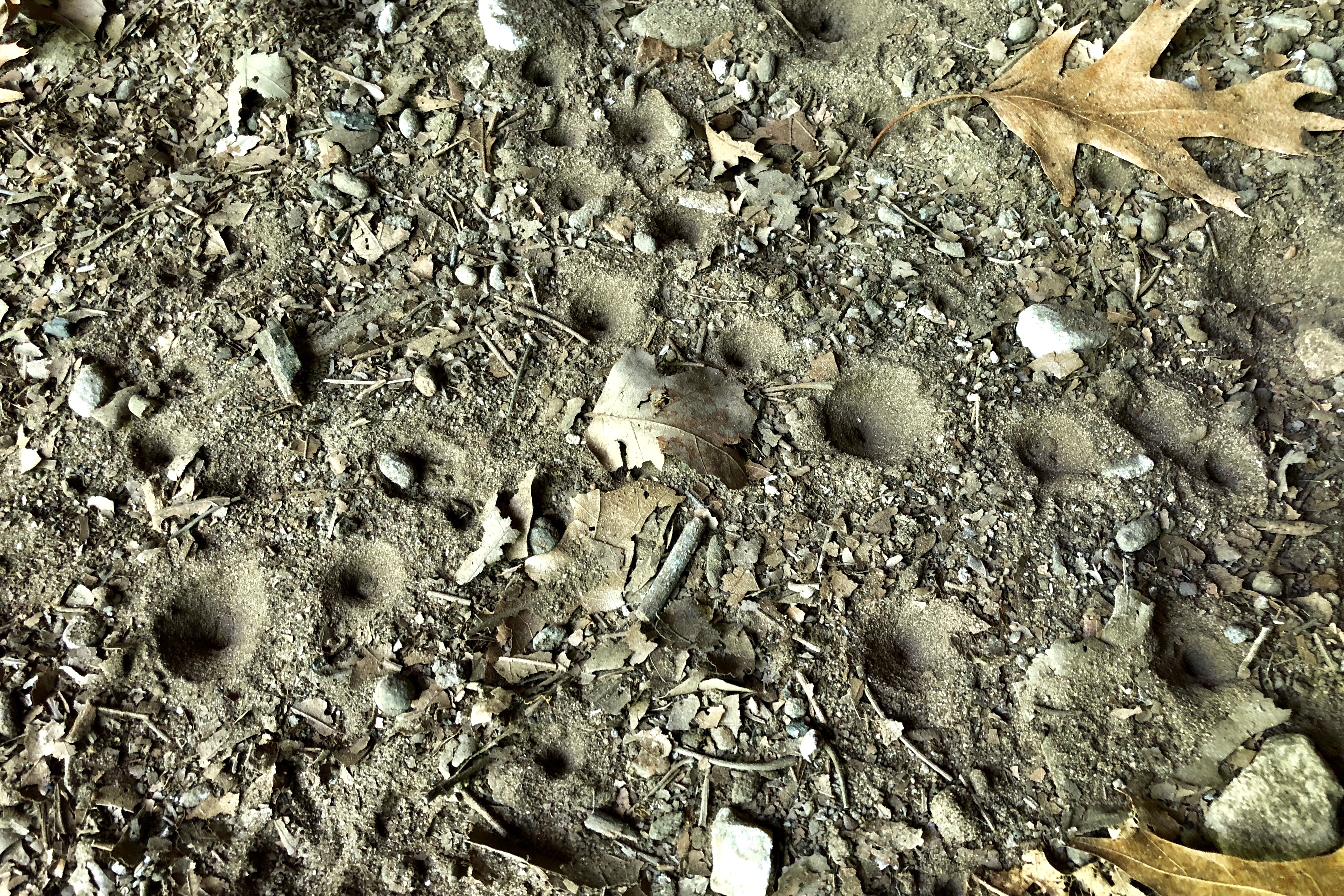
Sadly, the orchids were not yet in bloom—not even close, another victim of the cold, late spring we’ve been experiencing. Casey, our group leader, did find some very small showy orchis leaves, and we saw some nice clumps of another native orchid, rattlesnake plantain (Goodyera pubescens), an evergreen orchid that blooms during late summer. We hiked up another drainage that led to another box canyon—lacking a waterfall but equally impressive, nonetheless—but found no orchids in bloom there, either. We did, however, see cinnamon ferns sending up their spike-like fertile fronds and aggregations of antlion larvae (a.k.a. “doodlebugs”) in the soil beneath the sandstone ledges.

Leaves of rattlesnake plantain (Goodyera pubescens).

Moss growth is luxuriant in the wet sandstone exposures inside the box canyons.

Sandstone ledge above a box canyon.

Pits of antlions, or “doodlebugs”, clustered in the soil beneath a sandstone ledge. Ants and other insects that fall into the pits are quickly dispatched by the sickle-shaped mandibles of the bug lying buried at the bottom of the pit.

You might think failure to find what we were looking for would result in a disappointing field trip—far from it! Time in the field with like-minded friends in a beautiful spot is always a pleasure, and when it comes to searching for rare plants (or insects, or whatever), failure is the norm—making success, when it does come, that much sweeter. There will be other chances to see showy orchis (perhaps in a couple of weeks).

© Ted C. MacRae 2019

2019 WGNSS Nature Photo Contest

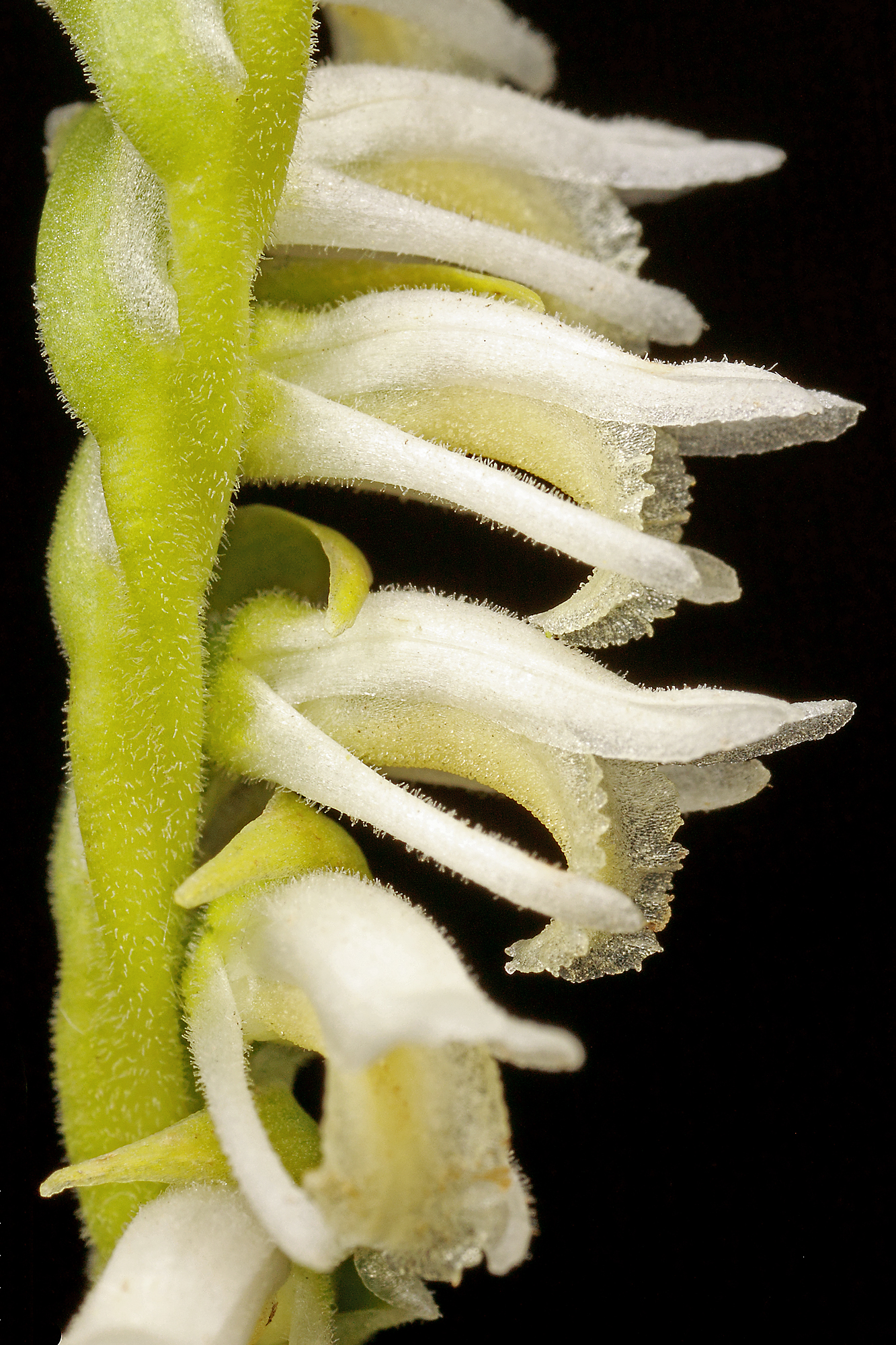
Last night the Webster Groves Nature Study Society (WGNSS) held their 2019 Nature Photo Contest, and I was fortunate to have a 1st place winner in the ‘Plants and Fungi’ category! This photograph of grassleaved lady’s tresses orchid (Spiranthes vernalis) flowers was taken at Taberville Prairie Natural Area in St. Clair Co., Missouri. Like other species of lady’s tresses orchids, their tubular flowers are arranged in a spiral along the inflorescence and cross-pollinated primarily by long-tongued bees (e.g. bumblebees, Bombus spp., and megachilid bees) (van der Cingel 2001).

Spiranthes vernalis (spring lady's tresses)

Grassleaved lady’s tresses orchid (Spiranthes vernalis), Taberville Prairie Natural Area, St. Clair Co., Missouri.

Spiranthes is one of the more complex genera of North American orchids, with seven species known to occur in Missouri (Summers 1985), and like almost all orchids, their pollination biology is fascinating! The flowers are “protandrous”, i.e., they are functionally male when they first open and become functionally female as they age. Since they open sequentially from the base of the inflorescence as it grows, this results in female flowers on the lower portion of the inflorescence and male flowers on the upper portion.  Thus, bee pollinators tend to act as pollen donors when visiting lower flowers and pollen recipients when visiting upper flowers.  Male pollinia are attached to the bee’s proboscis as it tries to access the nectar secreted into the base of the floral tube and then come in contact with the female stigma in the next flower that the bee visits.  Bees generally start at the bottom of an inflorescence when visiting a plant and then spiral up to the top before flying to the next plant.  Such “acropetal movement” is likely a result of the tendency for nectar rewards to be greater in the lower flowers, and it ultimately promotes cross-fertilization between neighboring plants.

This was the 4th edition of the contest, which has been held every other year since the inaugural edition in 2013. I’ve earned 2nd and 3rd place honors in the plants category each time before; however, this was my first win in that category. In addition to plants, I also had entries in the ‘Invertebrates’ (restricted to photos taken in Missouri or one of its contiguous states) and ‘Travel’ (open to photos taken anywhere in the world) categories, with one photo each making it to the final round of judging. You’ve seen them both before—Neotibicen superbus (below left—photographed at Mincy Conservation Area, Taney Co., Missouri) and Agrilus walsinghami (below right—photographed at Davis Creek Park, Washoe Co., Nevada). In the end, however, they both got beat out by the competition, so I only had the one winning photograph this time. Nevertheless, it was a 1st place winner, so I am very satisfied.

The WGNSS Nature Photo Contest has quickly become one of the organization’s marquee events, with the number of entries, caliber of competition, and attendance all exceeding the previous three editions. My thanks to the judges who volunteered their time, the attendees who supported the event, and especially to Bill Duncan, Chair of WGNSS’s Nature Photography Group (and an expert nature photographer in his own right), who worked hard to make this event the success that it was (and took home some well-deserved wins of his own). I look forward to the next competition in 2021!

REFERENCES:

Summers, B.  1981.  Missouri Orchids.  Missouri Department of Conservation, Natural History Series No. 1, 92 pp.

van der Cingel, N. A.  2001.  An Atlas of Orchid Pollination: America, Africa, Asia and Australia. A. A. Balkema, Rotterdam, Netherlands, 296 pp.

© Ted C. MacRae 2019

Backyard gems

I’ve been fortunate to have the chance to travel far and wide in my searches for insects—from the Gypsum Hills of the Great Plains and Sky Islands of the desert southwest to the subtropical riparian woodlands of the Lower Rio Grande Valley, tropical thorn forests of southern Mexico and veld of southern Africa. No matter how far I travel, however, I’m always happy to return to the Missouri Ozarks. It is here where I cut my entomological teeth so many years ago, and though I’ve now scrabbled around these ancient hills for more than three decades it continues to satisfy my thirst for natural history. Though not nearly as expansive as the Great Plains, there are nevertheless innumerable nooks and crannies nestled in the Ozarks, and I find myself constantly torn between looking for new spots (it would take several lifetimes to find them all) and going back to old favorites. Living in the northeastern “foothills” in the outskirts of St. Louis provides an ideal vantage for exploration; however, sometimes I am truly amazed at the natural history gems that can be found within a stone’s throw from my house. Some examples I’ve featured previously include Shaw Nature Reserve, home to a hotspot of the one-spotted tiger beetle, Castlewood State Park, where I found a gorgeously reddish population of the eastern big sand tiger beetle, and Victoria Glades Natural Area, site of the very first new species (and perhaps also the most beautiful) that I ever collected.

Englemann Woods Natural Area | Franklin Co., Missouri

Today I found another such area—Englemann Woods Natural Area, and at only 5 miles from my doorstep it is the closest natural gem that I have yet encountered. One of the last old-growth forests in the state, its deep loess deposits on dolomite bedrock overlooking the Missouri River valley support rich, mesic forests on the moister north and east facing slopes and dry-mesic forests on the drier west-facing slopes dissected by rich, wet-mesic forests with their hundreds-of-years-old trees. A remarkable forest of white oak, ash, basswood and maple in an area dominated by monotonous second-growth oak/hickory forests.

Englemann Woods Natural Area

Steep north-facing slopes border the Missouri River valley.

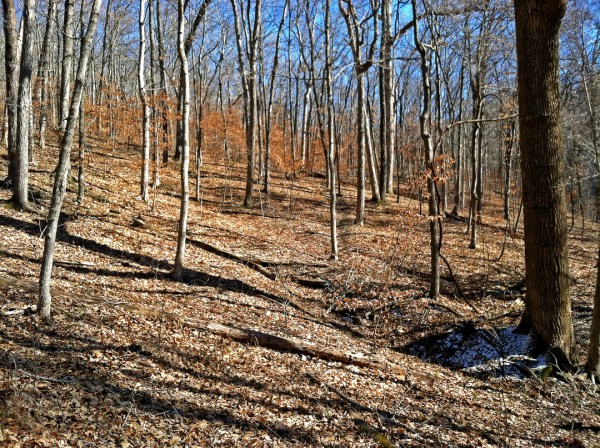
It is not, however, the 200-year-old trees that will bring me back to this spot, but rather the understory on the north and east-facing slopes. Here occur some of the richest stands of eastern hornbean (Ostrya virginiana) that I have ever seen. This diminutive forest understory inhabitant is not particularly rare in Missouri, but as it prefers rather moist upland situations it is not commonly encountered in the dry-mesic forests that dominate much of the Ozarks. Stands of this tree, a member of the birch family (Betulaceae) are easy to spot in winter due to their habit of holding onto their dried canopy of tawny-brown leaves (see photo below).

Englemann Woods Natural Area

Rich stands of eastern hornbeam (Ostrya virginiana) dominate the north- and east-slope understory.

Why am I so interested in this plant? It is the primary host of the jewel beetle species Agrilus champlaini. Unlike most other members of the genus, this species breeds in living trees rather than dead wood, their larvae creating characteristic swellings (galls, if you will) on the twigs and stems as they spiral around under the bark feeding on the cambium tissues before entering the wood to pupate and emerge as adults in spring. This species is known in Missouri from just two specimens, both collected by me way back in the 1980s as they emerged from galls that I had collected during the winter at two locations much further away from St. Louis. The presence of this rich stand of hornbeam just 5 miles from my home gives me the opportunity to not only search the area more thoroughly to look for the presence of galls from which I might rear additional specimens, but also to look for adults on their hosts during spring and (possibly, hopefully) succeed in photographing them alive.

Englemann Woods Natural Area

Inside the “hornbeam forest.”

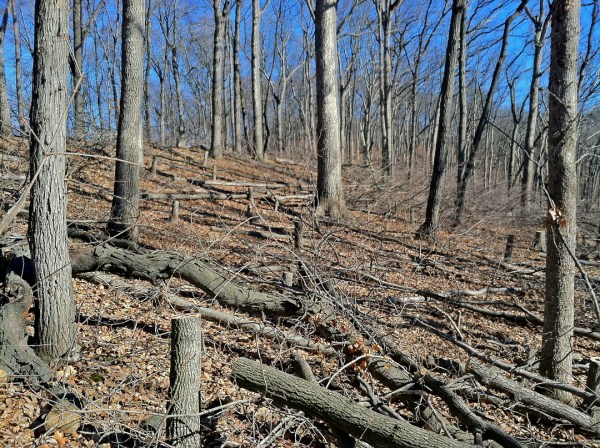
Another “draw” for me is the restoration work that has begun on some of the west-facing slopes in the areas. Pre-settlement Missouri was a far less wooded place than it is today, as evidenced by the richly descriptive writings penned by Henry Schoolcraft during his horseback journey through the Ozarks in the early 1800’s. At the interface between the great deciduous forests to the east and the expansive grasslands to the west, the forests of Missouri were historically a shifting mosaic of savanna and woodland mediated by fire. Relatively drier west-facing slopes were more prone to the occurrence of these fires, resulting in open woodlands with more diverse herbaceous and shrub layers. At the far extreme these habitats are most properly called “xeric dolomite/limestone prairie” but nearly universally referred to by Missourians as “glades”—islands of prairie in a sea of forest! I have sampled glades extensively in Missouri over the years, and they are perhaps my favorite of all Missouri habitats. However, it is not future glades or savannas that have me excited about Englemann Woods but rather the availability of freshly dead wood for jewel beetles and longhorned beetles resulting from the selective logging that has taken place as a first step towards restoration of such habitats on these west-slopes. The downed trees on these slopes and subsequent mortality of some still standing trees that is likely to result from the sudden exposure of their shade adapted trunks to full sun are likely to serve as a sink for these beetles for several years to come. I will want to use all the tools at my disposal for sampling them while I have this opportunity—beating, attraction to ultraviolet lights, and fermenting bait traps being the primary ones. It looks like I’d better stock up on molasses and cheap beer!

Englemann Woods Natural Area

Restoration efforts on the west-facing slopes begins with selective logging.

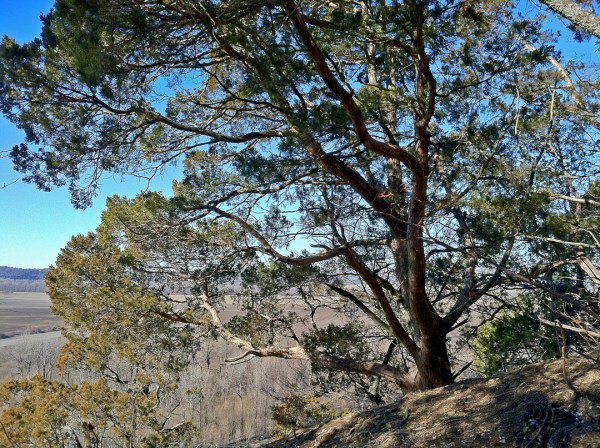
Eastern red-cedar (Juniperus virginiana) is native to Missouri, but in our time it has become a major, invasive pest tree. The suppression of fire that came with settlement also freed this tree from a major constraining influence on its establishment in various habitats around the state, primarily dolomite/limestone glades. Nowadays most former glade habitats, unless actively managed to prevent it, have become choked with stands of this tree, resulting in shading out of the sun-loving plants that historically occurred much more commonly in the state. Untold dollars are spent each year by landscape managers on mechanical removal and controlled burns to remove red-cedar and prevent its reestablishment in these habitats. There is one habitat in Missouri, however, in which eastern red-cedar has reigned supreme for centuries or possibly millenia—dolomite/limestone bluff faces.

Juniperus virginiana

Craggly, old Eastern red-cedars (Juniperus virginiana) cling tenaciously to the towering dolomite bluffs.

With little more than a crack in the rock to serve as a toehold, red-cedars thrive where no other tree can, growing slowly, their gnarled trunks contorted and branches twisted by exposure to sun and wind and chronic lack of moisture. Some of the oldest trees in Missouri are red-cedars living on bluffs, with the oldest example reported coming from Missouri at an incredible 750–800 years old. There is something awe-inspiring about seeing a living organism that existed in my home state before there were roads and cars and guns. These ancient trees are now an easy drive from my house (though a rather strenuous 300-ft bushwhacking ascent to reach the bluff tops)—they seem ironically vulnerable now after having endured for so long against the forces of nature. For me, they will serve as a spiritual draw—a reason to return to this place again regardless of what success I might have at finding insects in the coming months.

Juniperus virginiana

This tree may pre-date Eurpoean settlement.

Aplectrum hyemale

Adam-and-Eve orchid (Aplectrum hyemale).

Copyright © Ted C. MacRae 2013