GBCT Beetle #4—Crossidius hirtipes rubrescens

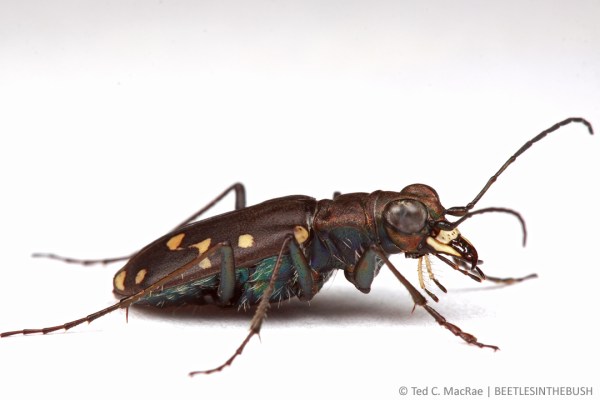
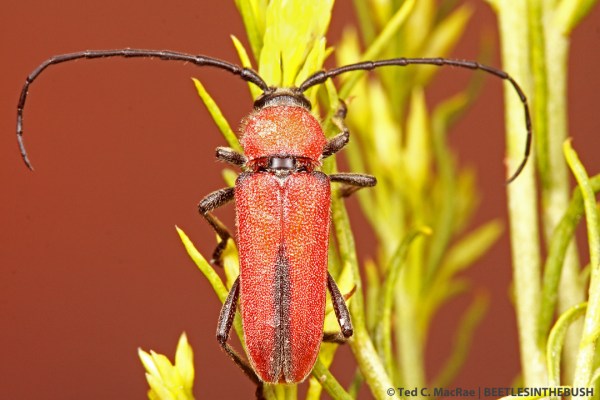
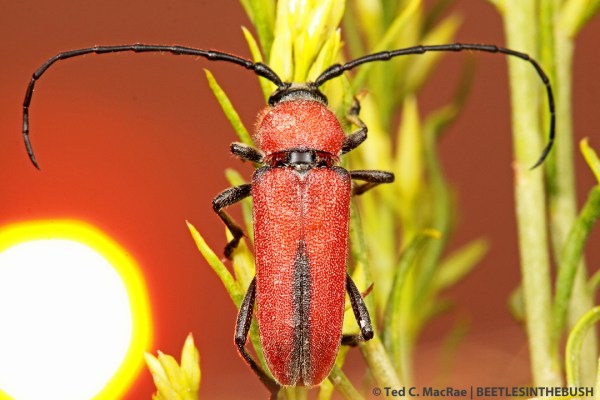
Crossidius hirtipes rubrescens (male) | Lyon Co., Nevada

Crossidius hirtipes rubrescens (male) | Lyon Co., Nevada

Linsley & Chemsak (1961) characterize the longhorned beetle species Crossidius hirtipes as “probably the most diverse species within the genus.” Occurring throughout the Great Basin and adjacent areas, the variability it expresses in punctation, color, elytral pattern and pubescence have resulted in the recognition of 16 named subspecies and numerous additional distinct but unnamed populations. During our Great Basin Collecting Trip (GBCT) in late August, we targeted ten of the named subspecies (representing the majority of populations found across the southern half of the species’ distribution) and succeeded in finding eight of them. I’ve already featured C. h. immaculatus, occurring across northern Nevada and northeastern California and the first beetle we found on the trip, and the photo above shows a male of what we consider to represent C. h. rubrescens—one of three C. hirtipes subspecies restricted to a very small area in west-central Nevada. Linsley & Chemsak (1961) described this subspecies from a series taken just north of Yearington on Chrysothamnus greenei (now Ericameria greenei), noting that it differs from other subspecies by its pinkish cast to its coloration and its pale appendages.

We almost did not find this subspecies.  We had stopped at several places along the road as we approached Yearington from the north and finally stopped at a spot 2.6 miles north of town with good stands of E. greenei. Although we found a few C. coralinus temprans on the plants, we did not see C. hirtipes. While we were searching we noticed a much smaller yellow-flowering asteraceous plant that at first we thought might be something in the genus Haplopappus but which I now believe represents a variety of Chrysothamnus viscidiflorus—the normal host plant for most subspecies of C. hirtipes (a plant voucher was collected and has been sent off for identification). We searched these plants as well but didn’t see any beetles on them, and after a while we decided we’d given the locality a good enough look and that we should move on. We began walking back towards the car, and as we approached the car I happened to look down and saw a mating pair of C. hirtipes sitting on a C. viscidiflorus flower. The pair split and bolted right when I saw them, but we managed to capture one of them and decided maybe we should look around a little more. The beetles were scarce, and another hour of searching produced only a handful—mostly in a small area further north of the area we had been searching. We then checked a couple of other nearby spots but found only a few host plants and no beetles, so we decided to go back to the site and search again. While none were seen in the original spot, we found much better stands of the plant in the adjacent area even further to the north and managed to collect a decent though not large series of adults before the setting sun caused the beetles to retreat and end our day. The individual in the photo above (recognizable as a male by its relatively longer antennae and immaculate elytra) was photographed as the setting sun turned the smoke-filled sky to a soft, burnt orange color that nicely compliments the color of the beetle.

REFERENCE:

Linsley, E. G. & J. A. Chemsak. 1961. A distributional and taxonomic study of the genus Crossidius (Coleoptera, Cerambycidae). Miscellaneous Publications of the Entomological Society of America 3(2):25–64 + 3 color plates.

Copyright © Ted C. MacRae 2013

Just another ‘bug on white’

“White box” photography seems to have become quite popular for insects during the past couple of years, and what used to be a rarely used technique for photographing insects has become rather commonplace. It’s really not that hard to do—all you need is a camera, a flash, an insect, and… um, a white box. Put the insect in the box (maybe cover it with a petri dish and turn the lights off for a bit of time until it settles down), direct the flash towards the interior of the box, and start shooting. It takes only a little bit of trial and error to dial in the proper flash direction and duration (or flash exposure compensation if you use ETTL), and the results can be dramatic, especially if you post-process to enhance levels, contrast, brightness, etc. You can even cheat a little and skip the white box if you have a good flash diffuser and don’t care that there might be a little bit of gray in the furthest reaches of the background (pleading guilty here)—just place the bug on white paper and shoot away.

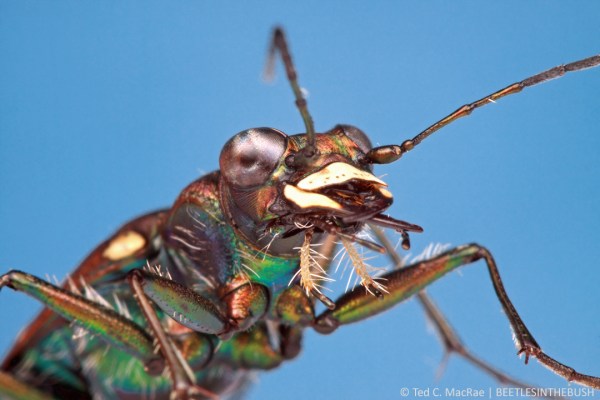
Cicindela oregona oregona | Topaz Lake, California

Cicindela oregona oregona | Topaz Lake, California

I guess I can’t complain about the new-found popularity of “bug-on-white” photography—anything that makes insects more appealing to the general public is a good thing, and the purity of the photos seems not only to enhance the appearance of the insects but actually makes them seem… well, “cleaner.” Nevertheless, I’ve only dabbled in bug-on-white photos and not gotten into the technique in a big way. The reason for this is that I still, all things being equal, prefer to photograph insects in the field in their native habitats—hopefully also exhibiting interesting natural behaviors. That is the goal, of course, but it is not always a possibility, especially when it comes to one of my favorite subject groups—tiger beetles. Photographing tiger beetles in the field is a challenge due to their extremely wary habits, swift running and rapid flight capabilities, and penchant for extreme, often hostile habitats. Many times I am up for the challenge and will spend whatever time it takes and suffer all manner of indignance to get the shot. However, there are times when there are other tasks at hand or a perfect storm of conditions makes the beetles simply impossible to approach. This was one of those times.

Cicindela oregona oregona | Topaz Lake, California


We encountered the beetle shown in these photos on the California side of Lake Topaz along its muddy southwestern banks. The beetles were not numerous—unusual for the species Cicindela oregona which can oftentimes be quite abundant along shoreline habitats throughout the western U.S. Time was at a premium, as it was supposed to be just a quick stop to see what might be found as we headed further south into Mono Co. to look for some rather spectacular longhorned beetles in the genus Crossidius unique to the area. An added difficulty was the habitat—the beetles were at the edge of a very shallowly pitched mudflat, preventing us from reaching the water’s edge without sinking deeply into the rancid mud. Between this and their scarce numbers, field photographs would have required more of an investment in time and cleanup than I was prepared to spend, so I netted a few individuals for the record and kept one alive for photographs later that night in the comfort of my hotel room.

xxx

One of the nice things about bug-on-white photographs is the ability to get a variety of carefully executed compositions from the most optimum vantage point. Lateral profile shots are almost a requirement, as are shots with the head of the insect slightly turned towards the lens. Of course, I cannot photograph a tiger beetle and not take the perfectly centered, full-on face shot. In all of these cases, the ability to get the camera truly “down” on the subject’s level means that I can maximize the use of low perspective, and nowadays I don’t even bother with dorsal shots that might be good for some future field guide but that I find really quite boring in their aesthetics.

xxx

In fact, you can even take the low perspective to the extreme by actually elevating the subject and coaxing it towards the edge of its platform to allow photography from below. Compare the above frontal portrait of the beetle, taken from a particularly extreme low perspective, with the photo above it, taken at the same level as the subject. Both photographs provide an interesting and aesthetically pleasing perspective, but in very different ways despite the small change in the angle of the camera—the upper photo is pleasing due more to the symmetry of the composition, while the lower photo derives its interest in the unusual perspective that highlights the setose mouthparts and bulging eyes.

xxx

I have long wanted to photograph a tiger beetle with blue sky background (hat tip to Thomas Shahan for giving me that idea during the inaugural BugShot). Sadly, I have not succeeded in doing this. The main problem is in trying to get an extremely wary subject in just the right place at the right time. Since these beetles occur on the ground rather than being elevated on foliage (at least under normal circumstances in the U.S.), one must find a spot where the ground drops sharply enough to allow the photographer to get below the subject, and then somehow get the tiger beetle to pose right at the edge of the precipice. The above photograph is sort of a simulation of the kind of photo I am striving for, achieved in this case by (are you ready for this?) hanging a pair of blue underwear behind the subject, which is sitting on a piece of white paper placed at the edge of the table. The combination of “blue-sky” and bug-on-white techniques is interesting, but don’t think I’ll be able to rest until I have succeeded in a true field version of this photograph. If anyone manages to achieve this before I do, please let me know how you did it (in exchange for me having given you the idea :)).

Copyright © Ted C. MacRae 2013
Under Blood Red Skies

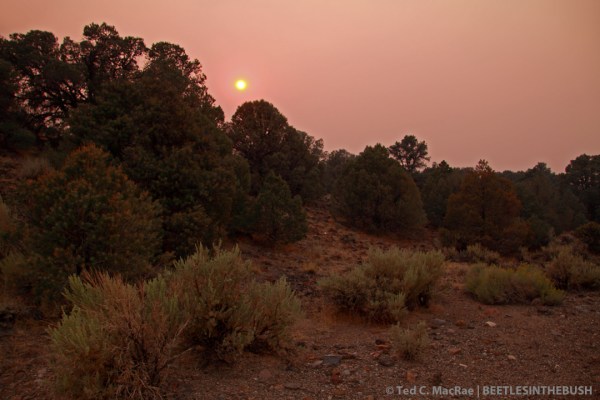
At the start of my recent Great Basin collecting trip, I found myself presented with a rather unique and unanticipated photographic opportunity. As I landed in Reno, Nevada, the then 6-day old Rim Fire was already well on it’s way to becoming the largest wildfire on record in the California Sierra Nevada. As acre after acre of the Sierra’s dramatic coniferous forest succumbed to the blaze, an enormous plum of smoke drifted northward for several hundred miles over eastern California and western Nevada, blanketing the area in a thick haze that turned the sun’s hot glare to a soft glow and limited visibility to under a mile. It was like a thick overcast foggy day, only without the cool, damp humidity. This was of little consequence to our business at hand—collecting beetles (although it did make pointless most attempts to photograph the area’s stunning landscape). At day’s end, however, a dramatic transformation took place in the sky as the sun sank lower and lower, turning to an increasingly red globe as it strained to shine through the ever thicker layer of smoke and haze. Then, for a few brief moments, the sun floated—a dark red globe under blood red skies—before the thick bottom layers of haze finally extinguished its fading light.

I’ve just begun trying to incorporate setting suns into my photography, having made to this point only a few attempts over Midwestern landscapes. I’m not really sure what gave me the idea, but I thought it might be fun to try incorporating the spectacular sun and unusual sky I was seeing as backgrounds in full-flash insect macrophotographs. Perhaps it seemed a logical progression from the natural sky background macrophotographs that I’ve put a lot of effort into perfecting this year. It was certainly a learning experience, but the basic principle is the same as it is for blue sky background—finding the right combination of camera and flash settings to balance flash illumination of the subject with ambient illumination of the background. The most difficult thing was, surprisingly, getting the sun in the desired position within the composition, as it does not appear through the viewfinder as the discrete ball that is seen in the photos. Rather, it appears as a large, amorphous, blinding flash that comes and goes as one pans across it, leading to a lot of guesswork regarding its actual position within the composition.

I gave a sneak preview of one of these photos in Sunset for another great collecting trip, and several of the photos I’ve shared since then have featured the remarkably colored sky in the background. Here are some other attempts that I was happy with:

Agrilus walsinghami (female) | Washoe Co., Nevada

Agrilus walsinghami (female) | Washoe Co., Nevada

Agrilus walsinghami (male) | Washoe Co., Nevada

Agrilus walsinghami (male) | Washoe Co., Nevada

Crossidius coralinus temprans (male) | Pershing Co., Nevada

Crossidius coralinus temprans (male) | Pershing Co., Nevada

Initially hot yellow (previous photo), the sun turns to soft yellow...

Initially hot yellow (previous photo), the sun turns to soft yellow…

...then yellow-red...

…then yellow-red…

...and finally blood-red!

…and finally blood-red!

Crossidius hirtipes macswainei (female) | Lyon Co., Nevada

Crossidius hirtipes macswainei (female) | Lyon Co., Nevada

Sunset over Toiyabe National Forest | Lyon Co., Nevada

Sunset over Toiyabe National Forest | Lyon Co., Nevada

Gray rabbitbrush (Ericameria nauseosa) | Lyon Co., Nevada

Gray rabbitbrush (Ericameria nauseosa) | Lyon Co., Nevada

Copyright © Ted C. MacRae 2013
Twig tethered to a twig

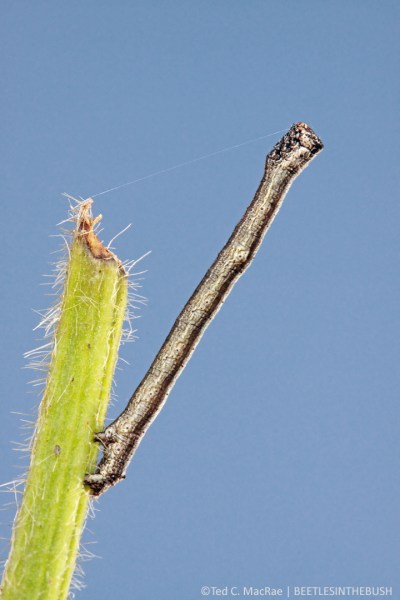
Geometrid larva (subfamily Ennominae?) | Plymouth, North Carolina

Geometrid larva (subfamily Ennominae?) | Plymouth, North Carolina

In September I visited soybean field trials across the southeastern U.S. It’s a trip I’ve done every year for the past I don’t know how many years and one that I enjoy immensely due to the opportunities it gives me to see the country, kick the dirt with academic cooperators, sample the local cuisine… and photograph insects. New for me this year was the Carolinas, and in a soybean field in Plymouth, North Carolina I encountered this geometrid larva on the stub of a soybean leaf petiole. Geometrid larvae are known variously as inchworms, cankerworms, spanworms, measuring worms, loopers, etc., depending on the species. Most of the common names refer to the same thing that the family name does—the larval method of locomotion whereby the caterpillar—possessing legs only at the two extremes of its body—”inches” its way along as if measuring the ground it walks on (Geometridae is derived from the Latin geometra, or “earth-measurer”). The resemblance of the larvae of many species to dead twig stumps is nothing short of remarkable, and had it not been for the contrasting coloration I may never have noticed the larva in the first place. I also did not notice until looking at it through the macro lens of my camera the tether attached by the larva to the tip of the twig—invisible to the naked eye but providing energy-saving stabilization for the larva to hold its cryptic position.

I’ve not encountered a geometrid larva in soybeans before, and my impression has been that they are largely deciduous tree feeders (perhaps due to the periodic occurrence in my area of outbreak species such as fall cankerworm). In trying to determine the species, I found no geometrids covered in the Higley & Boethel (1994) handbook on U.S. pests, and when I consulted the Turnipseed & Kogan (1976) and Kogan (1987) global reviews of soybean pests I found reference only to a few minor pests in India and southeast Asia. Hmm, time for BugGuide. Of course, lepidopteran larvae are not nearly as well represented as the adults, but it seemed most similar to species of the subfamily Ennominae, so I turned to Google and searched on “Ennominae soybean.” This turned up Passoa (1983), who reported larvae of Anacamptodes herse as pests of soybean in Honduras (and mentioned references to several other geometrid species associated with soybean in Brazil). Back to BugGuide, where I found the genus Anacamptodes listed as a synonym of Iridopsis, but the species I. herse was not among the list of species represented in the guide. Checking the link provided at the site to a revision of the genus by Rindge (1966) revealed that I. herse is strictly a Central American species. Perhaps another, North American species of the genus also favors soybean, which led me to Wagner (2005) who mentions soybean as a favored food plant for I. humilis. However, the contrasting purple-brown/yellow-green coloration and relatively thickened body of that species are quite unlike this individual. I don’t have Wagner’s book (only his smaller one on caterpillars of eastern forests—no match in there, either), so it may be that my only remaining option is to post the photo at BugGuide and hope that David Wagner encounters it (actually I should get David’s book anyway)¹.

¹ Update 10/5/13 11:30 am CDT—or hope that Brigette Zacharczenko runs into the post via Facebook and offers to pass it along to Dave during their lab meeting on Monday.

REFERENCES:

Higley, L. G. & D. J. Boethel [eds.]. 1994. Handbook of Soybean Insect Pests. The Entomological Society of America, Lanham, Maryland, 136 pp. [sample pages].

Kogan, M. 1987. Ecology and management of soybean arthropods. Annual Review of Entomology 32:507–538 [pdf].

Passoa, S. 1983. Immature stages of Anacamptodes herse (Schaus) (Geometridae) on soybean in Honduras. Journal of The Lepidopterists’ Society 37(3):217–223 [pdf].

Rindge, F. H. 1966. A revision of the moth genus Anacamptodes (Lepidoptera, Geometridae) (1966). Bulletin of the America Museum of Natural History 132(3):174–244 [pdf].

Turnipseed, S. G. & M. Kogan. 1976. Soybean entomology. Annual Review of Entomology 21:247–282 [pdf].

Wagner, D. L. 2005. Caterpillars of Eastern North America: A Guide to Identification and Natural History . Princeton University Press, Princeton, New Jersey, 496 pp. [Google eBook].

Copyright © Ted C. MacRae 2013

GBCT Beetle #3—Crossidius coralinus temprans

On Day 2 of our late August Great Basin Collecting Trip (GBCT), we headed east from Reno towards Fallon (Churchill Co.) and surrounding areas of western Nevada. Our quarry on this day was one of the spectacular Crossidius coralinus subspecies—in this case C. c. temprans. This subspecies was described by Linsley & Chemsak (1961) from large series of specimens collected in Lassen Co., California, but also mentioned were specimens from several locations in west-central Nevada. This material was not included in the type series because of the disjunct distribution but was otherwise not distinguished from the temprans populations, and for us the drive to Churchill Co. was much more feasible logistically than Lassen Co.

Crossidius coralinus temprans (female) | Churchill Co., Nevada

Crossidius coralinus temprans (female) | Churchill Co., Nevada

The female in the photo above is the first individual I encountered at the first stop we made to look for them—a swale about 12 miles west of Fallon in which we noted thick stands of gray rabbitbrush (Chrysothamnus nauseosus) in the early stages of flowering. It was still fairly early in the day, and though we scoured the area thoroughly only a few individuals were seen. The female exhibits some of the main characteristics that set this subspecies apart from the other red/black coralinus subspecies, including the faint bluish overtones, the deep red color, the relatively fine but dense elytral punctation, and its smaller average size. Females in particular exhibit a uniform, broadly expanded black pattern on the elytra that extends along the suture to at least the basal third of the elytra and also possess broadly black humeri connected by a black basal band.

A male from Churchill Co. shows reduction of elytral markings relative to females.

A male, also from Churchill Co., shows reduced elytral markings compared to females.

We had better luck finding individuals in the area 10–15 miles south of Fallon. I’m not sure whether this was due to actual greater abundance or the fact that it was now late morning and temperatures had warmed since our first stop. Nevertheless, we found a mating pair on one of the plants that I had hoped to photograph, but the female got skittish and took flight. Normally when one partner flees the other one does as well, but for some reason the male stayed put—nicely perched on top of the plant—and allowed me to take some photographs. Because I had already disturbed the female, I was pretty sure any attempted handling of the plant to position it with the sky in the background would cause the male to flee as well, so I photographed it as it sat—messy background and all. Still, the male shows the typical characters for males of the subspecies, in particular the faintly bluish dark pattern that is slightly expanded laterally and tapers anteriorly along the suture to the basal one-third of the elytra.

Lateral profile of the male shows a hint of black at the elytral base.

Lateral profile of the male (same individual as above) shows a narrow black band at the base of the elytra.

This lateral shot of the same male was taken, in part, to get an angle that allowed for a cleaner background, but it also more clearly shows the very narrow black band at the base of the elytra that connects the humeri, though the black markings are not as broad as in the female. After photographing this male, we found a spot near Carson Lake where the rabbitbrush was common not just along the road, but in the adjacent rangelands and along dikes adjacent to the wetlands surrounding the lake. There we found pretty good numbers of adults and worked the area for a couple of hours until we had adequate series.

This male from Pershing Co., Nevada has the elytral marking reduced to a narrow sutural stripe.

This male from Pershing Co., Nevada has the elytral markings reduced to a narrow sutural stripe.

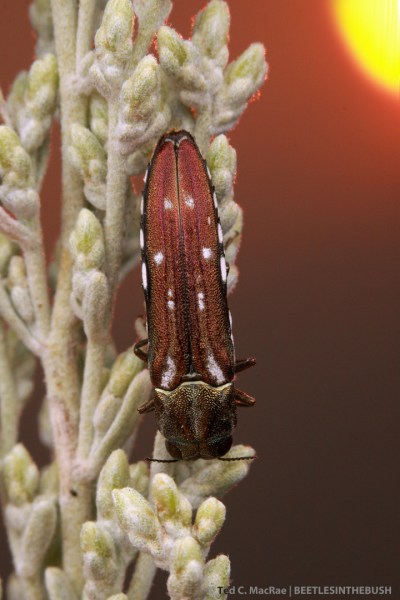
Another reason for going east on this day was to take a shot at C. hirtipes bechteli, a subspecies known from only a few localities along the I-80 corridor in north-central Nevada. The westernmost locations were close to Lovelock—a 90-minute drive from where we were, so when we finished up in the area around Fallon we headed towards Lovelock. We knew finding this subspecies was a long shot, since all of the records in Linsley & Chemsak (1961) were from mid- to late September, but since making the effort didn’t impact our ability to arrive at the first planned stop the next day at a decent hour we had nothing to loose by looking for it. We found one of the localities, but the plants at this relatively higher altitude site were still in the earliest stages of bloom, and we didn’t see any adults within about a half-mile stretch of roadside. The effort, however, was not for naught (I love saying that!), as the lateness of the hour and a heavy blanket of smoke from the nearby Rim Fire created a most beautiful blood red sky. Before the day slipped away completely, we stopped at a spot closer to Lovelock to see if we could find a C. coralinus temprans adult to photograph against this unusual backdrop and were immediately rewarded with the fine male shown in the photograph above. Sitting against this marvelous background, the male shows a much reduced black elytral marking that is sometimes the case with males of this subspecies. I hurriedly took as many shots as I could (getting that one photo that I really like is, for me, still a numbers game), but the conditions were fleeting and within a short time it became too dark to take any more.

REFERENCE:

Linsley, E. G. & J. A. Chemsak. 1961. A distributional and taxonomic study of the genus Crossidius (Coleoptera, Cerambycidae). Miscellaneous Publications of the Entomological Society of America 3(2):25–64 + 3 color plates.

Copyright © Ted C. MacRae

Cover Photo—The Coleopterists Bulletin 67(3)

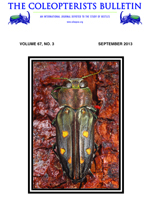
cso67-3co14.inddI hope you’ll all take note of the cover photo on the September 2013 issue of The Coleopterists Bulletin (vol. 67, no. 3), which just arrived in my mailbox. It features the adult jewel beetle, Chrysobothris octocola, that I found in September of last year at Gloss Mountains State Park (Woodward Co., Oklahoma) on a dead branch of mesquite (Prosopis glandulosa). That was a significant find, as it proved to be a new state record for Oklahoma. This is the second straight issue of the journal to feature one of my photos (the  featured the beautiful, metallic green weevil, Eurhinus cf. adonis, which I photographed in Argentina on flowers of Chilean goldenrod (Solidago chilensis).

Ironically, there are no articles in this issue about jewel beetles, but there are two articles covering my other main group of interest, the longhorned beetles, including a generic revision of Prionacalus by Antonio Santos-Silva and colleagues and a preliminary checklist of the Cerambycidae and Disteniidae of Alabama by Brian Holt. The Prionacalus revision appears to be everything we have come to expect from a modern taxonomic revision, complete with detailed taxonomic history and descriptions, key to species, and all species figured by line drawings and high quality photographs (including many of the primary types). Like most taxonomic works, it suffers from a lack of associated natural history information—not a fault of the authors, as such information is almost always lacking for all but the commonest of species in the Neotropics. The situation is a little better for Nearctic species, and the Holt checklist, happily, includes basic host plant associations for most of the species found within the state. I’ll be busily updating my database of distributional and host plant records for North American Cerambycidae from this work over the next week.

If you are not already a member of The Coleopterists Society, consider becoming a member. Not only is The Coleopterists Bulletin included with your membership, but you will also gain online access to archival and recent issues of the journal via JSTOR and BioOne.

REFERENCES:

Holt, B. D. 2013. A preliminary checklist of the Cerambycidae and Disteniidae (Coleoptera) of Alabama. The Coleopterists Bulletin 67(3):241–256 [abstract & references].

Santos-Silva, A., Z. Komiya & E. H. Nearns. 2013. Revision of the genus Prionacalus (Coleoptera: Cerambycidae: Prioninae: Prionini). The Coleopterists Bulletin 67(3):201–240 [abstract & references].

Copyright © Ted C. MacRae 2013

Sunday Spider: Backlit Araneus

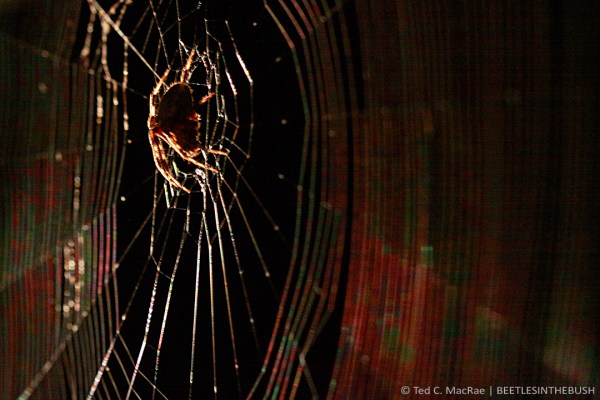
Araneus sp. | Wildwood, St. Louis Co., Missouri

Araneus sp. | Wildwood, St. Louis Co., Missouri

Letting the dog out tonight, I encountered this spider—presumably in the genus Araneus—who had strung up her web in the corner of the doorway and was eerily backlit when I turned on the porch light. Without a tripod that would allow me to position the camera about 7′ above the floor and make use of a super long exposure, my only option for capturing the scene hand-held was to crank the ISO all the way up to 3200, ratchet down the shutter speed to 1/20th sec, and open up the aperture to f/5.6 (any lower and the shallow depth of field would have been unacceptable). Heavy-handed processing to reduce noise and increase sharpness yielded a serviceable photo; however, I’ve been thinking about getting a tripod lately, and the chance to produce much better versions of scenes like this only strengthen those thoughts.

Copyright © Ted C. MacRae 2013