Orange and black on gold

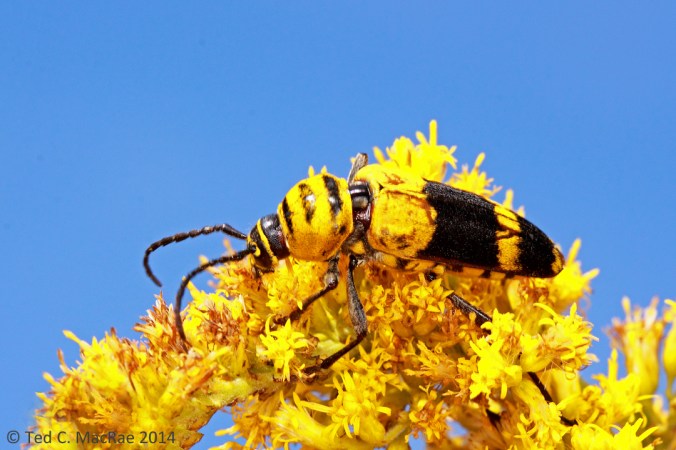
Trigonopeltastes delta on goldenrod (Solidago sp.) flowers | Stoddard Co., Missouri

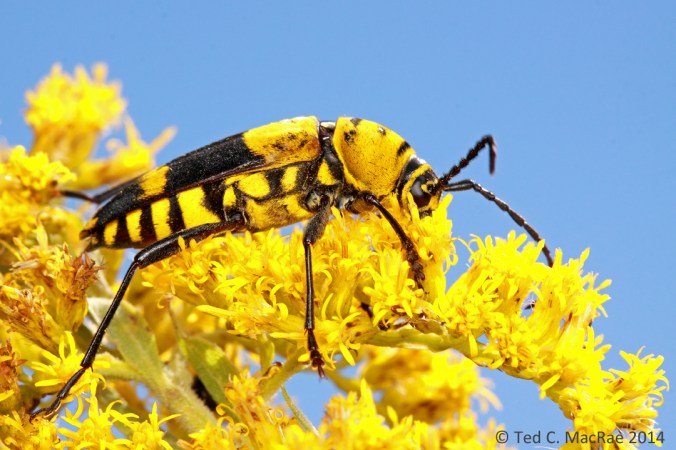
Trigonopeltastes delta on goldenrod (Solidago sp.) flowers | Stoddard Co., Missouri

The spectacular amorpha borer, Megacyllene decora, was not the only black-and-gold colored beetle that I saw on the flowers of goldenrod (Solidago sp.) a few weeks ago. In addition were several delta flower scarabs, Trigonopeltastes delta. This species is much more commonly encountered than the amorpha borer—not only geographically but also throughout the season on a greater diversity of flowers. Nevertheless, I had failed in my previous attempt to photograph the species at the very same locality just a few weeks earlier due to the much higher summer temperatures and resultant flightiness of the beetles.
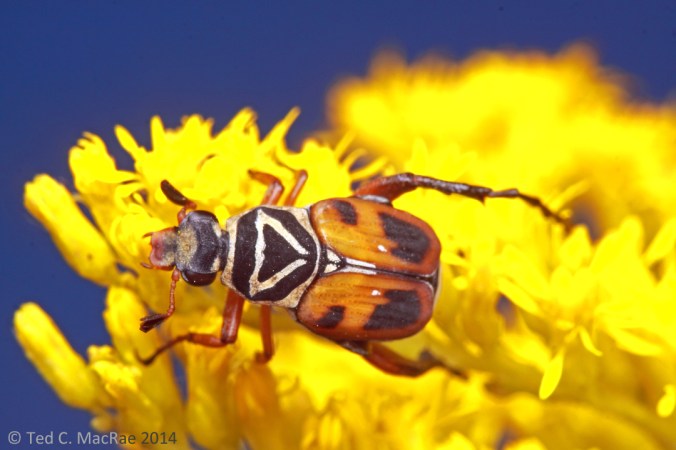
Trigonopeltastes delta
In the case of this beetle, the scientific name almost completely describes the beetle—the genus name being derived from the Greek words trigon (i.e., triangle, triangular) and pelt, (i.e., a shield), referring to the triangular and shield-shaped pronotum, and the species name based on the Greek letter Δ (“Delta”) in reference to the distinctive white triangle on the pronotum that resembles it. I mentioned the diversity of flowers on which adults of this beetle can be found. Pascarella et al, (2001) found this species on 13 different plant species (including mass aggregations numbering in the thousands on inflorescences of Sabal palm, Sabal palmetto) in their study of flower-visiting insects in the Everglades National Park. In Missouri, I see these beetles most commonly on Queen Anne’s lace (Daucus carota) and several other plants with white inflorescences such as American feverfew (Parthenium integrifolium), New Jersey tea (Ceanothus americanus), wild hydrangea (Hydrangea arborescens), and—most recently—hairy mallow (Hibiscus lasiocarpos). Interestingly, on this day there was an abundance of white-flowered snakeroot (Eupatorium sp.) in bloom at the same site, but I only saw the beetles on the yellow-flowered goldenrod.

Trigonopeltastes delta
It has been suggested that the Delta pattern on the pronotum and orange-and-black coloration of the elytra combine to mimic the appearance of paper wasps in the genus Polistes. Paper wasps are frequent visitors to many of the same flowers that these beetles frequent; however, the much smaller size of the beetles might suggest mimicry of aculeate hymenopterans (stinging wasps and bees) in general rather than paper wasps specifically. A more unusual type of mimicry has also been suggested in that a rear view of the beetle with its large, white, triangular pygidium seems to resemble the head of a hornet. Supporting this idea is the habit of the beetles to raise and hold their long hind legs in the air when disturbed in a manner that makes them resemble a hornet’s antennae!

Defensive posture with hind legs raised above abdomen.

Defensive posture with hind legs raised above abdomen (iPhone photo).

REFERENCE:

Pascarella, J. B., Waddington, K. D. & P. R. Neal. 2001. Non-apoid flower-visiting fauna of Everglades National Park, Florida. Biodiversity and Conservation 10(4):551–566 [abstract & pdf link].

© Ted C. MacRae 2014

Amorpha borer on goldenrod

Megacyllene decora (amorpha borer) | Stoddard Co., Missouri

Megacyllene decora (amorpha borer) | Stoddard Co., Missouri

One of my favorite longhorned beetle species is the amorpha borer, Megacyllene decora. Like its close relative, the locust borer—M. robiniae, this large, beautiful, black and yellow beetle is a classic harbinger of fall by virtue of its late-season adult activity period and affinity to flowers of goldenrod (Solidago) and snakeroot (Eupatorium). Compared to the locust borer, however, it is larger, chunkier, and more boldly marked, and despite the commonness of goldenrod flowers it is far less commonly encountered than the locust borer due to the more restricted habitat preferences of the larval host plant (false indigo—Amorpha fruticosa).

Megacyllene decora
The beetle in these photos is one of two that I found in late September at a site in the lowlands of southeastern Missouri. I’ve not seen the beetle at this site before, but I knew it must occur here because of the stands of false indigo that I noted during an earlier visit to the site. Considering the large number of plants present, two beetles is much less than I would have expected to see (in fact, both beetles were found in a single patch of goldenrod). I have previously featured this species (see A classic fall ‘bycid) from a site about 50 miles east of this one. At that site also only a few beetles were seen despite an abundance of larval host plants (but the adults occurring on snakeroot flowers instead of goldenrod). Only twice have I seen this species in numbers that I would consider plentiful (both times in western Missouri).

Megacyllene decora
Amorpha borers and locust borers are part of a larger complex of black and yellow insects that visit goldenrod flowers in the fall. These include a variety of bees, wasps, and other beetles (e.g., the delta flower scarab, Trigonopeltastes delta—family Scarabaeidae), but perhaps the most abundant is the goldenrod soldier beetle, Chauliognathus pensylvanicus—family Cantharidae (also called the Pennsylvania leatherwing). One can presume that any or all of these species serve as models for the longhorned beetles—bees and wasps are obviously protected from most predators by their ability to sting, and the bodies of soldier beetles are chemically protected by cantharidin, a highly toxic terpenoid that causes blistering and irritation of mucous membranes at low doses and can be fatal at higher doses. As the mimics, amorpha borers and locust borers could be expected to be less abundant than the models. However, considering how difficult-to-see these beetles can be when sitting on goldenrod flowers, their black-and-yellow coloration seems as though it could just as easily serve a cryptic function. It is even possible that mimicry and crypsis both have contributed to evolution of these beetle’s coloration.

Ted C. MacRae 2014

A truly disturbed garden spider

Argiope trifasciata vibrating web in response to disturbance.

Argiope trifasciata shaking its web in response to being approached.

This past weekend I made a trip to the White River Hills region in extreme southwestern Missouri. My goal was to find additional localities of the prairie tiger beetle (Cicindelidia obsoleta vulturina), which inhabits dolomite glades in the area and is disjunct from the main distribution in Texas and Oklahoma. As I was checking a particularly large glade complex in Roaring River State Park, I came upon this banded garden spider (Argiope trifasciata) that had spun its web across the span of branches from a gum bumelia tree (Sideroxylon lanuginosum). As I approached the spider the web began moving back and forth quite vigorously, and it occurred to me that there was not nearly enough wind for the web to be shaking to such degree. I stood still, and eventually the shaking stopped and the web became still again. To test whether it was really the spider shaking the web intentionally, I raised my net to one side and drew it closer to the spider, and once again the web began shaking back and forth just as vigorously as before. I watched the spider closely as the web shook, and I could see that the spider was actually flexing its two front pairs of legs back and forth to cause the shaking. It was clear at this point that the spider was doing this in response to my approach, probably as a defensive reaction to a perceived threat.

I suppose I have seen this behavior before but always assumed the web was just shaking in the breeze. Not until this time, with no wind to speak of and the web shaking quite rapidly, did it become clear to me that this was actually an intentional behavior exhibited by the spider. Eisner (2005) also notes this behavior, stating that Argiope spiders often engage…

…in a bobbing action, whereby through a quick flexion of its legs it sets the web into vibration, making itself a blurred target that is hard to grasp.

The photos used to make this animated gif were not easy to get. The spider was situated in a rather high and awkward-to-reach spot, and the iPhone had difficulty focusing on the spider while it was in motion. I overcame these problems by setting myself in a stable position, holding the iPhone in place, zooming the screen slightly (about 33%) and locking focus on the spider while it was still, and then asking my field buddy (Steve Penn) to approach the spider to trigger shaking. Once it began shaking it was a matter of holding down the shutter while keeping myself and the camera still long enough for a sufficient burst of photos (eight photos were used in this gif).

REFERENCE:

Eisner, T. 2005. For the Love of Insects. Harvard University Press, Cambridge, Massachusetts, 448 pp. [Google Books].

© Ted C. MacRae 2014

One-shot Wednesday: swamp milkweed leaf beetle

Labidomera clivicollis on Asclepias incarnata | Hickman Co., Kentucky

Labidomera clivicollis on Asclepias incarnata | Hickman Co., Kentucky

Technically this photograph of Labidomera clivicollis (swamp milkweed leaf beetle) doesn’t qualify as a “one-shot”, as I did take a few other shots as well. However, this was the only shot out of the handful that I didn’t throw away. It’s not perfect—the right front and left rear legs are raised awkwardly, and the lighting is a bit harsh. However, the important parts of the beetle are in focus, the composition is acceptable (with all parts of the beetle within the frame), and there is pleasing value contrast between the orange and black body of the beetle, the green plant on which it sits, and the clear blue sky in the background. The plant’s flowers have even added a smidgen of pink. All of the other photos lacked either focus or composition, neither of which are easily “fixable” in post-processing. The difficulty in getting a better photo is a result of the beetle’s refusal to settle down and stop walking and my lack of desire to spend an inordinate amount of time waiting for this to happen as opposed to finding the insect I was really looking for (more on that in a future post).

I found this beetle on swamp milkweed (Asclepias incarnata) in Hickman Co., Kentucky. As the common name suggests, swamp milkweed is one of the main hosts for this rather large beetle (at least, by leaf beetle standards). However, they can and do feed and develop on other milkweeds, especially common milkweed (A. syriaca), and even related genera such as swallow-wort (Cynanchum) and twinevine (Funastrum) (all belonging the family Asclepiadaceae).

Labidomera clivicollis is part of the orange and black milkweed mimicry complex, which includes monarch butterfly (Danaus plexippus), red milkweed beetles (Tetraopes spp.), large milkweed bug (Oncopeltus fasciatus), small milkweed bug (Lygaeus kalmii), milkweed assassin bug (Zelus longipes), and others. Most of these insects have evolved mechanisms for avoiding or detoxifying cardenolides (produced by milkweed as a defense against herbivores) and sequestering them within their bodies for their own defense against predators. This represents a classic example of a Müllerian mimicry ring, in which multiple insect species—sometimes from different families and even different orders—share a common warning color. Predators learn to avoid these colors and, thus, avoid all of the species within the mimicry ring.

© Ted C. MacRae 2014

My, what busy palps you have!

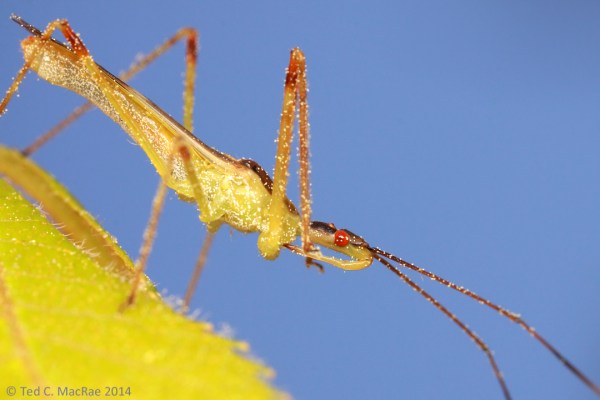
In mid- to late summer, the swamps of southeast Missouri and adjacent areas along the Mississippi River become awash in color as stands of hairy rose mallow (Hibiscus lasiocarpus) put forth their conspicuous, white and pink blooms. I’ve been waiting for the mallows to bloom this year, as there is one particular beetle associated with plants in this genus that I have been keen to photograph since I first picked up a real camera a few years ago, to this point without success. My first attempt this year came in early August as I noted the tell-tale blooms while passing through extreme western Kentucky. I was foiled again (but would succeed the next day—more on this in a future post), but as I tiptoed over the soggy ground searching through the lush foliage, I saw a small, brightly colored cricket with curiously enlarged mouthparts. Even more interesting was the constant, almost frenetic manner in which the insect was moving these mouthparts. My first attempts to detach the leaf on which it was moving spooked it, and it jumped to another leaf, but I persisted and finally succeeded in detaching the leaf with the critter still upon it and maneuvering it up towards the sky for a few photographs.

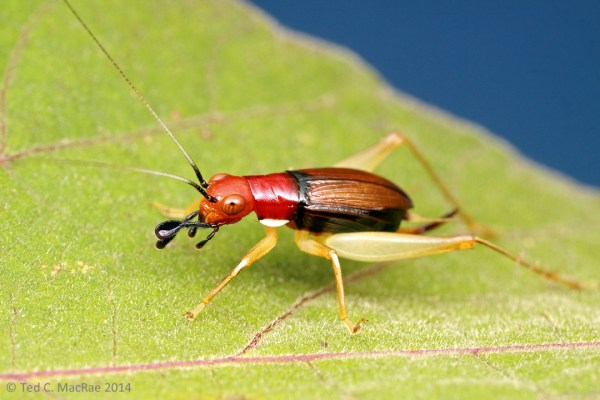
Phyllopalpus pulchellus (red-headed bush cricket) | Hickman Co., Kentucky

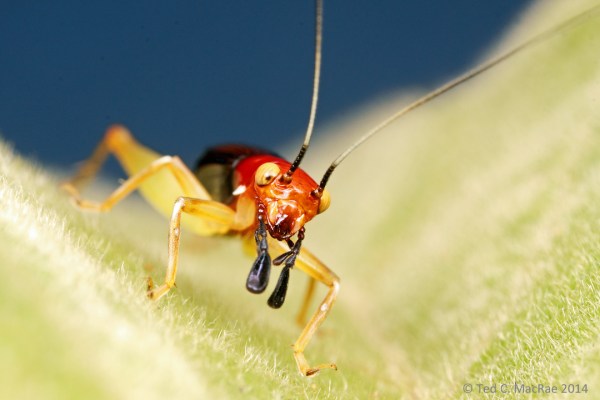
Phyllopalpus pulchellus (red-headed bush cricket or “handsome trig”) | Hickman Co., Kentucky

It didn’t take long to identify the cricket as Phyllopalpus pulchellus, or “red-headed bush cricket” (family Gryllidae). This species, also known as the “handsome trig” on account of its stunning appearance and membership in the subfamily Trigonidiinae, is distinctive among all North American orthopterans by its red head and thorax, pale legs, dark wings, and—as already noted—highly modified maxillary palpi with the greatly expanded and paddle-like terminal segment. According to Capinera et al. (2004), adults appear during mid- to late summer near streams and marshes on vegetation about one meter above the ground—precisely as this individual was found. Surely it represents one of our most photographed cricket species (208 BugGuide photos and counting).

The greatly expanded palps are thought to mimic beetle mandibles or spider pedipalps.

The greatly expanded palps are said to mimic beetle mandibles or spider pedipalps.

The obvious question to anyone who sees this species is, “Why the curiously enlarged palps?” Both males and females exhibit this character (even as juveniles), so it seems clear that there is no special sexual or hypersensory function. One idea mentioned on BugGuide (perhaps originating from this EOL post by Patrick Coin) suggests that the crickets are Batesian mimics of chemically-defended ground beetles (family Carabidae) such as bombardier beetles (genus Brachinus). This thought is based on their similar coloration, the convex and shiny (and, thus, beetle-like) forewings of the females, and some resemblance of the enlarged palpi to the mandibles of the beetles. I am not completely satisfied with this idea, since bombardier beetles are generally found on the ground rather than foliage. Moreover, males lack the convex, shiny forewings exhibited by females, and resemblance of the palps to beetle mandibles doesn’t explain their curiously constant movement (ground beetles don’t constantly move their mandibles). Another idea suggested by orthopterist (and insect macrophotographer extraordinaire!) Piotr Naskrecki is a mimetic association with another group of arthropods, noting that the busy movements of the palps is very similar to the way jumping spiders (family Salticidae) move their pedipalps. This suggestion also is not completely satisfying, as it leaves one wondering why the crickets are so boldly and conspicuously colored. While some jumping spiders are brightly colored, I’m not aware of any in eastern North America with similar coloration (indeed, many jumping spiders can be considered ‘drab’). Perhaps the crickets have adopted mimetic strategies using multiple models in their efforts to avoid predation?

The brown wings and long, sickle-shaped ovipositor identify this individual as a female.

The brown wings and sickle-shaped ovipositor identify this individual as a female.

The individual in these photos can be identified as a female due to the presence of the sickle-shaped ovipositor and, as mentioned above, the convex, shiny forewings. Males possess more typically cricket-like forewings, perhaps constrained to such shape by the sound producing function they must serve. The males do, however, exhibit an interesting dimorphism of the forewings, with one wing being clear and the other one black. Fellow St. Louisan and singing insect enthusiast James C. Trager notes this dimorphism has been mentioned in the literature but not explained and suggests it may have something to do with the adaptive physics of sound production.

Congratulations to Ben Coulter, who wins Super Crop Challenge #16, which featured a cropped close-up of the enlarged maxillary palpi of this insect. His 12 pts increase his lead in the overall standings for BitB Challenge Session #7 to an almost insurmountable 59 pts. Morgan Jackson and Troy Bartlett round out the podium with 10 and 9 pts, respectively—Troy’s points being enough to move him into 2nd place in the overalls with 23 pts. Third place in the overalls is still up for grabs, since none of the people occupying the 3rd through 6th places has played for awhile—realistically any number of people behind them could jump onto the podium (or even grab 2nd place!) in the next (and probably last) Session #7 challenge.

REFERENCE:

Capinera, J. L., R. D. Scott & T. J. Walker. 2004. Field Guide To Grasshoppers, Katydids, And Crickets Of The United States. Cornell University Press, Ithaca, New York, 249 pp. [Amazon].

© Ted C. MacRae 2014

One-shot Wednesday: pale green assassin bug

Zelus luridus (pale green assassin bug) | Howell Co., Missouri.

Zelus luridus (pale green assassin bug) | Howell Co., Missouri.

As my friend Rich and I set out a week ago Sunday on the final stretch in our quest to hike the 350-mile Ozark Trail in its entirety, I saw this slender, green assassin bug (family Reduviidae) sitting on a tender young leaf of an oak sapling. I already had my camera out but had outfitted with the 65-mm, 1–5× macro lens in anticipation of small beetles that I wanted to photograph on dogwood flowers. Nevertheless, it was still a bit on the cool side, making me think I might yet succeed in getting off some super-closeup shots of this delicate predator. I managed to carefully snip the leaf from the sapling and move the bug up close to the camera for a nice, blue-sky background shot, but one shot is all I got—as soon as the shutter clicked the bug took flight and left me with this single photo. As I have observed to usually be the case, the body of this individual is thickly covered with debris, which I take to be pollen from the abundant oaks at the height of their flowering period.

I’ve seen this species regularly over the years during my springtime forays in upland, oak-hickory Ozark forests. I presume the species is Zelus luridus, based on an online synopsis of the genus Zelus in eastern North America. As true bugs go, assassin bugs are undeniably cool—sometimes large, often colorful, and pure predators! Interestingly, these bugs have adopted a rather diverse array of strategies to assist their predaceous habits, mostly involving modifications of the front legs. Some involve a more typical raptorial design (similar to mantids) with chelate surfaces or even spines on the femora and tibiae, while others have developed flexible, cushion-like structures on the tips of the tibiae to aid in prey handling (Weirauch 2006). Gross morphological modifications, however, are not the only strategy employed by assassin bugs—some groups use secretions either to paralyze or immobilize their prey. Species in the genus Zelus employ the latter strategy—essentially using their front legs as “sticky traps”. The sticky substance is derived from glands on the front legs and is used to coat numerous, microscopically branched setae on the legs called “sundew setae” in reference to the similarity of appearance and function with insectivorous sundew plants. Interestingly, sundew setae have also been found on other parts of the body, at least in first-instar Z. luridus nymphs, leading to speculation that they may also serve some other function besides prey capture. Perhaps these setae explain why most individuals I see are so debris-covered, as with the pollen-laden individual above.

REFERENCE:

Weirauch, C. 2006. Observations on the sticky trap predator Zelus luridus Stål (Heteroptera, Reduviidae, Harpactorinae), with the description of a novel gland associated with the female genitalia. Denisia 19, zugleich Kataloge der OÖ. Landesmuseen
Neue Serie 50:1169–1180 [pdf].

© Ted C. MacRae 2014

Not all soybean caterpillars are ‘ugly’!

Although photographs of beetles dominate this site (they are my true love, after all), I am nevertheless an agricultural entomologist by day and, as such, find occasion to post photos of the insects I encounter in my area of expertise—soybean. I think by and large those soybean insects—especially the caterpillars—don’t generate as much interest as the beetles that I feature. I guess this is understandable—caterpillars of the agricultural pest variety seem generally unable to compete with the visual and behavioral charisma exhibited by jewel beetles, tiger beetles, tortoise beetles, etc. Here, however, is an example of a soybean caterpillar that is as beautiful as any beetle you will find—the larva of the silver-spotted skipper, Epargyreus clarus (Lepidoptera: Hesperiidae). Not only are the colors to die for, but that comically big head makes for a truly laughable frontal portrait!

Epargyreus clarus (silver-spotted skipper) late-instar larva on soybean | Baton Rouge, Louisiana

Epargyreus clarus (silver-spotted skipper) late-instar larva on soybean | Baton Rouge, Louisiana

This particular individual was found last September in a soybean field near Baton Rouge, Louisiana (amazingly, this is the first insect I have featured from Louisiana). Silver-spotted skippers feed on a wide variety of plants in the family Fabaceae (of which soybean is a member), but their occurrence on soybean rarely reaches levels that cause any economic impact. Normally the caterpillars hide during the day in a silken nest constructed by folding over a leaflet or tying adjacent leaflets together, emerging only at night to feed.

What a pretty face!

What a pretty face!

I suppose the orange spots on the head are intended to serve as false eye spots—for some reason the larger the eyes the more a potential predator seems to take pause before deciding to eat something. The actual eyes can be seen along the outer edge of the orange spot as a row of simple ocelli—incapable of forming sharp images and serving as little more than light and motion detectors. I can’t even begin to speculate on the function of the curious asperate/rugose texture of the head!

Copyright © Ted C. MacRae 2014

Pop! goes the beetle

Alaus oculatus (eyed elater) | Beaver Dunes State Park, Oklahoma

Alaus oculatus (eyed elater) | Beaver Dunes State Park, Oklahoma

Last June while collecting beetles from cottonwood trees at Beaver Dunes State Park, Oklahoma, I came across one of my favorite beetles—Alaus oculatus, or eyed elater (family Elateridae, or click beetles). Large by click beetle standards, the most striking feature of eyed elaters is, of course, their false eye spots, which are not eyes at all but patches of pubescence—black surrounded by a narrow ring of white—intended to look like eyes and located prominently on the prothorax rather than the head. A handful of related species are also found in various parts of the U.S., all of which exhibit variations on this same eye spot theme. Undoubtedly these spots serve to frighten would-be predators, much like the false eye spots on the thorax of many lepidopteran caterpillars. The true eyes, of course, are much smaller and are located on the head in front of the “false eyes.” In contrast to the prominently visible eye spots, pubescence on the rest of the body seems to function in cryptic coloration. The mottled patterning blends in with the bark of trees where these beetles usually hang out for effective concealment.

Look into my eye(spot)s!

Look into my eye(spot)s!

If either of those first two lines of defense don’t work, the beetles exhibit “thanatosis” by lying still with legs and antennae appressed to the body to fool the would-be predator into thinking that they are already dead.

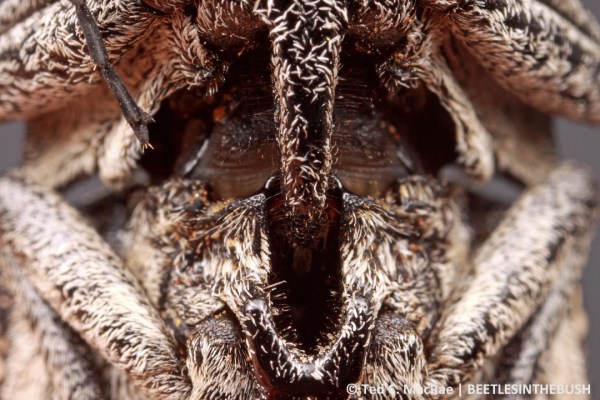
A ventral look at the clicking mechanism between the pro- and mesosterna.

Adults exhibit “thanatosis” (play dead)  when disturbed.

Their most remarkable defensive behavior, however, is their ability to snap or “click” their bodies with enough force to free themselves from the grasp of a novice predator (or careless entomologist). The click is produced by a large prosternal spine and mesosternal notch on the beetle’s underside. To click, the beetle arches back its head and pronotum to retract the spine from the notch cavity, the tip of which is then pressed against the edge of the notch. Muscles within the thorax contract, storing elastic energy, and as the flexible hinge between the pro- and mesothoraces moves, the spine slides until its tip passes over the edge of the notch, releasing the elastic energy stored in the thoracic musculature and snapping the spine back into the notch cavity with enough force to produce an audible click.

A large spine on the prosternum fits into a groove on the mesosternum.

A large spine on the prosternum fits into a groove on the mesosternum.

This clicking ability also comes in handy if the beetle frees itself from the grasp of a predator and lands on its back. While the beetle’s legs are too short to right itself, its click is capable of launching the beetle high into the air. By tumbling while in the air, the beetle has a 50% chance of landing on its feet (thus, several attempts may be required). When jumping from a hard surface, the beetle is actually capable of launching itself to a height that is several times its body length and can tumble several times while in the air. This raises an interesting question, since theoretically an elevation of only one body length and half of a body revolution are all that is needed for an upside-down beetle to right itself. The power of the click, thus, grossly exceeds the minimal requirement for righting, yet the beetles seem incapable of moderating the force of the click. Furthermore, the 50% probability of landing suggests that they are also incapable of controlling the orientation of their body during the jump and landing. Did the clicking mechanism initially evolve to combat the grasp of predators and was then co-opted for use in jumping, or was the ability to jump the selective pressure that drove its evolution?

Locked and loaded—the mechanism is primed for the click.

Locked and loaded—the mechanism is primed for the click.

Ribak & Weihs (2011) used biomechanical analyses with Lanelater judaicus to support the idea that the click evolved primarily as a mechanism for vertical jumping. They reason that the excessive vertical distance of the jumps ensures sufficient height when jumping from soft substrates such as foliage or loose soil. A followup study evaluating the effect of natural substrates (Ribak et al. 2012) found that jump height was dramatically reduced (by ~75%) when the beetles jumped from leaves that covered approximately half of the study site and that the reduction in jump height was directly correlated with the amount of work absorbed by the substrate. This provides further evidence that the beetles do not moderate their jumping force and instead simply aim to jump “as high as possible” and rely on random chance for landing back on their feet.

After clicking, the spine returns to its resting position out of the groove.

After clicking, the spine returns to its resting position within the groove.

REFERENCE:

Ribak, G., S. Reingold & D. Weihs. 2012. The effect of natural substrates on jump height in click-beetles. Functional Ecology 26(2):493–499 [abstract].

Ribak, G. & D. Weihs. 2011. Jumping without using legs: The jump of the click-beetles (Elateridae) is morphologically constrained. PLoS ONE 6(6):e20871. doi:10.1371/journal.pone.0020871 [full text].

Copyright © Ted C. MacRae 2014