ID Challenge #12

This should be a relatively easy ID Challenge compared to previous editions—2 points each for the correct order, family, genus, species, and subspecies.  Additional points will be awarded on a discretionary basis for relevant natural history comments.  Standard challenge rules apply, including moderated comments during the challenge period (you don’t have to be first to score points), early-bird points to those who do arrive at the correct answer before others, etc.  Ben Coulter maintains a commanding lead in BitB Challenge Session #4, but with this and one more challenges left in the current session is his lead secure?

Copyright © Ted C. MacRae 2011

My Canon 8X Macro Lens

For the past few months I have started routinely using extension tubes with my 100mm macro lens for photographing tiger beetles. I do this primarily because for most tiger beetles and other insects in the smallish to medium-sized range I need the capability to go both above and below 1X magnification, meaning that I must constantly switch between my Canon 100mm lens (1X maximum) and MP-E 65mm lens (1X minimum). With a full extension tube set (68mm), my 100mm macro lens effectively becomes a 0.7–2.0X macro lens, a nice range of magnifications for most of the photographs that I take. There is a secondary benefit to this in that the subject-to-lens distance is decreased somewhat, allowing me to get the MT-24EX flash heads closer to the subject for better lighting.

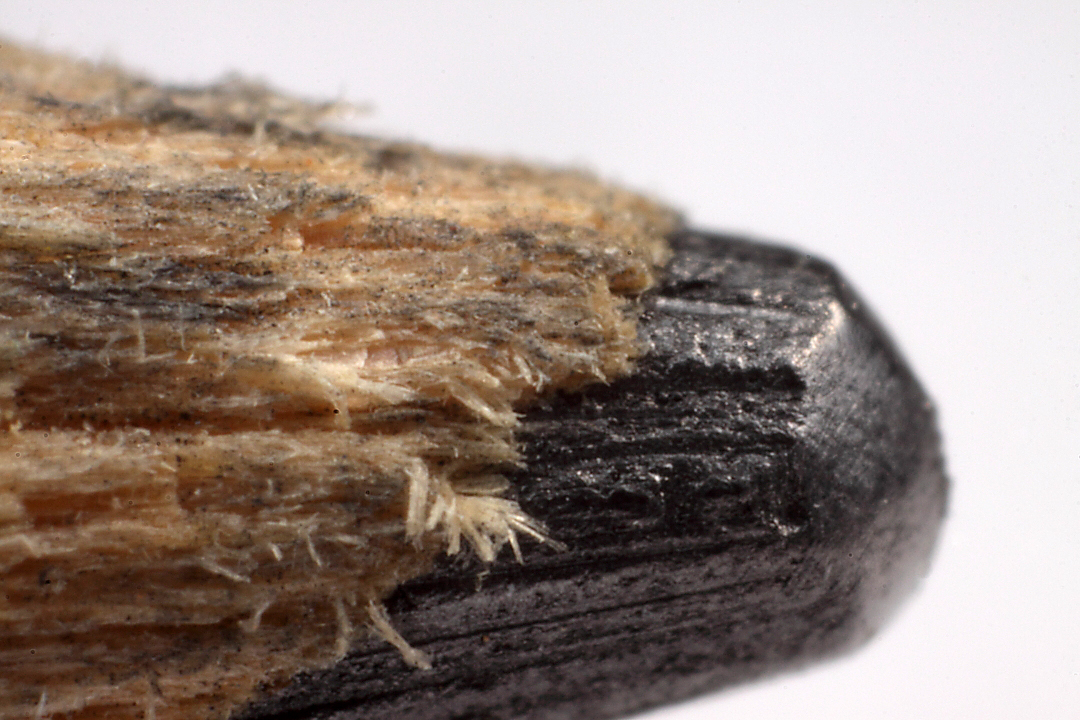
Lately I’ve been wondering what the magnification capabilities would be if I added extension tubes to the 65mm lens.  With a maximum magnification of 5X, it hardly seems that even more magnification would ever be needed, but who knows what uses one might find if the capability exists.  In theory, it seemed like it should work—after all extension tubes are simply tubes with no glass (in fact, the 65mm lens itself is simply a macro lens with a very expensive, built-in bellows).  The only consideration was whether the focal plane would remain outside of the lens.  Tonight I finally decided to sit down and try it out, and the results were really quite stunning.  The three photos below show an ordinary pencil lead, the first with the 65mm lens alone set at 1X, the second with the lens set at 1X plus full extension tubes, and the third with full extension tubes and the lens set at 5X.  The full extension tube set provides an additional ~1.7X magnification, making the 65mm lens effectively a 1.7–8.0X macro lens!

Canon MP-E 65mm lens @ 1X

Canon MP-E 65mm lens @ 1X + 68mm extension tubes (= 1.7X)

Canon MP-E 1-5X macro lens @ 5X + 68mm extension tubes (= 8X)

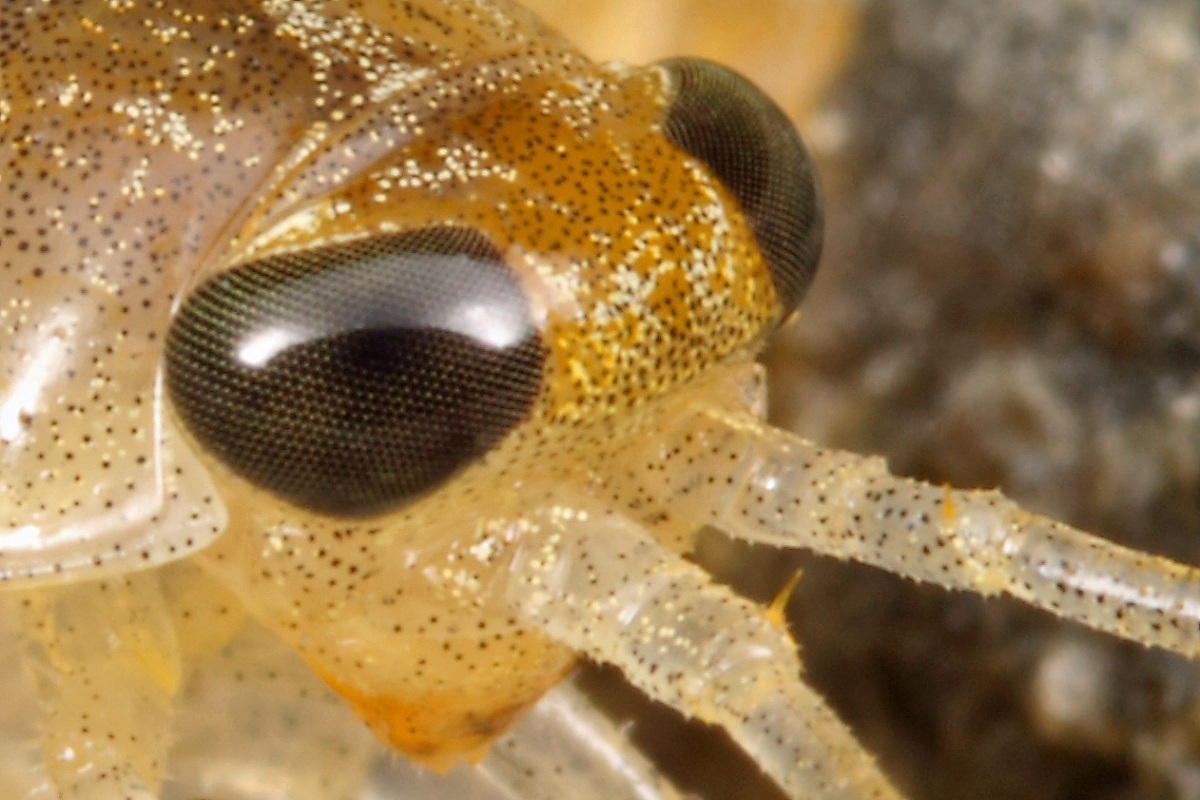
The subject-to-lens distance is indeed quite short—only about 38mm or so.  However, having at my disposal an 8X macro lens suddenly opens up a whole new world of ideas for insect macrophotography.  Knowing that the combination of 65mm lens and extension tubes is possible, I just had to try this out on a living subject—like now!  I happened to have in a terrarium a subject from the day’s collecting, so I tried it out—again with the 65mm lens fully extended to result in 8X magnification.  Shown below is a example of this lens combination at full magnification, completely uncropped—can you name the subject?

Canon MP-E 65mm lens @ 5X + 68mm extension tubes (= 8X)

Copyright © Ted C. MacRae 2011

ID Challenge #11

It’s time for another ID Challenge—can you name the organism(s) shown here?  I’ll give two points each for the correct order, family, genus and species.  Additional points will be awarded on a discretionary basis for relevant natural history comments.  Standard challenge rules apply, including moderated comments during the challenge period (you don’t have to be first to score points), early-bird points to those who do arrive at the correct answer before others, etc.  Ben Coulter has a solid lead in BitB Challenge Session #4, but there are enough challenges left in the current session that his lead is not secure—do you have what it takes to put together a run to bump him off the podium top spot?

Shaw Nature Reserve, Franklin Co., Missouri

Copyright © Ted C. MacRae 2011

Super Crop Challenge #9

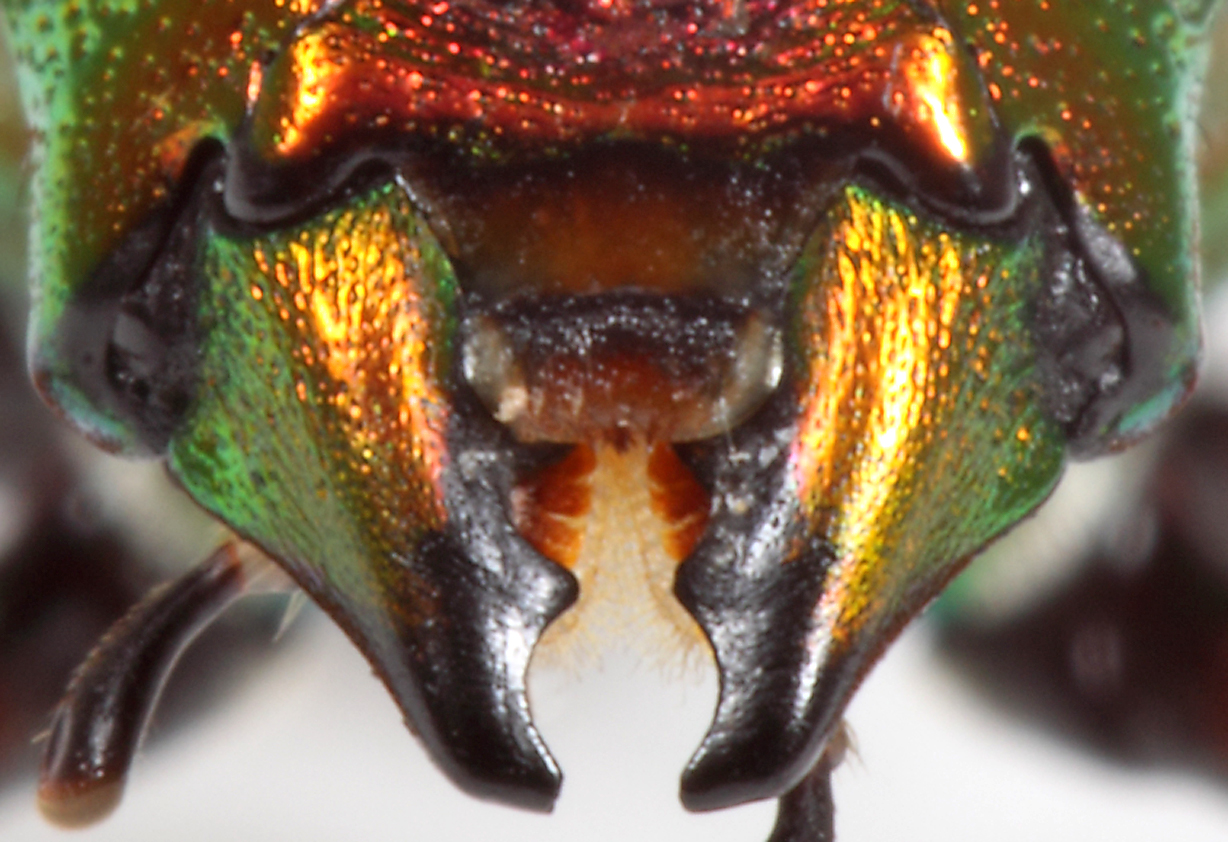
Can you name the structures in this photo (easy) and the critter they belong to (maybe not so easy)?  Because there are so many potential answers to those two questions, I’ll give 1 point for each correctly named structure (5 maximum) and taxon (primary categories from class to species).  As always, standard challenge rules apply, including moderated comments to allow time for everyone to submit their answers.  Bonus points will be awarded to early birds if multiple participants arrive at the same correct answer and possibly also for other relevant comments at my discretion.

The competition is really heating up in the current Session #4—current leader and 2-time champ Ben Coulter has 22 points, but there are at least half a dozen folks who could easily earn enough points in this one challenge to either take the lead or grab a podium spot.  If you’re stumped, remember that the pity points you earn now could be a tie-breaker at the end of the session.  Good luck!

Copyright © Ted C. MacRae 2011

Creepy Crawly Crustaceans

During my early August trip to the Gulf Coast of Florida, I spent several nights exploring the small mangrove marsh behind my sister-in-law’s condominium in Seminole. There were other reasons for me wanting to do this that will be revealed in a future post, but suffice it to say that, to this land-locked Midwesterner, the intertidal zone between land and sea is a strange and weird place. The plants are strange—long aerial roots, salt exudate-covered leaves, succulent jointed stems; and the animals are strange—molluscs and crustaceans featuring just as prominently as the insects with which I am more familiar. Even the smells are strange. Add to that the cover of darkness and it seems downright alien. For me, stumbling through the marsh with only the bright tunnel of light from my headlamp to reveal whatever lurks in the surrounding blackness seemed like a walk on another planet—new, exciting, and a tad unnerving!
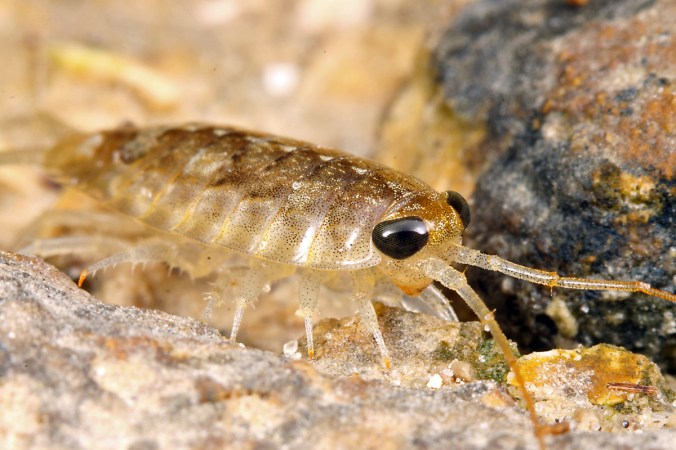

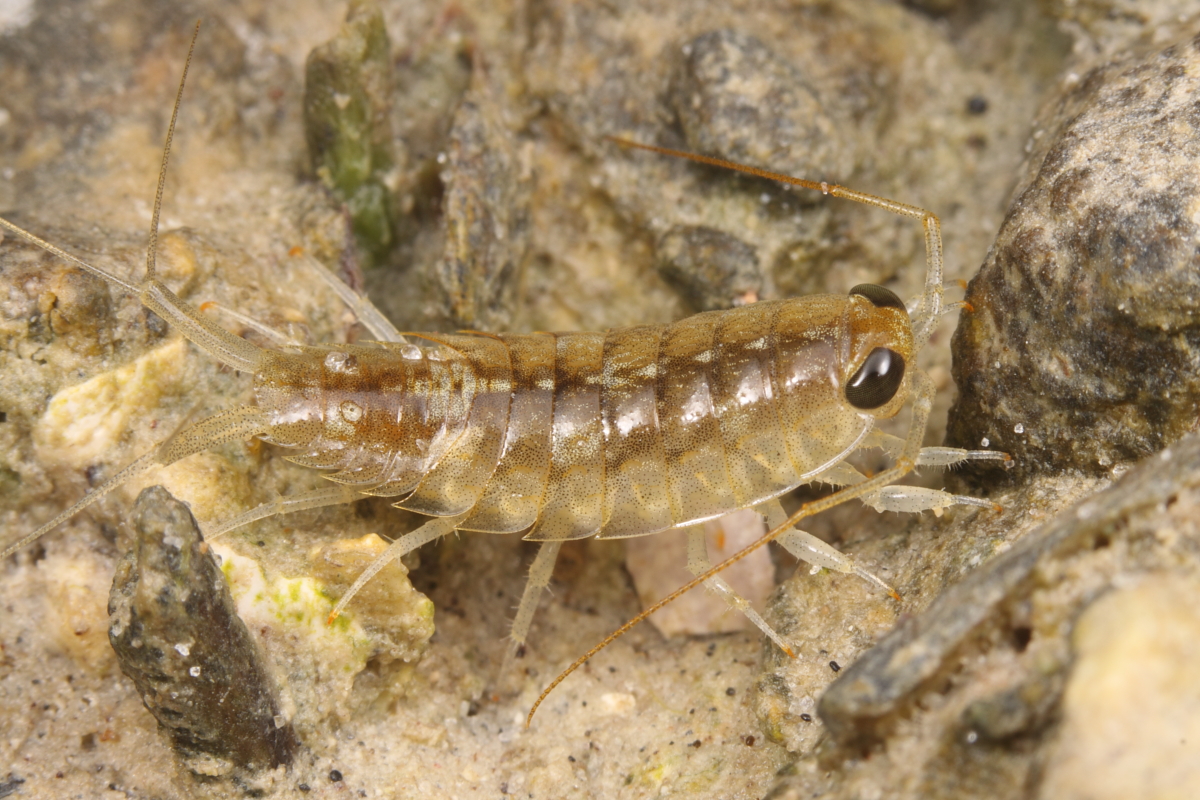
As I took those first tentative steps through the marsh, one of the first things I noticed scuttling across the moist ground were what looked to me like giant wood lice.  Terrestrial isopods (class Malacostraca, order Isopoda) are nothing new to me—”roly-polys” and wood lice are common where I live, but I have never seen any as large as these, measuring as much as 25-30 mm in length (that’s an inch or more, folks!), not even counting their quite long antennae and uropoda.  They were also quite numerous, abundant actually.  I must confess to feeling a little creeped out at first upon seeing them—I could just imagine these strange, alien creatures suddenly swarming all over me and devouring the flesh from my body under the cover of darkness.  Okay, it was more of a fleeting thought than a palpable fear, but it has been awhile since I’ve encountered an arthropod with which I am so completely unfamiliar.  During the course of the night I photographed a number of individuals, not knowing what characters might be most important for identification and hoping that maximizing the number of photographs would increase my odds of getting the right shot.  Once I sat down to figure out what they were, the answer came quickly, as there is really nothing quite like sea slaters (genus Ligia).  Several species of these apparently common residents of intertidal zones are found on both the Atlantic and Pacific Coasts (Schmalfuss 2003), where they hide during the day and come out at night to scavenge on algae and whatever other organic matter they can find.
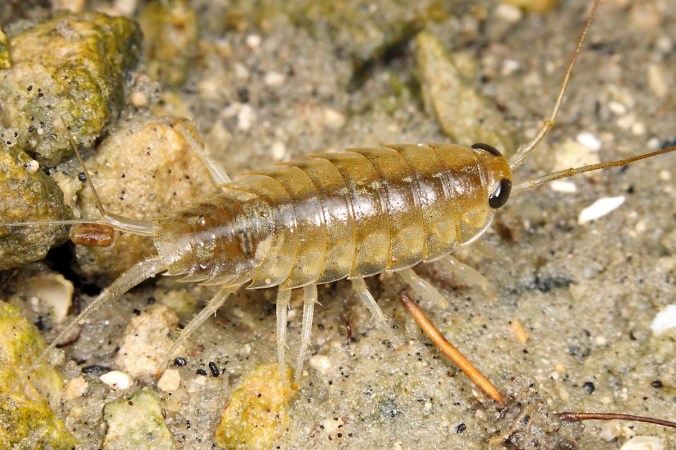
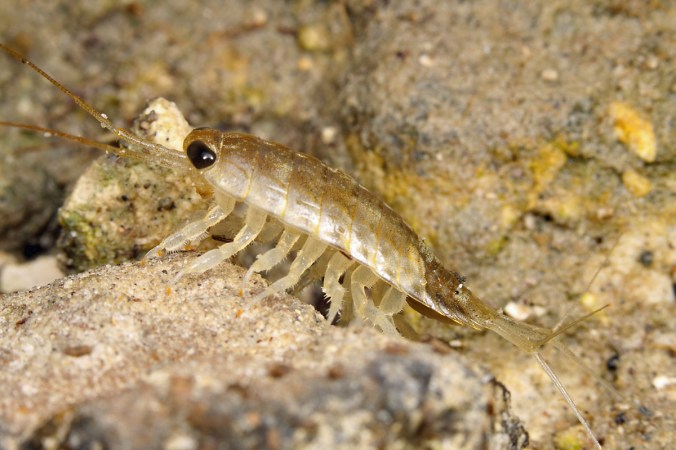


Despite my initial thought that a species ID might not be possible, I was eventually able to determine with a fair degree of confidence that the individuals in these photos represent L. baudiniana.  This species is distinguished from two other species in the genus in Florida (Schultz and Johnson 1984) by the combination of its long uropoda (L. oceanica—introduced from Europe—has the uropoda much less than 2/3 the length of the body) and brush-like structures on the first pair of legs of the male, visible in the middle photograph above (L. exotica males lack these structures and possess instead a process at the distal end of the leg). These characters are illustrated nicely in Richardson (1905), which despite its great age seems to still to be a relevant resource for the family in North America.


Congratulations to Morgan Jackson, who wins Super Crop Challenge #8 with 11 points and distinguishes himself as the only participant to correctly identify the species.  Dave and Roy complete the podium with 9 points each.  In the overalls, two-time Session Champ Ben Coulter earned 8 pts to retain his lead with 22 pts, while Mr. Phiddipus and Roy move into a tie for 2nd place just 4 pts off the lead.  It’s still early, but this is shaping up to be a competitive session!

In the next post, I’ll reveal the real reason I was so interested in searching this marsh at night…

REFERENCES:

Richardson, H.  1905.  A monograph on the isopods of North America.  Bulletin of the United States National Museum 54:i–liii, 1–727.

Schmalfuss, H. 2003. World catalog of terrestrial isopods (Isopoda: Oniscidea). Stuttgarter Beiträge zur Naturkunde (Serie A) 654:1–341 [revised and updated online version].

Schultz, G. A. and C. Johnson. 1984. Terrestrial isopod crustaceans from Florida (Oniscoidea). Tylidae, Ligiidae, Halophilosciidae, Philosciidae, and Rhyscotidae. Journal of Crustacean Biology 4(1):154-171. 

Copyright © Ted C. MacRae 2011

Super Crop Challenge #8

Here’s a face you don’t see that often (or at least I don’t).  There’s little doubt about what body parts are shown here, so rather than awarding points for naming structures we’ll treat this as a standard ID Challenge.  However, the categories are a little different from the usual—2 pts each for class, order, family, and genus (I suspect a species ID may not be possible, at least from this photo).  Standard challenge rules apply, including moderated comments (to give everyone a chance to take part) and bonus points awarded on a discretionary basis for a variety of reasons, e.g. as tie-breakers if multiple participants arrive at the same correct answer, providing additional relevant information, humor, etc.  

Reminder: I am quite the pedant—points can be awarded or taken away depending on one’s attention to detail.  Also, when all else fails pity points will be awarded.


Good luck!

Copyright © Ted C. MacRae 2011

ID Challenge #10

It’s time to begin Session #4 of the BitB Challenge Series.  Ben Coulter won Sessions #1 and #2 but was finally unseated by Max Barclay in Session #3.  We start Session #4 with a straight up ID Challenge.  Unlike previous ID Challenges, however, the order and family are gimmes this time, so I’m going to take them off the table and award double (4) points each for the correct genus and species (suggestion: being a stickler for details will increase your chances for full points).  Standard challenge rules apply, including moderated comments (to give everyone a chance to take part) and possible bonus points for being the first to guess correctly (if multiple people offer the same correct answers), offering additional relevant information, or—as always—the ability to make me chuckle.

Reminder: nobody walks away empty-handed, so it pays to try even if you think you’re stumped.  The pity points you earn in IDC#10 could make a difference in the final standings at the end of Session #4.

Good luck!


Copyright © Ted C. MacRae 2011

Super Crop Challenge #7

Who is this smiling critter?  Usual challenge rules apply, including moderated comments (to give everyone a chance to take part) and possible bonus points for beating others with the first correct answers, additional relevant information, or any suitably humorous quips.  I’ll give 2 points each for order, family, genus and species.  This is the last challenge of the current BitB Challenge Session, so the current leaders are playing for all the marbles!

Copyright © Ted C. MacRae 2011