Battle of the Bug Blogs

Something tells me that one of our bug blogging professors has charged this semester’s crop of students to go out and figure out what makes a good bug blog. My, how classwork assignments have changed since I was in grad school! Sort of a modern-day twist on the old ‘critic a journal paper’ assignment.

At any rate, apterobittacus seems to think I write a pretty good post, but eremoblatta thinks Crystal does it a little bit better (despite the taxonomic affinity between the subject of my critiqued post and the blog author’s pseudonym)! Nice job, kids—interesting reads that actually made me stop and think a little bit about how I present things here.

Copyright © Ted C. MacRae 2013

Ceti Eel offspring?

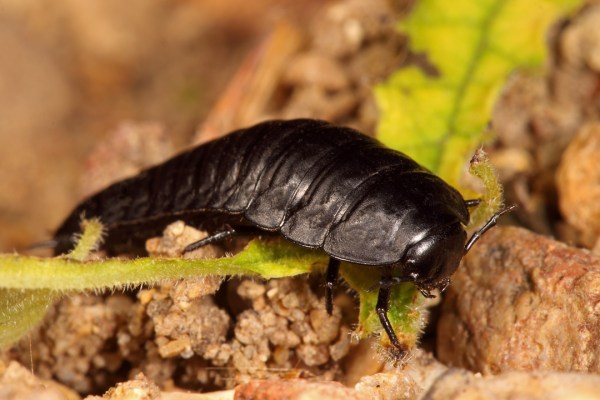
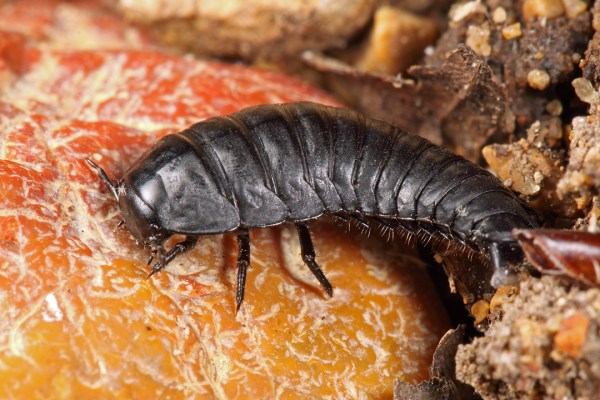
Nicrophila americana

Nicrophila americana (American carrion beetle) larva | Sam A. Baker State Park, Wayne Co., Missouri.

If this creature was a tad bit slimier, you might think it had just been plucked from underneath the armor of an adult Ceti Eel and was looking to slip inside the ear of Chekov or some other human to wrap itself around the unsuspecting victim’s cerebral cortex. In reality, this creature lives not on Ceti Alpha V., but right here on earth, and while it’s natural history may not include making human hosts “extremely susceptible to suggestion“, it does include an appetite for dead flesh and the maggots that try to compete for it. Say hello to the larva of Nicrophila americana (American carrion beetle), a member of the family Silphidae (carrion and burying beetles) (not to be confused with the endangered Nicrophorus americanus, or American burying beetle). Like most beetles, the larvae can be difficult to recognize as such due to its very different form compared to the adult. However, the one-segmented tarsi, distinct head, presence of chewing mouthparts, and presence of spiracles along the sides of the body give the clues to its identity.

Necrophila americana

While not the offspring of a Ceti Eel, its habits are almost as… er, disgusting!

The genus name (literally meaning “attracted to corpses“) is a perfect descriptor of this beetle’s natural history. Adults are attracted to animal carcasses, where they lay their eggs and prey on maggots (fly larvae) as they hatch to give a competitive advantage to their own larvae once they hatch. The larvae also will eat maggots and other larvae within the carcass, along with the carcass itself. This larva had completed its development and was searching the ground for a suitable spot to dig a burrow for pupation and eventual emergence as an adult.

Copyright © Ted C. MacRae

My favorite of Missouri’s milkweeds

Milkweeds of the genus Asclepias are among my favorite plants, although I’m not fully sure why that is the case. Sure, their blooms are conspicuous and colorful, but so are those of many other plants. Perhaps one reason is their status as hosts for milkweed beetles (genus Tetraopes, family Cerambycidae). Four species of these beetles occur in Missouri, including the rare T. texanus. Another reason might be their diversity—in Missouri alone there are 16 different species, ranging from the ubiquitous common milkweed (A. syriaca) to the federally endangered Mead’s milkweed (A. meadii). The latter is one of six milkweed species occurring in Missouri that I have not yet seen, so I suppose I should withhold judgement until I’ve succeeding in finding all 16 species. Nevertheless, I would have to say that clasping milkweed (A. amplexicaulis) has to be my favorite of Missouri’s milkweeds.

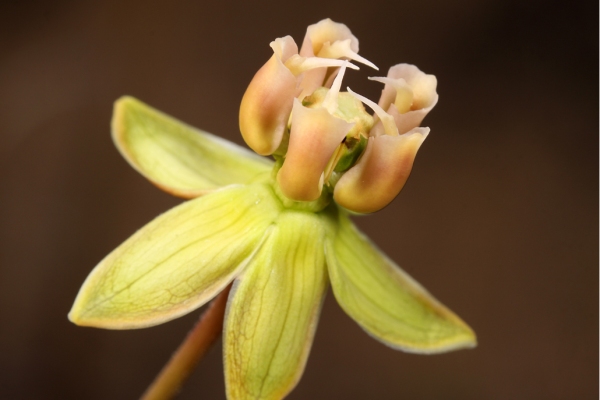
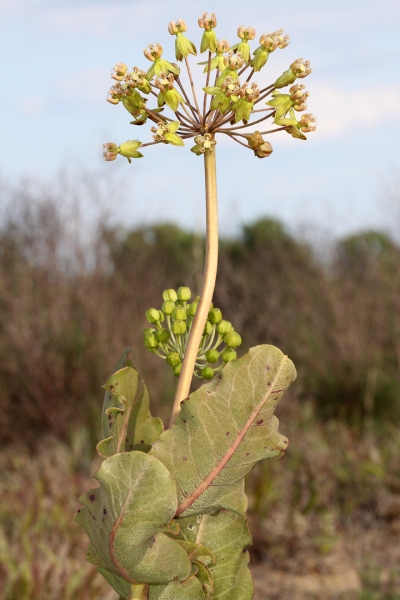
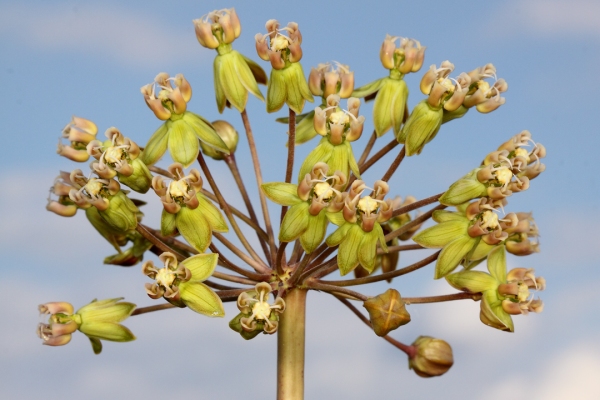
Clasping milkweed (Asclepias amplexicaulis) | Sand Prairie Conservation Area, Scott Co., Missouri

Clasping milkweed (Asclepias amplexicaulis) | Sand Prairie Conservation Area, Scott Co., Missouri

Clasping milkweed (also known as sand milkweed—not to be confused with A. arenaria occurring further west in the Great Plains) is said to occur sporadically throughout Missouri in prairies, glades, rocky open woods, roadsides, and railroads. However, I have seen this species only a few times—all in dry sand habitats in the southeastern Mississippi Alluvial Plain (or, the “bootheel” as we say here in Missouruh). Until a few  years ago the only time I had ever seen this plant was many years in an eroded sandy opening on Crowley’s Ridge (an elevated ridge of alluvium and loess deposited during the last glacial maximum). Those plants were not in flower, but their was no mistaking their identity due to their erect stems and broad, cordate-clasping, tomentulose leaves with wavy margins. I would see this plant again a few years ago during my first visit to Sand Prairie Conservation Area, and although I would see it again on many subsequent visits, at no time did I succeed in seeing the blooms.

This species is characterized by broad, clasping, tomentulose leaves with wavy margins.

Broad, clasping, tomentulose leaves with wavy margins.

Finally, last year, I returned to Sand Prairie during late April (a weather-delayed installment of my Annual-Birthday-First-Bug-Collecting-Trip-of-the-Year). I had actually gone there to photograph Missouri’s unique intergrade population of the Festive Tiger Beetle (Cicindela scutellaris), but the weather was cool and the beetles apparently had decided to remain in their burrows. A bad day of collecting, however, is still better than a good day of just about anything else—perhaps because there are almost always consolation prizes, and my consolation prize on this day was my first sight of clasping milkweed plants in full bloom.

A single inflorescence atops each stem.

A single inflorescence atops each stem.

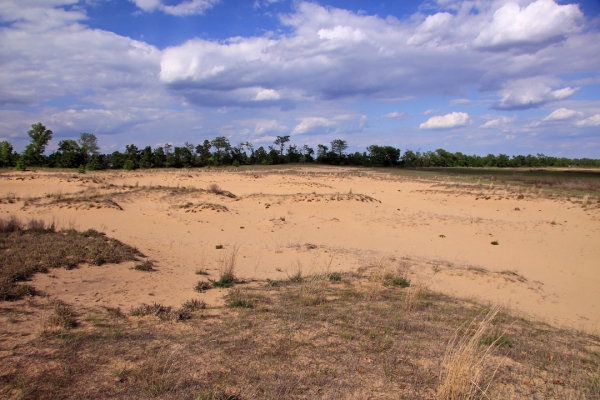
I may not be exactly sure why I like milkweeds so much, but I think I now know why I like clasping milkweed above all others. The softly colored green and pink blossoms are exquisite, to be sure, but more importantly the species is firmly linked in my mind to one of my favorite Missouri habitats. I imagine that clasping milkweed might be an attractive, if somewhat gangly, addition to a native wildflower garden. However, I’m not sure I would enjoy cultivated plants in my garden as much as I do seeing wild plants in one of Missouri’s rarest and most endangered natural communities.

Sand Prairie Conservation Area, Scott Co., Missouri

Sand Prairie Conservation Area, Scott Co., Missouri

Copyright © Ted C. MacRae 2013

Bollworms rising!

One of the most pernicious pests that U.S. farmers have battled is the larval stage of Helicoverpa zea (Lepidoptera: Noctuidae). This insect is destructive enough to have earned not just one official common name, but four (corn earworm, cotton bollworm, soybean podworm, and tomato fruitworm)—one for each of the crops in which it has attained major pest status. It isn’t only North American farmers, however, that must deal with this pest, but South American farmers as well. For many decades, corn and cotton have been its most important hosts in North America, but in recent years its importance has increased steadily in soybean as well, particularly across the mid-south. In South America, however, it seems satisfied—curiously—to confine its attacks to corn. Lest you think that South American farmers are getting off easy, there are other species of Helicoverpa in South America that are causing problems of their own. Perhaps the most troubling one is H. armigera, the Old World bollworm¹—a sister species to H. zea (Goldsmith & Marec 2010) native to Africa, Asia, and Australia and just as polyphagous as H. zea that was recently found infesting corn, cotton, soybean, and other crops in several areas of Brazil.

¹ Interestingly, in the Old World this species is called the “American bollworm,” despite the fact that it did not come from the Americas at all. I guess neither hemisphere wants to take the blame for this species.

Helicoverpa gelotopeon (South American bollworm) | Buenos Aires Province, Argentina

Helicoverpa gelotopeon (South American bollworm) | Buenos Aires Province, Argentina

While we wait to see what impact H. armigera ends up having in South America, another species of the genus is quietly rising from the ranks of secondary to primary pest further south on the continent. For many years, Helicoverpa gelotopeon (or South American bollworm) has been a sometimes pest of cotton and other crops in Argentina, Chile and Uruguay (Evangelina et al. 2012), but in a situation that mirrors the rise of H. zea on soybean in North America, the incidence of H. gelotopeon has grown during the past few years in the more southern soybean growing areas of South America as well. Like its North American counterpart, this insect causes not only indirect damage by feeding on the foliage of the plant during vegetative stages of growth (reducing photosynthetic capacity of the plant), but also direct damage by feeding on the developing pods during reproductive stages of growth. Predictably (and regrettably), farmers have responded by increasing applications of organophosphate insecticides, but the efficacy of these products—despite their relatively high toxicity—has often been inadequate to prevent yield losses. As a result, other management techniques and technologies will be required to keep this insect from having a major impact on soybean production in the temperate regions of Argentina.

Young larvae feed on foliage (note the very small caterpillar in the lower center area of the leaf).

Young larvae feed on foliage (note the very small caterpillar in lower left area of the leaf).

A mid-instar larvae feeding on soybean foliage.

A mid-instar larvae feeds on soybean foliage and exhibits the black pinacula characteristic of the subfamily.

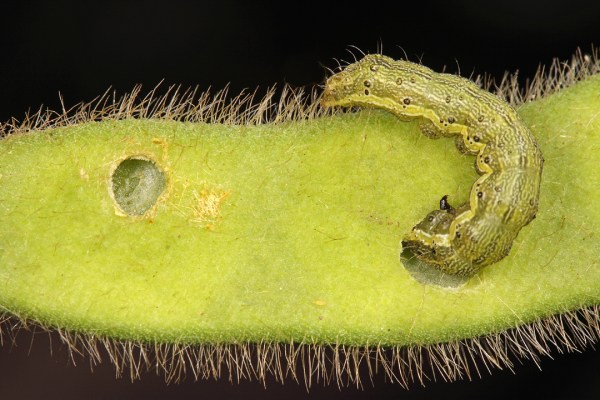
Larger larvae feed on developing pods, breaching the wall of the pod to consume the seeds within.

Larger larvae feed on developing pods, breaching the wall of the pod to consume the seeds within.

Adults are slightly smaller than H. zea and a little darker with somewhat bolder markings.

The photographs in this post may well be the best—and perhaps even the only ones—available of this species. A Google image search turned up nothing, and have I been unable to find any literature with photographs of either the adults or the larvae and their damage. If you are aware of any please leave a comment with the citation.

REFERENCES:

Goldsmith, M. R. & Marec, F. 2010. Molecular Biology and Genetics of the Lepidoptera. CRC Press, Boca Raton, Florida, 368 pp.

Evangelina, P., F. Crepo & J. C. Gamundi. 2012. Evaluación del daño simulado de “oruga bolillera” Helicoverpa gelotopoeon (Dyar) en estados vegetativos del cultivo de soja. Unpublished report, Instituto Nacional de Tecnología Agropecuaria (INTA), 6 pp.

Copyright © Ted C. MacRae 2013

The “little soybean weevil”

Lepidopteran caterpillars are without question the most important pests affecting soybean in South America, while stink bugs run a close second in terms of economic impact and as the targets of insecticide applications. There are, however, a number of weevil species (order Coleoptera, family Curculionidae) whose incidence has increased during the past decade or so as the area planted to soybean continues its decade’s long expansion on the continent. The most important of these is Sternechus subsignatus, a  relatively large (and rather attractive black-and-yellow) species that was first detected in southern Brazil in the 1970s. It has since spread to northern Brazil and in recent years has also begun affecting soybean in Salta and Tucumán Provinces of northern Argentina (sometimes considered a distinct species, S. pinguis). Known locally as “picudo grande” (big weevil), adults clip the petiole of leaves and girdle the stems, leading to stand loss. One adult is capable of killing multiple plants, so that even light infestations can result in severe damage.

IMG_2439_enh_1080x720

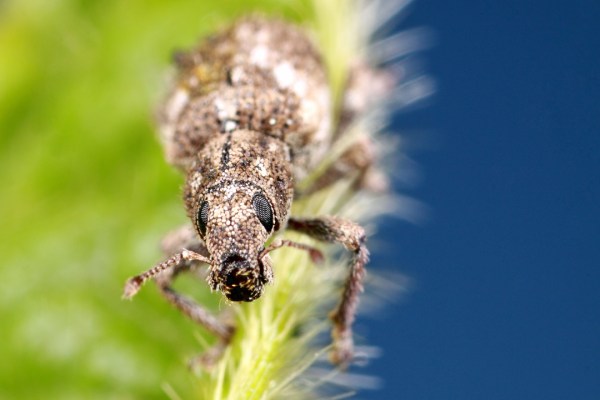
Promecops carinicollis | Tucumán Province, Argentina

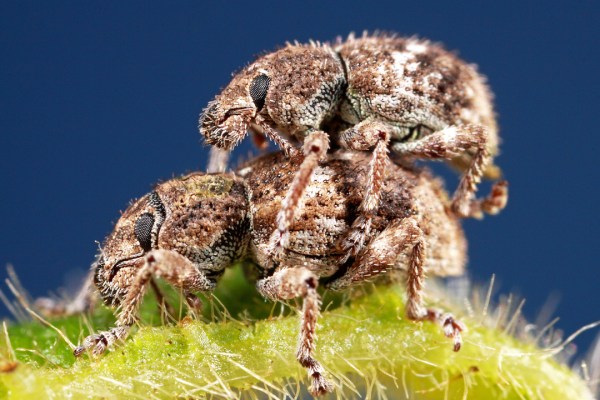
I’ve not yet seen “big weevils” for myself, but there are at least two other species that are showing up in soybean fields, particularly in Salta and Tucumán Provinces. During my recent visit to Argentina I happened upon a soybean field in northern Tucumán infested with one of them, Promecops carinicollis, a few photos of which I show here. This species is much smaller than S. subsignatus and is, thus, called “picudo chico” (little weevil)—certainly an appropriate name for the 3- to 4-mm long adults. While the integument is black, the body is densely covered with flat scales that form irregular white blotches on the elytra and otherwise give the beetle a mottled-brown appearance.

IMG_2436_enh_1080x720

Damage consists of adult feeding around the leaflet margins, giving them a scalloped appearance.

Like S. subsignatus, it is the adults that cause damage to the plants, although instead of the stems and petioles their feeding seems to be confined to the margins of the leaflets. This gives the leaflets a “scalloped edge” appearance that is quite distinctive and unlike the leaf damage caused by other leaf-feeding insects of soybean. The feeding causes a general reduction of the leaf surface area of the plant, which reduces the plant’s capacity to photosynthesize. However, as soybean has a rather high capacity to compensate for foliage loss by growing new foliage, especially during the earlier vegetative stages of growth, it would take rather high pressure by these weevils to cause enough damage to result in yield loss. It may be one of those soybean pests for which insecticide applications are made much more often than is warranted. The most important impact of this insect probably occurs just after seedling emergence, during which time feeding on the cotyledons and first leaves can weaken seedlings enough to cause stand loss.

Promecops carinicollis | Tucumán Province, Argentina

Beginning the process of making more Promecops carinicollis.

Copyright © Ted C. MacRae 2013

Baffling beetles

Even though I pride myself as a fairly competent coleopterist, I occasionally run into beetles that—despite my best efforts—I just cannot identify them beyond the family level. I don’t feel too bad about that, as the group’s 350,000 to 400,000 described species represent more than a third of all described life forms! Still, with the amount of information now available online combined with traditional print literature, it’s frustrating when I photograph species that seem quite distinctive but fail to show up in any search result. Here are a couple of South American beetles that I’ve pondered over for a year or more now. If you have any thoughts on their identity I would appreciate hearing from you.

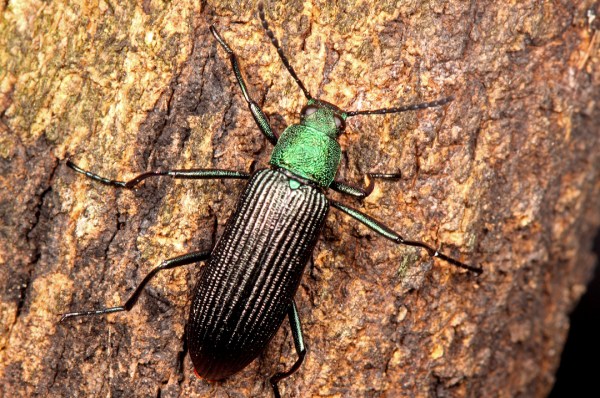
Tenebrionidae? | Campinas, São Paulo, Brazil.

Tenebrionidae? | Campinas, São Paulo, Brazil.

This first beetle was encountered January 2011 on the trunk of a tree in the city of Campinas, southeastern Brazil (São Paulo State). I only got this one shot of it before it dropped and disappeared, and except for the bright green color of the head and pronotum it reminds me of some of the long-jointed beetles—formerly the family Lagriidae but now a subfamily of Tenebrionidae (darkling beetles).

Elateridae | Rt 16 nr. Rio Nego, Chaco Province, Argentina

Elateridae | Rt 16 nr. Rio Negro, Chaco Province, Argentina

This is without question a species of click beetle (family Elateridae), but despite its rather distinctive coloration I’ve not found any images that resemble it. I found these beetles fairly commonly on flowers of Solidago chilensis in April 2012 at several localities along Rt 16 in northern Argentina (Chaco Province).

Copyright © Ted C. MacRae 2013

T.G.I.Flyday: Argentine robber

I’m back in South America for the next 2+ weeks, and though it will be another week before I actually make it into Argentina, I am celebrating my return to that lovely country with photos of Argentinian insects taken during last year’s extended visit but that I haven’t had a chance to share before now. Earlier this week I featured Camponotus sericeiventris (though I prefer the literal translation, “silky-bellied humpbacked ant“)—easily among the most handsome ants that I’ve ever seen and which I encountered in the remnant quebracho forests at Chaco National Park in northern Argentina. Today’s feature is an equally handsome robber fly (order Diptera, family Asilidae), also seen at the park and which landed on a dead log just long enough to allow one good lateral profile shot of the beast in all its hairy splendidness! (Probably it zipped off to impale an Odontocheila tiger beetle in the back of the neck!)

Triorla sp. | Chaco National Park, Argentina

Triorla sp. | Chaco National Park, Argentina

I sent this photo to a few fly guys looking for a more authoritative opinion about its identity, mentioning its resemblance to some of our North American species of Efferia. Herschel Raney agreed that it belonged to at least that group, while Eric Fisher suggested a species in the genus Triorla (an early segregate of Efferia that is now widely regarded as a valid genus). The most recent checklist of robber flies from Argentina (Artigas & Hengst 1999) lists three species in the Efferia group (all in the genus Nerax); however, both Herschel and Eric confirmed my suspicion that Argentina, and especially the north, is not well studied for Asilidae. Eric further suggested that there could be as many as several times the number listed, mainly undescribed but also described from adjacent countries and occurring in Argentina but not yet recorded from there. Also, I had presumed this individual to represent a female since it lacked the distinctly swollen genital capsule (e.g. see this post, presumably another Efferia-group species), but Herschel thought the terminal structure was odd and did not look female.

REFERENCE:

Artigas, J. N. & M. B. Hengst. 1999. Clave ilustrada para los géneros de asílidos argentinos (Diptera: Asilidae). Revista Chilena de Historia Natural 72:107—150.

Copyright © Ted C. MacRae 2013

The “silky-bellied humpbacked” ant

Last year during my extended work stay in Argentina, I was able to slip away from my duties during the first week of April and spend some time in the city of Corrientes in the northeastern part of the country. The city is one of my favorites in Argentina, but what I love most about it is its convenience as a base camp for exploring some of the habitats in the Grand Chaco ecoregion of northern Argentina. One day I had a chance to visit Chaco National Park about 100 km northwest of the city, site of some of the last remnants of the great quebracho forests that once covered much of northern Argentina. The forest preserved at Chaco NP takes its name from the quebracho colorado chaqueño (Schinopsis balansae) trees that dominate it, standing in defiant contrast to the vast, hot sea of cotton fields and mesquite fence-rows that surrounds it. While hiking a trail through the heart of the forest, I looked down to see a most impressive ant crawling across the forest floor:

Camponotus sericeiventris

Camponotus sericeiventris | Chaco National Park, Argentina

Because of its black color and the striking, silky sheen of the abdomen, I was immediately reminded of the Camponotus mus ants that I had photographed a year earlier further south in Buenos Aires. However, this fellow (er, fella…) was considerably larger than that species, and looking at the photographs later I was also struck by the acute spines at the humeral angles of the pronotum (in C. mus the humeral angles were obtuse) and the flattened legs. All of this combined to make it one of the most handsome ants that I had ever seen! I posted the above photo on my Facebook page asking for ID help, and James Trager quickly responded that the ant represents Camponotus sericeiventris, which translates roughly to “silky-bellied humpbacked” ant. Now there’s a common name I can get behind.

Camponotus sericeiventris

Of course, it turns out that I could have easily determined the species on my own using the characters I had already noted—primarily the acute spines. Googling “camponotus acute spines” retrieves as its first result a paper by Wheeler (1931) that discusses this ant and a newly discovered (at the time) cerambycid beetle, Eplophorus velutinus [now Euderces velutinus] mimicking the ant (Fisher 1931). As soon as I read Wheeler’s first paragraph I knew I had the right species:

Camponotus (Myrmepomis) sericeiventris, owing to its size, wide distribution and dense covering of silver or golden pubescence, is one of the handsomest and most conspicuous ants of the American tropics.

Apparently this ant is a popular choice of models for mimics in a number of insect groups. Lenko (1964) reported another cerambycid beetle, Pertyia sericea, as a mimic of C. sericieventris (the similarity of species epithets being no coincidence), and friend and colleague Henry Hespenheide has not only described a zygopine weevil, Copturus paschalis, from Costa Rica as a mimic of this ant (Hespenheide 1984) but also postulated mimicry by Apilocera cleriformis [now Euderces cleriformis] and three other species of Cerambycidae collected by him in central Panama. Henry further noted mimics in the families Cleridae and Mutillidae and the fact that all of the beetle mimics of this arboreally foraging ant are themselves woodborers or predators of woodborers as larvae.

It is interesting that Fisher (1931), in his description of E. velutinus, made no mention of the mimicry, while Wheeler (1931) in his paper about C. sericeiventris discussed this in great detail. He further noted the diversity of cerambycids here in our North American fauna that mimic ants. These include species in the genera Clytoleptus, Euderces, Cyrtophorus, Tilloclytus and—most strikingly—Cyrtinus pygmaeus, our smallest species of Cerambycidae which occurs on dead wood among small ants such as Lasius americanus, and Michthisoma heterodoxum which resembles small Camponotus pennsylvanicus workers. I’ve not yet encountered M. heterodoxum, which seems restricted to the southeastern Coastal Plain, but I have beaten C. pygmaeus from dead branches and can personally attest to the effectiveness of their mimicry—some slight something about the way they moved made me question my immediate assumption that they were ants and caused me to take a closer look at them before I shook them off the beating sheet. I wonder how many times before that I collected this species without realizing it!

REFERENCE:

Fisher, W. S. 1931. A new ant-like cerambycid beetle from Honduras. Psyche 38:99–101.

Hespenheide, H. A. 1984. New Neotropical species of putative ant-mimicking weevils (Coleoptera: Curculionidae: Zygopinae). The Coleopterists Bulletin 38(4):313–321.

Lenko, K. 1964. Sobre o mimetismo do cerambicideo Pertyia sericea (Perty, 1830) com Camponotus sericeiventris (Guerin, 1830). Papéis Avulsos de Zoologia (São Paulo) 16:89–93.

Wheeler, W. M. 1931. The ant Camponotus (Myrmepomis) sericeiventris Guérin and its mimic. Psyche 38:86–98.

Copyright © Ted C. MacRae 2013