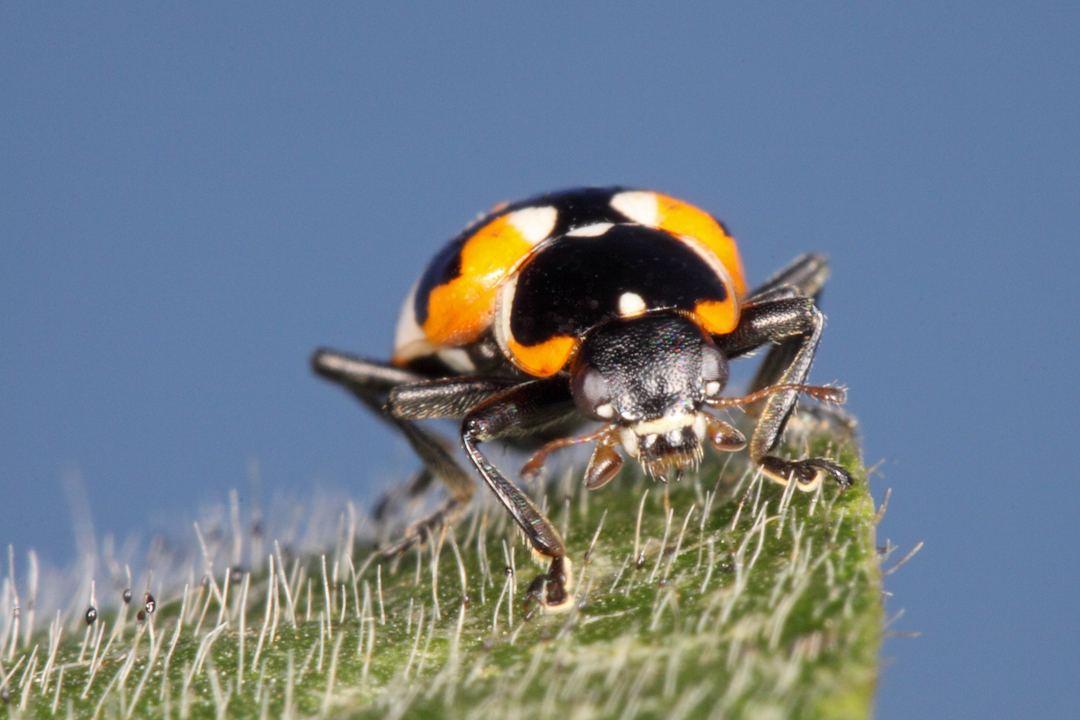
Eriopis connexa on soybean in Argentina

Eriopis connexa adult on soybean | Buenos Aires Province, Argentina

Congratulations to those of you who correctly guessed the identity of the “subject” in ID Challenge #16 as the ladybird beetle Eriopis connexa (family Coccinellidae). This is one of the most common ladybird beetles in Argentina, and during the past few weeks I have seen large numbers of these beetles in the soybean fields that I have been visiting. Coccinellids in Argentina are among the easier the groups to identify to species thanks to the excellent website Coccinellidae of Argentina. Identifying the “meal,” however, proved to be a little more difficult. Most people guessed aphids, a natural choice, but soybean aphids have not yet made it to the soybean fields of South America (thankfully!), so the victims of these predaceous beetles must be something else. There was a clue in the challenge photo that at least one person picked up on (but didn’t make the connection) in the form of small black globs stuck to the hairs of the plant on which the beetle was sitting. These are actually the fecal deposits of the bean thrips, Caliothrips phaseoli (order Thysanoptera, family Thripidae) (which I covered a year ago in A thrips is a thrips…), which for the past two seasons now has built up large populations on soybeans in Argentina. In fact, an adult bean thrips (yes, “thrips” is the correct singular form) can be seen in the above photo (which I did not notice while I was taking the photo). I’ve not yet witnessed these beetles actually feeding on a thrips, but the large numbers of thrips and beetles and near absence of any other suitable prey item makes the association almost a given.

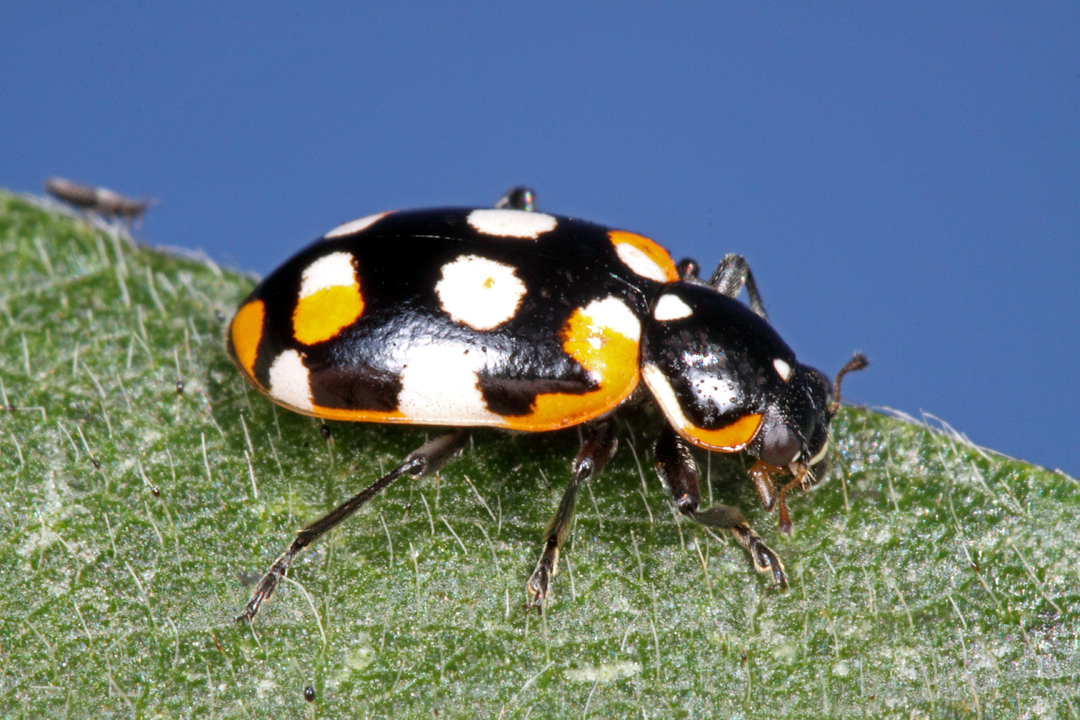
Eriopis connexa larva on soybean | Buenos Aires Province, Argentina

Not only are the adult beetles numerous on the plants, but eggs and larvae as well. Larvae are every bit as brightly colored as the adults, with a color scheme that leaves little doubt regarding their association. In the case of this larva, I watched it roam back and forth across the soybean leaf, pausing momentarily and apparently eating something—thrips eggs I presume.

Congratulations to Mr. Phidippus and Dennis Haines, who tie for the Challenge win with 14 points each, while Gustavo and Dave tie for the final podium spot. Mr. Phidippus, however, easily takes the overall win in BitB Challenge Session #5 with a whopping total of 57 points. Mr. Phidippus—contact me for your loot! Dennis Haines and Tim Eisele take 2nd and 3rd overall honors, and full standings for BitB Challenge Session #5 are shown below.

Commentor IDC#14 SSC#10 IDC#15 Bonus SSC#11 Bonus IDC#16 Total
Mr. Phidippus 11 11 9   12   14 57
Dennis Haines 9 4 2   10 1 14 40
Tim Eisele 8 6 2   13   6 35
Roy 5 6 7   10     28
Mike Baker 7   9       10 26
Dorian Patkus     9   11 4   24
David Winter 3   9       10 22
Gustavo             12 12
HBG Dave             12 12
Marlin 12             12
FlaPack 10             10
Laurie Knight 2       8     10
Doug Yanega         9     9
Brady Richards       4   3   7
John Oliver   6           6
George Sims 2 2 2         6
Richard Waldrep   6         6
Arpad Hervanek 4             4
Roxane Magnus 4             4
dragonflywoman       4     4
Wayne K         4     4
itsybitsybeetle         4     4
fatcatfromvox 2             2
Emily Gooch 1             1
Sean Whipple     1         1
Jon Q             1 1


Copyright © Ted C. MacRae 2012
ID Challenge #16

This will be the last post for BitB Challenge Session #5 (for a recap of the current standings see ). This is a straight up identification challenge, but with a twist. Can you identify the subject of this photo and its likely meal? The points will be a little different this time—only 1 pt each for order and family (because these are too easy) but 4 pts each for genus and species (because these are pretty hard). This goes for both subject and meal. Standard challenge rules apply (except as modified here), including moderated comments, tie-breaker points for first correct answers, and possible bonus pts for additional relevant information at my discretion (note: subfamilies, tribes, supergenus, hyperspecies, etc. do not constitute additional relevant information). ¡Buena suerte!

Copyright © Ted C. MacRae 2012

Lord of the flies!

I happened upon a rather interesting scene last week in a soybean field in northern Argentina (Chaco Province). This assassin bug (family Reduviidae) had captured and was feeding on an adult stink bug of the species Piezodorus guildinii—an important pest of soybean in Argentina and Brazil (where it is known by the common names “chinche de la alfalfa” and “chinche verde pequeño”, respectively). Assassin bug predation is always interesting enough itself, but what made this scene especially fascinating was the large congregation of flies surrounding and even crawling upon the predator and its prey. I had not witnessed something like this before, but it seemed clear to me that the flies were engaging in kleptoparasitism—i.e, stealing food. I’ve gotten into the habit of keeping a full set of extension tubes mounted on the camera with my 100mm macro lens—this not only provides the most useful (for me) range of magnification but also serves as a convenient and easy-to-use field microscope. Through the viewfinder I could see that there were at least two markedly different types of flies involved—more abundant, small, brown flies that I presumed (incorrectly, as it turns out) to be some type of drosophilid (vinegar fly), and a few larger, black flies that were completely unfamiliar to me. The flies were apparently feeding on fluids from the stink bug prey but also crawled all over the assassin bug as it fed. The assassin bug seem unencumbered in its feeding by the presence of the flies, but periodically it would slowly wipe its forelegs over its head to dislodge flies that had settled onto it. Just as quickly as they flew away, however, they crawled back.

The assassin bug, on the other hand, I recognized as very likely a species of Apiomerus—a large, exclusively New World genus known in North America as “bee killers” for their habit of sitting on flowers and ambushing visiting bees for prey. The prey selection behaviors of these insects, however, are more generalist than the name implies, as can be seen by these photographs. To verify my generic ID and possibly obtain a species ID, I sent some of these photos to Dimitri Forero at the Heteropteran Systematics Lab at University of California-Riverside. Dimitri is revising portions of Apiomerus (e.g., Berniker et al. 2011) and working on a general phylogenetic hypotheses for the genus. In the past he has been quite helpful in fielding questions from me about these bugs, and within a few hours Dimitri replied to inform me that the assassin bug was, indeed, a member of the genus Apiomerus, likely representing the common, widespread species A. lanipes (ranging from Panama to Argentina), based on its coloration, locality, and relative size. Update 12 March, 3:07 pm—After seeing the last photo in this post (which I did not send to him initially), Dimitri wrote to say the ventral abdominal pattern was not characteristic of A. lanipes. He asked about its size, to which I replied that it was about the same length but maybe a little less robust than A. crassipes (eastern North America). He later added, “I now think that this is A. flavipennis Herrich-Schaeffer, 1848. It is very similar to A. lanipes, but a lot smaller (lanipes is really robust), and with the abdomen with black and white patches, whereas in lanipes the abdomen is always black. I checked some series of specimens that I have here and, I am pretty sure now of the ID. I have material from Argentina as well. In some specimens that coloration of the corium varies, but the original description says it is yellow with a “hairy” pronotum, which fits very nicely your photos.” Apiomerus flavipennis is known from Argentina and Southern Brazil only.

Quite unexpectedly, Dimitri also noted that at least some of the flies could belong to the family Milichiidae. He first became aware of these flies after seeing a photograph of Apiomerus showing something similar and suggested Milichiidae online as a possible source for more information. This remarkably informative  website by milichiid expert Irina Blake, who dubs species in the family as “freeloader flies”, is a model for how websites dealing with obscure insect taxa should be organized and populated (and features on the home page a great photo of ant-mugging flies taken by our favorite myrmecophile). At any rate, I forwarded my photos to Irina and within minutes received her response that the bigger black flies most probably represent the cosmopolitan Milichiella lacteipennis and the smaller flies a species of the family Chloropidae (of “dog pecker gnat” fame) in the subfamily Oscinellinae, noting that she has seen similar (or the same?) chloropids in other photos as well engaging in kleptoparasitism.

Not long after receiving the first reply from Dimitri, I got another message from him with a link to a very interesting paper by Eisner and colleagues (1991), who recorded freeloader flies in Florida preferentially attracted to stink bugs and leaf-footed bugs (family Coreidae) being preyed upon by the orb-weaving spider Nephila clavipes. Olfactory stimuli were already suspected to be involved in attraction of milichiids and also chloropids (Sivinski 1985); however, Eisner et al. (1991) experimentally demonstrated that milichiid attraction was tied to specific components of defensive sprays in several pentatomid and coreid species (including P. guildenii, the prey species in this series of photographs). The defensive sprays of the bugs were generally ineffective at preventing predation by the spiders (and apparently this is the case for A. lanipes and other reduviids as well), thus serving as a signal to milichiids and chloropids not only of the presence of a food source but perhaps also assisting search for mates in a density dependent fashion (Sivinsky 1985). Milichiid attraction to hymenopteran prey, richly endowed with integumental glands themselves, has also been documented; the Eisner study raises the question whether these types of prey are also detected from chemical cues.

REFERENCES:

Berniker, L., S. Szerlip, D. Forero and C. Weirauch. 2011. Revision of the crassipes and pictipes species groups of Apiomerus Hahn (Hemiptera: Reduviidae: Harpactorinae). Zootaxa 2949:1–113.

Eisner, T., M. Eisner & M. Deyrup. 1991. Chemical attraction of kleptoparasitic flies to heteropteran insects caught by orb-weaving spiders. Proceedings of the National Academy of Sciences of the United States of America 88:8194–8197.

Sivinski, J. 1985. Mating by kleptoparasitic flies (Diptera: Chloropidae) on a spider host. Florida Entomologist 68(1):216–222.

Copyright © Ted C. MacRae 2012
Tucuras, langostas, y saltamontes

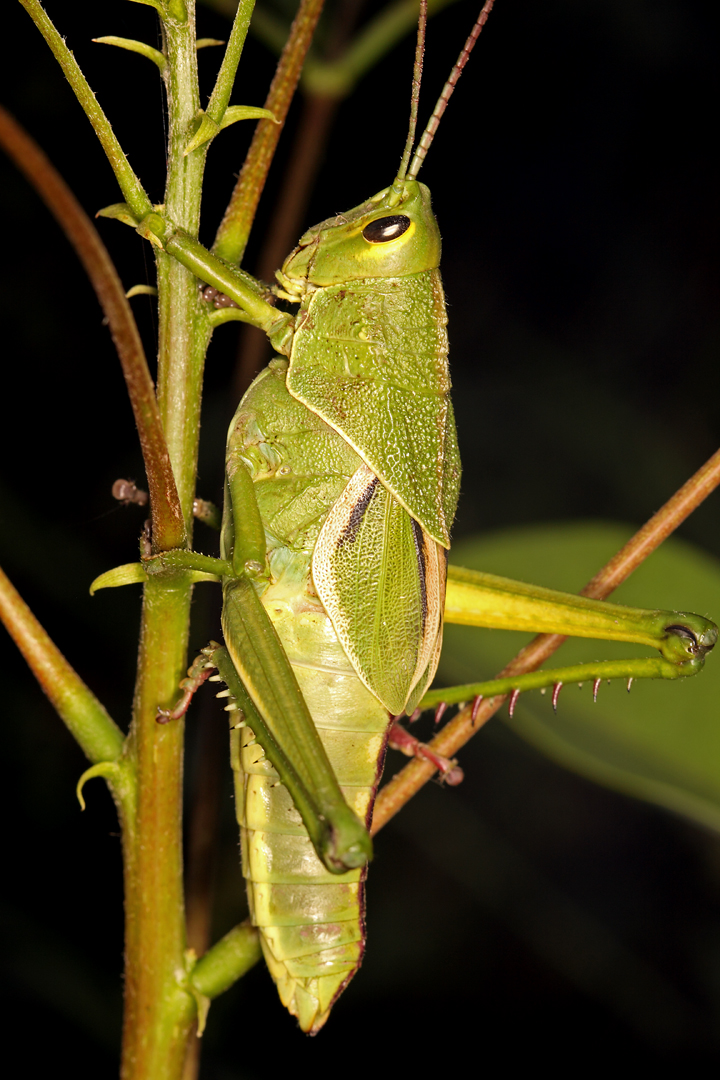
Staleochlora viridicata | Cordoba Province, Argentina (March 2011)

Tucuras, langostas, and saltamontes are names in Argentina for what we in North America call grasshoppers (order Orthoptera, superfamily Acridoidea). Argentina certainly has its share of species, some of which can only be described as “gigantes”! During my first week out in the field at my home base here in western Buenos Aires Province, I encountered the hefty-bodied female in the photo below and was immediately reminded of a similar-looking individual I had photographed in neighboring Córodoba Province during my March 2011 visit. Both had short but well-developed wing pads that at first suggested they might be mature nymphs of an incredibly large species. However, when I noted both were females I decided they likely represented adults of some type of lubber grasshopper (family Romaleidae), many of which—especially the females—are brachypterous (short-winged) and heavy-bodied as adults. A little searching revealed that both belong to the genus Elaeochlora, each looking very much like the species pictured on an Argentine postal stamp and identified as E. viridis (update 9 Mar 2012 – Sam Heads has identified these as Staleochlora viridicata).

Staleochlora viridicata| Buenos Aires Province, Argentina (March 2012)

Getting at least a genus name for these individuals then prompted me to go back to photographs I had taken last year of other types of grasshoppers. One of these, Eutropidacris cristata, is truly one of the largest grasshoppers I have ever seen (update 9 Mar 12 – Sam Heads notes that Eutropidacris is now a synonym of Tropidacris). This individual was seen in a soybean field in the northern Argentina province of Chaco. These insects, known in Argentina as “La tucura quebrachera,” apparently occur in outbreak numbers periodically and, understandably owing to their monstrous size, generate a lot of attention. In Brazil the sepcies is known as “gafanhoto-do-coqueiro” (coconut tree grasshopper),

Tropidacris cristata | Chaco Province, Argentina (March 2011)

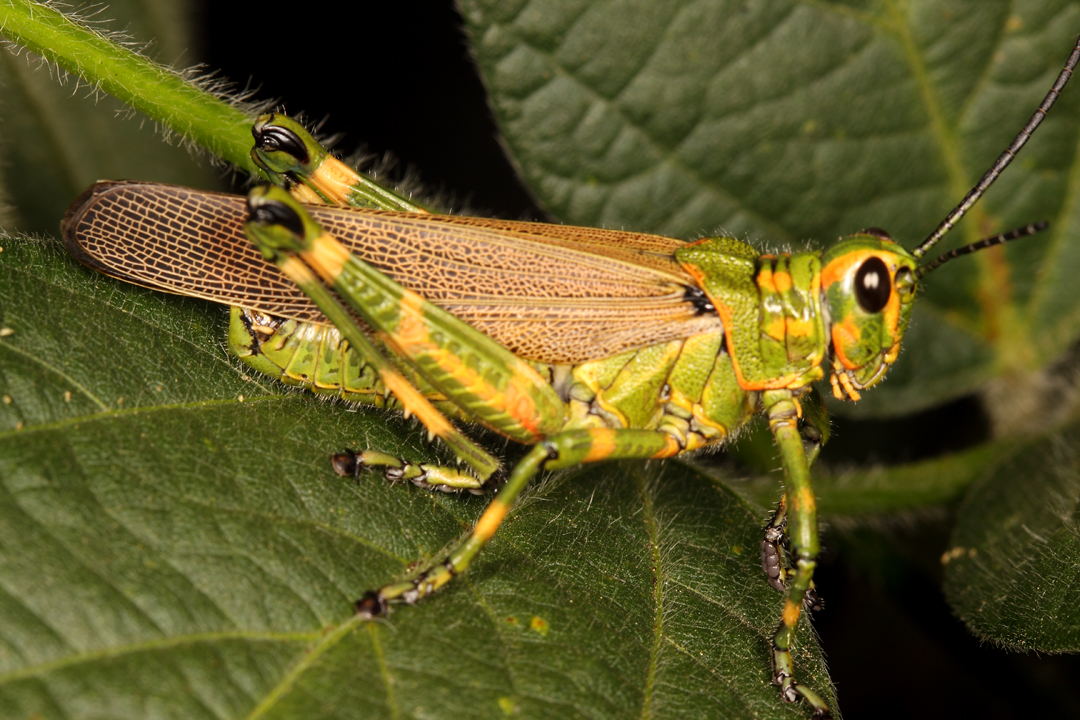
One of the more colorful grasshoppers I have seen in Argentina is Chromacris speciosa. The individual below was photographed last March in eastern Córdoba Province, also on soybean. It’s tempting to presume that the green and yellow coloration has a cryptic function, but apparently the nymphs of this species are brightly colored red and black and have the habit of aggregating on foliage. This is classic aposematism (warning coloration) to indicate chemical protection from predation, so perhaps there is a similar function to the adult coloration as well.

Chromacris speciosa | Cordoba Province, Argentina (March 2011)

Copyright © Ted C. MacRae 2012

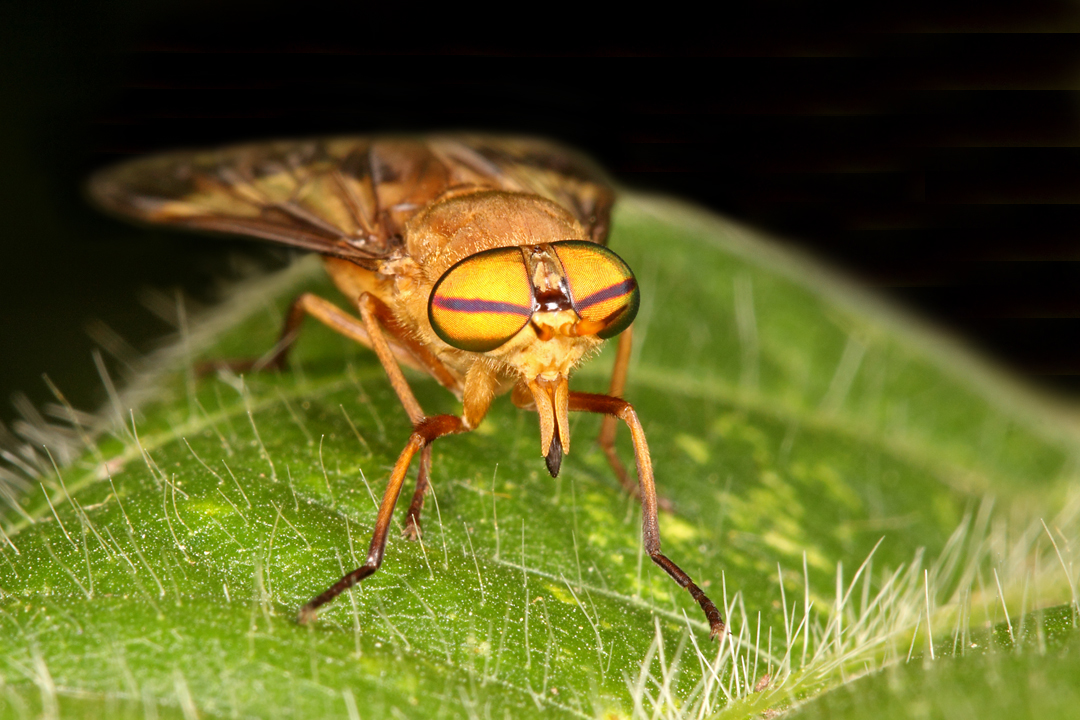
Crazy Eyes 2

Buenos Aires Province, Argentina | March 2012

While the eyes of this female horse fly (family Tabanidae) aren’t quite as striking as those of Tabanus lineolus (the wonderfully dimorphic males and females of which were made famous by Thomas Shahan and Ralph Holzehthal), they still managed to catch my eye as I was scouting for more pedestrian types of insect in a soybean field in central Argentina this past week. We know this is a female due to the separated eyes (males have larger eyes that meet at the middle of the head—supposedly the better to see females with); and by the obvious, blade-like mouthparts, which the females use to slice mammal skin so they can lap the blood that their eggs need for development prior to being laid while males forego specialized mouthparts and concentrate on using their huge eyes to look for females.

Female horse flies have well-separated eyes and distinct, blade-like mouthparts.


I suspect this individual had recently emerged from the soil (where many horse flies pupate) and was still hardening off, as she was very calm sitting on the leaf and allowed me to steady the leaf with one hand as I snapped a few photos with the other. I would have loved to have switched out the 100mm lens I was using and put on my 65mm 1-5X lens to really zoom in on those striking eyes. Unfortunately, I don’t think my field companions shared or understood my fascination with this little insect. If anybody has a clue about the identity of this species please let me know.

Copyright © Ted C. MacRae 2012

To the land of Gauchos

Today I leave for an extended stay in Argentina. Many have asked me if my trip is for work or fun, and my standard response has been, “It’s for work, and it will be fun!” For the next eight weeks, I’ll be helping out with field trials and speaking to farmers (while sampling a few Malbecs as well). Of course I would rather it be an 8-week collecting trip, but I consider myself fortunate even to have an opportunity such as this. I’ll pick up a few insects along the way, but what I really hope to bring back in large quantity is photographs.

It’s a little difficult to predict how reliable and consistent I’ll have internet access or the time to take advantage of it, so postings over the next few weeks may be a little less regular than what has become my usual custom. The trip is also heavily front-loaded with work activities as I get my bearings and spend time getting to know my new colleagues, so I’m not sure when I might have new photos to show here. Not to worry, I have plenty of material that I haven’t yet shown. Until then, I leave you with this photograph I took last November at  in Buenos Aires. These tiny bugs seem to be early-instar leaf-footed bug (family Coreidae) nymphs, their bright red and black coloration and aggregating behavior indicating ample chemical protection against predation.

Early-instar coreid nymphs | Buenos Aires, Argentina

Copyright © Ted C. MacRae 2012

Chrysobothris viridiceps

Chrysobothris viridiceps on dead branch of Quercus alba | Baxter Co., Arkansas

Despite their general popularity among beetle collectors, jewel beetles (family Buprestidae) have an admittedly deserved reputation for difficult taxonomy. Part of the reason for this is the existence of several highly speciose genera. In North America, for example, nearly half of its described species belong to just three genera—Acmaeodera, Chrysobothris, and Agrilus (the latter, with nearly 3,000 described species and many more awaiting description, being possibly the most speciose animal genus in the world). Identification of species within these genera is difficult enough due to their sheer numbers and is further complicated by the existence a number of “species-groups”—i.e., groups of very closely related species that have only recently become reproductively isolated from each other (likely in response to host partitioning) but have not yet evolved obvious unique morphological characters. Perhaps the most famous of these is the “Chrysobothris femorata species-group.” A dominant component of hardwood forests throughout North America, members of this group have confounded taxonomists, collectors, and foresters alike for many years. Fortunately, the recent revision of the group and formal description of several species by Wellso and Manley (2007) have brought much needed clarity to the group. While problems still remain (C. femorata sensu novo probably still encompasses several undescribed species), most individuals can now be identified with some confidence.

Males and females both exhibit completely divided post-median fasciae

I have previously discussed three of the seven now recognized species occurring broadly in eastern North America—the nominate C. femorata, still regarded as an important pest of ornamental and fruit tree plantings, C. caddo, one of the new species described by Wellso and Manley (2007) and associated with dead hackberry (Celtis spp.), and C. quadriimpressa, mostly associated with dead branches of oak (Quercus spp.). The individuals shown here, photographed on branches of a dead white oak (Quercus alba) in north-central Arkansas this past June, represent a fourth species in the group, Chrysobothris viridiceps. Unlike most members of the C. femorata species-group, C. viridiceps can be readily recognized in the field  due to the uninterrupted costa (raised narrow ridge) that completely bisects the posterior fovea (rounded pit) on each elytron. In all other species this costa is interrupted by the fovea. Moreover, this species is the only one in the group in which the males (easily distinguished from females by the bright green frons, or face) exhibit bicolored antennal segments, with the outer portion of each segment yellow and the remainder bright metallic green. While the species name is Latin for “green face,” this character is useless for species identification, as males of all species in the group exhibit a more or less green face.

Males sport not only the green face for which the species is named, but also distinct yellow areas on the antennal segments

Females are a little more difficult to distinguish in the field because, like those of other species of the group the antennae are more uniformly reddish. Likewise, the face also lacks the green coloration of the male, and although still useful for species identification the differences among females between the different species are more subtle and require microscopic examination. However, as in the male the elytral foveae are completely divided, allowing even females to be recognized relatively easily.

Females tend to be more reddish on the legs, antennae and face

One thing I have noticed about the different members of the C. femorata species-group is the usefulness of host plant association in distinguishing the different species. Of the seven species occurring in my region, I’ve seen C. femorata associated mostly with stressed but still living trees in genera other than oak or hickory (e.g., maple, sycamore, apple, poplar, ash, etc.), C. adelpha associated exclusively with dead hickory (Carya spp.), and C. caddo associated almost exclusively with hackberry (Celtis spp.). The remaining four species are all associated primarily or exclusively with oaks, but even these species often segregate according to branch size, with C. viridiceps occurring mostly on the smallest branches, C. quadriimpressa on somewhat larger branches, C. rugosiceps on very large branches and the upper trunk, and C. shawnee on large trunks and even stumps. Not surprisingly, these size preferences reflect the relative size of the beetles, with C. viridiceps (7–13 mm in length) generally being the smallest of the four species and C. shawnee (9–18 mm in length) the largest.

Okay, now to get photos of C. adelpha, C. rugosiceps and C. shawnee!

REFERENCES:

Wellso, S. G. and G. V. Manley. 2007. A revision of the Chrysobothris femorata (Olivier, 1790) species group from North America, north of Mexico (Coleoptera: Buprestidae). Zootaxa 1652:1–26.

Copyright © Ted C. MacRae 2012
Grampus and go-devil

Corydalus cornutus | Wayne Co. Missouri


Ever taken a close look at a female dobsonfly’s head? Female dobsonflys don’t get nearly as much attention as the males due to the latter’s ridiculously elongated mandibles. While female mandibles are more modestly proportioned, don’t think they’re ineffectual—females are quite capable of inflicting a blood-letting nip if one is not careful. Certainly the female head is no less dinosaurian in appearance than the male’s, and while I know that Corydalus cornutus is the product of the same amount of evolutionary time as any other species on earth today, I can’t help but think they look so “primitive.”

While dobsonfly is the commonest name applied to these insects, I much prefer “go-devil” (not sure of the origin) and “grampus” (from “Krampus”—a mythical horned, creature in Alpine countries). The latter name in particular pays more appropriate homage to the monstrous appearance of these insects.

Photographed July 2011 at a blacklight sheet in Sam A. Baker State Park, Wayne Co., Missouri.

Copyright © Ted C. MacRae 2012