Brazil Bugs #6 – A mosca

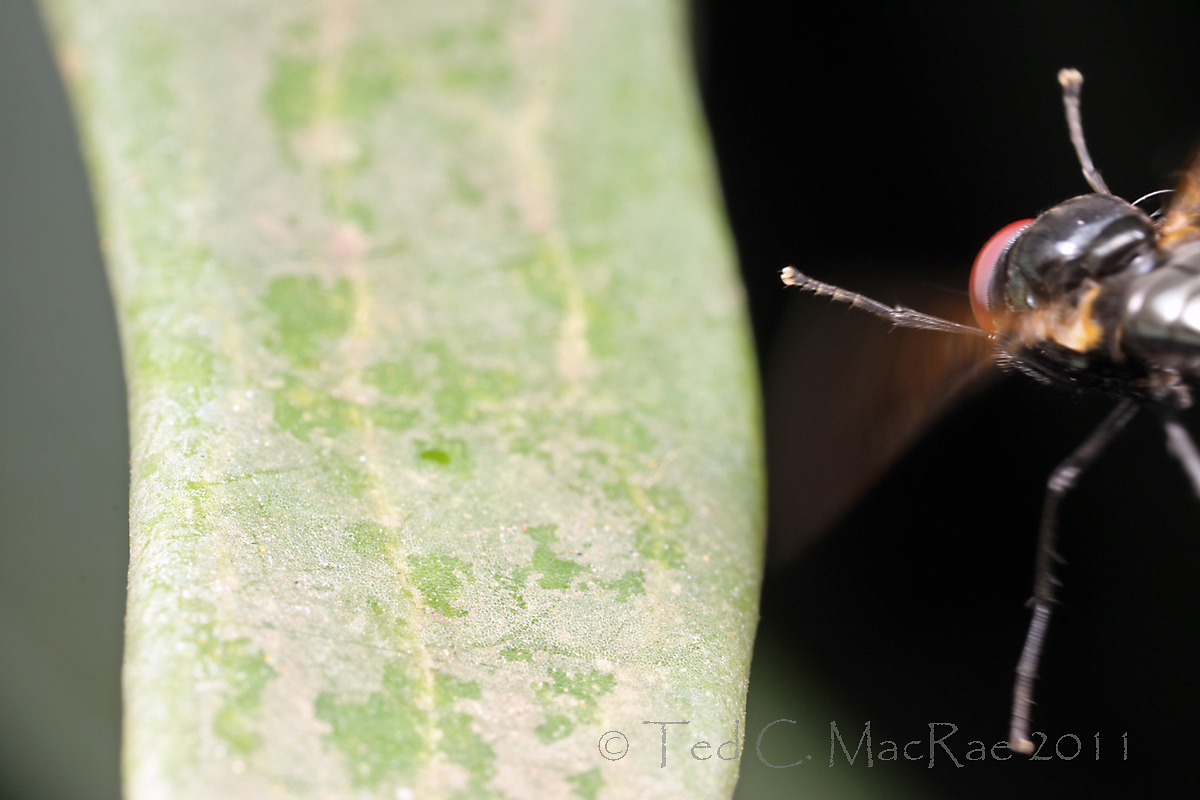
As I strolled the hotel grounds here in Campinas after work one day last week, I came upon a tree with several epiphytic orchids and a large staghorn fern (Platycerium sp.) mounted to its trunk.  On the tips of several of the fern’s leaves sat these peculiar looking flies – shining dark blue-black in color with a prominent red head.  I’m just guessing that they were some sort of blow fly (family Calliphoridae), although something about the look doesn’t seem quite right for the family (maybe because I’ve never seen Brazilian calliphorids before).  I found it interesting that they all oriented themselves head downward at the tip of the leaf on which they were sitting.  When I get intrigued by something, I want to photograph it, but in this case it was easier said than done.  They were small enough to require the 65mm lens, which means getting quite close, and every time I approached one it would fly away.  There were enough of them, however, that when one flew away I would just try another, and each fly would eventually return to the same leaf on which it had previously been sitting.  I spent some minutes scaring away fly after fly before I finally figured out the approach.  That, however, was only half the battle! 

When I finally started trying to take some shots, the pre-flash on the ETTL flash setting would scare the fly before I could complete the shutter snap, and I was getting only an empty frame where the fly had been sitting.  I thought about switching to manual flash but decided to keep working the fly and just see if I could get it accustomed to the flash.  The first photo in the series posted here is the first one in which I actually got part of the fly in the frame (I think he did a quick loop out and was actually returning to his spot when the shutter snapped).

I got closer in this one – the fly was just starting to take off as the shutter snapped (too bad I didn’t have better focus, or this could’ve been an interesting view).

Finally, I got the fly sitting still at the tip of the leaf.  This is when I started to get picky – I wasn’t too satisfied with the composition in this photo, and since he seemed to have become accustomed to the flash, I decided to take a few more shots to try to make sure I get one with good composition and focus.

Better composition this time, but the focus is still a bit off.  Unfortunately, this was my last shot at this guy, as he took off right afterward.  The thought taking the time to work another fly and get him accustomed first to me and then the flash didn’t appeal to me by this point – I was in Brazil, and there are so many other insects to photograph.  I decided good enough was good enough and continued my searches…

Copyright © Ted C. MacRae 2011

Brazil Bugs #4 – Mais dos percevejos

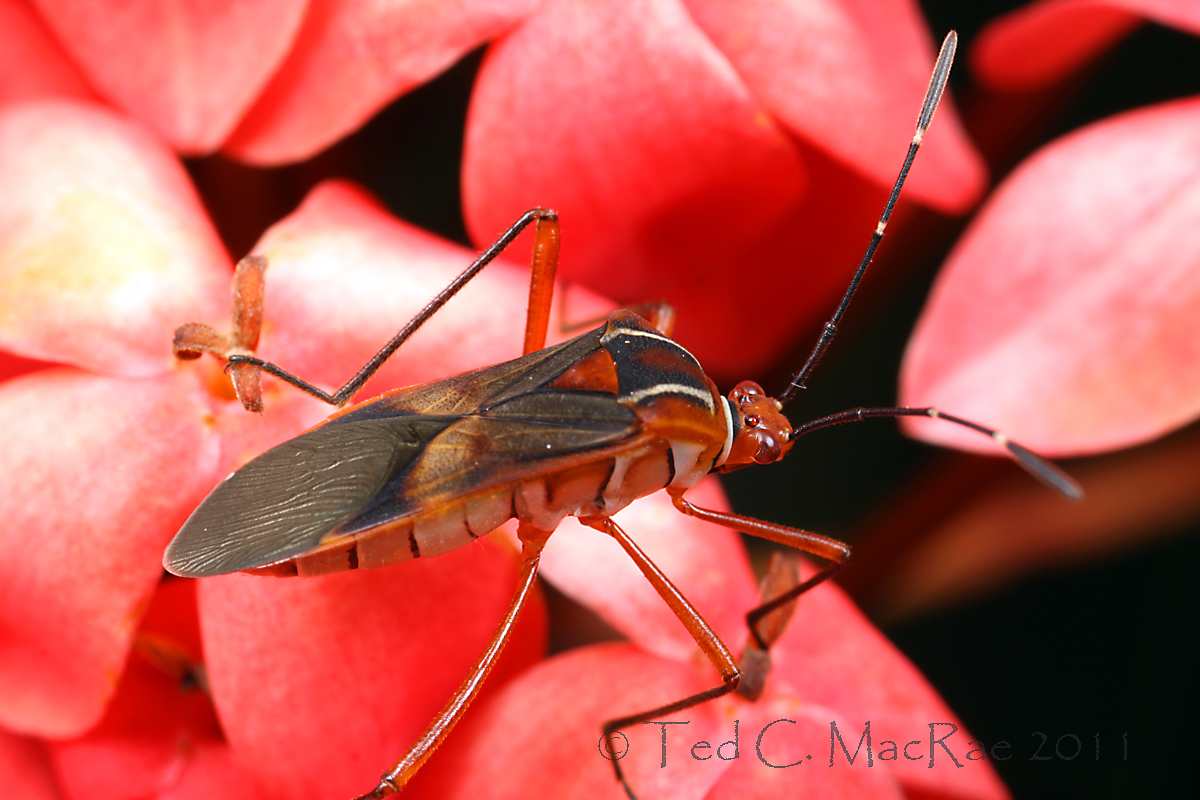
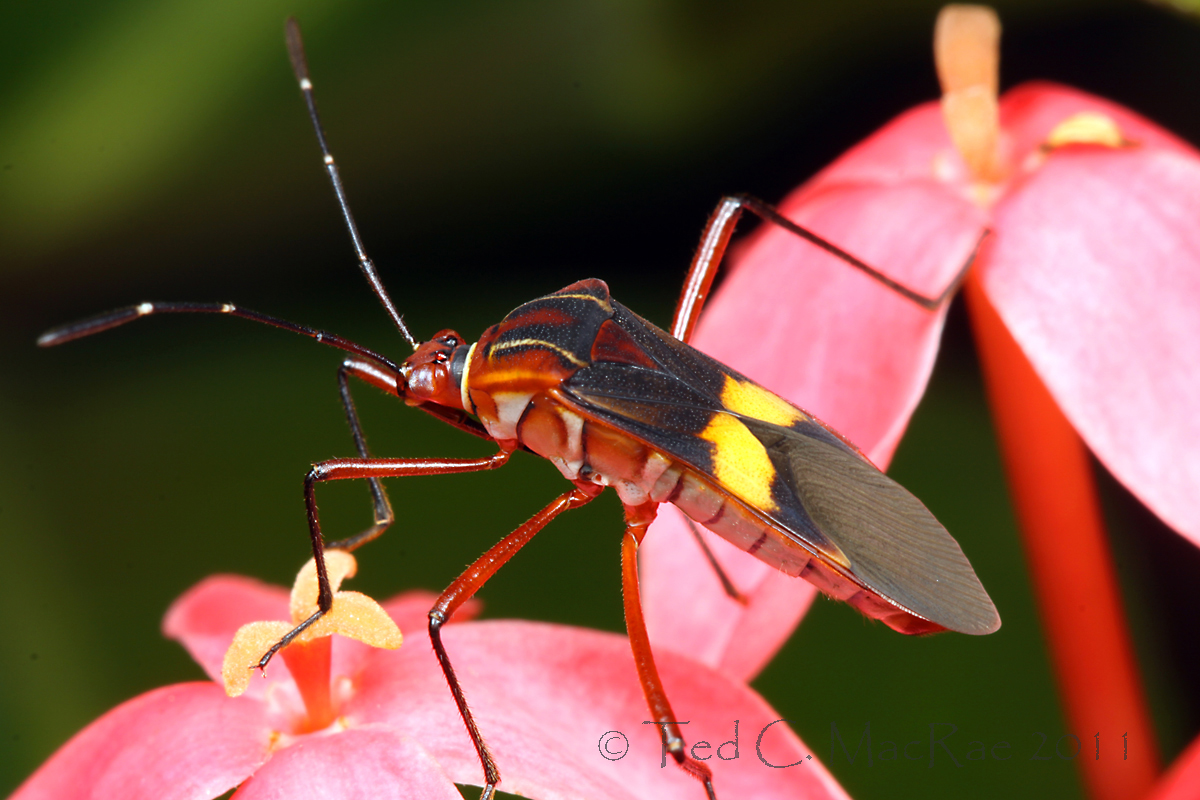
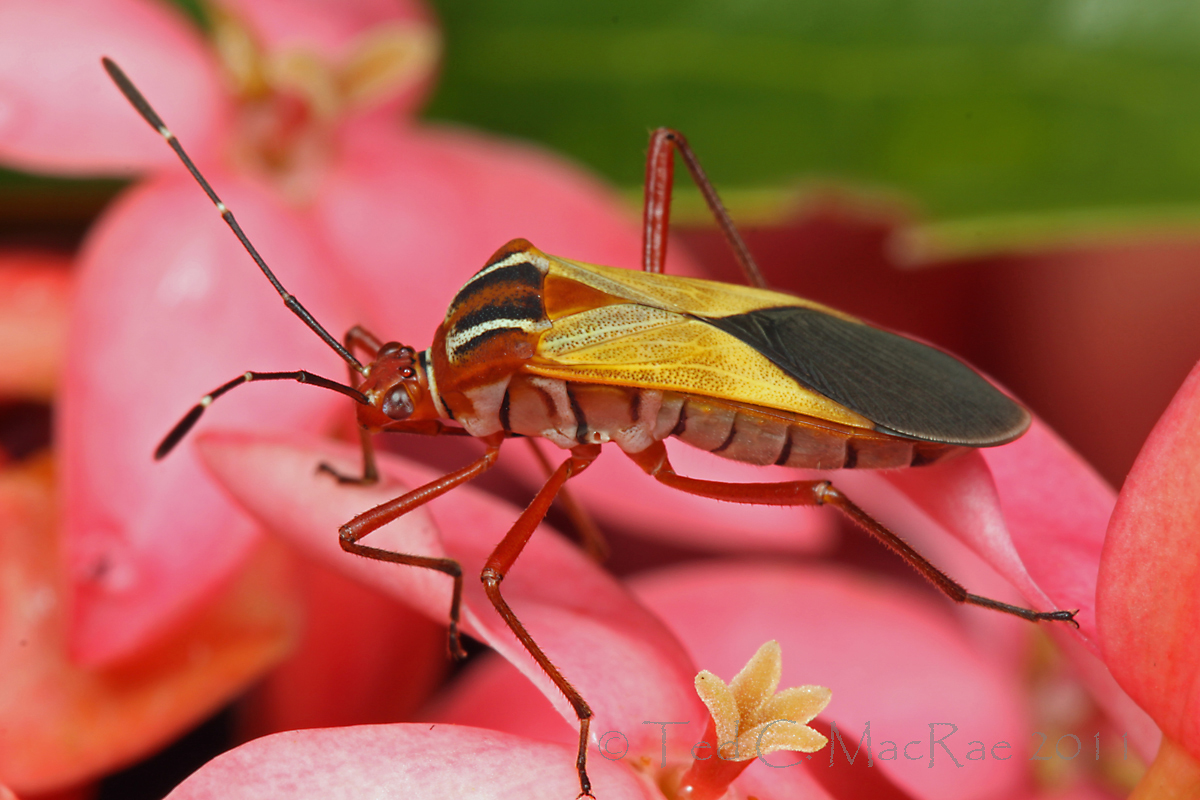
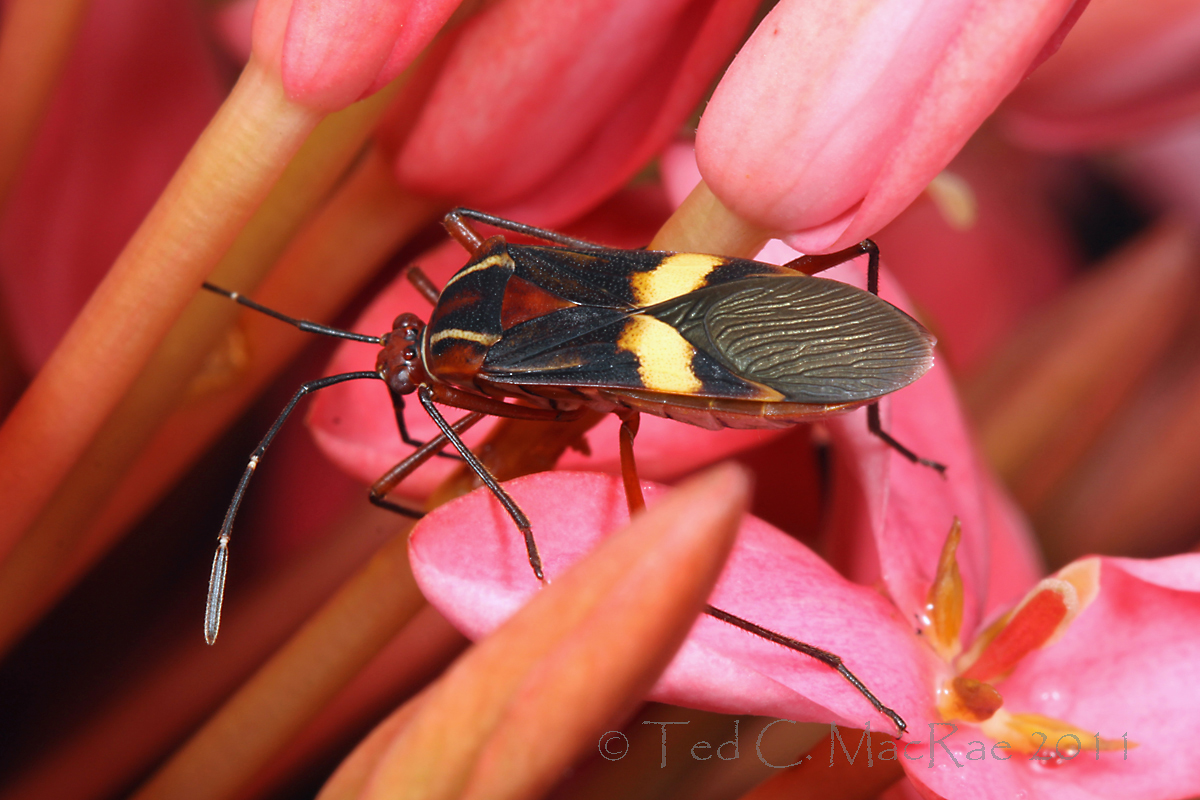
I found mais dos percevejos (more of the leaf-footed bugs) on the still-unnamed pink flowering shrub in back of the hotel in Campinas, Brazil.  Not only am I convinced that they truly do belong to the family Coreidae (for the reasons mentioned in the earlier post and below), but also that despite the different color patterns shown by the two individuals in that post that they are indeed a single species.  I also found the above individual, representing an even more heavily melanized version than the two shown previously.  In looking at a large number of individuals on the shrubs (and subsequently encountering them in a different part of Campinas over the weekend), it became clear that there were not just two distinct color forms but a broad range of variability.  I could believe maybe two species occurring together on a common resource, but it seems unlikely that each color variation represents a different species.  Thus, it now seems that there is one highly variable species visiting these flowers.

I had an idea on how to find the name of this species that almost worked.  Rather than Googling “leaf-footed bug” or “Coreidae,” I tried “percevejo” instead, along with Brazil or Brasil.  There were 3 or 4 photographs that showed up in the images search that I recognized instantly as belonging to the same species.  Unfortunately, none of the links where the photos were found gave any information more specific than family (all, however, agreeing with family Coreidae).  I think it’s time to send an email to Harry Brailovsky, a coreid specialist at the Instituto de Biologia (UNAM) in Mexico City.

Photo 1: Canon MP-E 65mm 1-5X macro lens (ISO 100, 1/200 sec, f/13).
Photo 2: Canon 100mm macro lens (ISO 100, 1/200 sec, f/16).
Both photos: Canon 50D, Canon MT-24EX flash w/ oversized DIY concave diffuser. Typical post-processing (levels, color, unsharp mask).

Last minute edit: I just heard back from Harry Brailovsky as I was ready to post (thank you Harry!).  The insect is, indeed, a species of Coreidae, which he identified as a member of the genus Hypselonotus.  I did some searching online to see if I could find any additional clues as the species identity – I found no images that looked right but did find this key to the Hypselonotus of Costa Rica.  The key relies on some ventral characters, and I’m a little uneasy about using it for something from southern Brazil, so I think I’ll just wait until Harry has a chance to look it up when he returns to the museum.

Second update 1/26/11:  Harry has confirmed the species as Hypselonotus interruptus, which was mentioned but not included in the key that I linked to above.  The only online images I have found of this species are at this link. Either Harry is wrong (unlikely), the photos in the link are misidentified (maybe), or the species is enormously variable (perhaps quite likely).

Copyright © Ted C. MacRae 2011

Brazil Bugs #3 – Gorgulho Enorme!

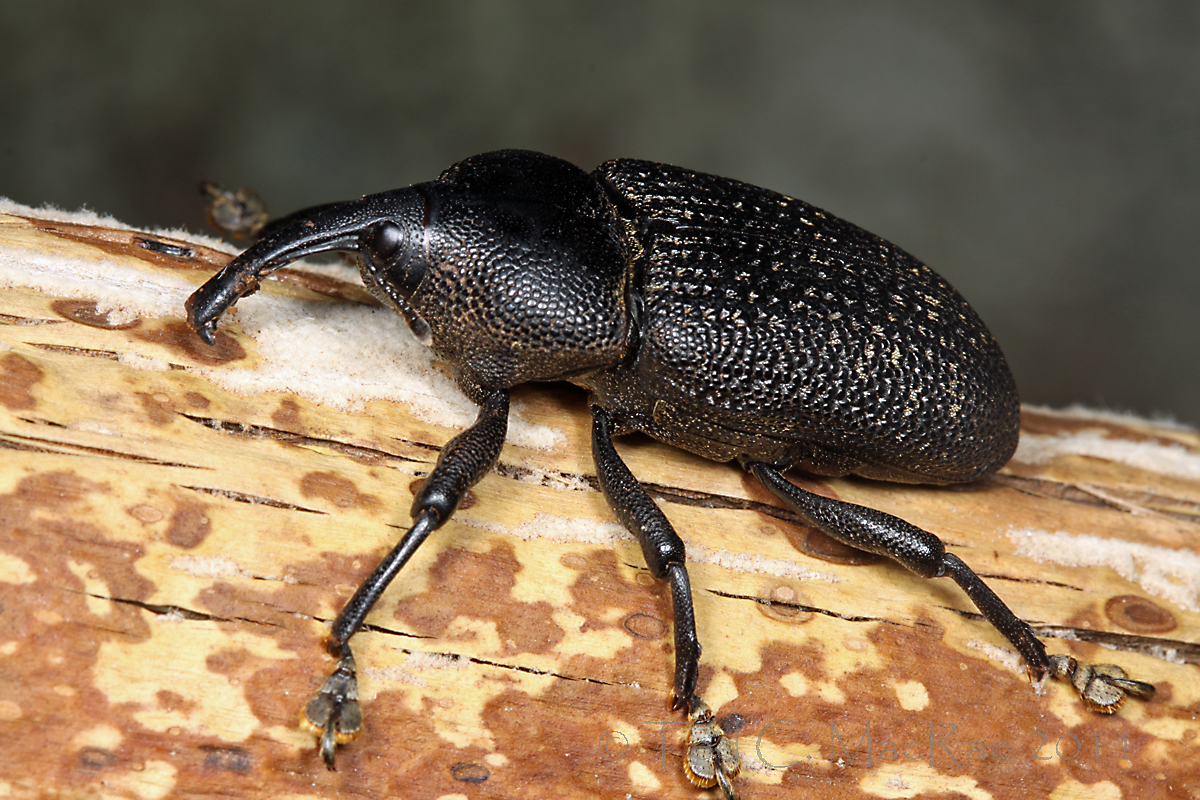
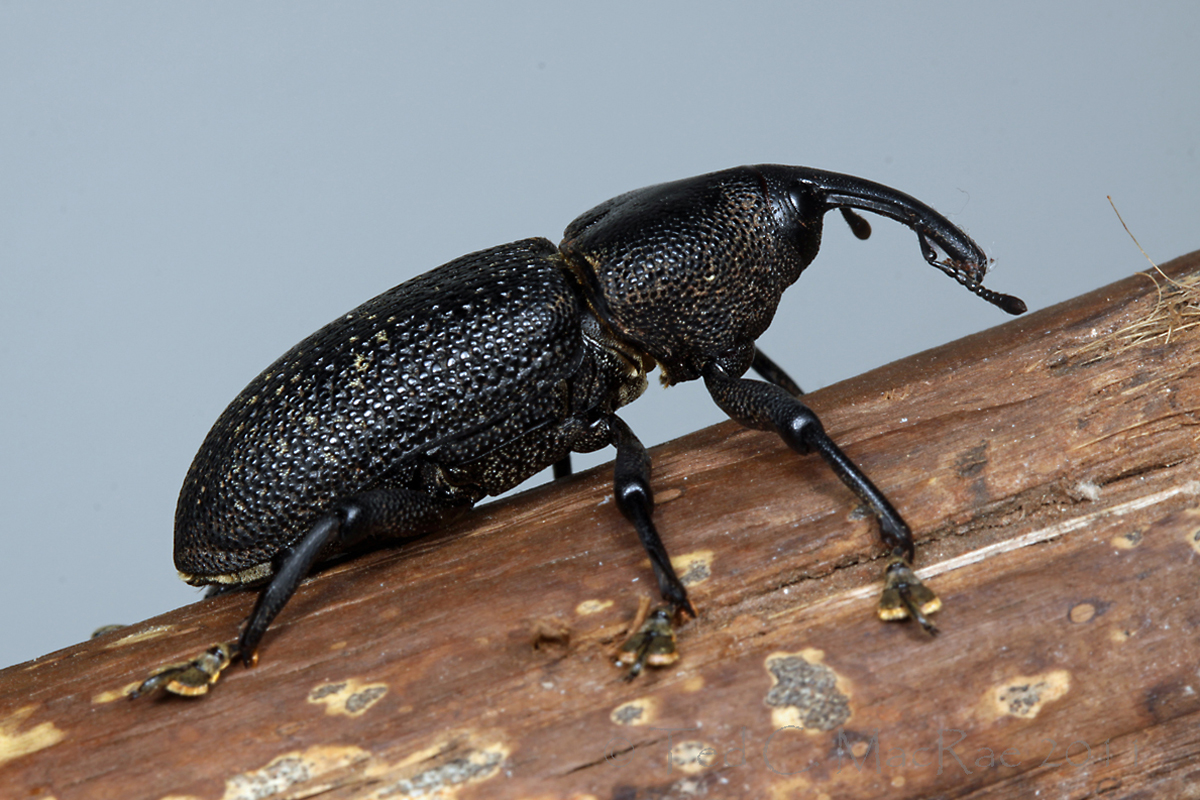
The second night at the hotel on the outskirts of Campinas (São Paulo, Brazil), I found this enormous weevil laying on the ground underneath some windows.  It was dead but completely relaxed and in perfect shape.  I wondered if it had been attracted to lights in the window the previous evening and flown there as its “last hurrah.”  This beast of a weevil – measuring a good 30mm from the tip of the snout to the apex of the elytra – immediately brought to my mind giant palm weevils of the genus Rhynchophorus (Coleoptera: Curculionidae).  I looked around and saw palm trees everywhere, so I figured that must be what it was.  I picked up one of the dead fronds from under a nearby palm tree and placed the weevil on the stem for a few photographs.  Given it’s freshness, it was quite easy to place in a lifelike pose, and I placed the stick in various positions to get a few different backgrounds.  As I was shooting, I noticed another, smaller, weevil on the ground near where I had found the first one – also dead and fresh.  Considering that Rhynchophorus often reaches pest status on palms, this further confirmed the ID in my mind.

Once back in the hotel room I smugly entered “giant palm weevil” into Google to bring up some images and confirm my ID (and also make sure my photos were at least on par with published images).  When the images came up, I saw immediately that my weevil was not a giant palm weevil at all.  While the South American species (R. palmarum) is black, the pronotum and elytra are much smoother and distinctly striate.  I don’t know if this weevil is a member of the same subfamily (Rhychophorinae) as the giant palm weevils, but it certainly not a member of that genus.  Still, considering its large size and distinctive appearance, I remained confident that an ID would come quickly.  Sadly, this has not proven to be the case – no search term I’ve tried involving the term “giant black weevil Brazil” or its many variations brings up anything remotely similar.  So, after spending much more time trying to identify this beetle than I should have, I leave it in the hands of my readers in the hopes that one of you will recognize it and provide a name.  Only when we have a name will it be possible to know something more about how this beetle lives (and if my placing it on a dead palm frond was a truly artificial setup).

Photo Details: Canon 50D w/ 100mm macro lens (ISO 100, 1/200 sec, f/16-18), Canon MT-24EX flash w/ oversized DIY concave diffuser. Typical post-processing (levels, minor cropping, unsharp mask).

Update 01/24/11: Thanks to Henry Hespenheide (via Facebook) and Art Evans, who clued me in to the genus Homalinotus (subfamily Cholinae).  I found a key to the 21 known species of this exclusively Neotropical genus (Vaurie 1973) and consider this individual to represent H. coriaceus – broca do cacho do coqueiro (black coconut bunch weevil).  This species breeds in the stems of old leaves of several native palms; however, it has adapted to the introduced coconut palm and apparently become a limiting factor in the commercial production of coconuts.  Thus, I can breathe easy now knowing that my photographs of this individual on the stem of a dead palm frond represent an entirely natural setting.

REFERENCE:

Vaurie, P.  1973.  The weevil genera Homalinotus and Ozopherus of the Neotropical Cholinae (Coleoptera, Curculionidae).  Bulletin of the American Museum of Natural History 152(1):1–49.

Copyright © Ted C. MacRae 2011

Brazil Bugs #2

A few more photographs from this past week in Campinas, Brazil.  It rained during the afternoon but stopped by the time I arrived back at the hotel, allowing me to stroll the lavishly landscaped grounds during the mild evening hours.  There is a pink-flowered shrub forming a hedge row in back of the hotel that is highly attractive to many types of insects.  The identity of the shrub remains a mystery to me, and most of the insects I’m finding on it I can recognize only to family – I’m hoping the hotel staff will be able to name the former and that the readers of this blog might be able to provide IDs for the latter.

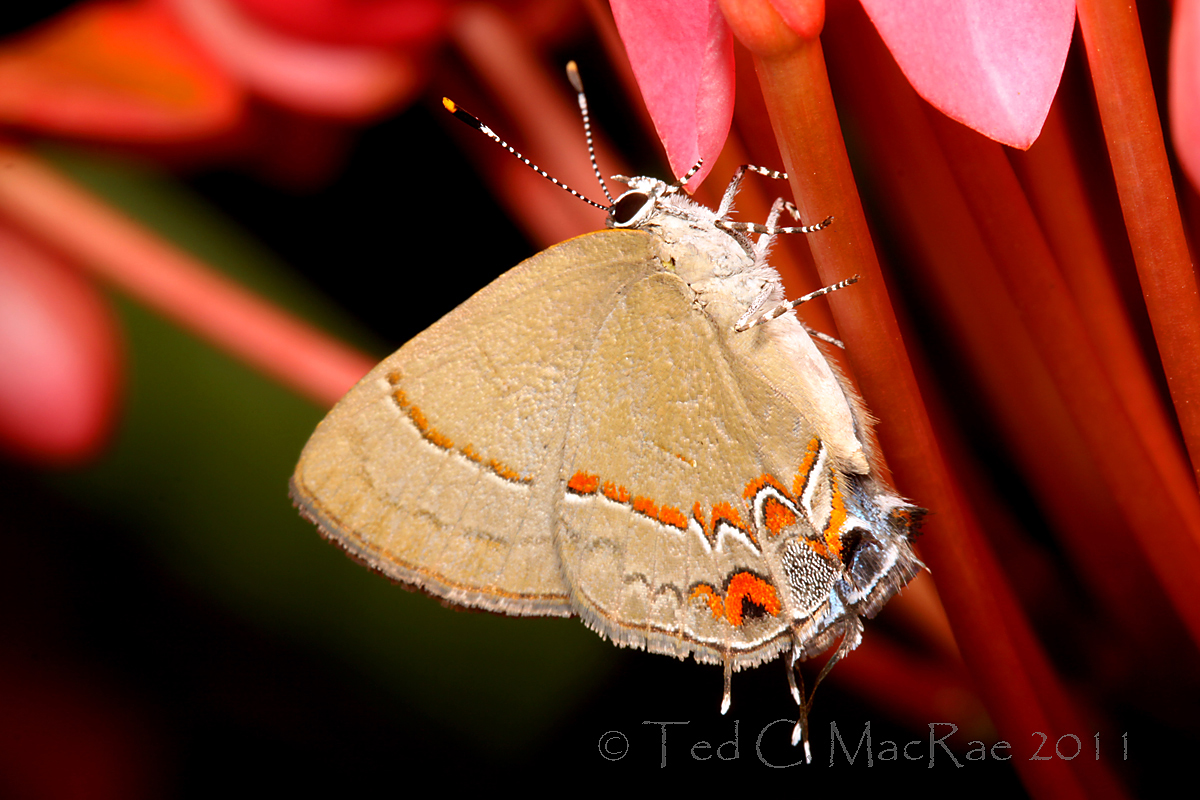
Calycopis sp. poss. origo (Lepidoptera: Lycaenidae). ID by Dave Hubble and Chris Grinter.

It took a bit of effort to find an unobstructed view of this hairstreak butterfly (family Lycaenidae) as it visited the flowers within the shrub.  Every time I tried to move foliage out of the way to get a good view, the butterfly became alarmed and flew to another part of the hedge row.  My antics drew the attention of a hotel worker, who was apparently interested enough in what I was doing to act as a spotter whenever the butterfly flew to help me relocate it.  Eventually I got a few shots that I was happy with, including the above.

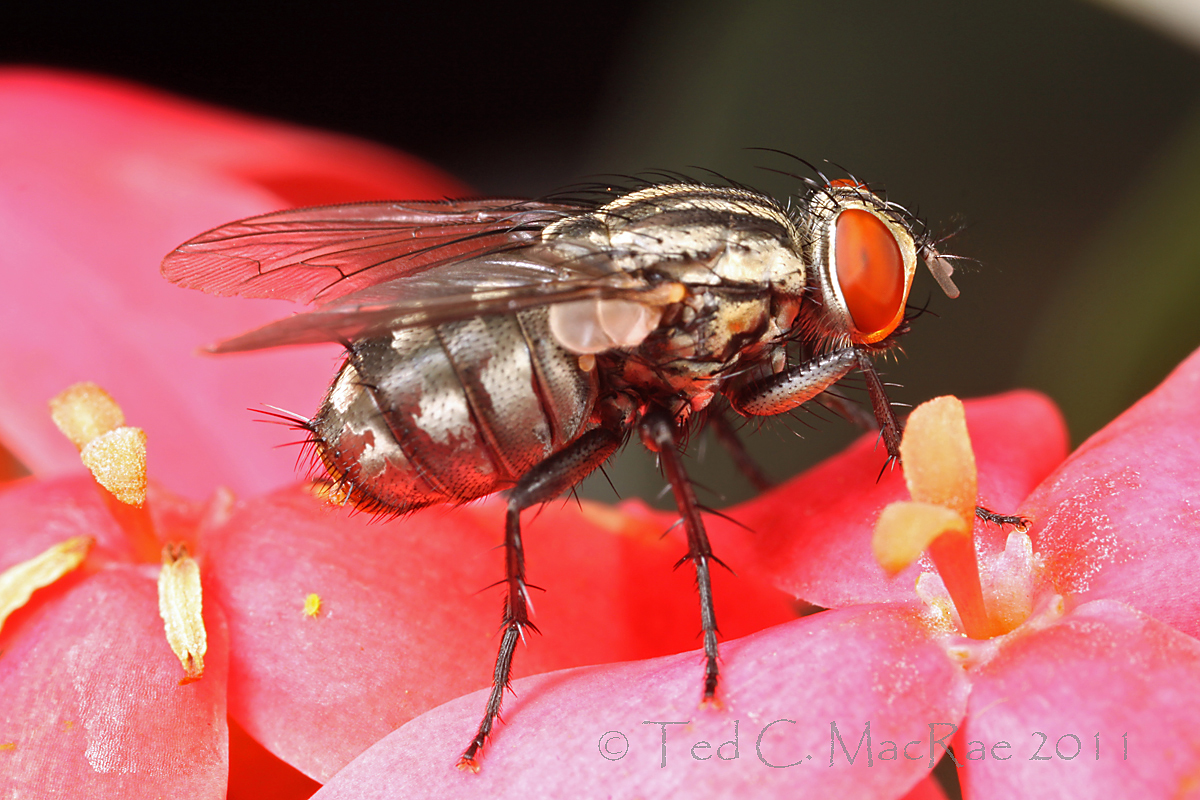
A flesh fly (Diptera: Sarcophagidae).

I presume this to be a type of flesh fly (family Sarcophagidae) based on the stout bristles and color pattern that seems typical for the family.  I like the striking contrast in coloration between the fly and the flower.  There are a few fly bloggers who I’m hoping might be able to give a better identification.

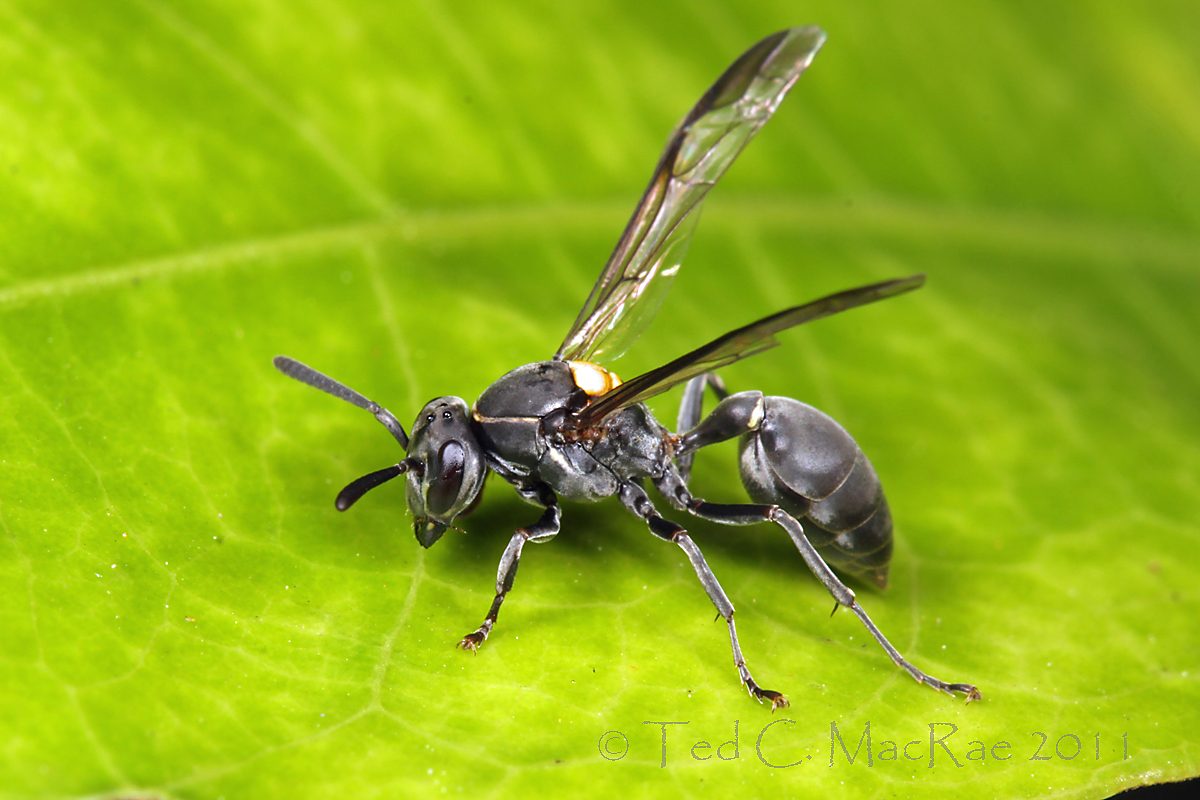
A potter/mason wasp? (Hymenoptera: Vespidae).

This appears to me to be some kind of potter or mason wasp (family Vespidae, subfamily Eumeninae) – it was a bit smallish at only about 12mm in length.  I hope one of the knowledgeable wasp bloggers out there (ahem… Eric?) can at least confirm this level of identification and perhaps the tribe or genus as well. 

Azya orbigera (Coleoptera: Coccinellidae). ID by Tucker Lancaster.

Every ladybird beetle (family Coccinellidae) I’ve ever seen is some variation of black and red/orange/yellow and has a smooth, glabrous appearance.  This beetle is cobalt blue with a dense pubescence over the dorsal surface, but it still seems to me to be some type of ladybird beetle.  It was a tiny little thing, so I suppose it could be one of the multitude of small beetle families with which I am unfamiliar.

Quedas sp.? (Hemiptera: Cicadidae).

This cast cicada exuvium was not on the shrub, but on a nearby tree at about eye level.  I really wish I could have seen the cicada that emerged from it, because this is certainly the biggest cicada exuvium I have ever seen.  I was about to simply label it “family Cicadidae” but seem to recall that cicada higher classification is in a bit of flux these days.  At any rate, given its great size I wonder if it might represent one of the giant cicadas in the genus Quesada.

I still have many more insect photographs from the past week and will certainly increase that number over the next week as well.  Stay tuned!

Copyright © Ted C. MacRae 2011

Rush skeletonplant pea gall wasp

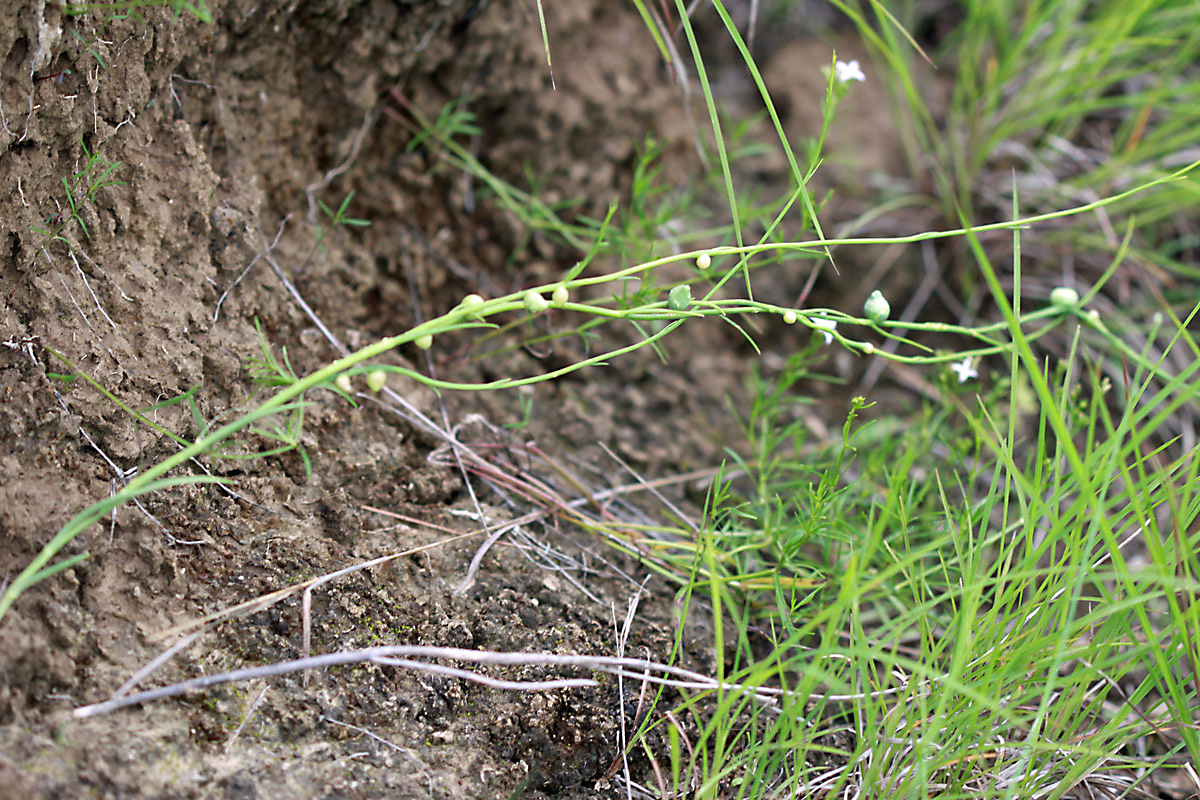
Lygodesmia juncea with galls of Antistrophus lygodesmiaepisum (Hymenoptera: Cynipidae) on stem.

The Loess Hills landform along the western edge of Iowa and extreme northwestern Missouri is home to a unique assemblage of plants and animals.  The majority of these are associated with loess hilltop prairies – grassland remnants that have their origins in the hypsithermal maximum of several thousand years ago and that persist as small relicts on the landform’s steep, dry, south- and west-facing slopes.  Many of the plants and animals found in these grassland remnants are more typically found further west in the Great Plains, but hang on in the Loess Hills as hypsithermal relicts.

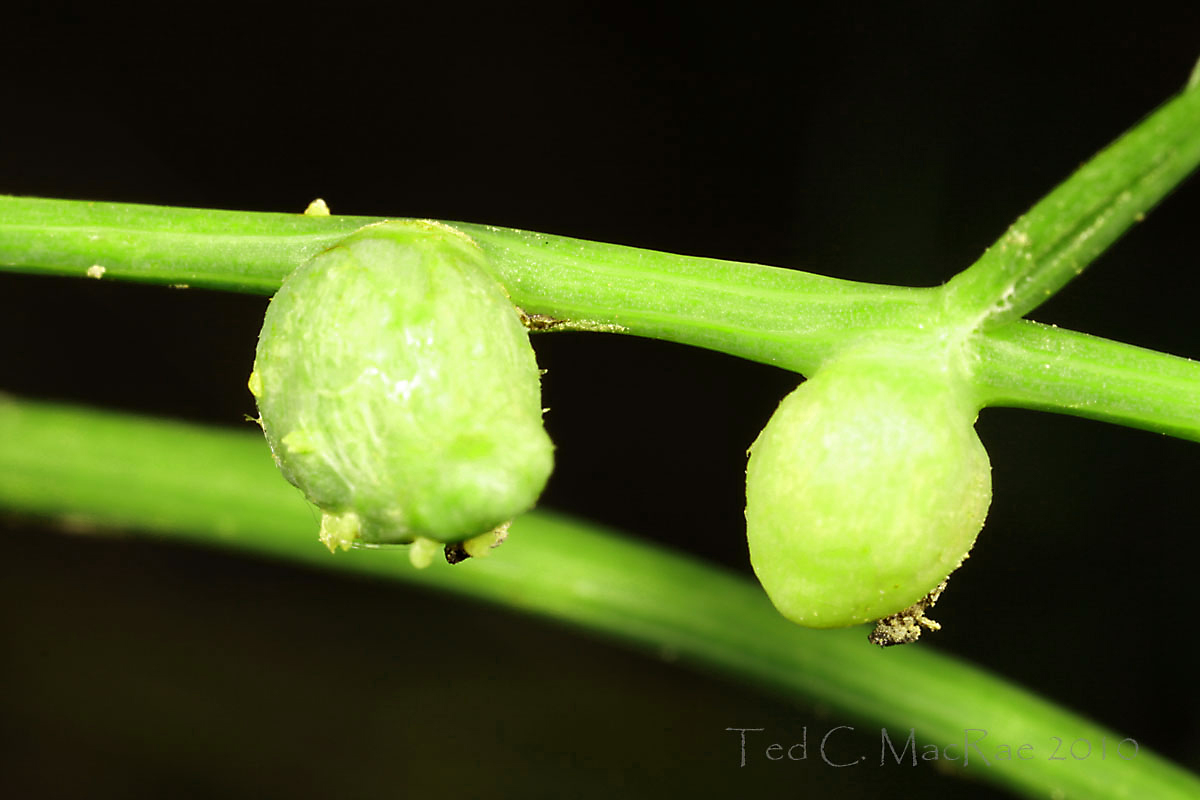
Antistrophus lygodesmiaepisum galls on stem of Lygodesmia juncea.

One such hypsithermal relict is rush skeletonplant, Lygodesmia juncea, a wirey, leafless-looking plant in the family Asteraceae¹.  More common in the Great Plains, this plant occurs in Missouri only on these loess hilltop prairie remnants.  The first time one encounters this plant, they are left with the impression that the plant bears small, pea-like fruiting structures along the length of its stem.  These are not fruiting structures, however, but galls made by the cynipid wasp Antistrophus lygodesmiaepisum.  Although this insect does not have a common name, it is associated exclusively with L. juncea, as suggested by its specific epithet (which also alludes to the pea-like galls with the suffix -pisum), so I see no reason why this wasp cannot be called the “rush skeletonplant pea gall wasp.”  Some sources variably misspell the genus as Anistrophus (without the first “t”) or the species name as simply pisum, a synonym first introduced by Ashmead in the late 19th century a few years after the species was described (I made both mistakes [and also erroneously referred to L. juncea as skeletonweed] in one of my earliest posts: The Loess Hills in Missouri).  It would seem that Antistrophus lygodesmiaepisum is the correct name, according to Pickering (2009).

¹ Not to be confused with rush skeletonweed, Chondrilla juncea – also in the Asteraceae, which despite the similarity of common names, specific epithet, and general appearance (except with yellow flowers) is an altogether different plant that was introduced from the Mediterranean Region and is now considered an invasive weed in much of the Great Plains.

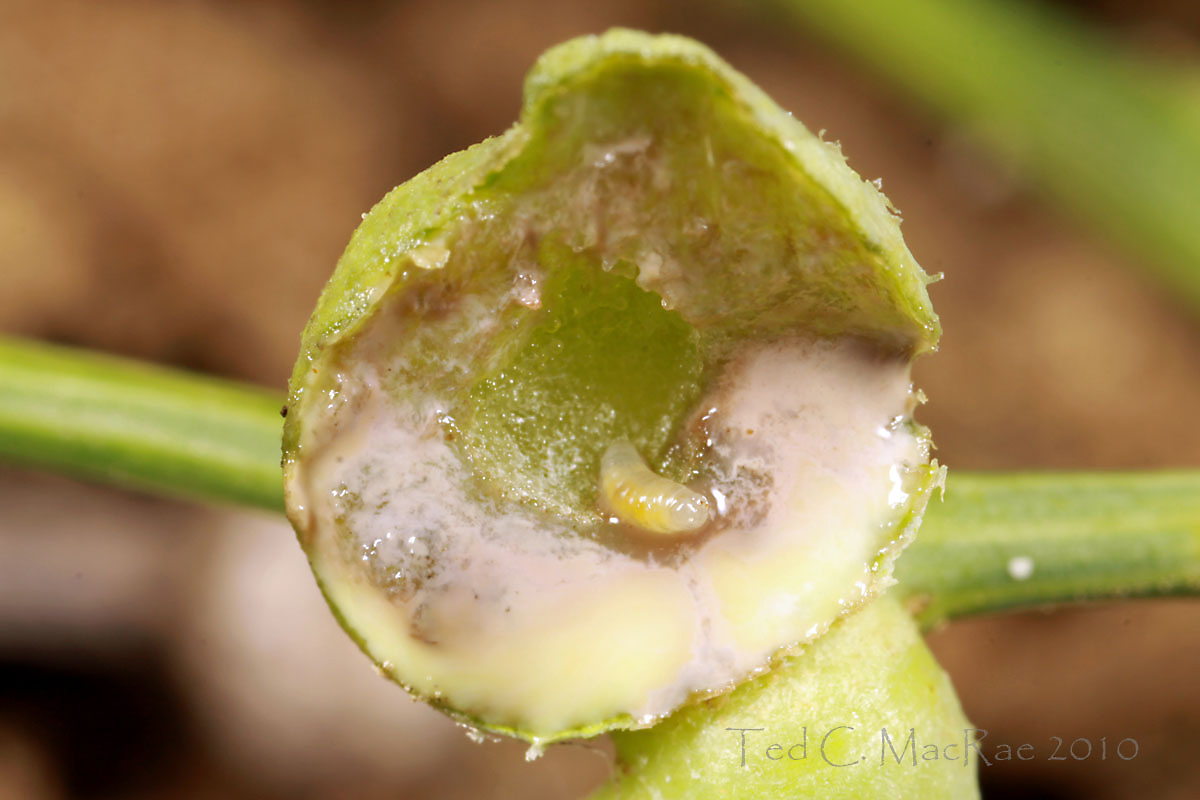
Antistrophus lygodesmiaepisum larva in gall on stem of Lygodesmia juncea.

Rush skeletonplant exudes a latex-like sap when damaged, making it unpalatable to most grazers – this latex-like sap can be seen when the galls made by the wasps are cut open.  Cynipid wasps are the second most diverse group of gall-making insects behind the gall midges, and many species are mono- or oligophagous (Ronquist and Liljeblad 2001), meaning that they are associated exclusively with a single plant species or group of closely related species.  Antistrophus lygodesmiaepisum is one such monophagous species, thus its occurrence in Missouri, like that of L. juncea, is restricted to the tiny loess hilltop prairie remnants in extreme northwestern Missouri.  In recent years, these prairie relicts have suffered heavily from conversion to agriculture, abusive grazing, and suppression of fire that has led to invasion by woody and exotic plants.  In Missouri, only about 50 acres of loess hilltop prairie remain, and only half of these are in conservation ownership, making it among the most critically imperiled of natural communities in Missouri.  While lacking the conservation charisma of L. juncea and the dozen or so other plants and vertebrates that are restricted in Missouri to these prairie remnants, A. lygodesmiaepisum nevertheless deserves equal consideration as a Missouri species of conservation concern.

I knew this would be a difficult ID Challenge and am quite impressed that at least a few people figured out at least the correct genus.  Tim Eisele scored 8 points in this challenge to not only take the win but also move way up into a 3-way tie for 4th place in the overalls.  Ben Coulter continues to be Mr. Consistency, earning 4 points for 2nd place and retaining his overall lead by an almost insurmountable margin (see what happens when you play every game!).  JasonC beat out the other contenders for the final podium spot on the basis of a bonus point, but the hot contest continues to be the battle for 2nd place overall.  Janet Creamer still holds it at 14 pts, but there is a veritable gaggle of contenders nipping at her heals – the next few challenges could be interesting.

Photo 1: Canon 100mm macro lens (ISO 100, 1/250 sec, f/2.8).
Photos 2-3: Canon MP-E 65mm 1-5X macro lens (ISO 100, 1/250 sec, f/14).
All photos: Canon 50D , Canon MT-24EX flash w/ Sto-Fen + GFPuffer diffusers. Typical post-processing (levels, minor cropping, unsharp mask).

REFERENCES:

Pickering, J.  2009.  Database of Hymenoptera in America north of Mexico. http://www.discoverlife.org/proceedings/0000/6/html/Cynipidae (accessed 20 Jan 2011).

Ronquist, F. and J. Liljeblad.  2001.  Evolution of the gall wasp-host plant association.  Evolution 55(12):2503–2522.

Copyright © Ted C. MacRae 2011

Brazil Bugs #1

ID Challenge #3 update: I knew this would be a hard one, and so far nobody has figured this one out (only one commenter got the right order!).  I’ve released the comments gotten so far so you can see where things stand, and maybe with the additional information (and my pointing out an important clue) it will be enough for one of you to arrive at a full ID.  Further comments are still being moderated until I decide to close the challenge.  Right now the points are there for the taking!


This past Monday I embarked on an extended business trip to Brazil.  “Wow, Brazil!” – you say, and while getting to travel to an exotic tropical locality on my company’s dime definitely rocks, I do have to justify the trip by actually working.  Add that to the time involved with planes, automobiles, and hotel transfers, and there is precious little time for more esoteric activities such as photographing insects.  It is Brazil, however, and summer at that, so whatever time does become available over the next ten days, I’ll be on it!  I’m stationed in Campinas, about 2 hours north of São Paulo, and this evening I had my first opportunity to break out the camera and do a little exploring around the hotel grounds during the waning hours of daylight. I’m not normally one to take short walks just looking for any random insect to photograph, but hey – it’s Brazil!  I also don’t normally like to post photographs of insects without knowing much about them – especially their identity. But hey, it’s Brazil!  I think I’ll be lucky to figure out most things to family, although I might be able to drill down a little further on occasion.  With that prelude, I hope you’ll indulge me these random postings over the next 10 days or so, primarily photographs but perhaps accompanied by a little bit of text.

Coreidae?

At first I thought this was a member of the hemipteran family Pyrrhocoridae (red bugs), as some North American species have similar coloration; however, members of that family apparently lack ocelli, which this insect clearly possesses. This would seem to indicate instead some species of Lygaeidae (seed bugs), but the forewing membrane with numerous veins arising from a transverse basal vein and presence of what appears to be a distinct metathoracic scent gland opening suggest instead some “unleaf-footed” species of leaf-footed bug (Coreidae). Whatever its identity, I would imagine it is quite distasteful, based on what clearly seems to be aposematic coloration and the fact that there were numbers of these bugs hanging out quite conspicuously on these flowers.

Same species?

This individual was differently colored than the others, but otherwise it seemed structurally and behaviorally identical.  Is it merely a highly melanized individual?  Maybe a case of sexual dimorphism, and I only saw this one individual of one of the sexes?  Maybe it truly is a different species – it is Brazil, afterall!

Pseudoplusia includens?

Daylight began to slip away much too soon, and I was about to pack it up when  I noticed some blurs at the flowers.  I realized that moths had begun to visit the flowers in the obscurity of dusk and became determined to photograph one, despite the fact that they never actually landed on the flowers but hovered in front of them instead.  It was quite difficult to even get them framed in the viewfinder, and on those few occasions when I managed to do this it was all but impossible to spend any time trying to focus – I used the lamp on the flash unit to help me see the moth, then just framed and quickly took the shot.  This one actually turned out not too bad – a little bit of blur in the wings but otherwise acceptable enough to let me tentatively identify it as Pseudoplusia includens (soybean looper).  Brazil is well on its way to becoming the world’s largest producer of soybean, and the caterpillars of these moths are enjoying the bounty!

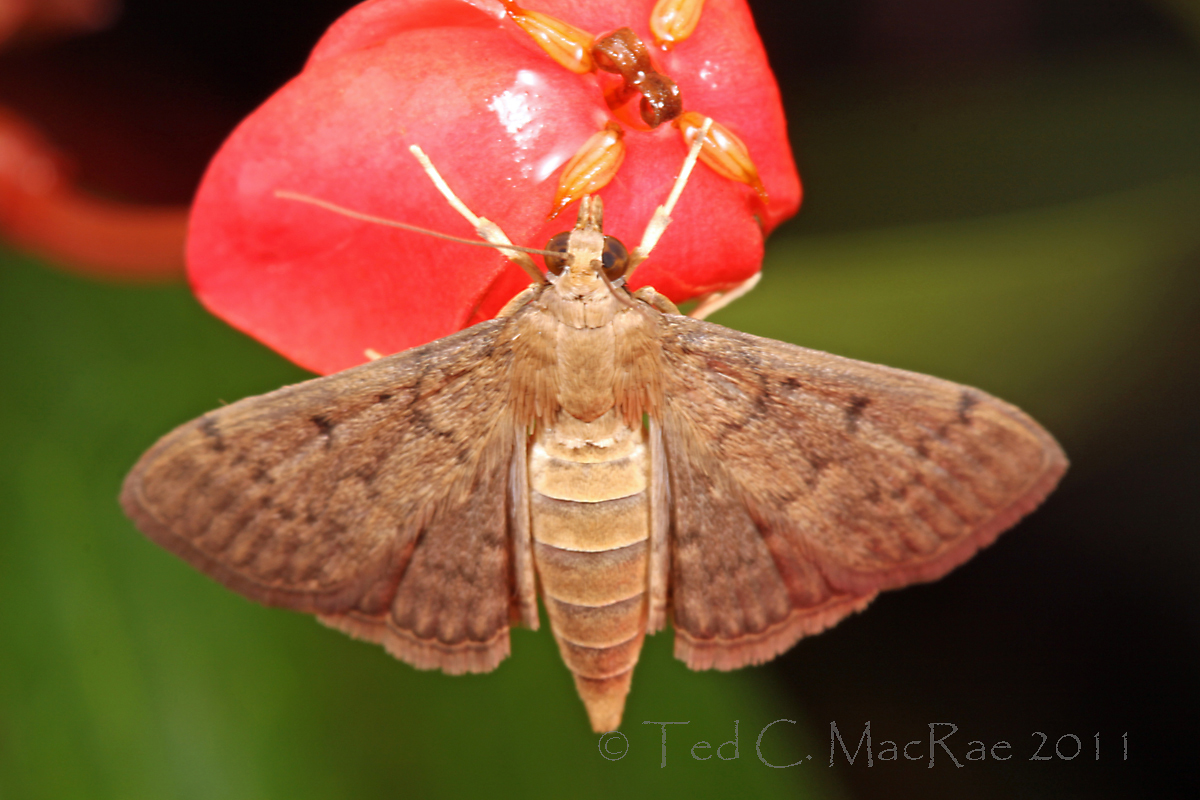
Family Crambidae, possibly Herpetogramma phaeopteralis (ID by Chris Grinter)

I saw one last moth before the final traces of daylight disappeared – I don’t have any idea about its identity, but it’s a pretty picture nonetheless.  It has the generic look of the large family Noctuidae, so that’s what I’m gonna go with until somebody tells me differently.  Edit 1/20/11 – Somebody just told me differently!  According to Chris Grinter, this is a species of Crambidae, possibly Herpetogramma phaeopteralis (tropical sod webworm).  Thanks, Chris!

I don’t know the name of the plant whose flowers these insects were visiting, but the hotel staff has promised to ask their gardener in the morning and let me know – now that’s service!

Copyright © Ted C. MacRae 2011

Calm waters, frenzied beetles

North Fork River - Ozark Co., Missouri

The North Fork River in south-central Missouri, like most Ozark rivers and streams, flows clear and cold over gravelled bottoms. Sustained year-round by the numerous seeps and springs that result from the region’s unique Karst geology, it meanders through a mix of forest and woodland alongside massive bluffs of half-a-billion-year-old dolomite. While small rapids can be found where gravel bars approach the bluffs, for the most part the shallow waters course lazily and idyllically south toward the White River in northern Arkansas.

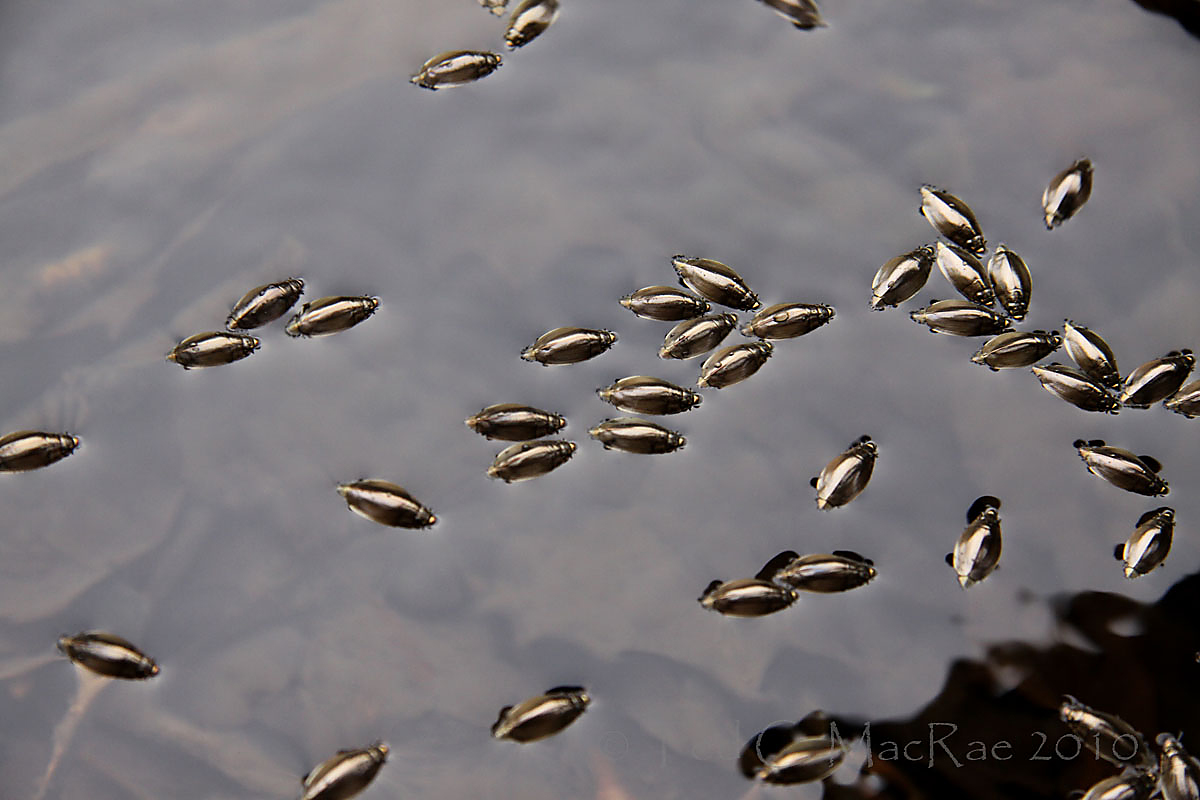
Dineutus sp. (poss. discolor, per Brady Richards)

Lazy waters are the domain of whirligig beetles (family Gyrinidae).  We encountered this ‘raft’ of beetles in a sheltered pool near the shore of the North Fork River while hiking the Ozark Trail last October.  These frenzied little beetles live almost exclusively on the surface of the water, where they feed on organisms or scavenge debris in their famously and erratically conspicuous aggregations.  Such behavior might make them seem vulnerable to predation, but in actuality the reverse is true.  Beetles in rafts benefit from the increased number of eyes that can better scan the environment for potential threats than can individual beetles (Vulinec and Miller 1989), and the larger the raft the more efficiently this occurs.  There is also evidence that the appearance of the rafts themselves is a signal to warn potential predators (primarily fish) of the noxious chemicals produced in the beetles’ paired pygidial glands (Ivarsson et al. 1996), despite the decidedly non-aposematic coloration of the beetles themselves.

Photo Details: Canon 50D w/ 17-85mm zoom lens, natural light. Photo 1 – 17mm, ISO 100, 1/25 sec, f/5.6; photo 2 – 85mm, ISO 500, 1/160 sec, f/5.6. Typical post-processing (levels, minor cropping, unsharp mask).

REFERENCES:

Ivarsson, P., B.-I. Henrikson and J. A. E. Stenson.  1996.  Volatile substances in the pygidial secretion of gyrinid beetles (Coleoptera: Gyrinidae).  Chemoecology 7(4):191–193.

Vulinec, K. and M. C. Miller. 1989. Aggregation and Predator Avoidance in Whirligig Beetles (Coleoptera: Gyrinidae). Journal of the New York Entomological Society 97(4):438–447.

Copyright © Ted C. MacRae 2011

Diversity in Tiger Beetle Larval Burrows

One of the fascinating aspects of tiger beetle study is their often high degree of fidelity for specific habitats.  Some species prefer wet habitats, while others frequent the drier uplands.  Some like sand while others need clay.  Differences in salinity, vegetational cover, and even slope dictate what species might be expected to occur in a given habitat, thus, the diversity of tiger beetle species one encounters is directly proportional to the diversity of habitats explored.  Unfortunately, tiger beetles can be rather ephemeral in their occurrence as adults.  Despite a life cycle that requires at least one year (and may take 2-3 years or even more), adults are often present for only for a few short weeks.  Even during the time that adults are present, they often hide if conditions aren’t right (too cold, too hot, too wet, too early, too late, etc., etc.  Add to that their marvelous evasive capabilities, and it’s a wonder I ever see or catch any at all!).  The study of tiger beetles is not, however, entirely dependent upon the adults.  The presence of larval burrows in an area is also useful information, and through understanding of the species that might occur in an area and their habitat preferences, it is possible to identify – at least tentatively – the species that might be living in them.

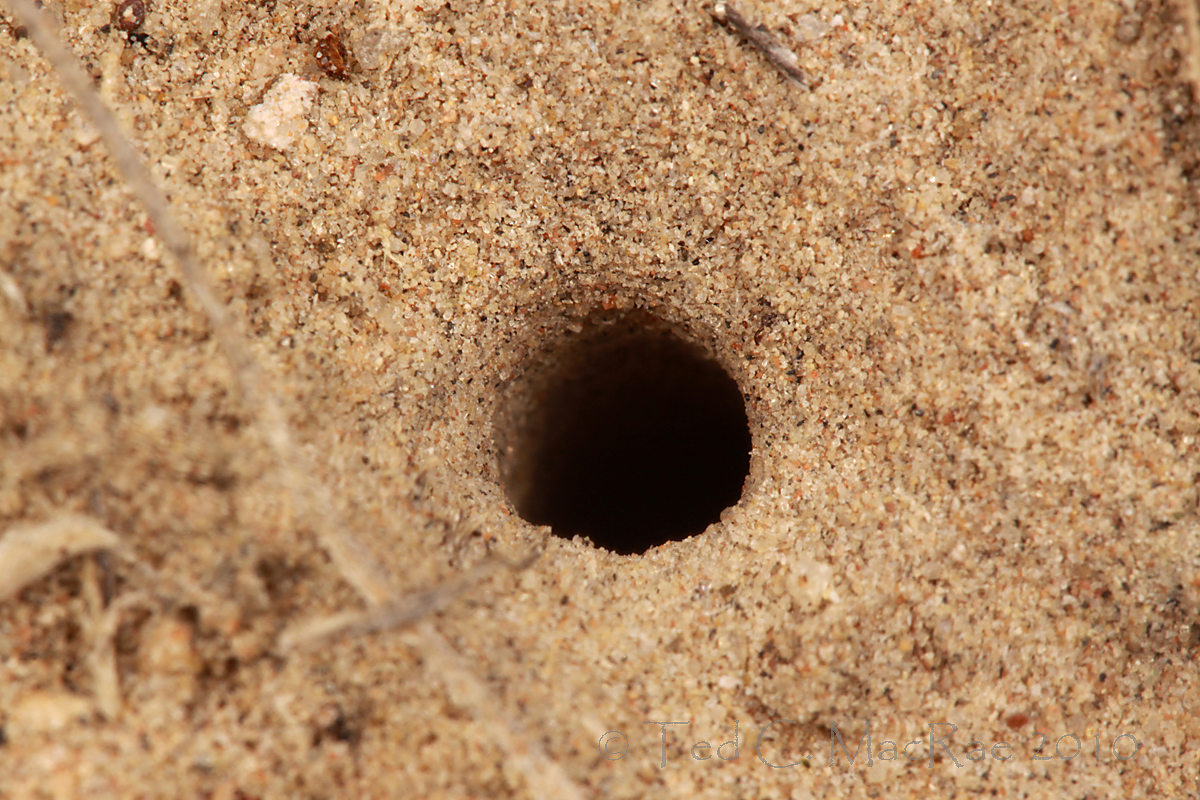
Cicindela lengi? (sandy tiger beetle) - Sioux Co., Nebraska

To the uninitiated, tiger beetle burrows might seem nothing more than a simple hole in the ground – anything could have made it.  However, with experience one becomes able to distinguish tiger beetle larval burrows almost instantly from burrows made by other ground-burrowing organisms.  The most common type of burrow is recognized by a combination of characters – almost perfectly circular except for a slight flattening on one side that gives the burrow a faint D-shape, and with the edge smoothly beveled.  This is your classic tiger beetle burrow and, for most U.S. species of Cicindela and related genera, averages ~5-6mm in diameter for 3rd instar larvae (tiger beetle burrows are most often observed at 3rd instar, since it is this final instar in which the larva spends the majority of its time and the burrow becomes most noticable).  The above burrow is one such burrow, found at Monroe Canyon in northwestern Nebraska last September.  While a number of species are known from the area, there are only a few that make their burrows in deep dry sands such as those that occur at this site.  We can eliminate Cicindela formosa (big sand tiger beetle) for reasons discussed below, and we can also dismiss Cicindela limbata (sand blow tiger beetle) because the habitat is not the barren, wind-shaped sand blow habitat that the species prefers.  This leaves two possibilities – Cicindela scutellaris (festive tiger beetle), a common and widespread inhabitant of sand habitats throughout the Great Plains, and Cicindela lengi (sandy tiger beetle), a much more localized resident of sand habitats with more western distribution.  The burrow likely represents the latter, since adults of this species have been found with greater frequency than C. scutellaris on the very fine-grained sands that occur in this part of Nebraska.  My confidence in this ID is bolstered by the fact that a larva I collected in the area from just such a burrow successfully finished its development and emerged a few months later as an adult C. lengi.

Cicindela pulchra pulchra (beautiful tiger beetle) - Fall River Co., South Dakota

Sometimes size alone is enough to indicate the species responsible for a burrow.  The above burrow was encountered last September in southwestern South Dakota on a clay/shale embankment in sage/shortgrass prairie.  A number of tiger beetle species fond of clay were observed at the site, including the two generalist species Cicindela tranquebarica (oblique-lined tiger beetle) and Cicindela purpurea audubonii (Audubon’s tiger beetle).  However, at ~8 mm in diameter the burrow is too large to have been made by either of these species.  The only tiger beetle in the area capable of making a burrow this size is Cicindela pulchra (beautiful tiger beetle), and in fact this burrow was found at one of several sites recently discovered by Matt Brust for this species in South Dakota.  Note again the classic shape – slightly flattened along the bottom side (the flattening accommodates the mandibles of the larval head – tiger beetle larvae always orient themselves in one position when sitting at the burrow entrance).

Cylindera celeripes (swift tiger beetle) - Woodward Co., Oklahoma

Just as large size was diagnostic for the previous burrow, the small size of the above burrow was also diagnostic.  This burrow, found at Alabaster Caverns in northwestern Oklahoma in October, 2009, measured only 3-4mm in diameter and can only have been made by Cylindera celeripes (swift tiger beetle).  This provisional ID was suggested by the fact that adults of the species had been observed abundantly in the lichen-encrusted clay exposures of this shortgrass prairie the previous June.  This photo, in fact, represents the first-ever discovery of the larval burrow of this species, and the identity of the species was confirmed when the larva collected from this and neighboring burrows and placed in rearing containers in the lab later emerged as adults.  I have found very similar-sized burrows in bottomland forest habitats in southeastern Missouri where the closely related species Cylindera cursitans has been seen.  The burrows are identical in size and shape, but the drastic difference in habitat is enough to distinguish the species that made them.

Cicindela formosa formosa (big sand tiger beetle) - Sioux Co., Nebraska

Not all tiger beetles utilize the simple hole-in-the-ground style of burrow, but rather incorporate some rather unique engineering features that make specific identification much easier.  This burrow can only be made by Cicindela formosa (big sand tiger beetle), a common resident of a variety of dry sand habitats throughout the Great Plains and eastern U.S.  The burrow entrance is on the large size for U.S. Cicindela (~6mm in diameter), and rather than opening flush on the ground it is directed horizontally and opens into a pit that is excavated to one side and underneath the burrow entrance.  No other U.S. tiger beetle makes a burrow quite like this (although I have noted Cicindela limbalis (common claybank tiger beetle) burrows on steep clay banks with a similar but much less distinct excavation on their lower side).  The pit apparently functions as a trap for potential prey, and since I have most often encountered burrows of this species in areas with some slope, I suspect the pit may help the larva capture its prey by preventing the prey from tumbling down the slope at the first sign of trouble.

Cicindela formosa 3rd instar larvae - Sioux Co., Nebraska

This is a different burrow by the same species, also at Monroe Canyon last September, that shows a 3rd instar larva sitting at the burrow entrance.  The sickle-shaped mandibles are resting against the slightly flattened lower edge of the burrow entrance, while the round pronotum fills the rest of the entrance profile.  The upper pair of eyes can be seen above the mandibles, but the lower pair (between the upper pair and the mandibles) are not visible in this photo due to the downward-facing angle of the burrow entrance.  I waited for quite some time with camera in position in hopes that I could photograph the larva, and when it did return to the burrow entrance I had time enough to fire off just a couple of shots before it retreated once again to safety in the depths of its burrow.

Cicindela fulgida fulgida (crimson salt flat tiger beetle) - Sioux Co., Nebraska

This unusual-looking burrow was found in a dry clay saline creek bed in the Badlands of northwestern Nebraska last September.  The turret structure is unique, but the nearly perfectly round and smoothly beveled burrow entrance identify it, nevertheless, as that of a tiger beetle larva.  These burrows can only be made by Cicindela fulgida (crimson salt flat tiger beetle).  There are several other saline-tolerant tiger beetles species in Nebraska, but most such as Ellipsoptera nevadica knausii (Knaus’ tiger beetle), Eunota togata (cloaked tiger beetle), and Habroscelimorpha circumpicta johnsonii (Johnson’s tiger beetle) require much more moisture than was found in this bone-dry creek bad.  I’ve found two other much more widely distributed clay-associated species – Cicindela tranquebarica and Cicindela purpurea audubonii – at this and other sites where I’ve seen C. fulgida; however, the larvae of those species do not utilize this unique turret-shaped structure for their burrows.  The turret is thought to have a cooling function for the larva during the heat of summer by raising it above the hottest layer of air against the white salt-encrusted ground and by aiding in the dissipation of heat from the larval burrow.  I wanted to photograph the larva sitting at the burrow entrance and spent quite a bit of time stalking out this and nearby burrows for a chance to do so.  Alas, however, on this day the larvae had greater patience than I!
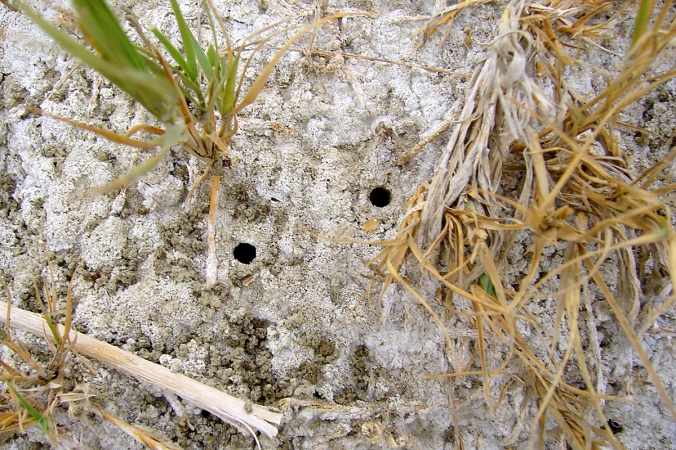
Cicindela tranquebarica kirbyi (Kirby's tiger beetle) adult & larval burrows - Sioux Co., Nebraska

The above burrow entrances were photographed in September 2008 at the same dry saline creek bed in Sioux Co., Nebraska.  I mentioned above that Cicindela tranquebarica kirbyi and Cicindela purpurea audubonii both occurred commonly at this site along with Cicindela fulgida; however, these burrows likely represent the former.  That species seems to be found more consistently in high saline environments than the latter, which in this case probably have their larval burrows in the more normal clay soil further away from the creek bed.  During that 2008 trip, I did collect larvae from burrows like these in several similar, high saline habitats in Nebraska, South Dakota, and Oklahoma, and in each case adults of C. tranquebarica kirbyi were what emerged.  I have also reared this species from larvae collected on clay banks and wet sand habitats – in all cases, the burrows are a tad larger than those I have seen for other species in the genus that I have reared, such as Cicindela limbalis and Cicindela repanda (common shore tiger beetle) – logical since adults of C. tranquebarica tend to be a little more robust than these other species (but smaller than Cicindela pulchra and Cicindela obsoleta vulturina (prairie tiger beetle)).  In the above photo, I believe the the upper-right burrow is that of a larva, while the the lower-left one is that of an emerged adult – note the not-perfectly-circular opening and more ragged edge to the burrow.  In fact, the latter burrow looks very much like the adult emergence burrow that I saw at this very location last September, in which the still unemerged adult was seen sitting!  Granular chunks of soil can be seen scattered about the latter burrow, but I believe these were actually tossed by the larva rather than the adult as a result of burrow excavation – the amount of soil an adult would need to remove to re-open its burrow for emergence would probably be far less than what can be seen in this photo.  I did not search the surrounding grasslands for larval burrows, but if I had done so, it is likely that I would have found similar burrows that belonged to the larvae of Cicindela purpurea audubonii – the only other tiger beetle that we have seen in this inhospitable place!

Copyright © Ted C. MacRae 2011