Super Crop Challenge #7

Who is this smiling critter?  Usual challenge rules apply, including moderated comments (to give everyone a chance to take part) and possible bonus points for beating others with the first correct answers, additional relevant information, or any suitably humorous quips.  I’ll give 2 points each for order, family, genus and species.  This is the last challenge of the current BitB Challenge Session, so the current leaders are playing for all the marbles!

Copyright © Ted C. MacRae 2011

Brazil Bugs #16 – Royal Moth Larva

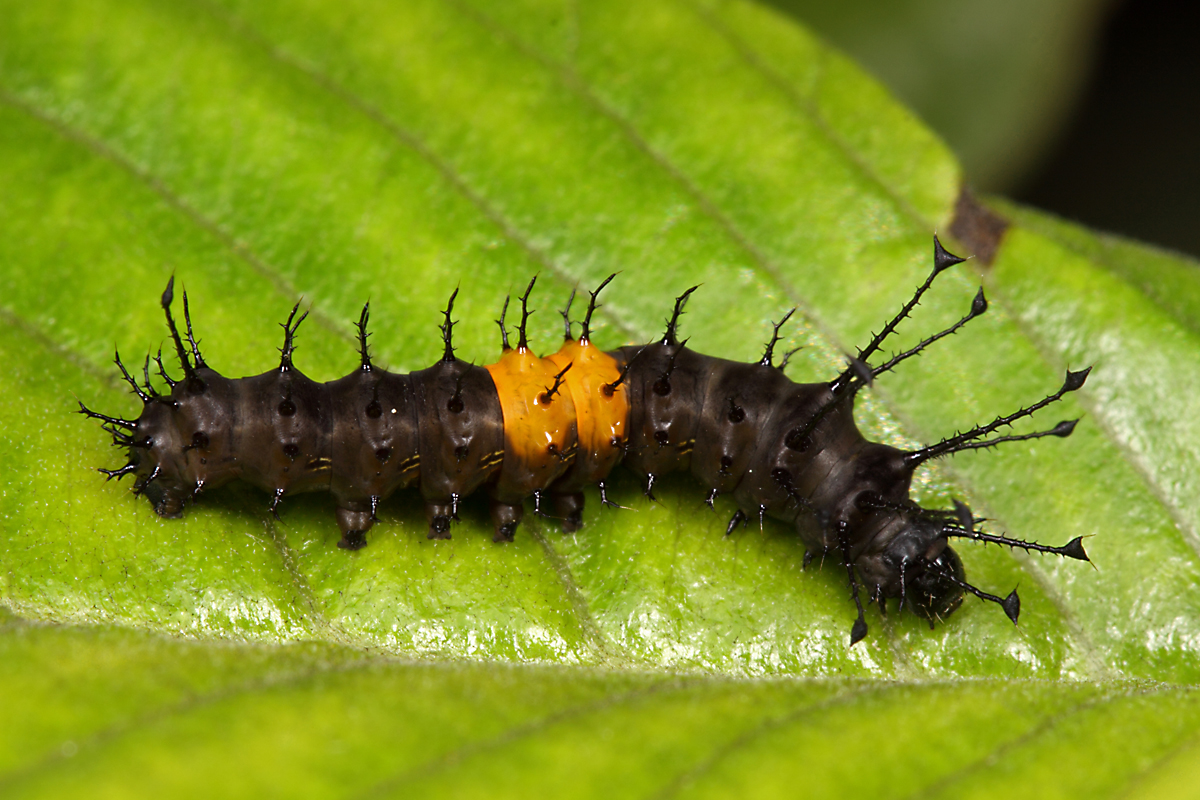
Citheronia laocoon? 1st instar larva | Campinas, Brazil

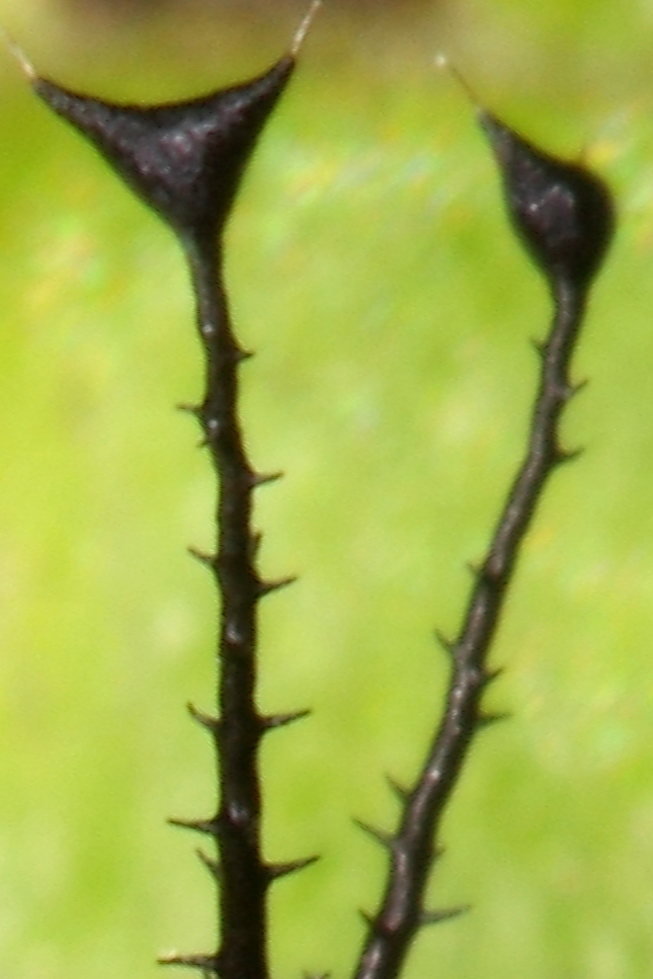
I was sure Super Crop Challenge #6 would be a win for the house, but Troy Bartlett scored an impressive points sweep by correctly deducing that the structures shown were the spines of an early instar caterpillar of “something akin to a hickory horned devil (Citheronia regalis).”  I found this caterpillar feeding on the foliage of a small tree in the Ciudad Universitaria (Distrito Barão Geraldo) area of Campinas, Brazil last January.  I must confess that I spent considerable time trying to identify it myself before I finally threw in the towel and called on the experts for help.  The spines made me think it must be some kind of nymphalid butterfly larva, although I had never seen such “fly swatter” clubs at the ends of the spines, so I sent the photo to Phillip Koenig, a local butterfly expert who has collected extensively in Ecuador.  He, too, was puzzled and forwarded the photo to Charley Eiseman, who himself didn’t know what to make of it and forwarded it on to Keith Wolfe, a lepidopterist who specializes in butterfly immatures.  After stumping his Brazilian contacts, Keith had the idea that perhaps it wasn’t a late-instar larva—as we all had assumed (this larva was a good 15–20 mm in length), but rather one in an early stadium.  A quick search of several standard websites revealed this to be the L1 or L2 larva of a species of Citheronia (Saturniidae, Ceratocampinae).  To support his ID, he provided links to larval photos of C. splendens (Arizona) and C. lobesis (Central America).  The L1 larva of both of these species bears the same “fly swatter” spines, and the latter is remarkably similar in color pattern as well.

In trying to determine what species of Citheronia occur in southeast Brazil, I came across this link with photos of a caterpillar from southern Brazil—the L1 looking nearly identical—that was eventually identified as the common Brazilian species C. laocoon.  Troy suggested C. brissotii—another good possibility as that species is found from southeastern Brazil through Uruguay to Argentina.  However, in perusing a number of online sources, it appears there are several other species of Citheronia that also occur in Brazil, so a species ID for the larva in this photo may not be possible.

Troy’s win vaults him into 3rd place in the current session overalls, but steady Tim Eisele took 2nd place with 6 pts and takes over the session lead.  Newcomer Roy rounds out the podium in 3rd place with 5 points.  Dave’s pity points are nothing to sneeze at, as they helped him retain sole possession of 2nd place in the overall standings (let that be a lesson to those who don’t play because they’re “stumped”!).  There will be at least two more challenges in the current session before a winner is crowned, so look for an opportunity to shake up the standings in the near future.

Copyright © Ted C. MacRae 2011

Super Crop Challenge #6

I thought I had everyone stumped in Super Crop Challenge #5, but Dave took advantage of the extended answer period and cracked the code for a solo win and the lead in the current session.  For this edition of Super Crop Challenge, I offer the following impossibly cryptic crop of a photo I took this past winter.  The organism is from Brazil, but that’s no excuse for punting since there are very similar North American counterparts.  Points for order, family, genus and a possible species ID are all up for grabs, as are the structures and specific life stage to which they belong.

Standard challenge rules apply, including moderated comments (to give everyone a chance to take part) and possible bonus points for being the first to guess correctly (in the off chance multiple people offer the same correct answers) or for making me chuckle.  Reminder: nobody walks away with no points, so it pays to try even if you haven’t a clue!

Copyright © Ted C. MacRae 2011

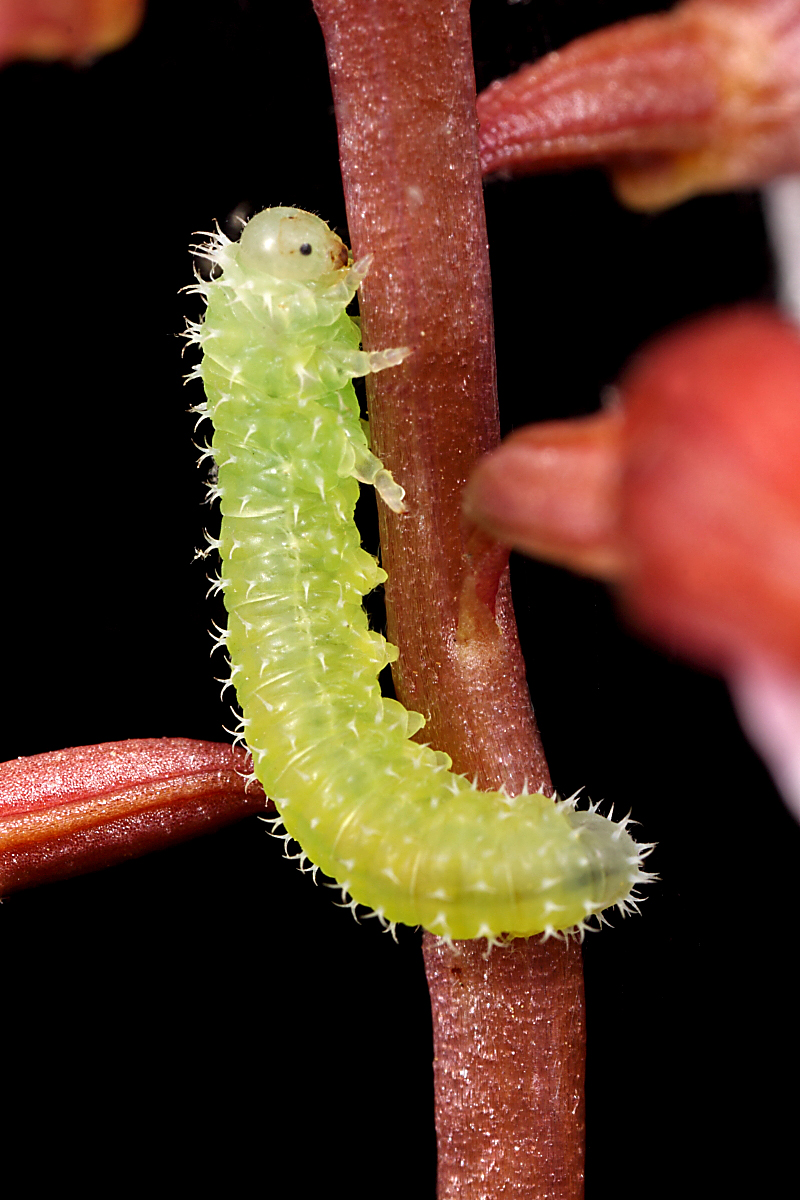
Sawfly larva – Periclista sp.


As I was photographing spring coralroot orchids in my front yard, I noticed a small green object clinging to the underside of one of the flowers.  Zooming in with the camera lens revealed the object to be a caterpillar, but this was no ordinary caterpillar (i.e., a member of the order Lepidoptera), but rather a sawfly larva.  Sawflies are not lepidopterans, but members of the order Hymenoptera, making them more related to bees and wasps while their larvae look much more like those of a moth or butterfly.  Although there are few absolutes in the world of insects, distinguishing sawfly larvae from lepidopteran caterpillars is as easy as counting the prolegs (false legs behind the three pairs of true legs)—lepidopterans have at most 5 pairs of prolegs (often less), while sawfly larvae always have 6 or more pairs of prolegs.

While its identity as some type of sawfly was immediately apparent, I wasn’t sure beyond that.  One thing I was fairly certain about was that the orchid itself was likely not its host plant.  I could see no evidence of feeding on any part of the plant on which it was resting (and orchids by the large seem relatively free of defoliating insect pests), nor could I find any other sawfly larvae on the plant or its neighbors (where there is one sawfly larva, there are usually more).  Rather, I suspected that it had fallen from one of the many native oaks and hickories that shade the front yard (and which provide the habitat that allows orchids to grow in my front yard to begin with).  Nevertheless, I Googled “orchid sawfly,” only to come up with page after page of links referring to the sawfly orchid (Ophrys tenthredinifera), native to the Mediterranean Region.  That wasn’t much help, so I began the process of slogging through the sawfly images posted at BugGuide in hopes that something close had already been posted.  Eventually I stumbled upon photos of larvae in the family Tenthredinidae, subfamily Blennocampinae that exhibited similar branched dorsal spines (including the pestiferous Monophadnoides rubi, or raspberry sawfly).  I gradually settled on a generic ID of Periclista sp. based on the resemblance of the larva in my photos to those in photos such as this one, and the fact that this genus of ~20 North American species feeds as larvae on oak and hickory seems to support to the identification.

This past week’s Super Crop Challenge was taken from the dorsal side of the caterpillar in the first photo and rotated—it apparently proved a little too tough for most people to handle.  Predictably, most participants guessed one of the different spined caterpillars of the order Lepidoptera, but Dave used the extended quiz time wisely and eventually came up with a correct ID and the challenge win.  He even suggests the species P. marginicollis, based on its widespread eastern distribution and the bifurcate processes—it’s a good guess, but the larval description in Smith (1969) is a little beyond my comprehension, so I’m leaving the ID at Periclista sp.  Dave’s win moves him into the top spot in the current overall standings, while Tim moves up to tie Alex for 2nd place with 9 pts each.

REFERENCE:

Smith, D. R.  1969.  Nearctic sawflies I.  Blennocampinae: Adults and larvae (Hymenoptera: Tenthredinidae).  U.S. Department of Agriculture, Agricultural Research Service, Technical Bulletin No. 1397, 179 pp. + 19 plates.

Copyright © Ted C. MacRae 2011

Super Crop Challenge #4

It’s been a long time since the last Super Crop Challenge – can you identify the structures and the organism they belong to?  As always, each correct taxonomic and descriptive answer is worth 2 points, and bonus points are awarded at my discretion for extra effort.  Standard challenge rules apply.

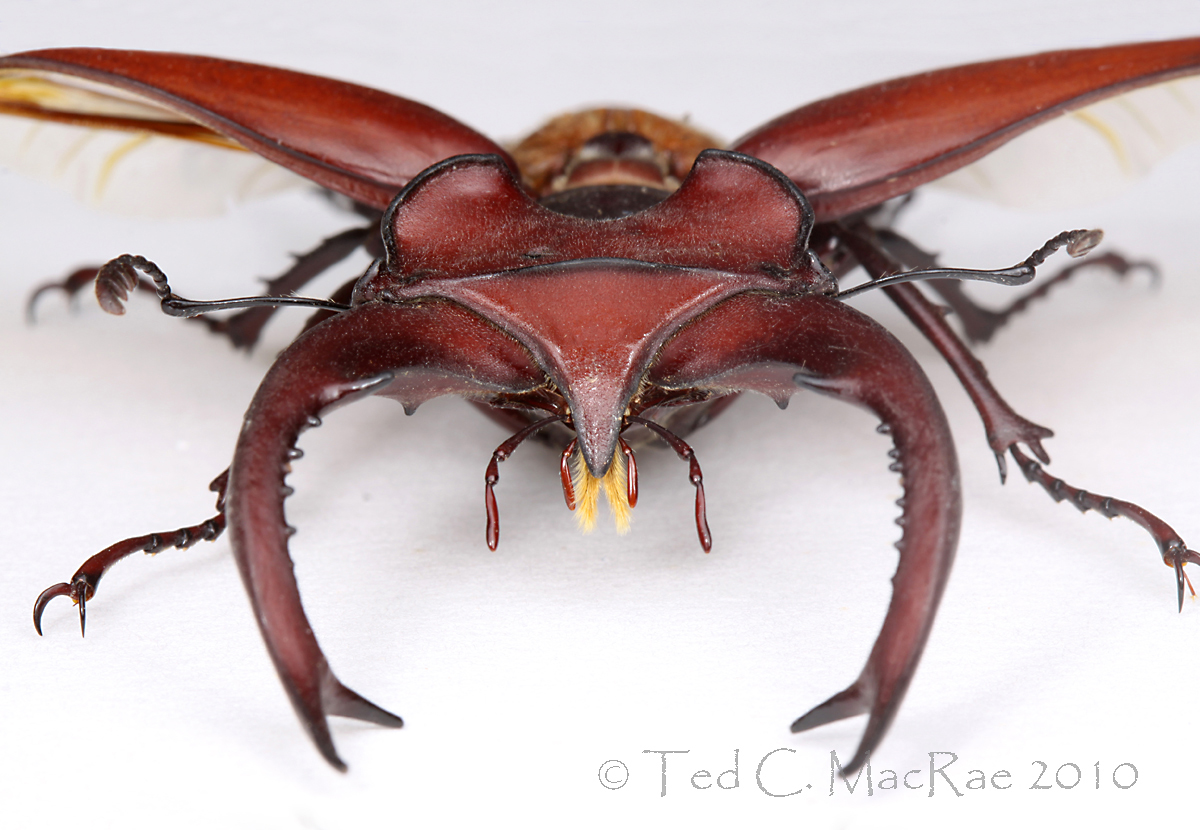
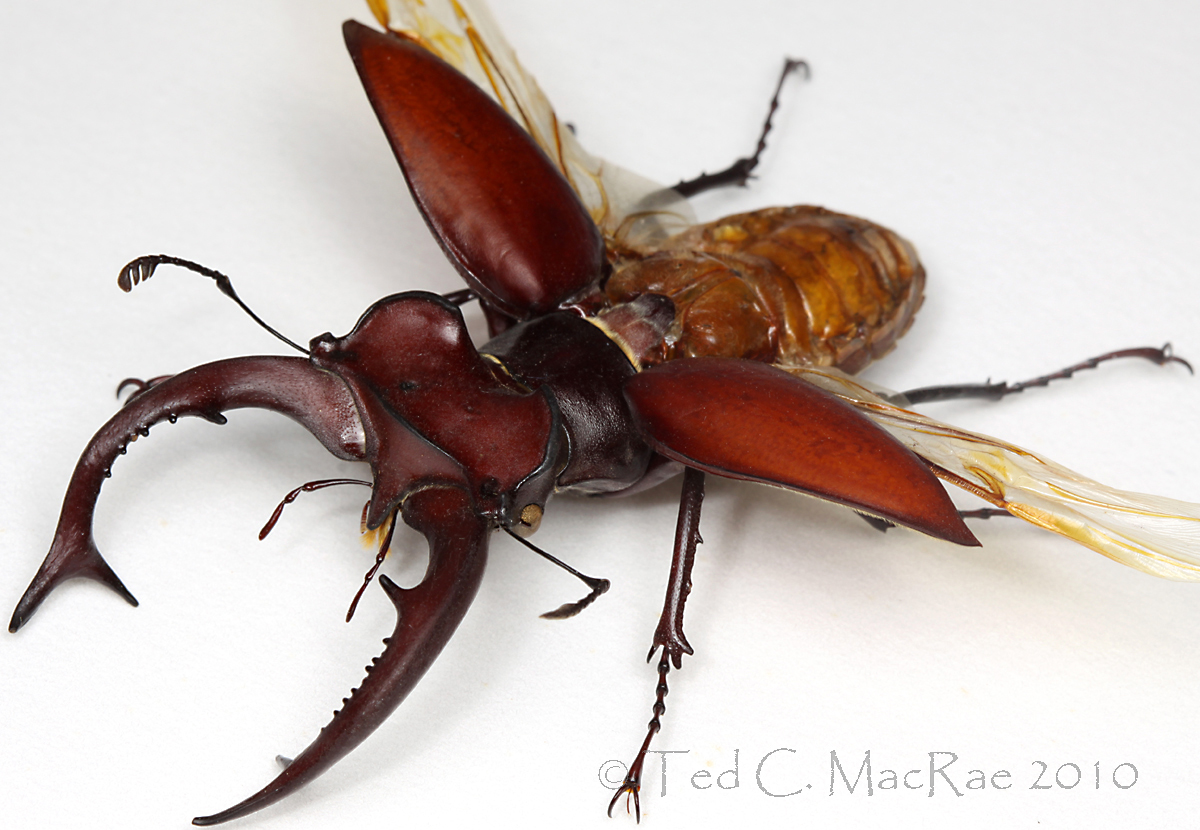
North America’s largest stag beetle


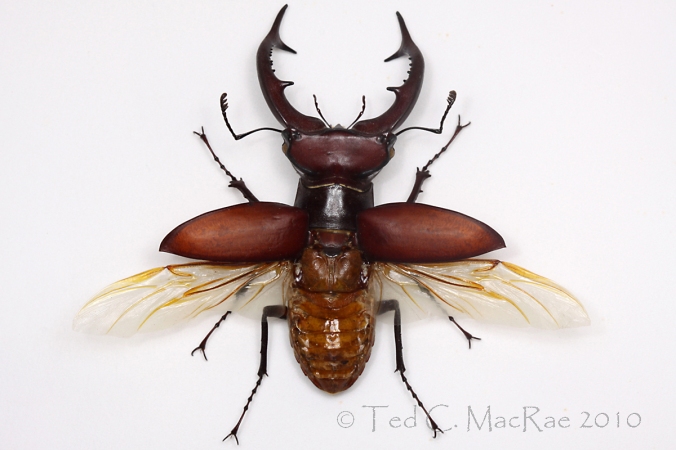
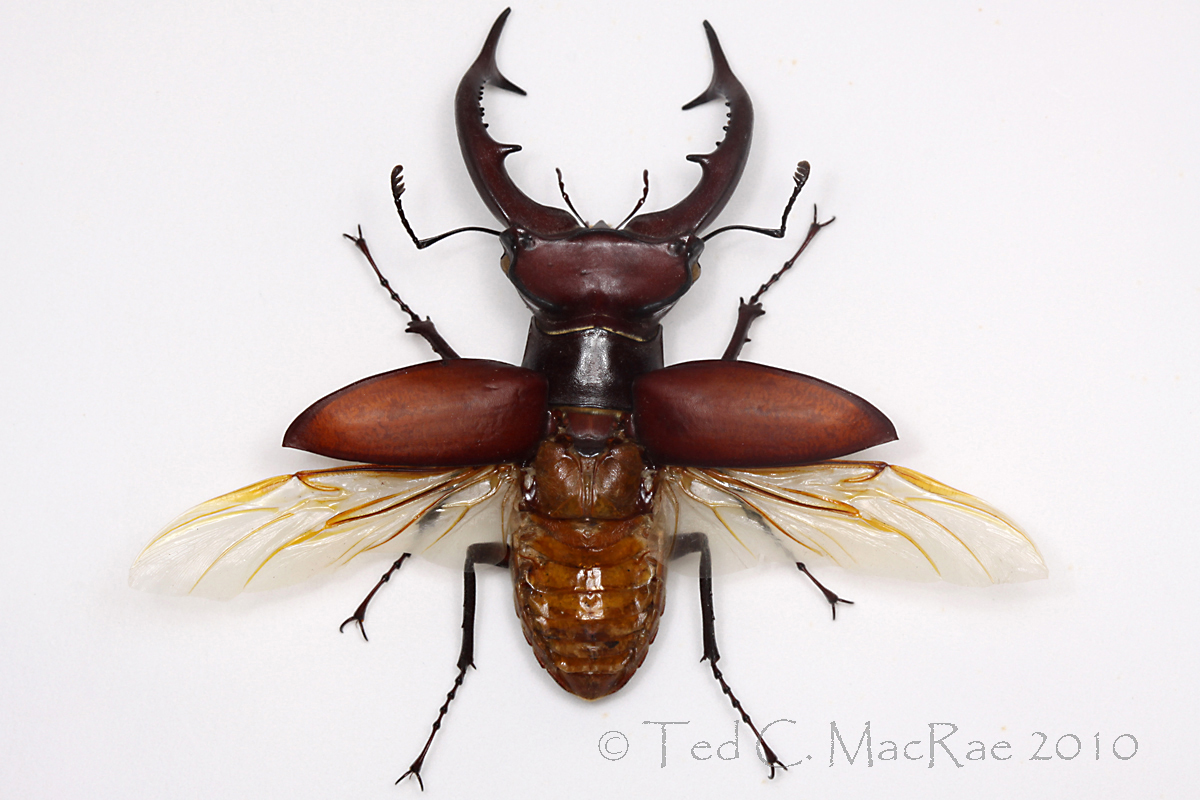
Here is the full-sized photo that provided the image for yesterday’s Super Crop Challenge #3.  The insect in the photo is, of course, a fine example of a male Lucanus elaphus – the giant stag beetle (family Lucanidae).  This striking insect is easily among North America’s most distinctive and recognizable species by virtue of the enormously super-sized mandibles sported by the males.  Its fearsome appearance belies the true nature of this harmless beetle, which spends its days feeding on sap that flows from wounds on the trunks and roots of trees.  Males use their massive mandibles in combat with other males, not for “biting,” but rather as tools to pry and lift their adversaries before dropping them to the ground.  Some marvelous photos of this behavior in a related European species can be seen at Stag Beetles Lucanus cervus Mating Behaviour.
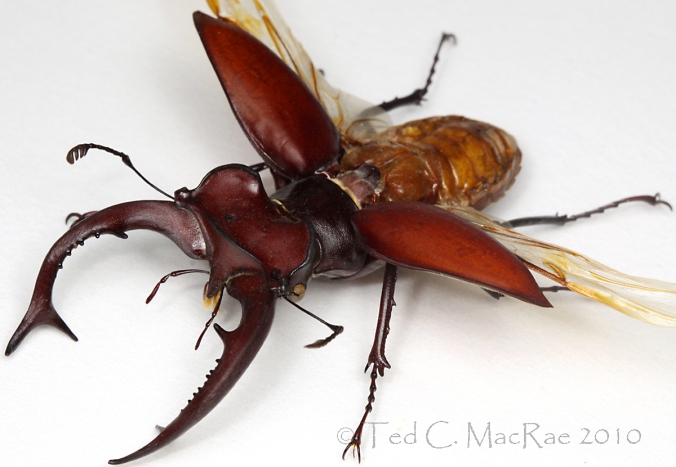
I collected this specimen many years ago at an ultraviolet light (“blacklight”) that I had setup in the pine/oak forests at Pinewoods Lake, Carter Co., in the southeastern Ozarks – one of my favorite 1980’s beetle collecting spots.  This was in my early days of studying beetles, during which time I was actively collecting material as part of my statewide surveys for the families Buprestidae (MacRae 1991) and Cerambycidae (MacRae 1994).  Lucanus elaphus is not a commonly encountered species, especially in the western reaches of its distribution here in Missouri, and I’ll never forget my rabid excitement when I encountered this fine major male at my blacklight sheet.  For many years afterward it remained the only individual that I had ever encountered, until a few years ago when I came across a group of two males and one female feeding on a sap flow in a wet bottomland forest along the Mississippi River in the lowlands of southeastern Missouri.  I encountered another male the following year at a nearby location “rafting” on debris in floodwaters from the nearby river, and two weeks later at that same site I picked up several males and females in a fermenting bait trap.¹  Like most “uncommon” species with broad distribution across the eastern U.S., I suspect that its apparent rarity is an artifact due to habits that make it infrequently encountered rather than being truely scarce.

¹ I have used fermenting bait traps to collect a wide variety of beetles, but especially longhorned beetles.  My recipe is based on that described by Champlain and Knull (1932) – bring 12 oz. dark molasses and 12 oz. beer up to 1 gal. with water, mix well and add a packet of dry baker’s yeast to get the fermentation started.  Hang a 1/2-gallon milk jug with big holes cut in the sides in a tree along the edge of a woods and add ~1 quart of fresh liquid.  It generally takes 2-3 days for the liquid to really start fermenting and become attractive, and it will remain so for about another week or so.  Check traps every 2-3 days by pouring the liquid through a kitchen strainer into another container – reuse or replace as necesssary. Place the collected specimens in vials of water to wash off the molasses residues, and either pin immediately afterward or transfer to 70% ethanol for longer term storage.  Some of the more desireable species I’ve collected in this manner, besides L. elaphus, are Plinthocoelium suaveolens, Purpuricenus axillaris, P. humeralis, P. paraxillaris, Stenocorus cylindricollis, S. shaumii, Sarosesthes fulminans, Stenelytrana emarginata [= Leptura emarginata], and S. gigas [= Leptura gigas].

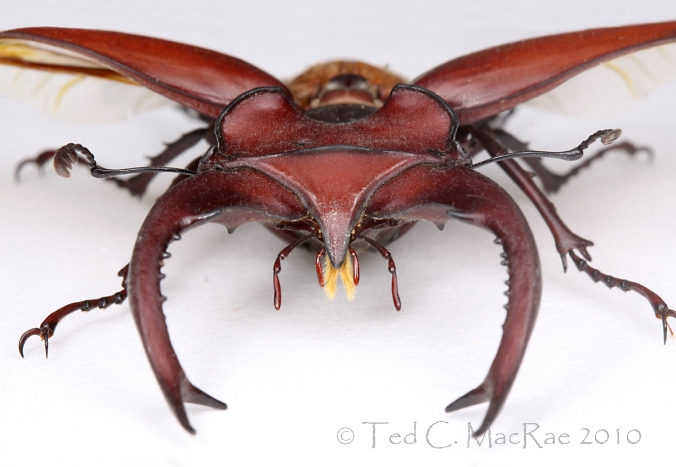
Congratulations to Ben Coulter and Janet Creamer, both of whom correctly identified the species and most of the mouthparts.  Each earned 14 pts and, thus, tied for the win, while JasonC. earned 5 pts. to take the final podium spot.  The pointed structure is the labrum (its shape distinguishing it from other North American species of the genus), and it is flanked on each side by the fuzzy yellow galeae (derived from the maxillae) and the labial palps.  Nobody correctly named the galeae, which seem to be greatly elongated and hairy in stag beetles as a function of their sap feeding behavior.  A portion of the left maxillary palpus can also be seen in the corner of the photograph, but nobody scored those points either.  Brady Richards just missed the podium, but his witty reference to Gene Shalit (if not immediately picked up on by me) earns him an honorable mention.

With points being formally awarded now beginning with the previous competition (ID Challenge #1), I’ll start keeping an overall leaders board, and with wins in both competitions Ben takes a commanding lead in the overalls with 23 pts, followed by Janet Creamer at 14 pts and TGIQ at 8 pts.  I guess I should start thinking of some sort of tangible prize for winners periodically – suggestions welcome.  Stay tuned for another issue of Super Crop Challenge or ID Challenge in the near future.

REFERENCES:

Champlain, A. B. and J. N. Knull.  1932. Fermenting bait traps for trapping Elateridae and Cerambycidae (Coleop.).  Entomological News 43(10):253–257.

MacRae, T. C. 1991. The Buprestidae (Coleoptera) of Missouri.  Insecta Mundi 5(2):101–126.

MacRae, T. C. 1994. Annotated checklist of the longhorned beetles (Coleoptera: Cerambycidae and Disteniidae) known to occur in Missouri. Insecta Mundi 7(4) (1993):223–252.

Copyright © Ted C. MacRae 2010

Super Crop Challenge #3

There are lots of points up for grabs with this one, what with several body parts to name as well as the organism to which they belong needing to be identified.  Rules and points will be awarded roughly as outlined in the inaugural ID Challenge – i.e., points are not mutually exclusive, with comment moderation turned on while the challenge is open to allow all a chance to participate (no advantage to those with trigger fingers).  Points will be awarded for correct taxonomic identifications (order, family, genus, and species – 2 pts each) and for each body part correctly names (2 pts each).  Bonus points may be awarded at my discretion for .

We’ll give this a day or so, depending on how quickly the answers come in…

Copyright © Ted C. MacRae 2010
Super Crop Challenge #2

Super Crop Challenge #1 appeared not to be too difficult – let’s see if this one is any harder. This is a straight up ID challenge, more points for greater specificity. To narrow things down a bit, the photograph from which this portion was cropped was taken during October in southern Missouri.

Copyright © Ted C. MacRae 2010