Missouri’s disjunct population of Cicindela obsoleta vulturina

Although I’ve been collecting insects since I was a kid (and seriously for nearly three decades), it has only been in more recent years that fall has become an important part of the collecting season for me. With the notable exception of Fall 1978, when the Systematic Entomology course I was enrolled in sent me on a frantic quest to become one of the few undergraduate members of the exclusive “200 family” club (I got 205!), I long viewed fall as a time to hang up the net and begin the winter-long process of mounting, labeling, and curating the hundreds – sometimes thousands – of specimens I had collected earlier in the year during spring and summer.  This has primarily been a reflection of my taxonomic interest – woodboring beetles in the families Buprestidae and Cerambycidae, which occur at their overwhelmingly greatest abundance and diversity throughout most of North America during spring and summer but are found only sparingly later in the season.  Tiger beetles (family Cicindelidae) changed all that, and when I first began serious study of the group around 10 years ago, I found the combination of gorgeous weather and multitude of “spring/fall” species that emerge briefly during fall an irresistible siren call to the field. I’ve not looked back, and the Annual Fall Tiger Beetle Collecting Trip™ is now an established and eagerly anticipated event.

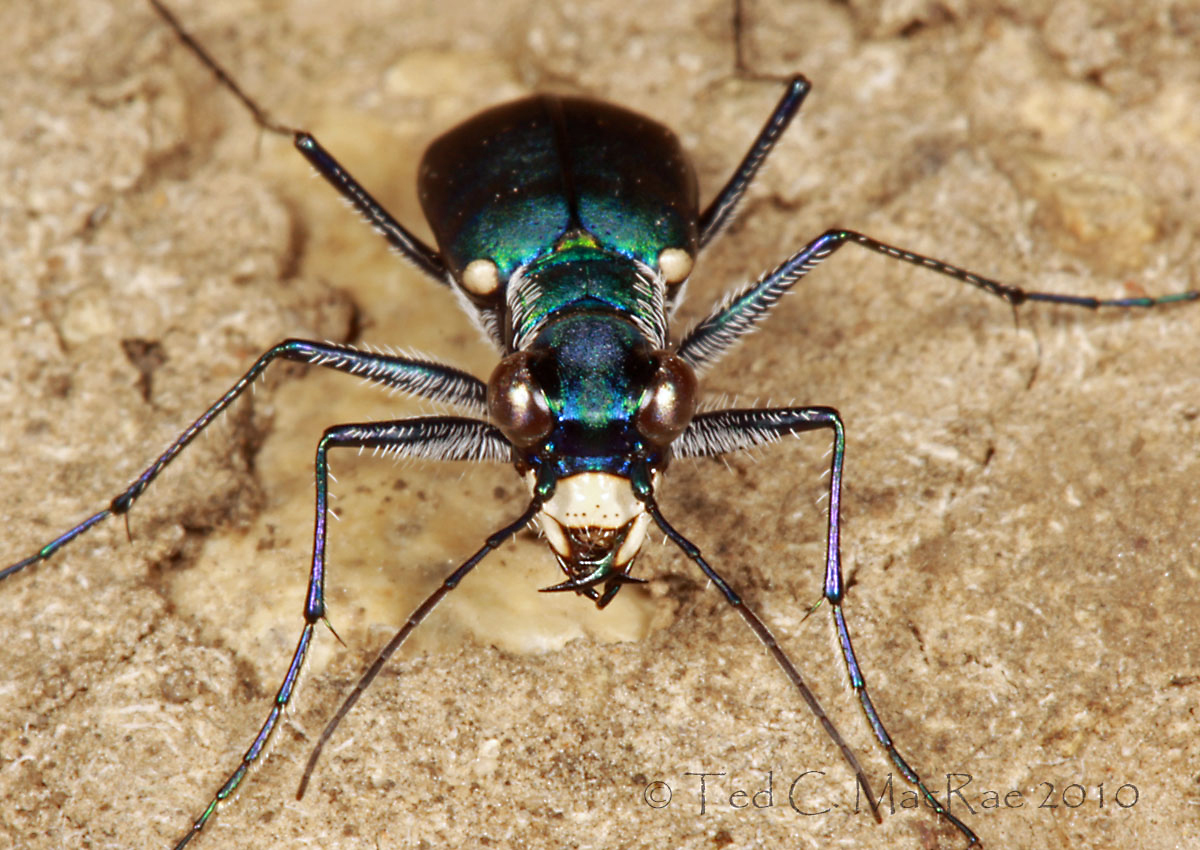
Cicindela obsoleta vulturina - the prairie tiger beetle (Blackjack Knob, Taney Co., Missouri).

No species embodies all that I love about fall tiger beetle collecting more than Cicindela obsoleta vulturina, the prairie tiger beetle. I first learned of the occurrence in Missouri of this large, dark green species back in 2000, when I saw a single specimen in the Enns Entomology Museum collected in Protem, Taney Co.  I was just beginning my tiger beetle studies and would later learn what the Tiger Beetle Guild already knew – that the occurrence of this species in Missouri was restricted to cedar glade habitats in the White River Hills region in the extreme southwestern part of the state, and that the population occurring there and in adjacent northern Arkansas was disjunct by 300+ miles from the main population in Texas and Oklahoma.  I couldn’t wait to see it for myself and eventually enlisted the help of Eric Eaton, living in the area at the time, and asked him to let me know if he saw a large green tiger beetle after the late summer rains began.  That September, I got a message from Eric saying that he had seen just such a beast not far from his home, and the following weekend he and I would enjoy the chance to meet each other in person and the splendor of the season while finding this marvelous species at several locations in the area.  Thus began my love affair with this species, and for several years I returned to the area each fall to document additional localities for this and other tiger beetle species occurring in the area.

Blackjack Knob is part of an extensive xeric dolomite prairie complex (commonly referred to as cedar glades, though the term is not precisely accurate) in the White River Hills subsection of the Ozark Highlands, providing habitat for prairie tiger beetles and other typically southwestern plants and animals.

In fact, until a few weeks ago it had been several years since I had last seen this species in the field.  I did make an attempt to see it again last year but returned home from that early October trip unsuccessful, cold and wet.  Thus, when tiger beetle enthusiast Steve Spomer mentioned to me earlier this summer that he wanted to see our Missouri population, I jumped at the chance to coordinate our visits this fall and show him some of my favorite sites.  The Patron Saint of Cicindela was smiling down upon us that day, as perfect timing and sunny skies combined to bring adults out in an abundance that I’d not seen in any of my previous visits.  I would take advantage of this rare opportunity and spend the next day in the area as well, documenting a number of new localities along the northern and eastern edge of its known distribution, including a far eastern extension of its range to Caney Mountain Conservation Area in Ozark Co. where we had long suspected the beetle to occur but failed in all previous attempts to find it.

Steve Spomer and yours truly at Cane Creek Rd. site.

The prairie tiger beetle is the easternmost subspecies of the large grassland tiger beetle, which along with its other included subspecies covers a geographic range covering most of Texas, New Mexico, and eastern Arizona and extending up through western Oklahoma and Kansas into eastern Colorado.  Individuals of subspecies vulturina, occurring primarily in eastern/central Texas, are distinguished from the other subspecies (nominate in western Texas and eastern New Mexico north into Colorado, santaclarae in New Mexico and Arizona, and neojuvenilis in south Texas) by their generally black to olive-green coloration and reduced, narrow elytral markings, typically with an inverted “V” at mid-elytron.  The Missouri/Arkansas disjunct population is interesting from several standpoints:

  • Individuals mostly dark olive-green – no black individuals.
  • Elytral maculations more completely developed.
  • Adults active in late summer/early fall rather than summer.

These features, in particular coloration and maculation, have fueled speculation that this isolated population might be subspecifically distinct (Pearson et al. 2006).  A recent review of material from throughout its range found these color characters of limited use in unequivocally diagnosing individuals from the Missouri and Arkansas population as a separate subspecific taxon (Mawdsley 2009); however, a molecular systematics approach ultimately may be needed to resolve the status of this population.  Presumably, the Missouri/Arkansas disjunct population represents a hypsithermal relict, left behind when the return of cooler, moister conditions caused a retreat of the formerly more expansive grasslands to their current position.  If true, then the Missouri/Arkansas population has been isolated from the parent population for ~6,000 years.  I suspect that the late summer/early fall adult phenology is an adaptation to local precipitation patterns, relying on more predictable late summer rains to trigger adult emergence after the generally droughty months of July and August.  In this regard it differs fundamentally from the true “fall” species, which emerge briefly in the fall as sexually immature adults before overwintering and re-emerging in the spring for mating and oviposition.  These Missouri/Arkansas disjuncts do not re-emerge in spring, but instead mate and lay eggs in the fall before the onset of cold weather.  The eggs hatch as well (based on my growth chamber observations of this species), so winter also is passed as a larva – either as newly-hatched 1st instars, or as later instars that hatched during the previous year(s) – rather than as adults.

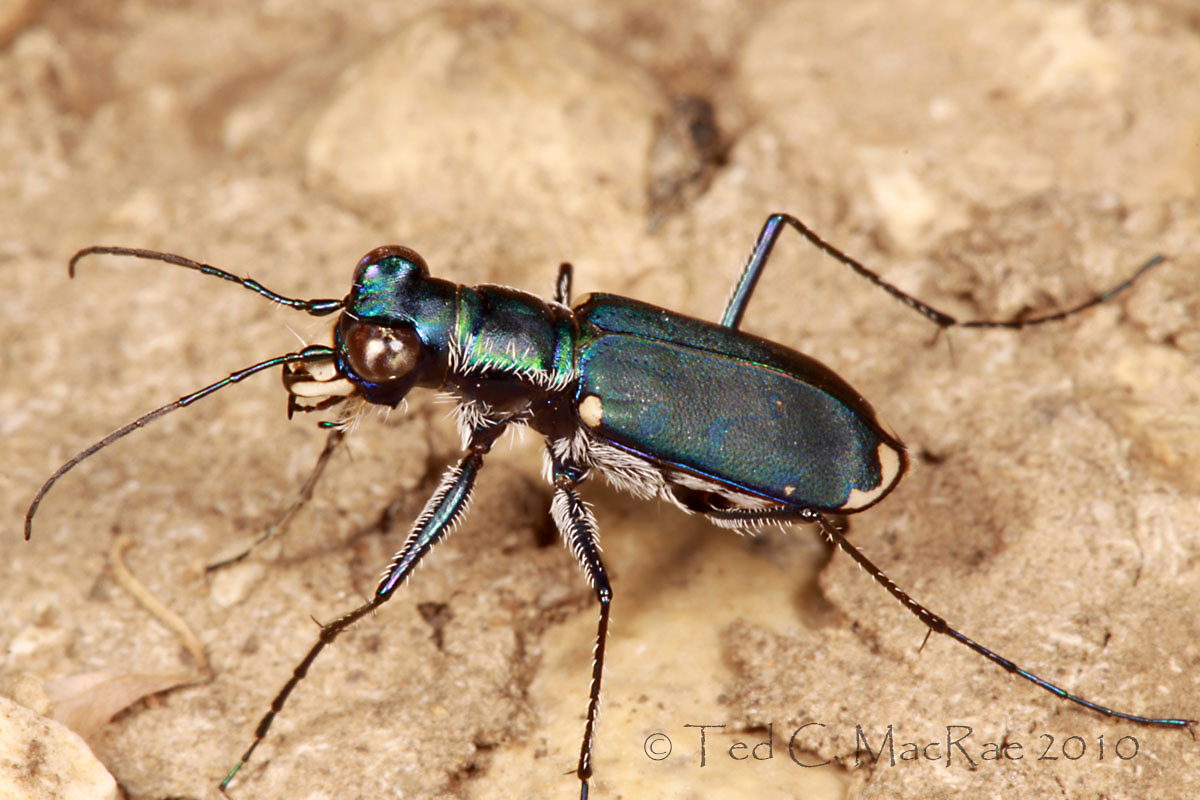
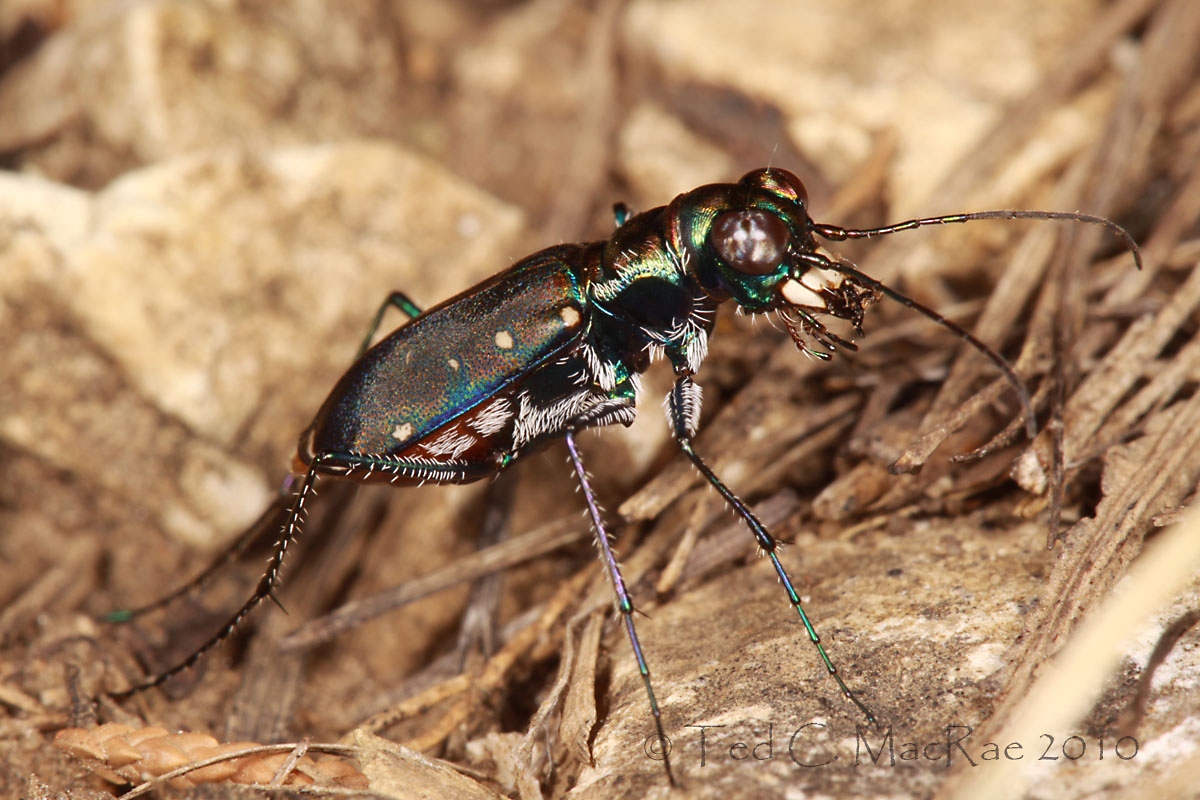
I have noted considerable variation in the coloration and maculations of individuals in this population.  The individual in the first photograph above is typical of the population – dark olive-green with thin but nearly complete maculations.  That individual comes from Blackjack Knob (Taney Co.), which is near the heart of the White River Hills region.  However, the degree to which the maculations are developed is variable, ranging from rather incomplete to even more fully developed due to the presence of a marginal connection.  Additionally, a few individuals can be found that show greater or lesser suffusion of brown on the head, pronotum, and elytra.  At another location in the county closer to the northern distributional limit (Hwy 160/Cane Creek Rd.), this brown suffusion is more common and variably expressed from minimal to nearly complete.  The photographs below show five individuals from this site expressing differing degrees of brown as well as the variable macular development seen throughout the population:

Male (Hwy 160/Cane Creek Rd.) - green w/ trace brown, marginal band incomplete, median band complete.


Female (Hwy 160/Cane Creek Rd.) - green w/ slight brown, marginal band complete, median band incomplete.
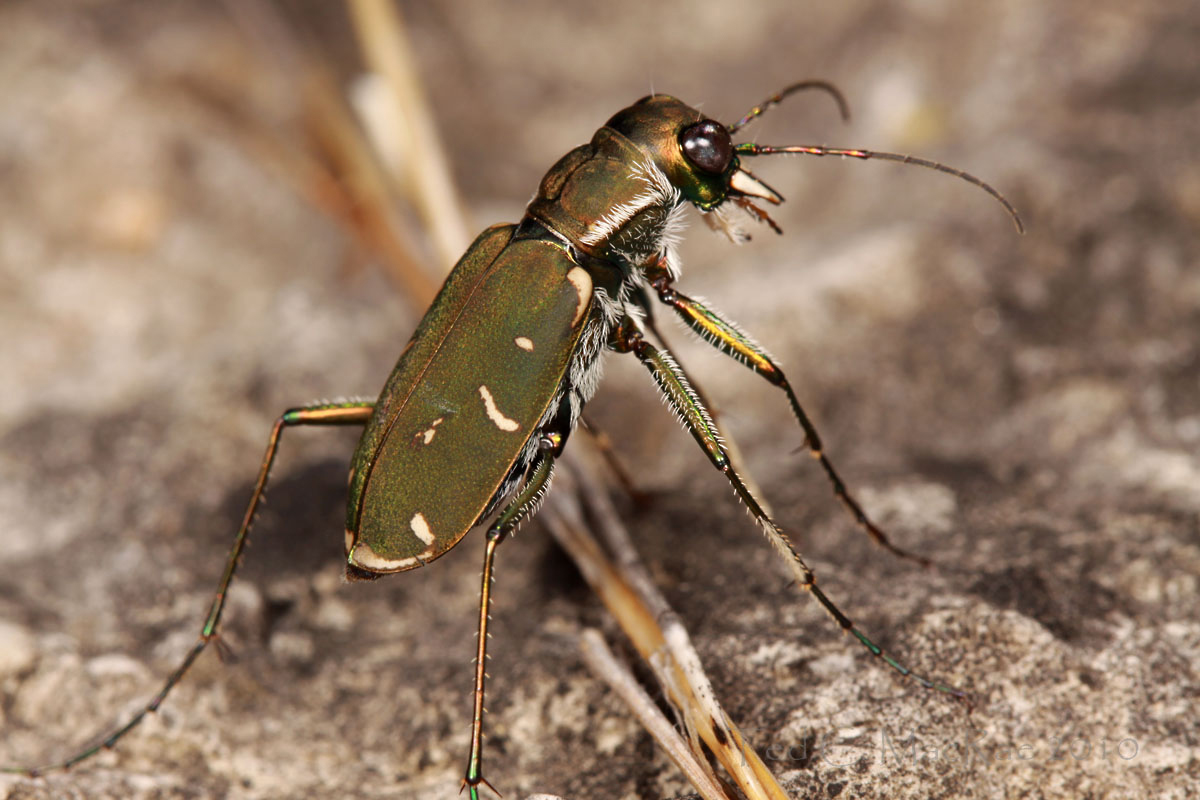

Male (Hwy 160/Cane Creek Rd.) - green w/ moderate brown, marginal band incomplete, median band incomplete.


Male (Hwy 160/Cane Creek Rd.) - green w/ heavy brown, marginal band complete, median band complete.
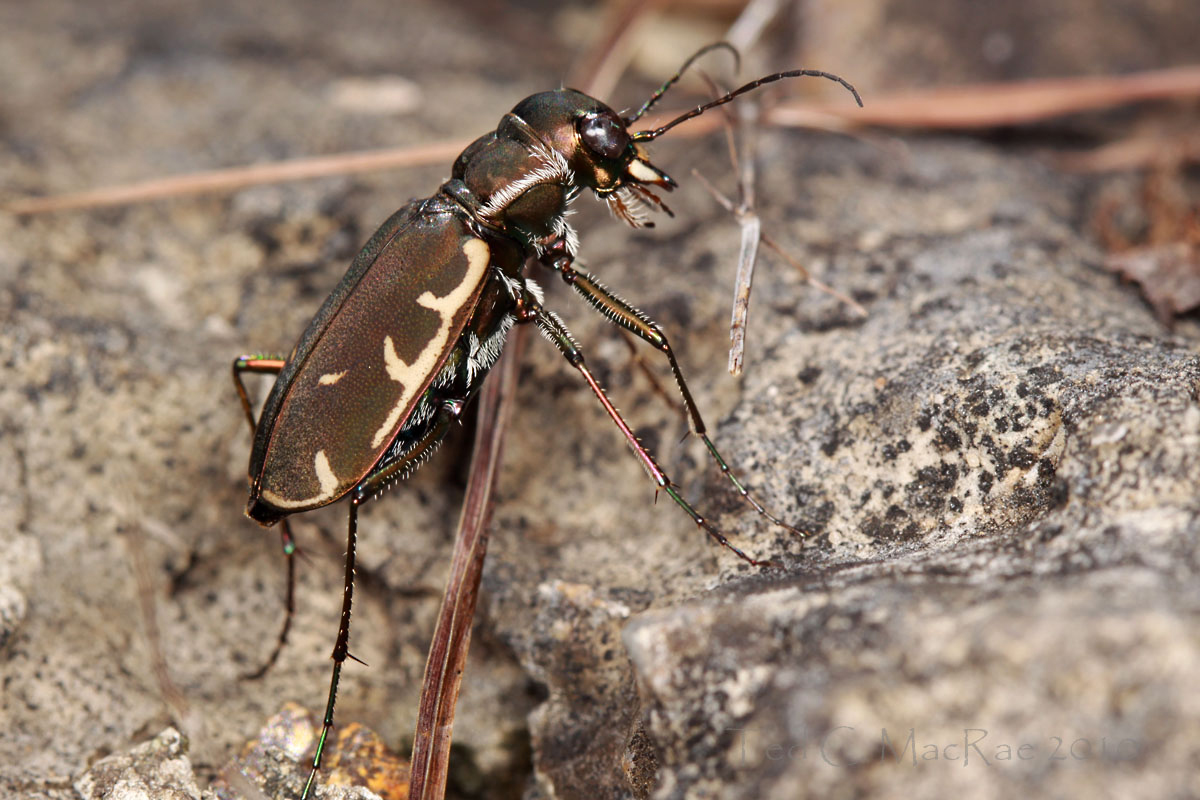

Female (Hwy 160/Cane Creek Rd.) - completely brown, marginal band complete, median band incomplete.

There is another site even further north in the county (Merriam Woods), which I found for the first time on this trip and, to my knowledge, represents the northernmost extent of the population in Missouri.  At this site, nearly all of the individuals show coppery-brown coloration with almost no hint of green.  These fully brown individuals seem to represent an appearance that is completely unlike that seen in any other part of the range of the species.  The individual in the photo below typifies the appearance of the beetles seen at this site:

Male (Merriam Woods) - brown, marginal band incomplete, median band complete.

I’m less familiar with coloration of the population further south in Arkansas, although in my limited collecting in that area I recall that most individuals I encountered exhibited the dark olive-green coloration typical of individuals at Blackjack Knob and other more southern sites in Missouri.  Thus, there seems to a clinal element to variability in coloration in the Missouri/Arkansas disjunct population.  I suspect that the unique coloration of the beetles in this population is related to the soils with which they are associated.  Light gray Jefferson City-Cotter dolomite bedrock forms the core of the White River Hills landscape and is exposed extensively in the glades that dominate its knobs and slopes.  These exposures are weather-stained black and overlain by thin, black soils that support dark, green-black lichens amongst the sparse vegetation, as seen in the following photographs taken at the newly identified northeasternmost site at Caney Mountain Conservation Area:

Thinly soiled dolomite exposures punctuate the glades in the White River Hills. Prairie tiger beetles are found in these exposures.


Dark green-black lichens encrust the thin black soils overlaying the dolomite exposures. Prairie tiger beetle adult coloration closely matches the coloration of the lichens and soil.

The glades and dolomite exposures where these beetles are found in the White River Hills and the dry oak woodlands that surround them have a characteristic look that is not seen once one leaves the area, and I have found many new sites for the beetle in the northern and eastern fringes of the region by stopping at locations where the roadside exposures had the right “look.”  The variation in maculation and coloration seen in this population may be an indication that the population is still adapting to local conditions since becoming isolated from main population.

Currently, I have 3rd-instar larvae that I collected from their burrows at Blackjack Knob (adults mostly green) and Merriam Woods (adults mostly brown) and hope the rear them to adulthood next year.  If I succeed in getting virgin adults from the two sites, I think it would be interesting to do some single-pair crossings and rear the progeny to see how coloration is expressed.  A long term project, for sure, as these beetles probably require at least two seasons to reach adulthood, but rearing them is fun!  A more difficult, yet far more interesting, project would be to secure virgin adults from the mostly black main population in Texas – or even the bright green, thickly-maculated santaclarae subspecies from Arizona – to see how interbreeding them with these Missouri disjuncts would affect coloration and maculation in their progeny – they could be some of the most unusual appearing large grassland tiger beetles ever seen (not to mention their tongue-twisting taxonomic moniker of Cicindela (Cicindelidia) obsoleta vulturina [Missouri disjunct] x obsoleta santaclarae!).  Timing would be a difficulty, since the Texas and Arizona populations exhibit a more normal summer adult phenology, but it would be worth a try if I could secure a source of larvae for rearing.  Anybody?

A male sports his impressive pair of choppers.

Photo Details (insects): Canon 50D w/ 100mm macro lens (ISO 100, 1/250 sec, f/13-22), Canon MT-24EX flash (1/4-1/2 ratio) w/ Sto-Fen + GFPuffer diffusers. Typical post-processing (levels, minor cropping, unsharp mask).

REFERENCES:

Mawdsley, J. R.  2009. Geographic variation in U. S. populations of the tiger beetle Cicindela obsoleta Say (Coleoptera: Cicindelidae).  Insecta Mundi 0094:1–10.

Pearson, D. L., C. B. Knisley and C. J. Kazilek. 2006. A Field Guide to the Tiger Beetles of the United States and Canada. Oxford University Press, New York, 227 pp.

Copyright © Ted C. MacRae 2010

Jeepers Creepers, where’d ya get those multilayered retinae?

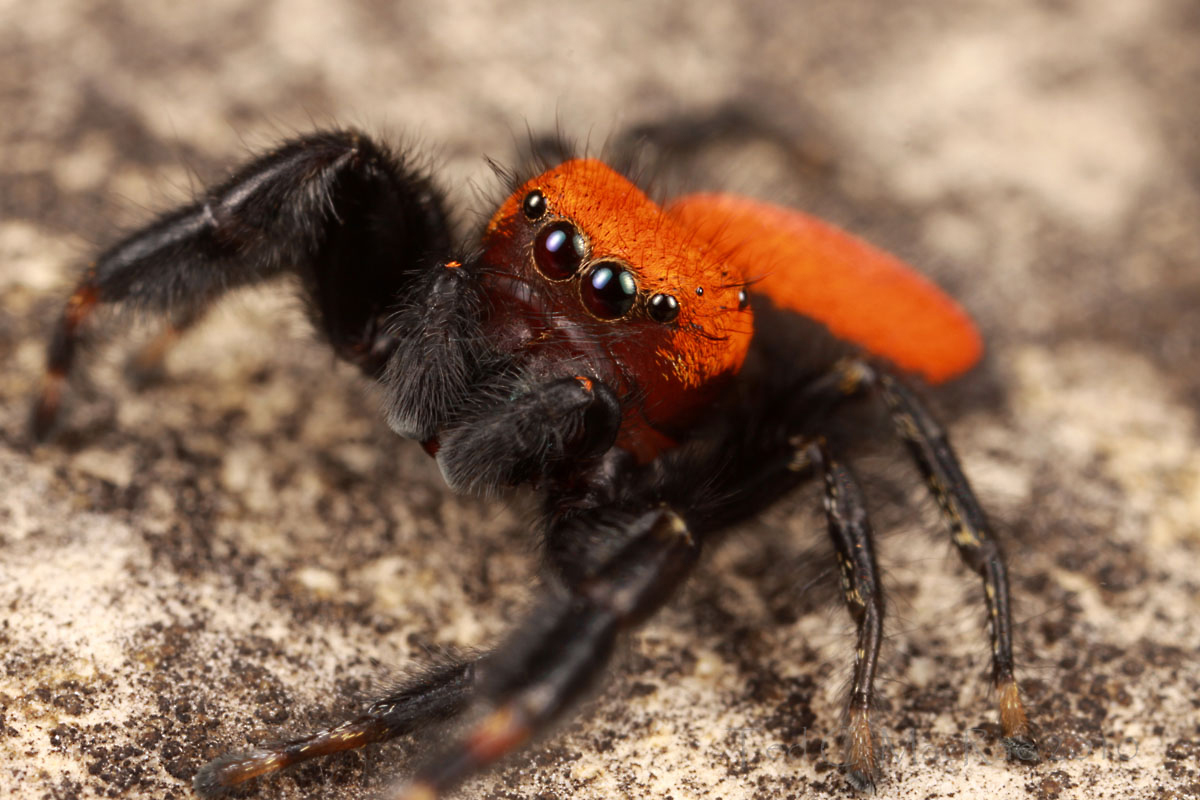
A few weeks ago I was fortunate to get a chance to blast down to the White River Hills in extreme southwestern Missouri.  Cicindela obsoleta vulturina (prairie tiger beetle) was my quarry – I had made arrangements to meet up with fellow cicindelophile Steve Spomer (principal author of Tiger Beetles of South Dakota & Nebraska, Spomer et al. 2008) and show him a few of the better sites I had found for this species.  We would have good success due to gorgeous fall weather and perfect timing, and the next day I would be fortunate to extend its known distribution further north and east.  Still, the beetles are not early risers, and I found myself that second morning with some time on my hands while waiting for these sleepy-heads to arise from their slumber and begin their foraging activities.  As I trolled the thinly soiled dolomite exposures of a new site I had identified the previous day, a spot of red jerking erratically through the sparse vegetation caught my eye, and looking closer I was delighted to see this small but brilliantly colored jumping spider (family Salticidae) trying to evade my gaze.

Jumping spiders are perhaps the most diverse of all spider families, but it is their extraordinary visual capabilities and complex predatory and courtship behaviors that they are best known for.  Popular as research subjects, to the rest of us they are simply endearing little animals.  Some of the largest and most colorful jumping spiders belong to the genus Phidippus, which is also one of the most diverse genera in the family and boasts some 60 species in the continental United States (Edwards 2004).  The genus is characterized by details of the eye placement and carapace shape (Richman 1978) but can often be recognized by their relatively large size, numerous erect hairs, and conspicuous iridescent chelicerae just below the front eyes.  The species can be quite difficult to identify, especially the females, but I feel reasonably confident that this individual is a male of the widespread species P. apacheanus.

I wasn’t always so confident – browsing images on BugGuide left me confused after finding images of P. apacheanus and P. cardinalis males that looked almost identical. However, further digging reveals P. apacheanus is characteristically a more intense red, while P. cardinalis is more orangey with lighter bristles which may appear silvery.  Also, P. cardinalis often displays makings on the abdomen – generally a light line running around the anterior part of the abdomen and sometimes tiny light spots on the dorsum – that are absent in P. apacheanus.  (This begs the question as to whether some of the BugGuide photos may be misidentified?)  Another Phidippus species that might be confused with P. apacheanus is P. clarus; however, that species has a black cephalothorax and bright abdominal markings.  According to Herschel RaneyP. apacheanus is most often seen in fall.

This was a very difficult subject to photograph.  He refused to come out in the open, preferring to duck and peek from behind whatever vegetation he could find.  Realizing that my desire to photograph him without any manipulation would be a lesson in futility, I used my finger to prod him towards and onto a small, flat, lichen-encrusted rock, where he would look at me with ever-increasing alarm and try to flee at the approach of the camera.  Lots of failed shots were discarded in the field before I finally got a few I thought I could live with (which, I think, are a decided improvement over my first jumping spider photos).  As I zoomed in for the closeups, I saw for the first time the shimmering of his multilayered retinae moving in the depths of his primary medial eyes.  The retina is the darkest part of the eye, thus, when the eye is at its darkest the spider is looking straight at you!

Photo Details: Canon 50D w/ MP-E 65mm 1-5X macro lens (ISO 100, 1/250 sec, f/13), Canon MT-24EX flash (1/8 ratio) w/ Sto-Fen + GFPuffer diffusers. Typical post-processing (levels, minor cropping, unsharp mask).

REFERENCES:

Edwards, G. B.  2004. Revision of the jumping spiders of the genus Phidippus (Araneae: Salticidae). Occasional Papers of the Florida State Collection of Arthropods 11:i-viii, 1-156, 350 figs.

Richman, D. B.  1978. Key to the jumping spider (salticid) genera of North America.  Peckhamia 1(5):77–81.

Spomer, S. M., M. L. Brust, D. C. Backlund and S. Weins.  2008. Tiger Beetles of South Dakota & Nebraska. University of Nebraska, Department of Entomology, Lincoln, 60 pp.

Copyright © Ted C. MacRae 2010

“Colorfull Cockroach” discovered in Panama

I won’t call this a taxonomy fail, since Patrick is clearly not a taxonomist, or even the first person to confuse a beetle with a cockroach.  Nevertheless, I was amused at Patrick’s amazement with the “colorfull cockroach” that he found and his palpable excitement that it might be a new discovery.

Well, I was amazed about this type of cockroach so, I would like to know if it is a cockroach or what because I know you guys will be also interested about checking out this type of bug.
Thanks please answer fast 🙂
Maybe is a new kind of cockroach not discovered yet.

Fortunately, the folks at What’s That Bug were able to correctly identify this as Euchroma gigantea (giant metallic ceiba borer), a beetle in the family Buprestidae (and the largest such species in the Western Hemisphere).  An interesting note about this photo is that it shows the beetle with some – but not all – of the green pulverulence (dusty coating) that these beetles exhibit over the elytra upon emergence from their host tree.  This coating is quickly worn off as the beetle goes about its activities, and most museum specimens of the species lack it completely – giving the beetle a purplish appearance as seen on the left elytron of the beetle in this photo.  Even handling a freshly-emerged specimen to mount it on an insect pin would likely result in loss of much of the coating, so it is quite difficult to preserve specimens in their lime-green dusty state.

Copyright © Ted C. MacRae 2010

Clown beetle surprise

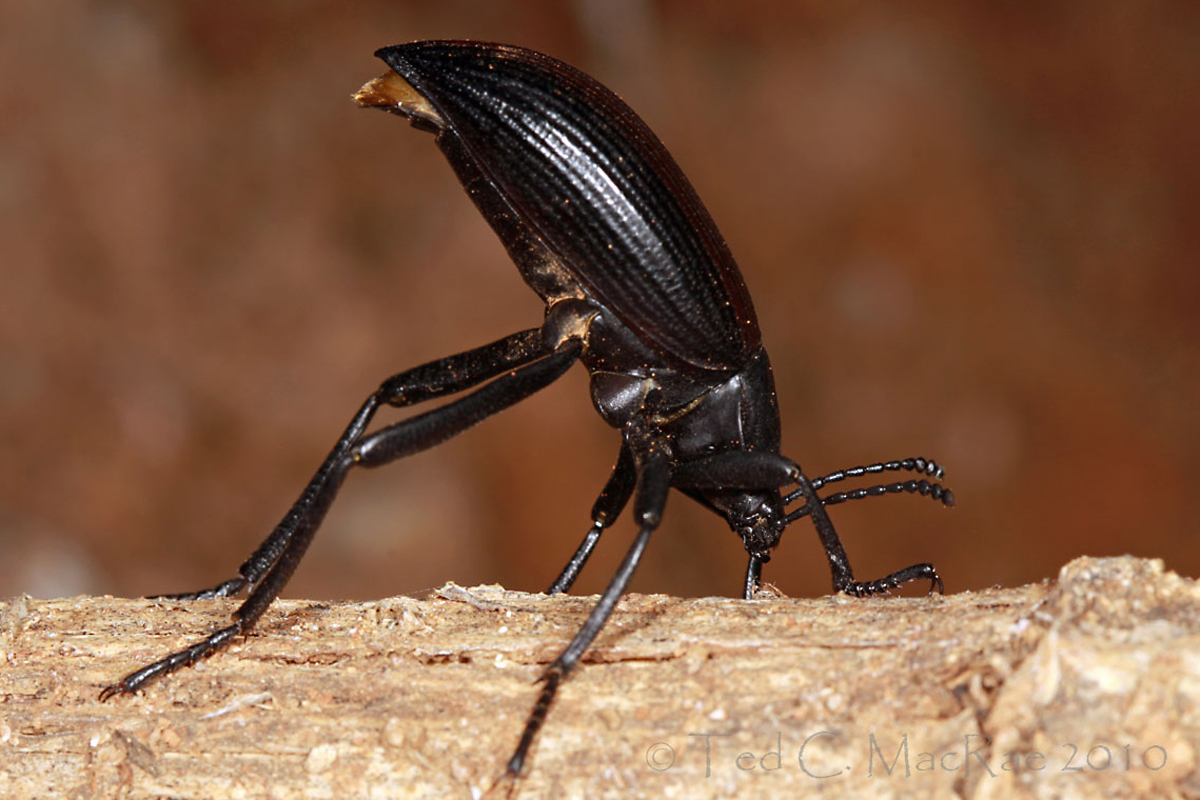
As I slowly scanned my flashlight through the darkness across the mixed-grass prairie in the Glass Mountains of northwestern Oklahoma last July, there was one thing that I hoped not to see (prairie rattlesnake, unless from afar) and one thing that I hoped more than anything to see (Great Plains giant tiger beetle, Amblycheila cylindriformis). Fortunately, I encountered none of the former and found several of the latter.  It took awhile before I saw the first one, but in the meantime I saw all too abundantly the clown beetle, Eleodes suturalis.  A member of the family Tenebrionidae, this species is one of the most conspicuous components of the Great Plains beetle fauna.  Adults are commonly encountered walking about the grasslands or crossing roads, especially after summer rains.  I recall my first encounter with this species when I made my first insect collecting trip to the Great Plains in 1986, marveling as I literally watched hundreds of individuals crossing a remote highway in southwestern Kansas.  Now, they were just an annoyance – close enough in size and appearance to the object of my search that I had to pause and look at each one I encountered to verify its identity.¹

¹ In fact, a mimetic association has been suggested for Amblycheila cylindriformis and Eleodes suturalis due to their similarity in size, shape and coloration (black with a reddish-brown sutural stripe) (Wrigley 2008).  This may be true, as Eleodes suturalis is an abundant species capable of defending itself with noxious sprays that contain benzoquinone and other hydrocarbons, while Amblycheila cylindriformis is a much rarer species (as mimics tend to be) that lacks defensive compounds.

After finding a few of the Amblycheila, I encountered this particular individual clinging to a root sticking out of the side of a wash.  My closer look caused it to immediately assume its characteristic defensive headstand pose (from which the name ‘clown beetle’ comes), so I decided to take a few photographs (not an easy task at night).  The photos have been sitting on my hard drive since, but in examining them more closely, I realized that this particular beetle is not E. suturalis.  Rather, it is one of several similar appearing species that co-occur with E. suturalis in the Great Plains and sometimes resemble it due to their large size, sulcate elytra, and occasional presence of a similar reddish-brown sutural stripe.  From these species, E. suturalis is at once distinguished by its broadly explanate (flanged) pronotum and laterally carinate, distinctly flattened elytra.  This individual clearly exhibits more rounded elytra and as best as I can tell keys to E. hispilabris – distinguished from E. acuta and E. obscurus by possessing a normal first tarsal segment (not thickened apically) on the foreleg (Bennett 2008).  Presumably this and the other related species of Eleodes also possess chemical defenses similar to E. suturalis – an example of Müllerian mimicry where multiple species exhibit similar warning coloration or behavior (in this case headstanding) along with genuine anti-predation attributes.

Photo Details: Canon 50D (ISO 100, 1/250 sec, f/14), Canon 100mm macro lens, Canon MT-24EX flash (1/4 ratio) w/ Sto-Fen diffusers. Post-processing: levels, unsharp mask, slight cropping.

REFERENCES:

Bernett, A. 2008. The genus Eleodes Eschscholtz (Coleoptera: Tenebrionidae) of eastern Colorado. Journal of the Kansas Entomological Society 81(4):377–391.

Wrigley, R. A.  2008. Insect collecting in Mid-western USA, July 2007.  The Entomological Society of Manitoba Newsletter 35(2):5–9.

Copyright © Ted C. MacRae 2010

Cicindela – A quarterly journal devoted to Cicindelidae

Being a cicindelophile (i.e., a tiger beetle enthusiast), I have on occasion highlighted articles published in the journal Cicindela (“A quarterly journal devoted to Cicindelidae”) (see previous post – also here, here and here).  This delightful little journal is the now 42-year old brainchild of Ronald L. Huber, among North America’s foremost experts of the group (and still serving as Managing Editor for the journal).  With Robert C. Graves and Richard Freitag also serving as Editors, the journal publishes four issues per year – each containing a variety of articles dealing with the taxonomy, biology, faunistics, and conservation of this captivating group.  More recent years have also seen the inclusion of color photographs.  For serious students of the group, the journal is an indispensable resource – its issues containing a significant portion of the recent tiger beetle taxonomic literature (indeed, I am fortunate to possess in my own library a complete and nicely bound set of this journal).  However, even those with only casual interest in the group can appreciate the journal’s informal, enthusiast-centric tone.  A remarkably longstanding labor-of-love, Ron himself lays out and delivers each issue to the printer, then mails copies to the journal’s few hundred subscribers.

One thing that the journal has lacked is a web presence.  This has becomes all too clear with each article that I’ve featured, each prompting requests for subscription information by readers whose interest in the journal was piqued but were then unable to find such information on the web.  All of that is about to change – with Ron’s permission, the journal’s editorial policy and subscription information are being reproduced here to make them more widely available to those who might wish to contribute or subscribe.  The cost of the journal is nominal (only $10 in the U.S.), so even the most casually interested person should be able to justify a subscription.

Editorial Policy

Manuscripts dealing with any aspect of the study of Cicindelidae will be considered from any author.  All manuscripts should be submitted to the Managing Editor via email or on diskette [see inside back cover for conventions and format].  Papers dealing with areas other than the Nearctic are especially solicited but should be in English.  Translations are also very welcome.  All manuscripts will be acknowledged upon receipt.  Proofs-for-correction will be emailed to authors for quality control.  Illustrations, charts, graphs, etc., are encouraged.  Authors that have institutional support or other funds available for publication purposes are importuned to arrange for at least partial payment of publication costs.  Current page charges are shown inside the back cover.

Subscriptions

The subscription price for each annual volume of four numbers is currently $10.00 (domestic) and $13.00 outside the U.S.  All subscriptions begin with the first issue of the year.  Back issues of prior volumes, if still available, are priced according to age.  Inquire for prices.  All requests for subscriptions and back issue availability should be addressed to the Managing Editor: Ronald L. Huber, 2521 Jones Place West, Bloomington, Minnesota 55431-2837, U.S.A.

My appreciation to Ron for allowing me to post this information, and also to Ken Allen, for permitting me to reproduce the cover of the latest issue of Cicindela, graced with a gorgeous variant of Cicindela longilabris that he photographed in Glacer National Park.

Copyright © Ted C. MacRae 2010

Add to FacebookAdd to DiggAdd to Del.icio.usAdd to StumbleuponAdd to RedditAdd to BlinklistAdd to TwitterAdd to TechnoratiAdd to Yahoo BuzzAdd to Newsvine

Email to a friend

The marvelously monstrous Microstylum morosum

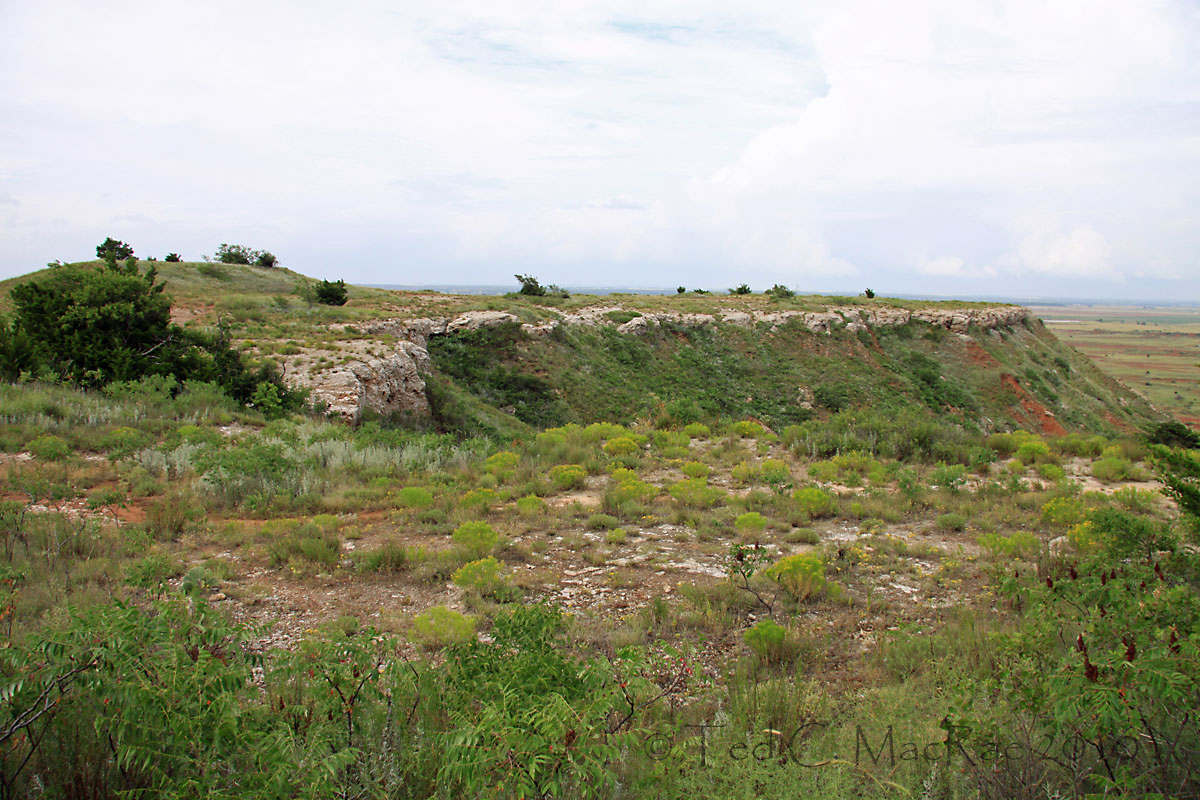
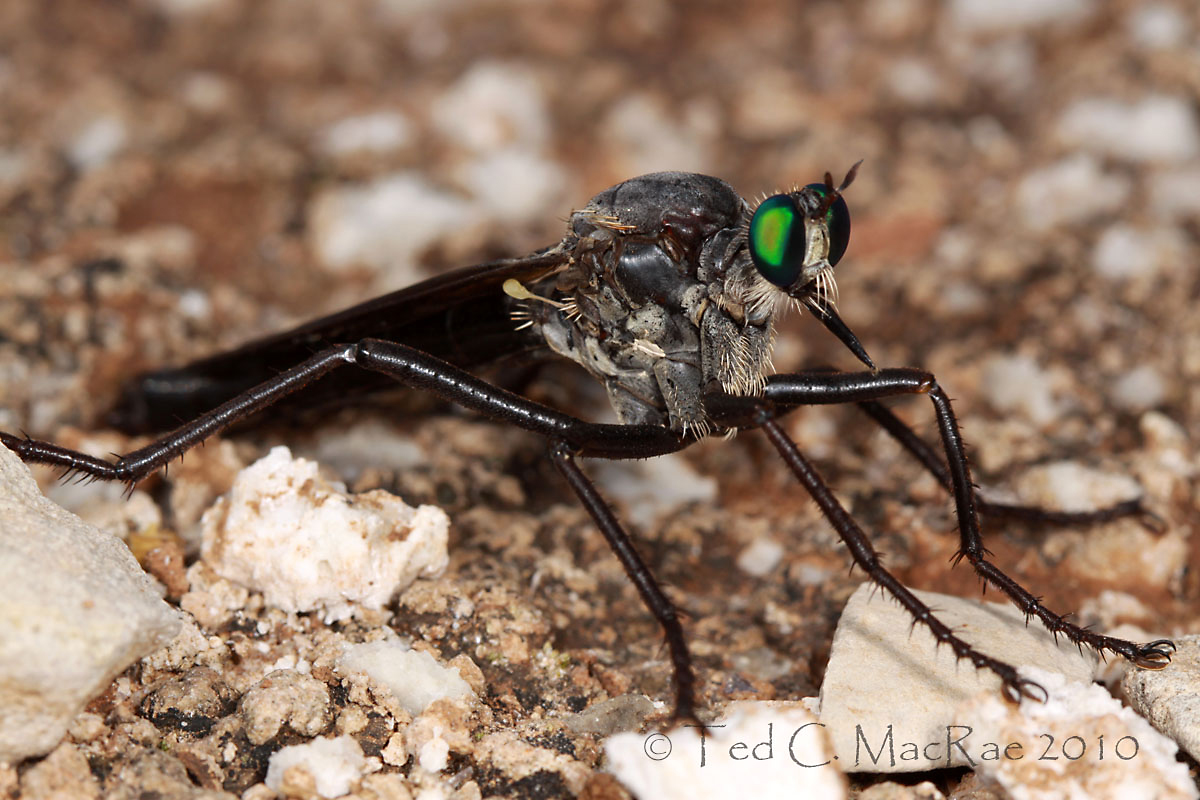
A few weeks ago, while waiting to begin my nocturnal hunt for the Great Plains giant tiger beetle (Amblycheila cylindriformis) in northwestern Oklahoma, I spent the daytime atop one of the red flat-topped mesas that meander through the area in nearby Gloss Mountain State Park.  Although my trip was all about seeing this giant of a tiger beetle in the wild for the first time (I could hardly wait for dusk to begin my search), I found enough splendid insects of other types atop the mesa to occupy my interest until that time.  One of these was the still-robust population of the Swift Tiger Beetle (Cylindera celeripes) that I discovered last summer and delighted in photographing yet again, while another was North America’s largest robber flyMicrostylum morosum!  I had just finished photographing one of the tiger beetles near the edge of the mesa when I turned and saw one of these impressively large flies sitting calmly on the ground nearby.

I first encountered this species last year in southwestern Missouri (a new state record!), so there was no question about its identity.  I also remembered how skittish they were and how difficult it was to get even the two mediocre photographs that I included in the resultant post.  Expecting the same, I kept my eye on the ground-sitter while preparing the camera and approached it with extreme caution.  To my surprise, it showed no sign of being alarmed or wanting to take flight.  I crouched down low and marveled at its monstrous impressiveness as I took frame after ever closer frame – eventually zeroing in on the head and its stunningly magnificent emerald-green eyes.

Satisfied that somewhere in the dozen and a half frames that I shot was at least one or two winners, I sat up and probed towards it with my finger to see how quickly it took flight.  It just sat there tenaciously until my touch caused it to finally take wing.  Winds were gusty atop the mesa, which may have accounted for its cooperativeness.  Standing up, I noted a few scattered eastern redcedars (Juniperus virginiana) in the mixed-grass prairie at the highest point of the mesa.  I recalled that robber flies are fond of “hilltopping” – a mating strategy whereby males fly to the highest point in their immediate landscape to defend a small territory or perch that provides a good vantage for spotting females and competing males (see Hilltopping by Eric Eaton at Bug Eric for a good discussion about this) – and my own experience with this species in Missouri and the way it tended to perch in the trees scattered across the upper part of the rocky, dolomite glade where I found them.  I wandered up to the redcedars, and as soon as I came close enough to one of them I saw another individual take flight – looking like some super-sized mosquito with it’s long legs spread wide as it clumsily flew to another tree.  As it turned out, I saw a number of individuals and mating pairs perching and flying among the trees on top of the mesa, each more spectacular than the previous.

Until recently, Microstylum morosum was considered a Texas-endemic.  However, Beckemeyer and Carlton (2000) documented this species to be much more broadly distributed in the southern Great Plains (from Texas up into Oklahoma and Kansas and west into New Mexico, Arizona, and Colorado), and Warriner (2004) recorded it shortly afterwards in Arkansas.  Although the species apparently occurs throughout Oklahoma (Beckemeyer and Carlton recorded from 13 counties across the state), my observation of it in Major County does seem to represent a new county record for the species.  There is another U.S. species in the genus, M. galactodes, and it has also been recorded from Oklahoma (the closest record is in nearby Woodward County).  However, it is easily distinguished by its generally smaller size, milky white wing membranes, reddish-brown body, and head and thoracic dorsum evenly covered with whitish pruinescence, while M. morosum has the wings and body black to brown and thoracic pruinescence restricted to the lateral margins (Beckemeyer and Carlton 2000).  I’m not sure I would have recognized that species for what it was had I seen it, but if it is anywhere near as impressive as M. morosum then I hope I have the fortune to find it someday as well.

Photo Details:
Landscape: Canon 50D w/ 17-85mm wide-angle lens (17mm), ISO 100, 1/100 sec, f/10, ambient light. Typical post-processing (levels, unsharp mask).
Insects: Canon 50D w/ 100mm macro lens, ISO 100, 1/250 sec, f/10 (photo 1), f/18 (photo 2), Canon MT-24EX flash (1/4 ratio) w/ Sto-Fen diffusers. Typical post-processing (levels, minor cropping, unsharp mask).

REFERENCES:

Beckemeyer, R. J. and R. E. Carlton.  2000. Distribution of Microstylum morosum and M. galactoides (Diptera: Asilidae): significant extensions to previously reported ranges.  Entomological News 111(2):84–96.

Warriner, M. D.  2004. First Arkansas record of the robber fly Microstylum morosum (Diptera: Asilidae).  The Southwestern Naturalist 49(1):83–84.

Copyright © Ted C. MacRae 2010

Add to FacebookAdd to DiggAdd to Del.icio.usAdd to StumbleuponAdd to RedditAdd to BlinklistAdd to TwitterAdd to TechnoratiAdd to Yahoo BuzzAdd to Newsvine

Email to a friend

Eastern Red-Bellied Tiger Beetle

Last summer, while looking for North America’s most beautiful longhorned beetle in the dolomite glades of southwest Missouri’s White River Hills, I also came across good numbers of a tiger beetle species that I had previously considered rather uncommon in the state – Cicindela rufiventris (eastern red-bellied tiger beetle).  While I have seen this species at numerous localities throughout the Ozark Highlands, I had not seen them in such numbers as were present along a rocky 2-track leading through one of the glades and into the adjacent dry upland forest.  I had intended to post about them much sooner than now, but they took a backseat to the photos I obtained of the stunning Plinthocoelium suaveolens and the fantastic diversity of Floridian tiger beetles that I encountered in the following weeks.  I had, in fact, completely forgotten that I had these photos until Steve Willson, author of Blue Jay Barrens, presented two posts with some excellent behavioral observations of this species in Ohio (see his posts Eastern Red-Bellied Tiger Beetle and Tiger Beetle Behavior).

In Missouri, I have found this species exclusively in the Ozark Highlands region, primarily along rocky clay exposures along roadsides and on trails and 2-tracks through open pine forests on sandstone substrates.  As I mentioned, however, I never saw large numbers of individuals – just a few here and there.  On this rocky, dolomite 2-track though, the species was quite abundant, to the point that I was able to pick and choose the more “cooperative” subjects for photography instead of stalking interminably behind a precious skittish few.  In my second trip to the region two weeks later, I would find the species again abundant along trails winding through the region’s finest and most extensive dolomite glade systems at Hercules Glades Wilderness.  In previous years I haven’t spent much time in the extreme southern Ozarks during July and August, since by then most woodboring beetle activity has largely ceased – this probably explains why I’ve not seen this summer active species more abundantly before now.

Cicindela rufiventris is quite closely related to C. ubiquita¹, both of which are included in the subgenus Cicindela (Cicindelidia), dubbed the “American Tiger Beetles” by Pearson et al. (2006).  It is immediately recognizable, however, by its red-orange abdomen – hints of which can be seen in these photos and which is fully exposed during flight.  It also lacks the distinct sutural row of green punctures on the elytra exhibited by the latter, and the upper body coloration tends to be a little more variable in Missouri, ranging from dull dark brown or black to dark blue.  According to Pearson et al. (2006), populations in southern Missouri represent the northern fringe of an intergrade between the nominate subspecies to the east and subspecies cumatilis ranging from southwestern Louisiana into eastern Texas.  The distinction between these two subspecies is a matter of degree, with the latter exhibiting reduced maculations and a blue rather than brown or black upper body.  The influence of cumatilis can be clearly seen in the individual shown in the first three photographs, while the individual in the photo below is much more “nominate” in appearance. For taxonomic purposes, individuals from these populations are probably best classified as “Cicindela (Cicindelidia) rufiventris rufiventris x rufiventris cumatilis intergrades.” Such nomenclature implies that these individuals represent hybrids between two geographically distinct populations, since subspecies in the strictest sense represent genetically divergent populations made allopatric or near-allopatric as a result of isolating geographical barriers. However, tiger beetle taxonomy is replete with “subspecies” that more likely represent extremes of clinal variation, of which cumatilis appears to be one example. The opposite expression of this cline can be found in a few isolated populations near Boston, in which the elytral maculation is at its most developed – these populations have been designated as subspecies hentzi.

¹ Referred to by most authors as Cicindela punctulata.

Photo Details: Canon 50D w/ 100mm macro lens, ISO 100, 1/250 sec, f/25 (photos 1-2), f/29 (photo 3), f/18 (photo 4),  Canon MT-24EX flash (1/4 ratio) w/ Sto-Fen diffusers. Typical post-processing (contrast and unsharp mask).

REFERENCES:

Pearson, D. L., C. B. Knisley and C. J. Kazilek. 2006. A Field Guide to the Tiger Beetles of the United States and Canada. Oxford University Press, New York, 227 pp.

Copyright © Ted C. MacRae 2010

Add to FacebookAdd to DiggAdd to Del.icio.usAdd to StumbleuponAdd to RedditAdd to BlinklistAdd to TwitterAdd to TechnoratiAdd to Yahoo BuzzAdd to Newsvine

Email to a friend

Call for paratypes!

Acmaeodera n. sp. (Santa Cruz Co., Arizona)

Earlier this year, I featured this small jewel beetle in the genus Acmaeodera (family Buprestidae).  It was collected a few years ago in southeastern Arizona by my hymenopterist friend Mike Arduser, who over the years has given me a great variety of buprestid and cerambycid beetles that he has encountered on flowers while collecting representatives of his chosen specialty – apoid bees (bee specialists are often great collectors of flower visiting insects across many taxa!).  This particular specimen is perhaps the most exciting of all of those, as it appears to represent an undescribed species.  Unfortunately, it is the only specimen known, and describing new species based on a single specimen in a genus such as Acmaeodera – diverse, variable, and with ill-defined species limits – is not advisable.  I have enlisted the help of a few insect collectors to try to find more specimens of this species to allow proper description; however, so far no additional specimens have turned up.  The summer monsoons have begun this season in southeast Arizona, thus the next few weeks will once again provide the opportunity to encounter this beetle.  I am hoping that this post, with precise locality data, information on the circumstances of its collection, and photographs of the beetle and its habitat, will prompt any entomologists reading this to scour the mountains of Arizona during the next month (or the accumulation of undetermined material in their collections) in the hopes of encountering additional specimens to allow formal description of this species.

Label data for the specimen are as follows: “ARIZONA Santa Cruz Co. | Atacosa Mountains | along Ruby Road [E of #100 Trailhead], 6,000 ft. | August 2, 2003 10-1200 [hrs] | Aloysia flwrs – Arduser”.  The first person to search for additional specimens was my friend Paul Kaufman, who searched for the beetle in August 2007.  Here is what he had to say afterwards:

Well, we found the site based on the GPS readings you gave me.  We could not find any of the Aloysia in that location, but there were some other leguminous plants with white flowers a-buzz with bees.  No beetles however.  The area has had a fire burn through it in fairly recent history – several years maybe?  It’s hard to tell, but that could have changed things a bit.  Anyway, we drove west on Ruby Rd a few tenths of a mile and did find a drainage full of Aloysia!  This was the only location along Ruby Rd where we found any growing.  Three of us checked it very carefully uphill and downhill from the road (rough scrambling).  There were lots of bees, flies and leps, but no beetles!

The following year, North American Acmaeodera guru Rick Westcott himself went to search for this species – also without success.  He wrote:

If you remain in touch with the collector of the latter, please ask him if he got it up on the pinyon-juniper zone, or were there just oaks and junipers?  If he was at 6000′, I am quite certain there had to be pinyon.  The trail (#100) starts on the Ruby Road at 4700′ and goes to the lookout that is at 6200′.  I decided not to go to the latter, but I was close.  I did not see any flowers that were suitable for Acmaeodera, let alone did I see an Aloysia bush.  Much of the area had been burnt, though some years ago.

I sent this information to Mike Arduser, who replied as follows:

It appears now that I  must have  misinterpreted the elevation on my topo map and carried that error onto the label, because though I walked up almost to the lookout I did not do any collecting up that high. My collecting (hand net and malaise traps) was done adjacent to Ruby Rd., then upslope approximately 100 meters or so, all of it east of the #100 trailhead (which is where I parked). The only woody plants in the immediate vicinity I noted were Aloysia (in narrow rocky drainages) and a legume (forget the genus at the moment). However, I think there were a few oaks scattered around (I believe there was one where I parked). There was no evidence of fire at the time I was there.

Mike also sent me the photo shown here taken near the collection site (if nothing else, the spectacular scenery makes a visit to this place seem like a good idea), noting:

Attached is a photo from the Atacosa Mtns. Area where the new buprestid was found – the photo was taken about 100ft. elev.  above the collection site and about a ¼ mile to the west.

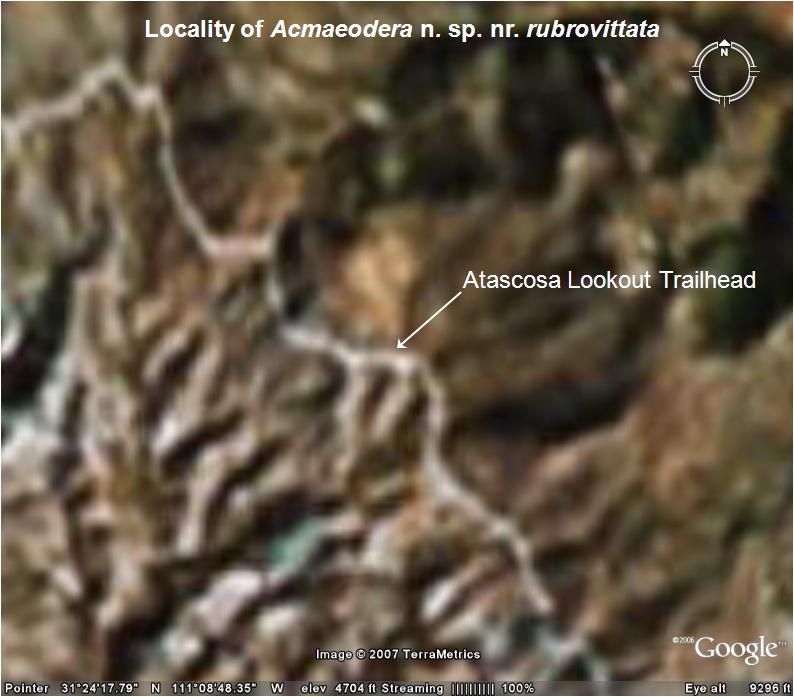
I’ve included a Google Map at left that shows the location of the Atascosa Lookout (#100) Trailhead.  It’s not the best overhead photo, but it does give an idea of the landscape relief and rather precisely pinpoints its location via GPS coordinates in the lower lefthand corner.  If the beetle truly does occur at lower elevations (~4,700′), then it is probably not terribly specific about this particular locality.  Perhaps it is a Mexican species that only occasionally makes it into the U.S. depending on the season. The repeated comments about apparent fire in the area by Paul and Rick suggest potential vegetational differences in the area from the time the beetle was collected compared to their subsequent visits. Although the single specimen was collected on Aloysia flowers, it is also possible that the species does not actually show a particular preference for this plant – although it does seem likely that it visits flowers of some type.  The only way to answer these questions is by finding more specimens!

Copyright © Ted C. MacRae 2010

Add to FacebookAdd to DiggAdd to Del.icio.usAdd to StumbleuponAdd to RedditAdd to BlinklistAdd to TwitterAdd to TechnoratiAdd to Yahoo BuzzAdd to Newsvine

Email to a friend