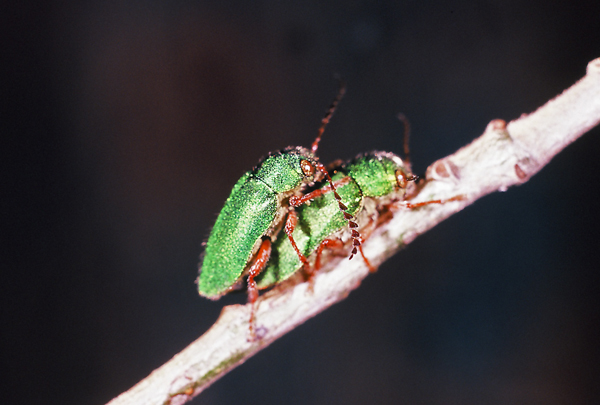
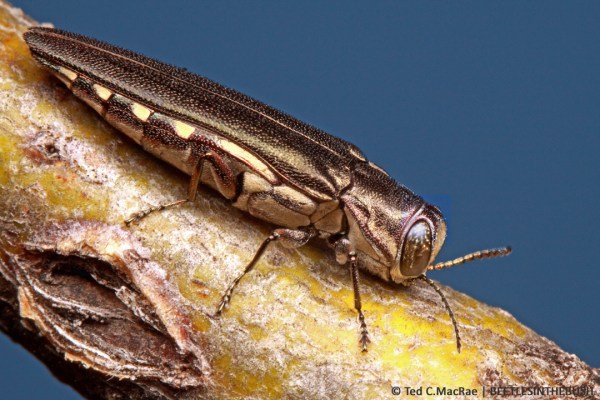
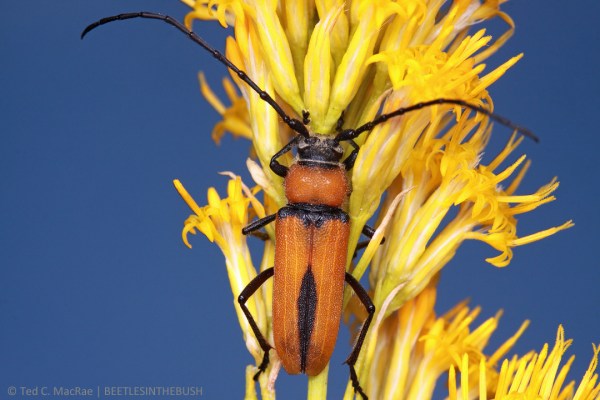
What was that insect?

Yesterday I posted an identification challenge of a different sort. The main subject in the photo was a jewel beetle (family Buprestidae), but there was also another insect in the photo—a small parasitic wasp sitting on the branch below the beetle. Some of you saw it—Charley Eiseman was the first and correctly guessed it was a member of the family Encyrtidae, earning 5 pts, and Wikispecies editor gets 5 pts for further identifying it as a member of the genus Metaphycus. Honestly, I took several shots of the beetle and never saw the wasp until I examined the photograph during processing. I’m not certain, but I think the small object next to the wasp could be a scale insect (family Coccidae), which are known hosts of Metaphycus spp.

Of course, there is still the jewel beetle, and it wouldn’t be fair for me to award points for the wasp but not the beetle. Heath gets 5 pts for first identifying the beetle in the genus Agrilus; however, nobody was able to identify the species as A. granulatus—commonly associated with cottonwood and poplar (Populus spp.) across North America. Since Charley was the only person to mention both the beetle and the wasp, I’m going to give him a tie-breaking bonus point and declare him the challenge winner.

Populations of A. granulatus have been assigned to several subspecies—the beetle shown here (photographed June 2013 at Beaver Dunes, Oklahoma) represents the nominate form—restricted to the U.S. east of the Rocky Mountains, where it breeds in native eastern cottonwoods (P. deltoides) and introduced Lombardy poplars (P. nigra var. ‘Italica’). Agrilus granulatus is often confused in collections with A. quadriguttatus, but that species is associated with willow (Salix spp.) and can be further distinguished by the less dense pubescence of the lower face not obscuring the surface; the pronotum with the lateral margins evenly rounded and not strongly sinuate at the base, the median channel less distinct, and the lateral depressions scarcely pubescent; and the elytra more gradually narrowed posteriorly with the tips more acutely rounded and more coarsely serrulate and the pubescent spots less distinct (Fisher 1928).

Here are a few more photographs of the jewel beetle (without the wasp):

Agrilus granulatus granulatus on Populus deltoides | Beaver Dunes, Oklahoma
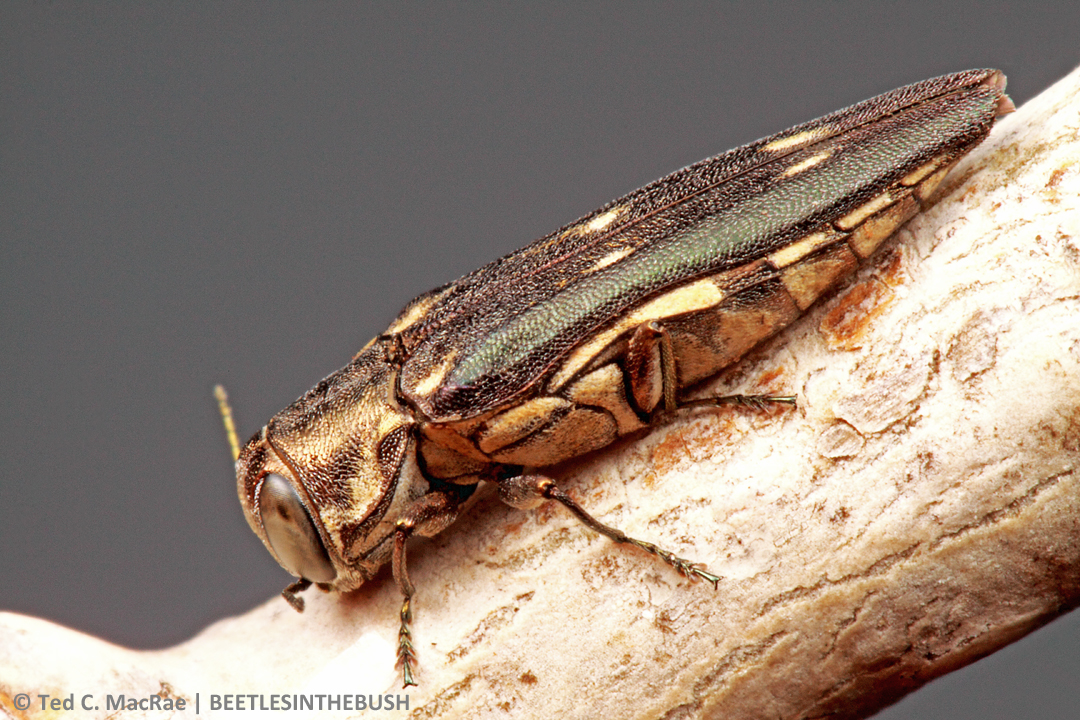
Agrilus granulatus granulatus on Populus deltoides | Beaver Dunes, Oklahoma
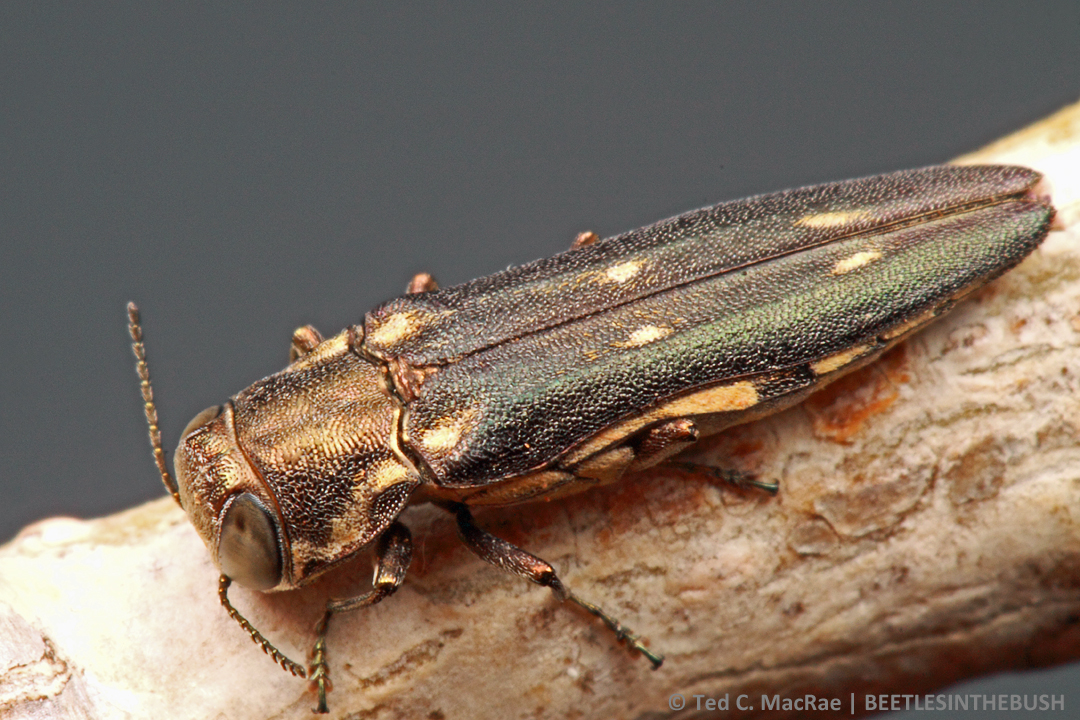
Agrilus granulatus granulatus on Populus deltoides | Beaver Dunes, Oklahoma

Agrilus granulatus granulatus on Populus deltoides | Beaver Dunes, Oklahoma

Agrilus granulatus granulatus on Populus deltoides | Beaver Dunes, Oklahoma

Agrilus granulatus granulatus on Populus deltoides | Beaver Dunes, Oklahoma

REFERENCE:

Fisher, W. S.  1928. A revision of the North American species of buprestid beetles belonging to the genus Agrilus.  U. S. National Museum 145, 347 pp.

Copyright © Ted C. MacRae 2014

Beetles by Chuck

A few months before his passing last August, Chuck Bellamy asked me if I was would like to have his photographic slide collection. I was, of course, deeply honored by this request, for in addition to becoming one of the most prolific students ever of jewel beetles, Chuck had for years photographed live adult beetles in the field and major type specimen holdings such as those at The Natural History Museum in London and the Muséum national d’histoire naturelle in Paris. As uncomfortable as it was discussing with him matters related to his impending mortality, I also knew that it was important to him that his slides end up in the hands of someone who would appreciate their great scientific value and, hopefully, make them available to the larger community of jewel beetle enthusiasts. A few weeks after he passed, three large, white, cardboard boxes showed up at my office—each one containing six or seven portfolio box binders with several hundred slides.

Chuck will be honored in an upcoming issue of The Coleopterists Bulletin. In addition to personal remembrances and a suite of papers describing new species of beetles named after him, the issue will feature some of Chuck’s best live adult images scanned from slides in the collection that I received. Choosing the photos was not easy, but I eventually narrowed down to 15 that I thought best represented the taxonomic diversity of jewel beetles, ranked them from most to least favorite, sent scanned images to fellow buprestophile Rick Westcott for him to do likewise, and tallied the combined rankings to determine the final selections. Six of the photos will appear on a plate within the issue, and a seventh will appear on the cover. I won’t spoil the surprise here by revealing what species were selected. Rather, I’ll just whet appetites by posting the photos that were not selected (despite which I think you’ll agree that they are still good photos).

Julodis chevrolati Laporte | Sep 2000, W. Springbok, Schaaprivier, Northern Cape Prov., RSA.

Julodis chevrolati Laporte | Sep 2000, W. Springbok, Schaaprivier, Northern Cape Prov., RSA.

Acmaeodera (s. str.) griffithi Fall | Apr 2001, Mohawk Valley, Yuma Co., Arizona, USA.

Acmaeodera (s. str.) griffithi Fall | Apr 2001, Mohawk Valley, Yuma Co., Arizona, USA.

Polycesta (Arizonica) aruensis Obenberger | Apr 2001, Frink Springs, Imperial Co., California, USA.

Polycesta (Arizonica) aruensis Obenberger | Apr 2001, Frink Springs, Imperial Co., California, USA.

Evides pubiventris  (Laporte & Gory) | Jan 1999, Geelhoutbosch, Northern [Limpopo] Prov., RSA.

Evides pubiventris (Laporte & Gory) | Jan 1999, Geelhoutbosch, Northern [Limpopo] Prov., RSA.

Castiarina klugii (Gory & Laporte) | Australia.

Castiarina klugii (Gory & Laporte) | Australia.

Temognatha chalcodera (Thomson) | Western Australia.

Temognatha chalcodera (Thomson) | Western Australia.

Sphaerobothris (s. str.) platti (Cazier) | 1998,  E. Jacumba, San Diego Co., California, USA.

Sphaerobothris (s. str.) platti (Cazier) | 1998, E. Jacumba, San Diego Co., California, USA.

Dystaxia elegans Fall | 1998, Warner Springs, San Diego Co., California, USA.

Dystaxia elegans Fall | 1998, Warner Springs, San Diego Co., California, USA.

Copyright © Ted C. MacRae 2014, photos by Charles L. Bellamy

Review of North American Chalcophora

The latest issue of The Coleopterists Bulletin arrived in my mailbox recently, and among the several papers of interest to me is a review of the North American species of the jewel beetle genus Chalcophora¹ (family Buprestidae). This genus contains some of the largest jewel beetles in North America and, due to their surface sculpturing and strict association with pine trees, are commonly referred to as “sculptured pine borers.” Four of the five species occur in the eastern U.S. and Canada, while only one, C. angulicollis, is found in the western states and provinces.

¹ I’d be interested to know how people pronounce this name. I’ve always pronounced it “kal-koh-FOR-uh”, but I’ve heard others use “kal-KAW-for-uh” or even “chal-KAW-for-uh.”

The review, authored by Crystal Maier and Mike Ivie at Montana State University, should put to rest a long-standing debate on the validity of the single western species. The four eastern species are distinct and easily distinguished from each other by virtue of color, presence/absence of ridges on the front legs, presence/absence of spines at the elytral apices, and, of course, male genitalia. Chalcophora angulicollis, on the other hand, has drifted in and out of synonymy under C. virginiensis, the most widespread of the four eastern species. The most recent changes in status were Bright (1987), who regarded C. angulicollis a synonym and treated all Canadian populations as C. virginiensis, followed by Nelson et al. (2008), who reinstated the former as a valid species. Neither of these actions were supported by any discussion of characters or detailed justification.

Chalcophora spp. (Maier & Ivie 2013)

Figs. 1–5. Chalcophora species, habitus. 1) C. virginiensis, Arkansas; 2) C. angulicollis, Idaho; 3) C. liberta, Wisconsin; 4) C. georgiana, Florida; 5) C. fortis, New York. Source: Maier & Ivie (2013).

My impression has always been that the two species are distinct, and I have maintained specimens separately in my collection despite Bright’s synonymy. Chalcophora angulicollis always seemed to me a little more cupreous in coloration and a little more robust. I know that these are weak characters, and they can easily be a result of geographical variability within a species. However, considering the wide and nearly complete disjunction between the distributions of these two species across the nearly treeless Great Plains, it seemed to me prudent to consider them distinct until conclusively proven otherwise. I was therefore pleased to find out that my suspicions were correct when I visited Mike Ivie in Bozeman, Montana this past summer and learned of this manuscript in progress. Mike and his graduate student Crystal had found a morphological difference in the mouthparts that consistently distinguished the two species—C. angulicollis with the penultimate maxillary palpomere flattened and relatively shorter, while in C. virginiensis this structure is cylindrical and relatively longer. Correlated with these structural differences in the mouthparts are the relatively wider male genitalia of C. angulicollis (<3.3 times as long as wide, versus >3.9 times as long as wide for C. virginiensis) and its weakly serrate to crenulate posterolateral elytral margin (weakly to strongly serrate in C. virginiensis).

In addition to reevaluating the status of C. angulicollis and C. virginiensis, the paper provides high quality images of the dorsal habitus (see figure above), elytral apices, and male genitalia for all five North American species, a revised key to the species, and an updated distribution map showing locality/state records for the two aforementioned species in the context of forest cover in North America. Type material also was examined for all species, each of which is redescribed and annotated with abbreviated taxonomic synonymy (complete synonymies are available in other recent publications), notes on variation, comparisons with other species, and recorded hosts and distributions.

REFERENCE:

Bright, D. E. 1987. The Metallic Wood-Boring Beetles of Canada and Alaska. Coleóptera. Buprestidae. The Insects and Arachnids of Canada, Part 15. Agriculture Canada Publication 1810, NRC Research Press, Ottawa, 335 pp. [pdf].

Maier, C. A. & M. A. Ivie. 2013. Reevaluation of Chalcophora angulicollis (LeConte) and Chalcophora virginiensis (Drury) with a review and key to the North American species of Chalcophora Dejean (Coleoptera: Buprestidae). The Coleopterists Bulletin 67(4):457–469 [abstract].

Nelson, G. H., G. C. Walters, Jr., R. D. Haines, & C. L. Bellamy.  2008.  A Catalogue and Bibliography of the Buprestoidea of American North of Mexico.  Coleopterists Society Special Publication No. 4, The Coleopterists Society, North Potomac, Maryland, 274 pp. [description].

Copyright © Ted C. MacRae 2014

Hooray for iStock—I finally have an ID for my photo

I was all set to make a “One-Shot Wednesday” post today, but sometimes big news strikes and plans must change. The news today was in the form of a random tweet by Alex Wild:

iStock-caption_Wild-20131120

The link in the tweet led me to the following photo on iStock by Getty:

bedbug has captured worm

I was stunned—the photo depicted a scene almost identical to one that I had photographed back in September while visiting soybean fields in Louisiana. For two months I sat on the photo with no idea what I was looking at, but now thanks to Alex I have my answer! Compare the above photo with mine below, and you’ll see that everything matches perfectly—I had photographed a “bedbug” that had captured a “worm”!

Podisus maculiventris preying on Chrysodeixis includens larva

bedbug captures a worm

I considered myself to be fortunate, because there was not just one but two different subjects in the photo, and both of them matched perfectly with the subjects shown in the iStock photo. Gotta love the internet—nowadays names for even the most hard-to-identify bugs are just a click away if you know where to look!

</snark>

Of course, the aggressor in both photos is not a “bedbug” [sic for “bed bug”] (order Hemiptera, family Cimicidae) but a stink bug (family Pentatomidae), specifically Podisus maculiventris, or “spined soldier bug”—perhaps the most common predatory stink bug in North Amerca and ranging from Mexico and parts of the West Indies north through the U.S. into Canada. It is a well-known predator of crop pests and, as such, has been imported to several other countries as part of classical biological control efforts. As for the “worm,” in my photo it is a late-instar larva of Chrysodeixis includens, or “soybean looper, and while I haven’t been able to identify the exact species in the iStock photo it is definitely a lepidopteran caterpillar that appears to related to if not in the same family as the soybean looper (Noctuidae). Now, I concede that “worm” is sometimes used for lepidopteran larvae, but one must also concede that in it’s broadest sense “worm” can refer to members of several disparate phyla such as Nematoda (roundworms), Platyhelminthes (flatworms), or Annelida (segmented worms).

This case, of course, just screams for application of the Taxonomy Fail Index (TFI), which scales the amount of error in a taxonomic identification in absolute time against the error of misidentifying a human with a chimpanzee—our closest taxonomic relative. For example, when TFI = 1 the error is of the same magnitude as mistaking a human for a chimp, while  TFI > 1 is a more egregious error and TFI < 1 a more forgivable one. In the case shown here, one must go back to the common ancestor that eventually gave rise to all of the worm phyla and noctuid moths (~937.5 mya). In addition, since there are two subjects in the photo, one must also go back to the divergence of the main hemipteran groups that contain bed bugs and stink bugs (mid-Triassic, ~227.5 mya). This results a whopping 1.165 billion total years of divergence between the identifications assigned to the subjects in the iStock photo and their actual identity. Assuming that chimps and humans diverged approximately 7.5 mya, this gives a TFI for the iStock photo of 155! I haven’t searched thoroughly to determine whether this is a record for the highest TFI in a single photo, but surely it is a strong contender!

Copyright © Ted C. MacRae 2013

Honey Locust Borer

Agrilus difficilis | Beaver Dunes State Park, Beaver Co., Oklahoma

Agrilus difficilis | Beaver Dunes State Park, Beaver Co., Oklahoma

Conditions for collecting didn’t look very promising when I awoke on Day 4 of my early June trip to northwestern Oklahoma. After collecting at Alabaster Caverns State Park the previous day, I had traveled a few hours further west during the evening with plans to collect at Beaver Dunes State Park the following morning. However, heavy rain during the night and lingering sprinkles during the morning had me thinking it might be a lost day. By noon, however, the rain had completely abated, and though the sky still hung low and gray I decided I had nothing to lose by at least trying. I knew quickly that I’d made the right decision, as within minutes of arriving at the park I began seeing jewel beetles (family Buprestidae) landing on my beating sheet. Hackberry (Celtis sp.) was abundant along the roadways and supporting great numbers of individuals in the genera Chrysobothris and Agrilus.

This species is associated almost exclusively with honey locust (Gleditsia triacanthos).

This species is associated almost exclusively with honey locust (Gleditsia triacanthos).

By the time I reached the back end of the campground, I’d collected rather large series of the hackberry associates when I noticed a dying honey locust (Gleditsia triacanthos) tree in one of the campsites. Honey locust (and fabaceous trees, in general) is favored by several species of jewel beetles—at least a dozen species have been recorded in the literature reared from its branches, and another dozen species have been collected on it as adults. As a result, when jewel beetles are active it’s always a good bet that some will be found on honey locust when present, especially if the trees are stressed or dying. I walked up to the tree—a fairly large one—and scanned the lower branches overhead to see if I could notice any activity. I did not, but I nevertheless placed my beating sheet underneath one of the branches, gave the branch a quick “whack” with the handle of my net, and lowered the beating sheet to have a look. To my surprise, I saw at least 50 adults of the jewel beetle species, Agrilus difficilis, sitting on the beating sheet. Because of the cloudy conditions and cool, moist air, the beetles were not very active and did not immediately zip off the beating sheet as they would have had the day been sunnier and warmer, so I was able to rather easily collect a decent series of the beetles without any trouble. I had never seen the beetles so numerous, however, so I continued to beat a few more branches—each yielding just as many adults as the previous. I was astonished by the fact that the beetles were so abundant on the branch, yet I had not seen them even when I specifically looked for the presence of jewel beetles in the branches prior to beating them. Taking another look at the branches, I was able to visually detect just a few individuals, and those only with great difficulty, until I pulled the branch down and was able to look at it up close.

Relatively large size, coppery-purple color without spots on the elytra, and the presence of lateral white patches distinguish this species.

Large size, coppery color, no spots on elytra, and presence of lateral white patches distinguish this species.

Honey locust became a rather popular landscape ornamental tree in the eastern U.S. after the development of thornless cultivars, and while at first the tree seemed to be relatively free of insect pests, A, difficilis has proven to be one of several insects that have adapted to these landscape plants and occasionally cause economic damage. Trees in urban landscapes are often planted in suboptimal sites and suffer from stress to a much greater degree than their native counterparts, and the beetles take advantage of the lowered defensive capabilities of these stressed trees to gain entry. Larvae mine beneath the bark and damage the cambium layer, interfering with movement of water and nutrients. Trees in later stages of attack usually exhibit branch dieback and D-shaped holes in the trunk and main branches where adults have emerged from the tree. In severe cases infestation by this species can result in death of the tree. As mentioned above, there are twelve other species of jewel beetles that have been reared from the wood of honey locust. All of these have been reared only from dead wood rather than living trees, but adults of these species might, nevertheless, be encountered on living trees. They include three species (A. egeniformisA. fallax, and A. pseudofallax) that might be confused with A. difficilis; however, the latter is easily distinguished from these and other congeners by its relatively large size, coppery color with purple luster, absence of any spots or pubescent lines on the elytra, and distinctive patches of white pubescence along the sides. As with most wood boring beetles, chemical control of the adults or larvae is usually not feasible once an infestation has already begun—the best method to avoid infestations in landscape trees is proper site selection and optimal care to prevent stress that reduces the ability of the tree to fend off attack.

Copyright © Ted C. MacRae 2013

GBCT Beetle #5: Crossidius coralinus monoensis

Crossidius coralinus monoensis (male) | Mono Co., California

Crossidius coralinus monoensis (male) | Mono Co., California

After spending the first four days of our Great Basin Collecting Trip (GBCT) traveling around west-central Nevada, we dropped down into California and traveled south next to the eastern flank of the Sierra Nevada towards Mono Basin. We had two goals for the day: 1) a very localized population of Crossidius hirtipes known from “Kennedy Meadow” and described originally by Chemsak & Linsley (1959) as C. rhodopus flavescens but transferred to a subspecies of C. hirtipes in their revision of the genus (Linsley & Chemsak 1961), and 2) the stunningly beautiful C. coralinus monoensis! Before reaching the first destination, we were temporarily distracted by the inviting shores of Topaz Lake just after crossing the Nevada/California state line, where we found only a few extremely wary Cicindela oregona oregona darting across its muddy banks. We then spent a good portion of the day in a futile attempt to find C. h. flavescens—one of only two Crossidius subspecies we did not find out of the 16 species/subspecies that we had targeted for the trip. Our failure to find this subspecies was largely a consequence of going to “Kennedy Meadows” in Tuolumne Co. rather than “Kennedy Meadow” further to the south in Tulare Co.! (Note to self: pay attention not only to the name of the locality but also the county!)

Crossidius coralinus monoensis (female) | Mono Co., California

Crossidius coralinus monoensis (female) | Mono Co., California

As a consequence of the day’s distractions and diversions, we didn’t arrive at the C. coralinus monoensis locality until quite late in the day. Fortunately, we were looking for a C. coralinus subspecies rather than a C. hirtipes subspecies, as the latter seem to have the habit of retreating down from the flower heads of their host plants starting around 5 p.m. and not coming back up until mid-morning the following day. Crossidius coralinus subspecies, on the other hand, seem to stay put on the flower heads through the night, perhaps burying themselves inside the flower heads but not retreating down from the plant. As a result, they may still be found during the late afternoon and early evening hours. Because of this, we still had a chance of finding them (if they were there) despite our late arrival, and only a few minutes passed before I found a male (first photo) on flowers of gray rabbitbrush (Ericameria nauseosa). The appearance was so strikingly different that I wasn’t even sure what I had found at first—I knew it wasn’t a C. hirtipes subspecies, but the bright orange coloration and relatively smaller size were quite different from the larger, red/black C. coralinus subspecies that I had seen to that point. Once I found a female, however (second photo), I realized that we had found C. coralinus monoensis.

Mono Basin near Mammoth Lakes (7000 ft)—locality for Crossidius coralinus monoensis

Mono Basin near Mammoth Lakes (7000 ft)—locality for Crossidius coralinus monoensis

This subspecies is immediately distinguishable from the C. c. temprans we were collecting further north in Nevada (and, in fact, most other C. coralinus subspecies) by its bright orange rather than dark red coloration. We found only a handful of individuals (as we did two days later when we passed by the site again), and their average size was considerably smaller than the former as well. The subspecies does greatly resemble C. c. caeruleipennis, found still further south at much lower elevations in Owen’s Valley (and a target for the following day) but differs by its smaller average size and presence of distinctly expanded black elytral markings and apical and basal black pronotal bands.

REFERENCES:

Chemsak, J. A. & E. G. Linsley. 1959. Descriptions of some new Cerambycidae from Mexico and southwestern United States. Journal of the Kansas Entomological Society 32(3):111–114 [preview].

Linsley, E. G. & J. A. Chemsak. 1961. A distributional and taxonomic study of the genus Crossidius (Coleoptera, Cerambycidae). Miscellaneous Publications of the Entomological Society of America 3(2):25–64 + 3 color plates.

Copyright © Ted C. MacRae 2013

The Festive Tiger Beetle in Southeast Missouri

Cicindela scutellaris lecontei x s. unicolor

Cicindela scutellaris lecontei x scutellaris unicolor (male) | Holly Ridge Conservation Area, Missouri

This past spring I returned to the lowlands of southeastern Missouri in an effort to find and photograph a population of tiger beetles that seems to be unique to the area. The beetles represent Cicindela scutellaris (Festive Tiger Beetle), a widespread species that is common in dry sand habitats across the central and eastern U.S. It is also one of North America’s most polytopic species, with populations in the Great Plains, eastern U.S., Atlantic Coast, southeastern Coastal Plain, and several isolated populations on the western and southwestern peripheries of the species’ range of distribution recognized as distinct subspecies. In Missouri the species is known only from the extreme northwestern, northeastern, and southeastern corners of the state. In all of these areas the populations are found on alluvial sand deposits associated with the Missouri and Mississippi Rivers. Additional sand deposits are found in the areas between these three widely disjunct areas, but curiously the species has not yet been found in them, despite the presence of other species that occupy these same habitats such as Cicindela formosa (Big Sand Tiger Beetle).

Cicindela scutellaris lecontei x s. unicolor

Cicindela scutellaris lecontei x scutellaris unicolor (male) | Holly Ridge Conservation Area, Missouri

The populations in northern Missouri fall well within the distributional range of subspecies C. s. lecontei and are readily assignable to that taxon based on their wine-red coloration and well developed elytral markings. The population in southeastern Missouri, however, cannot be assigned either to that subspecies or to the more southern subspecies C. s. unicolor, which occurs along the southeastern U.S. Coastal Plain and is characterized by solid green coloration and no elytral markings. Individuals from southeastern Missouri are typically green, as in C. s. unicolor, but usually exhibit a distinct wine overtone from C. s. lecontei that varies greatly in its degree of development. Like C. s. lecontei, the elytra are usually marked, but never as strongly as in C. s. lecontei and sometimes not at all (as in C. s. unicolor). The two individuals shown in these photos represent the typical condition—wine blushing and elytral markings only moderately developed; however, more extreme examples can be seen in photos from fall 2008 and spring 2009 (taken during my “point-and-shoot” days, which explains my desire to photograph these beetles again). The intergradation of characters, their variable development, and the apparent presence of a wide disjunction zone between this population and C. s. lecontei to the north suggest to me that it originated from a relatively recent hybridization event between C. s. lecontei and C. s. unicolor—perhaps during the post-glacial hypsithermal that ended some 5,000 years ago.

Cicindela scutellaris lecontei x s. unicolor

Cicindela scutellaris lecontei x scutellaris unicolor (female) | Sand Prairie Conservation Area, Missouri

While I am happier with these photos than I am with those taken earlier, they don’t represent either the full range of variability seen in the population or the most aesthetically pleasing tiger beetle photographs I’ve ever taken. I made two trips to the southeast this past spring, and on each trip I was successful in finding and photographing only a single, very skittish individual—one on a sandy trail through upland forest (Holly Ridge Conservation Area) and the other along the margin of a sand blowout in a native sand prairie remnant (Sand Prairie Conservation Area). I’ll try again this coming spring and hopefully will be able to show some better photographs.

p.s. Can you tell the difference in the type of flash diffuser I used between these two trips? If so, which one do you like better?

Copyright © Ted C. MacRae 2013

GBCT Beetle #4—Crossidius hirtipes rubrescens

Crossidius hirtipes rubrescens (male) | Lyon Co., Nevada

Crossidius hirtipes rubrescens (male) | Lyon Co., Nevada

Linsley & Chemsak (1961) characterize the longhorned beetle species Crossidius hirtipes as “probably the most diverse species within the genus.” Occurring throughout the Great Basin and adjacent areas, the variability it expresses in punctation, color, elytral pattern and pubescence have resulted in the recognition of 16 named subspecies and numerous additional distinct but unnamed populations. During our Great Basin Collecting Trip (GBCT) in late August, we targeted ten of the named subspecies (representing the majority of populations found across the southern half of the species’ distribution) and succeeded in finding eight of them. I’ve already featured C. h. immaculatus, occurring across northern Nevada and northeastern California and the first beetle we found on the trip, and the photo above shows a male of what we consider to represent C. h. rubrescens—one of three C. hirtipes subspecies restricted to a very small area in west-central Nevada. Linsley & Chemsak (1961) described this subspecies from a series taken just north of Yearington on Chrysothamnus greenei (now Ericameria greenei), noting that it differs from other subspecies by its pinkish cast to its coloration and its pale appendages.

We almost did not find this subspecies.  We had stopped at several places along the road as we approached Yearington from the north and finally stopped at a spot 2.6 miles north of town with good stands of E. greenei. Although we found a few C. coralinus temprans on the plants, we did not see C. hirtipes. While we were searching we noticed a much smaller yellow-flowering asteraceous plant that at first we thought might be something in the genus Haplopappus but which I now believe represents a variety of Chrysothamnus viscidiflorus—the normal host plant for most subspecies of C. hirtipes (a plant voucher was collected and has been sent off for identification). We searched these plants as well but didn’t see any beetles on them, and after a while we decided we’d given the locality a good enough look and that we should move on. We began walking back towards the car, and as we approached the car I happened to look down and saw a mating pair of C. hirtipes sitting on a C. viscidiflorus flower. The pair split and bolted right when I saw them, but we managed to capture one of them and decided maybe we should look around a little more. The beetles were scarce, and another hour of searching produced only a handful—mostly in a small area further north of the area we had been searching. We then checked a couple of other nearby spots but found only a few host plants and no beetles, so we decided to go back to the site and search again. While none were seen in the original spot, we found much better stands of the plant in the adjacent area even further to the north and managed to collect a decent though not large series of adults before the setting sun caused the beetles to retreat and end our day. The individual in the photo above (recognizable as a male by its relatively longer antennae and immaculate elytra) was photographed as the setting sun turned the smoke-filled sky to a soft, burnt orange color that nicely compliments the color of the beetle.

REFERENCE:

Linsley, E. G. & J. A. Chemsak. 1961. A distributional and taxonomic study of the genus Crossidius (Coleoptera, Cerambycidae). Miscellaneous Publications of the Entomological Society of America 3(2):25–64 + 3 color plates.

Copyright © Ted C. MacRae 2013