Peek-a-boo

At the end of this past June, the Webster Groves Nature Study Society (WGNSS) Entomology Group gathered at Pinewoods Lake Recreation Area. Nestled deep within the Mark Twain National Forest of the Ozark Highlands in Carter County, Missouri, the area features an idyllic lake surrounded by restored shortleaf pine/scarlet oak forest with a primitive campground and a nature trail that circumnavigates the lake. It has been one of my favorite insect collecting localities since I first discovered it back in the early 1980s and, as such, was an ideal spot bring the WGNSS Entomology Group for one of its monthly summer outings.

The official start of the outing was at noon on Saturday, but I arrived the prior evening to get in an extra night of night collecting, and two other participants (Lisa and Casey) arrived the next morning well before noon. Instead of waiting for others to arrive at the campsite, we decided to walk the nature trail while the temperatures were still (somewhat) moderate. During that walk, a clump of foliose lichen on the leaf of a low plant caught our attention—the clump looking puzzlingly out of place perched atop the leaf, and we wondered how it was remaining in place. A closer look revealed the presence of webbing bridging the gap between the front of the clump and the leaf, and still closer inspection revealed the culprit—a small but very colorful jumping spider that was sitting just behind the strands of webbing.
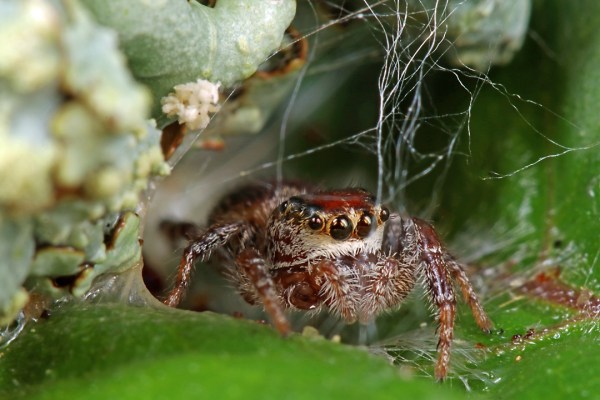
Clearly this is a female who has selected this little niche as a place to lay her eggs and stand guard over them. Maternal care is well known among female jumping spiders, who often create retreats such as this on leaves, under bark, or in crevices where they not only actively guard their egg masses from predators and parasites until the spiderlings hatch, but oftentimes remain with them until they molt and can venture out and fend for themselves.

What’s not clear is the actual identity of this spider. My first impression was possibly Platycryptus undatus (tan jumping spider), but Janelle Riley (@elizarose45) noted on iNaturalist the presence of a distinct red cap above/behind the eyes of this spider that seems to be absent in P. undatus. She further noted the similarity of this individual to images of Eris floridana, especially this one on BugGuide. However, without a good dorsal photograph, a more confident identification may not be possible.

©️ Ted C. MacRae 2026

Summer wildflower photography trick

Buchnera americana (American bluehearts) is a highly conservative (Coefficient of Conservatism = 10) native species that occurs sporadically across southern Missouri on limestone/dolomite glades and prairies. Like many other species in the family Orobanchaceae, the plants are hemiparasitic—i.e., they steal nutrients from the roots of neighboring plants. In Missouri, plants bloom during most of summer and are easily recognized since there are no close lookalikes in the state.

Buchnera americana (American bluehearts).

Photographing native wildflowers in full sun during the middle of summer can be challenging, especially on a wide open glade. High sun washes out colors and creates excessive contrast. Flash can mitigate these issues but results in an unnatural dark background that some may find unappealing. Shading the plant is an alternative solution, but care must be taken in dealing with the background—if the background is also shaded, the flowers may not stand out well. Keeping the background sunny can solve this, but a properly exposed background then results in flowers that look dark and lifeless. What is the solution? Overexpose the background!

In the photo above, I shaded the plant, read the exposure at the base of the plant in Av mode (aperture priority) to determine optimal aperture/shutter settings, then switched to manual mode using those settings and a bit of fill flash. This resulted in nicely exposed, richly saturated flowers. The background, however, was almost completely blown, but rather than competing with the flowers, it let them stand out in dramatic fashion.

Photographed 20 June 2026 at Victoria Glades Conservation Area, Jefferson County. Tip of the hat to my good friend and photographer extraordinaire Casey Galvan, who taught me this trick.

©️ Ted C. MacRae 2026

Thread-legged assassin bug

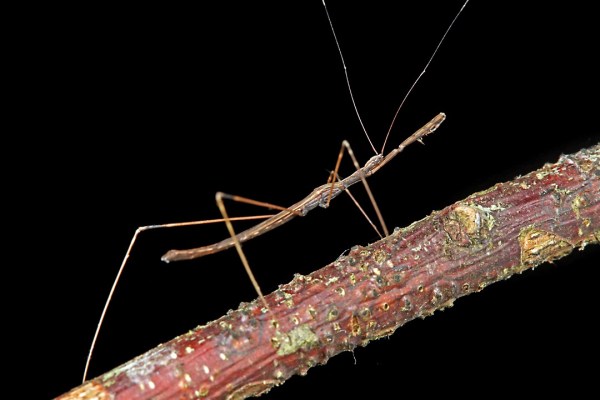
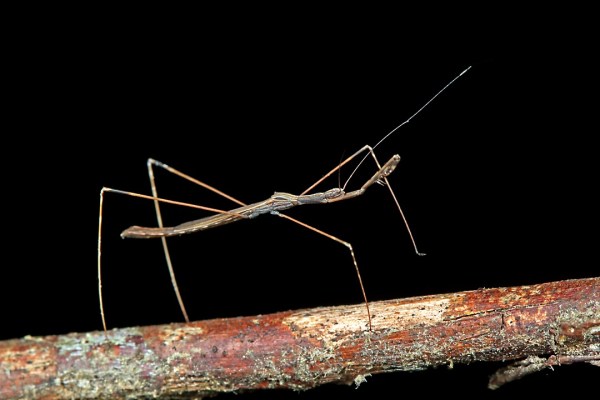
Another of the interesting insects seen by the Webster Groves Nature Study Society (WGNSS) Entomology Group during last June’s outing to Pinewoods Lake Recreation Area in Carter Co., Missouri was Emesaya brevipennis—aptly called the thread-legged assassin bug. Looking like a 3-way cross between a small walkingstick, a skinny mantid, and an elongated cellar spider, it is not closely related to any of them. Instead, it is a “true bug” (order Hemiptera) in the family Reduviidae (assassin bugs). More familiar members of this family include Arilus cristatus (wheel bug) and Triatoma spp. (bloodsucking conenoses).

Truth be told, I don’t recall ever having seen this species before, even though it is distributed widely across much of North America and south all the way to South America (although I have seen similar species out west). This individual showed up at one of our blacklight stations, from which we coaxed it onto a small twig for photographs. Perhaps it has escaped my attention until now due not only to its super slender, gracile build, but also its reportedly furtive habits. Like other assassin bugs, E. brevipennis is a predator of other insects, using its mantid-like “raptorial” front legs to grab the prey before stabbing it with its beak-like mouthparts and injecting digestive enzyme-laden saliva into it. The enzymes reduce the prey innards to a slurry that can be sucked back out through the beak. Unlike other assassin bugs, however, this species is also a bit of a “kleptoparasite” (i.e., food thief), reportedly often hanging out in spider webs and stealing the spider’s prey from right underneath its nose.

I often wonder about the selection pressures that result in fantastical body designs, and the elongate, überthin form of E. brevipennis is no exception. Unlike the walkingsticks’ resemblance to twigs, I think E. brevipennis is too small an insect for such explanation. One can imagine, however, that its kleptoparasitic habits might be a driver—the thinner and less conspicuous it is, the easier it is to steal prey. Perhaps it is not an accident that it also superficially resembles the cellar spiders whose webs they often frequent.

©️ Ted C. MacRae 2026

Emergence of Missouri’s largest cicada

Near the end of June this summer, the Webster Groves Nature Study Society (WGNSS) Entomology Group visited Pinewoods Lake Recreation Area in Carter Co., Missouri for an evening of blacklighting in the shortleaf pine/scarlet oak forests that surround the lake. I have spent many a weekend here since my first visit way back in 1984—in fact, I have probably collected insects here more than any other place on earth outside of Victoria Glades (Jefferson Co., south of St. Louis). Of the many insects we saw during the outing, the emergence of Missouri’s largest cicada—Megatibicen grossus (northern dusk-singing cicada, formerly known as Tibicen auletes)—was among the most interesting.

We had heard the distinctive song of the males as dusk settled over the campground, but it wasn’t until after nightfall that we began to see the large, chunky nymphs crawling up the trunks of trees in preparation for emergence. Their size alone was sufficient to distinguish them from two other cicada species that were also singing in the area—the slightly smaller Neotibicen lyricen (lyric cicada), and the much smaller Neocicada hieroglyphica (hieroglyphic cicada).

Megatibicen grossus (northern dusk-singing cicada) mature nymphs ready to emerge.

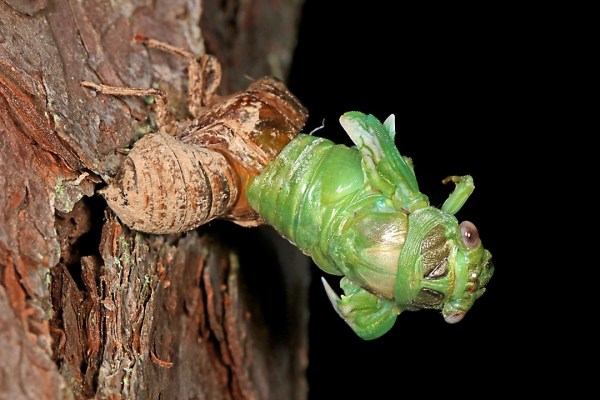
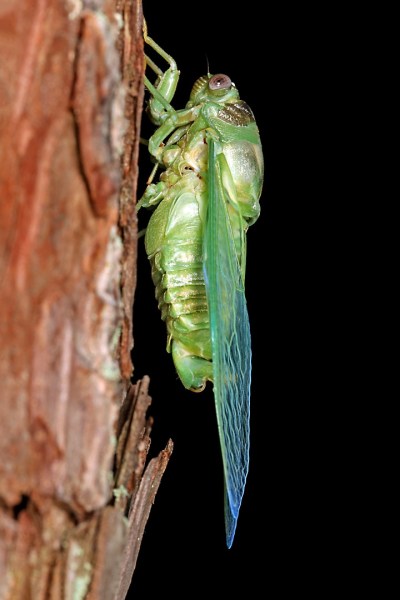
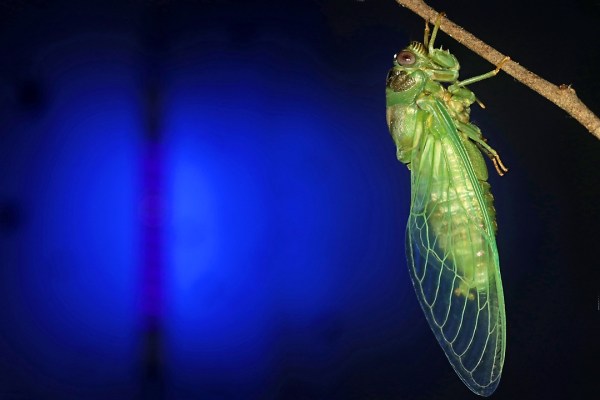
As we watched one particular individual begin the process of emergence, we were surprised to see the newly emerging adult was fluorescent lime green in color! As it slowly inched its way out of its exuvia, it leaned ever more backward until it freed itself completely and then hung itself vertically to allow the body to harden—a process that would take several hours!

Adults are fluorescent lime green when the first emerge.
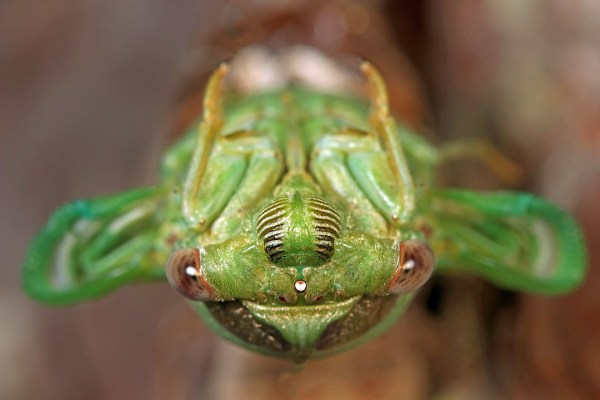
Face to face with an emerging adult!
Once fully expanded, the wings are held flat.
The lime green veins are beautiful against the blackness of the night.
Eventually, the wings are held in their more normal roof-like position.
An ultraviolet light glows softly in the background.

Interestingly, adults of the other two species I mentioned above (N. lyricen and N. hieroglyphica) visited our blacklights, but N. grossus did not. Conversely, the only nymphs we saw emerging were N. grossus. We watched this individual until well into the wee hours of the morning, then allowed it to “hang out” in our tent for the rest of the night while its body hardened and took on its normal color. The next morning, we placed the now hardened adult—a fine male—on the trunk of a pine tree, where it cooperated with us fully while we photographed it.

Megatibicen grossus ~10 hours post-emergence. The adult body has hardened and taken on its more normal, somber coloration.

©️ Ted C. MacRae 2026

🐛 Digrammia continuata

Caterpillars of Digrammia continuata (curve-lined angle—family Geometridae) feed on plants in the family Cupressaceae (e.g., Chamaecyparis, Hesperocyparis, Juniperus, etc.) across North America and are colored to blend in perfectly with the foliage of their hosts. Adult moths also display a cryptic pattern of brown and gray transverse lines to blend seamlessly into bark and dead leaves when resting during the day. The caterpillar shown here was beaten from Juniperus virginiana (eastern red-cedar) during a Webster Groves Nature Study Society (WGNSS) Nature Photography Group outing at Victoria Glades Conservation Area in Jefferson Co., Missouri on 20 June 2026.

Digrammia continuata (curve-lined angle) on Juniperus virginiana (eastern red-cedar).

©️ Ted C. MacRae