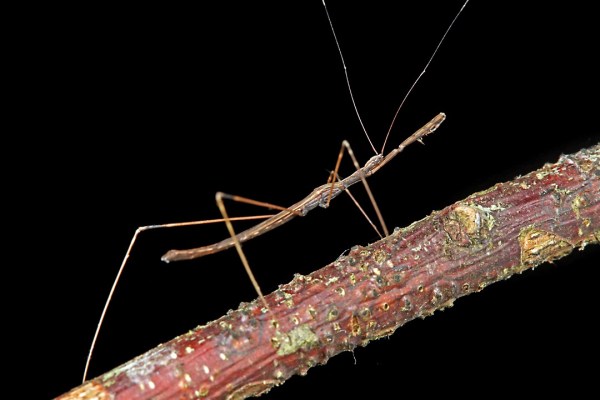
Another of the interesting insects seen by the Webster Groves Nature Study Society (WGNSS) Entomology Group during last June’s outing to Pinewoods Lake Recreation Area in Carter Co., Missouri was Emesaya brevipennis—aptly called the thread-legged assassin bug. Looking like a 3-way cross between a small walkingstick, a skinny mantid, and an elongated cellar spider, it is not closely related to any of them. Instead, it is a “true bug” (order Hemiptera) in the family Reduviidae (assassin bugs). More familiar members of this family include Arilus cristatus (wheel bug) and Triatoma spp. (bloodsucking conenoses).

Truth be told, I don’t recall ever having seen this species before, even though it is distributed widely across much of North America and south all the way to South America (although I have seen similar species out west). This individual showed up at one of our blacklight stations, from which we coaxed it onto a small twig for photographs. Perhaps it has escaped my attention until now due not only to its super slender, gracile build, but also its reportedly furtive habits. Like other assassin bugs, E. brevipennis is a predator of other insects, using its mantid-like “raptorial” front legs to grab the prey before stabbing it with its beak-like mouthparts and injecting digestive enzyme-laden saliva into it. The enzymes reduce the prey innards to a slurry that can be sucked back out through the beak. Unlike other assassin bugs, however, this species is also a bit of a “kleptoparasite” (i.e., food thief), reportedly often hanging out in spider webs and stealing the spider’s prey from right underneath its nose.
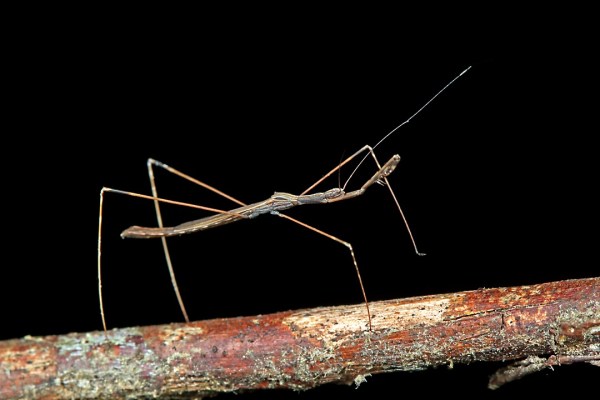
I often wonder about the selection pressures that result in fantastical body designs, and the elongate, überthin form of E. brevipennis is no exception. Unlike the walkingsticks’ resemblance to twigs, I think E. brevipennis is too small an insect for such explanation. One can imagine, however, that its kleptoparasitic habits might be a driver—the thinner and less conspicuous it is, the easier it is to steal prey. Perhaps it is not an accident that it also superficially resembles the cellar spiders whose webs they often frequent.
©️ Ted C. MacRae 2026

