Answer to Super Crop Challenge #2

I was hoping that Super Crop Challenge #2 would prove a little more difficult than the first one, but first responder Troy Bartlett quickly sniffed out the correct answer – the top part of the abdomen of the marmorated orb weaver, Araneus marmoreus.  As the first correct responder he earns bonus points.  Dennis also came up with the same answer after temporarily being led astray, and Colton got it right as well (once he realized the challenge was here and not over on FaceBook).  I might be justified if I deducted points for misspellings in the genus and common names (if there is any field unforgiving of spelling errors, it’s taxonomy); however, I’m watching a Christmas movie with my family and am feeling the holiday spirit.  That spirit extends to Dave as well, who earns pity points for refusing to believe that I would offer consecutive spider challenges (actually the first Super Crop Challenge was an opilionid, but the ID challenge before that was another spider, making this the third straight arachnid challenge I’ve posted – it wasn’t by design).

The crop I used for this challenge was taken from the above photo – not the best of the series, but it had the most symmetrical view of the dorsal abdominal pattern that some think looks like a face.  This is just one of many color variations exhibited by this most variable of North American spiders – see this BugGuide page for a pictorial summary of the extraordinary amount of variation found in this species.

My friend Rich and I encountered this individual – a female – in an upland oak/hickory forest while hiking the lower North Fork Section of the Ozark Trail in extreme southern Missouri.  These spiders normally hide in a retreat during the day (usually a curled leaf) and spin a new web at night – I’m not sure why she was out during the day, as it didn’t appear she was recycling the web, tattered and torn and probably still remaining from the previous evening.  When I first approached, I accidentally brushed against one of the support lines, which sent her scampering up into her retreat.  I figured “tapping” on the leaf might cause her to drop back out – Rich was skeptical, but after a few taps, the spider not only dropped out but obligingly went right back down to the center of the web and stayed in place long enough for me to get a few shots of the ventral surface.  (I couldn’t suppress a smug chuckle as Rich muttered in exasperated disbelief!)  Moving around to the other side disturbed the spider again, and she once again took refuge in her retreat.  This time, rather than fight it, I carefully uncurled the leaf that formed her retreat, working gingerly to avoid disturbing her, and took a series of photos of her attractive dorsal surface as she sat in the retreat.

Photo Details: Canon 50D w/ 100mm macro lens (ISO 100, 1/200 sec, f/16), Canon MT-24EX flash w/ Sto-Fen + GFPuffer diffusers. Typical post-processing (levels, minor cropping, unsharp mask, etc.).

Copyright © Ted C. MacRae 2010

Super Crop Challenge #2

Super Crop Challenge #1 appeared not to be too difficult – let’s see if this one is any harder. This is a straight up ID challenge, more points for greater specificity. To narrow things down a bit, the photograph from which this portion was cropped was taken during October in southern Missouri.

Copyright © Ted C. MacRae 2010

Tiny little slivers of life

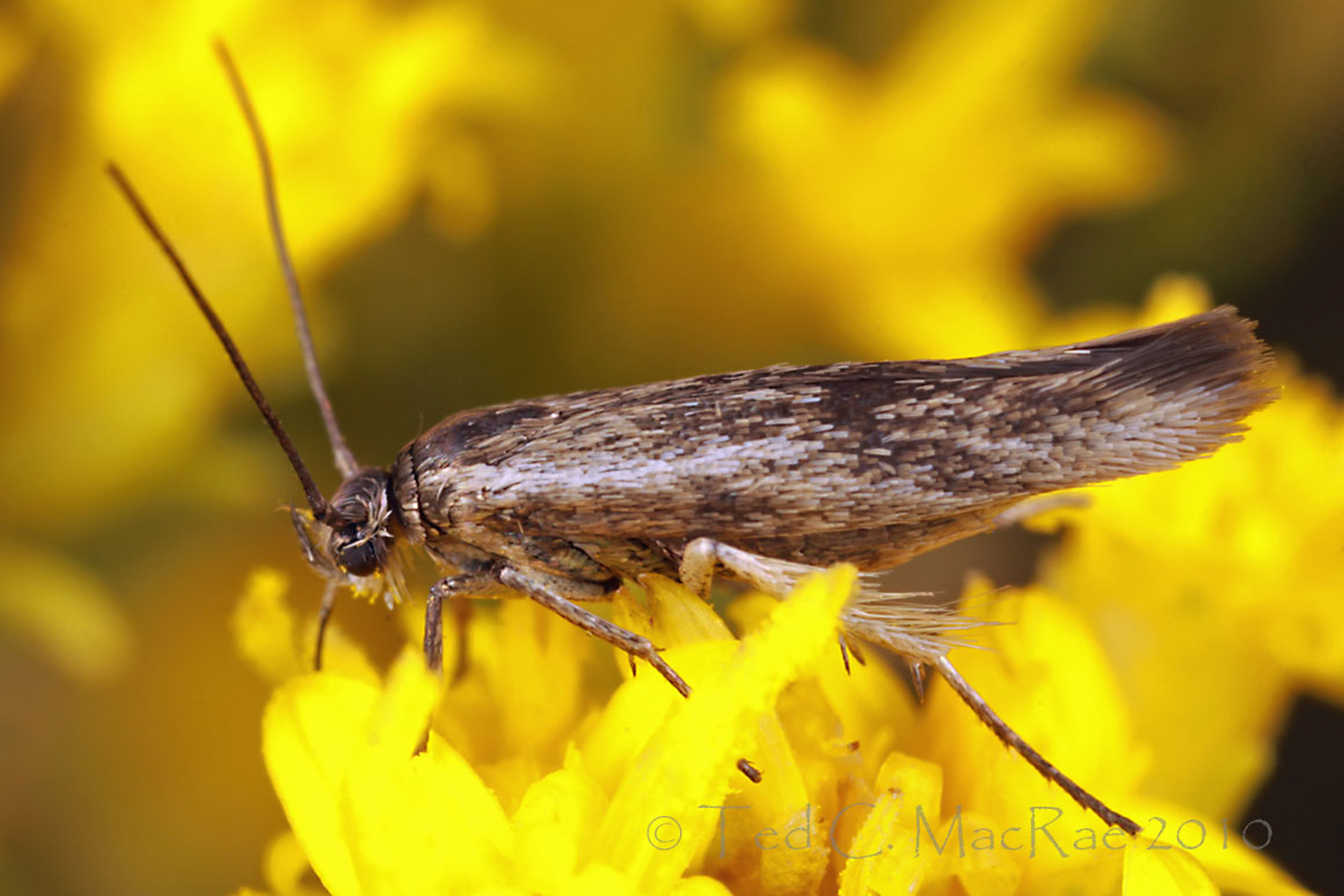
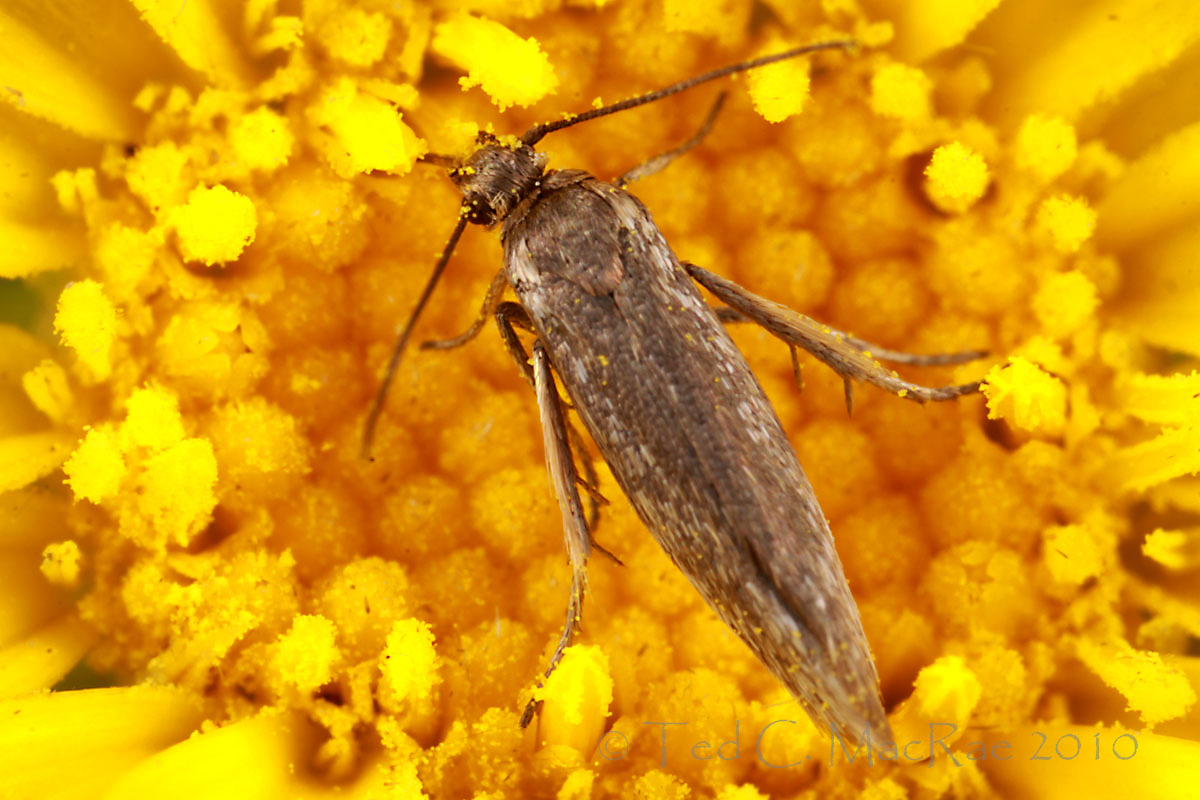
Day 1 of the 2010 Fall Tiger Beetle Trip™ had been an unqualified success.  Not only did we achieve our top goal of the trip – seeing good numbers of the recently discovered South Dakota population of Cicindela pulchra (beautiful tiger beetle), but we also saw C. nebraskana (prairie long-lipped tiger beetle) and a variety of other interesting insects in the nearby Nebraska Pine Ridge.  For Day 2, our destination was Monroe Canyon on the north face of the Pine Ridge escarpment, but on the way there we decided to check out some roadside clay banks in the town of Crawford.  Despite their appearance as perfect tiger beetle habitat, all we saw was a single individual of the normally ubiquitous C. purpurea audubonii (Audubon’s tiger beetle).  The area looked quite dry, and in fact there was little insect life of any kind present… or so I thought.  As I stood there looking out onto the embankment while deciding my next move, I glanced down at a nearby composit shrub with small yellow flowers.  These are often attractive to a variety of beetles (Crossidius longhorned beetles would be nice!), but I saw none.  I started to move on, but before I did I noticed some tiny little slivers of life moving about on the flowers.  Kneeling down to take a closer look, I saw that they were moths – in fact, they were some of the smallest moths that I had ever seen, and the shrub was covered with them.  Now, I may pride myself on my broad-based entomology knowledge, but when it comes to microlepidopterans there is a decided gap in that knowledge.  I really had no idea what they might be, but for some reason the combination of their unknown identity and tiny size became for me an irresistible photographic challenge (made truly challenging by the unrelenting prairie wind).  I’m fortunate that Chris also became distracted photographing something – any other collecting partner surely would have grown impatient waiting for me to finally be satisfied I’d gotten some good shots.

As far as I can tell, these moths represent something in the genus Scythris or perhaps Neoscythris.  These are the so-called flower moths, placed either in the family Scythrididae (Microleps.org and Moth Photographers Group) or subfamily Scythridinae of the Xylorictidae (BugGuide.net and Tree of Life).  According to Microleps.org, the life histories of relatively few scythridid species have been determined – the few that have showing a preference for feeding (usually internally, e.g., as leaf miners) on members of the Asteraceae.  There are images of several species of Scythrididae at the aforementioned sites; however, it’s a large group, and the individuals in these photos don’t appear to match any of the illustrated species.  Perhaps Chris Grinter or some other microlepidopterophile will chance upon this post and either confirm or further elucidate the identity of these individuals. 

Photo Details: Canon 50D w/ MP-E 65mm 1-5X macro lens (ISO 100, 1/250 sec, f/13), Canon MT-24EX flash w/ Sto-Fen + GFPuffer diffusers. Typical post-processing (levels, minor cropping, unsharp mask).

Copyright © Ted C. MacRae 2010

Kirby’s Tiger Beetle

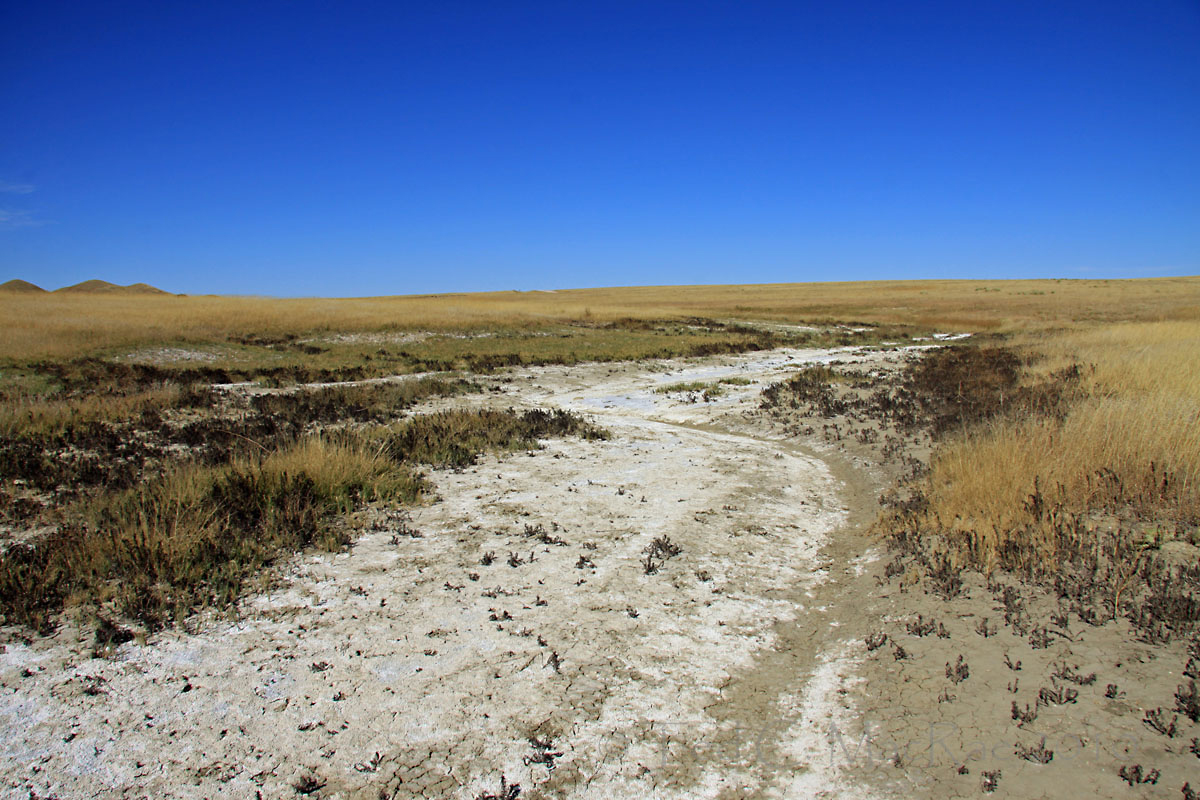
Dry alkaline creek in the Oglala National Grasslands, Sioux Co., Nebraska

At the northern edge of the Pine Ridge in northwestern Nebraska, the land drops precipitously from verdant High Plains to the eerie Badlands below.  The sterile landscape of eroded slopes and irregularly shaped landforms is at once beautiful and harsh.  Short grasses and silver sagebrush seem to be the only plants capable of living here, providing the meagerest of forage for the mule deer and pronghorn antelopes that dot the gently rolling hills.  Dissecting these arid grasslands are a series of seasonally dry alkaline creeks that support a number of tiger beetle species.  The most interesting of these is Cicindela fulgida fulgida (crimson saltflat tiger beetle), a beautifully colored little species that is restricted to wet, alkaline habitats.  It was this species that I and colleagues Chris Brown and Matt Brust wanted to see when we stopped by one such creek after finishing up at the C. pulchra site in South Dakota (and still recovering from “pulchra-fever”).

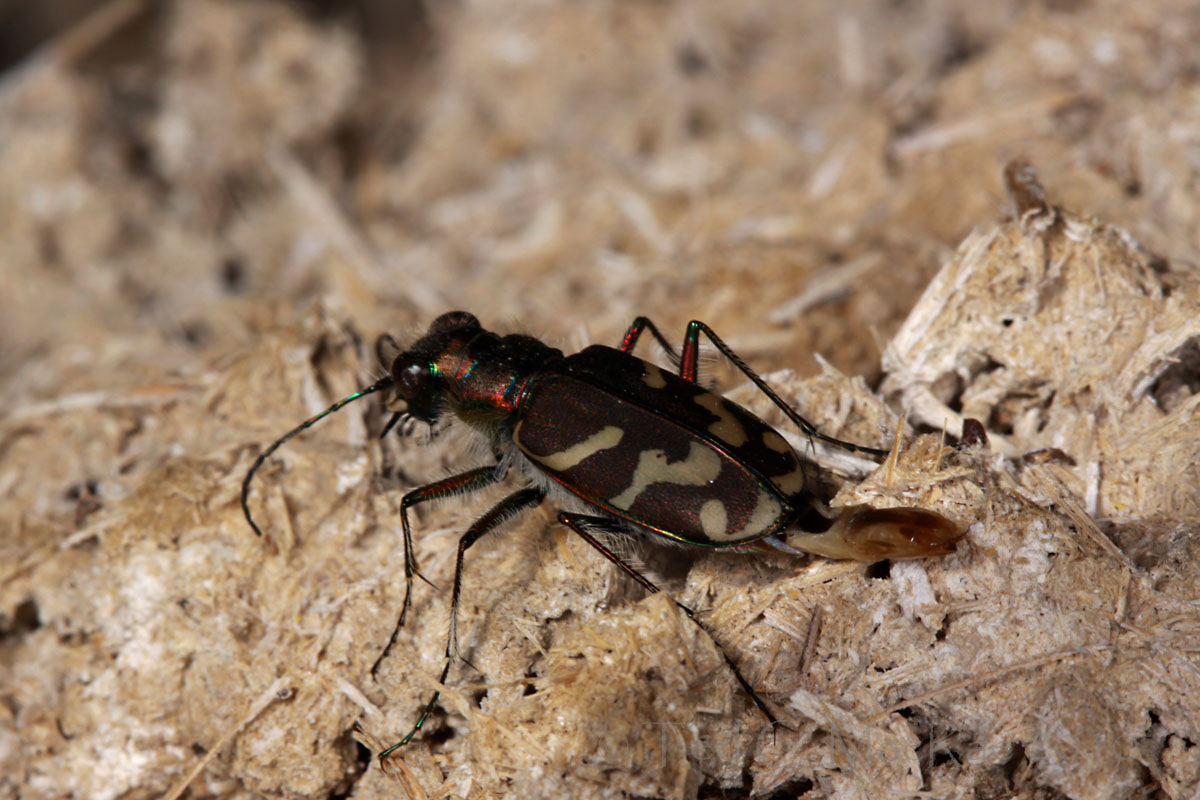
Cicindela tranquebarica kirbyi - Kirby's tiger beetle

I had been to this spot two years before and encountered a small number of C. fulgida along with much higher numbers of C. purpurea audubonii (Audubon’s tiger beetle) and C. tranquebarica kirbyi (Kirby’s tiger beetle).  Our luck wasn’t any better this time, and in fact we would encounter only a single C. fulgida that day.  This was Chris’ first opportunity to photograph this species, while I had already gotten some reasonably good field photos of the species during my 2009 visit to Salt Plains National Wildlife Refuge in northwestern Oklahoma.  As he photographed the individual, I continuing scanning the bright, alkaline barrens.  While I was not finding any C. fulgida, I was seeing a fair number of C. tranquebarica kirbyi, and it occurred to me that I still lacked good field photographs of this species.  I began stalking different individuals, but in the heat of the day I found it impossible to get close enough to any of them to attempt any shots.  It wasn’t until I encountered the individual shown above, apparently dragging something from its rear end, that I was able to close in for some shots.  A closer look revealed the individual to be a male who had somehow gotten his genital capsule pulled out of his abdomen.  Just the thought of how this might have happened makes me cringe.  At any rate, the individual exhibits the relatively broader white maculations that distinguish this Great Plains/Rocky Mountain subspecies from the more eastern nominotypical subspecies.

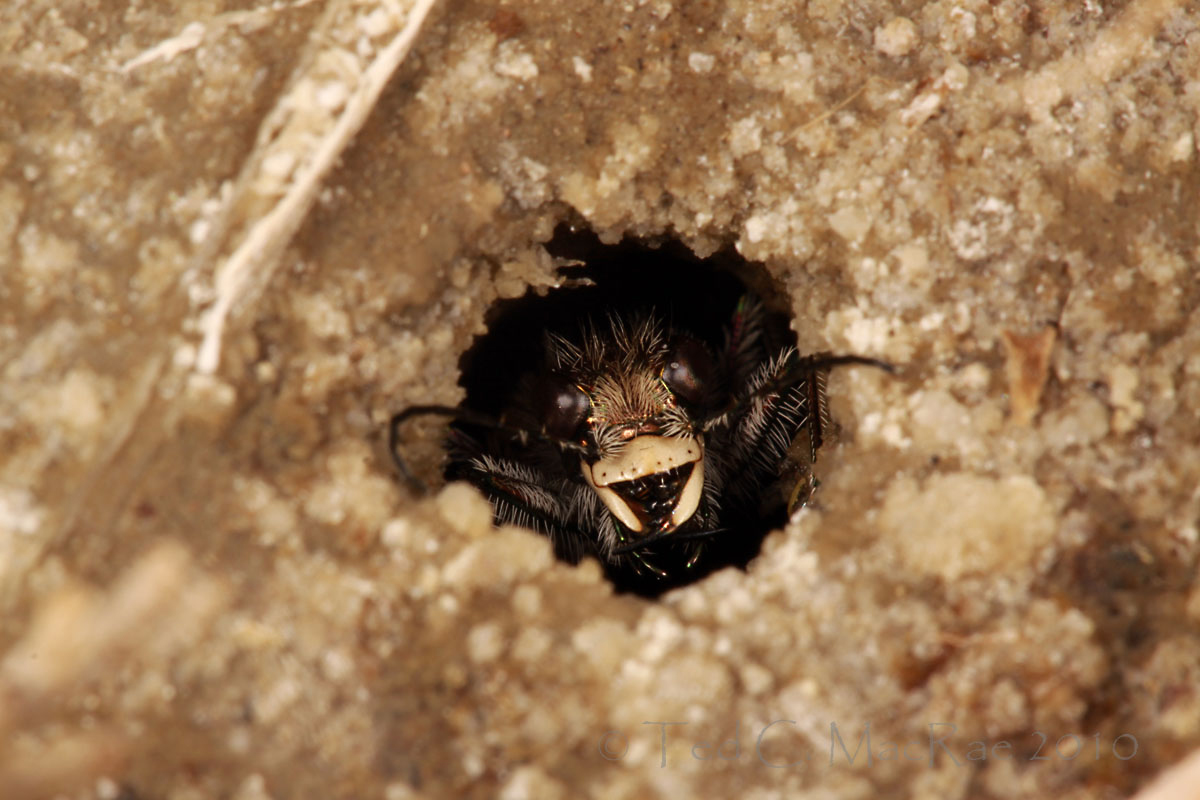
A newly emerged Kirby's tiger beetle sits at the entrance of his burrow.

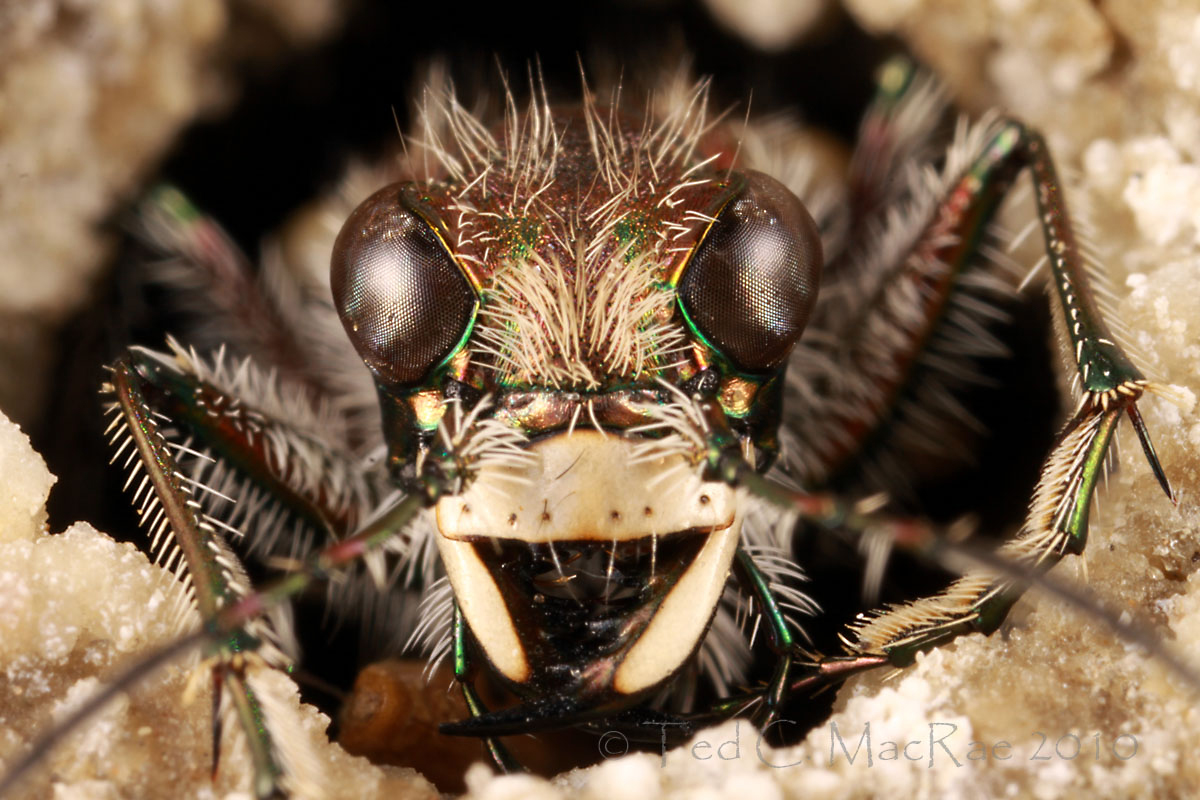
As I continued scanning the soil, I noticed a number of larval burrows of what I took to be this species located up near the edge of the vegetated zone.  One burrow in particular caught my attention – partly because of its slightly larger size and irregular outline, but also because there appeared to be something sitting within it.  A closer look revealed an adult tiger beetle sitting just below the burrow entrance.  Cicindela tranquebarica is a so-called “spring-fall” species that emerges initially in the fall as a sexually immature adult before digging back in for the winter and re-emerging in spring for mating and oviposition.  I thus took this individual to be a newly emerged male that had not yet decided to leave its burrow and burst forth into a life of adulthood.  The opportunity couldn’t be passed up – I took a few photos of him sitting there, then switched out the 100mm lens for the 65mm 1-5X lens.  I had to get real close for this last shot, which caused him to retreat somewhat in his burrow.  However, a knife thrust into the burrow below him, followed by careful twisting until it touched his rear, caused him to return to the burrow entrance and once again pause before embracing his new world.

A male Kirby's tiger beetle prepares to leave his emergence burrow.

Copyright © Ted C. MacRae 2010

Litaneutria minor – agile ground mantid

Litaneutria minor - agile ground mantid

Have you ever seen a mantid that lives exclusively on the ground?  Most mantids are ambush predators, hiding amongst the bushes while patiently waiting for unsuspecting prey to happen within striking range.  However, a few small groups of mantids have adopted a different strategy – running down their prey!  One such group is the ground mantids, represented in the U.S. by two genera – Litaneutria and Yersiniops.  These small mantids, cryptically colored brown or gray, occur in desert and grassland habitats across the western U.S.  This particular individual was seen in the expansive shortgrass prairie atop the Pine Ridge in northwestern Nebraska.  The rounded eyes and brown coloration identify it as as a member of the genus Litaneutria (the tops of the eyes are pointed in Yersiniops, giving them a “horned” appearance, and they tend to be more gray).  Two species of Litaneutria are found in the U.S. – this one, L. minor, occurring broadly throughout the Great Plains and western U.S. into southwestern Canada (it is Canada’s only native mantid), while a second species, L. obscura, is restricted to the desert southwest.¹  Several common names have been applied to L. minor, including lesser ground mantid, minor ground mantid, and agile ground mantid.  While the first two represent more precise literal translations of the scientific name, I like the latter which well describes the ability of these mantids to hop over rocks and dart swiftly through sparse prairie vegetation in pursuit of prey or to evade predators (and inexperienced collectors!).  Despite its small size (total length less than 1.5″), the presence of wings – albeit small – indicate this is an adult. All females of this species are brachypterous (short-winged), but most males are as well.  However, males apparently have a small spot at the base of the forewings, which seems lacking in this individual, and a smoother pronotum – also not readily apparent in this individual, so I’m guessing that this is an adult female. 

¹ BugGuide and many other web sources list five additional U.S. species in the genus (including L. borealis, described from northwestern Nebraska).  However, Vickery and Kevan (1983) note that these were all synonymized under L. minor by Hebard in 1935 (sorry – I couldn’t find that reference).

“Mantid” vs. “mantis” vs. “praying mantis.”  It has become common to use the terms “mantid” and “mantis” (or even “praying mantis”) interchangeably.  However, in its strictest sense the term “mantis” is most properly applied to species of the genus Mantis – of which Mantis religiosa – the European mantid or praying mantis, introduced to the U.S. in the late 19th century (either accidentally on a shipment of nursery plants or deliberately for pest control – depending on the source) is the most widely recognized.  The term “mantid” refers to any species in the suborder Mantodea as a whole.

Carnivorous cockroaches!  When I was in college back in the late 1970s, mantids and most other “orthopteroid” insects had long been considered suborders of a single order, the Orthoptera.  Around that time began a great dismantling of the Orthoptera, pared down to only the grasshoppers, crickets, and katydids while the other former suborders (mantids, walkingsticks, cockroaches, etc.) were raised to full order status.  The walkingsticks (Phasmida), grylloblattids (Grylloblattodea), and gladiators (Mantophasmatodea) all continue to enjoy their elevated status (Tree of Life Web Project 2003); however, a close relationship has been established between the mantids, cockroaches, and termites² (Kristensen 1991), resulting in the sinking of all three former orders into a single order, the Dictyoptera (Tree of Life Web Project 2002) (and not to be confused with the lycid beetle genus Dictyoptera).  Mantids, thus, can be considered derived cockroaches with morphological specializations for predation!

² Long accorded an order of their own – the Isoptera, recent molecular phylogenetic studies have placed termites not only with the cockroaches, but within them (Ware et al. 2008).  Just as mantids can be considered cockroaches that evolved as predators, termites can be considered cockroaches that evolved to eat wood (with the help of cellulose-digesting gut symbionts)!

Photo Details: Canon 50D w/ MP-E 65mm 1-5X macro lens (ISO 100, 1/250 sec, f/13), Canon MT-24EX flash w/ Sto-Fen + GFPuffer diffusers. Typical post-processing (levels, minor cropping, unsharp mask).

REFERENCES:

Kristensen, N. P. 1991. Phylogeny of extant hexapods. Pp. 125–140 in Insects of Australia: A Textbook for Students and Research Workers. Volume I and II. Second Edition. I. D. Naumann, P. B. Carne, J. F. Lawrence, E. S. Nielsen, J. P. Spradberry, R. W. Taylor, M. J. Whitten and M. J. Littlejohn eds. Carlton, Victoria, Melbourne University Press.

Tree of Life Web Project. 2002. Dictyoptera. Version 01 January 2002 (temporary). http://tolweb.org/Dictyoptera/8253/2002.01.01 in The Tree of Life Web Project, http://tolweb.org/

Tree of Life Web Project. 2003. Neoptera. Version 01 January 2003 (under construction). http://tolweb.org/Neoptera/8267/2003.01.01 in The Tree of Life Web Project, http://tolweb.org/

Vickery, V. R. and D. K. M. Kevan. 1983. A monograph of the orthopteroid insects of Canada and adjacent regions. Lyman Entomological Museum and Research Laboratory Memoir 13:216–237.

Ware, J. L., J. Litman, K.-D. Klass, and L. A. Spearman. 2008. Relationships among the major lineages of Dictyoptera: the effect of outgroup selection on dictyopteran tree topology. Systematic Entomology 33(3):429–450.

Copyright © Ted C. MacRae 2010

3rd Blogoversary, 7 New Blogs, & AIF #10

Today happens to be BitB’s 3rd blogoversary.  I won’t bore you with an attempt at witty, insightful introspection on what it means to have reached this modest milestone.  BitB is still what it started out as – tales from my life-long, entomocentric, natural history learning experience.  I’ve enjoyed these past three years immensely, learned far more than I would have initially imagined, and deeply appreciate the support and encouragement I’ve received from an admireably erudite readership.

Rather than talk on about myself, however, I’d like to talk about others.  I’m always on the lookout for new blogs – those that seem interesting make the blogroll, and if I find their content compelling enough they make my RSS feed list.  A few rise to the top due to their superior photography, insightful writing, or close alignment with my own interests – these I like to feature from time to time by name in an occasional post such as this one.  Following is the latest crop of new sites (or at least new to me) that have piqued my interest:

Crooked Beak Workshop is written by coleopterist Delbert la Rue, Research Associate at the Entomology Research Museum, University of California, Riverside.  I can forgive his primary interest in Pleocomidae (rain beetles) and other scarabaeoid taxa due to his strong side interests in Cicindelidae (tiger beetles), Buprestidae (jewel beetles), and ecology of sand dune ecosystems.  Posts occur irregularly, but when they do appear they are good old-fashioned hardcore coleopteran taxonomy and desert southwest ecology – what could be better?

Field Notes is a herpetology website by Bryan D. Hughes.  “Spectacular” does not even begin to describe his photographs, focused heavily on the marvelous diversity of venomous snakes and other reptiles in the desert southwest (and the occasional desert arachnid as well).  Bryan hopes his pictures and information will help homeowners who choose to live in areas harboring native wildlife become interested in it rather than kill it due to fear and myth – I hope he succeeds!

Gardening with Binoculars is a fairly new site by my good friend and fellow WGNSS member Anne McCormack.  Anne is a true “naturalist’s naturalist,” with solid knowledge that spans the breadth of Missouri’s flora and fauna – both vertebrate and invertebrate.  In GWB, Anne uses this knowledge and her considerable writing talents to weave informative and entertaining tales of her experiences with wildlife in a small native plant garden.  I can almost hear the campfire crackling in the background!

Natural History Museum Beetle blog is a new blog by Beulah Garner, one of the curators of Coleoptera in the Entomology department at The Natural History Museum in London (I am sooo jealous!).  With only two posts under her belt so far, it might be premature to give the site such quick praise; however, I couldn’t resist – the 2nd post had photos of tiger beetles!  Regardless, working amongst more than 9 million insects (did I mention I’m jealous?) should provide plenty of fodder for future posts.

The Atavism is written by David Winter, a PhD student in evolutionary genetics in New Zealand.  Wide ranging in his interests, it is his  series that has captured my interest (and while “spineless” across much of the blogosphere means squishy marine animals, David’s spinelessness is more to my liking – i.e., arthropod-heavy).  Moreover, in true academic fashion, David usually finds an unusual angle from which to discuss his subjects.

The Prairie Ecologist. Chris Helzer is an ecologist for The Nature Conservancy in Nebraska whose writings demonstrate deep, intimate understanding of the prairie landscape and its myriad biotic interactions, as well as the passion that many of us here in the heartland feel when looking out on its vast expanses.  As if that wasn’t enough, Chris is also one of the rare bloggers who combines his well-crafted writing with truly spectacular photography – he’s the total package!

The Sam Wells Bug Page is written by – you guessed it – Sam Wells.  This is a straight up entomology site, featuring a diversity of insects from that wonderful state called California.  You won’t find these insects anywhere else on the web, and though it is (to my liking) heavy on the beetles, a variety of other insect groups are featured as well.  What’s more, each post almost always contains fabulous photos of that remarkable California landscape.  Each post is a little mini-collecting trip – I get a little homesick for the Sierra Nevada every time I read!


One final note – Heath Blackmon at Coleopterists Corner has posted the tenth edition of An Inordinate Fondness.  This was Heath’s first blog carnival hosting gig (could there have been any more appropriate?), but you wouldn’t know it by looking – 14 coleocontributions artfully presented, each with a teaser photo and just enough text to invite further clicking.  Head on over to AIF #10 and enjoy elytral ecstasy at its finest (and don’t forget to tip the waiter!).

Copyright © Ted C. MacRae 2010

Answer to Super Crop Challenge #1

Seemingly correct answers came quickly to yesterday’s inaugural Super Crop Challenge, which featured a curious structure atop a harvestman (class Arachnida, order Opiliones) that I encountered while hiking the lower North Fork Section of the Ozark Trail in extreme southern Missouri. “Seemingly” I say, because even though some points were earned, others remained left on the table – the organism was rightly recognized as a harvestman, and the structure in the photo does indeed contain the ocelli (or eyes).  However, nobody actually named the structure itself (see update below) – the ocularium (ocular or optical tubercle would also have been accepted).  Hey, I’m pedantic and proud!

As near as I can tell, this individual belongs to the genus Leiobunum (family Sclerosomatidae).  Species in this genus are notoriously difficult to identify; however, the super long legs, dark dorsal stripe, pointed abdomen, and very long palps with “knees” that extend dorsally to a level well above the ocularium suggest a male L. vittatum or one of its close relatives (Schulz 2010). Leiobunum vittatum is a common inhabitant of wooded habitats across the eastern U.S.

I took this shot with an MP-E 65mm macro lens at about 2.5X. The short working distance of the lens at this level of magnification makes it difficult to photograph these longer-legged species in lateral profile due to their habit of “waving” their especially elongate 2nd pair of legs in the air as pseudo-antennae – one touch of any part of the camera sends them scampering. I chased this guy back and forth across a downed tree trunk for some time before I finally got lucky when it encountered some prey (note the long structure extending down from the mouth area – I believe it is the antenna of a tiny, nymphal blattodean) and became distracted just long enough for me to close in and fire off a couple of close shots. He was actually closer to the underside of the log, so when I took this photo I was leaning far over the log with the camera almost upside-down!

Okay – Art earns points for being the first to identify it as a harvestman, while Geek snaps rare duplicate ID points for using the order’s scientific name (no complaining – scientific names will always get points on this blog).  Art, Aniruddha, and Geek also get half-points for mentioning (in order of correctness) eye, ocelli (technically more correct, but wrong plurality), and ocellus (yes, only one is visible – did I mention my pedantic tendencies?).  However, I’m going to declare arachnologist and Opiliones specialist Chris as the winner of this round for his impressive display of generic-level identification based on the meagerest of evidence!

Update 11/22, 11:00 a.m. – actually, Chris did name this structure in an email sent to my office address while the comments box was unchecked and, thus, earns a clean sweep of this challenge.

Photo Details: Canon 50D w/ MP-E 65mm 1-5X macro lens (ISO 100, 1/250 sec, f/13), Canon MT-24EX flash w/ Sto-Fen + GFPuffer diffusers. Typical post-processing (levels, minor cropping, unsharp mask).

REFERENCE:

Schulz, J. W. 2010. The Harvestmen of Maryland (accessed 20 November 2010).

Copyright © Ted C. MacRae 2010

Super Crop Challenge #1

ID quizzes and challenges seem to have become an increasingly popular subject for natural history blogs. I’ve done a few of my own, but my straight up ID challenges are starting to seem a little unimaginative compared to the DNA sequence, crypsis, mimicry, taxonomy fail, and other challenges being offered up by bug blogdom’s more creative types. To step it up a notch, I offer the first Super Crop Challenge. Small structures that we take for granted within a larger context often take on alien qualities when viewed in isolation. Can you identify this structure and the organism that possesses it?


Copyright © Ted C. MacRae 2010