How to pack and ship pinned insect specimens

Even though I don’t work in a museum, sending and receiving pinned insects is a routine activity for me. As a collector of beetles with some expertise in their identification, I’ve had opportunity to exchange with or provide IDs to other collectors from around the world. Of course, the extreme fragility of dried, pinned insect specimens makes them vulnerable to damage during shipment, especially when shipped overseas. While properly labeled, pinned insect specimens have no monetary value, the scientific information they represent is priceless, and every attempt should be made to protect them from damage during shipment. Sadly, despite our best efforts damage is sometimes unavoidable, as even packages marked “Fragile” can be subject to rough or careless handling. More often than not, however, I have received shipments in which the contents suffered damage that could have been avoided had the sender paid more attention to packing the shipment in a manner that gave it the best possible chance of arriving safely. Here I offer some general tips on the best way to pack and ship pinned insect specimens for shipment. While these remarks are broadly applicable to pinned insects in general, they are given from the perspective of a someone who collects beetles—specimens of which are relatively small to moderate in size, hard-bodied, and compact in form. Insects from other groups, especially those with large, fragile species such as Lepidoptera and Orthoptera, may require additional precautions to minimize the risk of damage.

  1. Select a sturdy specimen box with a firm pinning bottom. The size of the box should be selected appropriate for the number of specimens—i.e., do not select a large box for only a few specimens or tightly pack too many specimens in too small a box,  Modern polyethylene foams used in pinning trays seem sufficiently firm to hold pinned specimens during shipment as long as they are at least ¼” thick—thicker foams, of course, will hold even more firmly but often “push” the labels on the pinned specimens up against each other, necessitating additional labor to reset them. The box should have a tight-fitting lid that can be set firmly in place. Pin the specimens into the box, making sure the pins are set completely through the foam and taking care not to overpack the specimens within the box too tightly (body parts, especially antennae and tarsi, should never overlap) that could result in damage to them or adjacent specimens during removal. Ideally the specimens should fill the box completely, but if they do not then fill the empty space with blank pins to avoid large, blank areas of foam bottom without pins. Here is an example of a filled specimen box:

    Pinned insects in specimen box ready for packing.

    Pinned insects in specimen box ready for packing.

  2. Use brace pins for large or heavy specimens. This is one of the most common mistakes I see! In the example above, several of the larger species are surrounded by brace pins to keep them from rotating on their pins and damaging neighboring specimens. At least two pins should be used—I place them against the elytra on each side behind the hind legs, and very long or heavy specimens should be further braced by additional pins on each side of the thorax to further ensure they are fully immobilized. Although not shown in this example, specimens with very heavy heads (large mandibles, etc.) should be even further immobilized with additional pins at the head. Here is a closeup view of some of the specimens in the above box that have been further secured with brace pins:

    Large specimens are further immobilized with brace pins.

    Large specimens are further immobilized with brace pins.

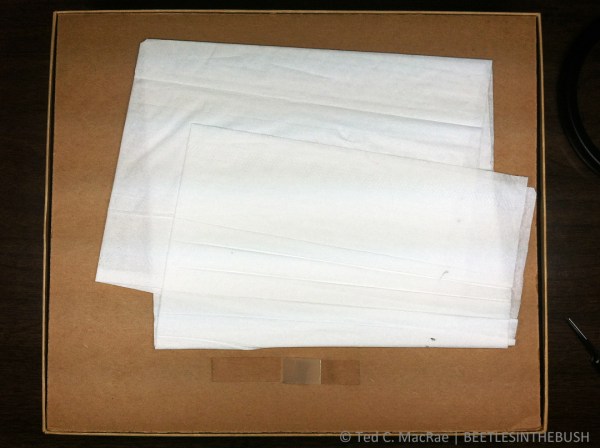
  3. Use an inner lid with padding to hold it firmly against the specimens. An inner lid lies on top of the specimens underneath the specimen box lid to keep the specimens securely seated in the foam and prevent them from “working” their way out. Some specimen boxes designed for shipping, such as the examples shown in these photos, come with an inner lid that is hinged on a long side. If the specimen box lacks an inner lid, one should be fashioned from cardboard or heavy card stock. The advantage of an attached inner lid is that it will not move inside the box, so if an inner lid must be fashioned it is essential to trim it so that it fits precisely within the box to minimize the potential for movement. I like to draw an outline on the cardboard with the specimen box and cut on the lines, then shave off extra material from each side to shape it to the inside perimeter of the box. Either way, make a “pull tab” out of adhesive tape and attach it to the inner lid to allow easy removal during unpacking. If the inner lid when set in place does not seat firmly against the outer lid, extra padding material such as paper towels should be placed on top of the inner lid to ensure that it sits firmly against the specimens when the outer lid is set in place. The specimen box with inner lid in place, pull tab attached, and extra padding placed on top is shown below:

    Cover the inner lid with padding to secure it firmly against the specimens.

    Cover the inner lid with padding to secure it firmly against the specimens.

  4. Seal closed specimen box with tape or rubber bands. The outer lid of the specimen box should be secured in place so that it does not “work” its way loose. Some people use tape, which is effective but must be cut if the box is opened for inspection, leaving the lid unsecured afterwards. I prefer to use sturdy rubber bands, which can be removed for inspection and then easily replaced afterwards. Some specimen boxes come equipped with metal tabs or hoops that fit through slots on the outer lid and that can be bent over to secure the lid in place. In my experience, these often break off after repeated use, so rubber bands or tape are a good insurance policy for such boxes. Another common practice is to wrap specimen boxes in packing paper or place them inside plastic, Zip-Lock bags. This was necessary in the days when excelsior shavings were often used as a packing material around the specimen box, which contained shavings that could work their way into the specimen box and cause damage. With the ready availability of modern packing materials such as foam peanuts there should no longer be any reason to use excelsior shavings. Still, wrapping or sealing inside a plastic bag can’t hurt if it is desired. A closed specimen box with rubber bands securely in place is shown in the photo below:

    Specimen box sealed with rubber bands

    Specimen box sealed with rubber bands

  5. Place an address label on the specimen box. This will ensure that the shipment does not get tossed into the “dead mail” pile if the outer address label is lost or destroyed (I’ve left the label off in these examples to ensure privacy of the recipient).
  6. Secure multiple specimen boxes tightly together. If multiple specimen boxes are shipped together, they should be secured tightly together so that they cannot “bump” into each other during shipment. As mentioned before, tape works but might end up being cut for inspection, so I prefer to use large rubber bands. String can also be used to tie the boxes together, but unless the inspection agent is handy with knots the boxes may not get tied back together. The two specimen boxes included in the shipment I used for this example, secured tightly together, are shown below:

    Multiple boxes should be bound tightly together.

    Multiple boxes should be bound tightly together.

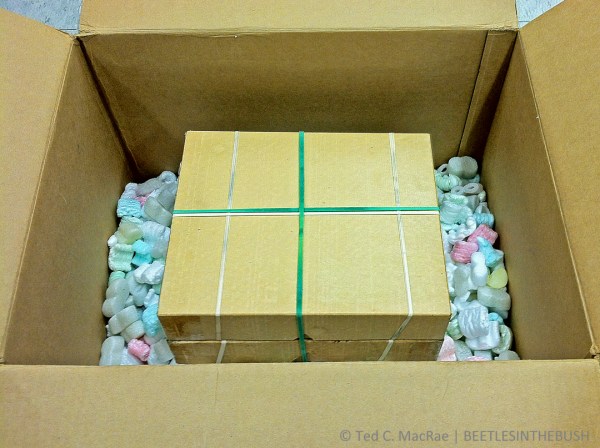
  7. Pack specimen box inside an oversized shipping boxShipping box size selection is critical! The shipping box should not only be sturdy but also big enough to accommodate specimen boxes with at least 3–4 inches below and 2–3 inches on top and each side of the specimen box. This space is necessary to allow the packing material to function not only as cushioning but also in “shock absorption.” My preferred packing material is foam peanuts, since it doesn’t settle during shipment and the amount used can be tailored precisely to the needs of an individual box. The photo below shows the pinning boxes resting on a 4-inch layer of foam peanuts with at least 2–3 inches of space on the sides and above:

    Place specimen boxes inside a sturdy shipping box with plenty of room on all sides.

    Place specimen boxes inside a sturdy shipping box with plenty of room on all sides.

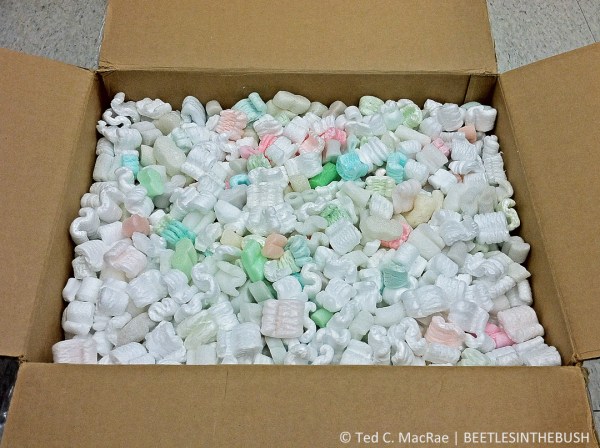
  8. DO NOT OVERPACK! This is the most common mistake people make! The packing material needs to serve two purposes: 1) provide a crush zone to protect from direct damage, and 2) provide shock absorption to protect from damage by impact jarring. The specimen box actually needs to be able to move slightly within the closed shipping box. If it cannot, energy from impacts is transmitted in full to the specimens inside, greatly increasing the risk that heavier body parts (especially the head/pronotum) will be jarred off the specimens. This not only results in damage to the broken specimen, but the dislodged body parts then act as “wrecking balls” that bounce and tumble inside the specimen box, destroying all of the specimens within their reach. After placing a 3–4-inch layer of packing in the bottom of the shipping box, I like to set the specimen box(es) on top of the foam in the center of the shipping box and fill the shipping box with additional foam peanuts to within about 1″ of the top. Avoid the temptation to fill the box to the brim, or to “settle” the foam peanuts and add a few more, as this will result in a tightly packed box that does not protect the specimens as well as a more loosely packed box. To test, close the flaps on top of the box and give the box a light up-and-down “shake”—you should feel the specimen box bounce slightly inside. If it does not, remove a small amount of packing peanuts and repeat the test. If you cannot remove enough packing peanuts without exposing the top of the specimen box inside, your shipping box is too small and you should select a larger size. The photo below shows the shipping box filled with packing peanuts to the proper level:

    Shipping box ''almost'' filled with packing material.

    Shipping box ”almost” filled with packing material.

  9. Label the package “FRAGILE”. Whether this is actually helpful or invites abuse by some passive aggressive handler is a matter of debate, but I am of the opinion that a majority of shipping personnel will actually treat the package with a little more respect if they see this label, especially with the disclosure that the contents are preserved insects with no commercial but extreme scientific value. Additionally, disclosure of such information may actually be required by some destination countries, so it’s a good idea to label packages as a matter of routine practice. I like to place one label on top of the shipping box and additional labels on all four sides. BioQuip Products sells moisture-activated adhesive labels as shown below, or similar labels can be designed in a word processing program and printed on blank adhesive labels; however, the latter should be covered with clear tape to prevent them from peeling off of the shipping box during transit.

    Place a fragile sticker on top and all four sides.

    Place a fragile sticker on top and all four sides.

Much of what I have written here I learned as a graduate student, based on a much more detailed article by Sabrosky (1971) that provides additional suggestions for extremely rare and valuable specimens, advice regarding the different postal classes available for international shipments, and a list of “Don’ts” under any circumstances.

Disclaimer: I am an amateur—albeit a highly practiced one, and there may be additional suggestions or advice from professional collection managers and museum curators that would be highly welcomed in the comments below  should it be offered.

REFERENCE:

Sabrosky, C. W. 1971. Packing and shipping pinned insects. Bulletin of the Entomological Society of America 17(1):6–8 [preview].

Copyright © Ted C. MacRae 2013

GBCT Beetle #5: Crossidius coralinus monoensis

Crossidius coralinus monoensis (male) | Mono Co., California

Crossidius coralinus monoensis (male) | Mono Co., California

After spending the first four days of our Great Basin Collecting Trip (GBCT) traveling around west-central Nevada, we dropped down into California and traveled south next to the eastern flank of the Sierra Nevada towards Mono Basin. We had two goals for the day: 1) a very localized population of Crossidius hirtipes known from “Kennedy Meadow” and described originally by Chemsak & Linsley (1959) as C. rhodopus flavescens but transferred to a subspecies of C. hirtipes in their revision of the genus (Linsley & Chemsak 1961), and 2) the stunningly beautiful C. coralinus monoensis! Before reaching the first destination, we were temporarily distracted by the inviting shores of Topaz Lake just after crossing the Nevada/California state line, where we found only a few extremely wary Cicindela oregona oregona darting across its muddy banks. We then spent a good portion of the day in a futile attempt to find C. h. flavescens—one of only two Crossidius subspecies we did not find out of the 16 species/subspecies that we had targeted for the trip. Our failure to find this subspecies was largely a consequence of going to “Kennedy Meadows” in Tuolumne Co. rather than “Kennedy Meadow” further to the south in Tulare Co.! (Note to self: pay attention not only to the name of the locality but also the county!)

Crossidius coralinus monoensis (female) | Mono Co., California

Crossidius coralinus monoensis (female) | Mono Co., California

As a consequence of the day’s distractions and diversions, we didn’t arrive at the C. coralinus monoensis locality until quite late in the day. Fortunately, we were looking for a C. coralinus subspecies rather than a C. hirtipes subspecies, as the latter seem to have the habit of retreating down from the flower heads of their host plants starting around 5 p.m. and not coming back up until mid-morning the following day. Crossidius coralinus subspecies, on the other hand, seem to stay put on the flower heads through the night, perhaps burying themselves inside the flower heads but not retreating down from the plant. As a result, they may still be found during the late afternoon and early evening hours. Because of this, we still had a chance of finding them (if they were there) despite our late arrival, and only a few minutes passed before I found a male (first photo) on flowers of gray rabbitbrush (Ericameria nauseosa). The appearance was so strikingly different that I wasn’t even sure what I had found at first—I knew it wasn’t a C. hirtipes subspecies, but the bright orange coloration and relatively smaller size were quite different from the larger, red/black C. coralinus subspecies that I had seen to that point. Once I found a female, however (second photo), I realized that we had found C. coralinus monoensis.

Mono Basin near Mammoth Lakes (7000 ft)—locality for Crossidius coralinus monoensis

Mono Basin near Mammoth Lakes (7000 ft)—locality for Crossidius coralinus monoensis

This subspecies is immediately distinguishable from the C. c. temprans we were collecting further north in Nevada (and, in fact, most other C. coralinus subspecies) by its bright orange rather than dark red coloration. We found only a handful of individuals (as we did two days later when we passed by the site again), and their average size was considerably smaller than the former as well. The subspecies does greatly resemble C. c. caeruleipennis, found still further south at much lower elevations in Owen’s Valley (and a target for the following day) but differs by its smaller average size and presence of distinctly expanded black elytral markings and apical and basal black pronotal bands.

REFERENCES:

Chemsak, J. A. & E. G. Linsley. 1959. Descriptions of some new Cerambycidae from Mexico and southwestern United States. Journal of the Kansas Entomological Society 32(3):111–114 [preview].

Linsley, E. G. & J. A. Chemsak. 1961. A distributional and taxonomic study of the genus Crossidius (Coleoptera, Cerambycidae). Miscellaneous Publications of the Entomological Society of America 3(2):25–64 + 3 color plates.

Copyright © Ted C. MacRae 2013

GBCT Beetle #4—Crossidius hirtipes rubrescens

Crossidius hirtipes rubrescens (male) | Lyon Co., Nevada

Crossidius hirtipes rubrescens (male) | Lyon Co., Nevada

Linsley & Chemsak (1961) characterize the longhorned beetle species Crossidius hirtipes as “probably the most diverse species within the genus.” Occurring throughout the Great Basin and adjacent areas, the variability it expresses in punctation, color, elytral pattern and pubescence have resulted in the recognition of 16 named subspecies and numerous additional distinct but unnamed populations. During our Great Basin Collecting Trip (GBCT) in late August, we targeted ten of the named subspecies (representing the majority of populations found across the southern half of the species’ distribution) and succeeded in finding eight of them. I’ve already featured C. h. immaculatus, occurring across northern Nevada and northeastern California and the first beetle we found on the trip, and the photo above shows a male of what we consider to represent C. h. rubrescens—one of three C. hirtipes subspecies restricted to a very small area in west-central Nevada. Linsley & Chemsak (1961) described this subspecies from a series taken just north of Yearington on Chrysothamnus greenei (now Ericameria greenei), noting that it differs from other subspecies by its pinkish cast to its coloration and its pale appendages.

We almost did not find this subspecies.  We had stopped at several places along the road as we approached Yearington from the north and finally stopped at a spot 2.6 miles north of town with good stands of E. greenei. Although we found a few C. coralinus temprans on the plants, we did not see C. hirtipes. While we were searching we noticed a much smaller yellow-flowering asteraceous plant that at first we thought might be something in the genus Haplopappus but which I now believe represents a variety of Chrysothamnus viscidiflorus—the normal host plant for most subspecies of C. hirtipes (a plant voucher was collected and has been sent off for identification). We searched these plants as well but didn’t see any beetles on them, and after a while we decided we’d given the locality a good enough look and that we should move on. We began walking back towards the car, and as we approached the car I happened to look down and saw a mating pair of C. hirtipes sitting on a C. viscidiflorus flower. The pair split and bolted right when I saw them, but we managed to capture one of them and decided maybe we should look around a little more. The beetles were scarce, and another hour of searching produced only a handful—mostly in a small area further north of the area we had been searching. We then checked a couple of other nearby spots but found only a few host plants and no beetles, so we decided to go back to the site and search again. While none were seen in the original spot, we found much better stands of the plant in the adjacent area even further to the north and managed to collect a decent though not large series of adults before the setting sun caused the beetles to retreat and end our day. The individual in the photo above (recognizable as a male by its relatively longer antennae and immaculate elytra) was photographed as the setting sun turned the smoke-filled sky to a soft, burnt orange color that nicely compliments the color of the beetle.

REFERENCE:

Linsley, E. G. & J. A. Chemsak. 1961. A distributional and taxonomic study of the genus Crossidius (Coleoptera, Cerambycidae). Miscellaneous Publications of the Entomological Society of America 3(2):25–64 + 3 color plates.

Copyright © Ted C. MacRae 2013

Under Blood Red Skies

At the start of my recent Great Basin collecting trip, I found myself presented with a rather unique and unanticipated photographic opportunity. As I landed in Reno, Nevada, the then 6-day old Rim Fire was already well on it’s way to becoming the largest wildfire on record in the California Sierra Nevada. As acre after acre of the Sierra’s dramatic coniferous forest succumbed to the blaze, an enormous plum of smoke drifted northward for several hundred miles over eastern California and western Nevada, blanketing the area in a thick haze that turned the sun’s hot glare to a soft glow and limited visibility to under a mile. It was like a thick overcast foggy day, only without the cool, damp humidity. This was of little consequence to our business at hand—collecting beetles (although it did make pointless most attempts to photograph the area’s stunning landscape). At day’s end, however, a dramatic transformation took place in the sky as the sun sank lower and lower, turning to an increasingly red globe as it strained to shine through the ever thicker layer of smoke and haze. Then, for a few brief moments, the sun floated—a dark red globe under blood red skies—before the thick bottom layers of haze finally extinguished its fading light.

I’ve just begun trying to incorporate setting suns into my photography, having made to this point only a few attempts over Midwestern landscapes. I’m not really sure what gave me the idea, but I thought it might be fun to try incorporating the spectacular sun and unusual sky I was seeing as backgrounds in full-flash insect macrophotographs. Perhaps it seemed a logical progression from the natural sky background macrophotographs that I’ve put a lot of effort into perfecting this year. It was certainly a learning experience, but the basic principle is the same as it is for blue sky background—finding the right combination of camera and flash settings to balance flash illumination of the subject with ambient illumination of the background. The most difficult thing was, surprisingly, getting the sun in the desired position within the composition, as it does not appear through the viewfinder as the discrete ball that is seen in the photos. Rather, it appears as a large, amorphous, blinding flash that comes and goes as one pans across it, leading to a lot of guesswork regarding its actual position within the composition.

I gave a sneak preview of one of these photos in Sunset for another great collecting trip, and several of the photos I’ve shared since then have featured the remarkably colored sky in the background. Here are some other attempts that I was happy with:

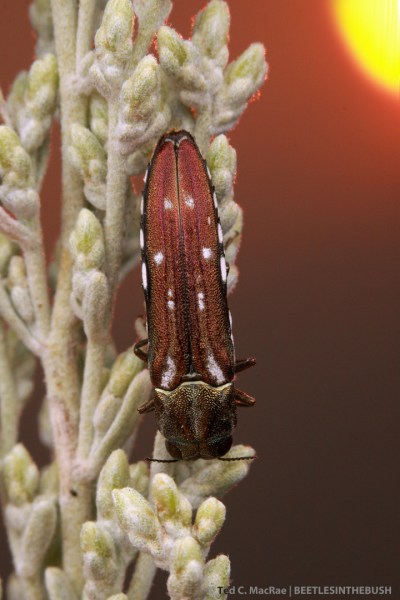
Agrilus walsinghami (female) | Washoe Co., Nevada

Agrilus walsinghami (female) | Washoe Co., Nevada

Agrilus walsinghami (male) | Washoe Co., Nevada

Agrilus walsinghami (male) | Washoe Co., Nevada

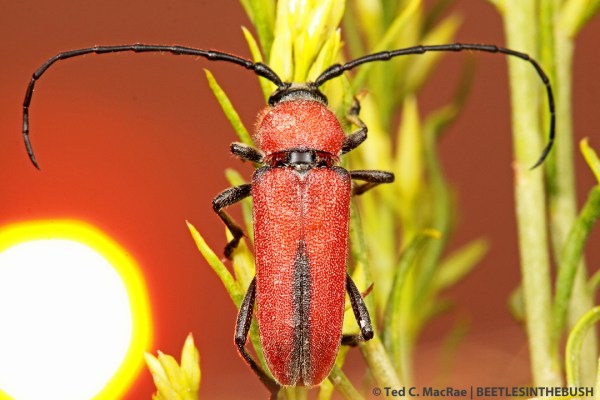
Crossidius coralinus temprans (male) | Pershing Co., Nevada

Crossidius coralinus temprans (male) | Pershing Co., Nevada

Initially hot yellow (previous photo), the sun turns to soft yellow...

Initially hot yellow (previous photo), the sun turns to soft yellow…

...then yellow-red...

…then yellow-red…

...and finally blood-red!

…and finally blood-red!

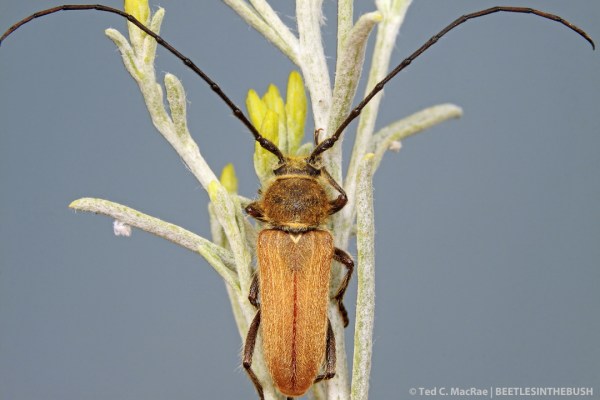
Crossidius hirtipes macswainei (female) | Lyon Co., Nevada

Crossidius hirtipes macswainei (female) | Lyon Co., Nevada

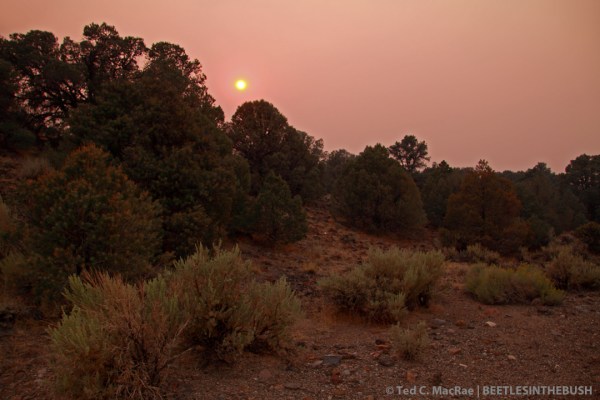
Sunset over Toiyabe National Forest | Lyon Co., Nevada

Sunset over Toiyabe National Forest | Lyon Co., Nevada

Gray rabbitbrush (Ericameria nauseosa) | Lyon Co., Nevada

Gray rabbitbrush (Ericameria nauseosa) | Lyon Co., Nevada

Copyright © Ted C. MacRae 2013

GBCT Beetle #1: Crossidius hirtipes immaculatus

In my recent Great Basin Collecting Trip (GBCT) overview, I provided some general comments about the longhorned beetles in the genus Crossidius that were the focus of the trip and, in many cases, photographs of the habitats in which the beetles were found. I didn’t show many photos of the beetles themselves, however, and such will be the focus of a series of posts intended to provide a little more detail about the individual taxa that we encountered. I was fortunate to obtain photographs of every species and subspecies that we found and, thus, will include these in the posts as well. Many of the images are bona fide, in situ field photographs—i.e., the beetles were photographed in their native habitat on the host plants on which they were encountered (although in most cases the plant part on which the beetle was resting was detached from the plant and hand-held to control the background). Some beetles were too active to photograph at the time they were encountered, in which case they were confined with their host and photographed that evening after they had settled down—either with a natural background or in front of blue-colored fabric intended to simulate a sky background. I believe in full disclosure when it comes to nature photography and will indicate if photos are anything other than in situ field photographs.

Crossidius hirtipes immaculatus (male) | Davis Creek Park, Washoe Co., Nevada

Crossidius hirtipes immaculatus (male) | Davis Creek Park, Washoe Co., Nevada

No need, however, for such disclosures in this first post of the series, as these images are true field photographs of Crossidius hirtipes immaculatus—the first longhorned beetle that we encountered on the trip. One of 16 currently recognized subspecies of C. hirtipes, populations assignable to this taxon are rather widely distributed from eastern Oregon to east-central California across northern Nevada (Linsley & Chemsak 1961). We found good numbers of these beetles in west-central Nevada at Davis Creek Regional Park (Washoe Co.) on flower heads of what I believe to be Chrysothamnus viscidiflorus. According to Linsley & Chemsak (1961), this subspecies differs from the nominotypical subspecies (the latter occurring further north in Oregon and Washington) by its paler coloration and (as the subspecies epithet indicates) reduced maculations of the elytra. In males the elytra are often completely immaculate (above), while in females the maculae are reduced to a narrow sutural stripe (below). A similar subspecies, C. h. setosus, occurs at the western edge of the distribution of C. h. immaculatus in east-central California (Nevada Co.) but is distinguished by the presence of short, dark, bristle-like hairs interspersed with longer hairs on the antennal scape—these are lacking in C. h. immaculatus.

Crossidius hirtipes immaculatus (female) | Davis Creek Park, Washoe Co., Nevada

Crossidius h. immaculatus (female) | Davis Creek Park, Washoe Co., Nevada

In addition to C. viscidiflorus were healthy stands of Ericameria nauseosa, but as was the case with nearly all subsequent C. hirtipes encounters adults were found almost exclusively on flower heads of the former. This contrasts somewhat with published information that suggests the species breeds as larvae in the roots only of C. viscidiflorus but readily feeds as adults on flowers of E. nauseosa. We saw several dozen individuals at this site, but only a small handful were found on E. nauseosa. We also noted the early exit of the adults, which started disappearing after ~5 pm local time. We suspect they crawl down to the base of the plant to spend the night hiding among debris, although we were unable to find any adults on the lower stems or around the base of the plants despite careful searches.

REFERENCE:

Linsley, E. G. & J. A. Chemsak. 1961. A distributional and taxonomic study of the genus Crossidius (Coleoptera, Cerambycidae). Miscellaneous Publications of the Entomological Society of America 3(2):25–64 + 3 color plates.

Copyright © Ted C. MacRae 2013

Great Basin Collecting Trip iReport

During the last week of August, I teamed up with fellow longhorned beetle enthusiast Jeff Huether to look for species in the genus Crossidius. This exclusively North American genus contains a number of colorful species in the tribe Trachyderini that are associated with woody composites in the genera Ericameria and Chrysothamnus (rabbitbrush) and Gutierrezia (snakeweed). While centered in the vast Great Basin in the western U.S., many species occur further east into the Great Plains, west to the Great Central Valley and deserts of southern California, north into southwestern Canada, and south into mainland Mexico and Baja California.¹ Adults of most species emerge during late summer or fall to coincide with the profusion of yellow blooms that appear on their host plants and upon which the adults can be found feeding, mating, and resting. A conspicuous feature of most species in the genus is extreme polytopism—a consequence of discontinuous host plant distributions across the basin and range topography that has resulted in more or less insular local populations. Not surprisingly, the taxonomic history of the genus is complex, but many of the Great Basin taxa are now regarded as subspecies of two widely ranging species—C. coralinus and C. hirtipes (the latter being, perhaps, the most highly polytopic species of Cerambycidae in all of North America).²

¹ Morris & Wappes (2013) recently described and assigned to this genus a species apparently restricted to relict sand formations in southern Georgia. Its highly disjunct distribution, however, along with significant differences in morphology, habits and biology compared to other species of Crossidius suggest that it might more properly be regarded as a distinct genus.

² Not all longhorned beetle enthusiasts accept the current taxonomy, arguing that species such as C. coralinus and C. hiripes merely reflect clinal patterns of variability. I concede the genus needs further work, as did Linsley & Chemsak (1961), whose generic revision forms the basis for current species/subspecies concepts. I will note, however, that the aforementioned authors examined more than 12,000 specimens during the course of their study, and wholesale dismissal of the subspecies they recognized might be premature until a significantly larger amount of material, preferably supplemented with series of specimens from lesser known geographies as well as molecular data from across their ranges, can be examined.

We flew into Reno and spent the first several days in western Nevada. Jeff arrived the night before I did and, thus, had the chance to scope out Davis Creek Park south of Reno during the morning of my arrival. It must have been to his liking, as after he picked me up at the airport we went straight back to the park and found good numbers of what we consider to be C. hirtipes immaculatus on the stands of rabbitbrush at the park. There were at least two types of rabbitbrush present, with the beetles showing a distinct preference for one over the other (vouchers of both plant species were collected for ID confirmation). Thick haze from the ongoing Rim Fire to the south in the Sierra Nevada had settled over the area, greatly limiting visibility and reducing adjacent Mt. Rose to a faint silhouette but allowing some rather spectacular sunset photos of one of my favorite western jewel beetle species, Agrilus walsinghami, which we found in small numbers on both types of rabbitbrush.

Davis Creek Regional Park

Haze from the Rim Fire settles over Davis Creek Park | Washoe Co., Nevada

The following day we drove to several areas further east near Fallon (Churchill Co.) and along Coal Canyon Road near Lovelock (Pershing Co.), where we found good numbers of C. coralinus temprans on gray rabbitbrush (Ericameria nauseosa). In most spots only a few individuals were found—mostly males, but in one spot south of Fallon we encountered good numbers of the beetles (and the heaviest numbers of mosquitoes from nearby Carson Lake that I have ever experienced!). We were skunked in our attempt to find C. h. bechteli, which has been collected at a few spots across northern Nevada, but we knew it would be a long shot since known records of the subspecies are from mid- to late September. Our visit to the area, however, was not for naught, as the sinking sun in the still smoke-filled sky presented a short window of opportunity for more stunning photos of insects at sunset.

Ted MacRae

Using the “left wrist” technique for Crossidius coralinus temprans on Ericameria nauseosa | Pershing Co., Nevada

Day 3 was spent dropping south along US-95A in western Nevada towards Yearington and Wellington (Lyon Co.). We made a number of stops and encountered C. c. temprans at most of the rabbitbrush habitats we sampled, but our real quarry was several named subspecies of C. hirtipesC. h. rubrescens, and in adjacent Douglas Co., C. h. immaculipennis and C. h. macswainei. For much of the day it looked as though we might not find any of the C. hirtipes subspecies, but finally as we approached Yearington we found what we consider to be C. h. rubrescens hiding among the flowers of yellow rabbitbrush (Chrysothamnus viscidiflorus). (In fact, we were actually walking back to the car to leave the spot when we finally spotted a mating pair on a flower. It turns out that we were focusing on the larger Ericameria plants preferred by C. coralinus, rather than the smaller Chrysothamnus plants preferred by C. hirtipes.) Considerable effort was required to collect a decent series and obtain field photographs before the setting sun caused the beetles to retreat and become too difficult to find. It would also be my last opportunity to take dramatic sunset photos, this time with C. hirtipes.
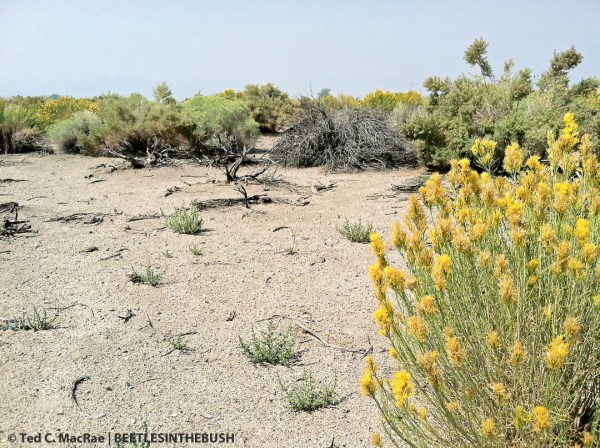
Sage grassland

Sage grasslands with established stands of rabbitbrush is perfect Crossidius habitat | Lyon Co., Nevada

Crossidius coralinus

Preparing to photograph a mating pair of Crossidius coralinus temprans | Lyon Co., Nevada

We continued our hunt for the other two C. hirtipes subspecies mentioned above on Day 4 in the area around Wellington in Lyon Co. and adjacent Douglas Co. Those of you who think Nevada is desolate and monotonous desert should take the drive south of Yearington through Walker Canyon and then south of Wellington through Toiyabe National Forest to Sweetwater Summit. I guarantee this will be some of the most spectacular countryside you have ever seen. As with C. h. rubrescens the previous day, it took some effort and trying several spots before we found a population in Douglas Co. west of Wellington that we consider to represent C. h. immaculipennis. They were co-occurring with almost equal numbers of C. ater, a widespread, all-black species that shows no appreciable variation across its range but which has been implicated in providing melanism to several C. hirtipes subspecies through introgressive hybridization (Linsley & Chemsak 1961). Eventually we decided we had sufficient material of C. h. immaculipennis and drove back through Wellington and south towards Sweetwater Summit, stopping at several spots along the way but finding nothing on either the Ericameria or Chrysothamnus. Finally, at the summit we found a single individual of C. h. macswainei, which I photographed later that evening. At the time we thought it was the only individual of this subspecies that we had collected on the trip, but closer examination of the material collected north of Yearington since returning home suggests that it may actually be a mixture of C. h. rubrescens and C. h. macswainei. [Clearly the taxonomy needs to be adjusted if this is the case; either the two taxa are not valid subspecies (in which case intermediates should also be found), or they actually represent two closely related but nevertheless distinct and partially sympatric species.]
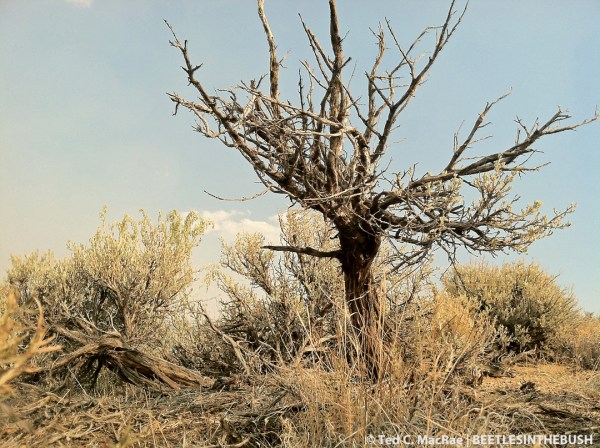
Toiyabe National Forest

Toiyabe National Forest, Nevada—what people think…
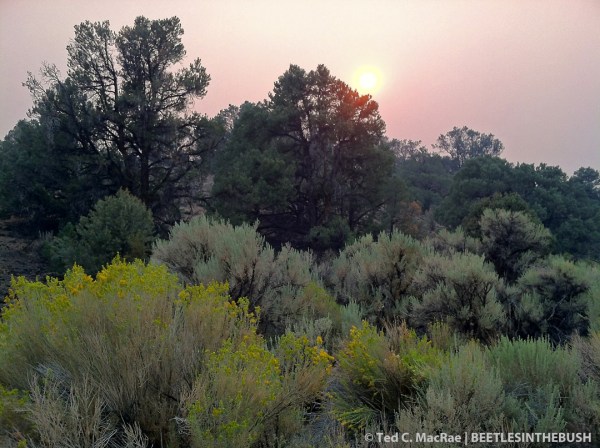
Toiyabe National Forest

Toiyabe National Forest, Nevada—the real thing (made even more dramatic by the setting sun)!

On Day 5 we continued our southward march, crossing over the Nevada-California border along US-95 and dropping south along the eastern flank of the Sierra Nevada—first into Mono Basin and then into Owens Valley. For me it was a return to one of my favorite places on earth, which I last visited way back in 1995 while living in California. We stopped briefly at Topaz Lake and found a few Cicindela o. oregona that proved to be extremely wary (white box photography alert), but our real target was C. h. flavescens, known only from the area around Kennedy Meadow in Inyo Co. Unfortunately, we didn’t pay attention to the county and went instead to Kennedy Meadows in Tuolomne Co.! Needless to say, while we did find some stands of Ericameria we did not find any Crossidius beetles, and it would not be until after the trip was over that we discovered our error. Nevertheless, the drive up the eastern flank of the Sierra Nevada, over Sonora Pass, and partway down the western flank to Kennedy Meadows allowed us to “clean up” on C. ater and offered spectacular scenery despite the continued cloaking of haze from the now much nearer Rim Fire. Jeff also managed to find the only specimen of C. punctatus that we would see on the trip.

Sonora Pass

Sonora Pass | Mono/Tuolomne Co., California
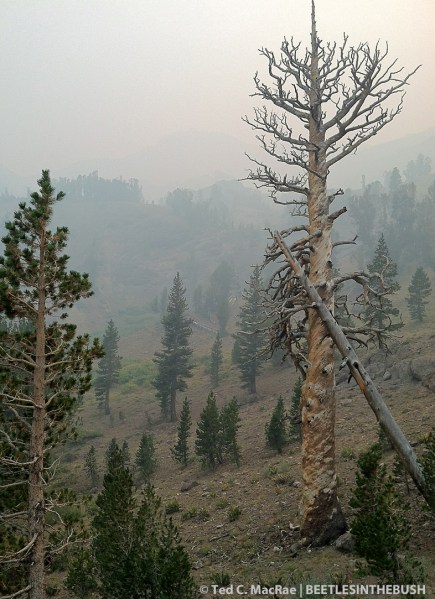
Pinus contorta murrayana

Lodgepole pine (Pinus contorta murrayana) cadaver at Sonora Pass

We continued south along US-95 into Mono Basin towards a locality near Mammoth Lakes to look for the spectacular orange subspecies C. c. monoensis. Of course, one cannot drive right through the Mono Lake area without stopping and every Vista Point and at the lake itself to admire its strange, almost moonscape-like tufa towers. It was getting late in the day, so I found myself in a bit of a race to photograph the towers before they were covered by the advancing shadows from the Sierra Nevada to the west. I did not succeed completely, but the resulting photos with contrasting “black and white” towers made for nevertheless interesting photos.
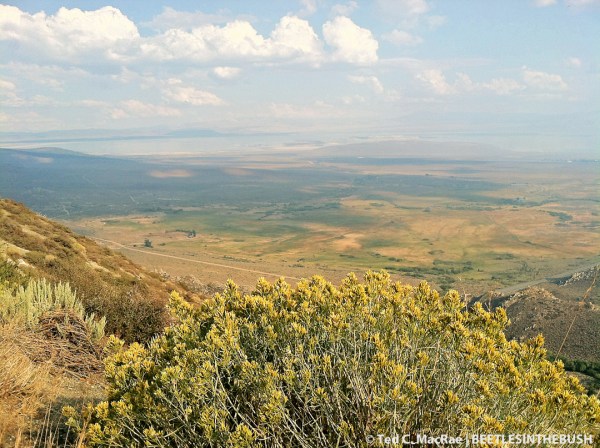
Mono Lake Vista Point

Mono Lake Vista Point along US-395 | Mono Co., California
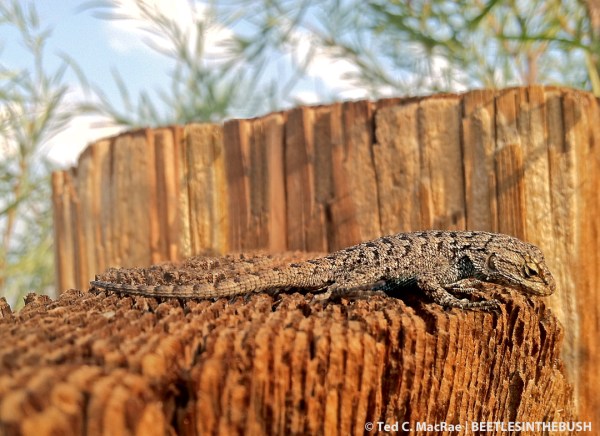
Great Basin fence lizard (Sceloporus occidentalis longipes)

Great Basin fence lizard (Sceloporus occidentalis longipes) at Mono Lake Vista Point

Mono Lake

Tufa towers at Mono Lake | Mono Co., California

Mono Lake

Late afternoon shadows create an interesting “black/white” contrast between shaded and sunlit tufa.

Eventually we resumed our southward trek and, with daylight waning rapidly, arrived at a spot near Mammoth Lakes where Jeff had taken C. c. monoensis in the past. We were rewarded with a few males and females, and I was able to take some rather spectacular field photographs of each. Until now, all of the C. coralinus I had seen were deep red and black, but these were bright orange with only a little bit of black—gorgeous! After failing in our attempt to find C. h. flavescens, finding this subspecies rescued the day as a success, and we were able to complete our drive into Bishop and spend the next day focusing on additional subspecies in Owens Valley and the White Mountains.

Sierra Nevada

The eastern slopes of the Sierra Nevada rise dramatically in the distance | Mono Co., California

Sierra Nevada

Mono Basin near Mammoth Lakes (7000 ft)—locality for Crossidius coralinus monoensis | Mono Co., California

Our first stop on Day 6 was just a short 2.5 drive north from our hotel in Bishop, where we found a very nice population of C. c. caeruleipennis. If you think C. c. monoensis is spectacular, wait until you see this subspecies bearing the same bright orange coloration as C. c. monoensis but larger and even less maculated with black—the males are almost pure orange! I presume we were on the early side of things (as with most of the populations we found), as the plants were just on the early side of blooming and the majority of individuals encountered were males (which tend to emerge earlier than females). The occasional E. nauseosa plant in full bloom often had several individuals on it, including mating pairs.

Sage grassland

Owens Valley near Bishop (4000 ft)—locality for Crossidius coralinus caeruleipennis | Inyo Co., California

With success already in hand, we continued south into the White Mountains to the area around Westgard Pass where a particularly dark subspecies—C. h. nubilus is known to occur. As we experienced earlier in the week, success did not come until we stopped searching the larger, more conspicuous Ericameria plants and focused on the much smaller and less conspicuous C. viscidiflorus plants. While I did manage to take some field photographs, the beetles were not numerous and I held some alive for photographs in the hotel room later than night. The beetles also seemed to be curiously patchy in their occurrence, with large stretches of seemingly good plants hosting none and the majority found in two small, localized spots in the area west of the pass.

Westgard Pass

Pinyon-juniper zone near Westgard Pass—locality for Crossidius hirtipes nubilus | Inyo Co., California

Under normal circumstances, I would have been content to close out the day looking for additional beetles to strengthen my series in the hopes of getting a good representation of the variation present in the population, but these were not normal circumstances—we were only a short drive from Ancient Bristlecone Pine Forest. Despite living in California for five years back in the 1990s, I never took the opportunity to visit this place and explore its incredible stands of Great Basin bristlecone pine (Pinus longaeva). The oldest non-clonal tree in the world, dated to nearly 5000 years old, occurs in this area, and many of the trees in the forest range from 1000–2000 years old. Indescribable is the only adjective that I can offer for one’s first sight of these trees, many gnarled and grotesquely twisted by age and wind, the older ones often with nothing but a narrow strip of living wood connecting the roots to a small group of live branches on an otherwise dead tree.
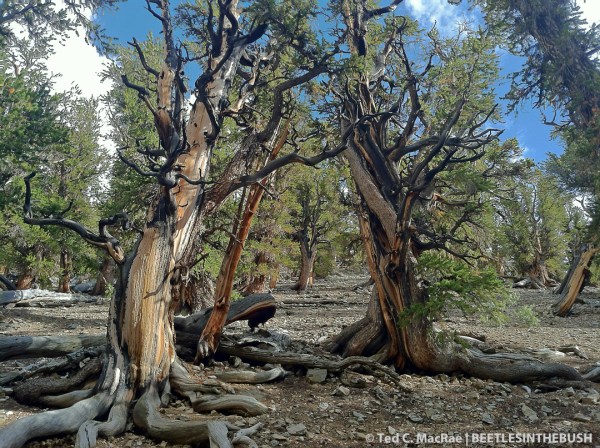
Pinus longaeva (bristlecone pine)

Great Basin bristlecone pines (Pinus longaeva) | Ancient Bristlecone Pine Forest, Inyo Co., California

Ted C. MacRae

Sitting next to an ancient cadaver—who knows how old it is?
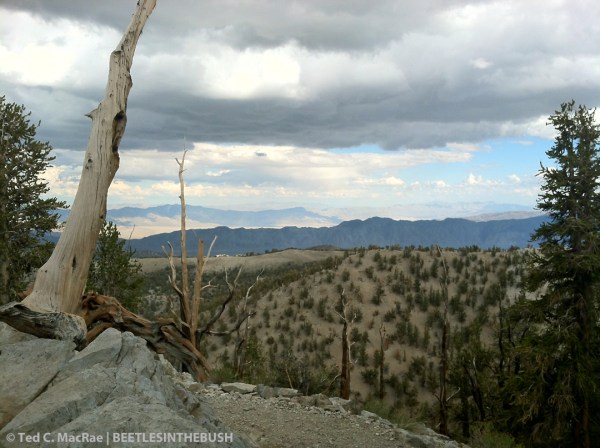
Bristlecone Pine Ancient Forest

Spectacular vistas around every bend at Ancient Bristlecone Pine Forest.

Pinus longaeva (bristlecone pine)

Female cones bear longish, incurved bristles on the tips of their scales.

Bristlecone Pine Ancient Forest

Great Basin bristlecone pines are restricted to high elevations in California, Nevada, and Utah.

On Day 7 we left Bishop and headed back north to Mono Basin to take another shot at C. c. monoensis and also look for C. h. rhodopus, the latter being a particularly reddish subspecies known only from Mono Basin. We had not seen the latter in our cursory look at Mono Basin habitats two days ago, and it continued to elude us at several stops in areas supporting the C. viscidiflorus host plants on which we expected it to occur (although we did manage to find a few more C. c. monoensis at the locality near Mammoth Lakes). I had collected C. h. rhodopus almost 20 years ago—my last trip to the Mono Basin—at a spot in the Benton Range at the south end of the Mono Basin (which also happens to be the type locality for the jewel beetle Nanularia monoensis, described by my late friend Chuck Bellamy in his 1987 revision of the genus). As a remembrance of Chuck I thought it would be nice to find and photograph N. monoensis as well, so we headed towards the Benton Range as our last stop in California before heading east through the Great Basin to look for additional C. hirtipes and C. coralinus subspecies. As we drove, we saw robust stands of C. viscidiflorus in Adobe Valley stretching south of Mono Lake towards the northern terminus of the White Mountains and decided to stop on the chance we might find C. h. rhodopus there. It’s a good thing we did, as the beetles were out in force. I tried photographing some individuals in the field, and while I did get some decent shots the beetles were generally too flighty and active to justify the effort. I was also anxious to look for N. monoensis, so I put a live male and female in a vial with a piece of host for photography later that evening and we continued towards the Benton Range.

Adobe Valley

Adobe Valley near the White Mountains—locality for Crossidius hirtipes rhodopus | Mono Co., California

Despite its close proximity to the comparatively lush Adobe Valley, conditions in the Benton Range were exceedingly dry. We searched around a bit, but it was apparent by the lack of any herbaceous plants or fresh growth on perennial plants that the area had not received rain for an extended period of time. In fact, I could not even find a single buckwheat (Eriogonum kearneyi var. monoensis) plant on which to search for jewel beetles. The only beetles seen were an aggregation of ~15 C. ater and C. h. rhodopus adults on a single E. nauseosa plant that, unlike the other plants in the area, somehow managed to achieve full bloom. Nevertheless, it was great to visit the locality and rekindle memories after so many years absence. Once we convinced ourselves that there were truly no more beetles to be had, we began the first leg of our long, 2-day drive across the southern Great Basin for the final phase of the trip.
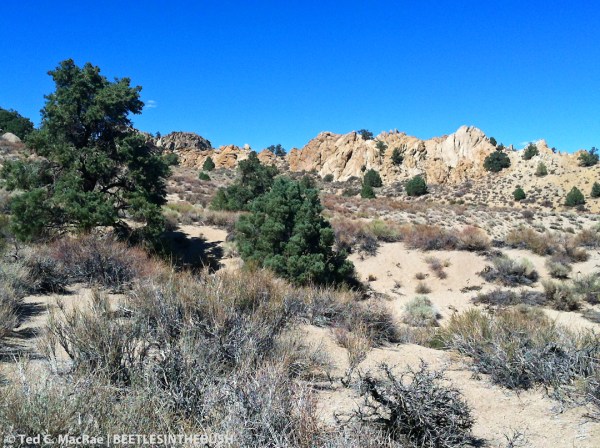
Benton Range

The Benton Range is the type locality of Nanularia monoensis | Mono Co., California

Benton Range

The White Mountains form a dramatic backdrop behind the Benton Range | Mono Co., California

Ted C. MacRae

The author takes a “pensive” selfie | Benton Range, Mono Co., California

We spent the night in Tonapah, Nevada and began Day 8 by driving east along US-6, stopping along the roadsides periodically whenever particularly promising-looking stands of Ericameria/Chrysothamnus were seen. We had expected to begin finding populations assignable to subspecies C. h. brunneipennis as soon as we left Tonapah, but for the most part searching during the morning hours was fruitless. We did find single male and female examples from south-central Nevada of what seems to best fit C. coralinus coccineus (known mostly from southwestern Utah), but it was not until late morning when we were within about 30 miles of Ely in east-central Nevada that we began finding adults of C. hirtipes brunneipennis. At first they were scarce and difficult to find, ensconced as they were within the flowers of their C. viscidiflorus hosts, but shortly they began to appear in great numbers and offered opportunity for field photographs and good series. We had observed on several days of the trip that C. hirtipes began ‘disappearing’ during late afternoon, in contrast to C. coralinus which tended to settle down within the flowers of their host plant where they could be found even at dusk (and perhaps all night had we searched for them at that time). I now believe that C. hirtipes tends to crawl down to the base of the host plant to spend the night and requires some period of warming temperatures before they come back up to the flowers the following morning, and that this is the reason why we did not succeed in finding populations further to the west in the areas we searched after leaving Tonapah in the morning. In contrast, we rarely failed to succeed in finding C. coralinus in the locations where they occur during early morning or early evening hours.

A short drive further east to Ely got us within range of the darkened subspecies C. h. cerarius, and at the first stop south of town sporting a good stand of C. viscidiflorus we found this one also in good numbers. Another short drive further east to near the Utah border brought us within the western limit of the final C. hirtipes subspecies that we were targeting—C. h. wickhami. Unlike the previous subspecies, which has an extremely limited distribution in east-central Nevada, C. h. wickhami is widespread from east-central Nevada across western Utah and northern Arizona. We waited until we crossed the Utah border, stopped at the first stand of C. viscidiflorus that we saw, and found decent numbers of this subspecies distinguished by its light coloration and distinct sutural stripe.
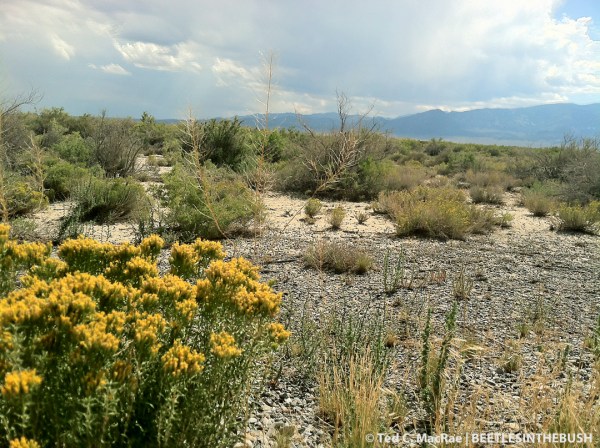
Great Basin desert

Yellow rabbitbrush (Chrysothamnus viscidiflorus) host for Crossidius hirtipes wickhami | Millard Co., Utah

We needed to make it to Moab, Utah in the evening, so we began the long trek across southern Utah. There is another C. coralinus subspecies known from southwestern Utah that we could have targeted—C. c. coccineus, but we had both already collected examples of this subspecies in Cedar City, Utah during a tour of the Great Western Sand Dunes two years ago. Finding a male and a female of what seem to be this subspecies fulfilled my desire for photography subjects, and there were additional C. coralinus subspecies to be had further east that I had not yet collected. As I first learned two years ago, and which was again confirmed on this trip, southern Utah has some of the most dramatic scenery in all of the western U.S. Period! The photos below are but two examples of the many spectacular sights that I saw, and more now than ever I hope to return to this area in the future for serious exploration.
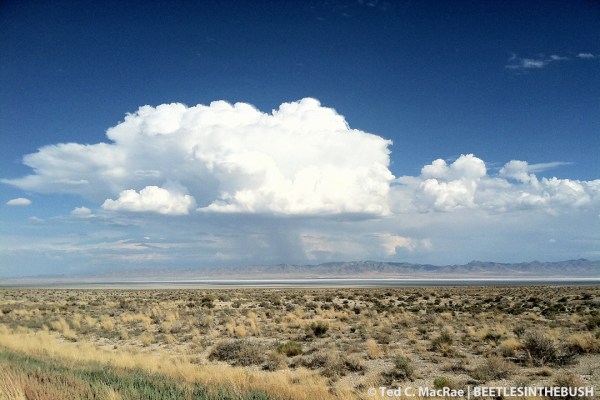
Sevier Lake

A thunderstorm settles over the Cricket Mountains behind Sevier Lake | Millard Co., Utah

Devil's Canyon

A late afternoon rainbow dissipates over Devil’s Canyon | Emery Co., Utah

The last field day of a trip is always a bit melancholic—I’m never happier than when I’m in the field, and when I’m having particularly good luck it makes the end of the trip even harder to think about. The best cure for melancholy, however, is more success in the field, and Day 9 started off with a bang. We had driven less than 40 miles south of Moab when we saw good looking stands of E. nauseosa and C. viscidiflorus, and on the very first plant we checked sat a spectacular female representing the robust, bright red and heavily marked nominotypical C. coralinus. Only a few more were found during the ensuing search until I found a “mother lode” plant hosting two mating pairs and three singletons. As it was still fairly early in the morning, the beetles were quite calm and I was able to fill my photographic quota of the subspecies with nice field shots of both sexes. We stopped at several more spots as we approached and crossed into Colorado, including Cortez where we found nice numbers of super-sized individuals. Mindful of the time, we tore ourselves away and continued east to the area around Fort Garland in south-central Colorado, where Jeff had previously seen C. c. jocosus—similar to C. c. coralinus but unusually diminutive in comparison. Anticipation, however, got the better of us before we made it to Fort Garland, for after passing through the San Juan Mountains we stopped at a few spots around Monte Vista on the western side of the San Luis Valley (Fort Garland lies further east on the opposite side of the valley). Good fortune awaited us, as we found a handful of individuals at two sites that appeared to represent C. c. jocosus, reducing the importance of getting to Fort Garland and finding them there. The sites where we found these beetles might represent the western limit of distribution for the subspecies, which would seem to be isolated from C. c. coralinus by the intervening San Juan Mountains. It’s a good thing we stopped at those sites, as further east near Fort Garland nearly all of the plants were past peak bloom and no beetles were seen. Only a last ditch stop at a stand of plants just east of Fort Garland produced a single male and single female to add to those we had collected earlier, but it was enough to put a smile on the face and make it easier to accept that a long, successful trip had finally come to an end. We recounted our successes during the 3-hour drive to Denver: 14 of 16 targeted taxa successfully located, plus an additional three taxa not targeted for a total count of 17 named taxa.
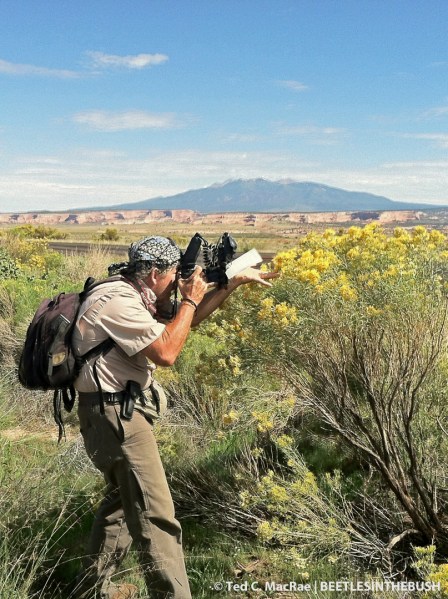
Ted MacRae

Photographing insects on Ericameria nauseosa | San Juan Co., Utah

In closing this report, I should note a few caveats:

  1. Identifications are preliminary and based primarily on expected geographical occurrence along with cursory comparison to descriptions and diagnoses published in Linsley & Chemsak (1961). Some modifications to these identifications might occur after collected material has been examined more closely (e.g., the possible co-occurrence of C. h. rubrescens and C. h. macswainei at a locality just north of Yearington, Nevada). This also applies to host plant identifications; however, voucher samples were collected from almost every location and will be submitted to specialists for ID confirmation.
  2. All of the photos in this post were taken with my iPhone. This does not mean that I have no photos taken with my ‘real’ camera to share—these will be forthcoming in future posts that examine many of the above mentioned subjects in more detail (as well as a few additional subjects not mentioned above). This also does not mean that these photos are ‘straight from the phone’—they have been post-processed in much the same way I process photos taken with the digital SLR to emphasize their good qualities and minimize their bad ones. I choose to include only iPhone photos in this post since the iPhone is what I mostly use to document a general ‘flavor’ of the trip, saving the digital SLR for true macro-photography or subjects requiring the highest possible quality. Aw heck, here’s a ‘real’ photo of one of the insects I found on the trip to whet your appetite for posts to come:
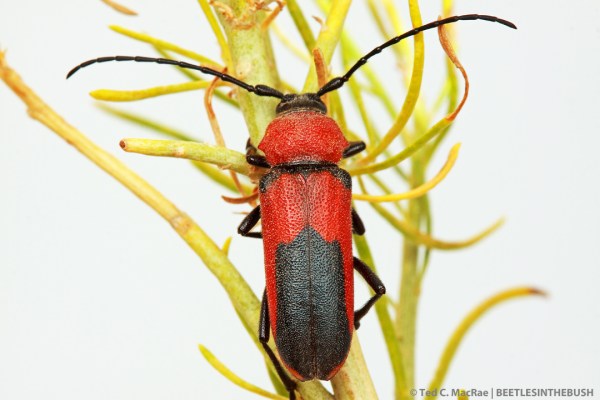
Crossidius coralinus temprans on Ericameria nauseosa | Churchill Co., Nevada

Crossidius coralinus temprans (female) on stem of Ericameria nauseosa | Churchill Co., Nevada

REFERENCES:

Bellamy, C. L. 1987. Revision of the genera Nanularia Casey and Ampheremus Fall (Coleoptera, Buprestidae, Chalcophorinae). Contributions in Science, Los Angeles County Museum of Natural History 387:1–20.

Linsley, E. G. & J. A. Chemsak. 1961. A distributional and taxonomic study of the genus Crossidius (Coleoptera, Cerambycidae). Miscellaneous Publications of the Entomological Society of America 3(2):25–64 + 3 color plates.

Morris, R. F., III & J. E. Wappes. 2013. Description of a new Crossidius LeConte (Coleoptera: Cerambycidae: Cerambycinae: Trachyderini) from southern Georgia with comments on its biology and unusual distribution. Insecta Mundi 0304:1–7.

Copyright © Ted C. MacRae 2013

Arizona collectors: Have you seen this beetle?

Placoschema dimorpha (male) | lower Madera Canyon, Arizona

Placoschema dimorpha (male) | lower Madera Canyon, Arizona

If you are a collector of beetles in Arizona, you should be on the lookout for longhorned beetles (family Cerambycidae) resembling the specimen in the above photos. Determined as Placoschema dimorpha Chemsak & Hovore, in Eya 2010 by Jeff Huether, the specimen was collected by Jeff’s son Mark Huether on 15 July 2013 as they roadside collected longhorned beetles and scarabs in lower Madera Canyon (Pima Co.). They were searching mainly on Baccharis, although there were very few flowers open at the time. It is not known what plant the specimen was collected from, but Jeff notes that it was collected around 2 pm in the heat of the day.

Placoschema dimorpha was described from just a handful of specimens (3 males and 4 females), all in Mexico, and is the only member of the genus. As a result, the above collection represents the first record of both the genus and the species in the U.S. New U.S. records for popularly collected groups like longhorned beetles are always noteworthy, and in this case its occurrence in southeast Arizona—well scrutinized for decades by legions of beetle collectors—is all the more remarkable. Perhaps its tiny size (the above specimen measures only ~10 mm) and somber coloration—unusual for the tribe Trachyderini with its mostly large and colorful members—have somehow contributed to it being overlooked until now. Others might be quick to cite climate change and recent expansion of its range northward into the U.S. as a possible explanation; however, it should be noted that the type specimens, despite being few in number, were collected from a rather large area across central and northern Mexico in the states of Chihuahua, Durango, Hidalgo, and Mexico.

While this specimen agrees very well with the original description of P. dimorpha, it does differ from the male paratype figured in that work in that the lateral margins of the elytra are red only in the basal half rather than completely to the apex. As the species name implies, females are colored differently, with the elytra entirely reddish or at most a darker fascia (may be incomplete) across the apical three-fourths.

My sincere thanks to Jeffrey Huether for allowing me to photograph this specimen and present these notes in advance of more formal documentation in peer-reviewed literature.

REFERENCE:

Eya, B. K. 2010. New Mexican and Central American genera and species of Trachyderini (Coleoptera, Cerambycidae, Cerambycinae). Les cahiers Magellanes 108:1–21.

Copyright © Ted C. MacRae 2013

The one that got away!

It was disappointing to reach Black Mesa, the furthest west destination for my June collecting trip through northwestern Oklahoma, only to discover that the whole region was dry as a bone. I spent an hour or so sweeping yellow roadside composites and got a few Typocerus confluens—a reasonably uncommon longhorned beetle, and another hour’s worth of beating oaks and junipers in the area produced a grand total of three Chrysobothris ignicollis, a very common jewel beetle associated with junipers in the southern Great Plains. This in glaring contrast to the veritable smörgåsbord of jewel and longhorned beetles I had encountered earlier in the week at Beaver Dunes, Alabaster Caverns, and Gloss Mountain State Parks. I had planned to spend at least a full day in the Black Mesa area—maybe two if the collecting was good, but as it was I couldn’t justify spending even another minute in the area. Unable to resist the siren call of more productive areas back to the east, I decided to cut my losses and return to those areas to close out the week. It was still early afternoon, and if I left immediately I would arrive back at Beaver Dunes (from where I had left just the previous evening) with at least a few hours to pad my series and perhaps even find something new.

Oberea oculaticollis Say 1824 | Beaver Dunes State Park, Beaver Co., Oklahoma

Oberea oculaticollis Say 1824 | Beaver Dunes State Park, Beaver Co., Oklahoma

One area I wanted to take another look at was the small lake near the campground. I had beaten a few willow-feeding Agrilus spp. from the black willow (Salix nigra) and Poecilonota cyanipes from the cottonwoods (Populus deltoides) surrounding the reservoir. I desired better series of what I had collected the previous day, so I retraced my steps and beat most of the same trees I had beaten before. While I did quite well with P. cyanipes on the cottonwoods, again only a few Agrilus were beaten from the willows. I had nearly completed the circuit around the lake when I walked up to a small willow sapling that I had not sampled the previous day, gave it a whack over my sheet, and onto the sheet fell a nice longhorned beetle that I didn’t immediately recognize. At first I thought it was a species of Mecas due to the dense covering of gray pubescense, but the long and narrow form seemed much more agreeable with the genus Oberea. At any rate, seeing that it was something new for me I placed it back on a willow branch and began taking photos of it.

The dark integument and dense, grayish pubescence distinguish this species.

The dark integument and dense, grayish pubescence distinguish this species.

It was late in the day, and the beetle was unusually calm and cooperative and allowed me to take a number of shots, from which I have selected a few to show here. Once I had my fill of photographs, I slipped it into a vial for safe-keeping while I disassembled and stowed my camera equipment, and after I was finished I pulled out the vial with one hand and reached for my bottle dropper of ethyl acetate with the other. I have a technique to unscrew both the vial and the bottle with the fingers of the hand that is holding them, lifting both caps simultaneously, dropping a few drops of ethyl acetate into the vial, and again simultaneously placing both caps back in place and screwing them shut. This minimizes the time the cap is off the vial while the insect is in it, thus minimizing the chance of the insect escaping during the process. In this case, however, as I was trying to do this a dog-pecker gnat flew right at my eye, and I instinctively swiped at it with my left hand—the one holding the vial with the beetle in it! Of course, the cap was off, and the beetle when sailing out of the vial and immediately took flight. All I could do is just stand there dumbfounded at my stupidity. I did go back and beat the same sapling (and every other willow tree) on my way back in a last ditch effort to recollect the species, but fortune was not with me at this time.

This adult on black willow (Salix nigra) is the first indication of its host plant.

This adult on black willow (Salix nigra) is the first indication of its host plant.

Once I returned home and had a chance to examine the photos more carefully, I learned that I had photographed Oberea oculaticollis Say 1824, a longhorned beetle distributed in central North America from Manitoba to Texas and distinguished, not surprisingly, by its dark integument and dense, grayish pubescence (Chemsak & Linsley 1995). Not only have I never before encountered this species, but it is also completely lacking in my collection. As far as I can tell, no host information has been recorded for this species, so my collection of an adult on willow might be the first clue as to its host plant. Without a voucher specimen, however, I am reluctant to publish the record and will have to keep this spot in mind for possible future collection of the species.

REFERENCE:

Linsley, E. G. & J. A. Chemsak.  1995. The Cerambycidae of North America. Part VII, No. 2: Taxonomy and classification of the subfamily Lamiinae, tribes Acanthocinini through Hemilophini. University of California Publications in Entomology 114:1–292.

Copyright © Ted C. MacRae 2013