Lord of the flies!

I happened upon a rather interesting scene last week in a soybean field in northern Argentina (Chaco Province). This assassin bug (family Reduviidae) had captured and was feeding on an adult stink bug of the species Piezodorus guildinii—an important pest of soybean in Argentina and Brazil (where it is known by the common names “chinche de la alfalfa” and “chinche verde pequeño”, respectively). Assassin bug predation is always interesting enough itself, but what made this scene especially fascinating was the large congregation of flies surrounding and even crawling upon the predator and its prey. I had not witnessed something like this before, but it seemed clear to me that the flies were engaging in kleptoparasitism—i.e, stealing food. I’ve gotten into the habit of keeping a full set of extension tubes mounted on the camera with my 100mm macro lens—this not only provides the most useful (for me) range of magnification but also serves as a convenient and easy-to-use field microscope. Through the viewfinder I could see that there were at least two markedly different types of flies involved—more abundant, small, brown flies that I presumed (incorrectly, as it turns out) to be some type of drosophilid (vinegar fly), and a few larger, black flies that were completely unfamiliar to me. The flies were apparently feeding on fluids from the stink bug prey but also crawled all over the assassin bug as it fed. The assassin bug seem unencumbered in its feeding by the presence of the flies, but periodically it would slowly wipe its forelegs over its head to dislodge flies that had settled onto it. Just as quickly as they flew away, however, they crawled back.

The assassin bug, on the other hand, I recognized as very likely a species of Apiomerus—a large, exclusively New World genus known in North America as “bee killers” for their habit of sitting on flowers and ambushing visiting bees for prey. The prey selection behaviors of these insects, however, are more generalist than the name implies, as can be seen by these photographs. To verify my generic ID and possibly obtain a species ID, I sent some of these photos to Dimitri Forero at the Heteropteran Systematics Lab at University of California-Riverside. Dimitri is revising portions of Apiomerus (e.g., Berniker et al. 2011) and working on a general phylogenetic hypotheses for the genus. In the past he has been quite helpful in fielding questions from me about these bugs, and within a few hours Dimitri replied to inform me that the assassin bug was, indeed, a member of the genus Apiomerus, likely representing the common, widespread species A. lanipes (ranging from Panama to Argentina), based on its coloration, locality, and relative size. Update 12 March, 3:07 pm—After seeing the last photo in this post (which I did not send to him initially), Dimitri wrote to say the ventral abdominal pattern was not characteristic of A. lanipes. He asked about its size, to which I replied that it was about the same length but maybe a little less robust than A. crassipes (eastern North America). He later added, “I now think that this is A. flavipennis Herrich-Schaeffer, 1848. It is very similar to A. lanipes, but a lot smaller (lanipes is really robust), and with the abdomen with black and white patches, whereas in lanipes the abdomen is always black. I checked some series of specimens that I have here and, I am pretty sure now of the ID. I have material from Argentina as well. In some specimens that coloration of the corium varies, but the original description says it is yellow with a “hairy” pronotum, which fits very nicely your photos.” Apiomerus flavipennis is known from Argentina and Southern Brazil only.

Quite unexpectedly, Dimitri also noted that at least some of the flies could belong to the family Milichiidae. He first became aware of these flies after seeing a photograph of Apiomerus showing something similar and suggested Milichiidae online as a possible source for more information. This remarkably informative  website by milichiid expert Irina Blake, who dubs species in the family as “freeloader flies”, is a model for how websites dealing with obscure insect taxa should be organized and populated (and features on the home page a great photo of ant-mugging flies taken by our favorite myrmecophile). At any rate, I forwarded my photos to Irina and within minutes received her response that the bigger black flies most probably represent the cosmopolitan Milichiella lacteipennis and the smaller flies a species of the family Chloropidae (of “dog pecker gnat” fame) in the subfamily Oscinellinae, noting that she has seen similar (or the same?) chloropids in other photos as well engaging in kleptoparasitism.

Not long after receiving the first reply from Dimitri, I got another message from him with a link to a very interesting paper by Eisner and colleagues (1991), who recorded freeloader flies in Florida preferentially attracted to stink bugs and leaf-footed bugs (family Coreidae) being preyed upon by the orb-weaving spider Nephila clavipes. Olfactory stimuli were already suspected to be involved in attraction of milichiids and also chloropids (Sivinski 1985); however, Eisner et al. (1991) experimentally demonstrated that milichiid attraction was tied to specific components of defensive sprays in several pentatomid and coreid species (including P. guildenii, the prey species in this series of photographs). The defensive sprays of the bugs were generally ineffective at preventing predation by the spiders (and apparently this is the case for A. lanipes and other reduviids as well), thus serving as a signal to milichiids and chloropids not only of the presence of a food source but perhaps also assisting search for mates in a density dependent fashion (Sivinsky 1985). Milichiid attraction to hymenopteran prey, richly endowed with integumental glands themselves, has also been documented; the Eisner study raises the question whether these types of prey are also detected from chemical cues.

REFERENCES:

Berniker, L., S. Szerlip, D. Forero and C. Weirauch. 2011. Revision of the crassipes and pictipes species groups of Apiomerus Hahn (Hemiptera: Reduviidae: Harpactorinae). Zootaxa 2949:1–113.

Eisner, T., M. Eisner & M. Deyrup. 1991. Chemical attraction of kleptoparasitic flies to heteropteran insects caught by orb-weaving spiders. Proceedings of the National Academy of Sciences of the United States of America 88:8194–8197.

Sivinski, J. 1985. Mating by kleptoparasitic flies (Diptera: Chloropidae) on a spider host. Florida Entomologist 68(1):216–222.

Copyright © Ted C. MacRae 2012

To the land of Gauchos

Today I leave for an extended stay in Argentina. Many have asked me if my trip is for work or fun, and my standard response has been, “It’s for work, and it will be fun!” For the next eight weeks, I’ll be helping out with field trials and speaking to farmers (while sampling a few Malbecs as well). Of course I would rather it be an 8-week collecting trip, but I consider myself fortunate even to have an opportunity such as this. I’ll pick up a few insects along the way, but what I really hope to bring back in large quantity is photographs.

It’s a little difficult to predict how reliable and consistent I’ll have internet access or the time to take advantage of it, so postings over the next few weeks may be a little less regular than what has become my usual custom. The trip is also heavily front-loaded with work activities as I get my bearings and spend time getting to know my new colleagues, so I’m not sure when I might have new photos to show here. Not to worry, I have plenty of material that I haven’t yet shown. Until then, I leave you with this photograph I took last November at  in Buenos Aires. These tiny bugs seem to be early-instar leaf-footed bug (family Coreidae) nymphs, their bright red and black coloration and aggregating behavior indicating ample chemical protection against predation.

Early-instar coreid nymphs | Buenos Aires, Argentina

Copyright © Ted C. MacRae 2012

Best of BitB 2011

Welcome to the 4th Annual BitB Top 10, where I get to pick my 10 (more or less) favorite photographs of the year. As an insect macrophotographer I still feel like a relative newcomer, although with three seasons under my belt fewer and fewer people seem to be buying it anymore. Granted I’ve learned a lot during that time, but the learning curve is still looking rather steep. I don’t mind—that’s the fun part! With that said, I present a baker’s dozen of my favorite photographs featured here during 2011. I hope they reflect the learnings I’ve had the past year and maybe show some progress over previous years (2009, 2008 and 2010).

One more thing—I’m including a special bonus for the first time in this year’s edition. Each of the photos shown below is linked to a 1680×1120 version that may be freely downloaded for use as wallpaper, printing in calendars, or any other use (as long as it’s personal and non-profit). It’s my way of saying thanks for your readership and support.


From  (posted 8 Jan). I’ve done limited photography with prepared rather than live specimens. However, the recreated aggressive-defensive posture of this greater arid-land katydid (Neobarrettia spinosa)—or “red-eyed devil”—was too striking to pass up. A clean background allows every spine and tooth to be seen with terrifying clarity.


From  (posted 6 Feb). I had never seen a cactus fly until I encountered this Nerius sp. I’m especially fond of the bizzarely-shaped head and un-fly-like spines on the front legs.


From  (posted 17 Feb). This photo of a fungus weevil, Phaenithon semigriseus, is one of the first where I nailed the focus right on the eye at such a magnitude of closeup (~3X) and also got the composition I was looking for. I didn’t notice at the time, but the beetle seems to be “smiling.”


From  (posted 28 Mar). One of the field techniques I’ve been practicing this year is actually holding the plant with the subject in one hand, resting the camera on my wrist and controlling it with the other hand, and manipulating the position of the plant to achieve a desired composition. It’s a difficult technique to master, but the results are worth it. The jumping spider, Euophrys sutrix, represents one of my earliest successful attempts with this technique.


From  (posted 30 Mar). This South American tree fruit weevil looks like it is sitting quite calmly on a branch. In reality, it never stopped crawling while I attempted to photograph it. Crawling subjects are not only difficult to focus on but also almost always have a “bum” leg. I achieved this photo by tracking the beetle through the lens and firing shots as soon as the center focus point flashed, playing a numbers game to ensure that I got at least one with all the legs nicely positioned. I’d have been even happier with this photo if I had not clipped the antennal tip.


From  (posted 4 May). Face shots of predatory insects are hard to resist, and in this one of the fiery searcher beetle, Calosoma scrutator, the angle of the subject to the lighting was perfect for showing off every ridge and tooth in its impressive mandibles.


From  (posted 10 May). I’ve taken plenty of lateral profile shots of tiger beetles, but I like this slightly panned out one especially because of the sense of scale and landscape created by the inclusion of the plantlets and the view over the small rise.


From  (posted 18 May). I found these Edessa meditabunda stink bug eggs on the underside of a soybean leaf in Argentina almost ready to hatch. The developing eye spots in each egg gives the photo a “cute” factor rarely seen in such super close-ups.


From  (posted 15 July). Some of my favorite insect photos are not only those that show the bug in all its glory, but also tell a story about its natural history. This nymphal lichen grasshopper, Trimerotropis saxatilis, is almost invisible when sitting on the lichens that cover the sandstone exposures in its preferred glade habitat. 


From  (posted 23 Aug). I know this is the second beetle face shot I’ve included in the final selections, but it was while photographing this rare Florida metallic tiger beetle, Tetracha floridana, in the middle of the night that I discovered the use of extension tubes to improve the quality of flash lighting (decreased lens to subject distance results in greater apparent light size). This is perhaps one of the best illuminated direct flash photographs that I’ve taken, and I also like the symmetry of the composition.


From  (posted 17 Sep). The three-cornered alfalfa hopper (Spissistilus festinus) is a common pest of alfalfa and soybean in the U.S. However, despite its abundance, I’ve never noticed the bizarre zig-zag pattern of the eyes until I took this photo. Even though both the insect and the background are green, there is sufficient value contrast to create a pleasing composition. Bumping up the ISO and a lower FEC setting prevented overblowing the light greens—easy to do with full flash macrophotography.


From  (posted 4 Oct). This longhorned beetle had settled in for the night on its Ericamera nauseosa host plant, allowing me to use higher ISO and lower shutter speed settings with a hand-held camera to achieve this very pleasing blue sky background, while retaining the sharpness of detail of the subject that comes from full-flash illumination. The blue sky background provides a more pleasing contrast with the colors of this particular beetle and flowers than the black background that is more typically seen with full-flash macrophotography.


From  (19 Dec). An uncommon underside view of these purple tree fungus (Trichaptum biforme) caps and use of flash illumination allows the colors to literally glow against the bright green lichens also growing on the tree. Keeping aperture at a moderate setting allows blurring of the caps further back, adding three-dimensionality to the photo and preventing it from looking ‘flat.’


Well, there you have it, and I hope you’ve enjoyed my selections. Please do tell me if you have a favorite among theses (and if there were other photos posted during 2011 that you think deserved making the final selections).

Copyright © Ted C. MacRae 2011

Crazy Eyes

Spissistilus festinus | Stoneville, Mississippi

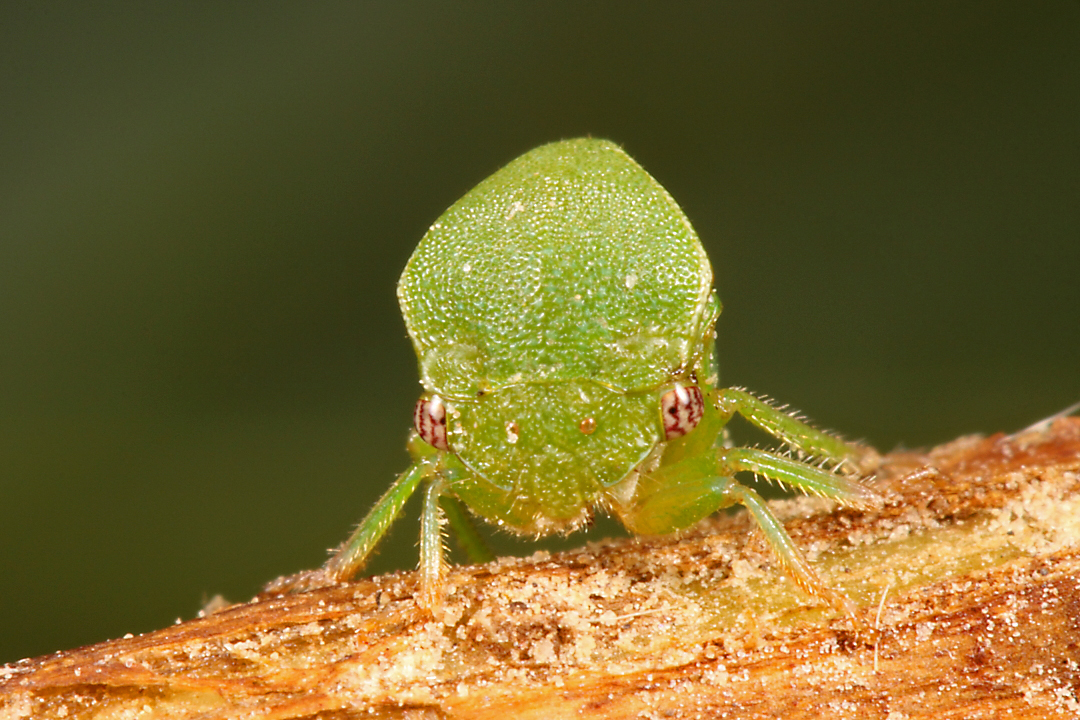
Spissistilus festinus (three-cornered alfalfa hopper) is one of the few truly economic pests in the otherwise bizarre and innocuous family Membracidae (treehoppers).  Its common name alludes to one of the crops it affects, but my encounters with this species are most often in soybean (I am, after all, a soybean entomologist).  Damage in this crop is caused by both adults and nymphs, whose piercing/sucking mouthparts cause girdling and breakage of the stem—often just a few inches above the soil.  This individual was seen during my travels last week in a soybean field in Stoneville, Mississippi, where numbers throughout the season were especially high this year.  Although I have seen innumerable S. festinus adults, I have never noticed their crazy, zig-zag patterned red and white eyes until I managed this closeup face shot (click on photo for best view).

This slightly cropped photo was taken with a 100mm macro lens and full extension tube set, resulting in slightly more than 2X magnification.  One of the lessons I took from was the need to pay more attention to background and value contrast.  By placing the subject a few inches in front of the dark green soybean foliage I was able to achieve a much more pleasing background than the typical black background one gets with full flash photos at high magnification.  Although both the subject and the background are green, there is still sufficient difference in shade to create contrast between them.  Light-green is one of the more difficult colors to work with when full flash is used with high shutter speeds and small apertures to maximize crispness and detail (in this case, 1/250 sec and f/16).  However, increasing ISO to 400 and lowering flash exposure compensation to -2/3 can reduce the amount of flash needed to illuminate the subject with such settings, making it easier to achieve a properly exposed and true-colored subject.

Copyright © Ted C. MacRae 2011

BugShot 2011 – Lesson 2

Most of my insect photography is done up close using fast shutter speeds (to prevent motion blur) and small apertures (to maximize depth of field).  This necessitates the use of full flash – the amount of light reaching the camera sensor at f/16 and 1/250 sec is not enough to show any image at all, much less one properly exposed.  Full flash photography has its own set of challenges, but for the most part it can be used to produce excellent closeup photographs of insects, even very small ones.  One thing that has always bothered me about full flash photography, however, is the “black background” effect when photographing an insect sitting up on a plant without something else in the immediate background to reflect light.  Not that I don’t like black backgrounds—they can be used to stunning effect with the right subject.  I just don’t want it to be my only option for insects that I photograph up off the ground. Of course, it is rather a simple matter to place something in the background that is close enough to reflect light but far enough away to remain out of focus, but what I really want to be able to do sometimes is have a blue sky.  I always thought this meant natural light, with its low f stops, slow shutter speeds, and the resulting motion blur and loss of depth of field. 

Of the many things I learned today, how to include a blue sky background in a closeup photograph at f/16 was my favorite.  This is accomplished by bumping up the ISO to 400 (to make the camera sensor more receptive to light) and decreasing the shutter speed to 1/60 sec.  Keeping the f stop high maintains the depth of field, but the increased ISO and decreased shutter speed allows sufficient light from a sky background to register on the sensor.  By themselves, however, these setting will still result in an underexposed subject, which is illuminated instead by fill flash.  Despite the slower shutter speed, there is no motion blur because the “effective” shutter speed for the subject is the duration of the flash pulse rather than the camera shutter speed—it’s like combining two exposure speeds in a single photograph, one for the background and another for the subject.

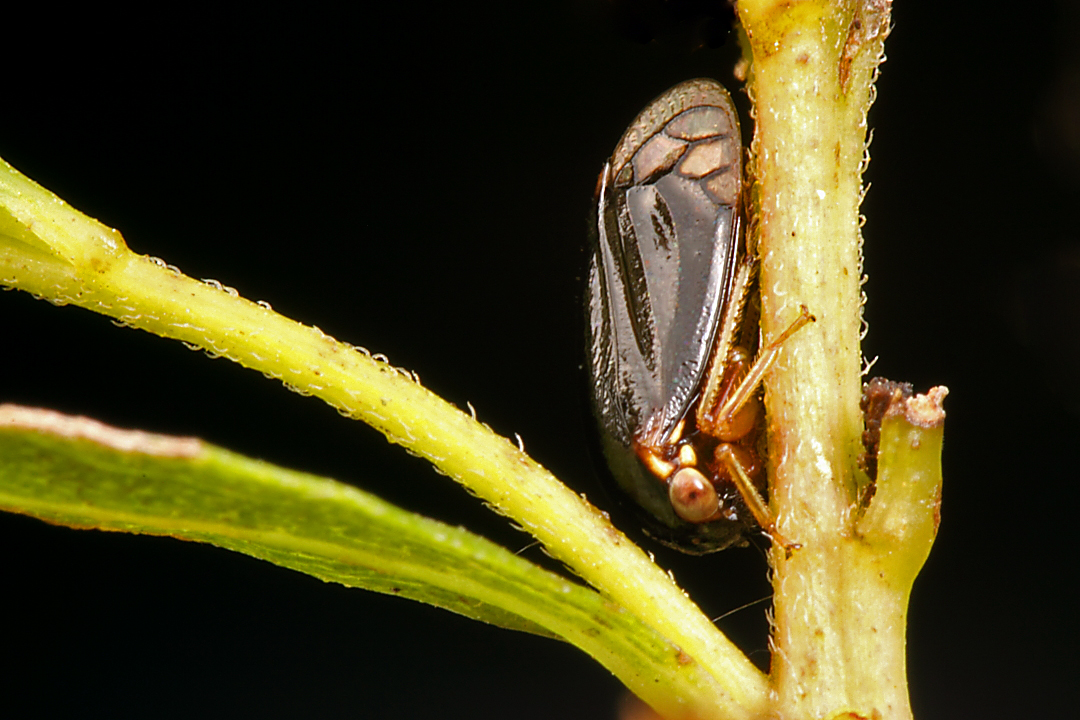
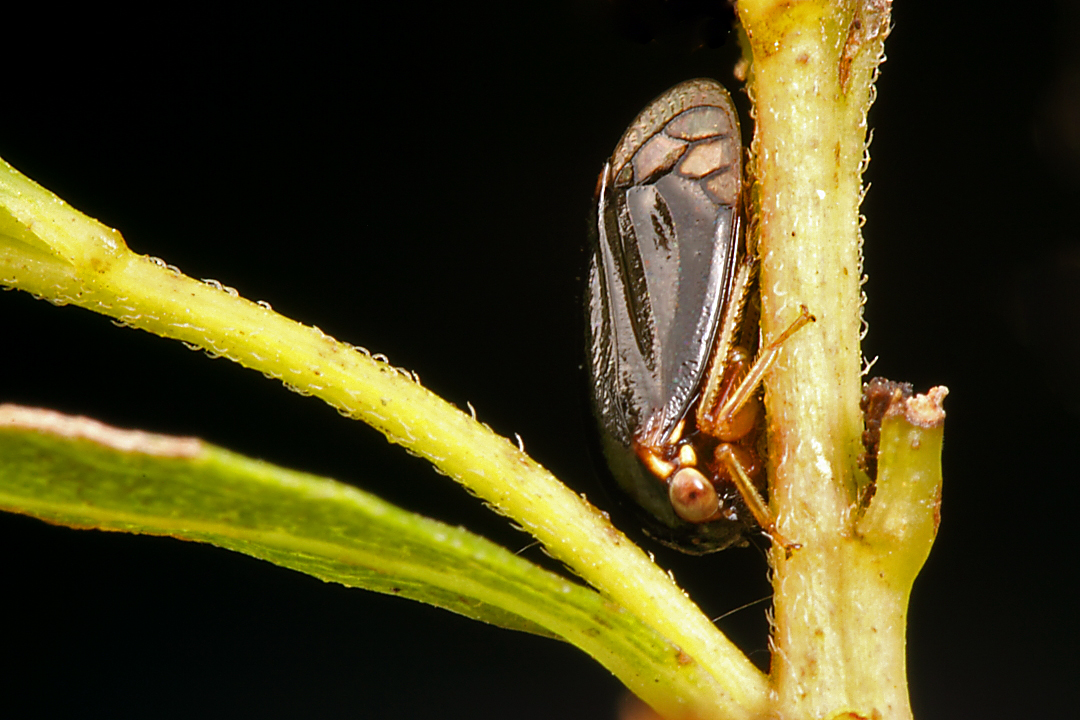
The following three photographs illustrate this principle—again, they are not technically perfect photos, but rather the result of quick experimentation to understand the principles involved.  Photo 1 is from yesterday’s post and illustrates what my typical settings have always been: ISO 160, f/16, and 1/250 sec.  It’s a decent photo of the treehopper, Acutalis tartarea; however, black is perhaps the least appropriate background to choose for this black species. Until now, it would have been my only option unless I tried arranging foliage in its background.  Photos 2 and 3 are of another individual of this species that I found today (fortunately in similar orientation to the individual photographed yesterday).  In both photos I kept the flash unit set to ETTL (adjusting FEC as appropriate for the shots).  In Photo 2 I bumped up the ISO to 400 but kept the shutter speed fast (1/200 sec)—you can see some effect in that the background is not truly black, having received some light from the blue sky.  It’s not enough, however, because the shutter speed was still too fast.  In Photo 3 the ISO remained at 400 but the shutter speed was also decreased to 1/60 sec.  The shutter staying open that long allows enough light from the sky to register on the sensor and, Voila!, we have a blue sky background that creates nice value contrast with the black subject.  The subject these photos is not terribly sharp, but that is just lack of focus—not motion blur from a slow shutter (sorry, I was just practicing settings rather than going for a perfect shot). All three photos were shot with the Canon 100mm macro lens + 68 mm of extension tube (total magnification ~2X).

''Typical'' insect macro settings: ISO 160, 1/250 sec, f/16

ISO increased to 400 (1/200 sec, f/16)

Shutter speed decreased to 1/60 (ISO 400, f/16)


Copyright © Ted C. MacRae 2011

BugShot 2011 – Lesson 1

I’m a lucky guy! First, I’m one of the fortunate attending this weekend’s BugShot insect photography workshop. Second, this first-of-a-kind event is being held only 13 miles from my home at Shaw Nature Reserve in Gray Summit, Missouri. Third, I was “adopted” by the BugShot instructors to assist in the event. Who are the instructors? None other than John Abbott from Austin, Texas—an expert on dragonfly biology and insect action photography, Thomas Shahan from Norman, Oklahoma—master of close-up arthropod (especially jumping spider) portraiture, and Alex Wild from Champaign-Urbana, Illinois—ant photographer extraordinaire and author of the most popular insect blog on the net.  In 2009 I picked up a digital SLR camera for the first time ever—in 2011 I am rubbing shoulders, discussing exposure and lighting, and enjoying social time with three of the country’s most accomplished insect macrophotographers (and some other very cool people as well).

I have come a long way, but I still have much to learn.  Intimate understanding of lighting, exposure, and the creative use of flash still eludes me—I can do a few things well, but there is much more I can’t do at all.  Today was my first time experimenting with the effect of lighting direction, i.e. taking the flash heads off their fixed position on the front of the lens and hand-holding them in different positions.  This simple technique can have dramatic effects on the look of a photograph, as illustrated by the following two photographs.  In the first, both flash heads of my Canon MT-24EX twin flash are attached to the front of the lens (as they have been for every single flash photograph I’ve ever taken up to this point).  In the second, only the right flash head remains attached to the lens, while the left head has been detached and is being hand-held directly above the subject (in this case, the treehopper Acutalis tartarea on Solidago sp.).  Technically they are not very good photographs, but they illustrate well the dramatic differences that can be achieved by varying the position of the flash heads.  Among other things, this is a technique that I will be exploring much over the coming weeks.

Both flash heads attached to front of lens.

Right flash head attached to front of lens; left flash head held directly above subject.

Copyright © Ted C. MacRae 2011

Vinerunt, futuerunt, ierunt

Very rough translation: They loved us, then left us. (the cicadas, that is.)¹ 

¹ Guest blogger’s subtext — Maybe if I dazzle the readers with a title in the colorful language of Pompeiian graffiti, they’ll forgive me for not posting pictures as beautiful as Ted’s. Well, anyway…

On this year’s US Independence Day, we in the St. Louis area were able to proclaim our freedom from the 5-week-long din of cicadas, or so the TV “news” reporters would have us believe. For me, it was more of a return to the dominance of human-made noise; the faint drone of a distant highway, the monotone roar of a neighbor’s lawn mower, the repetitively plosive engine of one of the many diesel pickups that float by, with the CD player’s bass thumping at an almost certainly hearing-damaging decibel level.

Magicicada burrows

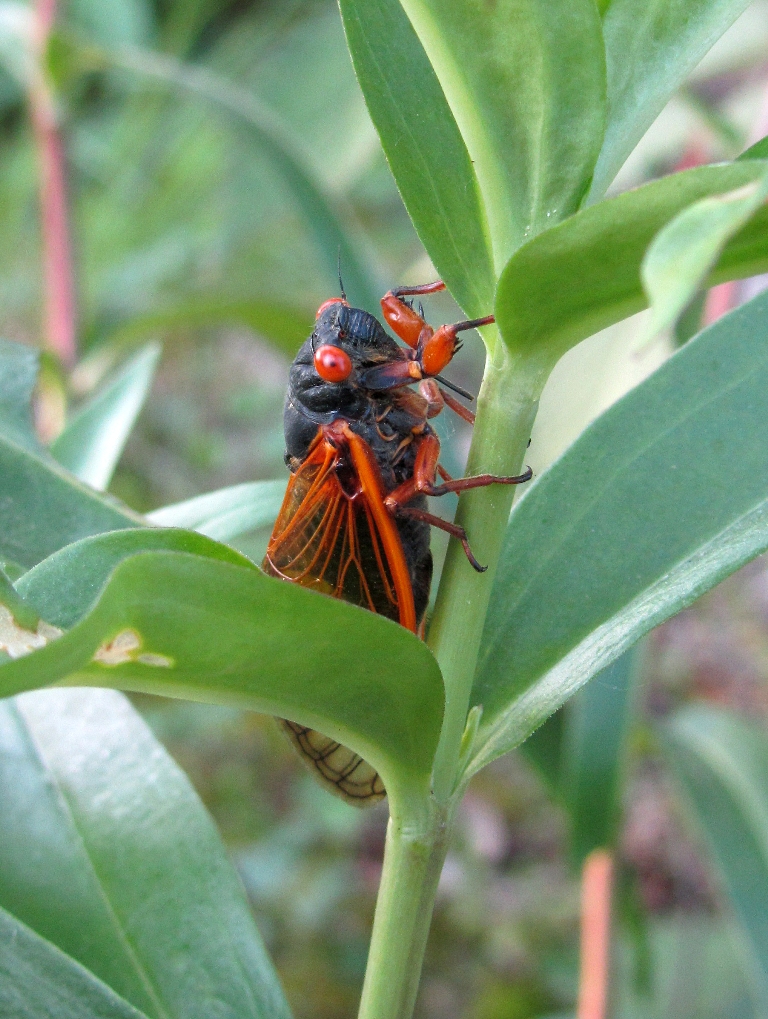
I started my celebration early in the day, by doing some gardening and rearranging in the yard. Moving a pile of concrete paving stones, I reached the bottom one and lifted it, and was greeted with a view of abandoned nymphal emergence burrows made by just a few of the many thousands of periodical cicadas that graced my yard with their presence this year. The burrows were already showing wear at the edges in their disuse. A little later later in the morning, I heard the whoooooooa-ooh of a last, lone Magicicada tredecim male from the hackberry tree—first one call, then another, then no more. But nature’s course proceeds, and as afternoon drifted into evening, I was pleased to hear the first of the dogday, or annual, cicadas of the genus Tibicen. These are not truly annual; They emerge every year, but actually take several years—4 or 5, it is said—to develop from egg to adult. 

The four Magicicada species that can be found in the St. Louis area, near the western edge of Periodical Cicada Brood XIX (a.k.a. the Great Southern Brood), are famous for their intermittent emergence as adults, every 13 years. (Life spans of 17 years occur in three, more northern species that do not occur in the St. Louis area). In fact, during years to either side of the two emergences of Brood XIX that I’ve experienced since moving to this area 24 years ago, I have always heard, and if really lucky, seen a few, one or two years before and after the “scheduled” emergence. But, the vast majority stick to the plan of feeding on the xylem sap of tree roots as subterranean, tan-colored nymphs for 13 seasons before coming out of the ground, then molting to the ever-so-buggy-looking, winged, black insects with red eyes and wing veins, that “freak everyone out” during their mass emergences. 

The mass emergence is all about reproduction, the successful transmission of genes to the next generation—you know, Darwinian fitness. When a female happens to “like” the song of a particular male, she flies to him, then is courted a for a bit with a different song, before “succumbing to his charms”. Mating typically takes place up in trees. But, being amoral creatures of little brain or scruples, they may choose indelicately to copulate on a porch rail or other such public place. 

Magicicada mating

Magicicada sipping Gentiana andrewsii

Consumed with sex, the adults don’t eat much, but occasionally one sees a cicada poking its proboscis into some soft plant tissue for a drink of sap (clearly exhibiting the relationship of these large insects to those smaller sap-feeders, the aphids and such). A little sap-drinking does little damage to plants, but the insertion of eggs by the mated females into small twigs of woody plants can do quite a bit of “natural pruning”. This would be more of a concern if it happened every year, I suppose, but it really also does little damage in the long run, especially on a mature tree. Still, I would have appreciated it they hadn’t found my recently planted black gum tree such an attractive oviposition site. 

Magicicada damage on Acer saccharum

Magicicada meets Nyssa sapling

But I don’t begrudge them this. I miss their mass serenade. I treasure the remembered sight of a corpulent hairy woodpecker muddying itself to pull one nymph after another from rain saturated ground. I delighted in seeing a surprisingly chubby chipmunk perched fearlessly on an exposed root as it munched a cicada whose wings never properly expanded. Perhaps best of all was watching a red-shouldered hawk clumsily hop about on the lawn to snarf up cicadas that weakly fluttered to the ground. But now, the periodical cicadas are, till May of 2024, mere shells of their former selves. 

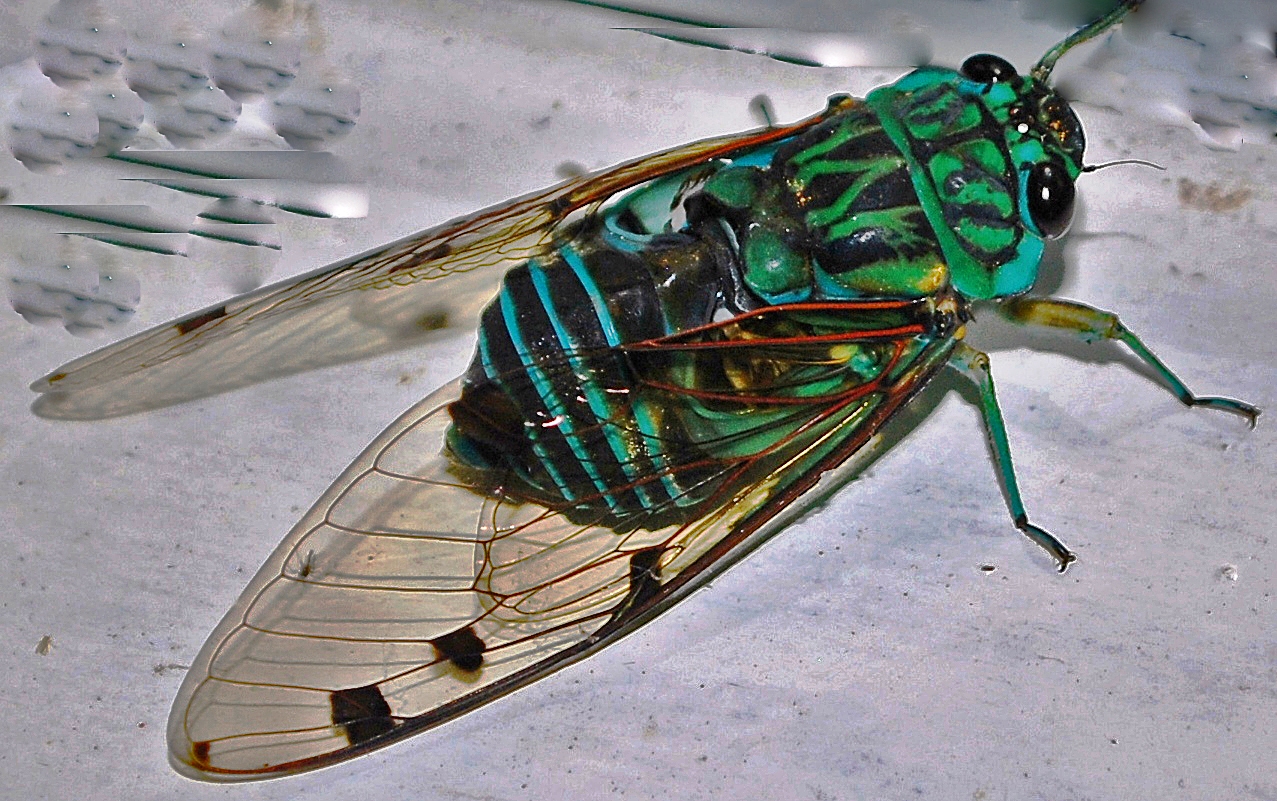
To end on a pretty note, here’s a gaudy cicada that was attracted to lights of the scientific station’s laboratory building in Yasuní National Park, Ecuador, and obligingly posed for a photo on the windowsill.

Ecuadorian cicada

Copyright © James Trager 2011

Predator Satiation

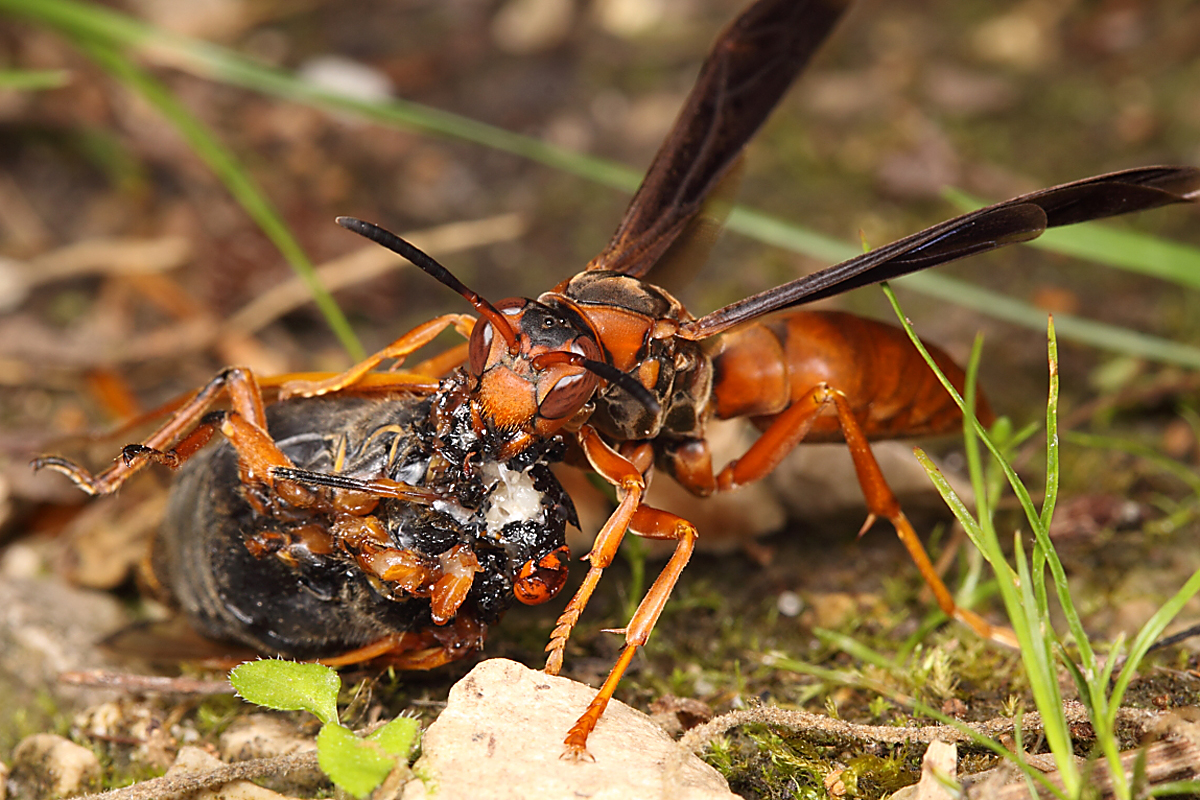
Polistes carolina/perplexus with Magicicada prey | Shaw Nature Reserve, Missouri

I’ve probably used the term predator satiation more often during the past couple of weeks than I have during the entire rest of my life.  Students of ecology know this as an antipredator adaptation in which prey occur at such high population densities that they overwhelm predator populations.¹  This ‘safety in numbers’ strategy reduces the probability that any given individual will be consumed, thereby ensuring that enough individuals survive to reproduce.  With St. Louis currently experiencing the appearance of Brood XIX of periodical cicadas, I’ve gotten lots of questions recently from many coworkers and friends wanting to know more about these cicadas.   Often the first question is “What is their purpose?”  My standard reply begins with a statement that they, like all living organisms, are the products of natural selection, which then presents an opportunity to explain how natural selection might result in such massive, temporally synchronized, multiple-species populations.  A few eyes have glazed over, but I think most have found my answer interesting, often even leading to further questions about where they lay their eggs, what is their life cycle, why are they so loud, how do they “do it” and select mates, etc.  Of course, as an entomologist with a strong natural history orientation, I’m always anxious to introduce people to ecological concepts, and right now the periodical cicada is providing a conspicuous, real-life example of such.

¹ Also called “predator saturation,” although this term might be misconstrued to mean that it is the predators that are over-abundant.

First the eyes...

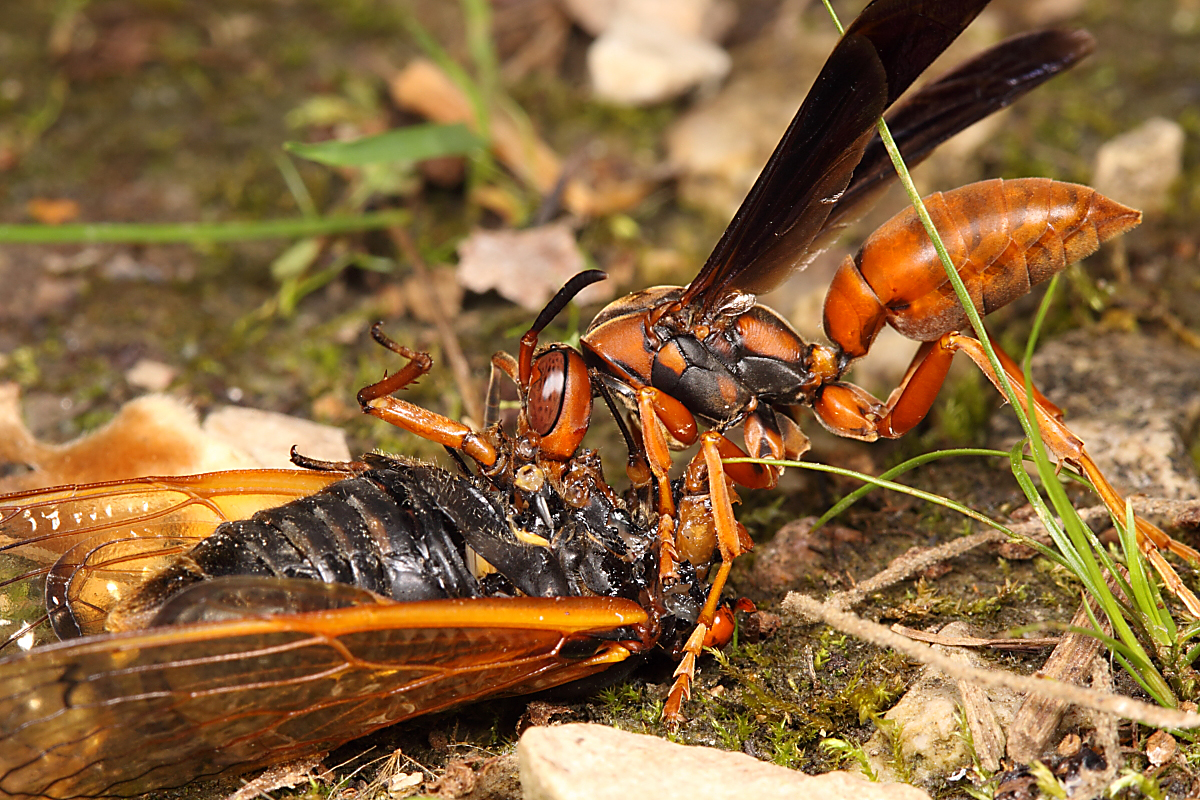
A few weeks ago, right at the beginning of their emergence in the St. Louis area, my friend Rich Thoma and I observed predator satiation in action.  While hiking one of the trails at Shaw Nature Reserve, we heard the unmistakable shriek and cellophane-sounding wing flapping of a just-captured male cicada.  Tussling on the ground ahead of us was the cicada in the grasp of a Polistes carolina/perplexus wasp, which was repeatedly stinging the hapless cicada on the underside of the abdomen.  The shrieking and wing-flapping grew less frequent as the stinging continued, until at last the cicada lay quiet.  As we approached, the wasp spooked and flew off, but we knew it would be back—we parked ourselves in place while I setup the camera, and before long the wasp returned.  It took several minutes of searching from the air and on the ground before the wasp finally relocated her prey, but once she did she began voraciously devouring it.  As the wasp was searching, we hypothesized that our presence had altered the visual cues she had memorized when flying off, resulting in some confusion when she returned, and thus the long period of time required to relocate her prey.

...then the legs!

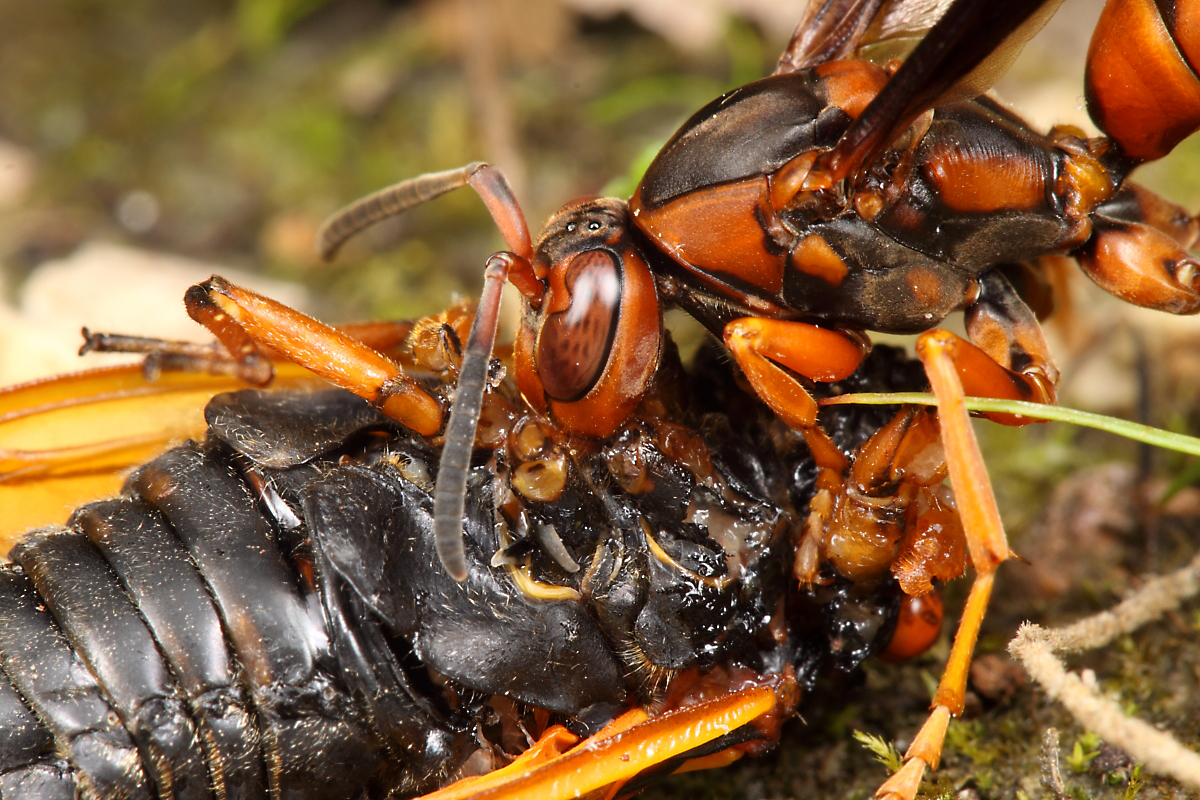
We watched for awhile—first the eyes were consumed, then the legs.  As it consumed its prey, Rich remarked that he bet he could pick up the wasp and not get stung—likely the entirety of its venom load had been pumped into the cicada.  Both of us declined to test his hypothesis.  We also wondered if the wasp would butcher the cicada after consuming part of it and bring the remaining pieces back to the nest.  We had seen a European hornet do this once with a band-winged grasshopper, consuming the head, then cutting off the legs from the thorax and flying away with it before returning to collect the abdomen as well.  No butchering took place this time, however, the wasp seemed content to continue eating as much of the cicada as possible—a satiated predator if there ever was one!

Leg after leg is consumed.

One eye and all six legs down, time to start on the abdomen.

Copyright © Ted C. MacRae 2011