North America’s second-rarest pine

Jeffrey (L) and Washoe (R) pines at Galena Creek Park

During last year’s trip to Lake Tahoe, I made it a goal to find all of the 11 conifer species occurring naturally in the Lake Tahoe Basin.  It took some effort, some good references (Arno 1973, Graf 1999, Lanner 1999, and Peterson 1975), and the help of an especially knowledgeable associate at the U.S.D.A. Forest Service headquarters in South Lake Tahoe, but I succeeded in my quest and later wrote two posts covering the Lake Tahoe conifers (Trees of Lake Tahoe – The Pines, Trees of Lake Tahoe – The “Other” Conifers).  In the first of the posts covering the six species of pines, I added the following footnote:

Two additional species of pine – Washoe pine (Pinus washoensis) and single-leaf pinyon pine (P. monophylla) – are often treated as occurring in the Lake Tahoe area. However, they are of sporadic occurrence on the eastern slopes of Mount Rose, and thus do not occur within the Tahoe Basin proper.

Of these, I am quite familiar with single-leaf pinyon pine.  Widespread on isolated mountain ranges throughout the Great Basin into eastern and southern California and Baja California Norte, I have encountered it during many of my field trips out west and reared a number of buprestid species from its tough, scrubby branches (including 2 specimens of the rarely encountered Phaenops piniedulis).  The other species, Washoe pine, was a new one on me, and it is, in fact, the second-rarest species of pine in all of North America (Torrey pine, Pinus torreyana, being the rarest).  Well, that was all it took to make me commit to finding this species on this year’s return to Lake Tahoe.

Washoe pine cones surround a larger Jeffrey pine cone.

Washoe pine grows only in a few locations, primarily in northern California with the best stands found in the Warner Mountains in Modoc County.  In the Tahoe area, Washoe pine grows only on the eastern slope of Mt. Rose in Nevada, where it is limited to the upper reaches of Galena Creek (Graf 1999, Lanner 1999).  It is apparently very similar to Jeffrey pine (P. jeffreyi) – the most common pine in the Tahoe area – but seems to be more closely related to ponderosa pine (P. ponderosa), which occurs at lower elevations and barely makes it up to the Tahoe area (some authorities even question the distinctiveness of this species, instead considering it a high elevation variety of ponderosa pine).  All three species are 3-needled and grow into tall, pyramidal trees with widely spaced horizontal branches.  Like ponderosa pine, the bark of mature trees forms broad yellowish plates separated by black fissures (the bark of Jeffrey pine is often more reddish with plate more narrowly separated).  The resin of Washoe pine is also chemically similar to that of ponderosa pine, both of which differ from the heptane-producing resin of Jeffrey pine.  However, Washoe pine cones more closely resemble those of Jeffrey pine, being somewhat smaller but sharing the “inward-curved” prickles on the scale tips that make them easy to handle (those of ponderosa pine point outwards, making them very prickly to handle).

Ponderosa (L) and Washoe (R) pine cones. Note smaller size and outward-pointing spines of ponderosa pine cone.

Jeffrey (L) and Washoe (R) pine cones. Both have inward-pointing spines, but Washoe pine cone is smaller and more loosely built.

None of my references had any specific locality information for Washoe pine beyond what I’ve stated above, but a little bit of Google snooping through conservation action plan documents revealed that the species occurred at Galena Creek Park, so early in the morning daughter Madison and I made the one-hour drive from South Lake Tahoe to the park.  Arriving at the park, I was disappointed to find nobody manning the headquarters, no maps in the park information board – indeed, no information whatsoever about the occurrence of Washoe pine within the park and where it might be found.  The only clue that there was something special about the pines at this place were the wooden signs around the parking and picnic areas stating “Collection of pine cones prohibited.” I reasoned that it would be very difficult to distinguish the species by its needles, bark, or form, but that the pine cones should be easier to distinguish. I also had no idea whether the pines would occur close to the parking area or if we would need to hike into the area to find them.  So, we just began picking up pine cones.  For a time, all of the pine cones seemed to be typical Jeffrey pine (abundant in the area) with an occasional ponderosa pine (just making up the 6,200′ of elevation in this area).  Ever concerned that I might be missing a subtle difference, I studied each “Jeffrey” pine cone carefully looking for any reason to regard it as truely smaller than normal.  Within about 15 minutes, however, we found it!  Picking up the pine cone, it had the compact build and inward-pointing spines of a Jeffrey pine, but it was smaller and a little more loosely built.  I looked at the trees above and could see no difference from what I would expect for a Jeffrey pine.  Further looking revealed numerous cones of the same type – each tree we found them under was otherwise indistinguishable from Jeffrey pine (at least to this eastern U.S.-based wannabe botanist).  Nevertheless, it was clear that we had found Washoe pine, and that it was quite abundant within this small watershed that we were exploring.  Jeffrey pine was also common in the watershed, and an occasional ponderosa pine could be found.  I took photos of mature individuals of each of the three species, identified conclusively by way of the cones found underneath them, to show how similar in appearance the three species are.
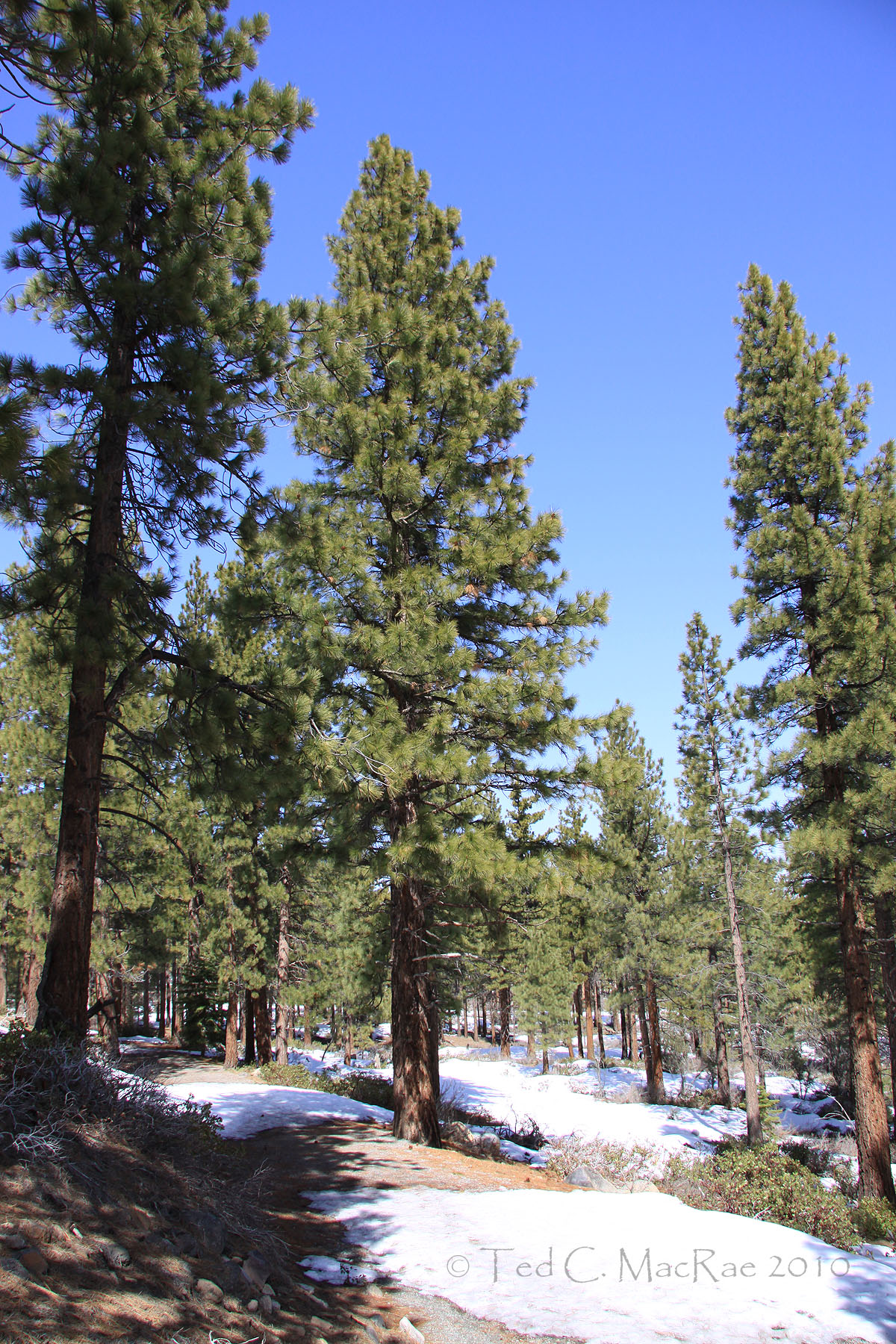
Pinus ponderosa
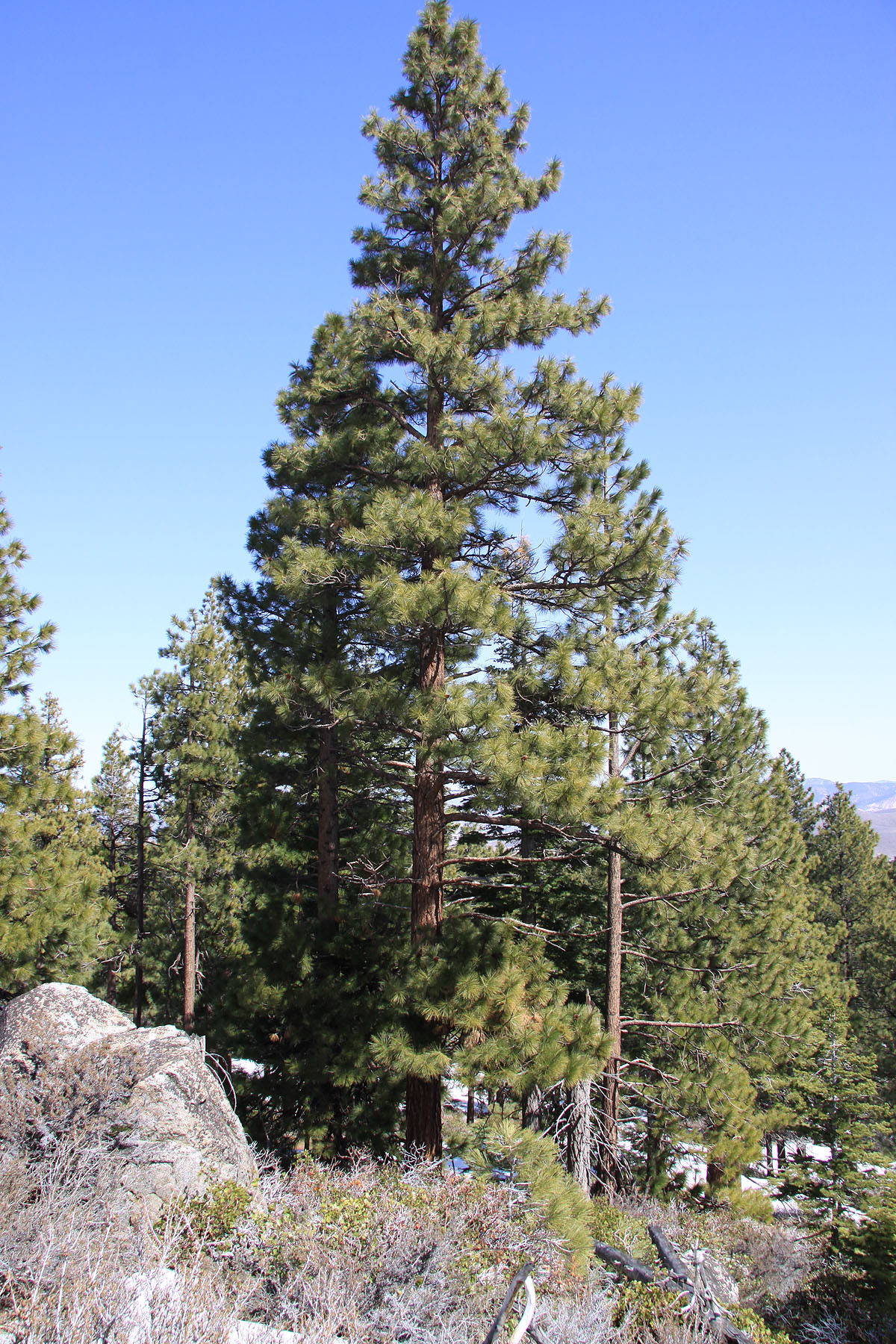
Pinus jeffreyi

Pinus washoensis

Madison and I later hiked out of the watershed into the higher elevations of Mt. Rose (from where these ants were photographed) – we noticed that almost immediately upon hiking out of the watershed the Washoe and ponderosa pines disappeared, and only Jeffrey pines were seen.  Although I have seen it many times before, I was still hoping to see single-leaf pinyon pine, but none were seen.

REFERENCES:

Arno, S. F. 1973. Discovering Sierra Trees. Yosemite Association, Yosemite National Park, California, 89 pp.

Graf, M.  1999. Plants of the Tahoe Basin.  Flowering Plants, Trees, and Ferns.  A Photographic Guide. California Native Plant Society Press, Berkeley, 308 pp.

Lanner, R. M.  1999. Conifers of California.  Cachuma Press, Los Olivos, California, 274 pp.

Peterson, P. V., and P. V. Peterson, Jr.  1975. Native Trees of the Sierra Nevada.  University of California Press, Berkeley, 147 pp.

Copyright © Ted C. MacRae 2010

Winter Botany Quiz #6 – answers and a checklist

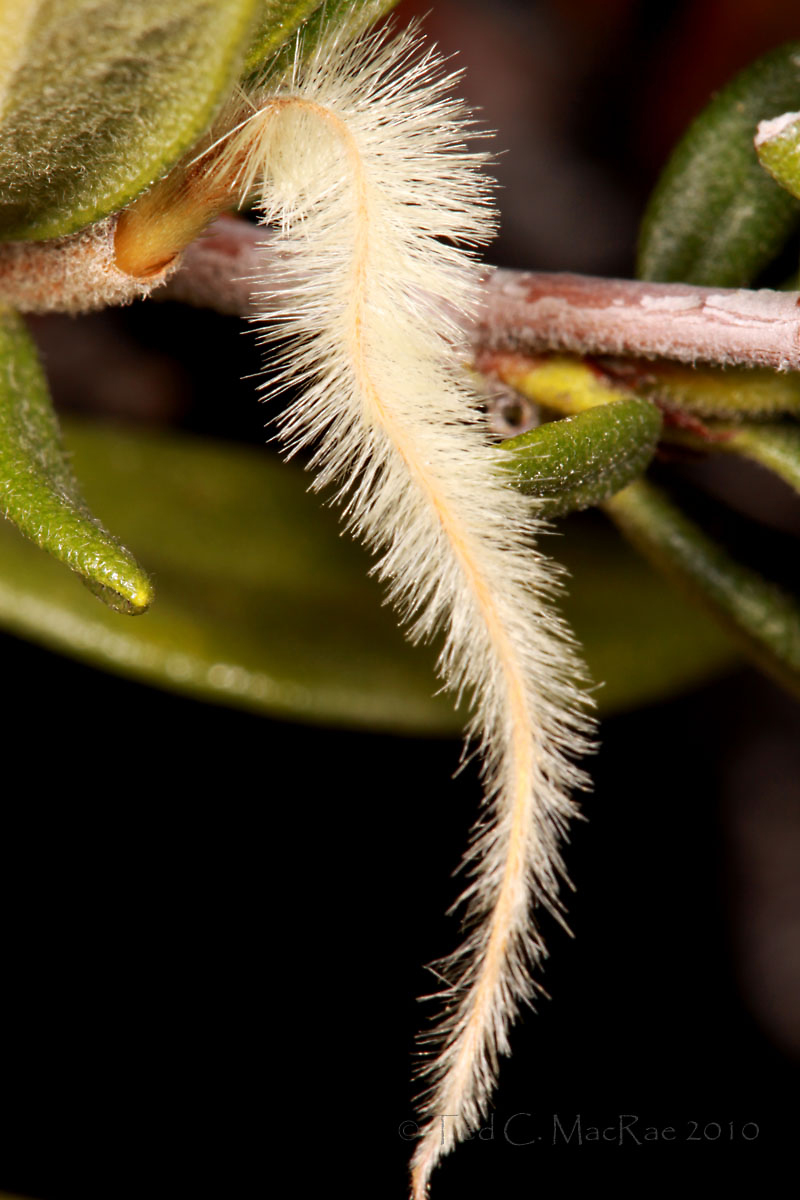
I thought yesterday’s Winter Botany Quiz #6 would be a fairly difficult, and given the apparent difficulty of my previous quizes (Pismire Puzzle and Tuesday Teaser) I thought I’d give readers a break this week and narrow down the location to the Lake Tahoe area. Despite publishing in the dead of night, it took only 31 minutes for Peter Yeeles to swoop down and correctly name the family, genus, species, and function for the structure pictured. His only lapsus regarded the terminology used for the name of the structure itself, leaving the door open for James Trager to snag some scrap points. The plant is, of course, Cercocarpus ledifolius (curl-leaf mountain mahogany) in the family Rosaceae, and the structures pictured above and in the previous post are the stigmas of the flowers persisting as wind-assisted dispersal structures for the fruit. “Cercocarpus” is, in fact, derived from the Greek words for “tailed” and “fruit”, whose numerous erect hairs give the plant in a silvery sheen late in the growing season.

Why was I interested in this plant? It was one of the few tree species occurring in the Lake Tahoe Basin that I wasn’t able to find for last year’s 3-part series, Trees of Lake Tahoe (including The Pines, The “Other” Conifers, and The Deciduous Trees).  Widespread in the mountainous west (and barely qualifying as a tree), its occurrence in the Tahoe Basin is more sporadic.  Better stands are found outside the basin proper on the dry eastern flank of the Sierra Nevada (Graf 1999), and indeed these plants were photographed at ~6,500 feet on the eastern slopes of Mt. Rose.

My real interest in Cercocarpus, however, is as a favored host plant for species of jewel beetles (family Buprestidae).  About two dozen species of these beetles have been associated with Cercocarpus spp. in North America, nine of which have been confirmed as breeding within dead branches of these plants and five having been associated with no other plant.  I’ve collected a number of these species myself, particularly in the San Gabriel and Santa Rosa Mountains of southern California and the Chisos Moutains of Big Bend National Park in Texas, including Polycesta cazieri, Chrysobothris piuta, and paratype specimens of Acmaeodera rubrocuprea. I thought it might be of interest to any readers who might collect these insects to present a checklist of Buprestidae associated with Cercocarpus in North America (see appendix below).

REFERENCE:

Graf, M. 1999. Plants of the Tahoe Basin. Flowering Plants, Trees, and Ferns. A Photographic Guide. California Native Plant Society Press, Berkeley, 308 pp.

Checklist of North American Buprestidae associated with Cercocarpus

(Bold indicates species that have been reared from Cercocarpus.  An asterisk indicates species that have been associated exclusively with Cercocarpus).
Acmaeodera (s. str.) angelica Fall
Acmaeodera (s. str.) connexa LeConte
Acmaeodera (s. str.) dolorosa dolorosa Fall
Acmaeodera (s. str.) idahoensis Barr
Acmaeodera (s. str.) mariposa mariposa Horn
Acmaeodera (s. str.) mariposa dohrni Horn
Acmaeodera (s. str.) nelsoni Barr
Acmaeodera (s. str.) nexa Fall
Acmaeodera (s. str.) plagiaticauda Horn
Acmaeodera (s. str.) pubiventris lanata Horn
Acmaeodera (s. str.) rubrocuprea Westcott & Nelson*
Acmaeodera (s. str.) vandykei Fall
Acmaeodera (s. str.) variegata LeConte
Acmaeodera (Squamodera) vanduzeei (Van Dyke)
Anthaxia (Haplanthaxia) caseyi sublaevis Van Dyke
Anthaxia (Melanthaxia) porella Barr*
Anthaxia (Melanthaxia) simiola Casey*
Chrysobothris bisinuata Chamberlin*
Chrysobothris mali Horn
Chrysobothris piuta Wickham
Chrysobothris purpureovittata purpureovittata Horn
Chrysobothris purpureovittata cercocarpi Westcott & Nelson*
Dicerca (s. str.) hornii hornii Crotch
Polycesta (Tularensia) californica LeConte
Polycesta (Tularensia) cazieri Barr

Copyright © Ted C. MacRae 2010

Add to FacebookAdd to DiggAdd to Del.icio.usAdd to StumbleuponAdd to RedditAdd to BlinklistAdd to TwitterAdd to TechnoratiAdd to Yahoo BuzzAdd to Newsvine

Email to a friend

Winter Botany Quiz #6

This photo was taken during my March trip to Lake Tahoe.  Can you identify the plant (family, genus, species), the structure shown, and its function?  Answer and more photos tomorrow.

© Ted C. MacRae 2010

Add to FacebookAdd to DiggAdd to Del.icio.usAdd to StumbleuponAdd to RedditAdd to BlinklistAdd to TwitterAdd to TechnoratiAdd to Yahoo BuzzAdd to Newsvine

Email to a friend

Bicycle ride around Lake Tahoe

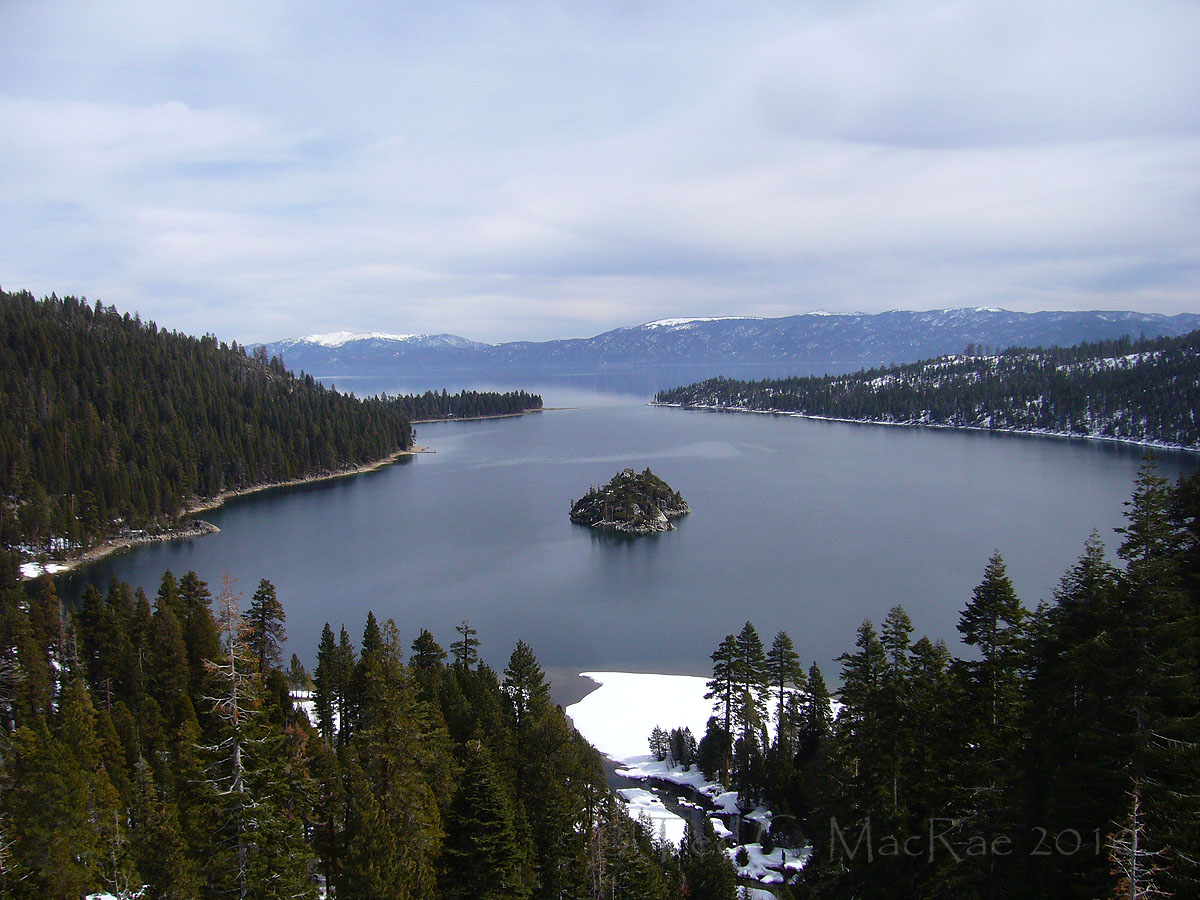
Overlooking Emerald Bay from Emerald Bay Pass.

Perhaps some of you have by now deduced that, in addition to insects and natural history, I have a second passion – cycling! In fact, I raced bikes competitively as an amateur for seven years (going by the local nickname “BugMan“) before hanging it up at the end of 2008.  However, even though I’m not racing anymore, I still ride as much as ever, only now it’s purely for the fun of it!  I’m a dedicated roadie, riding year-round and averaging around 5,000-6,000 miles a year.  I love the speed and the smoothness of the road and the opportunity it provides to cover long distances and enjoy the sights (not to mention the resulting freedom to eat like a horse and stay relatively trim!).

One of my most memorable cycling experiences was in 1995, when I joined a group that rode the entire circuit around Lake Tahoe.  I was living in Sacramento at the time and was a relative newbie – the 72-mile ride with 3,500 feet of climbing at elevations ranging from 6,200 feet at lake level to more than 7,000 feet near Carson Pass was without question the most difficult ride I had ever attempted at that point.  Now, as a seasoned ex-racer, such a ride is not extraordinarily difficult for me – in fact, I do rides in the 60-80 mile range with as much climbing or more almost every weekend.  Still, my memories of the challenge and the unbelievable scenery have kept that ride high in the ranks of my most epic, and since we began going back to Lake Tahoe two spring ago I’ve wanted to do it again.  It would not have been possible during our first trip back, as the roads still had quite a bit of snow on them; however, last year the roads were clean and dry, and I resolved to bring my bike with me on this year’s trip in the event that such was again the case.  Madonna del Ghisallo (patron saint of cycling) must have been smiling down upon me, because this year the roads were again in beautiful condition, despite the amount of snow blanketing the surrounding landscapes.  It made for one of the most beautiful bike rides I have ever done in my life.

There was a comforting familiarity to the ride, despite the 15 years since the last – the stunning landscape that I have come to cherish so dearly, the massively shaded solitude of the west shore, lunching on California cuisine in a quaint village along the north shore, and the long climbs and screaming descents through open Jeffrey pine forests along the east shore.  It was also different – I was by myself, yet despite that I was stronger and briming with confidence; not only a seasoned cyclist, but also much more knowledgeable of and closely attuned to the natural history of the area.  I didn’t fear the climbing, I relished it!  I didn’t overcome the challenge, I enjoyed it!  I stopped at a few places to take photographs (taken with my small point-and-shoot, for obvious reasons) and share some of them here – I hope they give you a tiny taste of the flavor of that day.

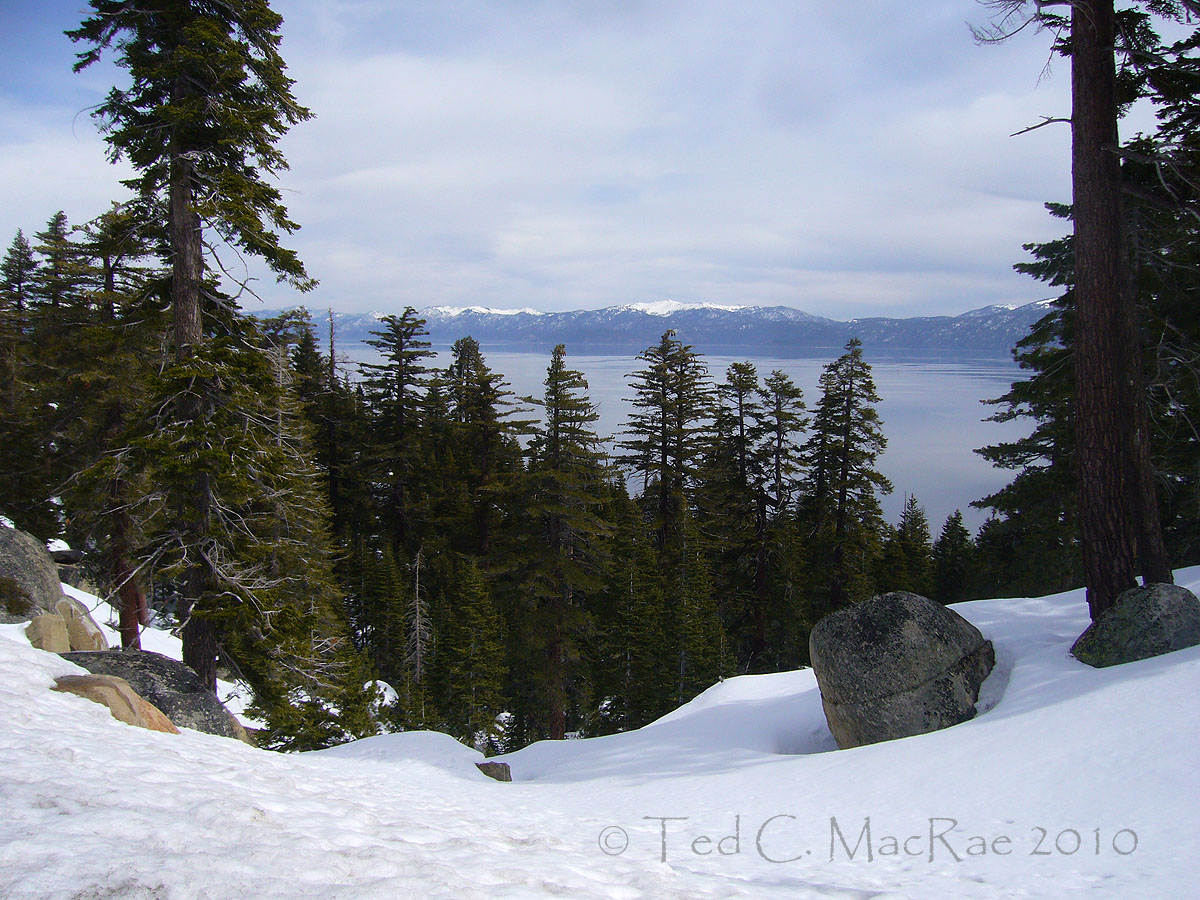
Near the summit of Emerald Bay Pass, looking back at Mt. Tallac.

High point on Emerald Bay Pass.

The descent to Eagle Falls at Emerald Bay.

 This is an avalanche zone (note deep snow deposits on steep slopes on left side – these extend high up the mountain here).  Moments after taking this photo, an avalanche fell onto the road right as I was descending by this spot. At ~35 mph there was no stopping – I rode right through it as the initial snow drop hit the pavement and then watched in amazement as the main drop dumped onto the road behind me.  It was not big enough to bury anything, but I surely would have crashed had I gotten there just a moment or two later!

Overlooking Emerald Bay from Emerald Bay Pass.

Emerald Bay is a glacial scour formed during the last glacial period ending only 10,000 years ago. Fannette Island, Lake Tahoe’s only island, is thought to be a resistant rib of granite rock that was overridden by the glacial ice. Lateral glacial morraines enclose each side of the bay, and an incomplete terminal morraine connects Emerald Bay to the main lake. Last year, I stood atop the outermost rock of the left side of the terminal morraine and took photographs looking back in this direction

Grove of sugar pines at D. L. Bliss State Park.

Sugar pine, Pinus lambertiana, is among my favorite of all pines.  More common on the west shore due to their preference for higher levels of moisture, their towering, ragged, asymmetrical crowns with long, pendulous cones (usually a foot or more in length) hanging from the branch tips are immediately recognizable from afar.  These majestic trees are the world’s tallest pine and bear the longest cones in the genus; they stand in defiant contrast to the uniformly symmetrical crowns of the more common Jeffrey pines (Pinus jeffreyi) and white firs (Abies concolor) that surrounded them.  For a more thorough treatment of the trees of Lake Tahoe, please visit my three-part series covering the pines, the “other” conifers, and the deciduous trees.

Some might think it was still a little too early in the season for bike riding.

Looking west across Lake Tahoe from Logan Shoals Overlook.

The east shore in Nevada is decidedly drier than California’s west shore.  The forest on the Nevada side is a more open, fire-mediated landscape dominated by Jeffrey pine, as opposed to the denser forests on the west shore with higher incidence of shade-tolerant trees such as white fir and incense-cedar (Libocedrus decurrens).

View of Cave Rock (left center) from Logan Shoals Overlook.

Cave Rock was and still is a sacred place for people of the Washoe tribe, whose ancestors occupied Lake Tahoe during the summers and performed religious ceremonies inside the largest of its caves.  These caves, sitting several hundred feet above the current lake level, were carved by wave action shortly after Lake Tahoe’s formation nearly 3 million years ago when lake levels were much higher than they are today.  The first of two highway tunnels was blasted through the rock in 1931 (much to the dismay of the Washoes), and the second was added in 1957.

Looking north along Lake Tahoe's east shore from atop Logan Shoals Overlook.

Copyright © Ted C. MacRae 2010

Add to FacebookAdd to DiggAdd to Del.icio.usAdd to StumbleuponAdd to RedditAdd to BlinklistAdd to TwitterAdd to TechnoratiAdd to Yahoo BuzzAdd to Newsvine

Email to a friend

Friday Flower – Ozark Witch Hazel

Spring is beginning its “march” across the nation, and in typical fashion the month started out with the promise of pleasant weather but is throwing a few tantrums before giving way to April. For most folks in the lower Midwest, spring began a week or so ago when daffodils began popping up from nowhere and dotting the suburban and semirural landscapes with their yellow smiles. Forsythia are also set to burst forth, their appearance temporarily put on hold by this latest cold/wet snap, but when they do most people here will be satisfied that spring has finally come. For me, spring comes much earlier, and it’s not planted ornamentals that mark its beginning, but native trees.  Silver maples (Acer saccharinum) and American elms (Ulmus americana) are first, bursting open in the very first warm days of early March.  These are followed by the sugar maples (A. saccharum) and red maples (A. rubrum) that are in full bloom now, which will themselves give way to the redbuds (Cercis canadensis) and serviceberrys (Amelanchier arborea) that will close out the month before flowering dogwood (Cornus florida) dominates the area’s understories in April.

There is one tree in this part of the country, however, that shows its amazing blooms in January and February while winter’s grip is still strong.  Ozark witch hazel (Hamamelis vernalis) is restricted to the Ozark Highlands of Missouri and Arkansas, where it grows along the rocky creeks and streams that dissect this ancient landscape.  I have long wanted to see its striking blooms, but despite my many wintertime hikes throughout the Ozarks, I have never found myself in the right place at the right time – until a few weeks ago when I hiked the Mina Sauk Trail at Taum Sauk Mountain State Park.  I found these plants growing below Mina Sauk Falls and along Taum Sauk Creek below, and even though it was the first weekend of March (and the very first warm day of the season), many of the plants had already passed their peak bloom.  Fortunately, I was able to find these several plants with flowers still in good shape.

There is only one other species in the genus – eastern witch hazel (Hamamelis virginiana).  Although distributed widely across eastern North America, it is restricted in Missouri to these same St. Francois Mountains where I saw H. vernalis.  The two species are very similar by the characteristics of their foliage but can be easily distinguished by floral characters.  Hamamelis virginiana blooms in fall rather than winter, and its flowers, while nearly twice the size, rarely show the amount of red on the inner calyx that is seen in this species.  Hamamelis vernalis flowers are also quite fragrant, having what has been described as a “vanilla” scent.  The photographs here show the rather unusual color range of the flowers of this species, which can vary from orange to deep red to deep yellow.  I suspect that flower color also changes with age, in that petals are initially deep red and later fade to yellow, as in the photo below.  It’s difficult to explain why H . vernalis is restricted to the Ozark Highlands while H. virginiana occurs so broadly, but the Ozarks are a well-known refugium for a number of other plants and animals, especially Ice Age relicts.

Sitting on a rhyolite ledge overlooking Taum Sauk Creek as I ate lunch, I wondered about the pollination biology of a plant that flowers during winter.  It was a warm day – certainly an unusual occurrence during the period in which this plant flowers – and even still it was too early in the season for a lot of insect activity.  I watched one of the nearby plants as I ate to see what insects came to the flowers, and for a time all I saw were a couple of European honey bees.  Clearly, the plant did not evolve in association with this now ubiquitous insect.  I continued watching, and at last I saw a native insect visiting the flowers – a large species of hover fly (family Syrphidae), perhaps something in the genus Helophilus.  After taking a few more photographs (unfortunately, none of the fly), another of the same species visited the plant.  Flies in general are famous for appearing during warm days in winter, and I wonder if the unusually extended bloom period of this species is intended to take advantage of those few, unpredictable days during winter when temperatures are sufficient for flies to become active.

Photo Details: Canon 100mm macro lens on Canon EOS 50D
Photo 1: ISO 100, 1/200 sec, f/11, MT-24EX flash w/ Sto-Fen-Puffer diffusers.
Photo 2: ISO 200, 1/200 sec, f/5.6, ambient light.
Photo 3: ISO 100, 1/60 sec, f/9, flash w/o diffusers.
Photo 4: ISO 200, 1/250 sec, f/5.6, ambient light.

Copyright © Ted C. MacRae 2010

Add to FacebookAdd to DiggAdd to Del.icio.usAdd to StumbleuponAdd to RedditAdd to BlinklistAdd to TwitterAdd to TechnoratiAdd to Yahoo BuzzAdd to Newsvine

Email to a friend

Clubmoss along the Ozark Trail

It has been a long, hard winter – one of the toughest I can remember during my years here in Missouri in terms of amount and frequency of precipitation and persistent cold temperatures. Tough winters, however, are no deterrent to my favorite wintertime activity – hiking. I’ve mentioned several times the goal of my friend Rich and I to hike all 350 miles of the Ozark Trail.  We’re at ~250 miles now (more than 2/3 done), thanks to the two 10-mile stretches of the Wappapello Section that we did on the days after Thanksgiving and New Year’s. 

Hiking these trails is an opportunity to imagine the Ozark Highlands in their wild, pre-settlement state – expansive hardwood forests covering miles and miles of rugged up-and-down terrain.  Of course, try as I might to pretend otherwise, the Ozarks have changed, and evidence of man’s pervasive presence are everywhere.  Some are overt, such as this mass grave of domestic cattle, dumped by their former owner for others to worry about when disease prevented them from realizing their economic potential.  Others are much more subtle, but to the discriminating naturalist they are everywhere – even in the most pristine-looking of areas.  A cedar-choked glade here, it’s rich, tawny, native warm-season grasses pushed the margins and interspaces; a monotonous, stunted black oak forest there, sprigs of herbaceous plants giving a hint of the diverse understory just waiting for a fire to bring back the more open woodland it needs to thrive.  Settlement has brought with it not only direct impacts to the land, but also changes in its ecology and vegetational character.  Once a fire-mediated landscape with shifting mosaics of bald ridges, grassy woodlands, and riparian forests, a century of logging, grazing, and fire suppression have turned much of the Ozark Highlands into homogenous stands of oak with depauperate mid- and understories.

While loss of diversity has been the overwhelming trend in response to settlement, additions to the state’s flora are also being seen.  The Wappapello Section is the southeasternmost of all the Ozark Trail sections, lying almost entirely in Wayne County, and as we traversed the rugged terrain north to Sam A. Baker State Park, we encountered this most unusual of plants – a clubmoss.  Since they are vascular plants, clubmosses are not really moss (which are non-vascular).  Clubmosses are not flowering plants either, nor do they even produce seeds, reproducing instead by spores – just like ferns, horsetails, and other ‘primitive’ (sorry, Alex!) vascular plants.  Practicing botanists include them in a group known as “fern allies”, meaning that they are not ferns (ferns have multiple branching veins in their delicate fronds, while clubmosses have a single vein in their small, scale-like leaves), but they are somewhat like them.

This particular clubmoss belongs to the genus Lycopodium, or ground cedars – the name obviously derived from the resemblance of their foliage to various gymnospermous plants known as cedars (though completely unrelated) but growing very low to the ground. There are three species of Lycopodium in Missouri (Yatskievych 1999), all confined to the Ozark Highlands and all considered species of conservation concern due to their rarity in the state (Missouri Natural Heritage Program 2010).  Two of these species are highly restricted (designated S1 for “critically imperiled”), boreal species occurring only on moist sandstone bluffs in Ste. Genevieve County as Pleistocene relicts – holdovers from a time when glaciers advanced to within about 50 miles to the north and cool, wet conditions prevailed throughout the rest of the state.  The third species, shown here, is Lycopodium digitatum.  Although more widespread in the cool forests of the northeastern U.S. and Canada, it is apparently expanding its range and was first found in Missouri in 1993.  While still considered uncommon (and accordingly designated S2, or “imperiled”), its range has since expanded to a core of several southeastern Missouri Ozark counties that include Carter, Iron, Madison, Reynolds, and Wayne Counties (Doolen and Doolen 2008).  We found this colony at the base of a moist wooded slope amongst an invading stand of Juniperus virginiana (ironically, called “cedars” by local residents).

“Running ground cedar” has been used as a common name for L. digitatum, most likely due to its habit of spreading by rhizomes – or “runners” – along the soil surface.  From a distance, the spore-producing strobili stood out in bright yellow contrast to the dark glossy green foliage that carpeted the ground – itself in stark contrast with the surrounding brown leaf litter.  It is these club-like strobili from which the common name “clubmoss” is derived, and from a distance of 20 m away I knew instantly that this was something unusual and worthy of investigation.  Despite the gray November skies and cool temperatures, the strobili were actively shedding spores – clouds of yellow dust swirling briefly with each knock of the finger before dissapating into the air.

Hundreds of millions of years ago, the Carboniferous earth was covered with vast forests of giant clubmosses – extinct relatives of this species that soared to heights of one hundred feet. These giants eventually gave way to new kinds of plants – first the seed-bearing conifers, and later the flowering angiosperms. The giant clubmosses are gone, but their descendents have survived the vastness of time, represented today by these humble, diminutive forms – extant members of an ancient group hiding in the nooks and crannies of the modern flora. I don’t know whether the recent appearance of L. digitatum in the Ozark Highlands is a result of the anthropogenic changes brought upon the area in recent years, but given its ancient, relictual qualities, it is one change in the flora of Missouri that I do not mind.

REFERENCES:

Doolen, W. and C. Doolen.  2008.  Clubmoss wonders in southeast Missouri.  Perennis, Newsletter of the S.E. Missouri Native Plant Society 1(4):1–2.

Missouri Natural Heritage Program.  2010.  Missouri Species and Communities of Conservation Concern Checklist.  Missouri Department of Conservation, Jefferson City, Missouri, 53 pp.

Yatskievych, G. 1999. Steyermark’s Flora of Missouri, Volume 1. Missouri Department of Conservation, Jefferson City, 991 pp.

Copyright © Ted C. MacRae 2010

Add to FacebookAdd to DiggAdd to Del.icio.usAdd to StumbleuponAdd to RedditAdd to BlinklistAdd to TwitterAdd to TechnoratiAdd to Yahoo BuzzAdd to Newsvine

Email to a friend

Friday Flower: Crystallofolia (“Frost Flowers”)

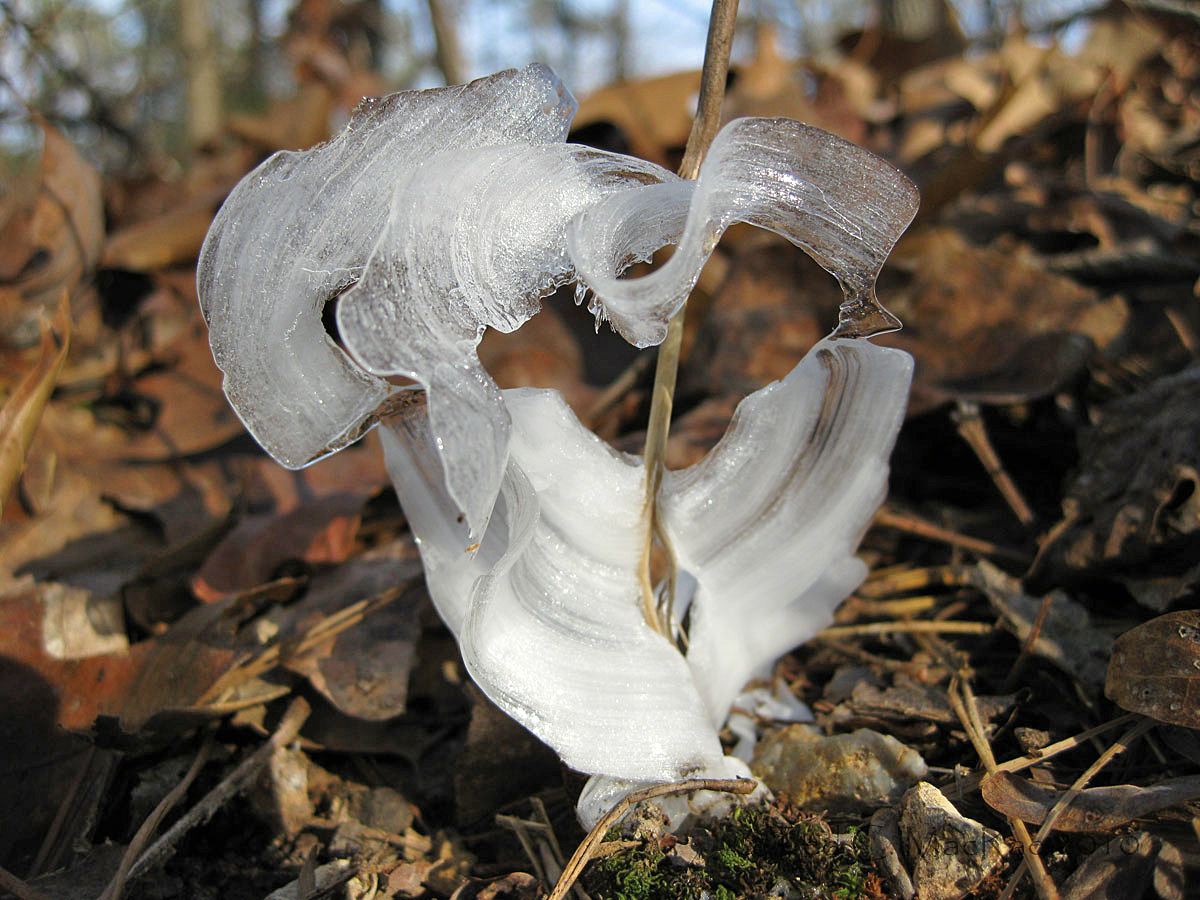
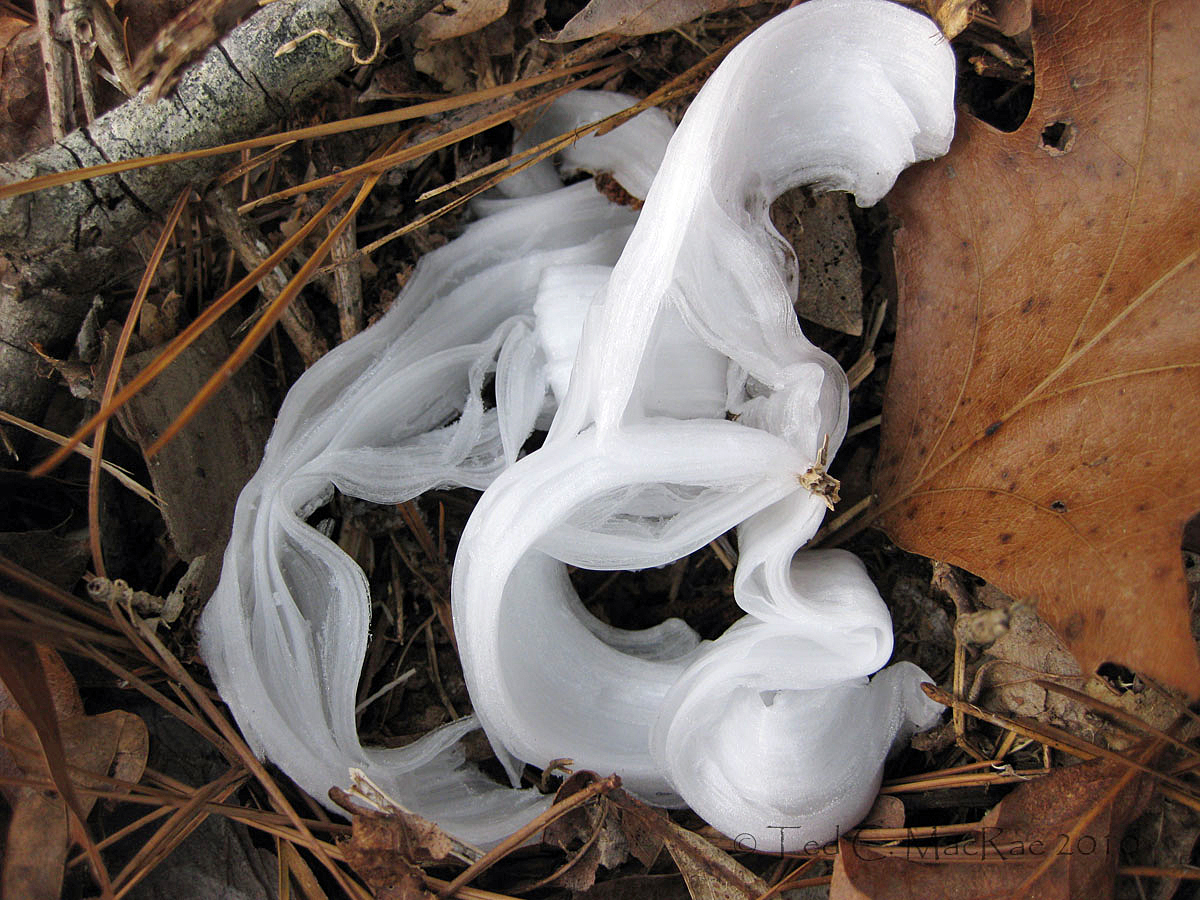
Crystallofolia (frost flowers) on dittany (Cunila origanoides).

While hiking the middle stretch of the Ozark Trail’s Wappapello Section, my friend Rich and I witnessed a bounty of crystallofolia, or “frost flowers”.  These fragile, yet exquisite formations are, of course, not flowers at all, nor are they true frost (which forms directly from water vapor without first condensing), but rather are thin layers of ice that form as water is drawn from cracks in plant stems and freezes upon contact with cold air.  As the water continues to be drawn from the plant by capillary action, newly forming ice pushes older ice further out, creating delicate, folded, curling ribbons of ice that resemble many-layered flower petals.  Air trapped within the ice upon freezing imparts a frothy white appearance.

Frost flowers are not an uncommon phenomenon, and I have seen them on more than a few occasions during my frequent off-season hikes.  However, never before had either Rich or I seen the numbers that we saw during our hike on this, the second day of the New Year.  Frost flowers are normally encountered during the first hard freezes of fall when the ground is not yet frozen.  Water in the stems of certain plants expands as a result of the freezing air temperatures, causing vertical cracks to form along the length of the stem through which the ice ribbons are extruded. The formations are rather ephemeral, usually melting or sublimating away by late morning in fall’s typically mild daytime temperatures.  As fall progresses to winter, water stores in the plant stems become depleted after several freezes or locked up when the ground itself freezes, and as a result frost flowers are rarely seen later than December in Missouri. However, it has been a wet and mild fall and early winter, and after an extended period of moisture during December, Missouri was finally gripped by a severe cold spell with lows in the single digits and daytime highs remaining down in the teens and 20s.  The saturated, yet unfrozen ground provided a good source of moisture for plant stems to draw upon, and continuous subfreezing air temperatures allowed frost flowers to persist throughout the days and attain remarkable size. The photo above was taken in late afternoon as a sinking sun shone brightly on the west-facing slope where this formation was seen, persisting in all its fragile glory.

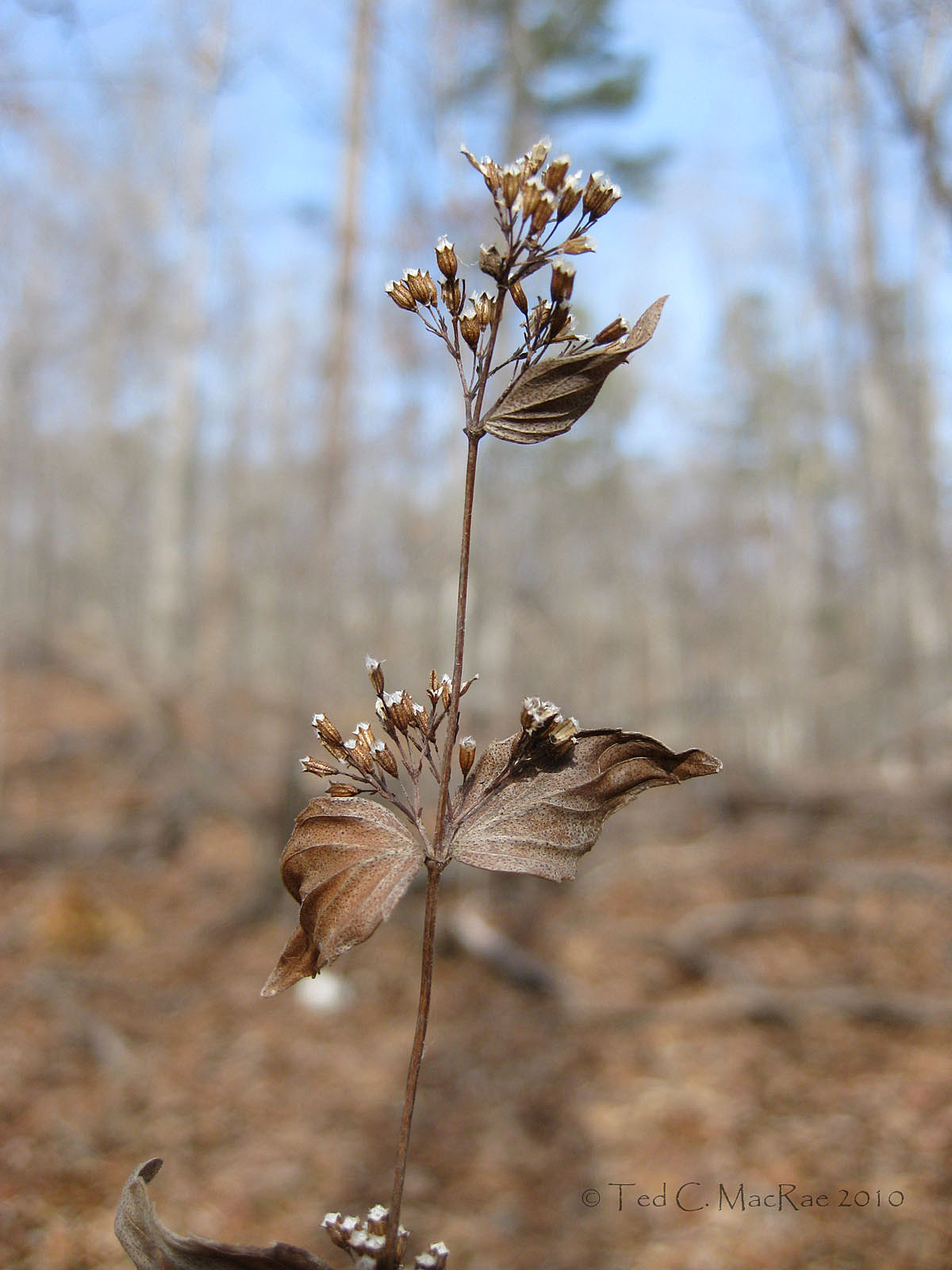
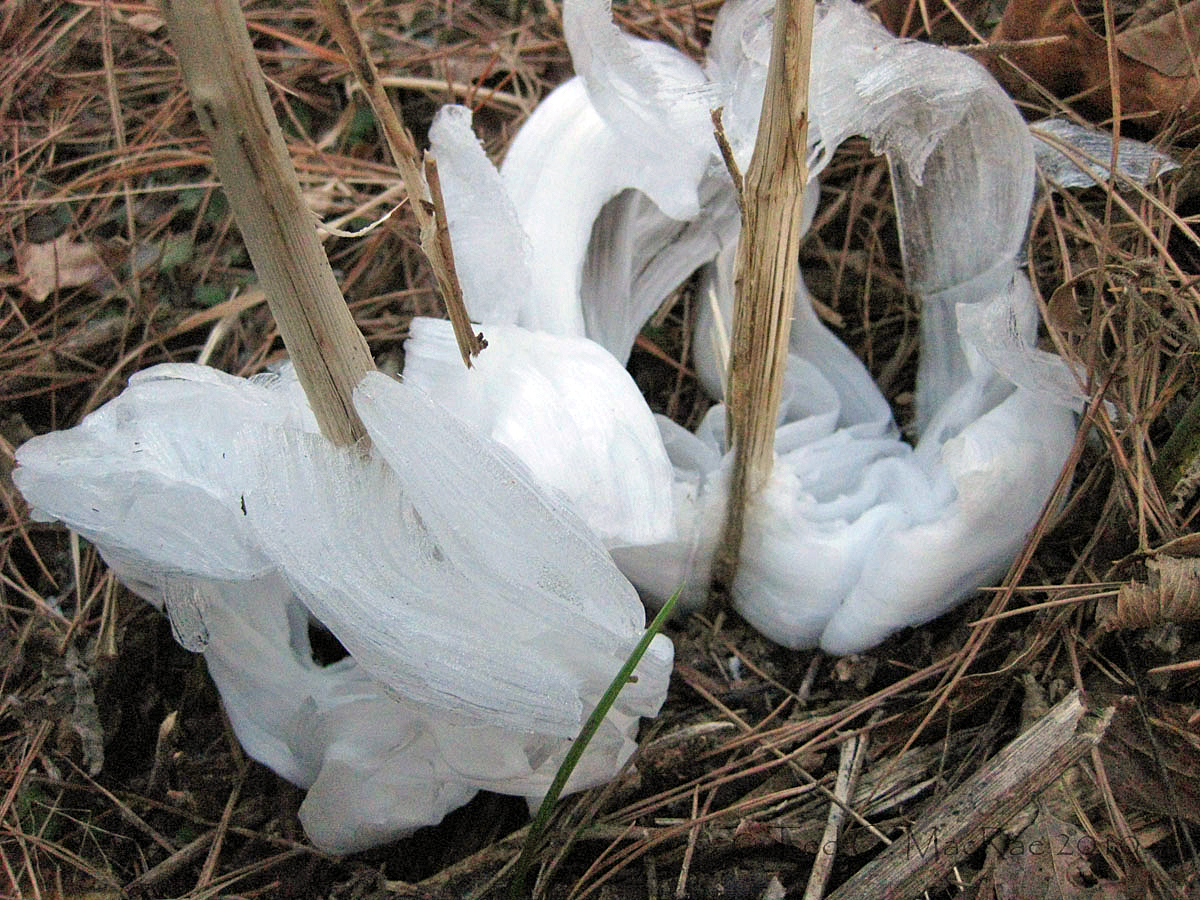
In Missouri, frost flowers are primarily associated with dittany (Cunila origanoides), species of Verbesina (V. virginica, white crownbeard; and V. alternifolia, yellow ironweed), and camphor weed (Pluchea camphorata).  Frost flowers are rarely seen on any other plant in Missouri, and I don’t know what it is about these plants and not others that make them suitable for frost flower formation.  Dittany is a daintly little member of the Lamiaceae, and as such has square stems – perhaps the angles on the stem are prone to splitting.  However, there are many other lamiaceous plants and non-lamiaceous square-stemmed plant species in Missouri that do not form frost flowers.  Likewise, Verbesina and Pluchea belong to the Asteraceae and do not have square stems.  They are, however, larger, more robust plants with thick, pithy stems that may be capable of holding a large amount of water and mature late in the season after most other plants have already dried up, perhaps allowing them to retain sufficient moisture in the stem late enough in the season to allow frost flower formation when conditions are right.  The majority of the frost flowers we saw were on dittany – dainty, delicate, fragile formations 2-3 inches across. However, at the end of the hike, as we were exploring the area around the parking lot, we found a stand of Verbesina (I suspect V. alternifolia), with which some of the most enormous and robust frost flowers that I have ever seen were associated.  Following are additional views of some of the more impressive formations we saw and the plants they were associated with.

Frost flowers on dittany - shaded, protected areas produced the largest formations.

Partial thawing during ribbon formation causes exquisite twists and turns.

Like snowflakes, each frost flower is one-of-a-kind.

Dittany (Cunila origanoides) dried stem, leaves, and fruits.

Verbesina sp. frost flowers were enormous - this one was approx. 5 inches wide.

Dried fruits of Verbesina sp. (poss. alternifolia).

Copyright © Ted C. MacRae 2009

Add to FacebookAdd to DiggAdd to Del.icio.usAdd to StumbleuponAdd to RedditAdd to BlinklistAdd to TwitterAdd to TechnoratiAdd to Yahoo BuzzAdd to Newsvine

Email to a friend

Great Plains Ladies’-tresses

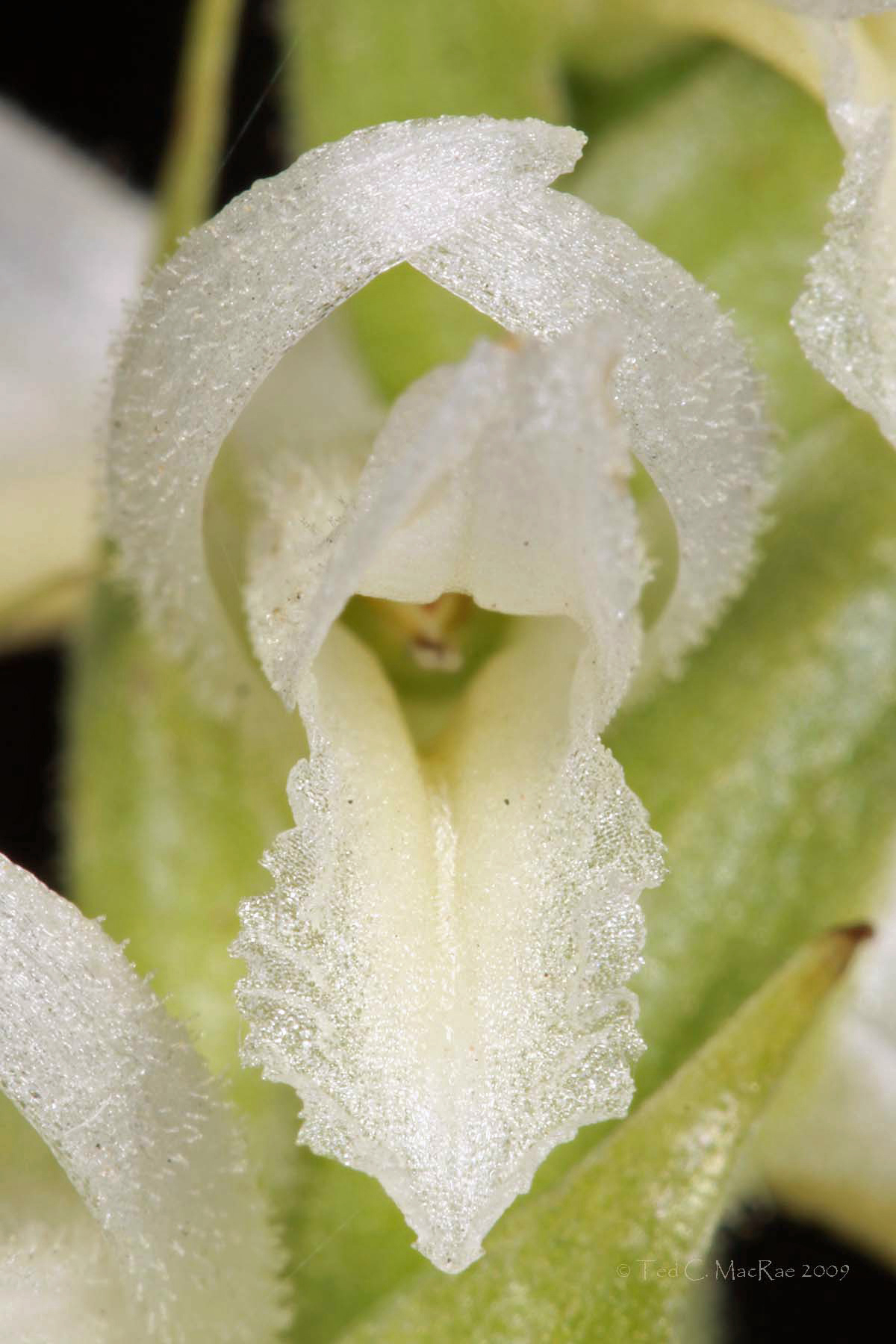
First things first—everyone who participated in the quiz in the previous post correctly identified the orchid flower in the photo as belonging to the genus Spiranthes, and a few were on the right track with their species suggestion of S. cernua.  However, Scott Namestnik from Indiana and Doug Taron from Illinois, were the only ones who recognized it to be a close relative of that species, the recently-described S. magnicamporum.  Nice job!  The plants in these photographs were found during early October in the dry dolomite glades of White River Balds Natural Area in southwestern Missouri (part of Ruth and Paul Henning Conservation Area).  The creamy white inflorescences stood in stark contrast to the russet big bluestem (Andropogon gerardii) and rusty gold Indian grass (Sorghastrum nutans) stems that dominated the rocky landscape.

Spiranthes¹ is one of the more complex genera of North American orchids, seven of which are known to occur in Missouri (Summers 1985).  Spiranthes magnicamporum² is closely related to S. cernua and was only recently (1975) described as a distinct species.  Conclusive separation of the two species requires microscopic examination of the seeds (those of S. magnicamporum are monoembryonic, whereas a large percentage of the seeds of S. cernua are polyembryonic) (Luer 1975).  In the field, however, S. magnicamporum can generally be distinguished from S. cernua by its spreading rather than appressed lateral sepals and absence of basal leaves at the time of flowering³.  It is likely that many previous records of S. cernua in Missouri actually refer to this species, as both occur throughout much of southern Missouri and sporadically in northern Missouri (refer to the USDA Plants Database Missouri county level distributions for S. cernua and S. magnicamporum).  However, they are ecologically isolated in that S. cernua prefers wet lowlands with acidic soils, while S. magnicamporum is typically found in drier uplands with calcareous soils.  Both species are late-season bloomers, but S. magnicamporum blooms even later (mid-September into November) than S. cernua (mid-August to mid-October) and has more fragrant flowers.

¹ From the Greek speira—σπειρα,—”coil,” and anthos—ανθος,—”flower,” referring to the coiled or spiraled spike of flowers common in the genus.

² From the Latin magnus, “large,” and campus, “plain,” meaning “of the Great Plains” in reference to the primary geographic area where this species is found.

³ My identification of these plants as Spiranthes magnicamporum was confirmed by Dr. George Yatskievych, author of Steyermark’s Flora of Missouri.

Orchids as a whole exhibit highly specialized pollination biology, and species of Spiranthes are no exception, with the spiral arrangement of their flowers evidently an adaptation to pollination by long-tongued bees (e.g. bumblebees, Bombus spp., and megachilid bees) (van der Cingel 2001).  Flowers are protandrous, i.e., they are functionally male when they first open and become functionally female as they age, and open sequentially from the base, resulting in female flowers on the lower inflorescence and male flowers on the upper inflorescence.  Thus, bee pollinators tend to act as pollen donors when visiting lower flowers and pollen recipients when visiting upper flowers.  Pollinia from male flowers are attached to the bee’s proboscis as it tries to access nectar secreted into the base of the floral tube.  When visiting a plant, bees start at the bottom of the inflorescence and spiral up to the top before flying to the next plant.  The reasons for this behavior, called acropetal movement, are not fully understood but could be related to the tendency for nectar rewards to be greater in the lower flowers.  Whatever the explanation, the result is to promote outcrossing between neigboring plants.

While specific insect pollinators have been documented for a number of Spiranthes spp., apparently the only account of pollination in S. magnicamporum is documented by Jeffrey R. Hapeman, author of the website Orchids of Wisconsin:

I have seen a bumblebee (Bombus nevadensis ssp. americorum) pollinating Spiranthes magnicamporum in a prairie in southeastern Wisconsin. After visiting a number of inflorescences, the bee began to vigorously scratch at the pollinia on its proboscis, trying to remove them. The bee became so involved in trying to remove the pollinia that it fell to the ground, where it was easily captured. The specimen was determined by Steve Krauth, and is deposited in the Insect Research Collection at the University of Wisconsin-Madison. Apart from this observation, there are no published accounts of pollination of S. magnicamporum.

Photo details:
All photos: Canon 100mm macro lens on Canon EOS 50D (manual mode), ISO 100, MT-24EX flash w/ Sto-Fen diffusers.
Photo 1: 1/160 sec, f/14, flash 1/2 power.
Photo 2: 1/250 sec, f/16, flash 1/4 power.
Photo 3: 1/250 sec, f/20, flash 1/4 power.
Photo 4: w/ 36 mm extension tube, 1/250 sec, f/16, flash 1/8 power.

REFERENCES:

Luer, C. A.  1975.  The Native Orchids of the United States and Canada Excluding Florida.  The New York Botanical Garden, 361 pp. + 96 color plates.

Summers, B.  1981.  Missouri Orchids.  Missouri Department of Conservation, Natural History Series No. 1, 92 pp.

van der Cingel, N. A.  2001.  An atlas of orchid pollination: America, Africa, Asia and Australia. A. A. Balkema, Rotterdam, Netherlands, 296 pp.

Copyright © Ted C. MacRae 2009

Add to FacebookAdd to DiggAdd to Del.icio.usAdd to StumbleuponAdd to RedditAdd to BlinklistAdd to TwitterAdd to TechnoratiAdd to Yahoo BuzzAdd to Newsvine

Email to a friend