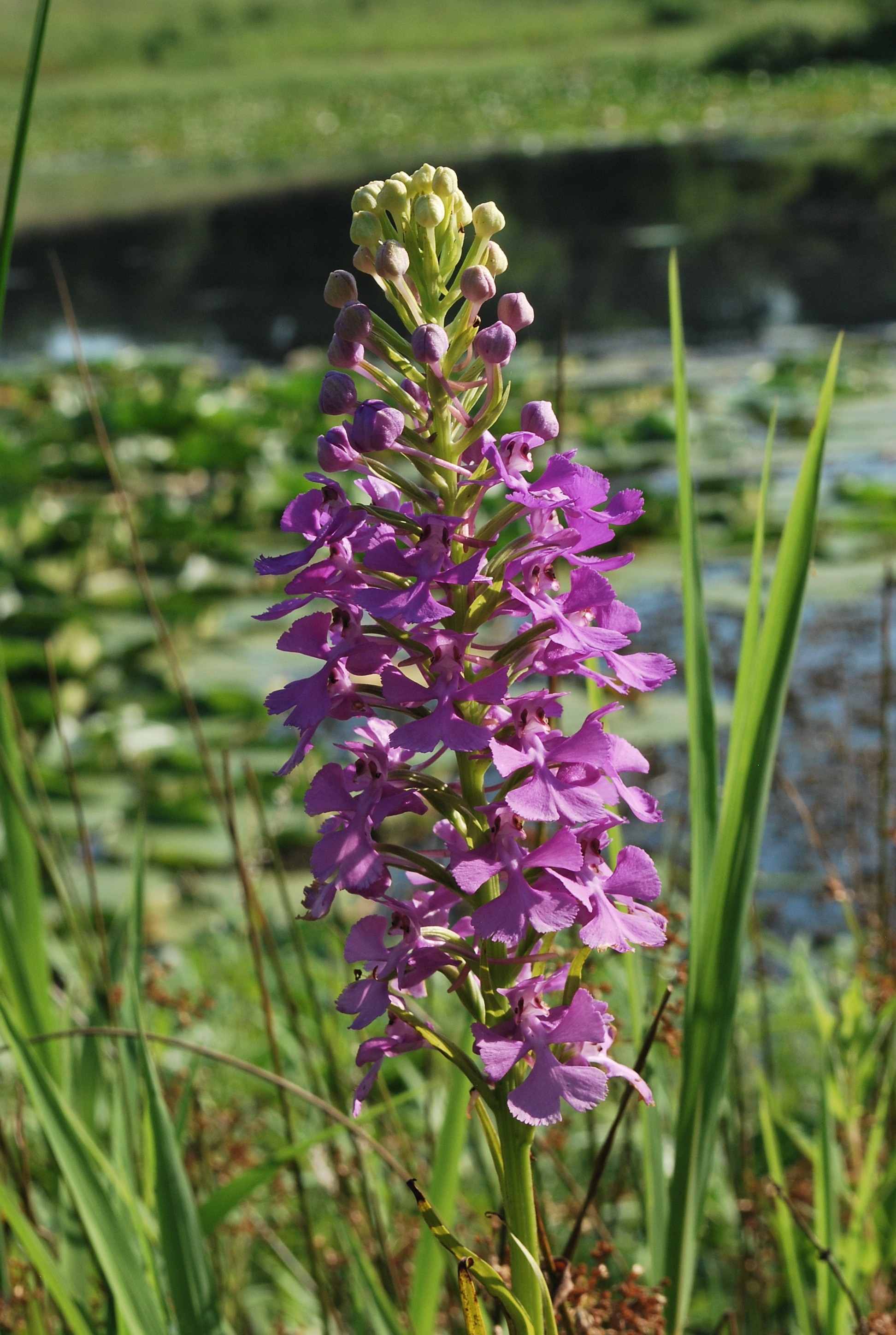
Friday Flower – Orquídea bambu


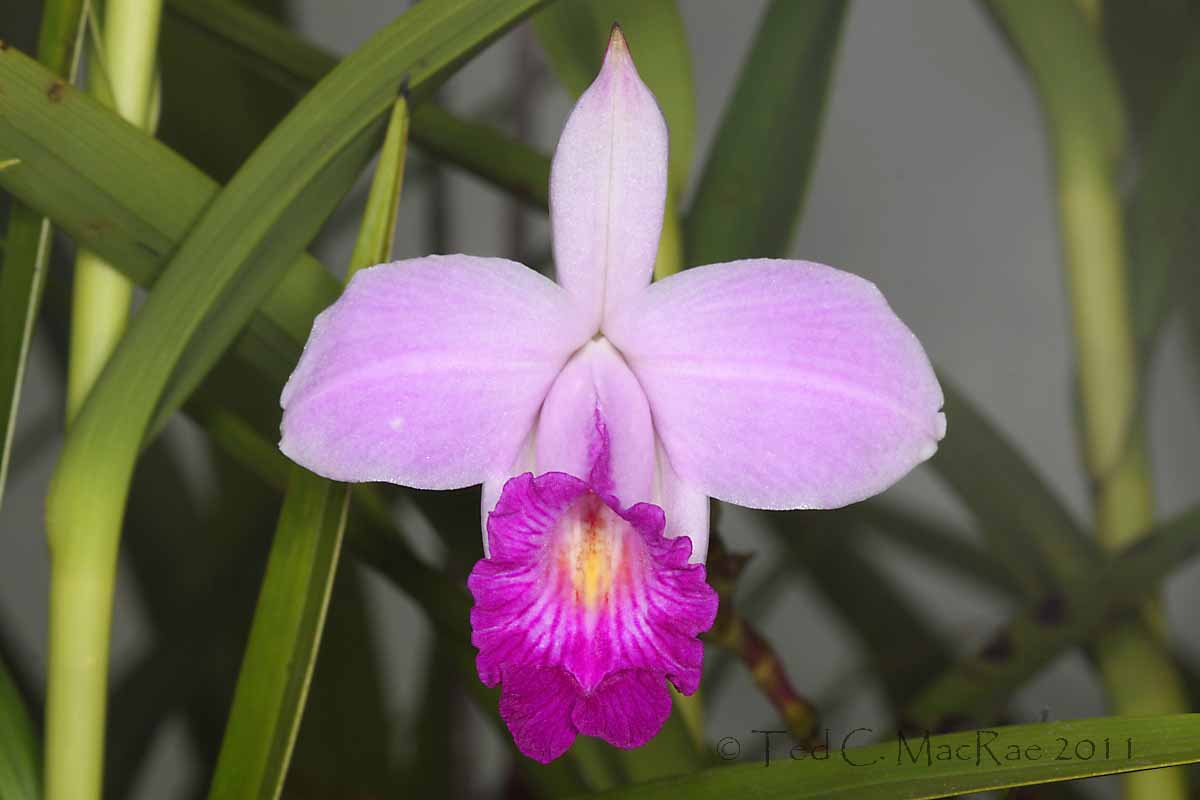
I arrived at our facility in Campinas, Brazil just before lunchtime.  I had spent the previous 20 hours on planes, trains, and automobiles (well, not trains), so when my colleague suggested that we take a short walk outside to the campus cafeteria I readily agreed.  Fresh air and at last a taste of that sumptuous Brazilian fare that I love so much sounded like a great idea.  As we walked to the cafeteria, I spotted these orchid blossoms on the tips of tall, reed-like stems growing in beds around the campus grounds… Orchids!  Growing in the ground, outside!  What a beautiful and appropriately tropical welcome to start things off.  I love orchids (and used to maintain a small collection back when I had time for such leisurely pursuits), so I asked my colleague if he knew which it was.  He didn’t, so I studied it carefully trying to remember its features so I could identify it later.  The terrestrial part struck me as a little odd for a Neotropical orchid, and I commented to my colleague that I’d bet it was something introduced from Asia.  That is precisely the case, although it took me a while to figure it out.  My initial Google and Flickr searches using terms such as “Brazil orchid” and the like produced pages and pages of Brazil’s famous diversity of native epiphytic species, but no obvious matches to this terrestrial species.  It later dawned on me that I should conduct my searches in Portuguese, and within the first page or two I found it – the appropriately named bamboo orchid (“orquidea bambusa”), Arundina graminifolia.


I would later see this orchid blooming not only in tended gardens, but from cracks in the pavement between buildings.  Originating from south and southeast Asia, this sole member of the genus is popularly cultivated in gardens across the tropics and has become naturalized in many areas.  Mary Farmer at A Neotropical Savanna has an excellent post on recognition and occurrence of this species in Panama, including detailed discussion and photographs of vegetational and floral morphology and its potential (or lack thereof) for becoming an invasive weed.

Copyright © Ted C. MacRae 2011

Rush skeletonplant pea gall wasp

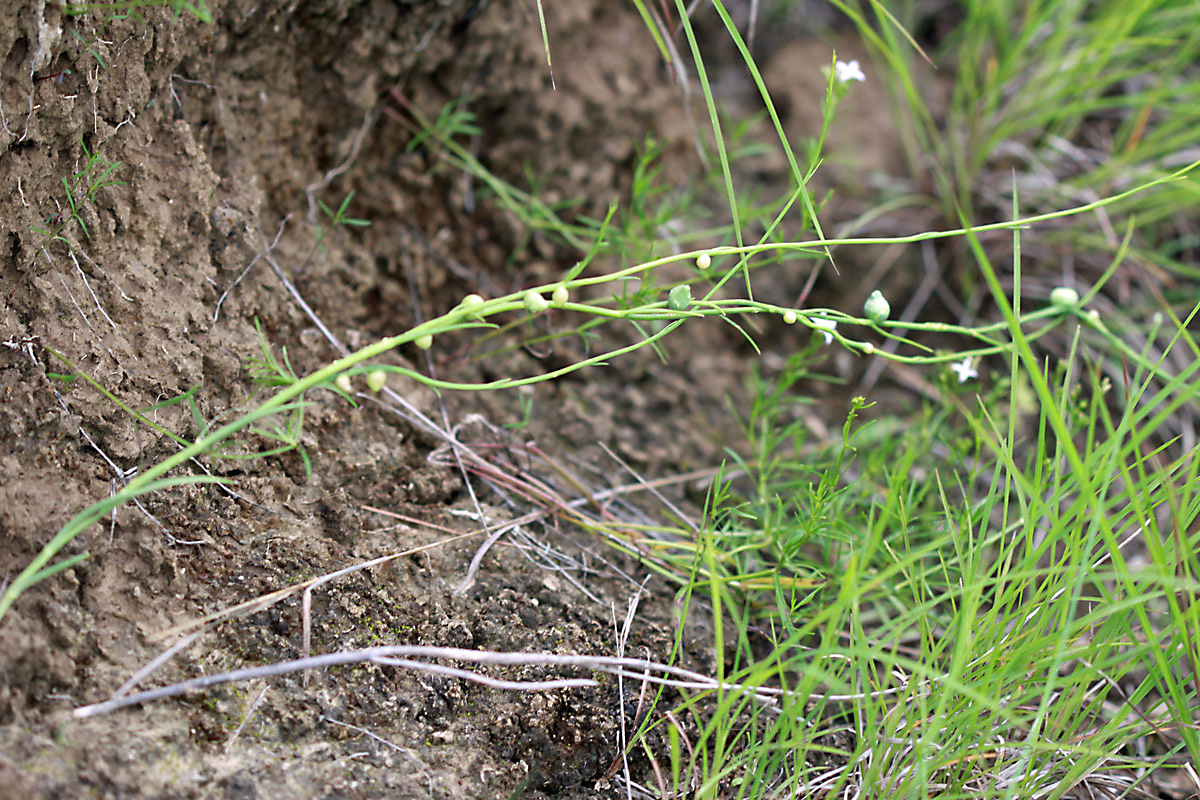
Lygodesmia juncea with galls of Antistrophus lygodesmiaepisum (Hymenoptera: Cynipidae) on stem.

The Loess Hills landform along the western edge of Iowa and extreme northwestern Missouri is home to a unique assemblage of plants and animals.  The majority of these are associated with loess hilltop prairies – grassland remnants that have their origins in the hypsithermal maximum of several thousand years ago and that persist as small relicts on the landform’s steep, dry, south- and west-facing slopes.  Many of the plants and animals found in these grassland remnants are more typically found further west in the Great Plains, but hang on in the Loess Hills as hypsithermal relicts.

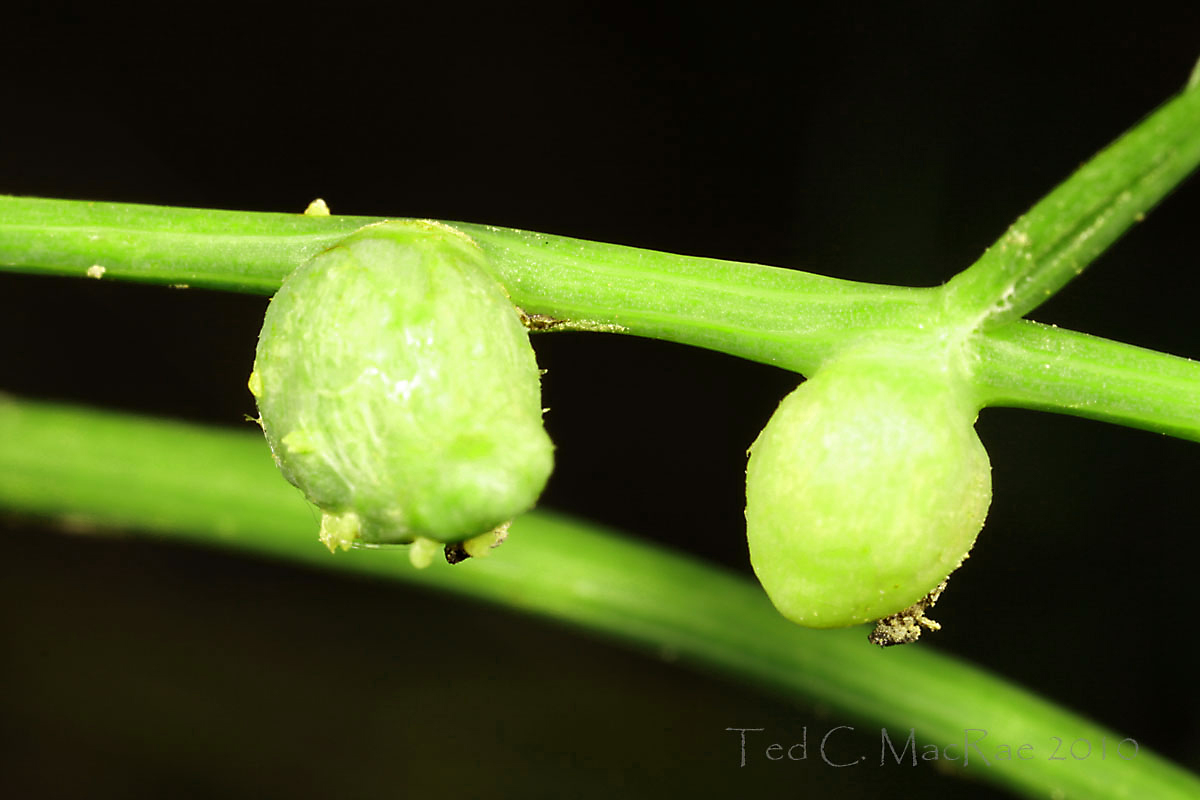
Antistrophus lygodesmiaepisum galls on stem of Lygodesmia juncea.

One such hypsithermal relict is rush skeletonplant, Lygodesmia juncea, a wirey, leafless-looking plant in the family Asteraceae¹.  More common in the Great Plains, this plant occurs in Missouri only on these loess hilltop prairie remnants.  The first time one encounters this plant, they are left with the impression that the plant bears small, pea-like fruiting structures along the length of its stem.  These are not fruiting structures, however, but galls made by the cynipid wasp Antistrophus lygodesmiaepisum.  Although this insect does not have a common name, it is associated exclusively with L. juncea, as suggested by its specific epithet (which also alludes to the pea-like galls with the suffix -pisum), so I see no reason why this wasp cannot be called the “rush skeletonplant pea gall wasp.”  Some sources variably misspell the genus as Anistrophus (without the first “t”) or the species name as simply pisum, a synonym first introduced by Ashmead in the late 19th century a few years after the species was described (I made both mistakes [and also erroneously referred to L. juncea as skeletonweed] in one of my earliest posts: The Loess Hills in Missouri).  It would seem that Antistrophus lygodesmiaepisum is the correct name, according to Pickering (2009).

¹ Not to be confused with rush skeletonweed, Chondrilla juncea – also in the Asteraceae, which despite the similarity of common names, specific epithet, and general appearance (except with yellow flowers) is an altogether different plant that was introduced from the Mediterranean Region and is now considered an invasive weed in much of the Great Plains.

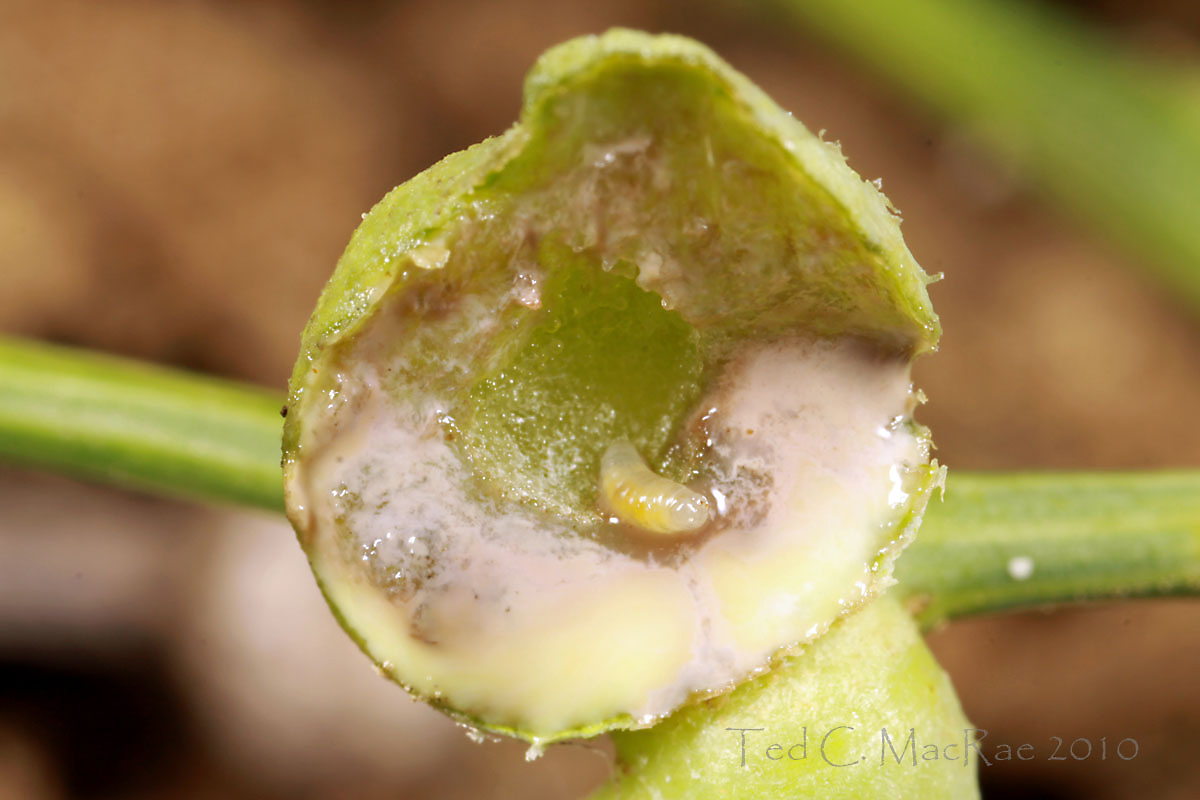
Antistrophus lygodesmiaepisum larva in gall on stem of Lygodesmia juncea.

Rush skeletonplant exudes a latex-like sap when damaged, making it unpalatable to most grazers – this latex-like sap can be seen when the galls made by the wasps are cut open.  Cynipid wasps are the second most diverse group of gall-making insects behind the gall midges, and many species are mono- or oligophagous (Ronquist and Liljeblad 2001), meaning that they are associated exclusively with a single plant species or group of closely related species.  Antistrophus lygodesmiaepisum is one such monophagous species, thus its occurrence in Missouri, like that of L. juncea, is restricted to the tiny loess hilltop prairie remnants in extreme northwestern Missouri.  In recent years, these prairie relicts have suffered heavily from conversion to agriculture, abusive grazing, and suppression of fire that has led to invasion by woody and exotic plants.  In Missouri, only about 50 acres of loess hilltop prairie remain, and only half of these are in conservation ownership, making it among the most critically imperiled of natural communities in Missouri.  While lacking the conservation charisma of L. juncea and the dozen or so other plants and vertebrates that are restricted in Missouri to these prairie remnants, A. lygodesmiaepisum nevertheless deserves equal consideration as a Missouri species of conservation concern.

I knew this would be a difficult ID Challenge and am quite impressed that at least a few people figured out at least the correct genus.  Tim Eisele scored 8 points in this challenge to not only take the win but also move way up into a 3-way tie for 4th place in the overalls.  Ben Coulter continues to be Mr. Consistency, earning 4 points for 2nd place and retaining his overall lead by an almost insurmountable margin (see what happens when you play every game!).  JasonC beat out the other contenders for the final podium spot on the basis of a bonus point, but the hot contest continues to be the battle for 2nd place overall.  Janet Creamer still holds it at 14 pts, but there is a veritable gaggle of contenders nipping at her heals – the next few challenges could be interesting.

Photo 1: Canon 100mm macro lens (ISO 100, 1/250 sec, f/2.8).
Photos 2-3: Canon MP-E 65mm 1-5X macro lens (ISO 100, 1/250 sec, f/14).
All photos: Canon 50D , Canon MT-24EX flash w/ Sto-Fen + GFPuffer diffusers. Typical post-processing (levels, minor cropping, unsharp mask).

REFERENCES:

Pickering, J.  2009.  Database of Hymenoptera in America north of Mexico. http://www.discoverlife.org/proceedings/0000/6/html/Cynipidae (accessed 20 Jan 2011).

Ronquist, F. and J. Liljeblad.  2001.  Evolution of the gall wasp-host plant association.  Evolution 55(12):2503–2522.

Copyright © Ted C. MacRae 2011

BitB Top 10 of 2010

Welcome to the 3rd Annual BitB Top 10, where I pick my 10 (more or less) favorite photographs of the year.  My goal for 2010 was to continue the progress that I began the previous year in my quest to become a bona fide insect macrophotographer.  I’m not in the big leagues yet, but I have gotten more comfortable with using my equipment for in situ field photographs and am gaining a better understanding of lighting and the use of flash.  I also began experimenting with different lighting techniques (e.g. white box) and diffusers and am putting more effort into post-processing techniques to enhance the final appearance of my photographs.  I invite you to judge for yourself how successful I’ve been toward those goals by comparing the following selections with those from 2009 and 2008 – constructive feedback is always welcome:


Best Tiger Beetle

Cicindela denverensis - green claybank tiger beetle

From ID Challenge #1 (posted December 23).  With numerous species photographed during the year and several of these dramatic “face on” shots, this was a hard choice.  I chose this one because of the metallic colors, good focus throughout the face, and evenly blurred “halo” of hair in a relatively uncluttered background.


Best Jewel Beetle

Buprestis rufipes - red-legged buprestis

From Special Delivery (posted July 13).  I didn’t have that many jewel beetles photos to choose from, but this one would have risen to the top no matter how many others I had.  The use of a white box shows off the brilliant (and difficult-to-photograph) metallic colors well, and I like the animated look of the slightly cocked head.


Best Longhorned Beetle

Desmocerus palliatus - elderberry borer

From Desmocerus palliatus – elderberry borer (posted November 18).  I like the mix of colors in this photograph, and even though it’s a straight dorsal view from the top, the partial dark background adds depth to the photo to prevent it from looking “flat.”


Best “Other” Beetle

Enoclerus ichneumoneus - orange-banded checkered beetle

From Orange-banded checkered beetle (posted April 22).  The even gray background compliments the colors of the beetle and highlights its fuzziness.  It was achieved entirely by accident – the trunk of the large, downed hickory tree on which I found this beetle happened to be a couple of feet behind the twig on which it was resting.


Best Non-Beetle Insect

Euhagenia nebraskae - a clearwing moth

From Euhagena nebraskae… again (posted October 21).  I photographed this species once before, but those photos failed to capture the boldness of color and detail of the scales that can be seen in this photo.


Best “Posed” Insect

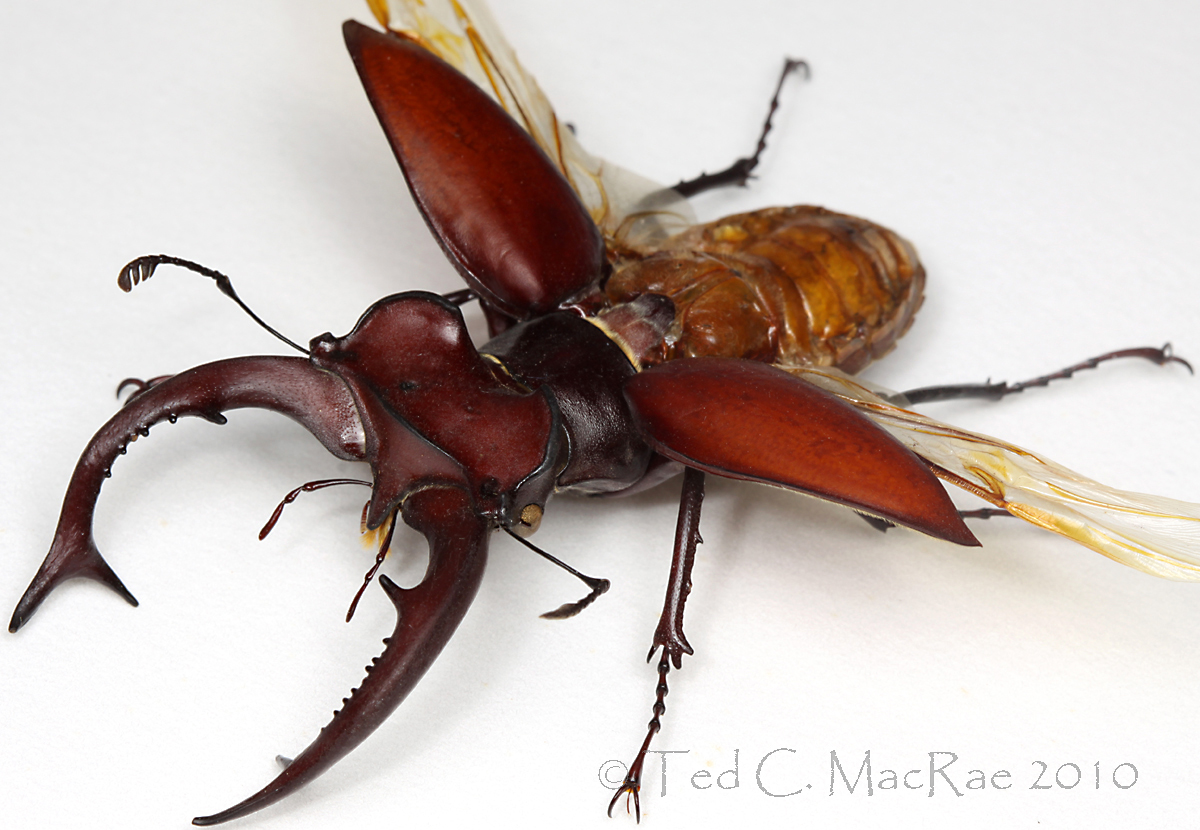
Lucanus elaphus - giant stag beetle

From North America’s largest stag beetle (posted December 30).  I’ve just started experimenting with photographing posed, preserved specimens, and in fact this male giant stag beetle represents only my second attempt.  It’s hard to imagine, however, a more perfect subject than this impressively stunning species.


Best Non-Insect Arthropod

Scolopendra heros - giant desert centipede

From North America’s largest centipede (posted September 7).  Centipedes are notoriously difficult to photograph due to their elongate, narrow form and highly active manner.  The use of a glass bowl and white box allowed me to capture this nicely composed image of North America’s most spectacular centipede species.


Best Wildflower

Hamamelis vernalis - Ozark witch hazel

From Friday Flower – Ozark Witch Hazel (posted March 26).  The bizarre form and striking contrast of colors with the dark background make this my favorite wildflower photograph for the year.


Best Non-Arthropod

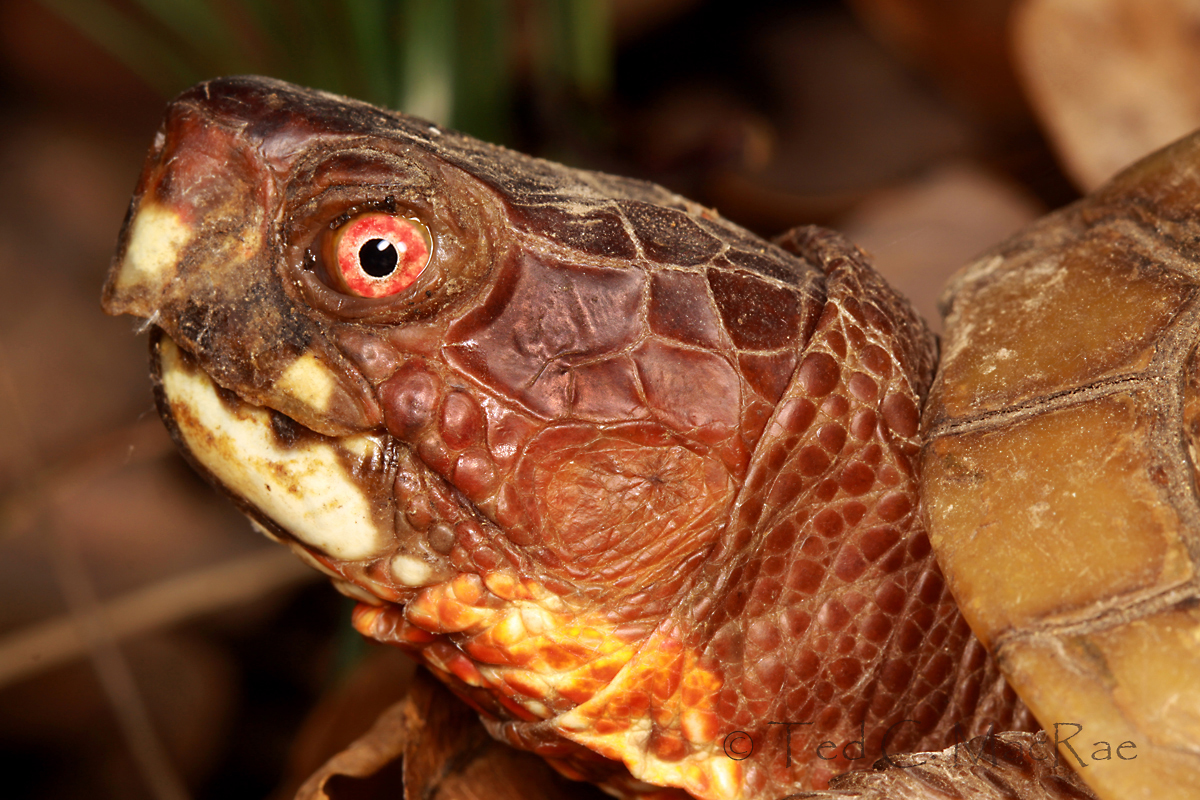
Terrapene carolina triunguis - three-toed box turtle

From Eye of the Turtle (posted December 10).  I had a hard time deciding on this category, but the striking red eye in an otherwise elegantly simple photograph won me over.  It was also one of two BitB posts featured this past year on Freshly Pressed.


Best “Super Macro”

Phidippus apacheanus - a jumping spider

From Jeepers Creepers, where’d ya get those multilayered retinae? (posted October 5).  I’m not anywhere close to Thomas Shahan (yet!), but this super close-up of the diminutive and delightfully colored Phidippus apacheanus is my best jumping spider attempt to date.  A new diffuser system and increasing comfort with using the MP-E lens in the field at higher magnification levels should allow even better photos this coming season.


Copyright © Ted C. MacRae 2011

Promiscuous Plants

Naturalists have long been aware of the greater tendency for plants than for animals to create viable interspecies hybrids. This is attributable not only (as some might expect) to a higher likelihood of passive plants whose mating is mediated by pollen-hungry insects, or the wind, to hybridize more often, but rather to a greater ability of plants, with the simpler design of their anatomies, successfully to build a functioning organism with a Gemisch of genes from parents of different species. Such hybrids occur naturally, and are often reported in regional floras. Further, the advent of modern techniques for characterizing DNA has revealed that hybridizations of yore have given rise to numerous species, and higher lineages, in plants, in fungi, and to a lesser extent in animals.

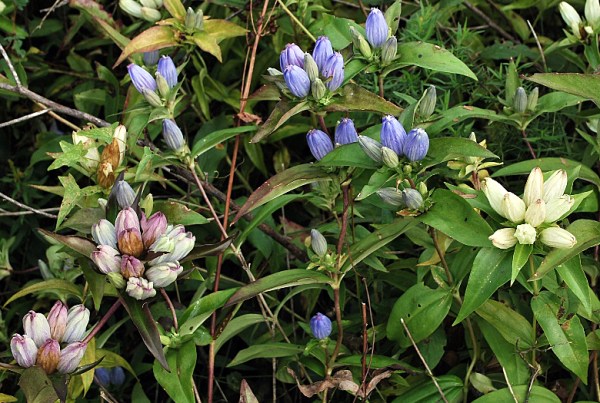
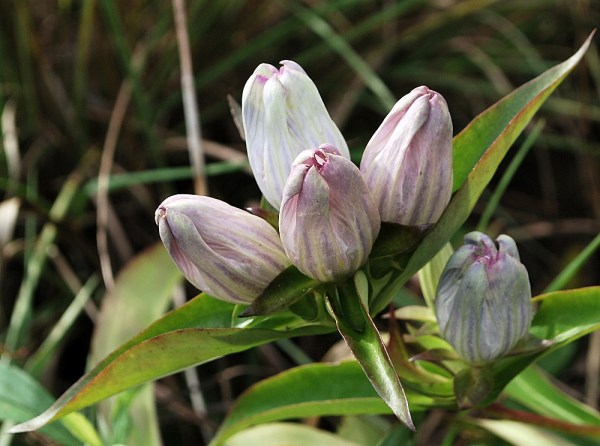
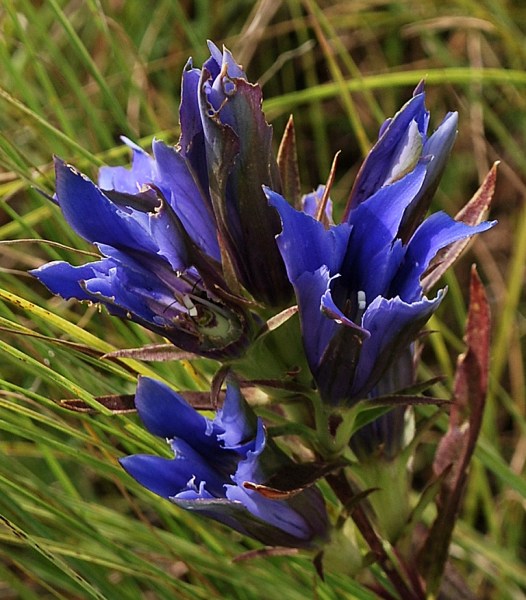
My recent wanderings in quest of fall flora photos at Shaw Nature Reserve really brought this phenomenon of admixture of species to mind as I was examining populations of the three Gentiana species that live at the reserve. All three are fairly recent introductions at SNR, added to the flora in several locations in our prairie and wetland habitat reconstruction program. Hybridization among these gentian populations was first brought home in my observation over the last three years of increasing numbers of purplish and bluish and outright blue individuals in a population that was originally pure white gentian – Gentiana alba. This population was sowed in the mid-1990s as part of a mesic prairie reconstruction in the watershed of our wetland complex.

Gentiana alba, G. andrewsii and their lavender tinted hybrid growing side by side at Shaw Nature Reserve.

Pale or white bottle gentian, in "pure" form.

A few years later, 50 or so meters distant, separated by a dense row of trees and shrubs, and in a much wetter habitat in which water pools after every rain and seeps subsurficially much of the year, blue bottle gentian – G. andrewsii — was sowed into a wet prairie / sedge meadow reconstruction.

The rich blue flowers of the blue bottle gentian, Gentiana andrewsii

At first the two populations grew independently and remained separate, but what I surmise was a combination of water borne seed transport (along the shore of a pond whose edge both populations are near), and bumblebee borne pollen transport, conspired to bring gametes of the two species together, creating what population geneticists call a hybrid swarm, and what taxonomists call a — well, I can’t write it in polite company such as my readers.

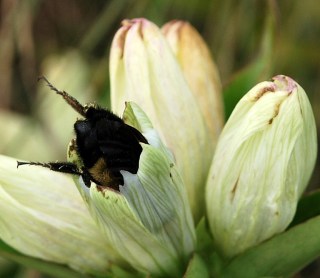
Observe in the sequence of images above how a bumblebee gyne (a potential queen of one of next year’s annual bumblebee colonies) pries open a bottle gentian flower and dives in for a long drink of nectar at the base of the large vessel. Apparently the nectar is copious, because bumblebees may remain in a single gentian flower for up to a minute.

The result of pollen transport among pale and blue bottle gentians, a hybrid of intermediate characteristics.

While there are other populations of both species on the reserve (one hopes, out of bumblebee range from each other) that may retain their genetic integrity, the rampantness of the admixture at this site does give me pause.

And it gets worse! — On drier ground up the slope, among a dense planting dominated by prairie dropseed and little bluestem grasses,  a third gentian known as downy or prairie gentian – Gentiana puberulenta – was established from a seed mix sowed 10 years ago to convert the watershed of the reserve’s wetlands to prairie vegetation.

Unlike the two previously mentioned species and their hybrids, the downy gentian's petals open wide at anthesis, admitting entry to small bees and even to spindly-legged potential pollinators such as syrphid flies.

And now those perverse bumblebees have gone and defied the laws of speciesness and created what appear to be hybrids of this third gentian species with the other two. Honestly, I don’t know whether to feel that I have done some sort of wrong by creating the situation that allowed this to happen … or simply to be intrigued by this unforeseen outcome of my work, and to wonder what will come of it after I’m gone?

The gentian in the upper photo appears to be the offspring of a cross between white and downy gentian parents, while the one in the lower photo appears to be the result of a cross between blue bottle and downy gentian.

Friday Flower – green fringed orchid

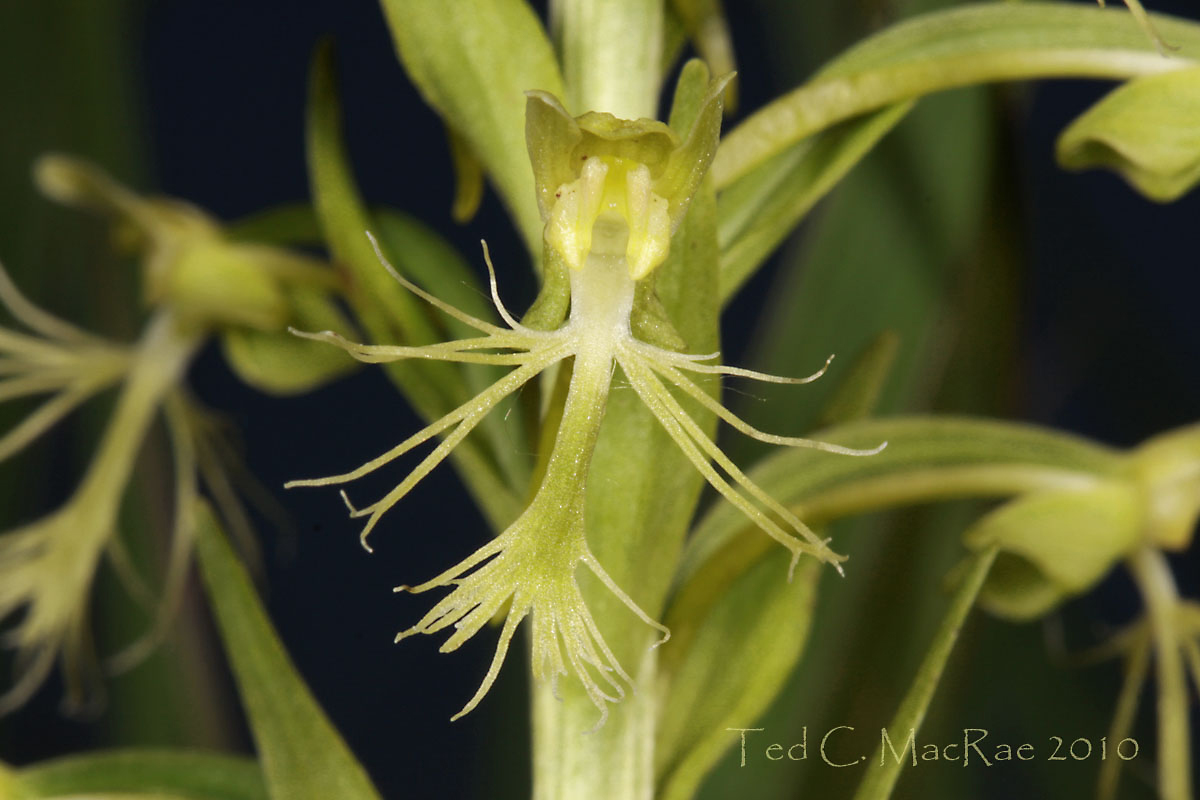
I may have been the “Beetle Group” leader for last May’s BioBlitz at Penn-Sylvania Prairie, a 160-acre tract of native tallgrass prairie in southwestern Missouri owned by the Missouri Prairie Foundation.  However, it was a plant – specifically the green fringed orchid  (Platanthera lacera) – that would prove be the highlight of my visit.  I’ve already lamented the paucity of beetles that I found at the prairie and the possible reasons for such.  It’s a shame, because to my knowledge the BioBlitz was the first real attempt to begin documenting the diversity of beetles and other insects that inhabit the prairie.  This is in great contrast to the vascular plants, of which about 300 mostly native prairie species have already been recorded from the site in active survey efforts that began even before its acquisition.   It’s no coincidence that prairie plant diversity would be so high in this frequently burned prairie remnant while beetles and other insects would be rather hard to find, since vascular plant diversity is the primary – and often the only – metric used to assess the success of and optimal timing for prescribed burning in native prairie remnants.  Unfortunately, the response of invertebrates to fire-centric management techniques such as those used here have not been so well considered, with the apparent declines in their populations now fueling an increasingly acrimonious debate on the subject.  But I digress…

Also called ragged fringed orchid, this species typifies the rather striking appearance of the genus as a whole.  I’ve always been quite enamored with orchids (even possessing a small collection during my young adult days that I grew outside under shadecloth during summer and indoors under artificial light during winter) but have encountered only a small fraction of Missouri’s 33 native orchid species – mostly in the genus Spiranthes (e.g., Great Plains Ladies’-tresses).  Despite not having seen this genus prior to this day, I knew immediately what I had stumbled upon (at least at the generic level) as we scoured the prairie in our search for its meager scraps of beetle life.  While not listed as threatened or endangered in Missouri, it is still quite uncommon, with populations scattered across the Ozark and Ozark Border counties and occurring with greater frequency in these Osage Plains in a variety of open, acidic-soiled habitats (Summers 1981).  As is typical for species with green-white colored flowers, the blossoms emit fragrance at night and thus attract sphinx moths (family Sphingidae) and owlet moths (family Noctuidae) for pollination, including the hummingbird clearwing hawkmoth (Hemaris thysbe) (Luer 1975).  While our Midwestern populations are considered “spindly and unattractive” compared to the more luxuriantly-blossomed plants of New England and maritime Canada (Luer 1975), I consider this to be the most strikingly handsome orchid I’ve encountered to date.

Photo Details: Canon 50D (ISO 100, 1/250 sec) w/ 100mm macro lens @ f/10 (whole plant) or f/18 (flower close-up), Canon MT-24EX flash (manual, 1/4 ratio) w/ Sto-Fen diffusers. Typical post-processing includes levels adjustment, minor cropping, and/or unsharp mask.

REFERENCES:

Luer, C. A.  1975. The Native Orchids of the United States and Canada Excluding Florida.  The New York Botanical Garden, 361 pp. + 96 color plates.

Summers, B.  1981. Missouri Orchids.  Missouri Department of Conservation, Natural History Series No. 1, 92 pp.

Copyright © Ted C. MacRae 2010

The joys of ecological restoration

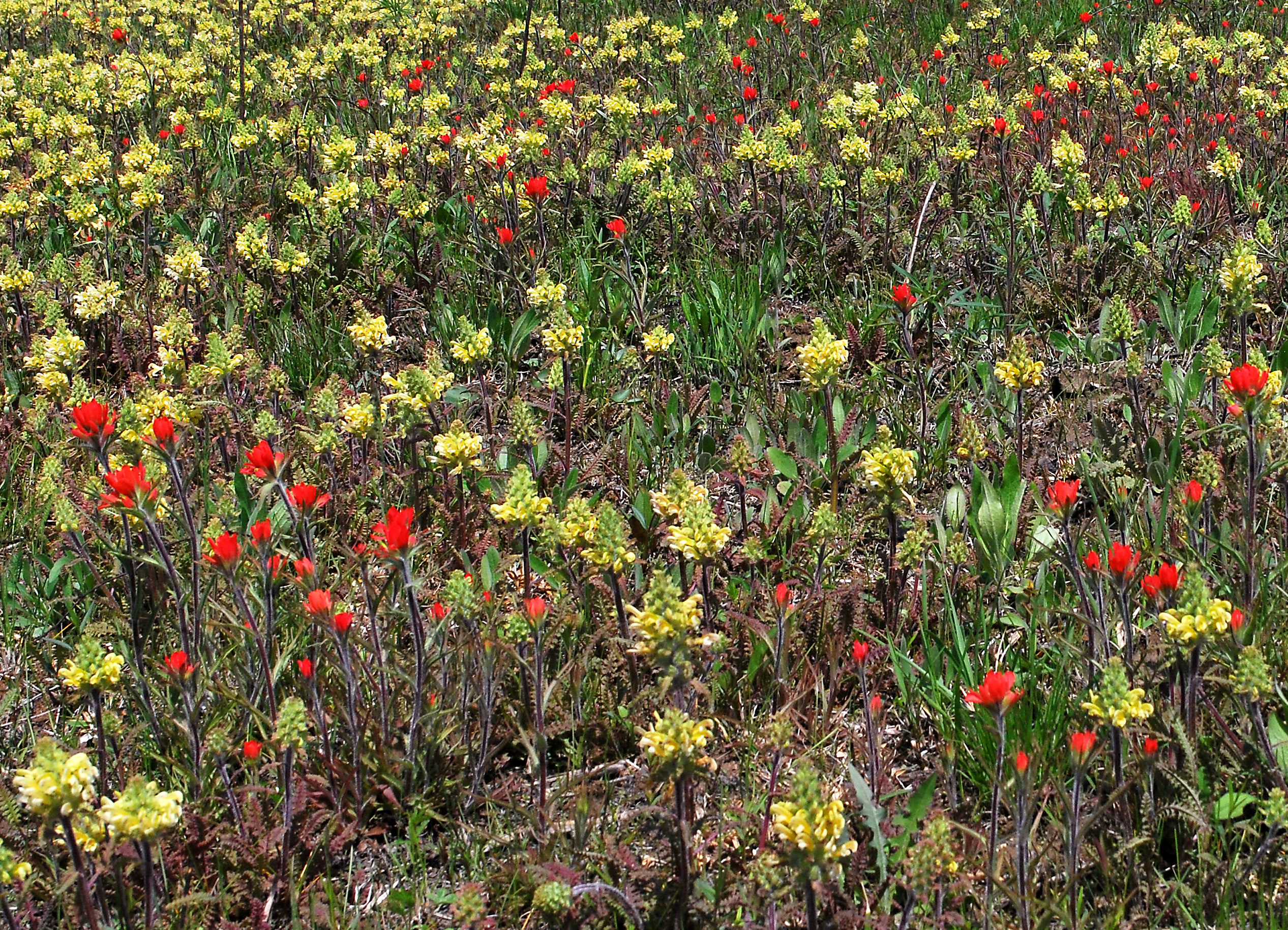
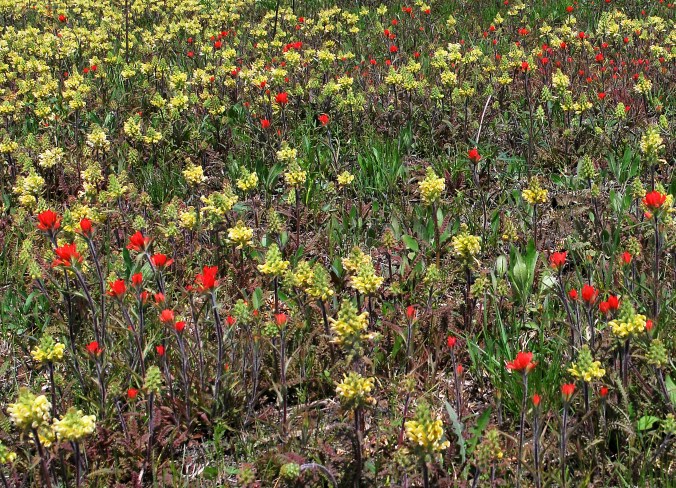
Indian paintbrush and lousewort now dominate patches of SNR

I moved to Missouri in the summer of 1988, having experienced 8 years of generous support of my family’s livelihood by my research on the infamous imported fire ants of the US Southeast, and their relatives in South America. When I arrived in the Midwest, I  hoped to land a job as an insect taxonomist in a university or museum, a goal of mine since before entering college. But this dream was one that even before moving to Missouri was dimming, and then receded ever further from the realm of possibility for me (and for traditionally trained taxonomists, generally), once here. So, I began to re-think what I might do with my work life. It would be something, I hoped, that would make some use of all the course work (mostly in entomology and botany) and research (on ant systematics) I had done during my 24 years (!) of getting educated and four additional years as a post-doc. As or more important, whatever job I ended up in would somehow have to allow me to share my life-long love of nature with others.

A museum drawer of ant specimens mounted for taxonomic study, the ants no doubt frustrated by the years of inattention they have received as I have tended to the duties of my day job.

Early in my residence in eastern Missouri, I made the acquaintance of the naturalist at a 2500-acre (1000-hectare) nature reserve outside of St. Louis. Shaw Arboretum, as it was then known, is country cousin to the world-renowned Missouri Botanical Garden, and is named after the Garden’s founder Henry Shaw. Long story short, in the summer of 1990 the naturalist mentioned to me that he would soon retire, the position would become available, and that I ought to apply. So I applied, and was hired as the arboretum’s naturalist in January 1991.

A dolomite glade plant endemic to a few counties in eastern Missouri, this leatherflower was established at SNR in the 1930s, but expanded exponentially after prescribed fire was introduced in the 1990s. Here, an ant characteristic of glades and dry prairies forages on the flower.

When I came on board, the “Arboretum” had mostly ceased to be an arboretum (a formal collection of trees for display, breeding and research), and most folks seemed unable to either pronounce or define the word. Indeed we learned, through a public survey, that the strange name and the stone wall in the front actually dissuaded people unfamiliar with it from entering! Yes, there were a few patches of exotic trees scattered around the property, especially in the conifer collection near the front entrance know as the “Pinetum”, but ever since the Garden had decided around 1930 that it would not, afterall move all of its horticultural operations to this then very rural site (the original intent of its purchase), formal arboretum and botanical garden type activities had been few and far between, and the site began gradually reverting from abandoned farmland to a wilder sort of place, as well as a haven for native biota. Thus, on its 75th anniversary in the year 2000, Shaw Arboretum was renamed Shaw Nature Reserve.

Colony-founding queen bumblebees are the primary actors in loosening pollen with ultrasound from shootingstar anthers, and distributing it about the plant population.

Around that time, my title changed too, to “Restoration Biologist”. The job is multifaceted; presenting public programs and classes on various aspects of the site’s natural history, writing and reviewing articles, acting as liaison to the vigorous regional group of academic ecologists who use the site for research and teaching, a very intermittent personal research program on ants resulting in sporadic publications, and last but certainly not least, ecological restoration.

Ecological restoration, in the broad sense, consists of  two primary practices:

  • Restoration of a natural community to structure and species composition presumed characteristic of an  ;;earlier condition (however arbitrary or ill-defined).
  • Reconstruction of regional, native-like habitats, de novo, using locally acquired native plant propagules in the appropriate settings of soil, hydrology,  slope aspect and climate.

Both  require essentially perpetual, follow-up maintenance, including invasive species control, mowing, haying, grazing, selective timber removal, species richness enhancements, and prescribed burning. All of these have many variations and nuances in application, and there can be impassioned arguments about their implementation in the literature, at conferences, and in forums and blogs on ecological restoration, native plants, butterflies, beetles, etc..

An ecologically conservative lily ally of undisturbed moist soil habitats now thrives in prairie plantings at the Reserve.

Attitudes about ecological restoration vary, among practitioners, among sociologists and philosophers, and in the general public. One broad attitudinal schism lies along the lines of  whether ecological restoration activities are some sort of primitivist, grand-scale gardening, or do they represent ecologically valid landscape conservation? Another question some pose is to what extent we should interfere with “natural successsion”? Be this as it may be, most people with functioning sensory perception agree the results can be very beautiful. The loveliness of the mosaic of colors in the herb layer of a spring woodland is inarguable, especially so after it has had its woody stem density reduced, and had the leaf litter burned off, to allow more light, rain and seeds to the soil surface — even where there is genuine concern about damage to invertebrate assemblages residing in forest duff. A waving meadow of grasses and flowers in a tallgrass prairie planting, intended to replace just a few of the tens of millions of acres of this ecosystem that have succumbed to the plow, has its own grand beauty, though its per-square-meter species density of plant species remains less than half that of a native prairie remnant and it is dominated mainly by habitat-generalist insect species rather than prairie specialists, even after 30 or more years.

A self-introduced grassland ant forages among a thriving, human-introduced population of this wet prairie gentian.

The smaller, daily rewards of restoration, to the practicing ecological restorationist and to those who visit his or her work, are many. Over 20 years, in the opened-up woods, restored glades and prairie and wetland plantings at SNR, I repeatedly have enjoyed the “sudden appearance” and increase in populations of ant species (of course) that I never observed during my early years of working at SNR (then scouring it for purposes of preparing an annotated ant list). The feeling I get upon discovering that a grouping of shooting star, royal catchfly, bunch flower or bottle gentian plants, are in bloom at a site where I spread their seeds five, seven, or even ten years earlier is a bit like that one feels when a child is born. The spontaneous colonization of SNR grassland plantings by prairie ragged orchid never fails to amaze me. Bird, or frog, or katydid and cricket songs in a former crop field or pasture, as the “restored” vegetation fills in and matures, is as pleasing to my ear as it is to my soul.

A few days ago (in early July), the director of the Reserve came to my office asking if I had noticed a purply pink, “possibly orchid” flower growing on a section of a berm (planted with native vegetation) in our 32-acre wetland complex. I had not been in the area recently, but headed right out to see what it was. Joyously, and not a little surprised, I learned that seeds of the purple fringeless orchid, sowed at a location nearby 17 years previously, had washed to this site, taken root, and as terrestrial orchids are wont to do, flowered after so many years!

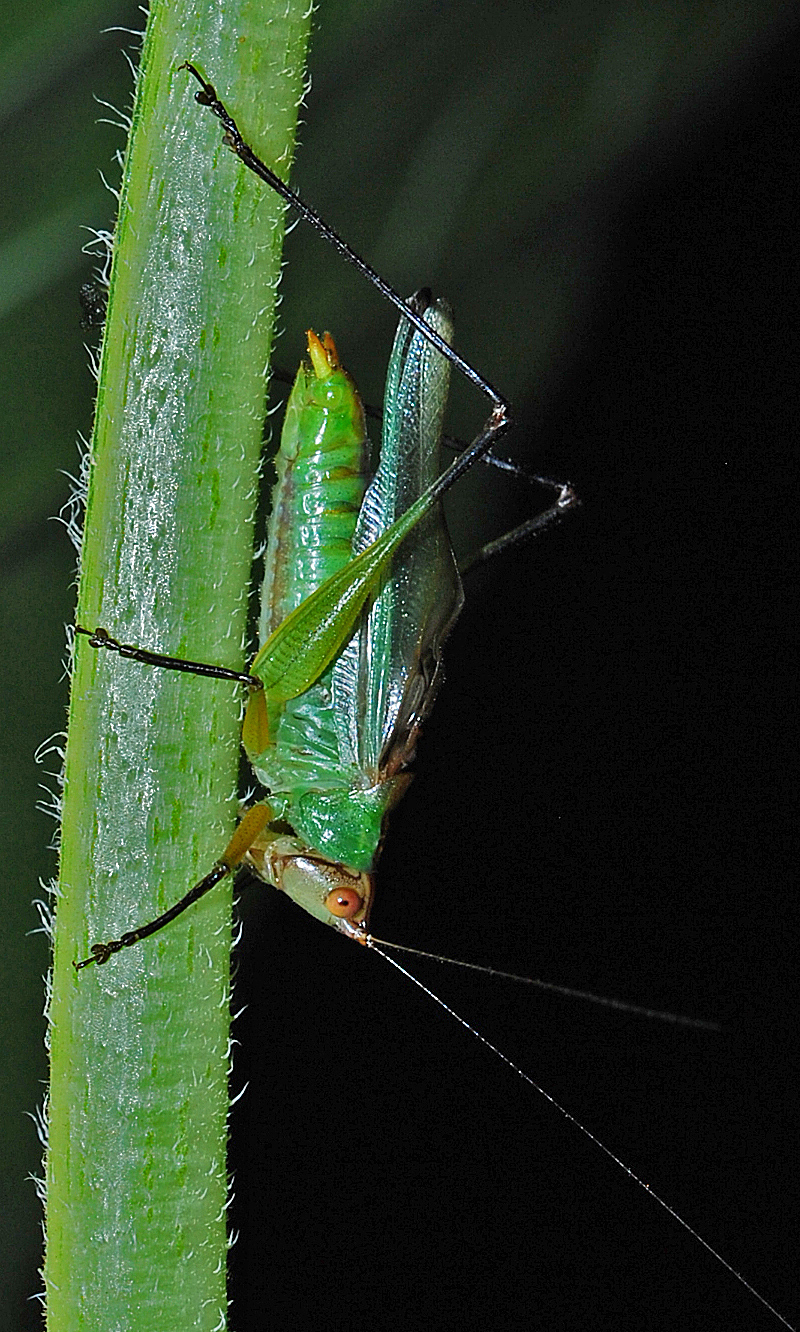
The black-legged greater meadow katydid thrives in low areas and near bodies of water in SNR

The prairie ragged orchid began to appear in old fields and prairie plantings where prescribed burning occurs at SNR. It has not been seen in fields maintained exclusively by mowing or haying.
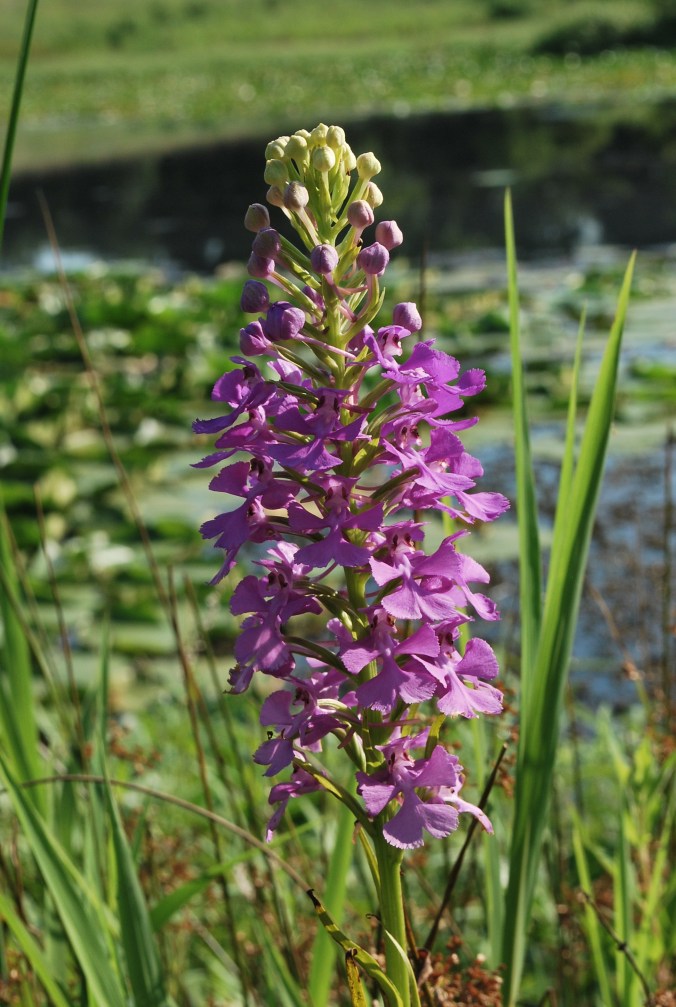
The purple fringeless orchid surprised the restorationist and St. Louis area botanists by flowering in the SNR wetland area 17 years after the original sowing.

Copyright © James Trager 2010

Add to FacebookAdd to DiggAdd to Del.icio.usAdd to StumbleuponAdd to RedditAdd to BlinklistAdd to TwitterAdd to TechnoratiAdd to Yahoo BuzzAdd to Newsvine

Email to a friend
Guest Blogger: Dogbane for Dinner

Our guest blogger for today is Anne McCormack. I have known Anne (or known of her) for more than 25 years now, first as a long-time editor of Nature Notes, the journal of the Webster Groves Nature Study Society, and more recently on a personal basis as I, myself, have followed in her editorial footsteps. Anne is an astute naturalist whose breadth of knowledge spans not only botany but also entomology and ornithology, all of which she write about in her own blog at Gardening with Binoculars.


I planted Common Dogbane (Apocynum cannibinum) because some of my butterfly-watching friends reported numbers of juniper hairstreak butterflies on the patch of dogbane at Powder Valley Nature Center in Kirkwood. I assumed incorrectly that dogbane was a host plant for hairstreaks, and believing it to be little more than caterpillar food, I placed it in a hot, dry, narrow strip along the driveway. Ragged, caterpillar-chewed leaves wouldn’t be noticed there, and I forgot about it. After a few seasons, it was still a modest-sized clump, but the leaves were in great shape. In fact, it had grown into an attractive bush of airy, elegant lime-green foliage, wine-red stems, and tiny white flowers. It’s quite a contrast to its relative, Common Milkweed, growing next to it, which looks as if it were designed by Dr. Seuss—even before it gets chewed to bits. At this point I decided it was time to look it up and see why it had failed to support hordes of munching caterpillars. As you have already guessed, gentle reader, the Juniper Hairstreak’s host plant is juniper, not dogbane, but good old Common Dogbane is a great nectar plant. Now that Dogbane and I understand each other better, I can appreciate the amount of traffic its tiny white blooms bring in, like this Peck’s Skipper butterfly. Ants, butterflies, tiny native bees, honeybees, and this mason wasp are busy there all day long.

Along with several species of moth, it is the host plant for the Dogbane Beetle, which spends its larval stage devouring the roots and its adulthood dining on the leaves of Dogbane, and nothing but Dogbane. Dogbane Beetle can be confused with Japanese Beetle by beginners like myself, but unlike its fellow Coleopteran, Dogbane Beetle is harmless. That makes its iridescence all the more gorgeous, as shown in this wonderful photo by Courtnay Janiak. It’s a native insect that has shared a long evolutionary history with this under-appreciated native plant. American Indians valued it for its bark, which is tough but peels off in long strips. They plaited it for bowstrings and anything that called for twine; hence, its other common name, Indian Hemp. Don and Lillian Stokes, in their 2002 PBS show about bird watching, demonstrated how birds seek out the dry stems of this perennial, pulling off strips for nests in early spring. Nesting material can be hard to come by for birds in the tidy suburbs, so I don’t clean up the stems after frost. “Bane” in the name refers to the toxin cymarin in the plant’s leaves, though the plant would have to be covered in braunschweiger before my dog would be interested. Edgar Denison, in Missouri Wildflowers, translates the genus name Apocynum as “away dog.” The species name cannibinum refers to hemp. Its seedpods remind me of French green beans. These split at the end of the season, and the seeds fly away on fibers similar to milkweed seeds. Collect some and try this plant in your butterfly or native plant garden. Give it a spot where it’s easy to watch the colorful visitors.

Dogbane beetle (Chrysochus auratus) - Copyright © Courtnay Janiak

Copyright © Anne McCormack 2010

Add to FacebookAdd to DiggAdd to Del.icio.usAdd to StumbleuponAdd to RedditAdd to BlinklistAdd to TwitterAdd to TechnoratiAdd to Yahoo BuzzAdd to Newsvine

Email to a friend

Friday Flower – Cleft Phlox

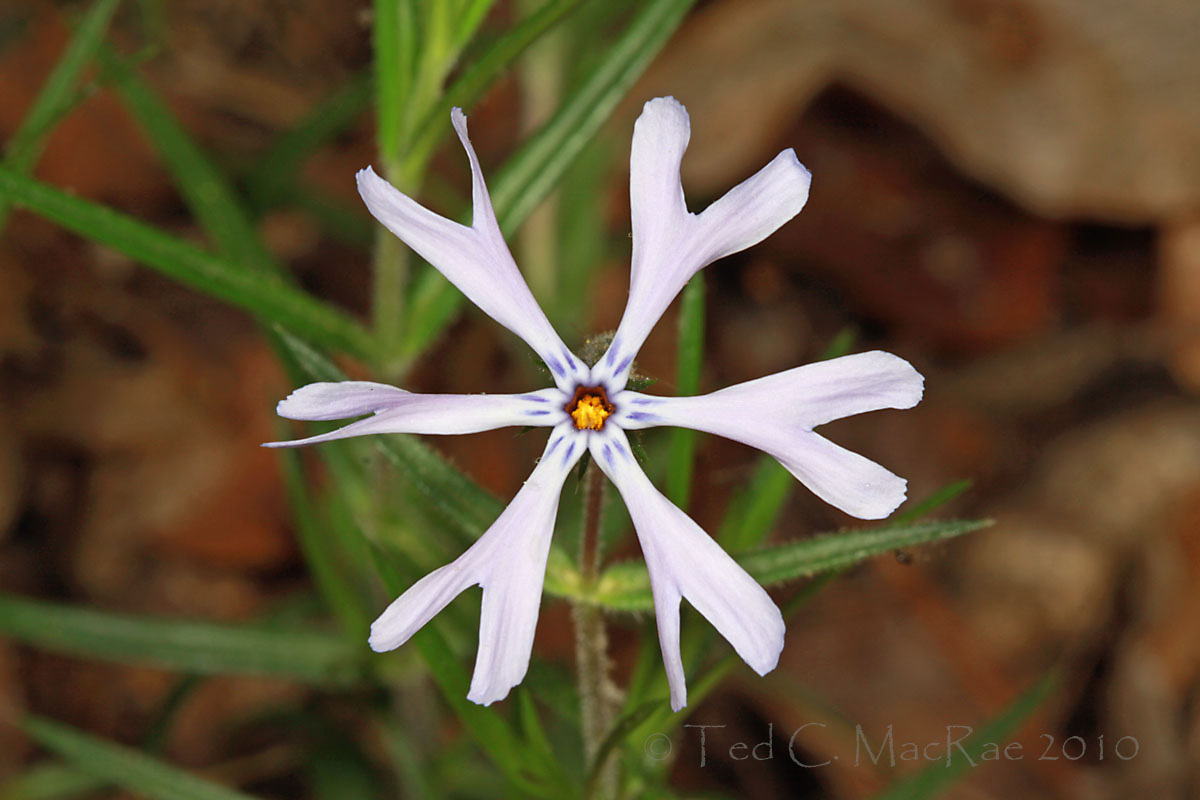
In a recent edition of my Friday Flower series I featured Tradescantia longipes (dwarf spiderwort or wild crocus), an exquisite Ozark endemic found scattered in dry igneous woodlands of the Missouri’s St. Francois Mountains and Arkansas’ Ouachita Mountains and that I had seen this past April at Sam Baker State Park. Growing alongside these beautiful plants was this equally exquisite plant bearing strikingly cleft petals on its blossoms.  I recognized it clearly as some type of phlox, but not one that I recalled having seen before.  There is good reason for this, as a quick check of Steyermark (1963) revealed this to be Phlox bifida, which, though not a true Ozark endemic, is known from just a handful of Missouri counties where it grows typically in dry, rocky soils of upland woods, ravine slopes and bluff ledges.  Commonly called cleft phlox or sand phlox, the strongly cleft (bifid) petals distinguish it from other species in the genus and, not surprisingly, are the basis for its species name.  This is another plant that would seem to make a good choice for a native wildflower garden, as it can perform very well in cultivation.

Photo Details: Canon 50D (ISO 100, 1/250 sec, f/18), Canon 100mm macro lens, Canon MT-24EX flash (diffused 1/4 power), typical post-processing (levels, unsharp mask).

REFERENCE:

Steyermark, J. A. 1963. Flora of Missouri. Iowa State University Press, Ames. 1728 pp.

Copyright © Ted C. MacRae

Add to FacebookAdd to DiggAdd to Del.icio.usAdd to StumbleuponAdd to RedditAdd to BlinklistAdd to TwitterAdd to TechnoratiAdd to Yahoo BuzzAdd to Newsvine

Email to a friend