Clubmoss along the Ozark Trail

It has been a long, hard winter – one of the toughest I can remember during my years here in Missouri in terms of amount and frequency of precipitation and persistent cold temperatures. Tough winters, however, are no deterrent to my favorite wintertime activity – hiking. I’ve mentioned several times the goal of my friend Rich and I to hike all 350 miles of the Ozark Trail.  We’re at ~250 miles now (more than 2/3 done), thanks to the two 10-mile stretches of the Wappapello Section that we did on the days after Thanksgiving and New Year’s. 

Hiking these trails is an opportunity to imagine the Ozark Highlands in their wild, pre-settlement state – expansive hardwood forests covering miles and miles of rugged up-and-down terrain.  Of course, try as I might to pretend otherwise, the Ozarks have changed, and evidence of man’s pervasive presence are everywhere.  Some are overt, such as this mass grave of domestic cattle, dumped by their former owner for others to worry about when disease prevented them from realizing their economic potential.  Others are much more subtle, but to the discriminating naturalist they are everywhere – even in the most pristine-looking of areas.  A cedar-choked glade here, it’s rich, tawny, native warm-season grasses pushed the margins and interspaces; a monotonous, stunted black oak forest there, sprigs of herbaceous plants giving a hint of the diverse understory just waiting for a fire to bring back the more open woodland it needs to thrive.  Settlement has brought with it not only direct impacts to the land, but also changes in its ecology and vegetational character.  Once a fire-mediated landscape with shifting mosaics of bald ridges, grassy woodlands, and riparian forests, a century of logging, grazing, and fire suppression have turned much of the Ozark Highlands into homogenous stands of oak with depauperate mid- and understories.

While loss of diversity has been the overwhelming trend in response to settlement, additions to the state’s flora are also being seen.  The Wappapello Section is the southeasternmost of all the Ozark Trail sections, lying almost entirely in Wayne County, and as we traversed the rugged terrain north to Sam A. Baker State Park, we encountered this most unusual of plants – a clubmoss.  Since they are vascular plants, clubmosses are not really moss (which are non-vascular).  Clubmosses are not flowering plants either, nor do they even produce seeds, reproducing instead by spores – just like ferns, horsetails, and other ‘primitive’ (sorry, Alex!) vascular plants.  Practicing botanists include them in a group known as “fern allies”, meaning that they are not ferns (ferns have multiple branching veins in their delicate fronds, while clubmosses have a single vein in their small, scale-like leaves), but they are somewhat like them.

This particular clubmoss belongs to the genus Lycopodium, or ground cedars – the name obviously derived from the resemblance of their foliage to various gymnospermous plants known as cedars (though completely unrelated) but growing very low to the ground. There are three species of Lycopodium in Missouri (Yatskievych 1999), all confined to the Ozark Highlands and all considered species of conservation concern due to their rarity in the state (Missouri Natural Heritage Program 2010).  Two of these species are highly restricted (designated S1 for “critically imperiled”), boreal species occurring only on moist sandstone bluffs in Ste. Genevieve County as Pleistocene relicts – holdovers from a time when glaciers advanced to within about 50 miles to the north and cool, wet conditions prevailed throughout the rest of the state.  The third species, shown here, is Lycopodium digitatum.  Although more widespread in the cool forests of the northeastern U.S. and Canada, it is apparently expanding its range and was first found in Missouri in 1993.  While still considered uncommon (and accordingly designated S2, or “imperiled”), its range has since expanded to a core of several southeastern Missouri Ozark counties that include Carter, Iron, Madison, Reynolds, and Wayne Counties (Doolen and Doolen 2008).  We found this colony at the base of a moist wooded slope amongst an invading stand of Juniperus virginiana (ironically, called “cedars” by local residents).

“Running ground cedar” has been used as a common name for L. digitatum, most likely due to its habit of spreading by rhizomes – or “runners” – along the soil surface.  From a distance, the spore-producing strobili stood out in bright yellow contrast to the dark glossy green foliage that carpeted the ground – itself in stark contrast with the surrounding brown leaf litter.  It is these club-like strobili from which the common name “clubmoss” is derived, and from a distance of 20 m away I knew instantly that this was something unusual and worthy of investigation.  Despite the gray November skies and cool temperatures, the strobili were actively shedding spores – clouds of yellow dust swirling briefly with each knock of the finger before dissapating into the air.

Hundreds of millions of years ago, the Carboniferous earth was covered with vast forests of giant clubmosses – extinct relatives of this species that soared to heights of one hundred feet. These giants eventually gave way to new kinds of plants – first the seed-bearing conifers, and later the flowering angiosperms. The giant clubmosses are gone, but their descendents have survived the vastness of time, represented today by these humble, diminutive forms – extant members of an ancient group hiding in the nooks and crannies of the modern flora. I don’t know whether the recent appearance of L. digitatum in the Ozark Highlands is a result of the anthropogenic changes brought upon the area in recent years, but given its ancient, relictual qualities, it is one change in the flora of Missouri that I do not mind.

REFERENCES:

Doolen, W. and C. Doolen.  2008.  Clubmoss wonders in southeast Missouri.  Perennis, Newsletter of the S.E. Missouri Native Plant Society 1(4):1–2.

Missouri Natural Heritage Program.  2010.  Missouri Species and Communities of Conservation Concern Checklist.  Missouri Department of Conservation, Jefferson City, Missouri, 53 pp.

Yatskievych, G. 1999. Steyermark’s Flora of Missouri, Volume 1. Missouri Department of Conservation, Jefferson City, 991 pp.

Copyright © Ted C. MacRae 2010

Add to FacebookAdd to DiggAdd to Del.icio.usAdd to StumbleuponAdd to RedditAdd to BlinklistAdd to TwitterAdd to TechnoratiAdd to Yahoo BuzzAdd to Newsvine

Email to a friend

BitB on NBN

Nature Blog NetworkI’m sure all of you have by now heard of Nature Blog Network. At more than 1,000 member blogs, it is THE nexus for the nature blog community. Consisting of a toplist that ranks websites based on pageviews (including separate toplists for each subject, like invertebrates) and a blog that keeps members up-to-date on the art and science of nature blogging, Nature Blog Network is a portal through which bloggers and readers alike can find what they’re looking for.

One of their regular blog items is the Featured Blog – an in-depth look at one of their member blog sites, and I’m thrilled that BitB has been chosen for this week’s edition.  Check it out for a peek inside the brain behind the beetles at BitB (and don’t forget to tip the waiter).

Copyright © Ted C. MacRae 2010

Add to FacebookAdd to DiggAdd to Del.icio.usAdd to StumbleuponAdd to RedditAdd to BlinklistAdd to TwitterAdd to TechnoratiAdd to Yahoo BuzzAdd to Newsvine

Email to a friend

North America’s largest jewel beetle

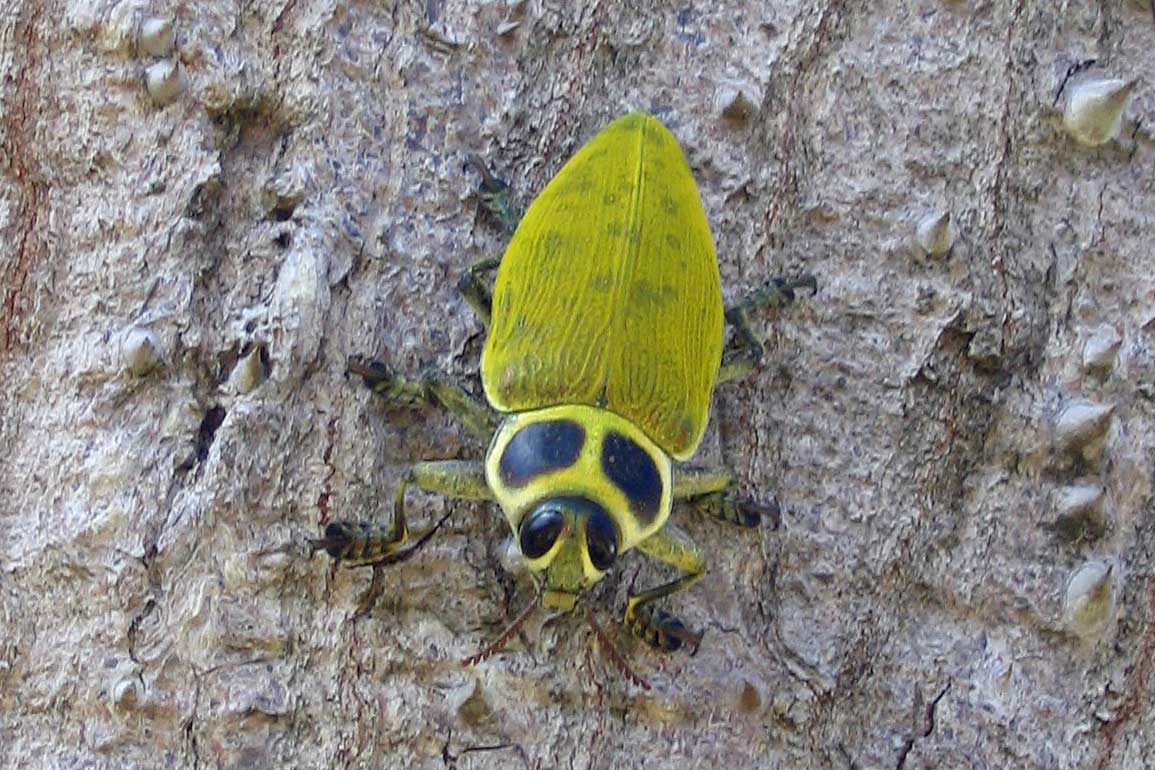
Euchroma gigantea in Jamaica. Photo © Steve Meyer


In recent weeks I’ve featured a few jewel beetles that I have encountered amongst specimens sent to me for identification (see “Aaack!-maeodera” and “Acmaeodera carlota in northern Arizona“).  While the new distributions and even unknown species that they represent are fascinating from a scientific perspective, their diminutive size (~6 mm in length) probably makes them less than spectacular to the non-specialist.  The family Buprestidae does, however, contain some very large species, including a few that qualify as bona fide giants.  One such species, Euchroma gigantea (Giant Metallic Ceiba Borer Beetle), occurs from Mexico through Central America, the West Indies, and most of South America.  At a maximum of 65mm in length, it is not only North America’s largest jewel beetle, but also the largest jewel beetle in the entire Western Hemisphere.

My colleague Steve Meyer encountered and photographed this individual in Negril, Jamaica.  Although its scientific name translates to “colorful giant”, the beetle in the photo is especially so due to the delicate, waxy bloom covering its elytra. This bloom is secreted by the adult after transforming from the pupa and prior to emerging from its larval host, giving it a bright yellow-green appearance.  After the beetle emerges and becomes active, the bloom is quickly rubbed off and the beetle takes on the shiny, iridescent purple-green color by which it is more familiar.  The presence of bloom on this individual suggests that it had just emerged from the trunk of the kapok tree (Ceiba pentandra) on which it was sitting.  Kapok and other large trees in the family Bombacaceae serve as hosts for larval development for this species (Hespenheide 1983).

Indigenous peoples in Central and South America have long utilized the dazzlingly colored elytra of these beetles to create beautiful natural jewelry and adorn their clothes and textiles.  The species is also eaten in both the larval and adult stages – Tzeltal-Mayans in southern Mexico (Chiapas) roast the adults when available, and the Tukanoans (northwestern Amazon) also eat the larvae (Dufour 1987). I have eaten a few insects in my day, but none as thick and massively juicy as the grub of this species must be. Holometabolous larvae typically contain a rather high percentage of fat (up to 66% dry weight) to meet the demands of pupal development and adult reproduction, and I suspect this makes the larvae quite tasty (especially when roasted). If there is any insect in the world that I really, really, really want to eat – it is the larva of this one!

REFERENCES:

Dufour, D. L.  1987.  Insects as food:  A case study from the northwest Amazon.  American Anthropologist 89(2):383–397.

Hespenheide, H. A.  1983.  Euchroma gigantea (Eucroma, giant metallic ceiba borer), p. 719.  In: D. H. Janzen [ed.], Costa Rican Natural History, University of Chicago Press, Chicago.

Copyright © Ted C. MacRae 2010

Tuesday Tarantula


One of my destinations on my annual fall tiger beetle collecting trip last October was The Glass Mountains in northwestern Oklahoma. Rising from the red Permian beds of the central Great Plains, the Glass Mountains are a series of mesas and buttes capped by thick layers of the sparkling, glass-like crystal selenite. It is still common to see them referred to as the “Gloss” Mountains, the result of a transcription error by a mapmaker back in the late 1800s, and although the soils that comprise the formations are very old (laid down as sedimentary deposits during the Permian Era some 250 million years ago), the landscape itself is relatively young – a result of erosion by glacial outwash from the Rocky Mountains during the past 1 million years.

Of course, I was not here to study crystals or geology, but to look for tiger beetles! It was at this spot that earlier in the year (June) I had discovered a new population of Cylindera celeripes (Swift Tiger Beetle), a rarely-collected flightless species that has declined worrisomely during the past century, and another seldom-collected flightless species, Dromochorus pruinina (Frosted Dromo Tiger Beetle), was also a good find. Neither of these species were my reason for being here in October, however, since by then adults of both have long disappeared. Instead, I was hoping that the large, unidentified larvae that I had seen in their burrows at this site back in June would be out as adults. Their great size suggested two possibilities – Cicindela obsoleta (Large Grassland Tiger Beetle) or C. pulchra (Beautiful Tiger Beetle), either of which would be a great find. Alas, overcast skies and a cold, biting wind made whatever tiger beetles were there – lovers of sun and warmth that they are – remain secreted within their protected haunts. I still have a shot at finding out what they are – I successfully extracted two larvae from their burrows and fed them well in the laboratory with fat fall armyworm larvae before putting them to sleep for the winter in a 10°C (50°F) incubator.  If all goes well, I’ll wake them up this spring and finish them out to adulthood this year.

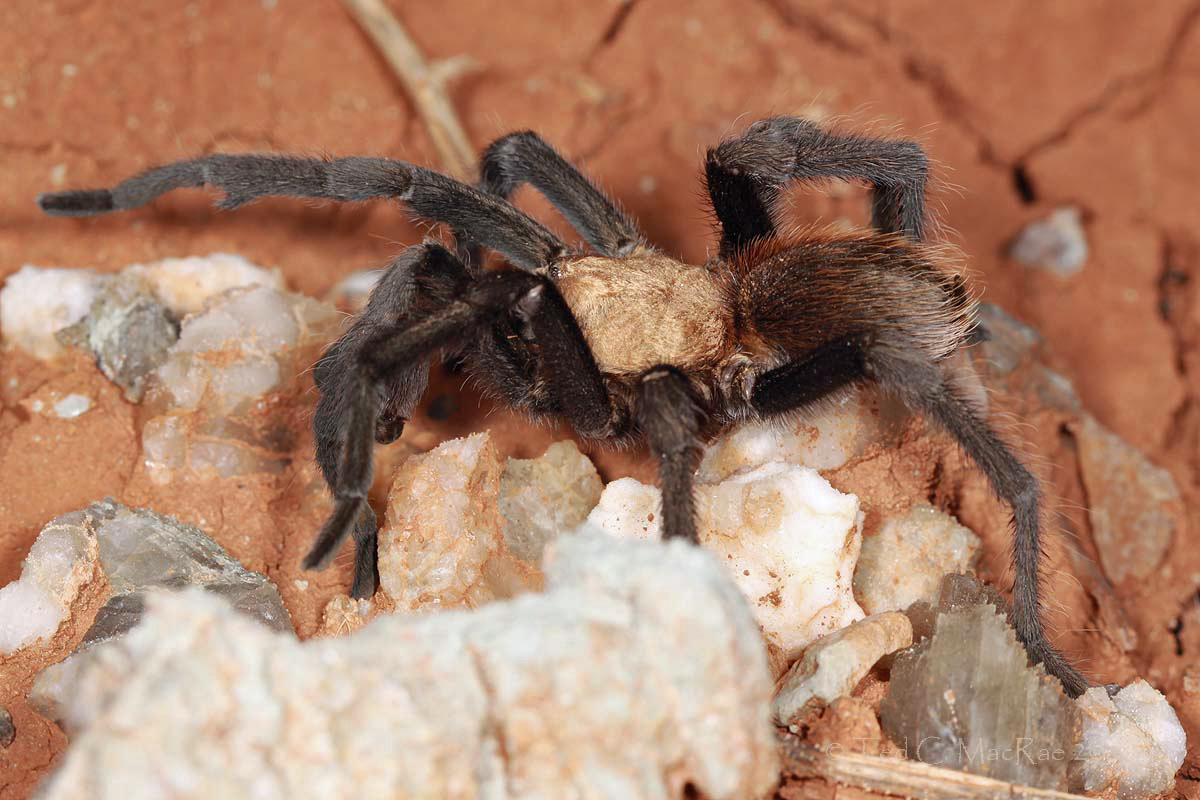
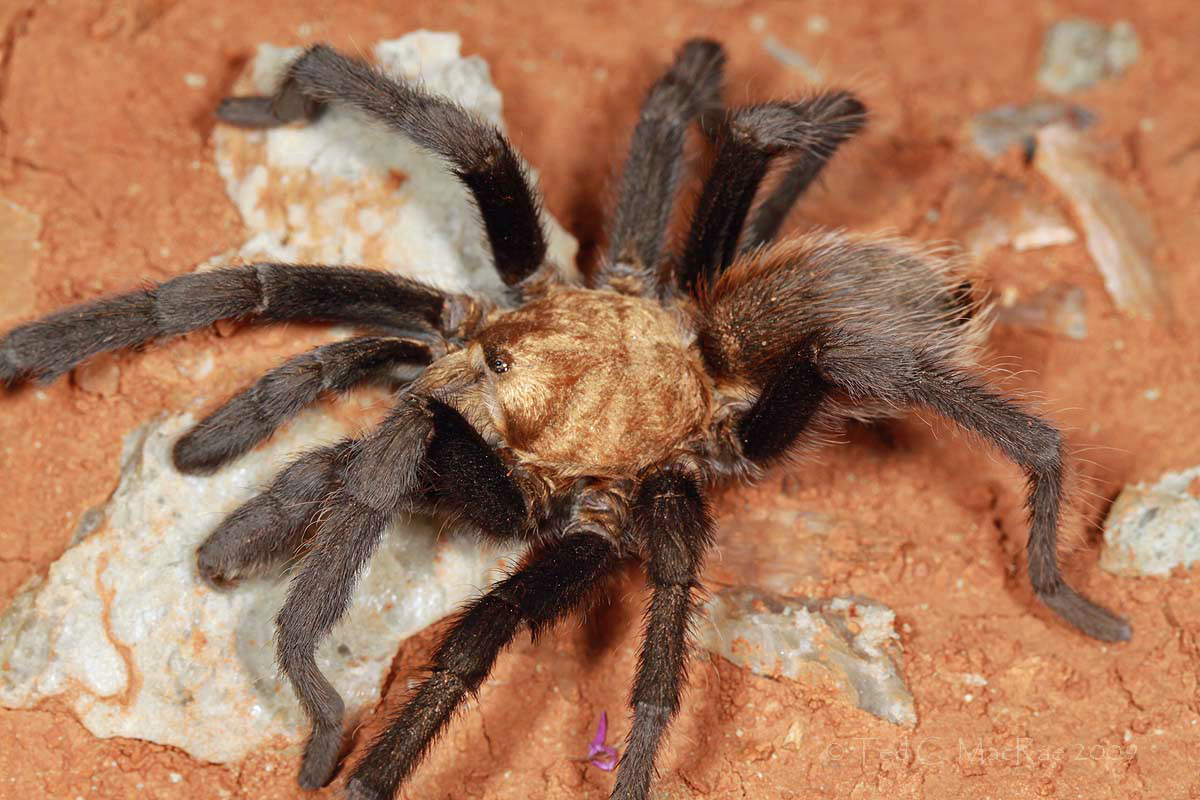
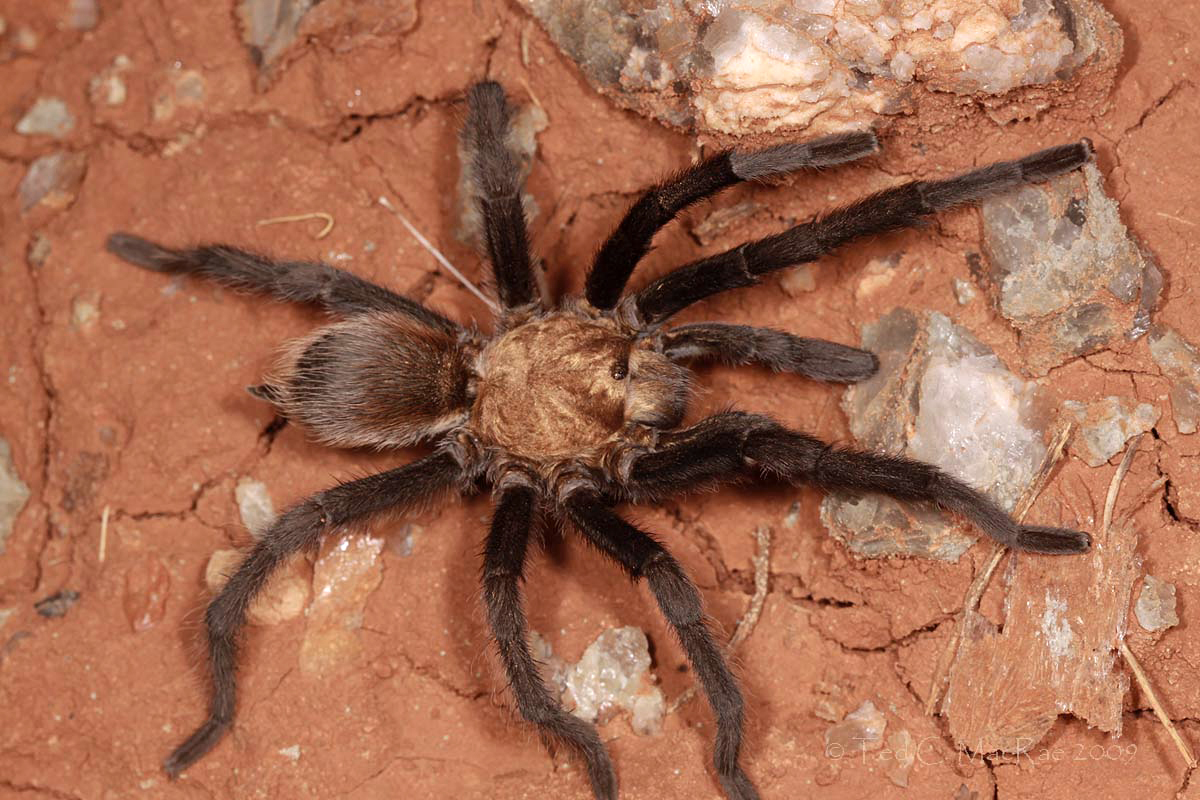
There were a few consolation prizes on the day, one of which was this large, lumbering male tarantula seen slowly making its way down the red clay slopes. For all their charisma and noteriety, it’s interesting to note that the taxonomy of U.S. tarantulas (almost all of which belong to the genus Aphonopelma) is rather poorly known – some 50 species have been described, but many of the descriptions are inadequately based on limited material (or even single specimens) and often rely upon variable, highly artificial characters (Prentice 1997). Brown or black species with no distinctive coloration (such as this one) seem to present the greatest challenge; however, the internet seems to have concluded that the only tarantula present in Oklahoma is Aphonopelma hentzi.


This spider can be distinguished as a mature male by way of the tibial hooks that can be seen on the undersides of the front pair of walking legs in the first photo.  Female and immature tarantulas normally stay in their burrows during the day and come out at night to hunt, but wanderlust strikes the adult males during late summer and fall, during which time they’ve been documented traveling as far as 1.3 km over a period of 2-3 weeks (Janowski-Bell and Horner 1999) – presumably in search of females with which to mate.  It is only after the male’s final molt that wanderlust sets in and the tibial hooks appear, which are said to function in holding the female (and her fangs!) at a safe distance during copulation.


It may seem hard to believe, given its large size and slow movement, but I found this spider exceedinly difficult to photograph compared to the tiger beetles that I have spent much more time with. I’m not used to photographing subjects with a 4-5 inch leg spread, which made it difficult for me to judge working distance and get a handle on proper settings and positions for the flash units. Once I did get that under control, I found the tarantula’s incessant desire to keep moving maddeningly frustrating. Tiger beetles, as active and flighty as they are, nevertheless eventually sit still long enough to allow at least a shot or two before bolting, but this tarantula… just… never… stopped… moving! I can’t tell you how many shots I discarded because it’s legs were splayed awkwardly in multiple directions. Eventually, however, I got enough shots that I felt there should be at least a few good ones among them, and those are the ones I share here.


Most male tarantulas will die within a few weeks or months of their final molt. Still, that doesn’t deter me from scooping them up whenever I find them and bringing them home to enjoy as pets for whatever time they have left. My daughters probably like tarantulas best of any of the critters that I bring home – I never have to ask “Has anybody fed ‘Hairy’?” (and props to awesome wife for enduring something most ‘normal’ wives couldn’t even begin to contemplate).

REFERENCE:

Janowski-Bell, M. E. and N. V. Horner.  1999.  Movement of the male brown tarantula, Aphonopelma Hentzi (Araneae, Theraphosidae), using radio telemetry.  The Journal of Arachnology 27:503–512.

Prentice, T. R. 1997. Theraphosidae of the Mojave Desert west and north of the Colorado River (Araneae, Mygalomorphae, Theraphosidae). The Journal of Arachnology 25:137–176.

Copyright © Ted C. MacRae 2010

Add to FacebookAdd to DiggAdd to Del.icio.usAdd to StumbleuponAdd to RedditAdd to BlinklistAdd to TwitterAdd to TechnoratiAdd to Yahoo BuzzAdd to Newsvine

Email to a friend

Acmaeodera carlota in northern Arizona

Acmaeodera carlota Fall – Coconino Co., Arizona

This is another of the interesting species that I encountered during my examination of material submitted for identification this past winter.  Acmaeodera carlota is one of 149 species/subspecies in North America belonging to this very difficult genus (recall my recent post, Aaack!-maeodera), and as with so many of its congeners it wasn’t described until after the last revision of the genus more than a century ago (Fall 1899).  Obviously, the genus badly needs another revision – or at least a revised key – so that the known species can be identified with some degree of confidence without having to send specimens to a specialist. There have been a handful of buprestid workers in recent decades who may have been able to accomplish this daunting task, but to date none have been willing to embrace this considerable challenge.

As far as is known, A. carlota occurs only in Arizona.  Fall (1932) described this species from a few specimens collected from cactus blossoms near Globe, Arizona (~90 miles east of Phoenix).  Since then, the only specific information recorded about this species was by Westcott et al. (1979), who reported adults cut from wood of Quercus dumosa near Sunflower (~60 miles northwest of the type locality) and collected from flowers in west-central Arizona near Wikieup.  Fall’s original description leaves much to be desired (as is the case for nearly all original descriptions prior to the last 50 years or so), and to this point no images have been published in the literature or appeared on the web.  This particular specimen was found in a batch of material sent to me by cerambycid-enthusiast Jeff Huether (the same batch containing the previously discussed Acmaeodera robigo), and the only reason I was able to identify it was by comparing it to a specimen given to me by the late Gayle Nelson, who collected the species near Wikieup after its occurrence was reported there by Westcott and colleagues.  The interesting thing about this specimen is that it was collected near Page, Arizona – nearly 200 miles north of any of the previous known localities and just south of the Utah border.  In suspect this species occurs even more broadly and is not, as the limited records suggest, restricted to Arizona.

Acmaeodera carlota belongs to a group of species that I loosely refer to as the A. tubulus-species group.  It is not clear that all of the species are actually closely related, but they do all resemble each other in their small size (<8 mm), general appearance (i.e., black with confused yellow maculations on the elytra), and inclusion in the so-called ‘Truncatae’ group (a subdivision of the genus established by 19th Century coleopterist George Horn to include those species having the prosternal margin nearly straight and not retracted from the sides). Within the Truncatae, the species in the tubulus-species group are distinguished by lacking a subapical crest on the last ventral segment and general appearance.  Only three species were known at the time of Fall’s revision (conoidea, neglecta, and tubulus); however, an additional eight species have been described since (carlota, ligulata, neoneglecta, opuntiae, parkeri, sabinae, starrae, and thoracata).  I have collected many of these species in my travels across the southwestern U.S. and lack only starrae and thoracta in my collection (the latter is known only from the type).  In the case of A. carlota, note the rather flattened dorsal surface that is densely clothed with long, stiff, dark, suberect hairs; the coarsely, contiguously punctate pronotum; and the subrugose, slightly irregular elytral intervals, which serve to distinguish this species from others in the group.

The group’s namesake, Acmaeodera tubulus, is widespread and common across the eastern U.S., making it relatively easy to identify. However, the remaining species of the tubulus-species group are limited to the south-central and southwestern U.S., and the lack of available identification keys and suitable descriptions makes them nearly impossible to identify except by comparison with determined specimens. As a result, I have built a key to the species in the Acmaeodera tubulus-species group that I use to assist in my own identifications.  The key is based on distinguishing characters given in the original descriptions (if any) and augmented by my examination of the material at my disposal.  I invite users to test the key with their own material and let me how well it works.

My sincere appreciation to Jeff Huether for allowing me to retain this specimen in my collection as a voucher for the range extension that it represents.

REFERENCES:

Fall, H. C.  1899.  Synonpsis of the species of Acmaeodera of America, north of Mexico.  Journal of the New York Entomological Society 7(1):1–37 [scroll to “Journal of the New York Entomological Society”, “v. 7 1899”, “Seq 12”].

Fall, H. C.  1932.  Four new Buprestidae from Arizona.  The Pan-Pacific Entomologist, 8(2) (1931):81-84.

Westcott, R. L., W. F. Barr, G. H. Nelson, and D. S. Verity.  1979.  Distributional and biological notes notes on North and Central American species of Acmaeodera (Coleoptera: Buprestidae).  The Coleopterists Bulletin, 33(2):169-181.

Copyright © Ted C. MacRae 2010

Add to FacebookAdd to DiggAdd to Del.icio.usAdd to StumbleuponAdd to RedditAdd to BlinklistAdd to TwitterAdd to TechnoratiAdd to Yahoo BuzzAdd to Newsvine

Email to a friend


March Carnivalia

It’s a new month, and that means a new crop of blog carnival issues. I have my favorites that I follow, and since I’m not hosting anything this month (for once!) I thought I’d give you my take on these newest editions.

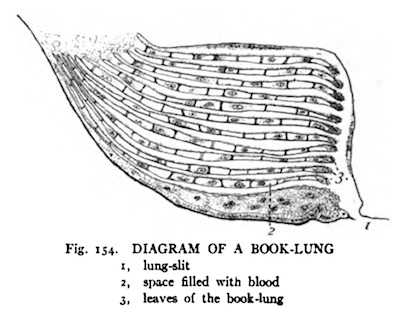
Circus of the Spineless is the undisputed king of invertebrate blog carnivals as it approaches its semi-centennial issue, and Matt Sarver at The Modern Naturalist introduces each contribution in Circus of the Spineless 48: Cabinet of Curiosity with a quote or image dusted off from the cabinet of scientific curiosity. Book lungs, honey pots, crusty love, hairstreaks, hot tigers (beetles, that is!), giant snails, monarchs, caterpillars, and shocked crayfish top the bill this month.

…botanical carnivals are like a box of chocolates: You never know what you’re going to get, but it’s bound to be delicious!

I have a fond spot in my heart for Berry Go Round, as it was the first blog carnival that I ever hosted. This month, Sally White at Foothills Fancies offers a delicious assortment of botanical treats with Valentines for Plant Lovers (BGR #25). My favorite are the white orchids (of course), but the stunning Arisaema photographs and two very interesting fossil plant posts also piqued my interest.

I don’t have a contribution of my own in this month’s Festival of the Trees, but I promote it anyway because it always offers such an exquisite blend of botanical learnings and passionate, almost spiritual writing. Trees evoke something deep in the human psyche, and this reverance is on full display in the quotes used by Jeremy at The Voltage Gate to introduce the posts in Festival of the Trees #45: Voice. Don’t believe it? How about this teaser?

If you were living just across and if I were a tree
In that yard,
I’d delight you with fruit,
I’ll be watered with your glimpse,
just look at me in ardor,
I’d bear the sweetest fruit for you.

…or this one?

I can’t imagine what it must be like to be tree-bereft, or tree-oblivious. I’m sure I’ve not been as open-hearted as I could be with trees, but I’m learning, and they are great teachers.

I’ve often considered Carnival of Evolution to be the most erudite of the blog carnivals that I follow, and Carnival of Evolution #21: The Superstar Edition by Kelsey at Mauka to Makai proves it. Eight of the issue’s contributors are finalists for Research Blogging Awards and one is an award-winning journalist. See what some of the best science bloggers have to say about biology’s biggest superstar (Darwin, of course) and all manner of terminal branches on his tree of life – from bacteria to fish to birds to mammals. I’ll be trying my own hand at the cerebral challenge of hosting this carnival’s next edition on or about April 1st – it would appear I have a tough act to follow.

Don’t forget – An Inordinate Fondness (my favorite carnival!) will make its first journey away from the homesite this month, with issue #2 to be hosted by Amber Coakley at Birder’s Lounge.  Submissions are due by March 15.  Issue #4 of House of Herps is also scheduled for mid-March but apparently still needs a host.  If you’ve never hosted a blog carnival before, why not give this one a try (every blog carnival host was once a newbie)?  If you have hosted a carnival before, you already know how to do it – why not help?  Submissions for this one are also due by March 15, and you can send them to the home site.

Copyright © Ted C. MacRae 2010

Add to FacebookAdd to DiggAdd to Del.icio.usAdd to StumbleuponAdd to RedditAdd to BlinklistAdd to TwitterAdd to TechnoratiAdd to Yahoo BuzzAdd to Newsvine

Email to a friend

A Tiger Beetle Aggregation

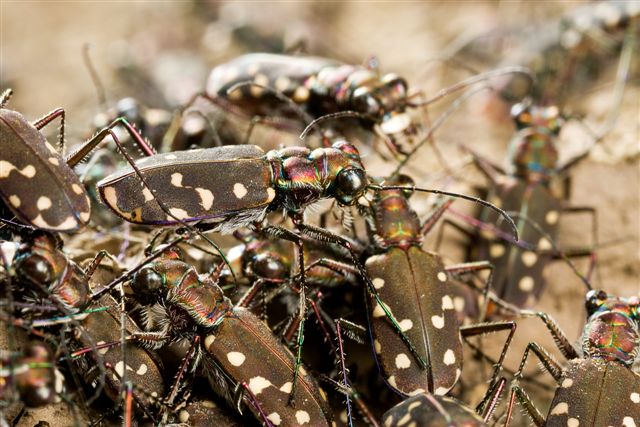
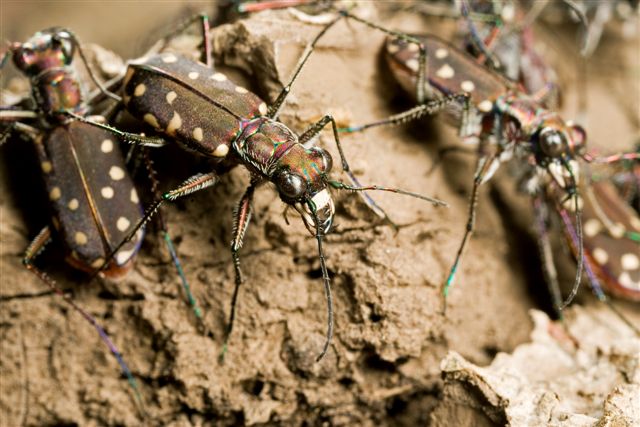
Not long ago, I received an interesting series of photographs from Joe Warfel, a nature photographer and macro specialist based in Massachussetts.  Joe traveled to Arizona last July, where he photographed an aggregation of Cicindela (Cicindelidia) sedecimpuntata (Western Red-bellied Tiger Beetle¹) near a small pool in the bottom of a dry creek bed at night.  Joe estimates that there may have been as many as 200 to 300 beetles per square meter in the aggregation, most of which were just “hanging out” and with only occasional individuals mating or feeding on moths that had been attracted to his headlamps.

¹ Found in the Sonoran and Chihuahuan Deserts of the southwestern U.S. and south through Mexico to Costa Rica. U.S. and northern Mexican populations are assigned to the nominate subspecies, while more southern populations are classified into four additional subspecies (Erwin and Pearson 2008).

Western Red-bellied Tiger Beetles are among the first tiger beetles to appear prior to the summer monsoons in the Sonoran Desert.  The species is famous for its daytime aggregations of as many as several thousand individuals, which congregate along the drying waterways and prey upon stranded tadpoles and other aquatic organisms (Pearson et al. 2006).  Joe noted that he has seen these aggregations many times before during the daytime at small pools and mudflats, with beetles usually mating and feeding frantically.  However, the aggregation shown in these photographs differs from those daytime aggregations by the relative inactivity of the beetles and the fact that they were congregated on dry ground rather than the moist areas that they frequent during the daytime.  In these respects, it seems to more resemble a communal nocturnal roost such as has been reported for several species of Odontocheila in South America.  In those cases, up to 70 beetles have been found resting on the foliage of low shrubs, apparently as an adaptation to avoid predation by multiplying chemical defense effectiveness as well as awareness of approaching enemies (Pearson and Vogler 2001 and references therein).  Cicindela sedecimpunctata is primarily a diurnal species (i.e., it is active during the daytime), though individuals are often attracted to lights at night, and adults of most diurnal species have been reported spending the night protected in burrows or under detritus and vegetation.  I am not aware of communal nocturnal roosts as a reported behavior for C. sedecimpunctata or any other North American tiger beetle species.

It is a bit ironic to think of tiger beetles – voracious predators that they are – as prey, but they must have many of their own predators to deal with since most species employ multiple antipredator mechanisms. In addition to the communal roosting behavior seen in these photos, a second antipredator characteristic exhibited by this species can be seen in their bright orange abdomen.  The abdomen is fully exposed only during flight, seemingly implying a “flash coloration” function for the bright color that disappears upon landing, momentarily confusing potential predators.  However, Pearson (1985) experimentally determined that orange abdomens in tiger beetles actually have an aposematic function in protecting them from predation against robber flies.  Most tiger beetle species with an orange abdomen also release a combination of benzaldehyde and cyanide² when captured (any tiger beetle collector is familiar with the characteristic “fruity” smell of a tiger beetle releasing benzaldehyde).  Pearson painted the abdomen of paper tiger beetles models either orange or black and endowed them with or without a drop of fresh benzaldehyde.  When presented on a tether to robber flies in the field, orange-abdomened models with benzaldehyde triggered significantly fewer attacks from robber flies than any other combination.  Interestingly however, vertebrate predators (lizards and birds) were not deterred by the defense chemicals or by the orange abdomen, perhaps explaining why only some and not all tiger beetle species produce defense chemicals and have bright orange abdomens (Pearson and Vogler 2001).

² Tiger beetles, thus, join millipedes as being among the few invertebrates that are capable of producing cyanide.

My sincere thanks to Joe Warfel for allowing me to use his photographs. More of his work can be seen at Eighth-Eye Photography.  Joe also recently had several images published in American Scientist magazine (November/December 2009 issue) for an article on harvestmen.  Check out the jaws on that juvenile!

REFERENCES:

Erwin, T. L. and D. L. Pearson. 2008. A Treatise on the Western Hemisphere Caraboidea (Coleoptera). Their classification, distributions, and ways of life. Volume II (Carabidae–Nebriiformes 2–Cicindelitae). Pensoft Series Faunistica 84. Pensoft Publishers, Sofia, 400 pp.

Pearson, D. L.  1985.  The function of multiple anti-predator mechanisms in adult tiger beetles (Coleoptera: Cicindelidae).  Ecological Entomology 10:65–72.

Pearson, D. L., C. B. Knisley and C. J. Kazilek. 2006. A Field Guide to the Tiger Beetles of the United States and Canada. Oxford University Press, New York, 227 pp.

Pearson, D. L. and A. P. Vogler.  2001. Tiger Beetles: The Evolution, Ecology, and Diversity of the Cicindelids.  Cornell University Press, Ithaca, New York, 333 pp.

Copyright © Ted C. MacRae 2010

Add to FacebookAdd to DiggAdd to Del.icio.usAdd to StumbleuponAdd to RedditAdd to BlinklistAdd to TwitterAdd to TechnoratiAdd to Yahoo BuzzAdd to Newsvine

Email to a friend

Euhagena nebraskae in Kansas

Gypsum Hills region of south-central Kansas (Barber Co.)

One of my favorite destinations for insect collecting is the Gypsum Hills region in Barber County of south-central Kansas.  I first went there in May 1986 after seeing a diverse selection of more typically Texan Buprestidae that J. Richard Heitzman, an iconic lepidopterist in the Kansas City area and author of Butterflies & Moths of Missouri, had collected there on soapberry (Sapindus saponaria).  I had my own success with Buprestidae as well during that trip, but in recent years I have returned to Barber County several times during the fall to look for one of North America’s most beautiful tiger beetles, Cicindela pulchra (Beautiful Tiger Beetle).  This species had been recorded in the area by the well-known cicindelophiles Ron Huber and Dave Brzoska, who suggested that I look in the red clay hills just west of Medicine Lodge.  My first trip to look for this beetle in 2004 was unsuccessful, and I suspect the early September timing of my trip may have been a tad too early.  I returned again in 2005, this time in early October and also enlisting the help of local entomologist “Beetle Bill” Smith, who knew of a population on private land near his home in Hardtner (south of Medicine Lodge).  Although at first it looked like success might again elude me, in the end I saw a robust population of these spectacular beetles and published an account of that marvelous experience (MacRae 2006).

As with so many of the things that I have seen over the years, they came before my interest in photography, and I now find myself wanting to re-find some of the more spectacular insects that I’ve previously found so that I can properly photograph them.  Such is the case with C. pulchra, so in October of last year I returned to Barber County in hopes of seeing this species armed not only with an aerial net, but also a Canon 50D.  Sadly, this would not come to pass – the same sudden cold snap that dashed my hopes of finding this species in nearby Woodward/Major Counties, Oklahoma would keep any tiger beetle activity to a bare minimum the following day in Barber County as well.  Despite bright sunny skies, I would see only two tiger beetles the entire day, both representing the dreadfully ubiquitous Cicindela punctulata (Punctured Tiger Beetle).  Not all insect activity, however, was squelched, and after scanning the red soils for an hour or so without seeing the object of my desire I began to notice some of these other not-so-temperature-finicky species.  One of the more magnificent of these is shown in the photo below — Euhagena nebraskae in the family Sesiidae (cess-EYE-id-ee) (formerly Aegeriidae).

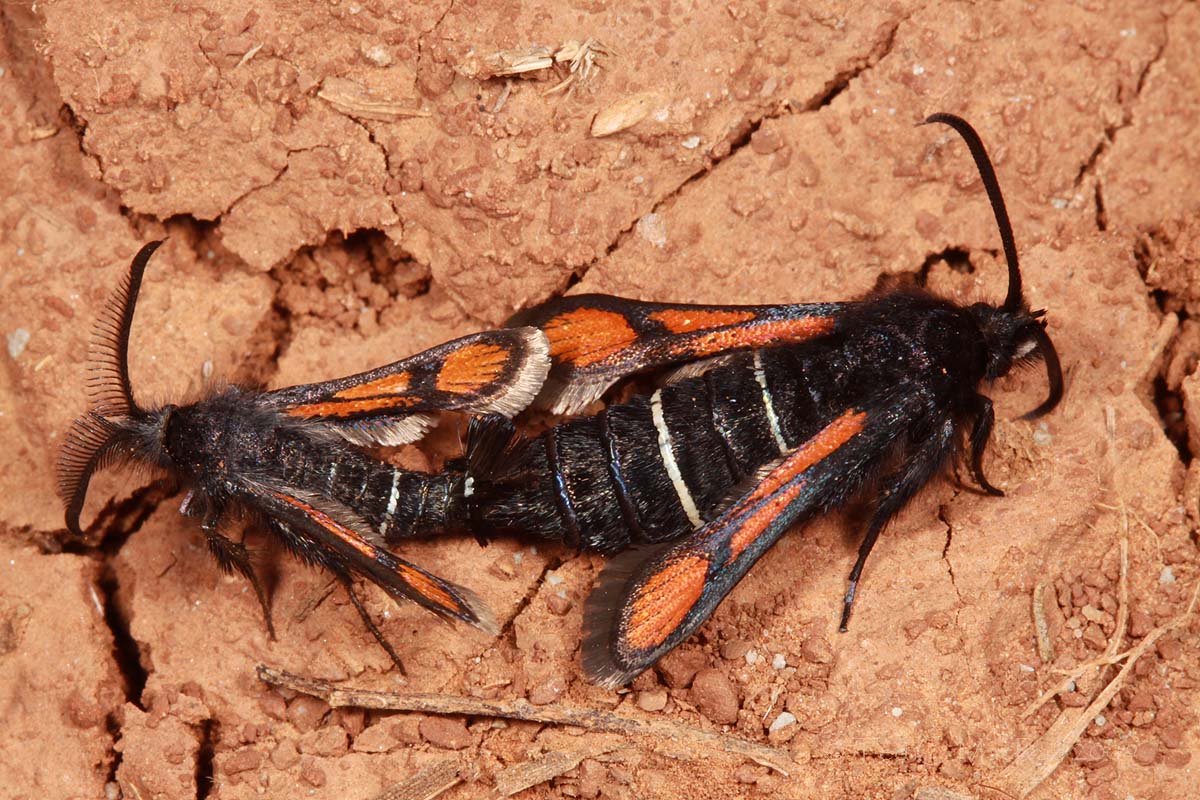
Euhagena nebraskae

Euhagena nebraskae (Lepidoptera: Sesiidae)

Although I wasn’t sure of the species at first, I recognized it immediately as a clearwing moth.  I had an interest in this family of moths for a time in my early days as a field entomologist with the Missouri Department of Agriculture.  Many species are important pests of woody plants in orchard and ornamental landscapes, and it was during that time that synthetic pheromones became widely used for monitoring purposes.  I often walked around with a pheromone tag pinned to my bag to attract the male moths — it was fun watching people seeing these moths “buzzing” me and thinking I was under attack by the wasps that they so effectively mimic (despite my calmness in these situations, I still found it hard to actually grab one from the air with my hand – so convincing is their mimicry).

Euhagena nebraskae is one of two species in the genus in North America, both of which develop as larvae in the roots of plants in the evening primrose family (Onagraceae) (Eichlin and Duckworth 1988).  In fact, I had seen its congener — E. emphytiformis — many times in the 1980s in pheromone traps that I used to place in the glades of Jefferson County just south of St. Louis, where it presumably breeds in one or both of two Oenetherea species growing there (O. gaura and O. macrocarpa).  Euhagena nebraskae is a more western species that does not occur in Missouri, occurring instead across the Great Plains west to California and from southern Alberta and Saskatchewan south to Mexico.  It is likely that many entomologists never see this species, as adults are active only during late fall.  Thus, its perception as an uncommon species may be an artifact of its late seasonality. 

I thought it odd that nearly every individual that I saw was sitting on the ground rather than perched higher on a plant.  At first I wondered if the cold temperatures were a reason for this, perhaps causing the moths to seek out the ground as a source of radiant heat.  This seems doubtful, however, since females always seemed to be “calling” – their tufted abdominal tips raised in the air with the scales spread apart, apparently releasing pheromone.  I was fortunate to find this mating pair, which shows nicely the rather high degree of sexual dimorphism seen in these moths.  Note the much more highly bipectinate antennae of the male (pectinate = resembling a comb, bipectinate = ‘teeth’ on both sides of the main stem) versus the simple antennae of the female — males use their antennae for detecting female pheromones, and the bipectinate form presumably provides greater surface area for placement of sensory pores. Note also the male’s smaller size, “hairier” head and thorax, and greater amount of white coloration on the abdomen and wings.  Engelhardt (1946) supposed that the excessive hairiness of adult Euhagena species was an adaptation to their late-season emergence (principally during October and sometimes as late as November), a time when frosty nights prevail in their high-elevation haunts.    

REFERENCES:    

Eichlin, T. D. and W. D. Duckworth. 1988. The Moths of America North of Mexico, Fascicle 5.1, Sesiodea: Sesiidae. Wedge Entomological Research Foundation, Washington, 176 pp.

Engelhardt, G. P. 1946.  The North American clear-wing moths of the family Aegeriidae. Bulletin of the United States National Museum 190:1-222.

MacRae, T. C. 2006. Beetle bits: The “beautiful tiger beetle”. Nature Notes, Journal of the Webster Groves Nature Study Society 78(4):9–12.

Copyright © Ted C. MacRae 2010

Add to FacebookAdd to DiggAdd to Del.icio.usAdd to StumbleuponAdd to RedditAdd to BlinklistAdd to TwitterAdd to TechnoratiAdd to Yahoo BuzzAdd to Newsvine

Email to a friend