
Last week I mentioned that I had been thinking about starting a blog carnival devoted exclusively to beetles. Actually, I’ve been thinking about it for some time now, but following up on the idea apparently needed a catalyst. That catalyst came last week when Amber Coakley and Jason Hogle announced the debut of House of Herps—another specialty nature blog carnival, focusing on reptiles and amphibians. I supported the idea of a herp carnival when Amber first mentioned it, and she responded to that support by actually going out and doing it! Amber penned a guest post on Nature Blog Network called House of Herps: The Origin Story that described in fascinating detail the process that she and Jason went through in creating a new blog carnival.
Well, the story that Amber told and the details she provided were enough to convince me that I could do it, and the many comments I got on my post last week mentioning what I was thinking about convinced me that I should do it. The screenshot above is a first peek at the home site of nature blogging’s newest carnival, An Inordinate Fondness (AIF)—the monthly blog carnival devoted to beetles. The name honors J.B.S. Haldane’s perhaps apocryphal riposte when queried about what his studies of nature’s diversity had taught him about the Creator (a quote made even more famous by the breathtakingly beautiful An Inordinate Fondness for Beetles, written and illustrated by my friends and colleagues, Drs. Charles L. Bellamy and Arthur V. Evans). Some of you may recall that the alternate name, “Beetle Bacchanalia,” also received strong support (even edging out AIF in raw vote count). However, while both names imply unbridled passion, I eventually decided that AIF better described the nature of that passion and added historical context.
Even though the AIF website is up and running, the first issue is not scheduled to appear until mid-February. The reasons for this are primarily personal—I’m already slated to host House of Herps #2 on Jan 18 and Circus of the Spineless #47 on Feb 1 (does this make me a carnival hosting slut?). There are also still a few things I’d like to have in order before AIF debuts—primarily a badge. Seabrooke Leckie has offered some help in this regard, and I’ve got a few ideas of my own, but please don’t hesitate to let me know if you’ve got ideas as well. In addition, I’m hoping this will be the start of getting the word out so that by the time Feb 15 (first issue submission due date) rolls around there will be enough submissions on hand to make the inaugural edition a memorable one. Lastly, I’m hoping to recruit volunteers for hosting future editions—AIF will be a migrating carnival, dependent upon a community of science and natural history bloggers to keep it going.
My deepest thanks to Amber, Jason, Seabrooke, and Mike Bergin for their very helfpul and supportive comments.
Copyright © Ted C. MacRae


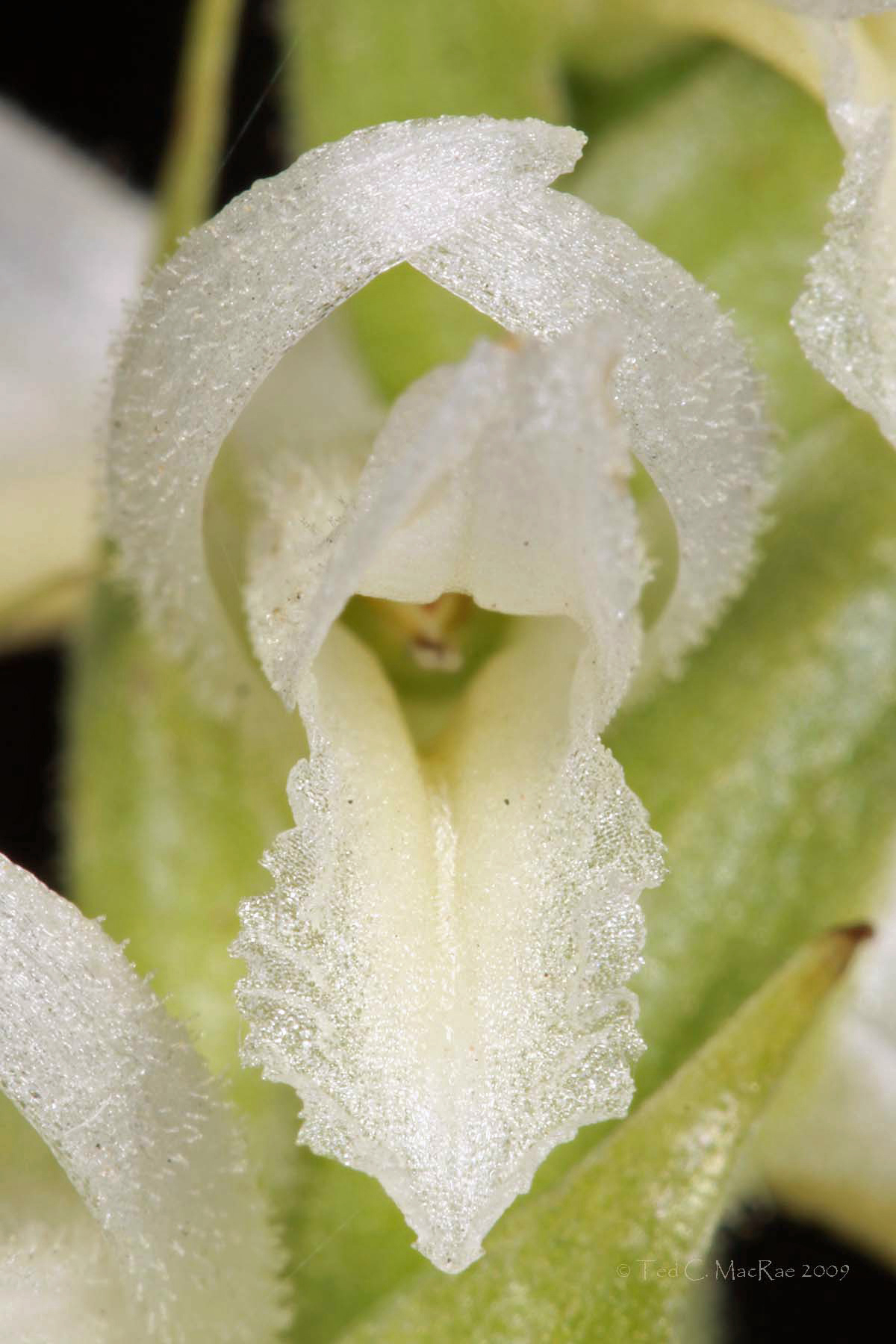
 Spiranthes¹ is one of the more complex genera of North American orchids, seven of which are known to occur in Missouri (Summers 1985). Spiranthes magnicamporum² is closely related to S. cernua and was only recently (1975) described as a distinct species. Conclusive separation of the two species requires microscopic examination of the seeds (those of S. magnicamporum are monoembryonic, whereas a large percentage of the seeds of S. cernua are polyembryonic) (Luer 1975). In the field, however, S. magnicamporum can generally be distinguished from S. cernua by its spreading rather than appressed lateral sepals and absence of basal leaves at the time of flowering³. It is likely that many previous records of S. cernua in Missouri actually refer to this species, as both occur throughout much of southern Missouri and sporadically in northern Missouri (refer to the






 Beetles In The Bush