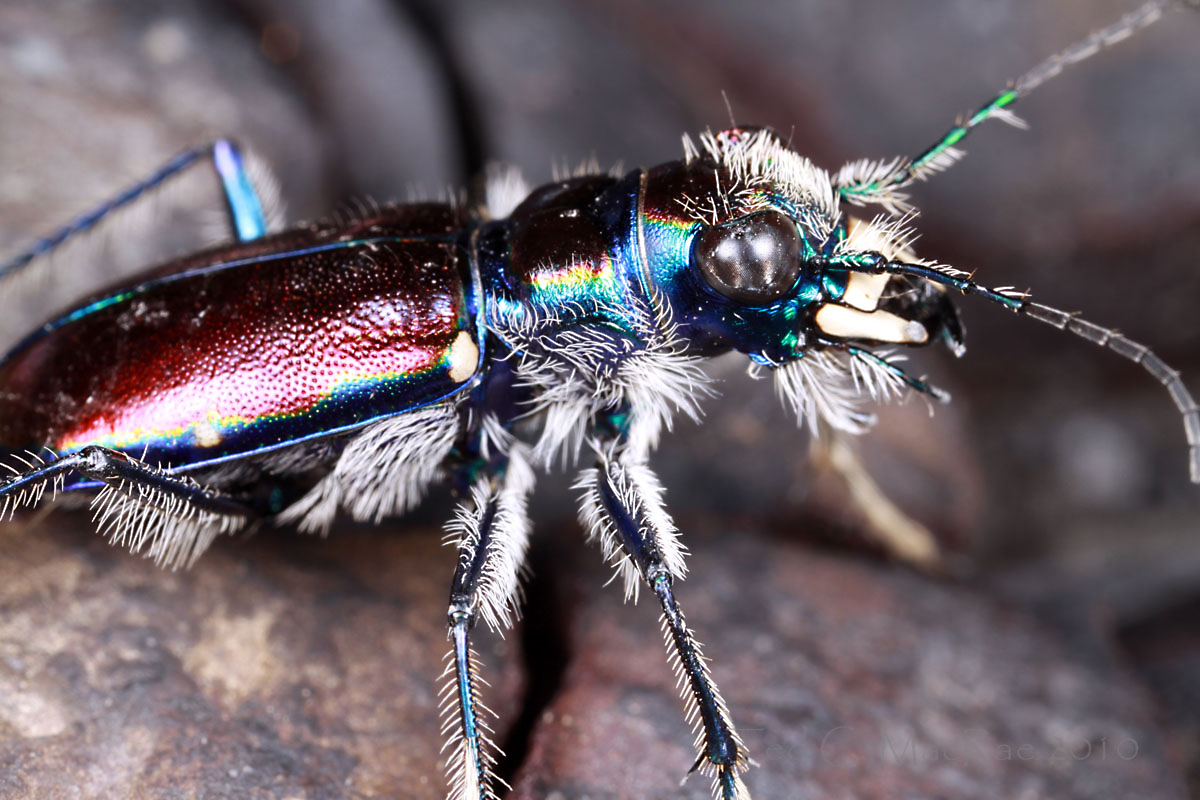
Josef Knull was wrong!

A few weeks ago I received an email from Kyle Schnepp, an entomology student at Purdue University.  Kyle has taken on the rather ambitious project of developing an illustrated key to the Buprestidae of eastern North America, for which he has been spending the past year acquiring material for photographs.

During his examination of specimens in the Field Museum of Natural History, Kyle came across two examples of an extraordinarily rare species of Buprestidae, Agrilus audax Horn.  Although described more than 100 years ago from specimens collected in Texas (Horn 1891), few records have been published in the years since.  Chamberlin (1926) reported the species also from Arizona and Illinois but without further details, causing Fisher (1928), in his revision of the genus (woefully out-of-date now, but still the only comprehensive resource for identifying the North American species), to regard at least the Illinois record as probably erroneous (common for many of Chamberlin’s records).  The first undisputed report of this species from outside of Texas was by Josef Knull (1934), who reported the species emerging from living, wind-thrown branches of slippery elm (Ulmus rubra) collected in western Missouri.  More than half a century would pass before the species would turn up again – first in Oklahoma (Nelson and MacRae 1990) and twice again in Missouri through the efforts of Gayle Nelson and myself (MacRae 1991, MacRae and Nelson 2003). All but one of these specimens were beaten from bur oak (Quercus macrocarpa).

Agrilus audax Horn, 1891 – male (L) and female (R)

While the rarity of this species makes Kyle’s find significant enough, there is an even more significant – and interesting – aspect to his discovery.  Both of the specimens, one male and one female, were collected in Ohio, which is a rather extraordinary geographical range extension. Additionally, the specimens were collected by none other than Josef Knull.  To students of North American Buprestidae, the name Josef Knull is as familiar as Carl Linnaeus, Charles Darwin, or Thomas Say. A Professor of Entomology at The Ohio State University from 1934-1962, Knull published nearly 200 papers on the taxonomy, biology, and distribution of these and other families of beetles (Davidson and Bellamy 2002).  Although he lacked a Ph.D., he was an indefatigable collector and describer of beetles – to his fellow colleagues and students, he was known as “Professor” or “Doctor” as a show of respect.  He spent many of his summers traveling through the southwestern U.S. with his wife Dorothy Knull (herself an entomologist specializing in leafhoppers), and by the time he died in 1975 he had described 233 species and subspecies of beetles (as well as one species of Fulgoridae).  He was, and is, an icon among North American beetle collectors.

Curiously, Knull did not recognize these specimens for what they were, instead identifying them as the similar and much more widespread species, Agrilus vittaticollis.  Curious, because Knull collected these specimens in 1949 and 1953 – after first reporting the species in Missouri.  Agrilus audax belongs to a small group of species that look very similar to each other by way of their large size and striking coloration – black elytra and a red pronotum with a densely pubescent median channel.  Agrilus vittaticollis is the most common of these (though still not as commonly encountered as many other species in the genus), and the much less common A. benjamini also belongs to this group.  Kyle had sent me the above photo in an attempt to confirm their identity, but true confirmation would require examination of characters of the face and ventral surface.  Kyle quickly took additional photographs of these characters and sent them to me – they are shown below and leave no doubt as to the identity of these specimens.

Agrilus vittaticollis prosternum – note sides bent downward to sharp points.

Agrilus audax prosternum – sides normal, not bent downward to sharp points.


Agrilus audax frons is moderately depressed and uniformly pubescent (deeply depressed & pubescent only on lower half in A. benjamini).

Agrilus audax male sternite – the deep, smooth, elongate depression is diagnostic (A. benjamini males have only an obsolete depression).


Finding a new state record buprestid in Ohio – the land of Knull – based on specimens collected by Knull himself is nothing short of remarkable (almost like proving E. O. Wilson wrong¹). The occurrence of A. audax in Ohio also lends some credibility to Chamberlin’s record of the species in Illinois. Kyle is graciously allowing me to include these new records in a forthcoming publication; my thanks to him for this and also for allowing me to use his fine photographs in this post.  Kyle did also mention that these were the only misidentified specimens he saw in the Knull collection at the Field Museum of Natural History. For those interested in acquiring reprints of Knull’s papers, pdfs of the 50 papers he published in the Ohio Journal of Science may be found at this link.

¹ The title of this post is a play on the title of a recent post by Alex Wild at Myrmecos. No true disrespect is intended to Josef Knull, who’s legacy (with the possible exception of his frustratingly vague label data) is rightfully held in high regard by all who knew him or know of his work.

REFERENCES:

Chamberlin, W. J. 1926. The Buprestidae of North America, exclusive of Mexico, a catalogue including synonymy, bibliography, distribution, type locality and hosts of each species. W. J. Chamberlin, Corvallis.

Davidson, J. M., and C. L. Bellamy.  2002. The entomological contributions of Josef Nissley Knull (1891-1975).  Zootaxa 37:1-24.

Horn, G. H. 1891. The species of Agrilus of Boreal America. Transactions of the American Entomological Society 18:277-366.

Knull, J. N. 1934. Notes on Coleoptera, No. 4. Entomological News 45(10):207-212.

MacRae, T. C. 1991. The Buprestidae (Coleoptera) of Missouri. Insecta Mundi 5(2):101–126.

MacRae, T. C., and G. H. Nelson. 2003. Distributional and biological notes on Buprestidae (Coleoptera) in North and Central America and the West Indies, with validation of one species. The Coleopterists Bulletin 57(1):57–70.

Nelson, G. H., and T. C. MacRae. 1990. Additional notes on the biology and distribution of Buprestidae (Coleoptera) in North America, III. The Coleopterists Bulletin 44(3):349–354.

Copyright © Ted C. MacRae 2010

Add to FacebookAdd to DiggAdd to Del.icio.usAdd to StumbleuponAdd to RedditAdd to BlinklistAdd to TwitterAdd to TechnoratiAdd to Yahoo BuzzAdd to Newsvine

Email to a friend

Posted in Buprestidae, Coleoptera | Tagged , , , , , , , , , | 11 Comments

Mylabris oculatus in South Africa

Mylabris oculata, the CMR bean beetle, is a large, conspicuously-colored beetle in the family Meloidae (blister beetles) that I saw quite commonly during my stay in South Africa.  “CMR” refers to the Cape Mounted Rifle Corps, a police force in the old Cape Colony whose uniforms sported black and yellow bands that resemble the colors of this beetle.

Blister beetles as a whole are, of course, well known for their chemical defenses, primarily cantharidin (the active ingredient in ‘Spanish Fly’, an extract of a European species of blister beetle).  This terpenoid compound is a painful irritant, especially when coming into contact with mucous-lined membranes such as those of the gatrointestinal and urinary tracts.  Blister beetles emit body fluids containing cantharidin from joints on the legs when disturbed, giving any would-be predators a foul-tasting appetizer. As we have so often seen, insects containing such effective defenses are often aposematically colored to advertise the fact, allowing them to brazenly lumber about fully exposed during the day with little to fear.  If there ever was an insect that screamed aposematic, it is M. oculatus with its boldy contrasting black and yellow elytra and hot-orange antennae.

These beetles, however, are more than just a frustration for hungry birds, but also a serious pest of numerous ornamental, fruit and vegetable crops (Picker et al. 2002).  Large numbers of adults congregate on plants and preferentially feed on the flowers.  In the more natural settings where I was encountering these beetles, they were most often seen on flowers of Acacia spp. or (as in the above photo) Dichrostachys cinerea in the family Fabaceae.  To be honest, they became quite a source of frustration for me as well – not because of their distastefulness or pestiferous habits, but because of their role as the model in a mimicry complex.  It was the mimic that I was after, and since mimics tend to be much less common than their models, I had to look at a lot of M. oculatus to find the few specimens of the species I was after. 

Pop quiz: Can anybody name the mimic?

Back to their chemical defenses – I’ve often wondered just how poisonous blister beetles really are, especially to humans.  Here in the U.S., their main importance is as contaminants in alfalfa hay fed to cattle and horses.  Deaths from severely contaminated forage do occur, but this is dependent upon the cantharidin content of the species and their abundance within the hay.  The highest reported cantharidin content for a blister beetle is 5.4% dry weight in Epicauta vittata.  Calculations based on this figure and the lethal dose for a 1000-lb horse indicate that around 100 such beetles would need to be eaten to receive a fatal dose.  This seems to make the claim that a single beetle can kill a human a little far-fetched.  However, M. oculatus are big beetles – more than a full inch in length and bulky.  In this regard, I found an interesting tidbit at the TrekNature website.  Clarke Scholtz is an entomologist at the University of Pretoria, and when asked, “Is it true that their poison can kill a human being?”, he responded:

Yes; they are poisonous enough to kill people – especially a big beetle… The poison is very toxic and actually causes collapsed tissue. It would also depend on the weight of the person, as with any other toxin. The poison of a CMR beetle, that is dried and powdered, is sufficient to kill a 70kg human.

REFERENCE:

Picker, M., C. Griffiths and A. Weaving. 2002. Field Guide to Insects of South Africa. Struik Publishers, Cape Town, 444 pp.

Copyright © Ted C. MacRae 2010

Add to FacebookAdd to DiggAdd to Del.icio.usAdd to StumbleuponAdd to RedditAdd to BlinklistAdd to TwitterAdd to TechnoratiAdd to Yahoo BuzzAdd to Newsvine

Email to a friend

Posted in Coleoptera, Meloidae | Tagged , , , , , , , , , | 16 Comments

Winter Botany Quiz #6 – answers and a checklist

I thought yesterday’s Winter Botany Quiz #6 would be a fairly difficult, and given the apparent difficulty of my previous quizes (Pismire Puzzle and Tuesday Teaser) I thought I’d give readers a break this week and narrow down the location to the Lake Tahoe area. Despite publishing in the dead of night, it took only 31 minutes for Peter Yeeles to swoop down and correctly name the family, genus, species, and function for the structure pictured. His only lapsus regarded the terminology used for the name of the structure itself, leaving the door open for James Trager to snag some scrap points. The plant is, of course, Cercocarpus ledifolius (curl-leaf mountain mahogany) in the family Rosaceae, and the structures pictured above and in the previous post are the stigmas of the flowers persisting as wind-assisted dispersal structures for the fruit. “Cercocarpus” is, in fact, derived from the Greek words for “tailed” and “fruit”, whose numerous erect hairs give the plant in a silvery sheen late in the growing season.

Why was I interested in this plant? It was one of the few tree species occurring in the Lake Tahoe Basin that I wasn’t able to find for last year’s 3-part series, Trees of Lake Tahoe (including The Pines, The “Other” Conifers, and The Deciduous Trees).  Widespread in the mountainous west (and barely qualifying as a tree), its occurrence in the Tahoe Basin is more sporadic.  Better stands are found outside the basin proper on the dry eastern flank of the Sierra Nevada (Graf 1999), and indeed these plants were photographed at ~6,500 feet on the eastern slopes of Mt. Rose.

My real interest in Cercocarpus, however, is as a favored host plant for species of jewel beetles (family Buprestidae).  About two dozen species of these beetles have been associated with Cercocarpus spp. in North America, nine of which have been confirmed as breeding within dead branches of these plants and five having been associated with no other plant.  I’ve collected a number of these species myself, particularly in the San Gabriel and Santa Rosa Mountains of southern California and the Chisos Moutains of Big Bend National Park in Texas, including Polycesta cazieri, Chrysobothris piuta, and paratype specimens of Acmaeodera rubrocuprea. I thought it might be of interest to any readers who might collect these insects to present a checklist of Buprestidae associated with Cercocarpus in North America (see appendix below).

REFERENCE:

Graf, M. 1999. Plants of the Tahoe Basin. Flowering Plants, Trees, and Ferns. A Photographic Guide. California Native Plant Society Press, Berkeley, 308 pp.

Checklist of North American Buprestidae associated with Cercocarpus

(Bold indicates species that have been reared from Cercocarpus.  An asterisk indicates species that have been associated exclusively with Cercocarpus).
Acmaeodera (s. str.) angelica Fall
Acmaeodera (s. str.) connexa LeConte
Acmaeodera (s. str.) dolorosa dolorosa Fall
Acmaeodera (s. str.) idahoensis Barr
Acmaeodera (s. str.) mariposa mariposa Horn
Acmaeodera (s. str.) mariposa dohrni Horn
Acmaeodera (s. str.) nelsoni Barr
Acmaeodera (s. str.) nexa Fall
Acmaeodera (s. str.) plagiaticauda Horn
Acmaeodera (s. str.) pubiventris lanata Horn
Acmaeodera (s. str.) rubrocuprea Westcott & Nelson*
Acmaeodera (s. str.) vandykei Fall
Acmaeodera (s. str.) variegata LeConte
Acmaeodera (Squamodera) vanduzeei (Van Dyke)
Anthaxia (Haplanthaxia) caseyi sublaevis Van Dyke
Anthaxia (Melanthaxia) porella Barr*
Anthaxia (Melanthaxia) simiola Casey*
Chrysobothris bisinuata Chamberlin*
Chrysobothris mali Horn
Chrysobothris piuta Wickham
Chrysobothris purpureovittata purpureovittata Horn
Chrysobothris purpureovittata cercocarpi Westcott & Nelson*
Dicerca (s. str.) hornii hornii Crotch
Polycesta (Tularensia) californica LeConte
Polycesta (Tularensia) cazieri Barr

Copyright © Ted C. MacRae 2010

Add to FacebookAdd to DiggAdd to Del.icio.usAdd to StumbleuponAdd to RedditAdd to BlinklistAdd to TwitterAdd to TechnoratiAdd to Yahoo BuzzAdd to Newsvine

Email to a friend

Posted in Coleoptera, Rosaceae | Tagged , , , , , , , , | 7 Comments

Winter Botany Quiz #6

This photo was taken during my March trip to Lake Tahoe.  Can you identify the plant (family, genus, species), the structure shown, and its function?  Answer and more photos tomorrow.

© Ted C. MacRae 2010

Add to FacebookAdd to DiggAdd to Del.icio.usAdd to StumbleuponAdd to RedditAdd to BlinklistAdd to TwitterAdd to TechnoratiAdd to Yahoo BuzzAdd to Newsvine

Email to a friend

Posted in Plantae | Tagged , , , , | 7 Comments

Monday Moth: Arniocera erythropyga

Arniocera erythropyga (Zygaenidae), Geelhoutbosch, South Africa

Last week’s king cricket quiz (Tuesday Teaser) reminded me that I still have quite a few photographs from my trip to South Africa, now 10 years ago, that I still haven’t shared. This pretty little moth is Arniocera erythropyga, which I photographed at Geelhoutbosch farm in South Africa’s Northern (now Limpopo) Province while clambering up the magnificent north-facing escarpment of the Waterberg Mountains. 

I saw this moth as it sat on the foliage of Grewia sp. (family Malvaceae) – fully exposed for all the world to see.  If we’ve learned anything by now, we know that brightly colored insects that expose themselves conspicuously during the day are probably protected by chemical defences (or perhaps mimicking something that is). Such was the case for Bromophila caffra, an equally strikingly-colored fly that I saw on the same hike, and it is also the case for this moth as well. Arniocera erythropgya is a member of the family Zygaenidae, or burnet moths – many members of which are known to release hydrogen cyanide (Scholtz and Holm 1985). This is the same family to which another toxic species I featured last spring belongs (Pyromorpha dimidiata).  A number of moths and butterflies in other families are also known to release HCN (produced by the breakdown of cyanoglucosides sequestered from the plants on which they feed); however, all life stages of zygaenid moths, including the egg, contain these compounds.  This suggests that zygaenid species are capable of synthesizing these compounds themselves rather than needing to sequester them from their host plants (Scoble 1992). While some zygaenid larvae do feed on plants that contain cyanoglucosides, they apparently do so simply because of their tolerance to the compounds but without the need to sequester them from the plant.

Thus, when I saw and approached this little moth, it didn’t flinch or flee.  Protected by toxicity, it continued sitting brazenly atop its exposed perch – welcoming me to see it, daring me to do anything more than take its photo.

My thanks to Roy Goff at African Moths for confirming the identity of the individual in this photograph.

REFERENCES:

Scholtz, C. H. and E. Holm (eds.). 1985. Insects of Southern Africa. Butterworths, Durbin, South Africa, 502 pp.

Scoble, M. J. 1992. The Lepidoptera. Form, Function and Diversity. Oxford University Press, Oxford, 404 pp.

Copyright © Ted C. MacRae 2010.

Add to FacebookAdd to DiggAdd to Del.icio.usAdd to StumbleuponAdd to RedditAdd to BlinklistAdd to TwitterAdd to TechnoratiAdd to Yahoo BuzzAdd to Newsvine

Email to a friend

Posted in Lepidoptera, Zygaenidae | Tagged , , , , , , | 14 Comments

The “New” Gromphadorina portentosa

I don’t pretend to be a photography guru – I’m learning, and though I still have much to learn I’m happy with my progress so far.  The photographs I posted earlier this week of Gromphadorina portentosa, the Madagascan hissing cockroach, were the results of my first attempt at photographing insects in a white box, and I was reasonably happy with the results.  However, a commentor suggested the photographs could benefit from increased contrast – and he was right!  I admit that I haven’t focused much on post-processing so far, as I’m still in a rather steep part of the whole insect macrophotography learning curve thing. I have played around with the different enhancement tools in Photoshop Elements, but for some reason I don’t find them all that intuitive, and just playing around with them hasn’t helped me understand how they work or the best way to use them.  The Photoshop online help site wasn’t much help either – in fact, it was all gibberish to me!  I started to wonder if maybe I just lacked some basic talent when it came to understanding post-processing.

Fortunately, the commentor provided a link to an excellent article at EarthBound Light called The 1-2-3 of Photoshop Levels.  That article opened up for me a whole new world of understanding!  It explained that Levels is a better alternative for optimizing photos that Brightness and Contrast, and it did it in plain English!  I actually understood it!  Well, my appetite whetted, I started browsing other articles at the site and found the object of my desire: a clear explanation of the seemingly misnomored “Unsharp Mask” in an article called Behind the Unsharp Mask: The Secret World of Sharpening.  I read it excitedly, just waiting for it to become unintelligibly technical, but it was as clearly written as the previous, and for the first time ever I actually felt like I understood the basics of how to use Unsharp Mask.  Well, I couldn’t wait to take my newfound knowledge and apply it to my photos of the already spectacular Gromphadorina portentosa to see if I could make them really pop. The following comparison shows the original photo of the male (size reduced to 1200×800) and the optimized photo adjusted for levels, color, and sharpness (also slightly cropped). What do you think?

Original photo

Optimized photo

Here are paired comparisons of the other photos I included in the original post with their optimized versions (click to see enlarged versions). I would be most interested in hearing any specific comments you might have about these optimizations.

Original

Optimized

Original

Optimized

Original

Optimized

Original

Optimized

Copyright © Ted C. MacRae 2010

Add to FacebookAdd to DiggAdd to Del.icio.usAdd to StumbleuponAdd to RedditAdd to BlinklistAdd to TwitterAdd to TechnoratiAdd to Yahoo BuzzAdd to Newsvine

Email to a friend

Posted in Blaberidae, Blattodea | Tagged , , , , , | 16 Comments

New Bug Blogs of note

I try to keep my blogroll useful and relevant – by that I mean that each blog I list has, in a sense, “earned its spot” by offering engaging writing and/or quality photographs on subjects that interest me, and if they go silent or become, well… boring then I remove them. In the past two years, I’ve pretty well explored most of the established blogs dealing with insects and natural history and know what I like, so additions these days tend to be primarily startup blogs. Recommending startups is risky – blogs come and go all the time, and it’s difficult to know if the energy and passion apparent in the first few posts of a blog indicates sustainable creativity or just an ephemeral burst. With that caveat, I’d like to highlight three new blogs that have not only captured my interest, but also seem to have what it takes to sustain that interest for a long time to come.

Chris Grinter is an entomologist at the California Academy of Sciences in San Francisco. He has an interest in microlepidopterans, and his 6-week old blog, called The Skeptical Moth, has featured some rather stunning photographs of these tiny, yet extraordinarly beautiful insects. Moreover, he actually knows something about them – how refreshing it is to see scientific names attached to each photograph and associated discussion that doesn’t sound like a Wikipedia excerpt. As his blog title suggests, he also has a passion for encouraging science education and critical thinking, adding to the general feeling of erudition. There are lots of bug blogs out there, but only a few really good ones – this has the makings of a really good bug blog!

Peter Yeeles has only been blogging since the middle of March, but he is well-known among entomology-blog-circles by his frequent and articulate participation in the comments sections.  Happily, Peter has finally taken the bait and started his own blog, called ptygmatics.  His contributions thus far have been more than engaging and have featured some wonderful photographs of Australian insects (the stalk-eyed flies being far and away my favorite).  Peter has described himself as a “work in progress” entomologist, but I think we are about to witness the emergence of a more substantial entomologist than he is willing to admit. If nothing else, you must see his stalk eyed flies video link.

Heath Blackmon is the newest blogger featured here, and his blog, Coleopterists Corner, in fact has only three posts so far.  Nevertheless, I was impressed by his willingness to jump right into Coleoptera deep phylogeny in his inaugural post, in which he reviewed a recent paper on the subject by Friedrich et al. (2009).  Yea, another beetle lover!  An amateur naturalist for many years, Heath has decided he wants to become a professional coleopterist and is beginning graduate studies this fall (sounds like another back-to-schooler that has won our hearts in recent months).  His first post was followed by a post on how to make a $69 malaise trap.  So he’s also a collector – that’s even better.  The clincher, however, was the photograph he posted in his sidebar of him collecting tiger beetles in Florida – well, this one just has to be a winner!

Copyright © Ted C. MacRae

Add to FacebookAdd to DiggAdd to Del.icio.usAdd to StumbleuponAdd to RedditAdd to BlinklistAdd to TwitterAdd to TechnoratiAdd to Yahoo BuzzAdd to Newsvine

Email to a friend

Posted in [No taxon] | Tagged , , | 9 Comments

Bicycle ride around Lake Tahoe

Overlooking Emerald Bay from Emerald Bay Pass.

Perhaps some of you have by now deduced that, in addition to insects and natural history, I have a second passion – cycling! In fact, I raced bikes competitively as an amateur for seven years (going by the local nickname “BugMan“) before hanging it up at the end of 2008.  However, even though I’m not racing anymore, I still ride as much as ever, only now it’s purely for the fun of it!  I’m a dedicated roadie, riding year-round and averaging around 5,000-6,000 miles a year.  I love the speed and the smoothness of the road and the opportunity it provides to cover long distances and enjoy the sights (not to mention the resulting freedom to eat like a horse and stay relatively trim!).

One of my most memorable cycling experiences was in 1995, when I joined a group that rode the entire circuit around Lake Tahoe.  I was living in Sacramento at the time and was a relative newbie – the 72-mile ride with 3,500 feet of climbing at elevations ranging from 6,200 feet at lake level to more than 7,000 feet near Carson Pass was without question the most difficult ride I had ever attempted at that point.  Now, as a seasoned ex-racer, such a ride is not extraordinarily difficult for me – in fact, I do rides in the 60-80 mile range with as much climbing or more almost every weekend.  Still, my memories of the challenge and the unbelievable scenery have kept that ride high in the ranks of my most epic, and since we began going back to Lake Tahoe two spring ago I’ve wanted to do it again.  It would not have been possible during our first trip back, as the roads still had quite a bit of snow on them; however, last year the roads were clean and dry, and I resolved to bring my bike with me on this year’s trip in the event that such was again the case.  Madonna del Ghisallo (patron saint of cycling) must have been smiling down upon me, because this year the roads were again in beautiful condition, despite the amount of snow blanketing the surrounding landscapes.  It made for one of the most beautiful bike rides I have ever done in my life.

There was a comforting familiarity to the ride, despite the 15 years since the last – the stunning landscape that I have come to cherish so dearly, the massively shaded solitude of the west shore, lunching on California cuisine in a quaint village along the north shore, and the long climbs and screaming descents through open Jeffrey pine forests along the east shore.  It was also different – I was by myself, yet despite that I was stronger and briming with confidence; not only a seasoned cyclist, but also much more knowledgeable of and closely attuned to the natural history of the area.  I didn’t fear the climbing, I relished it!  I didn’t overcome the challenge, I enjoyed it!  I stopped at a few places to take photographs (taken with my small point-and-shoot, for obvious reasons) and share some of them here – I hope they give you a tiny taste of the flavor of that day.

Near the summit of Emerald Bay Pass, looking back at Mt. Tallac.

High point on Emerald Bay Pass.

The descent to Eagle Falls at Emerald Bay.

 This is an avalanche zone (note deep snow deposits on steep slopes on left side – these extend high up the mountain here).  Moments after taking this photo, an avalanche fell onto the road right as I was descending by this spot. At ~35 mph there was no stopping – I rode right through it as the initial snow drop hit the pavement and then watched in amazement as the main drop dumped onto the road behind me.  It was not big enough to bury anything, but I surely would have crashed had I gotten there just a moment or two later!

Overlooking Emerald Bay from Emerald Bay Pass.

Emerald Bay is a glacial scour formed during the last glacial period ending only 10,000 years ago. Fannette Island, Lake Tahoe’s only island, is thought to be a resistant rib of granite rock that was overridden by the glacial ice. Lateral glacial morraines enclose each side of the bay, and an incomplete terminal morraine connects Emerald Bay to the main lake. Last year, I stood atop the outermost rock of the left side of the terminal morraine and took photographs looking back in this direction

Grove of sugar pines at D. L. Bliss State Park.

Sugar pine, Pinus lambertiana, is among my favorite of all pines.  More common on the west shore due to their preference for higher levels of moisture, their towering, ragged, asymmetrical crowns with long, pendulous cones (usually a foot or more in length) hanging from the branch tips are immediately recognizable from afar.  These majestic trees are the world’s tallest pine and bear the longest cones in the genus; they stand in defiant contrast to the uniformly symmetrical crowns of the more common Jeffrey pines (Pinus jeffreyi) and white firs (Abies concolor) that surrounded them.  For a more thorough treatment of the trees of Lake Tahoe, please visit my three-part series covering the pines, the “other” conifers, and the deciduous trees.

Some might think it was still a little too early in the season for bike riding.

Looking west across Lake Tahoe from Logan Shoals Overlook.

The east shore in Nevada is decidedly drier than California’s west shore.  The forest on the Nevada side is a more open, fire-mediated landscape dominated by Jeffrey pine, as opposed to the denser forests on the west shore with higher incidence of shade-tolerant trees such as white fir and incense-cedar (Libocedrus decurrens).

View of Cave Rock (left center) from Logan Shoals Overlook.

Cave Rock was and still is a sacred place for people of the Washoe tribe, whose ancestors occupied Lake Tahoe during the summers and performed religious ceremonies inside the largest of its caves.  These caves, sitting several hundred feet above the current lake level, were carved by wave action shortly after Lake Tahoe’s formation nearly 3 million years ago when lake levels were much higher than they are today.  The first of two highway tunnels was blasted through the rock in 1931 (much to the dismay of the Washoes), and the second was added in 1957.

Looking north along Lake Tahoe's east shore from atop Logan Shoals Overlook.

Copyright © Ted C. MacRae 2010

Add to FacebookAdd to DiggAdd to Del.icio.usAdd to StumbleuponAdd to RedditAdd to BlinklistAdd to TwitterAdd to TechnoratiAdd to Yahoo BuzzAdd to Newsvine

Email to a friend

Posted in Cupressaceae, Pinaceae, Plantae | Tagged , , , , , , , | 5 Comments