Continuing hot and very muggy during the last week, and today it was already in the low 90s by the time I got into the field a little before noon. Silphium terebinthinaceum (prairie dock) and old Solidago nemoralis (field goldenrod) are are in full bloom across the glade, and I noticed pre-flowering plants of what must be a different goldenrod species and a different blazing star. I suspect they will be in full bloom by the time I check the traps again at the end of next week. The plant of the day, however, was Agalinis skinneriana (pale false foxglove), not a true foxglove but rather a member of the family Orobanchaceae. Midwestern gerardia is another common name for the species, and like other members of the family it is a hemiparasitic annual forb.
Agalinis skinneriana (pale false foxglove).
This plant is relatively uncommon, both in Missouri, being found primarily in glades, upland prairies, and in the few other states in which it is found, and though I’ve not noticed this plant here previously I found at least a few individuals in both the east and the west parcels. The upward-facing flowers are a key attribute for identification in the field. The two upper corolla lobes are spreading to reflexed, and the plants are relatively slender, being fewer-branched and less bushy than the more common A. tenuifoliaand A. gattingeri.
Our destination for this week’s Monday field trip with the Webster Groves Nature Study Society (WGNSS) Botany Group was Pickle Creek Natural Area. This gem of a site has one of the most natural history action-packed 2.5 miles of trail in Missouri, featuring moist sandstone canyons, fascinating sandstone “hoodoos,” and unique sandstone glades. Fr. Sullivan got there early to beat the heat and had a few interesting things to show us in the small sandstone glade (more correctly called a xeric sandstone prairie) near the trailhead. These included two new-to-me glade specialists: Hypericum gentianoides (pineweed), and Trichostema dichotomum (blue curls).
Hypericum gentianoides (pineweed).
Hypericum gentianoides (pineweed).
Beginning along the trail we saw two species of aster still not quite ready to bloom: Symphyotrichum anomalum (many-rayed aster), with its distinctively reflexed phyllaries, and S. patens (spreading aster), distinctive by its strongly clasping leaves with rounded basal auricles. Two species of goldenrod were also present: the very common Solidago nemoralis (old-field goldenrod) in early bloom, and the very conservative (CC value = 8) S. buckleyi (Buckley’s goldenrod), its buds still growing for bloom in early September. Passing through the first of many deep cuts through the sandstone, we saw a small Aralia racemosa (American spikenard)—cousin to the devil’s walking sticks (A. spinosa) that we saw last week in southeastern Missouri. The plant was already past bloom and sporting bright red-purple berries.
Aralia racemosa (American spikenard).
Aralia racemosa (American spikenard).
Further down into one of the moist valleys, we found one of our objectives: Goodyera pubescens (downy rattlesnake plantain). I have seen this native orchid many times, as it’s distinctive white-veined leaves are a prominent winter sight in this area; however, this was the first time that I’ve seen them in bloom. Most of those with flower stalks were a bit past peak bloom, but we found at least a couple of plants still with good flowers for photographs. There were also many more basal leaf rosettes in the area without flower stalks, indicating a good population.
Goodyera pubescens (downy rattlesnake plantain).
Goodyera pubescens (downy rattlesnake plantain).
Goodyera pubescens (downy rattlesnake plantain).
The sandstone hoodoos of the area are among its most unique feature, and John showed us a spot on one of them where all three Missouri species of Vaccinium (a genus of plants in the blueberry family) can be found growing right next to each other: V. arboreum (farkleberry), V. pallidum (lowbush blueberry), and V. stramineum (deerberry).
All three Missouri Vaccinium species can be seen in this photo: V. arboreum (farkleberry) at upper right, V. pallidum (lowbush blueberry) at right-center, and V. stramineum (deerberry) at lower left.
The last mile of the hike was more difficult due to the heat, but the deep, sandstone canyons and moist north-facing bluff still provided visual interest and a bit of cool relief. At the end of the hike, John almost tripped over a Geotrupes splendidus (splendid earth-boring beetle) lumbering across the trail.
Alternative title: Rich and Ted’s “Excellenter” Adventure.
This is the ninth “Collecting Trip iReport”; this one covering a 10-day trip to western Texas from April 27 to May 6, 2021 with friend and local collecting buddy Rich Thoma. Rich and I have done many shorter collecting trips (up to five days) throughout Missouri and in the neighboring states of Kansas, Nebraska, and Oklahoma (in fact, our first joint trip was to Barber County, Kansas way back in May 1986!). This trip, however, was our first truly long one together—10 days of collecting plus a travel day on each end. To take full advantage of the amount of time we had, we chose western Texas; an area that I have visited several times from the mid-90s through 2004 but not since. We wanted to make the trip during early to mid-May, but scheduling conflicts forced us to go earlier. I reasoned that even if it was a bit too early in the season, I could still collect infested wood for rearing—as I did with great success during my April 2004 trip. For Rich, who is more of a general insect collector, the trip provided him an opportunity for extended collecting in an area that he’d not previously spent a lot of time.
Day 1 – Monahans State Park, Shin Oak Picnic Area First stop of the trip. I was hoping to see beetles on flowers and maybe some tiger beetles, but unfortunately the area hasn’t had any rain yet this spring (according to the ranger). The mesquite was in bloom, but the only beetles I beat from it were a few tiny weevils. A few other plants were in bloom, but only one—Hymenopappus flavescens—had beetles on it (mordellids, which I picked up for Enrico Ruzzier). After a lot of walking I noticed Quercus havardii (shin oak) with flagged branches of dead leaves—a bit of investigation revealed it had been attacked by what must be Chrysobothris mescalero, so I collected as many flagged branches as I could find (7 total) and will bring them back for rearing.
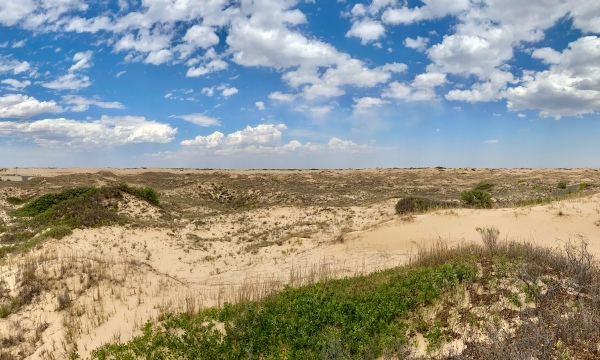
Monahans Sandhills State Park.
Oenethera berlandieri (Berlandier’s sundrops).
Penstemon buckleyi (Buckley’s beardtongue).
Hymenopappus flavescens (collegeflower)—host flower for mordellids).
Chaetopappa ericoides (rose-heath).
Quercus havardii (shin oak) attacked by buprestid, presumably Chrysobothris mescalero.
Monahans State Park, Sandhills Picnic Area The big dunes are in this area. We didn’t expect to see any insects but brought our nets anyway. As we were walking the ridge we saw two grouse-like birds in the distance. We tracked them for a bit before I decided to go back and get my binoculars. They kept us at bay, but eventually I was able to get close enough to get a good look at them—they turned out to be scaled quail, a new bird for me. We continued tracking them and eventually they were joined by two more individuals. Handsome birds!
Rich scans the vast sand dunes.
Endless dunes!
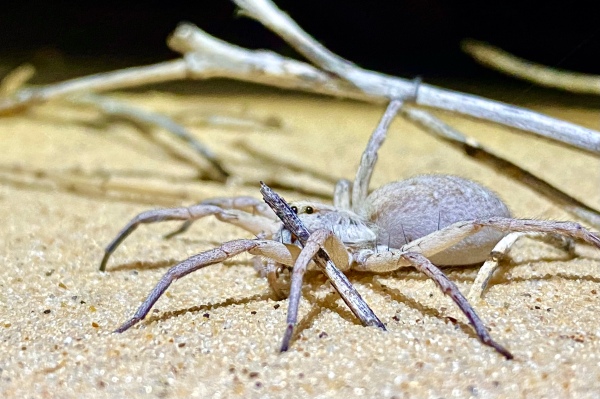
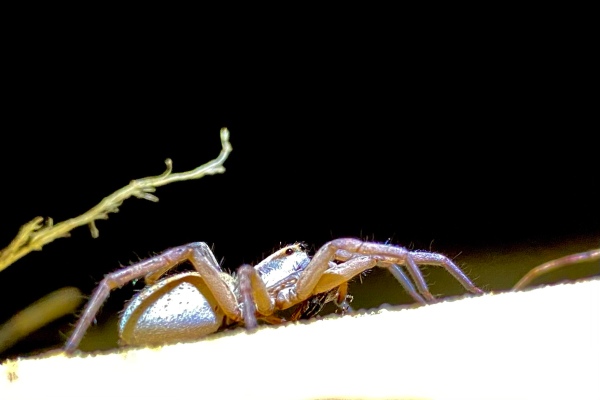
Monahans State Park, Shin Oak Picnic Area After going into town and picking up some dinner, we came back out to the park and setup the ultraviolet lights. I didn’t have much optimism based on the lack of insect activity we saw during the day, but the temperatures were still plenty warm (well into the 80s) and we had nothing better to do. We returned to the Shin Oak Picnic Area since it had a mix of open and more vegetated dunes. Glad we did because two male Prionus arenarius, one Megacyllene antennata, and a tiny, unidentified elaphidiine came to the lights. I also found two small darkling beetles crawling on the sand nearby. I searched the surrounding sand hoping to find more males looking for females, or perhaps even a female herself, but found none. Wolf spiders, however, were common on the sand, their glowing eyes drawing attention beyond their abundance. I guess they are a species of Hogna, but I’m not certain—I photographed two individuals. Also got a large bostrichid (Apatides fortis?) at the light. Before we took down the lights, Rich called me over to see a tiny, slender, worm-like snake that we eventually determined was one of the blind snakes (Leptotyphlum sp.)—definitely a first for me.
Blacklights setup and humming.
Prionus arenarius male in front of the blacklight. This species is restricted to sand dune systems in west Texas and southeastern New Mexico.
Megacyllene antennata at ultraviolet light.
Hogna sp. (burrow-living wolf spider)—individual #1. This one appears to be a large female.
Hogna sp. (burrow-living wolf spider)—individual #2.
Hogna sp. (burrow-living wolf spider)—individual #2.
Day 2 – Toyahyale We stopped here on a tip from Jason Hansen and Tyler Hedlund, who swept good numbers of Agrilus cochisei off of Ambrosia psilostachya (western ragweed)—albeit, a few weeks later during May. I found the plants, but they were very small and low to the ground. Nevertheless, adults could be swept abundantly from the plants, and I was able to take good photos of singles and a mating pair with the big camera (iPhone photo here just to show what they loook like). Also got a single specimen of an apparently undescribed Acmaeodera sp. while sweeping for A. cochisei and one of two A. cochisei adults that I saw on flowers of Sphaeralcea sp.
Ambrosia psilostachya (western ragweed).
Agrilus cochesei mating pair on Ambrosia psilostachya (western ragweed).
Davis Mountains, 15.8 mi NE Ft. Davis We stopped here to look for the undescribed species of Acmaeodera, which Jason had found in good numbers during May on blooms of Lygodesmia and Convolvulus. Both plants were present, but neither was in bloom. Still, I found one adult on flowers of Verbina sp. and swept another from roadside vegetation. Ambrosia polystachia (western ragweed) was also present—I looked visually for Agrilus cochisei and did not see any, but I did get one adult and a couple of cryptocephalines in the sweeping that produced the second Acmaeodera.
Verbina sp. (host for Acmaeodera sp.).
Verbina sp. (host for Acmaeodera sp.).
Day 3 – Point of Rocks Roadside Park The weather turned decidedly cool in the Davis Mountains—first time I’ve ever frozen camping out on a collecting trip. The high temps are expected to stay in the 50s to 60s with a chance of rain for the next few days, so we decided to head down to the Big Bend area where there is still a chance of rain but warmer temps (up to the high 70s). Maybe we’ll come back to this area next week. Before leaving, however, I wanted to check the Quercus vasseyana (vassey oak) at Point of Rocks, where in the past I collected a good series of Mastogenius texanus even earlier in April (it was actually undescribed at the time). I’ve also collected Elytroleptus lycid-mimicking cerambycids on soapberry flowers here in June, although I knew the soapberry would not be in bloom. There was nothing on the oaks, but I did collect a few miscellaneous beetles beating Prosopis glandulosa (mesquite) and found one vassey oak branch with evidence of wood-boring beetle larval feeding and which I collected for rearing.
Point of Rocks Roadside Park.
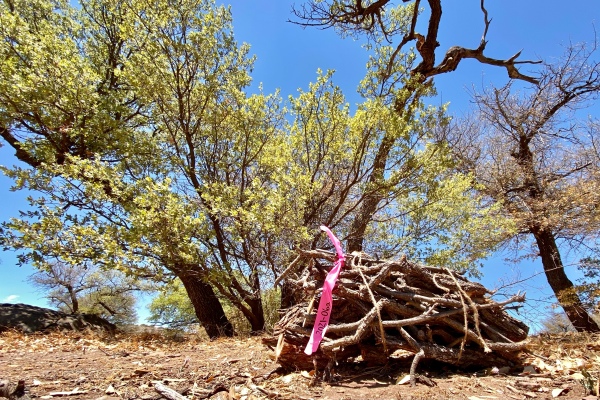
17 mi S Alpine This is the first of two picnic areas along Hwy 118 going south from Alpine towards Big Bend National Park. There are lots of big Quercus vasseyana and Q. grisea here, so I stopped to see if I could find any infested wood. Bingo—one of the Q. grisea had a dead branch hanging from it that looked recently dead, and breaking apart a few of its smaller branches revealed fresh larval workings of some kind of buprestid (perhaps Polycesta arizonica). I cut of the branch and will bring back the bundle for rearing.
Dead Quercus grisea (gray oak) cut and bundled for rearing.
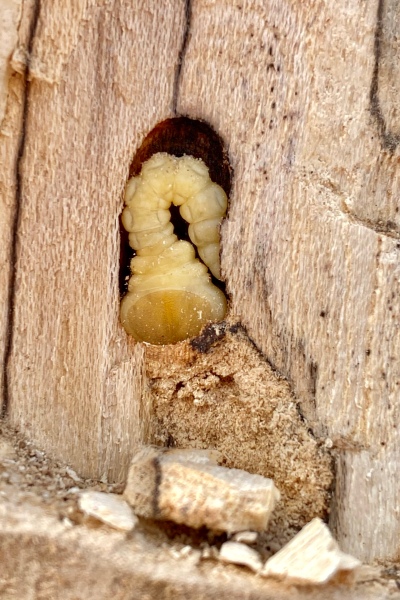
26 mi S Alpine This is the second of two picnic areas south of Alpine on Hwy 118 towards Big Bend National Park. Rich and I have both stopped here before, and Rich brought back infested wood (apparently Juglans sp.) from which I reared Chrysobothris comanche, so that was the plan again unless we saw active insects. We did not, so I scanned the trees and found a small Celtis laevigata (sugarberry) that had recently died—the bark was peeling, but there were no emergence holes that I could see. I started chopping into the trunk wood and quickly encountered a large buprestid larvae in its “pre-pupal fold”. This could be Texania fulleri based on host and location, so I cut a couple of bolts from the trunk to bring back for rearing. The branches also showed fresh larval workings, so I cut up one along with its smaller branchlets to also bring back for rearing.
Texania sp. prob. fulleri larva in trunk sapwood of dead Celtis laevigata (sugarberry).
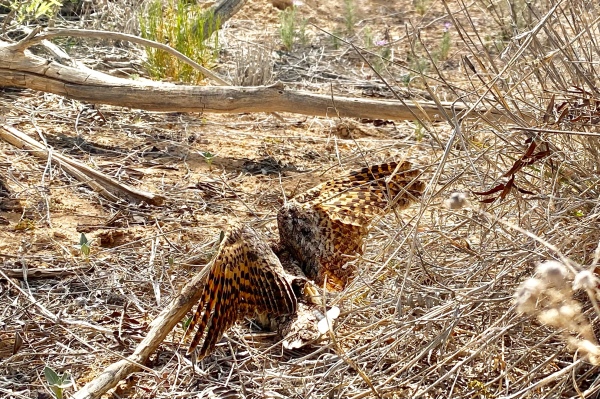
3.3 mi W of Hwy 118 on Agua Fria Rd. Last stop of the day, which I was told could have water with tiger beetles. The creekbed was bone dry, and I collected but a single Chrysobothris sp. beating Prosopis glandulosa in flower—amazing given the proliferation of wildflowers that were in bloom. We did find a nautiloid/ammonite-type fossil in the bone-dry creekbed, which Rich says is of Cretaceous origin based on clam fossils in the underlying layer, and I tracked a common poorwill (Phalaenoptilus nuttallii) for a little bit, eventually getting close enough for the rare iPhone bird photo. Interesting position it assumed upon landing with its wings outstretched above its back.
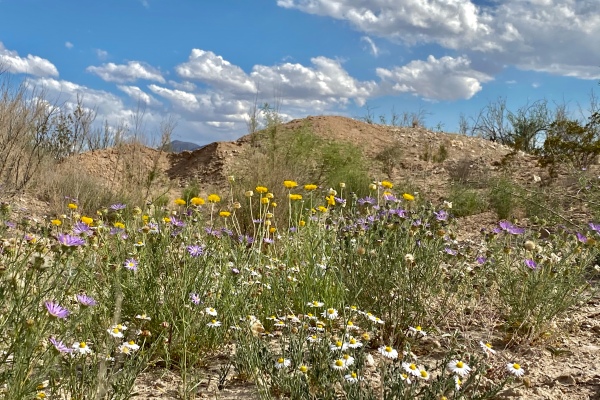
Amazing wildflower displays in the area.
Seam in sedimentary layer of bedrock. I’m not sure if it is of volcanic provenance.
Common poorwill (Phalaenoptilus nuttallii) feigning injury.
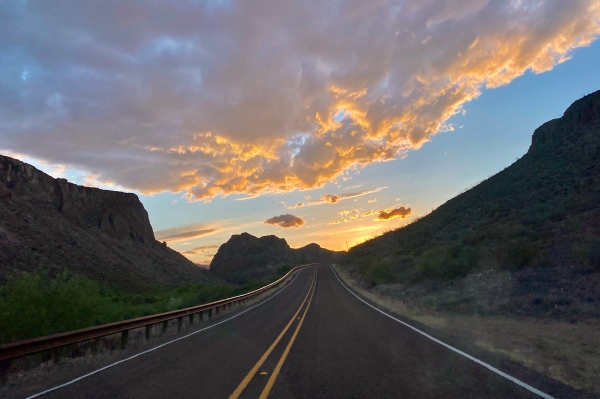
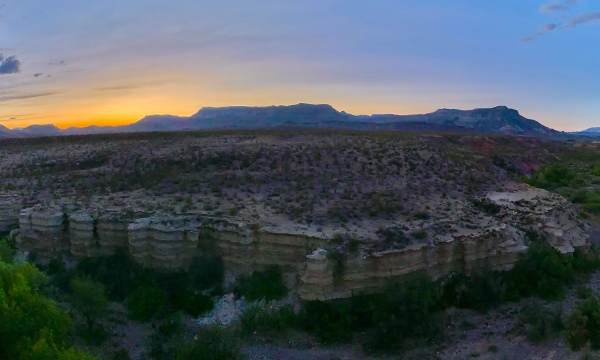
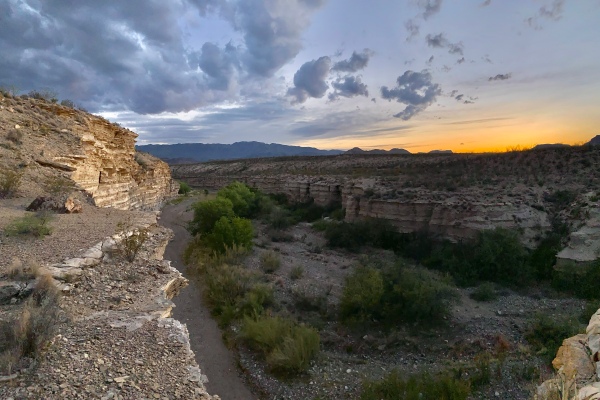
Big Bend Ranch State Park, West Contrabondo Campground We arrived in Study Butte with just enough time to check into a motel and get dinner before heading out to Big Bend Ranch State Park. The drive through the park was incredible as we searched for a spot to setup the lights. After finding such spot, however, we were greeted as we got out of the car by a stiff, chilly wind. I knew there was no point in going through the trouble to setup, so instead we drove further down the 2-track to an amazing scenic overlook into an impressive box canyon. Words cannot describe the contortions this acrophobiac took to find good position for these photos, but it was well worth the views.
Dusk along Hwy 170 approaching Big Bend Ranch State Park.
Sunset over canyon near West Contrabondo Campground.
The closest I will ever get to the edge of a canyon!
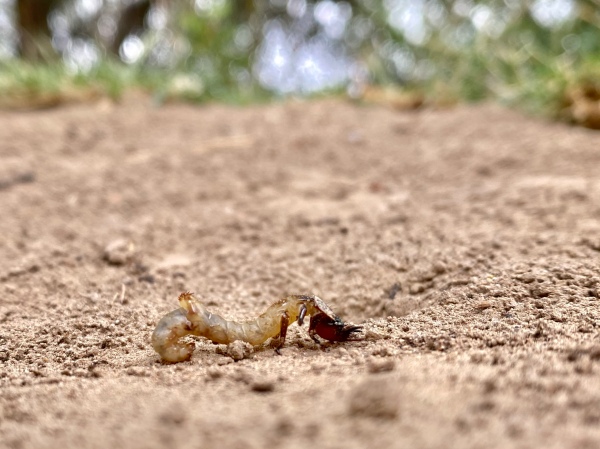
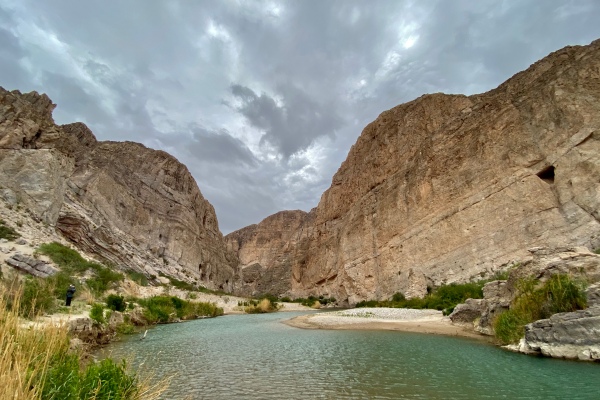
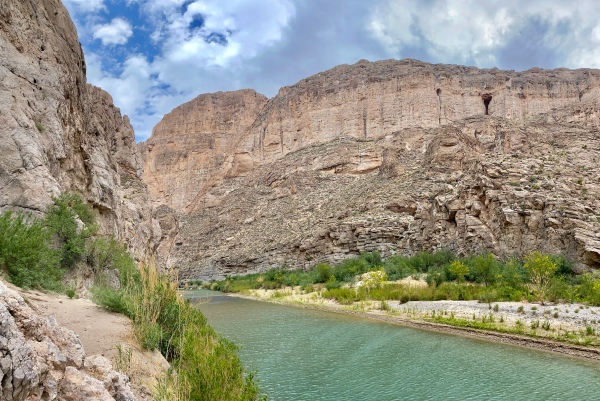
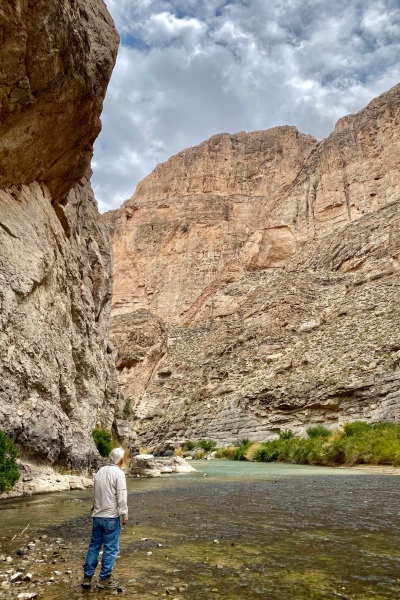
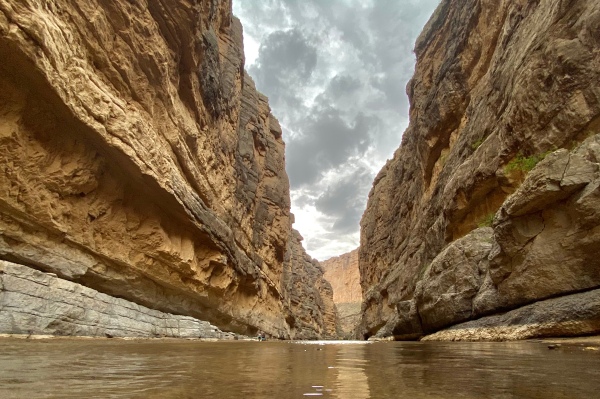
Day 4 – Big Bend National Park, Boquillas Canyon Trail Well, the rain and cold continue to follow us. Rather than trying once again to drive somewhere else to escape, we decided to just sit this day out and visit the national park (not a bad Plan B!). Boquillas Canyon is an amazing slice through the rocks along the course of the Rio Grande River, and we hiked as far into the canyon as we could before sheet rock on the left and deep water on the right prevented any further progress. We saw only two insects—a tiger beetle larva that I “fished” out of one of the many larval burrows we saw (definitely Tetracha, and likely T. carolina) and a velvet ant (black head and pronotum, red abdomen).
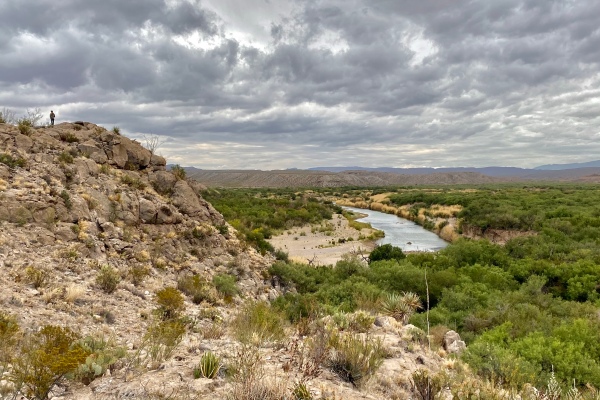
Rio Grande River from Boquillas Canyon Trail.
Tetracha sp. prob. carolina (Carolina metallic tiger beetle) larva extracted from its borrow.
Mouth of Boquillas Canyon.
Mouth of Boquillas Canyon.
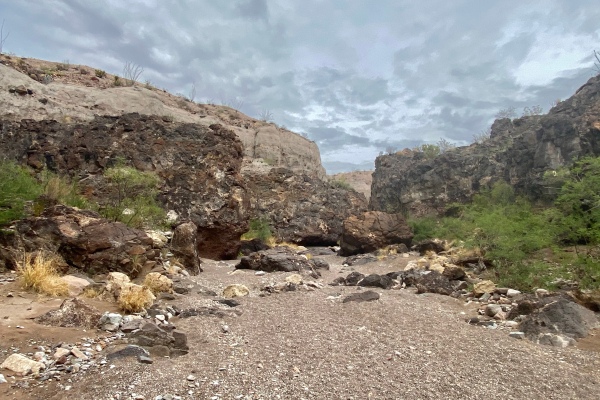
Cobblestone view of Boquillas Canyon.
Rio Grande River in Boquillas Canyon.
Rich contemplates emigration.
Still contemplating.
Big Bend National Park, near Panther Junction Driving towards the Chisos Mountains after hiking the Boquillas Canyon Trail, we encountered this fine adult male Aphonopelmis hentzii (Texas tarantula) crossing the road.
Male Aphonopelmis hentzii (Texas tarantula).
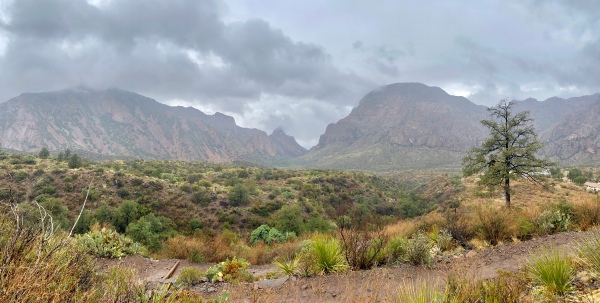
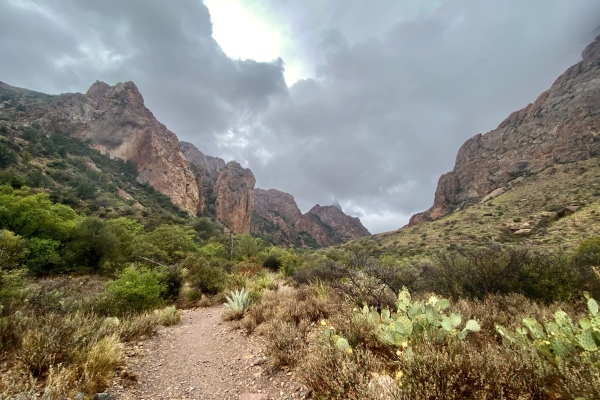
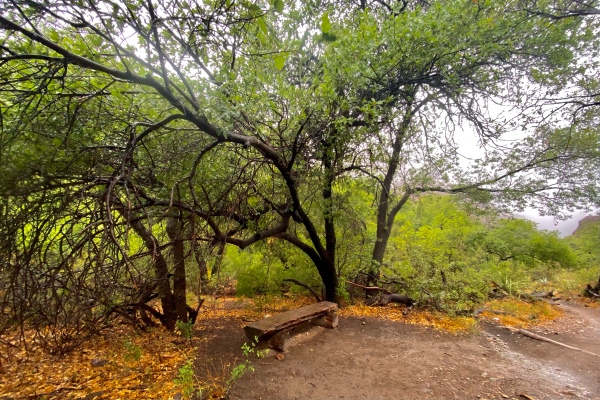
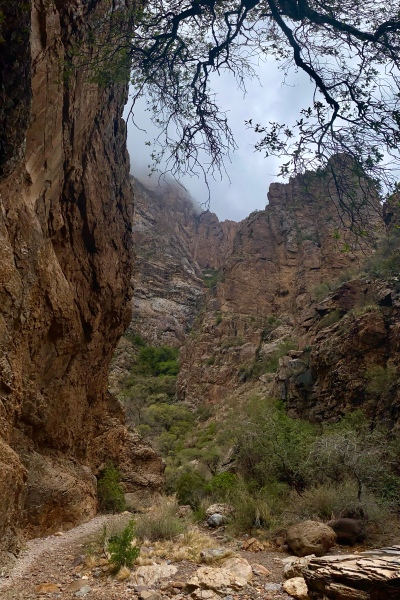
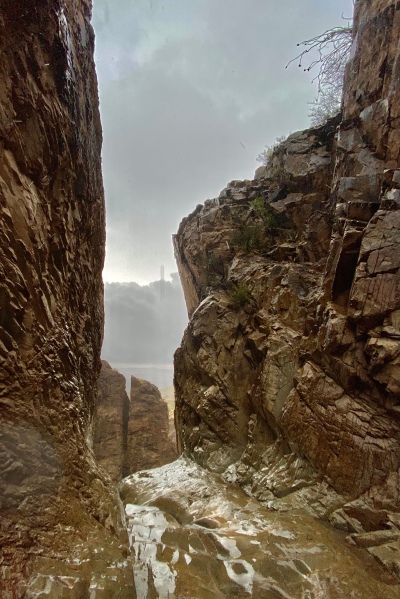
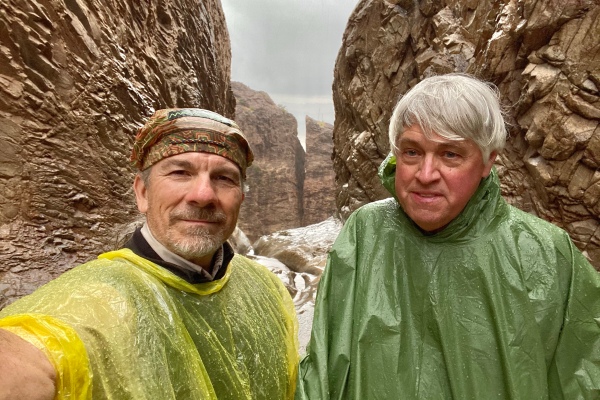
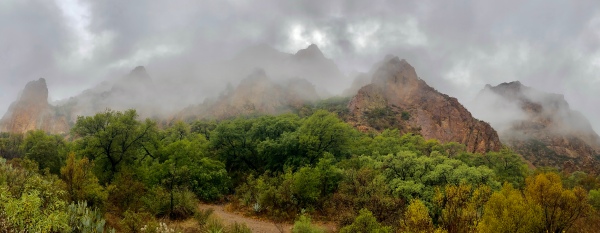
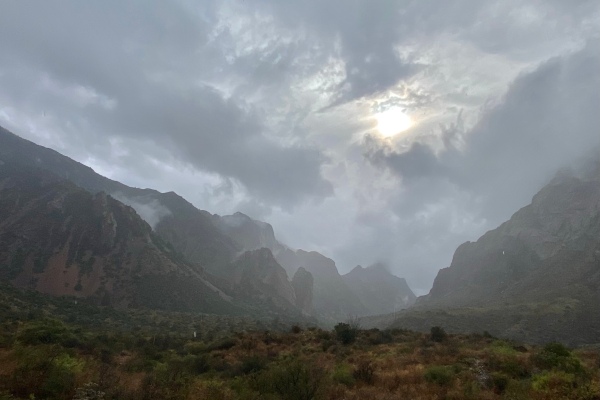
Big Bend National Park, Chisos Basin, Window Trail After lunching at Panther Junction, we headed up the into the Chisos Mountains towards Chisos Basin. Heavy clouds shrouded the peaks, so we weren’t sure what we would encounter up there, and once in the cloud zone and then heading down into the basin we could hardly see anything. Suddenly the western side of the basin came into view, still overcast and drizzly but at least free from the heavy fog that shrouded the eastern half of the basin. That made our decision of which trail to hike easy—the Lost Mines Trail under heavy fog versus the Window Trail with semi-clear views. I’ve hiked the Window Trail several times, but the last time was 17 years ago, and Rich in his single attempt a year or two later did not make it to the “Window” due to an impatient 10-year old son in tow. The views on the way down the canyon were spectacular—not despite the rain and clouds but because of it. It is a rare opportunity to see richly moist desert mountains shrouded in mist. At one point on the way down, a Woodhouse’s scrub jay (Aphelocoma woodhouseii) caught our attention—sitting very nearby in a tree before hopping down to the ground and nonchalantly pecking for bugs. Another soon joined him, first landing on a branch just a few feet above me and returning my captivated stare for a few moments before joining his mate on the trail ahead of us… followed shortly by a third individual. Their soft chirpings were a charming contrast to their more familiar raucous calls, and Rich and I soaked in the moment until they moved on. The trail is not an easy hike—nearly 7 miles round trip, dropping over a thousand feet on the way down, and then gaining over a thousand feet on the way back. The “Window,” however, is a sight to behold—a narrow gap in the rocks soaring high overhead with a view out onto the desert floor almost a thousand feet below. There is tempting danger at the window—its smooth, water-carved rocks are deceptively slippery even in dry conditions, and with the rain of the day they were especially so. I would not be surprised to learn that at least one person had made a fatal error in judging how close to the window one can get. They would have had plenty of time to think about that mistake on the way down! The views on the way back up were even more breathtaking, as fog enshrouded the high peaks towering above us. Periodically the sun attempted to push through the clouds, creating surreal lighting in a battle of sun versus rain, but eventually the rain won out and fell steadily on us for the last, switchback-laden mile back to the trailhead. As for insects, we actually did see some despite the rain—a few blister beetles resting torpidly on yellow composite flowers.
Window Trailhead.
Chisos Mountains’ South Rim from Window Trail.
Chisos Mountains east rim from Window Trail.
Beginning the descent to the “Window.”
Rich photographs a Woodhouse’s scrub-jay.
Yellow composites bloom en masse.
Resting point halfway down—Rich’s prior turnaround point.
The descent steepens!
Steps carved into the rock aid the traverse across slippery rocks.
The “Window” from as close as I was willing.
The author (left) and Rich document their arrival at the “Window.”
Looking back at the “Window” from a bit further back up the trail.
Beginning the rugged, 1,000-ft ascent back up to the basin.
Clouds and mist shroud the surrounding peaks.
A rainy last few miles provides a spectacular last look at from whence we came.
Day 5 – Big Bend National Park, Sotol Overlook We’re on our way to Santa Elena Canyon and stopped at this overlook. From a distance of 14 air miles, the canyon entrance looks like a tiny split in the rocks, belying the 1000-foot canyon walls that await us. Cacti were nicely in bloom, if a bit rain battered—two species of yellow-flowered Opuntia (pricklypear) and the always extraordinary pink flowers of Cylindropuntia imbricata (tree cholla). No insects were to be found, but we did find a live Orthoporus ornatus (desert millipede)—the first that we’ve seen on this trip—who obliged us by coiling into its classic defensive pose.
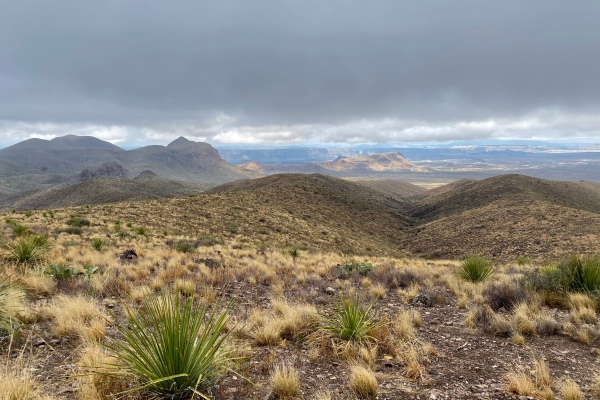
View towards Santa Elena Canyon—some 15 miles to the south—from Sotol Vista Overlook.
Orthoporus ornatus (desert millipede).
Cylindropuntia imbricata (tree cholla).
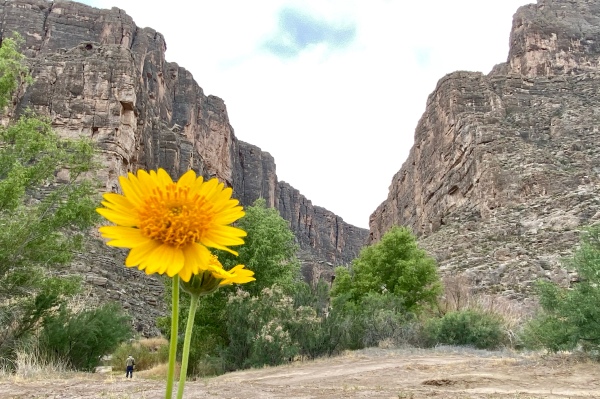
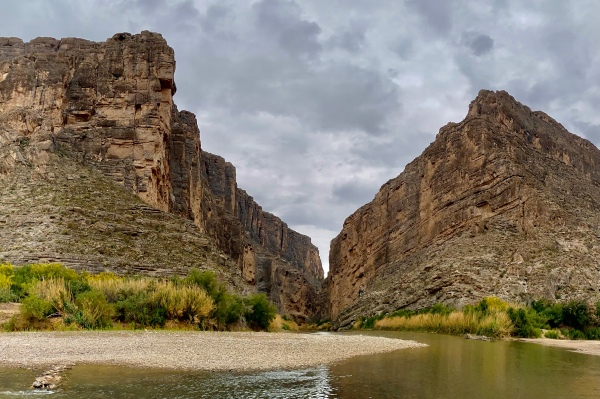
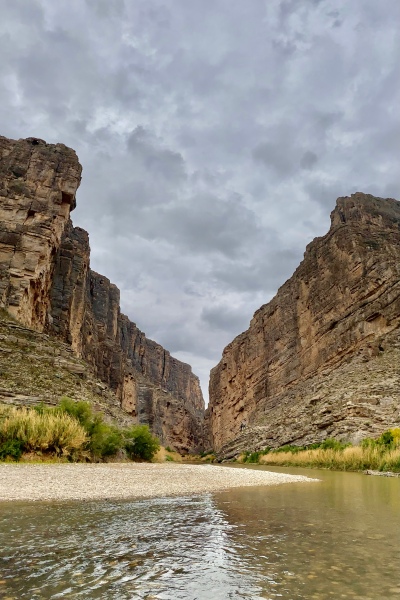
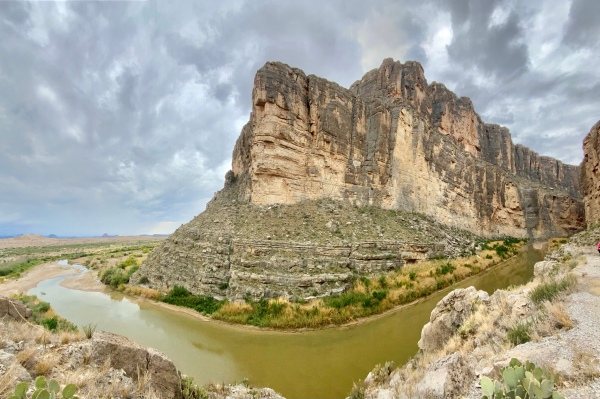
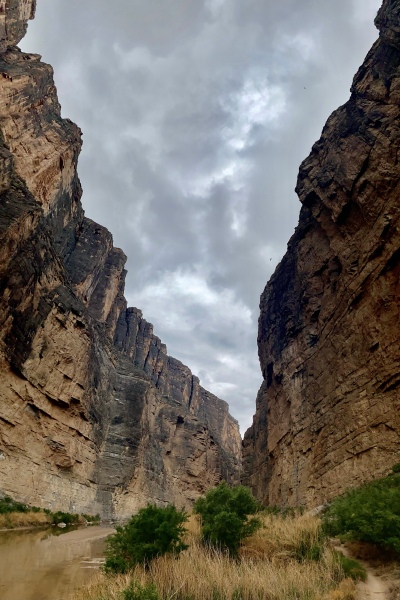
Big Bend National Park, Santa Elena Canyon From 14 air miles away, Santa Elena Canyon looks like a tiny split in a little cliff (see previous post). Up close, however, it’s soaring walls tower 1000 feet overhead! The hike into the canyon features a tortuous staircase to bypass a narrows, followed by a leisurely stroll along the canyon bottoms along the Rio Grande River. Rain last night has triggered an en masse millipede emergence, and even a few insects were seen: velvet ant; Acmaeodera mixta, Trichodes sp. and Gnathium sp. on yellow composite flowers; and Omorgus sp. crawling in the sand.
Undetermined yellow composite in Rio Grande River floodplain.
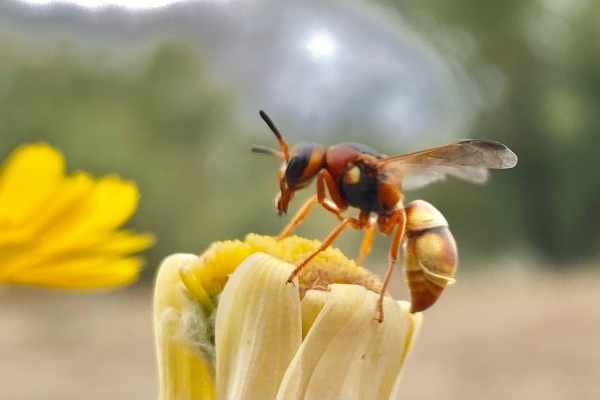
Euodynerus pratensis on flower of undetermined yellow composite.
Mouth of Santa Elena Canyon.
The Rio Grande River spills forth from Santa Elena Canyon.
Agave lechuguilla (lechuguilla).
View of Mexican side of Santa Elena Canyon from the U.S. side.
The Santa Elena Canyon Trail probes deeper into the canyon.
Narrowing canyon walls.
No more land!
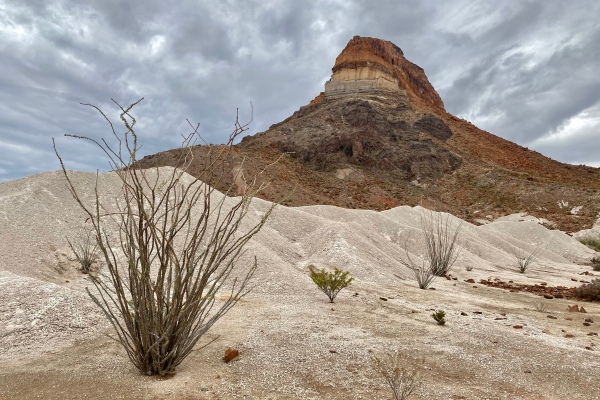
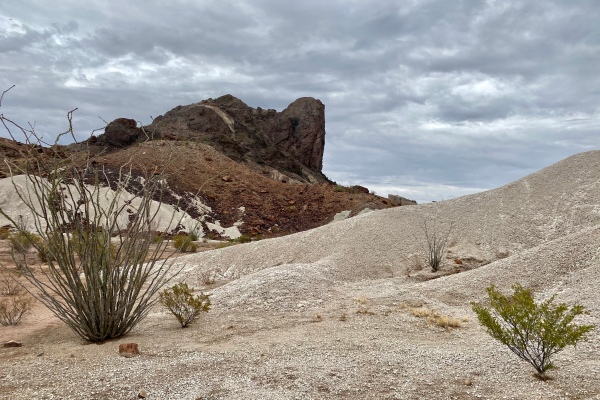
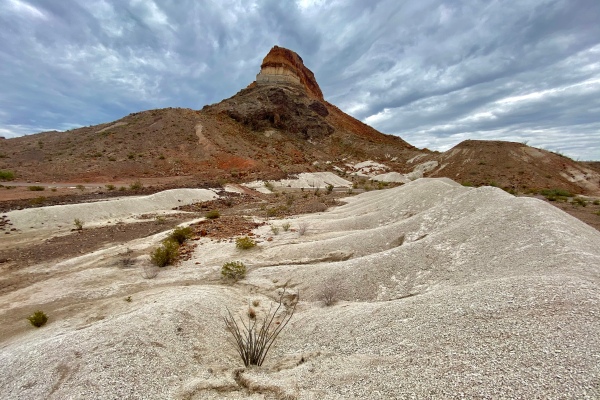
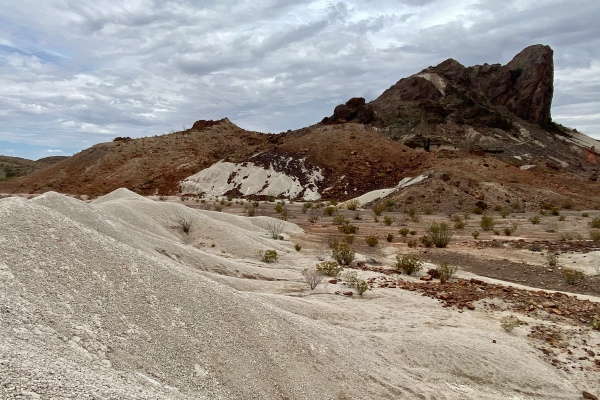
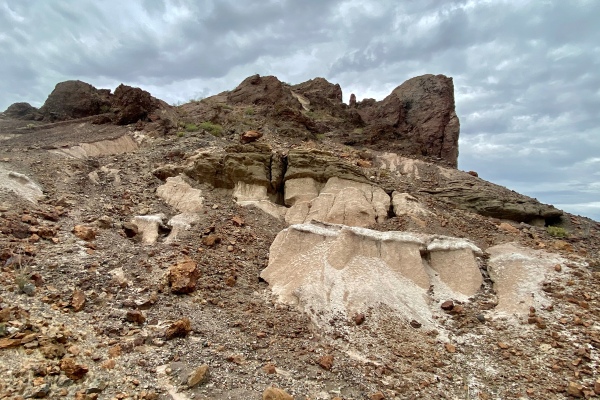
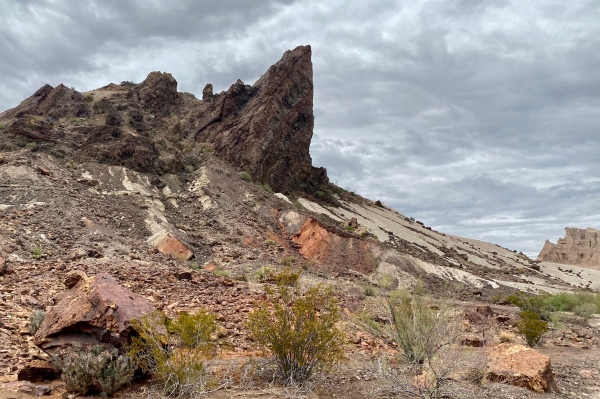
Big Bend National Park, Cerro Castellan (Castolon Peak) The layers visible in Cerro Castellan reveal millions of years of volcanic events. Stacked in this tower are several lava flows and volcanic tuffs (ash deposits), with layers of gravel and clay from periods of erosion between eruptions. Cerro Castellan’s cap rock is the same lava that formed the Chisos’ South Rim. The lighter orange and gray layers beneath are tuffs.
Cerro Castellan (Castolon Peak).
A smaller peak northwest of Cerro Castellan rises above volcanic tuffs (ash deposits) in the foreground.
Cerro Castellan (Castolon Peak).
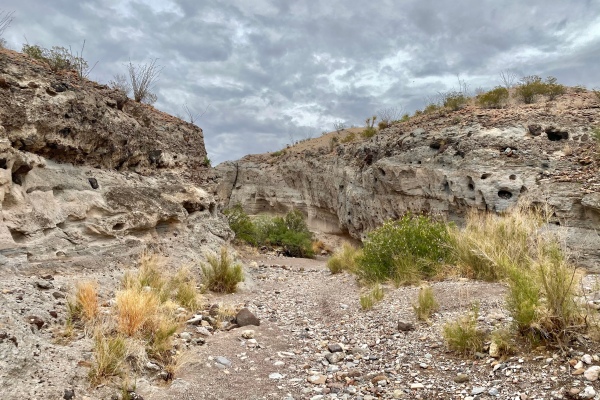
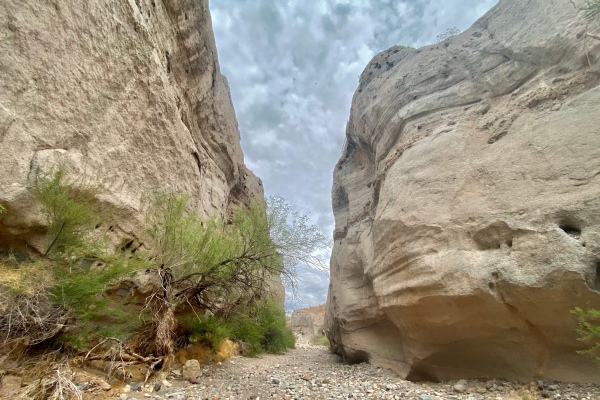
Big Bend National Park, Tuff CanyonTrail Some of the oldest layers of volcanic rocks lie at the bottom of Tuff Canyon. It is dry most of the time, but summer thunderstorm runoff churns through the canyon, cutting it deeper. This canyon is narrower and deeper than most others in Big Bend, partly because the light gray volcanic tuff is relatively cohesive. Swift, powerful floodwaters will cut down through any kind of bedrock, but the tuff is better able to resist the widening effects of sideward erosion.
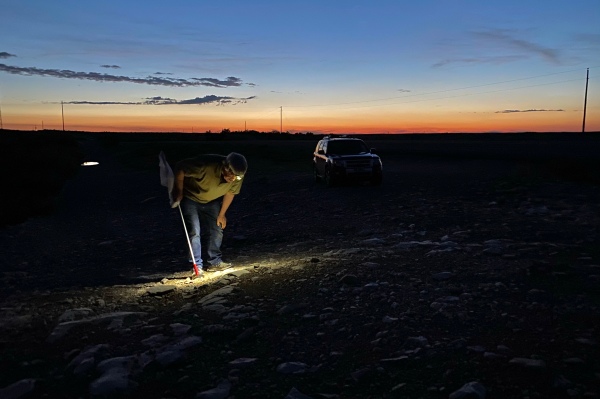
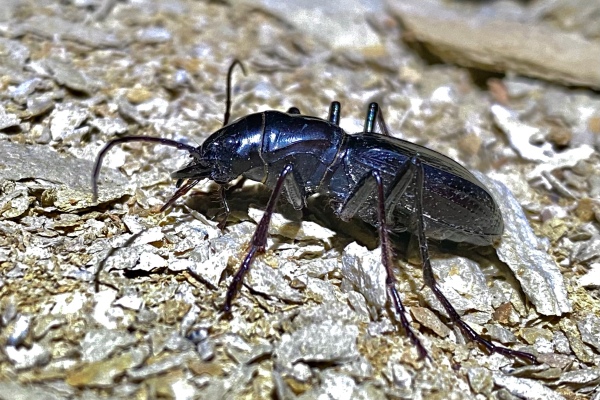
4.6 mi W of Langtry After leaving Big Bend National Park we started making our way towards the Del Rio area in Val Verde Co., where we plan to meet up tomorrow with a few other beetle collectors (Dan Heffern, Brian Raber, and Ed Riley). I noted that our path took us right by the type locality of the recently described tiger beetle, Amblycheila katzi. I didn’t have much hope of actually seeing the species, given that the season seems to have even really started yet and the earliest record of the species is the 23rd of May. Nevertheless, since we happened by the spot right as dusk was falling it seems a good idea to at least try. First we walked the limestone 2-track just to see what was out and about (just a few darkling beetles), then we started checking the limestone ledges where the tiger beetle can be found. We checked about 100 m of ledge without seeing any, and I was about ready to call it a night when we finally spotted one. It was running in a seam about 2 m above the ground and was unmistakable. My attempt tiger an in situ photo failed at first, and it almost escaped deep into a crevice before I pulled out my long forceps and pulled him out by a tarsus. It gave me a healthy pinch when I grabbed it while fumbling in my pack for a bottle, but eventually I prevailed. Later on I placed it back on the ledge and covered it with the Nalgene bottle cap, waited for it to calm down, then carefully lifted the cap and got a couple of shots before it began scurrying again. We checked another 50 m of ledge without seeing any and decided to call it a night.
Rich scanning the ground at dusk for nocturnal insects.
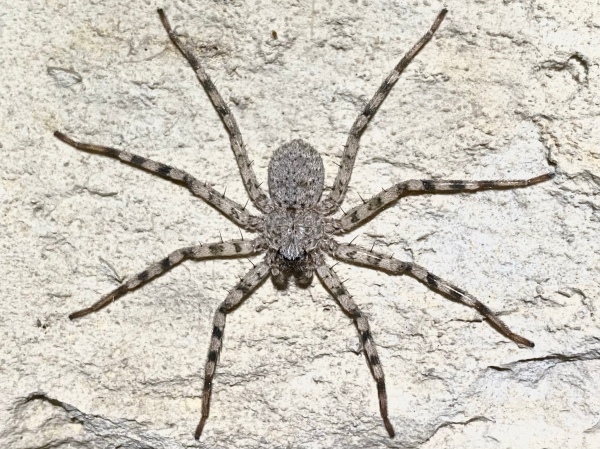
Selenops actophilus, one of the so-called “flatties.”
Day 6 – Comstock (prologue) The owner of the motel in which we stayed was super friendly and kind enough to leave a key in the door for our very late arrival last night. Settling up this morning, I saw this on the wall (right next to his vaccination card—two doses) and just had to get a pic. He was only too happy to oblige when I told him how awesome it was and could I get a picture. Hey, no reason to reveal true political leanings if it means we can all just get along.
Trump Lost LOL!
Illegal tender.
Amistad National Recreation Area, Spur 406 Campground A quick stop here on the way to meet up with Dan, Brian, and Ed near Devil’s River. There were lots of dead and dying Acacia constricta (whitethorn acacias), off of which I beat a diversity of cerambycids and buprestids from both the dead and dying branches. I found one small sapling of the same with evidence of fresh woodboring beetle larval feeding, so I collected it as well for rearing. Other than that I just collected a few weevils off of living Prosopis glandulosa (mesquite) for weevil-specialist Bob Anderson.
Apiomerus spissipes, one of the bee assassins, in flower of Opuntia engelmannii (Engelmann’s pricklypear)
Devils River near Dry Devils River We met up with Dan, Brian, and Ed north of Del Rio and, after exchanging peasantries, followed them into a private resort surrounding a stretch of the Devils River*—considered by some to be the most unspoiled river in Texas. Dan had arranged for access after befriending Dave Barker, a commercial herpetologist who had built a home on property overlooking the Devils River and also a guest cabin on property overlooking nearby Gold Mine Canyon. We met up at the cabin and then carpooled to a spot along the Devils River where Dan and Brian had placed a variety of traps that needed servicing. While they took care of that, Rich, Ed, and I collected in the area around where the traps had been placed. I started off beating dead branches of Vachellia farnesiana (huisache), sweeping blooming Salvia sp. (sage), and beating dead branches of Acacia rigidula (blackbrush acacia) down by the river but collected only a smattering of beetles. I then clambered up the rocks and found good numbers of Acmaeodera spp. visiting flowers of Echinocereus enneacanthus (strawberry cactus) and Opuntia engelmannii (Engelmann’s pricklypear). After collecting my fill of those beetles, I returned to the riverbanks and noticed some large Carya illinoensis (pecan), from which I beat a few Anthaxia (Haplanthaxia) sp. (hoping they are one of the recently described taxa). By then, Dan and Brian had finished servicing their traps and gave me a few specimens that had been collected in their ethanol-baited Lingren funnel trap.
* The accepted usage of the name is without an apostrophe, although the reason for this is a matter of debate.
Dan (right) and Brian service a malaise trap.
Echinocereus enneacanthus (strawberry cactus).
After finishing along the Devils River, Dave invited us to his home for a few post-collecting beers. Spectacular views overlooking the river.
The author (left) with (L-R): Dan Heffern, Brian Raber, Dave Barker, Rich Thoma, and Ed Riley.
GoldMine Canyon We setup a variety of light stations at Dave’s cabin a little east of the river. It was warm and dry, so conditions were good, if a bit windy. My two ultraviolet light stations a bit north of the cabin ended up catching the lion’s share of cerambycids, although it was mostly elaphidiines and a Lepturges sp. We also picked up a few tenebrionids and a Carabidae crawling on the ground near the lights. Ed’s mercury vapor/ ultraviolet station on the road west of the cabin attracted a few more cerambycids, including a Lagocheirus sp. Dan, however, got the catch of the night—a Goes that came to Dan’s $6 battery-powered lantern on the road south of Ed’s station. We at first thought it might be G. novus, but that Dan later decided it was just a very lightly marked G. tesselatus. Zephyranthes chlorosolen (Brazos rain lily) blossoms were beautiful at night, their stark whiteness catching the beam of the headlamp.
Zephyranthes chlorosolen (Brazos rain lily).
Day 7 – Gold Mine Canyon Rich and I spent the morning walking the grounds around Dave’s cabin while the others packed up and got ready to leave. I found some oak (Quercus vasseyana) saplings infested with cerambycid larvae, which I cut and bundled to bring back for rearing. Acmaeodera were already coming to the flowers—a couple of small ones on an undetermined white composite, three different species on Opuntia engelmannii (Engelmann’s pricklypear) and Echinocereus enneacanthus (strawberry cactus) flowers, and a couple on Coreopsis? flowers. I beat some of the Diospyros texana (Texas persimmon) looking for Spectralia robusta but did not find any. It got hotter than blazes real quick!
Opuntia engelmannii (Engelmann’s pricklypear).
After Dan, Brian, and Ed left, Rich and I went down to the canyon entrance to beat on the oaks and Texas persimmons that dot the sides of the canyon. Nothing was on either plant, however, and I ended up again concentrating on the diversity of Acmaeodera that were coming to flowers of Coreopsis sp., Opuntia engelmannii, and an unidentified yellow composite. I did beat a single Cleridae off a dead branch of mesquite.
Gold Mine Canyon.
Devils Rivernear Dry Devils River After finishing at Gold Mine Canyon, we came back to the Devils River crossing near the first stop we made here for our final stop of the day. Temperatures had maxed out at 99°F! and I wasn’t too motivated to collect much more today, but when we arrived at the spot I noticed some declining Platanus occidentalis (American sycamore) with large emergence holes suggestive of Mallodon dasystomus and old fallen branches with the same suggestive of Polycesta elata. The tree with the Mallodon holes was much too large to cut (and embedded within a thicket of poison ivy), so I occupied myself by collecting a few more Acmaeodera off of Opuntia engelmannii flowers. As I walked the roadway I noticed more sycamore with some smaller trees in the grove that looked recently dead. One was dead from about three feet up and had buprestid workings under loose, peeling bark. I cut just above the live portion (3–4” diameter) and took three 4-ft sections of the trunk above that point, each cut showing internal galleries. If P. elata emerges from these pieces of wood I will be “elated” [Later edit: I did rear the species!].
Devils River crossing.
The water was too deep for my Ford Escape.
Next time I’ll have a higher-clearance vehicle.
Gold Mine Canyon For blacklighting tonight we decided to bring the lights down to the mouth of the canyon where we collected this afternoon so we could have acces to anything associated with the oaks. Unfortunately it was a much slower night than last night and cooled off quickly despite the high heat earlier in the day. I only got three cerambycids (one Ecyrus and two Aneflomorpha) and a few clerids at the lights. I also walked the jeep track leading to the mouth of the canyon and the main road outside and didn’t see anything until I almost got back, when I noticed a beetle sitting on the trail that looked a bit odd. When I picked it up I realized it was a buprestid in the genus Melanophila—what the heck?! Totally unexpected to see this beetle at night and especially on the ground instead of on a tree. I suppose it is one of the juniper-feeding species (since pine doesn’t occur here).
Sinking sun over Gold Mine Canyon.
Juniper cadaver in late-evening light.
Day 8 – Gold Mine Canyon Our plan today was to head over to some spots further west in Val Verde Co., but before leaving the cabin we did a bit of walking around and took a last few photographs.
Gold Mine Canyon in the morning.
Epithelantha micromeris (button cactus).
22 mi N Del Rio I had noted a few scattered plants of Senna roemeriana (two-leaved senna) at this spot a couple of days ago when meeting up with Dan but didn’t have the chance to sample them for Agrilus obtusus—one of my target species for the trip. I found one on the second plant I checked, so I went back to the truck to get my big camera hoping to photograph one in situ. I didn’t see anything on the next plant, but when I tapped it over my net there was another one! I did that for the next hour or so—inspecting and tapping—and never saw another one. Rich did get one sweeping the S. roemeriana (in an area I’d already worked) and was gracious enough to give it to me. There were also tiny bruchids and clerids on the plant. Other than that I got a couple of Acmaeodera mixta sweeping, a couple of Canthon sp. in flight, and a Euphoria kerni on the flower of Zephyranthes chlorosolen.
Senna roemeriana (two-leaved senna).
Hwy 90 at Del Rio River I first visited this spot nearby 30 years ago based on a tip by Dan Heffern, who had reared a Polycesta elata from Fraxinus greggii (Gregg ash). I found the ash on that visit, though I didn’t find any wood infested with that species here, but what I did find was Diospyros texana (Texas persimmon) infested with Spectralia robusta and managed to rear out a few individuals. That was my quarry today, but when I arrived the abandoned road on the northwest side of the bridge was fenced and posted. I took a look on the southwest side and found open access up top and decided to hike down towards the ravine from that point. Things seems to be about as far along here as they were at Devils River, with not much activity except for Acmaeodera coming to the Opuntia engelmannii flowers, albeit not quite the diversity. I found a few more also on flowers of an undetermined yellow composite, Coreposis sp., and an undetermined white composite. Closer towards the ravine I found just a single large F. microphylla (with no signs of infestation) and several D. texana—two of which had the half-live/half-dead branches in which S. robusta larvae live and showing the emergence holes of adults. I collected both branches and will bring them back for rearing.
Hwy 90 bridge over Pecos River.
Adult emergence hole of Spectralia robusta in live/dead trunk of Diospyros texana (Texas persimmon).
Amistad National Recreation Area, Pecos River Access Nature Trail Just a quick stop at the Pecos River Access on the east side to walk the short nature trail and gaze at the 300-ft high, 100 million-year-old (Cretaceous Period) limestone bluffs that the Pecos River has cut near the junction with the Rio Grande River (the latter can be seen on the left side of photo 2). The first photo also shows the old road that was originally used to cross the river snaking down the west bluff—traffic today uses the tall bridge in the right side of the photo.
Limestone bluffs over the Pecos River
Pecos River junction with the Rio Grande River.
Pecos River Access Nature Trail.
Seminole Canyon State Park, Canyon Rim Trail We came here looking for oak potentially infested with Spectralia roburella. We didn’t find any oak on this trail, but I did find a Acacia rigidula (blackbrush acacia) showing signs of infestation by buprestid larvae (difficult to find such this year because the freeze in February apparently killed or severely knocked back most of this species). I cut up and bundled the wood to bring back for rearing.
To insects, the collectors’ shadows loom large.
Amistad National Recreation Area, Spur 406 Campground We got to Seminole Canyon State Park too late to check with the supervisor about setting up our blacklights at the park, so we came back to Spur 406 Campground where we’d collected a few things two days earlier. Temps were okay and there was no moon or wind, but it was still a very slow night—for me just a couple of elaphidiines, two trogids, two Digitinthophagus gazella (why do I continue to pick these things up?), and a bostrichid.
Ready for another night of blacklighting.
Day 9 – Seminole Canyon State Park, Windmill Trail We came back to the state park since we ran out of time to look for oak yesterday. The park staff were extraordinarily helpful—both in getting me checked in with my permit and in directing me to the spots where I might be able to find oak. Their first tip—along the Window Trail—paid off, where we found a nice cluster of Quercus fusiformis (plateau live oak) clinging to the upper canyon walls. Most of them had dead branches on them, and I did some beating to see if by some chance the beetles would be out already. They were not, but on the second tree that I examined I found a main branch from near the base with the outer 4–6 ft dead but the bark not peeling and small living sprouts about 2 ft from the base. Pulling apart the dead portion revealed buprestid larval workings, likely my quarry—Spectralia roburella, but these could be old. I cut the branch at the base, however, and found fresh larval galleries in the sapwood of the still-living portion even extending into the trunk—success! I’ll bring this back for rearing and will hopefully get S. roburella out of it. Further along the trail I found a single Senna roemeriana (two-leaved senna), inspected it carefully and didn’t see anything, then tapped the plant over my beating sheet and a single Agrilus obtusus fell onto it to add to the three that I got yesterday. I really wish I could see these things before I beat them off the plants so I could take an in situ photo!
The Maker of Peace, a bronze sculpture by Texas artist Bill Worrell.
View of Seminole Canyon to the east.
View of Seminole Canyon to the west. The Fate Bell rock shelter is on the right at the bend.
A vulture soars overhead.
Panoramic view of Seminole Canyon.
The author admires a fine stand of Quercus fusiformis (plateau live oak). No oaks were harmed in the making of this photo!😊
My souvenir for the trip!
Seminole Canyon State Park, Canyon Rim Trail Another place the park staff recommended to find oaks was along the Canyon Rim Trail. We hiked that trail yesterday for a bit and didn’t see any oaks, but it turns out they were farther down the trail then we went. We headed back out on the trail to find them, along the way checking Opuntia engelmannii flowers for Acmaeodera and seeing only one for the time being. Just past the first of two east-facing ravines where we expected to find oaks, we found one on the canyon edge that looked rather bedraggled. There were some completely dead branches with bark already sloughed but also one large fresher-looking dead branch that had one live branchlet coming out of it about a third of the way up (meaning there was at least a strip of live wood within the branch). I broke of one of the dead branches near the live/dead junction, and there in its gallery was a smallish buprestid larva that almost certainly is Spectralia roburella! I took the entire branch and cut it up to bring back for rearing. We continued hiking along the canyon rim and saw the most amazing views—sheer Cretaceous limestone walls towering 300 feet above the narrow canyon bottoms! Farther down the trail we finally started seeing Acmaeodera on O. engelmannii flowers. By then we’d hiked more than a mile and a half down the trail and temps were beginning to soar, so we turned back, picked up the wood we’d cut as we came back by, and finished the long, hot slog back to the truck.
A mirid bug (Oncerometopus sp.) on flower of Viguiera dentata.
View of cave dwelling area.
Top of a Canyon!
Seminole Canyon stretches from one side to the other.
Seminole Canyon walls.
Comstock As Rich and I were lunching after our last stop, I got a text from Ed Riley about a spot near Comstock where he’d collected what he believed to be Acmaeodera starrae—a species I’ve never encountered. It just so happened that we would be passing by Comstock on our way back east this afternoon, so we stopped to see if we could find it. Bingo—right where and in the flowers he said it would be (an undetermined white composite that I later determined to be Aphanostephus ramosissimus [lazy daisy]). Together we found about 15 specimens, and interestingly about 25% have red rather than yellow elytra markings. [EDIT: I’m not convinced these are A. starrae, but I do not yet know what they are.]
Aphanostephus ramosissimus (lazy daisy).
Aphanostephus ramosissimus (lazy daisy).
Day 10 – Garner State Park, Wild Horse Creek/Highway/Campos Trails It’s the final day of collecting for the trip, and for our last stop we picked Garner State Park along the Frío River. I was last here back in the mid 90s—nearly 30 years ago, Acmaeodera ornatoides and Polycesta elata being the two species of note that I remember finding. I remember during that first visit that the area reminded me of my beloved Ozark Mountains, especially the White River Hills region in southwestern Missouri—scraggly forests of oak and juniper on steep, rocky slopes over craggy hill and lazy dale. It still does, although the species are a bit different—Juniperus ashei (Ashe juniper) dominates instead of J. virginiana (eastern red-cedar), and a variety of other oaks replace the familiar Ozarkian Quercus stellata and Q. marilandica (post and blackjack oaks, respectively). We hiked a series of trails on the western side of the park, thinking the west-facing slopes would tend to be drier and result in more open, glade-like habitats, and for the most part this was true. Almost immediately after reaching the first glade along Wild Horse Creek Trail, we found A. ornatoides and at least two smaller congeners on flowers of Coreopsis sp. Flowers of Viguiera dentata have been uncharacteristically depauperate of buprestids on this trip, but I picked up a couple of Acmaeodera neglecta/neoneglecta nearby as well. On the Highway Trail a good series of Acmaeodera was found on flowers of an undetermined small white composite, and a few were also found on flowers of Senna roemeriana (two-leaved senna)—though no Agrilus obtusus. The Campos Trail ascended steeply and ruggedly to a nice overlook, where I found one Acmaeodera sp. on the flower of Zephyranthes chlorosolen and then the mother-load—the biggest diversity and abundance of Acmaeodera I’ve ever seen on cactus flowers occurred nearby in a single flowering Opuntia engelmannii. The final specimen of the day’s “Acmaeodera-a-thon” was taken a bit further up the trail on the flower of Echinocereus enneacanthus (strawberry cactus). Fortunately, the trail was all downhill from there (albeit a bit too steep and rocky at times for these no-longer-nimble legs!). We finished off the hike back along the Wild Horse Creek Trail by collecting a branch off a fallen oak that I hope proves fruitful in the rearing box back home and had some lunch. As we were getting ready to leave, I noticed most of the trees in the camping area were Carya illinoensis (pecans)—a great host for buprestids (especially Xenorhipis brendeli), so I picked up several fallen branches from under the trees to complete the wood collecting portion of the trip.
Acmaeodera ornatoides on flower of Coreopsis sp.
Overlook from atop the Campos Trail.
Xeric limestone prairie (glade) habitat.
Echinocereus enneacanthus (strawberry cactus).
Echinocereus enneacanthus (strawberry cactus).
Garner State Park, Brazos River (epilogue) We visited the nearby Frio River for one last look at the park, took a shower, and settled in for the 15-hour trek back to St. Louis.
Alternative title: Rich and Ted’s Excellent Adventure
This is the seventh “Collecting Trip iReport”; this one covering a 5-day trip to Arkansas and Oklahoma from June 7–11, 2019 with my friend and local collecting buddy Richard Thoma. As with all previous “iReports” in this series, this one too is illustrated exclusively with iPhone photographs.
Day 1 – Ozark National Forest, vic. Calico Rock, Arkansas It’s been many years since I’ve visited these sandstone glades overlooking the White River near Calico Rock. Conditions were partly sunny when we arrived, but water on the ground suggested rain earlier in the day. We had only a short time to start exploring before the wind started blowing up and the smell of rain filled the air. I did manage to beat one Amniscus sexguttata from a branch of living Pinus echinata and collect a couple of Strigoderma sp. from Coreopsis lanceolata flowers before steady rain forced us to retreat.
White River near Calico Rock, Arkansas—before the rain.
White River near Calico Rock, Arkansas—rain’s a comin’!
Day 2 – Ouachita National Forest, Winding Stair Campground & Ouachita Trail, Oklahoma We walked the trail from the campground S about 2½ miles and back. I started off with Acmaeodera tubulus on Krigia sp. flowers, eventually finding a lot of them on this plant at higher elevations along with a single Acmaeodera ornata, and I beat a few Agrilus cepahlicus off of Cornus drummondii. This had me thinking it would be a good buprestid day, but it wasn’t, the only other species collected being some Chrysobothris cribraria off of small dead Pinus echinata saplings and Pachyschelus laevigatus on Desmodium sp. Also beat a few miscellaneous insects off of Cercis canadensis and Vaccineum arborea and swept some from grasses and other herbaceous plants. Back at the campground I collected Chrysobothris dentipes on the sunny trunks of large, live Pinus echinata trees.
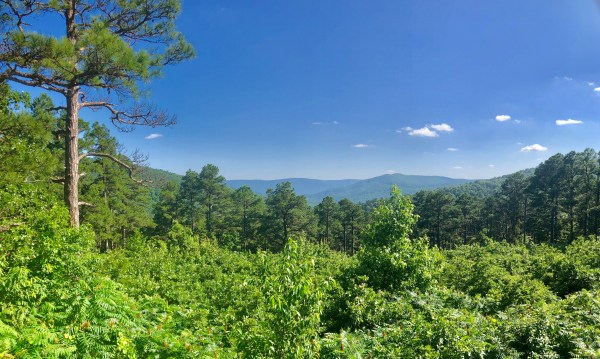
Emerald Vista, along the Talihema Scenic Drive.
Acmaeodera tubulus on flower of Rosa carolina.
Acmaeodera tubulus on flower of Rosa carolina.
Canthon sp.
Apheloria virginiensis reducta (ID by Derek Hennen).
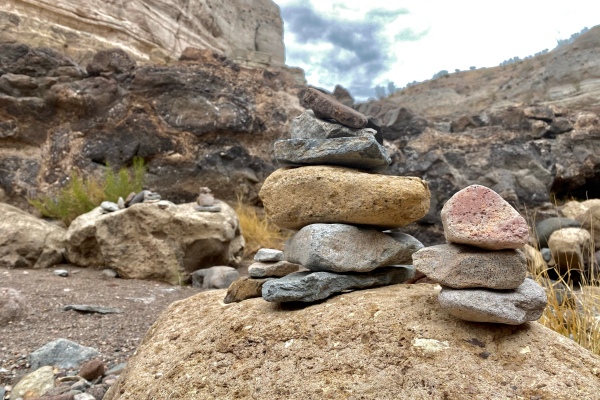
The biggest cairn I’ve ever seen.
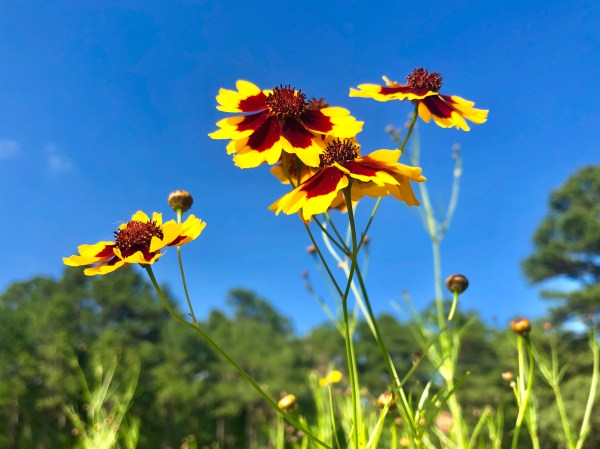
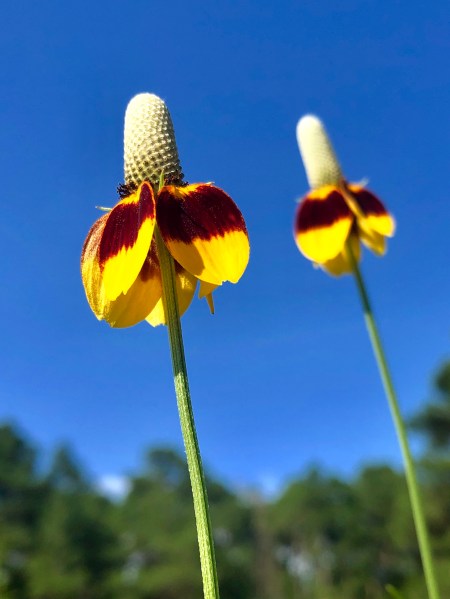
Ouachita National Forest, Talimena Scenic Dr at Big Cedar Vista, Oklahoma There were lots of native wildflowers like Coreopsis tinctoria and Ratibida columnifera in bloom, so we stopped to check them out. There were lots of butterflies, however, I found only a single Typocerus zebra on Coreopsis lanceolata.
View south from Talimena Scenic Drive at Big Cedar Vista.
Ouachita National Forest, Winding Stair Campground, Oklahoma We returned to the campground in the evening to do some blacklighting. I had high hopes, but only five cerambycids came to the lights, all represented by a single individual: Monochamus carolinensis, Acanthocinus obsoletus, Amniscus sexguttatus, Eutrichillus biguttatus, and Leptostylus tranversus (the first four are pine-associates). I also picked up a few other miscellaneous insects.
Rich processes the day’s catch as the blacklight hums in the background.
Day 3 – Medicine Park Primitive Campground, Oklahoma There wasn’t much insect activity going on in eastern Oklahoma, so we drove out west to the Wichita Mountains for hopefully better luck. We found a small park with a primitive campground in the city of Medicine Park—my first thought was to beat the post oaks dotting the campground, but when I went into the native prairie between the campground and the creek I never came out! Right away I found what must be Acmaeodera ornatoides on flowers of Opuntia sp., then I found more on flowers of Gallardia pulchella along with Acmaeodera mixta. The latter were also on flowers of Thelesperma filifolium along with Acmaeodera neglecta—took a nice series of each, and I also got a few of the latter on flowers of Coreopsis grandiflora. Strangalia sexnotata were on flowers of C. tinctoria and Torilis arvensis, and then on the latter plant I saw a male Strangalia virilis—a Texas/Oklahoma specialty that I’ve never collected before! I spent the next hour looking for these guys and ended up with 3 males and 2 females along with a few Trichiotinus texanus—another Texas/Oklahoma specialty—and a single Agrilaxia sp. nr. flavimana (could be A. texana). One single Typocerus octonotatus was on flowers of Achillea millefolium. I think we may come back here tomorrow—I’d like to look for more S. virilis and beat the post oaks (the reason we stopped here to begin with).
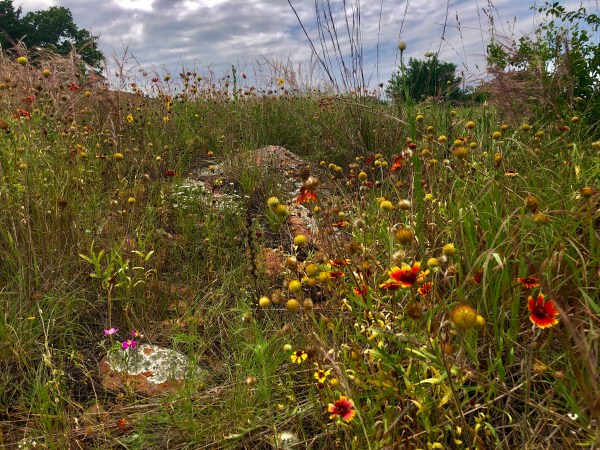
A cacophony of native wildflowers!
An orgy of Euphoria kernii (Kern’s flower scarab) in Opuntia sp. flower. Multiple color forms exist for this species.
At first I thought this was a type of hover fly (family Syrphidae), but eventually I determined it to be Esenbeckia incisuralis, a horse fly (family Tabanidae)—incredible emerald green eyes!
Lake Lawtonka nr. Ma Ballou Point, Oklahoma We stumbled into this area while looking for stands of Sapindus drummondii (soapberry)—found a small stand along the road, but it was too inaccessible. The same diversity of blooms were present as at the previous spot, so I picked a few longhorns off flowers of Coreopsis grandiflora and Gaillardia pulchella. Super windy, so we didn’t stay long.
View across Lake Lawtonka from Ma Ballou Point.
Neochlamisus sp. (case-bearing leaf beetle) larvae inside their “casas de caca” on Monarda fistulosa (bee balm).
I believe this is Harrisina coracina, a leaf skeletonizer in the family Zygaenidae. Both BugGuide and the Moth Photographers Group show records only from Texas.
Day 4 – Wichita Mountains National Wildlife Refuge, Oklahoma Before starting the day’s collecting, we wanted to go into the Wichita Mountains National Wildlife Refuge to have a look around. On the way into the refuge we some American bison near the road and had to stop, take photos, and simply admire these massive, majestic beasts. We then went to the Cedar Plantation, where I had visited before back in 2012 and photographed black individuals of Cicindelidia obsoleta vulturina (prairie tiger beetle). No tiger beetles were out now (they come out in the fall), but I’d hoped to maybe see Cylindera celeripes (swift tiger beetle) along the 2-tracks in the area. No such luck—nevertheless, we saw a myriad of interesting insects, including several more Esenbeckia incisuralis (green-eyed horse flies) and a beautiful Trichodes bibalteatus (checkered beetle), the latter of which I photographed on flowers of Ratibida columnifera and Achillea millefolium with the big camera. Afterwards we visited the “prairie dog town” and got marvelous views and photographs of black-tailed prairie dogs.
Native American wildlife on a native American landscape.
American bison (Bison bison bison).
Wichita Mountains from Cedar Plantation.
Acmaeodera mixta on flower of Rudbeckia hirta (black-eyed Susan).
Typocerus octonotatus on inflorescence of Achillea millefolium (yarrow).
Strangalia sexnotatus on flower of Ratibida pinnata (gray coneflower)
Trichodes bibalteatus on flower of Rudbeckia hirta (black-eyed Susan).
Trichodes bibalteatus on flower of Ratibida pinnata (gray coneflower)
The author walks a bison trail through the Cedar Plantation.
Black-tailed prairie dog at its burrow entrance.
“Watch you lookin’ at, Willis?!”
Black-tailed prairie dog (Cynomys ludovicianus).
Medicine Park, Jack Laughter Park, Oklahoma We’d noticed this spot yesterday because of the old post oaks and wealth of wildflowers blooming up the mountainside. There wasn’t much going on today, however—just a few Acmaeodera mixta on flowers of Gaillardia pulchella. I did find an Anthaxia (Haplanthaxia) sp. on my arm! Otherwise I spent some time photographing the landscape and some geometrid larvae on flowers of Gaillardia pulchella.
Small Oncoptus fasciatus (large milkweed bugs) nymphs colonize seed pods of Asclepias asperula (antelope-horns).
Medicine Park Primitive Campground, Oklahoma We returned to this spot since we had so much luck yesterday. I was hoping to collect more Acmaeodera ornatoides and Strangalia virilis, but there was much less going on today than yesterday—basically didn’t see anything for the first hour and a half. I didn’t give up, however, and kept checking the area where we saw most of the S. virilis yesterday, and eventually I saw another male in the same area as yesterday on the same stand of Torilis arvensis. I found two more males in the same area over the next hour, so three males on the day was a good reward for the time spent looking for them. I also collected Trichodes apivorus and Trichiotinus texanus on flowers of Allium sp. Interestingly, beating the post oaks—the reason why I originally wanted to stop here—produced nothing. So, not very many specimens on the day, but happy with those I did get.
Medicine Park, Jack Laughter Park, Oklahoma I was pretty much done for the day after spending all morning at the refuge and most of the afternoon at the previous spot, but Rich wanted to take another look at Jack Laughter Park because he’d found some interesting grasshoppers there. As with earlier in the day there were few beetles of interest to me, but I did collect a couple of Trichiotinus texanus on flowers of Cirsium undulatum. I checked out some large post oaks with large dead branches thinking that might be what Strangalia virilis was breeding in but never saw any, and eventually I turned my attention to photographing a few interesting native plants that I found along the way.
Krameria lanceolata (trailing krameria).
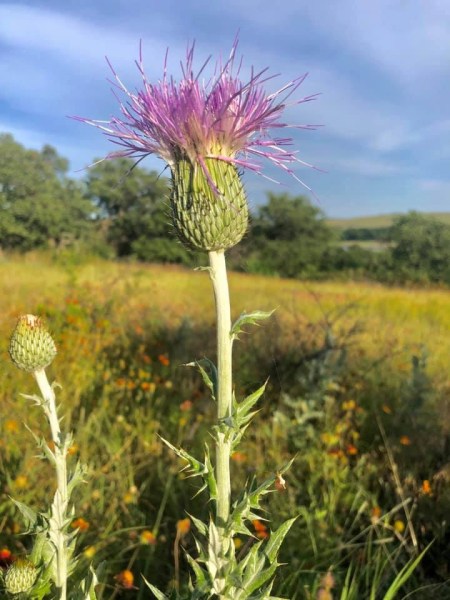
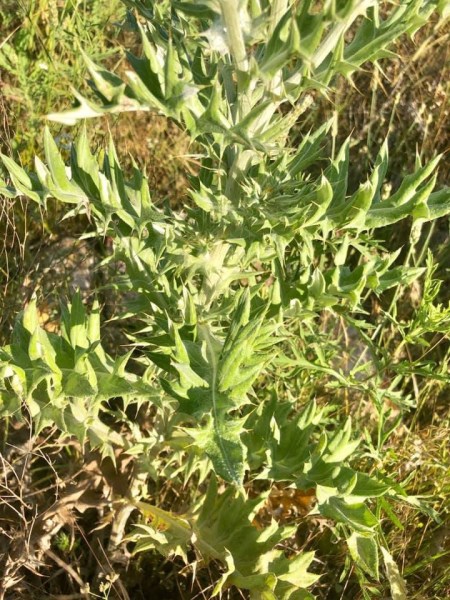
Cirsium undulatum (wavyleaf thistle or gray thistle) inflorescence.
Cirsium undulatum (wavyleaf thistle or gray thistle) can be distinguished by its wavy leaves that are gray-green on both upper and lower surfaces.
Day 5 – Epilogue We were tempted to do one last little bit of collecting on the way back to St. Louis, but since had pretty good luck during the last couple of days and the drive alone would take more than nine hours we decided to leave well enough alone and get home at a reasonable hour. A walk with Beauregard when I got home to stretch the post-drive legs was the perfect way to end the mini-vacation.
This month’s destination for the WGNSS Natural History Photography Group was Orchid Valley Natural Area in Hawn State Park. This natural area is south of the main park and not normally open to the public, but we were granted permission to enter by the park administration. Our targets were several species of orchids and other rare plants that are known to occur in the area—showy orchis (Galearis spectabilis) being the one I hoped most to see.
Our group for the day (front to back): me, Lynne, David, Casey, Avery, James, Bill, and Rich (Chris behind tree at back).
There are no trails here—not even a place to park, as we squeezed our cars against the side of the road at a spot that appeared to provide good access. A bit of GPS-guided bushwhacking brought us to increasingly rough and sloping ground that ended up at the edge of a cliff overlooking one of the sandstone box canyons that this area is know for—down below was where we wanted to go. Wild azaleas lined the upper canyon edges with their stunning pink blossoms. We followed the canyon edge and found a way down, then circled back into the canyon to find a stunning waterfall, its sandstone walls dripping with mosses and ferns. We spent quite a bit of time here photographing the waterfall and surrounding area before eventually resuming the search for the orchids that we came to see.
Bill surveys a waterfall at the center of a sandstone box canyon.
The waterfall fell about 25 feet onto the sandstone rocks below, its splash creating perfect conditions for luxurious growth of mosses and ferns.
Mosses sending up their “stems” (actually setae), each holding up a capsule filled with spores.
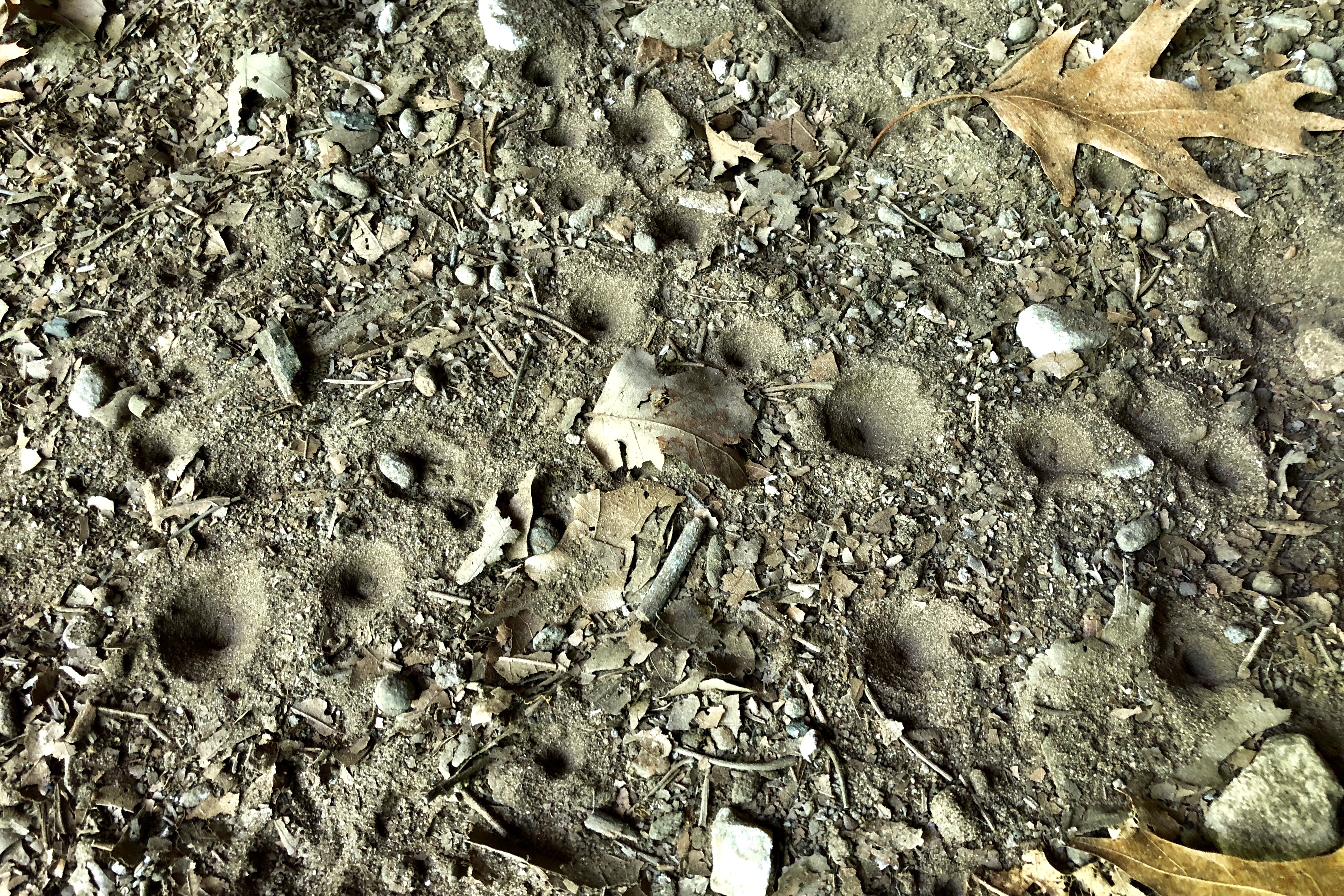
Sadly, the orchids were not yet in bloom—not even close, another victim of the cold, late spring we’ve been experiencing. Casey, our group leader, did find some very small showy orchis leaves, and we saw some nice clumps of another native orchid, rattlesnake plantain (Goodyera pubescens), an evergreen orchid that blooms during late summer. We hiked up another drainage that led to another box canyon—lacking a waterfall but equally impressive, nonetheless—but found no orchids in bloom there, either. We did, however, see cinnamon ferns sending up their spike-like fertile fronds and aggregations of antlion larvae (a.k.a. “doodlebugs”) in the soil beneath the sandstone ledges.
Leaves of rattlesnake plantain (Goodyera pubescens).
Moss growth is luxuriant in the wet sandstone exposures inside the box canyons.
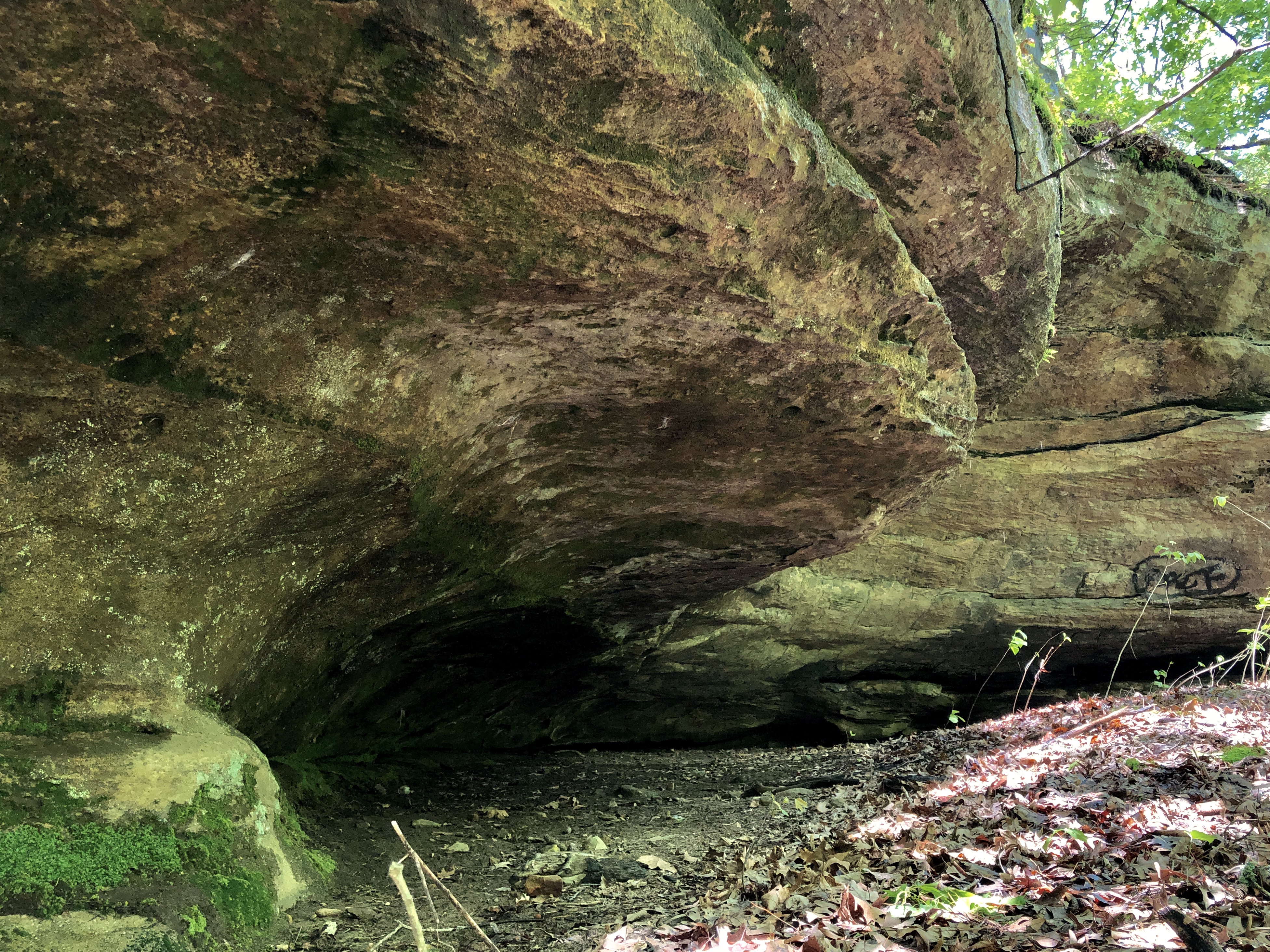
Sandstone ledge above a box canyon.
Pits of antlions, or “doodlebugs”, clustered in the soil beneath a sandstone ledge. Ants and other insects that fall into the pits are quickly dispatched by the sickle-shaped mandibles of the bug lying buried at the bottom of the pit.
You might think failure to find what we were looking for would result in a disappointing field trip—far from it! Time in the field with like-minded friends in a beautiful spot is always a pleasure, and when it comes to searching for rare plants (or insects, or whatever), failure is the norm—making success, when it does come, that much sweeter. There will be other chances to see showy orchis (perhaps in a couple of weeks).
Last Saturday, the Webster Groves Nature Study Society (WGNSS) Nature Photography Group was joined by several members of the WGNSS Botany Group and Missouri Native Plant Society to look for one of Missouri’s rarest plants—Geocarpon minimum, a.k.a. tinytim or earth-fruit (family Caryophyllaceae). This diminutive, federally-threatened and state-endangered plant grows only on sandstone glades, primarily in west-central Missouri with a few populations known also from Arkansas, Louisiana, and Texas. The window for finding this plant is short—it’s entire life cycle lasts only about 4 weeks, with an even shorter window for finding it in flower.
Our first stop to look for them was Bona (pronounced “Bonnie”) Glade Natural Area. I’d been here before, but it was about 10 years ago and at the wrong time to look for this plant (but I did find widowscross, Sedum pulchellum, in bloom). Some of the group had seen it here before and were able to coach us on the microhabitat where we would likely find them, and it didn’t take long before we did. Soon after finding the first plants, we found them in bloom as well—their almost microscopic flowers being the perfect subject for my macro lenses!
Remnant sandstone glade at Bona Glade Natural Area, Dade Co., Missouri.
Geocarpon minimum (tinytim or earth-fruit). Note the tiny open flowers just below center. (This is an iPhone photo—I have much better photos with my “big” camera.)
After getting plenty of shots of the plant and flowers, we moved to an adjacent plot of land across the highway, where we not only found more tinytim plants but also Corydalis aurea, commonly called golden corydalis (pronounced koor-ID-uh-lyss), in the family Papaveraceae—something I’d never seen before.
Next the group moved on to Corry Branch Glade. It was originally our intent to look for more of the plant at this site, but immediately upon entering the glade we noticed a stunning display of Selenia aurea, or golden selenia. This small, striking species in the mustard family is restricted to just a handful of counties in the west-central part of the state, again primarily glade habitats. It was a surprising and pleasant find that occupied the groups’ attentions for some time before we finally decided to break for lunch (it was well into the afternoon!). While I was there, I not only photographed the plant but started having some success with my new 15-mm wide-angle macro lens, with which I had been experimenting all day (to that point without much success).
Members of WGNSS & MoNPS go hunting for rare plants! Front to back: Ted MacRae (me), John Oliver, Casey & Anh Do Galvan, Steve Turner, Bill Duncan, David Seidensticker, Deb Tyler, Adam Rembert, and James Faupel.
After “lunch” (which was closer to dinner!), a few of us (Bill, David, and I) wanted to go back to Bona Glade to take another crack at photographing tinytim with our wide-angle macro lens. I especially was not satisfied with what I had gotten earlier, that being my first serious attempt at using the lens in the field. Having a better idea now of how to use the lens and what our compositional goals were, we scoured the area looking for just the right plants in just the right situations. I can honestly say I finally got a feel for how to use the lens, the trickiest part of it being how to balance use of flash on the subject with the amount of ambient light from the background (I’m not a stranger to this concept at all, frequently having combined flash with “blue sky” in much of the macrophotography I’ve done up to this point). We photographed several plants on different substrates looking for the right combination of plant, substrate, and background, and we all walked away pretty optimistic that we’d gotten the photos that we wanted.
Bill Duncan photographing tinytim with his wide-angle macro lens.
My thanks to Casey and Ando Galvan for letting me ride down there with them, to David Seidensticker and Bill Duncan for letting me ride back with them, and for everyone in the group who so generously shared their great, collective knowledge of botany, photography, and natural history. What a fun day!
NOTE: The photos in this post were taken with an iPhone X. The “real” photos, taken with our “real” cameras, will be shared as they become available.
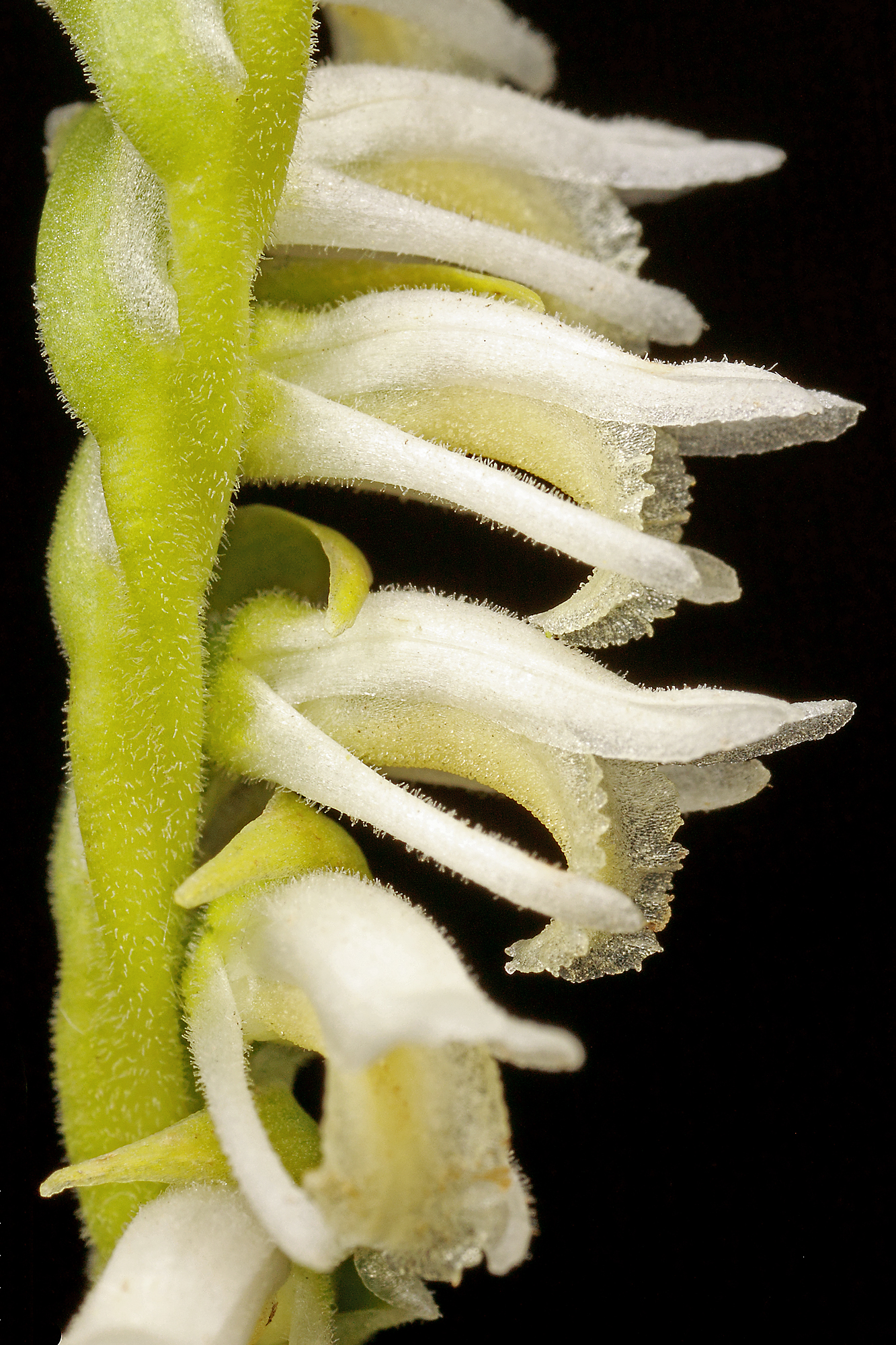
Last night the Webster Groves Nature Study Society (WGNSS) held their 2019 Nature Photo Contest, and I was fortunate to have a 1st place winner in the ‘Plants and Fungi’ category! This photograph of grassleaved lady’s tresses orchid (Spiranthes vernalis) flowers was taken at Taberville Prairie Natural Area in St. Clair Co., Missouri. Like other species of lady’s tresses orchids, their tubular flowers are arranged in a spiral along the inflorescence and cross-pollinated primarily by long-tongued bees (e.g. bumblebees, Bombus spp., and megachilid bees) (van der Cingel 2001).
Spiranthes is one of the more complex genera of North American orchids, with seven species known to occur in Missouri (Summers 1985), and like almost all orchids, their pollination biology is fascinating! The flowers are “protandrous”, i.e., they are functionally male when they first open and become functionally female as they age. Since they open sequentially from the base of the inflorescence as it grows, this results in female flowers on the lower portion of the inflorescence and male flowers on the upper portion. Thus, bee pollinators tend to act as pollen donors when visiting lower flowers and pollen recipients when visiting upper flowers. Male pollinia are attached to the bee’s proboscis as it tries to access the nectar secreted into the base of the floral tube and then come in contact with the female stigma in the next flower that the bee visits. Bees generally start at the bottom of an inflorescence when visiting a plant and then spiral up to the top before flying to the next plant. Such “acropetal movement” is likely a result of the tendency for nectar rewards to be greater in the lower flowers, and it ultimately promotes cross-fertilization between neighboring plants.
This was the 4th edition of the contest, which has been held every other year since the inaugural edition in 2013. I’ve earned 2nd and 3rd place honors in the plants category each time before; however, this was my first win in that category. In addition to plants, I also had entries in the ‘Invertebrates’ (restricted to photos taken in Missouri or one of its contiguous states) and ‘Travel’ (open to photos taken anywhere in the world) categories, with one photo each making it to the final round of judging. You’ve seen them both before—Neotibicen superbus (below left—photographed at Mincy Conservation Area, Taney Co., Missouri) and Agrilus walsinghami (below right—photographed at Davis Creek Park, Washoe Co., Nevada). In the end, however, they both got beat out by the competition, so I only had the one winning photograph this time. Nevertheless, it was a 1st place winner, so I am very satisfied.
Neotibicen superbus
The WGNSS Nature Photo Contest has quickly become one of the organization’s marquee events, with the number of entries, caliber of competition, and attendance all exceeding the previous three editions. My thanks to the judges who volunteered their time, the attendees who supported the event, and especially to Bill Duncan, Chair of WGNSS’s Nature Photography Group (and an expert nature photographer in his own right), who worked hard to make this event the success that it was (and took home some well-deserved wins of his own). I look forward to the next competition in 2021!
REFERENCES:
Summers, B. 1981.Missouri Orchids. Missouri Department of Conservation, Natural History Series No. 1, 92 pp.
van der Cingel, N. A. 2001.An Atlas of Orchid Pollination: America, Africa, Asia and Australia. A. A. Balkema, Rotterdam, Netherlands, 296 pp.
Earlier this month the Webster Groves Nature Study Society (WGNSS) sponsored their second Nature Photo Contest. I’ve been a member of this group since I first moved to St. Louis after college in the early 1980s—primarily as a participant in the Entomology Natural History Group but for the past six years also as board member and editor of the Society’s newsletter, Nature Notes. The photo contest was run much like the first one in 2013, again with nice cash prizes for the winners, except two things: 1) the categories were a little different (see below), and 2) I was tapped to be one of the three judges in the two categories that I did not submit photos. The categories were:
Invertebrates
Vertebrates
Plants & Fungi
Natural Communities
Seasons
I submitted two photos each to the first three categories—the maximum allowed in both cases. One limitation for me was that the photographs had to be taken in Missouri or an adjacent state. Remarkably, during the past few years I’ve taken most of my photos in places further afield—primarily in the western U.S. in states such as California, Colorado, New Mexico, and Nevada. I have many photographs from earlier years, but frankly I don’t consider much of that body of work to be photo contest worthy. Still, I was able to come up with a few more recent photographs that I thought would be competitive.
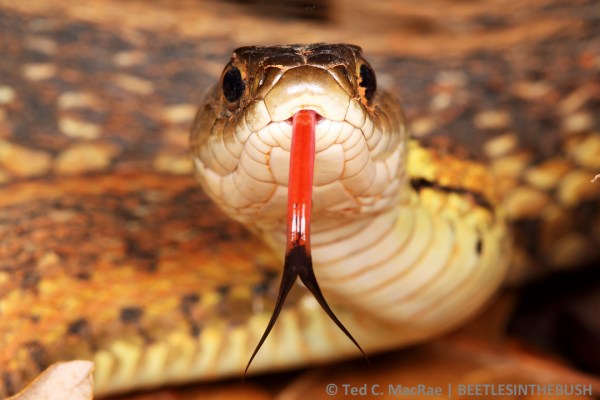
How did it go for me? Pretty good, with two of my photos taking cash-winning prizes (see below). This may not be as good as I did last time, when I won one 1st place, one 2nd place, and one 3rd place—the last of these also voted by the audience as the Grand Prize winner. Nevertheless, the cash award is much welcomed and will be put to good use. Remarkably, it turns out that two winning photographs have never been posted at this site, so here they are:
The judges regarded that it represents the true “essence” of a snake. Technically they liked the position of and focus on the tongue, the contrasting red color working well in the composition, with the blurred, winding body of the snake adding depth in a cleaner fashion than a cluttered jumble of leaves. I can’t tell you how many shots I took hoping to get one with the tongue in the perfect position—knowing all along that at any moment the snake could stop flicking it or decide to make a run for it
2nd Place—Plants & Fungi
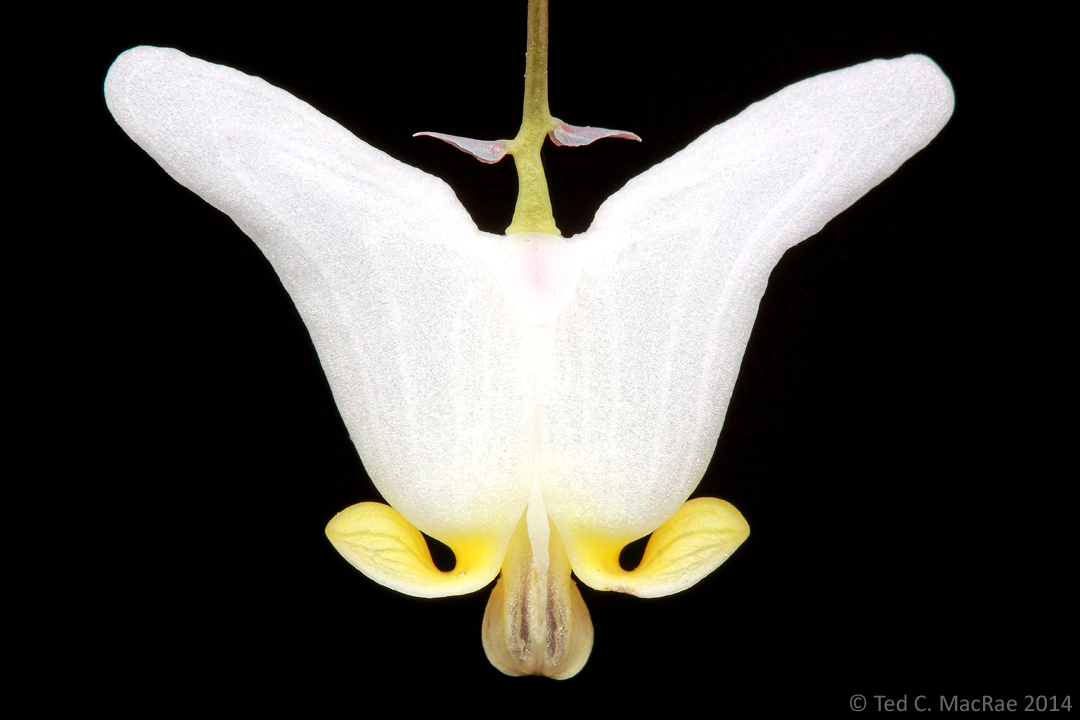
Dutchman’s breeches, Dicentra cucullaria | Battle of Athens State Park, Clark Co., Missouri
Unfortunately, I didn’t get a chance to hear the judges’ feedback regarded this photo, as I was busy judging the photos in the ‘Natural Communities’ and ‘Seasons’ categories. This photo also took many shots, even though I didn’t have to worry about the subject not cooperating. Flash on white is tricky—not enough and you don’t get the stark contrast with the black background; too much and you end up blowing the highlights and losing the delicate detail. Add to that trying to get the subject perfectly symmetrical within the frame (I wanted to achieve this ‘for real’ and not through subsequent cropping), and I probably took close to two dozen shots before I felt like I had it right.
Perhaps you noticed that neither of the photos were in the ‘Invertebrates’ category. This just goes to show that the amount of interest in and effort one puts into a certain type of photography does not guarantee success—or prevent success in photographing other, less-familiar subjects. For my part I am pleased that any of my photographs were deemed good enough to receive a cash prize and thank WGNSS for giving local nature photographers the opportunity to have their work recognized and rewarded.









































































 Beetles In The Bush