Are we loving our prairies/glades/woodlands to death?

I had such high hopes for last weekend’s collecting trip – late May is boom time for insects across Missouri, we have had good moisture this spring, and I would be visiting some high-quality natural communities that I had not visited for a long time.  My stated goals (the jewel beetles, Agrilus impexus and A. frosti) were long shots – I knew that and would have been fine coming home without those species (which I did) had the the collecting been otherwise productive (which it was not).  Still, I’ve been doing this for a long time now, and I’ve learned to draw on my accumulated experience when things don’t go as planned to give myself the best shot at turning a bad collecting trip into a decent one when things don’t go as planned.  The itinerary with which I start is rarely the one that I actually follow, and this past weekend was a good example of such.

My first stop was Ha Ha Tonka State Park, one of Missouri’s premier parks, boasting high-quality chert, dolomite, and sandstone savanna interspersed with dolomite glades.  It is on these glades and savannas that I hoped to find Agrilus impexus, or failing that at least collect a nice diversity of other jewel beetles on the oaks and hickories of the savannas and surrounding woodlands.  However, it was with some reservation that I even came here after being told by my colleague at the Department of Natural Resources just 2 days before my trip that 75% of the park’s grasslands and woodlands had been burned within the past two years.  For an insect collector, this is never good news – in all my years of collecting insects, my experience in relatively recently-burned habitats has been consistent: collecting sucks!  I decided, however, to visit Ha Ha Tonka anyway because of the quality of the natural communities it contains, thinking perhaps I might be able to find pockets of unburned habitat supporting good insect populations.  This was not to be. I beat oak after oak in the savannas and woodlands – nothing!  I swept little bluestem and Indian grass in the glades – nothing!  The foliage was lush and green and the savanna and glade landscapes highly diverse – given the time of season the place should have been teeming with insect life, yet it almost seemed sterile. Were it not for a few Chrysobothris quadriimpressa jewel beetle adults that I found attracted to a recently wind-thrown black oak tree, I would not have seen any insects here at all.  It appeared my fears about park-wide depression of insect populations had been realized.  However, not one to waste a visit I decided to explore some of Ha Ha Tonka’s fascinating geological features.  Ha Ha Tonka contains one of Missouri’s best examples of karst geology, with complex structures formed from the collapse of a major cave system.  The Devil’s Promenade is one of the more spectacular examples of such, its horseshoe-shaped cliff representing the former interior walls of a now-collapsed cave.  As dusk approached, the day’s poor insect collecting caused me to abandon my plans to stay here and blacklight for nocturnal beetles.  Instead, I decided to break from the itinerary, drive further west and explore Lichen Glade Natural Area in the morning before heading to the Penn-Sylvania Prairie BioBlitz later that afternoon.
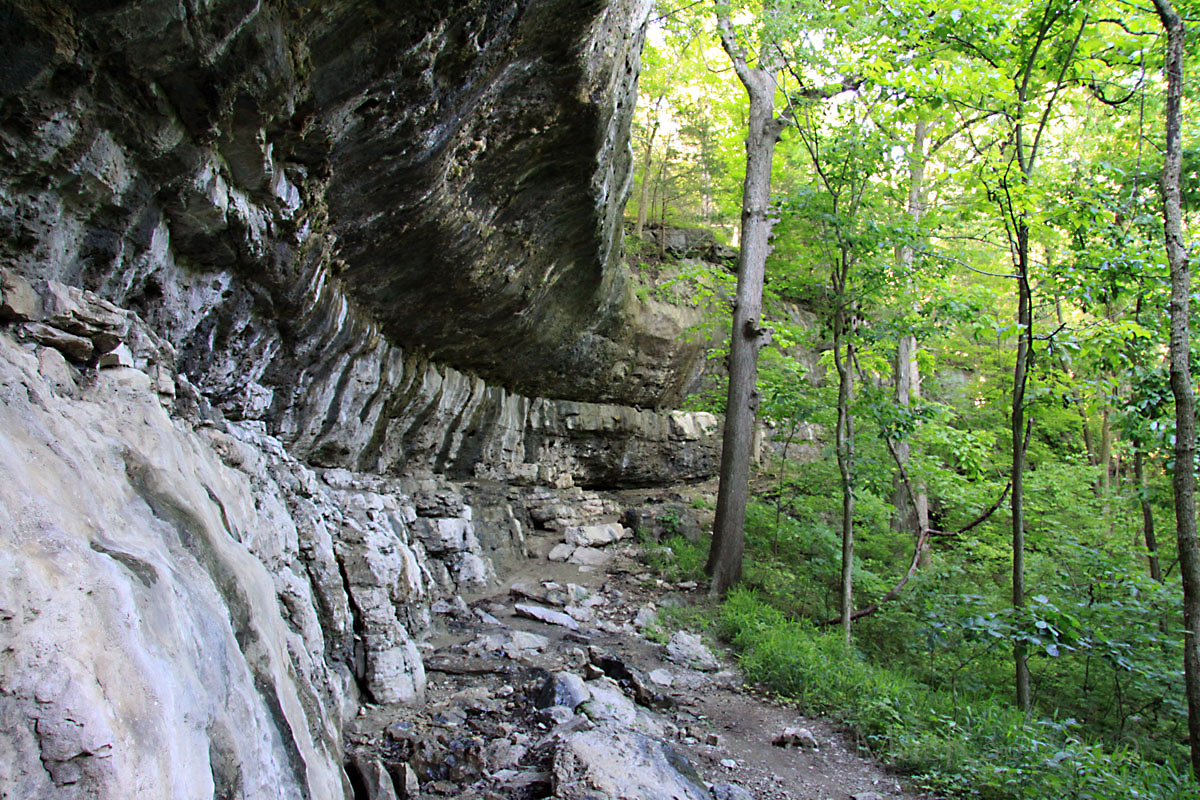
Devils Promenade, Ha Ha Tonka State Park

Lichen Glade Natural Area is a small area owned by The Nature Conservancy that boasts a high-quality sandstone glade surrounded by post oak/black jack oak forest.  My first visit to the area more than 20 years ago was during May, and it was one of the most productive collecting trips I’ve had with a number of Agrilus spp. (including A. frosti) beaten from post oak (Quercus stellata) along the woodland edge.  I didn’t visit again until fall of 2002, when Chris Brown, Rich Thoma and I found claybank tiger beetles (Cicindela limbalis) sunning on the exposed sandstone outcrops, and I made one more visit the following May to beat more insects off of post oak.  The Lichen Glade that I returned to this past weekend was a very different place from when I last visited – the surrounding woodlands had been extensively opened (I would guess within the past few years based on the size of the post oak resprouts), and fire had been used throughout the area.  Anticipation turned to frustration when no amount of beating of the woodland vegetation and sweeping of the glade vegetation turned up beetles in any appreciable numbers (or any insects for that matter) and two hours worth of effort yielded not a single buprestid beetle!

Sandstone glade community, Lichen Glade Natural Area

With resignation, I headed on over to Penn-Sylvania Prairie, where during the introduction to the BioBlitz I learned that nearly half of the 160-acre prairie was burned last December and all of it had been burned within the past few years.  I knew what I was going to find – nothing!  Okay, I shouldn’t say nothing, as there actually were some beetles present.  However, the numbers and diversity were low, with all of the species encountered representing common, widespread species.  Moreover, it was not just beetles – all of the invertebrate group leaders (which included experts on snails, ants, butterflies, and bees) reported low overall abundance and diversity in their groups of interest.  Only the vascular plants – the metric by which the value of prescribed burning is always assessed – showed high diversity, with 300 species of mostly native prairie plants recorded for the site.  It was a fun event, with probably ~75 attendees and a delicious pot luck dinner that evening; however, it would have been more enjoyable had there actually been a nice diversity of insects present to document for the preserve.

My comments may make it seem that I am against the use of prescribed burning.  This is not true – I understand the critical role that fire as a management technique plays in restoring and maintaining examples of Missouri’s historically fire-mediated landscape. Without fire and other processes to mimic natural disturbance factors, most of Missouri’s historical grasslands and woodlands suffer relentless encroachment by woody vegetation. However, the modern landscape is very different from the historical landscape, where fires of unpredictable scale, intensity, and frequency operated within a vastly larger scale to create a shifting mosaic of natural communities in various stages of ecological succession. Such processes cannot be recreated on today’s severely fragmented landscape, where the precious few remaining tracts of native habitat are relatively to extremely small and more often than not separated from each other by vast expanses of homogeneous and “inhospitable” habitat (e.g., agricultural, urbanized, or severely degraded lands).  It is in that context that I have great concerns about how aggressively fire has been used in recent years on our state’s natural areas and the impact this is having on insect populations – specialist and generalist alike.  Fire proponents will point to published studies that show little to no effect by the use of fire for managing small, isolated remnants on specialist insects (see review in Henderson 2010).  However, there are an equal number of studies that suggest such concerns are well-founded (see review in Panzer 2002). A consistent limitation in all of the studies that have been conducted is the lack of very large and long un-burned remnants.  Prescribed burning has been adopted so rapidly and pervasively that there just aren’t any significant un-burned remnants left to properly include as controls in such studies.  As a result, the insect fauna present at a given site at the start of such a study is already skewed towards those species that successfully recolonized the area post-burn.  At a minimum, the data to this point are inconclusive, and certainly the potential for impacts has not been given the consideration it warrants in designing fire-management plans for our own state’s prairies and glades. Furthermore, as rapidly and aggressively as fire has been adopted on our few, small, widely disjuct remnants, the opportunity for proper investigation of those potential effects may be gone.  A particularly egregious example of the lack of consideration being given to prairie invertebrates in designing fire management plans is shown in these photos of Iowa’s Sylvan Runkel State Preserve before and after a late May burn and the impact of that burn on a resident population of Nevada buck moths (Hemileuca nevadensis).

Here in Missouri, as in Iowa, it’s a problem of scale – the landscape is too fragmented and remnants too disjunct to manage based strictly on floristic response.   Populations of generalist insect species will recover, and even specialist species may be able to overcome such management practices if they are widely distributed and sufficiently mobile. But what about conservative species with low vagility, such as the swift tiger beetle (Cylindera celeripes) and our disjunct population of the frosted dromo tiger beetle (Dromochorus pruinina), flightless species restricted in Missouri to the few tiny remnants of loess hilltop prairie in northwestern Missouri and a single 2.5-mile stretch of roadside habitat in west-central Missouri?  Until directly relevant data, gathered here in Missouri, are forthcoming to suggest otherwise, I believe the most judicious use of fire possible should be practiced in restoring and maintaining our grasslands and woodlands.  In-season burns may have been a part of the historical landscape, but their use today has great potential to result in local extirpations and should be used only after the most careful consideration.  Leaving un-burned refugia within remnant habitats to accelerate recovery would also be prudent – yet many land managers disregard this practice because of its logistical difficulties. This is especially true in small parcels, yet it is precisely these remnants that have the most to gain from their use (or lose from not doing so!).  In the historical landscape, every burn was a patch burn – no matter what its size, there were always adjacent or proximal unburned habitat from which recolonization could occur.  Elk and bison, too, were integral components of the presettlement prairie landscape – their roamings caused intermittent, localized disturbances that were likely not only crucial to the tiger beetles that I study but may also have contributed to vegetational diversity through patch succession.  Techniques that mimic these natural disturbance factors include mowing, haying, and managed grazing.  They can be utilized to mimic those disturbances as well as delay woody encroachment, and their use in land management should be considered for their ecological value rather than deprioritized because of their relatively greater complexity and cost to implement. Mechanical removal and selective use of herbicides offer additional tools for addressing woody encroachment while minimizing potential impacts to insect populations. An effective management program that considers all of the flora and fauna of a remnant may not be possible unless all of these management tools are utilized, or at least properly considered. As my good friend James Trager said in a recent email (quoting Andrew Williams), habitat restoration “cannot rest on any single management practice, nor practicing it too extensively.”

REFERENCES:

Henderson, R. A.  2010. Influence of Patch Size, Isolation, and Fire History on Hopper (Homoptera: Auchenorrhyncha) Communities of Eight Wisconsin Prairie Remnants.  Wisconsin Department of Natural Resources, Research Report 189, 22 pp.

Panzer, R. 2002. Compatibility of prescribed burning with the conservation of insects in small, isolated prairie reserves. Conservation Biology, 16(5):1296-1307.

Copyright © Ted C. MacRae 2010

Add to FacebookAdd to DiggAdd to Del.icio.usAdd to StumbleuponAdd to RedditAdd to BlinklistAdd to TwitterAdd to TechnoratiAdd to Yahoo BuzzAdd to Newsvine

Email to a friend

The Moth and Me #11

The Moth and MeWelcome to issue #11 of The Moth and Me, the monthly carnival devoted to the “forgotten” lepidopterans. Most people – even entomologists – regard these as the lesser leps, denizens of the night, as if to hide their somber-colored drabness from the flashy brilliance of their rhopaloceran relatives. Of course, this simply isn’t true, as the contributions to this month’s issue well demonstrate. Butterflies may be among the largest insects on earth, but the largest lepidopteran in the world is a moth. They may also be as gaudily colored as the rainbow itself, but what butterfly is more colorful than the Urania day-flying moths (the genus name literally means, “The heavenly one”).   And, they may be almost universally accepted by a largely insect-indifferent public, but who among us does not think back to that first sight of a luna moth as the most stunning insect we had ever seen to that point.  Yes, moths are all that butterflies are, and for this month’s issue of TMaM, 15 contributions by nine writer’s show us why.

Family Saturniidae – Giant Silkworm & Royal Moths

Tales from the Butterfly Garden: LepcuriousLuna moths belong to the royal moths of the family Saturniidae, and as the name implies they are not the only stunningly beautiful member of the group. Kristen at Tales from the Butterfly Garden: Lepcurious writes about an encounter with the Sweetbay Silkmoth (Callosamia securifera).  Like other members of the family, larvae of this species are rather particular about the type of tree that they utilize for food, which in the case of this moth is sweetbay (Magnolia virginiana).  I’m a little too far north here in Missouri for this tree, so I have never seen this moth.  However, I have seen (and reared) some of its close relatives, the Promethia Silkmoth (Callosamia promethea) which hosts on several plant species and the Tulip-tree Silkmoth (Callosamia angulifera) which hosts on Tulip Tree (Liliodendron tulipifera).

Family Zygaenidae – Leaf Skeletonizer Moths

xenogereJason Hogle at xenogere is fond of the unusual and has a gift for finding it. In his post The Unmoth, Jason shows us a male grapeleaf skeletonizer (Harrisina americana) – not your typical moth!, The uniformly black color and bright red neck collar just screams “Don’t eat me – I’m poisonous”, and indeed species in this family are among the few insects capable of producing hydrogen cyanide!  As the name suggests, larvae skeletonize the leaves of both wild and cultivated grapes (Vitis spp.), as well as the related Virginia creeper (Parthenocissus quinquefolia).

Family Noctuidae – Noctuid Moths & Tiger Moths

Tales from the Butterfly Garden: LepcuriousRoyal moths are not the only stunningly colored moths that Kristen at Tales from the Butterfly Garden: Lepcurious has found in Florida, as she shows in this post on Oleander Moths (Syntomeida epilais) and a companion piece on its Oleander host plant.  This striking day-active moth, also called Uncle Sam Moth (for its red, white, and blue colors) and Polka-Dot Wasp Moth (for obvious reasons), may seem like an easy-to-spot target for would be predators, but its gaudiness is actually warning of the toxic chemicals it has sequestered in its body from the Oleander on which it fed as a larva.  Oleander contains the toxins oleandrin, a cardiac glycoside, and neandrin and is toxic if ingested.  Although oleander is an Old World exotic, oleander moths may also be found feeding on devil’s potato vine (Echites umbellata), which may have been their native Florida host before the introduction of oleander to the United States.

See TrailAside from the underwings (genus Catacola) and the recently incorporated tiger moths, Noctuids are typically thought of as the “basic brown moths” – relying on just the aforementioned groups to add a splash of color to the family’s otherwise drearyness.  Nothing could be further from the truth – check out the stunning Eight-spotted Forester (Alypia octomaculata) in this post by Matthew York at See Trail. Larvae of this beautiful little moth feed on ampelopsis, Virginia creeper, and other plants in the grape family (similar to the grape leaf skeletonizer above). “A great moth; brilliant color, diurnal…… and yes… Noctuid. Some moths, like people, don’t go with the trends.”

See TrailFor the most part, tiger moths shun the daytime in preference for the safety of the night. That does not mean, however, that they are any less colorful, as Matthew York at See Trail shows in his post Poor Grammia. Notarctia proxima, the Mexican Tiger Moth, and its relatives have had a bit of name shuffling over the years at the hands of taxonomists – formerly placed in the genera Grammia and Apantesis. Whatever name you call it, the striking white and black striped forewings give a clue about their common name of tiger moths, and the red, black-tipped abdomen not only add to its beauty, but belies the defensive compounds it surely contains.

Speaking of tiger moths and defensive compounds, watch the video that Chris Grinter at The Skeptical Moth included in his post Moth Perfume. In it, Chetone angulosa gives a striking display of a common defensive mechanism for the group – excreting hemolymph (sweating blood, so to speak!). So spectacularly does the moth do this that you can actually hear the hissing sound of the fluid being pumped from the body. Moreover, there seem to be at least a couple of active ingredients in the froth – one that smells like peppermint, and another that causes numbing of the tongue (as Chris can testify firsthand – he is a truly dedicated experimental naturalist!).

Karthik's JournalIn similar fashion to our North American species of underwing moths (Catocola spp.), the related Eudocima materna, one of the fruit-sucking moths of south India, uses its drab-colored forewings to hide its brilliantly colored hindwings, as Karthik at Karthik’s Journal shows us in his post Startling Displays.  This forms a double line of defense against would-be predators – the forewings blend marvelously into the color of the tree trunks upon which it rests during the day, camouflaging the insect and making it nearly invisible.  If this doesn’t work, a sudden flash of the hindwings may startle the predator just enough to allow the moth to take flight to another tree – where it instantly “disappears” as soon as it closes its wings.

Snails Eye ViewAustralia also has some very colorful fruit-piercing moths, and Bronwen Scott at Snails Eye View presents some beautiful photos of the particularly strikingly-colored Othreis iridescens. Like other members of the group, this Far North Queensland endemic feeds on fruit (Pycnarrhena novoguineensis and Hypserpa laurina, both Menispermaceae, in the case of this species), but as it is apparently the rarest of the primary fruitpiercing moth species in Australia it is not considered to be a pest (and Bronwen would cut it some slack even if it was!).

EntophileAdults are but only one of four life stages that all moths go through. If moths are the “forgotten” leps, then caterpillars are the “forgotten” moths. In many cases, the caterpillar stage cannot be recognized until it becomes a moth (and in some cases the caterpillars are completely unknown). Fortunately, Navy entomologist corycampora at Entophile recognized the caterpillar he found on his croton bush, which he features in the post Croton caterpillar, Achaea janata (Linnaeus), (Lepidoptera: Noctuidae). These “eating machines” can be just as fascinating to observe as their scaled adult counterparts, and while croton seems to be a preferred host in Hawaii, it apparently also feeds on castor beans (judging by its other common name, Castor Oil Semi-looper).

Family Notodontidae – Prominent Moths

the Marvelous in NatureOften dismissed as noctuids, the prominent moths tend to be fuzzier, more thickly-bodied moths that rest with their wings curled around their abdomen or tented over their back (rather than flat like noctuids and most other moths). TMaM organizer Seabrooke Leckie at the Marvelous in Nature has a love affair with prominents, and in her post Georgian Prominent, she features the nicely thick-bodied and fuzzy Georgian Prominent, Hyperaeschra georgica. The caterpillars of this widespread species feed on oak (Quercus spp.), thus, unless you live in the Pacific Northwest you stand a good chance of encountering this species – if you’re you’re willing to make the effort.

Family Psychidae – Bagworm Moths

xenogereMany of us are probably familiar with the evergreen bagworm moth (Thyridopteryx ephemeraeformis), whose large, cone-shaped bags almost look like fruit hanging from the evergreen bushes on which the caterpillars feed. But did you know there are other species of bagworms as well? Jason Hogle at xenogere does, and he compares and contrasts two of them in this duo of posts, Rainy day on the patio and The Other Bagworm. One huge and prominent, the other (Dahlica triquetrella) very small and oft unseen. One with all manner of plant matter stuck to its bag, the other usually mistaken for small bits of dirt or wood. Jason is so good, he can even determine the sex of the caterpillar inside the bag!

Family Sphingidae – Hawk Moths

Roundtop RumingsCarolyn at Roundtop Rumings is hoping that somebody can Name this moth, which she found on the door of her cabin in the forests of Pennsylvania. Don’t let her inability to name this moth fool you, however, for her post contains loads of information on exactly the kinds of characters one should take note of when trying to identify hawk moths. Large size and membership in a popularly studied group aren’t enough – what do the hindwings look like? Are there any spots on the abdomen? As a coleopterist, I hesitate to offer my relatively uninformed opinion on the exact genus and species for this moth, but I’m going to go out on a limb here and suggest maybe something in the genus Ceratomia, perhaps the waved sphinx (C. undulosa)?


I hope you have enjoyed this issue of The Moth and Me, and my sincere thanks go out to all of those who contributed!  The hosting slot for next month’s issue of TMaM is still open, but you can submit your contributions anyway to Seabrooke Leckie at the home site for inclusion in the June 2010 issue once a host is selected.  The submission deadline is June 13, with the issue appearing a few days later.  Perhaps you might like to host the June issue – hosting is not only fun, but also a great way to introduce readers to your site and generate a little traffic.  Contact Seabrooke at the home site if you’re interested – I’m sure she would love to hear from you.

Copyright © Ted C. MacRae 2010

Add to FacebookAdd to DiggAdd to Del.icio.usAdd to StumbleuponAdd to RedditAdd to BlinklistAdd to TwitterAdd to TechnoratiAdd to Yahoo BuzzAdd to Newsvine

Email to a friend

Monday Moth – Trichaeta pterophorina

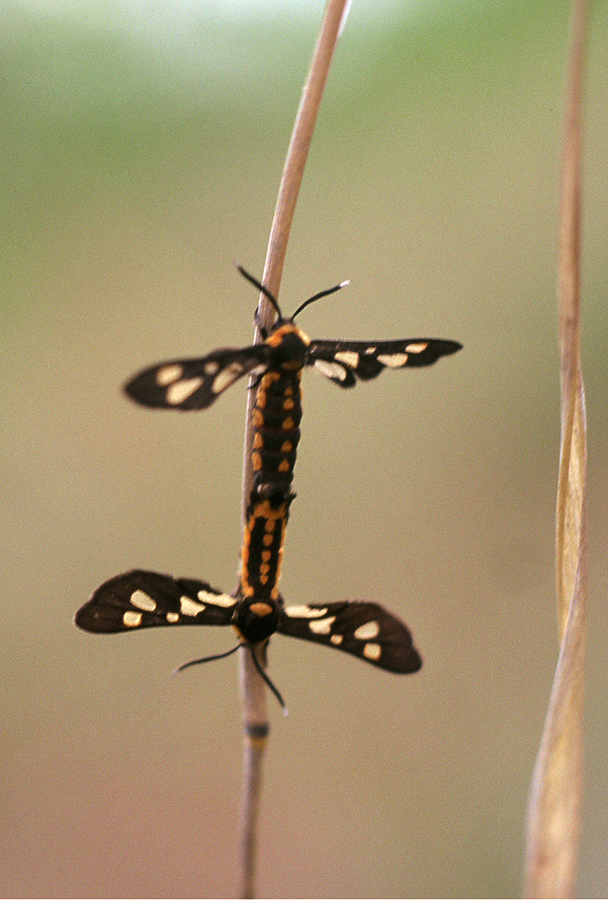
 Trichaeta pterophorina – Borakalalo National Park, South Africa

Another photo from the South Africa files, and one that continues the mimicry theme that has been featured in several recent posts. It’s not a great photograph – the focus is off – but the colors these moths sport are dazzling, and there is a nice symmetry to their tail-to-tail mating position.

Roy Goff, author of the website African Moths, tells me this species is the Simple Maiden (Amata simplex) in the family Arctiidae (whose ~2,000 species worldwide are increasingly considered a subfamily of the already enormous Noctuidae) [update 6/20/2012—Martin in a comment considers these moths to actually represent Trichaeta pterophorina in the same subfamily].  Its gestalt – greatly resembling a stinging wasp – brings to mind the so-called “wasp moths” of North America (subtribe Euchromiina); however, maidens belong to the exclusively Old World Syntomina.  Like the wasp moths, most maidens are exceptionally colorful and exhibit clearly aposematic patterns.  While these might seem to be textbook examples of Batesian mimicry, most species in this group are also protected by distasteful secondary plant compounds that they sequester through feeding, making them Mullerian rather than Batesian mimics.  These compounds are not only acquired by larvae from their food plants, but also by adult moths who imbibe them from fluid regurgitated through their proboscis onto dried parts of plants containing the compounds and into which they dissolve.

Their aposematism is not limited to strictly visual cues.  An Australian species, Amata annulata, is known to regularly emit ultrasonic clicks when flying, thought to be aposematic behavior to warn bats of its distastefulness in the same way that that its coloration warns daytime predators. Additional defensive characters that have been described for species in the group include frothing and extrusion of defensive processes. Clearly, maidens are leaders in the arms race among the insects!

Copyright © Ted C. MacRae 2010

Add to FacebookAdd to DiggAdd to Del.icio.usAdd to StumbleuponAdd to RedditAdd to BlinklistAdd to TwitterAdd to TechnoratiAdd to Yahoo BuzzAdd to Newsvine

Email to a friend

Two ladies from Ontario

What do bugs and snakes/lizards/frogs/turtles have in common? Yes, they’re both ectothermic, but that is the scientist’s answer. Most folks would say they’re just creepy – girls especially! Well, two ladies from Ontario are proving the latter notion wrong by hosting three blog carnivals that cater to these cold-blooded critters: House of Herps, An Inordinate Fondness, and The Moth and Me.

Most people approach their first blog carnival hosting gig with some trepidation, but the Geek in Question at Fall to Climb has embraced the challenge by volunteering to host two blog carnivals simultaneously.  What chutzpah!  Clearly, she was up to the task – for issue of An Inordinate Fondness, she introduces us to technical terms such as OMGSHINY and Coleappetite™ in Discovery Zone, with thirteen stories of beetley discovery. She then shows off her “slammer” talent in House of Herps #5: Slime Poetry – deftly pairing poems with prose.  I would love to see her do this live!

Seabrooke Leckie’s passion for moths is obvious – she is the founder of The Moth and Me and co-author of the soon-to-be-published Peterson Field Guide to Moths of Northeastern North America. Issue #10 of TMaM, Down to the letter, comes home to mama at the Marvelous in Nature – its 24 contributions almost enough to complete the alphabet! Recite your ABCs in lepidopterous fashion with this fine array of contributions.

Copyright © Ted C. MacRae 2010

Add to FacebookAdd to DiggAdd to Del.icio.usAdd to StumbleuponAdd to RedditAdd to BlinklistAdd to TwitterAdd to TechnoratiAdd to Yahoo BuzzAdd to Newsvine

Email to a friend

Monday Moth: Arniocera erythropyga

Arniocera erythropyga (Zygaenidae), Geelhoutbosch, South Africa

Last week’s king cricket quiz (Tuesday Teaser) reminded me that I still have quite a few photographs from my trip to South Africa, now 10 years ago, that I still haven’t shared. This pretty little moth is Arniocera erythropyga, which I photographed at Geelhoutbosch farm in South Africa’s Northern (now Limpopo) Province while clambering up the magnificent north-facing escarpment of the Waterberg Mountains. 

I saw this moth as it sat on the foliage of Grewia sp. (family Malvaceae) – fully exposed for all the world to see.  If we’ve learned anything by now, we know that brightly colored insects that expose themselves conspicuously during the day are probably protected by chemical defences (or perhaps mimicking something that is). Such was the case for Bromophila caffra, an equally strikingly-colored fly that I saw on the same hike, and it is also the case for this moth as well. Arniocera erythropgya is a member of the family Zygaenidae, or burnet moths – many members of which are known to release hydrogen cyanide (Scholtz and Holm 1985). This is the same family to which another toxic species I featured last spring belongs (Pyromorpha dimidiata).  A number of moths and butterflies in other families are also known to release HCN (produced by the breakdown of cyanoglucosides sequestered from the plants on which they feed); however, all life stages of zygaenid moths, including the egg, contain these compounds.  This suggests that zygaenid species are capable of synthesizing these compounds themselves rather than needing to sequester them from their host plants (Scoble 1992). While some zygaenid larvae do feed on plants that contain cyanoglucosides, they apparently do so simply because of their tolerance to the compounds but without the need to sequester them from the plant.

Thus, when I saw and approached this little moth, it didn’t flinch or flee.  Protected by toxicity, it continued sitting brazenly atop its exposed perch – welcoming me to see it, daring me to do anything more than take its photo.

My thanks to Roy Goff at African Moths for confirming the identity of the individual in this photograph.

REFERENCES:

Scholtz, C. H. and E. Holm (eds.). 1985. Insects of Southern Africa. Butterworths, Durbin, South Africa, 502 pp.

Scoble, M. J. 1992. The Lepidoptera. Form, Function and Diversity. Oxford University Press, Oxford, 404 pp.

Copyright © Ted C. MacRae 2010.

Add to FacebookAdd to DiggAdd to Del.icio.usAdd to StumbleuponAdd to RedditAdd to BlinklistAdd to TwitterAdd to TechnoratiAdd to Yahoo BuzzAdd to Newsvine

Email to a friend

New Bug Blogs of note

I try to keep my blogroll useful and relevant – by that I mean that each blog I list has, in a sense, “earned its spot” by offering engaging writing and/or quality photographs on subjects that interest me, and if they go silent or become, well… boring then I remove them. In the past two years, I’ve pretty well explored most of the established blogs dealing with insects and natural history and know what I like, so additions these days tend to be primarily startup blogs. Recommending startups is risky – blogs come and go all the time, and it’s difficult to know if the energy and passion apparent in the first few posts of a blog indicates sustainable creativity or just an ephemeral burst. With that caveat, I’d like to highlight three new blogs that have not only captured my interest, but also seem to have what it takes to sustain that interest for a long time to come.

Chris Grinter is an entomologist at the California Academy of Sciences in San Francisco. He has an interest in microlepidopterans, and his 6-week old blog, called The Skeptical Moth, has featured some rather stunning photographs of these tiny, yet extraordinarly beautiful insects. Moreover, he actually knows something about them – how refreshing it is to see scientific names attached to each photograph and associated discussion that doesn’t sound like a Wikipedia excerpt. As his blog title suggests, he also has a passion for encouraging science education and critical thinking, adding to the general feeling of erudition. There are lots of bug blogs out there, but only a few really good ones – this has the makings of a really good bug blog!

Peter Yeeles has only been blogging since the middle of March, but he is well-known among entomology-blog-circles by his frequent and articulate participation in the comments sections.  Happily, Peter has finally taken the bait and started his own blog, called ptygmatics.  His contributions thus far have been more than engaging and have featured some wonderful photographs of Australian insects (the stalk-eyed flies being far and away my favorite).  Peter has described himself as a “work in progress” entomologist, but I think we are about to witness the emergence of a more substantial entomologist than he is willing to admit. If nothing else, you must see his stalk eyed flies video link.

Heath Blackmon is the newest blogger featured here, and his blog, Coleopterists Corner, in fact has only three posts so far.  Nevertheless, I was impressed by his willingness to jump right into Coleoptera deep phylogeny in his inaugural post, in which he reviewed a recent paper on the subject by Friedrich et al. (2009).  Yea, another beetle lover!  An amateur naturalist for many years, Heath has decided he wants to become a professional coleopterist and is beginning graduate studies this fall (sounds like another back-to-schooler that has won our hearts in recent months).  His first post was followed by a post on how to make a $69 malaise trap.  So he’s also a collector – that’s even better.  The clincher, however, was the photograph he posted in his sidebar of him collecting tiger beetles in Florida – well, this one just has to be a winner!

Copyright © Ted C. MacRae

Add to FacebookAdd to DiggAdd to Del.icio.usAdd to StumbleuponAdd to RedditAdd to BlinklistAdd to TwitterAdd to TechnoratiAdd to Yahoo BuzzAdd to Newsvine

Email to a friend

Euhagena nebraskae in Kansas

Gypsum Hills region of south-central Kansas (Barber Co.)

One of my favorite destinations for insect collecting is the Gypsum Hills region in Barber County of south-central Kansas.  I first went there in May 1986 after seeing a diverse selection of more typically Texan Buprestidae that J. Richard Heitzman, an iconic lepidopterist in the Kansas City area and author of Butterflies & Moths of Missouri, had collected there on soapberry (Sapindus saponaria).  I had my own success with Buprestidae as well during that trip, but in recent years I have returned to Barber County several times during the fall to look for one of North America’s most beautiful tiger beetles, Cicindela pulchra (Beautiful Tiger Beetle).  This species had been recorded in the area by the well-known cicindelophiles Ron Huber and Dave Brzoska, who suggested that I look in the red clay hills just west of Medicine Lodge.  My first trip to look for this beetle in 2004 was unsuccessful, and I suspect the early September timing of my trip may have been a tad too early.  I returned again in 2005, this time in early October and also enlisting the help of local entomologist “Beetle Bill” Smith, who knew of a population on private land near his home in Hardtner (south of Medicine Lodge).  Although at first it looked like success might again elude me, in the end I saw a robust population of these spectacular beetles and published an account of that marvelous experience (MacRae 2006).

As with so many of the things that I have seen over the years, they came before my interest in photography, and I now find myself wanting to re-find some of the more spectacular insects that I’ve previously found so that I can properly photograph them.  Such is the case with C. pulchra, so in October of last year I returned to Barber County in hopes of seeing this species armed not only with an aerial net, but also a Canon 50D.  Sadly, this would not come to pass – the same sudden cold snap that dashed my hopes of finding this species in nearby Woodward/Major Counties, Oklahoma would keep any tiger beetle activity to a bare minimum the following day in Barber County as well.  Despite bright sunny skies, I would see only two tiger beetles the entire day, both representing the dreadfully ubiquitous Cicindela punctulata (Punctured Tiger Beetle).  Not all insect activity, however, was squelched, and after scanning the red soils for an hour or so without seeing the object of my desire I began to notice some of these other not-so-temperature-finicky species.  One of the more magnificent of these is shown in the photo below — Euhagena nebraskae in the family Sesiidae (cess-EYE-id-ee) (formerly Aegeriidae).

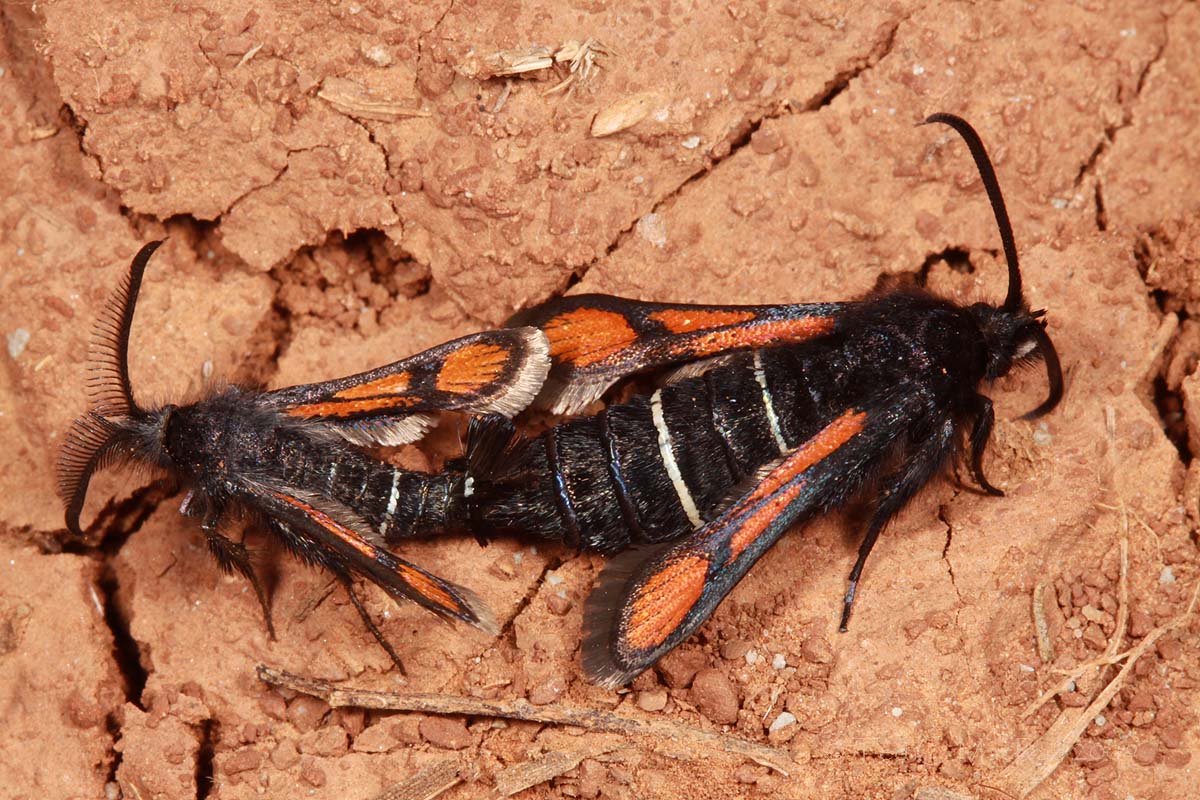
Euhagena nebraskae

Euhagena nebraskae (Lepidoptera: Sesiidae)

Although I wasn’t sure of the species at first, I recognized it immediately as a clearwing moth.  I had an interest in this family of moths for a time in my early days as a field entomologist with the Missouri Department of Agriculture.  Many species are important pests of woody plants in orchard and ornamental landscapes, and it was during that time that synthetic pheromones became widely used for monitoring purposes.  I often walked around with a pheromone tag pinned to my bag to attract the male moths — it was fun watching people seeing these moths “buzzing” me and thinking I was under attack by the wasps that they so effectively mimic (despite my calmness in these situations, I still found it hard to actually grab one from the air with my hand – so convincing is their mimicry).

Euhagena nebraskae is one of two species in the genus in North America, both of which develop as larvae in the roots of plants in the evening primrose family (Onagraceae) (Eichlin and Duckworth 1988).  In fact, I had seen its congener — E. emphytiformis — many times in the 1980s in pheromone traps that I used to place in the glades of Jefferson County just south of St. Louis, where it presumably breeds in one or both of two Oenetherea species growing there (O. gaura and O. macrocarpa).  Euhagena nebraskae is a more western species that does not occur in Missouri, occurring instead across the Great Plains west to California and from southern Alberta and Saskatchewan south to Mexico.  It is likely that many entomologists never see this species, as adults are active only during late fall.  Thus, its perception as an uncommon species may be an artifact of its late seasonality. 

I thought it odd that nearly every individual that I saw was sitting on the ground rather than perched higher on a plant.  At first I wondered if the cold temperatures were a reason for this, perhaps causing the moths to seek out the ground as a source of radiant heat.  This seems doubtful, however, since females always seemed to be “calling” – their tufted abdominal tips raised in the air with the scales spread apart, apparently releasing pheromone.  I was fortunate to find this mating pair, which shows nicely the rather high degree of sexual dimorphism seen in these moths.  Note the much more highly bipectinate antennae of the male (pectinate = resembling a comb, bipectinate = ‘teeth’ on both sides of the main stem) versus the simple antennae of the female — males use their antennae for detecting female pheromones, and the bipectinate form presumably provides greater surface area for placement of sensory pores. Note also the male’s smaller size, “hairier” head and thorax, and greater amount of white coloration on the abdomen and wings.  Engelhardt (1946) supposed that the excessive hairiness of adult Euhagena species was an adaptation to their late-season emergence (principally during October and sometimes as late as November), a time when frosty nights prevail in their high-elevation haunts.    

REFERENCES:    

Eichlin, T. D. and W. D. Duckworth. 1988. The Moths of America North of Mexico, Fascicle 5.1, Sesiodea: Sesiidae. Wedge Entomological Research Foundation, Washington, 176 pp.

Engelhardt, G. P. 1946.  The North American clear-wing moths of the family Aegeriidae. Bulletin of the United States National Museum 190:1-222.

MacRae, T. C. 2006. Beetle bits: The “beautiful tiger beetle”. Nature Notes, Journal of the Webster Groves Nature Study Society 78(4):9–12.

Copyright © Ted C. MacRae 2010

Add to FacebookAdd to DiggAdd to Del.icio.usAdd to StumbleuponAdd to RedditAdd to BlinklistAdd to TwitterAdd to TechnoratiAdd to Yahoo BuzzAdd to Newsvine

Email to a friend

Monday Moth: White-tipped Black Moth

Melanchroia_chephise_IMG_1241_1200x800_enh

Photo details: Canon 100mm macro lens on Canon 50D (manual mode), ISO-100, 1/250 sec, f/22, MT-24EX flash w/ Sto-Fen diffusers.

When is a ctenuchid moth not a ctenuchid moth?  When it’s a White-tipped Black Moth (Melanchroia chephise) in the family Geometridae!

I may be a beetle guy, but I also consider myself a competent general entomologist.  What is a competent general entomologist?  Someone who can identify any insect to order at first glance and a majority of them to family – regardless of one’s own taxa of expertise.  Thus, when I encountered this mating pair of moths on the outside wall of my sister-in-law’s condominium in Seminole, Florida, I “recognized” them as something in what I learned as the family Ctenuchidae (later subsumed within the Arctiidae, first as a subfamily and now as several disparate tribes).  They had all the hallmarks of ctenuchids—black and red coloration, narrowish wings with light colored patches, and about the size of the wasps that they presumably mimic.  Upon my return to St. Louis, I sat down to identify the moths—confident that their distinctive appearance would lead to the quick ID that never materialized after scanning through all of the ctenuchine pages at BugGuide.  Frustrated, I resorted to posting the photo on the site’s ID Request, never questioning my ctenuchine placement.  Precisely 4 minutes later, the moths were identified by John Maxwell as Melanchroia chephise and moved to their proper place—among the 50 other adult photographs of this species that can be found on the site!  I might as well have failed to identify a monarch butterfly!

Melanchroia chephise is apparently common in the American tropics, reaching its northern distributional limit along the coastal plains of Florida and Texas but straying further north in certain years.  Larvae feed on several plants in the family Euphorbiaceae, primarily Breynia and Phyllanthus species.  The adult coloration strikes me as obviously aposematic (warning coloration), but I could find no specific references to this.  However, considering that euphorbiaceous plants are famous for their diverse arsenal of latex and irritant toxins (e.g., diterpene esters, alkaloids, glycosides, ricin-type protein toxins, etc.), it seems reasonable to presume that Melanchroia larvae have evolved mechanisms for sequestering one or more of these compounds.  NABA South Texas states that adults of this species are probably mimics of the Red-bordered Pixie (Melanis pixe), an aposematic metalmark butterfly also of Neotropical distribution that reaches south Texas (but not Florida).  Personally, I don’t really see the resemblance (but then, nor am I an avian predator).  I suppose it’s possible that a species such as this can employ different defense strategies in different parts of its range, relying on Batesian mimicry in areas where suitable models occur and aposematism in areas where they don’t, but I have to admit that I’m now straying well outside the coleopteran-centric bounds of my expertise.

Copyright © Ted C. MacRae 2009

Add to FacebookAdd to NewsvineAdd to DiggAdd to Del.icio.usAdd to StumbleuponAdd to RedditAdd to BlinklistAdd to TwitterAdd to TechnoratiAdd to Furl