Red-eyed poop!

I was looking at some of my older files and ran across these photographs taken in early 2011 in Campinas (São Paulo state), Brazil. They’re not my best photos from a compositional and technical perspective, as I was still on the steep part of the learning curve with the Canon MP-E 65mm macro lens. This lens is no doubt powerful and allows amazingly close-up photographs, but it is rather a beast to learn in the field, especially hand-held. I could quibble endlessly about missed focus and suboptimal composition with these shots, and that is probably why they never made it to the front of the line for being posted. Nevertheless, they still depict some interesting natural history by one of nature’s most famous natural history poster children—the treehoppers (order Hemiptera; family Membracidae).

An adult next to a cast nymphal exuvia.

Bolbonota sp. (Hemiptera: Membracidae), upper right | Campinas, São Paulo, Brazil. Note cast exuvia.

The treehoppers shown in these photos were found on a low shrub in a municipal park and are all that I could manage before my clumsy, unpracticed molestations caused the few adults and nymphs present in the aggregation to disperse. The dark coloration of the adult and its globular form, corrugated pronotal surface, and lack of any horns identify the species as a member of the genus Bolbonota in the New World tribe Membracini (another similar genus, Bolbonotoides, occurs as a single species in Mexico). Species identification, however, is much more difficult, as there are at least a dozen species recorded from Brazil and perhaps many more awaiting description. We have a similar though slightly more elongate species here in eastern North America, Tylopelta americana. I don’t know if this is a specific character or not, but I don’t recall seeing any members of this genus with smoldering red eyes—it gives them an almost devilish appearance, especially the blackish adults (see last photo)!

Bolbonota sp. late-instar nymphs clustered together.

Bolbonota and similar genera are often cited by evolutionists as examples of insects that mimic seeds. I can see such a resemblance if I force myself, but honestly I don’t really buy it. To me they seem to bear an uncanny resemblance to the chlamisine leaf beetles which are thought to mimic caterpillar frass. As with the beetles they resemble, frass-mimicry seems to make much more sense than seed-mimicry, especially given their preference for positioning themselves along the stems of the plants on which they feed (when was the last time you saw seeds of a plant randomly distributed along its stems?). Another thought I’ve had is that this is not an example of mimicry at all, but merely an accidental consequence of the heavy, corrugated body form they have adopted, which likely also affords them a reasonable amount of protection from predation. Confounding both of these theories, however, are the radically different appearance and form of the adults versus the nymphs, and indeed even between the different nymphal instars (see early- and late-instar nymphs in photo below). The later instars seem perfectly colored for mimicking unopened leaf buds, but why they would start out dark in early instars before turning mottled/streaked-white as they mature, only to revert back to dark when reaching adulthood, is a mystery to me. If my thoughts are anywhere close to the truth, it would be a remarkable case of different life stages mimicking the products of two different taxonomic kingdoms (plant parts as nymphs, animal poop as adults)!

Bolbonota sp. nymphs tended by Camponotus sp. | Campinas, São Paulo, Brazil.

An ant (presumably Camponotus sp.) tends a first-instar nymph alongside a later instar.

Of course, if either/both of these lines of defense fail then there are the ant associates that often protect treehoppers and other sap-sucking, aggregating insect species in exchange for the sweet, sugary honeydew that such insects exude as a result of their sap-feeding habits. I presume this ant belongs to the genus Camponotus, perhaps C. rufipes or C. crassus which are both commonly encountered treehopper associates in southern Brazil. I have written previously about ant-treehopper mutualism in the stunningly-marked nymphs of another treehopper, Guayaquila xiphias, and its ant-associate C. crassus in Brazil Bugs #15 – Formiga-membracídeos mutualismo (a post that has become one of this blog’s most popular all-time). Maybe this post will never match that one in popularity, but I do find the third photo shown here remarkable in that is shows no less than five elements of this treehopper’s natural history (early-instar nymph, late-instar nymph, cast nymphal exuvia, partial adult, and an ant-associate) within a single frame (shot by a person still on the steep portion of the MP-E 65mm learning curve!).

Copyright © Ted C. MacRae 2013
The “Dagger Butt Weevil”

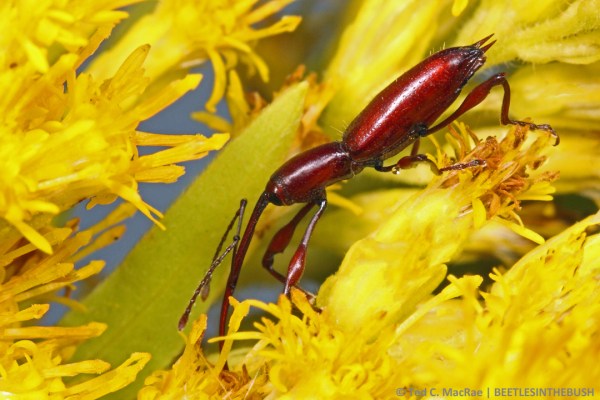
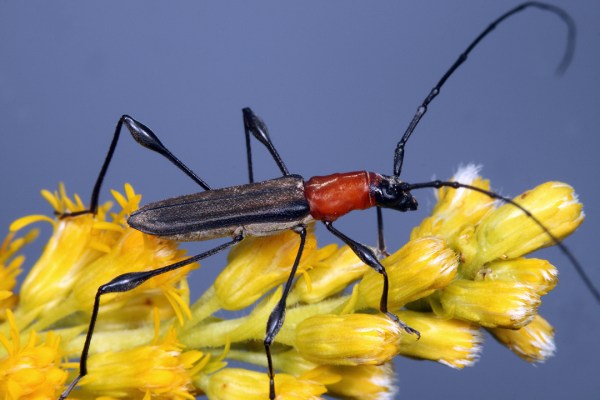
In April 2012 I spent some time in northern Argentina collecting insects, and while collecting was not that great (late in the season after a protracted drought) I saw enough of interest to make it a worthwhile effort. Among the insects that I saw were two species of weevil (family Curculionidae)—one being Eurhinus c.f. adonis () and the other this one, also kindly identified by Charles O’Brien as Erodiscus obidensis (Monte 1944). Both of them were found on flowers of Solidago chilensis growing along the roadside near La Escondida in Chaco Province; however, the two weevils are almost complete opposites in terms of coloration and body form—E. adonis brilliant metallic green and robust chunky, and E. obidensis chestnut-colored and elongate slender.

Erodiscus obidensis (Monte) | Chaco Province, Argentina | Apr 2012

Erodiscus obidensis (Monte) | Chaco Province, Argentina | Apr 2012

An obvious feature of E. obidensis are its two stout spines located at the apices of the elytra. I presume that these serve a defensive purpose to protect them against potential avian or reptilian predators. However, if elytral spines are all that is needed for such then why are these structures not found widely across the order Coleoptera—certainly the potential is there, as many beetles exhibit very small spines at the elytral apices. With enough selection pressure one can easily imagine that larger spines would be selected for. Either the spines also/instead serve some other purpose, or development of spines is more energetically expensive than I am imagining.

What purpose those daggers?

What purpose those daggers?

Compared to most of the insects that I have featured on this blog, I wasn’t able to find much information on this species. It was originally described as Atenistes attenuatus var. obidensis from Óbidos in the Brazilian state of Pará (Monte 1944) and is listed as such in the Blackwelder (1947) catalogue. However, my weevil literature is sparse compared to the other beetle groups with which I am more familiar, and I found nothing else in searches on the web as well. It apparently is already known from Argentina, as it is listed at the website Curculionidae de Argentina (but without any photos). As far as I could tell, these are the first photos of the species to be posted to the web, at least with the associated name. Since so little seems to be known about this weevil, I take it upon myself to give it a common name, and I can’t think of a more amusing and fun-to-say name than the “dagger butt weevil” in reference to its distinctive apical spines.

REFERENCES:

Blackwelder, R. E. 1947. Checklist of the coleopterous insects of Mexico, Central America, the West Indies, and South America. Part 5. Bulletin of the U. S. National Museum 185:765–925 [pdf].

Monte, O. 1944. Sobre coleópteros Otidocephalinae. Revista Entomologia, Rio de Janeiro 15(3):318–320 [abstract].

Copyright © Ted C. MacRae 2013
Bee Assassin on Coneflower

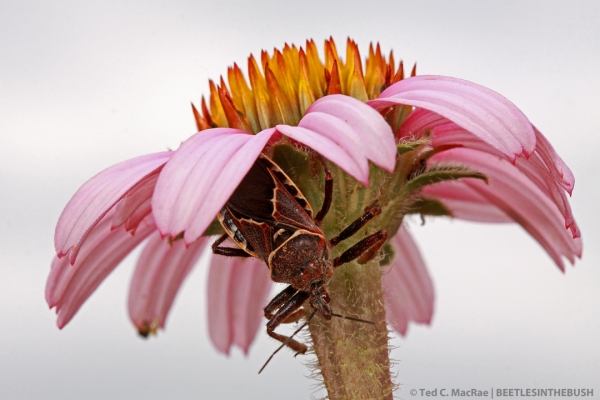
Bee assassin (Apiomerus spissipes) on coneflower (Echinacea sp.) | Gloss Mountain State Park, Major Co., Oklahoma

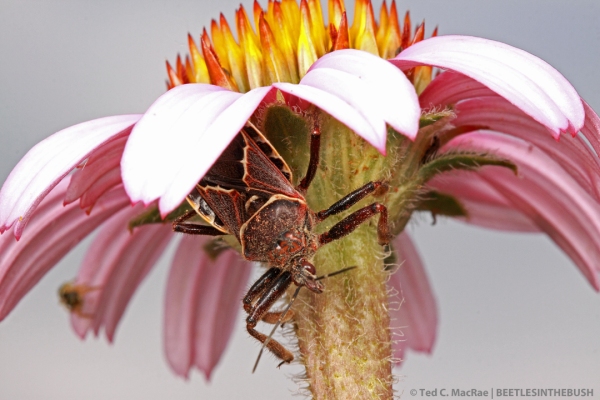
Apiomerus spissipes? on coneflower (Echinacea sp.) | Gloss Mountain State Park, Major Co., Oklahoma

While looking for longhorned beetles on prickly pear cactus (Opuntia macrorhiza) at Gloss Mountains State Park, I saw a coneflower that didn’t look quite right—there was nothing on the top, but there seemed to be something on the underside. I knelt down cautiously and peered underneath the blossom to find this bee assassin (family Reduviidae, genus Apiomerus) lurking under the petals. As a collector with eyes always looking for signs of insects, I’ve trained myself to look for both the obvious and the non-obvious, yet  this brightly colored insect still almost completely escaped my notice. I can imagine that a bee with little room in its mind for anything but collecting pollen would be easy pickings for such a stealthy predator.

Apiomerus spissipes

The coloration of this individual seems to best match specimens representing the species Apiomerus spissipes, which ranges broadly and abundantly across the Great Plains (Berniker et al. 2011). The location of Gloss Mountain State Park in western Oklahoma places it almost smack in the middle of the recorded distribution for this species, which is largely replaced further east by the closely related but generally darker A. crassipes. Interestingly, very few Oklahoma specimens were available for examination by Berniker and colleagues during their study, a fact that once again demonstrates the need for continued collecting in even “well-collected” states like Oklahoma.

REFERENCE:

Berniker, l., S. Szerlip, D. Forero & C. Weirauch. 2011. Revision of the crassipes and pictipes species groups of Apiomerus Hahn (Hemiptera: Reduviidae: Harpactorinae). Zootaxa 2949:1–113.

Copyright © Ted C. MacRae 2013

Group mimicry in Cerambycidae… and more

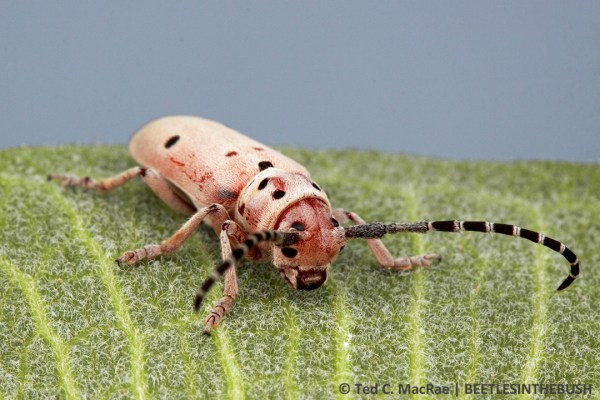
During last year’s extended visit to Argentina, I had the chance to spend the early part of April in the northern province of Chaco. Though much of this hot, arid plain has been converted to agriculture, remnants of thorn forest remain along fence rows and in small patches of Chaco Forest. Despite the decidedly tropical latitude of the region, however, the profuse bloom of Chilean goldenrod, Solidago chilensis, along these fence rows during the Argentine autumn is reminiscent of crisp fall days here in the eastern U.S., and like the goldenrod here the ubiquitous stands of yellow blossoms stretching across the Chaco Plain are equally attractive to a multitude of insects. Among those insects are the Cerambycidae, or longhorned beetles, and while the eastern U.S. cerambycid fauna of goldenrod boasts only a few (albeit spectacular) species in the genus Megacyllene, the Argentine cerambycid fauna that I found on these flowers included at least three species in various genera belonging to two different tribes.

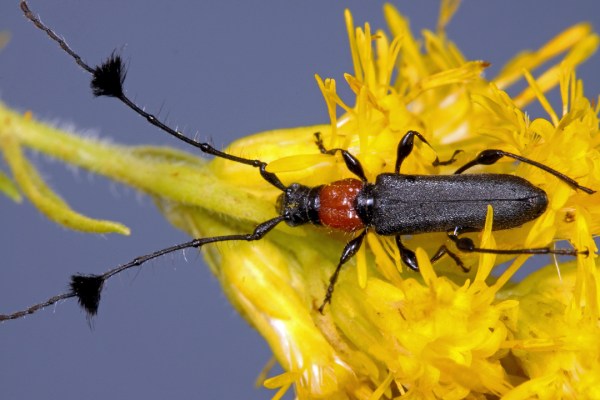
Rhopalophora collaris (Germar 1824) | Chaco Province, Argentina

Rhopalophora collaris (Germar 1824) | Chaco Province, Argentina

Two of the species I saw are shown here, and their similarity of appearance is no coincidence, as both belong to the tribe Rhopalophorini (coming from the Greek words rhopalon = club and phero = to bear, in reference to the distinctly clavate, or club-shaped, legs exhibited by nearly all members of the tribe). In fact, a great many species in this tribe exhibit the same general facies—slender in form and black in coloration with the head and/or pronotum red to some degree. Since all of these species are diurnal (active during the day) and frequently found on flowers, one can assume that the members of this tribe represent an example of what Linsley (1959) called ‘group mimicry.’ In this simple form of Batesian mimicry (harmless mimic with protected model), a group of related species within a genus or even a tribe have a general but nonspecific resemblance to those of some other group of insects—in this case presumably small, flower-visiting wasps. Although the tribe is largely Neotropical, the nominate genus Rhopalophora does extend northward with one eastern U.S. representative, R. longipes. Among the numerous species occurring in South America, the individuals I saw in Argentina can be placed as R. collaris due to the relative lengths of their antennal segments and uniquely shaped pronotum (Napp 2009).

Cosmisoma brullei (Mulsant 1863) | Chaco Province, Argentina

Cosmisoma brullei (Mulsant 1863) | Chaco Province, Argentina

The second species could easily be mistaken for another species of Rhopalophora were it not for the distinct tufts of hair surrounding the middle of the antennae. These tufts immediately identify the beetle as a member of the large, strictly Neotropical genus Cosmisoma (derived from the Greek words kosmos = ornament and soma = body, a direct reference to the tufts adorning the antennae of all members of this genus). Three species of the largely Brazilian genus are known from Argentina, with the black and red coloration of this individual easily identifying it as C. brullei (Bezark 2o13). In the years since this genus was described, additional related genera have been described that bear remarkably similar tufts of hair not on the antennae, but on the elongated hind legs. The great, 19th century naturalist Henry Walter Bates “tried in vain to discover the use of these curious brush-like decorations” (Bates 1863), and nearly a century later Linsley (1959) conceded that their function still remained unknown. Antennal tufts are actually quite common in Cerambycidae, especially in Australia, and while experimental evidence continues (to my knowledge) to be completely lacking, Belt (2004) records observing “Coremia hirtipes” (a synonym of C. plumipes) flourishing its leg tufts in the air (presumably in a manner similar to waving of antennae) and, thus, giving the impression of two black flies hovering above the branch on which the beetle was sitting. This seems also to suggest a function in defense, with the tufts perhaps serving as a distraction to potential predators in much the same way that many butterflies have bright spots near the tail to draw the predator’s attention away from the head.

REFERENCES:

Bates, H. W. 1863. The Naturalist on the River Amazons. Murray, London, 2 vols.

Belt, T. 2004. The Naturalist in Nicaragua. Project Guttenberg eBook.

Bezark, L. G. 2009. A Photographic Catalogue of the Cerambycidae of the World. Available at http://plant.cdfa.ca.gov/byciddb/

Linsley, E. G. 1959. Ecology of Cerambycidae. Annual Review of Entomology 4:99–138.

Napp, D. S. 2009. Revisão das espécies sul-americanas de Rhopalophora (Coleoptera: Cerambycidae). Zoologia (Curitiba) 26(2):343–356.

Copyright © Ted C. MacRae 2013

The “silky-bellied humpbacked” ant

Last year during my extended work stay in Argentina, I was able to slip away from my duties during the first week of April and spend some time in the city of Corrientes in the northeastern part of the country. The city is one of my favorites in Argentina, but what I love most about it is its convenience as a base camp for exploring some of the habitats in the Grand Chaco ecoregion of northern Argentina. One day I had a chance to visit Chaco National Park about 100 km northwest of the city, site of some of the last remnants of the great quebracho forests that once covered much of northern Argentina. The forest preserved at Chaco NP takes its name from the quebracho colorado chaqueño (Schinopsis balansae) trees that dominate it, standing in defiant contrast to the vast, hot sea of cotton fields and mesquite fence-rows that surrounds it. While hiking a trail through the heart of the forest, I looked down to see a most impressive ant crawling across the forest floor:

Camponotus sericeiventris

Camponotus sericeiventris | Chaco National Park, Argentina

Because of its black color and the striking, silky sheen of the abdomen, I was immediately reminded of the Camponotus mus ants that I had photographed a year earlier further south in Buenos Aires. However, this fellow (er, fella…) was considerably larger than that species, and looking at the photographs later I was also struck by the acute spines at the humeral angles of the pronotum (in C. mus the humeral angles were obtuse) and the flattened legs. All of this combined to make it one of the most handsome ants that I had ever seen! I posted the above photo on my Facebook page asking for ID help, and James Trager quickly responded that the ant represents Camponotus sericeiventris, which translates roughly to “silky-bellied humpbacked” ant. Now there’s a common name I can get behind.

Camponotus sericeiventris

Of course, it turns out that I could have easily determined the species on my own using the characters I had already noted—primarily the acute spines. Googling “camponotus acute spines” retrieves as its first result a paper by Wheeler (1931) that discusses this ant and a newly discovered (at the time) cerambycid beetle, Eplophorus velutinus [now Euderces velutinus] mimicking the ant (Fisher 1931). As soon as I read Wheeler’s first paragraph I knew I had the right species:

Camponotus (Myrmepomis) sericeiventris, owing to its size, wide distribution and dense covering of silver or golden pubescence, is one of the handsomest and most conspicuous ants of the American tropics.

Apparently this ant is a popular choice of models for mimics in a number of insect groups. Lenko (1964) reported another cerambycid beetle, Pertyia sericea, as a mimic of C. sericieventris (the similarity of species epithets being no coincidence), and friend and colleague Henry Hespenheide has not only described a zygopine weevil, Copturus paschalis, from Costa Rica as a mimic of this ant (Hespenheide 1984) but also postulated mimicry by Apilocera cleriformis [now Euderces cleriformis] and three other species of Cerambycidae collected by him in central Panama. Henry further noted mimics in the families Cleridae and Mutillidae and the fact that all of the beetle mimics of this arboreally foraging ant are themselves woodborers or predators of woodborers as larvae.

It is interesting that Fisher (1931), in his description of E. velutinus, made no mention of the mimicry, while Wheeler (1931) in his paper about C. sericeiventris discussed this in great detail. He further noted the diversity of cerambycids here in our North American fauna that mimic ants. These include species in the genera Clytoleptus, Euderces, Cyrtophorus, Tilloclytus and—most strikingly—Cyrtinus pygmaeus, our smallest species of Cerambycidae which occurs on dead wood among small ants such as Lasius americanus, and Michthisoma heterodoxum which resembles small Camponotus pennsylvanicus workers. I’ve not yet encountered M. heterodoxum, which seems restricted to the southeastern Coastal Plain, but I have beaten C. pygmaeus from dead branches and can personally attest to the effectiveness of their mimicry—some slight something about the way they moved made me question my immediate assumption that they were ants and caused me to take a closer look at them before I shook them off the beating sheet. I wonder how many times before that I collected this species without realizing it!

REFERENCE:

Fisher, W. S. 1931. A new ant-like cerambycid beetle from Honduras. Psyche 38:99–101.

Hespenheide, H. A. 1984. New Neotropical species of putative ant-mimicking weevils (Coleoptera: Curculionidae: Zygopinae). The Coleopterists Bulletin 38(4):313–321.

Lenko, K. 1964. Sobre o mimetismo do cerambicideo Pertyia sericea (Perty, 1830) com Camponotus sericeiventris (Guerin, 1830). Papéis Avulsos de Zoologia (São Paulo) 16:89–93.

Wheeler, W. M. 1931. The ant Camponotus (Myrmepomis) sericeiventris Guérin and its mimic. Psyche 38:86–98.

Copyright © Ted C. MacRae 2013
Featured Guest Photo: A Spectacular Case of Mimicry

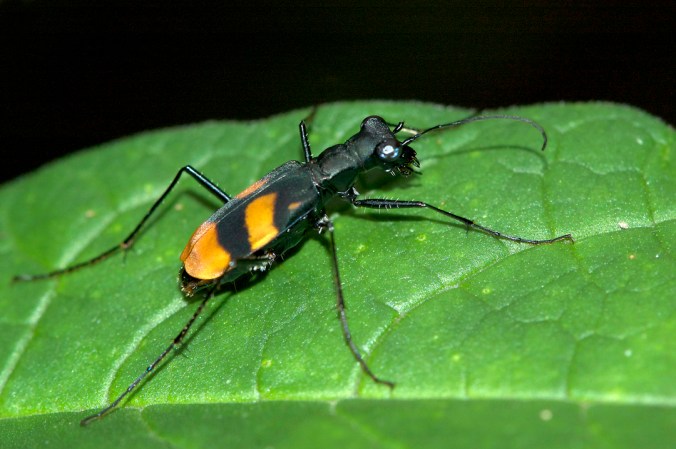
On occasion I receive photos from readers that are so remarkable I simply must share them (with the owner’s permission, of course). Recently I received a note from Len de Beer in Maputo, Mozambique, who was looking for help identifying a tiger beetle he had photographed on the beaches of the Maputo elephant reserve. My knowledge of Afrotropical tiger beetles is rudimentary, so I had to tap the expertise of fellow cicindelophile Dave Brzoska for the ID (many thanks, Dave), but in the ensuing correspondence Len sent me the following photograph that he took of another tiger beetle species while living in Madagascar:

The mimic: Peridexia hilaris

The mimic: Peridexia hilaris | Anzojorobe, Madagascar (photo © Len de Beer) 

A spectacular species to be sure, but the story behind its appearance is even more remarkable. This tiger beetle is one of two species in the Madagascan-endemic genus Peridexia, both of which exhibit color patterns that are a near-perfect match for that of the local pompilid wasp, Pogonius venustipennis (see photo below). According to Pearson & Vogler (2001), not only do these tiger beetles share the wasp’s bright yellow and black color pattern, but they also run in constant small circles (rather than the distinct, straight-line sprints that are more typical of tiger beetles) and fly readily when frightened, only to land again on the forest floor. These running and flying behaviors more closely resemble the foraging movements of the wasp than the movements of a typical tiger beetle, resulting in mimicry so effective that even tiger beetle collectors have been fooled and stung on the fingers when they attempted to collect their first Peridexia!

The model: Pogonius venustipennis

The model: Pogonius venustipennis (photo © Len de Beer)

Camouflage is the most widely observed predator avoidance mechanism in tiger beetles, with numerous species known whose color patterns closely resemble or otherwise allow them to blend in with the color and texture of the soils found in their preferred habitats. Nevertheless, mimicry is common enough (although anecdotal evidence still far outweighs true experimental evidence). Pearson & Volgler (2001) list examples of tiger beetles resembling mutillid wasps (commonly called “velvet ants”) from North and South America, as well as India, and also mention a South American tiger beetle species, Ctenostoma regium, that is the same size and shape as Paraponera clavata (or “bullet ant”), a large solitary species that is purported to pack the most painful of all insect stings (that this is true, I am inclined to agree). Tiger beetles can also serve as models—there is a katydid in Borneo whose immatures bear a remarkable resemblance to arboreal species of tiger beetles in the genus Tricondyla (Pearson & Vogler 2001, Plates 26 and 27). It has also been suggested that mimicry in tiger beetles might not be restricted to Batesian associations (unprotected mimic and harmful model) but may also include Müllerian associations (both model and mimic are distasteful or harmful).

My sincere thanks to Len de Beer for allowing me to post his photographs of this remarkable tiger beetle and the wasp it mimics.

REFERENCE:

Pearson, D. L. & A. P. Vogler.  2001. Tiger Beetles: The Evolution, Ecology, and Diversity of the Cicindelids.  Cornell University Press, Ithaca, New York, xiii + 333 pp.

Copyright © Ted C. MacRae 2013 (text)

Araneus marmoreus encore

Araneus marmoreus adult female—ventral view showing epigyne.

Here is the full-sized photo from which the crop shown in Super Crop Challenge #14 was taken. The small finger-like structure in the upper right of the photo—the object of the challenge—is the epigyne (or epigynum) of Araneus marmoreus (marbled orb weaver spider). Spiders have a rather unusual mating strategy—rather than possessing genitalia that couple for insemination, male spiders first form a packet of sperm (spermatophore) and transfer the packet to an enlarged segment (tarsus) at the end of their pedipalps. During mating, the male inserts the tarsus into the female genital opening, thereby effecting sperm transfer. The female genital opening and associated structures, located on the underside near the front of the abdomen, are called the epigyne and function to direct the male pedipalps during sperm transfer. The shape of the epigyne varies greatly and uniquely among species—probably serving as an isolating mechanism that prevents interspecific mating and also providing a good diagnostic character for species recognition among even very closely related species (similarly to the hardened male genitalia of many insect groups). An even closer view of the epigyne of A. marmoreus can be seen in this BugGuide photo.

Araneus marmoreus (marbled orb weaver) | Washington Co., Missouri

This is actually the second time I’ve featured A. marmoreus in a quiz—the intricate pattern of the dorsal abdomen being the subject of Super Crop Challenge #2. Folks had an easier time identifying the critter in that challenge than this one, which I guess is not surprising since people tend to know animals more by their color patterns than the structures of their genitalic openings. As in that first challenge, I encountered this adult female during a hike along the Ozark Trail, this time in Washington County in east-central Missouri. Unlike before, however, I found this spider crawling on a fallen log in the dark forest floor rather than resting in her web. The colors of this species are diverse and spectacular—a recipe that makes them almost irresistible to insect macrophotographers. That this is true is demonstrated by the 360! photos of this species posted to BugGuide.

Hot orange and yellows glow against the dark, moist wood of a fallen tree trunk.

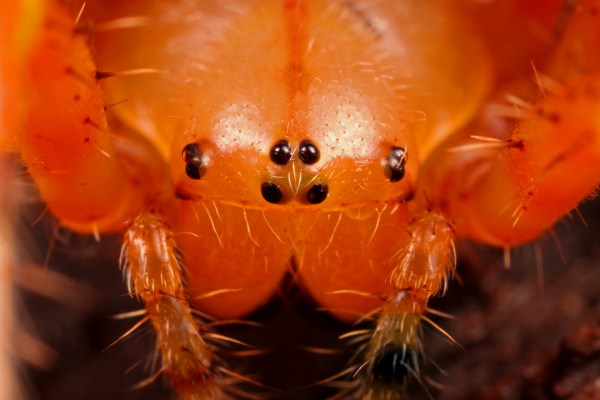
While my previous photos of this species were colorful, these simply glow due to the more orange coloration of this individual and its contrast with the darkened color of the moist wood. It’s a November color scheme if there ever was one—appropriate since I took them exactly one year ago today on November 23, 2011. She was a lot more cooperative than the first subject, and because of this and the stable substrate on which she was sitting I was able to get my favorite shot of all—the face portrait! Not quite as endearing as a jumping spider face (with its large, anthropomorphic median eyes), but striking nevertheless.

The obligatory BitB face shot!

A word about the challenges—I’m not sure if the lack of response to this one is an indication of difficulty or further evidence of declining relevance of blogs as an interactive social medium. I can’t help but notice that blog commenting in general has dropped with the rise of more functionally interactive media such as Twitter and Google+. What do you think—was this challenge too hard, or has the concept of challenge posts lost its appeal?

Copyright © Ted C. MacRae 2012

Gulf Fritillary in southern Missouri

Gulf Fritillary (Agraulis vanillae) | Mississippi Co., Missouri

I’m not sure, but I think this might be the first time I’ve photographed a butterfly caterpillar. Not a bad subject to start with, as few butterflies have caterpillars that are more colorful than the Gulf Fritillary, Agraulis vanillae. A common resident in the southern states and further south, this member of the nymphalid subfamily Heliconiinae is less commonly encountered in Missouri—in fact, I had never seen (or at least noticed) these caterpillars before encountering a few feeding hungrily on the foliage of maypop (Passiflora incarnata) growing in a city park in Missouri’s southeastern lowlands. While the stunning colors of these caterpillars are a delight to human eyes, their function, as in most butterfly caterpillars, is to advertise the unpalatability of their toxin-laced bodies. In the case of this species, the toxins include cyanogenic glycosides that the larvae sequester from the tissues of their host plants (ironically these compounds are supposed to serve the same protective function for the plant that produces them, but butterflies have become master specialists at evolving mechanisms to sidestep toxic impacts).

According to my friends Richard & Joan Heitzman, long-time students of Missouri Lepidoptera, this species is a sporadic migrant that occasionally forms summer colonies in Missouri, especially in the western half of the state, until the first hard freeze destroys the colony (Heitzman & Heitzman 1987).

REFERENCE:

Heitzman, J. R. & J. E. Heitzman. 1987. Butterflies and Moths of Missouri. Missouri Department of Conservation, Jefferson City, 385 pp.

Copyright © Ted C. MacRae 2012