Brazil Bugs #8 – Desafio de identificação #4

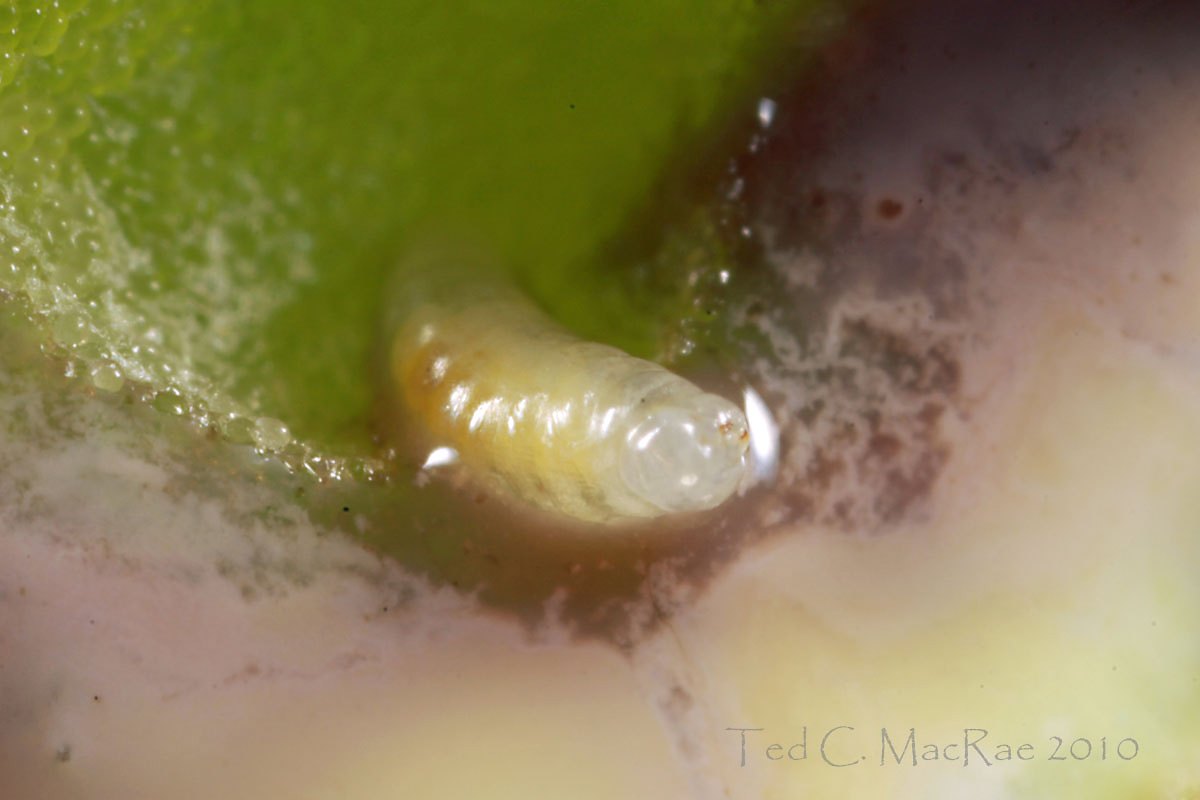
It’s time for a new ID Challenge, this one from my recent trip to Brazil.  I don’t expect this to be a terribly difficult challenge, so whoever wins is going to do so by gaining bonus points for providing detail about what is shown here in addition to correct taxonomic assignments.

See ID Challenge #2 for a detailed explanation of the rules

Copyright © Ted C. MacRae

ID Challenge #2

Here is another straight-up ID Challenge. Standard rules apply:

  • Points awarded for correctly naming the order, family, genus, and species (2 pts each).
  • Bonus points may be given (at my discretion) for providing additional relevant information (e.g., diagnostic characters, biological/ecological uniquities, clever jokes, etc.).¹
  • Comments will be moderated during the 1- to 2-day open challenge period to allow all a chance to participate (you don’t have to be first to win!).
  • Submitted answers will be posted at the end of the challenge period along with the number of points earned.

¹ Don’t ignore the opportunity for bonus points – they often determine the winner in these challenges!

Good luck!

Copyright © Ted C. MacRae 2011

North America’s largest stag beetle


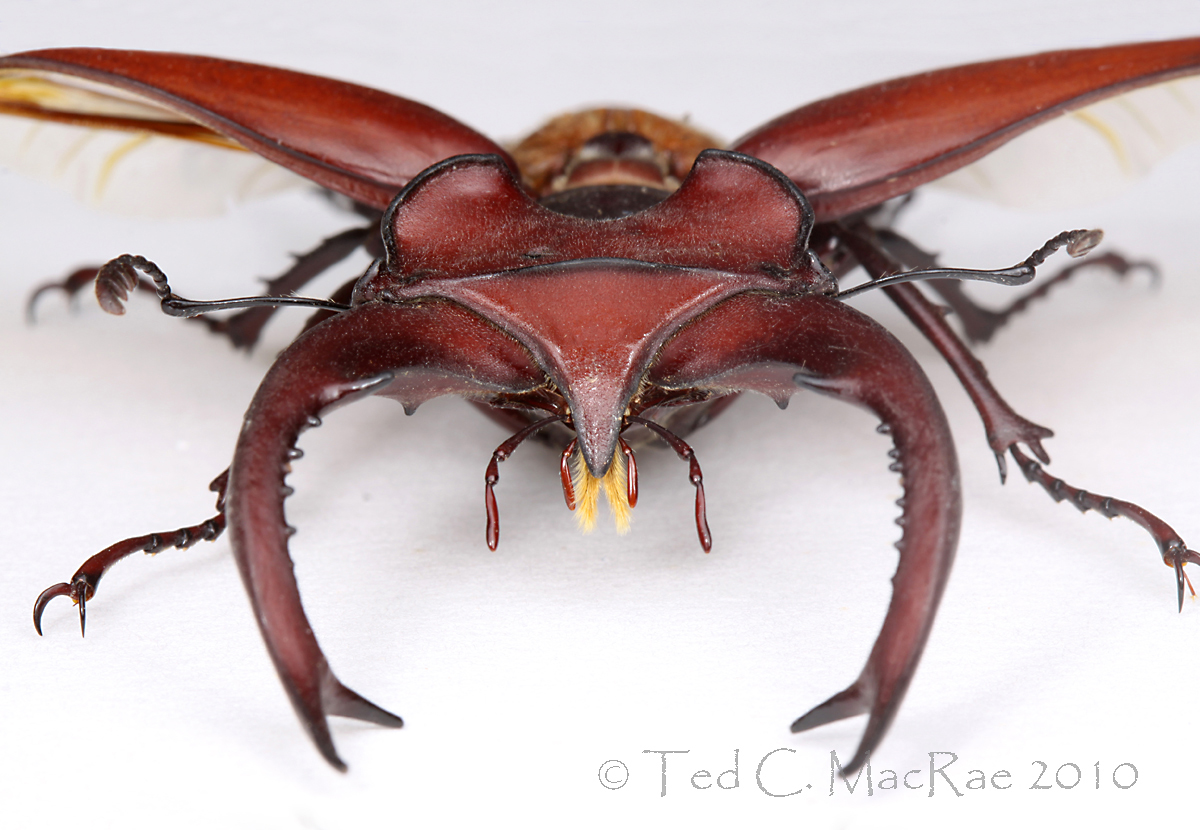
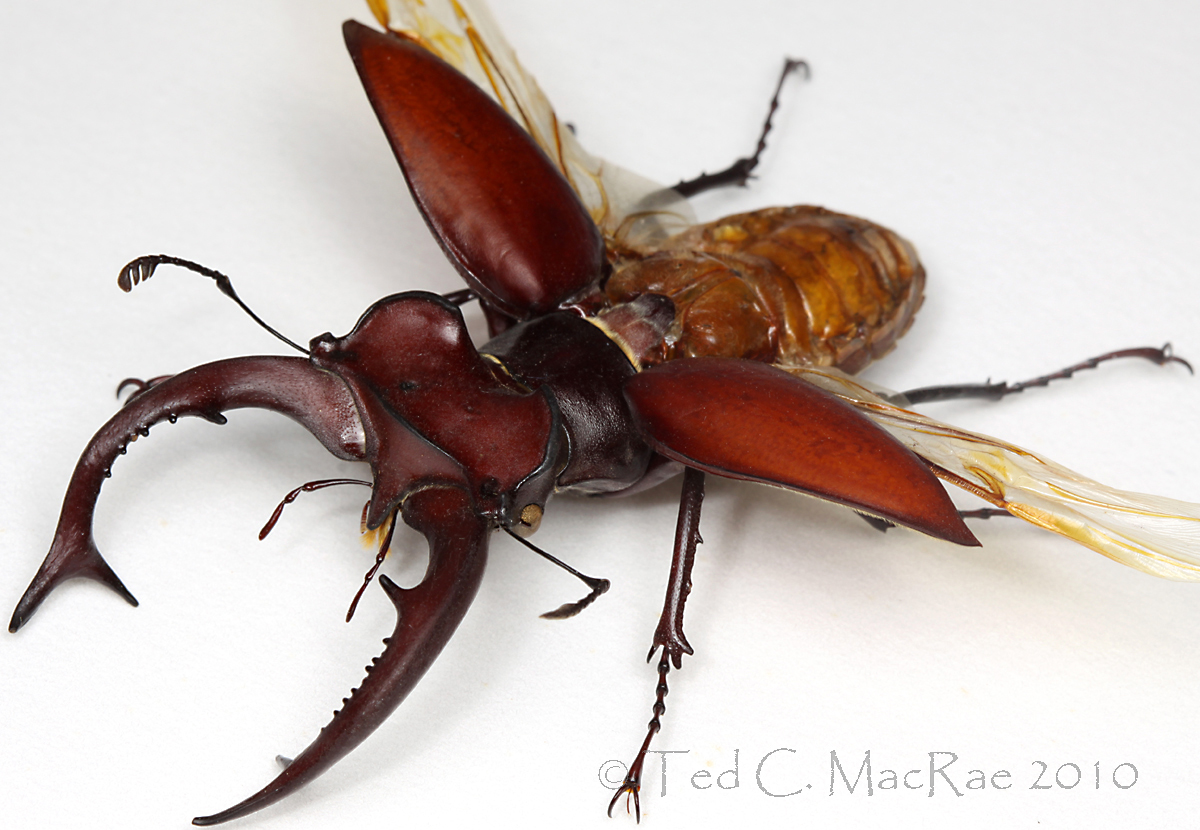
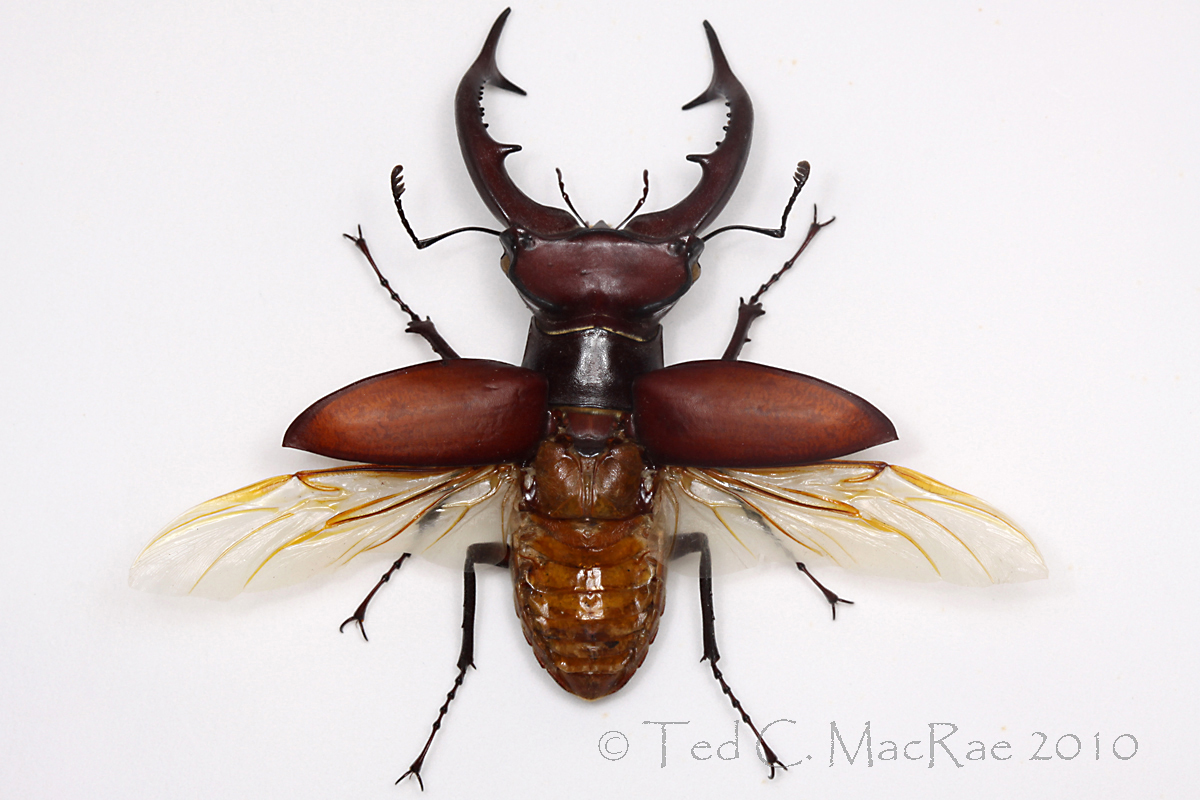
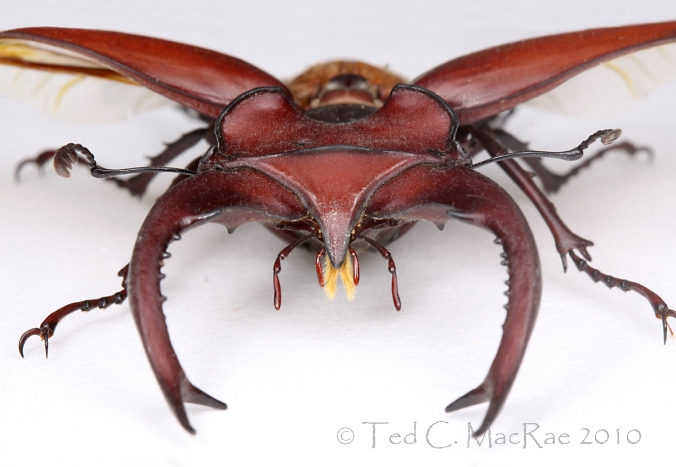
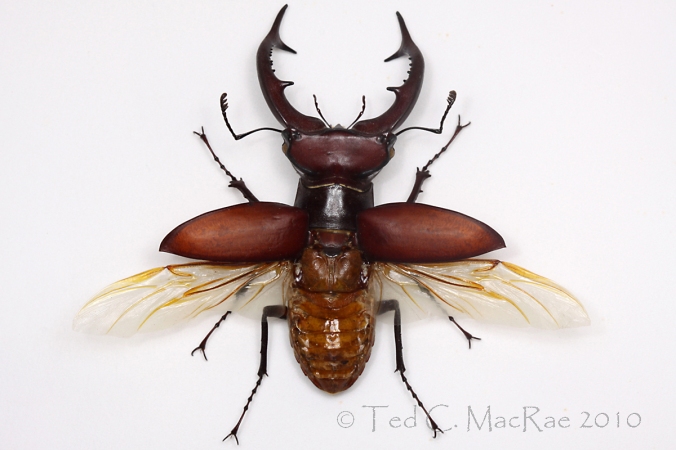
Here is the full-sized photo that provided the image for yesterday’s Super Crop Challenge #3.  The insect in the photo is, of course, a fine example of a male Lucanus elaphus – the giant stag beetle (family Lucanidae).  This striking insect is easily among North America’s most distinctive and recognizable species by virtue of the enormously super-sized mandibles sported by the males.  Its fearsome appearance belies the true nature of this harmless beetle, which spends its days feeding on sap that flows from wounds on the trunks and roots of trees.  Males use their massive mandibles in combat with other males, not for “biting,” but rather as tools to pry and lift their adversaries before dropping them to the ground.  Some marvelous photos of this behavior in a related European species can be seen at Stag Beetles Lucanus cervus Mating Behaviour.
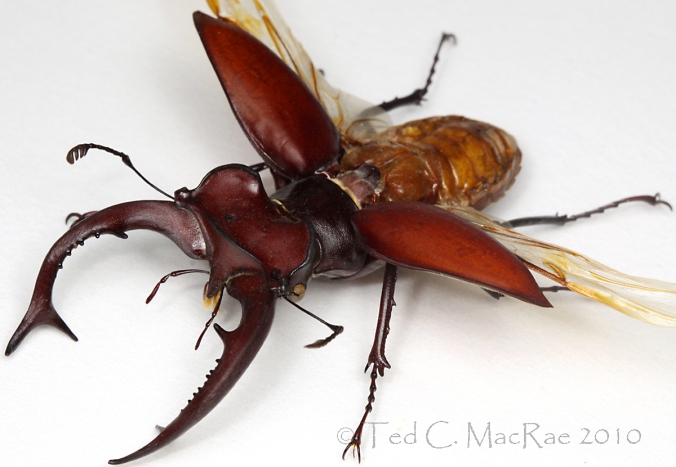
I collected this specimen many years ago at an ultraviolet light (“blacklight”) that I had setup in the pine/oak forests at Pinewoods Lake, Carter Co., in the southeastern Ozarks – one of my favorite 1980’s beetle collecting spots.  This was in my early days of studying beetles, during which time I was actively collecting material as part of my statewide surveys for the families Buprestidae (MacRae 1991) and Cerambycidae (MacRae 1994).  Lucanus elaphus is not a commonly encountered species, especially in the western reaches of its distribution here in Missouri, and I’ll never forget my rabid excitement when I encountered this fine major male at my blacklight sheet.  For many years afterward it remained the only individual that I had ever encountered, until a few years ago when I came across a group of two males and one female feeding on a sap flow in a wet bottomland forest along the Mississippi River in the lowlands of southeastern Missouri.  I encountered another male the following year at a nearby location “rafting” on debris in floodwaters from the nearby river, and two weeks later at that same site I picked up several males and females in a fermenting bait trap.¹  Like most “uncommon” species with broad distribution across the eastern U.S., I suspect that its apparent rarity is an artifact due to habits that make it infrequently encountered rather than being truely scarce.

¹ I have used fermenting bait traps to collect a wide variety of beetles, but especially longhorned beetles.  My recipe is based on that described by Champlain and Knull (1932) – bring 12 oz. dark molasses and 12 oz. beer up to 1 gal. with water, mix well and add a packet of dry baker’s yeast to get the fermentation started.  Hang a 1/2-gallon milk jug with big holes cut in the sides in a tree along the edge of a woods and add ~1 quart of fresh liquid.  It generally takes 2-3 days for the liquid to really start fermenting and become attractive, and it will remain so for about another week or so.  Check traps every 2-3 days by pouring the liquid through a kitchen strainer into another container – reuse or replace as necesssary. Place the collected specimens in vials of water to wash off the molasses residues, and either pin immediately afterward or transfer to 70% ethanol for longer term storage.  Some of the more desireable species I’ve collected in this manner, besides L. elaphus, are Plinthocoelium suaveolens, Purpuricenus axillaris, P. humeralis, P. paraxillaris, Stenocorus cylindricollis, S. shaumii, Sarosesthes fulminans, Stenelytrana emarginata [= Leptura emarginata], and S. gigas [= Leptura gigas].

Congratulations to Ben Coulter and Janet Creamer, both of whom correctly identified the species and most of the mouthparts.  Each earned 14 pts and, thus, tied for the win, while JasonC. earned 5 pts. to take the final podium spot.  The pointed structure is the labrum (its shape distinguishing it from other North American species of the genus), and it is flanked on each side by the fuzzy yellow galeae (derived from the maxillae) and the labial palps.  Nobody correctly named the galeae, which seem to be greatly elongated and hairy in stag beetles as a function of their sap feeding behavior.  A portion of the left maxillary palpus can also be seen in the corner of the photograph, but nobody scored those points either.  Brady Richards just missed the podium, but his witty reference to Gene Shalit (if not immediately picked up on by me) earns him an honorable mention.

With points being formally awarded now beginning with the previous competition (ID Challenge #1), I’ll start keeping an overall leaders board, and with wins in both competitions Ben takes a commanding lead in the overalls with 23 pts, followed by Janet Creamer at 14 pts and TGIQ at 8 pts.  I guess I should start thinking of some sort of tangible prize for winners periodically – suggestions welcome.  Stay tuned for another issue of Super Crop Challenge or ID Challenge in the near future.

REFERENCES:

Champlain, A. B. and J. N. Knull.  1932. Fermenting bait traps for trapping Elateridae and Cerambycidae (Coleop.).  Entomological News 43(10):253–257.

MacRae, T. C. 1991. The Buprestidae (Coleoptera) of Missouri.  Insecta Mundi 5(2):101–126.

MacRae, T. C. 1994. Annotated checklist of the longhorned beetles (Coleoptera: Cerambycidae and Disteniidae) known to occur in Missouri. Insecta Mundi 7(4) (1993):223–252.

Copyright © Ted C. MacRae 2010

Super Crop Challenge #3

There are lots of points up for grabs with this one, what with several body parts to name as well as the organism to which they belong needing to be identified.  Rules and points will be awarded roughly as outlined in the inaugural ID Challenge – i.e., points are not mutually exclusive, with comment moderation turned on while the challenge is open to allow all a chance to participate (no advantage to those with trigger fingers).  Points will be awarded for correct taxonomic identifications (order, family, genus, and species – 2 pts each) and for each body part correctly names (2 pts each).  Bonus points may be awarded at my discretion for .

We’ll give this a day or so, depending on how quickly the answers come in…

Copyright © Ted C. MacRae 2010

ID Challenge #1

Okay, this isn’t really the first ID challenge I’ve had on this site, but the first in a series that is formally named such.  I’ll be offering these up occasionally to fill the void left by the suspension of Alex’s Monday Night Mystery series (okay, not really a void – we still have a wealth of serial quizzes to choose from, including Crypsis Challenges by Troy, Monday Mimic by Mike,  by Chris, Genius of the Press by the other Chris, Electron Challenge by macromite, and my own !).  This series will feature classic identification challenges, with points awarded for correctly naming the order, family, genus, and species.  Points are not mutually exclusive – you don’t have to be first, you just have to be correct.  That being the case, I’ll turn on comment moderation during the answer phase so that all have equal opportunity to participate.  I also give bonus points for providing additional diagnostic information, comments on taxonomic status, or even wrong answers if they somehow make me chuckle.  I’ll give this a day or so – starting… right… now.

Update 12/24/10: answer posted here.

Copyright © Ted C. MacRae 2010

Super Crop Challenge #2

Super Crop Challenge #1 appeared not to be too difficult – let’s see if this one is any harder. This is a straight up ID challenge, more points for greater specificity. To narrow things down a bit, the photograph from which this portion was cropped was taken during October in southern Missouri.

Copyright © Ted C. MacRae 2010

Answer to Super Crop Challenge #1

Seemingly correct answers came quickly to yesterday’s inaugural Super Crop Challenge, which featured a curious structure atop a harvestman (class Arachnida, order Opiliones) that I encountered while hiking the lower North Fork Section of the Ozark Trail in extreme southern Missouri. “Seemingly” I say, because even though some points were earned, others remained left on the table – the organism was rightly recognized as a harvestman, and the structure in the photo does indeed contain the ocelli (or eyes).  However, nobody actually named the structure itself (see update below) – the ocularium (ocular or optical tubercle would also have been accepted).  Hey, I’m pedantic and proud!

As near as I can tell, this individual belongs to the genus Leiobunum (family Sclerosomatidae).  Species in this genus are notoriously difficult to identify; however, the super long legs, dark dorsal stripe, pointed abdomen, and very long palps with “knees” that extend dorsally to a level well above the ocularium suggest a male L. vittatum or one of its close relatives (Schulz 2010). Leiobunum vittatum is a common inhabitant of wooded habitats across the eastern U.S.

I took this shot with an MP-E 65mm macro lens at about 2.5X. The short working distance of the lens at this level of magnification makes it difficult to photograph these longer-legged species in lateral profile due to their habit of “waving” their especially elongate 2nd pair of legs in the air as pseudo-antennae – one touch of any part of the camera sends them scampering. I chased this guy back and forth across a downed tree trunk for some time before I finally got lucky when it encountered some prey (note the long structure extending down from the mouth area – I believe it is the antenna of a tiny, nymphal blattodean) and became distracted just long enough for me to close in and fire off a couple of close shots. He was actually closer to the underside of the log, so when I took this photo I was leaning far over the log with the camera almost upside-down!

Okay – Art earns points for being the first to identify it as a harvestman, while Geek snaps rare duplicate ID points for using the order’s scientific name (no complaining – scientific names will always get points on this blog).  Art, Aniruddha, and Geek also get half-points for mentioning (in order of correctness) eye, ocelli (technically more correct, but wrong plurality), and ocellus (yes, only one is visible – did I mention my pedantic tendencies?).  However, I’m going to declare arachnologist and Opiliones specialist Chris as the winner of this round for his impressive display of generic-level identification based on the meagerest of evidence!

Update 11/22, 11:00 a.m. – actually, Chris did name this structure in an email sent to my office address while the comments box was unchecked and, thus, earns a clean sweep of this challenge.

Photo Details: Canon 50D w/ MP-E 65mm 1-5X macro lens (ISO 100, 1/250 sec, f/13), Canon MT-24EX flash w/ Sto-Fen + GFPuffer diffusers. Typical post-processing (levels, minor cropping, unsharp mask).

REFERENCE:

Schulz, J. W. 2010. The Harvestmen of Maryland (accessed 20 November 2010).

Copyright © Ted C. MacRae 2010