Receiving a shipment of insects for identification…

…is like Christmas all over again!

Unopened shipping box

Unopened shipping box

The sight of a newly delivered box sitting outside my office brings on a rush of excitement. The sight of an enormous box is even more exciting. I know what’s inside is gonna be good, but I don’t know how good. Will there be rare species I haven’t seen before? Will there be specimens representing new (and, thus, publishable) state records or host associations? By the same token, the bigger the box, the more nervous I get. Shipping pinned insect specimens can be risky, and the potential for damage to the specimens increases as the size of the shipment increases—it all depends on how well they were packed (and a little bit of luck!). The prominent “Fragile” labeling, detailed description of the contents, and up arrow indicators are all good first signs.

Opened shipping box w/ paperwork

Opened shipping box w/ paperwork

I remain optimistic as I open the shipping box and see foam peanuts filling the box almost, but not completely, to the brim to allow a little bit of shuffle for shock absorption. The specimen boxes are also completely hidden under the top layer of foam peanuts, suggesting there is enough vertical clearance inside. Lastly, paperwork placed inside the shipping box and on top of the cushioning ensures that the shipment can be delivered even if the outer shipping label is damaged or lost.

Inner shipping boxes

Inner shipping boxes

Below the top layer of foam I find two inner shipping boxes. I am a little concerned by the lack of clearance between the inner shipping boxes and the sides of the outer shipping box—ideally there should be a foam-filled gap of at least a couple of inches to allow some lateral shock absorption. I am also concerned that the two inner shipping boxes are not also bound to prevent bumping against each other, although the lack of space between them and the outer shipping box probably makes this point moot.

Opened inner shipping boxes

Opened inner shipping boxes

Inside the inner shipping boxes are very nicely wrapped specimen boxes. I’m not sure the inner wrapping to cushion the specimen boxes from each other accomplishes all that much other than to increase the size of the inner shipping boxes, which in turn decreases the clearance between the inner and outer shipping boxes. I would have rather seen the specimen boxes bound tightly together into a small unit to have additional space between them and the outer shipping box.

Unopened specimen boxes

Unopened specimen boxes

Seven classic insect specimen shipping boxes—the excitement (and nervousness) mounts as I prepare to open them and get my first look at the enclosed specimens.

Opened specimen boxes

Opened specimen boxes

A fine selection of gorgeous jewel beetles—mostly from Colorado but with a good number of specimens collected from countries around the world. But uh-oh, no inner false lids! A false lid rests directly on top of the pins of the specimens inside and is held in place by cushioning between the false and true lids. False lids are essential in shipments of any size to keep the pinned specimens, especially heavy-bodied ones, from working their way loose from the foam and bouncing around inside the specimen box during shipment. Fortunately, all of the specimens stayed put in most of the specimen boxes, …

Shipping damage

Shipping damage

…but one or two of the really heavy-bodied specimens did work their way loose in a couple of the boxes. As a result, there was some minor damage in the form of broken tarsi and antennae. The damage, however, is not great, and with fine-tipped forceps and a little bit of clear finger nail polish I should be able to effect decent (if not perfect) repairs. To the shipper’s credit, they made extensive use of brace pins on each side of heavier-bodied specimens in all of the boxes—this probably served to keep the damage as minimal as it was.

Although I salivate looking at the specimens—nearly 800 in all, I must set aside my desire to dive right into them and turn my attentions back to a previously received shipment (also numbering in the several hundreds). As soon as I finish that shipment, I’ll start working on this one, but I suspect that while I’m working on it I will receive another shipment that, like this one, competes newly for my attentions.

Copyright © Ted C. MacRae 2014

Pop! goes the beetle

Alaus oculatus (eyed elater) | Beaver Dunes State Park, Oklahoma

Alaus oculatus (eyed elater) | Beaver Dunes State Park, Oklahoma

Last June while collecting beetles from cottonwood trees at Beaver Dunes State Park, Oklahoma, I came across one of my favorite beetles—Alaus oculatus, or eyed elater (family Elateridae, or click beetles). Large by click beetle standards, the most striking feature of eyed elaters is, of course, their false eye spots, which are not eyes at all but patches of pubescence—black surrounded by a narrow ring of white—intended to look like eyes and located prominently on the prothorax rather than the head. A handful of related species are also found in various parts of the U.S., all of which exhibit variations on this same eye spot theme. Undoubtedly these spots serve to frighten would-be predators, much like the false eye spots on the thorax of many lepidopteran caterpillars. The true eyes, of course, are much smaller and are located on the head in front of the “false eyes.” In contrast to the prominently visible eye spots, pubescence on the rest of the body seems to function in cryptic coloration. The mottled patterning blends in with the bark of trees where these beetles usually hang out for effective concealment.

Look into my eye(spot)s!

Look into my eye(spot)s!

If either of those first two lines of defense don’t work, the beetles exhibit “thanatosis” by lying still with legs and antennae appressed to the body to fool the would-be predator into thinking that they are already dead.

A ventral look at the clicking mechanism between the pro- and mesosterna.

Adults exhibit “thanatosis” (play dead)  when disturbed.

Their most remarkable defensive behavior, however, is their ability to snap or “click” their bodies with enough force to free themselves from the grasp of a novice predator (or careless entomologist). The click is produced by a large prosternal spine and mesosternal notch on the beetle’s underside. To click, the beetle arches back its head and pronotum to retract the spine from the notch cavity, the tip of which is then pressed against the edge of the notch. Muscles within the thorax contract, storing elastic energy, and as the flexible hinge between the pro- and mesothoraces moves, the spine slides until its tip passes over the edge of the notch, releasing the elastic energy stored in the thoracic musculature and snapping the spine back into the notch cavity with enough force to produce an audible click.

A large spine on the prosternum fits into a groove on the mesosternum.

A large spine on the prosternum fits into a groove on the mesosternum.

This clicking ability also comes in handy if the beetle frees itself from the grasp of a predator and lands on its back. While the beetle’s legs are too short to right itself, its click is capable of launching the beetle high into the air. By tumbling while in the air, the beetle has a 50% chance of landing on its feet (thus, several attempts may be required). When jumping from a hard surface, the beetle is actually capable of launching itself to a height that is several times its body length and can tumble several times while in the air. This raises an interesting question, since theoretically an elevation of only one body length and half of a body revolution are all that is needed for an upside-down beetle to right itself. The power of the click, thus, grossly exceeds the minimal requirement for righting, yet the beetles seem incapable of moderating the force of the click. Furthermore, the 50% probability of landing suggests that they are also incapable of controlling the orientation of their body during the jump and landing. Did the clicking mechanism initially evolve to combat the grasp of predators and was then co-opted for use in jumping, or was the ability to jump the selective pressure that drove its evolution?

Locked and loaded—the mechanism is primed for the click.

Locked and loaded—the mechanism is primed for the click.

Ribak & Weihs (2011) used biomechanical analyses with Lanelater judaicus to support the idea that the click evolved primarily as a mechanism for vertical jumping. They reason that the excessive vertical distance of the jumps ensures sufficient height when jumping from soft substrates such as foliage or loose soil. A followup study evaluating the effect of natural substrates (Ribak et al. 2012) found that jump height was dramatically reduced (by ~75%) when the beetles jumped from leaves that covered approximately half of the study site and that the reduction in jump height was directly correlated with the amount of work absorbed by the substrate. This provides further evidence that the beetles do not moderate their jumping force and instead simply aim to jump “as high as possible” and rely on random chance for landing back on their feet.

After clicking, the spine returns to its resting position out of the groove.

After clicking, the spine returns to its resting position within the groove.

REFERENCE:

Ribak, G., S. Reingold & D. Weihs. 2012. The effect of natural substrates on jump height in click-beetles. Functional Ecology 26(2):493–499 [abstract].

Ribak, G. & D. Weihs. 2011. Jumping without using legs: The jump of the click-beetles (Elateridae) is morphologically constrained. PLoS ONE 6(6):e20871. doi:10.1371/journal.pone.0020871 [full text].

Copyright © Ted C. MacRae 2014

Beetles by Chuck

A few months before his passing last August, Chuck Bellamy asked me if I was would like to have his photographic slide collection. I was, of course, deeply honored by this request, for in addition to becoming one of the most prolific students ever of jewel beetles, Chuck had for years photographed live adult beetles in the field and major type specimen holdings such as those at The Natural History Museum in London and the Muséum national d’histoire naturelle in Paris. As uncomfortable as it was discussing with him matters related to his impending mortality, I also knew that it was important to him that his slides end up in the hands of someone who would appreciate their great scientific value and, hopefully, make them available to the larger community of jewel beetle enthusiasts. A few weeks after he passed, three large, white, cardboard boxes showed up at my office—each one containing six or seven portfolio box binders with several hundred slides.

Chuck will be honored in an upcoming issue of The Coleopterists Bulletin. In addition to personal remembrances and a suite of papers describing new species of beetles named after him, the issue will feature some of Chuck’s best live adult images scanned from slides in the collection that I received. Choosing the photos was not easy, but I eventually narrowed down to 15 that I thought best represented the taxonomic diversity of jewel beetles, ranked them from most to least favorite, sent scanned images to fellow buprestophile Rick Westcott for him to do likewise, and tallied the combined rankings to determine the final selections. Six of the photos will appear on a plate within the issue, and a seventh will appear on the cover. I won’t spoil the surprise here by revealing what species were selected. Rather, I’ll just whet appetites by posting the photos that were not selected (despite which I think you’ll agree that they are still good photos).

Julodis chevrolati Laporte | Sep 2000, W. Springbok, Schaaprivier, Northern Cape Prov., RSA.

Julodis chevrolati Laporte | Sep 2000, W. Springbok, Schaaprivier, Northern Cape Prov., RSA.

Acmaeodera (s. str.) griffithi Fall | Apr 2001, Mohawk Valley, Yuma Co., Arizona, USA.

Acmaeodera (s. str.) griffithi Fall | Apr 2001, Mohawk Valley, Yuma Co., Arizona, USA.

Polycesta (Arizonica) aruensis Obenberger | Apr 2001, Frink Springs, Imperial Co., California, USA.

Polycesta (Arizonica) aruensis Obenberger | Apr 2001, Frink Springs, Imperial Co., California, USA.

Evides pubiventris  (Laporte & Gory) | Jan 1999, Geelhoutbosch, Northern [Limpopo] Prov., RSA.

Evides pubiventris (Laporte & Gory) | Jan 1999, Geelhoutbosch, Northern [Limpopo] Prov., RSA.

Castiarina klugii (Gory & Laporte) | Australia.

Castiarina klugii (Gory & Laporte) | Australia.

Temognatha chalcodera (Thomson) | Western Australia.

Temognatha chalcodera (Thomson) | Western Australia.

Sphaerobothris (s. str.) platti (Cazier) | 1998,  E. Jacumba, San Diego Co., California, USA.

Sphaerobothris (s. str.) platti (Cazier) | 1998, E. Jacumba, San Diego Co., California, USA.

Dystaxia elegans Fall | 1998, Warner Springs, San Diego Co., California, USA.

Dystaxia elegans Fall | 1998, Warner Springs, San Diego Co., California, USA.

Copyright © Ted C. MacRae 2014, photos by Charles L. Bellamy

Review of North American Chalcophora

The latest issue of The Coleopterists Bulletin arrived in my mailbox recently, and among the several papers of interest to me is a review of the North American species of the jewel beetle genus Chalcophora¹ (family Buprestidae). This genus contains some of the largest jewel beetles in North America and, due to their surface sculpturing and strict association with pine trees, are commonly referred to as “sculptured pine borers.” Four of the five species occur in the eastern U.S. and Canada, while only one, C. angulicollis, is found in the western states and provinces.

¹ I’d be interested to know how people pronounce this name. I’ve always pronounced it “kal-koh-FOR-uh”, but I’ve heard others use “kal-KAW-for-uh” or even “chal-KAW-for-uh.”

The review, authored by Crystal Maier and Mike Ivie at Montana State University, should put to rest a long-standing debate on the validity of the single western species. The four eastern species are distinct and easily distinguished from each other by virtue of color, presence/absence of ridges on the front legs, presence/absence of spines at the elytral apices, and, of course, male genitalia. Chalcophora angulicollis, on the other hand, has drifted in and out of synonymy under C. virginiensis, the most widespread of the four eastern species. The most recent changes in status were Bright (1987), who regarded C. angulicollis a synonym and treated all Canadian populations as C. virginiensis, followed by Nelson et al. (2008), who reinstated the former as a valid species. Neither of these actions were supported by any discussion of characters or detailed justification.

Chalcophora spp. (Maier & Ivie 2013)

Figs. 1–5. Chalcophora species, habitus. 1) C. virginiensis, Arkansas; 2) C. angulicollis, Idaho; 3) C. liberta, Wisconsin; 4) C. georgiana, Florida; 5) C. fortis, New York. Source: Maier & Ivie (2013).

My impression has always been that the two species are distinct, and I have maintained specimens separately in my collection despite Bright’s synonymy. Chalcophora angulicollis always seemed to me a little more cupreous in coloration and a little more robust. I know that these are weak characters, and they can easily be a result of geographical variability within a species. However, considering the wide and nearly complete disjunction between the distributions of these two species across the nearly treeless Great Plains, it seemed to me prudent to consider them distinct until conclusively proven otherwise. I was therefore pleased to find out that my suspicions were correct when I visited Mike Ivie in Bozeman, Montana this past summer and learned of this manuscript in progress. Mike and his graduate student Crystal had found a morphological difference in the mouthparts that consistently distinguished the two species—C. angulicollis with the penultimate maxillary palpomere flattened and relatively shorter, while in C. virginiensis this structure is cylindrical and relatively longer. Correlated with these structural differences in the mouthparts are the relatively wider male genitalia of C. angulicollis (<3.3 times as long as wide, versus >3.9 times as long as wide for C. virginiensis) and its weakly serrate to crenulate posterolateral elytral margin (weakly to strongly serrate in C. virginiensis).

In addition to reevaluating the status of C. angulicollis and C. virginiensis, the paper provides high quality images of the dorsal habitus (see figure above), elytral apices, and male genitalia for all five North American species, a revised key to the species, and an updated distribution map showing locality/state records for the two aforementioned species in the context of forest cover in North America. Type material also was examined for all species, each of which is redescribed and annotated with abbreviated taxonomic synonymy (complete synonymies are available in other recent publications), notes on variation, comparisons with other species, and recorded hosts and distributions.

REFERENCE:

Bright, D. E. 1987. The Metallic Wood-Boring Beetles of Canada and Alaska. Coleóptera. Buprestidae. The Insects and Arachnids of Canada, Part 15. Agriculture Canada Publication 1810, NRC Research Press, Ottawa, 335 pp. [pdf].

Maier, C. A. & M. A. Ivie. 2013. Reevaluation of Chalcophora angulicollis (LeConte) and Chalcophora virginiensis (Drury) with a review and key to the North American species of Chalcophora Dejean (Coleoptera: Buprestidae). The Coleopterists Bulletin 67(4):457–469 [abstract].

Nelson, G. H., G. C. Walters, Jr., R. D. Haines, & C. L. Bellamy.  2008.  A Catalogue and Bibliography of the Buprestoidea of American North of Mexico.  Coleopterists Society Special Publication No. 4, The Coleopterists Society, North Potomac, Maryland, 274 pp. [description].

Copyright © Ted C. MacRae 2014

I’m a fun guy!

The habit of looking at things microscopically as the lichens on the trees & rocks really prevents my seeing aught else in a walk.—Henry David Thoreau

I should have loved an opportunity to go for a walk in the woods with Thoreau—especially during the winter when my preoccupation with insects no longer restrains my fascination with all things natural. While many entomologists see winter as a break from field work—a time to indulge/suffer (depending on mood) the more mundane curatorial tasks associated with their studies, my time in the field continues uninterrupted with long walks in the woods. Hiking stick replaces insect net. Energy foods replace vials. I still pry bark and flip rocks—I cannot completely ignore the potential to find insects. But I also peer through miniature forests of moss, poke about the mushrooms on a fallen log, and squint at the lichens encrusting a rock. Yes, insect specimens collected during the previous summer still need to be pinned, but there is time for that. There will always be time for that—if not now then in my later years when my ability to scramble through the bush begins to wane. For now, the woods sing their siren song, and I must listen.

Trichaptum biforme (purple tooth) on fallen river birch (Betula nigra) | Reynolds Co., Missouri

Trichaptum biforme on fallen trunk of Betula nigra | Reynolds Co., Missouri

Purple tooth (Trichaptum biforme) on dead red maple (Acer rubrum) | Reynolds Co., Missouri

Trichaptum biforme on fallen branch of Acer rubrum | Reynolds Co., Missouri

Multicolored gilled polypore (Lenzites betulina) on river birch (Betula nigra) stump | Reynolds Co., Missouri

Lensites betulina on dead stump of Betula nigra | Reynolds Co., Missouri

"Gills" distinguish this shelf fungus from turkey tails and other similar types.

“Gills” distinguish this shelf fungus from turkey tails and other similar types.

Cladonia chlorophaea or C. pyxidata on chert-trail | Reynolds Co., Missouri

Cladonia sp. (poss. C. chlorophaea or C. pyxidata) on chert-trail | Reynolds Co., Missouri

(Cladonia pyxidata)

A forest in miniature!

Irpex lacteus? on fallen branch of Acer rubrum | Iron Co., Missouri

Irpex lacteus (?) on fallen branch of Acer rubrum | Iron Co., Missouri

Spores are released from the toothy cap underside

Spores are released from the toothy cap underside

Leucobryum glaucum on forest floor | Reynolds Co., Missouri

Leucobryum glaucum on forest floor | Reynolds Co., Missouri

Postscipt: all photos shown taken on 30 November 2013 while hiking a 7-mile stretch of the Ozark Trail (Karkaghne Section in Reynolds Co. and Middle Fork Section in Iron Co.).

Copyright © Ted C. MacRae 2014
Virtual Mantle 2013

One of my favorite customs over the holidays is exchanging Christmas e-cards with my fellow entomologist/natural historian friends and colleagues. On the sending side, I’m especially fond of the “insect-with-Photoshopped-Santa-hat” variety (see 2011’s Santa Jaws and 2012’s Buprestis saintnicholasii), but I broke from the insect part of the theme this year and instead used a lizard to wish everybody a Felizard Navidad! On the receiving side, and in the spirit of my first Virtual Mantle post last year, here are the e-cards that I received for my virtual mantle this year from entomologists as near as neighboring Illinois and as far as Europe and Asia! If you didn’t send me an e-card this year, I hope you’ll consider sending one to me in 2014!

Sam Heads, Illinois Natural History Survey, Champaign

Sam Heads, Illinois Natural History Survey, Champaign

Mark Kalashian,  National Academy of Sciences of Armenia, Yerevan

Mark Kalashian, National Academy of Sciences of Armenia, Yerevan

Denis Keith, Muséum des Sciences Naturelles et de Préhistoire 5bis, Chartres, France

Denis Keith, Muséum des Sciences Naturelles et de Préhistoire 5bis, Chartres, France

Hong Thai Pham, Institute of Ecology and Biological Resources, Hanoi, Vietnam

Hong Thai Pham, Institute of Ecology and Biological Resources, Hanoi, Vietnam

Erico Ruzzier, Mirano, Italy

Erico Ruzzier, Mirano, Italy

Ilja Trojan, South Moravia, Czech Republic

Ilja Trojan, South Moravia, Czech Republic

Eduard Vives, Museo Nacional de Ciencias Naturales, Barcelona,  Spain

Eduard Vives, Museo Nacional de Ciencias Naturales, Barcelona, Spain

Junsuke Yamasako, Ehime University, Tarumi, Matsuyama, Japan

Junsuke Yamasako, Ehime University, Tarumi, Matsuyama, Japan

Copyright © Ted C. MacRae 2013

Hairy milkweed beetle

Across the Great Plains of North America, sand dune fields dot the landscape along rivers flowing east out of the Rocky Mountains. Formed by repeated periods of drought and the action of prevailing south/southwest winds on alluvium exposed by uplifting over the past several million years, many of these dunes boast unique assemblages of plants and animals adapted to their harsh, xeric conditions. Some are no longer active, while others remain active to this day. Among the latter is Beaver Dunes in the panhandle of northwestern Oklahoma.

Beaver Dunes, Oklahoma

Beaver Dunes State Park, Beaver Co., Oklahoma

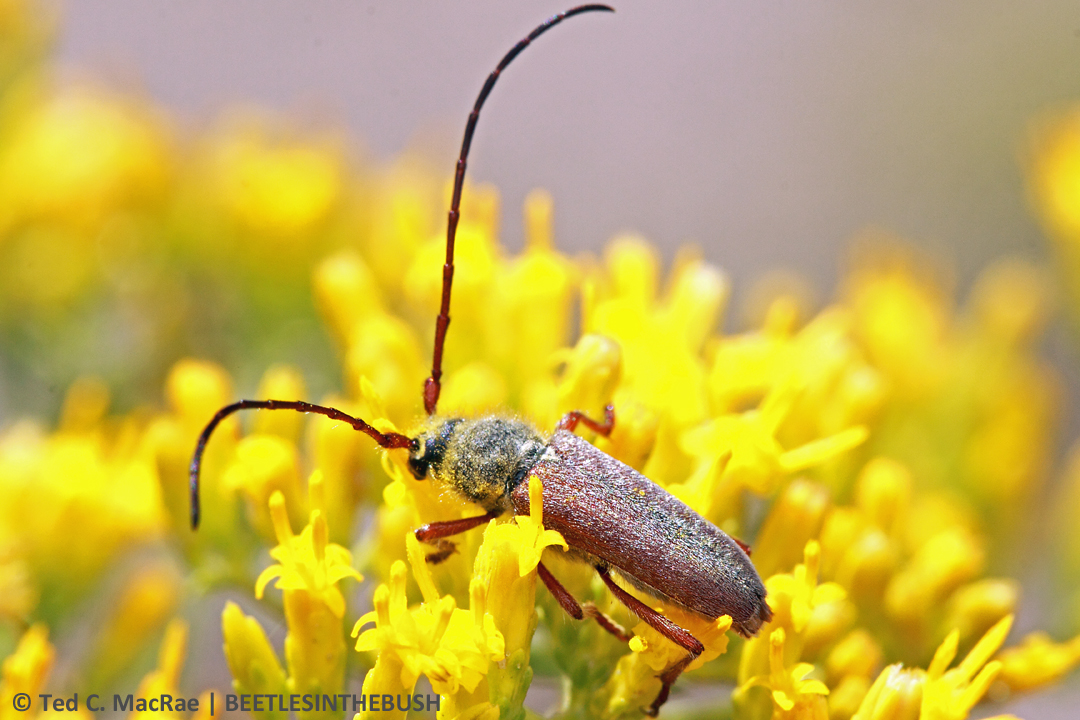
As I explored the more vegetated areas around the perimeter of the dunes, I spotted the characteristically hairy, fleshy, opposite leaves of Ascelpias arenaria. Known also as “sand milkweed,” this plant is associated with sand dunes and other dry sandy soil sites throughout the central and southern Great Plains. I always give milkweeds a second look whenever I encounter them due to the association with them by longhorned beetles in the genus Tetraopes. It wasn’t long before I spotted the black antennae and red head of one of these beetles peering over one of the upper leaves from the other side.

Tetraopes pilosus on Asclepias arenaria

Tetraopes pilosus on Asclepias arenaria | Beaver Dunes State Park, Oklahoma

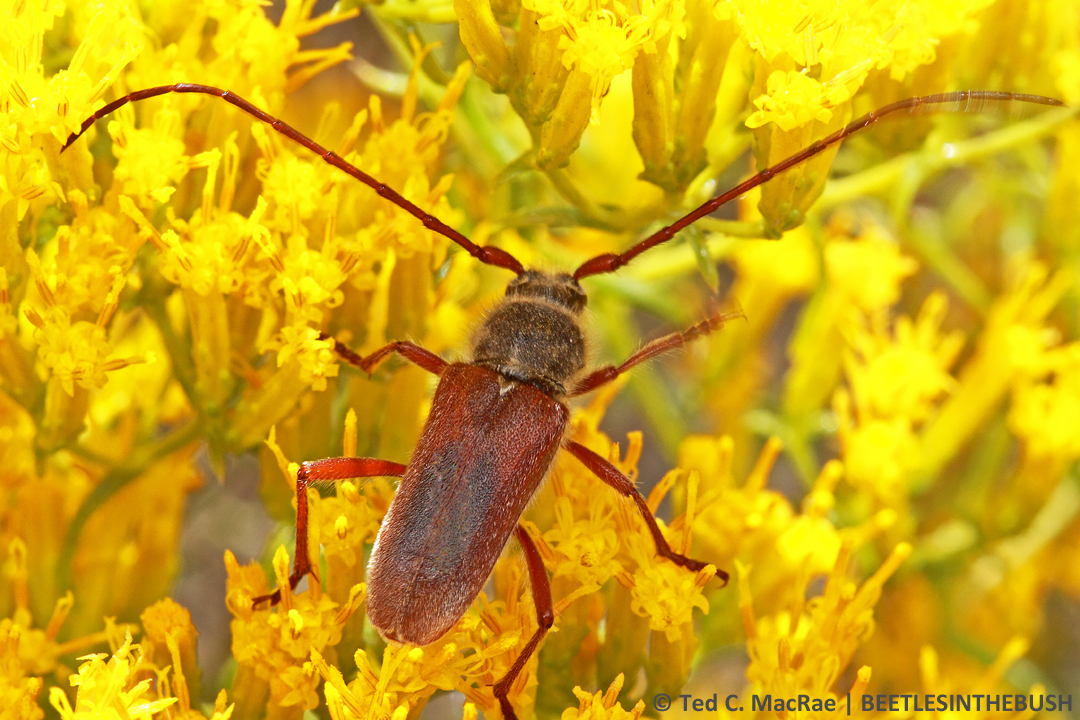
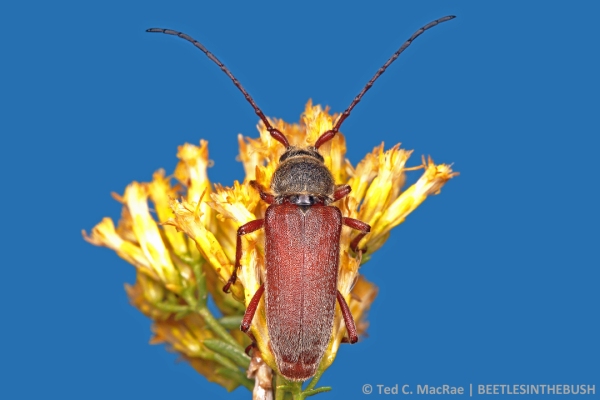
This was no ordinary Tetraopes, however. Its large size, dense covering of white pubescence, and association with sand milkweed told me immediately that this must be T. pilosus (the specific epithet meaning “hairy”). Like its host, this particular milkweed beetle is restricted to Quaternary sandhills in the central and southern Great Plains (Chemsak 1963), and also like its host the dense clothing of white pubescence is presumably an adaptation to prevent moisture loss and overheating in their xeric dune habitats (Farrell & Mitter 1998).

Tetraopes pilosus

Species of Tetraopes have the eyes completely divided by the antennal insertions—thus, “four eyes.”

Tetraopes is a highly specialized lineage distributed from Guatemala to Canada that feed as both larvae and adults exclusively on milkweed (Chemsak 1963). Larval feeding occurs in and around the roots of living plants, a habit exhibited by only a few other genera of Cerambycidae but unique in the subfamily Lamiinae (Linsley 1961). Milkweed plants are protected from most vertebrate and invertebrate herbivores by paralytic toxins, commonly termed cardiac glycosides or cardenolides. However, a few insects, Tetraopes being the most common and diverse, have not only evolved cardenolide insensitivity but also the ability to sequester these toxins for their own defense. Virtually all insects that feed on milkweed and their relatives have evolved aposematic coloration to advertise their unpalatability, and the bright red and black color schemes exhibited by milkweed beetles are no exception.

Species of the genus Tetraopes are characterized by the completely divided eyes.

Adult beetles, like the leaves of their hosts, are clothed in white pubescence.

As  noted by Mittler & Farrel (1998), variation in coloration among the different species of Tetraopes may be correlated with host chemistry. Milkweed species vary in toxicity, with more basal species expressing simpler cardenolides of lower toxicity and derived species possessing more complex and toxic analogs. Most species of Tetraopes are associated with a single species of milkweed, and it has been noted that adults of those affiliated with less toxic milkweeds on average are smaller, have less of their body surface brightly colored, and are quicker to take flight (Chemsak 1963, Farrell & Mitter 1998). Thus, there seems to be a direct correlation between the amount of protection afforded by their host plant and the degree to which the adults advertise their unpalatability and exhibit escape behaviors. Asclepias arenaria and related species are the most derived in the genus and contain the highest concentrations of cardenolides. In fact, they seem to be fed upon only by Tetraopes and monarchs while being generally free from other more oligophagous insect herbivores such as ctenuchine arctiid moths and chrysomelid beetles that feed on less derived species of milkweed (Farrell & Mitter 1998). Accordingly, T. pilosus is among the largest species in the genus and has the majority of its body surface red. Also, consistent with it being more highly protected than others in the genus, I noted virtually no attempted escape behavior as I photographed this lone adult.

Asclepias arenaria

Asclepias arenaria (sand milkweed) growing at the base of a dune.

In addition to metabolic insensitivity to cardenolides, adult Tetraopes also exhibit behavioral adaptations to avoid milkweed defenses (Doussard & Eisner 1987). The milky sap of milkweed is thick with latex that quickly dries to a sticky glue that can incapacitate the mouthparts of chewing insects that feed upon the sap-filled tissues. Adult Tetraopes, however, use their mandibles to cut through the leaf midrib about a quarter of the way back from the tip. This allows much of the sticky latex-filled sap to drain from the more distal tissues, on which the beetle then begins feeding at the tip. Leaves with chewed tips and cut midribs are telltale signs of feeding by adult Tetraopes.

REFERENCES:

Chemsak, J. A. 1963. Taxonomy and bionomics of the genus Tetraopes (Coleoptera: Cerambycidae). University of California Publications in Entomology 30(1):1–90, 9 plates.

Doussard, D. E. & T. Eisner. 1987. Vein-cutting behavior: insect counterploy to the latex defense of plants. Science 237:898–901 [abstract].

Farrell, B. D. & C. Mitter. 1998. The timing of insect/plant diversification: might Tetraopes (Coleoptera: Cerambycidae) and Asclepias (Asclepiadaceae) have co-evolved? Biological Journal of the Linnean Society 63: 553–577 [pdf].

Linsley, E.G. 1961. The Cerambycidae of North America. Part 1. Introduction. University of California Publications in Entomology 18:1–97, 35 plates.

Copyright © Ted C. MacRae 2013

A polypipin’ we will go!

A polypipin’ we will go, a polypipin’ we will go
Heigh ho, the dairy-o, a polypipin’ we will go
A polypipin’ we will go, a polypipin’ we will go
We’ll catch a tiger beetle and put him in a vial
And then we’ll let him go (not!)

Okay, maybe my adaptation of the popular children’s song A Hunting We Will Go isn’t the best, but if you want to collect tiger beetles in the genus Tetracha then you’ve got to try the method that my friend Kent Fothergill has dubbed “polypipin’.”

The author polypipin’ in a soybean field in Starkville, Mississippi, September 2013. Photo by Lisa G. Ruschke.

What exactly is polypipin’? Well, it’s when you look for stuff under polypipe—a big plastic tube with holes in it that some farmers use to irrigate their crops. The tube is laid across one end of their field, and when water is pumped into it the water leaks out of the holes along the length of the tube and runs down the furrows between the rows. This is a popular method of irrigation in the Mississippi Delta because the terrain is flat and the equipment costs are much lower than center pivot irrigation systems. Of course, the tube also provides excellent cover for insects and other small critters that live in and around agricultural fields, and these include tiger beetles in the genus Tetracha.

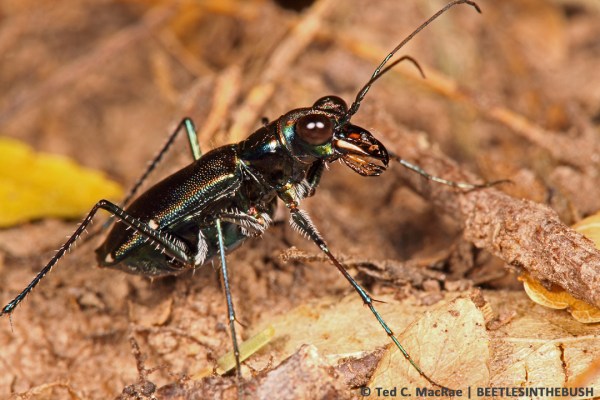
Tetracha carolina under polypipe in a soybean field in Starkville, Mississippi

Tetracha carolina under polypipe in a soybean field in Starkville, Mississippi

I wish I could take the credit, but it was Kent who had the great idea to use polypipin’ as a way to survey for T. carolina (Carolina metallic tiger beetle) in the Mississippi Lowlands (“bootheel”) in southeast Missouri. This is a common species across the southern tier of the United States, but prior to this survey the occurrence of this species in Missouri was not well understood. While a number of specimens had been collected in the bootheel over the years prior to the survey, some regarded Missouri records of the species to be a result of vagrants migrating into the state rather than residents (Pearson et al. 2006). Tiger beetles in the genus Tetracha are nocturnal and take refuge during the day, so they are not often encountered unless one goes at at night with a flashlight. Kent was interested in determining the status of this species in Missouri and had noticed their tendency to take refuge under polypipe—where they could be easily found during the day by simply lifting up the pipe. Rather than give up on sleep, Kent and colleagues surveyed agricultural fields throughout the bootheel by looking under polypipe and demonstrated not only that T. carolina is well established in and a resident of the bootheel, but that it is actually quite abundant and may reside even further north in Missouri than just the bootheel (Fothergill et al. 2011).

Adults are amazingly calm if the polypipe is lifted carefully so as not to disturb them.

Adults are amazingly calm if the polypipe is lifted carefully so as not to disturb them.

I don’t know what it is, but there is just something really fun about polypipin’. Being an agricultural entomologist by day, I have ample opportunity to do a little polypipin’ of my own as I travel across the southern U.S. looking at soybean fields, including this past September when I found myself in fields with polypipe in Arkansas and Mississippi. These photos were taken in Starkville, Mississippi near the Mississippi State University campus, and as has happened in every other case where I’ve looked, I found adults of T. carolina quite abundant underneath the polypipe. Some were found simply resting on the soil surface beneath the pipe, but a great many were observed to have dug burrows under the pipe for added shelter.

Adults often construct burrows underneath the polypipe for additional refuge.

Adults often construct burrows underneath the polypipe for additional refuge.

Polypipin’ works as a survey tool for T. carolina because of that species’ propensity for agricultural fields and other moist, treeless habitats. I’ve not yet found T. virginica (Virginia metallic tiger beetle) under polypipe, but that species is more fond of forested rather than treeless habitats. Perhaps an agricultural field next to forest with polypipe laid on the side adjacent to the forest might produce this species. At any rate, polypipin’ might offer a tool to better define the entire northern distributional limit of T. carolina—all one has to do is look.

REFERENCE:

Fothergill, K., C. B. Cross, K. V. Tindall, T. C. MacRae and C. R. Brown. 2011.Tetracha carolina L. (Coleoptera: Cicindelidae) associated with polypipe irrigation systems in southeastern Missouri agricultural lands. CICINDELA 43(3):45–58 [pdf].

Pearson, D. L., C. B. Knisley & C. J. Kazilek. 2006. A Field Guide to the Tiger Beetles of the United States and Canada. Oxford University Press, New York, 227 pp. [Oxford description].

Copyright © Ted C. MacRae 2013