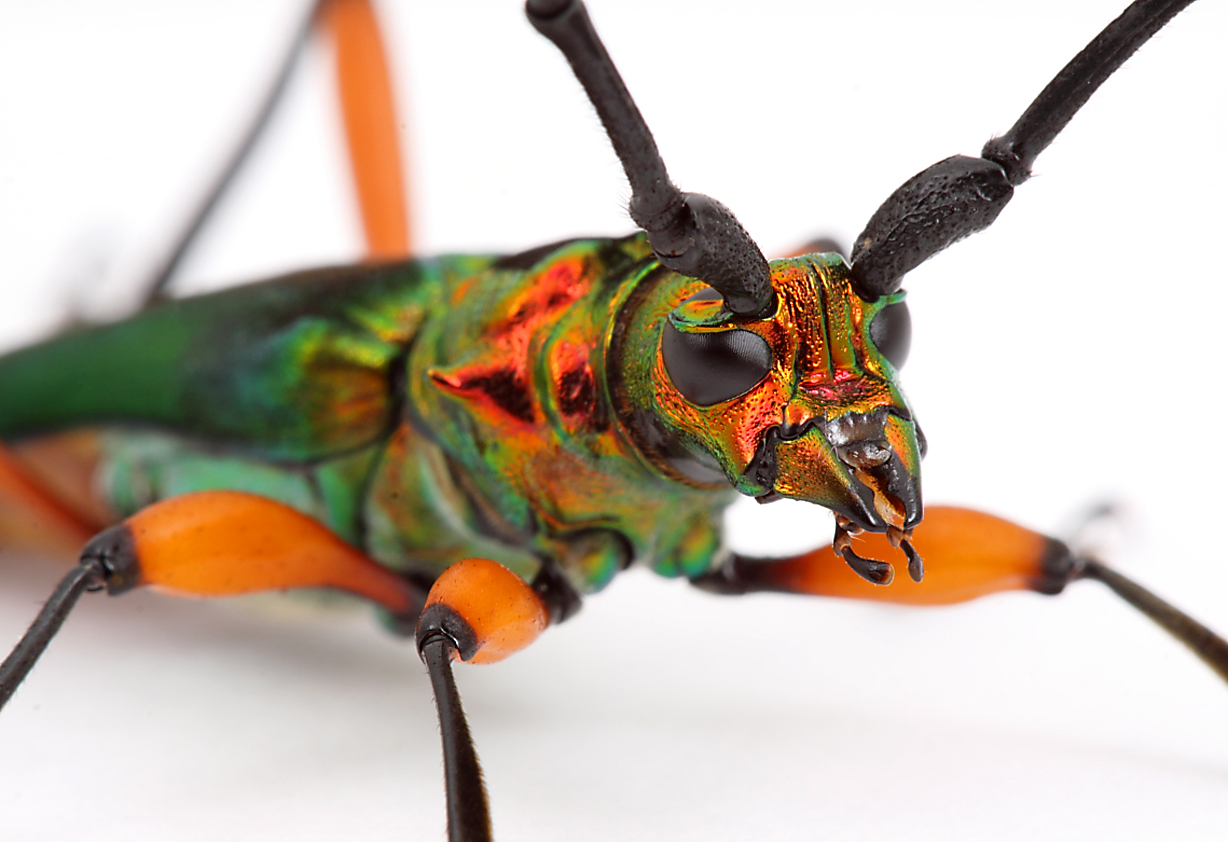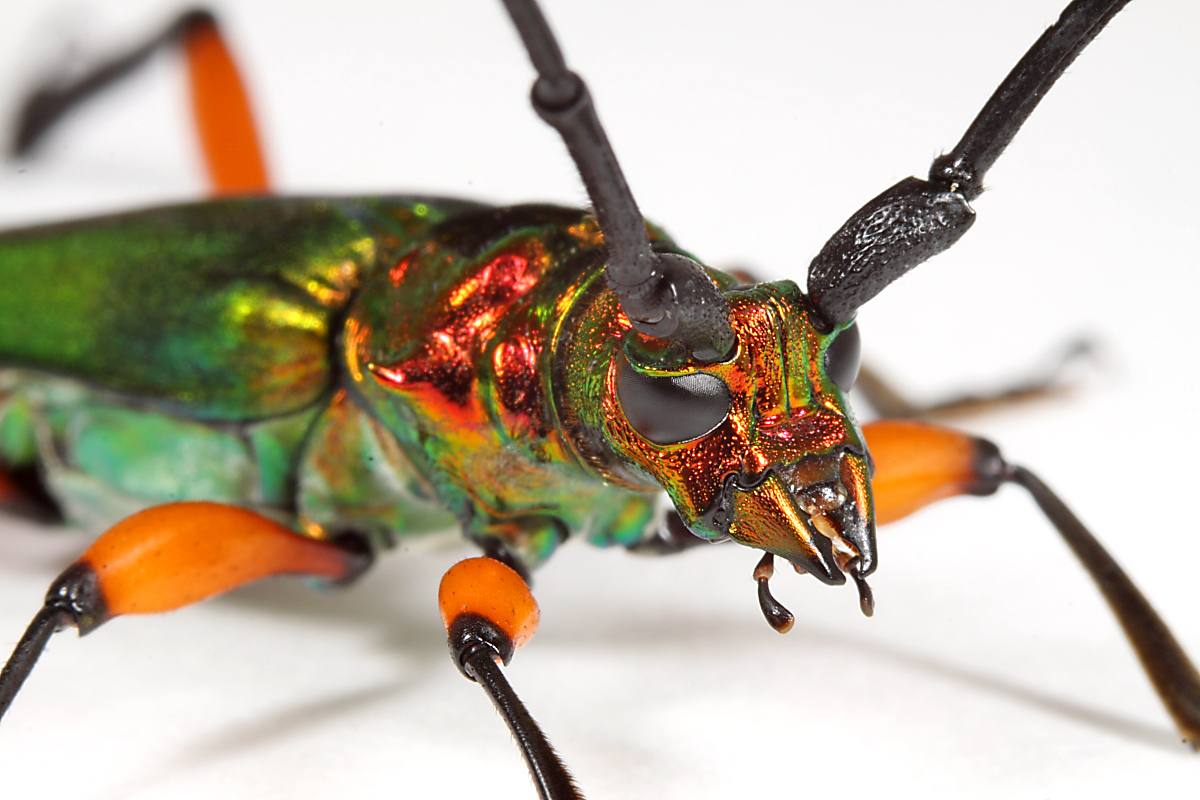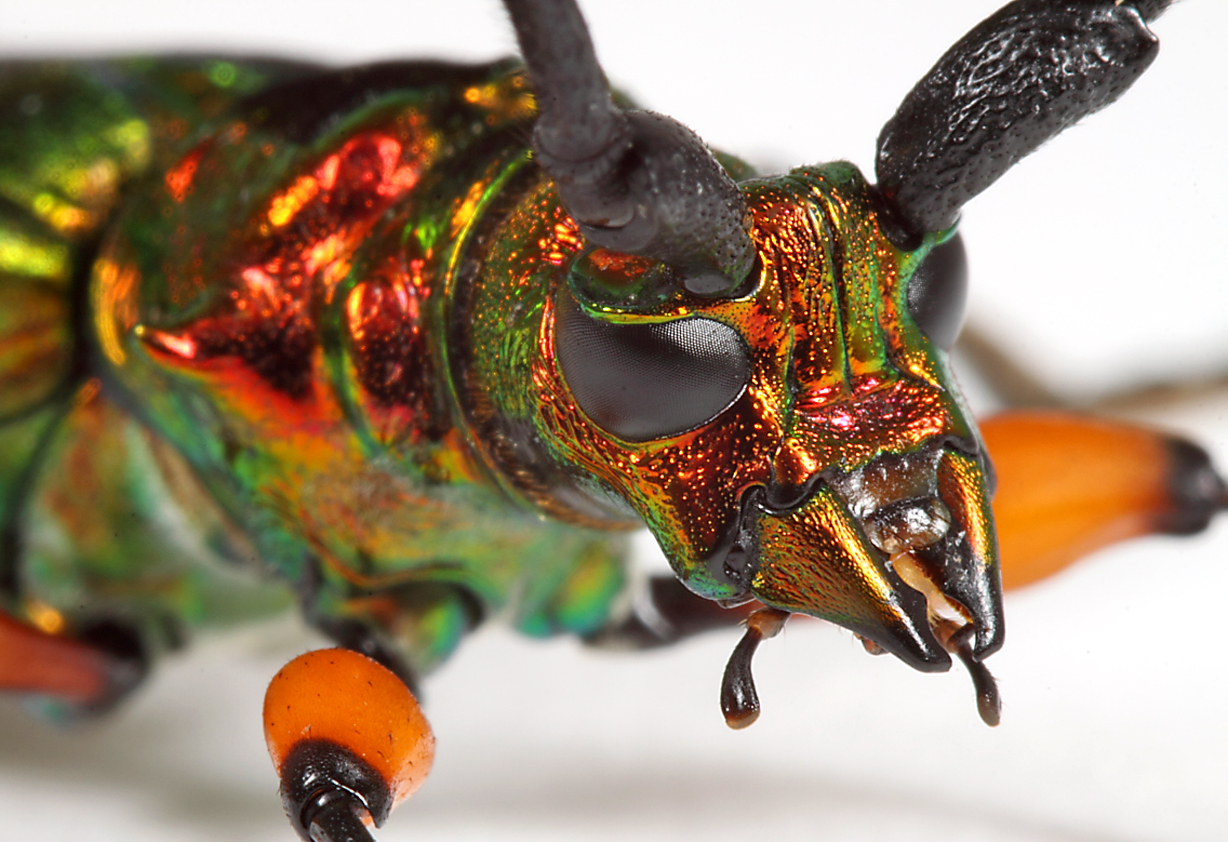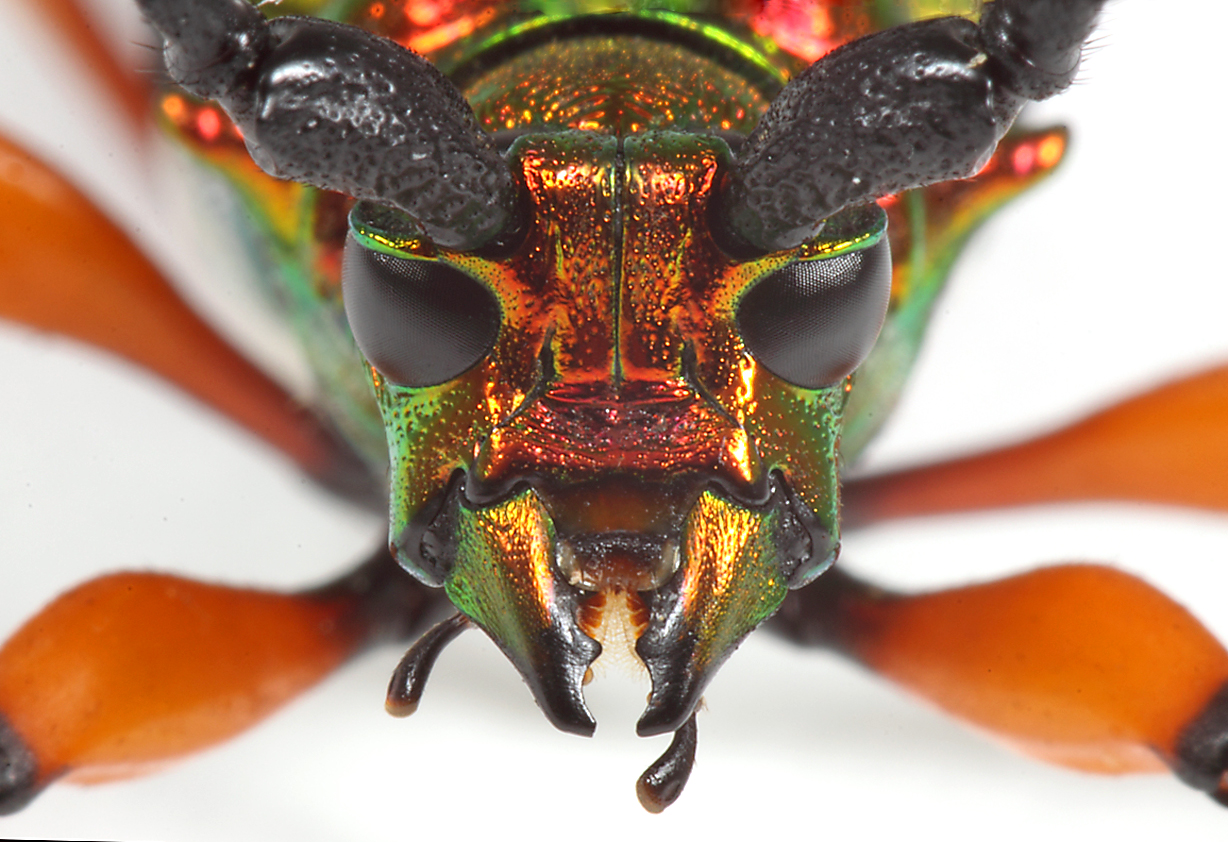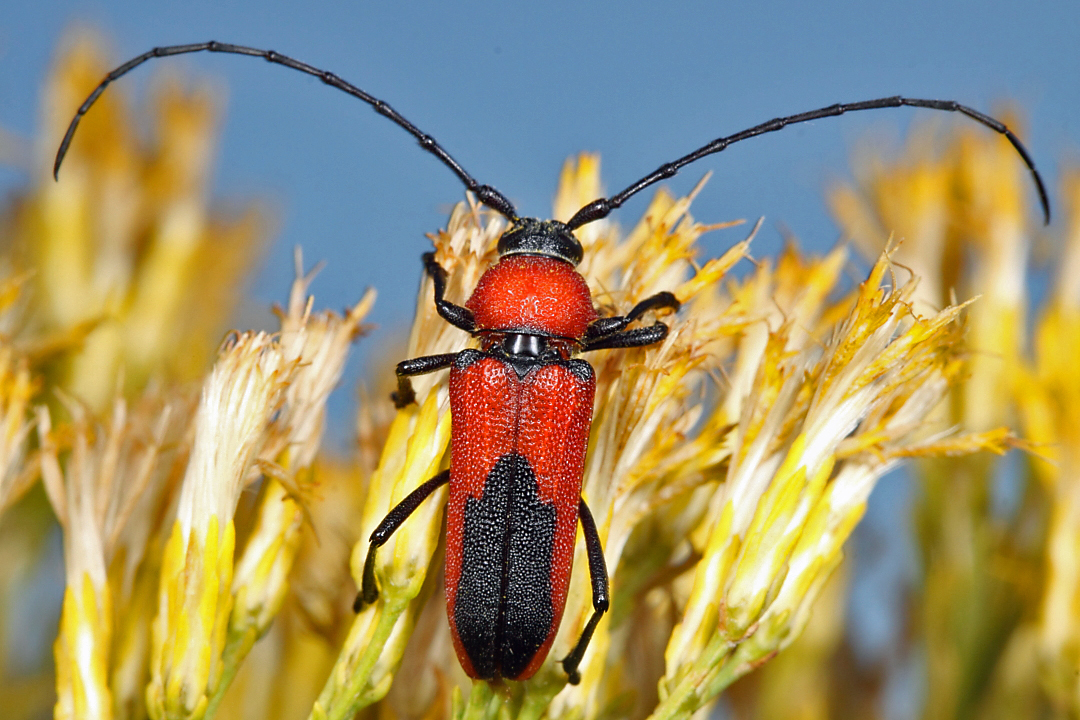
Crossidius coralinus fulgidus

Crossidius coralinus fulgidus | Uintah Co., Utah

Tiger beetles may have been the primary focus of last week’s 9-day, 10-state, 4,700-mile collecting trip; however, they were not the only beetles I was hoping to see. Longhorned beetles (family Cerambycidae) of the genus Crossidius are unusual in the family because of their fall rather than spring/summer adult activity period, and they just happen to occur in dizzying variety throughout the Great Basin and surrounding mountainous areas. Larvae of all species are presumed to feed on the roots of perennial, shrubby, fall-blooming composites, primarily in the genera Chrysothamnus, Ericameria, Gutierezzia, and Haplopappus (Linsley and Chemsak 1961), with the adult activity period undoubtedly timed to allow congregation and mating on the late-season blooms of their host plants.  Only 13 species are currently recognized, but these are further divided into 37 subspecies and innumerable locally distinct populations.  Not having spent much time in the mountain west during the fall, this group has till now been poorly represented in my collection.

The species shown here, Crossidius coralinus fulgidus, was among the first of many that we encountered during our trip.¹  This population was seen near Vernal in northeastern Utah.  It was late in the day and the adults had settled for the night onto the flowers of their host plant, Ericamera nauseosa.  Flower-visiting longhorned beetles are notoriously frustrating subjects to photograph, as their constant movement and long legs and antennae make focus and composition difficult.  These beetles had essentially ceased activity, allowing me to carefully compose and focus the shot, and the low sun in the western sky provided a bright blue eastern sky to use as a colorfully contrasting background.  The photo above (the very long antennae identify it as a male) was taken hand-held with my Canon 100mm macro lens at ISO 400 and 1/60 sec to allow exposure of the sky and flash at an aperture of f/16 to illuminate the subject and achieve good depth of field.  My only criticism of this photo is the small amount of blur seen in the distal antennal segments.

¹ “We” refers to myself and Jeff Huether from Geneva, NY. Jeff is primarily interested in Meloidae but like me also has an interest in Cerambycidae. I was fortunate to have Jeff with me on this trip, as he has collected extensively throughout the Great Basin region and encountered nearly all of North America’s named species and subspecies of Crossidius. It is only because of his prior experience with this group that I was able to find this and several others that we saw during the trip.
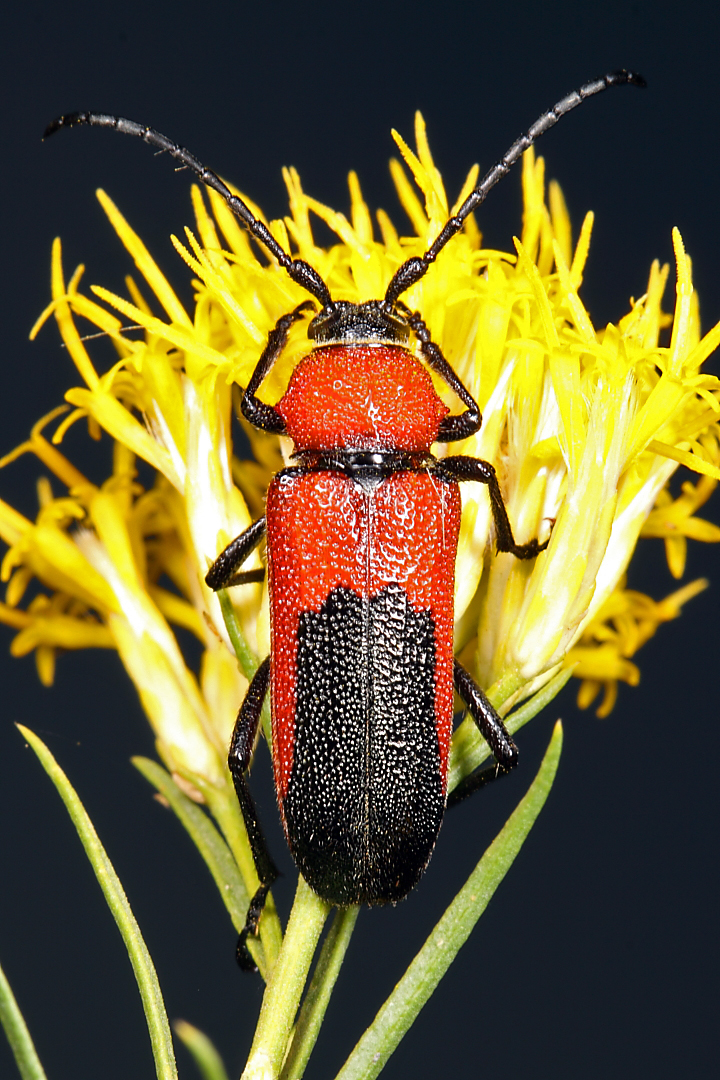
ISO 100, 1/200 sec
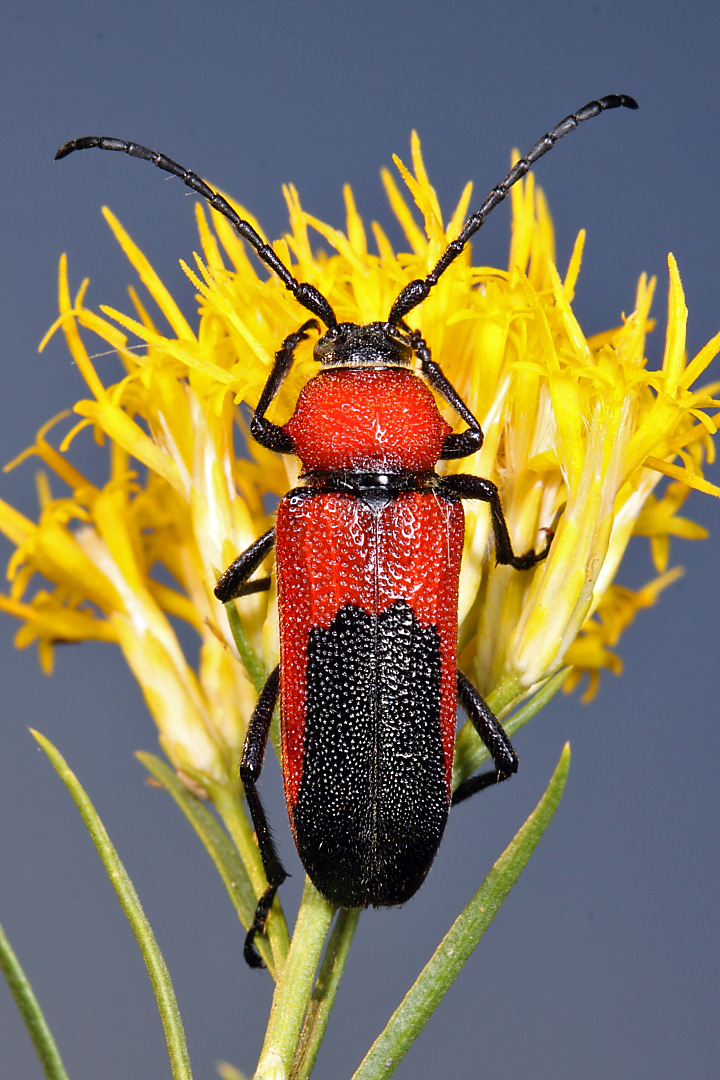
ISO 400, 1/200 sec
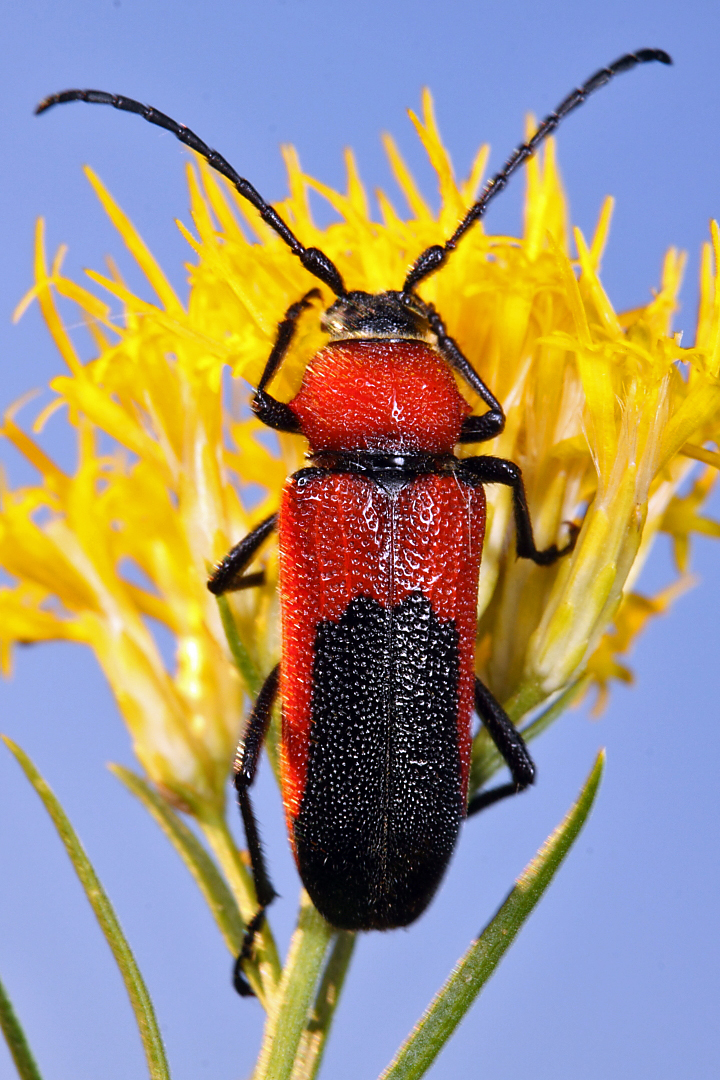
ISO 400, 1/60 sec

Because the beetles were so calm, I spent some time with this female individual trying different settings to see their effect on background color, subject illumination, and detail.  All were taken hand-held using the same lens at f/16, with the left photo also using my “typical” settings of ISO 100 and 1/200 sec.  The background is very dark (in post-processing I might choose to make it black)—good for some subjects but not this one, and although the focus is good the lighting is rather harsh (I had to decrease highlights in post-processing much more than I normally like).  The center photo was taken with ISO increased to 400 and results in a much more pleasing, if still not very natural-looking sky background.  Focus remains good and the shorter flash duration needed reduces the amount of highlighting that needs post-processing adjustment.  Overall I like this photo the best except that the sky is not true in color.  The right photo is also at ISO 400 but uses a slower shutter speed (1/60 sec).  The sky in this photo is the most natural-looking, and as might be expected problems with flash highlights are minimal—it almost looks like a natural light photograph.  However, some amount of motion blur can be detected, especially in the antennae.  Perhaps intermediate shutter speeds (e.g. 1/120 sec) or slightly higher ISO might effectively deal with this while still allowing the truest colors.  What do you think?

REFERENCE:

Linsley, E. G. and J. A. Chemsak.  1961.  A distributional and taxonomic study of the genus Crossidius (Coleoptera, Cerambycidae).  Miscellaneous Publications of the Entomological Society of America 3(2):26–64, 3 color plates.

Copyright © Ted C. MacRae 2011

My Canon 8X Macro Lens

For the past few months I have started routinely using extension tubes with my 100mm macro lens for photographing tiger beetles. I do this primarily because for most tiger beetles and other insects in the smallish to medium-sized range I need the capability to go both above and below 1X magnification, meaning that I must constantly switch between my Canon 100mm lens (1X maximum) and MP-E 65mm lens (1X minimum). With a full extension tube set (68mm), my 100mm macro lens effectively becomes a 0.7–2.0X macro lens, a nice range of magnifications for most of the photographs that I take. There is a secondary benefit to this in that the subject-to-lens distance is decreased somewhat, allowing me to get the MT-24EX flash heads closer to the subject for better lighting.

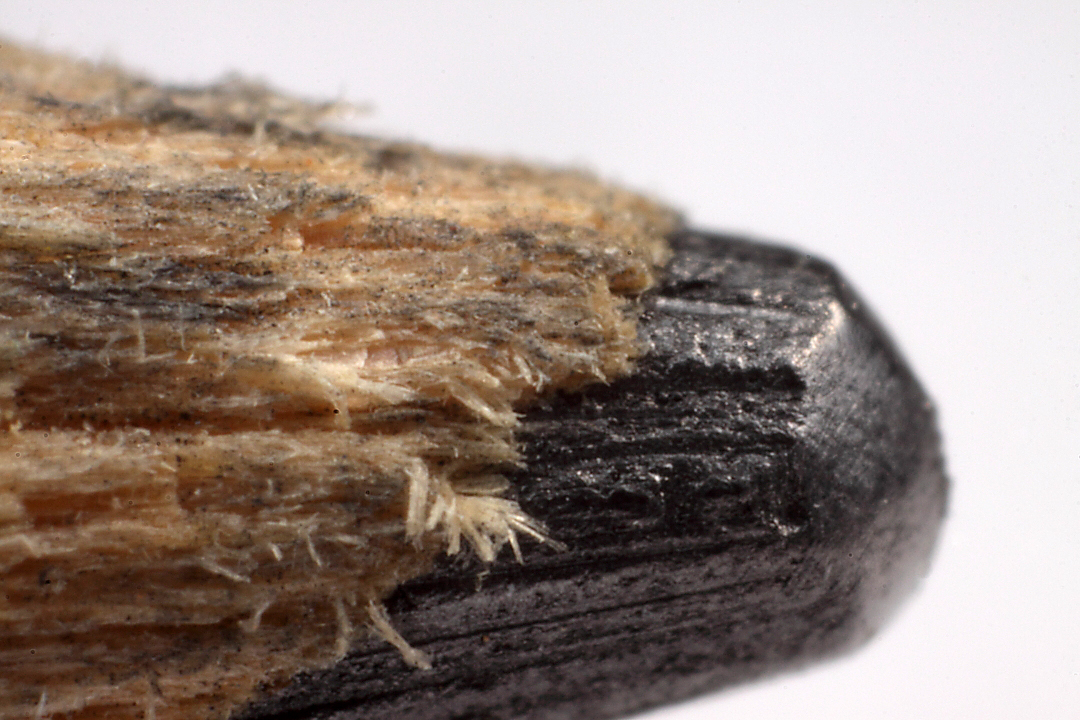
Lately I’ve been wondering what the magnification capabilities would be if I added extension tubes to the 65mm lens.  With a maximum magnification of 5X, it hardly seems that even more magnification would ever be needed, but who knows what uses one might find if the capability exists.  In theory, it seemed like it should work—after all extension tubes are simply tubes with no glass (in fact, the 65mm lens itself is simply a macro lens with a very expensive, built-in bellows).  The only consideration was whether the focal plane would remain outside of the lens.  Tonight I finally decided to sit down and try it out, and the results were really quite stunning.  The three photos below show an ordinary pencil lead, the first with the 65mm lens alone set at 1X, the second with the lens set at 1X plus full extension tubes, and the third with full extension tubes and the lens set at 5X.  The full extension tube set provides an additional ~1.7X magnification, making the 65mm lens effectively a 1.7–8.0X macro lens!

Canon MP-E 65mm lens @ 1X

Canon MP-E 65mm lens @ 1X + 68mm extension tubes (= 1.7X)

Canon MP-E 1-5X macro lens @ 5X + 68mm extension tubes (= 8X)

The subject-to-lens distance is indeed quite short—only about 38mm or so.  However, having at my disposal an 8X macro lens suddenly opens up a whole new world of ideas for insect macrophotography.  Knowing that the combination of 65mm lens and extension tubes is possible, I just had to try this out on a living subject—like now!  I happened to have in a terrarium a subject from the day’s collecting, so I tried it out—again with the 65mm lens fully extended to result in 8X magnification.  Shown below is a example of this lens combination at full magnification, completely uncropped—can you name the subject?

Canon MP-E 65mm lens @ 5X + 68mm extension tubes (= 8X)

Copyright © Ted C. MacRae 2011

Crazy Eyes

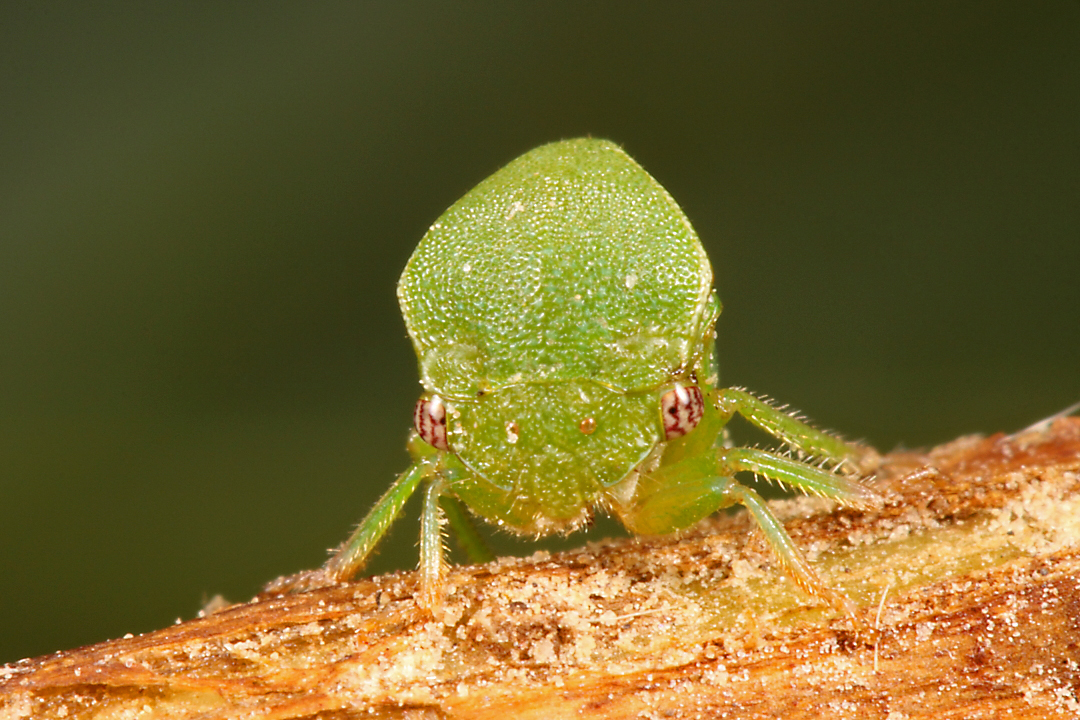
Spissistilus festinus | Stoneville, Mississippi

Spissistilus festinus (three-cornered alfalfa hopper) is one of the few truly economic pests in the otherwise bizarre and innocuous family Membracidae (treehoppers).  Its common name alludes to one of the crops it affects, but my encounters with this species are most often in soybean (I am, after all, a soybean entomologist).  Damage in this crop is caused by both adults and nymphs, whose piercing/sucking mouthparts cause girdling and breakage of the stem—often just a few inches above the soil.  This individual was seen during my travels last week in a soybean field in Stoneville, Mississippi, where numbers throughout the season were especially high this year.  Although I have seen innumerable S. festinus adults, I have never noticed their crazy, zig-zag patterned red and white eyes until I managed this closeup face shot (click on photo for best view).

This slightly cropped photo was taken with a 100mm macro lens and full extension tube set, resulting in slightly more than 2X magnification.  One of the lessons I took from was the need to pay more attention to background and value contrast.  By placing the subject a few inches in front of the dark green soybean foliage I was able to achieve a much more pleasing background than the typical black background one gets with full flash photos at high magnification.  Although both the subject and the background are green, there is still sufficient difference in shade to create contrast between them.  Light-green is one of the more difficult colors to work with when full flash is used with high shutter speeds and small apertures to maximize crispness and detail (in this case, 1/250 sec and f/16).  However, increasing ISO to 400 and lowering flash exposure compensation to -2/3 can reduce the amount of flash needed to illuminate the subject with such settings, making it easier to achieve a properly exposed and true-colored subject.

Copyright © Ted C. MacRae 2011

BugShot 2011 – Final Thoughts

As I suspected would be the case,  has proven to be an especially difficult challenge.  As a result, instead of posting the answer tonight I’m going to give folks another day to make their play for points (remember, nobody walks away empty-handed).  In the meantime, I’ve had a chance to ruminate over this past weekend’s BugShot insect photography workshop at Shaw Nature Reserve in Gray Summit, Missouri, and now seems to be an appropriate time to post some final thoughts while they’re still fresh in my mind. Suffice it to say that it was an incredible experience—both technically and socially.  I learned far more than I thought possible (and hope I can remember even a portion of it) and made some great friends in the process.  It’s really not possible for me to summarize here all of the techniques, insights, equipment choices, etc. that were covered, nor do I want to—such a list would be boring to read and not very meaningful without the context to go with it.  What I would like to do is shout out a few people who, beyond the collective, helped make the weekend what it was for me.

Instructors.  The three instructors, all accomplished insect photographers of the highest caliber, typified three very different yet complimentary approaches to the art.  Alex Wild (University of Illinois), ant photographer extraordinaire and author of the insect blog I’ve most tried to emulate, gave me tremendous insight on lighting and practical approaches on how to use it effectively.  My discussions with John Abbott (University of Texas) about equipment will be very helpful for the type of photography that I like to do (I’m not sure I’m ready for the tripod yet, but maybe the other ideas we discussed will be the “slippery slope”).  Finally, I thoroughly enjoyed my time with Thomas Shahan (Norman, Oklahoma), whose great artistic insight helped me see a whole new world of possibilities for tiger beetle portraiture.  I must admit to feeling a little star-struck when I first began talking to him, but his infectious enthusiasm and exuberance quickly put me at ease.

Friends.  I can’t begin to list everybody whose company I enjoyed, but standouts include Jo Holly (Alex’s better half!), as well as fellow bloggers Crystal, Lee, Dave, and DragonflyWoman.  Even though I only met them this weekend, it was if I had known them for years.  My time “fishing” tiger beetle larvae with Crystal and Lee was not only a highlight of the trip (watching them “jump” as the larva came flying up and out of the burrow was a real treat), but also represented a discovery in the truest sense of the word (as will become clear in a future post).  No discussion of friends would be complete without mentioning James Trager, not only for opening up Shaw Nature Reserve to this weekend’s event, but also for the access he’s given me over the past several years and our frequent, humorous email discussions about all things entomological (or botanical, ecological, etc.).

Gratitudes.  I want to thank Alex for inviting me to take part in this event as something more than just an attendee.  I hope my contribution, however small, was beneficial.  My thanks also to Patsy Hodge, who was so helpful and gracious to me in the days leading up to and during the event.  I also appreciate the kind comments that many of the attendees made to me about my blog and my photographs—your encouragement means a lot to me.

Regrets.  In an event like this, packed as it was with seminars and group discussions, it is sad but unavoidable that one cannot spend at least a little time with each and every person in attendance.  To those that I did have a chance to talk to, the pleasure was all mine.  To those that I missed, I will catch you next time!

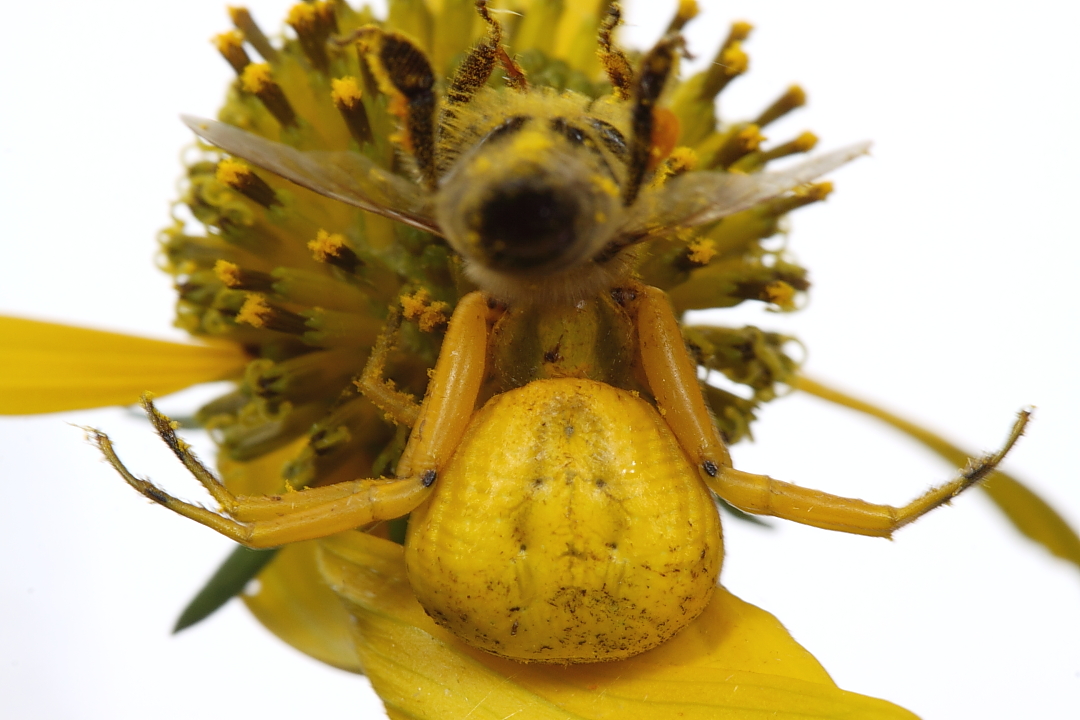
I think I’ll close with this minimally processed photograph of what I take to be Misumenoides formosipes (whitebanded crab spider) and its honey bee (Apis mellifera) prey.  Although I photographed this spider using flash and looking straight up into an overcast sky, I managed to properly illuminate the subject and avoid blown yellows and an all-black background by using some of the very techniques and principles that I had just learned earlier that day.  I hope to learn more at BugShot 2012!

Misumenoides formosipes (whitebanded crab spider) | Shaw Nature Reserve, Franklin Co., Missouri

BugShot 2011 – Lesson 1

I’m a lucky guy! First, I’m one of the fortunate attending this weekend’s BugShot insect photography workshop. Second, this first-of-a-kind event is being held only 13 miles from my home at Shaw Nature Reserve in Gray Summit, Missouri. Third, I was “adopted” by the BugShot instructors to assist in the event. Who are the instructors? None other than John Abbott from Austin, Texas—an expert on dragonfly biology and insect action photography, Thomas Shahan from Norman, Oklahoma—master of close-up arthropod (especially jumping spider) portraiture, and Alex Wild from Champaign-Urbana, Illinois—ant photographer extraordinaire and author of the most popular insect blog on the net.  In 2009 I picked up a digital SLR camera for the first time ever—in 2011 I am rubbing shoulders, discussing exposure and lighting, and enjoying social time with three of the country’s most accomplished insect macrophotographers (and some other very cool people as well).

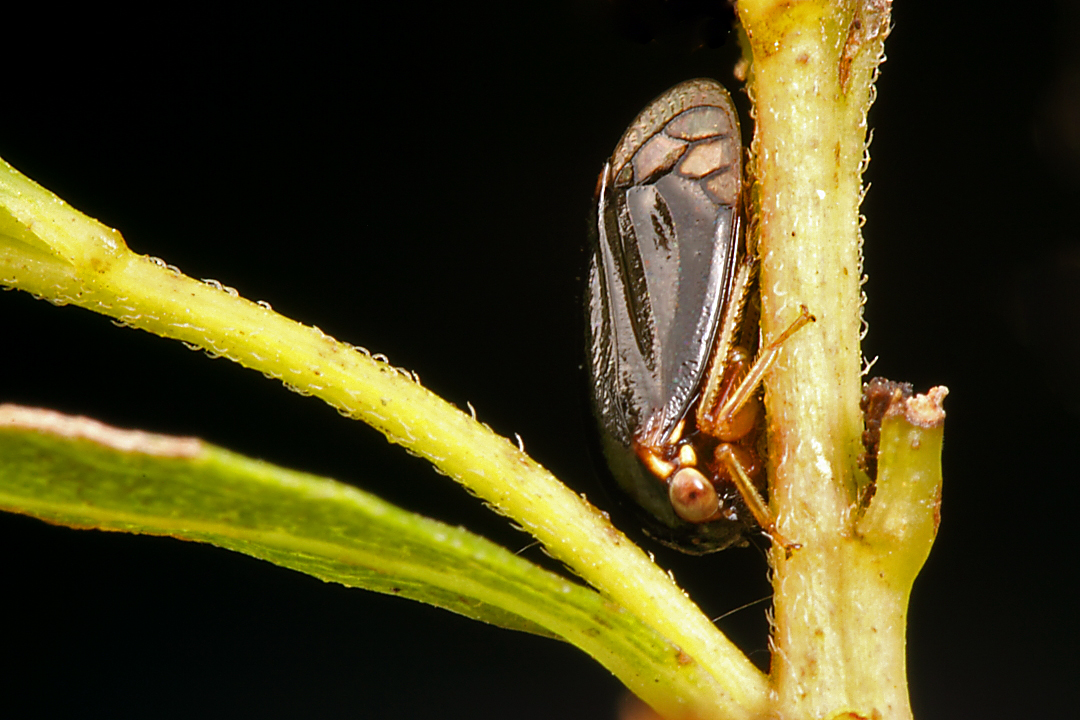
I have come a long way, but I still have much to learn.  Intimate understanding of lighting, exposure, and the creative use of flash still eludes me—I can do a few things well, but there is much more I can’t do at all.  Today was my first time experimenting with the effect of lighting direction, i.e. taking the flash heads off their fixed position on the front of the lens and hand-holding them in different positions.  This simple technique can have dramatic effects on the look of a photograph, as illustrated by the following two photographs.  In the first, both flash heads of my Canon MT-24EX twin flash are attached to the front of the lens (as they have been for every single flash photograph I’ve ever taken up to this point).  In the second, only the right flash head remains attached to the lens, while the left head has been detached and is being hand-held directly above the subject (in this case, the treehopper Acutalis tartarea on Solidago sp.).  Technically they are not very good photographs, but they illustrate well the dramatic differences that can be achieved by varying the position of the flash heads.  Among other things, this is a technique that I will be exploring much over the coming weeks.

Both flash heads attached to front of lens.

Right flash head attached to front of lens; left flash head held directly above subject.

Copyright © Ted C. MacRae 2011

Bumelia borer on white

Plinthocoelium suaveolens suaveolens | Ozark Co., Missouri

Last weekend I visited one of my favorite collecting spots in all of Missouri—Long Bald Glade Natural Area (part of Caney Mountain Conservation Area in Ozark Co.).  Nestled at the eastern edge of the White River Hills in southwestern Missouri, its deeply dissected hills are home to numerous plants and animals that are more typical of the southern Great Plains and which have found refuge in the xeric, thin-soiled calcareous prairies (commonly “cedar glades”) that cover the area’s southern- and western-facing slopes.  These include some rather impressive insects, such as a disjunct population of Cicindelidia obsoleta vulturina, which I just found here last year as the new northeasternmost extent of the population, as well as the marvelously monstrous Microstylum morosum, North America’s largest robber fly and so far known in Missouri only from Long Bald Glade where it was discovered in 2009. 

Another quite striking insect found at Long Bald Glades (though not restricted in Missouri to the White River Hills) is the bumelia borer, Plinthocoelium suaveolens.  This beetle occupied much of my time in July 2009 as I committed to photographing the species in the wild, and it was Long Bald Glade where I finally (if not completely satisfactorily) succeeded in that goal.  This time I was visiting the Glade to look for the earliest individuals of C. obsoleta vulturina and, hopefully, document additional glades within Caney Mountain that might support the beetle.  However, in the back of my mind I was also keeping a lookout for P. suaveolens—this species is primarily active during July and August in Missouri, but I do have records of it as late as September.  As I looked for (and found) tiger beetles, I also checked out each bumelia tree that I passed hoping to see a P. suaveolens adult perched on its lower trunk.  It was not until later in the afternoon that I heard a loud “buzz” approaching from behind and turned to see one of these beauties fly right past me—legs and antennae held outstretched—before landing on a nearby tree.  Now, over the years I’ve learned a few lessons, and one is that you don’t try to take in situ photographs of the first individual you encounter of a prized species.  More often than not it gets away before you even fire the first shot, and you’re left with nothing.  My standard procedure now is to procure the first individual immediately and keep it alive.  If attempts to photograph subsequent individuals are not successful (or none are seen), then at least I have a backup for studio shots (not my first choice, but better than nothing!).  Such was the case with this individual.

Although I still lack that “perfect” beetle-on-a-branch shot that I hope to eventually get for this species, it seemed a good subject for some white-box photography.  I’ve vacilated between true white-box w/ indirect flash versus getting a white-box effect by using direct, diffused flash with the subject on a white background.  I decided now was the time for a direct comparison of the two techniques.  All of the following photographs were taken with the Canon 100mm macro lens on a Canon 50D body at 160 ISO, 1/200 sec, and f/16.  For the closeups (photos 3 and 5 of each series), 68mm of extension tubes were added.  The photos on the left are true white-box photos, i.e. the flash heads were directed up and away from the subject placed inside a box lined with white tissue (Kim-Wipes laboratory wipers).  The photos on the right mimic the white-box effect by placing the subject on white filter paper, but the flash heads were pointed directly at the subject through my DIY concave diffuser (click on photos for 1200×800 versions):

Indirect flash in white box

Direct flash w/ DIY diffuser

Indirect flash in white box

Direct flash w/ DIY diffuser

Indirect flash in white box

Direct flash w/ DIY diffuser

Indirect flash in white box

Direct flash w/ DIY diffuser

Indirect flash in white box

Direct flash w/ DIY diffuser

I must admit, looking at the photos on the camera playback screen I had the impression that I would like the direct-diffuser photos better, but after reviewing them on the computer and applying typical post-processing enhancements (e.g., levels, slight shadow reduction, and unsharp mask), the true white-box photos appear to have benefited from more even lighting, resulting in truer color, less shadowing, and minimal specular highlighting.  Not that the direct-diffuser photos are bad—they’re just not as good as the white-box photos.  I guess what this means is that my DIY diffuser, while a significant improvement over my previous diffusers, still could use some improvement (if ability to create white-box-like results is the ultimate test of a diffuser’s effectiveness).  I’d be interested in knowing your opinions based on these comparisons.

Congratulations to Ben Coulter, who wins yet another Super Crop Challenge and strengthens his lead in the overall standings of the current BitB Challenge Session #4 with 13 points.  Mr. Phidippus also correctly identified the species and takes 2nd place in the challenge with 8 points, keeping him in 2nd place in the overall standings as well.  Morgan Jackson takes 3rd place in the challenge with 7 points, but Roy’s retains 3rd place in the overall standings by way of his 6 points in this challenge.  Congratulations to these top points earners, and thanks to all who played.

Copyright © Ted C. MacRae 2011

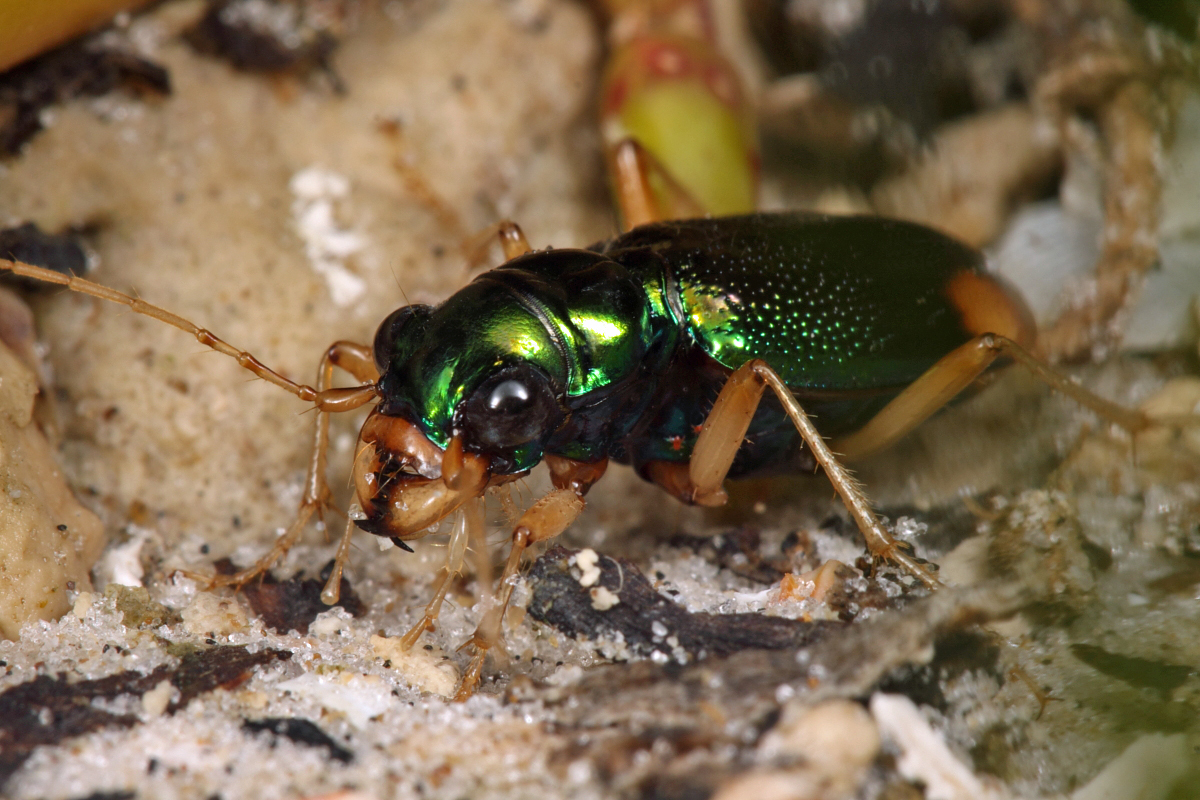
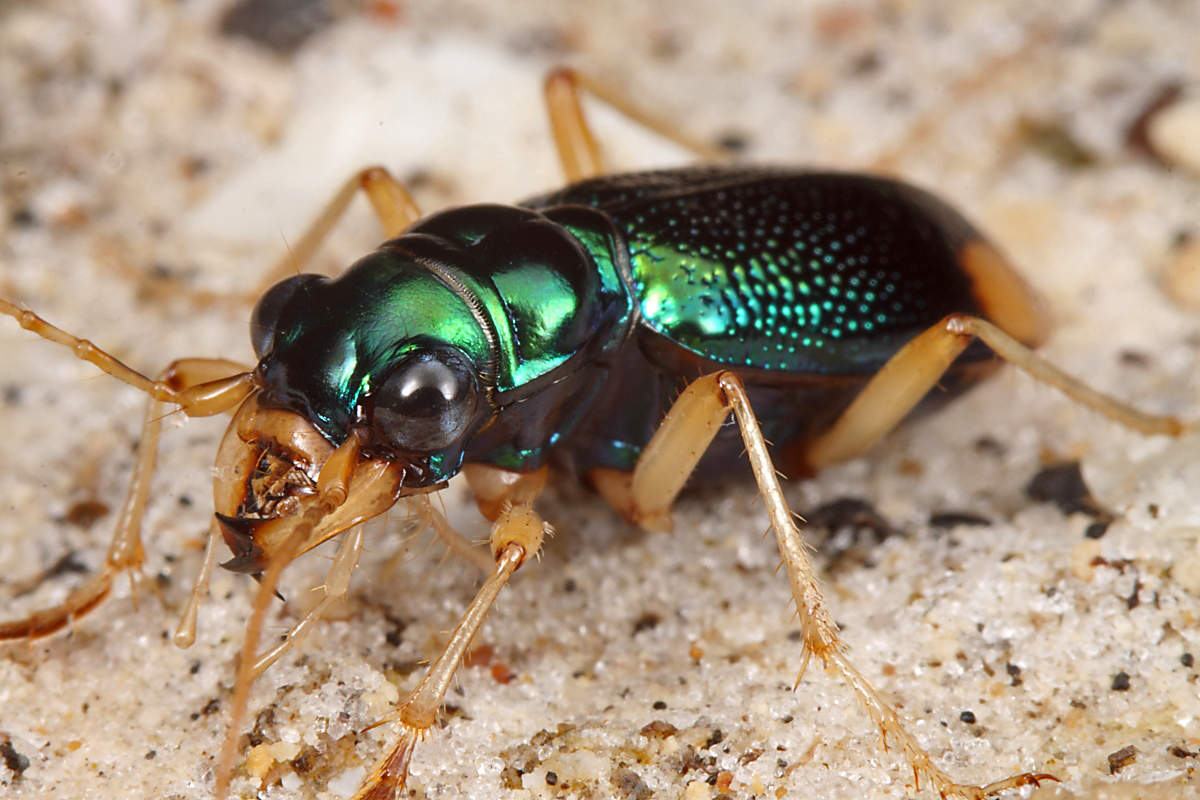
Use of extension tubes for better lighting

The photos in this post of Tetracha floridana (Florida Metallic Tiger Beetle) illustrate a technique that I have begun using recently to improve the lighting in my full-flash insect macrophotographs—use of extension tubes!  I know this sounds strange, and I actually just stumbled onto it myself when I started using extension tubes in combination with my Canon EF 100mm macro lens.  Okay, I can hear it now: “Why not use the Canon MP-E 65 mm macro lens?”  It’s a good question, as at magnifications above 1X there is no finer lens than the 65mm.  However, the tiger beetles that I spend a lot of time photographing are right in that size range where sometimes I need magnifications below 1x (whole body shots of medium to large species), while other times I need magnifications above 1X (small species and closeups—particularly face shots).  Fortunately, the entire spectrum of magnifications (up to 5X) is covered by these two lenses, but there is, unfortunately, no overlap.  This is where the extension tubes come in—when all 68mm are added the 100mm lens effectively changes from a 1.0X–∞ lens to a 0.7–2.0X lens.  This gives a frame width of 11–33 mm, perfect for nearly all North American tiger beetles (most species range from 6-20 mm, excluding legs and antennae). 

In addition to allowing a more appropriate range of magnifications without the need to switch out lenses, this has one other effect—it moves the lens a little closer to the subject.  That in itself is of no particular benefit, but since I use the front-of-the-lens-mounted Canon MT-24EX dual flash, it also moves the flash a little closer to the subject.  It’s not a huge distance, only about 20 mm, but keep in mind that the flash heads extend forward from the front of the lens (especially with the Kaiser shoes that I use with my diffuser), and the front of the diffuser itself lies at about 60 mm in front of the lens face.  Thus, at 1X the the front of the diffuser sits ~80 mm from the subject with the 100mm lens only, but with 68 mm of extension tubes added it sits only 60 mm from the subject.  The closer the light source is to the subject, the greater the apparent light size, and larger apparent light size results in more even lighting with reduced specular effects.

Tetracha floridana | Pinellas Co., Florida (100mm lens only)

100mm lens + 68mm extension tubes

100mm lens only (slightly cropped)

100mm lens + 68mm extension tubes

The primary disadvantage to doing this is loss of ability to focus to infinity.  Frankly, this is functionality I never used with the 100mm lens, preferring instead the 17-85mm wide-angle lens for more general landscape and habitat photos.  The other downside is that placing the lens closer to the subject can result in greater chance of “spooking” the subject and causing it to flee or behave evasively.  Again, however, my experience is that if a subject can be photographed at 1X with the 100mm lens, it can be photographed at 2X with the 100mm lens + extension tubes.

Has anybody else ever tried this, and if so what was your experience?

Copyright © Ted C. MacRae 2011

Charming Couple revisited

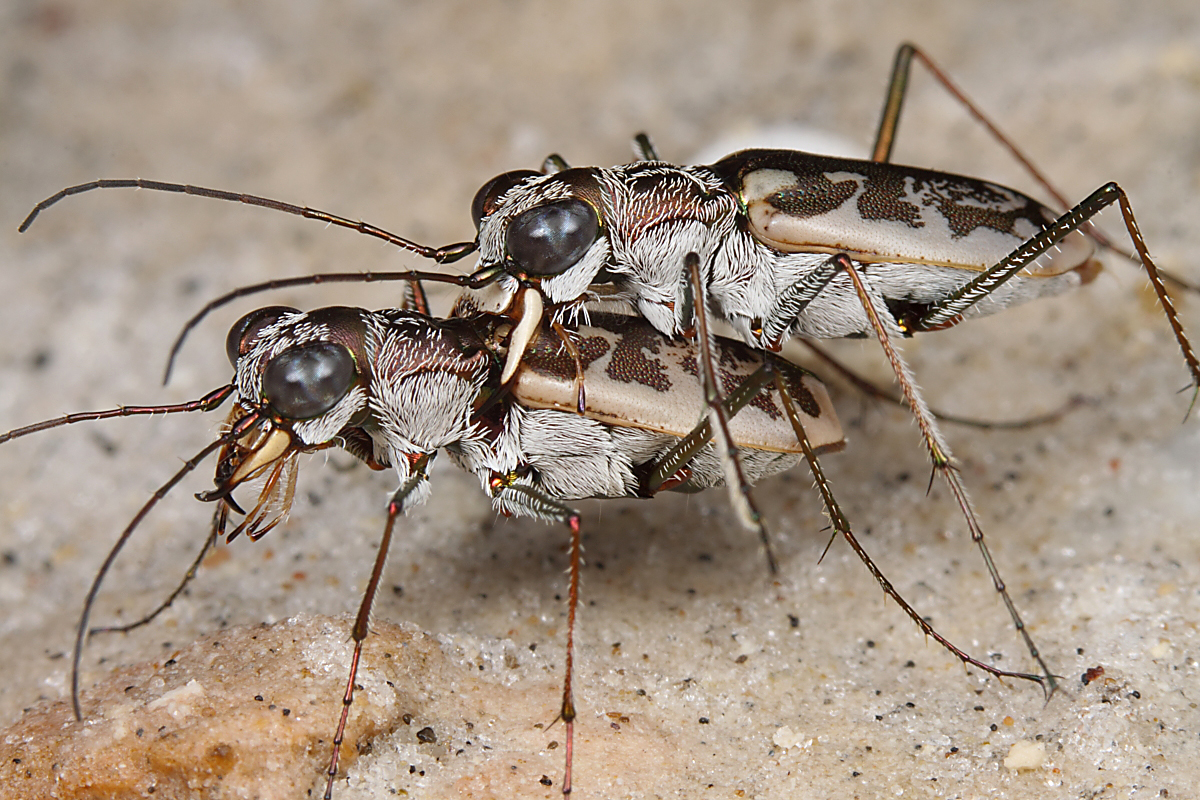
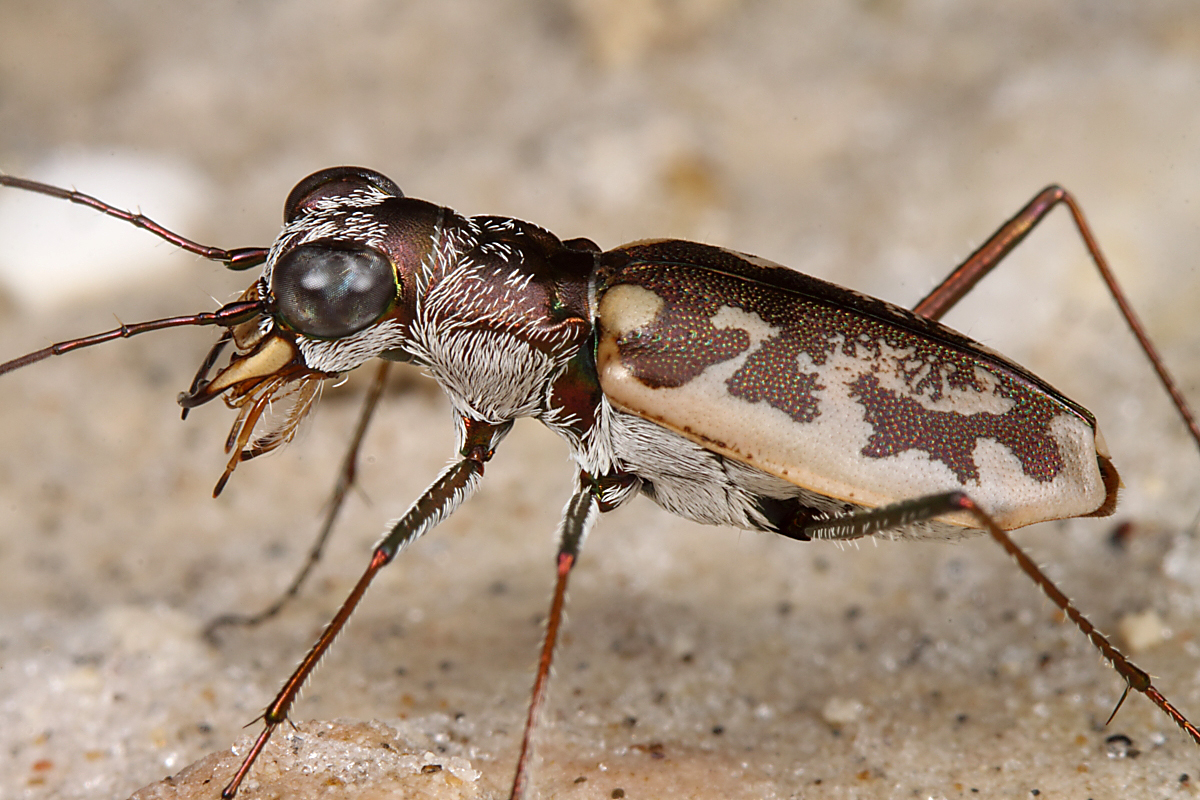
Another view of the of Ellipsoptera hamata lacerata (Gulf Coast Tiger Beetle) that I photographed in a small mangrove marsh in Seminole, Florida. These are actually among the first tiger beetles that I ever tried to photograph at night, and the major learnings involved: 1) figuring out how to turn on the flash lamp and then compose the shot quickly enough before the lamp shut off, and 2) making sure to use the histogram in the field to ensure I’d gotten the proper flash level. My first few attempts all tended to be underexposed because the brightness of the image on the playback screen in the darkness caused me to keep undersetting the flash exposure compensation. I’d not previously gotten in the habit of using the histogram in the field since I do a lot of flash level bracketing, but perhaps this is a tool that will allow me to cut down on that to some degree. Anyway, these are two additional photos that worked out pretty well—I like the first because of the contrast between the bright white mandibles of the male versus the off-white mandibles of the female, and the second (female only after the male bolted) for its nice view of the curiously bent elytral apices that distinguish it from the female of the very similar and (in this area) sympatric E. marginata (Margined Tiger Beetle). Also clearly seen in the second is one of the distinct basolateral grooves on the pronotum that serve to receive the male mandibles during mating (compare to same area on pronotum of male). I was amazed at how easy this mating pair and other individuals of this species were to photograph at night in view of their extreme wariness during the day.

Ellipsoptera hamata lacerata | Seminole, Pinellas Co., Florida

Note curiously bent elytral apices and basolateral pronotal groove for reception of male mandibles.

Copyright © Ted C. MacRae 2011