Charming Couple revisited

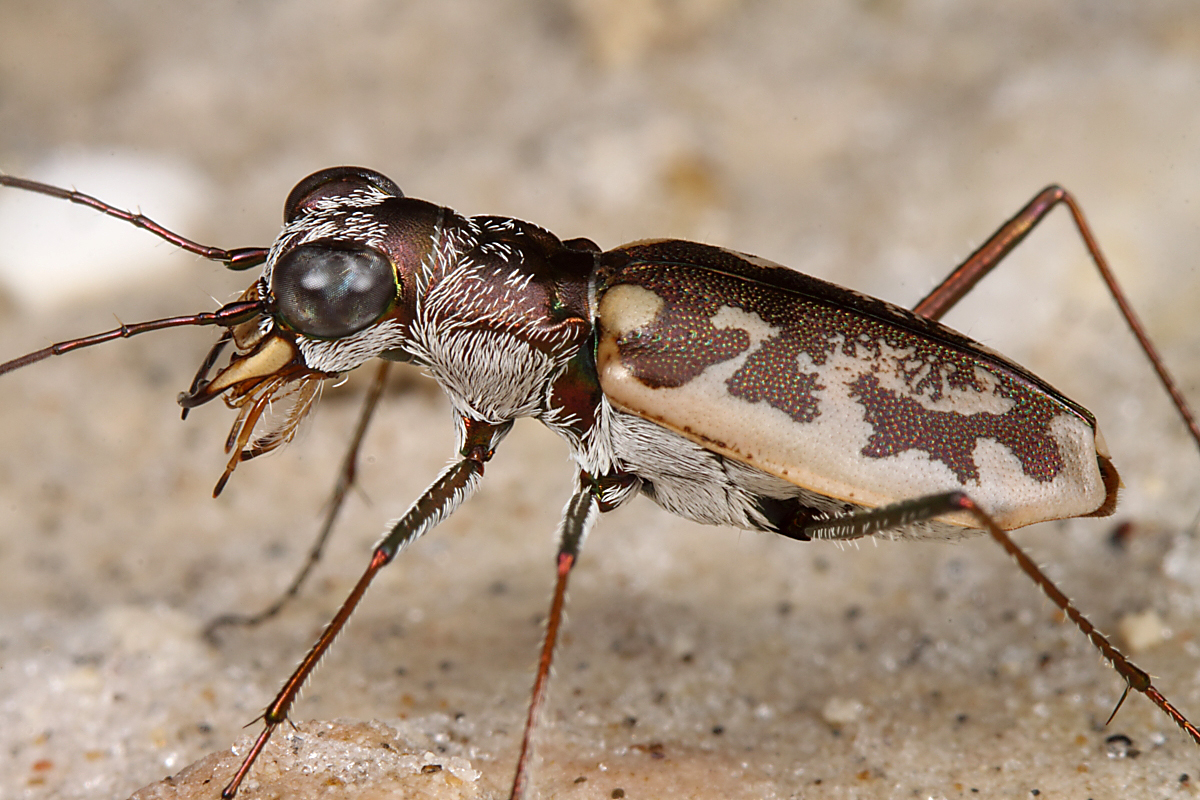
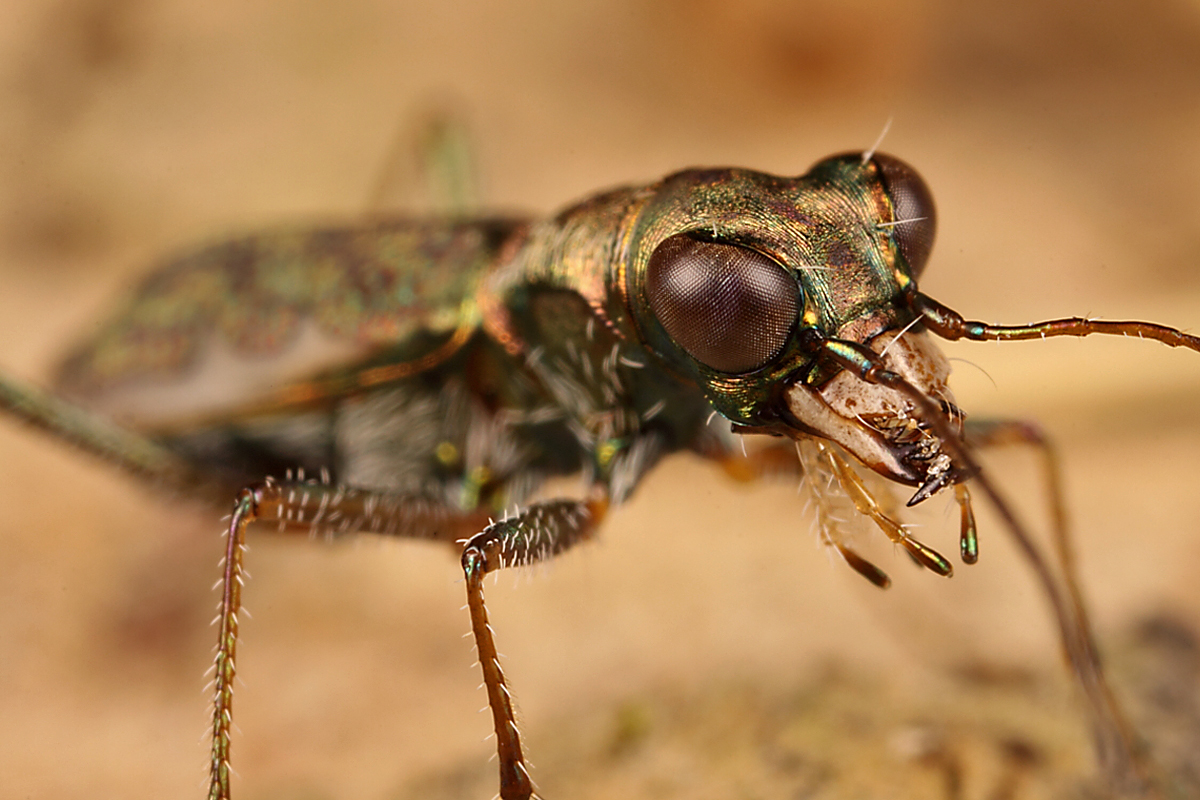
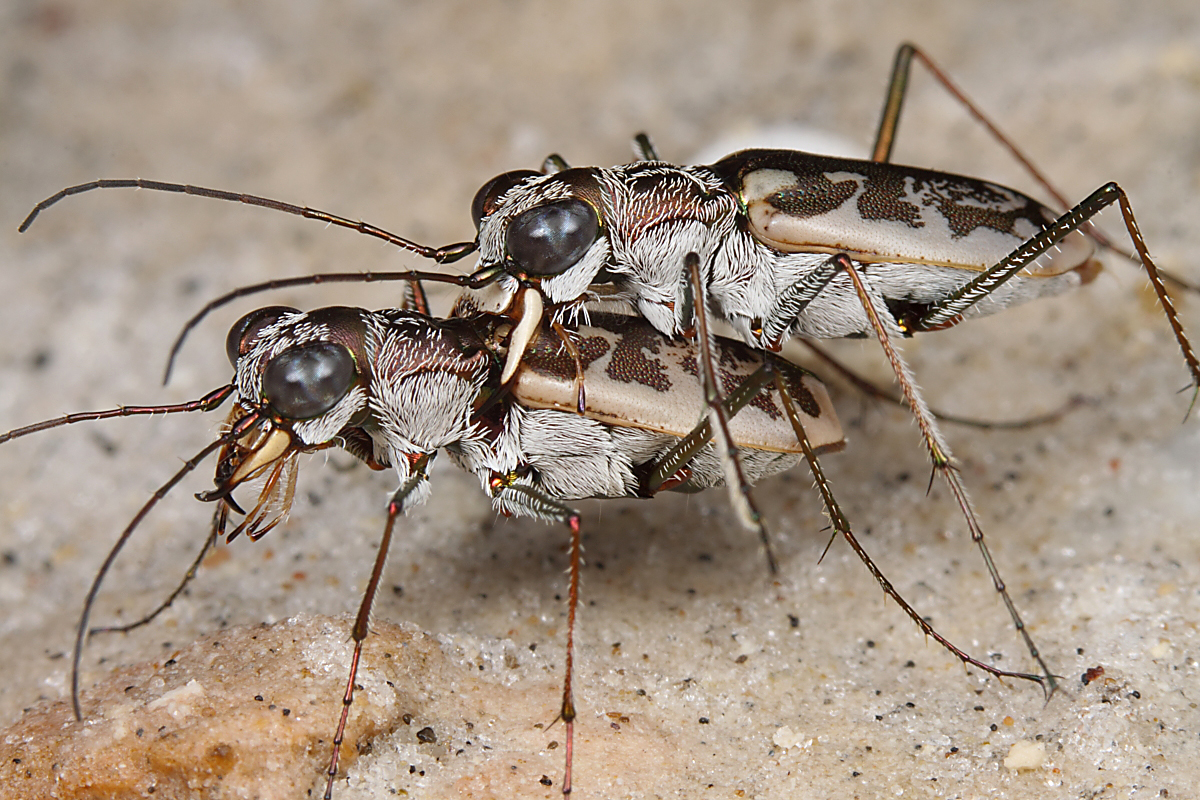
Another view of the of Ellipsoptera hamata lacerata (Gulf Coast Tiger Beetle) that I photographed in a small mangrove marsh in Seminole, Florida. These are actually among the first tiger beetles that I ever tried to photograph at night, and the major learnings involved: 1) figuring out how to turn on the flash lamp and then compose the shot quickly enough before the lamp shut off, and 2) making sure to use the histogram in the field to ensure I’d gotten the proper flash level. My first few attempts all tended to be underexposed because the brightness of the image on the playback screen in the darkness caused me to keep undersetting the flash exposure compensation. I’d not previously gotten in the habit of using the histogram in the field since I do a lot of flash level bracketing, but perhaps this is a tool that will allow me to cut down on that to some degree. Anyway, these are two additional photos that worked out pretty well—I like the first because of the contrast between the bright white mandibles of the male versus the off-white mandibles of the female, and the second (female only after the male bolted) for its nice view of the curiously bent elytral apices that distinguish it from the female of the very similar and (in this area) sympatric E. marginata (Margined Tiger Beetle). Also clearly seen in the second is one of the distinct basolateral grooves on the pronotum that serve to receive the male mandibles during mating (compare to same area on pronotum of male). I was amazed at how easy this mating pair and other individuals of this species were to photograph at night in view of their extreme wariness during the day.

Ellipsoptera hamata lacerata | Seminole, Pinellas Co., Florida

Note curiously bent elytral apices and basolateral pronotal groove for reception of male mandibles.

Copyright © Ted C. MacRae 2011

Cylindera cursitans (Ant-like Tiger Beetle) in Arkansas

In late June I visited Chalk Bluff Natural Area in northeastern Arkansas.  Situated at the northeastern-most corner of the state, it is here where the St. Francis River enters Arkansas from Missouri, slicing through the loose Tertiary conglomerates of Crowley’s Ridge before settling into its lazy, meandering course between the two states in the Upper Mississippi Alluvial Plain.  The site’s geological history, however, is not what attracted me to it, but rather its status as the state’s only known locality for Cylindera cursitans (ant-like tiger beetle).  It was the existence of this population that convinced my colleagues Chris Brown and Kent Fothergill and I that the species must occur in southeast Missouri not only along the Mississippi River, but also along the St. Francis River some 50 miles to the west.  Persistence eventually paid off last year when Kent captured a single individual on the Missouri side of the river at Chalk Bluff Access in Dunklin Co. (MacRae et al. 2011).

Kent had to really work for that specimen, spending several hours crawling through the underbrush in wet, bottomland forests before eventually finding the lone individual.  I was confident, however, that my search at the Arkansas site would require far less effort, as Kent had also observed this population during his attempts to locate the species on the Missouri side of the river, writing “I saw more cursitans in an hour than I have seen lifetime total!” The playground/picnic area where Kent had seen them sits right next to the parking lot and is as un-curitans a habitat as one can imagine—tidy and neat, with a nicely-mowed grass lawn under the shade of large oak trees rather than the sweltering, poison ivy choked understory habitats with their attendant swarms of mosquitoes and deer flies that we’ve braved in order to find the species in Missouri.  Only the small, intermittent patches of barren sandy loam soil gave a clue that this might be good tiger beetle habitat, and even then one might expect only the more pedestrian species such as Cicindela punctulata and Tetracha virginica and not something as exciting as C. cursitans.

But occur there it does, and hardly a few steps had been taken from the parking lot before I saw that familiar “dash” of movement, looking for all intents and purposes at first like a small spider.  A closer look confirmed its true identity, and during the next hour or so I would see countless such individuals—all scrambling rapidly for cover on my approach.  I have seen a number of cursitans populations during the course of our surveys for this species in southeastern Missouri, and this population was as robust as any of them.

Despite my earlier work with this species, I still lacked photographs I was completely happy with—i.e., field photographs of unconfined beetles taken with a true macro lens and flash to control lighting.  All of my previous photographs were either taken with a small point-and-shoot camera or had to rely upon beetles confined in a terrarium.  The species is not easy to photograph in the field—the small size of the adults (6–8 mm in length) and their cryptic coloration matching the soil surface makes them almost impossible to see until they move.  They are also very skittish and are quick to flee when approached, necessitating very slow, deliberate movements in order to approach them closely enough for photographs.  Oftentimes adults will run towards and hide up against the base of a clump of grass, where they are even more difficult to photograph, but sometimes they will hide beneath fallen leaves or other debris.  Interestingly they do not flee immediately if the leaf/debris is very carefully lifted up and removed—almost as if they think they’re still hidden.  I’ve found exposing adults hiding under leaves to be an easier way to get field photographs of the species, although I have noted that some individuals (but not others) seem eventually to adjust to my presence and resume normal activity despite having a camera lens hovering inches away from them.

Once I had my fill of photographs, I walked the trail to the river and back but did not see any beetles along the trail within the forest (too much leaf litter) or along the river.  Surely the beetles occur in these other areas and are not confined in the area just to that small, man-made habitat that is the picnic ground.  Seeing this population gives me greater confidence that the species does indeed occur more broadly along the St. Francis River in Missouri than suggested by single individual caught on the Missouri side by Kent.

REFERENCE:

MacRae, T. C., C. R. Brown and K. Fothergill. 2011. Distribution, seasonal occurrence and conservation status of Cylindera (s. str.) cursitans (LeConte) (Coleoptera: Carabidae: Cicindelitae) in Missouri. Cicindela 43(3): in press.

Copyright © Ted C. MacRae 2011

Sugarcane Weevil in Brazil

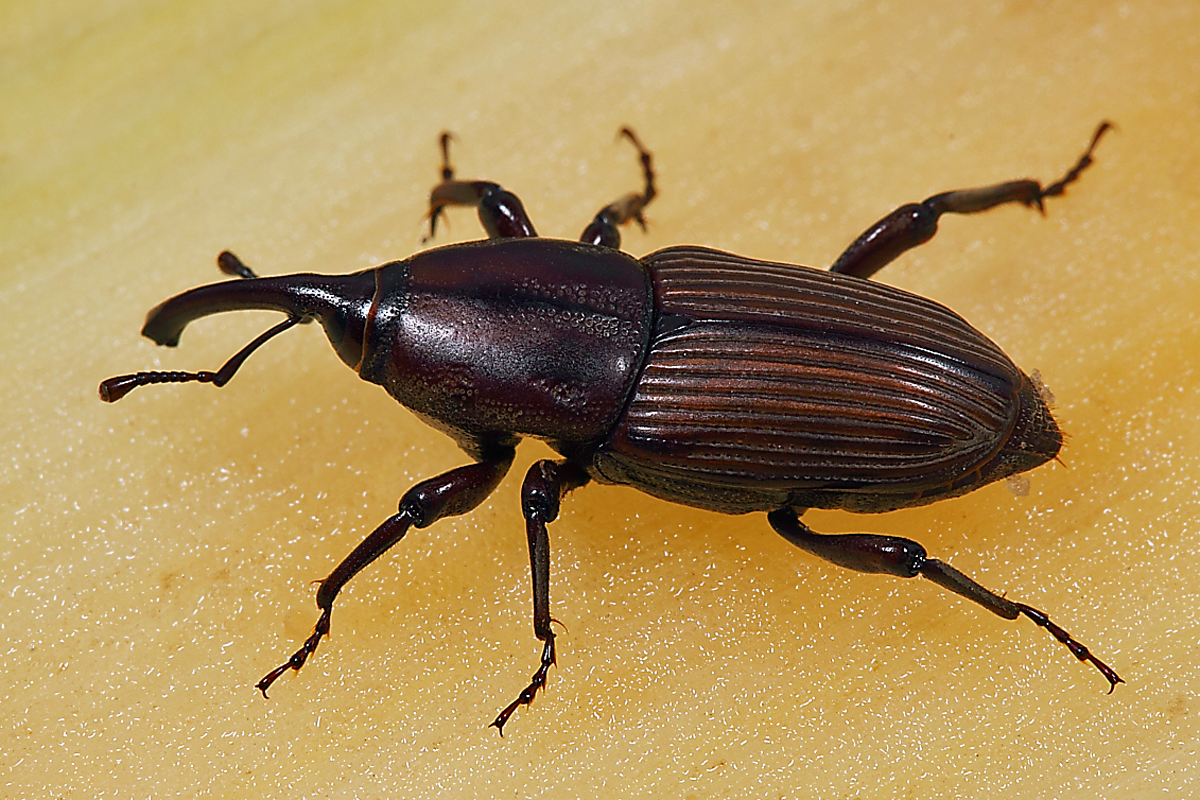
Sphenophorus levis (sugarcane weevil) | Conchal, Brazil.

Brazil is one of the world’s top producers of sugarcane, and they have the Middle East to thank for it.  While the U.S. was responding to the 1973 OPEC oil embargo by building bigger and bigger SUVs, Brazil aggressively developed an alternative fuels industry based on sugarcane for ethanol production.  Today, about half of Brazil’s sugarcane is milled for ethanol, yet despite this enough raw sugar is produced from the remaining sugarcane crop to rival India as the world’s top producer.

The large acreage devoted to sugarcane and tropical climate in which it is grown make Brazil’s crop especially vulnerable to infestation by insect pests—and there are many!  One of the most important is Sphenophorus levis (sugarcane weevil, or “bicudo da cana-de-açúcar”).  Larvae bore in the roots and crown of the plant, reducing biomass accumulation and longevity.  This feature of the insect’s biology also makes the larvae extraordinarily difficult to control, since they are largely protected from chemical applications by surrounding plant tissues.  This adult beetle was captured in a field trap placed in a sugarcane field in Conchal, approximately 175 km N of São Paulo.  The traps consist of split sugarcane stalks buried under debris within crop rows—adults are attracted to the cut surface of the stalks, where they congregate in numbers.  Traps are used not only to monitor beetle occurrence and abundance in fields, but also to provide a source of insects for laboratory rearing and evaluation of control test agents.

Copyright © Ted C. MacRae 2011

Wrong lens

During the past couple of years, as I’ve transitioned from strictly a net-wielding entomologist to one that also carries a camera, I’ve had to start making choices about whether to keep the camera in the backpack or hold it at the ready, and if the latter which lens to keep on it. They are situational decisions, influenced largely by what I’m focused on (heh!) at the time—keeping the camera in the bag facilitates collecting, but it also tends to reduce the number of subjects I deem worthy of the setup effort required to photograph them. Conversely, carrying the camera out of the bag greatly impedes collecting but results in much more photographs having been taken. Even when I do decide to carry the camera at the ready, which lens should I have on it—the 100mm for tiger beetle-sized and larger, or the 65mm for tiger beetle-sized and lower? (Annoyingly, most tiger beetles are right at that life-sized threshold, and neither lens alone allows me to float above and below 1:1 for the full range of photos I like for them. As a result, I sometimes end up with extension tubes stacked under the 100mm lens to give me some extra range above its normal 1:1 limit.) I wish there was some way to have the camera with either lens at the ready (and not impeding net swings would be even better), but that just isn’t possible. As a result, I sometimes find myself with the wrong lens on the camera when I see something I want to photograph. If it’s important, I’ll go through the trouble to switch out lenses—hopefully quickly enough to avoid losing the photographic opportunity; other times I might just decide I don’t really need the photo that badly.  Then there are times when I feel a little adventurous and will just go ahead and take the photo anyway without switching lenses.

The following is an example of the latter—an eastern fence lizard (Sceloporus undulatus) photographed with the 65mm lens (minimum magnification 1:1). Not only is this the first time that I have succeeded in approaching one of these lizards closely enough to take a good photograph, but the short working distance of the 65mm required that I get extraordinarily close. He was on the side of a fallen log, and I approached from the other side crouching low, then slowly (slowly!!!) peered over the edge of the log until I had his head in focus. I got off just this one shot, as the flash caused the lizard to bolt for good. The angle could have been better, but I got the eye focused spot-on so it’s a keeper.

Sceloporus undulatus (eastern fence lizard) | Shaw Nature Reserve, Franklin Co., Missouri

I wonder if anybody else has ever photographed a 6-inch long lizard with a 65mm lens…

Copyright © Ted C. MacRae 2011

Bichos Argentinos #7 – Naupactus xanthographus

Naupactus xanthographus (South American fruit tree weevil) | Buenos Aires, Argentina

This weevil (family Curculionidae) was one of just a few beetle species that I encountered earlier this month in Buenos Aires, Argentina at La Reserva Ecológica Costanera Sur.  Weevils are, of course, one of the most taxonomically diverse and difficult groups of Coleoptera, making species IDs based purely on photographs quite challenging.  Nevertheless, I am reasonably confident that this individual represents Naupactus xanthographus, or the South American fruit tree weevil.  This name, it seems, has also been applied to a variety of other weevils photographed in South America and posted on the web, but the images I found at a few seemingly more authoratative sites give me confidence that this is the true N. xanthographus.  The narrow form suggests this individual is a male.

The genus, known collectively as “white-fringed weevils” is a large genus of exclusively Neotropical species – several of which have been introduced to North America (e.g., N. cervinus, Fuller rose beetle, and N. leucoloma) and which were, until recently, placed in a separate genus Graphognathus (Lanteri and Marvaldi 1995) (apparently the reduced humeri and lack of metathoracic wings were deemed insufficient for generic distinction).  In South America some of the species have become pests as well, with N. xanthographus becoming a problem for growers of grapes and other fruits and, thus, earning the names “burrito de la vid” (Chile) and “mulita de la vid” (Argentina) (both roughly translating to “grapevine little donkey”).

This was not an easy photograph to get – I found the weevil clinging to the underside of a leaf above my head.  It was impossible to photograph it in situ, so I moved it to a low twig away from other foliage where I could get the black background I desired.  Once moved, however, the weevil just never… stopped… crawling.  Snapping shots of an actively crawling insect is a crap shoot at best – not only are focus and framing more difficult to nail, but subjects photographed while moving almost always have one or two “bum” legs (lifted or cocked out of position).  A number of attempts were required to get a photo I was happy with (save for the slightly clipped antennal tip).  In such situations, I’ve found it best to track the beetle as it moves and as soon as the center focus point of the lens flashes take the shot.  This at least gives the best chance for nailing the focus, and then it’s simply a numbers game to get a shot with good framing and composition and all the body parts well placed.  Of course, I could’ve zoomed out and just cropped to perfection, but this feels a little like cheating – I’d rather put in the time and practice perfecting my game out in the field as much as possible.  An occasional clipped antenna, tarsus, etc. now will lead to better results down the line.

REFERENCE:

Lanteri, A. A. and A. E. Marvaldi. 1995. Graphognathus Buchanan a new synonym of Naupactus Dejean and systematics of the N. leucoloma species group (Coleoptera: Curculionidae). Coleopterists Bulletin 49(3): 206-228.

Bichos Argentinos #6 – Jumping Spider

I photographed this jumping spider (family Salticidae) two weeks ago in Buenos Aires, Argentina at La Reserva Ecológica Costanera Sur. In gestalt it is very similar to our North American species of the genus Phidippus, but I can’t say for sure whether it actually belongs to that genus. I found it crawling on the foliage of a tree just about eye height, and I’m guessing from the muted markings and roundish shape to the abdomen that it is a female (I saw another individual later that I took to be a male of the same species – it was similarly but more boldly marked and with a much more tapered abdomen). I hope you’ll forgive my hubris, but I’m rather pleased with how these photographs turned out (although, admittedly, there were others that were not so good). In my opinion, they represent further improvement over my first two attempts at photographing jumping spiders (with the standard caveat that I am still no Thomas Shahan). These improvements involve primarily sharpness and detail but also composition, and I consider them to be largely due to lighting and learning how to handle the subject.
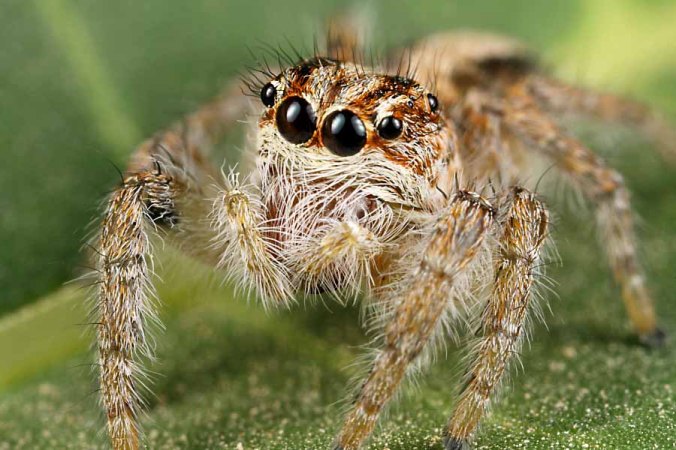
The detail in these photos results not only from proper focus, but also lighting techniques. All of these photos were taken hand-held using a Canon MP-E 65mm macro lens at f/13 with full flash lighting. Although I used an exposure setting of 1/200 sec, the actual exposure is determined strictly by the duration of the flash pulse, which is much shorter than 1/200 sec. While flash pulse duration can be set manually (and I started out doing so), I now prefer to use E-TTL mode (Evaluative Through The Lens), which adjusts the flash duration automatically based on the amount of light that the camera senses coming through the lens from a short pre-flash at the aperture chosen. The more light that is sensed, the shorter the flash pulse – the less light sensed, the longer the pulse. Obviously, with a shorter flash pulse there is less likelihood that image sharpness will be affected by movement – either by the subject or by the camera-holder. Since light intensity decreases in proportion to distance, it is desirable to get the light source as close to the subject as possible to achieve the highest intensity and, thus, shortest flash duration.

It’s not that simple, however. Most insect macrophotographers agree that diffused light gives better results than undiffused light, but no matter what diffuser one uses there will be loss of light. Loss of light leads to longer flash pulse duration and, thus, increased potential for movement during the flash pulse (especially in hand-held photography). The trick, then, is to diffuse the light as much as possible, while at the same time minimizing light loss. I continue to favor my Puffer+Sto-Fen double diffuser for use with the 65mm lens, because it places the outer diffuser almost right on top of the subject for maximal apparent light size. This is not to say that improvements still are not possible – the open-side design likely results in some loss of light, and a thin inner diffuser film to replace the Sto-Fens would probably further reduce light loss and allow for even shorter flash pulses (and probably also allow a bit more battery life). I’ll get around to effecting these improvements someday, but in the meantime the current setup is working pretty well.
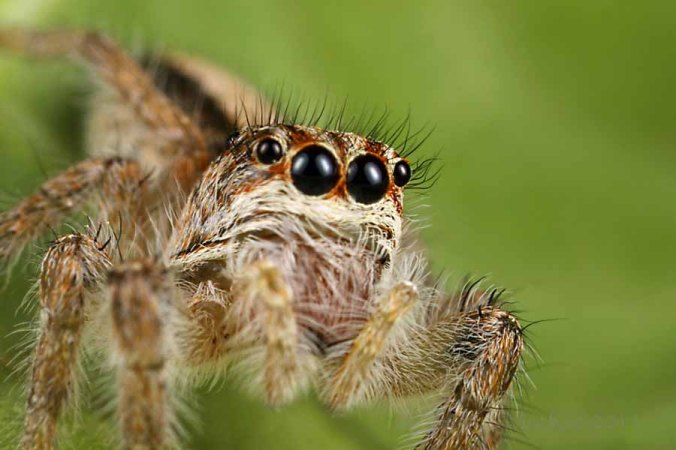
Compositionally, I like this last photo the best due to the placement of the subject within the frame (all photos are shown completely uncropped, although I’m not above doing so), its slight upward-looking pose, and the evenly-blurred light-green background. This was achieved by using my left hand to hold the leaf on which the spider was sitting and to also serve as a brace for resting the camera, which I held with the right hand. This minimizes wind-movement and fixes the distance between the subject and the lens (as long as the subject sits still!). By carefully twisting and turning the leaf as the spider moved upon it, I was able to turn the spider into the desired positions, and by paying attention to what was behind the spider I could compose a nicely colored blurred background. Understanding subject behavior was a tremendous advantage in this case, as it allowed me to predict and anticipate how the spider would move in response to my finger-prodding and leaf turning to get desirable poses. I tend to get my best compositions after I’ve worked the subject for awhile and taken several shots to learn its behavior and get it accustomed to my presences – this is reflected in the accompanying photos, which are posted in the order in which they were taken. Make no mistake – patience and practice are still required. However, it’s techniques such as these that can make the difference between good photographs and great ones!

Edit 3/30/11, 11:50am: My thanks to G. B. Edwards, Curator at the Florida State Collection of Arthropods, who just sent me the following message:

Hi Ted,
Nice photos.  Most likely it is a female “Euophrys” sutrix, which is not a Euophrys nor even a euophryine, but a freyine, so eventually will have another genus name. It is one of the larger species in the subfamily.

This species is called “aranhas papa-moscas” in southern Brazil, where it is a principal predator of fruit flies in peach orchards (Wikipedia).

Copyright © Ted C. MacRae 2011
North America’s largest scarab beetle

Dynastes tityus male - USA: Missouri, Jefferson Co., DeSoto

As one of North America’s largest, most written about, and most photographed beetles, Dynastes tityus (eastern Hercules beetle) hardly needs an introduction.  I photographed this male specimen from my collection back in December while testing my DIY diffuser for the MT-24EX twin flash and 100mm macro lens.  It’s a good test subject for such – its glossy exoskeleton may be beauty to the eye but is the bane of flash photographers, and its nearly 60mm of length demand a huge subject-to-lens distance that gives even the largest lens-mounted flash a small apparent size.  Nevertheless, the diffuser did a pretty good job of creating even illumination and preventing harsh specular highlights, giving almost the effect of an indirect strobe in a white box.

Dense setae adorn the underside of the thoracic horn of the male.

I hadn’t really noticed until I took the photos the dense adornment of setae (hairs) on the underside of the thoracic horn.  While setae in insects most often perform a tactile function, the density and placement on the horns of the males of these beetles makes me wonder if they might serve more of a display function.

Despite the overwhelming popularity of this beetle amongst hobbyist breeders and its widespread occurrence across the eastern United States (and the internet), it is not one that I have encountered with much frequency myself.  I suspect this is due to the position of Missouri near its western limit of distribution – likely a function of the species’ preference for moist treehole cavities with rotting wood in which the larvae can develop.  This particular specimen was given to me many years ago by a nursery grower in Jefferson Co. during my first job out of graduate school – before I’d ever found one myself, but since then I’ve encountered perhaps half a dozen or so at blacklights in mesic forests across the eastern Ozark Highlands.  Most recently (last summer) I found a female sitting on my driveway, apparently attracted to the mercury vapor lamp above the garage that I leave on occasionally during the months of June and July just for such purpose.

Copyright © Ted C. MacRae 2011
Frenatae 2011 Calendar

Ralph Holzenthal - Tabanidae. Adobe Illustrator, gradient mesh/Adobe Photoshop.

Even though we’re now in the latter part of February, I wanted to spread the word about a cool insect-themed calendar shown to me by a colleague during my recent trip to Brazil. Produced by Frenatae, the Graduate Student Entomology Club at the University of Minnesota, the calendar features original work by students using computer illustration techniques taught in a UMN course titled, ENT 5051, Scientific Illustration of Insects. The mastermind behind this course is Dr. Ralph W. Holzenthal, who – as can be seen by the stunning image above of a female (L) and male (R) Tabanus lineola – knows a thing or two about insect illustration! While the course covers traditional techniques such as pen & ink, pencil, watercolor, etc., its major emphasis is on computer-assisted techniques using Adobe Illustrator® and Photoshop®. This includes instruction on preparing full habitus color illustrations of insects on the computer. How I wish a course such as this had been available when I was in graduate school (of course, how I wish computers had been available when I was in graduate school!).

While Dr. Holzenthal’s illustrative skills are obvious, it’s also clear that he excels at teaching these skills to his students, as evidenced by this selection of my favorite images (not surprisingly, all beetles!) from the course website galleries:

Caitlin Krueger - Scarabaeidae

Martha Megarry - Scarabaeidae

Heather Cummins - Zopheridae

.
It should be pointed out that all of these Photoshop illustrations represent original artwork and not modified photographs!

I ordered my copy of the calendar as soon as I returned home from my trip. You can order one too by sending a check for $12 to the following address:

Frenatae
1980 Folwell Ave Rm 219
St Paul, MN 55108

My thanks to Dr. Holzenthal for allowing me to post this small selection of images from his website.

Copyright © Ted C. MacRae 2011