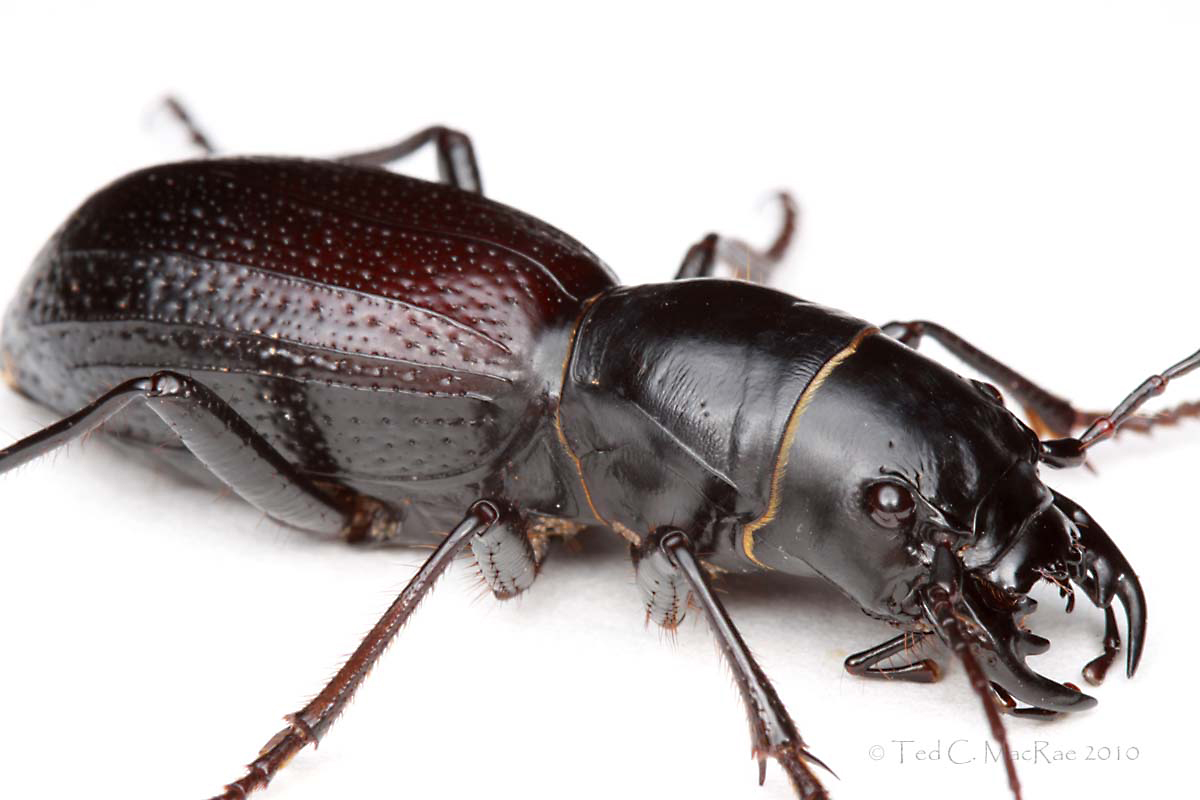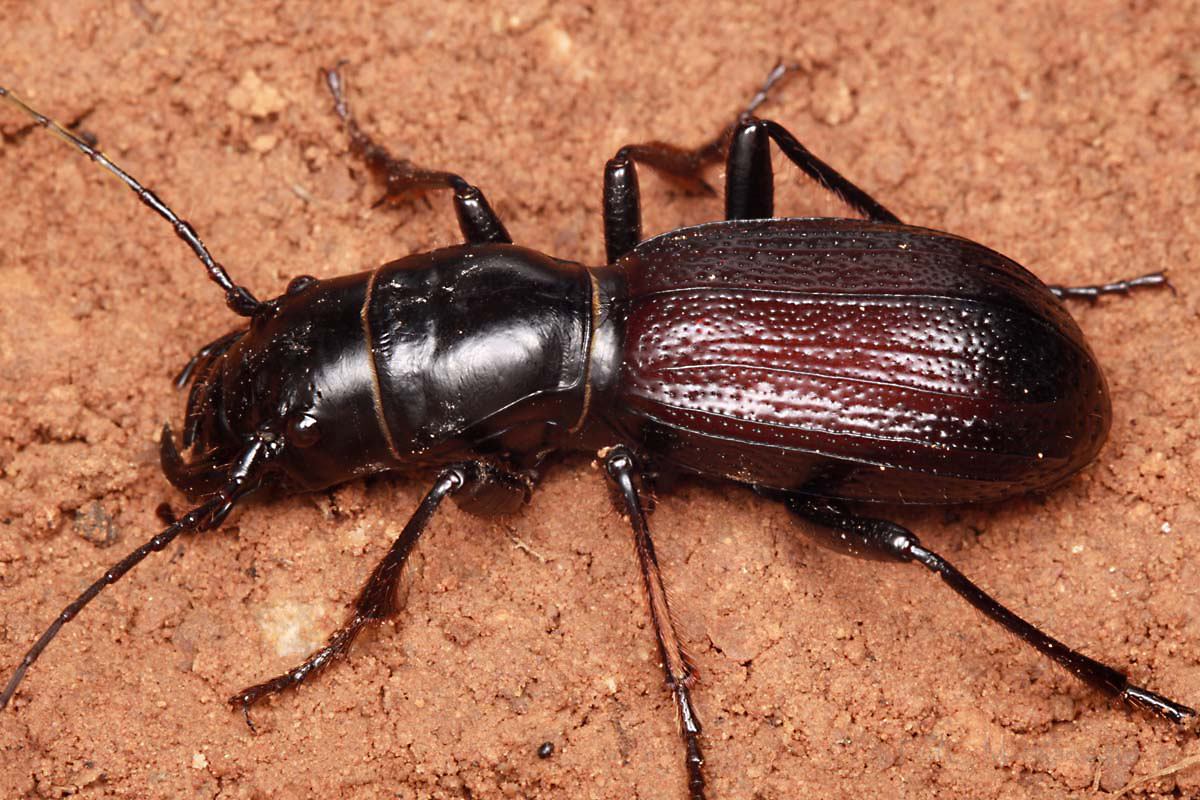
North America’s largest stag beetle


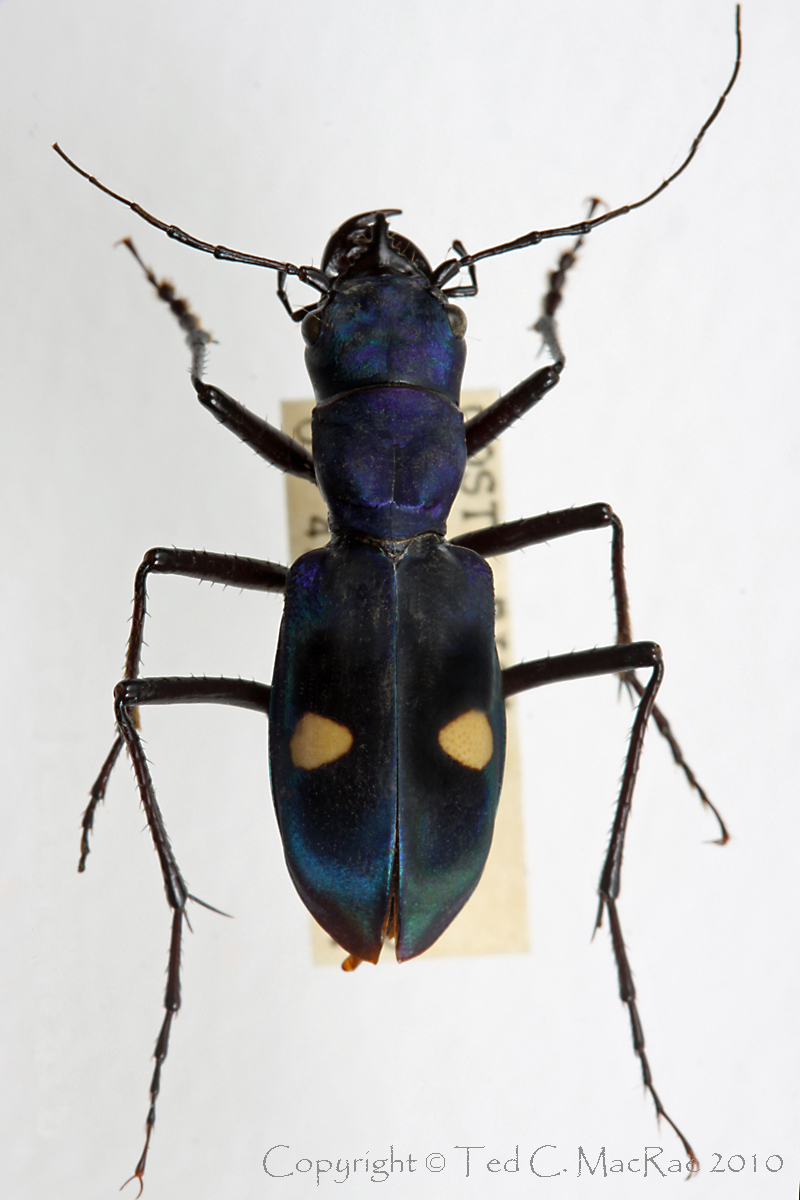
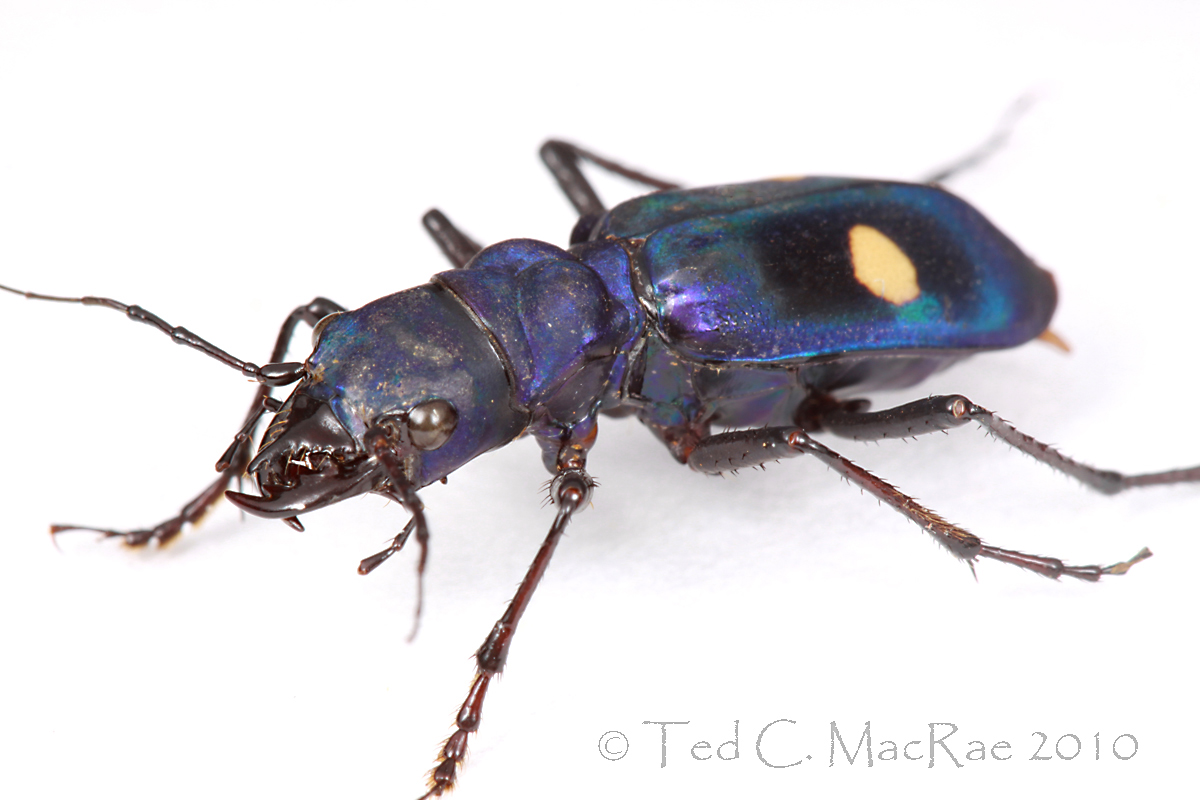
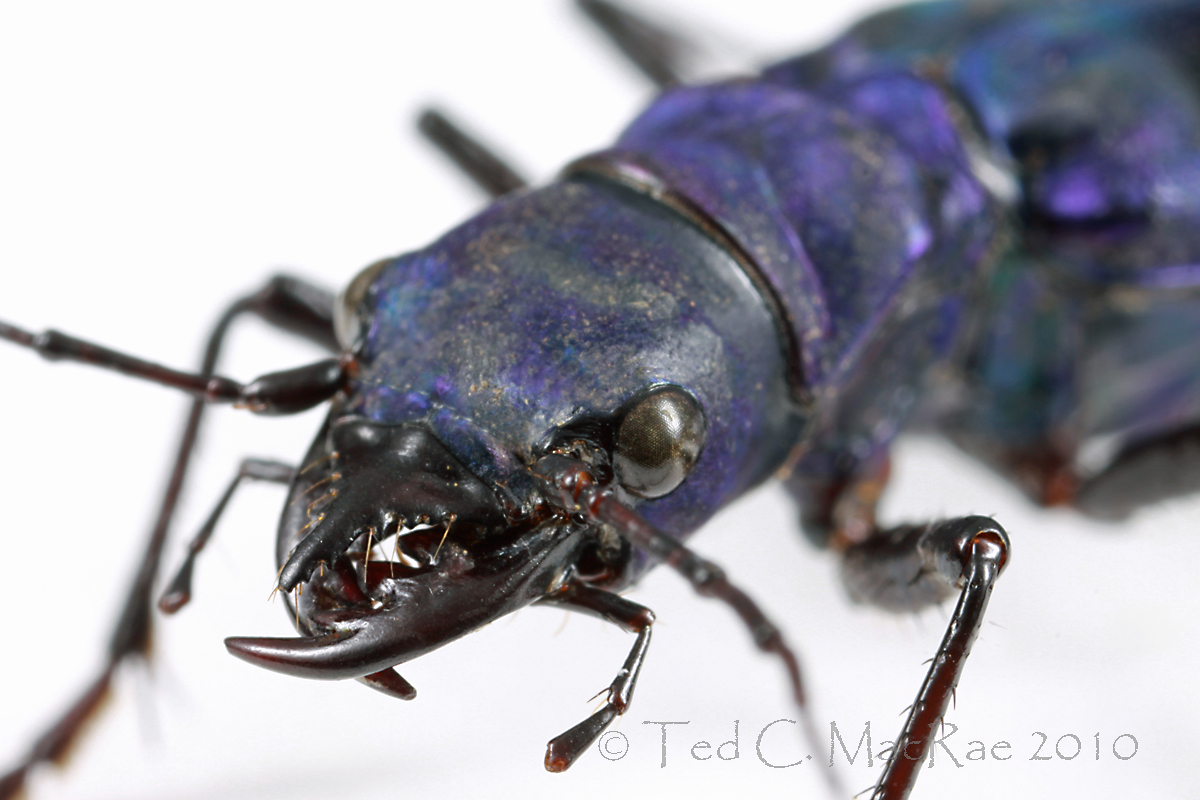
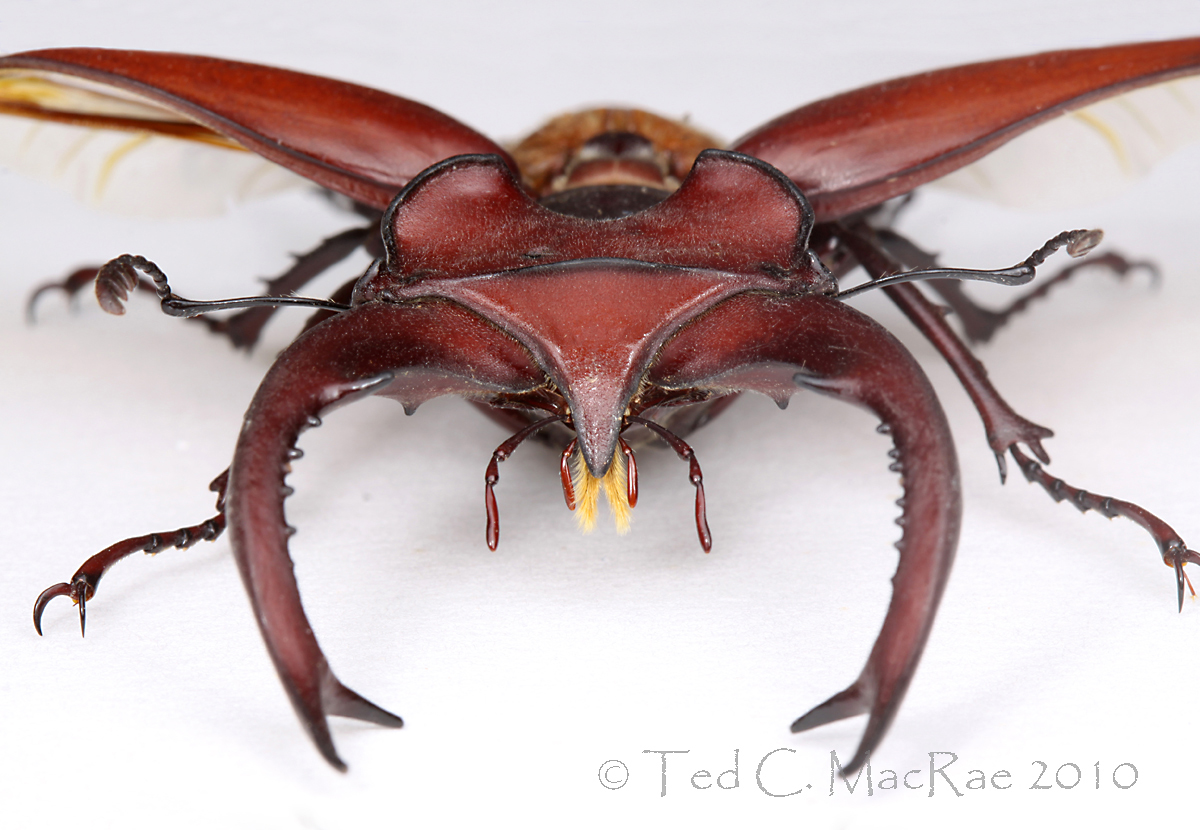
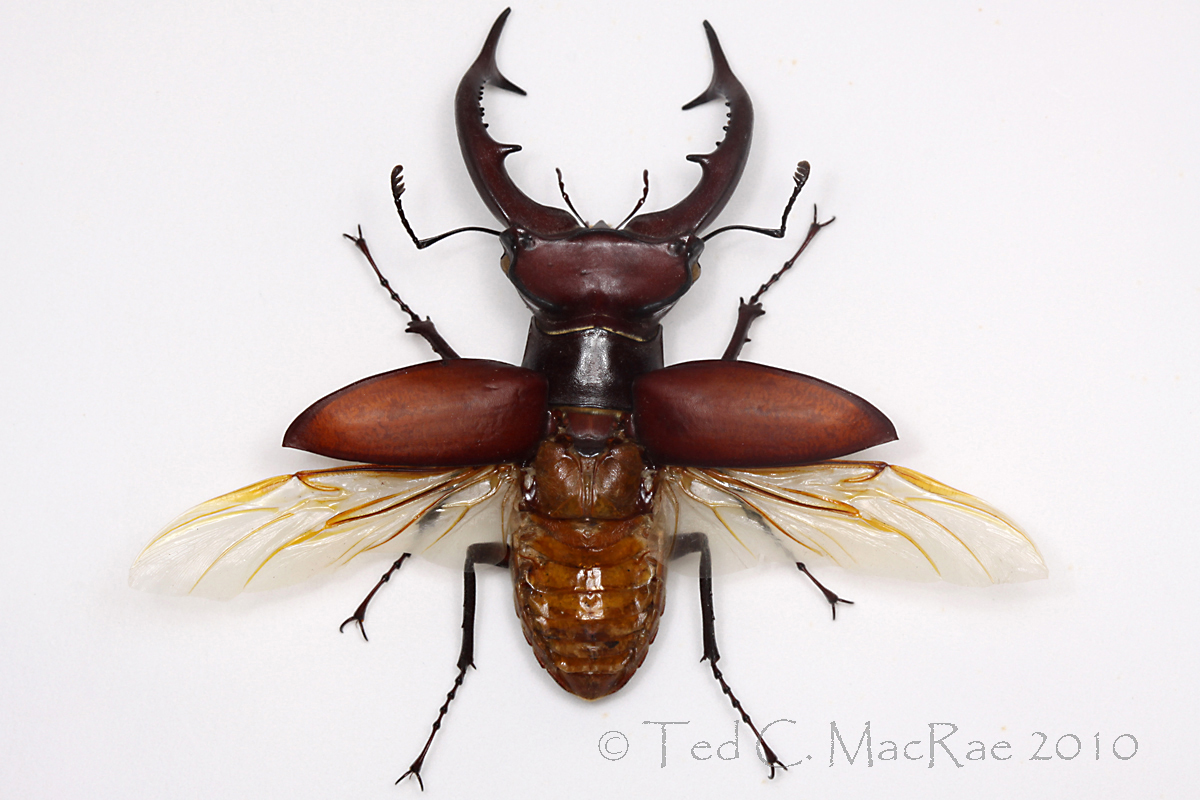
Here is the full-sized photo that provided the image for yesterday’s Super Crop Challenge #3.  The insect in the photo is, of course, a fine example of a male Lucanus elaphus – the giant stag beetle (family Lucanidae).  This striking insect is easily among North America’s most distinctive and recognizable species by virtue of the enormously super-sized mandibles sported by the males.  Its fearsome appearance belies the true nature of this harmless beetle, which spends its days feeding on sap that flows from wounds on the trunks and roots of trees.  Males use their massive mandibles in combat with other males, not for “biting,” but rather as tools to pry and lift their adversaries before dropping them to the ground.  Some marvelous photos of this behavior in a related European species can be seen at Stag Beetles Lucanus cervus Mating Behaviour.
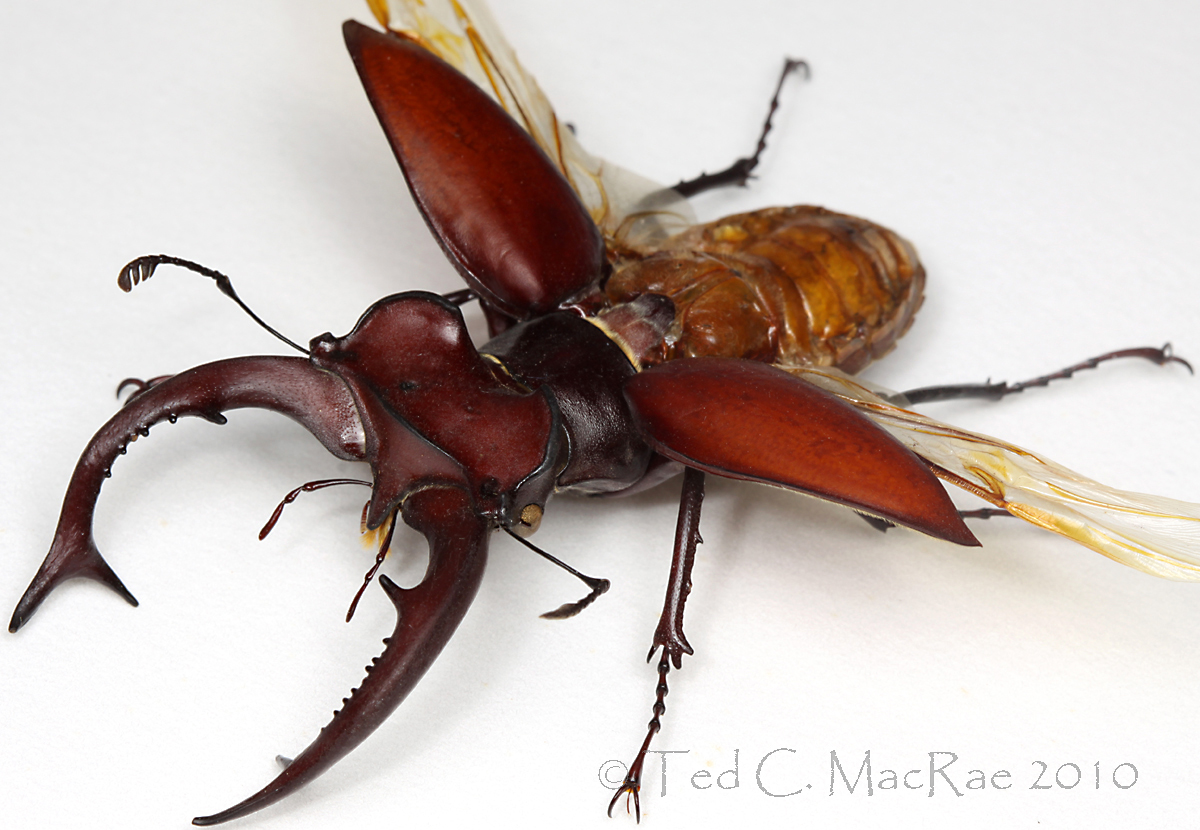
I collected this specimen many years ago at an ultraviolet light (“blacklight”) that I had setup in the pine/oak forests at Pinewoods Lake, Carter Co., in the southeastern Ozarks – one of my favorite 1980’s beetle collecting spots.  This was in my early days of studying beetles, during which time I was actively collecting material as part of my statewide surveys for the families Buprestidae (MacRae 1991) and Cerambycidae (MacRae 1994).  Lucanus elaphus is not a commonly encountered species, especially in the western reaches of its distribution here in Missouri, and I’ll never forget my rabid excitement when I encountered this fine major male at my blacklight sheet.  For many years afterward it remained the only individual that I had ever encountered, until a few years ago when I came across a group of two males and one female feeding on a sap flow in a wet bottomland forest along the Mississippi River in the lowlands of southeastern Missouri.  I encountered another male the following year at a nearby location “rafting” on debris in floodwaters from the nearby river, and two weeks later at that same site I picked up several males and females in a fermenting bait trap.¹  Like most “uncommon” species with broad distribution across the eastern U.S., I suspect that its apparent rarity is an artifact due to habits that make it infrequently encountered rather than being truely scarce.

¹ I have used fermenting bait traps to collect a wide variety of beetles, but especially longhorned beetles.  My recipe is based on that described by Champlain and Knull (1932) – bring 12 oz. dark molasses and 12 oz. beer up to 1 gal. with water, mix well and add a packet of dry baker’s yeast to get the fermentation started.  Hang a 1/2-gallon milk jug with big holes cut in the sides in a tree along the edge of a woods and add ~1 quart of fresh liquid.  It generally takes 2-3 days for the liquid to really start fermenting and become attractive, and it will remain so for about another week or so.  Check traps every 2-3 days by pouring the liquid through a kitchen strainer into another container – reuse or replace as necesssary. Place the collected specimens in vials of water to wash off the molasses residues, and either pin immediately afterward or transfer to 70% ethanol for longer term storage.  Some of the more desireable species I’ve collected in this manner, besides L. elaphus, are Plinthocoelium suaveolens, Purpuricenus axillaris, P. humeralis, P. paraxillaris, Stenocorus cylindricollis, S. shaumii, Sarosesthes fulminans, Stenelytrana emarginata [= Leptura emarginata], and S. gigas [= Leptura gigas].

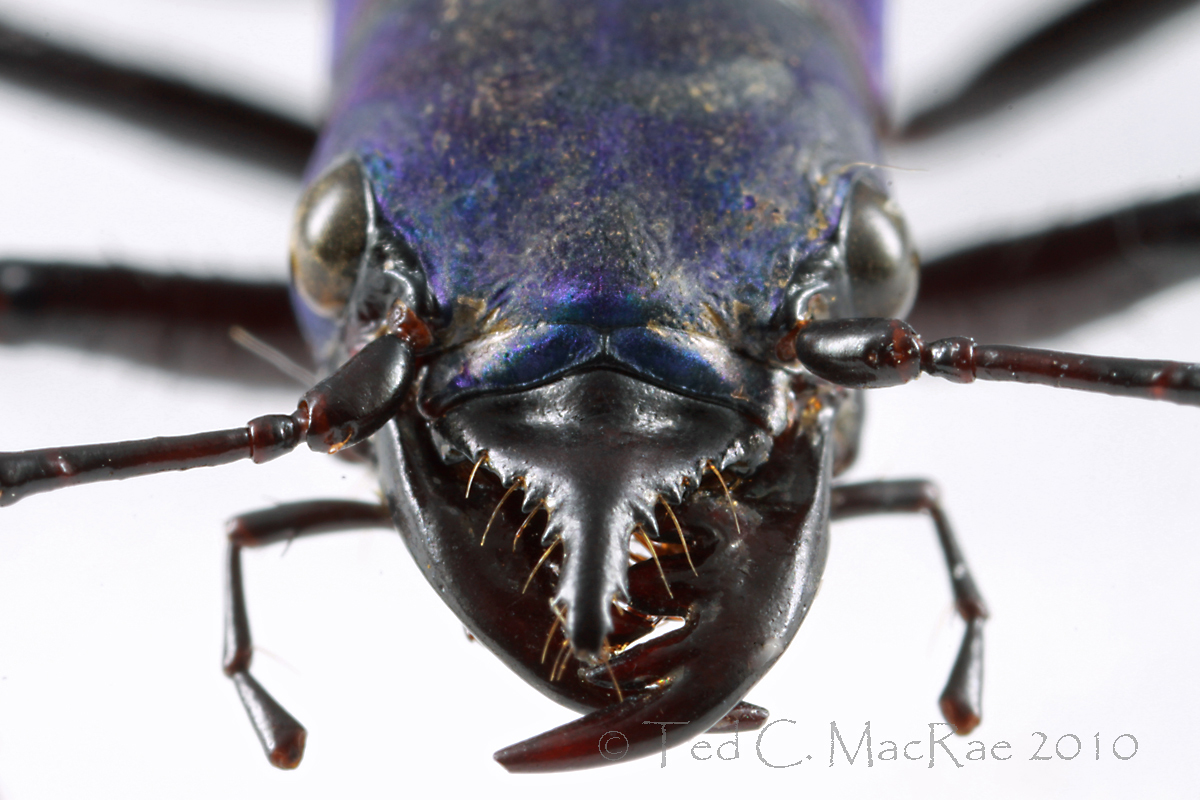
Congratulations to Ben Coulter and Janet Creamer, both of whom correctly identified the species and most of the mouthparts.  Each earned 14 pts and, thus, tied for the win, while JasonC. earned 5 pts. to take the final podium spot.  The pointed structure is the labrum (its shape distinguishing it from other North American species of the genus), and it is flanked on each side by the fuzzy yellow galeae (derived from the maxillae) and the labial palps.  Nobody correctly named the galeae, which seem to be greatly elongated and hairy in stag beetles as a function of their sap feeding behavior.  A portion of the left maxillary palpus can also be seen in the corner of the photograph, but nobody scored those points either.  Brady Richards just missed the podium, but his witty reference to Gene Shalit (if not immediately picked up on by me) earns him an honorable mention.

With points being formally awarded now beginning with the previous competition (ID Challenge #1), I’ll start keeping an overall leaders board, and with wins in both competitions Ben takes a commanding lead in the overalls with 23 pts, followed by Janet Creamer at 14 pts and TGIQ at 8 pts.  I guess I should start thinking of some sort of tangible prize for winners periodically – suggestions welcome.  Stay tuned for another issue of Super Crop Challenge or ID Challenge in the near future.

REFERENCES:

Champlain, A. B. and J. N. Knull.  1932. Fermenting bait traps for trapping Elateridae and Cerambycidae (Coleop.).  Entomological News 43(10):253–257.

MacRae, T. C. 1991. The Buprestidae (Coleoptera) of Missouri.  Insecta Mundi 5(2):101–126.

MacRae, T. C. 1994. Annotated checklist of the longhorned beetles (Coleoptera: Cerambycidae and Disteniidae) known to occur in Missouri. Insecta Mundi 7(4) (1993):223–252.

Copyright © Ted C. MacRae 2010
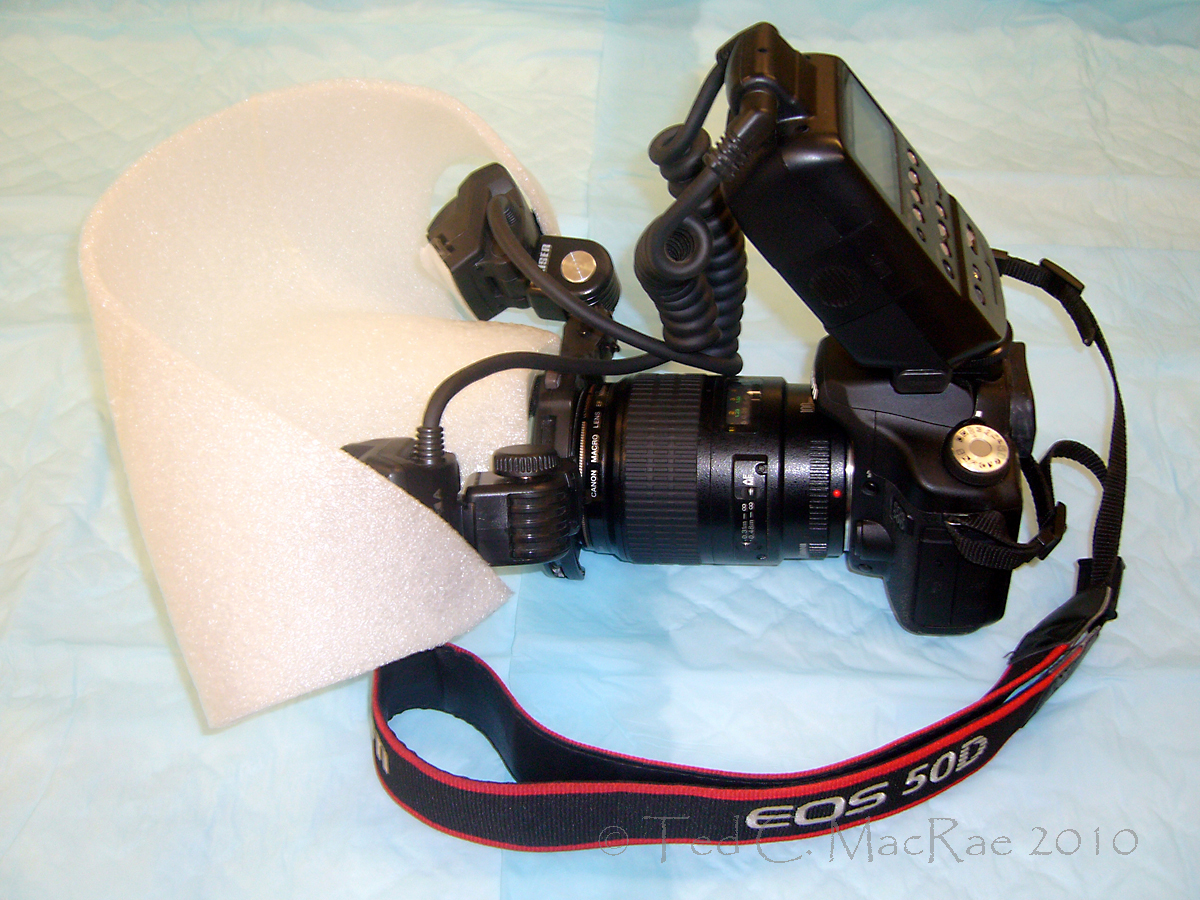
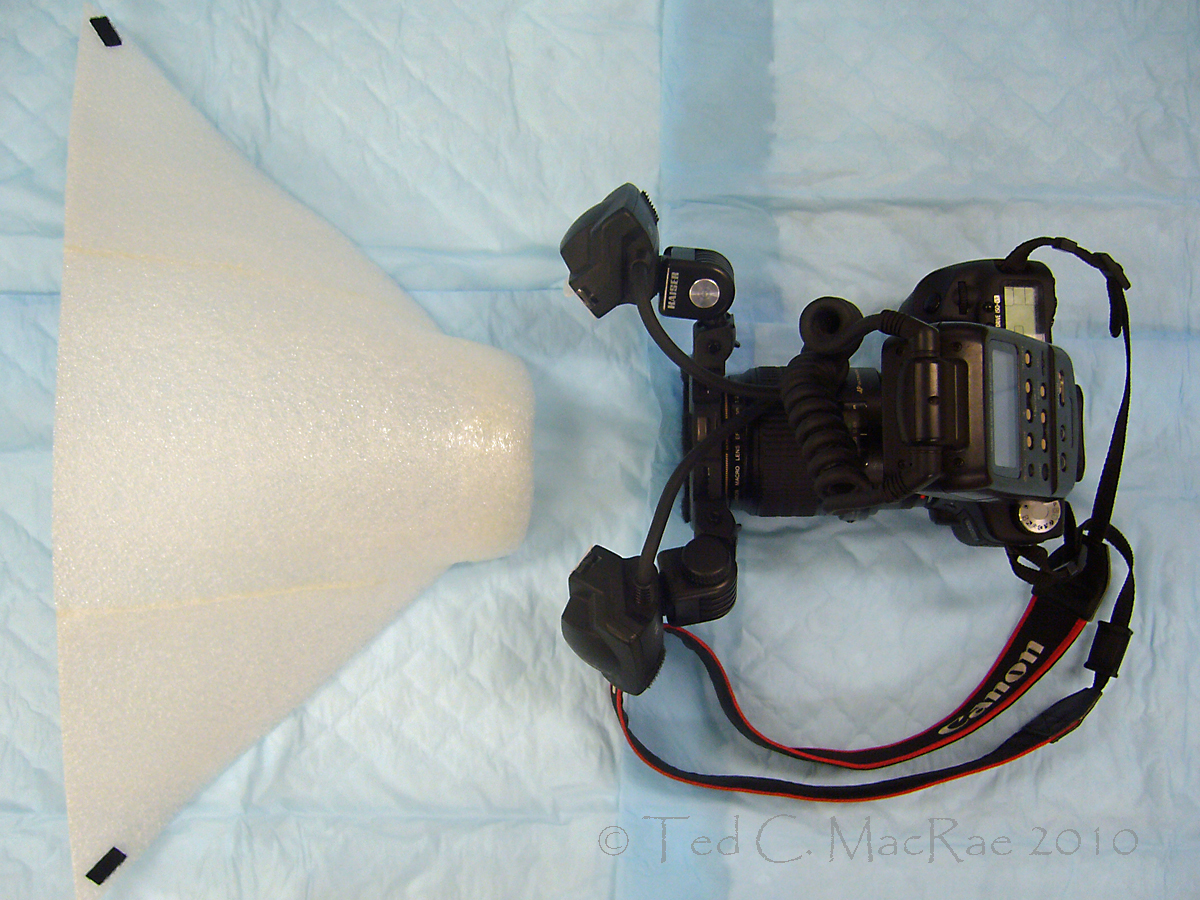
My MT-24EX flash diffuser

When I purchased my insect macrophotography rig two summers ago, I already knew that one of the biggest challenges I would face (besides a steep learning curve) was lighting.  While it is possible to do insect macrophotography using only natural light, this generally requires the use of a tripod and reflector for all but the largest of insects.  Unfortunately, such devices aren’t very practical for field photographs of the tiger beetles that I have come to enjoy stalking (and I already have enough to carry as it is without adding such incumbrances).  Supplemental flash lighting is a more attractive alternative for me – not only does it minimize the amount of equipment I must carry, but the high shutter speeds and small apertures it allows are perfect for ‘freezing’ subjects prone to quick movements while maintaining good depth-of-field. There are many flash units to choose from, but I went with the Canon MT-24EX Macro Twin Lite Flash for its dual light sources (eliminating the “flatness” of a traditional ring flash) and lightweight, front-of-lens mounted bracket (no need for heavy bracket extenders).  Combined with Canon’s 100mm f/2.8 (up to 1X magnification) or MP-E 65mm (1-5X magnification) macro lens, this flash unit has become quite popular in recent years for insect macrophotography. 

The problem with flash, of course, is the harsh, unnatural light that it produces.  With natural lighting, illumination comes from all directions, while with flash it is essentially unidirectional.  This is especially problematic with beetles, many of which have a smooth, shiny integument that reflects the flash to produce strong specular highlights.  Diffusion and maximizing the apparent size of the light source are key to achieving good results with flash units, and a variety of diffusers are commonly used to achieve this. Unfortunately, the small size of the MT-24EX flash heads and their placement at the front of the lens creates some unique challenges for diffusing their light.  The only commercially available diffusers for the MT-24EX (that I’m aware of) are the Stofen OM-24XSET, which are translucent plastic caps that fit over the unit heads.  I used these during my first season of photography, and while better than nothing they still leave much to be desired.  The problem is that they do nothing to increase the apparent size of the light source, and it is an even worse problem with the 100mm lens than the 65mm because of its longer working distance.  Much better results have been achieved by Kurt (Up Close with Nature) with his concave foam diffuser and Alex (Myrmecos) with his tracing paper diffuser.  Unfortunately, these diffusers only work with short focal length lenses such as the 65mm, while it is the 100mm lens that I use most often for tiger beetles (1.0-1.5X range).  For most of this past season, I tried a Gary Fong Puffer + Sto-Fen combo diffuser based on an idea by Dalantech, but again that setup seemed only slightly better than Sto-Fens alone with the 100mm.  As the season progressed, I continued to mull over various contraptions and ideas to extend the flash heads out in front of the lens to increase apparent light size.  Most of those ideas were expensive and bulky, but at the end of the season I came up with an idea that seemed like it might work and went with it.  The following photographs are the first iteration of that idea.

Canon MT-24EX flash and 100mm macro lens with DIY oversized concave diffuser.

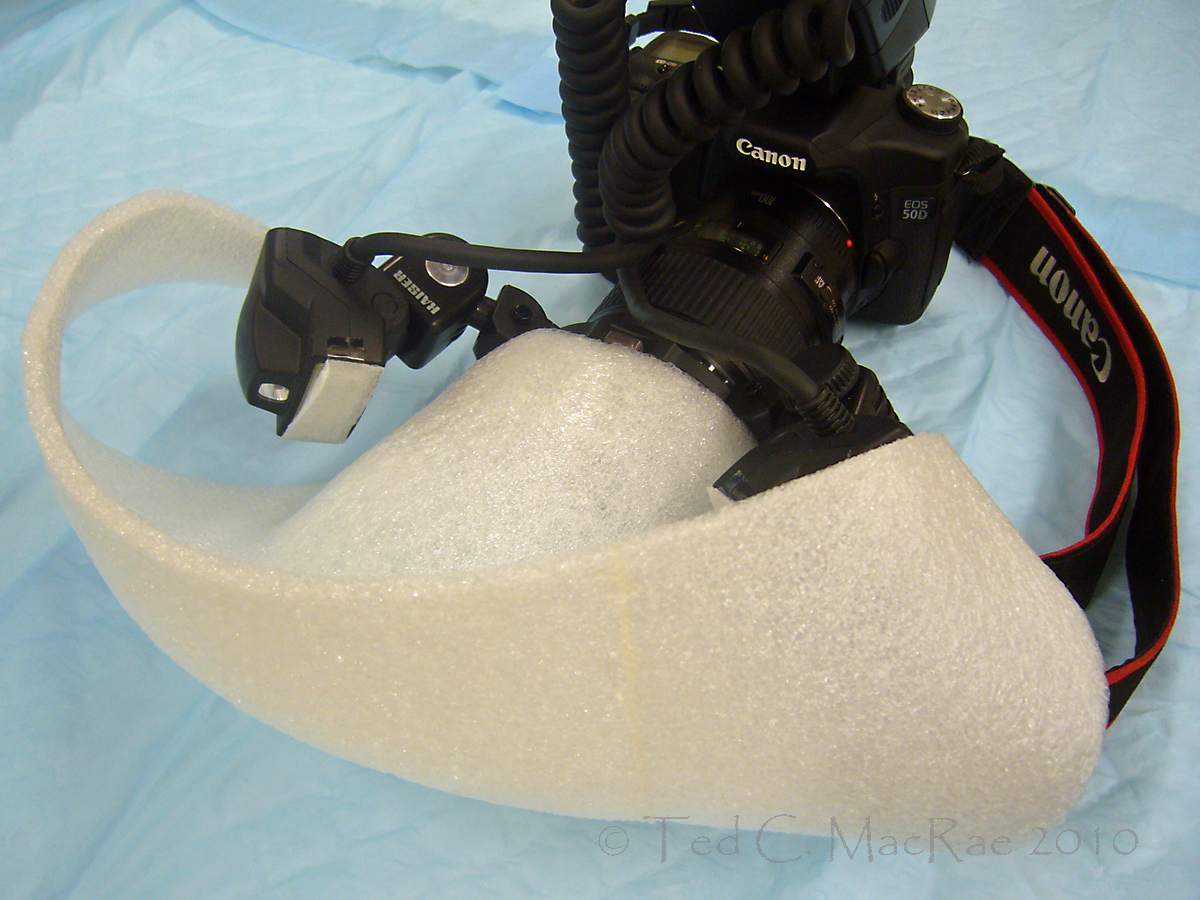
The diffuser is a larger version of Kurt’s do-it-yourself (DIY) concave diffuser.  It uses thick polypropylene foam (used as padding in cardboard shipping boxes) that is sturdy enough to hold its shape but flexible enough to curl back and over the top of the flash heads, essentially forming a large “soft box” in front of both flash heads.

Diffuser is ultralight and lays almost flat when not installed - easily carried in camera backpack.

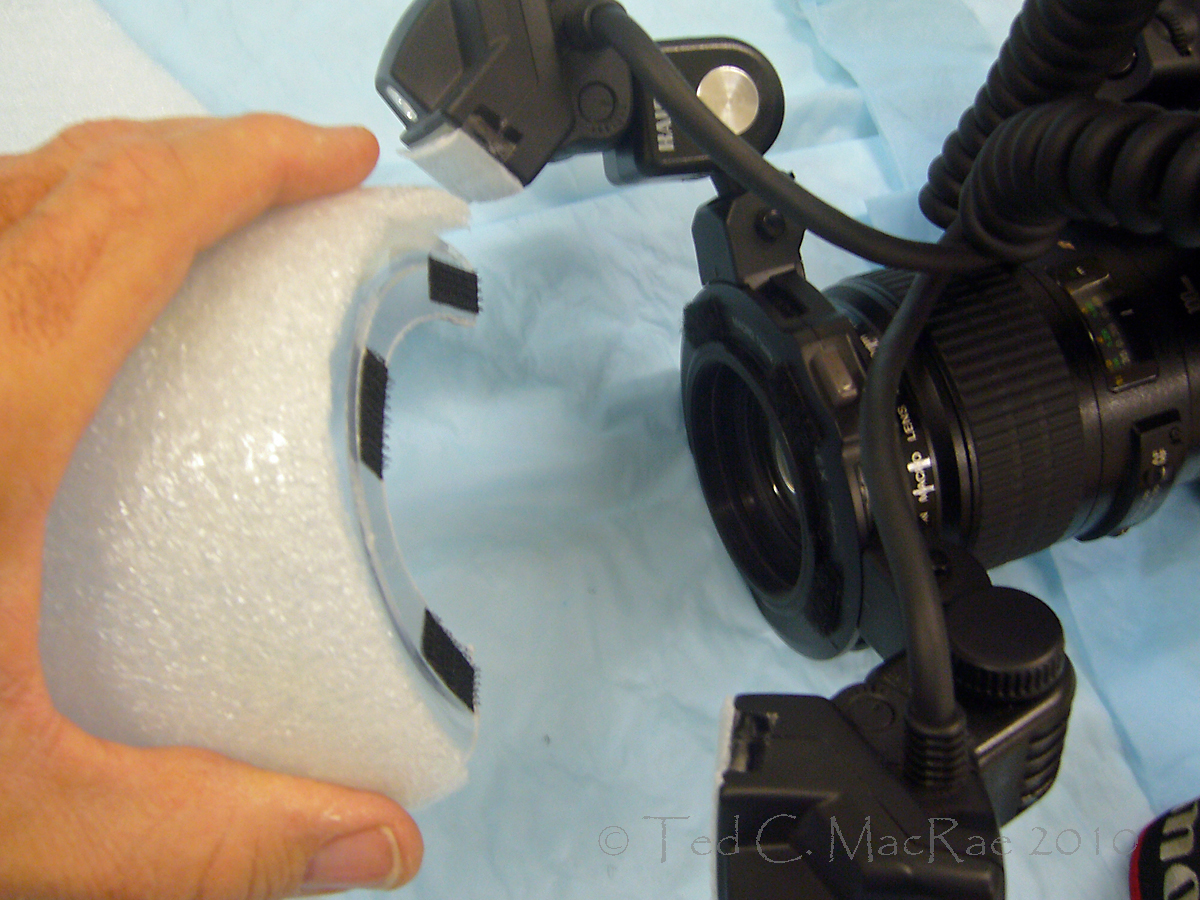
I cut the bottom inch off of a a 1,000-mL polypropylene beaker (the prototype used a 500-mL beaker, but that was too small).  I then cut the center out of the beaker bottom so that the hole size matched the lens opening of the flash head bracket, and then cut the beaker bottom in half.  This forms a sturdy but translucent, semi-circular frame to hold the polypropylene foam against the flash head bracket on the front of the lens.  The piece of foam measures 21″ (front) x 7″ (back) x 9″ (front to back) and is attached to the polypropylene frame using hot glue.

Flash heads extended forward w/ Kaiser shoes. Thin polypropylene foam layer taped over flash head.

I also used Kaiser shoes to extend the flash heads a little further forward in front of the lens, and I taped a small piece of thin polypropylene foam over front of each flash head to provide some initial diffusion.  This helps to increase the apparent light size by reducing the distance between the flash heads and the subject.  I snugged the pivot screw on the Kaiser shoes just enough to hold the flash head in place but still allow me to adjust their aim.

Diffuser attaches to front of flash bracket using Velcro strips.

The diffuser frame is attached to the front of the flash head bracket using pieces of Velcro strips.  It’s not a tight, sturdy connection, but so far I have not had any problems with the diffuser falling off.  This system allows me to quickly and easily switch out similar diffusers of different sizes (I have a smaller one that I made for the 65mm lens).

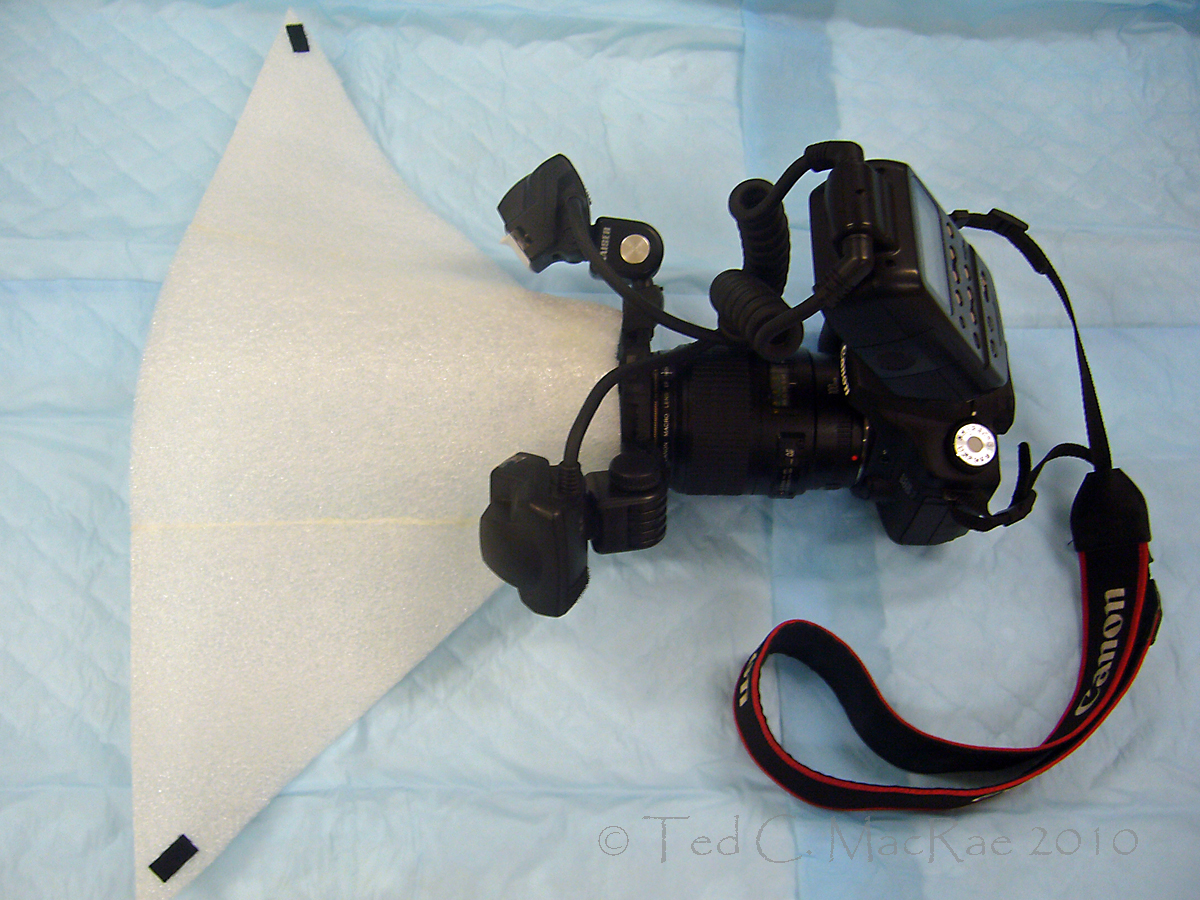
Diffuser attached to flash bracket.

Diffuser is curled back and corners attached to back of flash heads using Velcro.

Pieces of Velcro strip are also attached the corners of the diffuser and the back of the flash heads to hold the diffuser foam in position after attaching the bracket to the flash head bracket.

Diffuser in position and ready for use.

Diffuser remains properly positioned regardless of flash head position or lens changes.

I have since added additional Velcro strips along the front edge of the foam to allow it to be pulled back closer to the flash heads, depending on the distance to subject. 

One nice thing about this diffuser is that it does also work with the 65mm lens as long as there is nothing to get in the way of the diffuser.  It is simply a matter of angling the flash heads back closer to the lens and adjusting their aim according to the subject distance, then pulling the foam layer back closer toward them.  Or, just swap out with a smaller version.  When detached, the diffuser can be folded to lay flat in the backpack.

Of course, the proof is in the pudding, and none of this means anything if it doesn’t actually do the job.  I’m now immersed in the depths of a Midwestern winter, so I haven’t yet had a chance to test the diffuser in the field.  I have, however, done a fair amount of testing here in the laboratory using both live and dead insects and have been quite pleased with the results so far.  Those photographs can be seen in the following posts.  This coming season I’ll put it to the test in the field to see if it actually has the usability and durability that I have hoping for.

Copyright © Ted C. MacRae 2010
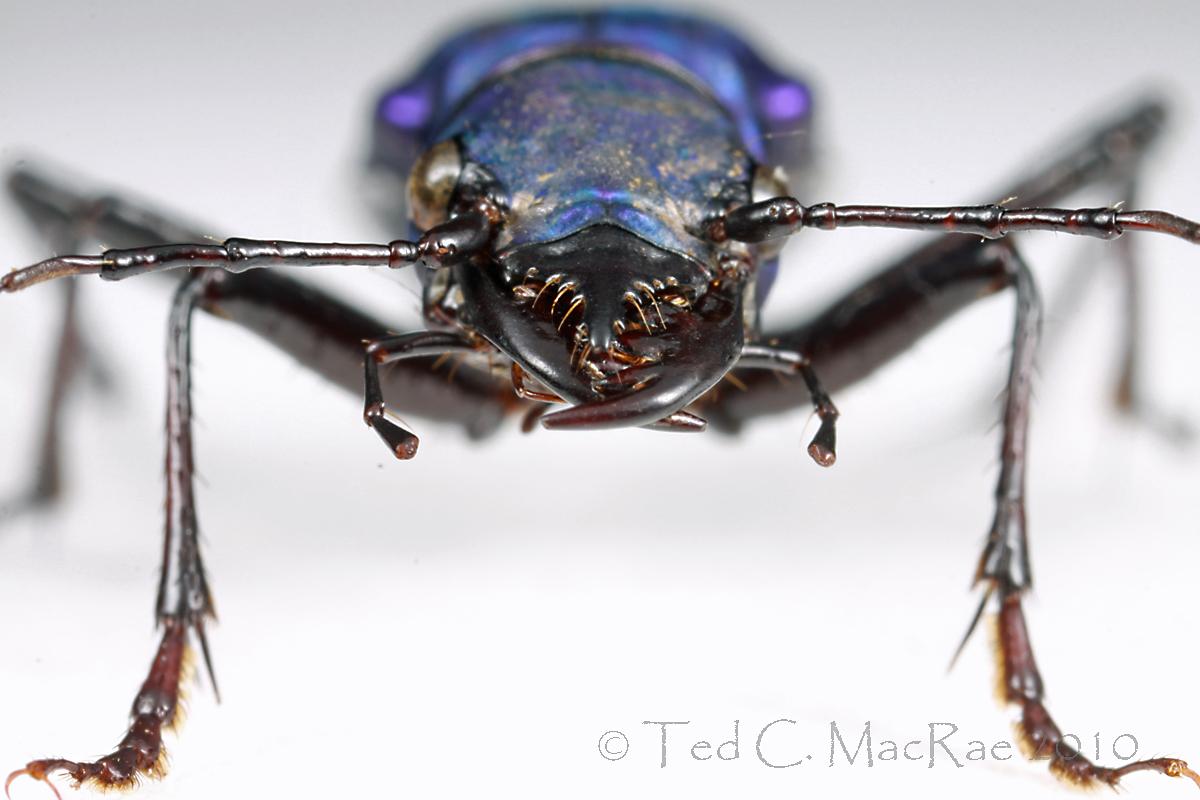
Pseudoxycheila tarsalis – remounted

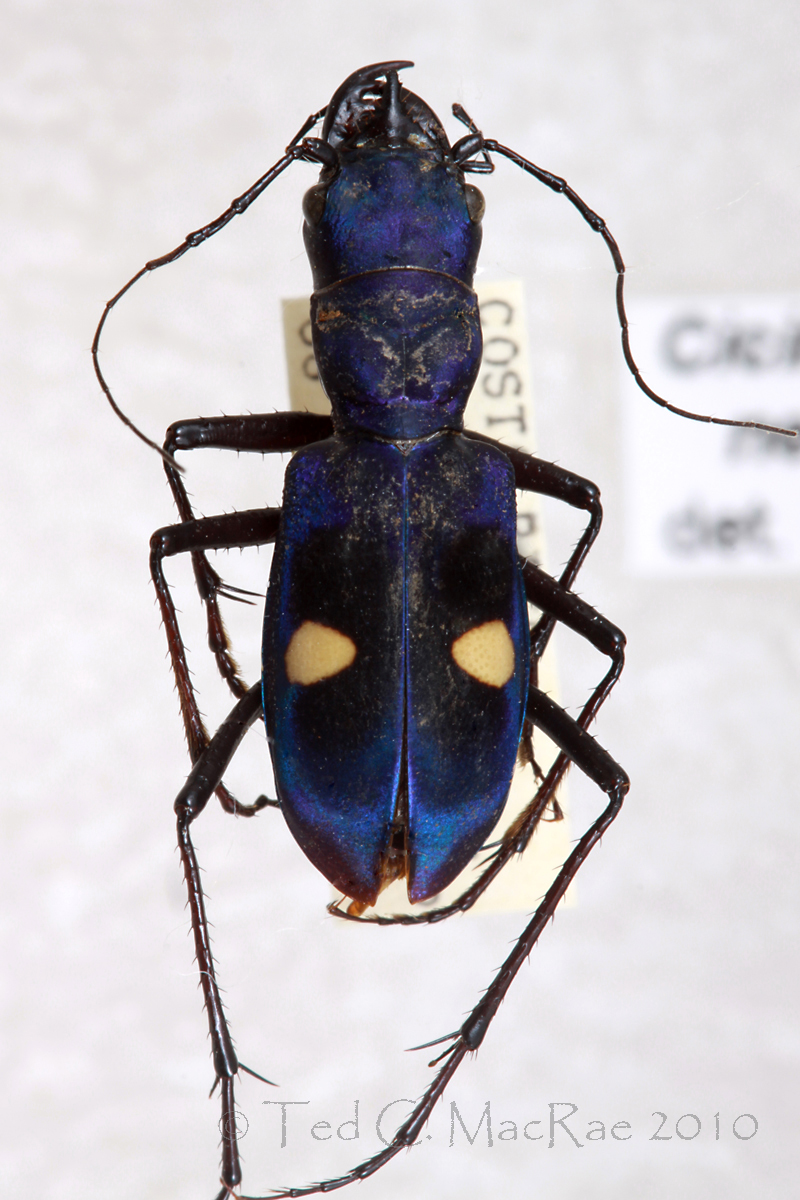
Pseudoxycheila tarsalis (Central American montane tiger beetle) | specimen ex. Costa Rica.

I tend to be a minimalist when it comes to mounting beetles. That is, I mount them so that they take up minimal space – legs tucked neatly and symmetrically against each side of the body and antennae laid straight alongside each elytron. This is important not only for space considerations (always a premium, but especially so in a private collection), but also to minimize the chances of accidental breakage when handling specimens. I must admit that beetles mounted in such manner don’t have quite the visual appeal of beetles mounted in a more relaxed, life-like position, but the ability to pack them tightly in my limited drawer space generally overrides whatever aesthetic desires I may have. Every now and then, however, I come across a specimen that just begs to be mounted life-like due to its striking appearance or impressive structures. Pseudoxycheila tarsalis (Central American montane tiger beetle), which I recently received as a gift from Henry Hespenheide, is one such species.

Remounting a dry, already-mounted beetle is a little trickier than mounting a fresh specimen. The beetle must first be relaxed, and even when relaxed well the beetle is never as pliable as when fresh. This makes it more difficult to get the legs and antennae into the desired position, and there is always a higher risk of breakage while trying to do so. Many different methods for relaxing beetles are available – some better than others, but for a one-off specimen I usually just soak it in very warm tap water. Generally 15-20 minutes will suffice, although large specimens may require more than this. Soaking has the added benefit of softening whatever debris might be caked onto the beetle so that it can be removed more easily. In this case, once the beetle was relaxed I used forceps to hold the specimen by the pin to keep it submerged in the water while “scrubbing” its upper surface with a camel-hair brush. Younger eyes might be able to do this unaided, but I find a binocular dissecting scope at low power to be quite helpful.

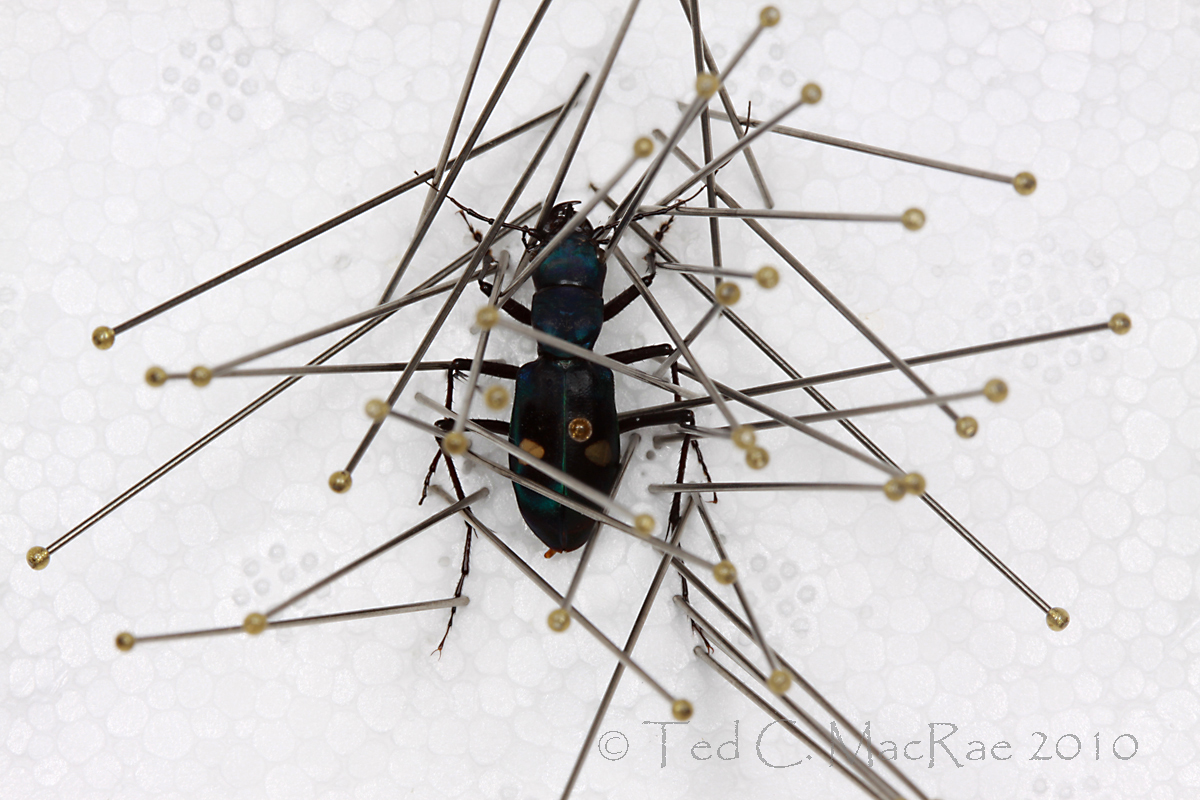
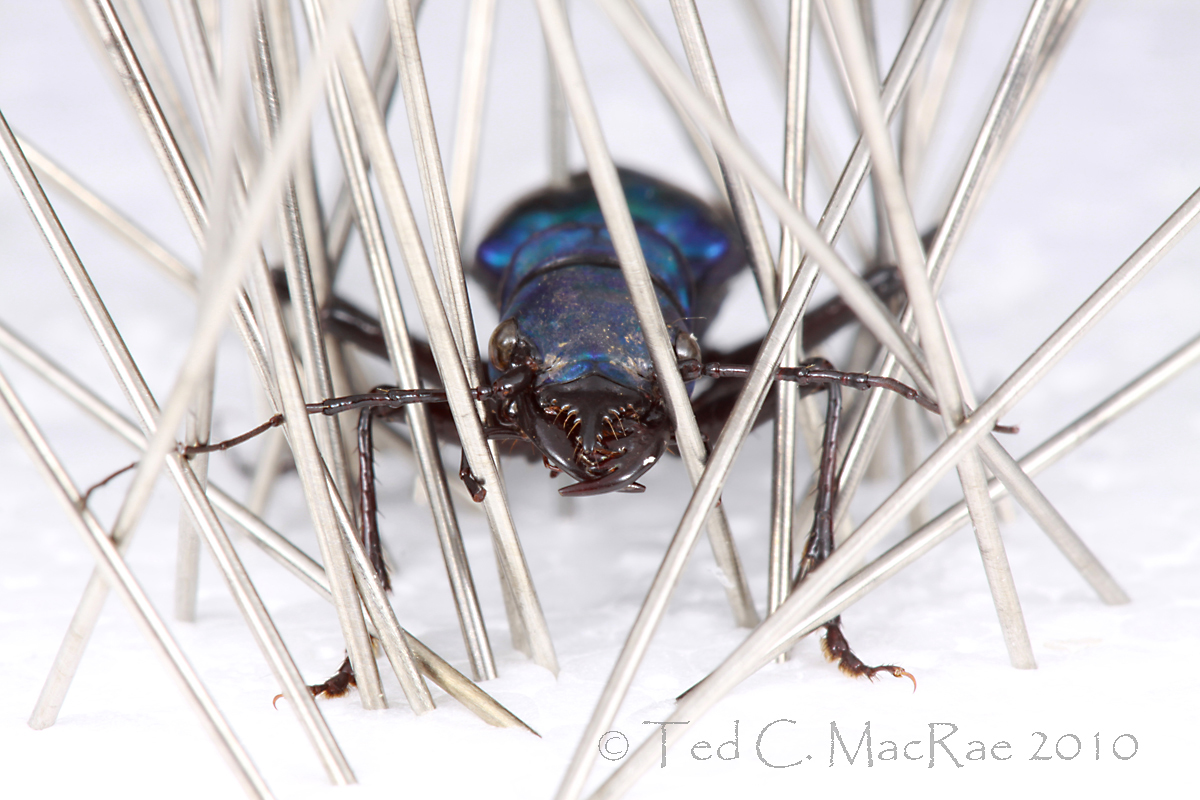
Once clean, I inserted the pin into a styrofoam block for positioning of the body parts. Since this specimen was to be posed in a life-like position, I didn’t insert the pin all the way, but rather left the body up off the styrofoam as it would be in life. Also, my favorite tiger beetle pose is slightly elevated on the front legs, so I inserted the pin at an angle to leave more space under the head than the abdomen. Then it was a matter of using brace pins to hold each body part in the desired position. I work from “sturdy” to “delicate” – i.e., the sturdiest body parts are placed in position first and the most delicate are done last, since positioning the sturdier parts causes tugging and pulling that could break the more delicate parts if they are already braced in position. This usually means bracing the body itself first, then then the legs, and lastly the antennae. Again, my eyes prefer to do this under a scope. While the antennae and tarsi can usually be positioned directly with the brace pins, sturdier body parts may need to be positioned and held in place with fine-tipped forceps in one hand while placing brace pins around them with the other hand. I also work “proximal to distal” with each part – i.e., positioning the part closest to the body first, followed by the more distal portions. There’s no way around it – this kind of work takes practice and patience, and even with all my years of experience I still managed to break off the distal four antennomeres from the left antenna (and failed in my attempt to glue them back on after drying). For this specimen, a total of 42 brace pins were used.

While fresh specimens may take several days (to a week or more for large specimens) to dry, relaxed specimens usually dry much more quickly – overnight was more than adequate for this specimen. Be careful when removing the brace pins! If you grab them too tightly as you pull them out of the styrofoam, you can end up “flicking” a leg or antenna and breaking it – better to grab the pin head loosely and lightly spin it back and forth as you pull up gently until the pin is free. Once all the brace pins are removed, pull up carefully on the main pin as well until you’re sure the tarsal claws aren’t grabbing the styrofoam – if they are, slide a pin or forceps underneath and gently unhook the claws before pulling the pin out any further. Replace the labels and voila – a much more aesthetically pleasing specimen! Is all this effort worth it? You be the judge. Below on the left is the photograph I showed previously for the specimen prior to cleaning and remounting, while on the right is the now clean and nicely mounted specimen.

Before

After

With the beetle in its new life-like position (and scrambling for any chance to get some more practice with my new diffuser setup [photos coming soon, I promise!] as I slide into the depths of this Midwestern winter), I couldn’t resist the urge to take a few studio shots of the remounted beetle “on white.” While photographs of posed, dead beetles may not be to everyone’s liking, they do provide a chance to see detailed views of species that may not be otherwise available. The first photo above and the three below are some of my favorites from the session:

Photo Details: Canon 50D, Canon MT-24EX flash w/ DIY diffuser (photos 1, 7-8: Canon MP-E 65mm 1-5X macro lens, ISO 100, 1/250 sec, f/13; photos 2-6: Canon 100mm macro lens, ISO 100, 1/250 sec, f/16). Typical post-processing (levels, minor cropping, unsharp mask) with digital removal of pin heads and minor debris.

Copyright © Ted C. MacRae 2010
Cleaning Tiger Beetles

Cicindela scutellaris scutellaris - the festive tiger beetle

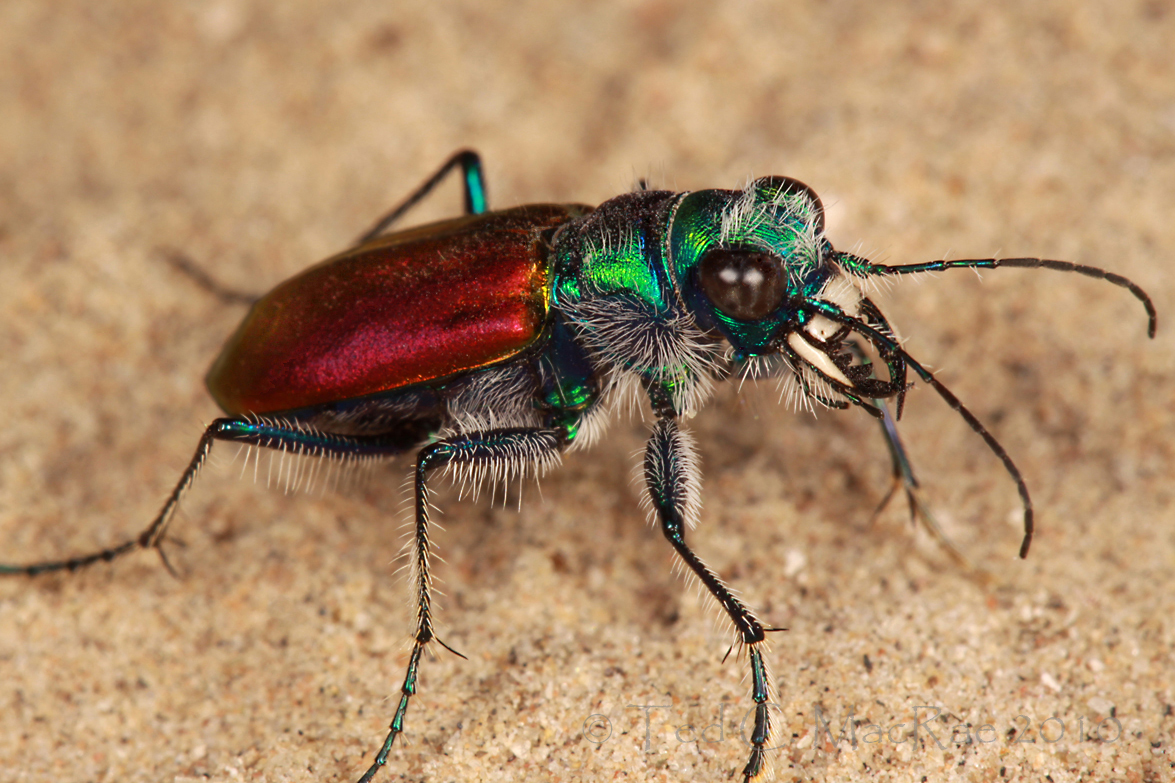
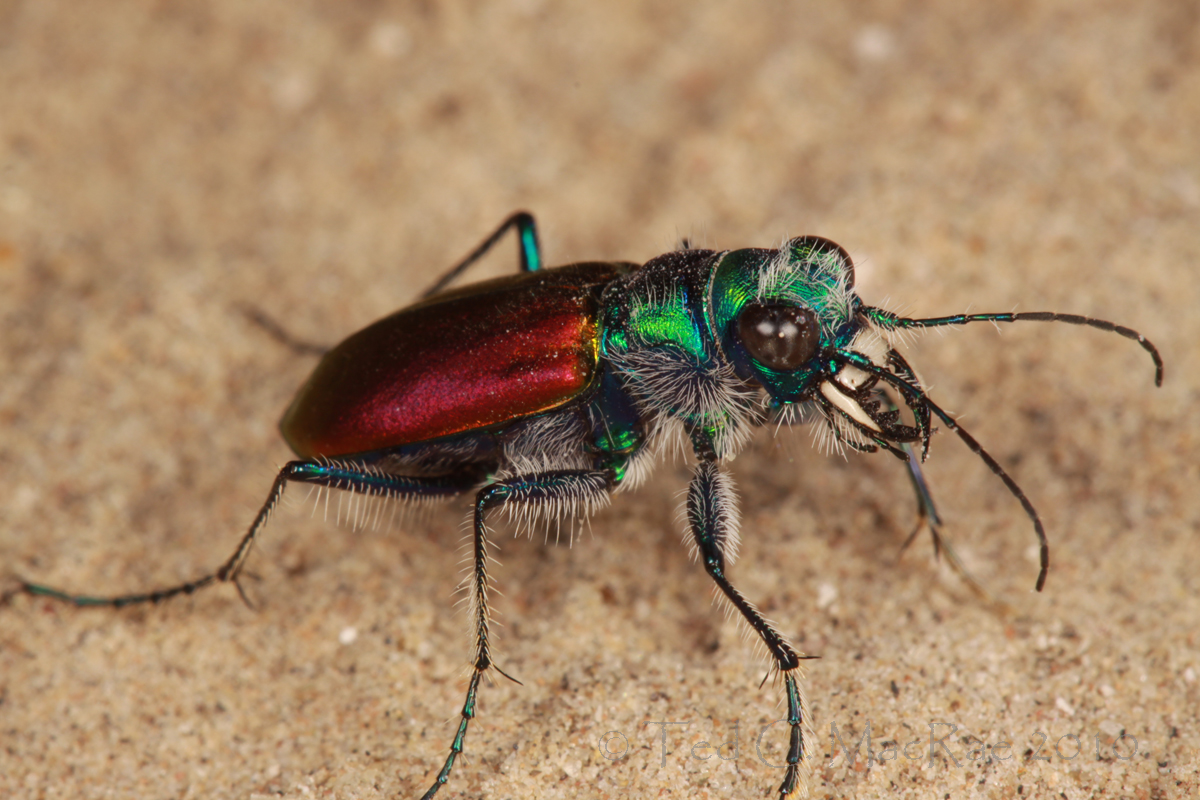
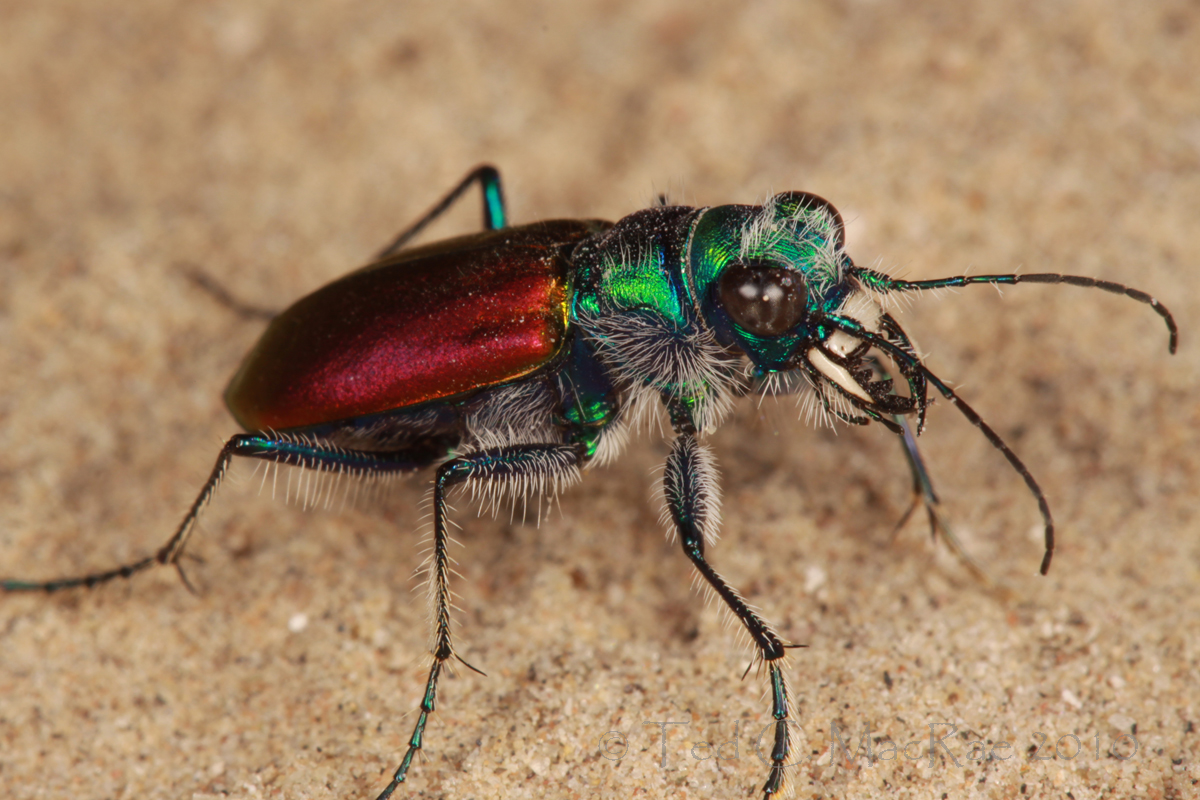
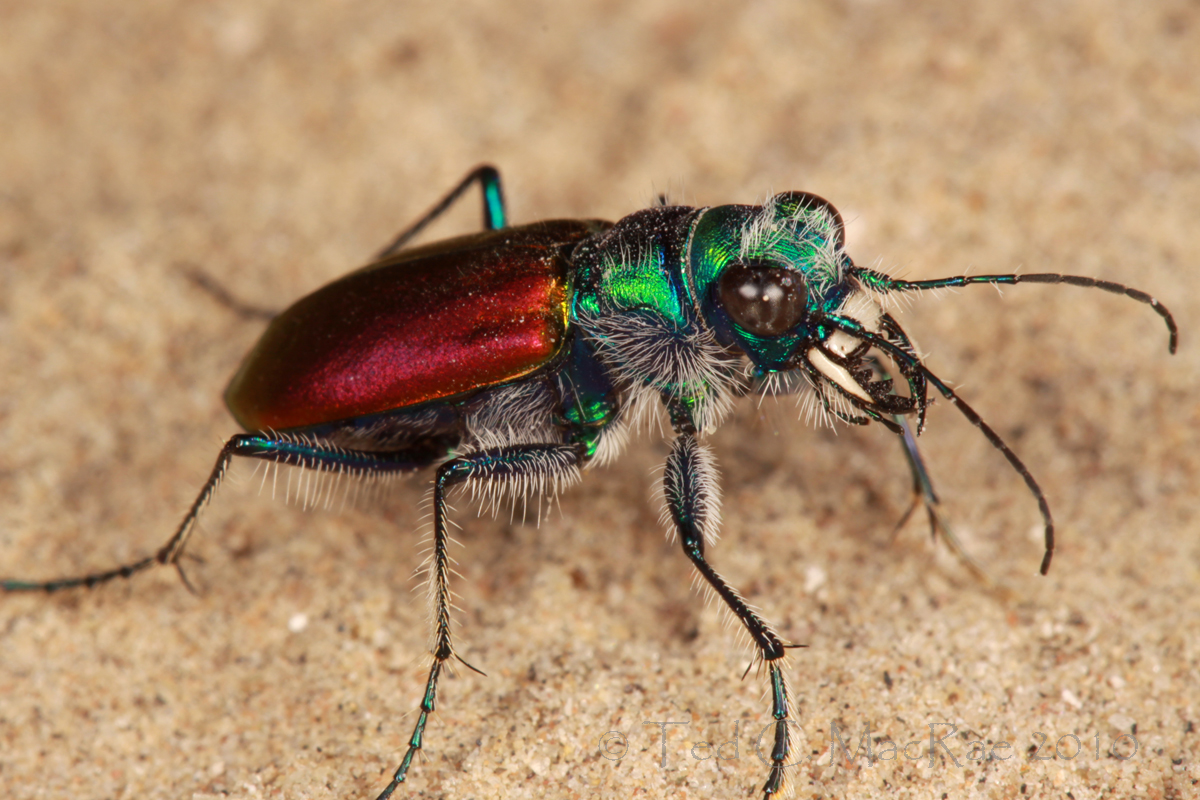
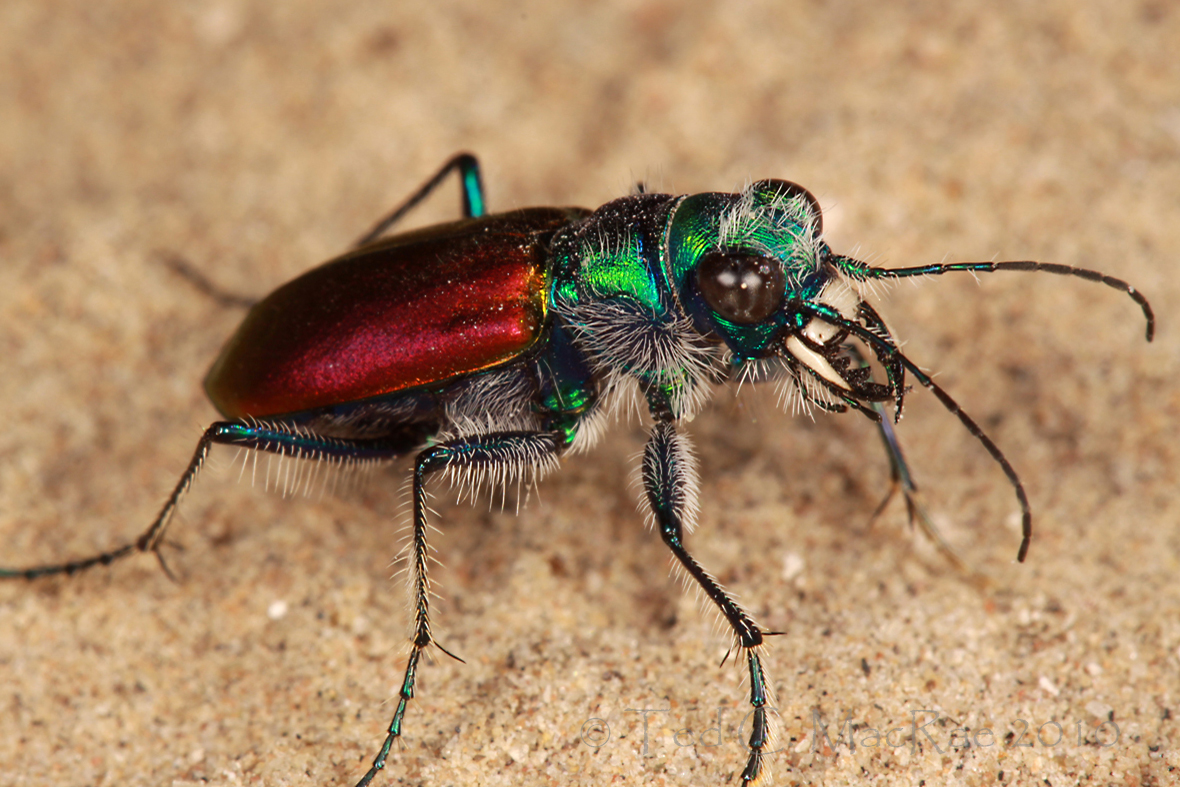
This is Cicindela scutellaris (festive tiger beetle), one of the six species of tiger beetles that we found last September at Monroe Canyon in the Pine Ridge area of northwestern Nebraska.  The red elytra and green head and pronotum are characteristic of nominotypical populations of this species that are found in sandy habitats throughout the Great Plains.  This is your classic tiger beetle in a classic tiger beetle pose; however, photographs such as this are not so easy to come by.  The biggest challenge is the beetle itself – rarely are they so accommodating to allow this nice lateral profile perspective with the head slightly cocked towards the camera while standing up on their front legs.  This posture is seen only when the beetles are warm and active, and warm beetles are skittish beetles that yield lots of not-as-interesting back shots (head directed away from the camera) as they persistently run away from the photographer.  Cooler temperatures make them less skittish and easier to approach from the desired angle, but in this case they often lay flat on the ground trying to absorb heat – flay-laying beetles are not very photogenic either.  With practice and patience, one learns how to “work” an active, skittish subject and get them accustomed to the photographer so that the above perspective can be achieved.

Getting the shot, however, is only half the battle.  Tiger beetles are dirty bugs!  They run around over bare ground and dig in it, often leaving them covered with debris.  This is particularly true for species that frequent sandy habitats.  For those of us who like to photograph wild individuals in their native habitats, debris-covered beetles is something we have to live with.  Or do we…?  The beetle in the above image looks squeaky-clean thanks to some simple digital image processing tools that I used to “clean up” the subject (I use Photoshop Elements 6.0).  Now, I’ve never been one to want to spend a lot of time on post-processing of my photographs.  I’d rather be looking for bugs, photographing them, studying them, and writing about them – time spent on post-processing is time not spent on any of these other activities.  However, I have developed a little routine that I follow for most of my tiger beetle photographs now that cleans them up a bit – some more than others – and doesn’t take too much time.  Maybe some of you will find this useful for your own photographs.¹

¹ Disclaimer:  I am not a Photoshop expert.  I’m not even a photographer.  I’m an entomologist with a camera.  As a result, this post is intended to be not so much an authoritative tutorial on the use of Photoshop as a summary of what I’ve learned in dealing with my own photographs.  Constructive dialogue about these and other techniques is welcome. 

Like it or not, no digital image comes out of the camera ready to use (still perhaps the most perplexing aspect of this whole digital photography thing for me personally).  Almost every image needs some levels adjustment and unsharp mask applied to it, and while others are against it I’m not above doing a little cropping to enhance the final composition of the photograph (hey, it’s difficult enough just getting these guys in the frame, much less positioned exactly where you want them).  These are the basic steps that I follow for almost every photograph, as illustrated in the following sequence (reduced versions used for all photos):

Original photograph before processing.

Slight cropping to enhance composition.

Levels adjusted to brighten photo.

Unsharp mask applied (amount = 80%, radius = 2.0 pixels, threshold = 12 levels).

 Normally I would be done at this point, but there are two things that bother me about this photo: 1) the dark shadow on the distal back portion of the elytra (common with this pose), and 2) the debris scattered about on the eye, mandibles, thorax, and elytra.  To fix the shadow, I used the Magic Wand Tool (set on contiguous) to select the shadowed area of the elytra, then used the Dodge Tool set on Highlights (exposure = 25%) to lighten the shadowed area.  For the debris, I enlarged the photo to 100% and used the Spot Healing Brush Tool to remove most of the sand particles, adjusting the size of the brush to just larger than the size of the individual sand particles.  This works fine for particles surrounded by a uniform background, but it doesn’t work so well for particles along edges (particularly the mandibles).  For this, I used the Clone Stamp Tool (again, with the photograph enlarged to 100%) and carefully “cloned” a clean spot along the edge of the mandible next to the sand particle and then replaced the piece of debris with the cloned piece of the image.  As with the Spot Healing Brush Tool, the pixel size is set to the smallest size needed for the size of the debris particles.  Compare the above image with the finished image below to see the difference.

Finished photo with dark shadows on elytra and sand debris on body removed.

 The biggest improvements can be seen with the eyes, always the focal point of a photo such as this, and the mandibles – both now appearing nice and clean.  Is this cheating?  Have I compromised my ideal of getting an image of a wild individual of this species in its native habitat?  I’d be interested to know your opinion about this.

Photo Details: Canon 50D w/ 100mm macro lens (ISO 100, 1/250 sec, f/16), Canon MT-24EX flash w/ Sto-Fen + GFPuffer diffusers.

Copyright © Ted C. MacRae 2010
Amblycheila cylindriformis on white

It’s been four months now since I went to the Glass Mountains of northwestern Oklahoma on a hunch to look for Amblycheila cylindriformis (Great Plains giant tiger beetle).  The five adults that I brought back from that night are still alive in a terrarium of native soil, but to this point they have refused to lay eggs.  Despite feeding them regularly with fat Maduca larvae, there is obviously still something they need that I am not providing.  I’ve suspected that perhaps the terrarium that I have them in is too small, and I’ve also noted in the literature that larval burrows are often found clustered near the entrance of mammal burrows.  With this in mind, I combined the native soil from three separate terraria into one larger, deeper terrarium, packed the soil lightly, and used a spoon to create an artificial mammal burrow entrance.  Not long after placing the adults in their new home they began digging at the back of the burrow, eventually creating two separate tunnels leading in opposite directions (and fortunately against the container walls so that I can see inside the tunnels).  I was optimistic at first that finally I had given them what they wanted, but since digging the burrows they’ve just sat in them.  Perhaps they “know” that winter is coming and are just looking to hole up for now, so I suppose I’ll go ahead and place the terrarium in the 10°C incubator with the rest of my larval and adult rearing containers and wait until next spring to see what happens.

In the meantime, I thought I would share these recent photographs of one of them.  I had been wanting to take photographs of this species in a white box, which I have used with a few other species to generate some rather striking photographs (e.g., Gromphadorina portentosa, Buprestis rufipes, Scolopendron heros, Eleodes suturalis). The photographs in this post might look like they were taken in a white box, however, they were not.  I’ve been spending a lot of time lately trying to come up with a diffuser setup that is convenient for field photographs of wild insects in their native habitats.  Kurt’s do-it-yourself concave diffuser and Alex’s tracing paper diffuser work great with the Canon MT-24EX Macro Twin Lite Flash and the Canon MP-E 65mm f/2.8 1-5X Macro Lens, but as I mentioned in a previous post they do not work so well with the Canon EF 100mm f/2.8 Macro USM Lens and its longer working distance… or so I thought!  I’ve come up with a modified version of the concave diffuser that seems to be what I am looking for – it is easy to use, adds virtually no weight to the camera, is completely portable for field use, can be used with both the 65mm and 100mm macro lenses, and – best of all – costs virtually nothing.  The photographs in this post were taken with the first prototype, and now that the basic design and general dimensions seem to work I’ll try to make a more durable version. It’s simply a larger version of the concave diffuser – I found some very thick polypropylene foam that is sturdy enough to hold its shape but flexible enough to curl back and over the top of the flash heads, where the corners are held in place by Velcro. Essentially it forms a large “soft box” type diffuser in front of both flash heads. I cut the bottom inch off of a a 500-mL polypropylene beaker, then cut that in half and cut out all but a quarter inch of the bottom to form a sturdy but transluscent frame to hold the polypropylene foam against the flash head bracket on the front of the lens. Right now the foam is held in place by tape, but hot glue should do a better job, and the diffuser bracket is attached to the flash head bracket with Velcro. The whole rig comes off in a flash and lays mostly flat in the camera bag.

If this diffuser proves successful, it will eliminate the need for the different flash head extender brackets that I was considering.  I really didn’t want to go that route because even the cheapest models are rather costly, and all of them add bulk to the camera and create problems for those who need to switch lenses frequently (such as I do).  Of course, the real test is – does it achieve the desired result?  I’m quite happy with these initial photographs – the lighting is quite even due to the large “apparent” size of the light source, and the annoying double specular highlights that are the hallmark of the MT-24EX are much less apparent (though still slightly discernible).  The closest shots are at 1:1, while those of the entire beetle are between 1:1.5 and 1:2.  They are among the largest beetle species that I have photographed, so the range of magnifications used here pretty much covers the entire range that I typically use with this lens.  Wildflowers often require smaller mags and longer working distances, so it remains to be seen whether this diffuser/lens combination will be useful for them as well. 

All of the photographs in this post were taken with the 100mm macro lens (ISO100, 1/250 sec, F16) and direct MT-24EX macro twin flash using this new diffuser.  The beetle was placed on white filter paper and covered with a clear glass bowl until it settled against the side of it.  Once the beetle was quiet, I gently lifted the bowl and used micro-forceps to gently tug its legs into more appealing positions – surprisingly this did not cause it to become alarmed and try to flee (as long as I didn’t accidentally brush against one of its antennae!).  For the last photograph, I placed the beetle back in its terrarium and used the same techniques to get the beetle in a good position. 

Copyright © Ted C. MacRae 2010
Flash solutions for the beautiful tiger beetle

Canon MP-E 65mm f/2.8 1-5X macro lens (f/13), Canon MT-24EX flash w/ concave diffuser.

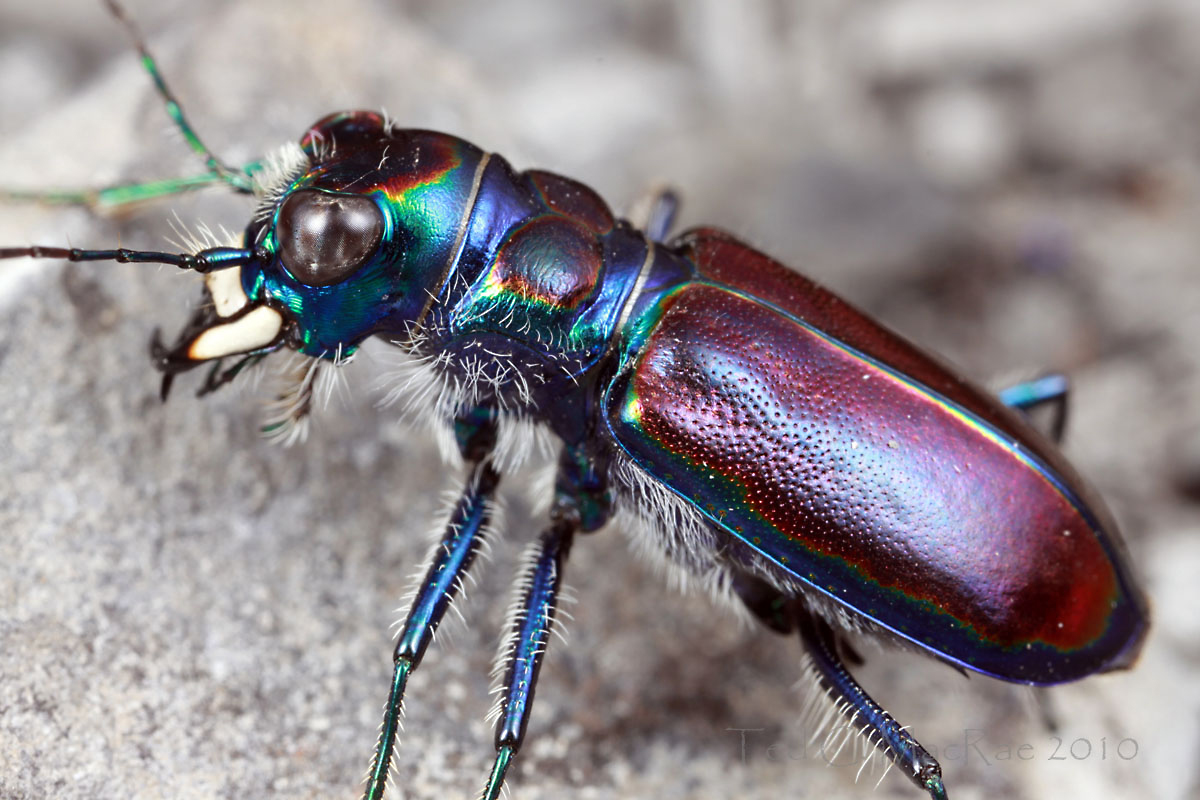
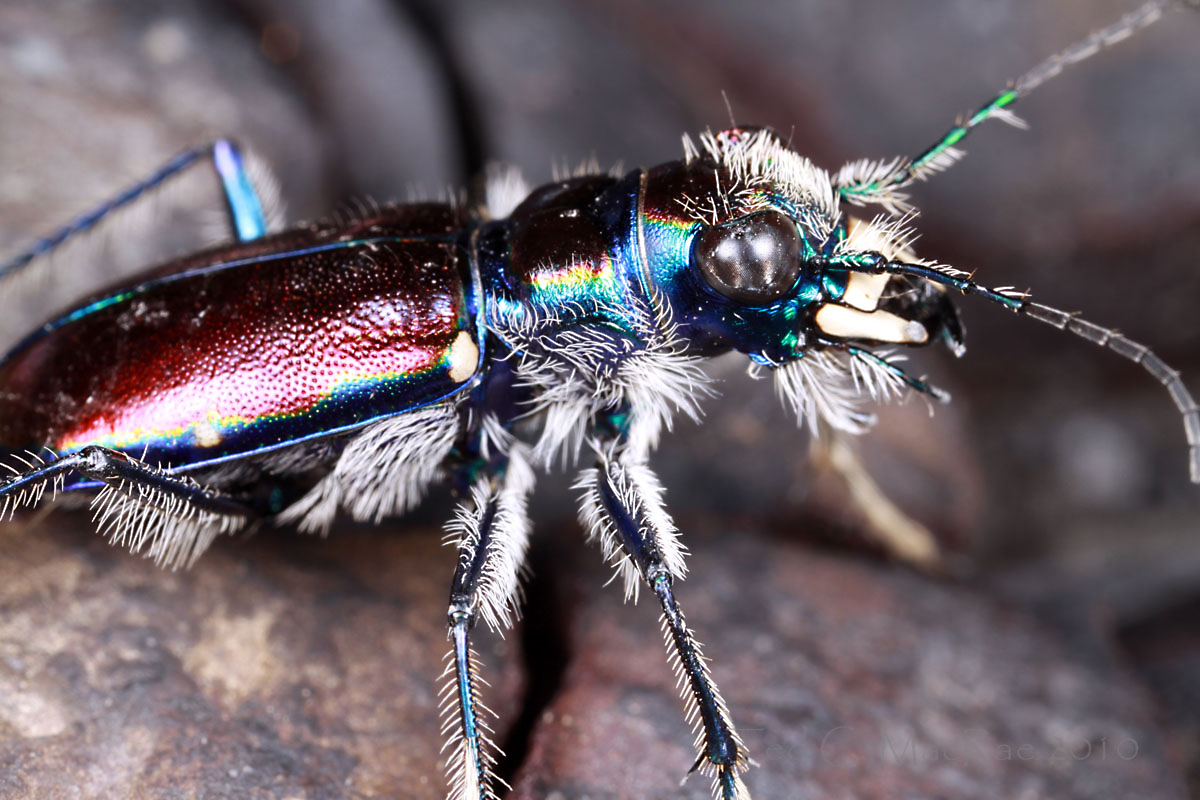
Recently I’ve been trying some different lighting and flash diffusion techniques with the Cicindela pulchra adults I brought back from South Dakota (see previous post).  While the beetles themselves are certainly among the most spectacular tiger beetles I’ve ever seen, I’ve been less than impressed with the photographs that I’ve managed to take of them.  Two factors have been largely responsible for this: 1) the smooth, shiny integument of the beetle reflecting the flash to create strong specular highlights, and 2) the colors, though brilliant, are also dark and difficult to bring out without further exacerbating the specular highlights.  Normally, the Sto-Fen+Puffer diffuser combination that I use does a pretty good job at diffusing the flash, but it just can’t handle these beetles.  To deal with this problem, I finally got around to trying out the do-it-yourself concave diffuser that Kurt at Up Close with Nature has been using with stunning results (similar to the tracing paper diffuser used so famously by Alex Wild at Myrmecos).  Photo 1 above and 2-3 below were taken with this diffuser on my Canon MP-E 65mm f/2.8 1-5X Macro Lens, and I’m rather pleased with these initial attempts.  I do need to figure out a better way to attach the diffuser to my Canon MT-24EX Macro Twin Lite Flash.

Canon MP-E 65mm f/2.8 1-5X macro lens (f/13), Canon MT-24EX flash w/ concave diffuser.

Canon MP-E 65mm f/2.8 1-5X macro lens (f/13), Canon MT-24EX flash w/ concave diffuser.

I’d have to say the lighting with this diffuser represents a considerable improvement over the Sto-Fen+Puffer diffusers using the same lens.  Compare especially Photo 3 above and 4 below – both taken with the MP-E 65mm lens at 1:1 and f/13 – Photo 3 was taken using the concave diffuser, while Photo 4 used the Sto-Fen+Puffer diffusers.

Canon MP-E 65mm f/2.8 1-5X macro lens (f/13), Canon MT-24EX flash w/ Sto-Fen+Puffer diffusers.

The problem with the concave diffuser is that it won’t work so well on my Canon EF 100mm f/2.8 Macro USM Lens due to its longer working distance.  I actually use this lens in the field as often as the MP-E 65mm lens, especially for the tiger beetles on which I focus (heh!) – not only do they rarely require more than 1:1 magnification, but they also rarely allow the ultra-close approach needed to use the 65mm lens.  The only solution is to find some way to get the flash heads closer to the subject to increase the apparent size of the light source, but so far I haven’t figured out a satisfactory way to do this.  Some photographers use the stalwart Canon Speedlite 580EX II Flash, equipped either with a do-it-yourself snoot diffuser or mounted on a bracket extender with a small softbox.  However, I am not a photographer, but rather an entomologist with a camera – I need to carry with me a net, vials, and in some cases a beating sheet and hatchet.  Both of the previously mentioned approaches for diffusing 100mm shots add far more bulk to the camera setup than I can accept.  I’ve been looking for extender brackets that will move the MT-24EX flash heads out closer to the subject to increase apparent light size and have found a few.  The Really Right Stuff B85-B Flash Bracket equipped with two FA-EX1 Flash Extenders and an extra Flash Mount looks like it would do the job quite well, but it is still bulkier (and vastly more expensive) than I would like.  The PhotoMed R2-C Dual Point Flash Bracket is a much less bulky and more reasonably priced option; however, the lack of any vertical adjustment capabilities is an insurmountable shortcoming.  Why Canon hasn’t themselves designed a lightweight, low-cost accessory for extending the MT-24EX flash heads out away from the lens is beyond me, and I’ve actually been toying with some ideas on how to do this myself using a couple of Kaiser Adjustable Flash Shoes.

Until I do figure out a solution, at least there is always the white box for any captive-held individuals (and yes, I have considered a small, collapsible white box to bring into the field – I’m not ready to resort to that just yet!):

Canon 100mm macro lens (f/16), Canon MT-24EX flash indirect in white box.

Photo Details: Canon 50D (ISO 100, 1/250 sec). Typical post-processing (levels, minor cropping, unsharp mask).

Copyright Ted C. MacRae 2010

…the “better” Eleodes suturalis

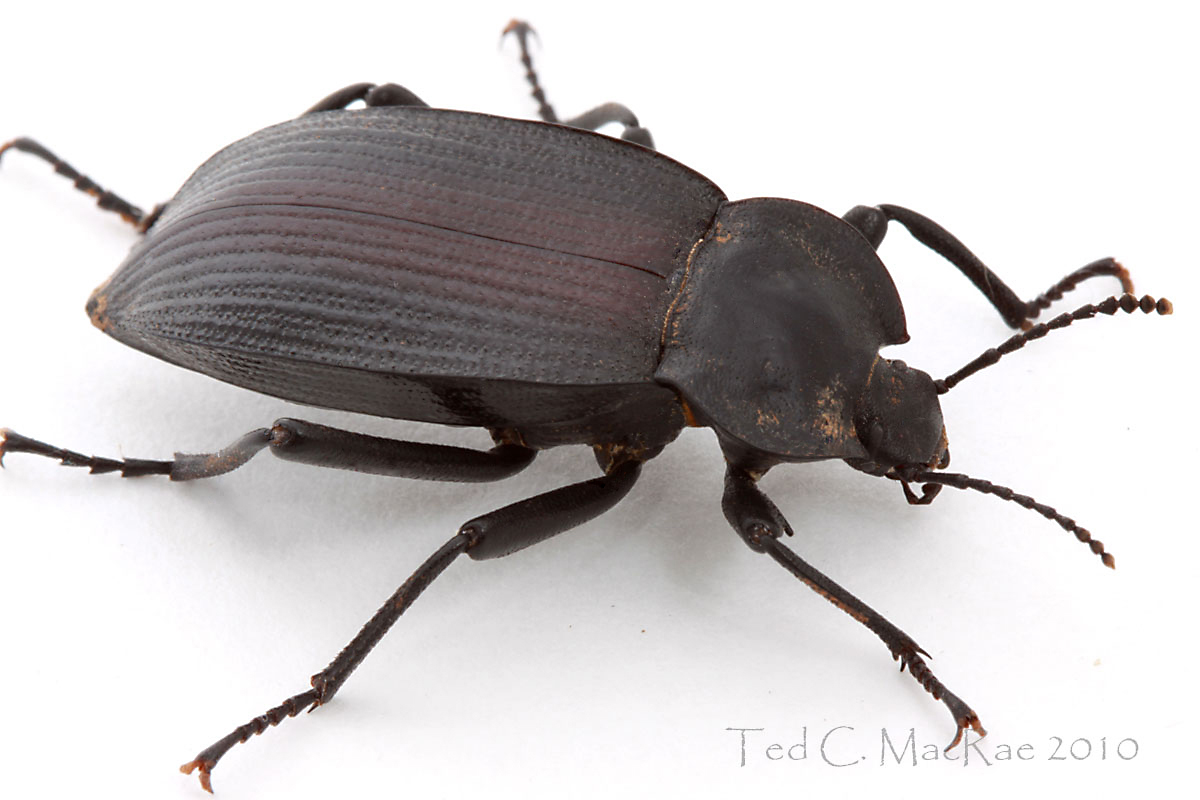
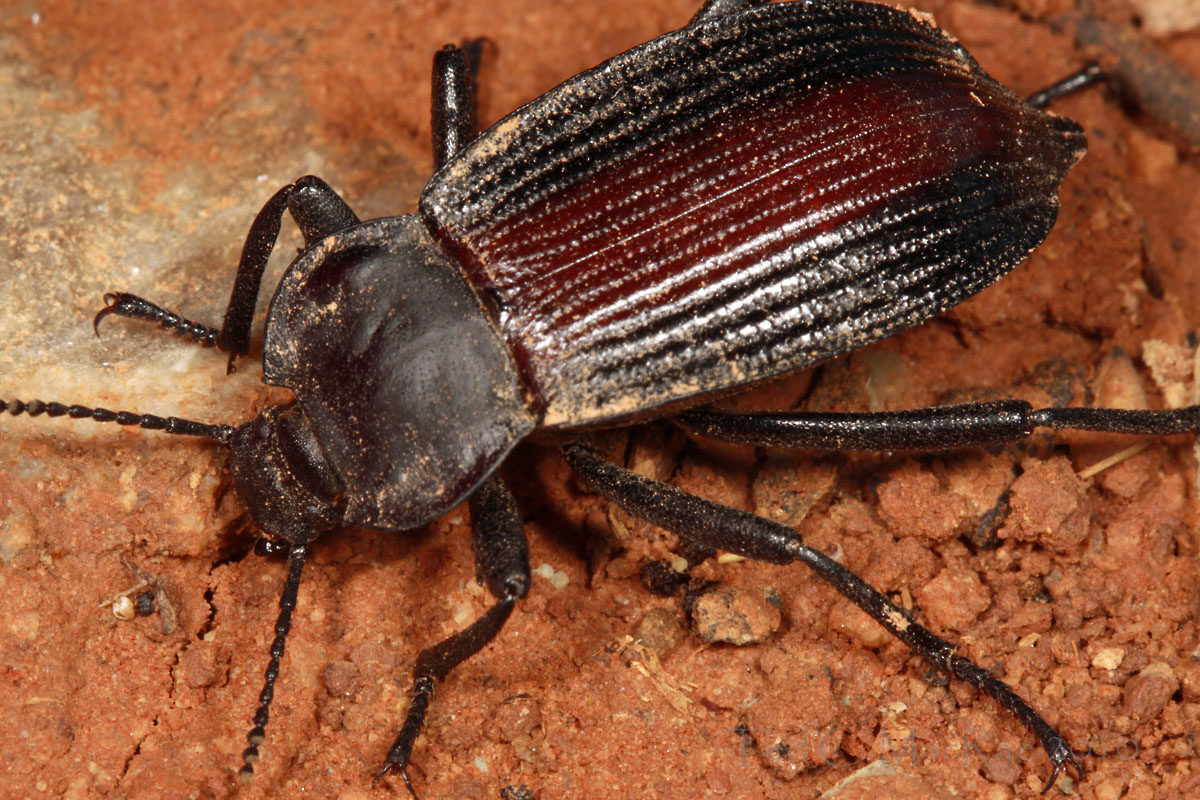
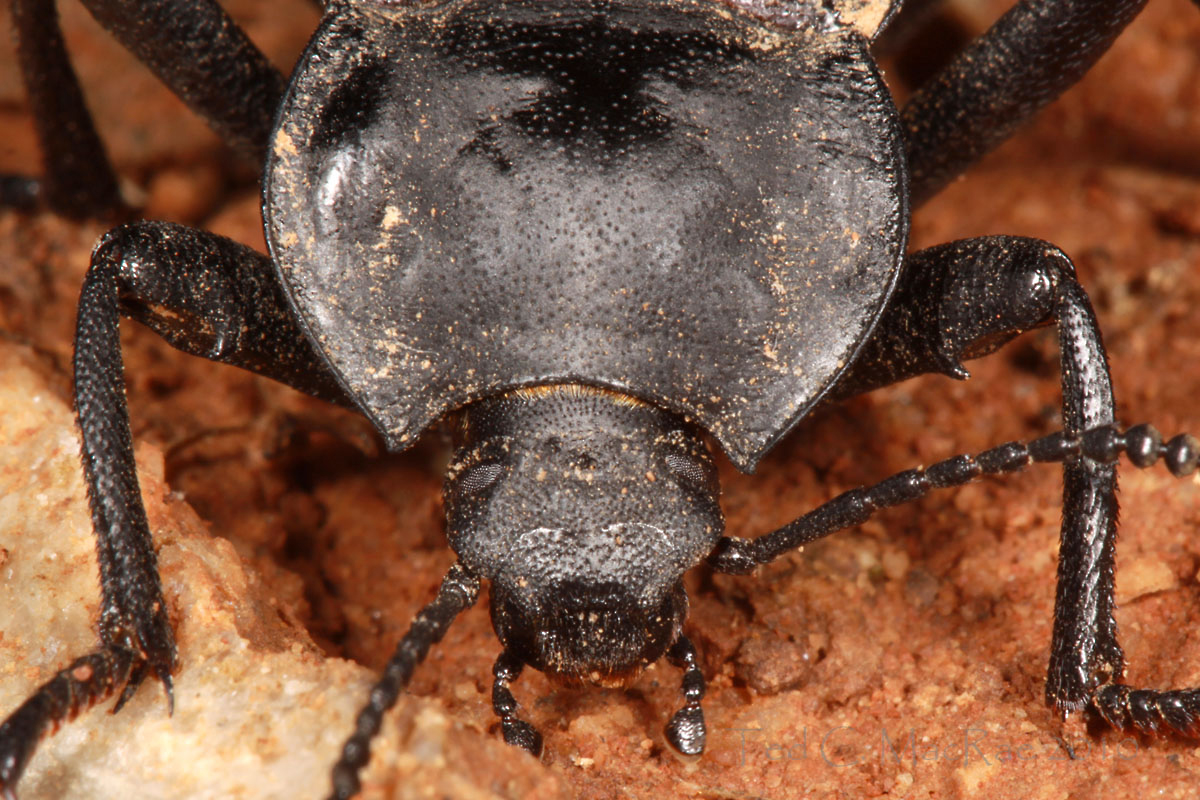
As I mentioned in my previous post, I really wasn’t satisfied with the photographs I took of the clown beetle, Eleodes suturalis, that I brought back from Oklahoma. I had placed the beetle in a terrarium of native soil and taken the obligatory whole beetle and head close-up photographs, both showing all the characters needed to identify the species in adequate detail. They were good, scientific photos, but they weren’t very exciting. In fact – they were boring! Now, I know not every subject I photograph is going to be a wower (the giant desert centipede I recently featured probably setting that standard), but it is important to me that the photographs I post here at least be interesting. After taking those first E. suturalis photographs, then being underwhelmed as I brought them up one-by-one on the computer, I started thinking about whether certain insects are just ‘homely’, and no matter how you photograph them they will still be homely. Eleodes suturalis is by no means a homely beetle in real life, but that is due mostly to the impressiveness of its size – a quality not easy to project in photographs.  Beyond that, its somber coloration, lack of unusual morphological modifications, and “beady little eyes” (fide Adrian) don’t offer much else in the way of help.  Combine that with the unflattering salmon coloration of its native soil as a substrate and an exoskeleton just shiny enough to cause annoying specular highlights, and you’ve got a recipe for really boring beetle photographs!

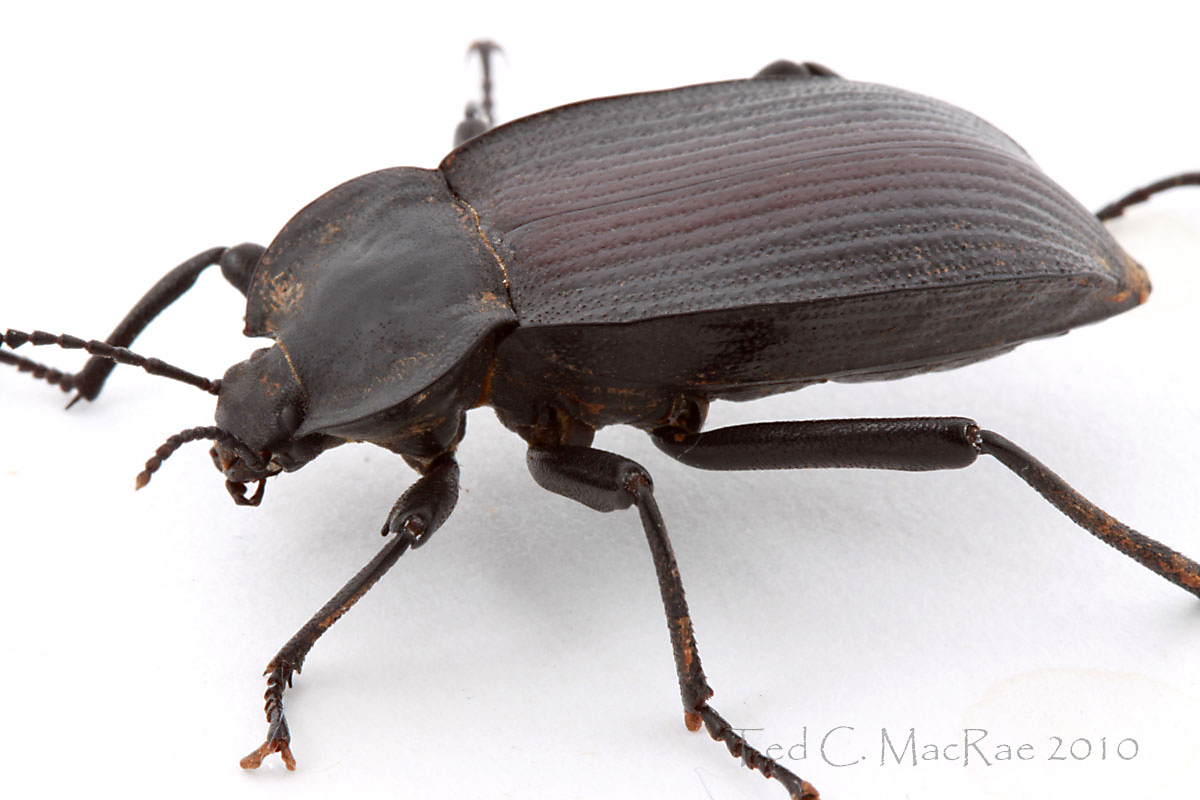
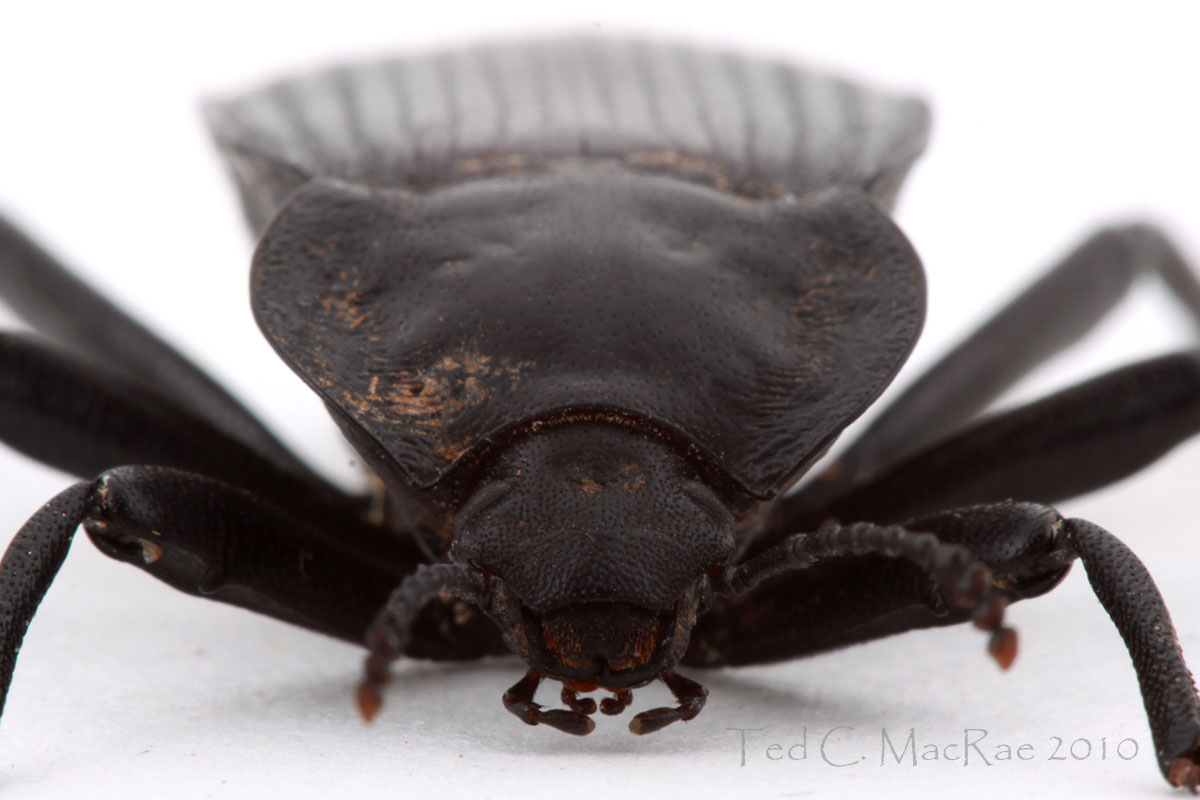
That’s when it occurred to me to try photographing the beetle in a white box.  I’ve only just begun to experiment with this technique and have been impressed with its ability to make somber-colored subjects (e.g., Gromphadorina portentosa) attractive and truly beautiful subjects (e.g. Buprestis rufipes) simply stunning.  The sharp, clean environment of a white box demands a clean beetle, so I gave the beetle (who had done much digging since the previous photo shoot) a good soaking and scrubbing (to the beetle’s great disapproval!).  Yes, I know there is still some dirt on him, but I think a dental pick and wire brush would have been needed to remove every last bit, caked on as it was!  Despite that, I think I achieved the desired effect – specular highlights… gone!  Boring background… gone!  Clean and crisp and ready to impress! The photos also do a much better job of highlighting the 3-dimensionality of the beetle than the original photographs.  Of the many photos I took, my favorite is featured above, and below I present two more that closely approximate the vantage of the two photos I posted from the first shoot in a side-by-side comparison.

For those of you wondering how I managed to secure the beetle’s cooperation for these photos, I used a modification of the “lens cap” technique, covering the beetle with a large glass bowl instead.  The beetle crawled around under the bowl for a bit but eventually would end up settled down against the edge.  By carefully lifting the bowl I was able to avoid disturbing the beetle and fire a few shots before it would start wandering again.  I just repeated the process until I was satisfied I had a few good shots in the sequence.

Does this mean an end to my preference for in situ photographs?  Certainly not.  But some beetles just look better in white!

Photo Details:
White box: Canon 50D w/ 100mm macro lens (ISO 100, 1/250 sec, f/18-20), Canon MT-24EX flash, indirect. Typical post-processing (levels, minor cropping, unsharp mask).
Terrarium: same except f/18, direct flash w/ Sto-Fen diffusers.

Copyright © Ted C. MacRae 2010
Lens and lighting comparisons

I’ve had my macrophotography rig for one year and a summer now, and while I still hesitate to regard myself a bona fide insect macrophotographer, I’ve learned a lot, feel I’m on the right track, and have had immeasurable fun in the process. I’m a tactile learner – i.e., I do best just trying different things for myself and seeing the results. The photos I show here are some “comparison” shots that I did during my recent giant desert centipede white box photo shoot.

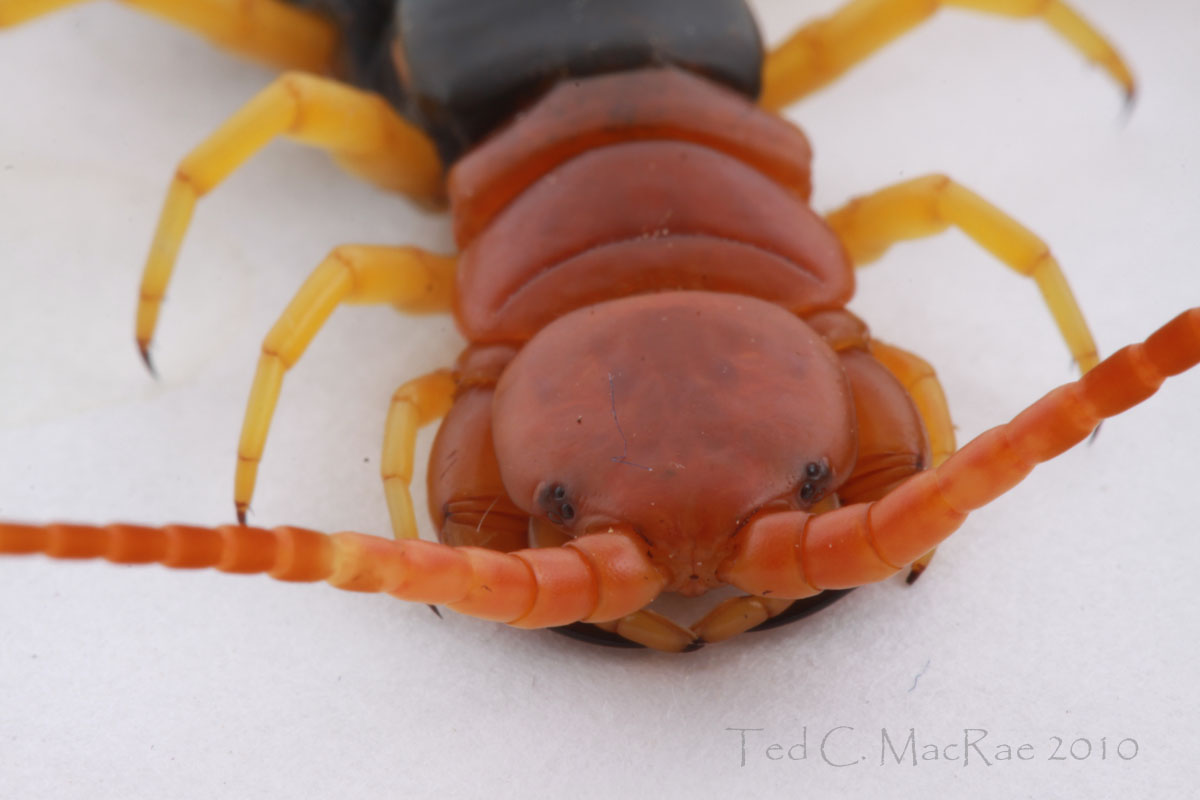
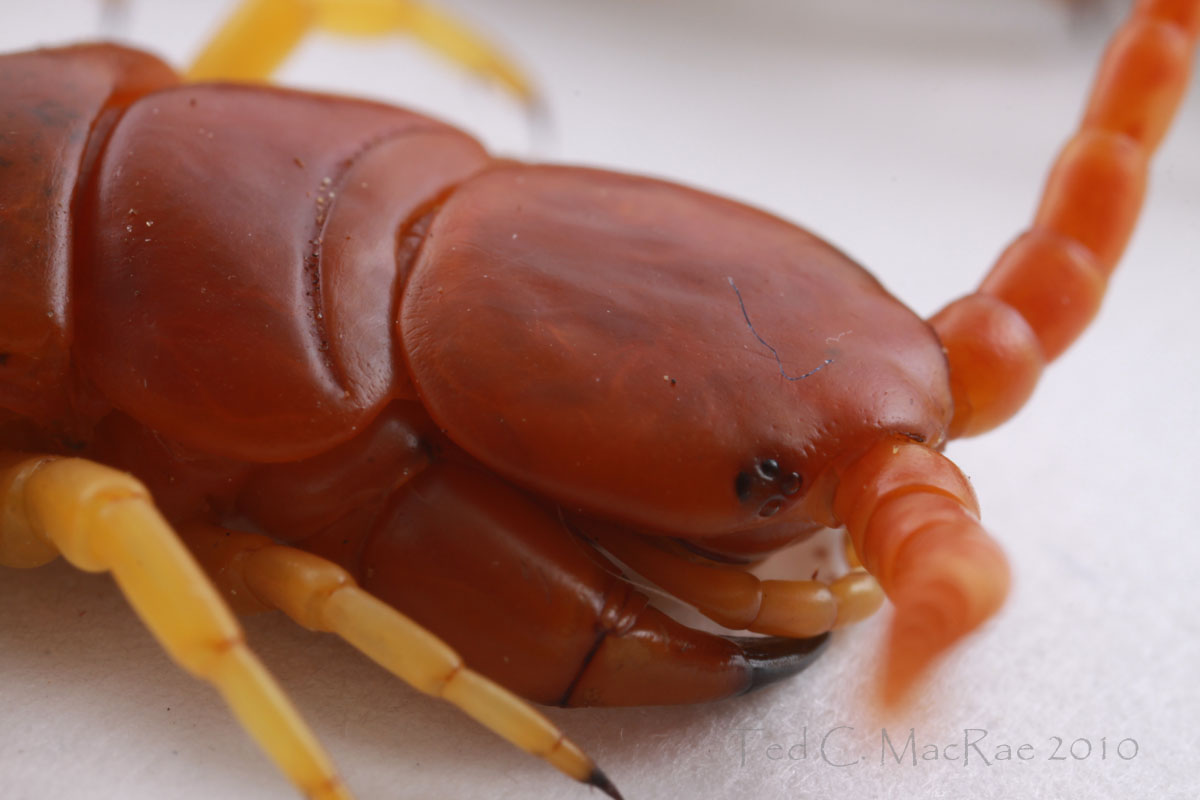
For my photography, I use two macro lenses, both Canon, with almost equal frequency: the 100mm lens (up to 1X), and the MP-E 65mm lens (1X to 5X).  Although the choice is clear if I am much above or below 1X, I find that a large part of my shooting is right around the 1X level.  I’ve often debated which lens I should use in such situations – the longer working distance of the 100mm lens makes it easier to use in the field and less likely to spook the insects I am photographing, but lighting is also more problematic since the flash units are farther away from the subject.  One thing I hadn’t thought about, however, is the possibility of differences in image quality between the two lens (all other things being equal).  The white box session gave me an opportunity to look at this, since the use of indirect flash largely eliminates subject-to-flash distance as a variable.  The two shots below show 1X shots of the centipede – one taken with the 100mm lens and the other with the 65mm lens.  The photos have not been post-processed at all (except size reduction for web posting) to give the truest comparison possible – normally I would do some levels adjustment and unsharp mask (and for these, clone out that annoying blue fiber that ended up on its head!).

Canon 100mm macro lens @ 1X

Canon 65mm macro lens @ 1X

I think one can easily see how much more detail is captured by the 65mm lens (click on each for a larger version, as always), even despite its more limited depth of field (f/14 for the 65mm versus f/22 for the 100mm). This makes me re-think my strategy of using the 100mm when I can and switching to the 65mm only when I have to. In fact, I’ve occasionally opted to add extension tubes to the 100mm when I needed just a bit more magnification, but these photos make me think I should use the 65mm when I can and reserve the 100mm just for sub-1X shooting.

Both photos in the second comparison were shot using the 65mm at f/13, the only difference being the use of indirect flash in one photo and direct flash in the other. I’m not quite sure what to make of this – the direct flash photo is better lit and shows more detail, but this could be an artifact of insufficient flash unit power in the indirect photo. I probably should have done this comparison (or both, for that matter) using E-TTL rather than manual mode on the flash unit (and I may have to do that).

Canon 65mm macro lens, indirect flash

Canon 65mm macro lens, direct flash

Anyway, nothing earth-shattering here, and I may just be figuring out what others have learned long ago. Although I prefer the field for photography, I’m finding the white box – or at least a controlled, indoor environment – valuable for this type of experimentation.

Copyright © Ted C. MacRae 2010