At the end of this past June, the Webster Groves Nature Study Society (WGNSS) Entomology Group gathered at Pinewoods Lake Recreation Area. Nestled deep within the Mark Twain National Forest of the Ozark Highlands in Carter County, Missouri, the area features an idyllic lake surrounded by restored shortleaf pine/scarlet oak forest with a primitive campground and a nature trail that circumnavigates the lake. It has been one of my favorite insect collecting localities since I first discovered it back in the early 1980s and, as such, was an ideal spot bring the WGNSS Entomology Group for one of its monthly summer outings.
The official start of the outing was at noon on Saturday, but I arrived the prior evening to get in an extra night of night collecting, and two other participants (Lisa and Casey) arrived the next morning well before noon. Instead of waiting for others to arrive at the campsite, we decided to walk the nature trail while the temperatures were still (somewhat) moderate. During that walk, a clump of foliose lichen on the leaf of a low plant caught our attention—the clump looking puzzlingly out of place perched atop the leaf, and we wondered how it was remaining in place. A closer look revealed the presence of webbing bridging the gap between the front of the clump and the leaf, and still closer inspection revealed the culprit—a small but very colorful jumping spider that was sitting just behind the strands of webbing.
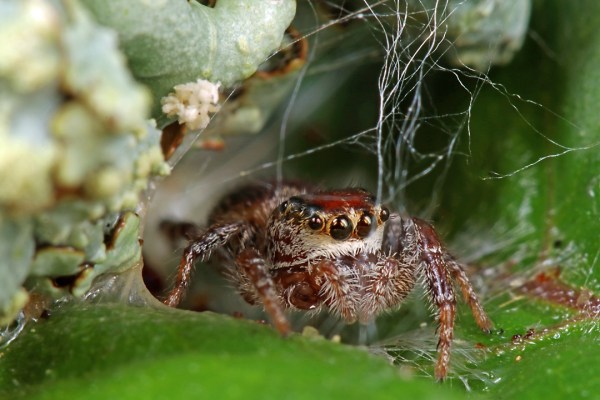
Clearly this is a female who has selected this little niche as a place to lay her eggs and stand guard over them. Maternal care is well known among female jumping spiders, who often create retreats such as this on leaves, under bark, or in crevices where they not only actively guard their egg masses from predators and parasites until the spiderlings hatch, but oftentimes remain with them until they molt and can venture out and fend for themselves.

What’s not clear is the actual identity of this spider. My first impression was possibly Platycryptus undatus (tan jumping spider), but Janelle Riley (@elizarose45) noted on iNaturalist the presence of a distinct red cap above/behind the eyes of this spider that seems to be absent in P. undatus. She further noted the similarity of this individual to images of Eris floridana, especially this one on BugGuide. However, without a good dorsal photograph, a more confident identification may not be possible.
©️ Ted C. MacRae 2026

