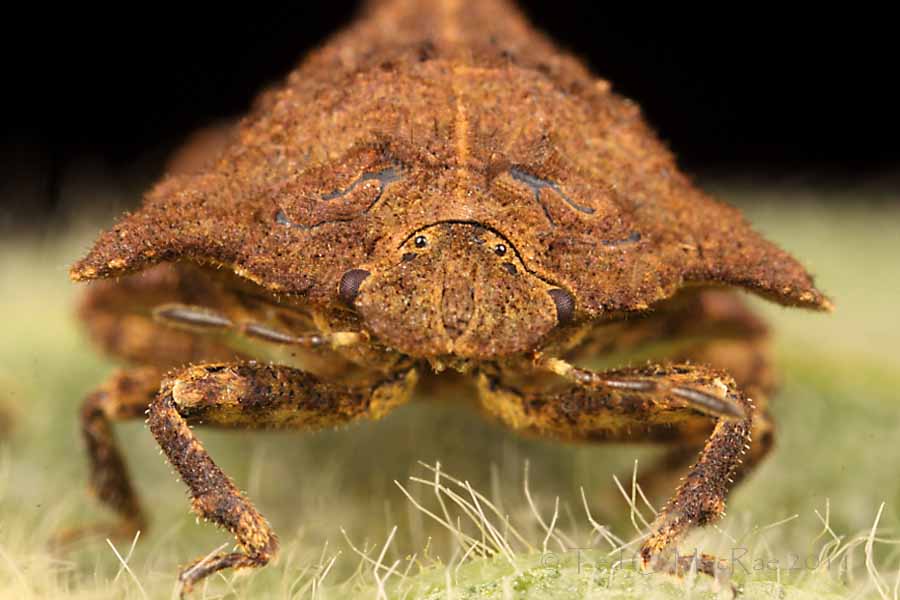
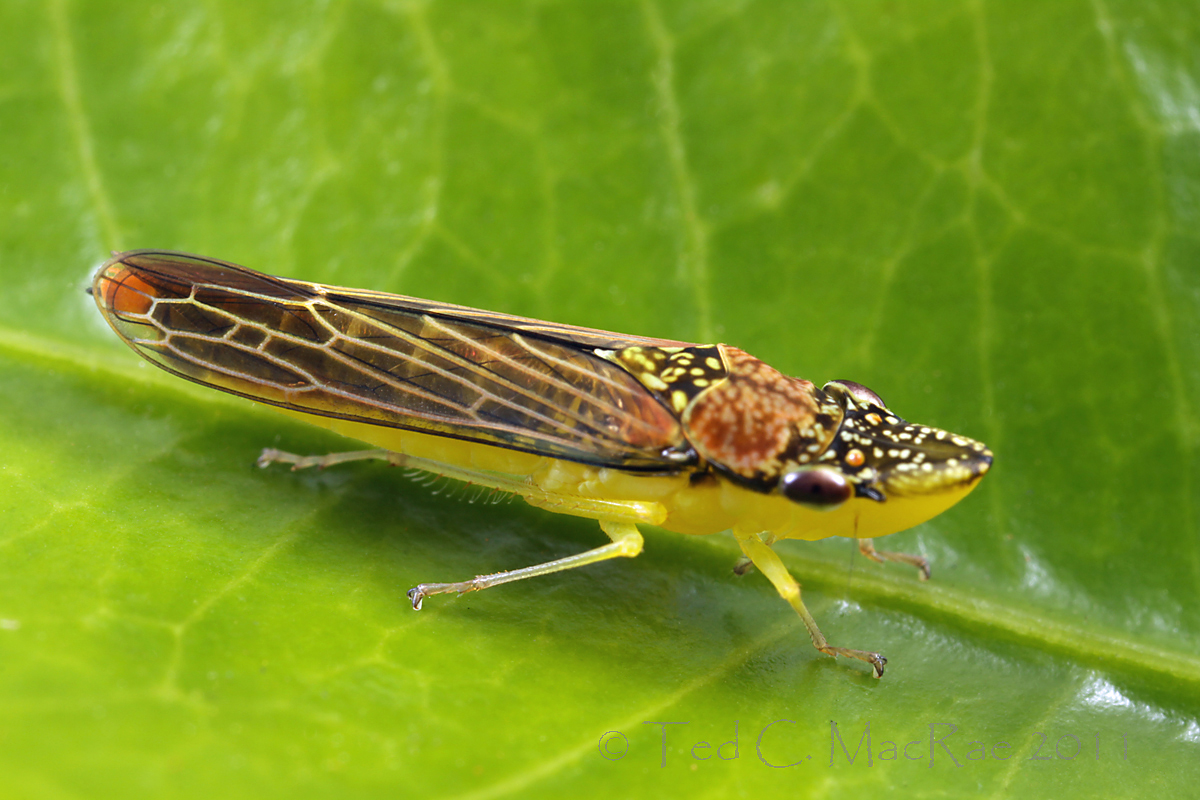
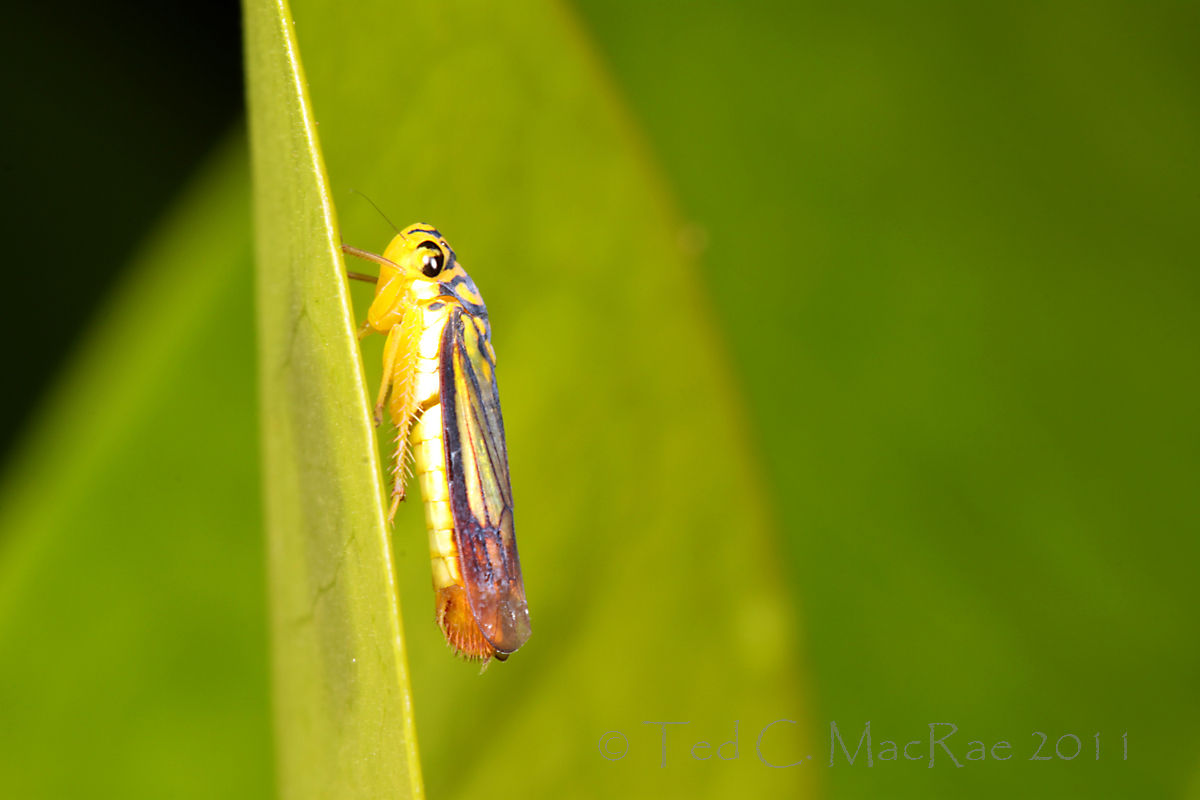
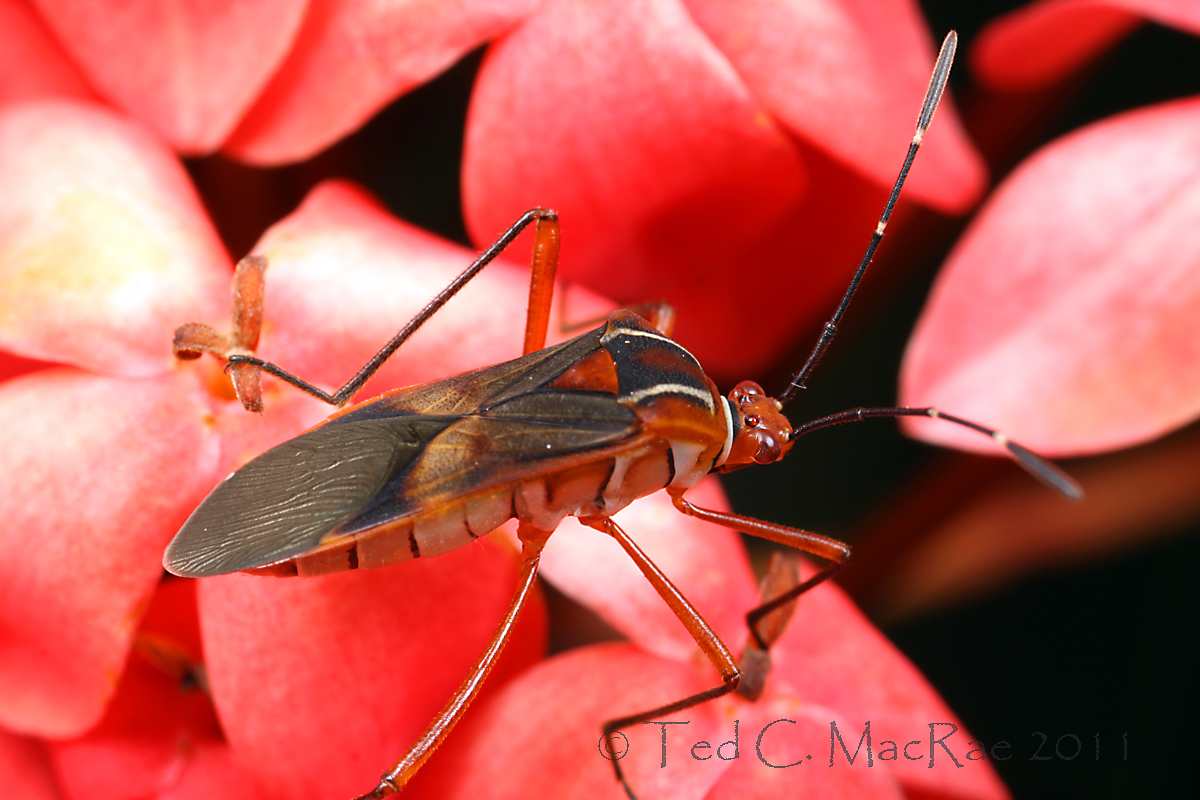
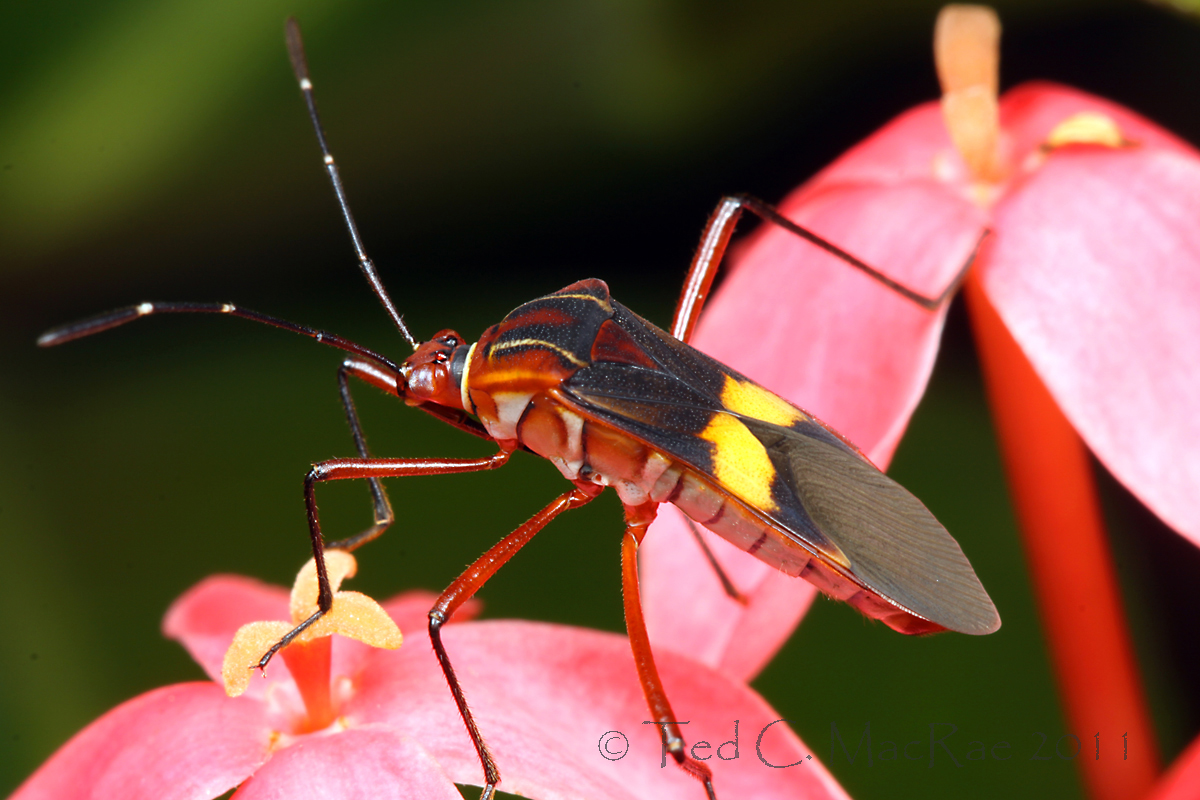
 Of the several insect groups that I most wanted to see and photograph during my trip to Brazil a few weeks ago, treehoppers were near the top of the list. To say that treehoppers are diverse in the Neotropics is certainly an understatement – South America boasts an extraordinary number of bizarre and beautiful forms that still, to this day, leave evolutionary biologists scratching their heads. The development of this amazing diversity is a relatively recent phenomenon (thinking geological scale here), as there are no known membracid fossils prior to Oligo-Miocene Dominican and Mexican amber – well after the early Cretaceous breakup of Gondwanaland split the globe into the “Old” and “New” Worlds. With its origins apparently in South America, numerous groups continued to spring forth – each with more ridiculous pronotal modifications than the last and giving rise to the dazzling diversity of forms we see today. Even North America got in the evolutionary act, benefiting from northern dispersal from South America’s richly developing fauna via temporary land bridges or island stepping stones that have existed at various times during the current era and giving rise to the almost exclusively Nearctic tribe Smiliini (whose species are largely associated with the continent’s eastern hardwood forests). Only the subfamily Centrotinae, with its relatively unadorned pronotum, managed to successfully disperse to the Old World, where it remains the sole representative taxon in that hemisphere. With a few notable exceptions, treehoppers have virtually no economic importance whatsoever, yet they enjoy relatively active study by taxonomists, evolutionists, and ecologists alike – due almost completely to the bizarreness of their forms and unique mutualistic/subsocial behaviors.
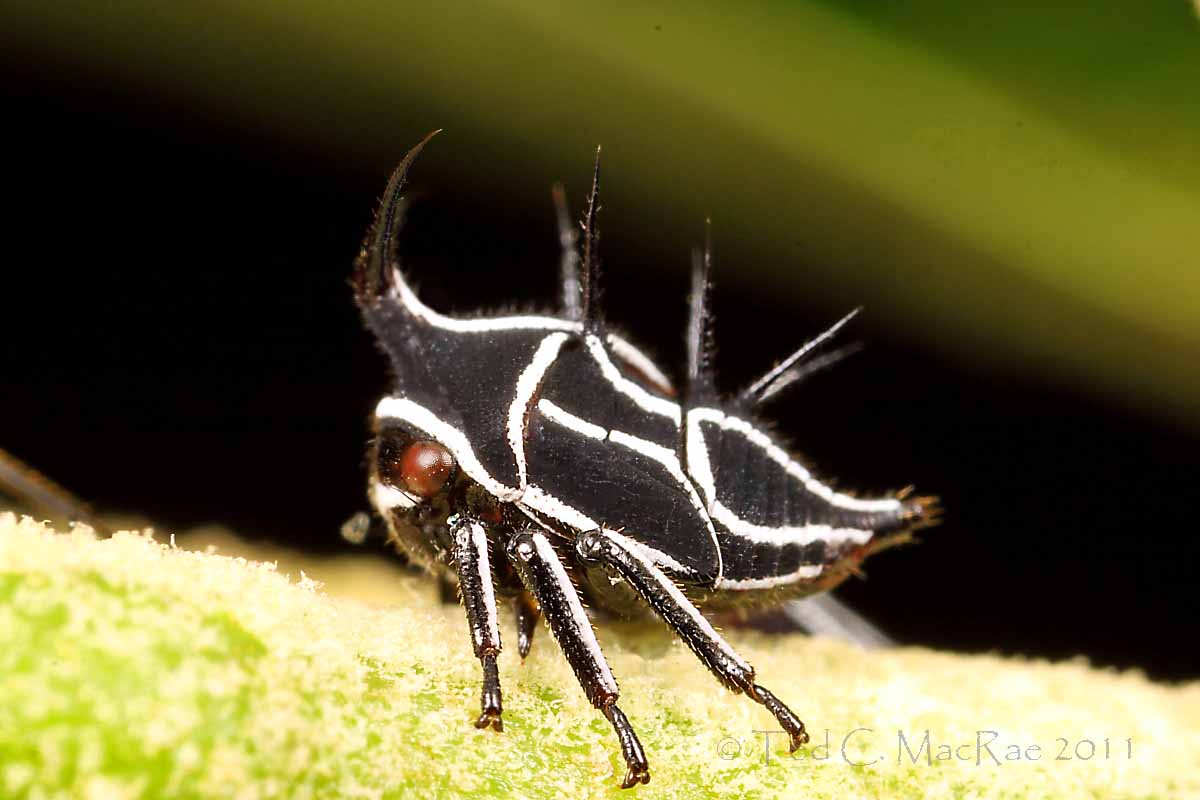
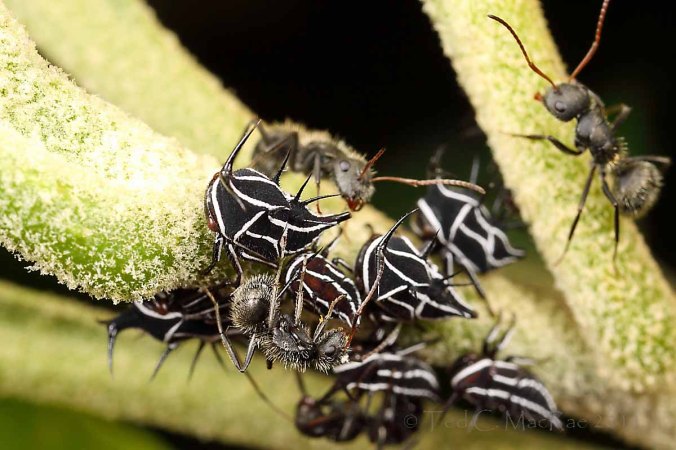
 I did manage to find a few species of treehoppers during the trip (a very primitive species being featured in Answer to ID Challenge #4 – Aetalion reticulatum), and of those that I did find the nymphs in this ant-tended aggregation on a small tree in the rural outskirts of Campinas (São Paulo State) were perhaps the most striking in coloration and form. Most were jet black, although a few exhibited fair amounts of reddish coloration, and all exhibited sharply defined white bands of wax and long erect processes on the pronotum, mesonotum, and abdomen. I’ve seen a fair number of treehopper nymphs, but I did not recognize these as something I had seen before, and given the incomplete state of immature taxomony I feared an identification might not be possible. Still (and I know this is probably beginning to sound like a broken record), I gave it the old college try.
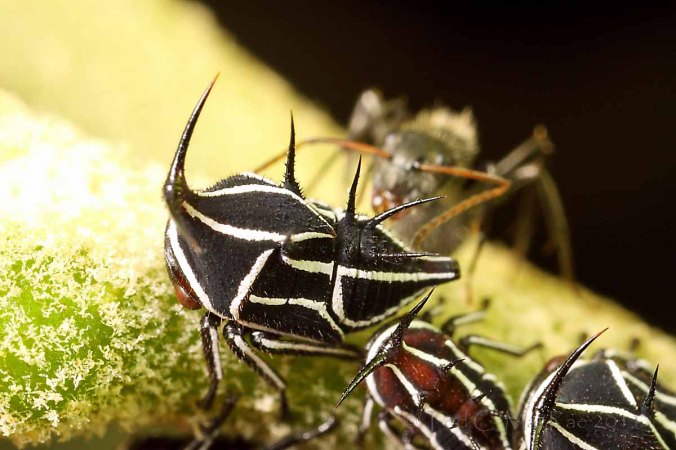 I usually like to start simple and get more creative if the results aren’t satisfactory, so I went to my old friend Flickr and simply typed “Membracidae” as my search term. Predictably, pages and pages of results appeared, and I began scanning through them to see if any contained nymphs at all resembling what I had. After just a few pages, I encountered this photo with very similar-looking nymphs, and although no identification beyond family was indicated for the photo, I recognized the lone adult sitting with the nymphs as a member of the tribe Aconophorini – a diverse group distinguished from other treehoppers by their long, forward-projecting pronotal horn. Luck was with me, because I happen to have a copy of the relatively recent revision of this tribe by Dietrich and Deitz (1991). Scanning through the work, I learned that the tribe is comprised of 51 species assigned to three genera: Guayaquila (22 spp.), Calloconophora (16 spp.), and Aconophora (13 spp.). The latter two genera can immediately be dismissed, as ant-interactions have not been recorded for any of the species in those two genera – clearly the individuals that I photographed were being tended by ants. Further, the long, laterally directed apical processes of the pronotal horn, two pairs of abdominal spines, and other features also agree with the characters given for nymphs of the genus Guayaquila. In looking at the species included in the genus, a drawing of a nymph that looked strikingly similar to mine was found in the species treatment for G. gracilicornis. While that species is recorded only from Central America and northern South America, it was noted that nymphs of this species closely resemble those of the much more widely distributed G. xiphias, differing by their generally paler coloration. My individuals are anything but pale, and reading through the description of the late-instar nymph of the latter species found every character in agreement. A quick search of the species in Google Images was all that was needed to confirm the ID (at least to my satisfaction).
 In a study of aggregations of G. xiphias on the shrub Didymopanax vinosum (Araliaceae) in southeastern Brazil, Del-Claro and Oliveira (1999) found an astounding 21 species of associated ant species – a far greater diversity than that reported for any other ant-treehopper system. The most frequently encountered ant species were Ectatomma edentatum, Camponotus rufipes, C. crassus, and C. renggeri, and after perusing the images of these four species at AntWeb I’m inclined to believe that the ants in these photos represent Camponotus crassus (although I am less confident of this ID than the treehoppers – corrections welcome!). The authors noted turnover of ant species throughout the day in a significant portion of the treehopper aggregations that they observed, which they suggest probably reflects distinct humidity and temperature tolerances among the different ant species and that might serve to reduce interspecific competition among ants at treehopper aggregations. Since treehopper predation and parasitism in the absence of ant mutualists can be severe, the development of multispecies associations by G. xiphias results in nearly “round-the-clock” protection that can greatly enhance their survival.

Update 3/3/11, 9:45 a.m.: My thanks to Chris Dietrich at the Illinois Natural History Survey, who provided me in an email exchange some clarifying comments on the origins and subsequent dispersal of the family. The first paragraph has been slightly modified to reflect those comments.
REFERENCES:
Del-Claro, K. and P. S. Oliveira. 1999. Ant-Homoptera interactions in a Neotropicai savanna: The honeydew-producing treehopper, Guayaquila xiphias (Membracidae), and its associated ant fauna on Didymopanax vinosum (Araliaceae). Biotropica 31(1):135–144.
Dietrich, C. H. and L. L. Deitz. 1991. Revision of the Neotropical treehopper tribe Aconophorini (Homoptera: Membracidae). North Carolina Agricultural Research Service Technical Bulletin 293, 134 pp.
Copyright © Ted C. MacRae 2011