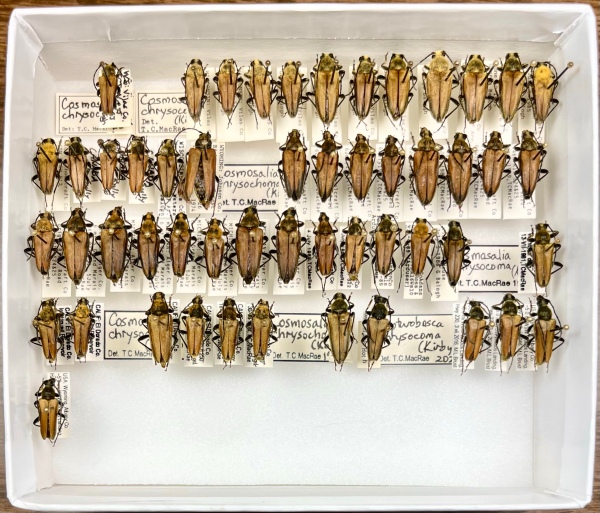
Unit tray of Lepturobosca chrysocoma (formerly Cosmosalia chrysocoma).
I belong (or used to belong) to several Facebook groups frequented by insect collectors—both professional and amateur. One question that frequently comes up—primarily for collections with species organized by unit trays—is how to deal with species identification labels. Not surprisingly, the opinions are as varied as the collectors. Some like to put a label on each specimen, while others put a label only on the lead specimen of a series. Some also print or write a separate header label that is placed in the unit tray. What about when names change? Or when reexamination of the specimen(s) reveals an erroneous ID? Should you remove outdated or erroneous identification labels? Fold them? Turn them upside down? Remove them altogether? These questions may seem trivial if one deals only with their own personal collection, but they become much more important when identifying specimens in institutional collections accessible to the public.
Here is my philosophy: an identification is a hypothesis, not data. As a result, ID labels are fundamentally different from labels indicating locality, date, ecological information, and collector, which are data—immutable and unchanging. Identifications can be “wrong” or may change over time, but regardless they merely reflect an individual’s opinion based on their level of expertise and familiarity with state of taxonomy and nomenclature at the time the identification was made. It then follows that identification labels do not need to be placed on every specimen—if a specimen without an ID label gets separated from the series, it does not result in a loss of data in the way it does for a specimen without a locality label, nor do old ID labels need to be changed as a result of nomenclatural changes or corrected identifications—a new label may be added (especially if it is an ID correction), but the old label should not be removed.
Almost as bad as removing old ID labels is folding them, which not only makes them difficult to read but results in mutilation—not just from the fold itself but also from the additional pin holes that are added when re-pinning the folded label. Old ID labels, even if incorrect or out-if-date, represent a historical record of opinion regarding the identity of the specimen, and degrading the labels obscures that history. If one simply must do something to denote a corrected ID, the old label may be turned over, but even then every effort should be made to reuse existing pinholes—just flatten with a fingernail before reusing so the label doesn’t spin. Seriously, however, this simply isn’t necessary—just add the new ID label beneath the old one, which denotes it as the more recent ID (another reason why year should be included on ID labels). Some people don’t like the way this looks, but to do otherwise is to greater priority on visual aesthetics than the integrity of the scientific data represented by the specimen.
As for dealing with nomenclatural changes—I don’t, at least not with already labeled specimens. That old ID label is not “wrong”—it accurately reflects the ID that was given to the series at the time the specimens were identified. Of course, any additional specimens that are added to the unit tray will receive an ID label the reflects the newer nomenclature. Case in point is the above photo, which contains longhorned beetles known for many years as Cosmosalia chrysocoma but recently reassigned to the genus Lepturobosca. You’ll note the older series of specimens bear ID labels with the older name, but the most recently added series contains an ID label with the newer name. There is no reason to go back and change or add ID labels for the older specimens, especially since newer specimens reflecting current nomenclature have been placed in the same unit tray with them. The mix of ID labels representing past and present nomenclature is not problematic—in fact, it adds historical perspective to the series as a whole. On the other hand, were I to receive a series of specimens labeled with an older name from another collection, I would be inclined to add my own, more current ID label (and would certainly do so if the ID—current nomenclature or not—was incorrect), since it was the result of subsequent examination by a different specialist.
Lastly, I don’t waste time creating header labels for unit trays—the ID labels on the specimens themselves are enough to indicate the identity of the species, and the time required to update header labels when nomenclature changes is just that much less time that I have to pin, label, and identify additional specimens being added to the collection.
For the past few years, I’ve been involved with the Missouri Native Plant Society (MONPS). To this point, however, my involvement has been limited to attending the monthly meetings of the St Louis Chapter—unfortunately, now only via Zoom since the beginning of the pandemic. I hope that soon we can return to in-person meetings (or, even better, a hybrid of the two, which allows person-to-person interaction without excluding participation by those who cannot attend in-person), but one activity that has resumed live are their periodic, multi-day field trips. The Spring 2022 Field Trip, held this past weekend in southwestern Missouri, was my first chance to participate in one of these events, and I looked forward to seeing the remnant prairies, limestone, dolomite, and sandstones glades, and chert woodland that were all on tap while rubbing elbows with some of the state’s best botanists and naturalists—some old friends and others new acquaintances!
Day 1 – Schuette Prairie I wasn’t able to make it to the actual Day 1, so I left St. Louis early in the morning to meet the group at the first stop of the following day—Schuette Prairie in Polk Co. Named after my friend and former Cuivre River State Park naturalist, Bruce Schuette, this recently acquired limestone/dolomite prairie with a wet swale contains many plants more typical of glades such as Silphium terebinthinaceum (prairie dock), Echinacea paradoxa (yellow coneflower), and Rudbeckia missouriensis (Missouri coneflower). Of course, on this cold, overcast, early-April morning, it was far too early to see any of these highly charismatic plant species (although some of the more astute botanists were about to point them out by their barely emergent foliage, which was easy to find in the recently-burned northern half of the parcel). Abundantly in bloom, however, was the more subdued Erythronium mesochoreum (prairie fawn lily, midland fawnlily, prairie dogtooth violet). Distinguished from the similar E. albidum (white trout lily) that occurs abundantly further east by its narrower, folded, usually unmottled leaves, all but a few of which remained stubbornly closed against the stiff, cold wind.
Precious few other blooms were seen—I recall somebody mentioning they had seen Viola sororia (common violet), and I photographed this little clump of Fragaria virginica (wild strawberry) that will eventually provide food for one of the area’s many box turtles.
Fragaria virginica (wild strawberry).
Speaking of box turtles, I found this completely naked, bleached carapace and at first hoped that it might have been from an ornate box turtle (Terrapene ornata)—limited in Missouri to western prairies and a species I have not yet seen. However, the presence of a midline ridge and its relatively more domed shape suggest it is from a three-toed box turtle (Terrapene carolina triunguis).
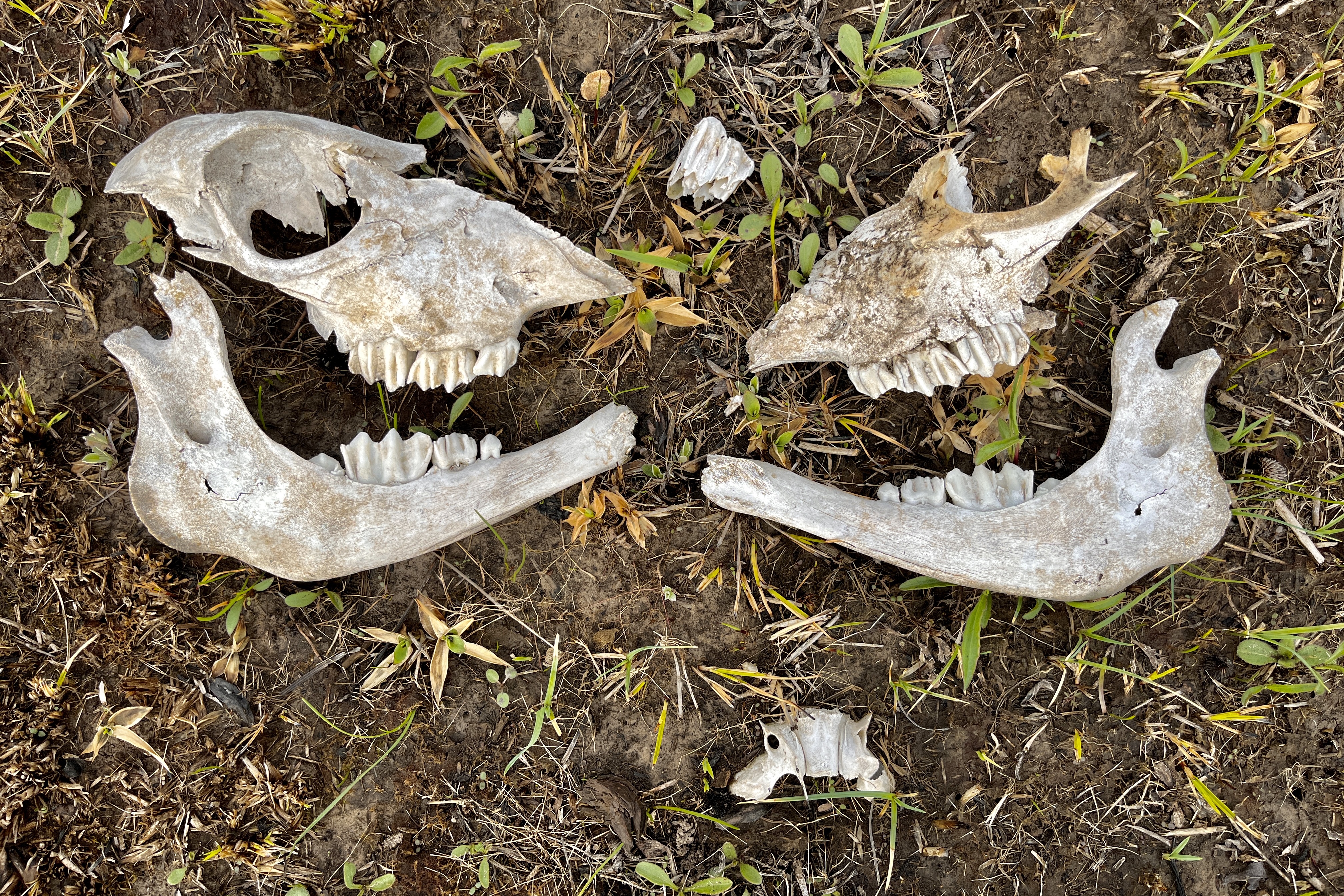
Many other carapaces were seen (though none in such good shape), and in fact bones of many types were easy to find in the burned portion of the prairie. This disarticulated skull from what appears to be a young calf (Bos taurus) was perhaps the most impressive bone find, but we did also find a dried skeleton of a smaller individual. Being the lone entomologist of the group, I just had to turn over the carcass and search for beetles and managed to capture a skin beetle (family Trogidae) and one other small unidentified beetle (but, unfortunately, no Necrobia rufipes [red-legged ham beetle]).
Disarticulated bovid skull – probably a young calf (Bos taurus).
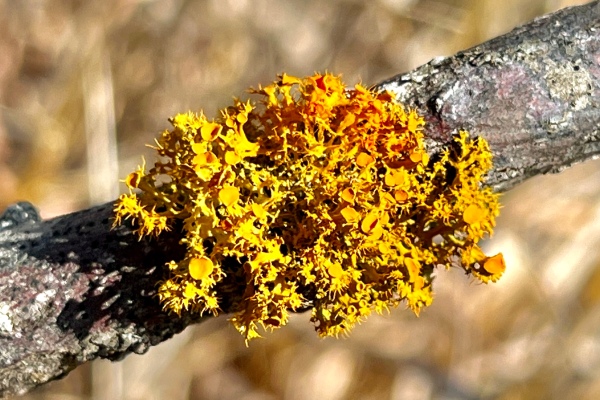
Rocky Barrens Conservation Area Later in the morning, the group caravaned to Rocky Barrens Conservation Area, a 281-acre area in Greene Co. featuring Mississippian limestone glades and site for the federally-endangered Physaria filiformis (Missouri bladder-pod). This plant, in the mustard family, is found only in four counties in southwest Missouri. The plants were readily found, but we were too early to see them in bloom—or anything else, for that matter. For me, however, the glade alone was still interesting, and I couldn’t help but take note of the similarities—and differences—between this limestone example and the dolomite glades south of St. Louis with which I am so much more familiar. Almost immediately, I noted the presence of Sideroxylon lanuginosum (gum bumelia), host for Plinthocoelium suaveolens (bumelia borer)—surely one of North America’s most beautiful longhorned beetles! I didn’t see any frass piles at the base of any of the trees, the presence of which would indicate larval activity, but I’m sure the beetle is here. It would be interesting to come back during the season and look for it. While I didn’t find any signs of the beetle, I couldn’t miss the bright orange-yellow gold-eye lichens (Teloschistes chrysophthalmus) colonizing it’s branches.
Teloschistes chrysophthalmus (gold-eye lichen) on branch of living Sideroxylon lanuginosum (gum bumelia).
Another tree that caught my interest was Celtis tenuifolia (dwarf hackberry). I see these small, gnarly versions of the genus in glades and other xeric habitats, and they always catch my interest because of the diversity of interesting woodboring beetles associated with it. As I looked at the trees, I noticed one small tree in particular that was the perfect stage of dead—branches brittle but bark mostly still intact with a little bit of peeling on the trunk revealing woodboring beetle larval galleries underneath! There were only a few emergence holes present—strong evidence that the tree was still infested and worth bringing back to put in an emergence box to trap the emerging adult beetles. With luck, I’ll be pinning a series of Agrilus ferrisi next winter!
Corry Flatrocks Conservation Area After lunch at a nearby city park, the group caravaned to Corry Flatrocks Consevation Area in Dade Co.—site of another federally-endangered plant, Mononeuria minima (formerly Geocarpon minima) (tiny-Tim, earth fruit). The sandstone glades at this site are among the largest in the area and, thus, host a large population of the plant. By this time of day, the sun had been out for awhile and the day had warmed considerably, so we hoped to see other flowering plants as well. Among the first that we encountered while walking towards the glade proper was Ranunculus fascicularis (early buttercup), distinguished from other “large-flowered buttercups” by its canescent (grayish due to hairiness) leaves with long and narrow lobes, their tips bluntly pointed or rounded. The dry, gladey habitat also distinguishes the species from the similar R. hispidus (hairy buttercup), which flowers at the same time but prefers moister habitats.
Ranunculus fascicularis (early buttercup).
On the glade proper, we quickly encountered tiny little saxifrages in bloom, which turned out to be Micranthes texana (Texas saxifrage), restricted in Missouri to this part of the state (and thus with a high CC value of 9) and distinguished from the more widespread M. virginiensis (early saxifrage) by its small, compact stature. These first individuals we encountered had especially reddish-tinged flowers.
Micranthes texana (Texas saxifrage).
As soon as we reached the more open part of the glade with large expanses Of exposed rock, the group dropped to their hands and knees to find the diminutive plants we were looking for.
MONPS Field Trip participants looking for Mononeuria minima (formerly Geocarpon minima) (tiny-Tim, earth fruit).
The plants were not uncommon, even abundant, in shallow, sand-filled depressions in the rock. Nevertheless, careful observation was still required to see and recognize them. Fortunately, the plants were already in bloom, their tiny styles barely visible to the naked eye within the green, not-much-bigger, petalless flowers. Photographing these plants, and especially those in bloom, proved to be a task almost beyond the capabilities of the smart phones that most in the group were using (me included).
Mononeuria minima (formerly Geocarpon minima) (tiny-Tim, earth fruit).
The glades stretched on for quite a distance, inviting further exploration. At the margins, white flowering trees were noticed, and moving closer they proved to be Amelanchier arborea (downy serviceberry, common serviceberry)—among the first we have seen open this spring. (I typically see the first blooms of these trees in the final days of March, at least around my home in east-central Missouri.) an even closer looked revealed tiny insects (also among the first insects I have seen active this spring) flying around and crawling about on the flowers. These proved to be parasitic hymenopterans—family ID is still pending, but I suspect they will prove to be a species in one of the many families of “microhymenopterans” that are egg parasitoids. I am not sure whether they were visiting the flowers as pollinators (which behavior I am not aware of) or in hopes of encountering other pollinators which could potentially serve as hosts—a subject with which I will need to follow up.
Amelanchier arborea (downy serviceberry, common serviceberry) with numerous tiny parasitic wasps (family undetermined).
Near the back end of the glade, we encountered a few more Micranthes texana (Texas saxifrage), these having more typical white flowers in perfect peak bloom.
Micranthes texana (Texas saxifrage) with white flowers.
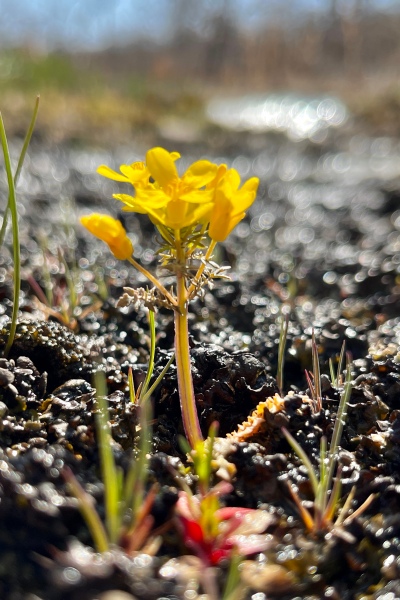
Also in that part of the glade we found a few scattered individuals of Selenia aurea (golden selenia). While not quite as conservative as M. texana (CC value = 6), it has a similar range in the U.S. and in Missouri is also restricted to a handful of counties in the southwestern part of the state. The plant is known to occur in large colonies (which I have seen at nearby Corry Branch Glade)—its brilliant yellow flowers forming a spectacular display.
Selenia aurea (golden selenia).
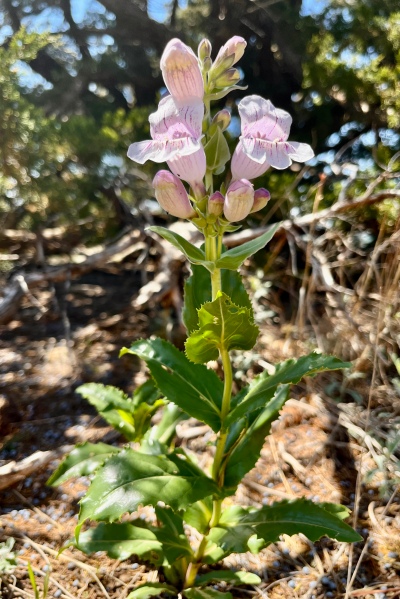
To this point, the only insect I had seen besides the microhymenopterans was a skin beetle (family Trogidae), which I found when I kicked over some dried mammal scats. However, on the way back to the cars we finally encountered an insect large enough in size and striking enough in appearance to pique the interest of not just me but the group as a whole—a large caterpillar feeding on the foliage of Penstemon digitalis (smooth beard-tongue). It’s appearance—dark with longitudinal yellow stripes and blue spotting—immediately called to mind one of the tiger moths (formerly Arctiidae, now a subfamily in the Erebidae), specifically the genus Haploa (commonly called haploa moths). A little detective work on BugGuide comparing photos and recorded host plants narrowed the likely choice to H. confusa (confused haploa moth).
Haploa sp. prob. confusa (confused haploa moth) caterpillar feeding on foliage of Penstemon digitalis (smooth beard-tongue).
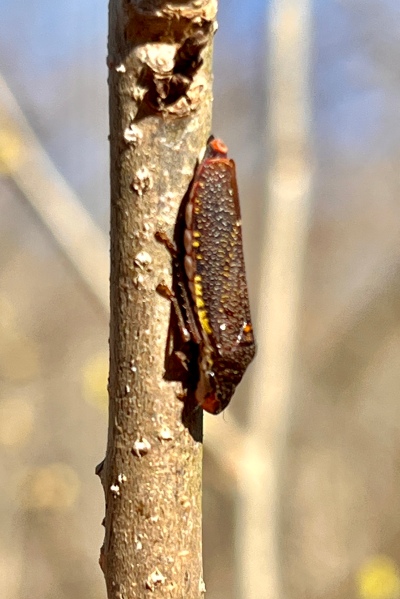
Day 2 – Lead Mines Conservation Area The final day of the MONPS Field Trip featured a morning trip to Lead Mine Conservation Area in Dallas Co. Of particular interest to the group were several parcels within the area designated as Niangua River Hills Natural Area and featuring a diversity of habitats including dolomite glades, chert woodlands, and calcareous wet meadows (fens). Most in the group visited the northern parcel to see the dolomite glades; however, a few of us—primarily from St. Louis and well-familiar with dolomite glades—opted to visit the smaller southern unit of the natural area to see the fen and riparian woodland we needs to pass through to get there. It was a much warmer morning than yesterday, though still chilly starting out, so blooms were sparse as we hiked the woodland trail searching for any hint of color. At one point, someone noticed a shrub a bit off the trail with large, reddish pink flowers—the color seeming a bit unexpected for the situation. Bushwhacking toward it, we realized it was Chaenomelesspeciosa (common flowering quince), a common, ornamental non-native plant that rarely—but obviously sometimes—escapes cultivation. While the group looked at the plant, I saw my first insect of the day—Paraulacizes irrorata (speckled sharpshooter), one of our largest and most recognizable leafhoppers, sitting head-down on the stem of a small sapling.
Paraulacizes irrorata (speckled sharpshooter).
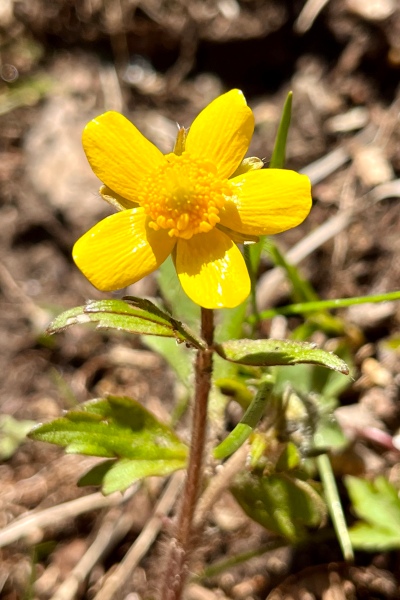
Among the first native blooms we saw was Ranunculus hispidus (hairy buttercup). Though similarly “large-flowered” as R. fascicularis (early buttercup), it differs by its sprawling growth habit, differently shaped-leaves, and preference for moist habitats. Buttercups are a favorite flower host for jewel beetles (family Buprestidae) in the genus Acmaeodera, and one species —A. tubulus—is among our earliest-emerging beetles in the spring, so I checked each buttercup flower that I saw hoping to see these little beetles signaling the beginning of insect activity for the season. Sadly, none were seen.
Ranunculus hispidus (hairy buttercup).
At last we reached the fen—a large open area on the toe-slopes of the adjacent hillside where water draining through the underlying strata emerged to the surface to maintain a continually wet environment. The fen here is special, as two species of Cyprepedium (lady’s slipper orchids) are know to occur in the fen (and in fact, all four of the state’s Cyprepedium spp. can be found with Lead Mine Conservation Area). At this early date, the orchids would not be anywhere close to blooming; however, the group looked for evidence of their presence, walking gingerly through the fen so as to avoid inadvertently stepping upon any emergent foliage. No putative clumps were found, but already in my mind I’m thinking a mid-May trip back to the fen might be warranted! Unlike the orchids, Castilleja coccinea (Indian paintbrush) was abundantly evident throughout the fen, with an occasional plant almost ready to burst forth their scarlet blooms. Senescent flower stems of composites, presumably Rudbeckia, were also seen throughout the glade, which, combined with the abundance of Castilleja, created the promise of a stunning early-summer display across the fen.
Castilleja coccinea (Indian paintbrush).
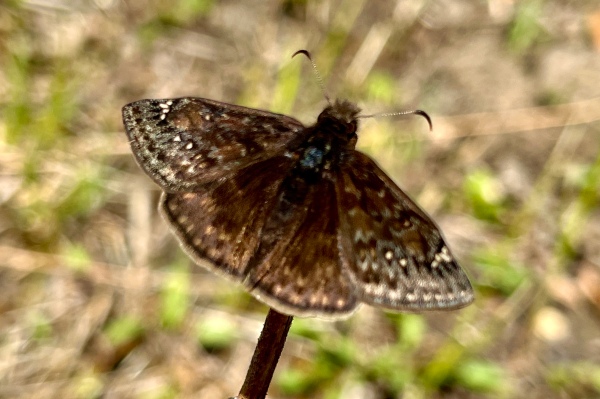
During our time in the fen, two species of butterflies were seen flitting about the herbaceous vegetation: tiny blue Celastrina ladon (spring azure), and one of the dustywing skippers in the genus Erynnis. The former were impossible to photograph due to their persistent flitting and skittish behavior, and the latter almost were as well. Only when I locked the focus on a preset 2x zoom and fired shots in rapid succession while moving the smartphone ever closer to the subject did I manage this one imperfect but passable photograph of the last one I tried. The genus Erynnis is diverse and notoriously difficult to identify, and my expertise with skippers and butterflies pales compared to my skills with beetles, so the ID will have to remain Erynnis sp. until a more authoritative opinion is offered. [Edit 4/6/22, 11:38 am: According to my lepidopterist friend Phillip Koenig, Erynnis horatius and E. juvenalis both fly in early spring, and they cannot be reliably separated from the dorsal side. Erynnis juvenalis has one or two dots on the ventral hind wing that E. horatius lacks and only flies in the early spring, while E. horatius can be seen through the summer. If only I could turn the picture over to see what it looks like on the ventral side!]
Erynnis horatio or E. juvenalis (Horatio’s or Junenale’s duskywing) in fen habitat.
Returning through the riparian woodlands after visiting the fen, the day had warmed considerably, and numerous flowers not seen earlier were suddenly in full bloom. These included Erythronium mesochorium (prairie fawn lily midland fawnlily, prairie dogtooth violet)—the same species we saw yesterday so reluctantly in bloom at Schuette Prairie. Most were of the familiar form with unmottled leaves; however, we found one individual with notably mottled leaves that resembled those of E. albidum (white dogtooth violet) (1st photo). Nevertheless, the leaves were still narrower than that species and folded, and the plant was growing a mere 12” from another individual with no trace of mottling (2nd photo).
Claytonia virginca (spring beauty) was also blooming in abundance as we took the trail back. I am always amazed at the variability seen in the flowers of this species—from pure white to vividly pink-striped to pink at the tips. This especially vivid pink individual was about as pink as they come.
Claytonia virginca (spring beauty)—an especially vivid pink example.
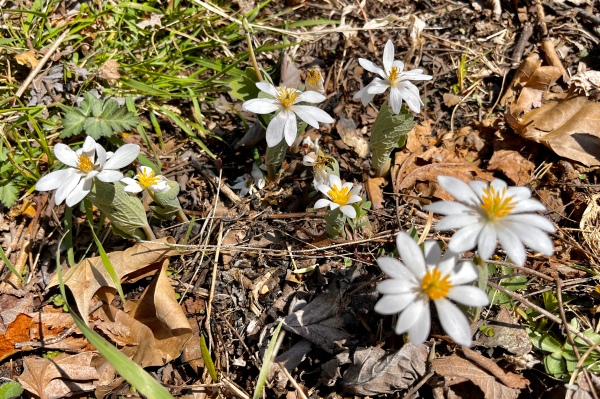
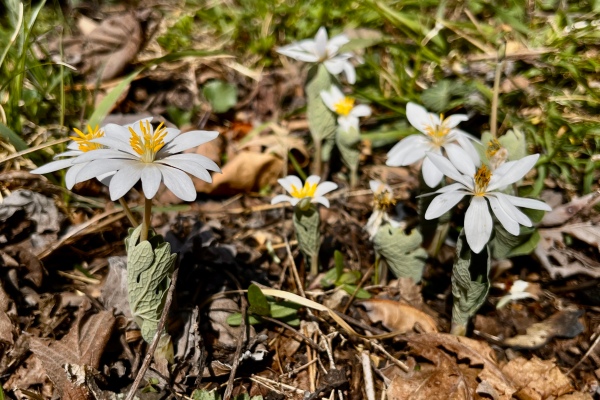
Sanguinaria canadensis (bloodroot) also was popping up regularly. We had seen isolated plants sitting the trailsides when we first part through—their flowers tightly folded in stubborn response to the chilly morning temperatures. By early afternoon, however, they were spread wide open as invitation to any of the flying insects that had surely also been awakened by the warmer temperatures of the afternoon. While most were seen as isolated individuals, a particularly idyllic clump captured our attention, almost begging “photograph me!”
Sanguinaria canadensis (bloodroot).
With that, we rejoined the main group to recount the days experiences and cement new relationships before heading back towards our respective home areas.
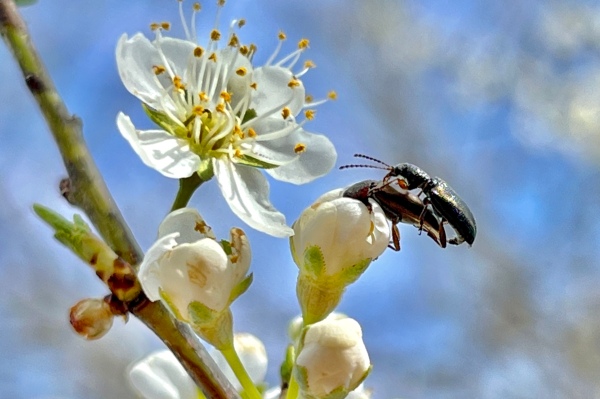
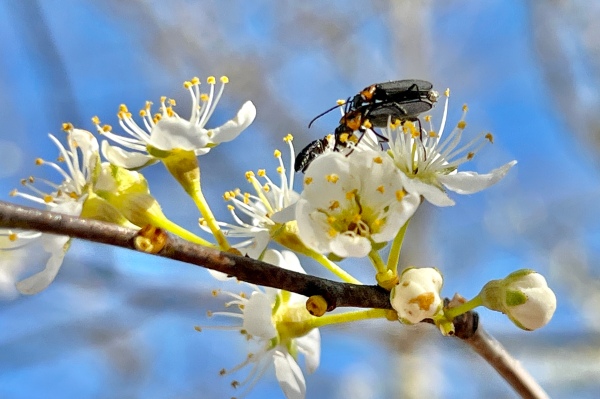
Long Ridge Conservation Area On the way back home, I decided to check out this conservation area in Franklin Co., which I’ve never visited before. The afternoon had gotten quite warm, so I reasoned that maybe today would be the day when insects start coming out in abundance. I was right! As soon as I pulled into the parking lot, I saw a Prunus mexicana (Mexican plum) in full bloom, and walking up to it I immediately saw an abundance of bees and small beetles all over the flowers. The latter turned out to be Orsodacne atra (a leaf beetle) and Ischnomera ruficollis (rednecked false blister beetles).
Orsodacne atra (leaf beetle) on flowers of Prunus mexicana (Mexican plum).
Orsodacne atra (leaf beetle) mating pair on flowers of Prunus mexicana (Mexican plum).
Ischnomera ruficollis (rednecked false blister beetle) mating pair on flowers of Prunus mexicana (Mexican plum).
Inside the woods along the Blue Trail, there were the usual suspects in bloom—Claytonia virginica (spring beauty), Cardamine concatenata (toothwort), Antennaria parlinii (Parlin’s pussytoes) and Ranunculus hispidus (hairy buttercups).
Antennaria parlinii (Parlin’s pussytoes).
Eventually I happened upon an Amelanchier arborea (downy serviceberry) in full bloom. There were more O. atra and I. ruficollis on the flowers (though not so many as on the Mexican plum), along with a Mecaphesa sp. crab spider that had caught and was feeding on a male Andrena carlini (Carlin’s mining bee)*.
Mecaphesa sp. crab spider with male Andrena carlini (Carlin’s mining bee) prey on flowers of Amelanchier arborea (downy serviceberry). *Bee ID by Mike Arduser.
On the back third of the trail, I found two fallen branches under a Quercus shumardii (Shumard’s oak) that had been pruned by longhorned beetles—presumably Anelaphus villosus. At the end of the trail I found a third such branch of the same species of oak. All three will be placed in an emergence box, and hopefully the culprits will emerge as adults.
Anelaphus villosus-pruned branches of Quercus shumardii (Shumard’s oak)—both collected under the same tree.
Pinus echinata (shortleaf pine) woodland at Hawn State Park.
Nestled in the northern foothills of the St. Francois Mountains lies one of Missouri’s most remarkable of places—Hawn State Park. I have written about this place onseveraloccasions and visited even more often, yet I never tire of exploring its sandstone canyons, rhyolite shut-ins, and stately pine forests. As such, I was happy to see it as the selected destination for the WGNSS Botany Group Monday Walk.
A partially frozen Pickle Creek meanders through Hawn State Park.
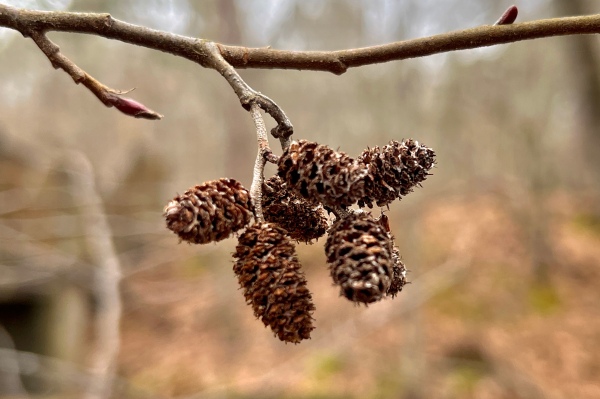
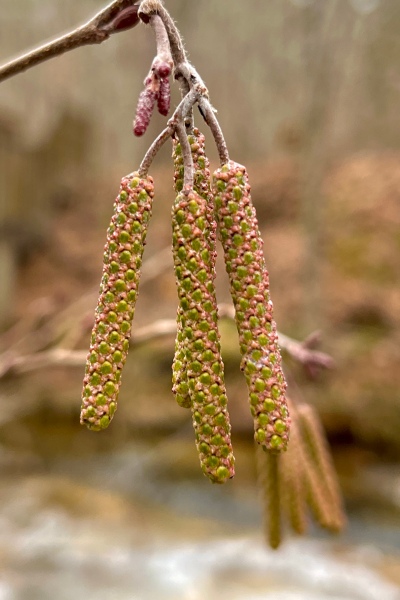
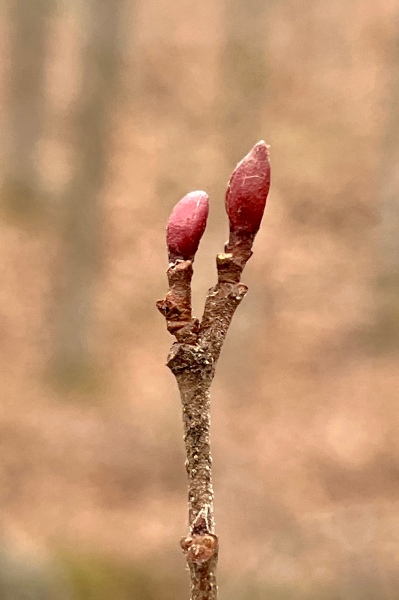
It was a chilly winter morning when the group met at the picnic area parking lot, and after a bit of discussion to orient ourselves on the plants we might see, we crossed the foot bridge over Pickle Creek to explore the habitats off the Whispering Pines Trail. Almost immediately (in fact, even before completely crossing the bridge), we noticed Alnus serrulata (smooth alder) lining the edges of the creek banks. Unlike many trees, A. serrulata is easy to recognize during winter by virtue of its persistent female cones and newly-formed male catkins. Alnus serrulata is one of five species in Missouri belonging to the family Betulaceae—all five of which occur together here in Hawn State Park (and, in fact, can be found within feet of each other). In the case of this species, the female cones are unique, the male catkins are green and red and occur during winter in clumps, and the winter buds are red with two scales.
Alnus serrulata (smooth alder) – newly-emerged male catkins.
Alnus serrulata (smooth alder) – winter buds.
Immediately after crossing the bridge, we saw the second betulaceous species on slightly higher ground—Corylus americana (American hazelnut). Like A. serrulata, this species is usually a small tree, but it lacks the persistent cones during winter, has more brownish male catkins that may be clumped, especially at the branch tips, but also tend to occur singly along the length of the branch, and has brownish, rounded winter buds and noticeably fuzzy twigs.
Corylus americana (American hazelnut) – male catkins.
Corylus americana (American hazelnut) – winter bud.
Corylus americana (American hazelnut) – male catkins.
Entering the mixed pine-oak forest (and pondering Fr. Sullivan’s oak ID quiz—which turned out to be Quercus coccinea, or scarlet oak), Kathy noticed the persistent fruiting stalks of one of our native terrestrial orchids—Goodyera pubescens (downy rattlesnake plantain). Normally, this orchid is noticed during winter by virtue of its striking white-veined green leaves, but in this case they were completely hidden under leaf litter. Had it not been for the fruiting stalk, we would never have noticed its presence. Hawn State Park has a healthy population of these orchids, and hopefully the fruits of this individual will bear an abundance of its tiny (spore-sized) seeds.
Goodyera pubescens (downy rattlesnake plantain) – last season’s fruiting stalk.
Continuing our off-trail bushwhacking, we eventually reached a series of sandstone canyons that promised not only spectacular ice formations from their constant moisture drip, but the potential for seeing plants that rely on the cool, shaded, moist, acidic nooks and crannies they offer.
Sandstone ledges.
Two fern species were seen. The first was Asplenium platyneuron (ebony spleenwort)—not uncommon and distinguished by the dark, reddish-brown, glossy stipe and rachis (on fertile fronds) with simple pinnate leaves and alternately-arranged leaflets with a basal auricle (ear-lobe). Two columns of elongated sori (spore-bearing structures) oriented diagonally to the central veins can be found on their lower surface of the leaflets. Dryopteris marginalis (marginal wood fern) was also found on the sandstone ledges. This fern is most easily identified by the location of its sori on fertile fronds, which occur along the margins of its subleaflets (some other less common species will have the sori placed more interiorly).
Dryopteris marginalis (marginal wood fern) – lower surface of lower leaves of fertile frond.
The most exciting find on the sandstone ledges was Mitchella repens (partridge berry). This member of the Rubiaceae (same family as coffee) is characteristic of sandstone canyons and ledges and occurs in Missouri only in a few counties in the southeastern part of the state where this habitat exists. The plant is unmistakable and easily identified, especially when in fruit. Interestingly, each of its bright red berries is actually a fusion of two fruits, as evidenced by the pair of minute, persistent calyces at the tip.
Mitchella repens (partridge berry).
Mitchella repens (partridge berry) – fruit showing paired calyces.
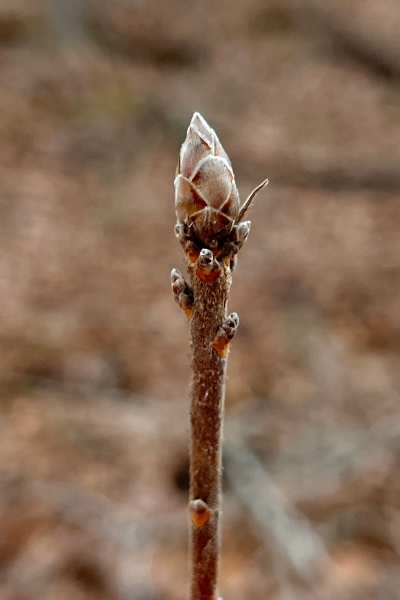
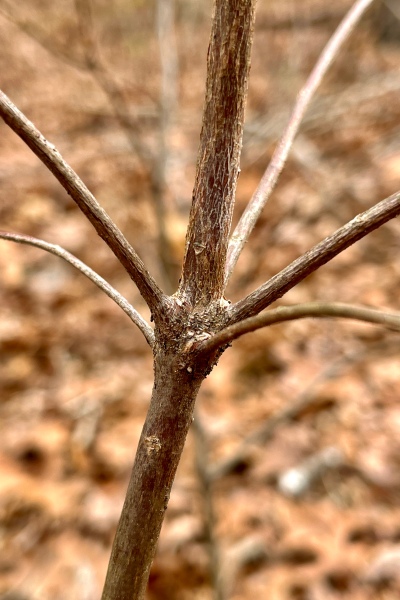
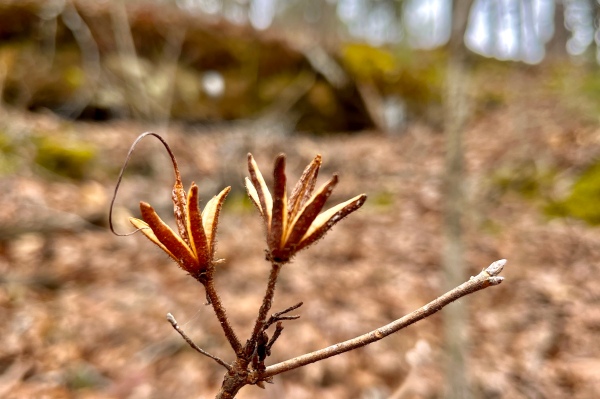
Back on-trail, the group focused on identifying the many different tree species along the trail (Quercus coccinea was dominant). One small “tree” had us stumped, however, it’s giant terminal bud with small lateral buds clustered nearby seemingly suggesting oak—until we noted the curious whorl at the branch node and, on a subsequently-seen individual, persistent fruit capsules that immediately identified it as Rhododendron prinophyllum (early azalea). Another lover of acidic pine woodlands, this species is restricted in Missouri to high-quality habitats in the Ozark Plateau, and Hawn State Park has some of the finest populations to be found.
Rhododendron prinophyllum (early azalea) – last season’s fruiting capsules.
As the group ascended the trail and began pondering whether to turn around, the characteristic leaves of a small saxifrage were seen at the base of an oak tree. Micranthes virginiensis (early saxifrage, Virginia saxifrage) shows a preference for rocky acid soils and reaches the western limit of its distribution in Missouri, where it is limited to a few counties in the Ozarks. A similar but much smaller species, Micranthes texana (Texas saxifrage) can be found in sandstone glades in western Missouri.
Micranthes virginiensis (early saxifrage, Virginia saxifrage).
Micranthes virginiensis (early saxifrage, Virginia saxifrage) – last season’s fruiting stalk.
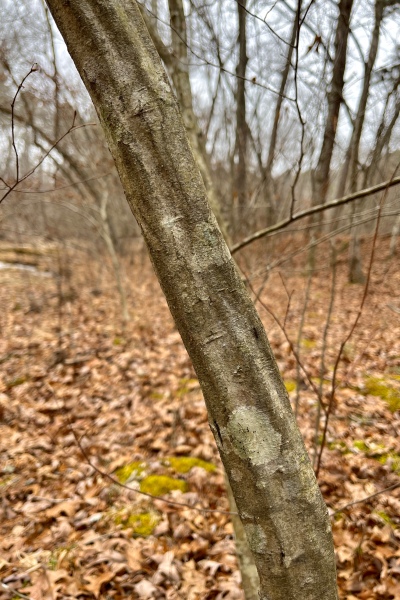
Returning to Pickle Creek, the group focused on the remaining three species of Betulaceae found in Missouri—and Hawn State Park, all growing in the immediate vicinity of the foot bridge. The three species—Betula nigra (river birch), Carpinus caroliniana (American hornbeam, musclewood, blue beech), and Ostrya virginiana (American hophornbeam), all have numerous subtle characters that distinguish them from the other two members of the family (Alnus and Corylus), but in winter they are most easily recognized by their bark. The flaky, peeling, cinnamon-brown bark of B. nigra is the most distinctive and cannot be mistaken for anything else. This contrasts completely with the smooth, gray, sinuous look of C. caroliniana (which I can’t help but stroke whenever I see it—should I be admitting that!?). In between is the rough, shredded, brownish appearance of O. virginiana (which is further distinguished from C. americana by its pointed rather than rounded buds).
Betula nigra (river birch) – bark.
Carpinus caroliniana (American hornbeam, musclewood, blue beech) – bark.
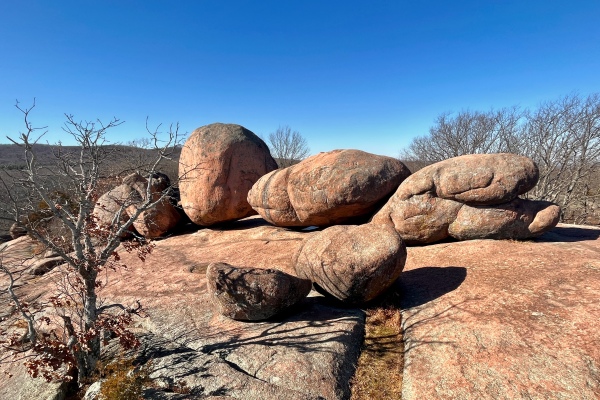
After missing the past three weeks, I was finally able to rejoin the Webster Groves Nature Study Society Botany Group for their weekly Monday outing. It was a good outing for making my return, as the group visited one of Missouri’s most famous and unusual landmarks—Elephant Rocks State Park—on what turned out to be a sunny day with unseasonably balmy conditions. Located in Acadia Valley in the heart of the St. Francois Mountains, the park is named for its main feature—one of the mid-continent’s best examples of an unusual geological feature known as a “tor.” These piles of rounded, weathered granite boulders sitting atop a bedrock mass of the same rock resemble groups of elephants lumbering across the landscape. First shaped underground in 1.5-billion-year-old granite as vertical and horizontal fractures developed in the rock and percolating water softened and degraded the rock adjacent to the cracks, the “core stones” were eventually exposed as erosion removed the overlying layers and the disintegrated rock surround the fractures, exposing the giant boulders at the surface.
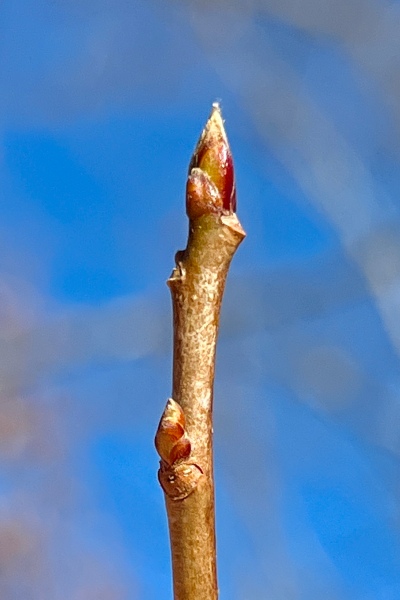
The group explored the area along the Braille Trail, which passes through dry-mesic upland deciduous forest as it circumnavigates the tor. Oaks and hickories—primarily Quercus alba (white oak), post oak (Q. stellata), blackjack oak (Q. marilandica), Carya ovata (shagbark hickory), and C. glabra (pignut hickory)—dominate the canopy, while the understory featured Viburnum rufidulum (rusty blackhaw), Cornus florida (flowering dogwood), Prunus serotina (black cherry). Unusually abundant also was Nyssa sylvatica (black or sour gum). This small tree reaches its northern limit of distribution near St. Louis, Missouri but is more common further south. Winter bud skills are necessary to recognize the species at this time of year, which can be recognized by their alternate arrangement with three reddish-brown scales and three bundle scars. The leaves of this tree turn a brilliant red in the fall, making them desirable for landscape planting.
Nyssa sylvatica (black gum) winter buds.
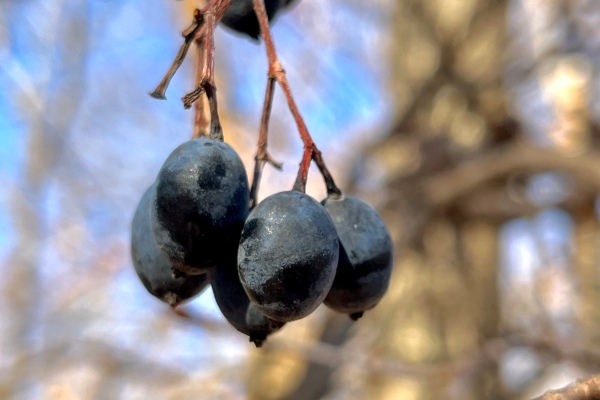
Like Nyssa sylvatica, Viburnum rufidulum (rusty blackhaw) is also most common south of the Missouri River. However, in contrast to the former, the winter buds of the latterare immediately recognizable by their dark rusty-colored “velvety” buds and opposite arrangement. The tree we saw at the beginning of today’s outing was also heavily laden with fruits, a dark blue-black pruinose drupe.
Viburnum rufidulum (rusty blackhaw) winter bud.
Viburnum rufidulum (rusty blackhaw) fruits.
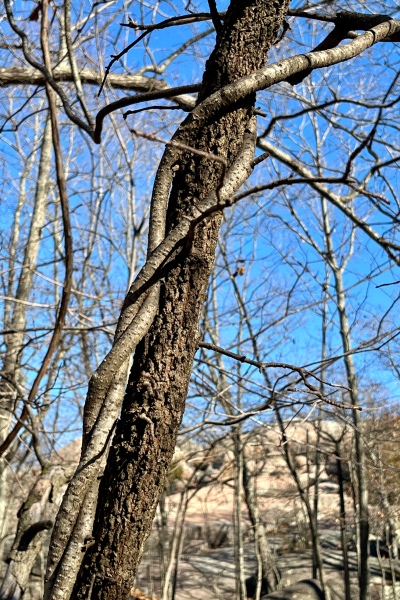
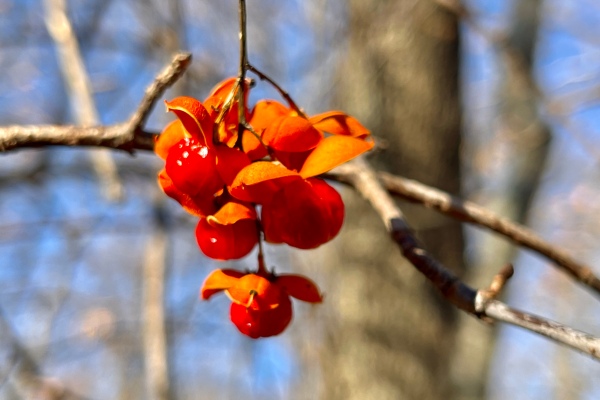
As we examined the blackhaw tree, we noticed a robust vine entwining its trunk and ascending high into the canopy above. Heavily laden along its length was a crop of fruits that immediately identified the vine as Celastrus scandens (American bittersweet). This native species can be distinguished from the introduced C. orbiculatus (Oriental bittersweet) at this time of year by its terminal fruits with orange instead of yellow dehiscing valves.
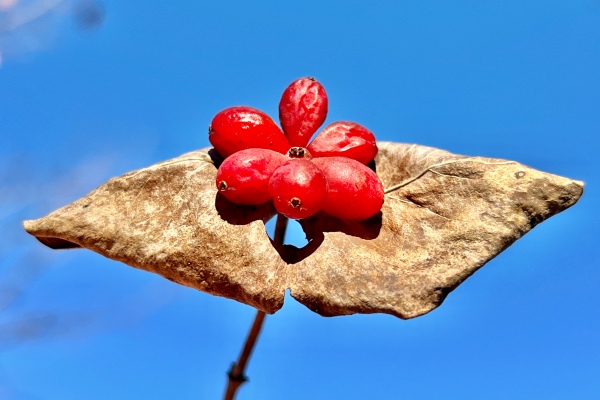
The “fruit” theme of the day continued as we veered off the path to look at a rather magnificent specimen of Quercus marilandica (blackjack oak) and saw yet another vine bearing fruit inside its canopy. The opposite leaf remnants had us quickly thinking of some type of honeysuckle (genus Lonicera), and we arrived at Lonicera sempervirens (trumpet honeysuckle) once we noticed the fused perfoliate leaf pairs directly behind the fruits. This native honeysuckle is a desirable species and not to be confused with any of the several invasive introduced species of honeysuckle that can now be found in Missouri.
Another honeysuckle relative, Symphoricarpos orbiculatus (coralberry), was heavily laden with fruit in the shrub layer. Like Lonicera sempervirens, this species is also native to Missouri and should not be confused with the invasive introduced species—especially Lonicera mackii (bush honeysuckle), which it superficially resembles but can be immediately distinguished from during this time of year by its uniquely coral-colored fruits.
Symphoricarpos orbiculatus (coralberry) fruits.
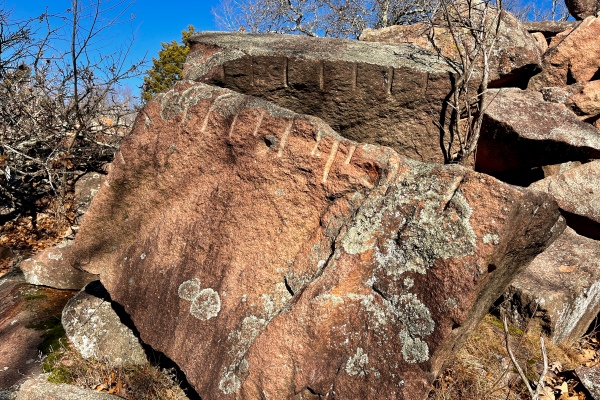
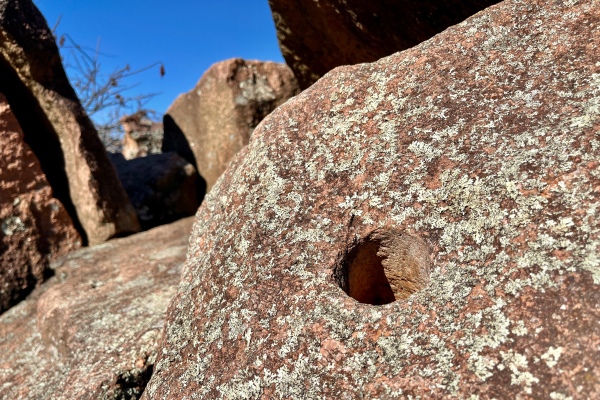
As the Braille Trail wrapped around the eastern side of its loop, we passed by a pile of granite boulders—obvious rubble fragments from the quarrying days of the area’s earlier history due to their sharp, angular shapes. Drill holes could be seen in and around the margins of some of the fragments, providing more evidence of their provenance from rock splitting operations before their eventual abandonment, perhaps not being of sufficient quality to warrant further cutting and shaping into building blocks or paving stones before shipment to St. Louis. Lichens growing sparingly on the cut faces indicated that some amount of time had passed since the stone had been cut, but it was a mere fraction of time compared to the densely colonized original exposed surfaces.
Granite rubble showing drill holes along margins.
Drill hole in granite bolder from quarrying.
Lichens were not the only forms of life taking advantage of new habitat created by past quarrying activities. Two species of ferns were found growing in protected crevices between the boulders, especially those where water was able to collect or seep from. The first was Asplenium platyneuron (ebony spleenwort), with only sterile fronds present but distinguished by the shiny dark rachis (stem) and stipe (stem base) and alternate, basally auriculate (lobed) pinnae (leaflets). The second was at first thought to be another species of Asplenium, possibly A. trichomanes (maidenhair spleenwort), but later determined to be Woodsia obtusa (common woodsia) by virtue of its all green rachis and stipe and much more highly dissected pinnae arranged very nearly opposite on the rachis. We later found the two species again growing close to each other right along the trail—completely unnoticed despite the group having passed them three times already (i.e., 25 person passes!).
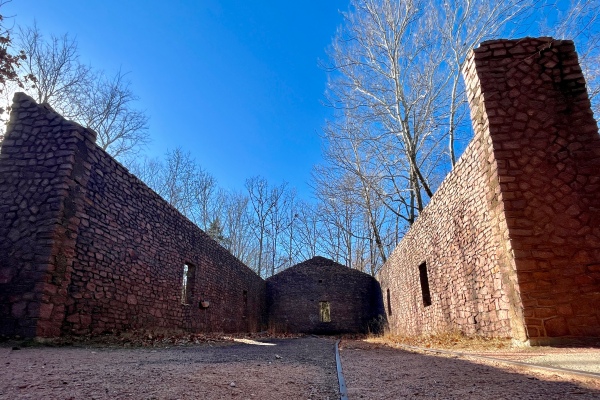
A short spur took us to the Engine House ruin—originally built to repair train engines and cars; its granite skeleton still in good condition—before passing by the park’s main geological attraction: the central tor with its famous “elephants”! Standing atop the exposed granite and boulders, I try to let my mind go back half a billion years—an utterly incomprehensible span of time—when the boulders before me are still part of a giant submerged batholith underneath volcanic peaks soaring 15,000 above the Precambrian ocean lapping at their feet; life already a billion years old and dizzyingly diverse yet still confined to those salty waters.
Engine House ruin.
Exposed granite bedrock.
This formation—a stack or pile of rounded, weathered granite boulders sitting atop a bedrock mass of the same rock—is called a “tor.”
Vertical cracks in the bedrock erode into narrow gaps once exposed by erosion.
The landscape atop the tor seems sterile and barren, but like the rubble piles below it’s cracks and crevices abound with life. An especially fruticose stand of Vaccinium arboreum (farkleberry) found refuge in a protected area among some of the bigger boulders, their dark blue fruits continuing the “berry” theme of the day and providing an opportunity for the group to sample their flavor and compare to its cultivated blueberry cousins (I found their flavor to be quite pleasing, if somewhat subdued compared to what is my favorite fruit of all). Vaccinium arboreum is the largest of the three species in the genus occurring in Missouri, and the woody stems of larger plants make it quite unmistakable. Smaller plants, however, can be difficult to distinguish from the two other species, in which case the leaf venation can be used—that of V. arboreum being very open. This is another species that finds itself at the northwestern limit of its distribution in the craggy hills of the Ozark Highlands, where it shows a distinct preference for the dry acidic soils found in upland forests overlying igneous or sandstone bedrocks.
Vaccinium arboreum (farkleberry) fruits.
Vaccinium arboreum (farkleberry) leaf.
Despite this being a botany group outing, I rarely manage to go the entire time go by without finding and pointing out at least one interesting insect. Today, it was an adult Chilocorus stigma (twice-stabbed ladybird beetle) sitting on a Nyssa sylvatica trunk. This is a native ladybird, not to be confused with the introduced and now notorious Harmonia axyridis (Asian ladybird beetle), that lives primarily in forest habitats and is generally considered to be a beneficial species (although not sold for commercial use in orchards or on farms).
Don Robinson State Park comprises and protects much of the upper watershed of LaBarque Creek in northwestern Jefferson Co.—one of east-central Missouri’s most pristine and ecologically significant watersheds. The St. Peter’s sandstone bedrock underlying the area features box canyons, shelter caves, cliffs, and glades amidst high-quality upland and lowland deciduous forests. The property was originally purchased in the 1960s by businessman Don Robinson, who’s dream was to have a personal sanctuary as large as New York’s Central Park. Through his generosity, the property was bequeathed to the state to become part of Missouri’s state park system following his death a half-century later. The park opened to the public in 2017 and offers some of the highest-quality hiking trails within an hour’s drive from St. Louis. For those interested in more detail regarding the watershed’s geology, ecology, and conservation, an excellent summary can be found in the recently issued LaBarque Creek Watershed Conservation Plan by Friends of LaBarque Creek Watershed.
Here are a few photos from along the Sandstone Canyon Trail.
Rich photographs a box canyon on the Sandstone Canyon Trail.
Box canyon on the Sandstone Canyon Trail.
Sandstone bluffs on the Sandstone Canyon Trail.
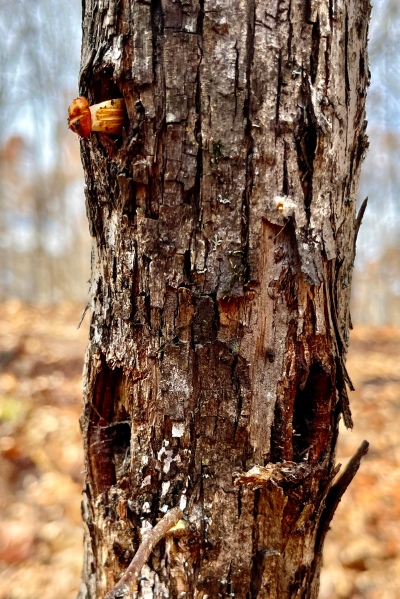
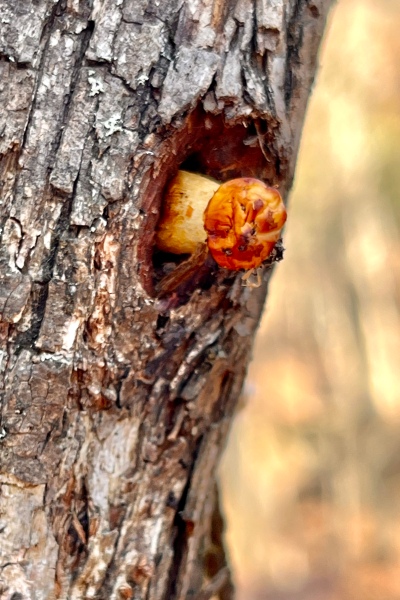
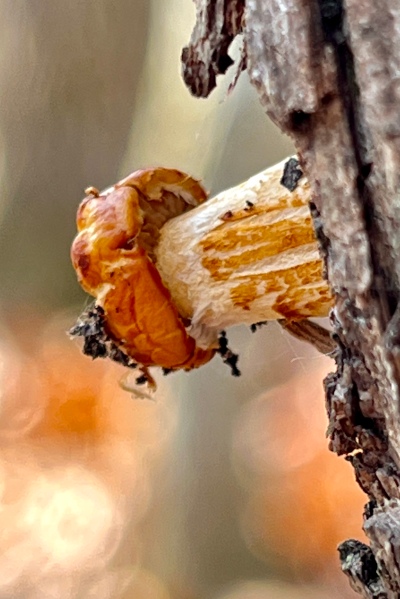
Armillaria gallica (bulbous honey mushroom)? Growing from woodpecker damage on living Ostrya virginiana (hop hornbeam) in mesic upland deciduous forest.
I’ve never seen a mushroom growing out of a woodpecker hole.
This fungus lives as a saprobe or opportunistic parasite in weakened tree hosts and can cause root or butt rot.
The flora along the riparian corridor inside the box canyons was of particular interest to me, as it contained nice stands of three tree species of note: Betula nigra (river birch), Ostrya virginiana (eastern hop hornbeam), and Carpinus caroliniana (blue beech, musclewood, American hornbeam). All three species belong to the family Betulaceae and have been associated with some interesting woodboring beetle species in Missouri. I have reared large series of Anthaxia (Haplanthaxia) cyanella from fallen branches of B. nigra (both blue and bronze color forms—see MacRae 2006), and in the course of doing so I also reared a series of an Agrilus species that turned out to be undescribed (to which I later gave the name Agrilus betulanigrae—see MacRae 2003). From O. virginiana, I have reared two specimens of Agrilus champlaini from galls on living trees (still the only known Missouri specimens of this species—see MacRae 1991). Finally, from dead branches of C. caroliniana, I have reared Agrilus ohioensis (see Nelson & MacRae 1990), and from a larger, punkier dead branch I reared a single Trachysida mutabilis—this also still the only known specimen from Missouri (see MacRae & Rice 2007). I think I’ll go back in late winter to early spring and see if I can find dead branches of each to place in rearing boxes or perhaps girdle some branches to leave in situ for a season before retrieving and placing in rearing boxes. Who knows, maybe I’ll get lucky with additional new finds.
References
MacRae, T. C. 1991. The Buprestidae (Coleoptera) of Missouri. Insecta Mundi 5(2):101–126.
MacRae, T. C. 2003.Agrilus (s. str.) betulanigrae MacRae (Coleoptera: Buprestidae), a new species from North America, with comments on subgeneric placement and a key to the otiosus species-group in North America. Zootaxa 380:1–9.
MacRae, T. C. 2006. Distributional and biological notes on North American Buprestidae (Coleoptera), with comments on variation in Anthaxia (Haplanthaxia) cyanella Gory and A. (H.) viridifrons Gory. The Pan-Pacific Entomologist 82(2):166–199.
MacRae, T. C. & M. E. Rice. 2007. Biological and distributional observations on North American Cerambycidae (Coleoptera). The Coleopterists Bulletin 61(2):227–263.
Nelson, G. H. & T. C. MacRae. 1990. Additional notes on the biology and distribution of Buprestidae (Coleoptera) in North America, Part III. The Coleopterists Bulletin 44:349–354.
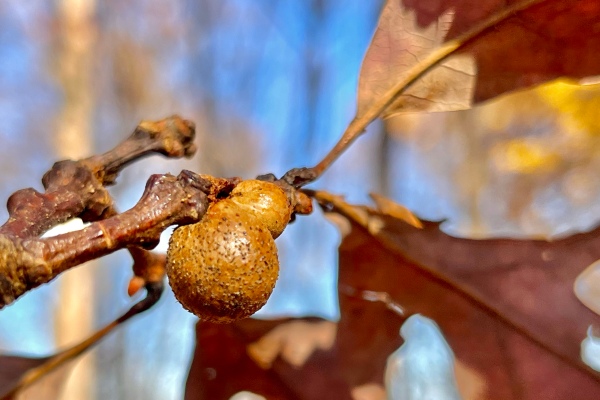
Galls of Disholcaspis quercusglobulus (round bullet gall wasp) on twig of Quercus alba (white oak).
Not all gall wasps (family Cynipidae) affect the leaves of their hosts—some instead affect the twigs. One example of such is Disholcaspis quercusglobulus (round bullet gall wasp), which forms round, detachable galls, singly or in small clusters, on the twigs of Quercus alba (white oak).
There are about a dozen other species in this genus, all of which seem to to have succeeded in eliminating the need for males (Weld 1959). All galls produce female wasps, which emerge from their galls during the fall and immediately lay eggs in twigs to begin the next year’s crop of females—no males needed. Ain’t evolution grand?!
Literature Cited
Weld, D. 1959.Cynipid Galls of the Eastern United States. Privately printed in Ann Arbor, Michigan [pdf].
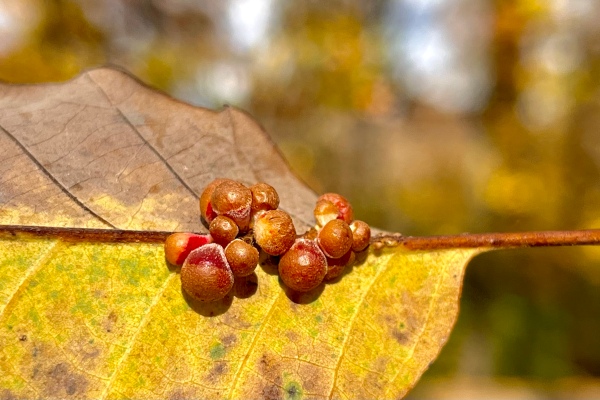
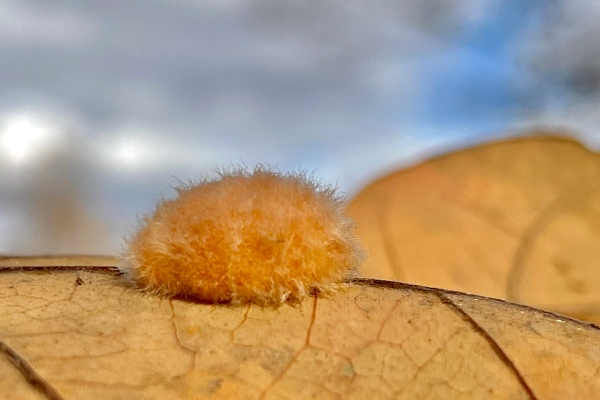
Walking Beau Diddley (my black lab) and blowing leaves today gave me an opportunity to glimpse into the world of leaf galls. Lots of organisms, both animal and disease, cause these bizarre structures to grow on the leaves and stems of various plants. In the case of the two shown here, they are cause by tiny wasps called cynipid gall wasps. There are thousands of different species of gall wasps, each creating their own characteristic type of gall and restricted to one or a few closely related host plants, but in each case the adult female wasp lays one or more eggs in the leaf—their “stinger” being used like a hypodermic needle to inject the eggs inside the leaf tissues (but completely unable to sting humans). When the eggs hatch, the larvae (called grubs) do not begin feeding directly on the existing leaf tissue, but instead secrete plant growth-like hormones that cause the plant to grow a specialized structure—called a gall—inside which the grub lives and feeds. It’s sort of like “Invasion of the Body Snatchers” on a micro-scale. When the grub has completed its development, it transforms into a pupa (kind of a wasp version of a butterfly chrysalis), and eventually the adult wasp emerges and chews its way out of the gall. It’s a marvelously elegant life cycle that goes unnoticed by most people.
Andricus dimorphus (clustered midrib gall wasp, family Cynipidae) on abaxial lower midrib of leaf of Quercus muhlenbergii (chinquapin oak).
Andricus pattoni (family Cynipidae) on abaxial leaf surface of Quercus stellata (post oak).
In any insect collection, space is expensive and, thus, almost always at a premium—especially a large, self-funded, private collection such as mine. As a result, I am constantly looking for creative ways to maximize space efficiency. The photo here shows a technique I’ve adopted that works especially well for “leggy” beetles. Rather than lining them up “knee-to-knee” and wasting space between the specimens, I line them up “knee-to-elbow” by orienting every other specimen head downward. Of course, one can always simply tuck the legs and antennae underneath the body. However, this manner of mounting not only obscures the underside, but, in my opinion, looks rather sloppy and aesthetically unpleasing.
Unit trays of Plinthocoelium suaveolens.
I have a few other tricks I use to maximize not only space in my collection but also its athletics that I may show here in future posts. However, if you have tips and tricks of your own, I’d love to hear them in the comments below.