Blackjack oak “flower”

Quercus_marilandica_P1020923_2

This blackjack oak (Quercus marilandica) was found on one of southeastern Missouri’s finest sand prairie relicts a couple of weeks ago on my ‘Annual Birthday Season Opener Bug Collecting Trip.’ Growing near the edge of the prairie at the transition to dry sand forest (Nelson 1985), the arrays of soft, red, newly-expanding leaves at each branch tip had a distinctly floral quality to them. Of course, as with all oaks, the actual flowers of blackjack oak are much less conspicuous, with the staminate (male) flowers borne on drooping catkins, the pistillate (female) flowers on separate spikes on the branch, and pollination accomplished by wind.

Missouri is oak country – nearly a quarter of North America’s 90 oak species (Nixon 2009) occur naturally within the state. This high diversity is explained partly by Missouri’s ecotonal continental position – straddling the east-west transition from the great eastern deciduous forest to the western grasslands. The boundary between these two great biomes is a dynamic, ever-changing interdigitation of woodland, savanna, and prairie that ebbs and flows with the prevailing climatic conditions. Unlike the more mesic forests further east, these dry woodland habitats were often subjected to fire during presettlement times – to which oaks in general (and blackjack oak in particular) are supremely adapted with their thick bark and ability to resprout repeatedly after being burned or grazed back. Sadly, the suppression of these fires post-settlement has caused many of these unique, fire-mediated natural communities to shrink drastically amidst a choking growth of junipers (“cedars” ’round these parts), maples, and other fire-intolerant species. Only on publicly owned preserves and a few private parcels under progressive ownership (such as the sand prairie relict where this photograph was taken) is fire once again shaping the landscape.

Oaks are among my favorite trees, and among the oaks I have several favorites. White oak (Quercus alba) – tolerating many forest types but forming nearly pure stands in high-quality, mesic sites, its tall symmetrical crown, pale bark, and brilliant fall colors are unparalleled among Missouri’s other oaks. Post oak (Q. stellata) as well – lacking the elegance of white oak but achieving its greatest character in fire-adapted savannas and open woodlands as squat, gnarled, massively-trunked trees with broad, spreading crowns¹. Blackjack oak has none of these qualities, yet somehow, it is still one of my favorite Missouri oaks. Stunted and gnarled (‘scrub oak’ to some), it occurs mostly in sandstone and limestone glades, savannas and woodlands on dry, nutrient-poor soils that support few other tree species. The dark green of its tough, waxy (to limit the loss of water), pear-shaped leaves contrasts beautifully with its rough, blocky, almost black bark. Blackjack oak has virtually no timber value, although it is sometimes used for charcoal and firewood. Nevertheless, for me, it is almost an icon for the unique natural communities in Missouri in which it occurs – communities that face ever-increasing pressure from human and forest encroachment.

¹ Please refer to this lovely essay about post oaks in Missouri, by the talented Allison Vaughn.

REFERENCE:

Nelson, P. W. 1985. The Terrestrial Natural Communities of Missouri. Missouri Natural Areas Committee, Jefferson City, 197 pp.

Nixon, J. C.  2009. Quercus in Flora of North America, Vol. 3.

Copyright © Ted C. MacRae 2009

Add to FacebookAdd to NewsvineAdd to DiggAdd to Del.icio.usAdd to StumbleuponAdd to RedditAdd to BlinklistAdd to TwitterAdd to TechnoratiAdd to Furl

Posted in Fagaceae | Tagged , , , , , , , | 7 Comments

Now you see me…

Myrmeleon_sp_P1020915_2

…now you don’t!
Myrmeleon_sp_P1020914_2

In a previous post, I lamented the fact that I had never actually seen a live antlion larva, or doodlebug (family Myrmeleontidae). Lovers of sand, I’ve seen their famous pitfall traps many times, especially in recent years as I’ve searched sand habitats for my beloved tiger beetles. Occasionally, I’ve stopped to jab my knife under a pit, give it a quick flip, and search the freshly turned sand for the maker of the pit – never seeing anything. It never bothered me much either – there were always beetles to catch!  Two weeks ago I returned to the sand prairies of southeastern Missouri to look for additional sites for Cicindela scutellaris (festive tiger beetle), and as we searched one particular site on the Sikeston Sand Ridge I once again saw the characteristic funnel-shaped pits amongst sparse vegetation in the sandy soil.  I decided this time I needed to give it a good effort – how can any self-respecting entomologist accept not having ever seen a live doodlebug?  As I’d done many times before, I kneeled down, gently put the tip of the knife about an inch away from the edge of the pit, and then jabbed its full length assertively into the sand and under the burrow and flipped it over.  Like previous times, I studied the turned sand and saw nothing.  I stirred the sand gently with the tip of the knife and studied it again – nothing.  I tried another burrow – again, nothing.  I decided right then and there that I was doing something wrong – I could not simply be picking ’empty’ pits.  I continued staring at the turned sand, and then I saw movement – I looked closer, and it seemed as though the sand itself was moving.  At last I made out its outline – I had finally succeeded in finding a doodlebug!  I dug up another burrow, and knowing what I was looking for this time I had no problem quickly locating the little creature.  I watched it as it lay motionless – perfectly camouflaged by its color and with sand grains sticking to its body, and chuckled as it buried itself almost instantly with a quick, backwards shuffle into the sand. Who knows how many doodlebugs I’d successfully dug up in the past, completely overlooking them as they lay disguised and motionless in the sand.

More than 100 species of antlions, representing at least 19 genera, live in the Nearctic Region, although much of this diversity occurs in the southwestern U.S. and Mexico.  Despite the commonly drawn association between antlions and pitfall traps, in North America only those in the genus Myrmeleon actually exhibit this behavior.  This larva dug a pit and so must represent a species of Myrmeleon – perhaps M. immaculatus, a common species in North America and one whose adult I observed last fall on a nearby sand prairie remnant.  Species in other genera have free-living larvae that hide under objects or roam underneath the sand, from where emerge briefly to hunt for prey.

For those interested in learning more about antlions, Mark Swanson has an excellent website called The Antlion Pit.

REFERENCE:

Swanson, M.  1996. The Antlion Pit: A Doodlebug Anthology. http://www.antlionpit.com/

Copyright © Ted C. MacRae 2009

Add to FacebookAdd to NewsvineAdd to DiggAdd to Del.icio.usAdd to StumbleuponAdd to RedditAdd to BlinklistAdd to Ma.gnoliaAdd to TechnoratiAdd to Furl

Posted in Myrmeleontidae, Neuroptera | Tagged , , , , , , , , , , | 12 Comments

Body Invaders

In keeping with the parasitic theme I established in my last two posts, I happened upon this brief video promotion for a National Geographic special called In the Womb: Extreme Animals which will air this Sunday (May 10). The video features the offspring of a parasitic wasp (Cotesia glomerata) that has injected her eggs into a caterpillar — and now they’re ready to emerge! It’s a fascinating study of parasitoid-host relationships, filmed incredibly from inside the caterpillar! Watch the whole video for the wicked, surprising ending.

Viewing tips: after beginning play, click on “HQ” in the lower right corner to view the video in high quality. Or, click on the video itself to be taken to YouTube, where you have the option to watch the video in HQ and in full screen mode (2nd button from the lower right corner). You will be amazed!

Vodpod videos no longer available.

more about “Body Invaders“, posted with vodpod

Tip of the hat to Adrian, who posted this yesterday (but I really did find it on my own).

Copyright © Ted C. MacRae 2009

Add to FacebookAdd to NewsvineAdd to DiggAdd to Del.icio.usAdd to StumbleuponAdd to RedditAdd to BlinklistAdd to Ma.gnoliaAdd to TechnoratiAdd to Furl

Posted in Braconidae, Hymenoptera | Tagged , , , , , , , , | 9 Comments

Newly emerged rabbit bot fly

Cuterebra buccata_P1020896_2

First things first – congratulations to Mark Deering (Sophia Sachs Butterfly House, right here in St. Louis) and Rod Rood (Washington State University) for correctly identifying yesterday’s “What the heck?” as the cast puparium of an oestrid bot fly.  Mark eventually staked his claim on the genus Cuterebra, and Rod as well included this genus in his short list.  They are more astute naturalists than I – had I not found the newly emerged adult right next to it, I doubt that I would have known or figured out what it was.  Thanks also to the many other people who played the game – most were united in thinking it was some kind of insect, with many noting its distinctly abdominal appearance.  It seems, at least among my readers, that shed insect cuticle is a more popular quiz subject than plants.

Cuterebra buccata_P1020891_2I encountered this individual on open sandy ground while searching for my beloved  southeastern Missouri festive tiger beetles.  When I first saw the adult, it was on its back on the ground, feebly waving a couple of legs in the air.  I at first thought it was some kind of clumsy beetle but realized what it was as I approached it.  Clearly the fly was in distress, and I thought it odd that the puparium was laying on the ground next to it.  Bot flies in the genus Cuterebra have among the most deliciously gruesome of all insect life histories.  The ultra short-lived adults (lacking even functional mouthparts) lay their eggs near rodent and lagomorph burrow entrances, with the different species showing a fair degree of host specificity (Catts 1982).  When the fly larva hatches, it migrates to the host and enters the animal’s body through a natural orifice or break in the skin.  It then finds a subcutaneous location to feed, creating a cyst-like structure within a swelling of subcutaneous tissue and with a hole at the skin surface to allow respiration.  Once mature, the larva exits and drops from the host and burrows into the ground for pupation. We could find no emergence hole nearby, so perhaps the puparium was exposed by rain prior to emerging and suffered some desiccation, or perhaps the adult had gotten stuck in the tough puparium and pulled it to the surface as it emerged – burning its limited energy reserves in the process. At any rate, it is rather unusual to find these things emerging with the pupal case.

Cuterebra buccata_P1020894_2Cuterebra spp. are known collectively as New World skin bot flies (formerly family Cuterebridae, but now classified as a subfamily of Oestridae).  I suspected this was the rabbit bot fly (C. buccata) due to its general appearance – notably the red bands in the eyes, which is a characteristic of rabbit-infesting species.  However, the genus is diverse, with 34 recognized North American species – seven of which belong to the rabbit-infesting group (Sabrosky 1986).  I don’t have a copy of Sabrosky’s revision, and my efforts to locate it electronically turned up only retail listings for $70 or more.  That’s serious coin for someone who really needs to stay focused on his beetles, so I sent these photographs to bot fly specialist Jeff Boettner at the University of Massachusetts.  Jeff confirmed that it is indeed a Cuterebra rabbit bot and will confirm a species identity after checking his collection.

Jeff also sent the following note and interesting link:

Speaking of red eyed bots…there is one on Bugguide that a woman from NM posted. It is Cuterebra mirabilis and it may be the rarest photo on BugGuide. It’s only known from 2 previous specimens (also from NM). Its the largest of the rabbit bots. Much darker than yours.

Jeff notes that “mirabilis” in Latin means “extraordinary” – a truly appropriate name for this beautiful insect. Even though I am a devout coleopterist, I must confess – cuterebrids rock!

REFERENCES:

Catts, E. P.  1982.  Biology of New World bot flies: Cuterebridae.  Annual Review of Entomology 27:313-338.

Sabrosky, C. W. 1986. North American species of Cuterebra, the rabbit and rodent bot flies (Diptera: Cuterebridae). Entomological Society of America Thomas Say Foundation Monograph, College Park, Maryland, 240 pp.

Copyright © Ted C. MacRae 2009

Add to FacebookAdd to NewsvineAdd to DiggAdd to Del.icio.usAdd to StumbleuponAdd to RedditAdd to BlinklistAdd to Ma.gnoliaAdd to TechnoratiAdd to Furl

Posted in Diptera, Oestridae | Tagged , , , , , , , , | 15 Comments

Wednesday “What the heck?”

p1020893_2

This might be the hardest nature quiz ever – I don’t think I would’ve ever figured out what this was had I not found what I did next to it.  I found it on my recent trip to look for Cicindela scutellaris (festive tiger beetle) in southeastern Missouri. Of course, now knowing what it is, the image does seem to provide enough clues about its identity – perhaps some crack naturalist will figure it out.

I’ll provide the answer with additional photos tomorrow.

Copyright © Ted C. MacRae 2009

Add to FacebookAdd to NewsvineAdd to DiggAdd to Del.icio.usAdd to StumbleuponAdd to RedditAdd to BlinklistAdd to Ma.gnoliaAdd to TechnoratiAdd to Furl

Posted in Diptera, Oestridae | Tagged , , , , , , , , , | 39 Comments

A festive (tiger beetle) birthday

Last Thursday was my birthday, and as has become my custom, I took the day off and went on my ‘Annual Season Opening Birthday Bug Collecting Trip.’  One or two of you might remember how these plans were scrubbed last year by a last minute business trip, during which I discovered Pipestone National Monument in southwest Minnesota. That experience – and the post that I wrote about it – remain high among my all-time favorites. Despite that, nothing was going to derail my plans to go collecting this year, and at 5:30 in the morning I awoke to begin what would turn out to be as enjoyable and successful a day as I could hope for. I had convinced my colleagues and long-time collecting buddies Rich Thoma and Chris Brown to take the day off as well and accompany me down to the lowlands of southeastern Missouri to search for additional localities of the festive tiger beetle – Cicindela scutellaris.

Records of Cicindela scutellaris in southeast Missouri

Records of Cicindela scutellaris in southeast Missouri

As far as is currently known – C. scutellaris is represented in Missouri by three highly disjuct populations in the extreme northwestern, northeastern, and southeastern corners of the state.  The two northern populations are unambigously assignable to the northern subspecies lecontei, although their absence from areas further south in Missouri along the Missouri and Mississippi Rivers remains a mystery.  The southeastern population apparently represents an intergrade population with influences from both lecontei and the southeastern subspecies unicolor.  While this population was discovered many years ago (I first collected it in the mid-1980s), it remained known only from sand forests in Holly Ridge Conservation Area on Crowley’s Ridge.  A second population was discovered several years ago on sand exposures in the extreme western lowlands near the Ozark Escarpment when Chris Brown and I began our formal survey of tiger beetles in Missouri, and last year I succeeded in locating several populations of the beetle in the critically imperiled sand prairie relicts located along the spine of the Sikeston Sand Ridge.

cicindela_scutellaris_p1020910_2This year, we wanted to determine if intergrade populations also occurred on the Malden Sand Ridge – the southernmost expanse of sand exposures in the southeastern lowlands.  We didn’t know if they did – presettlement sand prairies were less abundant on the Malden Ridge due to its higher soil organic content.  As a result, no sand prairie relicts survived the Malden Ridge’s complete conversion to agriculture.  Undeterred, I got onto Google Maps and scoured satellite imagery of the ridge and located several spots that seemed to have potential – even though they were agricultural fields, they appeared to be of sufficient expanse and with enough sand to possibly support populations of the beetle.

So, on the morning of April 23, my ‘Annual Birthday Season Opening Bug Collecting Trip’ began by meeting up with Rich and Chris and driving the 223 miles from Wildwood to Kennett to explore several locations for a beetle based only on the suggestion of a flickering computer screen.  The first of these locations was a bust – there was a house constructed right in the middle of the site that wasn’t on the Google Map.  cicindela_scutellaris_p1020889_2Maybe the beetle occurred here and maybe it didn’t, but the last thing I wanted to do on a Thursday morning was interrupt a homeowner from their morning routine and ask them if we could collect bugs in their front yard.  Besides, there was another locality just a couple miles up the road that looked equally promising.  We found the spot and drove by slowly – it was an agricultural field that looked like it had been fallow for at least a short time, and although it did not look great (not as much sand as I had hoped) we eventually decided that since we were there we might as well take a look.  It wasn’t long before we saw an individual near the highest part of the field, and through a couple hours of exploring and digging adult burrows we had observed a limited number of adults.  Success!  The landowner happened by while we were there and graciously allowed us to continue our searches.  Through her, we learned that the field had been under soybean cultivation during the previous season.  This was good news to learn that beetles were inhabiting sand exposures on the Malden Ridge despite its complete conversion to agriculture.

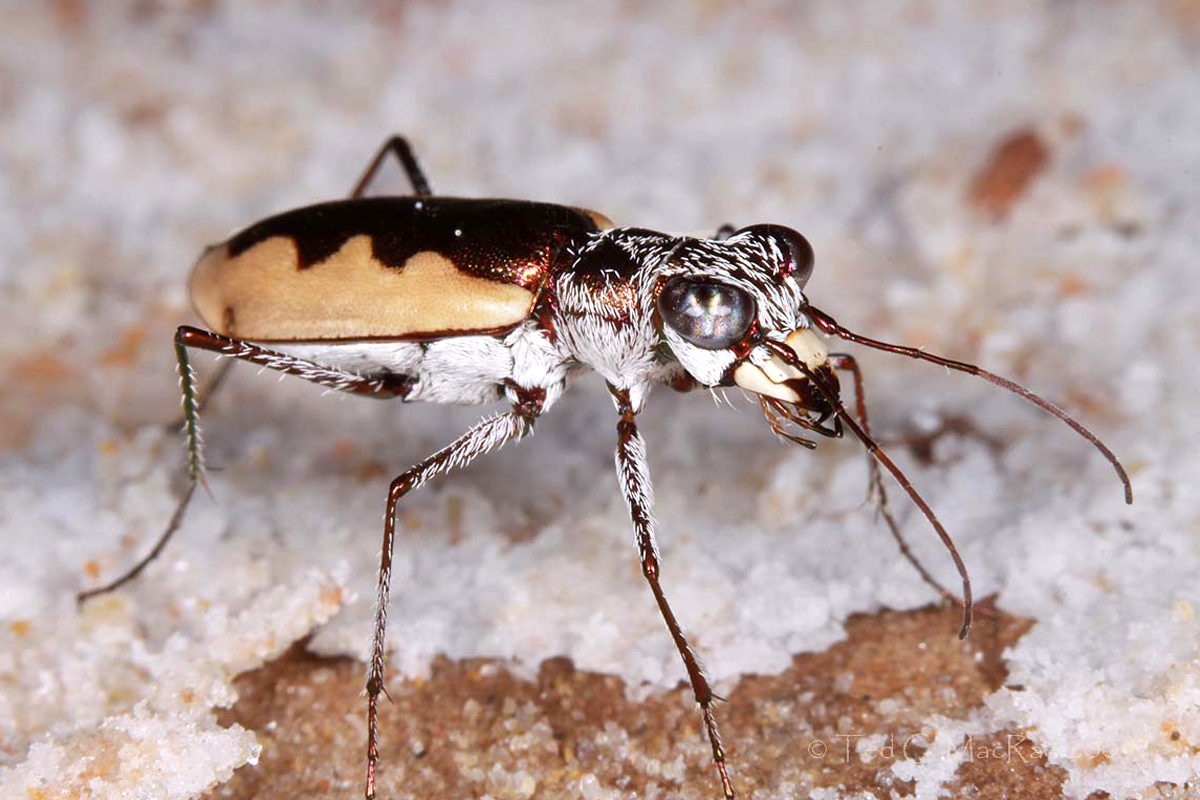
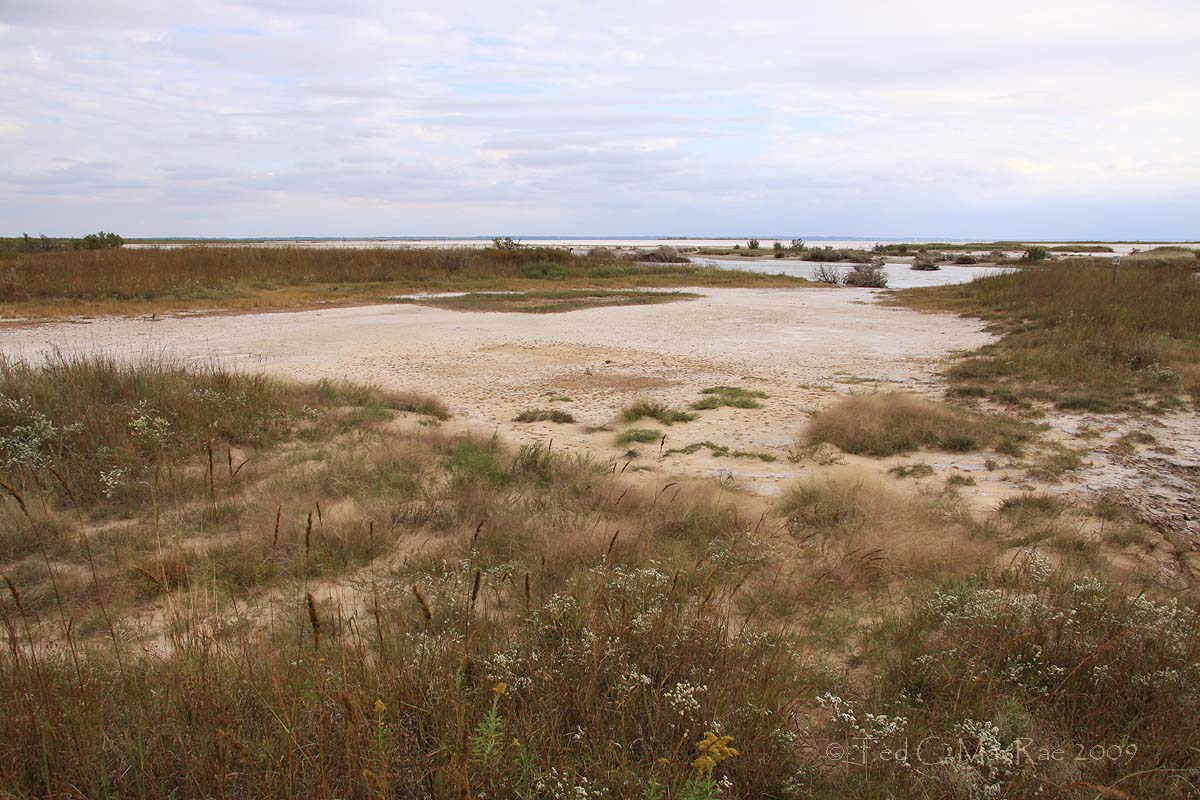
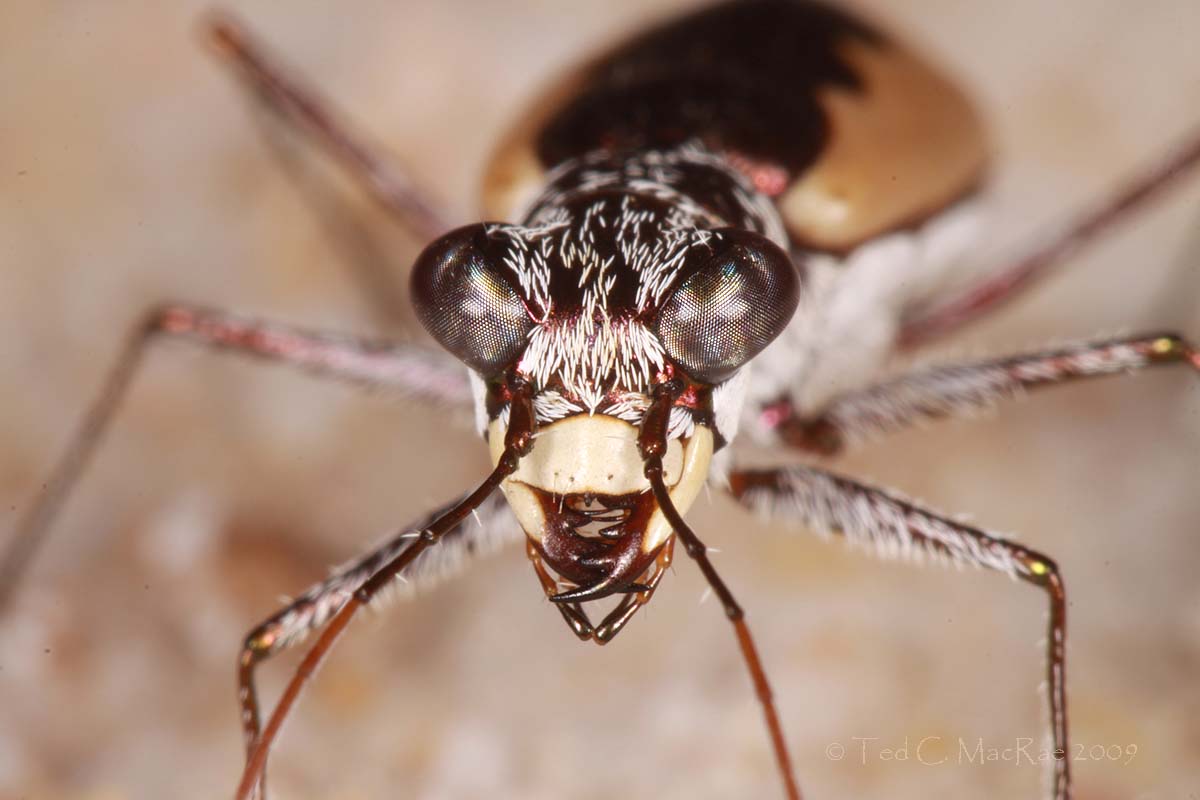
Having confirmed the occurrence of C. scutellaris on the Malden Ridge, we then began driving to the next putative locality some miles north along the ridge.  Along the way, Chris spotted a rather large sand expanse in another agricultural field right next to the highway.  cicindela_scutellaris_p1020906_2Even though I hadn’t detected it in my Google Map search, it looked promising enough to explore, and so we did a quick U-turn and found a place to pull over.  This spot can only be described as the ‘festive tiger beetle motherlode’ of southeast Missouri!  Even though the field was obviously under active agricultural use, the beetles were abundant within the fairly large expanse of exposed sand within the field (photo below).  We were quickly able to collect a sufficient series to document the beetle’s range of variation and set about obtaining additional photographs.  I felt fortunate to be able to photograph this mating pair, which nicely illustrates the white labrum of the male (top) versus the dark labrum of the female (bottom) – one character that distinguishes this intergrade population from the similar-appearing six-spotted tiger beetle (C. sexguttata – commonly encountered along woodland trails throughout the eastern U.S., and with both sexes exhibiting a white labrum).  Note also how the male is holding his legs out horizontally (a behavior I’ve seen with other mating pairs) and the more heavily padded tarsi on his front legs. The latter specialization is thought to aid in grasping and holding the female (Pearson et al. 2006), although in this instance it clearly is not serving that function, but I have not yet determined for what purpose the horizontal posturing of the front legs is all about (perhaps it is related to alarm behavior).

cicindela_scutellaris_habitat_p1020899_2We completed the day by documenting the occurrence of this species on the third of only three sizeable sand prairie relicts that remain on the Sikeston Sand Ridge – a private parcel located a few miles south of the other two preserves.  These observations have increased our confidence that C. scutellaris is secure in Missouri’s southeastern lowlands, and that – thankfully – no special conservation measures will be required at this time to assure its continued existence.  We also now have enough material on hand to characterize the range of variation exhibited by individuals across this population.  We hope this will allow a greater understanding of the relative influence of lecontei populations to the north versus unicolor populations to the south in contributing to the makeup of this population.

Since it was my birthday, it was appropriate that I should discover this “gift” next to the rim of my net after I slapped it over a mating pair of beetles.  I haven’t found a large number of Native American artifacts during my time in the field, but this has to be most impressive of those that I have found – it is in almost perfect condition, with only the smallest of chips off of one of the lower corners.  Edit 5/5/09: After a little research, I believe this to be a spear point from the Archaic period (12,000 to 2,500 years ago).

arrowhead_p1020900_2

p.s. – my 100th post!

REFERENCE:

Pearson, D. L., C. B. Knisley and C. J. Kazilek. 2006. A Field Guide to the Tiger Beetles of the United States and Canada. Oxford University Press, New York, 227 pp.

Copyright © Ted C. MacRae 2009

Add to FacebookAdd to NewsvineAdd to DiggAdd to Del.icio.usAdd to StumbleuponAdd to RedditAdd to BlinklistAdd to Ma.gnoliaAdd to TechnoratiAdd to Furl

Posted in Cicindelidae, Coleoptera | Tagged , , , , , , , , , , , | 24 Comments

Bon appétit!

I collected this larva in northwest Nebraska during last year’s Fall Tiger Beetle Trip.  I collected an adult Cicindela lengi (blowout tiger beetle) at the spot – a species that greatly resembles but is much less common than the ubiquitous C. formosa (big sand tiger beetle – see my post Cicindela lengi vs. Cicindela formosa for a comparison of the two species).  Before finally finding that adult, however, I had fished out several larvae from the site in the hopes that they represented that uncommon species (see how I did this in my post Goin’ fishin’).  After collecting the larvae and placing them in a small terrarium with native sandy soil, they burrowed in but then closed up shop – I wasn’t sure whether they had survived or not.  In early December I put the terrarium in a 10°C incubator for the winter and brought it back out earlier this month.  Yesterday, happily, this larva and one other opened up their burrows again, so with any luck I’ll feed them well and they’ll complete their development.  While I do hope they represent C. lengi, other possibilities include C. scutellaris (festive tiger beetle), which would not be exciting, and C. nebraskana (prairie long-lipped tiger beetle), which would be VERY exciting.  One species I do not have to worry about it being is C. formosa, as the larvae of that species make very unique excavations in the sand with the burrow opening directed towards the excavation (I don’t believe I’ve posted photos of that here, yet – I’ll have to do so soon).

In the meantime, here is a closeup of the larva in the video prior to feeding. Those of you who have ever reared or photographed tiger beetle larvae will know just how easily “spooked” these larvae can be – any sudden movement will cause the larva to “drop” into its burrow and sit there for awhile. As a result, it was a real challenge to go through the whole process of taking first the photos and then the video while feeding it without causing it to drop.

cicindela_sp_larva_p1020936

Coming soon – lunchtime for adults!

Copyright © Ted C. MacRae 2009

Add to FacebookAdd to NewsvineAdd to DiggAdd to Del.icio.usAdd to StumbleuponAdd to RedditAdd to BlinklistAdd to Ma.gnoliaAdd to TechnoratiAdd to Furl

Posted in Cicindelidae, Coleoptera | Tagged , , , , , , , , , , , | 8 Comments

I Brake for Dung Beetles!

A few days ago I learned of a new campaign by The WILD Foundation called “Make a Big Impact with Small Change.” Founded in 1974, WILD seeks to protect intact wilderness areas and the wildlife and people who depend upon them. Their new campaign pays homage to dung beetles – usually overlooked by conservationists in favor of the so-called “charismatic megafauna,” but who nevertheless provide an important ecological service by tirelessly processing megafaunal dung. From the WILD website:

Here at The WILD Foundation, we realize that it is not just those large, charismatic animals that inspire conservation – it is often the small, typically unnoticed and vastly under-appreciated ones that inspire us the most….and that are an indispensible part of the ecosystem!

As a way of generating support for their work, WILD is giving away bumper stickers like the one pictured above. I have got to have one of these bumper stickers! It is the best entomology bumper sticker I’ve seen since “I fear no weevil!” The WILD website also features this amusing little video that shows some dung beetles in action:

Vodpod videos no longer available.

more about “I Brake for Dung Beetles!“, posted with vodpod

The website doesn’t provide any clues as to the species of dung beetle or where it was recorded, but judging by its large size I’m guessing that it might have been recorded in Africa, perhaps representing a species of the genus Scarabaeus.  My most memorable dung beetle experiences occurred in Africa, which is blessed with a dizzying diversity of “dungers.”  Following is an excerpt from an article I wrote that appeared in the December 2008 issue of the SCARABS Newsletter, in which I discussed some of these marvelous beetles:

Chafers were not the only scarabs I encountered in abundance at Borakalalo [National Park], and I’ll give you one guess as to what other scarab group I encountered in abundance at this mammal game reserve. That’s right, dung beetles. Never before have I seen such an abundance and diversity of dung beetles in one spot, but then again, never before have I seen such an abundance of dung!  The ground was littered with the stuff – antelope such as gemsbok  and impala, warthogs, giraffes, and a host of other mammals thrive in the protected confines of the park, and the seasonally dry climate allows their dung to dry quickly and accumulate rather than breaking down and disappearing. It did, however, take a few days before I became aware of the area’s dung beetle diversity. Prior to our arrival in the park, the weather had been dry for some time, and so it remained for the first few days we were there. I collected a smattering of different dung beetles during that time, but it seemed like they should be more abundant considering the abundance of available resource. Our third day in the park was interrupted by heavy thundershowers that moved through during the afternoon. The next morning, as we arose and begin wandering away from the camp, the air seemed literally abuzz with dung beetles. They were flying everywhere and crawling all over the ground, frantically rolling and fighting over the reconstituted pieces of dung. Big, black scarabaeines proper such as Kheper clericus (Boheman) and Scarabaeus galenus Westwood (Photo 4), the small metallic

scarabaeus-galenus_1

Photo 4: Scarabaeus galenus (Westwood).

Phalops ardea Klug, the attractive green iridescent species Garetta nitens (Olivier) and Gymnopleurus virens Erichson, their darkened relative Allogymnopleurus thalassinum (Klug) (Photo 5),
Photo 5: Allogymnopleurus thalassinum (Klug) individuals fighting over a mammal dung ball.

Photo 5: Allogymnopleurus thalassinum (Klug) individuals fighting over a mammal dung ball.

and the tiny little Sisyphus costatus (Thunberg),  standing tall on its elongated hind legs while pushing dung with its forward pairs of legs (opposite of what I’ve seen in any other dung beetle), all made their sudden appearance. I spent some time  watching one S. galenus individual excavating a burrow for the prized piece of poop it had snatched (Photo 6).
Photo 6: Scarabaeus galenus (Westwood) excavating a burrow.

Photo 6: Scarabaeus galenus (Westwood) excavating a burrow.

The most impressive dunger that I saw, however, was the enormous, flattened Pachylomera femoralis Kirby (Photo 7).
Photo 7: Pachylomera femorata Kirby.

Photo 7: Pachylomera femorata Kirby.

Looking like flying Tonka trucks and sounding like diesel engines from real trucks, their low-pitched, rumbling buzz filled the air as they searched among the freshly moistened turds. So loud was the noise caused by the beating of their wings that several times I ducked thinking one was about to collide with me. This sudden dunger super-diversity continued into the night, as Anachalcos convexus Boheman, Catharsius sp., Copris elphenor Klug, Metacatharsius sp., Pedaria sp., Scarabaeus goryi (Laporte), three species of Onitis, Caccobius ferrugineus (Fåhraeus), Digitonthophagus gazella (Fabricius), and nearly a dozen species of Onthophagus flew to our ultraviolet light-illuminated sheet.

REFERENCE:

MacRae, T. C. 2008. Dungers and chafers: A trip to South Africa. SCARABS 34:1-9.

Copyright © Ted C. MacRae 2009

Add to FacebookAdd to NewsvineAdd to DiggAdd to Del.icio.usAdd to StumbleuponAdd to RedditAdd to BlinklistAdd to Ma.gnoliaAdd to TechnoratiAdd to Furl

Posted in Coleoptera, Scarabaeidae | Tagged , , , , , , , , | 16 Comments